anaheim-gazette 1880-10-02
Scanned page
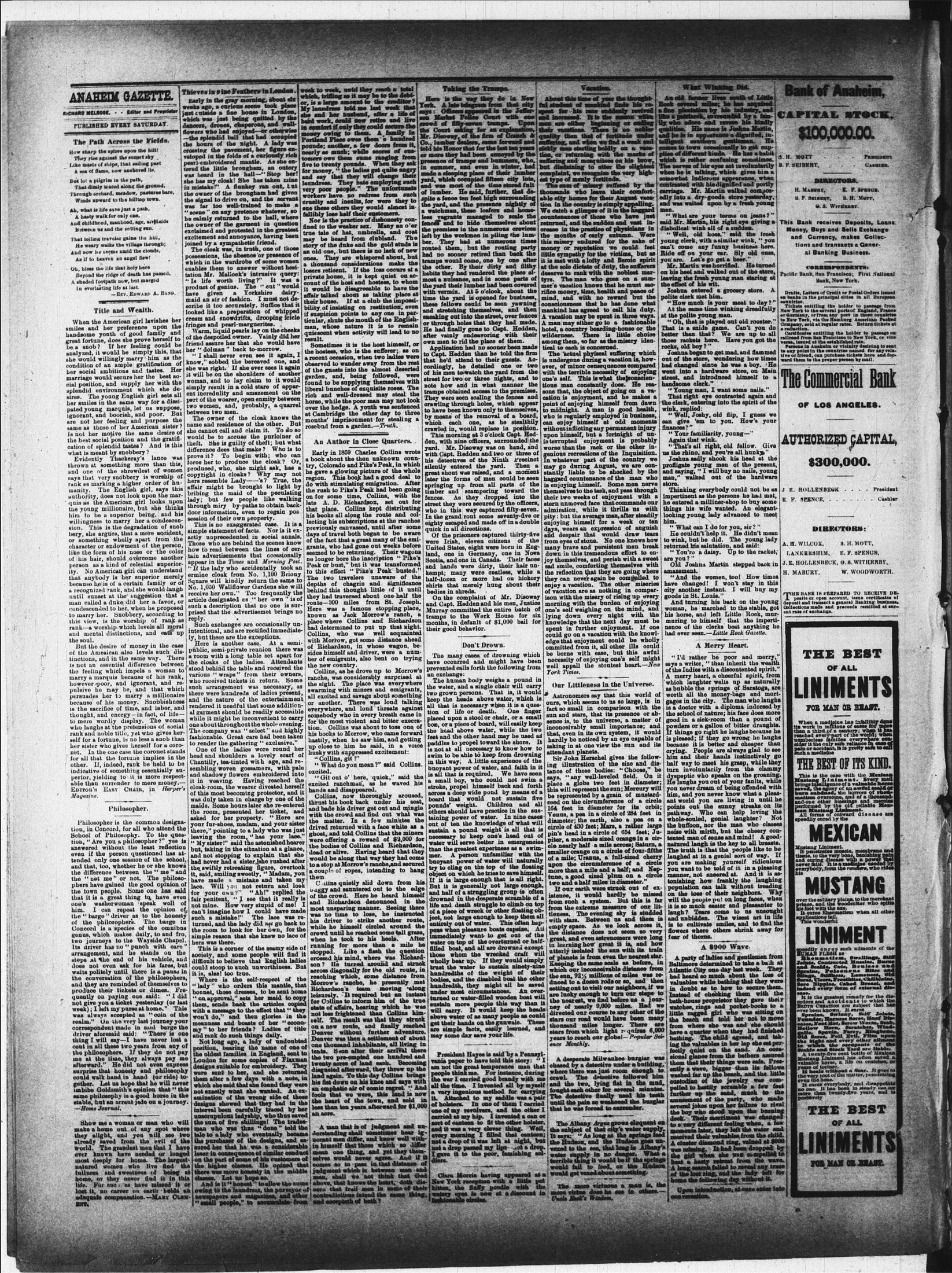
Searchable text
ANAHEIM GAZETTE.
RICHARD MELROSE. - Editor and Proprietor
PUBLISHED EVERY SATURDAY.
The Path Across the Fields.
How sharp the spires upon the hill!
They rise against the sunset sky
Like masts of ship, that sailing past
A sea of flame, now anchored lie.
But lo! a pilgrim in the path,
That dimly traced along the ground,
Through orchard, meadow, pastures bare,
Winds upward to the hilltop town.
Ah, what is life save just a path,
A hasty walk for only one,
And childhood, manhood, age, are fields
Between us and the settling sun.
That toiling traveler gains the hill,
He weary walks the village through;
And now he seems amid the clouds,
As if to heaven an angel flew!
Oh, bless the life that holy here
Beyond the ridge of death has passed,
A shaded footpath now, but merged
In everlasting life at last.
—REV. EDWARD A. RAND.
Title and Wealth.
When the American girl lavishes her smiles and her preference upon the handsome youth of good family and great fortune, does she prove herself to be a snob? If her feeling could be analyzed, it would be simply this, that she would willingly marry him as the condition of an ample gratification of her social ambitions and tastes. Her marriage would secure her the best social position, and supply her with the splendid environment which she desires. The young English girl sets all her smiles in the same way for a dissipated young marquis, let us suppose, ignorant, and boorish, and poor. But are not her feeling and purpose the same as those of her American sister? Is not her motive the same desire of the best social position and the gratification of splendid tastes? And is this what is meant by snobbery?
Evidently Thackeray's lance was thrown at something more than this, and one of the shrewdest of women
Thieves in fine Feathers in London.
Early in the gray morning, about six weeks ago, a curious scene took place just outside a fine house in London, which was just being quitted by the dancers, drones, chaperons, and wallflowers who had enjoyed—or otherwise—the splendid ball that had occupied the hours of the night. A lady was crossing the pavement, her figure enveloped in the folds of a curiously rich pearl-embroidered mantle. As she entered the little brougham, an outtery was heard in the hall—"Stop her! she has my cloak! She has taken mine in mistake!" A flunkey ran out, but the owner of the brougham had given the signal to drive on, and the servant was far too well-trained to make a "scene" on any pretence whatever, so he calmly returned to the hall, where the owner of the garment in question exclaimed and protested in the greatest excitement and annoyance, having been joined by a sympathetic friend.
The cloak was, in truth, one of those possessions, the absence or presence of which in the wardrobe of some women enables them to answer without hesitation Mr. Malock's intrusive query: "Is life worth living?" It was a product of genius. The "cut" would have given a Yorkshire dairy-maid an air of fashion. I must not describe it too accurately. Suffice that it looked like a preparation of whipped cream and snowdrifts, drooping teicle fringes and pearl-marguerites.
Warm, liquid pearls lay on the cheeks of the despoiled owner. Vainly did her friend assure her that she would have her "dolman" back to-morrow.
"I shall never even see it again, I know," sobbed the bereaved one, and she was right. If she ever sees it again it will be on the shoulders of another woman, and to lay claim to it would simply result in a cold stare of apparent incredulity and amazement on the part of the woarer, open enmity between two women, and, probably, a quarrel between two men.
The owner of the cloak knows the name and residence of the other. But she cannot call and claim it. To do so would be to accuse the purloiner of theft. She is guilty of theft; but what difference dees that make? Who is to prove it? To begin with; who can force her to produce the cloak? Or, produced, who, she might ask, has a copyright in cloaks? Why may not week to week, until which, trifling as it is, is a large amount My laundress told she and her husband work, could not in comfort if only the money owing to the Portland Place owes pounds; another, nearly as much; womens owe them five to twenty pounds for money," the lady said say that the laundress. They very poor people workers have no cruelty and insult sue these others they fallibly lose half tht Nor is the practiced fined to the weakest true tale of hat, may be heard from story of the duke an old one, but their ones. They are a thousand consis losers reticent. In private house, it count of the host it would be disair talked about their house. If ability of insisting if suspicion pointicular, shuts the man, whose nature quiescent when a result.
Sometimes it is in the hostess, who is a recent occasion, observed to wandering garden, and, be found to be supplie liberal bunches ores rich and well-drive horse, while the peper over the hedge. At Cambridge that months' imprison rosebud from a gown.
An Author in
Early in 1859 a book about the try, Colorado and he gave a glowing
marriage would secure her the best social position, and supply her with the splendid environment which she desires. The young English girl sets all her smiles in the same way for a dissipated young marquis, let us suppose, ignorant, and boorish, and poor. But are not her feeling and purpose the same as those of her American sister? Is not her motive the same desire of the best social position and the gratification of splendid tastes? And is this what is meant by snobbery?
Evidently Thackeray's lance was thrown at something more than this, and one of the shrewdest of women says that very snobbery is worship of rank as marking a higher order of humanity. The English girl, says this authority, does not look upon the marquis as the American girl looks upon the young millionaire, but she thinks him to be a superior being, and his willingness to marry her a condescension. This is the degradation of snobbery, she argues, that a mere accident, or something wholly apart from the character or endowment of the person, like the form of his nose or the color of his hair, should overcome another person as a kind of celestial superiority. No American girl can understand that anybody is her superior merely because he is of a certain family or of a recognized rank, and she would laugh until sunset at the suggestion that a man called a duke did her a favor, or condescended to her, when he proposed to marry her. Snobbery, according to this view, is the worship of rank as rank—a worship which levels all moral and mental distinctions, and eats up the soul.
But the desire of money in the case of the Ameican also levels such distinctions, and in the same way. There is not an essential difference between the feeling which impels a woman to marry a marquis because of his rank, however spoor, and ignorant, and repulsive he may be, and that which persuades her to marry a millionaire because of his money. Snobbishness is the sacrifice of time, and labor, and thought, and energy—in fact, of life—to mere wordly display. The woman who laughs at the pretensions of social rank and noble title, yet who gives herself for a fortune, is no less a snob than her sister who gives herself for a coronet. In the one case the coronet stands for all that the fortune implies in the other. If, indeed, rank be held to be indicative of something essentially superior, yielding to it is more respectable than surrender to mere money.—EDITOR'S EASY CHAIR, in Harper's Magazine.
Philosopher.
Philosopher is the common designation, in Concord, for all who attend the School of Philosophy. To the question, "Are you a philosopher?" yes is answered without the least reflection even if the person questioned has attended only one session of the school, and that, too, whether he or she knows the difference between the "me" and the "not me" or not. The philosophers have gained the good opinion of the town people. Some one has said that it is a great thing to have even it will be on the shoulders or another woman, and to lay claim to it would simply result in a cold stare of apparent incredulity and amazement on the part of the woarer, open enmity between two women, and probably, a quarrel between two men.
The owner of the cloak knows the name and residence of the other. But she cannot call and claim it. To do so would be to accuse the purloiner of theft. She is guilty of theft; but what difference dees that make? Who is to prove it? To begin with; who can force her to produce the cloak? Or, produced, who she might ask, has a copyright in cloaks? Why may not hers resemble Lady—'s? True, the affair might be brought to light by bribing the maid of the peculating lady; but few people like walking through miry by-paths to obtain backdoor information, even to regain possession of their own property.
This is no exaggerated case. It is a simple statement of facts. Nor is it exactly unprecedented in social annals. Those who are behind the scenes know how to read between the lines of certain advertisements that occasionally appear in the Times and Morning Post.
“If the lady who accidentally took anermine cloak from No. 1,100 Briony Square will kindly return the same to No. 1,050 Wallflower Gardens she will receive her own.” Too frequently the article designated as “her own” is of such a description that no one is surprised that the advertisement brings no reply.
Such exchanges are occasionally unintentional, and are rectified immediately, but these are the exceptions.
Here is another case. At a semi-public, semi-private reunion there was a room with a long table set apart for the cloaks of the ladies. Attendants stood behind the table and received the various “wraps” from their owners, who received tickets in return. Some such arrangement was necessary, as there were hundreds of ladies present, and the nature of the entertainment rendered it needful that some additional garment should be readily accessible while it might be inconvenient to carry one about throughout the whole evening.
The company was “select” and highly fashionable. Great care had been taken to render the gathering “exclusive.”
One of the ladies wore round her head and shoulders a lovely scarf of Chantilly, tea-tinted with age, and resembling woven gossamers, with pale and shadowy flowers embroidered into it in weaving. Having reached the cloak-room, the wearer divested herself of this most becoming protector, and it was duly taken in charge by one of the maids. Some hours later she re-entered the room, presented her ticket, and asked for her property. “Here are your fur-shoes, madam, and your sister there,” pointing to a lady who was just leaving the room,“has your lace.”
“My sister!” said the astonished hearer but, taking in the situation at a glance, and not stopping to explain that she had never had a sister,"she rushed after the swiftly retreating figure, overtook it, said, smiling sweetly,"Madam, you have made a mistake and taken my lace. Will you not return and look for your own?” "Ah!" replied the fair penitent. "I see that it really is it will be on the shoulders or another woman,and to lay claim to it would simply result in a cold stare of apparent incredulity and amazement on the part of the woarer, open enmity between two women,and probably,a quarrel between two men.
The owner of the cloak knows the name and residence of the other. But she cannot call and claim it. To do so would be to accuse the purloiner of theft. She is guilty of theft; but what difference dees that make? Who is to prove it? To begin with; who can force her to produce the cloak? Or, produced, who she might ask, has a copyright in cloaks? Why may not hers resemble Lady—'s? True,the affair might be brought to light by bribing the maid of the peculating lady; but few people like walking through miry by-paths to obtain backdoor information,even to regain possession of their own property.
This is no exaggerated case. It is a simple statement of facts. Nor is it exactly unprecedented in social annals. Those who are behind the scenes know how to read between the lines of certain advertisements that occasionally appear in the Times and Morning Post.
“If the lady who accidentally took anermine cloak from No. 1,100 Briony Square will kindly return the same to No. 1,050 Wallflower Gardens she will receive her own.” Too frequently the article designated as “her own” is of such a description that no one is surprised that the advertisement brings no reply.
Such exchanges are occasionally unintentional,and are rectified immediately,but these are the exceptions.
Here is another case. At a semi-public,semi-private reunion there was a room with a long table set apart for the cloaks of the ladies. Attendants stood behind the table and received the various “wraps” from their owners,who received tickets in return.Some such arrangement was necessary.as there were hundreds of ladies present,and the nature of the entertainment rendered it needful that some additional garment should be readily accessible while it might be inconvenient to carry one about throughoutthe whole evening.
The company was “select”and highly fashionable.Great care had been taken to render the gathering “exclusive.”
One of the ladies wore round her head and shoulders a lovely scarf of Chantilly,tea-tinted with age,and resembling woven gossamers,with pale and shadowy flowers embroidered into it in weaving.Having reachedthe cloak-room,the wearer divested herselfof this most becoming protector,and itwasduly takeninchargebyoneofthemaids.Somehourslatershere-enteredtheroom,presentedherticket,andaskedforherproperty.“Hereareyourfur-shoes,madam,andyoursisterthere,”pointingtoa ladywhawasjustleavingtheroom,“hasyourlace.”
“My sister!”saidtheastonishedhearbut,takinginthesituationataglance,andnotstoppingtoexplainthatshehadneverhadasister,"sherushedaftertheswiftlyretreatingfigure,overtookit,said,smilingsweetly,"Madam,youhavemadeamistakeandtakenmylace.Willyounotreturnandlookforyourown?” "Ah!" repliedthefairpenitent."Isee thatitreallyisitwillbeontheshouldersoranotherwoman,andtolayclaimtoitwouldsimplyresultinacoldstareofapparent incredulityandamazementonthepartofthewoarer,开到lightbateheparkorbust,becausethis effect“
Thetwo traveldeepseasonsbehindthisthoughttheyhadtraverseroute300milesHerewasafailknownamedJackplacewhereColldhaddeterminedCollins,whowithMorrow,gotoRichardson,sideshimselfandberofemigrantsthenewcountryCollins,asheranche.wassonsthesight.Theswarmingwithmallexcitedandasother.Theeverywhere,andsomebodywhoinforsothemostviolition.CollinswhispisshisbookstoMorris hastilywhenhupclose治himhuskywithsupplierCollins,gitWhatdoyouexcited.
"Gitoutoh excitedranchmanhandsanddisapointCollins,now thrusthisbookandbadehisdrivingreturnedghost,and tolddereofferingalothebodiesOfCoedoraldeadoraldeave.WouldbealongtoastopatMorrisacoupleofropersCollinsquietbaggyandsaunahalfofthe crowd."
Philosopher.
Philosopher is the common designation, in Concord, for all who attend the School of Philosophy. To the question, "Are you a philosopher?" yes is answered without the least reflection even if the person questioned has attended only one session of the school, and that, too, whether he or she knows the difference between the "me" and the "not me" or not. The philosophers have gained the good opinion of the town people. Some one has said that it is a great thing to have even one's washerwoman speak well of him. I can repeat the opinion of the "barge" driver as to the honesty of the philosophers. The barge in Concord is a species of the omnibus genus, which makes daily, to and fro, two journeys to the Wayside Chapel. Its driver has no "punch with care" arrangement, and he stands on the steps at the end of his vehicle, and does not even ask for his fares, but waits politely until there is a pause in the conversation of the philosophers, and they are reminded of themselves to produce their tickets or dimes. Frequently on paying one said: "I did not give you a ticket yesterday (or last week); I left my purse at home." This was always accepted as "coin of the realm." On the very last journey your correspondent made in said barge the driver aforesaid said: "There is one thing I will say—I have never lost a cent in all these two years from any of the philosophers. If they do not pay me at the time, they always pay me afterward." He did not even express surprise that honesty and philosophy could walk hand in hand (or ride) together. Let us hope that he will never imbibe Goldsmith's opinion that "this same philosophy is a good horse in the stable, but an arrant jade on a journey."
—Home Journal.
Show me a woman or man who will make a home out of any spot where they alight, and you will see two already saved from the evil of the world. The grandest man that I have ever known have needed or longed most deeply for home. The largest-natured women who live find the fullness and sweetness of being at home, or they never find it in this life. For such as have missed it or lost it, no career on earth holds an adequate compensation.—MARY CLEMENY.
was duly taken in charge by one of the maids. Some hours later she re-entered the room, presented her ticket, and asked for her property. "Here are your fur-shoes, madam, and your sister there," pointing to a lady who was just leaving the room, "has your lace." "My sister!" said the astonished hearer but, taking in the situation at a glance, and not stopping to explain that she had never had a sister, she rushed after the swiftly retreating figure, overtook it, said, smiling sweetly, "Madam, you have made a mistake and taken my lace. Will you not return and look for your own?" "Ah!" replied the fair penitent, "I see that it really is not mine. How very stupid of me! I can't imagine how I could have made such a mistake!" The lace was returned, and the lady did not go back to the room to look for her own, for the simple reason that she knew no lace of hers was there.
This is a corner of the seamy side of society, and some people will find it difficult to believe that English ladies could stoop to such unworthiness. But it is, alas! too true.
Where is the self-respect of the "lady" who orders this mantle, that bonnet, those dresses, to be sent home "on approval," sets her maid to copy them, sends back the articles copied with a message to the effect that "they won't do," and then glories in the meanness and boasts of her "economy" to her friends? Ladies of title and rank do such things daily.
Not long ago, a lady of undoubted position, bearing the name of one of the oldest families in England, sent to London for some copies of Flaxman designs suitable for embroidery. They were sent to her, and she returned them after a few days with a note, in which she said that she found they were not exactly what she wanted. An examination of the wrong side of these designs showed that they had in the interval been carefully traced by her unscrupulous ladyship, who thus saved the sum of five shillings! The tradesman who was thus "done" told the tale to a lady who eventually became the purchaser of the designs, and assured her that he was a considerable loser in consequence of similar conduct on the part of some of his customers of the higher classes. He opined that there was more honesty in the middle classes. Let us hope so.
And is it "honest" to allow the sum owing to the laundress, the purveyor of newspapers and magazines, and other "small people," to accumulate from
Collins quietly baggy and sauna of the crowd. I and Richardson most unsparing was no time to his driver to while he himself crewd until he when he took running for me stopped. Like crossed his minion? He turns across diagonally reaching which Morrows ran Richardson's leisurely. It rails for Collins to in state of affairs, not less frighten self. The result on a new route Denver without Denver was that one thousand in tents. Beon althe two pre-eminent twenty acres of disgusted after land again. To his flat down on an emphatic air fools that we heart of less than ten yean an acre.
A man that is derstanding shoar norant men diffie in himself that mean one this selves would come so to judge judgment which man shall w above that know certain that frail contradictions and accepteth
week to week, until they reach a total which, trifling as it may be to the debtor, is a large amount to the creditor? My laundress told me last week that she and her husband, after a life of hard work, could now retire and live in comfort if only they could secure the money owing to them. A family in Portland Place owes them a hundred pounds; another, a few doors from it, nearly as much; while scores of customers owe them sums ranging from five to twenty pounds. When they ask for money, "the ladies get quite angry and say that they will change their laundress. They hate employing such very poor people." The unfortunate workers have no redress from such cruelty and insults, for were they to sue these others they would almost infallibly lose half their customers.
Nor is the practice of dishonesty confined to the weaker sex. Many an o'er true tale of hat, umbrella, and coat may be heard from clubland. The story of the duke and the gold studs is an old one, but there is no lack of new ones. They are whispered about, but a thousand considerations make the losers reticent. If the loss occurs at a private house, it is kept quiet on account of the host and hostess, to whom it would be disagreeable to have the affair talked about as taking place at their house. If at a club the impossibility of insisting on restitution, even if suspicion points to any one in particular, shuts the mouth of the Englishman, whose nature it is to remain quiescent when activity will lead to no result.
Sometimes it is the host himself, or the hostess, who is the sufferer; as on a recent occasion, when two ladies were observed to wander away from the rest of the guests into the almost deserted garden, and, being followed, were found to be supplying themselves with liberal bunches of exquisite roses. The rich and well-dressed may steal the horse, while the poor man may not look over the hedge. A youth was sentenced at Cambridge the other day to three months' imprisonment for stealing a rosebud from a garden.—Truth.
An Author in Close Quarters.
Early in 1859 Charles Collins wrote a book about the then unknown country, Colorado and Pike's Peak, in which he gave a glowing picture of the whole
Taking the Tramps.
Here is the way they do in New York. A late telegram from that city says: Officers appeared in the Jefferson Market Police Court with one crowd of fifty-seven tramps. Upon the Court asking for an explanation, Mr. Disoway, of the firm of Cranch & Co., lumber dealers, came forward and told his Honor that for the last ten years or more they had been annoyed by the presence of tramps and bummers, who, in summer, and even in winter, had made a sleeping place of their lumber yard, which occupied fifteen city lots, and was most of the time stored full of lumber. He said further, that despite a fence ten feet high surrounding the yard, and the presence nightly of a watchman, these loafers and home-less yagrants managed to scale the fences and to hide themselves about the premises in the numerous crevices left by the workmen in piling the lumber. They had at numerous times routed them, but the routing party had no sooner retired than back the tramps would come, one by one after the other. By their dirty and filthy habits they had rendered the place almost a nuisance, and in some parts of the yard their lumber had been covered with vermin. At 5 o'clock, about the time the yard is opened for business, these fellows could be seen yawning and stretching themselves, and then sneaking out into the street, over fences or through holes that they had made. He had finally gone to Capt. Hedden, after vainly endeavoring with their own men to rid the place of them.
Application had no sooner been made to Capt. Hedden than he told the firm that he'd attend to their guests. Accordingly, he detailed one or two of his men to watch the yard from the street for two or three nights, and to note how and in what manner the tramps obtained access to the premises. They were seen scaling the fences and crawling through holes, which appear to have been known only to themselves, by means of the removal of a board, which each one, as he stealthily crawled in, would replace in position.
This morning at 3 o'clock Capt. Hedden, with nine officers, surrounded the yard. Mr. Disoway was on hand, and with Capt. Hedden and two or three of his detectives of the Ninth Precinct silently entered the yard. Then a great shout was raised, and a moment
Vacation.
About this time of year the thoughtful student of mankind finds his respect for his race suddenly revived and increased. It is the season when man are either beginning or ending their vacations. There is no nobler quality than that of fortitude under suffering, and when we find a weak and sickly man starting boldly on a vacation, or returning with the marks of suffering and mosquitoes on his brow, but disdaining to utter the slightest complaint, we recognize the very highest type of manly fortitude.
The sum of misery suffered by the thousands who leave their comfortable city homes for their August vacation in the country is simply appalling. We catch a glimpse of it in the haggard countenances of those who have just returned, and the sudden and vast increase in the practices of physicians in the months of early autumn. Were this misery endured for the sake of money or reputation we could feel little sympathy for the victims, but as it is met with a lofty and heroic spirit at the sole dictate of duty, the sufferers deserve to rank with the noblest marrys. The man who goes on a summer's vacation knows that he must sacrifice money, time, health and peace of mind, and with no reward but the consciousness that he has done what mankind has agreed to call his duty. A vacation may be spent in three ways. A man may either go to a fashionable hotel, a country boarding-house or the wilderness. There is little choice among them, so far as the misery identical to each is concerned.
The actual physical suffering which is undergone during a vacation is, however, of minor consequences compared with the terrible necessity of enjoying one's self. This is what the jeonscientious man constantly does. He reasons that, the object of going on a vacation is enjoyment, and he makes a point of enjoying himself from dawn to midnight. A man in good health who is regularly employed in business can enjoy himself at odd moments without inflicting any permanent injury upon himself, but a fortnight of uninterrupted enjoyment is probably worse than the rack or the other ingenious recreations of the Inquisition. In whatever part of the country we may go during August, we are constantly liable to be shocked by the
An Author in Close Quarters.
Early in 1859 Charles Collins wrote a book about the then unknown country, Colorado and Pike's Peak, in which he gave a glowing picture of the whole region. This book had a good deal to do with stimulating emigration. After the rush to Pike's Peak had been going on for some time, Collins, with the late A. D. Richardson, set out for that place. Collins kept distributing his books all along the route and collecting his subscriptions at the ranches previously canvassed, until after some days of travel both began to be aware of the fact that a great many of the emigrants, who had gone out weeks before seemed to be returning. Their wagons ne longer bore the inscription "Pike's Peak or bust," but it was transformed to this effect "Pike's Peak busted."
The two travelers unaware of the depths of chagrin and significance behind this thought little of it until they had traversed about one half the route—300 miles from St. Joseph. Here was a famous stopping place, known as Jack Morrow's ranch, a place where Collins and Richardson had determined to put up that night. Collins, who was well acquainted with Morrow, got some distance ahead of Richardson, in whose wagon, besides himself and driver, were a number of emigrants, also bent on trying the new country.
Collins, as he drove up to Morrow's ranche, was considerably surprised at the sight. The place was everywhere swarming with miners and emigrants, all excited and savage about something or another. There was loud talking everywhere, and loud threats against somebody who in every breath came in for the most violent and bitter execution. Collins was about to toss one of his books to Morrow, who came forward hastily, when he saw him, and getting up close to him he said, in a voice husky with suppressed excitement:
"Collins, gif!"
"What do you mean?" said Collins excited.
"Git out o' here, quick," said the excited ranchman, as he waved his hands and disappeared.
Collins, now thoroughly aroused, thrust his book back under his seat, and bade his driver get out and mingle with the crowd and find out what was the matter. In a few minutes the drived returned with a face white as a ghost, and told Collins that the miners were offering a reward of $2,000 for the bodies of Collins and Richardson, dead or alive. Having heard that they would be along that way they had come to a stop at Morrow's ranche, and secured a couple of ropes, intending to hang them.
Collins quietly slid down from his baggy and sauntered out to the edge of the crowd. Here he heard himself street for two or three nights, and to note how and in what manner the tramps obtained access to the premises. They were seen scaling the fences and crawling through holes, which appear to have been known only to themselves, by means of the removal of a board, which each one, as he stealthily crawled in, would replace in position.
This morning at 3 o'clock Capt. Heden, with nine officers, surrounded the yard. Mr. Disoway was on hand, and with Capt. Heden and two or three of his detectives of the Ninth Precinct silently entered the yard. Then a great shout was raised, and a moment later the forms of men could be seen springing up from all parts of the timber and scampering toward the fences. As they dropped into the street they were secured by the officers, who in this way captured fifty-seven. In the grand rout some seventy-five or eighty escaped and made off in a double quick in all directions.
Of the prisoners captured thirty-five were Irish, eleven citizens of the United States, eight were born in England, one in Germany, one in Nova Scotia, and one in Canada. Their faces and hands were dirty, their hair unkempt; many were ceatless, while a half-dozen or more had on hickory shirts that merely hung about their bedies in shreds.
On the complaint of Mr. Disoway and Capt. Heden and his men, Justice Murray committed the entire batch of tramps to the Work House for six months, in default of $1,000 bail for their good behavior.
Don't Drown.
The many cases of drowning which have occurred and might have been prevented calls forth the following from an exchange:
The human body weighs a pound in the water, and a single chair will carry two grown persons. That is, it would keep the heads above water, which is all that is necessary when it is a question of life or death. One finger placed upon a stool or chair, or a small box, or a piece of board, will easily keep the head above water, while the two feet and the other hand may be used as paddles to propel toward the shore. It is not at all necessary to know how to swim to be able to keep from drowning in this way. A little experience of the buoyant power of water, and faith in it is all that is required. We have seen a small boy, who could not swim a stroke, propel himself back and forth across a deep wide pond by means of a board that would not sustain five pounds' weight. Children and all others should have practice in the sustaining power of water. In nine cases out of ten the knowledge of what will sustain a pound weight is all that is necessary to keep one's head out of water will serve better in emergencies than the greatest expertness as a swimmer. A person unfamiliar with the buoyant power of water will naturally try to cling on the top of the floating object on which he tries to save himself. If it is large enough that is all right. But it is generally not large enough, and half of a struggling group is often drowned in the deeper scramble of one's self. This is what the conscience man constantly does. He reasons that, the object of going on a vacation is enjoyment, and he makes a point of enjoying himself from dawn to midnight. A man in good health, who is regularly employed in business, can enjoy himself at odd moments without inflicting any permanent injury upon himself, but a fortnight of uninterrupted enjoyment is probably worse than the rack or other ingenious recreations of the Inquisition. In whatever part of the country we may go during August, we are constantly liable to be shocked by the haggard countenance of the man who is enjoying himself. Some men nerve themselves to the task, and pass through their two weeks of enjoyment with a stern unmoved face that commands our admiration; while it thrills us with pity: but the average man, after steadily enjoying himself for a week or ten days, wears an expression of anguish and despair that would draw tears from eyes of stone. No one knows how many brave and persistent men break down in this tremendous effort to enjoy themselves, and perish with a sweet smile, comforting themselves with reflection that they are going where they can never again be compelled to enjoy a vacation. The other miseries of vacation are as nothing in comparison with the misery of rising up every morning with the burden of enjoying one's self weighing on the mind, and lying down every night with the knowledge that the next day must be spent in further enjoyment. If one could go on a vacation with the knowledge that enjoyment could be wholly omitted from it, all other illls could be borne with case, but this awful necessity of enjoying one's self might well appall the stoutest heart.
Our Littleness in the Universe.
Astronomers say that this world of ours, which seems to us so large, is in fact so small in comparison with the sun and stars, that its presence or absence is, to the universe, a matter of inconceivably small importance; and that even in its own system, it would hardly be noticed by an eye capable of taking in at one view the sun and its attendant planets.
Sir John Herschel gives the following illustration of the size and distance of these bodies: "Choose," he says, "any well-leveled field. On it place a globe two feet in diameter; this will represent the sun; Mercury will be represented by a grain of mustard-seed on the circumference of a circle 164 feet in diameter for its orbit; Venus, a pea in a circle of 284 feet in diameter; the earth, also a pea on a circle of 430 feet; Mars, a rather large pin's head in a circle of 654 feet; Jupiter, a moderate sized orange in a circle nearly half a mile across; Saturn, a smaller orange on a circle-of-four-fifths of a mile; Uranus, a full-sized cherry upon the circumference of a circle more than a mile and a half; and Neptune, a good sized plum on a circle two and a half miles in diameter."
If our earth were struck out of existence, it would hardly be missed
Collins quietly alid down from his baggy and sauntered out to the edge of the crowd. Here he heard himself and Richardson denounced in the most unsparing manner. Seeing there was no time to lose, he instructed his driver to strike another route, while he himself circled around the crowd until he reached some tall grass, when he took to his heels.
Running for more than a mile he stopped. Like a flash the question crossed his mind, where was Richardson? He turned around and struck across diagonally for the old route, in reaching which, some distance from Morrow's ranche, he presently met Richardson's team moving along leisurely. It required but an instant for Collins to inform him of the true state of affairs, hearing which he was not less frightened than Collins himself. The result was that they struck on a new route, and finally reached Denver without further adventure. Denver was then a settlement of about one thousand inhabitants, all living in tents. Soon after their arrival there the two pre-empted one hundred and twenty acres of land each. Becoming disgusted afterward, they threw up the land again. To this day Collins brings his fist down on his knee and says with an emphatic air of comic regret. "And fools that we were, this land is now the heart of the town, and sold in less than ten years afterward for $1,000 an acre.
A man that is of judgment and understanding shall sometimes hear ignorant men differ, and know well within himself that those which so differ mean one thing, and yet they themselves would never agree. And if it comes so to pass in that distance of judgment which is between man and man, shall we not think that God above, that knows the heart, doth discern that frail man in some of their contradictions intend the same thing, and accepteth of both?
President Hayes is said by a Pennsylvania paper to have told this story: "I am not the great temperance man that people think me. For instance, during the war I carried good brandy with me all the time. I invented all by myself a very ingenious method for carrying it. Attached to my saddle was a pair of holsters. In one of them I carried one of my revolvers, and the other I carried at my hip. I invented a can or sort of canteen to fit the other holster, and it was a very clever thing. Well, every morning I filled that canteen; not a drop of it was left at night, but not a drop passed my lip—not a drop. I gave it to the poor, famishing soldiers.
Clara Morris having appeared at a New York reception with a little pet kitten, the fluffy poodle with the watery eyes is now at a discount in fashionable circles.
A desperate Milwaukee burglar was chased by a detective under a building, where there was just room enough to crawl. The detective followed him and the two, lying flat in the mud, fought each other for several minutes. The detective finally used his teeth until the pain so weakened the burglar that he was forced to surrender.
The Albany Argus grows eloquent on the subject of that city's water supply. It says: "As long as the springs feed the Hudson, and the Hudson goes unvexed to the sea, that long in Albany's water supply in no danger. What a terrible thing it would be if the springs would fail to feed, or the Hudson would get vexed about something."
The more virtuous a man is, the more virtue does he see in others.—Uncle Rock's Wisdom.
Bank of Anaheim,
CAPITAL STOCK,
$100,000.00.
S. H. MOTT
President
B. F. SEIBERT,
Cashier.
DIRECTORS:
H. MARRY,
E. F. SPENCE.
S. F. SEIBERT,
S. H. MOTT,
Q. S. WITHERBY.
This Bank receives Deposits, Loans.
Money, Buys and Sells Exchange
and Currency, makes Collections and transacts a General Banking Business.
CORRESPONDENTS:
Pacific Bank, San Francisco; First National Bank, New York.
Drafts, Letters of Credit or Postal Orders issued on banks in the principal cities in all European countries.
Tickets entitling the holder to passage from New York to the several ports of England, France or Germany, or from any port in those countries to New York, via the Hamburg American Packed Company, sold at regular rates. Return tickets at a reduction.
Certificates entitling the holder to passage on railroad from San Francisco to New York, or vice versa, issued at the established rate.
Persons in Anaheim or vicinity desiring to sent to any point in the countries named for any relative or friend, can purchase tickets here and forward them to the proper person by mail.
The Commercial Bank
OF LOS ANGELES.
AUTHORIZED CAPITAL,
$300,000.
The Commercial Bank of Los Angeles.
AUTHORIZED CAPITAL,
$300,000.
J E. HOLLENBEGK President
E. F. SPENCE Cashier
DIRECTORS:
A. H. WILCOX, S. H. MOTT,
LANKERSHIM, E. F. SPENCE,
J.E. HOLLENBECK, O.S.WITHERBY,
H. MABURY, W. WOODWORTH.
THE BEST OF ALL LINIMENTS FOR MAN OR BEAST.
When a medicine has infallibly done its work in millions of cases for more than a third of a century; when it has reached every part of the world; when numberless families everywhere consider it the only safe reliance in case of pain or accident, it is pretty safe to call such a medicine.
THE BEST OF ITS KIND.
This is the one with the Mexican Mustang KAMISAAT. Every mail brings intelligence of a valuable horse served, the agony of an awful saddl or burns subdued, the horrors of rheumatism overcome, and of a thousand-and-one other blessings and merits performed by the old reliable Mexican Mustang Liniment.
All forms of outward disease are speedily cured by the MEXICAN Mustang Liniment.
It penetrates muscle, membrane and tissue, to the very bone, banishing pain and curing disease with a power that never fails. It is a medicine needed by everybody, from the richest, who rides his MUSTANG.
A $900 Wave.
A party of ladies and gentlemen from Baltimore determined to take a bath at Atlantic City one day last week. They had heard so much about the loss of valuables while bathing that they were in doubt as to how to secure them. Instead of checking them with the bath-house proprietor they gave their watches, rings and pocket-books to a little ragged girl who was sitting on the beach and told her not to move from where she was and she should have a quarter when they had finished bathing. The child agreed, and taking the valuables in her lap she sat perfectly quiet on the sand. An occasional glance from the bathers assured them that their things were safe. Presently a wave, bigger than its follows washed far up the beach, and the little custodian of the jewelry was compelled to hastily scramble a few feet further up the sand, much to the amusement of the party, who made several jokes upon her failure to rival the boy who stood upon the burning deck. Their merriment was changed to a very different feeling when, a few moments later, they left the water and received their valuables from the child. A cluster diamond ring, valued at $900 was missing. It had been dropped by the girl when she was compelled to beat a basty retreat from the wave. A long search failed to reveal any trace of the lost ring, and the lady left for home the following day without it.
Upon introduction, at once enter into conversation.