anaheim-gazette 1880-08-28
Scanned page
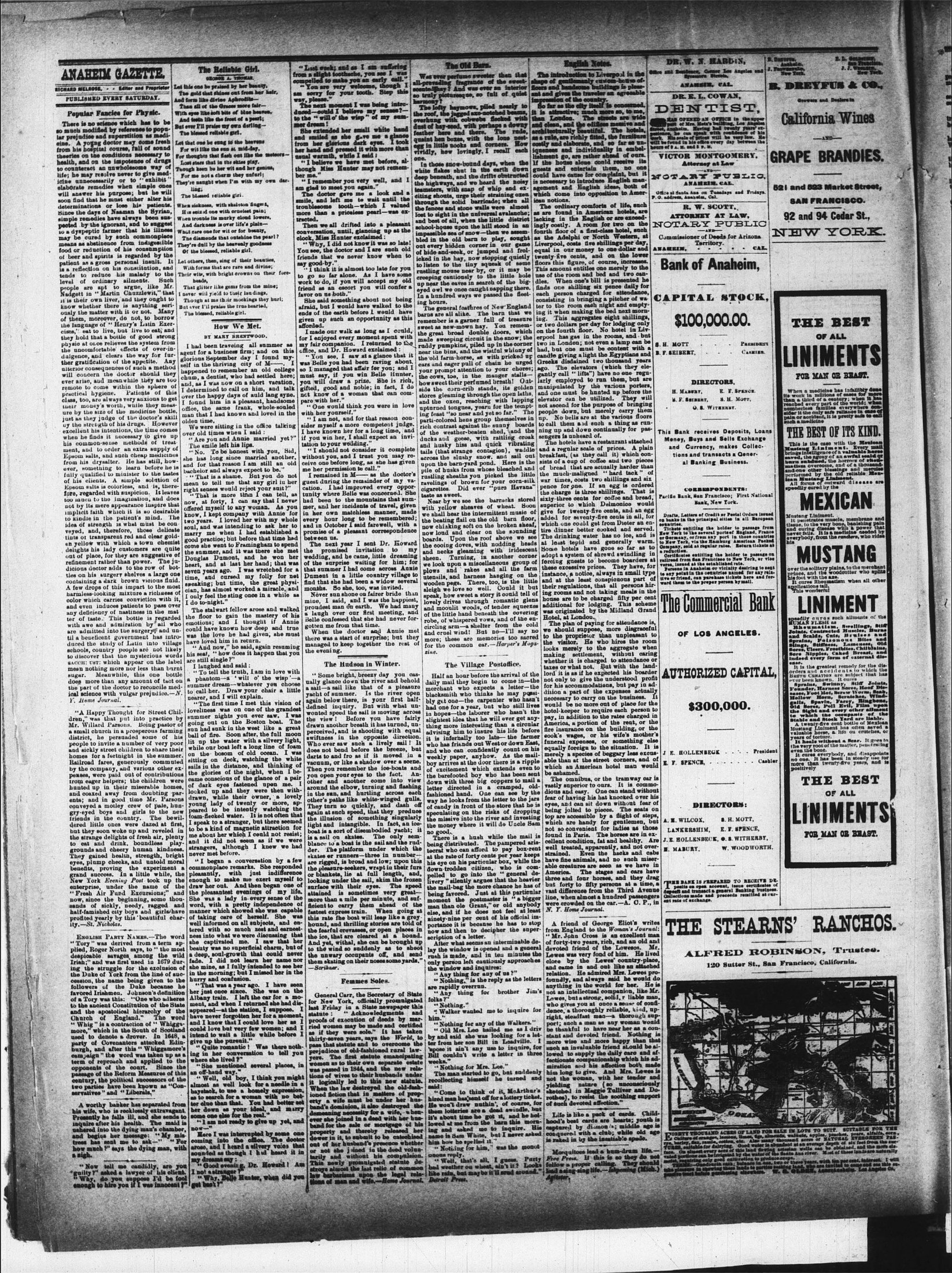
Searchable text
ANAHEIM GAZETTE.
RICHARD MELROSE, - Editor and Proprietor
PUBLISHED EVERY SATURDAY.
Popular Fancies for Physic.
There is no science which has to be so much modified by reference to popular prejudice and superstition as medicine. A young doctor may come fresh from his hospital course, full of sound theories on the conditions necessary to health, and on the impotence of drugs to counteract an unwholesome way of life; he may resolve never to give medicine unnecessarily or to "exhibit" elaborate remedies when simple ones will answer his purpose; but he will soon find that he must either alter his determinations or lose his patients. Since the days of Naaman the Syrian, simple remedies have always been suspected by the ignorant, and to suggest to a dyspeptic farmer that his illness may be cured by such commonplace means as abstinence from indigestible food or reduction of his consumption of beer and spirits is regarded by the patient as a gross personal insult. It is a reflection on his constitution, and tends to reduce his malady to the level of ordinary ailments. Such people are apt to argue, like Mr. Nadgett in "Martin Chuzzlewit," that it is their own liver, and they ought to know whether there is anything seriously the matter with it or not. Many of them, moreover, do not, to borrow the language of "Henry's Latin Exercises," eat to live, but live to eat, and they hold that a bottle of good strong physic at once relieves the system from the uncomfortable effects of over-indulgence, and clears the way for further gratification of the appetite. Any anterior consequences of such a method will concern the doctor should they ever arise, and meanwhile they are too remote to come within the sphere of practical hygiene. Patients of this class, too, are always very anxious to get their money's worth, while they measure by the size of the medicine bottle, just as they judge of the doctor's skill by the strength of his drugs. However excellent his intentions, the time comes when he finds it necessary to give up his common-sense methods of treatment, and to order an extra supply of Epsom salts, and such cheap medicines from his drysalter. He has still, however, something to learn before he is fully qualified to minister to the tastes
The Reliable Girl.
GEORGEN A. THOMAS.
Let this one be praised by her beauty.
The gold that shines out from her hair,
And form like divine Aphrodite—
Than all of the Graces more fair—
With eyes like soft bits of blue heaven,
And teeth like the frost of a pearl;
But ever I'll praise my own darling—
The blessed reliable girl.
Let that one be sung to the heavens
For wit like the sun at mid-day,
For thoughts that flash out like the meteors—
Lost stars that in the skies play.
Though keen be her wilt and her genius,
For me not a charm they unfurl;
They're naught when I'm with my own darling;
The blessed reliable girl.
When sickness, with skeleton fingers,
Has seized one with crusiest pain;
When trouble its murky cloud lowers,
And darkness is over life's plain—
What care one for wit or for beauty,
The diamonds that outshine the pearl?
They're dull by the heavenly goodness
Of the blessed, reliable girl.
Let others, then, sing of their beauties,
With forms that are rare and divine;
The wits, with bright crowns on their foreheads,
That glitter like gems from the mine;
I never will yield to their landings.
Though at me their mockings they hurl;
But ever I'll praise the true hearted.
The blessed, reliable girl.
How We Met.
BY MARY BRENTWOOD.
I had been traveling all summer as agent for a business firm; and on this glorious September day I found myself in the thriving city of M——. I happened to remember an old college chum, a dentist, who had settled here; and, as I was now on a short vacation, I determined to call on him, and talk over the happy days of auld lang syne. I found him in a pleasant, handsome office, the same frank, whole-souled man that I had known and loved in the olden time.
We were sitting in the office talking over old times when I said:
"Are you and Annie married yet?"
The smile left his lips.
No. To be honest with you, Sid,
she has long since married another,
and for that reason I am still an old bachelor and always expect to be."
Last week; and as soon from a slight toothache compelled to make you
"You are very well am sorry for your way, please."
The next moment I induced—could I believe to the "will o' the wister dream!
She extended her smile and smiled as she from her glorious dress her hand and pressed usual warmth, while
"I believe we have though Miss Hunter ber me."
"I remember you am glad to meet you.
The doctor gave smile, and left me troublesome toothmore than a priceless traced.
Then we all drifted conversation, until clock, Miss Hunter eased.
"Why, I did not tell You see, the doctor friends that we new say good-by."
"I think it is almost to go so far alone work to do, if you friend as an escort favor on us both."
She said something afraid, but I would end of the earth be given up such an afforded.
I made our walk for I enjoyed every day my fair companion's office, and Dr. Howe.
"You see, I saw was Belle you had so I managed that must say, if you you will draw a gifted, good and not know of a woman pare with her."
"One would think with her yourself."
"I am not, and sider myself a more without you, and I receive one before love me her permission."
will concern the doctor should they ever arise, and meanwhile they are too remote to come within the sphere of practical hygiene. Patients of this class, too, are always very anxious to get their money's worth, while they measure by the size of the medicine bottle, just as they judge of the doctor's skill by the strength of his drugs. However excellent his intentions, the time comes when he finds it necessary to give up his common-sense methods of treatment, and to order an extra supply of Epsom salts, and such cheap medicines from his drysalter. He has still, however, something to learn before he is fully qualified to minister to the tastes of his clients. A simple solution of Epsom salts is colorless, and is, therefore, regarded with suspicion. It leaves too much to the imagination, and does not by its mere appearance inspire that implicit faith which it is so desirable to kindle in the patient's mind. The idea of strength is what must be conveyed, and therefore, those delicate tints or transparent red and clear golden yellow with which a town chemist delights his lady customers are quite out of place, for they are suggestive of refinement rather than power. The judicious docter adds to the row of bottles on his surgery shelves a large one containing a dark brown vicious fluid. A few drops of this impart to the most harmless-looking mixture a richness of color which carries conviction with it, and even induces patients to pass over any deficiency of nastiness in the matter of taste. This bottle is regarded with awe and admiration by all who are admitted into the surgery, and until a beneficent government has introduced the study of Latin into village schools, country people are not likely to discover that the mysterious words saccen: usr: which appear on the label mean nothing more nor less than burnt sugar. Meanwhile, this one bottle does more than any amount of tact on the part of the doctor to reconcile medical science with vulgar prejudice.—N. Y. Home Journal.
"A Happy Thought for Street Children," was that put into practice by Mr. Willard Parsons. Being pastor of a small church in a prosperous farming district, he persuaded some of his people to invite a number of very poor and sickly street children to share their homes for a fortnight in the summer. Railroad fares, generously commuted by the company, and various other expenses, were paid out of contributions from eager helpers; the children were hunted up in their miserable homes, and coaxed away from doubting parents; and in good time Mr. Parsons conveyed a motley crew of pale, hungry-eyed boys and girls to the new friends in the country. The bewildered little ones were dazed at first, but they soon woke up and reveled in the strange delights of fresh air, plenty to eat and drink. boundless playgrounds and cheery human kindness. They gained health, strength, bright eyes, plump cheeks, and untold moral benefits, proving the experiment a grand success. In a little while, the New York Evening Post took up the enterprise, under the name of the "Fresh Air Fund Excursions;" and now since the beginning some thon chum, a dentist, who had settled here; and, as I was now on a short vacation, I determined to call on him, and talk over the happy days of auld lang syne. I found him in a pleasant, handsome office, the same frank, whole-sonled man that I had known and loved in the olden time.
We were sitting in the office talking over old times when I said:
"Are you and Annie married yet?" The smile left his lips.
No. To be honest with you, Sid, she has long since married another, and for that reason I am still an old bachelor and always expect to be."
That is a shame. But you do not mean to tell me that any girl in her right senses would reject your suit?
That is more than I can tell, as now, at forty, I can say that I never offered myself to any woman. As you know, I kept company with Annie for two years. I loved her with my whole soul, and was intending to ask her to marry me when I had established a good practice; but before that time had come she went to Framingham to spend the summer, and it was there she met Douglas Dumont, and he won her heart, and at last her hand; that was seven years ago. I was wretched for a time, and cursed my folly for net speaking; but time, the great physician, has almost worked a miracle, and I only feel the sting once in a while as I do to-night."
The stalwart fellow arose and walked the floor to gain the mastery of his emotions; and I thought if Annie could have known how deep and true was the love he had given, she must have loved him in return.
"And now," he said, again resuming his seat, "how does it happen that you are still single?"
I laughed and said:
"To tell the truth, I am in love with a phantom—a 'will o' the wisp'—a summer dream—whatever you choose to call her. Draw your chair a little nearer, and I will explain.
"The first time I met this vision of loveliness was on one of the grandest summer nights you ever saw. I was going out on the Boston boat. The sun had sunk in the west like a great ball of fire. Soon after, the full moon lit up the water with a silvery light, while our boat left a long line of foam on the bosom of old ocean. I was sitting on deck, watching the white sails in the distance, and thinking of the glories of the night, when I became conscious of the glance of a pair of dark eyes fastened upon me. I looked up and they were then withdrawn, while their owner, a lovely young lady of twenty or more, appeared to be intently watching the foam-flecked water. It is not often that I speak to a stranger, but there seemed to be a kind of magnetic attraction for me about her which I could not resist; and it did not seem as if we were strangers, although I knew we had never met before.
"I began a conversation by a few commonplace remarks. She responded pleasantly, with just indifference enough to make me exert myself to draw her out. And then began one of the pleasantest evenings of my life. She was a lady in every sense of the chum,"
"I am not, and sider myself a moor! I have known her if you win her, I receive one before losing me her permission."
I remained in My guest during the recitation. I had impunity where Belle had been to the mer, and her incident in her own match every hour long and in October I promise of a pleasant between us.
The next year she promised her wedding, and he owed of the surprise that summer I had Dument in a little find that she had months. So she.
Never sun shone mine, I said, and proudest man on a laugh over our Belle confessed that gotten me from them.
When the door there was a start it managed to keep the evening."
and in good time Mr. Parsons conveyed a motley crew of pale, hungry-eyed boys and girls to the new friends in the country. The bewildered little ones were dazed at first, but they soon woke up and reveled in the strange delights of fresh air, plenty to eat and drink, boundless playgrounds and cheery human kindness. They gained health, strength, bright eyes, plump cheeks, and untold moral benefits, proving the experiment a grand success. In a little while, the New York Evening Post took up the enterprise, under the name of the "Fresh Air Fund Excursions;" and now, since the beginning, some thousands of sickly, needy, ragged and half-famished city boys and girls have profited yearly by this beautiful charity.—St. Nicholas.
ENGLISH PARTY NAMES.—The word "Tory" was derived from a term applied, Roger North says, to "the most despicable savages among the wild Irish;" and was first used in 1679 during the struggle for the exclusion of the Duke of York from the line of succession, the name being given to the followers of the Duke because he favored Irishmen. Johnson's definition of a Tory was this: "One who adheres to the ancient Constitution of the State and the apostolical hierarchy of the Church of England." The word "Whig" is a contraction of "Whiggamore," which in the South of Scotland used to denote a drover. In 1648, a party of Covenanters attacked Edinburgh, and after this "Whiggamore's campaign" the word was taken up as a term of reproach and applied to the opponents of the court. Since the passage of the Reform Measures of this century, the political successors of the two parties have been known as "Conservatives" and "Liberals."
A worthy banker has separated from his wife, who is recklessly extravagant. Presently he falls ill, and she sends to inquire after his health. The maid is ushered into the dying man's chamber, and begins her message: "My mistress has sent me to ask—" "For how much?" says the dying man, with a sigh.
Now tell me candidly, are you guilty?" asked a lawyer of his client. "Why, do you suppose I'd be fool enough to hire you if I was innocent?"
"I began a conversation by a few commonplace remarks. She responded pleasantly, with just indifference enough to make me exert myself to draw her out. And then began one of the pleasantest evenings of my life. She was a lady in every sense of the word, with a pretty independence of manner which showed she was capable of taking care of herself. She was well informed on all subjects, and entered with so much zest and earnestness into what we were discussing that she captivated me. I saw that her beauty was no superficial charm, but of a deep, soul-growth that could never fade. I did not learn her name nor she mine, as I fully intended to see her in the morning; but I missed her in the hurry and confusion.
"That was a year ago. I have seen her just once since. She was on the Albany train. I left the car for a moment, and when I returned she had disappeared—at the station, I suppose. I have never forgotten her for a moment, and I know that I could love her as I could love but very few women; and I intend to wait a little while before I give up the purseit."
"Quite romantic! Was there nothing in her conversation to tell you where she lived?"
"She mentioned several places, in an off-hand way."
"Well, old boy, I think you might almost as well look for a needle in a haystack, to use a homely expression, as to search for a woman with no better eloquence than that. You had better set her down as your ideal, and marry some one else for the real."
"I am not ready to give up yet, and now—"
Here I was interrupted by some one coming into the office. The doctor arrose, and I heard a silvery voice that sounded as though I had heard it in my dreams say:
"Good evening, Dr. Howard! Am I not a stranger?"
"Why, Belle Hunter, when did you get back?"
General Carr, for New York, last Friday in statute: "A proofs of execution ried women may as if they were thirty-seven years pass that statute prejudices of old yers. The first women as to them was passed in 1825 of wives to it logically led. When the law dioned fiction that orgy a wife must band's dominion demeaning neces ever she joined band for the same property and dwower in it, to seize out of her husband or not she join tarily and with This newly prostrates almost the law barbarism tions of men an
"List week; and as I am suffering from a slight toothache, you see I was compelled to make you an early call."
"You are very welcome, though I am sorry for your tooth. Step this way, please."
The next moment I was being introduced—could I believe my senses?—to the "will o' the wisp" of my summer dream!
She extended her small white hand and smiled as she gave me a glance from her glorious dark eyes. I took her hand and pressed it with more than usual warmth, while I said:
"I believe we have met before, although Miss Hunter may not remember me."
"I remember you very well, and I am glad to meet you again."
The doctor gave me a look and a smile, and left me to wait until the troublesome tooth—which I valued more than a priceless pearl—was extracted.
Then we all drifted into a pleasant conversation, until glancing up at the clock, Miss Hunter exclaimed:
"Why, I did not know it was so late! You see, the doctor and I are such old friends that we never know when to say good-by."
"I think it is almost too late for you to go so far alone. As I have some work to do, if you will accept my old friend as an escort you will confer a favor on us both."
She said something about not being afraid, but I would have walked to the ends of the earth before I would have given up such an opportunity as this afforded.
I made our walk as long as I could, for I enjoyed every moment spent with my fair companion. I returned to the office, and Dr. Howard exclaimed:
"You see, I saw at a glance that it was Belle you had been raving about, so I managed that affair for you; and I must say, if you win Belle Hunter, you will draw a prize. She is rich, gifted, good and noble; in fact, I do not know of a woman that can compare with her."
"One would think you were in love with her yourself."
"I am not, and for that reason consider myself a more competent judge. I have known her for a long time, and if you win her, I shall expect an invitation to your wedding."
"I should not consider it complete without you, and I trust you may receive one before long, as she has given me her permission to call."
The Old Burn.
Was ever perfume sweeter than that all-prevading fragrance of the sweet-scented hay? And was ever an interior so truly picturesque, so full of quiet harmony?
The lofty haymows, piled nearly to the roof, the jagged are-notched beams, overhung with cobwebs flocked with dust of hay-seed, with perhaps a downy feather here and there. The rude, quaint hen boxes, with the lone nest-egg in little nooks and corners. How vividly, how lovingly, I recall each one.
In those snow-bound days, when the white flakes shut in the earth down deep beneath, and the drifts obstructed the highways, and we heard the noisy teamsters, with snap of whip and exciting shouts, urge their straining oxen through the solid barricade; when all the fences and stone walls were almost lost to sight in the universal avalanche; and best of all, when the little district school-house upon the hill stood in an impassible sea of snow—then we assembled in the old barn to play, sought out every hidden corner in our game of hide-and-seek, or jumped and frolicked in the hay, now stopping quietly to listen to the tiny squeak of some rustling mouse near by, or it may be creeping cautiously to the little hole up near the eaves in search of the big-yed owl we once caught napping there. In a hundred ways we passed the fleeting hours.
The general features of New England barns are all alike. The barn that we remember is a garner full of treasure sweet as new-mown hay. You rememble the great broad double doors, which made sweeping circuit in the snow; the ruddy pumpkins, piled up in the corner near the bins, and the wistful whinny of the old farm-horse, as with pricked ears and eager pull of chain he urged your prompt attention to your chores; the cows, toe, in the manger stalls—how sweet their perfumed breath! Outside the corn-crib stands, its golden stores gleaming through the open laths, and the oxen, reaching with lapping upturned tongues, yearn for the tempting feast "so near and yet so far." The parti-colored hens group themselves in rich contrast against the sunny boards of the weather-beaten shed, and the ducks and geese, with rattling croak and husky hiss and quick vibrating tails (that strange contagion), waddle across the slushy snow, and sail out upon the barn-yard pond. Here is the pile of husks from whose bleached and vicious skin they are rather ahead of ours.
If the house alone could receive its guests and entertain them, no one could have cause for complaint, but it is necessary to introduce English management and English ideas, both of which come into opposition to American notions.
The ordinary comforts of life, such as are found in American hotels, are lacking in the English or are exceedingly costly. A room for two on the fourth floor of a first-class hotel, such as the Adelphi or North Western, at Liverpool, costs five shillings per day, equal in our money to one dollar and twenty-five cents, and on the lower floors this figure, of course, increases. This amount entitles one merely to the use of the room and bed and two candles. When one's bill is presented he finds one shilling six pence daily for each person charged for attendance, consisting in bringing a pitcher of water to the room each night and emptying it when making the bed next morning. This aggregates eight shillings, or two dollars per day for lodging only on the fourth floor. No hotel in Liverpool has gas in the rooms, and but two in London; not even a lamp can be had, but one must be content with a candle giving a light the Egyptians and Greeks disdained two thousand years ago. The elevators (which they elegantly call "lifts") have no one regularly employed to run them, but are manipulated by the various porters, and one must be hunted up before the elevator can be utilized. They will not ascend for the purpose of bringing people down, but merely carry them up. No bells are at the various floors to call them and such a thing as running up and down continually for passengers is unheard of.
The hotels have a restaurant attached and a regular scale of prices. A plain breakfast (as they call it) which consists of a cup of coffee and two pieces of bread that are actually harder than the much-maligned "hard tack" of
must say, if you win Belle Hunter, you will draw a prize. She is rich, gifted, good and noble; in fact, I do not know of a woman that can compare with her."
"One would think you were in love with her yourself."
"I am not, and for that reason consider myself a more competent judge. I have known her for a long time, and if you win her, I shall expect an invitation to your wedding."
"I should not consider it complete without you, and I trust you may receive one before long, as she has given me her permission to call."
I remained in M—as the doctor's guest during the remainder of my vacation. I had improved every opportunity where Belle was concerned. She had been to the mountains that summer, and her incidents of travel, given in her own matchless manner, made every hour long to be remembered; and in October I said farewell, with a promise of a pleasant correspondence between us.
The next year I sent Dr. Howard the promised invitation to my wedding, and he came, little dreaming of the surprise waiting for him; for that summer I had come across Annie Dument in a little country village to find that she had been a widow several months. So she, too, was invited.
Never sun shone on fairer bride than mine, I said, and I was the happiest, proudest man on earth. We had many a laugh over our first meeting, and Belle confessed that she had never forgotten me from that time.
When the doctor and Annie met there was a start of surprise; but they managed to keep together the rest of the evening.
The Hudson in Winter.
"Some bright, breezy day you casually glance down the river and behold a sail—a sail like that of a pleasure yacht of summer. Is the river open again below there, is your first half-defined inquiry. But with what unwonted speed the sail is moving across the view! Before you have fairly drawn another breath it has turned, unperceived, and is shooting with equal swiftness in the opposite direction. Who ever saw such a lively sail! It does not bend before the breeze, but darts to and fro as if it moved in a vacuum, or like a shadow over a scene. Then you remember the ice-boats and you open your eyes to the fact. Another and another come into view around the elbow, turning and flashing in the sun, and hurtling across each other's paths like white-winged gulls. They turn so quickly, and dash off again at such speed, that they produce the illusion of something singularly light and intangible. In fact, an ice-boat is a sort of disembodied yacht; it is a sail on skates. The only semblance to a boat is the sail and the rudder. The platform under which the skates or runners—three in number—their pleasure-seekers, wrap in their furs or blankets, lie at full length, and looking under the sail, skim the frozen surface with their eyes. The speed attained is sometimes very great—more than a mile per minute, and suffices."
The Village Postoffice.
Half an hour before the arrival of the daily mail they begin to come in—the merchant who expects a letter—the blacksmith who thinks he may possibly get one—the carpenter who hasn't had one for a year, but who still lives in hopes—the laborer who hasn't the slightest idea that he will ever get anything more interesting than a circular advising him to insure his life before it is infernally too late—the farmer who has friends out West or down East, and who can confidently count on his weekly paper, anyhow. As the mailboy arrives at the door there is a ripple of excitement which extends even to the barefoot boy who has been sent down with three big copperts to mail a letter directed in a cramped, old-fashioned hand. One can see by the way he looks from the letter to the jars of candy in front of the store that he is speculating on the risks of dropping the missive into the river and investing the money where it will do Uncle Sam no good.
There is a hush while the mail is being distributed. The pampered aristocrat who can afford to pay box-rent at the rate of forty cents per year keeps his eye on his particular box, while the down-trodden citizen, who is compelled to go into the "general delivery" silently argues that the heavier mail-bag the more chance he has of being favored. Just at this particular moment the costmaster is "a bigger
gantly call (hits) have no regularly employed to run them, but are manipulated by the various porters, and one must be hunted up before the elevator can be utilized. They will not ascend for the purpose of bringing people down, but merely carry them up. No bells are at the various floors to call them and ench a thing as running up and down continually for passengers is unheard of.
The hotels have a restaurant attached and a regular scale of prices. A plain breakfast, (as they call it) consists of a cup of coffee and two pieces of bread that are actually harder than the much-maligned "hard task" of war times, costs two shillings and six pence for one. If an egg is ordered the charge is three shillings. That is sixty-three cents for coffee and bread, superior to which Delmonice would give for twenty-five cents, and an egg added for seventy-five cents in all, for which one could get from Dieter an entire dinner better cooked and served. The drinking water has no ice, and is at least tepid and generally warm. Some hotels have gone so far as to adopt a system of shrewd swindling in forcing guests to become boarders at these excessive prices. They have, for instance, a notice, always in small type and at the least conspicuous part of their regulations, that all persons hiring rooms and not taking meals in the house are to be charged fifty per cent additional for lodging. This scheme was originated by the Midland Grand Hotel, at London.
The plan of paying for attendance is, we should suppose, more disgrateful to the proprietor than unpleasant to the visitor. He who hires the room looks merely to the aggregate when making settlement, without caring whether it is charged to attendance or taxes or what not. But with the landlord it is as if he expected his boarder not only to give the understood profit for his accommodations, but pay in addition a part of the expenses actually necessary to carry on the business. It would be no more out of place for the hotel-keeper to require each person to pay, in addition to the rates charged in America, a portion of the rent; or the fire insurance on the building, or the cook's wages, or his wife's mother's funeral expenses, or something else equally foreign to the situation. It is merely a species of beggary less excusable than at the street corners, and of which an American hotel man would be ashamed.
The omnibus, or the tramway car is vastly superior to ours. It is commodious and easy. One can stand without fear of having his hat knocked over his eyes, and can sit down without fear of being jolted to pieces. The seats on top are accessible by a flight of steps, which are handy for gentlemen, but not so convenient for ladies as those found in Paris. The horses are in excellent condition, fat and healthy. Are well treated, apparently, and not overstrained. Even the hacks and cabs have fine animals, and no such miserable creatures are seen as we have in America. The stages and cars have three and four horses, and they drag but forty to fifty persons at a time, a vast difference from the Third Avenue line, when almost a hundred passengers
Femmes Soles.
General Carr, the Secretary of State for New York, officially promulgated last Friday in a State newspaper this statute: "Acknowledgments and proofs of execution of deeds by married women may be made and certified as if they were sole." It has taken thirty-seven years, says the World, to pass that statute and to overcome the prejudices of old-fashioned rural lawyers. The first statute emancipating women as to their own separate estate was passed in 1844, and the new relations of wives to their husbands under it logically led to this new statute. When the law destroyed the old-fashioned fiction that in matters of property a wife must be under her husband's dominion, it also destroyed the demeaning necessity for a wife, whenever she joined in a dead with her husband for the sale or mortgage of his property and thereby released her dower in it, to submit to be catechised out of her husband's presence whether or not she joined in the deed voluntarily and without his compulsion. This newly promulgated statute destroys almost the last relic of common law barbarism upon the legal relations of man and wife.—Home Journal.
There is a hush while the mail is being distributed. The pampered aristocrat who can afford to pay box-rent at the rate of forty cents per year keeps his eye on his particular box, while the down-trodden citizen, who is compelled to go into the "general delivery" silently argues that the heavier mail-bag the more chance he has of being favored. Just at this particular moment the postmaster is "a bigger man than ole Grant," or old anybody else, and if he does not feel at least ninety-nine per cent of his official importance it is because he has to stop now and then to decipher the supercription of a letter.
After what seems an interminable delay the window is opened and a general rush is made, and in ten minutes the only person left cautiously approaches the window and inquires:
"Any thing for any of us?"
"Nothing," is the reply as the letters are rapidly overrun.
"Any thing for brother Jim's folks?"
"Nothing."
Walker wanted me to inquire for him.
"Nothing for any of the Walkers."
"Old Mrs. Lee hailed me as I drive by and said she was looking for a letter from her son Bill in Leadville. I 'pose it ain't any use to inquire, for Bill couldn't write a letter in three weeks."
"Nothing for Mrs. Lee."
The man started to go, but suddenly recollect himself he turned and said:
"Come to think of it, McArthur's hired man has sent off for a lottery ticket. He won't draw nuthin', of course, for them lotteries are a dead swindle, but it's about time he got it, and he hollowed at me from the barn this morning and asked me to inquire. His name is Sam White, but I never asked him how he spelled it."
"Nothing for him," was the monotone reply.
Well, that's all, I guess. Party bad weather on wheat, ain't it? Looks like rafs, but maybe it'll send around." Detrail Press.
A friend of George Eliot's writes from England to the Woman's Journal: "Mr. John Cross is an excellent man of forty-two years, rich, and an old and devoted friend of the Leweses. Mr. Lewes was very fond of him. He lived close by the Lewes' country-place, and came in and out like an attached relation. He admired Mrs. Lewes profoundly, and always said he would do anything in the world for her. He is not an intellectual companion, like Mr. Lewes, but a strong, solid, reliable man, who gives you at once a sense of confidence, a thoroughly reliable kind, upright, steadfast man—a thorough support; such a man as any woman would be thankful to have near her as a constant and devoted friend. Nothing is more wise and more happy than that such an invaluable friend should be allowed to supply the daily care and affectionate companionship which his admiration and his affection both made him long to give. And Mrs. Lewes is not the woman, with her tender and yielding nature (so unconsciously sketched in Maggie Tulliver and Dorothea), to resist the soothing support of such devoted affection."
Life is like a pack of cards. Childhood's best cards are hearts; youth is captured by diamonds; middle age is conquered with a club; while old age is raked in by the insatiable spade.
Mosquitoes lead a hum-drum life—Free Press. If this is so they do not follow a proper calling. They should lead a singing life—Lifting (Mich.) Agitator.
DR. W. N. HARDIN,
Office and Residence, Corner Los Angeles and
Syracuse Streets,
ANAHEIM, CAL.
DR. E. L. COWAN,
DENTIST,
Has opened an office in the upper part of Mrs. Metra's building, Los Angeles
Street, Anaheim. Having had twenty years' experience, he can speak with confidence of his work. His scale of offices will be very low. He will be found in his office every day between the hours of 9 A.M. and 8 P.M.
VICTOR MONTGOMERY,
Attorney at Law
AND
NOTARY PUBLIC,
ANAHEIM, CAL.
Office at Santa Ana on Tuesdays and Fridays.
P.O. address, Anaheim, Cal.
R. W. SCOTT,
ATTORNEY AT LAW,
NOTARY PUBLIC
AND
Commissioner of Deeds for Arizona Territory.
ANAHEIM, CAL.
Bank of Anaheim,
CAPITAL STOCK,
$100,000.00.
S. H. MOTT ... President
B. F. SEIBERT, ... Cashier.
DIRECTORS.
H. MABURY, E. F. SPENCE.
M. F. SEIBERT, S. H. MOTT,
Q. S. WITHERBY.
This Bank receives Deposits, Loans Money, Buys and Sells Exchange and Currency, makes Collections and transacts a General Banking Business.
THE BEST
OF ALL
LINIMENTS
FOR MAN OR BEAST.
When a medicine has infiltribly done its work in millions of cases for more than a third of a century; when it has reached every part of the world; when numberless families everywhere consider it the only safe reliance in case of pain or accident, it is pretty safe to call such a medicine
THE BEST OF ITS KIND.
This is the case with the Mexican Mastang Lamentment. Every mail brings intelligence of a valuable horse saved, the agony of an awful scald or burn subdued, the horrors of rheumatism overcome, and of a thousand-and-one other blessings and mercies performed by the old reliable Mex-
DIRECTORS.
H. MABURY,
E. F. SPENCE.
M. F. SEIBERT,
S. H. MOTT.
O. S. WITHERBY.
This Bank receives Deposits, Loans Money, Buys and Sells Exchange and Currency, makes Collections and transacts a General Banking Business.
CORRESPONDENTS:
Pacific Bank, Man Francisco; First National Bank, New York.
Drafts, Letters of Credit or Postal Orders issued on banks in the principal cities in all European countries.
Tickets entitling the holder to passage from New York to the several ports of England, France or Germany, or from any port in those countries to New York, via the Hamburg American Packed Company, sold at regular rates. Return tickets at a reduction.
Certificates entitling the holder to passage on railroad from San Francisco to New York, or vice versa, issued at the established rate.
Persons in Anaheim or vicinity desiring to sent to any point in the countries named for any relative or friend, can purchase tickets here and forward them to the proper person by mail.
The Commercial Bank
OF LOS ANGELES.
AUTHORIZED CAPITAL,
$300,000.
J. E. HOLLENBECK President
E. F. SPENCE Cashier
DIRECTORS:
A. M. WILCOX,
S. H. MOTT,
LANKERSHIM,
E. F. SPENCE,
J. E. HOLLENBECK, O. S. WITHERBY,
M. MABURY,
W. WOODWORTH.
THE BANK IS PREPARED TO RECEIVE DEPOSITS on open account, issue certificates of deposit and transact a general Banking business.
FOR MAN OR BEAST.
When a medicine has infiltribly done its work in millions of cases for more than a third of a century; when it has reached every part of the world; when numberless families everywhere consider it the only safe reliance in case of pain or accident, it is pretty safe to call such a medicine.
THE BEST OF ITS KIND.
This is the case with the Mexican Mustang Liniment. Every small brings intelligence of a valuable horse saved, the agony of an awful sould or burns subdued, the horrors of rheumatism overcome, and of a thousand-and-one other blessings and mercies performed by the old reliable Mexican Mustang Liniment.
All forms of outward disease are speedily cured by the MEXICAN Mustang Liniment.
It penetrates muscle, membrane and tissue, to the very bone, banishing pain and curing disease with a power that never fails. It is a medicine needed by everybody, from the rancho, who rides his MUSTANG over the solitary plains, to the merchant prince, and the woodcutter who splits his foot with the axe.
It cures Rheumatism when all other applications fail.
This wonderful LINIMENT speedily cures such alliments of the HUMAN FLESH as Rheumatism, Swellings, Stiff Jeluces, Continued Muscles, Burns and Scalds, Cuts, Bruises and Sprains, Poisonous Bites and Stings, Stiffness, Lameness, Old Sorens, Ulcers, Frostbites, Chilblains, Sore Nipples, Caked Breast, and indeed every form of external disease.
It is the greatest remedy for the disorders and accidents to which the Burru Curation are subject that has ever been known. It cures Sprains, Swinnny, Stiff Joints, Founder, Harness Noses, Hoof Diseases, Foot Mot, Screw Worms, Seams, Hollow Horn, Seratchen, Wind-galls, Spavin, Parry, Elongbone, Old Sorens, Poll Ewlh Film upon the Sight and every other alliment to which the occupants of the Stable and Stock Yard are liable.
A twenty-five cent bottle of Mexican Mustang Liniment has often saved a valuable horse, a life on crutches, or years of torture.
It heals without a Scar. It goes to the very root of the matter, penetrating even the bone.
It cures everybody, and disappoints no one. It has been in steady use for more than twenty-five years, and is positively THE BEST OF ALL LINIMENTS FOR MAN OR BEAST.
DIRECTORS:
A. H. WILCOX, S. H. MOTT,
LANKERSHIM, E. F. SPENCE,
J. E. HOLLENBECK, O. S. WITHERBY,
M. MABURY, W. WOODWORTH.
THE BANK IS PREPARED TO RECEIVE DEPOSITS ON OPEN ACCOUNT, ISSUE CERTIFICATES OF DESPOSITIVE AND TRANSACT A GENERAL BANKING BUSINESS. Collections made and proceeds remitted at current rate of exchange.
THE STEARNS' RANCHOS.
ALFRED ROBINSON, Trustee.
120 Sutter St., San Francisco, California.
EIGHTY THOUSAND ACRES OF LAND FOR SALE IN LOTS TO SUIT. SUITABLE FOR THE Culture of oranges, lemons, limes, figs, almonds, walnuts, apples, peaches, pears, alfalfa, corn, rye, barley, flax, raille, cotton, etc. Also many thousand acres of NATURAL EVERGREEN PATTERNS, suitable for dairying. Good water is abundant at an average depth of six feet from the surface. On almost every acre of this land flowing estates walls can be obtained, and the more elevated portions can be irrigated by the water of the Santa Ana river. Most of these lands are naturally moist, requiring only good cultivation to produce crops.
THREE: One-fourth cash; balance in one, two or three years, with ten per cent interest. I will take pleasure in opening these lands to parties seeking land, who are invited to come and see this expoire must before purchasing elsewhere. W. H. OLDBEE, Arroyanaheim, Los Angeles Co.