anaheim-gazette 1880-08-21
Scanned page
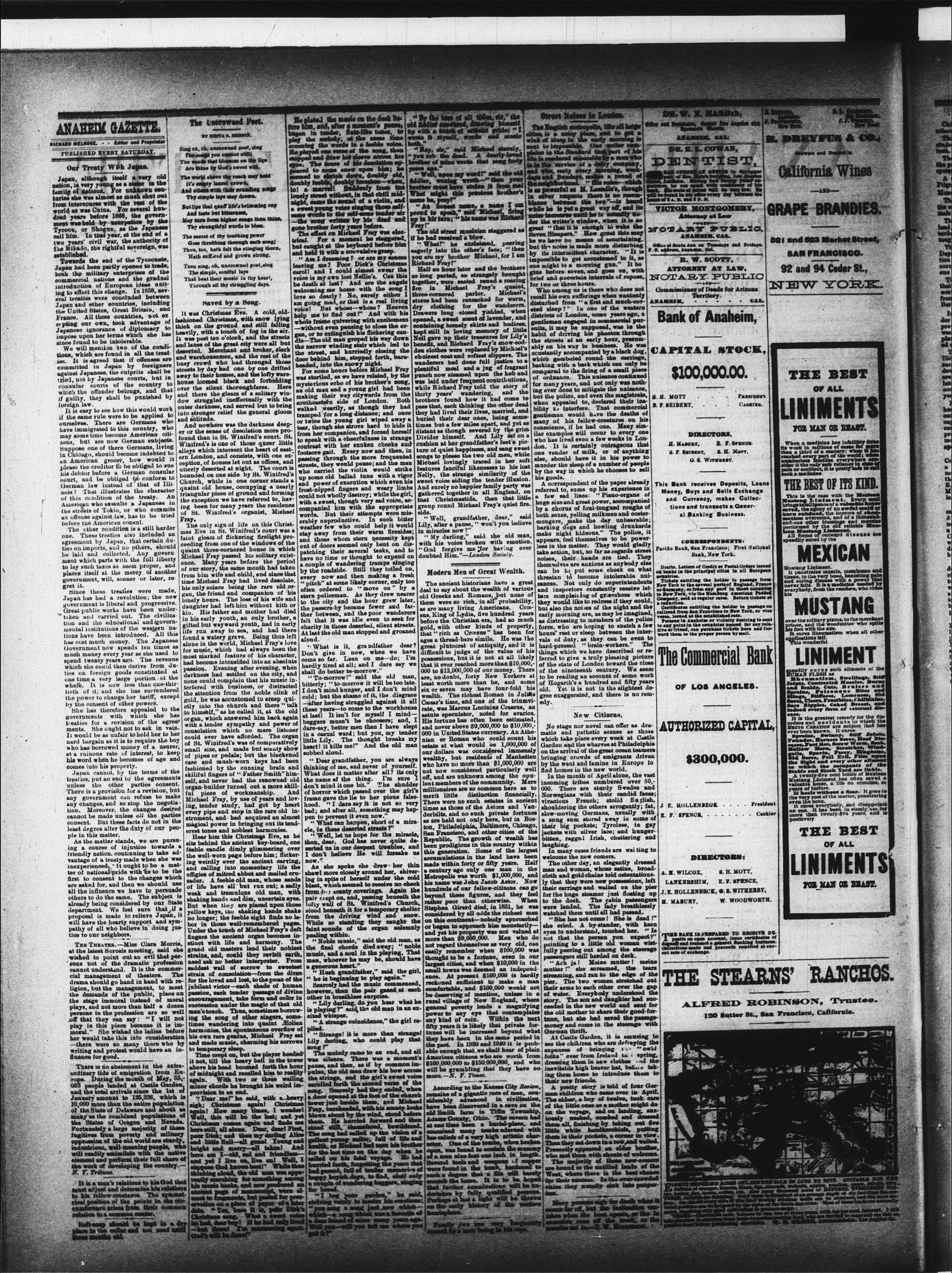
Searchable text
ANAHEIM GAZETTE.
RICHARD MELROSE. - Editor and Proprietor
PUBLISHED EVERY SATURDAY.
Our Treaty With Japan.
Japan, although itself a very old nation, is very young as a sister in the family of nations. For unknown centuries she was almost as much shut out from intercourse with the rest of the world as was China. For several hundred years before 1868, the government was held by usurpation by the Tycoon, or Shogun, as the Japanese call him. In that year, at the end of a two years' civil war, the authority of the Mikado, the rightful sovereign, was established.
Towards the end of the Tycoonate, Japan had been partly opened to trade, both the military enterprises of the commercial nations and the gradual introduction of European ideas uniting to effect this change. In 1858, several treaties were concluded between Japan and other countries, including the United States, Great Britain, and France. All these countries, not excepting our own, took advantage of Japanese ignorance of diplomacy to impose upon her terms which she has since found to be intolerable.
We will mention two of the conditions, which are found in all the treaties. It is agreed that if offenses are committed in Japan by foreigners against Japanese, the culprits shall be tried, not by Japanese courts, but in consular courts of the country to which the offender belongs, and that if guilty, they shall be punished by foreign law.
It is easy to see how this would work if the same rule were to be applied to ourselves. There are Germans who have immigrated to this country, who may some time become American citizens, but are now German subjects. Suppose one of there Germans, living in Chicago, should become indebted to an American grocer, how would it please the creditor so be obliged to sue his debtor before a German consular
The Untrowned Poet.
BY MEYTA R. NESSON.
Sing on, oh! uncrowned poet, sing
The songs you cannot still;
The words that blossom on thy lips
Are thine by God's sweet will.
The world above thy reach may hold
It's empty laurel crown,
And others with their sounding songs
Thy simple lays may drown.
But lips that quaff life's brimming cup
And taste but bitterness,
May turn from higher songs than thins,
Thy strengthful words to bless.
The secret of thy touching power
Goes throbbing through each song!
Then, too, hath felt the stinging thorn,
Hath suffered and grown strong.
Then sing, oh, uncrowned poet, sing
The simple, soulful lays
That beat their music in thy heart,
Through all thy struggling days.
Saved by a Song.
It was Christmas Eve. A cold, old-fashioned Christmas, with snow lying thick on the ground and still falling heavily, with a touch of fog in the air.
It was past ten o'clock, and the streets and lanes of the great city were all but deserted. Merchant and broker, clerk and warehousemen, and the rest of the busy crowd who had thronged those streets by day had one by one drifted away to their homes, and the lofty warehouse loomed black and forbidding over the silent thoroughfares. Here and there the gleam of a solitary window struggled ineffectually with the outer darkness, and served but to bring into stronger relief the general gloom and solitude.
And nowhere was the darkness deeper or the sense of desolation more profound than in St. Winifred's court. St. Winifred's is one of those queer little alleys which intersect the heart of eastern London, and consists, with one exception, of houses let out as offices, and utterly deserted at night. The court is bounded on one side by St. Winifred's
He glanced the music fore him, and after a moment began in tender, fluttering the words in He played one verse of stopped and drew his eyes. The sense of lonely street without night, came the sound of a sweet young voice sharing same words to the solitary song written by gone brother forty years.
The effect on Michael trical. For a moment but caught at the key and held it with a comma.
"Am I dreaming? leaving me? Poor carol! and I could voice is my own lost life death at last? And welcoming me home love so dearly? No am going mad, or that voice! But whose help me to find out whole frame quivering—without even pausing gan, or to extinguish die—the old man grew the narrow winding street, and hurried door behind him, steamed into the snow.
For some hours he was startled, as we heard mysterious echo of an old man and a young making their way across southeastern side of walked wearily, as tramped for a long or twice the young tear, though she strangely from her companion to speak with a cheek contrast with her soft sore gait. Every passing through the streets, they would who carried the v
It is easy to see how this would work if the same rule were to be applied to ourselves. There are Germans who have immigrated to this country, who may some time become American citizens, but are now German subjects. Suppose one of these Germans, living in Chicago, should become indebted to an American grocer, how would it please the creditor be obliged to sue his debtor before a German consular court, and be obliged to conform to German law instead of that of Illinois? That illustrates the character of this condition of the treaty. An American who assaults a Japanese in the streets of Tokio, or who commits an offense against law, has to be tried before the American consul.
The other condition is a still harder one. These treaties also included an agreement by Japan, that certain duties on imports, and no others, should be laid and collected. Any government which parts with the full liberty to lay such taxes as seem proper, and places itself at the mercy of another government, will, sooner or later, regret it.
Since these treaties were made, Japan has had a revolution; the new government is liberal and progressive. Great public works have been undertaken and carried out. The civilization and the educational and governmental institutions of the western nations have been introduced. All this has cost much money. The Japanese Government now spends ten times as much money every year as she used to spend twenty years ago. The revenue which she could then derive from duties on foreign goods constituted at one time a very large portion of the whole. It is now less than one-third of it; and she has surrendered the power to change her tariff, except by the consent of other powers.
She has therefore appealed to the governments with which she has treaties for a revision of the agreements. She ought not to ask in vain. It would be as unfair to hold her to her nard bargain as it is to require the boy who has borrowed money of a usurer, at a ruinous rate of interest, to keep his word when he becomes of age and comes into his property.
Japan cannot, by the terms of the treaties, put an end to the agreements unless the other parties consent. There is a provision for a revision, but any government can refuse to make any changes, and so stop the negotiation. Moreover, the changes desired cannot be made unless all the parties consent. But these facts do not in the least degree alter the duty of our people in this matter.
As the matter stands, we are pursuing a course of injustice towards a friendly nation, continuing to take advantage of a treaty made when she was inexperienced. It ought to be a matter of national pride with us to be first to consent to the changes which are asked for, and then we should use all the influence we have to persuade others to do the same. The subject is away to their homes, and the lofty warehouse loomed black and forbidding over the silent thoroughfares. Here and there the gleam of a solitary window struggled ineffectually with the outer darkness, and served but to bring into stronger relief the general gloom and solitude.
And nowhere was the darkness deeper or the sense of desolation more profound than in St. Winifred's court. St. Winifred's is one of those queer little alleys which intersect the heart of eastern London, and consists, with one exception, of houses let out as offices, and utterly deserted at night. The court is bounded on one side by St. Winifred's Church, while in one corner stands a quaint old house, occupying a nearly triangular piece of ground and forming the exception we have referred to, having been for many years the residence of St. Winifred's organist, Michael Fray.
The only sign of life on this Christmas Eve in St. Winifred's court was a faint gleam of flickering firelight proceeding from one of the windows of the quaint three-cornered house in which Michael Fray passed his solitary existence. Many years before the period of our story, the same month had taken from him wife and child, and since that time Michael Fray had lived desolate, his only solace being the rare old organ, the friend and companion of his lonely hours. The loss of his wife and daughter had left him without kith or kin. His father and mother had died in his early youth, an only brother, a gifted but wayward youth, had in early life run away to sea, and had there found a watery grave. Being thus left alone in the world, Michael Fray's love for music, which had always been the most marked feature of his character, had become intensified into an absolute passion. Evening after evening, when darkness had settled on the city, and none could complain that his music interfered with business, or distracted the attention from the noble clink of gold, he was accustomed to creep quietly into the church and there "talk to himself," as he called it, at the old organ, which answered him back again with a tender sympathy and power of consolation which no mere listener could ever have afforded. The organ of St. Winifred's was of comparatively small size, and made but scanty show of pipes or pedals; but the blackened case and much-worn keys had been fashioned by the cunning brain and skillful fingers of "Father Smith" himself, and never had the renowned old organ-builder turned out a more skillful piece of workmanship. And Michael Fray, by use of years and loving, tender study, had got by heart every pipe and stop in the rare old instrument, and had acquired an almost magical power in bringing out its tenderness tones and noblest harmonies.
Hear him this Christmas Eve, as he sits behind the ancient key-board, one feeble candle dimly glimmering over the well-worn page before him; flickering weirdly over the ancient carving, and calling into momentary life the effigies of mitred abbot and mailed crusader. A feeble old man, whose sands of life have all but run out; a sadly weak and tremulous old man, with shaking hands and dim uncertain eyes.
was startled, as we heard mysterious echo of light from her companion to speak with a cheek contrast with her feet soore gait. Every passing through the streets, they would who carried the view up some old ballad and power of execution frost-nipped fingers could not wholly deceive with a sweet, though companied him with words. But their erably unproductive weather few who stay away from them and those whom sit out of doors seemed patching their seas have no time or chance a couple of wanderers by the roadside. So every now and then "pitch" at some lily often ordered to stern policeman.
To the city and the passers-by because between, and felt that it was idiot charity in those days At last the old man aloud.
What is it,
Don't give in now come so far. Lear hardly tired at all; shall do better to bitterly; "to-morrow I don't mind hunger cold; but the shame—after having struck these years—to covet at last! It isn't for beggars musn't b dare-say, better m in a casual ward; little Lily. The heart! it kills me! sobbed aloud.
Dear grandfather thinking of me, what does it matter the name of the don't mind it one of horror which pains gave the lie hood: "I dare sad bad; and after all pen to prevent it."
What can have ole, in these deserts?
Well, let us then dear. God sorted us in our d I don't believe now."
As she spoke she shawl more closely in spite of ha blast, which seems from her scanty o pair crept on on,
As the matter stands, we are pursuing a course of injustice towards a friendly nation, continuing to take advantage of a treaty made when she was inexperienced. It ought to be a matter of national pride with us to be the first to consent to the changes which are asked for, and then we should use all the influence we have to persuade others to do the same. The subject is already being considered by our State department. We feel sure that if a proposal is made to relieve Japan, it will have the hearty support and sympathy of all who believe in doing justice to our neighbors.
The Theater.—Miss Clara Morris, at the latest Sorosis meeting, said she wished to point out an evil that persons not of the dramatic profession cannot understand. It is the commercial management of theaters. The drama should go hand in hand with religion, but the management, to meet the demands of the public, place on the stage immoral instead of moral plays, and not more than half a dozen persons in the profession are so well off that they can say: "I will not play in this piece because it is immoral." She wished the ladies before her would take this into consideration—there were so many there who by writing and protest would have an influence for good.
There is no abatement in the extraordinary tide of emigration from Europe. During the month of May, 55,083 people landed at Castle Garden, and the total arrivals since the 1st of January amount to 135,336, which is 10,000 more than the entire population of the State of Delaware and about as many as the combined populations of the States of Oregon and Nevada. Fortunately a large majority of these fugitives from poverty and military oppression of the old world are sturdy, industrious, well-meaning people, who will readily assimilate with the native element and perform their full share of the work of developing the country.—N. Y. Tribune.
It is a man's relations to his God that must adjust and determine his relations to his fellow creatures. The symmetrical position of the points in the circumference arises from their common relation to a common center.
Soft-soap should be kept in a dry place in the callar and not used until three months old.
Michael Fray, by use of years and loving, tender study, had got by heart every pipe and stop in the rare old instrument, and had acquired an almost magical power in bringing out its tenderness tones and noblest harmonies.
Hear him this Christmas Eve, as he sits behind the ancient key-board, one feeble candle dimly glimmering over the well-worn page before him; flickering weirdly over the ancient carving, and calling into momentary life the effigies of mitred abbot and mailed cruader. A feeble old man, whose sands of life have all but run out; a sadly weak and tremulous old man, with shaking hands and dim, uncertain eyes. But when they are placed upon those yellow keys, the shaking hands shake no longer; the feeble sight finds no labor in those well-remembered pages. Under the touch of Michael Fray's deft fingers the ancient organ becomes instinctive with life and harmony. The grand old masters lend their noblest strains, and could they revisit earth, need ask no better interpreter. From saddest wail of sorrow to sweetest strain of consolation—from the dirge for the loved and lost, to the prean of the jubilant victor—each shade of human passion, each tender passage of divine encouragement, take form and color in succession under the magic of that old man's touch. Thus, sometimes borrowing the song of other singers, sometimes wandering into quaint Eolian harmonies, the spontaneous overflow of his own rare genius, Michael Fray sat and made music, charming his sorrows to temporary sleep.
Time crept on, but the player heeded it not, till the heavy bell in the tower above his head boomed forth the hour of midnight and recalled him to reality again. With two or three wailing minor chords he brought his weird improvisation to an end.
"Dear me!" he said, with a heavy sigh; Christmas again! Christmas again! How many times, I wonder! Well, this will be the last; and yet Christmas comes again and finds me here still, all alone. Dear, dear! First, poor Dick; and then my darling Alice and little Nell—all gone! Young and bright and merry—all taken! And here am I—old, sad and friendless—and yet I live on, live on! Well, I suppose God knows best!" While thus thinking aloud, the old man was apparently searching for something among his music books, and now produced an ancient page of manuscript, worn almost to fragments, but pasted for preservation on a piece of paper of a later date. "Yes, here it is, poor Dick's Christmas song. What a sweet voice he had, dear boy! If he had only lived—but there! I'm murmuring again. God's will be done!"
No placed, the music on the desk before him, and after a moment's pause, began in tender, flute-like tone, to play the melody, at the same time crowing the words in a feeble voice. He played one verse of the song, then stopped and drew his sleeve across his eyes. The sense of his desolation appeared to come awaken him; he seemed to shrink down, doubly old, doubly feeble, doubly forsaken—when, lo! a marvel! Suddenly from the lonely street without, in that chill midnight, came the sound of a violin, and a sweet young voice singing those self-same words to the self-name tender air—the song written by his dead and gone brother forty years before.
The effect on Michael Fray was electrical. For a moment he staggered, but caught at the keyboard before him and held it with a convulsive grasp.
"Am I dreaming? or are my senses leaving me? Poor Dick's Christmas carol! and I could almost swear the voice is my own lost Nellie's. Can this be death at last? And are the angels welcoming me home with the song I love so dearly? No, surely either I am going mad, or that is a real living voice! But whose—whose? Heaven help me to find out!" And with his whole frame quivering with excitement—without even pausing to close the organ, or to extinguish his flickering candle—the Old man groped his way down the narrow winding stair which led to the street, and hurriedly closing the door behind him, stepped forth, bareheaded, into the snowy night.
For some hours before Michael Fray was startled, as we have related, by the mysterious echo of his brother's song, an old man and a young girl had been making their way citywards from the southeastern side of London. Both walked wearily, as though they had tramped for a long distance; and once or twice the young girl wiped away a tear, though she strove hard to hide it from her companion, and forced herself to speak with a cheerfulness in strange contrast with her sunken cheeks and footsore gait. Every now and then, in passing through the more frequented streets, they would pause; and the man who carried the violin would strike
"By the best of all titles, sir," the old fiddler sternly, "you rob the dead. A dearly-loved brother of mine wrote that song forty years ago."
"Well, upon my word!" said the old fiddler, waxing wroth—"then your brother must have stolen it from me! What might this precious brother's name be, pray?"
"An honest name, a name I am proud to speak," said Michael, firing up in his turn; "his name was Richard Fray!"
The old street musician staggered as if he had received a blow.
"What!" he exclaimed, peering eagerly into the other's face; "then you are my brother Michael, for I am Richard Fray!"
Half an hour later and the brothers so long parted, so strangely brought together, were seated round a roaring fire in Michael Fray's quaint, three-cornered parlor. Michael's stores had been ransacked for warm, dry clothing for the wanderers. Drawers long closed yielded, when opened, a sweet scent of lavender, and containing homely skirts and bodices, kept still in loving memory of little Nell gave up their treasures for Lily's benefit, and Richard Fray's snow-sodden clothes were replaced by Michael's choice coat and softest slippers. The wanderers had done full justice to a plentiful meal and a jug of fragrant punch now steamed upon the heb and was laid under frequent contributions, while Richard Fray told the story of thirty years' wandering, and the brothers found how it had come to pass that, each thinking the other dead they had lived their lives, married, and buried their dear ones, being sometimes but a few miles apart, and yet as distant as though severed by the grim Divider himself. And Lily sat on a cushion at her grandfather's feet a picture of quiet happiness, and sang sweet songs to please the two old men, while Michael lovingly traced in her soft features fanciful likenesses to his lost Nelly the strange similarity of the
Street Noises in London.
The English metropolis, like all large cities, is a noisy place, and to get a wink of sleep in the early morning is next to impossible. One writer complains in the Standard that part of his life is rendered miserable by a man who is in the service of a dairy company, and who, early every morning, weekdays and Sundays, makes a round of the neighborhood. "His voice—which is as powerful as M. Lassalle's, though in other respects there is no resemblance between the two"—is heard while he is yet a great way off, and its noise increases until he is actually under the writer's window, when it is so great "that it is enough to wake the Seven Sleepers." How great this may be we have no means of ascertainting but the noise is made more disturbing by its intermittent character. "It is impossible to get accustomed to it, as one might to a morning gun." It be gins before seven, and goes on, with brief and uncertain intervals of repose, for two or three hours.
Who among us is there who does not recall his own sufferings when wantonly disturbed from "a first and much-coveted sleep?" In one of the western districts of London, some years ago, a gentleman engaged in commercial pursuits it may be supposed was in the habit of driving his phaeton through the streets at an early hour, presumably on his way to business. He was constantly accompanied by a black dog, which gamboled round the carriage, barking with a bark which can only be compared to the firing of a small piece of ordnance. This nuisance continued for many years, and not only was nothing ever done to mitigate the nuisance, but the police, and even the magistrate, when appealed to, declared their inability to interfere. That commercial gentleman would have the deaths of many of his fellow-creatures on his conscience, if he had one. Many similar examples will occur to every one who has lived even a few weeks in London. It is certainly outrageous that one vender of milk, or of anything else, should have it in his power to murder the sleep of a number of people by the way in which he chooses to sell
was startled, as we have related, by the mysterious echo of his brother's song, an old man and a young girl had been making their way citywards from the southeastern side of London. Both walked wearily, as though they had tramped for a long distance; and once or twice the young girl wiped away a tear, though she strove hard to hide it from her companion, and forced herself to speak with a cheerfulness in strange contrast with her sunken cheeks and footsore gait. Every now and then, in passing through the more frequented streets, they would pause; and the man who carried the violin would strike up some old ballad tune with a vigor and power of execution which even his frost-nipped fingers and weary limbs could not wholly destroy; while the girl, with a sweet, though very sad voice, accompanied him with the appropriate words. But their attempts were miserably unproductive. In such bitter weather few who could help it would stay away from their warm firesides; and those whom stern necessity kept out of doors seemed only bent on dispatching their several tasks, and to have no time or thought to expend on a couple of wandering tramps singing by the roadside. Still they toiled on, every now and then making a fresh "pitch" at some likely corner, only too often ordered to "move on" by a stern policeman. As they drew nearer to the city and the hour grew later, the passers-by became fewer and farther between, and the poor wanderers felt that it was idle even to seek for charity in those deserted, silent streets. At last the old man stopped and groaned aloud.
"What is it, grandfather dear? Don't give in now, when we have come so far. Lean on me—do! I'm hardly tired at all; and I dare say we shall do better to-morrow."
"To-morrow!" said the old man, bitterly; "to-morrow it will be too late. I don't mind hunger, and I don't mind cold; but the shame of it, the disgrace after having struggled against it all these years—to come to the workhouse at last! It isn't for myself I mind—beggars mustn't be choosers; and, I dare-say, better men than I have slept in a casual ward; but you, my tender little Lily. The thought breaks my heart! it kills me!" And the old man sobbed aloud.
"Dear grandfather, you are always thinking of me, and never of yourself. What does it matter after all? its only name of the thing. I'm sure I don't mind it one bit." The shudder of horror which passed over the girl's frame gave the lie to her pious falsehood. "I dare say it is not so very bad; and after all, something may happen to prevent it even now."
"What can happen, short of a miracle, in these deserted streets?"
"Well, let us hope for the miracle, then, dear. God has never quite deserted us in our deepest troubles, and I don't believe He will forgive us now."
As she spoke she drew her thin shawl more closely around her, shivering in spite of herself under the cold blast, which seemed to receive no check from her scanty coverings. Again the pair crested on, and passing beneath the punch now steamed upon the neo and was laid under frequent contributions, while Richard Fray told the story of thirty years' wandering, and the brothers found how it had come to pass that, each thinking the other dead they had lived their lives, married, and buried their dear ones, being sometimes but a few miles apart, and yet as distant as though severed by the grim Divider himself. And Lily sat on a cushion at her grandfather's feet a picture of quiet happiness, and sang sweet songs to please the two old men, while Michael lovingly traced in her soft features fanciful likenesses to his lost Nelly, the strange similarity of the sweet voice aiding the tender illusion. And surely no happier family party was gathered together in all England, on that Christmaidide, than that little group round Michael Fray's quiet fire side.
"Well, grandfather, dear," said Lily, after a pause, "won't you believe in miracles now?"
"My darling," said the old man, with his voice broken with emotion. "God forgive me for having ever denbted Him."—London Society.
Modern Men of Great Wealth.
The ancient historians have a great deal to say about the wealth of various old Greeks and Romans, but none of them were so rich, in all probability, as are many living Americans. Crosus, King of Lydia, five hundred years before the Christian era, had so much gold, with other kinds of property, that "rich as Crosus" has been for ages a thread-bare simile. He was the great plutocrat of antiquity, and it is difficult to judge of the value of his possessions, but it is not at all likely that it ever reached more than $10,000,-000 to $12,000,000 of our money. There are no doubt, forty New Yorkers at least worth more than he, and some six or seven may have four-fold his wealth. The richest Roman in Julius Caesar's time, and one of the triumvirate, was Marous Lucinius Crassus, an statute speculator, noted for avarice. His fortune has often been estimated, and never above $9,000,000 to $10,000,-000 in United States currency. An Athenian or Roman who could count his estate at what would be 1,000,000 of our dollars was considered immensely wealthy, but residents of Manhatten who have no more than $1,000,000 are not now considered particularly well off, and are unknown among the opulent members of the community. More millionaires are so common here as to merit little distinction financially. There were no such estates in ancient times as those of the Astors and Vanderbilts, and no such private fortunes as are held not only here, but in Boston, Philadelphia, Baltimore, Chicago, San Francisco, and other cities of the Republic. The growth of wealth has been prodigious in this country within this generation. Some of the largest accumulations in the land have been made within forty or fifty years. Half a century ago one man in the Metropolis was worth $1,000,000, and his name was John Jacob Astor. Now hundreds of our fellow-citizens can go beyond these figures, and they feel of ordnance. This nuisance continued for many years, and not only was nothing ever done to mitigate the nuisance, but the police, and even the magistrate, when appealed to, declared their inability to interfere. That commercial gentleman would have the deaths of many of his fellow-creatures on his conscience, if he had one. Many similar examples will occur to every one who has lived even a few weeks in London. It is certainly outrageous that one vender of milk, or of anything else should have it in his power to murder the sleep of a number of people by the way in which he chooses to sell his goods.
A correspondent of the paper already referred to, sums up his experience in a few sad lines: "Piano-organs of huge size and great power, accompanied by a chorus of foul-tongued roughs of both sexes,yelling milkmen and costermongers,make the day unbearable; barking dogs and howling drunkards make night hideous." The police,它 appears,feel themselves to be powerless in the matter. They would gladly take action,但so far as regards street noises,their hands are tied. They themselves are anxious as anybody else can be to put some cheek on what threaten to become intolerable nuisances. Not only do superintendents and inspectors constantly receive letters complaining of grievances which they would like to redress if they could,但 also the noises of the night and the early morning are,as may be imagined,as distressing to members of the police force,who are hoping to snatch a few hours' rest or sleep between the intervals of duty,as they can be even to hard-pressed "brain-workers." The things which we have described or referred to give a truly pleasing picture of the state of London toward the close of the nineteenth century. We seem to be reading an account of some work of Hogarth's a hundred and fifty years old. Yet it is not in the slightest degree exaggerated,and there is no remedy.
New Citizens,
No stage nor novel can offer as dramatic and pathetic scenes as those which take place every week at Castle Garden and the wharves at Philadelphia on the arrival of the great ocean teamers bringing crowds of emigrants driven by the want and famine in Europe to find homes in the new world.
In the month of April alone,the vast incoming tribes numbered over 50-,000. There are sturdy Swedes and Norwegians with their candid faces; vivacious French; stolid English;shouldering the others arrogantly;fat,slow-moving Germans,nually with a snug sum stored away in some of their big pockets; Tyrolese,in gay jackets with silver lace;and hunger-bitten,ragged Irish,chattering and laughing.
In many cases friends are waiting to welcome the new comers.
The other day,an elegantly dressed man and woman,whose satins,broadcloth and gold chains told ostentatiously that they were new possessions,left their carriage and waited on the pier for the huge steamer just floating up
I dare say it is not so very bad; and after all, something may happen to prevent it even now."
What can happen, short of a miracle, in these deserted streets?
Well, let us hope for the miracle, then, dear. God has never quite deserted us in our deepest troubles, and I don't believe He will forsake us now."
As she spoke she drew her thin shawl more closely around her, shivering in spite of herself under the cold blast, which seemed to receive no check from her scanty coverings. Again the pair crept on, and passing beneath the lofty wall of St. Winifred's Church, stood beneath it for a temporary shelter from the driving wind and snow. While so standing they caught the faint sounds of the organ solemnly pealing within.
Noble music," said the old man, as the final chords died away; "noble music, and a soul in the playing. That man, whoever he may be, should have a generous heart."
Hush grandfather," said the girl, "he is beginning to play again."
Scarcely had the music commenced, however, than the pair gazed at each other in breathless surprise.
"Lily darling, do you hear what he is playing?" said the old man in an excited whisper.
"A strange coincidence," the girl replied.
Strange! it is more than strange! Lily darling, who could play that song?
The melody came to an end, and all was silence. There was a moment's pause, and then, as if by common impulse, the old man drew his bow across the strings, and the girl's sweet voice carolled forth the second verse of the song. Scarcely had they ended, when a door opened at the foot of the church tower just beside them, and Michael Fray, bareheaded, with his scanty locks blown about by the wind, stood before them. He hurried forward and then stood still, shamafaced, bewildered. The song had called up the vision of a gallant young sailor, full of life and health, as Michael had seen his brother for the last time on the day when he called on his fatal voyage. He had hurried forth, forgetting the years that had passed, full of tender memories of happy boyish days, to find, alas only a couple of wandering beggars, singing for bread.
"I beg your pardon," he said, striving vainly to master his emotions; "you sang a song just now which—which—a song which was a favorite of a dear friend of mine many years ago. Will you—will you tell me where you got it?"
There were no such estates in ancient times as those of the Astors and Vanderbilts, and no such private fortunes as are held not only here, but in Boston, Philadelphia, Baltimore, Chicago, San Francisco, and other cities of the Republic. The growth of wealth has been prodigious in this country within this generation. Some of the largest accumulations in the land have been made within forty or fifty years. Half a century ago only one man in the Metropolis was worth $1,000,000, and his name was John Jacob Astor. Now hundreds of our fellow-citizens can go beyond these figures, and they feel rather poor than otherwise. When Stephen Girard died, in 1831, he was considered by all odds the richest man on this continent—nobody approached or began to approach him monetarily—and yet his property was not valued at more than $9,000,000. Men who do not regard themselves as very old, can easily remember when $100,000 was thought to be a fortune, even in our largest cities, and when $10,000 in the small towns was deemed an independence. At present $100,000 is hardly rockoned sufficient to make a man comfortable, and $100,000 would not be deserving of mention, unless in a rural village of New England, where general poverty lends a magnifying power to any eye that contemplates any kind of coin. Within the next fifty years it is likely that private fortunes will be increased beyond what they have been in the same period in the past. In 1930 and 1940 it is probable enough that we shall hear of plain American citizens who are worth from $100,000,000 to $150,000,000, and who will be grumbling that they have no more.—N. Y. Times.
According to the Kansas City Review, remains of a gigantic race of men, considerably advanced in civilization, have been discovered in a cave on the old Smith farm in Tiffin Township, Adams County, Ohio. The cavern had at one time been a burial-place, and contained many tombs adorned with bas-reliefs of a very high artistic character. One of the tombs, when broken open, was found to contain the mummy of a man nine feet one inch in length. Several tools and weapons of copper were found in the tomb, hardened to such a degree that a file will barely scratch the lance. It is to be hoped that further examinations will be undertaken by fully qualified persons. Perhaps at last a light will be thrown on the early history of the western hemisphere.
Family jaws are very frequently caused by a man being in his cups.
There were no such estates in ancient times as those of the Astors and Vanderbilts, and no such private fortunes as are held not only here, but in Boston, Philadelphia, Baltimore, Chicago, San Francisco, and other cities of the Republic. The growth of wealth has been prodigious in this country within this generation. Some of the largest accumulations in the land have been made within forty or fifty years. Half a century ago only one man in the Metropolis was worth $1,000,000, and his name was John Jacob Astor. Now hundreds of our fellow-citizens can go beyond these figures, and they feel rather poor than otherwise. When Stephen Girard died, in 1831, he was considered by all odds the richest man on this continent—nobody approached or began to approach him monetarily—and yet his property was not valued at more than $9,000,000. Men who do not regard themselves as very old, can easily remember when $100,000 was thought to be a fortune, even in our largest cities, and when $10,000 in the small towns was deemed an independence. At present $100,000 is hardly rockoned sufficient to make a man comfortable, and $100,000 would not be deserving of mention, unless in a rural village of New England, where general poverty lends a magnifying power to any eye that contemplates any kind of coin. Within the next fifty years it is likely that private fortunes will be increased beyond what they have been in the same period in the past. In 1930 and 1940 it is probable enough that we shall hear of plain American citizens who are worth from $100,000,000 to $150,000,000, and who will be grumbling that they have no more.—N. Y. Times.
According to the Kansas City Review,
remains of a gigantic race of men,
considerably advanced in civilization,
have been discovered in a cave on the old Smith farm in Tiffin Township,
Adams County, Ohio.
The cavern had at one time been a burial-place,
and contained many tombs adorned with bas-reliefs of a very high artistic character.
One of the tombs,
when broken open,
was found to contain the mummy of a man nine feet one inch in length.
Several tools and weapons of copper were found in the tomb,
hardened to such a degree that a file will barely scratch the lance.
It is to be hoped that further examinations will be undertaken by fully qualified persons.
Perhaps at last a light will be thrown on the early history of the western hemisphere.
A pretty story is told of four German children who came over in April. The eldest,a boy of twelve,took care of the little ones as a mother might do on the voyage,and on landing,nuxiously washed,combed and dressed them all,finally by taking out five little white handkerchiefs,pitting them in their pockets,a corner in view. Then they sat down in a row,and waited.Presently appeared an older brother,
who met them with shouts of welcome.
The majority of these new-comers are bound to the untilled lands of the West,name there isthe best chance for their success.In the over-crowded cities they usually sink into panoramic.
Many persons sigh for death when it seems far off,but the inclination vanishes when the best upsets or the leisure runs off the truth,或the miseries set in—T.W.Himerson.
DR. W. N. MANDIN,
Office and Syndicate, Center Los Angeles the
ANAMEIM, CAL.
DR. E. L. COWAN,
DENTIST,
MAN OPENED AN OFFICE in the upper
part of Man. Mate's building, Los Angeles
Street, Anameim. Having had twenty years' expipence, he can speak with confidence of his work. His scale of prices will be very low. He will be found in his office every day between the hours of 9 A. M. and 8 P. M.
VICTOR MONTGOMERY,
Attorney at Law
NOTARY PUBLIC,
ANAMEIM, CAL.
Office at Santa Ana on Tuesdays and Fridays.
P. O. address, Anameim, Cal.
R. W. SCOTT,
ATTORNEY AT LAW,
NOTARY PUBLIC
Commissioner of Deeds for Arizona Territory.
ANAMEIM, CAL.
Bank of Anaheim,
CAPITAL STOCK,
$100,000.00.
S. H. MOTT . . . President
B. F. SEIBERT, . . . Cashier.
DIRECTORS.
H. MABURY, E. F. SPENCE.
S. F. SEIBERT, S. H. MOTT,
O. S. WITHERBY.
THE BEST
OF ALL
LINIMENTS
FOR MAN OR BEAST.
When a medicine has infallibly done its work in millions of cases for more than a third of a century; when it has reached every part of the world; when numberless families everywhere consider it the only safe reliance in case of pain or accident, it is pretty safe to call such a medicine.
THE BEST OF ALL LINIMENTS FOR MAN OR BEAST.
When a medicine has infallibly done its work in millions of cases for more than a third of a century; when it has reached every part of the world; when numerous families everywhere consider it the only safe reliance in case of pain or accident, it is pretty safe to call such a medicine.
THE BEST OF ITS KIND.
This is the case with the Mexican Mustang Liniment. Every mail brings intelligence of a valuable horse saved, the agony of an awful scald or burn subdued, the horrors of whom-matters overcome, and of a thousand-and-one other blessings and mercies performed by the old reliable Mexican Mustang Liniment.
All forms of outward disease are speedily cured by the MEXICAN Mustang Liniment.
It penetrates muscle, membrane and tissue, to the very bone, hamstring pain anduring disease with a power that never fails. It is a medicine needed by everybody, from the rancher, who rides his MUSTANG over the solitary plains, to the merchant prince, and the woodcutter who spits his foot with the axe.
It cures Rheumatism when all other applications fail.
This wonderful LINIMENT speedsily cures such ailments of the HUMAN FLESH as Rheumatism, Swelling, Stiff Joints, Contracted Muscles, Burns and Scalds, Cuts, Bruises and Sprains, Petsionous Bites and Sings, Stiffness, Lameness, Old Sore, Ulcer, Frostbites, Chillblains, Sore Nipples, Caked Breast, and indeed every form of external disease.
It is the greatest remedy for the disorders and accidents to which the BRUT CREATION are subject that has ever been known. It cures Sprains, Swinnny, Stiff Joints, Founder, Harness Sores, Hoof Diseases, Foot Met, Sore Worm, Seah, Hollow Horn, Serutches, Windgalls, Spavin, Farey, Ringworms, Old Sores, Poll Evil, Plum wounds the Sight and every other aliment to which the occupants of the Stable and Stock Yard are liable.
A twenty-five cent bottle of Mexican Mustang Liniment has often saved a valuable horse, a life on crutches, or years of torture.
It heals without a scar. It goes to the very root of the matter, penetrating even the bone.
It cures everybody, and disappoints no one. It has been in steady use for more than twenty-five years, and is positively
THE BEST OF ALL LINIMENTS FOR MAN OR BEAST.
THE BEST OF ALL LINIMENTS FOR MAN OR BEAST.
DIRECTORS:
A. M. WILCOX, S. H. MOTT,
LANKERSHIM, E. F. SPENCE,
J. E. HOLLENBECK, O. S. WITHERBY,
H. MABURY, W. WOODWORTH.
THE BANK IS PREPARED TO RECEIVE DEPOSITS ON OPEN ACCOUNT, ISSUE CERTIFICATES OF DEPARTMENT AND TRANSACT A GENERAL BANKING BUSINESS. Collections made and proceeds remitted at current rate of exchange.
THE STEARNS' RANCHOS.
ALFRED ROBINSON, Trustee.
120 Sutter St., San Francisco, California.
UNITED THOUGHAND ACRES OF LAND FOR SALE IN LOTS TO SUIT. SUITABLE FOR THE CULTURE OF ORANGES, LEMONS, LIMONS, GREENS, VELVETS, APPLES, POMEGAS, YEARS, ALFALFA, DIRYS, HONEY, FAT, NUTS, COFFEE, etc. Also many Thorough areas of NATURAL EVENNESS TURNERIES, suitable for drying. Good water in abundant of an average depth of six feet from the surface. On almost every corner of this land flowing arterial wells can be obtained, and the more devoid portions can be frigid by the water of the Flinta Sun river. Most of these lands are naturally moist, requiring only good irrigation to produce crops.
THIS HOUSE: Ground floor; balance in one, two or three years, with ten percent interest. I will take pleasure in showing them lands to particular cooking land who are invited to own and see this expensive time before purchasing elsewhere. W. B. CLARK, Asmendham, Los Angeles Co.