anaheim-gazette 1880-08-14
Scanned page
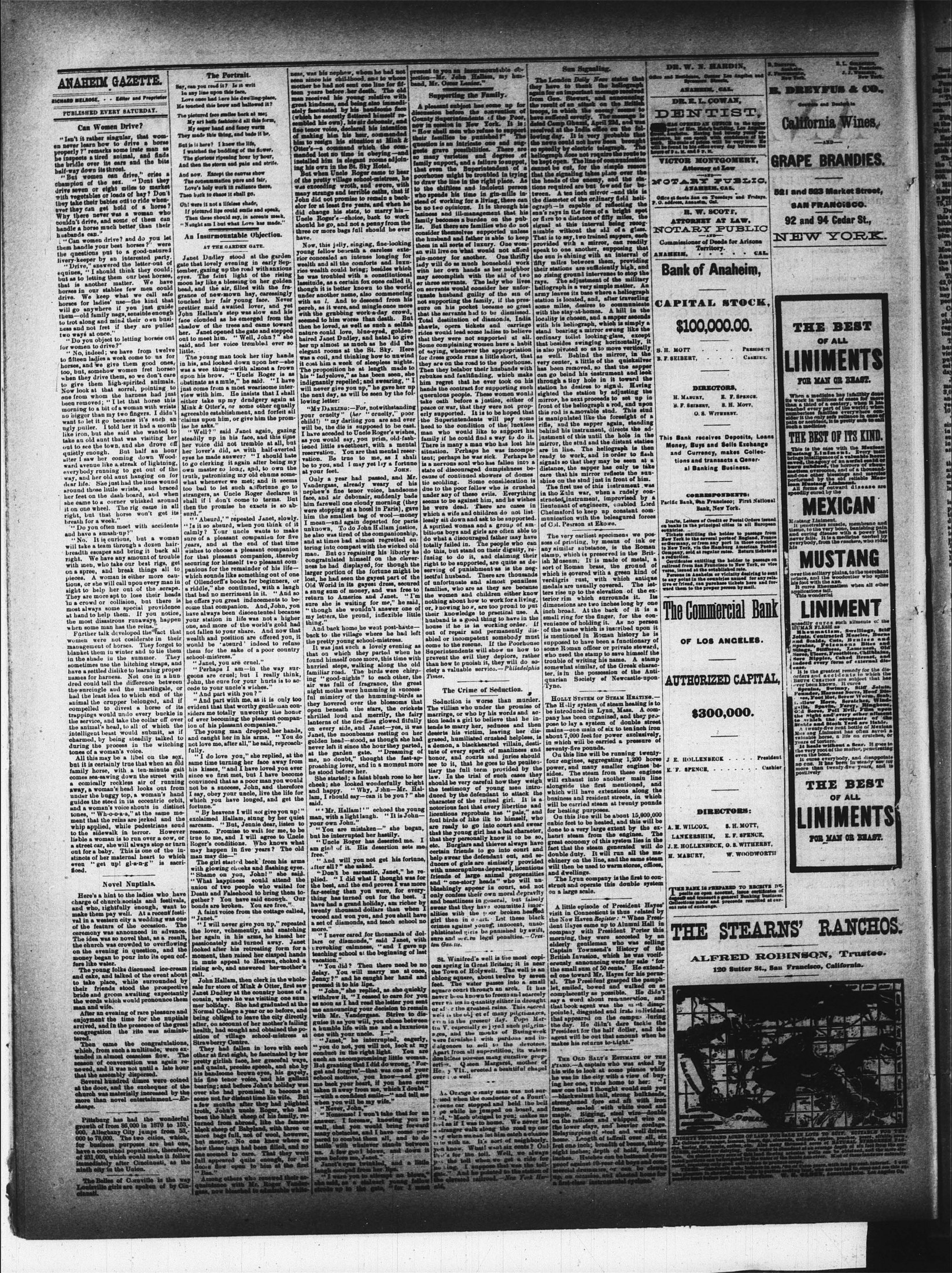
Searchable text
ANAHEIM GAZETTE.
RICHARD MELROSE. . . Editor and Proprietor
PUBLISHED EVERY SATURDAY.
Can Women Drive?
"Isn't it rather singular, that women never learn how to drive a horse properly?" remarks some irate man as he inspects a tired animal, and finds the bridle over its ears and the bits half-way down its throat.
"But women can drive," cries a champion of the sex. "Dont they drive seven or eight miles to market with vegetables or loads of hay? Don't they take their babies out to ride whenever they can get hold of a horse? Why there never was a woman who couldn't drive, and some of them can handle a horse much better than their husbands can."
"Can women drive? and do you let them handle your best horses?" were the questions put to a good-natured livery-keeper by an interested party.
"Drive," answered the letter-out of equines, "I should think they could; but as to letting them our best horses, that is another matter. We have horses in our stables few men could drive. We keep what we call safe horses for ladies' use—the kind that will go anywhere if you just guide them—old family nags, sensible enough to trot along and mind their own business and not fret if they are pulled two ways at once."
"Do you object to letting horses out for women to drive?"
"No, indeed; we have from twelve to fifteen ladies a week come to us for horses, and we give them good ones, too, but somehow women fret horses when they drive them, so we don't care to give them high-spirited animals. Now look at that sorrel, pointing to one from whom the harness had just been removed; "I let that horse this morning to a bit of a woman with wrists no bigger than my two fingers. I didn't want to let it go because it's such an ugly puller. I told her it had a mouth like iron, but she said she wanted to take an old aunt that was visiting her out to see the town, and she drove off quietly enough. But half an hour after I saw her coming down Woodward avenue like a streak of lightning, everybody running to get out of the house, was his nephew, seen since his childhood mother he had not sent teen years before. Her man received his great kindness, and be astly fascinated by him (which he secretly flashed his own), his fine tenor voice, declaring of making him his own. Otter's—a command manded lost no time installed him in elegant his own in the St.
But when Uncle Rufus of the pretty village was exceeding wroth many strange and terrifying John did not promise elor for at least five years did change his state. Uncle Roger's—chose should he go, and no three or more bags for have.
Now, this jelly, six young fellow beneath rior concealed an inn wealth and all the coats wealth could bring he was troubled with lassitude, as a certain though it is better under another name with an l. And to perch, as it were, and with the grubbing seemed to him worse then he loved, as we nature could love, haired Janet Dudley her up almost as my elegant rooms at that was a coil, and thin it cost him a week The proposition he his "ladyelove," as indignantly repellent will never give you the next day, as willowing letter:
"My Darling:—your cruelty" (his child!) "my darlin will be, the die is I have acceded to as you would say, issued little sweet reservation. You vation. Be true be to you, and I am at your feet."
when they drive them, so we don't care to give them high-spirited animals. Now look at that sorrel, pointing to one from whom the harness had just been removed; "I let that horse morning to a bit of a woman with wrists no bigger than my two fingers. I didn't want to let it go because it's such an ugly pailer. I told her it had a mouth like iron, but she said she wanted to take an old aunt that was visiting her out to see the town, and she drove off quietly enough. But half an hour after I saw her coming down Woodward avenue like a streak of lightning, everybody running to get out of the way, and her old aunt hanging on for dear life. She just had the lines wound around those little wrists, and braced her feet on the dash-board, and when she came to a corner whisked around it on one wheel. The rig came in all right, but that horse won't get its breath for a week."
"Do you often meet with accidents and have a smash-up?"
"No. It is curious, but a woman will take a team through a dozen hair-breadth escapes and bring it back all right. We have any amount of trouble with men, who take our best rigs, get on a spree, and break things all to pieces. A woman is either more cautious, or she will call upon every man in sight to help her out of the scrape. They are more apt to lose their heads in a crowd or collision, but there is most always some special providence at hand to help them. If you notice, the most disastrous runaways happen when some man has the reins."
Further talk developed the fact that women were not considerate in their management of horses. They forget to blanket them in winter and to tie them in the shade in the summer. They sometimes use the hitching straps, and have a settled dislike to learning proper names for harness. Not one in a hundred could tell the difference between the suringle and the martingale, or had the least idea to which end of the animal the crupper belonged, and if compelled to divest a horse of its trappings would undo every buckle in the service, and take the collar off over the animal's head, to all of which the intelligent beast would submit, as if charmed, by being steadily talked to during the process in the witching tones of a woman's voice.
All this may be a libel on the sex, but it is certainly true that when an old family horse, with a ten-minute gait comes sea-sawing down the street with a comically reckless air of running away, a woman's head looks out from under the buggy top, a woman's hand guides the steed in its eccentric orbit, and a woman's voice shouts in distinct tones, "Wh-o-o-a-a," at the same moment that the reins are jerked and the whip applied, while pedestrians soud to the sidewalk in terror. However lisble a woman is to run over a cow, or a street car, she will always stop or turn out for a baby. This is one of the instincts of her maternal heart to which even "get up! gl-a-n-g" is sacrificed.
Novel Nuptials.
Here's a hint to the ladies who have...
Novel Nuptials.
Here's a hint to the ladies who have charge of church socials and festivals, and who, rightfully enough, want to make them pay well. At a recent festival in a western city a wedding was one of the features of the occasion. The ceremony was announced in advance. The idea was so novel that, as a result, the church was crowded to overflowing on the evening in question, and the money began to pour into its open coffers like water.
The young folks discussed ice-cream and cake, and talked of the event about to take place, while surrounded by their friends stood the prospective bride and groom awaiting expectantly the words which would pronounce them man and wife.
After an evening of rare pleasure and enjoyment the time for the nuptials arrived, and in the presence of the great congregation the rite was administered.
Then came the congratulations, which, from such a multitude, were extended in almost ceaseless flow. The season of conversation was again renewed, and it was not until a late hour that the assembly dispersed.
Several hundred dimes were coined at the door, and the exchequer of the church was materially increased by the more than novel entertainment—Exchange.
Pittsburg has had the wonderful growth of from 86,000 in 1870 to 153,000. Alleghany City jumps from 53,000 to 78,000. The two cities, which, for business purposes are but one, have a combined population, therefore, of 231,000, which would make it follow immediately after Cincinnati, as the ninth city in the Union.
The Balles of Cornville is the way Louisville girls are spoken of by Cincinnati.
By heavens I will not give you up! exclaimed Hallam, stung by her quiet sarcasm. But, Jennie dear, listen to reason. Promise to wait for me, to be true to me, and I will agree to Uncle Roger’s conditions. Who knows what may happen in five years? The old man may die—
The girl started back from his arms with glowing cheeks and flashing eyes. "Shame on you, John!" she said. "What happiness could attend the union of two people who waited for Death and Falsehood to bring them together? You have said enough. Our bonds are broken. You are free."
A faint voice from the cottage called, "Janet."
"I will never give you up," repeated the lover, vehemently, and snatching her again in his arms, he kissed her passionately and turned away. Janet looked after his retreating form for a moment, then raised her clasped hands in mute appeal to Heaven, choked a rising sob, and answered her mother’s call.
John Hallam, then clerk in the wholesale fur store of Mink & Otter, first saw Janet Dudley at the country house of a cousin, where he was visiting one summer holiday. She had graduated at the Normal College a year or so before, and being obliged to leave the city directly after, on account of her mother’s failing health, had sought and obtained the position of village school-mistress at Strawberry Centre.
They had fallen in love with each other at first sight, he fascinated by her pretty girlish face, her graceful ways, and quaint, precise speech, and she by his handsome brown eyes, his gayly, his fine tenor voice, and his gallant bearing; and before John’s holiday was over she had promised to become at some not far distant time his wife. But a few months after they had plighted troth, John’s uncle Roger, who had been the black sheep of his family, returned from abroad, like the famous black sheep of Babyland, with three or more bags full, not of wool, however, but money. No one knew where or how these tags had been filled, and no one seemed to care. That they were full appeared quite enough, for all doors flow open to him at the first "Ban."
Among others who renewed their acquaintance with Mr. Roger Vandenga, now blissed to admirable white-which you have longed, and get the fortune."
Mr. Hallam man, with a light your own John.
"You are my but he interrupts." Uncle Roger am glad of it.
"And will you after all?" she replied. "I did best, and the far-seeking thing has turned have had a grant twenty thousand wooed and won a set of diamonds more."
"I never care lars or dismow provoking calls teaching school vacation."
"You did? delay. You w Jenny?" and pressed it to him.
"John," she withdrew it. "as soon as I have me announcing with Mr. Van guise it as you a humble life one with your."
"Janet," he "you do not," conduct in this such an uncomprehending granting to get and forgive school mottoes me back your taken it away—with a confidion when you will."
Never, John "Nonsense!" answer. I for well, that you many obstacles pared to comb battles with us. A few goons before me Janet’s eyes laugh escaped.
"I warn you she said, as so simple up in..."
ness, was his nephew, whom he had not seen since his childhood, and to whose mother he had not sent one line for fifteen years before her death. The old man received his young relative with great kindness, and being also immediately fascinated by his handsome face (which he secretly flattered himself resembled his own), his air debonair, and fine tenor voice, declared his intention of making him his hear, commanded him to resign his situation at Mink & Otter's—a command which the commanded lost no time in obeying—and installed him in elegant rooms adjoining his own in the St. Sky Hotel.
But when Uncle Roger came to hear of the pretty village school-mistress, he was exceeding wroth, and swore, with many strange and terrible oaths, that if John did not promise to remain a bachelor for at least five years, and when he did change his state, to marry his—Uncle Roger's—choice, back to work should he go, and not a penny from the three or more bags fall should he ever have.
Now, this jelly, singing, fine-looking young fellow beneath a careless exterior concealed an intense longing for wealth and all the comforts and luxuries wealth could bring; besides which he was troubled with a constitutional lassitude, as a certain fox once called it, though it is better known to the world under another name, also commencing with an 1. And to descend from his perch, as it were, and mingle once more with the grubbing work-a-day crowd, seemed to him worse than death. But then he loved, as well as such a selfish nature could love, blue-eyed, golden-haired Janet Dudley, and hated to give her up almost as much as he did the elegant rooms at the St. Sky. Here was a coil, and thinking how to unwind it cost him a week of sleepless nights. The proposition he at length made to his "ladyelove," as has been seen, she indignantly repelled; and swearing, "I will never give you up," he gave her up the next day, as will be seen by the following letter:
"My Darling:—For, notwithstanding your cruelty" (her "cruelty," poor child!) "my darling you are and ever will be, the die is supposed to be cast. I have acceded to Uncle Roger's wishes, as you would say, you prim, old-fashioned little sweetheart, with a mental reservation. You are that mental reservation. Be true to me, as I shall be to you, and I may yet lay a fortune at your feet.
present to you an insurmountable objection—Mr. John Hallam, my husband, Mr. Oscar Lenier."
Supporting the Family.
A pleasant subject has come up for discussion before the convention of County Superintendent of the Poor, now in session in New York. It is: "How shall men who refuse to support their families be punished?" The question is an intricate one and suggests grave possibilities. There are so many varieties and degrees of family support, and a failure to suppose that even the Superintendent of a poorhouse might be troubled in trying to draw the line in the right place. As to the shiftless and indolent person who spends his time in gin-mills instead of working for a living, there can be no two opinions. It is through his laziness and ill-management that his family becomes a burden on the public. But there are families who do not consider themselves supported unless the husband and father is able to keep them in all sorts of luxury. One woman will live on what would not afford pin-money for another. One thrifty lady will do as much household work with her own hands as her neighbor may accomplish with the aid of two or three servants. The lady who lives on servants would consider her unfortunate husband guilty of the sin of not supporting the family, if the pressure on his pocket became so great that the servants had to be dismissed. Total destitution of diamonds, India shawls, opera tickets and carriage rides would lead some ladies to believe that they were not supported at all. Some complaining women have a habit of saying, whenever the appropriation for dress goods runs a little short, that they are on the road to the poorhouse. Then they belabor their husbands with rebukes and faultfinding, which make him regret that he ever took on his hands the contract for supporting such quarrelous people. These women would take oath before a justice, either of peace or war, that they were not properly supported. It is to be hoped that the Superintendent will pay some heed to the condition of the luckless man who would like to support his family if he could find a way to do it. There is many a man who has lost his situation. Perhaps he was incompetent; perhaps he was sick. Perhaps he is a nervous soul who has fallen into a state of discouraged dumpishness because of insufficient sleep.
Sun Signaling.
The London Daily News states that they have to thank the heliograph again for an important message received from Gen. Stewart, and announcing the result of an attack on the British troops, in which the enemy seems to have suffered severely. The message is dated Camp Ghazali, April 2d, and was received at the Indian office on the following day. It is very probable that the news could not have been brought so speedily by electric telegraph. The heliograph does not require the route to be kept open. The line of communication cannot be cut, for the simple reason that the signaling takes place over the heads of the enemy, and the stations required are but few and far between. A ten inch mirror—and this is the diameter of the ordinary field heliograph—is capable of reflecting the sun's rays in the form of a bright spot or flare to a distance of fifty miles, the signal at this interval being recognizable without the aid of a glass. That is to say, two trained superseded with a mirror, can readily speak to one another, supposing that the sun is shining with an interval of fifty miles between them, providing their stations are sufficiently high, and no rising ground intervenes to stop the rays. The adjustment of the military heliograph is a very simple matter. An army leaves its base where a heliograph station is located, and, after traversing some miles, desires to communicate with the stay-at-homes. A hill in the locality is chosen, and a supper ascended with his heliograph, which is simply a stand bearing a mirror swung like the ordinary toilet looking-glass, except that besides swinging horizontally, it is also pivoted so as to move vertically as well. Behind the mirror, in the very center, a little of the quicksilver has been removed, so that the supper can go behind his instrument and look through a tiny hole in it toward the station he desires to signal. Having sighted the station by adjusting the mirror, he next proceeds to set up in front of the heliograph a rod, and upon this rod is a movable stud. This stud is manipulated like the foresight of a rifle, and the supper again, standing behind his instrument, directs the adjustment of this until the hole in the mirror, the stud and the distant station are in line. The heliograph is then ready to work, and in order to flash signals so that they may be seen at a distance, the supper has only to take care that his mirror reflects the sun-
his "ladyelove," as has been seen, she indignantly repelled, and swearing, "I will never give you up," he gave her up the next day, as will be seen by the following letter:
"My Darling:—For, notwithstanding your cruelty" (her "cruelty," poor child!) "my darling you are and ever will be, the die is supposed to be cast. I have acceded to Uncle Roger's wishes, as you would say, you prim, old-fashioned little sweetheart, with a mental reservation. You are that mental reservation. Be true to me, as I shall be to you, and I may yet lay a fortune at your feet.
Only a year had passed, and Mr. Vandergaas, already weary of his nephew's fine tenor voice, handsome face, and air debonair, suddenly bade him farewell one cloudy morning (they were stopping at a hotel in Paris), gave him the smallest bag of wool—money I mean—and again departed for parts unknown. To do John Hallam justice, he also was tired of the companionship, and at times had almost regretted entering into compact with the wicked man. But on regaining his liberty he congratulated himself on the cleverness he had displayed, for though the larger portion of the fortune might be lost, he had seen the gayest part of the Old World in its gayest dress, secured a snug sum of money, and was free to return to America and Janet. "I'm sure she is waiting for me," he said, "though she wouldn't answer one of my letters, the proud, inflexible little thing."
And back home he went post-haste—back to the village where he had left the pretty young school-mistress.
It was just such a lovely evening as that on which they parted when he found himself once more, this time with hirred steps, walking along the old familiar road. The birds were chirping "good-nights" to each other, the air was full of fragrance, the great night moths were humming in successful mimicry of the humming-birds as they hovered over the blossoms that open beneath the stars, the crickets shrilled loud and merrily, the fairy lanterns of the fire-flies glowed fitfully on every side, and Janet—yes, it was Janet, the moonbeams resting on her golden head—stood, as though she had never left it since the hour they parted, at the garden gate. "Dreaming of me, no doubt," thought the fast-approaching lover, and in a moment more he stood before her.
She started; a faint blush rose to her cheek; she looked wonderfully bright and happy. "Why, John—Mr. Hallam, I should say—can it be you?" she said.
"Mr. Hallam!" echoed the young man, with a light laugh. "It is John—your own John."
"You are mistaken—" she began, but he interrupted her hastily.
"Uncle Roger has deserted me. I am glad of it. His desertion sets me free."
"And will you not get his fortune, after all?" she saked.
"Don't be sarcastic, Janet," he replied. "I did what I thought was for the best, and the end proves I was more far-seeing than you were, for everything has turned out for the best. I rebuke and fault finding, which make him regret that he ever took on his hands the contract for supporting such querulous people. These women would take oath before a justice, either of peace or war, that they were not properly supported. It is to be hoped that the Superintendents will pay some heed to the condition of the luckless man who would like to support his family if he could find a way to do it. There is many a man who has lost his situation. Perhaps he was incompetent; perhaps he was sick. Perhaps he is a nervous soul who has fallen into a state of discouraged dumpishness because of continued showers of domes tio scolding. Some consideration is due to the poor fellow who is crushed under any of these evils. Everything seems to be against him, and he wishes he were dead. There are cases in which a wife and children do not listlessly sit down and ask to be supported. A spirited woman and a group of ambitious boys and girls are often able to do what a discouraged father may have totally failed in. The people who can do this, but stand on their dignity, refusing to do it, and claiming their right to be supported, are quite as serving of punishment as is the neglectful husband. There are thousands of unfortunate and almost penailess families, who are as they are because the women and children either know nothing about how to work for a living, or knowing how*, are too proud to put their knowledge to practical use. A husband is a good thing to have in the house if he is in working order. If out of repair and permanently disabled or incompetent somebody must come to the rescue. If the Poorhouse Superintendents will show us how to prevent the evil they deplore, rather than how to punish it, they will do society a valuable service.—Philadelphia Times.
The Crime of Seduction.
Seduction is worse than murder. The villian who under the promise of marriage, or who by his words and action leads a girl to believe that he intends to marry her, seduces and then deserts his victim, leaving her disgraced, humiliated crushed helpless, is a demon, a blackhearted villain, destitute of every spark of manliness and honor, and courts and juries should see to it, that he goes to the penitentiary the full term provided by the law. In the trial of such cases they should be very careful how they weigh the testimony of young men introduced by the defendant to attack the character of the ruined girl. It is a notorious fact that every libertine and licentious probate has "pals," and foul birds of like ilk to himself, who are ready to go into court and swear that the young girl has a bad character, that they personally know it to be so, etc. Burglars and thieves always have certain friends to go into court and help swear the defendant out, and seducers of girls are similarly provided with unscrapulous depraved, licentious friends of large animal propensities and "one-story heads" who will unblushingly appear in court, and not only confess their own moral depravity can go behind his instrument and look through a tiny hole in it toward the station he desires to signal. Having sighted the station by adjusting the mirror, he next proceeds to set up in front of the heliograph a rod, and upon this rod is a movable stud. This stud is manipulated like the foresight of a rifle, and the sapper again, standing behind his instrument, directs the adjustment of this until the hole in the mirror, the stud and the distant staties are in line. The heliograph is then ready to work, and in order to flash signals so that they may be seen at a distance, the sapper has only to take care that his mirror reflects the sunshine on the stud just in front of him.
The first use of this instrument was in tho Zulu war, when a rudely constructed instrument, improvised by a lieutenant of engineers, enabled Lord Chelmsford to keep up constant communication with the beleagured forces of Col. Pearson at Ekowe.
The very earliest specimens we possess of printing, by means of ink or any similar substance, is the Roman stamp, which is preserved in the British Museum. It is made of metal, a sort of Roman brass, the ground of which is covered with a green kind of verdigris rust, with which antique medals are usually covered. The letters rise up to the elevation of the exterior rim which surrounds it. Its dimensions are two inches long by one inch broad. At the back of it is a small ring for the finger, for the convenience of holding it. As no person of the name which is inscribed upon it is mentioned in Roman history he is supposed to have been a functionary of some Roman officer or private steward, who used the stamp to save himself the trouble of writing his name. A stamp somewhat similar, of the Greek character, is in the possession of the Antiquarian Society of Newcastle-upon-Tyne.
Holly System of Steam Heating.
The Holly system of steam heating is to be introduced in Lynn, Mass. A company has been organized,and they propose to lay a system of double street mains—one main of six to ten inch iron about 7,000 feet for power exclusively, in which will be carried a pressure of seventy-five pounds.
On this line will be running twenty-four engines, aggregating 1,200 horsepower,and many smaller engines besides.The steam from these engines will exhaust into another main line alongside the first mentioned,and which will have extensions along the business and resident streets,在which will be carried steam at twenty pounds for heating purposes.
On this line will be about 15,000,000 cubic feet to be heated,and this will be done to a very large extent by the exhaust steam from the engines.The great economy of this system lies in the fact that the steam generated will do double duty.It will run allthe machinery on the line,and the same steam will then be used to warm stores,offices,and dwellings.
The Lynn company is the first to construct and operate this double system on a large scale.
Mr. Hallam!’ echoed the young man, with a light laugh. “It is John—your own John.”
“You are mistaken—” she began, but he interrupted her hastily.
“Uncle Roger has deserted me. I am glad of it. His desertion sets me free.”
And will you not get his fortune, after all?” she asked.
“不 be sarcastic, Janet,” he replied. “I did what I thought was for the best, and the end proves I was more far-seeing than you were, for everything has turned out for the best. I have had a grand holiday, am richer by twenty thousand dollars than when I wooed and won you, and you shall have a set of diamonds, and teach school no more.”
“I never cared for thousands of dollars or diamonds,” said Janet, with provoking calmness, “and I gave up teaching school at the beginning of last vacation.”
“You did? Then there need be no delay. You will marry me at once, Jenny?” and he caught her hand and pressed it to his lips.
“John,” she replied, as she quickly withdrew it. “I ceased to care for you as soon as I had read the letter you sent me announcing your decision to remain with Mr. Vandergaas. Strive to disguise it as you will, you chose between a humble life with me and a luxurious one with your uncle. I—”
“Janet,” he interrupted, eagerly, “you do not, you will not, look at my conduct in the right light. You are such an incompromising little woman. But granting that I did do wrong. ‘Forget and forgive’—that was one of your school mottoes, you know—and give me back your heart, if you have ever taken it away from me, which I doubt—with a confident smile—” and tell me when you will be my wife.”
“Never, John,”
“Nonsense! I won’t take that for an answer. I forewarn, knowing you so well, that you would bring forward many obstacles, and I have come prepared to combat them all, and to do battle with whatever stands between us. A few good blows, and down it goes before me, Janet.”
Janet’s eyes twinkled, and a little laugh escaped from her lips.
“I warn you to attempt no blows,” she said, as a stalwart young follow stroke up in the gate, “for I must character of the ruined girl. It is a notorious fact that every libertine and licentious reprobate has “pals,” and foul birds of like ilk to himself, who are ready to go into court and swear that the young girl has a bad character, that they personally know it to be so, etc. Burglaries and thieves always have certain friends to go into court and help swear the defendant out, and seducers of girls are similarly provided with unsorrupulous depraved, licentious friends of large animal propensities and “one-story heads” who will unblushingly appear in court, and not only confess their own moral depravity and beastliness in general, but falsely swear that they have committed immoralities with the poor broken hearted girl then in court. Let these black crimes against young, innocent, unsophisticated girls be punished by swift, sure and severe legal penalties. — Creston Gazette.
St. Winifred’s well is the most copious spring in Great Britain; it is near the Town of Holywell. The well is an oblong square, about twelve by seven feet. The water passes into a small square court through an arch. It has never been known to freeze and scarely ever varies in quantity either in drought or after the greatest rains. This sacred well is the object of many pilgrimages, even in the present day. Pope Martin V., especially enjoyed such pilgrimages, and the monks of Basingweek were furnished with pardons and indulgences to sell to the devotees. Apart from all superstition, its waters doubtless possess many curative properties. Queen Margaret, mother of Henry VII., erected a beautiful chapel over the well.
A Orange county man was not surprised when the conductor of a Fourth Avenue car stopped and held the bell while he jumped on board, and said, “Much obliged to you; makes me feel as if I was to home. We never let a stranger walk along the road up our way when we can let him catch a chance ride with us. It’s sort of neighborly, you know. What I want six cents? Out there for the toll. Well, we always pay the toll when we get a ride for nothing. I suppose that was the toll-gate.” And he pointed to the station of the elevated railroad. — New York Harbor.
A little episode of President Hayes’ visit in Connecticut is thus related by the New Haven Register: “When President Hayes came up to Alumni Hall in company with President Porter this morning, they were accosted by an elderly gentleman who was selling Captain Townsend’s History of the British Invasion, which he was vociferously announcing were for sale ‘for the small sum of 50 cents.’ He extended one toward Mr. Hayes for his perusal. The President grasped the pamphlet, smiled, bowed and walked on as complacently as possible. He didn’t say a word about remuneration, and that book agent was the most disappointful, disgusted and frat individual that appeared on the campus during the day. He didn’t dare tackle the President for the half dollar, and the agent will be out that amount when he makes his returns to Light.”
The Old Salt’s Estimate of the PIano—a captain who was asked by his wife to look at some pianos while he was in the city with a view of buying her one, wrote home to her: “I saw one that I thought would suit you—blackwalnut hull, strong bulkheads, strengthened fore and aft with iron frame, sealed with white wood and maple. Higging, steel wire—double on the raillines and whipped wire on the lower stays, and heavier cordage. Helaying pins of steel and well driven home. Length of taffrail over all, six first one inch; breadth of beans, thirty-eight inches; depth of hold, fourteen inches. Hatches can be battained down proof against 10-year old boys and commercial drummers; or can be elapsed up on occasion; and attached home for a first-class instrumental syllabus.”
DR. W. N. HARDIN,
Office and Bedside, Guest Los Angeles and
Syracuse Storks,
ANAHEIM, CAL.
DR. E. L. COWAN,
DENTIST,
HAS OPENED AN OFFICE in the upper
part of Mrs. Mote's building, Los Angeles
Street, Anaheim. Having had twenty years exppenses, he can speak with confidence of his work. His skills of patient will be very low. He will be found in his office every day between the hours of 9 A.M. and 5 P.M.
VICTOR MONTGOMERY,
Attorney at Law
AND
NOTARY PUBLIC,
ANAHEIM, CAL.
Office at Santa Ana on Tuesdays and Fridays.
P. O. address, Anaheim, Cal.
R. W. SCOTT,
ATTORNEY AT LAW,
NOTARY PUBLIC
AND
Commissioner of Deeds for Arizona Territory.
ANAHEIM, CAL.
Bank of Anaheim,
CAPITAL STOCK,
$100,000.00.
S. H. MOTT . . . President
B. F. SEIBERT, . . . Cashier.
DIRECTORS,
H. MABURY, E. F. SPENCE.
B. F. SEIBERT, S. H. MOTT,
O. S. WITHERBY.
This Bank receives Deposits, Loans
Money, Buys and Sells Exchange
and Currency, makes Collections and transacts a General Banking Business.
R. L. GOLDBERG,
Anaheim,
J. P. PHARMACY,
New York.
E. DREYFUS & CO.
Government and Design in
California Wines
GRAPE BRANDIES.
521 and 623 Market Street,
SAN FRANCISCO.
92 and 94 Cedar St.,
NEW YORK.
THE BEST
OF ALL
LINIMENTS
FOR MAN OR BEAST.
When a medicine has infallibly done its work in millions of cases for more than a third of a century; when it has reached every part of the world; when numberless families everywhere consider it the only safe reliance in case of pain or accident; it is pretty easy to call such a medicine.
THE BEST OF ITS KIND.
This is the case with the Mexican Mustang X-Immensit. Every mail brings intelligence of a valuable horse sword, the agony of an awful scald or burn subdued, the horrors of zombies overcome, and of a thousand other biosciences and marriages.
DIRECTORS,
H. MABURY, E. F. SPENCE.
H. F. SEIBERT, S. H. MOTT,
O. S. WITHERBY.
This Bank receives Deposits, Loans Money, Buys and Sells Exchange and Currency, makes Collections and transacts a General Banking Business.
CORRESPONDENTS:
Pacific Bank, San Francisco; First National Bank, New York.
Drafts, Letters of Credit or Postal Orders issued on banks in the principal cities in all European countries.
Tickets entitling the holder to passage from New York to the several ports of England, France or Germany, or from any port in those countries to New York, via the Hamburg American Posted Company, sold at regular rates. Return tickets at a reduction.
Certificates entitling the holder to passage on railroad from San Francisco to New York, or vice versa, issued at the established rate.
Persons in Anaheim or vicinity desiring to sent to any point in the countries named for any relative or friend, can purchase tickets here and forward them to the proper person by mail.
The Commercial Bank
OF LOS ANGELES.
AUTHORIZED CAPITAL,
$300,000.
J. E. HOLLENBECK President
E. F. SPENCE Cashier
DIRECTORS:
A. H. WILCOX, S. H. MOTT,
LANKERSHIM, E. F. SPENCE,
J. E. HOLLENBECK, O. S. WITHERBY,
H. MABURY, W. WOODWORTH
THE BANK IS PREPARED TO RECHIVE DEPOSITS on open account, issue certificates of demand and transact a general Banking business.
FOR MAN OR BEAST.
When a medicine has infallibly done its work in millions of cases for more than a third of a century; when it has reached every part of the world; when numberless families everywhere consider it the only safe reliance in case of pain or accident, it is pretty easy to call such a medicine.
THE BEST OF ITS KIND.
This is the case with the Mexican Mustang K.I.M.S.M.E.N.S.
Every mail brings intelligence of a valuable horse eavesdropping, the agony of an unwieldy gold or burn subduced, the horrors of rheumatism overcome, and of a thousand-and-one other blemishes and morbies performed by the old reliable Mexican Mustang Limestone.
All forms of outward disease are speedily cured by the MEXICAN Mustang Liniment.
It penetrates muscle, membrane and tissue, to the very bone, banishing pain and curing disease with a power that never hills. It is a medicine needed by everybody, from the rancher, who rides his MUSTANG over the solitary plains, to the merchant prince, and the woodcutter who splits his foot with the axe.
It cures Rheumatism when all other applications fail.
LINIMENT
speedily cures such ailments of the HUMAN FLESH as Rheumatism, Swellings, Stiff Joints, Continued Muscles, Burns and Seals, Cuts, Bruises and wounds, Poisons Bites and Nipses, Stiffness, Lameness, Old Noses, Ulears, Frostbites, Chillblains, More Nipples, Caked Breast, and indeed every form of external disease.
It is the greatest remedy for the disorders and accidents to which the BRUSH CREATION are subject that has ever been known. It cures Sprains, Swimny, Stiff Jelts, Founder, Harness Borre Moof Diseases, Foot Mot, Serew Worm, Snake, Yellow Horn, Serwatches, Windgalls, Spavin, Parry, Ringbone, Old Sores, Poll Evil, Film upon the Nights and every other element to avail the occupants of the Stable and Stock Yard are liable.
Twenty-five cent bottle of Mexican Musang Liniment has often saved a valuable horse, a life on crutches, or years of torture.
It heals without a Scar. It goes to the very root of the matter, penetrating even the bone.
It cures everybody, and disappoints no one. It has been in steady use for more than twenty-five years, and in positively
THE BEST OF ALL LINIMENTS FOR MAN OR BEAST.
DIRECTORS:
A. H. WILCOX, S. H. MOTT,
LANKERSHIM, E. F. SPENCE,
J. E. HOLLENBECK, O. S. WITHERBY,
H. MABURY, W. WOODWORTH
THE BANK IS PREPARED TO RECHIVE DEPOSITS ON OPEN ACCOUNT, ISSUE CERTIFICATION OF DEMAND AND TRANSACT A GENERAL BANKING BUSINESS.
Collections made and proceeds remitted at current rates of exchange.
THE STEARNS' RANCHOS.
ALFRED ROBINSON, Trustee.
120 Sutter St., San Francisco, California.
EIGHTY THOUSAND ACRES OF LAND FOR SALE IN LOTS TO SUIT. SUITABLE FOR THE Culture of oranges, lemons, limes, apples, peaches, pears, alfalfa corn, yams, hays, sax, cabbage, cotton, etc. Also many hundred acres of NATURAL STRENGTH FACTORIES suitable for drying. Good water is abundant at an average depth of six feet from the surface. On almost every acre of this land diving artesian wells can be obtained, and the more elevated positions can be irrigated by the water of the Santa Ana river. Most of these lands are naturally wooded, requiring only good cultivation to produce crops.
THIS: One-third cash balance in and ten or three years, with ten percent interest. I will take plumbers in christened flume lands in parties existing land, who are invited to come and see this enterprise once before purchasing elsewhere. W. H. GARBER, sanpancasolm, Los Angeles Co.