anaheim-gazette 1880-07-31
Scanned page
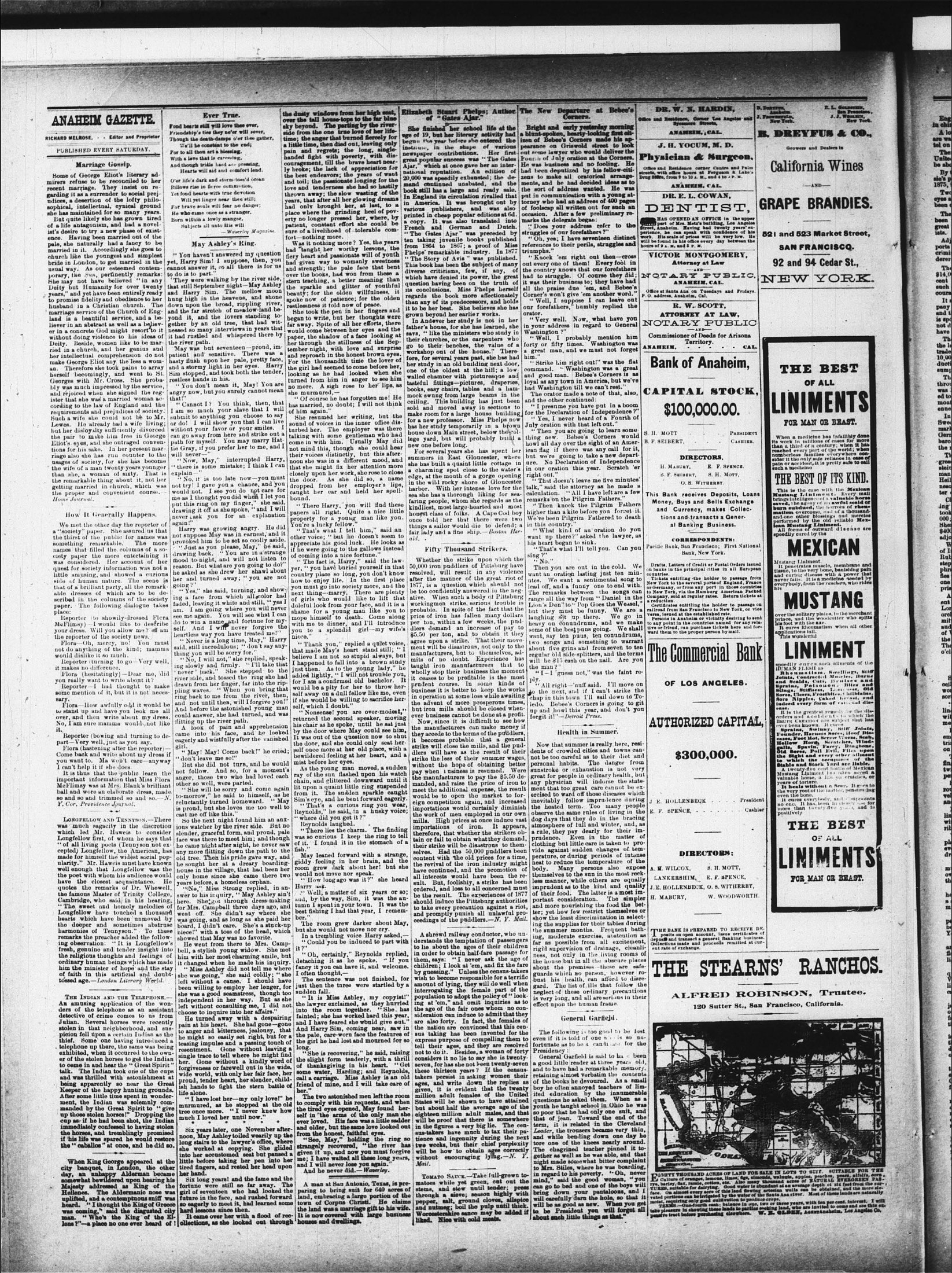
Searchable text
ANAHEIM GAZETTE.
RICHARD MELROSE. . . Editor and Proprietor
PUBLISHED EVERY SATURDAY.
Marriage Gossip.
Some of George Eliot's literary admirers refuse to be reconciled to her recent marriage. They insist on regarding it as a surrender to social prejudices, a desertion of the lofty philosophical, intellectual, cynical ground she has maintained for so many years.
But quite likely she has grown tired of a life antagonism, and had a novelist's desire to try a new phase of existence. Having been married out of the pale, she naturally had a fancy to be married in it. Accordingly she goes to church like the youngest and simplest bride in London, to get married in the usual way. As our esteemed contemporary, the Sun, pertinently remarks: She may not have believed "in any Deity but Humanity for over twenty years," and yet have been entirely ready to promise fidelity and obedience to her husband in a Christian church. The marriage service of the Church of England is a beautiful service, and a believer in an abstract as well as a believer in a concrete God might resort to it without doing violence to his ideas of Deity. Beside, women like to be married in a church, and her genius and her intellectual comprehension do not make George Eliot any the less a woman. Therefore she took pains to array herself becomingly, and went to St. Georges with Mr. Cross. She probably was much impressed by the service, and rejoiced when she signed the register that she was a married woman according to the law of England and the requirements and prejudices of society. Such a wife she could not be to Mr. Lewes. He already had a wife living; but her disloyalty sufficiently divorced the pair to make him free in George Eliot's eyes, and she outraged conventions for his sake. In her present marriage also she has run counter to the usages of society, for she has become the wife of a man twenty years younger than she a woman of sixty. That is
Ever True.
Fond hearts still will love these ever,
Friendship's ties they never will sever,
Though the death-damps o'er thee gather,
We'll be constant to the end;
For to all thou art a blessing.
With a love that is caressing,
And though trials hard are pressing,
Hearts will aid and comfort land.
O'er life's dark and storm-toss'd ocean
Billows rise in fierce combustion,
Yet food hearts with true devotion
Will yet linger near thee still;
For brave souls will fear no danger;
He who came once as a stranger,
Born within a lowly manger,
Subjects all unto His will
—Waverley Magazine.
May Ashley's King.
"You haven't answered my question yet, Harry Sim! I suppose, then, you cannot answer it, so all there is for us to do is to part."
They were walking by the river side, that still September night—May Ashley and Harry Sim. The mellow moon hung high in the heavens, and shone down upon the broad, rippling river, and the far stretch of meadow-land beyond it, and the lovers standing together by an old tree, that had witnessed so many interviews in years that it had rustled and whispered there by the river path.
May was but seventeen—prud, impatient and sensitive. There was a hasty flush upon her pale, pretty face, and a stormy light in her eyes. Harry Sim stopped, and took both the tender, restless hands in his.
"You don't mean it, May! You are angry now, but you surely cannot mean that!"
Cannot I? You think, then, that I am so much your slave that I will submit to anything you choose to say or do! I will show you that I can live without your favor or your smiles. I can go away from here and strike out a path for myself. You may marry Hattie Gray, if you prefer her to me, and I will never—"
Now, May," interrupted Harry,
"there is some mistake; I think I can explain—"
the dusty windows from over the tall house-tops sky beyond. The parting side from the one true love time; the anger that burns a little time, then died out pain and regrets; the handed fight with power couragement, till the brain broke; the lack of age the best endeavors; the end toil; the passionate love and tenderness she thrown away; the slow years, that after all her gaze had only brought her place where the grindingerty no longer pressed patient, constant effort sure of a livelihood of fort—nothing more.
Was it nothing more? had 'taught her worthy fiery heart and passionate had given way to women and strength; the pale over the books, had won stern teaching, a better the sparkle and glitter beauty; for the older spoke now of patience; restlessness it told now.
She took the pen in her began to write, but her far away. Spite of all he would come between her paper, the shadow of a her through the stillness tember night, with love and reproach in the home. For the thousandth time the girl had seemed to look as he had looked turned from him in no more. A sigh rose she murmured,
"Of course he has for has married, no doubt; of him again."
She resumed her w sound of voices in the turbed her. The empt talking with some gen come in with him. U not mind this, though their voices distinctly noon she was in a diff that she might fix her closely upon her work.
How It Generally Happens.
We met the other day the reporter of a "society" paper. She assured us that the thirst of the public for names was something remarkable. The more names that filled the columns of a society paper the more entertaining it was considered. Her account of her quest for society information was not a little amusing, and showed a curious side of human nature. The scene is that of a brilliant party, all the remarkable dresses of which are to be described in the columns of the society paper. The following dialogue takes place:
Reporter (to showily-dressed Flora McFlimsy)—I would like to describe your dress. Will you allow me? I am the reporter of the society news.
Flora—Oh, mercy, no! You must not do anything of the kind; mamma would dislike it so much.
Reporter (turning to go—Very well, it makes no difference.
Flora (hesitatingly)—Dear me, did you really want to write about it?
Reporter—I had thought to make some mention of it, but it is not necessary.
Flora—How awfully odd it would be to stand up and have you look me all over, and then write about my dress. No, I am sure mamma would not like it.
Reporter (bowing and turning to depart—Very well, just as you say.
Flora (hastening after the reporter)—Come back and write about my dress if you want to. Ma won't care—anyway I can't help it if she does.
It is thus that the public learn the important information that Miss Flora McFlimsy was at Mrs. Blank's brilliant ball and wore an elaborate dress, made so and so and trimmed so and so.—N. Y. Cor, Providence Journal.
LONGFELLOW AND TENNYSON.—There was much sagacity in the discretion which led Mr. Haweis to consider Longfellow first, of whom he says that "of all living poets (Tennyson not excepted) Longfellow, the American, has made for himself the widest social popularity." Mr. Haweis must have known well enough that Longfellow was the poet with whom his audience would have the closest acquaintance. He quotes the remarks of Dr. Whewell, the famous Master of Trinity College, Cambridge who lived in his home.
Sim stopped, and took both the center, restless hands in his.
"You don't mean it, May! You are angry now, but you surely cannot mean that!"
"Cannot I? You think, then, that I am so much your slave that I will submit to anything you choose to say or do! I will show you that I can live without your favor or your smiles. I can go away from here and strike out a path for myself. You may marry Hatte Gray, if you prefer her to me, and I will never—"
"Now, May," interrupted Harry, "there is some mistake; I think I can explain—"
"No, it is too late now—you must not try! I gave you a chance, and you would not. I see you do not care for me as I thought you did when I let you put this ring on my finger," she said, drawing it off as she spoke, "and I will never ask you for an explanation again."
Harry was growing angry. He did not suppose May was in earnest, and it provoked him to be set so coolly aside.
"Just as you please, May," he said, drawing back. "You are in a strange mood to night, and will not listen to reason. But what are you going to do?" he asked as she drew her shawl about her and turned away; "you are not going?"
"Yes," she said, turning, and showing a face from which all color had faded, leaving it white and still, "yes I am. I am going where you will never see me again. You will see what I can do to win a name and fortune for myself. And I will never forgive the heartless way you have treated me!"
"Never is a long time, May," Harry said, still incredulous; "don't say anything you will be sorry for."
"No, I will not," she replied, speaking slowly and firmly. "I'll take that 'never' back." She stepped to the river side, and tossed the ring she had drawn from her finger, far into the rippling waves. "When you bring that ring back to me from the river, then, and not until then, will I forgive you!" And before the astonished young man could answer, she had turned, and was flitting up the river path.
A look of pain and apprehension came into his face, and he looked eagerly and wistfully after the vanished girl.
"May! May! Come back!" he cried; "don't leave me so!" But she did not turn, and he would not follow. And so, for a moment's anger, those two who had loved each other so well, were parted.
"She will be sorry and come again to-morrow," he said to himself, as he reluctantly turned homeward. "May is proud, but she loves me too well to cast me off like this."
So the next night found him an anxious watcher by the river side. But no slender, graceful form, and proud, pale face was there to meet him; and though he came night after night, he never saw any more fitting down the path to the old tree. Then his pride gave way, and he sought her at a dreary boardinghouse in the village, that had been her only home since she came there two years before, a homeless orphan.
"Ne," Miss Strong replied, in answer to his inquiry, "May Ashley ain't looking as he had been turned from him in no more. A sigh rose she murmured,
"Of course he has for has married, no doubt; of him again."
She resumed her sound of voices in the turbed her. The emptied talking with some genie come in with him. Unnot mind this, though their voices distinctly noon she was in a diffuse that she might fix her closely upon her work; the door. As she dropped from her ear caught her ear and bound.
"There Harry, your papers all right. Quite property for a young You're a lucky fellow."
That's what I tell other voice; but he appreciate his good luck if he were going to the of coming into a nice life.
"The fact is, Harry yer," you have buried country place so long how to enjoy life. In you must go into society next thing—marry." Of girls who would do doleful look from your shame for a young nope himself to deal with me to dinner; and you to a splendid niece."
"Thank you," replied that made May's heart believe I am not so sick I happened to fall into just then. As to the added lightly; "I will for I am a confirmed woman would be a pity for her self away on a dull feel if she would be willing self, which I doubt."
"Nonsense! you returned the second day his chair as he spoke; by the door where Mr. It was out of the queue the door, and she could self once more at her bewildered feeling at mist before her eyes.
As the young man ray of the sun flashen chain, and glittered little from it. The sudden Sim's eye, and he been
"That's a curious Reynolds," he said; "where did you get in Reynolds laughed."
There lies the chase was so curious I knew of it. I found it in fish."
May leaned forward giddy feeling in her room grew dark abwould not move nor How long ago was Harry ask.
Well, a matter of
LONGFELLOW AND TENNYSON.—There was much sagacity in the discretion which led Mr. Haweis to consider Longfellow first, of whom he says that "of all living poets (Tennyson not excepted) Longfellow, the American, has made for himself the widest social popularity." Mr. Haweis must have known well enough that Longfellow was the poet with whom his audience would have the closest acquaintance. He quotes the remarks of Dr. Whewell, the famous Master of Trinity College, Cambridge, who said in his hearing, "The sweet and homely melodies of Longfellow have tonched a thousand hearts which have been unmoved by the deeper and sometimes abstruse harmonies of Tennyson." To these remarks the preacher added the following observation: "It is Longfellow's fresh, genuine and tender insight into the religious thoughts and feelings of ordinary human beings which has made him the minister of hope and the stay of faith in this artificial and doubt-tossed age.—London Literary World."
THE INDIAN AND THE TELEPHONE.—An amusing application of the wonders of the telephone as an assistant detective of crime comes to us from Julian. Several horses were recently stolen in that neighborhood, and suspicion fell upon a certain Indian as the thief. Some one having introduced a telephone up there, the same was being exhibited, when it occurred to the owner of the stolen horses to get the Indian to come in and hear the "Great Spirit" talk. The Indian took one of the cups and was thrilled with astonishment at being apparently so near the Great Keeper of the happy hunting grounds. After some little time spent in wonderment, the Indian was solemnly commanded by the Great Spirit to "give up those stolen horses!" Dropping the cup as if he had been shot, the Indian immediately confessed to having stolen the horses, and tremblingly promised if his life was spared he would restore the "caballos" at once, and he did so.
When King George appeared at the city banquet, in London, the other day, an unhappy Alderman became somewhat bewildered upon hearing his Majesty addressed as King of the Hellenes. The Aldermanic nose was uplifted, and a contemptuous sniff was heard. "I thought the King of Greece was coming," said the disgusted city man. "Who's the King of the Eldens?"—a place no one ever heard of!
So the next night found him an anxious watcher by the river side. But no slender, graceful form, and proud, pale face was there to meet him; and though he came night after night, he never saw any more flitting down the path to the old tree. Then his pride gave way, and he sought her at a dreary boarding-house in the village, that had been her only home since she came there two years before, a homeless orphan.
"No," Miss Strong replied, in answer to his inquiry, "May Ashley ain't here. She got through dress-making for Mrs. Campbell three days ago, and weat off. She didn't say where she was going, and as long as she paid her board, I didn't care. She's a stuck-up piece!" with a toss of the head, which showed that May was no favorite.
He went from there to Mrs. Campbell, a stylish young widow. She met him with her most charming smile, but it changed when he made his inquiry.
"Miss Ashley did not tell me where she was going," she said coldly; "she left without a cause. I should have been willing to employ her longer, for she was a good seamstress, though too independent in her way. But as she left without consulting me, I did not choose to inquire into her affairs."
He turned away with a despairing pain at his heart. She had gone—gone to anger and bitterness, jealousy, that he might so easily set right, but for a teasing impulse and a passing touch of resentment. Gone without leaving a single trace to tell where he might find her. Gone without a kindly word of forgiveness or farewell out in the wide, wide world, with only her fair face, her proud, tender heart, her slender, childish hands to fight the stern battle of life alone.
"I have lost her—my only love!" he murmured, as he stopped at the old tree once more. "I never knew how much I loved her until now."
Six years later, one November afternoon, May Ashley toiled wearily up the long stairs to the lawyer's office, where she worked at copying. She glided into her accustomed seat but paused a little before taking her pen into her tired fingers, and rested her head upon her hand.
Six long years! and the fame and the fortune were still se far away. The girl of seventeen who had looked the future in the face, and rushed forward so eagerly to meet it, had learned some hard lessons since then.
It came over her with a flood of recollections, as she looked out through Sim's eye, and he beamed "That's a curious Reynolds," he said; "where did you get in Reynolds laughed."
"There lies the chase was so curious I kept it. I found it in fish."
May leaned forward giddy feeling in her room grew dark about would not move nor would long ago be Harry ask.
Well, a matter of and, by the way, Sim tumn I spent in your best fishing I had this berer."
The room grew dull but she would not move in.
In a trembling voice could you be in it?
"Oh certainly," detaching it as he fancy it you can have I often thought,
The sentence was just then the three sudden fall.
"It is Miss Ashley the lawyer exclaimed into the room together; she has workd and I have feared she And Harry Sim, connecthe pale care-worn for the girl he had lost a long.
"She is recovering the slight form tenderness of thanksgiving in some water, Hardin call a carriage. Miser friend of mine, and her."
The two astonished to comply with his mind the tired eyes opened self in the arms of ever loved. His face and older, but the sae from the honest, fait
"See, May," holt strangely recovered given it up, and now me; I have waited all and I will never lose And he never did.
A man at San Antio paring to bring sun land, embracing a fath town of Corpus Christi the land was a marriage It is now covered with houses and dwelling
the dusty windows from her high seat, over the tall house-tops to the far blue sky beyond. The parting by the river-side from the one true love of her lifetime; the anger that burned fiercely for a little time, then died out, leaving only pain and regrets; the long, single-handed fight with poverty, with discouragement, till the brave heart nearly broke; the lack of appreciation for the best endeavors; the years of want and toil; the passionate longing for the love and tenderness she had so hastily thrown away; the slow wasting of the years, that after all her glowing dreams had only brought her, at last, to a place where the grinding heel of poverty no longer pressed her, where, by patient, constant effort she could be sure of a livelihood of tolerable comfort—nothing more.
Was it nothing more? Yes, the years had "taught her worthy lessons, the fiery heart and passionate will of youth had given way to womanly sweetness and strength; the pale face that bent over the books, had won from these a strenuous teaching, a better meaning than the sparkle and glitter of youthful beauty; for the olden willfulness, it spoke now of patience; for the olden restlessness it told now of peace.
She took the pen in her fingers and began to write, but her thoughts were far away. Spite of all her efforts, there would come between her eyes and the paper, the shadow of a face looking at her through the stillness of the September night, with love and surprise and reproach in the honest brown eyes. For the thousandth time the lover of the girl had seemed to come before her, looking as he had looked when she turned from him in anger to see him no more. A sigh rose to her lips, as she murmured,
"Of course he has forgotten me! He has married, no doubt; I will not think of him again."
She resumed her writing, but the sound of voices in the inner office disturbed her. The employer was there talking with some gentleman who had come in with him. Usually May did not mind this, though she could hear their voices distinctly, but this afternoon she was in a different mood, and that she might fix her attention more closely upon her work, she rose to close Elizabeth Stuart Phelps; Author of "Gates Ajar."
She finished her school life at the age of 19, but her literary activity had begun the year before she entered the institute, in the shape of various newspaper contributions. Her first great popular success was "The Gates Ajar," which at once gave her an international reputation. An edition of 20,000 was speedily exhausted; the demand continued unabated, and the book still has a large and ready sale. In England its circulation rivalled that in America. It was brought out by various publishers, and was also printed in cheap popular editions at 6d. a copy. It was also translated into French and German and Dutch. "The Gates Ajar" was preceded by ten taking juvenile books published from 1864 to 1867; a proof of Miss Phelps' remarkable industry. In 1877 "The Story of Avis" was published. This book has been the subject of many diverse criticisms, few, if any, of which have denied its power, the great question having been on the truth of its conclusions. Miss Phelps herself regards the book more affectionately than any of its predecessors, and holds it to be her best. She believes she has grown beyond her earlier works.
In Andover her study is not in her father's house, for she has learned, she savs," like the ministers who study in their churches, or the carpenters who go to their benches, the value of a workshop out of the house." Therefore, for several years past, she has had her study in an old building next door, one of the oldest at the hill; a low-walled chamber with picturesque and tasteful fittings—pictures, draperies, books, easy chairs, tables and a hammock swung from large beams in the ceiling. This building has just been sold and moved away in sections to make room for a large house building for a new professor. Miss Phelps now has her study temporarily in a brown house down Main street, below the college yard, but will probably build a new one before long.
For several years she has spent her summers in East Gloucester, where she has built a quaint little cottage in a charming spot close to the water's edge.
The New Departure at Bebee's Corners.
Bright and early yesterday morning a blunt-spoken, hearty-looking first citizen of Bebee's Corners made his appearance on Griswold street to look out some lawyer who would deliver the Fourth of July oration at the Corners. He was business and no fooling. He had been deputized by his fellow-citizens to make all oratorical arrangements, and he had decided ideas as to the sort of address wanted. He was put in communication with a young attorney who had an address of 400 pages of foolscap all written out for such an occasion. After a few preliminary remarks the delegate began:
"Does your address refer to the struggles of our forefathers?"
"Oh, yes; I have seventeen distinct references to their perils, struggles and triumphs."
"Knock 'em right out then—cross out every one of them! Every fool in the country knows that our forefathers had to struggle. Of course they did; it was their business to; they have had all the praise due 'em, and Bebee's Corner's won't give 'em another word."
"Well, I suppose I can leave out our forefathers," humbly replied the orator.
"Very well. Now, what have you in your address in regard to General Washington?"
"Well, I probably mention him forty or fifty times. Washington was a great man, and we must not forget him."
"Strike him right out!" was the flat command. "Washington was a great and good man. Bebee's Corners is as loyal as any town in America, but we've had Washington till we can't rest."
The orator made a note of that, also, and the other continued:
"I presume you have put in a boom for the Declaration of Independence?"
"Yes, I never heard of a Fourth of July oration with that left out."
"Then you are going to learn something new. Bebee's Corners would howl all day over the sight of an American flag if there was any call for it, but we're going to take a new departure. No Declaration of Independence in our oration this year. Scratch 'er right out."
looking as he had looked when she turned from him in anger to see him no more. A sigh rose to her lips, as she murmured,
"Of course he has forgotten me! He has married, no doubt; I will not think of him again."
She resumed her writing, but the sound of voices in the inner office disturbed her. The employer was there talking with some gentleman who had come in with him. Usually May did not mind this, though she could hear their voices distinctly, but this afternoon she was in a different mood, and that she might fix her attention more closely upon her work, she rose to close the door. As she did so, a name dropped from her employer's lips, caught her ear and held her spell-bound.
"There Harry, you will find these papers all right. Quite a nice little property for a young man like you. You're a lucky fellow."
"That's what I tell him," said another voice; "but he doesn't seem to appreciate his good luck. He looks as if he were going to the gallows instead of coming into a nice fortune."
"The fact is, Harry," said the lawyer, "you have buried yourself in that country place so long, you don't know how to enjoy life. In the first place you must go into society more, and the next thing—marry. There are plenty of girls who would like to lift that doleful look from your face, and it is a shame for a young man like you to mope himself to death. Come along with me to dinner, and I'll introduce you to a splendid girl—my wife's niece."
"Thank you," replied a quiet voice, that made May's heart stand still; "I believe I am not so stupid always, but I happened to fall into a brown study just then. As to the young lady," he added lightly; "I will not trouble you, for I am a confirmed old bachelor. It would be a pity for her to throw herself away on a dull fellow like me, even if she would be willing to sacrifice herself, which I doubt."
"Nonsense! you are over-modest," returned the second speaker, moving his chair as he spoke, until he sat just by the door where May could see him. It was out of the question now to shut the door, and she could only seat herself once more at her old place, with a bewildered feeling at her heart, and a mist before her eyes.
As the young man moved, a sudden ray of the sun flashed upon his watch chain, and glittered downward until it lit up on a quaint little suspended from it. The sudden sparkle caught Sim's eye, and he bent forward eagerly.
"That's a curious ring you wear, Reynolds," he said in a husky voice; "where did you get it?"
Reynolds laughed.
"There lies the charm. The finding was so curious I keep the ring to tell it. I found it in the stomach of a fish."
May leaned forward with a strange, giddy feeling in her brain, and the room grew dark about her! but she would not move nor speak.
"How long ago was it?" she heard Harry ask.
"Well, a matter of six years or so; and by the way, Sim, it was the walled chamber with picturesque and tasteful fittings—pictures, draperies, books, easy chairs, tables and a hammock swung from large beams in the ceiling. This building has just been sold and moved away in sections to make room for a large house building for a new professor. Miss Phelps now has her study temporarily in a brown house down Main street, below the college yard, but will probably build a new one before long.
For several years she has spent her summers in East Gloucester, where she has built a quaint little cottage in a charming spot close to the water's edge, at the mouth of a gorge opening in the wild rocky shore of Gloucester harbor. With her intense love for the sea she has a thorough liking for seafaring people, whom she regards as the kindliest, most large-hearted and most honest class of folks. A Cape Cod boy once told her that there were two things a sailor would die to defend; a fair lady and a fine ship.
Fifty Thousand Strikers.
Whether the strike upon which the 50,000 iron puddlers of Pittsburgh have resolved, will result in any violence after the manner of the great riot of 1877, is a question which should not be too confidently answered in the negative. When such a body of Pittaburg workingmen strike, serious trouble is probable. In spite of the fact that the price of iron has fallen many dollars per ton, within a few weeks, the puddlers demand an increase of pay to $5.50 per ton, and to obtain it they agree upon a strike. That their movement will be disastrous, not only to the manufacturers, but to themselves, admits of no doubt. Experience has taught iron manufacturers that to wholly stop their business the moment it ceases to be profitable is the most prudent course. In some kinds of business it is better to keep the works in operation at some loss while awaiting the advent of more prosperous times, but iron mills should be closed whenever business cannot be done at a profit.
Now, since it is difficult to see how the manufacturers can make money if they accede to the terms of the puddlers, it becomes probable that a general strike will close the mills, and the puddlers will have as the result of their strike the less of their summer wages, without the hope of obtaining better pay when business is resumed.
Were the manufacturers to pay the $5.50 demanded, and raise the price of iron to meet the additional expense, the result would be to open the market to foreign competition again, and increased importations would certainly diminish the work of men employed in our own mills. High prices at once induce vast importations of iron. It appears, therefore, that whether the strikers obtain or fail to obtain what they demand, their strike will be disastrous to themselves. Had the 50,000 puddlers been content with the old prices for a time, the revival of the iron industry might have continued, and the promotion of all interests would have been the result. But foolishly, a strike has been ordered, and loss to all concerned must be the result. The experiences of 1877
Bebee's Corners is as loyal as any town in America, but we've had Washington till we can't rest."
The orator made a note of that, also, and the other continued:
"I presume you have put in a boom for the Declaration of Independence?"
Yes, never heard of a Fourth of July oration with that left out.
"Then you are going to learn something new. Bebee's Corners would howl all day over the sight of an American flag if there was any call for it, but we're going to take a new departure. No Declaration of Independence in our oration this year. Scratch 'er right out."
"That doesn't leave me five minutes' talk," said the attorney as he made a calculation. "All I have left are a few remarks on the Pilgrim Fathers."
"Then knock the Pilgrim Fathers higher than a kite before you forget it. We've been Pilgrim Fathered to death in this country."
"What kind of an oration do you want up there?" asked the lawyer, as his heart began to sink.
"That's what I'll tell you. Can you sing?"
No.
Then you are out in cold. We want an oration lasting just ten minutes. We want a sentimental song to lead off, and a funny one to end with. The remarks between the songs can range all the way from "Daniel in the Lion's Den" to "Pop Goes The Weasel," but they must be funny. We are a laughing set up there. We go in heavy on conundrums, and we make some of the best puns going. We shall want, say ten puns, ten conundrums, two songs and something to warrant about five grins and from seven to ten regular old side-splitters, and the terms will be $15 cash on the nail. Are you man?
"I-I guess not," was the faint reply.
"All right—nuff said. I'll move on to the next, and if I can't strike the chap in this town I'll sail down Toledo. Bebee's Corners is going to git up and howl this year, and don't you forgit it!" —Detroit Press.
Health in Summer.
Now that summer is really here, residents of crowded cities and towns cannot be too careful as to their diet and personal habits. The danger from sunstroke or exhaustion is not very great for people in ordinary health, but any physician will indorse the statement that too great care cannot be exercised to ward off those diseases which inevitably follow imprudence during the heated term. Too many people observe the same rules of living in the dog days that they do in the bracing atmosphere of full and winter, and as a rule, they pay dearly for their imprudence. Even in the matter of clothing but little care is taken to provide against sudden changes of temperature or during periods of intense heat to reduce the temperature of the body. Many persons also expose themselves to the sun in the most reckless manner, while others are equally imprudent as to the kind and quality of their food. The latter is a most important consideration. The simpler
Sim's eye, and he bent forward eagerly.
"That's a curious ring you wear, Reynolds," he said, in a husky voice;
"where did you get it?"
Reynolds laughed.
"There lies the charm. The finding was so curious I keep the ring to tell of it. I found it in the stomach of a fish."
May leaned forward with a strange, giddy feeling in her brain, and the room grew dark about her! but she would not move nor speak.
"How long ago was it?" she heard Harry ask.
"Well, a matter of six years or so; and, by the way, Sim, it was the autumn I spent in your town. It was the best fishing I had that year, I remember."
The room grew darker about May, but she would not move nor cry.
In a trembling voice Harry asked,
"Could you be induced to part with it?"
"Oh, certainly," Reynolds replied, detaching it as he spoke. "If you fancy it you can have it, and welcome. I often thought,—"
The sentence was not finished, for just then the three were startled by a sudden fall.
"It is Miss Ashley, my copyist!" the lawyer exclaimed, as they hurried into the room together. "She has fainted; she has worked hard this year, and I have feared she would give out." And Harry Sim, coming near, saw in the pale, care-worn face the features of the girl he had lost and mourned for so long.
"She is recovering," he said, raising the alight form tenderly, with a thrill of thanksgiving in his heart. "Get some water, Harding; and Reynolds, call a carriage. Miss Ashley is an old friend of mine, and I will take care of her."
The two astonished men left the room to comply with his requests, and when the tired eyes opened, May found herself in the arms of the only man she ever loved. His face was a little sadder and older, but the same love looked out from the honest, faithful eyes.
"See, May," holding the ring so strangely recovered, "the river has given it up, and now you must forgive me; I have waited all these long years, and I will never lose you again."
And he never did.—Waverley.
A man at San Antonio, Texas, is preparing to bring suit for 640 acres of land, embracing a large portion of the town of Corpus Christi. He claims the land was a marriage gift to his wife. It is now covered with large business houses and dwellings.
A shrewd railway conductor, who understands the temptation of passengers to lie about the ages of their children in order to obtain half-fare passage for them, says: "I never ask the age of children; I look at 'em, and fix the fare by guessing." Unless the census-takers wish to become responsible for a terrific amount of lying, they will do well when interrogating the female part of the population to adopt the policy of "looking at 'em," and omit inquiries as to the age of the fair ones whom no consideration can induce to admit that they are also forty. In fact, the females of the nation are convinced that this census taking has been invented for the express purpose of compelling them to tell their ages, and they are resolved not to do it. Besides, a woman of forty considers it no lie to say she is twenty-seven, for has she not been twenty-seven these thirteen years? If the census-takers persist in asking women their ages, and write down the replies as given, it is evident that the twenty million adult females of the United States will be shown to have attained but about half the average age of the eighteen million adult males, and that will be proof that there is somewhere in the figures a very big lie. The census-takers have much to tax their patience and ingenuity during the next two weeks, but their chief perplexity will be how to obtain ages correctly without encouraging lying.—N. Y. Mail.
Tomato Sauce.—Take full-grown tomatoes while yet green, cut out the stems, and siew until tender; press through a sieve; season highly with pepper, salt, ground cloves, allspice and nutmeg; boil the pulp until thick. Worcestershire sauce may be added if liked. Nice with cold meats.
inevitably follow imprudence during the heated term. Too many people observe the same rules of living in the dog days that they do in the bracing atmosphere of full and winter, and, as a rule, they pay dearly for their imprudence. Even in the matter of clothing but little care is taken to provide against sudden changes of temperature, or during periods of intense heat to reduce the temperature of the body. Many persons also expose themselves to the sun in the most reckless manner, while others are equally imprudent as to the kind and quality of their food. The latter is a most important consideration. The simpler and more nourishing the food the better; yet how few restrict themselves or show the least discrimination in selecting the supplies for their tables during the summer months. Frequent bathing, moderate exercise, abstention as far as possible from all excitement, rigid supervision of drainage, cleanliness, not only in the living rooms of the house but in all the obscure places about the premises—these are safeguards which no person; however robust his health, can afford to disregard. The list of ills that follow the neglect of these ordinary precautions is very long, and all are serious in their effect upon the human frame.
General Garfield.
The following is too good to be lost even if it is told of one world so unfortunate as to be a candidate for the Presidency:
General Garfield is said to have been a good little reader at three years old, and to have had a remarkable memory, retaining almost verbatim the contents of the books he devoured. As a small boy he often annoyed teachers of limited education by the innumerable questions he asked them. When as a youth he taught school in Ohio he was so poor that he had only one suit, and that of jean. Toward the end of the term, it is related in the Cleveland Leader, the trousers became very thin, and while bending down one day he tore one of the knees nearly around. The chagrined teacher pinned it together as well as he was able, and that night made somewhat bitter complaint to Mrs. Stiles, where he was boarding, in regard to his poverty. "Oh, never mind," said the good woman, "you can go to bed and one of the boys will bring down your pantaloons, and I will carefully darn the hole, so that it will be as good as new. When you get to be President you will forget all about such little things as that."
DR. W. N. HARDIN,
Office and Residence, Corner Los Angeles and Sycamore Streets,
ANAHEIM, CAL.
J. H. YOCUM, M. D.
Physician & Nurgeon.
Office and Residence corner Centre and Palm streets, with office hours at Ferguson & Lake's Drug Store, from 9 to 10 A.M., and 4 to 5 P.M.
ANAHEIM, CAL.
DR. E. L. COWAN,
DENTIST,
HAS OPENED AN OFFICE in the upper part of Mrs. Mottr's building, Los Angeles Street, Anaheim. Having had twenty years' experience, he can speak with confidence of his work. His scale of prices will be very low. He will be found in his office every day between the hours of 9 A.M. and 5 P.M.
VICTOR MONTGOMERY,
Attorney at Law
AND
NOTARY PUBLIC,
ANAHEIM, CAL.
Office at Santa Ana on Tuesdays and Fridays.
P.O. address, Anaheim, Cal.
R. W. SCOTT,
ATTORNEY AT LAW,
NOTARY PUBLIC
AND
Commissioner of Deeds for Arizona Territory.
ANAHEIM, CAL.
Bank of Anaheim,
CAPITAL STOCK,
$100,000.00.
S. H. MOTT
President
B. F. SEIBERT,
Cashier.
DIRECTORS.
H. MABURY,
E. F. SPENCE.
E. L. GOLNERMUS,
San Francisco,
J. F. WEISMAN,
New York.
B. DREYFUS & CO.,
Growers and Dealers in
California Wines
AND
GRAPE BRANDIES.
521 and 523 Market Street,
SAN FRANCISCO.
92 and 94 Cedar St.,
NEW YORK.
THE BEST
OF ALL
LINIMENTS
FOR MAN OR BEAST.
When a medicine has infallibly done its work in millions of cases for more than a third of a century; when it has reached every part of the world; when numberless families everywhere consider it the only safe reliance in case of pain or accident, it is pretty safe to call such a medicine
CAPITAL STOCK,
$100,000.00.
S. H. MOTT PRESIDENT
B. F. SEIBERT, CASHIER
DIRECTORS:
H. MABURY, E. F. SPENCE.
B. F. SEIBERT, S. H. MOTT,
O. S. WITHERBY.
This Bank receives Deposits, Loans Money, Buys and Sells Exchange and Currency, makes Collections and transacts a General Banking Business.
CORRESPONDENTS:
Pacific Bank, San Francisco; First National Bank, New York.
Drafts, Letters of Credit or Postal Orders issued on banks in the principal cities in all European countries.
Tickets entitling-the holder to passage from New York to the several ports of England, France or Germany, or from any port in those countries to New York, via the Hamburg American Packed Company, sold at regular rates. Return tickets at a reduction.
Certificates entitling the holder to passage on railroad from San Francisco to New York, or vice versa, issued at the established rate.
Persons in Anaheim or vicinity desiring to sent to any point in the countries named for any relative or friend, can purchase tickets here and forward them to the proper person by mail.
The Commercial Bank
OF LOS ANGELES.
AUTHORIZED CAPITAL,
$300,000.
J. E. HOLLENBECK President
E. F. SPENCE, Cashier
DIRECTORS:
A. H. WILCOX, S. H. MOTT,
LANKERSHIM, E. F. SPENCE,
J. E. HOLLENBECK, O. S. WITHERBY,
H. MABURY, W. WOODWORTH.
OF ALL
LINIMENTS
FOR MAN OR BEAST.
When a medicine has infallibly done its work in millions of cases for more than a third of a century; when it has reached every part of the world; when numberless families everywhere consider it the only safe reliance in case of pain or accident, it is pretty safe to call such a medicine.
THE BEST OF ITS KIND.
This is the case with the Mexican Mustang Liniment. Every mail brings intelligence of a valuable horse eavesdropping the agony of an awful scald or burn subdued, the horrors of sheen-matism overcame, and of a thousand-and-one other blessings and mercies performed by the old reliable Mexican Mustang Liniment.
All forms of outward disease are speedily cured by the MEXICAN Mustang Liniment.
It penetrates muscle, membrane and tissue, to the very bone, banishing pain and curing disease with a power that never fails. It is a medicine associated by everybody, from the ranchoo, who rides his MUSTANG over the solitary plains, to the merchant prince, and the woodcutter who splits his foot with the axe.
It cures Rheumatism when all other applications fail.
This wonderful LINIMENT speeds such ailments of the HUMAN FLESH as Rheumatism, Swellings, Stiff Joints, Contracted Muscles, Burns and Scalds, Cuts, Bruises and Sprains, Poisonous Bites and Stings, Stiffness, Lameness, Old Nose, Ulcers, Frostbites, Chillsbins, Sore Nipples, Caked Breast, and indeed every form of external disease.
It is the greatest remedy for the disorders and accidents to which the Braun Creation are subject that has ever been known. It cures Sprains, Swainny, Stiff Joints, Founder, Barnes Bones, Moof Diseases, Foot Rot, Sorrow Worm, Seah Hollow Horse, Seraches, Windgalls, Spavin, Parey, Ringhone, Old Sore, Poll Evil, Plies upon the Sight and every other aliment to which the occupants of the Stable and Stock Yard are Dable.
A twenty-five cent bottle of Mexican Mustang Liniment has often saved a valuable horse, a lion on crutches, or years of torture.
It heals without a Scar. It goes to the very root of the matter, penetrating even the bone.
It cures everybody, and does points no one. It has been in steady use for more than twenty-five years, and is positively THE BEST OF ALL
LINIMENTS
FOR MAN OR BEAST.
THE BEST OF ALL LINIMENTS FOR MAN OR BEAST.
DIRECTORS:
A. H. WILCOX, S. H. MOTT,
LANKERSHIM, E. F. SPENCE,
J. E. HOLLENBECK, O. S. WITHERBY,
H. MABURY, W. WOODWORTH.
THE BANK IS PREPARED TO RECEIVE DEPOSITS ON OPEN ACCOUNT, ISSUE CERTIFICATES OF DEPOSIT AND TRANSACT A GENERAL BANKING BUSINESS. Collections made and proceeds remitted at current rate of exchange.
THE STEARNS' RANCHOS.
ALFRED ROBINSON, Trustee.
120 Sutter St., San Francisco, California.
EIGHTY THOUSAND ACRES OF LAND FOR SALE IN LOTS TO SUFFICE. SUITABLE FOR THE CULTURE OF ORANGES, LEMONS, LIMES, FIGS, ALMONDS, WALNUTS, APPLES, PEACHES, PEARS, ALFalfa, CORN, Rye, Barley, Flax, Ramie, Cotton, etc. Also many thousand acres of NATURAL EVERGREEN PASSTURES, suitable for dairying. Good water is abundant at an average depth of six feet from the surface. On almost every acre of this land flowing artesian wells can be obtained, and the more elevated portions can be irrigated by the water of the Santa Ana river. Most of these lands are naturally moist, requiring only good cultivation to produce crops.
TERMS: One-fourth cash; balance in one, two or three years, with ten per cent interest. I will take pleasure in showing these lands to parties seeking land, who are invited to come and see this expansive tract before purchasing elsewhere. W. H. OLDEN, AGNEXAnashetm, Los Angeles Co.