anaheim-gazette 1880-07-24
Scanned page
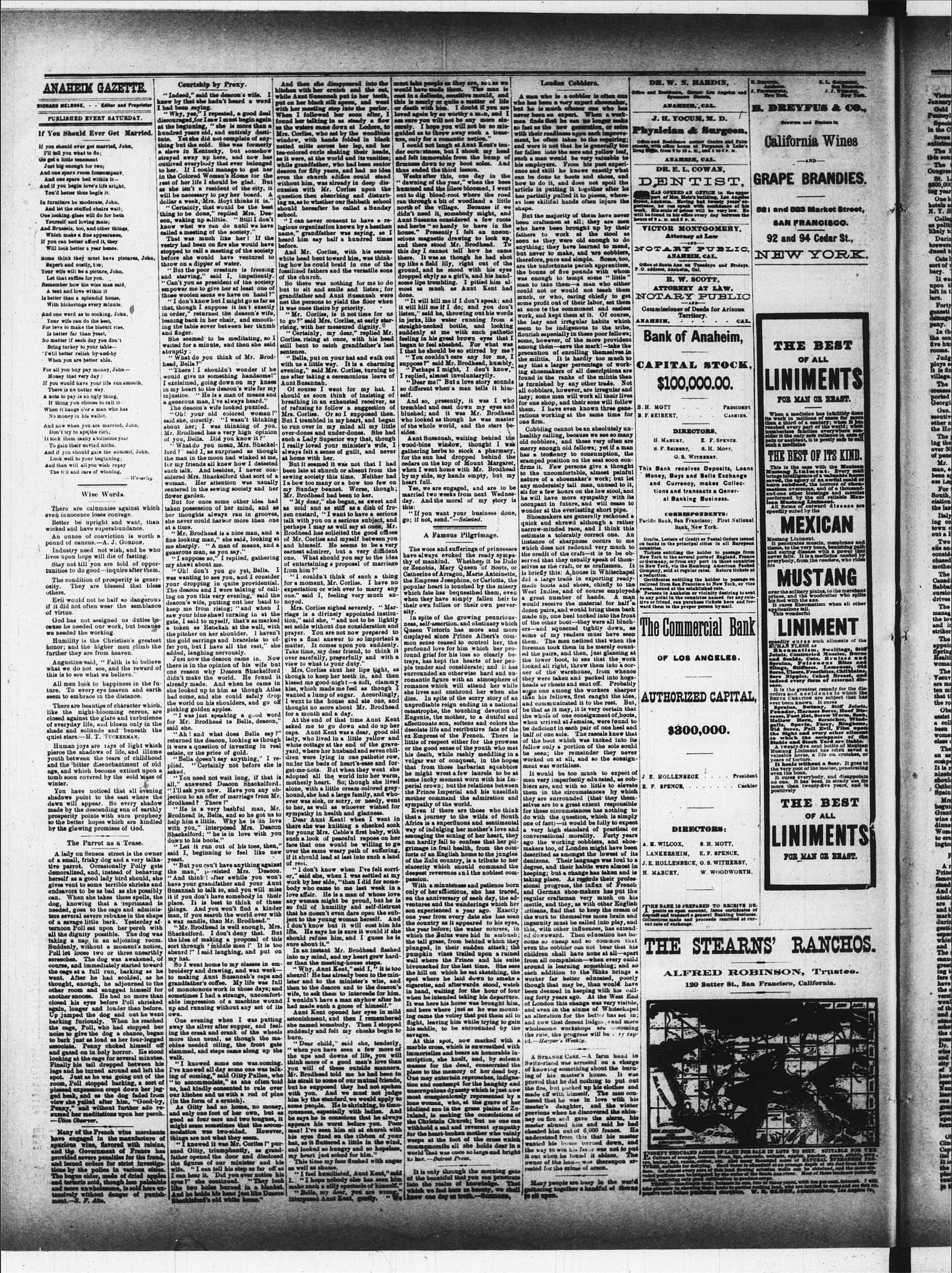
Searchable text
ANAHEIM GAZETTE.
RICHARD MELROSE. - Editor and Proprietor
PUBLISHED EVERY SATURDAY.
If You Should Ever Get Married.
If you should ever get married, John,
I'll tell you what to do;
Go get a little tenement
Just big enough for two;
And one spare room formcompany,
And one spare bed within it—
And if you begin love's life aright,
You'd better thus begin it.
In furniture be moderate, John,
And let the stuffed chairs wait;
One looking-glass will do for both
Yourself and loving mate;
And Brussels, too, and other things,
Which make a fine appearance.
If you can better afford it, they
Will look better a year hence.
Some think they must have pictures, John,
Superb and costly, too;
Your wife will be a picture, John,
Let that suffice for you.
Remember how the wise man said,
A tent and love within it
Is better than a splendid house,
With bickerings every minute.
And one werd as to cooking, John,
Your wife can do the best,
For love to make the biscuit rise,
Is better far than yeast,
No matter if each day you don't
Bring turkey to your table—
Twill better relish by-and-by
When you are better able.
For all you buy pay money, John—
Money that very day!
If you would have your life run smooth,
There is no better way.
A note to pay is an ugly thing,
If thing you choose to call it—
When it hangs o'er a man who has
No money in his wallet.
And now when you are married, John,
Don't try to ape the rich;
It took them many a tollsome year
To gain their envied niche.
And if you should gain the summit, John,
Look well to your beginning;
And then will all you wish repay
The toll and care of winning,
Courtship by Proxy.
"Indeed," said the deacon's wife. I knew by that she hadn't heard a word I had been saying.
"Why, yes," I repeated, a good deal discouraged, for I saw I must begin again at the beginning, "she is more than a hundred years old, and entirely destitute. Yet she did not complain of anything but the cold. She was formerly a slave in Kentucky, but somehow strayed away up here, and now has outlived everybody that ever belonged to her. If I could manage to get her in the Colored Woman's Home for the rest of her life I should be glad. But as she isn't a resident of the city, it will be necessary to pay her board. A dollar a week, Mrs. Hoyt thinks it is."
"Certainly, that would be the best thing to be done," replied Mrs. Deacon, waking up a little. "Still I don't know what we can do until we have called a meeting of the society."
That was much like her! If the vestry had been on fire she would have stopped to call a meeting of the society before she would have ventured to throw on a dipper of water.
"But the poor creature is freezing and starving," said I, impatiently.
"Can't you as president of the society empower me to give her at least one of those woolen sacks we have on hand?"
"I don't know but I might go as far as that, though I suppose it isn't exactly in order," returned the deacon's wife, leaning back in her chair, and smoothing the table cover between her thumbs and fingers.
She seemed to be meditating, so I waited for a minute, and then she said abruptly:
"What do you think of Mr. Brodhead, Bella?"
"There! I shouldn't wonder if he would give us something handsome!" I exclaimed, going down on my knees in my heart to the deacon's wife for my injustice. "He is a man of means and a generous man, I've always heard."
The deacon's wife looked puzzled.
"Oh! your old colored woman!" said she, directly. "I wasn't thinking about her; I was thinking of you. Mr. Brodhead has a very high opinion of you, Bella. Did you know it?"
"What do you mean, Mrs. Shackelford?" said I, as surprised as though the man in the moon had winked at me, for my friends all knew how I detested such talk. And besides, I never conAnd then she disappeared kitchen with her crutch and while Aunt Susannah put in put on her black silk apron with her meeting step into it.
When I followed her soon found her talking in as steal as the waters came down at Mrs. Corliss, who sat by the window, with hands folded netted mitts across her lined-colored curls shaking them as it were, at the world and while grandfather, who had deacon for fifty years, and even the church edifice without him, was already in cussion with Mr. Corliss question then absorbing sitting us, as to whether our Saloon should hereafter be called school.
"I can never consent to ligious organization known name," grandfather was to heard him say half a hour before.
And Mr. Corliss, with white head bent toward him ing how he could braid in fossilized fathers and the veil of the church.
So there was nothing but to sit and smile and grandfather and Aunt Susannah net the persons to yield tha it was once theirs by prior.
"Mr. Corliss, is it not to go?" said Mrs. Corliss, rising, with her measured certainty, my dear," Corliss, rising at once, we still bent to catch grand sentence.
"Bella, put on your hat with us a little way. It is evening," said Mrs. Corliss me after taking a ceremony Aunt Susannah.
Of course I went for should as soon think of breathing in an exhausted of refusing to follow a Mrs. Corliss. Or so I sund But I trembled in my head to run over in my mind over-dones and under-done such a Lady Superior way I really loved your mini always felt a sense of guild at home with her.
But it seemed it was not been late at church or ab
Money that very day!
If you would have your life run smooth,
There is no better way.
A note to pay is an ugly thing.
If thing you choose to call it
When it hangs over a man who has
No money in his wallet.
And now when you are married, John,
Don't try to ape the rich;
It took them many a toilsome year
To gain their envied niche.
And if you should gain the summit, John,
Look well to your beginning;
And then will all you wish repay
The till and care of winning.
Wise Words.
There are calumnies against which even innocence loses courage.
Better be upright and want, than wicked and have superabundance.
An ounce of conviction is worth a pound of cancus.—A. J. Gordon.
Industry need not wish, and he who lives upon hope will die of fasting.
Stay not till you are told of opportunities to do good—inquire after them.
The condition of prosperity is generosity. They are blessed that bless others.
Evil would not be half so dangerous if it did not often wear the semblance of virtue.
God has not assigned us duties because he needed our work, but because we needed the working.
Humility is the Christian's greatest honor; and the higher men climb the further they are from heaven.
Augustine said, "Faith is to believe what we do not see, and the reward of this is to see what we believe."
All men look to happiness in the future. To every eye heaven and earth seem to embrace in the distance.
There are beauties of character which, like the night-blooming cereus, are closed against the glare and turbulence of everyday life, and bloom only in the shade and solitude and beneath the quiet stars.—H. T. Tuckerman.
Human joys are rays of light which pierce the shadows of life, and illume youth between the tears of childhood and the bitter disenchantment of old age, and which become extinct upon a tomb soon covered by the cold mass of winter.
You have noticed that all evening shadows point to the east where the dawn will appear. So every shadow made by the descending sun of earthly prosperity points with sure prophecy so the better hopes which are kindled by the glowing promises of God.
The Parrot as a Tease.
A lady on Seneca street is the owner of a small, frisky dog and a very talkative parrot. Occasionally Polly gets demoralized, and, instead of behaving herself as a good lady bird should, she gives vent to some terrible shrieks and endeavors to be as bad as she possibly can. When she takes these spells, the would give us something handsome!" I exclaimed, going down on my knees in my heart to the deacon's wife for my injustice. "He is a man of means and a generous man, I've always heard."
The deacon's wife looked puzzled.
"Oh! your old colored woman!" said she, directly. "I wasn't thinking about her; I was thinking of you. Mr. Brodhead has a very high opinion of you, Bella. Did you know it?"
What do you mean, Mrs. Shackelford?" said I, as surprised as though the man in the moon had winked at me, for my friends all knew how I detested such talk. And besides, I never considered Mrs. Shackelford that sort of a woman. Her attention was usually centered in the sewing society and her flower garden.
But for once some other idea had taken possession of her mind, and as her thoughts always ran in grooves, she never could harbor more than one at a time.
Mr. Brodhead is a nice man, and a fine-looking man," she said, looking at me sharply. "A man of means, and a generous man, as you say."
"I suppose so," I replied, gathering my shawl about me.
"Oh! don't you go yet, Bella. I was wanting to see you, and I consider your dropping in quite providential. The deacon and I were talking of calling on you this very evening," said the deacon's wife, putting out her hand to keep me from rising; "and when I saw your blue shawl turning in at the gate, I said to myself, that's marked a token as Rebekah at the well, with the pitcher on her shoulder. I haven't the gold earrings and bracelets to offer you, but I have all the rest," she added, laughing nervously.
Just now the deacon came in. Now there is in the opinion of his wife but one reason why Deacon Shackelford didn't make the world. He found it already made. And when he came in she looked up to him as though Atlas had come, and she could safely drop the world on his shoulders, and go off picking golden apples.
"I was just speaking a good word for Mr. Brodhead to Bella, deacon," said she.
"Ah! and what does Bella say?" returned the deacon, looking as though it were a question of investing in real estate, or the price of gold.
"Bella doesn't say anything," I replied. "Certainly not before she is asked."
You need not wait long, if that is all," answered Deacon Shackelford. "I'll ask you now. Have you any objection to an offer of marriage from Mr. Brodhead? There I"
He is a very bashful man, Mr. Brodhead is, Bella, and so he got us to help him a little. Why he is in love with you," interposed Mrs. Deacon Shackelford; "he is in love with you down to his boots."
"Let it run out of his toes, then," said I, beginning to feel like new yeast.
But you can't have anything against the man," persisted Mrs. Deacon. "And think! after awhile you won't have your grandfather and your Aunt Susannah to talk to, and you will miss if you don't have somebody in their me after taking a ceremonial Aunt Susannah.
Of course I went forth should as soon think off breathing in an exhausted refusing to follow a Mrs. Corliss. Or so I sued But I trembled in my head to run over in my mind over-dones and under-dons such a Lady Superior way I really loved your mind always felt a sense of guilt at home with her.
But it seemed it was no been late at church or abide sewing society this time. I bow too many or a boy my Sunday bennet. Ww Mr. Brodhead had been t
"My dear," she began as cold and as stiff as Zen custard, "I want to talk with you on a serious perhaps I may as well say Brodhead has solicited that of Mr. Corliss and myself and himself. He seems earnest admirer, but a one. What should you use of entertaining a proposal from him?"
"I couldn't think of for a moment, Mr. Corliss expectation or wish ever one." said I, feeling vnoyed.
Mrs. Corliss sighed sevriage is a divinely apption," said she, "and not set aside without due com prayer. You are not not give a final answer to matter. It comes upon Take time, my dear friend over carefully, prayerful view to what is your duty
Mrs. Corliss shut her thought to keep her teeth kissed me good-night—kiss, which made me feel wanted a lump of sugar. I went to the house and thought no more about for a month and a day.
At the end of that time asked me to go down caps. Aunt Kent was a lady, who lived in a little white cottage at the end yard, where her husband dren were lying in one under the beds of hearts get-me-nots. But when adopted all the world's motherly heart. So; the alone, with a little cream hound, she had a large foe ever was sick, or sorry; to her, as well as whose sympathy in health and Dear Aunt Kent! w here she was knitting for young Mrs. Cable's such a look of peaceful face that one would be over the same weary past if it should lead at last i of rest.
"I don't know when er," said she, when I work by her side," than body who came to me love affair. He is a man
The Parrot as a Tease.
A lady on Seneca street is the owner of a small, frisky dog and a very talkative parrot. Occasionally Polly gets demoralized, and instead of behaving herself as a good lady bird should, she gives vent to some terrible shrieks and endeavors to be as bad as she possibly can. When she takes these spells, the dog, knowing that a reprimand is needed, goes to the cage and administers several severe rebukes in the shape of a savage little bark. Yesterday afternoon Poll sat upon her perch with all the dignity possible. The dog was taking a nap in an adjoining room. Suddenly, without a moment's notice, Poll let loose two or three unearthly screeches. The dog was awakened, of course, and immediately started toward the cage at a full run, barking as he went. After he had scolded, as he thought, enough, he adjourned to the other room and snugged himself for another snooze. He had no more than closed his eyes before Poll shrieked again, longer and louder than before. Up jumped the dog and out he went barking furiously. When he reached the cage, Poll, who had stopped her noise to give the dog a chance, began to bark just as loud as her four-legged associate. Penny choked himself off and gazed on in holy horror. He stood looking at the cage for several minutes. Finally his tail dropped between his legs and he turned around and left the spot. Just as he was going out of the room, Poll stopped barking, a sort of pleased expression crept down her jagged beak, and as the dog faded from view she yelled after him, "Good-by, Penny," and without further ado resumed her meditations upon her perch.
—Ulica Observer.
Many of the French wine merchants have engaged in the manufacture of spurious wine, flavored with raisins, and the Government of France has provided severe penalties for the fraud, and issued orders for strict investigations by the police in various cities. The bogus older, made of dried apples and tarric acid, though less palatable and more unwholesome, is sold here extensively without danger of punishment.—S. F. Alta.
And then she disappeared into the kitchen with her crutch and the cat, while Aunt Susannah put in her teeth, but on her black silk apron, and went with her meeting step into the parlor. When I followed her soon after, I found her talking in as steady a flow as the waters came down at Lodore, to Mrs. Corliss, who sat by the woodbine window, with hands folded in black netted mitts across her lap, and her sea-colored curls shaking their heads, as it were, at the world and its vanities; while grandfather, who had been senior leason for fifty years, and had no idea even the church edifice could stand without him, was already in deep discussion with Mr. Corliss upon the question then absorbing and disturbing us, as to whether our Sabbath school should hereafter be called a Sunday school.
"I can never consent to have a religious organization known by a heathen name," grandfather was saying, as I heard him say half a hundred times before.
And Mr. Corliss, with his serene white head bent toward him, was thinking how he could braid in one of the fossilized fathers and the versatile sons of the church.
So there was nothing for me to do but to sit and smile and listen; for grandfather and Aunt Susannah were not the persons to yield the floor when it was once theirs by priority.
"Mr. Corliss, is it not time for us to go?" said Mrs. Corliss, at early star-rising, with her measured dignity.
"Certainly, my dear," replied Mr. Corliss, rising at once, with his head still bent to catch grandfather's last sentence.
"Bella, put on your hat and walk out with us a little way. It is a charming evening," said Mrs. Corliss, turning to me after taking a ceremonious leave of Aunt Susannah.
Of course I went for my hat. I should as soon think of insisting of breathing in an exhausted receiver, as of refusing to follow a suggestion of Mrs. Corliss. Or so I supposed then. But I trembled in my heart, and began to run over in my mind all my little over-dones and under-dones. She had such a Lady Superior way that, though I really loved your minister's wife, I always felt a sense of guilt, and never at home with her.
But it seemed it was not that I had been late at church or absent from the must take people as they are, not as we would have made them. The man is cast in a delicate, sensitive mould, and this is nearly or quite a matter of life or death with him. I doubt if you are loved again by so worthy a man, and I am sure you will not be any more sincerely. I hope you will not be so misguided as to throw away such a treasure, only for a romantic notion."
I could not laugh at Aunt Kent's tender earnestness, but I shook my head and felt immovable from the bump of firmness down to my boot soles. And thus ended the third lesson.
Weeks after this, one day in the "dawning of the year," when the bees hummed and the lilacs bloomed, I went out to dig blood-root where the road ran through a bit of woodland a little north of the village. Because if we didn't need it, somebody might, and Aunt Susanna considered a few roots and herbs "so handy to have in the house." Presently I felt an unconscious magnetic drawing to look up, and there stood Mr. Brodhead. To this day I cannot tell how he came there. It was as though he had shot up like a field lily, right out of the ground, and he stood with his eyes dropped shyly as a girl's, and his handsome lips trembling. I pitied him almost as much as Aunt Kent had done.
"It will kill me if I don't speak; and it will kill me if I do; and you don't listen," said he, throwing out his words in jerks, like water running from a straight-necked bottle, and looking suddenly at me with such pathetic feeling in his great brown eyes that I began to feel abashed. For what was I that he should be so stirred by me?
"You couldn't care any for me, I suppose?" said Mr. Brodhead, humbly.
"Perhaps I might, I don't know," I replied, almost involuntaryily.
"Dear me!" But a love story sounds so different when a man tells it himself.
And so, presently, it was I who trembled and cast down my eyes and blushed; and it was Mr. Brodhead who looked as though he was master of the whole world, and the stars besides.
Aunt Susannah, waiting behind the wood-bine window, thought I was gathering herbs to stock a pharmacy, for the sun had dropped behind the cedars on the top of Mount Margaret, when I went home with Mr. Brodhead
London Cobblers.
A man who is a cobbler is often one who has been a very expert shoemaker, but he is much oftener one who has never been an expert. When a workman finds that he can no longer make so fast as the new generation, or seine with their readiness upon each improvement, he often takes to the repairing; and were it not that he is generally too far fallen into the sore and yellow leaf, such a man would be very valuable to his employers. From his past experience and skill he knows exactly what can be done to boots and shoes, and how to do it, and does not spoil the article in putting it together after he has partially pulled it to pieces, whereas less skillful hands often injure the shape.
But the majority of them have never been craftsmen at all; they are men who have been brought up by their fathers to work at the stool as soon as they were old enough to do anything; they have learned to mend but never to make, and are cobblers, therefore pure and simple. Some, too, are the unfortunate parish apprentices, the bonus of five pounds with whom was enough to tempt some "little" man to take them—a man who either could not or would not teach them much, or who, caring chiefly to get some profit out of their labor, set them at once to the commonest and easiest work, and kept them at it. Of course,the lazy and irregular habits which seem to be indigenous to the tribe,fluorish especially in these poor fellows; some, however, of the more provident among them—save the mark!—take the precaution of enrolling themselves in the militia. It is hardly too much to say that a larger percentage of working shoemakers of all descriptions are found in the ranks of the militia than is furnished by any other trade. Not all cobblers, however, are irregular and lazy; some men will work all their lives for one shop,and their sons will follow them. I have even known three generations working at the same time for one firm.
Cobbling cannot be an absolutely unhealthy calling because we see so many old cobblers,and these very often are merry enough old fellows; yet if a man has a tendency to consumption,the eramped position on the seat soon confirms it. Few persons give a thought to the uncomfortable, almost painful
After taking a ceremonious leave of Aunt Susannah,
Of course I went for my hat. I should as soon think of insisting of breathing in an exhausted receiver, as of refusing to follow a suggestion of Mrs. Corliss. Or so I supposed then. But I trembled in my heart, and began to run over in my mind all my little over-dones and under-dones. She had such a Lady Superior way that, though I really loved your minister's wife, I always felt a sense of guilt, and never at home with her.
But it seemed it was not that I had been late at church or absent from the sewing society this time. Neither had I bow too many or a bow too few on my Sunday bonnet. Worse, though; Mr. Brodhead had been to her.
As dear, she began, as sweet and cold and as stiff as a dish of frozen custard, "I want to have a serious talk with you on a serious subject, and perhaps I may as well say at once, Mr. Brodhead has solicited the good offices of Mr. Corliss and myself between you and himself. He seems to be a very earnest admirer, but a very diffident one. What should you say to the idea of entertaining a proposal of marriage from him?"
"I couldn't think of such a thing for a moment. Mr. Corliss. I have no expectation or wish ever to marry any one." said I, feeling very much annoyed.
Mrs. Corliss sighed severely. "Marriage is a divinely appointed institution," said she, "and not to be lightly set aside without due consideration and prayer. You are not now prepared to give a final answer to so important a matter. It comes upon you suddenly. Take time, my dear friend, to think it over carefully, prayerfully and with a view to what is your duty."
Mrs. Corliss shut her lips tight, as though to keep her teeth in, and then kissed me good-night—a soft, clammy kiss, which made me feel as though I wanted a lump of sugar. Accordingly, I went to the house and ate one, and thought no more about Mr. Brodhead for a month and a day.
At the end of that time Aunt Kent asked me to go down and do up her caps. Aunt Kent was a dear, good old lady, who lived in a little yellow and white cottage at the end of the graveyard, where her husband and seven children were lying in one pathetic row, under the beds of heart's ease and forget-me-nots. But when they went she adopted all the world into her warm, motherly heart. So; though she lived alone, with a little cream-colored grey-hound, she had a large family, and whoever was sick, or sorry, or needy, went to her, as well as whoever wished for sympathy in health and gladness.
Dear Aunt Kent! when I went in there she was knitting a checked sock for young Mrs. Cable's first baby, with such a look of peaceful repose on her face that one would be willing to go over the same weary path of suffering, if it should lead at last into such a land of rest.
"I don't know when I've felt sorrier," said she, when I was settled at my work by her side, "than I did for somebody who came to me last week in a love affair. He is a man of whose love I replied, almost involuntarily.
"Dear me!" But a love story sounds so different when a man tells it himself.
And so, presently, it was I who trembled and cast down my eyes and blushed; and it was Mr. Brodhead who looked as though he was master of the whole world, and the stars besides.
Aunt Susannah, waiting behind the wood-bine window, thought I was gathering herbs to stock a pharmacy, for the sun had dropped behind the cedars on the top of Mount Margaret, when I went home with Mr. Brodhead by my side, my hands empty, but my heart full.
Yes, we are engaged, and are to be married two weeks from next Wednesday. And the moral of my story is this:
"If you want your business done, go; if not, send."—Selected.
A Famous Pilgrimage.
The woes and sufferings of princesses have always evoked the ready sympathy of mankind. Whether it be Dido or Zenobia, Mary Queen of Scots, or Catherine of Arragon, Marie Antoinette, the Empress Josephine, or Carlotta, the popular heart is touched by the misery which fate has bequeathed them, even when they have simply fallen heir to their own follies or their own perversity.
In spite of the growing penuriousness, self-assertion, and obstinacy which Queen Victoria has more and more displayed since Prince Albert's common sense ceased to control her, the profound love for him which her profound grief for his loss so clearly betrays, has kept the hearts of her people tender and considerate; and it has surrounded an otherwise hard and unromantic figure with an atmosphere of romance which will attend her while she lives and enshroud her when she dies.
In spite of the sorry story of an unprofitable reign ending in a national catastrophe, the touching devotion of Eugenie, the mother, to a dutiful and affectionate son, softens and colors the desolate life and retributive fate of the ex Empress of the French. There is little of respect either for the prowess or the good sense of the youth who met his death, while rashly meddling in a vulgar war of conquest, in the hopes that from those barbarian squabbles he might wrest a few laurels to be at some lucky memento worn with his Imperial crown; but the relations between the Prince Imperial and his unselfish mother command the admiration and sympathy of the world.
Even if there are those who think that a journey to the wilds of South Africa is a superfinous and sentimental way of indulging her mother's love and assuaging the aching of her heart, they can hardly fail to confess that her pilgrimage in frail health, from the comforts of an English home to the jungles of the Zulu country, is a tribute to her sincerity which should command the deepest reverence and the noblest compassion.
With a minuteness and patience born only of her afflictions, she has traced on the anniversary of each day, the ad
Cobbling cannot be an absolutely unhealthy calling because we see so many old cobblers, and these very often are merry enough old fellows; yet if a man has a tendency to consumption, the eramped position on the seat soon confirms it. Few persons give a thought to the uncomfortable, almost painful nature of a shoemaker's work; but let any moderately tall man, unused to it, sit for a few hours on the low stool, and he will have more sympathy with its occupant in future, and will cease to wonder at the everlasting short pipe.
Shoemakers are generally reckoned a quick and shrewd although a rather narrow-minded race, and I think this estimate a tolerably correct one. An instance of sharpness occurs to me which does not redound very much to the credit of the craft—it is to be observed that they usually speak of themselves as the craft, or as craftsmans. It is briefly this: A house in Whitechapel did a large trade in exporting ready-made boots and shoes, chiefly to the West Indies, and of course employed a great number of hands. A man would receive the material for half-a dozen pairs, and would bring them back made up, one heel tucked into the front of the other boot—they were all bluchers—and squeezed tightly down, as some of my readers must have seen them.
The men noticed when the foreman took them in he merely counted the pairs, and then, just glancing at the lower boot, to see that the work looked all right, threw them into a corner of the warehouse, from whence they were taken and packed into hoga-heads or cheats and sent off. Probably some one among the workers sharper than his fellows, first caught the idea,and communicated it to the rest. But,beth that as it may,它 is very certain thatthe whole of one consignment of boots,when arrived at Jamaica,were found to be deficient in each pair of one heel and half of one sole.The rascals knew thatof the boot which was tucked into its fellow only a portion of the sole couldbe seen;the remainder they never worked on at all,and so the consignment was worthless.
It would be too much to expect of men very imperfectly educated,as cobblers are,and with so little to elevate them in the circumstances by which they are surrounded (that they themselves are to a great extent responsible for these circumstances has nothing to do with the question,which is simply one of fact)—it would be folly to expecta very high standard of practical or conversational morality.Forty years agothe working cobblers,and shoe-makers too.of London might have been described as amongst the lowest of its denizens.Their language was foul toa degree,and their habits were almost in keeping;but a change has takenand is taking place.A regards their professional progress,the influx of Frenchand German shoe-makers has putthe regular craftsmans very much on his
ever was sick, or sorry, or needy, went to her, as well as whoever wished for sympathy in health and gladness.
Dear Aunt Kent! when I went in there she was knitting a checked sock for young Mrs. Cable's first baby, with such a look of peaceful repose on her face that one would be willing to go over the same weary path of suffering, if it should lead at last into such a land of rest.
"I don't know when I've felt sorrier," said she, when I was settled at my work by her side, "than I did for somebody who came to me last week in a love affair. He is a man of whose love any woman might be proud, but he is so full of humility and self-distrust that he doesn't even dare open the subject to the young woman herself. And I don't know but it will cost him his life. He says he is sure it would if she should refuse him, and I guess he is sure about it."
In an instant Mr. Brodhead flashed into my mind, and my heart grew harder than the meeting-house steps.
"Why, Aunt Kent," said I, "it is too absurd! He has already been to the minister and to the minister's wife, and then to the deacon and to the deacon's wife, to ask them to intercede for him. I wouldn't have a man anyhow after he had made such a goose of himself."
Aunt Kent opened her eyes in mild astonishment, and then I remembered she named somebody. Then I stopped suddenly and felt my cheeks begin to burn.
"Dear child," said she, tenderly, "when you have seen a few more of the ups and downs of life, you will think more of a good man's love than you will of these outside manners. Mr. Brodhead told me he had been in his strait to some of our mutual friends, but he supposed they had not spoken with you. And we must not judge him by the standard we would apply to some people. He is shrinking, to timorousness, especially with ladies. And he says he is conscious that he always appears his worst before you. Poor man! I've seen him sit at church with his eyes fixed on the ribbon of your hat, as it fluttered a little in the wind, and looked so hungry and so hopeless, my heart just sched for him."
This time my face flushed with anger as well as shame.
"I feel humiliated, Aunt Kent," said I. "I hope nobody else has seen him make such a silly spectacle of himself."
"Bella, my dear, you are wrong," interposed Aunt Kent, gently.
Even if there are those who think that a journey to the wilds of South Africa is a superfluous and sentimental way of indulging her mother's love and assuaging the aching of her heart, they can hardly fail to confess that her pilgrimage in frail health, from the comforts of an English home to the jungles of the Zulu country, is a tribute to her sincerity which should command the deepest reverence and the noblest compassion.
With a minuteness and patience born only of her afflictions, she has traced, on the anniversary of each day, the adventures and the wanderings which her son experienced a year ago. Exactly one year from every date she has seen the country as it appeared to his eyes, the year before; the water courses, in which the Zulu were hid in ambush; the tall grass, from behind which they plunged, in their sudden attack; the pumpkin vines trailed upon a ruined wall where the Prince and his suite bivouacked for the last time. She sees the hill on which he sat sketching, the spot where he laid down to smoke a cigarette, and afterwards stood, watch in hand, waiting for the hour of four when he intended taking his departure. It was here his horse was brought him, and here where just as he was mounting came the volley that put them all to flight, leaving him while trying to gain his saddle, to be surrounded by the savages.
At this spot, now marked with a marble cross, which is enwresthed with immortelles and bears an honorable inscription, she knelt, and, by solemn masses for the dead, consecrated the place to the memory of her dead boy. One may entertain reproaches, indignation and contempt for the haughty and unscrupulous dynasty which is just now most conspicuously represented by a lone woman, who, at the grave of her idolized son in the grass plains of Zululand, is seeking the consolations of the Christain Church; but no one can withhold a sad and reverent sympathy for the heart-broken mother who vainly weeps at the foot of the cross which commemorates all she holds dear in a world that was once so large and bright as her.—Detroit Press.
It is only through the morning gate of the beautiful that you can penetrate into the realm of knowledge. That which we feel here as beauty, we shall know one day as truth.—Sonneman,
they are surrounded (that they themselves are to a great extent responsible for these circumstances has nothing to do with the question, which is simply one of fact)—it would be folly to expect a very high standard of practical or conversational morality. Forty years ago the working cobblers, and shoe-makers too, of London might have been described as amongst the lowest of its denizens. Their language was foul to a degree, and their habits were almost in keeping; but a change has taken and is taking place. As regards their professional progress, the influx of French and German shoe-makers has put the regular craftsman very much on his mettle, and they, as with other English artisans, find that to keep the cream of the work to themselves more brain and ingenuity must be called into play, and this, with other influences, has extended downward. Then education has become so cheap and so common that even the cobbler can not bear that his children shall have none at all—apart from all compulsion—when every child around is learning something; and so each addition to the ranks brings a worker far better educated, poorly though that may be, than would have been deemed in keeping with his calling forty years ago. At the West End of London this change was very visible, and even in the slums of Whitechapel an alteration for the better has set in; and now that decent lodgings and more wholesome workshops are becoming the rule, the progress will be very rapid.—Harper's Weekly.
A STRANGE CASE.—A farm hand in Switzerland was arrested on a charge of knowing something about the burning of his master's house. It was proved that he did nothing to put out the fire, but packed up his clothes and made off with himself. The man confessed that he was in love with his master's daughter, and the winter previews when he discovered the chimney on fire and gave the alarm, his master abused him and said he had cheated him out of 6,000 francs. He understood from this that his master wanted his house burned down, and the way to win his favor was not to put it out when he found it ablaze. The owner of the house was thereupon arrested for the crime of arson.
Many people are busy in the world's gathering together a handful of thorns to sit upon.
DR. W. N. HARDIN,
Office and Residence, Corner Los Angeles and
Syracuse Streets,
ANAHEIM, CAL.
J. H. YOCUM, M. D.
Physician & Surgeon.
Office and Residence corner Centre and Palm
street, with office hours at Perguson & Lake's
Drug Store, from 9 to 10 A.M., and 4 to 5 P.M.
ANAHEIM, CAL.
DR. E. L. COWAN,
DENTIST,
HAS OPENED AN OFFICE in the upper
part of Mr. Metz's building, Los Angeles
Street, Anaheim. Having had twenty years' expience, he can speak with confidence of his
work. His scale of prices will be very low. He
will be found in his office every day between the
hours of 9 A.M. and 6 P.M.
VICTOR MONTGOMERY,
Attorney at Law
AND
NOTARY PUBLIC,
ANAHEIM, CAL.
Office at Santa Ana on Tuesdays and Fridays.
P.O. address, Anaheim, Cal.
R. W. SCOTT,
ATTORNEY AT LAW,
NOTARY PUBLIC
AND
Commissioner of Deeds for Arizona Territory.
ANAHEIM, CAL.
Bank of Anaheim,
CAPITAL STOCK,
$100,000.00.
S. H. MOTT
PRESIDENT
B. F. SEIBERT,
CASHIER.
DIRECTORS,
H. MABURY,
E. F. SPENCE.
B. F. SHIBERT,
S. H. MOTT.
O. S. WITHERBY.
This Bank receives Deposits, Loans
R. L. GOLDMAN,
San Francisco,
New York.
B. DREYFUS & CO.
Growers and Dealers in
California Wines
AND
GRAPE BRANDIES.
521 and 523 Market Street,
SAN FRANCISCO.
92 and 94 Cedar St.",
NEW YORK.
THE BEST
OF ALL
LINIMENTS
FOR MAN OR BEAST.
When a medicine has infallibly done its work in millions of cases for more than a third of a century; when it has reached every part of the world; when numberless families everywhere consider it the only safe reliance in case of pain or accident, it is pretty safe to call such a medicine
THE BEST OF ITS KIND.
This is the case with the Mexican Mustang Liniments. Every mail
$100,000.00.
S. H. MOTT
PRESIDENT
B. F. SEIBERT,
CASHIER.
DIRECTORS.
H. MABURY,
E. F. SPENCE.
H. F. SHIBERT,
S. H. MOTT.
O. S. WITHERBY.
This Bank receives Deposits, Loans Money, Buys and Sells Exchange and Currency, makes Collections and transacts a General Banking Business.
CORRESPONDENTS:
Pacific Bank, San Francisco; First National Bank, New York.
Drafts, Letters of Credit or Postal Orders issued on banks in the principal cities in all European countries.
Tickets entitling the holder to passage from New York to the several ports of England, France or Germany, or from any port in those countries to New York, via the Hamburg American Packed Company, sold at regular rates. Return tickets at a reduction.
Certificates entitling the holder to passage on railroad from San Francisco to New York, or vice versa, issued at the established rate.
Persons in Anaheim or vicinity desiring to sent to any point in the countries named for any relative or friend, can purchase tickets here and forward them to the proper person by mail.
The Commercial Bank
OF LOS ANGELES.
AUTHORIZED CAPITAL,
$800,000.
J. E. HOLLENBECK
President
E. F. SPENCE,
Cashier
DIRECTORS:
A. H. WILCOX,
S. H. MOTT,
LANKERSHIM,
E. F. SPENCE,
J. E. HOLLENBECK, O. S. WITHERBY,
H. MABURY,
W. WOODWORTH.
LINIMENTS
FOR MAN OR BEAST.
When a medicine has infallibly done its work in millions of cases for more than a third of a century; when it has reached every part of the world; when numberless families everywhere consider it the only safe reliance in case of pain or accident, it is pretty safe to call such a medicine.
THE BEST OF ITS KIND.
This is the case with the Mexican Mustang Liniment. Every mail brings intelligence of a valuable house saver, the agony of an awful snail or burn subdued, the horrors of marmite overcomes, and of a thousand-and-one other blundings and mercies performed by the old reliable Mexican Mustang Liniment.
All forms of outward disease are speedily cured by the MEXICAN Mustang Liniment.
It penetrates muscle, membrane and tissue, to the very bone, banishing path and curing disease with a power that never fails. It is a medicine used by everybody, from the rancher, who rides his MUSTANG over the solitary plains, to the merchant prince, and the woodcutter who splits his foot with the axe.
It cures Rheumatism when all other applications fail.
This wonderful LINIMENT speedsly cures such ailments of the HUMAN FLESH as Rheumatism, Swellings, Stiff Joints, Contracted Muscles, Burns and Soils, Cuts, Bruises and Sprains, Poisonous Bites and Stings, Stiffness, Lameness, Old Sores, Ulcers, Frostbites, Chickenpaws, Sore Nipples, Caked Breast, and indeed every form of external disease.
It is the greatest remedy for the disorders and accidents to which the Braun Creation are subject that has ever been known. It cures Sprains, Swimny, Stiff Joints, Founder, Harness Sores, Hoof Diseases, Foot Met, Screw Worms, Snub Hollow Horn, Serathear, Windgalls, Spavin, Furry, Ringbone, Old Sores, Fall Evil Film upon the Night and every other ailment to which the occupants of the Stobie and Stock Yard are liable.
A twenty-five cent bottle of Mexican Mustang Liniment has often saved a valuable horse, a life on crutches, or years of torture.
It heals without a Scar. It goes to the very root of the matter, penetrating even the bone.
It cures everybody, and disappears no one. It has been in steady use for more than twenty-five years, and is positively THE BEST OF ALL LINIMENTS FOR MAN OR BEAST.
DIRECTORS:
A. H. WILCOX, S. H. MOTT,
LANKERSHIM, E. F. SPENCE,
J. E. HOLLENBECK, O. S. WITHERBY,
H. MABURY, W. WOODWORTH.
THE BANK IS PREPARED TO RECHIVE DEPOSITS ON OPEN ACCOUNT, ISSUE CERTIFICATES OF DEPOSITS AND TRANSACT A GENERAL BANKING BUSINESS. Collections made and proceeds remitted at current rate of exchange.
THE STEARNS' RANCHOS.
ALFRED ROBINSON, Trustee.
120 Sutter St., San Francisco, California.
EIGHTY THOUSAND ACRES OF LAND FOR SALE IN LOTS TO SUIT. SUITABLE FOR THE Culture of oranges, lemons, limes, figs, almonds, walnuts, apples, peaches, pears, alfalfa, corn, rye, barley, hay, rams, cotton, etc. Also many thousand acres of NATURAL EVEORGREEN PASTURES, suitable for drying. Good water is abundant at an average depth of six feet from the surface. On almost every zone of this land flowing irrigation wells can be obtained, and the more elevated portions can be integrated by the water of the Santa Ana river. Most of these lands are naturally moist, requiring only good cultivation to produce crops.
TERMS: One-fourth each; balance in one, two or three years, with ten per cent interest. I will take pleasure in showing these lands to parties seeking land, who are invited to come and see this act, positive trust before purchasing discovers. W. R. OLSON, AGNESANABIM, Los Angeles Co.