anaheim-gazette 1880-07-03
Scanned page
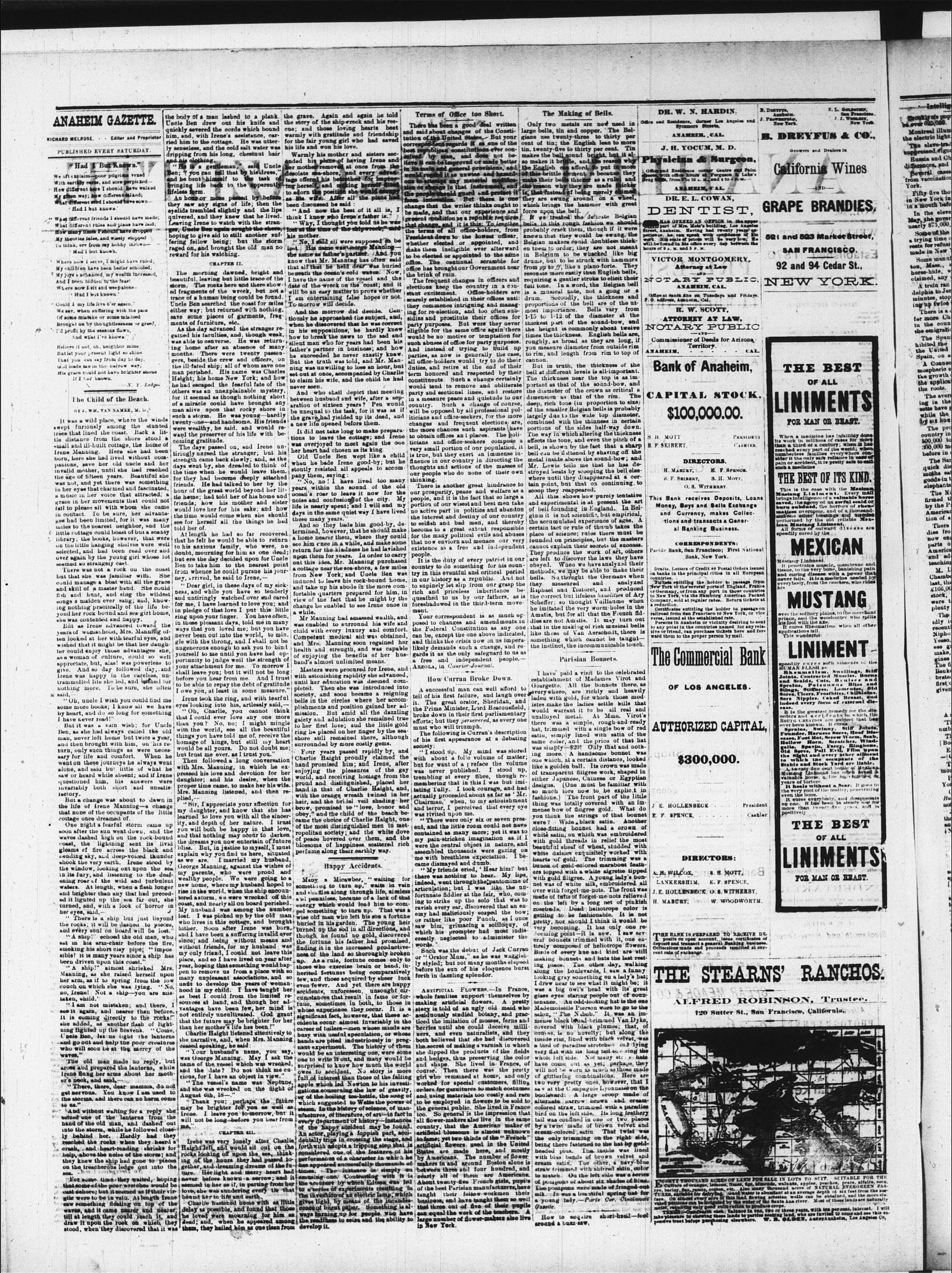
Searchable text
ANAHEIM GAZETTE.
RICHARD MELROSE. Editor and Proprietor
PUBLISHED EVERY SATURDAY.
"Had I But Known."
We oft explain—poor pilgrims vexed
With earthly care, and sore perplexed—
How different here I should have walked
My given way; how different talked;
What different seed I should have sown—
Had I but known.
What different friends I should have made;
What different rules and plans have laid;
How many times I should have dropped
My theories false, and wisely stopped
To think, ere from my hobby thrown—
Mad I but known.
Where now I serve, I might have ruled,
My children have been better schooled;
My joys enhanced, my wealth increased,
And I been bidden to the fear.
Where now I sit and weep alone—
Had I but known.
Could I my life live o'er again?
We say, when suffering with the pain
Of some mistake or some misdeed
Brought on by thoughtlessness or greed,
I'd profit by the seasons flown,
And what I've known.
Believe it not, oh, neighbor mine;
But let your present light so shine
That you can say from day to day;
Od leads me in the narrow way;
His grace could not have brighter shone
If I had known.
N.Y. Ledger
The Child of the Beach.
BY J. WM. VAN NAMEE, M.D.
It was a wild place, where the winds swept furiously among the stunted trees that lined the coast. Back a little distance from the shore stood a small and ill-built cottage, the home of Irene Manning. Here she had been born, here she had lived without companions, save her old uncle and her invalid mother, until she had reached the body of a man lashed to a plank.
Uncle Ben drew out his knife and quickly severed the cords which bound him, and, with Irene's assistance, carried him to the cottage. He was utterly senseless, and the cold salt water was dripping from his long, chestnut hair and his clothing.
"He is a gentleman," said Uncle Ben; "you can tell that by his dress," and he bent himself to the task of bringing life back to the apparently lifeless form.
An hour or more passed by before they saw any signs of life; then the eyelids trembled slightly and the lips quivered, and they knew that he lived. Leaving Irene to watch with the stranger, Uncle Ben again sought the shore, hoping to give aid to still another suffering fellow being; but the storm raged on, and brought the old man no reward for his watching.
CHAPTER II.
The morning dawned, bright and beautiful, leaving but little trace of the storm. The rocks here and there showed fragments of the wreck, but not a trace of a human being could be found. Uncle Ben searched the coast for miles either way; but returned with nothing, save some pieces of garments, fragments of furniture, etc.
As the day advanced the stranger regained his faculties, and, though weak, was able to converse. He was returning home after an absence of many months. There were twenty passengers, beside the crew and officers, on the ill-fated ship; all of whom save one man perished. His name was Charles Haight; his home New York; and how he had escaped the fearful fate of the others was an unexplainable mystery, for it seemed as though nothing short of a miracle could have brought any man alive upon that rocky shore in such a storm. He was young—hardly twenty-one—and handsome. His friends were wealthy, he said, and would reward the preserver of his life with becoming gratitude.
The days passed on, and Irene untiringly nursed the stranger; but his strength came back slowly; and, as the days went by, she dreaded to think of the time when he would leave them.
the grave. Again and again the story of the shipwreck came; and those loving warmly with gratitude arose for the fair young girl who his life and won his love.
Warmly his mother ended his plane of having her mother removed at desolate sea-shore, and taged offered his betrothed herself, and making to adorn the position she as his wife. After all been discussed he said:
"And now the best think I know who Irene."
Why, I thought you lost at the time of the ship's mother.
No, I said all were lost. His name was too same as father's parish know that Mr. Manning that all that he held beneath the ocean's colony I have the name of the date of the wreck on this will be an easy matter to I am entertaining falls To-morrow will decide.
And the morrow diagonally he approached thru in his suppositions, how to break the news silent man who for year father's partner in bush he succeeded in never But the truth was told ning was unwilling to set out at once, accompany claim his wife, and never seen.
And who shall depart between husband and warrion of sixteen years be unequal to the task the grave had yielded a new life opened before It did not take long tions to leave the co-was overjoyed to meet her heart had chosen a Old Uncle Ben when he bade Irene stoutly resisted all ap-
It was a wild place, where the winds swept furiously among the stunted trees that lined the coast. Back a little distance from the shore stood a small and ill-built cottage, the home of Irene Manning. Here she had been born, here she had lived without companions, save her old uncle and her invalid mother, until she had reached the age of fifteen years. Beautiful she was not, and yet there was something in her eyes that charmed and fascinated, a music in her voice that attracted, a grace in her movements that could not fail to please all with whom she came in contact. To be sure, her advantages had been limited, for it was many miles to the nearest neighbor, and the little cottage could boast of but a scanty library; the books, however, that were on the little hanging shelves were well selected, and had been read over and over again by the young girl whose lot seemed so strangely cast.
There was not a rock on the coast but that she was familiar with. She could manage a boat with all the grace and skill of a master hand. She could fish and hunt, and sing the wildest songs a maiden ever sang; and, knowing nothing practically of the life beyond her rock bound and sea-girt home, she was contented and happy.
But as Irene advanced toward the years of womanhood, Mrs. Manning often looked at her with tearful eyes, and wished that it might be that her daughter could enjoy those advantages she as a woman of culture, could so well appreciate, but, alas! was powerless to give. And so day followed day, and Irene was happy in the careless, untrammelled life she led, and washed for nothing more. To be sure, she often said,
"Oh, uncle I wish you could find me some more books; I know all we have by heart, and do so long for something I have never read!"
But it was a vain wish; for Uncle Ben, as she had always called the old man, never left home but twice a year, and then brought with him, on his return, only such things as were necessary for life and comfort. When he went on these journeys he always went alone, and said but little of what he saw or heard while absent; and if Irene questioned him, his answers were invariably both short and unsatisfactory.
But a change was about to dawn in the life of Irene Manning—a change that none of the occupants of the little cottage once dreamed of.
One night a fearful storm came up soon after the sun went down, and the waves dashed high on the rock-bound coast, the lightning sent its vivid gleams of fire across the black and sending sky, and deep-voiced thunder shook the very earth. Irene stood by the window, looking out upon the sea in its fury, and listening to the deafening roar of the wild and turbulent waters. At length, when a flash longer and brighter than any that had preceded it lit up on the sea outside Haight; his home New York; and how he had escaped the fearful fate of the others was an unexplainable mystery, for it seemed as though nothing short of a miracle could have brought any man alive upon that rocky shore in such a storm. He was young—hardly twenty-one—and handsome. His friends were wealthy, he said, and would reward the preserver of his life with becoming gratitude.
The days passed on, and Irene nitrifying narsed the stranger; but his strength came back slowly; and, as the days went by, she dreaded to think of the time when he would leave them, for they had become deeply attached friends. He had talked to her by the hour of the great world beyond her little home; had told her of his home and friends; how his mother and sister would love her for his sake; and how the time would come when she should see for herself all the things he had told her of.
At length he had so far recovered that he felt he would be able to return to his anxious family, who were no doubt, mourning for him as one dead; but ere the day decided upon for Uncle Ben to take him to the nearest point from whence he could purse his journey, arrived, he said to Irene,
"Dear girl, in these days of my sickness, and while you have so tenderly and untiringly watched over and cared for me, I have learned to love you; and in pledge of that love I put this little ring upon your finger. You have often, in these pleasant days, told me in many ways that you loved me; but you have never been out into the world, to mince with the throng, and I shall not be ungenerous enough to ask you to bind yourself to me until you have had opportunity to judge well the strength of your attachment for me. To morrow I shall leave you; but it will not be long before you hear from me. And I trust to be able to repay the debt of gratitude I owe you, at least in some measure."
Irene took the ring, and with tearful eyes looking into his artlessly said,
"Oh, Charlie, you cannot think that I could ever love any one more than you? No, no; I might mingle with the world, see all the beautiful things you have told me of. receive the homage of kings, but still my heart would be all yours. Do not doubt me; but trust me ever, as I trust you."
Then followed a long conversation with Mrs. Manning, in which he expressed his love and devotion for her daughter; and his desire, when the proper time came, to make her his wife. Mrs. Manning listened, and then replied,
"Sir, I appreciate your affection for my daughter, and know that she has learned to love you with all the sincerity, and depth of her nature. I trust you will both be happy in that love, and that nothing may occur to darken the dreams you now entertain of future bliss. But, in justice to myself, I must explain why you find us here, situated as we are. I married my husband, George Manning, against the wishes of my parents, who were proud and wealthy people. We were going to a new home, where my husband hoped to rise in the world; when the ship encountered a storm, we were wrecked off this harbour; his home New York; and how he had escaped the fearful fate of the others was an unexplainable mystery, for it seemed as though nothing short of a miracle could have brought any man alive upon that rocky shore in such a storm. He was young—hardly twenty-one—and handsome. His friends were wealthy, he said, and would reward the preserver of his life with becoming gratitude.
The days passed on, and Irene nitrifying narsed the stranger; but his strength came back slowly; and as the days went by, she dreaded to think of the time when he would leave them. For they had become deeply attached friends. He had talked to her by the hour of the great world beyond her little home; had told her of his home and friends; how his mother and sister would love her for his sake; and how the time would come when she should see for herself all the things he had told her of.
At length he had so far recovered that he felt he would be able to return to his anxious family, who were no doubt, mourning for him as one dead; but ere the day decided upon for Uncle Ben to take him to the nearest point from whence he could purse his journey, arrived, he said to Irene,
"Dear girl, in these days of my sickness, and while you have so tenderly and untiringly watched over and cared for me, I have learned to love you; and in pledge of that love I put this little ring upon your finger. You have often, in these pleasant days,told me in many ways that you loved me; but you have never been out into the world; to mince with the throng,and I shall not be ungenerous enough to ask you to bind yourself to me until you have had opportunity to judge well the strength of your attachment for me. To morrow I shall leave you; but it will not be long before you hear from me. And I trust to be able to repay the debt of gratitude I owe you, at least in some measure."
Irene took the ring, and with tearful eyes looking into his artlessly said,
"Oh, Charlie, you cannot think that I could ever love any one more than you? No, no; I might mingle with the world, see all the beautiful things you have told me of. receive the homage of kings,但 still my heart would be all yours. Do not doubt me; but trust me ever.as I trust you."
Then followed a long conversation with Mrs. Manning, in which he expressed his love and devotion for her daughter; and his desire,when the proper time came,to make her his wife.Mrs. Manning listened,and then replied,
"Sir,I appreciate your affection for my daughter,and know that she has learned to love you with all the sincerity,and depth of her nature.I trust you will both be happy in that love,and that nothing may occur to darkenthe dreamsyounowentertainoffuturebliss.But,在justicetomyself,我mustexplainwhyyoufindushere,situatedasweare.ImarriedmyhusbandGeorgeManning,againstthewishesofmyparents,whowereproudandwealthypeople.Weweregoingtoanewhomewheremyhusbandhopedtoreiseintheworld,whentheshipencountereda storm,我们werewreckedoffthisharbour;hishomeNewYork;andhowhehadescapedthefearfulfateoftheotherswasanunexplainablemystery.foritseemedasthoughnothingshortofamiraclecouldhavebroughtanymanaliveupinhisabodeorreturnforthekindnessuponthemforyears.outthisideaMr.Ma,cottageneartheseafromNewYork;andinducedtoleavehisranchtakeuphisabodefortablequarterspreviewofthefactthatchangebeenabledtoawhile.MrManninghadanwasenabledtosurprisechildwitheveryluxuryCompetentmedicalandMrs.Manningshealth和strength.ofenjoyingthebeachband'salmostunlimitedMasterswereprocesswithastonishingrapidityuntilhereducationwouldpleted。Thenshewasacalledtoherfirstlove;andringheplacedonhershorestillremainedsurroundedbymoreFouryearspassedCharlieHaightpromisedhimenjoyingthepleasureworld,andreceivingproudanddistinguishhandinthatofChairwiththeorangewristhair,andthebridialbow,promisedtoobey,"andthechildcamethechoiceOfOfthemostdistinguishropolitan society;andofpeacehoveredowblossomsofhappinessperumealongtheir
Happy A
But a change was about to dawn in the life of Irene Manning—a change that none of the occupants of the little cottage once dreamed of.
One night a fearful storm came up soon after the sun went down, and the waves dashed high on the rock-bound coast, the lightning sent its vivid gleams of fire across the black and winding sky, and deep-voiced thunder shook the very earth. Irene stood by the window, looking out upon the sea in its fury, and listening to the deafening roar of the wild and turbulent waters. At length, when a flash longer and brighter than any that had preceded it lighted up the sea far out, she turned, and with a look of horror in her eyes, said,
"There is a ship but just beyond the rocks; it will be dashed to pieces, and every soul on board will be lost."
"A ship!" echoed the old man, who sat in his arm-chair before the fire, smoking his short clay pipe; "impossible! It is many years since a ship has been driven upon this coast."
"A ship!" almost shrieked Mrs. Manning, as she raised herself upon her arm, as if to spring from the low couch on which she was lying. "No, no, Irene! Not a ship—you are mistaken, child."
"I am not mistaken; and there, I see it again, and nearer than before. It is coming directly to the rocks!" she added, as another flash of lightning lighted up the heavens. "Come, Uncle Ben, let us fight the lanterns and go out and help the poor creatures who will soon be at the mercy of the waves."
The old man made no reply, but arose and prepared the lanterns, while Irene flung her arms about her mother's neck, and said,
"There, there, dear mamma, do not get nervous. You know I am used to the storms, and there can no harm come to us."
And without waiting for a reply she seized one of the lanterns from the hand of the old man, and dashed out into the storm, while he followed closely behind her. Hardly had they reached the rocks when they heard a crash, and heart-reading shrieks for help, above the noise of the storm; and they knew the ship had gone to pieces on the treacherous ledge out into the sea.
For some time they waited, hoping that some of the poor wretches would be cast ashore; but it seemed as if their vigile were to be in vain. At length Irene saw something floating on top of the waves, and it came nearer and nearer; till at length they could reach it, and draw it upon the rock on which they stood, when they discovered that it was
Sir, I appreciate your affection for my daughter, and know that she has learned to love you with all the sincerity, and depth of her nature. I trust you will both be happy in that love, and that nothing may occur to darken the dreams you now entertain of future bliss. But, in justice to myself, I must explain why you find us here, situated as we are. I married my husband, George Manning, against the wishes of my parents, who were proud and wealthy people. We were going to a new home, where my husband hoped to rise in the world, when the ship encountered a storm; we were wrecked off this coast, and nearly all on board perished. My husband was among the number lost. I was picked up by the old man who lives in this cottage, and brought hither. Soon after Irene was born, and I have been a suffering invalid ever since; and being without means and without friends, for my husband was my only friend, I could not leave this place, and so I have lived on year after year, hoping that something would happen to remove us from a place with so many unpleasant associations, and so unfit to develop the years of womanhood in my child. I have taught her as best I could from the limited resources at hand, and though her advantages have been few, her mind is not entirely uncultivated. God grant that the future may be brighter for her than her mother's life has been!
Charlie Haight listened attentively to the narrative, and when Mrs. Manning ceased speaking, he said:
"Your husband's name, you say, was George Manning. May I ask the name of the vessel which was wrecked, and the date? Do not think me curious, for I have an object in view."
"The vessel's name was Neptune, and she was wrecked on the night of August 6th, 18—"
"Thank you; perhaps the future may be brighter for you as well as Irene. I leave you to morrow, but it will not be long before you hear from me."
CHAPTER SIX.
Irene was very lonely after Charlie Haight left, and would sit out on the rocks looking off upon the sea, thinking of the hours they had passed together, and dreaming dreams of future Her light and merry heart had never before known a sorrow; and it seemed to her as if, in part from her love, she was sundering every tie that bound her to life and earth.
Charlie hastened home with as little delay as possible, and found that those he loved were mourning for him as dead; and when he appeared among them, they hailed him as one risen from hair, and the bridal brow promised to obey," and the child came the choice of C of the most distinguishropolitan society; and of peace hovered over blossoms of happiness perfume along their
Happy Ace
Many a Micawb somehow to turn in shades along this wall and penniless because energy which would pel something to tune wise old man who lear buried in his garden turned up the sod ind though he found nthe fortune his fate finding it in the incense of the land so np. As a rule, forty those who exercise herited fortunes be few, and those acquainted even fewer. And yet accidents, unforescured circumstances that result sometimes in whose experience this significant fact how oidenta occur almost career of tailors—may busy with useful spands hands are plied indnant experiment. T would be an interest one to write it out,s surprised to know how owes to accident full of interest than apple which led Newgations concerning or of the boiling test which suggested to steam. In the history infactures of literature every department of of the happy accident An actor playing a dentally trips in crook forthwith adopts a performance of a chin has appeared success times. The instill amusing one. Conducted by whiseto a series of experimentsthe invention of an gives light by mean cause of burnt paper ways turning up for readiness to seize develop it.
the grave. Again and again he told the story of the shipwreck and his rescue; and those loving hearts beat warmly with gratitude and friendship for the fair young girl who had saved his life and won his love.
Warmly his mother and sisters seconded his plans of having Irene and her mother removed at once from the desolate sea-shore, and every advantage offered his betrothed for improving herself, and making herself fitted to adorn the position she would occupy as his wife. After all the plans had been discussed he said:
"And now the best of it all is, I think I know who Irene's father is."
"Why, I thought you told us he was lost at the time of the shipwreck," said his mother.
"No, I said all were supposed to be lost. His name was George Manning—the same as father's partner. And you know that Mr. Manning has often said that all that he held dear was buried beneath the ocean's cold waves. Now, I have the name of the vessel and the date of the wreck on the coast; and it will be an easy matter to prove whether I am entertaining false hopes or not. To-morrow will decide.
And the morrow did decide. Cautiously he approached the subject, and when he discovered that he was correct in his suppositions, he hardly knew how to break the news to the sad and silent man who for years had been his father's partner in business; and how he succeeded he never exactly knew. But the truth was told, and Mr. Manning was unwilling to lose an hour, but set out at once, accompanied by Charlie to claim his wife, and the child he had never seen.
And who shall depict that meeting between husband and wife, after a separation of sixteen years? Pen would be unequal to the task, for it was as if the grave had yielded up its dead, and a new life opened before them.
It did not take long to make preparations to leave the cottage; and Irene was overjoyed to meet again the one her heart had chosen as its king.
Old Uncle Ben wept like a child when he bade Irene good-by; but he stoutly resisted all appeals to accompany them saving:
Terms of Office too Short.
There has been a good deal written and said about changes of the Constitution of the United States. But your correspondents regard it as one of the best republican constitutions ever conceived by man, and does not believe it can be improved or made better in its main and general provisions, and would regard it as unwise and hazardous to attempt any material modification or change in that instrument, and the people should guard and protect it from innovation. But there is one change that the writer thinks ought to be made, and that our experience and present condition as a republic requires that change, and it is this: To lengthen the terms of all office-holders, from President down to the lowest officer, whether elected or appointed, and make them ineligible ever afterward to be elected or appointed to the same office. The continual scramble for office has brought our Government near the brink of ruin.
The frequent changes in officers and elections keep the country in a constant excitement. Office-holders are scarcely established in their offices until they commence intriguing and managing for re-election, and too often subsidize and prostitute their offices for party purposes. But were they never eligible for the same office again there would be no motive or temptation for such abuses of office for party purposes. And instead of trying to build up parties, as now is generally the case, all office-holders would try to do their duties, and retire at the end of their term honored and respected by their constituents. Such a change certainly would tend to remove and obliterate party and sectional lines, and restore in a measure peace and quietude to our country. Such a change of course, will be opposed by all professional politicians and office-seekers, for the more changes and frequent elections, are, the more chances such aspirants have to obtain offices and places. The politicians and office-seekers compose a very small portion of our population, it is true, but they exert an immense influence in our country in directing the thoughts and actions of the masses of our people who do none of their own
The Making of Bells.
Only two metals are now used in large bells, tin and copper. The Belgians use twenty-three to thirty per cent of tin; the English lean to more tin, twenty-five to thirty per cent. Tin makes the bell sound bright, but it also makes it brittle, and the reason why the English can afford to put in more of this brittle element is because they make their bells thicker as a rule; and the reason why they are made thicker is that instead of being merely chipped they are swung around on a wheel, which brings the hammer with great force upon the bell.
If we treated the delicate Belgian bells in this rough fashion we should probably crack them, though if it were known that they would be swung, the Belgian makers could doubtless thicken them to order; they are not meant in Belgium to be whacked like big drums, but to be struck with hammers from pp to ff, like a piano-forte. They resonate more easily than English bells, requiring a gentler stroke to elicit their full tone. In a word, the Belgian bell is a musical note, not a gong or a drum. Secondly, the thickness and proportions of the bell are of utmost importance. Bells vary from 1-15 to 1-12 of the diameter at the thickest part of the sound-bow, and the height is commonly about twelve times the thickness. English bells are roughly, as broad as they are long, if you measure diameter from outside rim to rim, and length from rim to top of cannon.
But in truth, the thickness of the bell at different levels is all-important. The thickness near the top is as important as that of the sound-bow, and the diameter of the crown as critical a dimension as that of the rim. The deep, rich tone (in proportion to size) of the smaller Belgian bells is probably largely due to the wide top diameter, combined with the thinness in certain portions of the sides half-way down. The way in which altering the thickness affects the tone, and even the pitch of a bell, is shown by the fact that a sharp bell can be distended by shaving off the metal inside above the sound-bow; and Mr. Lewis tells me that he has destroyed beats by scooping the bell else-
set out at once, accompanied by Charles to claim his wife, and the child he had never seen.
And who shall depict that meeting between husband and wife, after a separation of sixteen years? Pen would be unequal to the task, for it was as if the grave had yielded up its dead, and a new life opened before them.
It did not take long to make preparations to leave the cottage; and Irene was overjoyed to meet again the one her heart had chosen as its king.
Old Uncle Ben wept like a child when he bade Irene good-by; but he stoutly resisted all appeals to accompany them, saying:
"No, no! I have lived too many years within the sound of the old ocean's roar to leave it now for the noise and confusion of the city. My life is nearly spent; and I will end my days in the same quiet way I have lived these many years."
And so they bade him good-by, determined, however, that he should make a home nearer them, where they could see him once in a while, and make some return for the kindness he had lavished upon them for years. In order to carry out this idea, Mr. Manning purchased a cottage near the sea-shore, a few miles from New York, and Irene Ben was induced to leave his rock-bound home, and take up his abode in the more comfortable quarters prepared for him, in view of the fact that he might by the change be enabled to see Irene once in a while.
Mr Manning had amassed wealth, and was enabled to surround his wife and child with every luxury and comfort. Competent medical aid was obtained, and Mrs. Manning soon regained her health and strength, and was capable of enjoying the benefits of her husband's almost unlimited means.
Masters were procured for Irene, and with astonishing rapidity she advanced, until her education was deemed completed. Then she was introduced into society, and soon became a reigning belle in the circles where her accomplishments and position gained her admission. But amid all the dazzling gaiety and adulation she remained true to her first love; and the little gold ring he placed on her finger by the seashore still remained there, although surrounded by more costly gems.
Four years passed rapidly by, and Charlie Haight proudly claimed the hand promised him; and Irene, after enjoying the pleasures of the gay world, and receiving homage from the proud and distinguished, placed her hand in that of Charlie Haight, and with the orange wreath twined in her hair, and the bridal veil shading her brow, promised to "love, honor and obey," and the child of the beach became the choice of Charlie Haight, one of the most distinguished men in metropolitan society; and the white dove of peace hovered over them, and the blossoms of happiness scattered rich perfume along their earthly way.
Happy Accidents.
Many a Micawber, "waiting for something to turn up," waits in vain and similes along through life, aimless, because of a lack of that term honored and respected by their constituents. Such a change certainly would tend to remove and obliterate party and sectional lines, and restore in a measure peace and quietude to our country. Such a change of course, will be opposed by all professional politicians and office-seekers, for the more changes and frequent elections are, the more chances such aspirants have to obtain offices and places. The politicians and office-seekers compose a very small portion of our population, it is true, but they exert an immense influence in our country in directing the thoughts and actions of our people who do none of their own thinking.
There is another great hindrance to our prosperity, peace and welfare as a people, and it is the fact that so large a portion of our wisest and best men take no active part in politics and abandon the interest and destiny of our country to selfish and bad men, and thereby become to a great extent responsible for the many political evils and abuses that now enviorn and menace our very existence as a free and independent people.
It is the duty of every patriot in our country to do something for his country in this eventful and critical period in our history as a republic. And not to supinely let slip from our grasp the rich and priceless inheritance bequeathed to us by our fathers, as is foreshadowed in the third-term movement.
Your correspondent is as much opposed to changes and amendments in the Federal Constitution as any one can be, except the one above indicated, and thinks the crisis now on us imperatively demands such a change, and regards it as the only safeguard to us as a free and independent people.—ARROLA, in Courier-Journal.
How Curran Broke Down.
A successful man can well afford to tell of his first failure, and laugh over it. The great orator, Sheridan, and the Prime Minister, Lord Beaconsfield, broke down in their first parliamentary efforts; but they persevered, as every one must who will triumph.
The following is Curran's description of his first appearance at a debating society:
"I stood up. My mind was stored with about a folio volume of matter; but for want of a preface the volume was never published. I stood up, trembling at every fibre, though remembering that in this I was but imitating fully. I took courage, and had actually proceeded about as far as 'Mr. Chairman,' when, to my astonishment and terror, I perceived that every eye was rivited upon me.
"There were only six or seven present, and the little room could not have contained as many more; yet it was to my pain-striken imagination as if I were the central object in nature, and assembled thousands were gazing on me with breathless expectation. I became dismayed and dumb.
"My friends cried, 'Hear him!' but there was nothing to hear. My lips indeed went through the pantomime of articulation; but I was like the unfortunate fiddler at the fair, who,
I have paid a visit to the celebrated establishment of Madames Virot and Geargette. All the bonnets there, as everywhere, are richly and heavily laden with gold, for which those modifies make the ladies settle bills that would warrant it to be all real and unalloyed metal. At Mme. Virot's there was a simple, rough-and-ready hat, trimmed with a single bow of red satin, simply lined with satin of the same color, and the price of that hat was simply—$20! Only that and nothing more. A handsome bonnet was one which, at a certain distance, looked like a golden ball. Its crown was made of transparent diagree work, shaped in either Japanese, Chinese or Egyptian designs. (One must be familiar with so much tore now to be explicit in fashions.) The front part of the little thing was totally covered with an immense bow of fingree gold. What do you think of the strings of that bonnet were? Wide black satin. Another close-fitting bonnet had a crown of white satin, on which was embroidered with gold threads in relief the most beautiful sheaf of wheat, studded with white daisies exquisitely worked with hearts of gold. The trimming was a bungee of gold-colored maraboat feathers topped with a white sigarette tipped with gold filigree. A young lady's bonnet was of white silk, embroidered all over with forget-me-nots. The front was made of tufts of forget-me-nots relieved
Happy Accidents.
Many a Micawber, "waiting for something to turn up," waits in vain and shuffles along through life, aimless and penniless, because of a lack of that energy which would lead him to compel something to turn up. That was a wise old man who left his son a fortune buried in his garden. The young heir turned up the soil in directions, and though he found no gold, discovered the fortune his father had promised, finding it in the increased productivity of the land so thoroughly broken up. As a rule, fortune comes only to those who exercise brain or hand, inherited fortunes being comparatively few, and those acquired by sheer luck even fewer. And yet there are happy accidents, unforeseen, unsought circumstances that result in fame or fortune, sometimes in both, to those in whose experience they occur. It is a significant fact, however, that these accidents occur almost invariably in the career of tailors—men whose minds are busy with useful speculation, or whose hands are plied industriously in pregnant experiment. The history of them would be an interesting one, were some one to write it out, and many would be surprised to know how much the world owes to accident. No story is more full of interest than those of the falling apple which led Newton to his investigations concerning the law of gravity, or of the boiling tea-kettle, the song of which suggested to Watte the power of steam. In the history of science, of manufactures, of literature, of art—in fact in every department of history—instances of the happy accident may be found.
An actor, playing a foppish part, accidentally trips in crossing the stage, and forthwith adopts a tripping step that is considered one of the features of his performance of a character in which he has appeared successfully thousands of times. The instance is simply an amusing one. Contrasting with it is the accident by which Edison was led to a series of experiments resulting in the invention of an electric lamp, which gives light by means of the incandescence of burnt paper. Something is always turning up for people who have the readiness to seize and the ability to develop it.
Chairman,' when, to my astonishment and terror, I perceived that every eye was rivited upon me.
"There were only six or seven present, and the little room could not have contained as many more; yet it was to my pain-striken imagination as if I were the central object in nature, and assembled thousands were gazing on me with breathless expectation. I became dismayed and dumb.
"My friends cried, 'Hear him!' but there was nothing to hear. My lips indeed, went through the pantomime of articulation; but I was like the unfortunate fiddler at the fair, who, coming to strike up the solo that was to ravish every ear, discovered that an enemy had maliciously soaped the bow; or rather like poor Punch, as I once saw him, grimacing a soliloquy, of which his prompter had most indiscreetly neglected to administer the words."
Such was the debut of Jack Curran or "Orator Mum," as he was waggishly styled; but not many months elapsed before the sun of his eloquence burst forth in dazzling splendor.
ARTIFICIAL FLOWERS.—In France, whole families support themselves by making artificial flowers. A pretty story is told of an ugly old maid who assiduously studied botany, and practiced the imitation of mosses, ferns and berries until she could deceive millers, and even naturalists, and they both believed that she had discovered the secret of making a varnish in which she dipped the products of the fields and hedges, thus preserving the color and shape. She lived in France, of course. Then there was the pretty girl who remained at home, and only worked for special customers, filling orders for garnitures to match costumes and using materials too costly and rare to be employed in flowers to be sold to the general public. She lived in France too. So general is the impression that all flower-makers also live in the same country, that the American maker of artificial blossoms is almost unknown to fame; yet two-thirds of the "French" artificial flowers used in the United States are made here, and mostly by Americans. The number of flower-makers in and around Boston alone is between three and four hundred, and nearly all of them are Americans. About twenty-five French girls, pupils of the best Parisian manufacturers, have taught their fellow-workmen their business, and have taught them so well that three out of five of their pupils can equal the work of the teachers. A large number of flower-makers also live in New York.
How to acquire short-hand—fool around a buzz-saw,
Another close-fitting bonnet had a crown of white satin, on which was embroidered with gold threads in relief the most beautiful sheaf of wheat, studded with white daisy exquisitely worked with hearts of gold. The trimming was a bunch of gold-colored marabout feathers topped with a white aigrette tipped with gold filigree. A young lady's bonnet was of white silk, embroidered all over with forget-me-nots. The front was made of tufts of forget-me-nots relieved on the left by a long net of pinkish rosebuds. Dead heliotrope color is getting to be fashionable. It is not pretty, nor should I think it would be very becoming. It has only one reeling point—it is new. I saw several bonets trimmed with it, one entirely composed of heliotrope flowers. Birds of every hue and kind are still making bonnets; and hats the last resting place. The other day, walking along the boulevards, I saw a funny-looking gray something on a lady's hat; I drew near to see what it might be; it was a big owl's head with its great glass eyes staring people out of countenance. An odd-looking hat is the one Mademoiselle Pierson wore to go to the salon," The Nabob." It was an immense black broad-brimmed Van Dyke, covered with black plumes; that, of course, is no novelty; but along the inside rim, lined with black velvet, was a bird of paradise stretched and lying very flat with its long tail covering the whole left side. Not many struts have come out as yet; perhaps they will not be worn as much as those made of glittering combinations. Here are two very pretty ones; however, that I saw at the Compagnie Lyonnaise on the boulevard: A large scoop made of alternate narrow brown and cream-colored straw; trimmed with a paradise bird on the left side. Its long feathery tail was confined in one or two places by a twist made of brown velvet and cream-colored satin. The other, a navy-blue straw trimmed with shirred satin, color to match. On the left side was a series of pompons of about six shades of blue. The pompons were made of fringed-out milk. It was a beautiful spring hat for a young Italy—Paris Corcineau Gascette.
How to acquire short-hand—fool around a buzz-saw,
Another close-fitting bonnet had a crown of white satin, on which was embroidered with gold threads in relief the most beautiful sheaf of wheat, studded with white daisy exquisitely worked with hearts of gold. The trimming was a bunch of gold-colored marabout feathers topped with a white aigrette tipped with gold filigree. A young lady's bonnet was of white silk, embroidered all over with forget-me-nots. The front was made of tufts of forget-me-nots relieved on the left by a long net of pinkish rosebuds. Dead heliotrope color is getting to be fashionable. It is not pretty, nor should I think it would be very becoming. It has only one reeling point—it is new. I saw several bonets trimmed with it, one entirely composed of heliotrope flowers. Birds of every hue and kind are still making bonnets; and hats the last resting place. The other day, walking along the boulevards, I saw a funny-looking gray something on a lady's hat; I drew near to see what it might be; it was a big owl's head with its great glass eyes staring people out of countenance. An odd-looking hat is the one Mademoiselle Pierson wore to go to the salon," The Nabob." It was an immense black broad-brimmed Van Dyke, covered with black plumes; that, of course, is no novelty; but along the inside rim, lined with black velvet, was a bird of paradise stretched and lying very flat with its long tail covering the whole left side. Not many struts have come out as yet; perhaps they will not be worn as much as those made of glittering combinations. Here are two very pretty ones; however, that I saw at the Compagnie Lyonnaise on the boulevard: A large scoop made of alternate narrow brown and cream-colored straw; trimmed with a paradise bird on the left side. Its long feathery tail was confined in one or two places by a twist made of brown velvet and cream-colored satin. The other, a navy-blue straw trimmed with shirred satin, color to match. On the left side was a series of pompons of about six shades of blue. The pompons were made of fringed-out milk. It was a beautiful spring hat for a young Italy—Paris Corcineau Gascette.
How to acquire short-hand—fool around a buzz-saw,
Another close-fitting bonnet had a crown of white satin, on which was embroidered with gold threads in relief the most beautiful sheaf of wheat, studded with white daisy exquisitely worked with hearts of gold. The trimming was a bunch of gold-colored marabout feathers topped with a white aigrette tipped with gold filigree. A young lady's bonnet was of white silk, embroidered all over with forget-me-nots. The front was made of tufts of forget-me-nots relieved on the left by a long net of pinkish rosebuds. Dead heliotrope color is getting to be fashionable. It is not pretty, nor should I think it would be very becoming. It has only one reeling point—it is new. I saw several bonets trimmed with it, one entirely composed of heliotrope flowers. Birds of every hue and kind are still making bonnets; and hats the last resting place. The other day, walking along the boulevards, I saw a funny-looking gray something on a lady's hat; I drew near to see what it might be; it was a big owl's head with its great glass eyes staring people out of countenance. An odd-looking hat is the one Mademoiselle Pierson wore to go to the salon," The Nabob." It was an immense black broad-brimmed Van Dyke, covered with black plumes; that, of course, is no novelty; but along the inside rim, lined with black velvet, was a bird of paradise stretched and lying very flat with its long tail covering the whole left side. Not many struts have come out as yet; perhaps they will not be worn as much as those made of glittering combinations. Here are two very pretty ones; however, that I saw at the Compagnie Lyonnaise on the boulevard: A large scoop made of alternate narrow brown and cream-colored straw; trimmed with a paradise bird on the left side. Its long feathery tail was confined in one or two places by a twist made of brown velvet and cream-colored satin; The other, a navy-blue straw trimmed with shirred satin, color to match. On the left side was a series of pompons of about six shades of blue. The pompons were made of fringed-out milk. It was a beautiful spring hat for a young Italy—Paris Corcineau Gascette.
How to acquire short-hand—fool around a buzz-saw,
Another close-fitting bonnet had a crown of white satin, on which was embroidered with gold threads in relief the most beautiful sheaf of wheat, studded with white daisy exquisitely worked with hearts of gold. The trimming was a bunch of gold-colored marabout feathers topped with a white aigrette tipped with gold filigree. A young lady's bonnet was of white silk, embroidered all over with forget-me-nots. The front was made of tufts of forget-me-nots relieved on the left by a long net of pinkish rosebuds. Dead heliotrope color is getting to be fashionable. It is not pretty, nor should I think it would be very becoming. It has only one reeling point—it is new. I saw several bonets trimmed with it, one entirely composed of heliotrope flowers. Birds of every hue and kind are still making bonnets; and hats the last resting place. The other day, walking along the boulevards, I saw a funny-looking gray something on a lady's hat; I drew near to see what it might be; it was a big owl's head with its great glass eyes staring people out of countenance. An odd-looking hat is the one Mademoiselle Pierson wore to go to the salon," The Nabob." It was an immense black broad-brimmed Van Dyke, covered with black plumes; that, of course, is no novelty; but along the inside rim, lined with black velvet, was a bird of paradise stretched and lying very flat with its long tail covering the whole left side. Not many struts have come out as yet; perhaps they will not be worn as much as those made of glittering combinations. Here are two very pretty ones; however, that I saw at the Compagnie Lyonnaise on the boulevard: A large scoop made of alternate narrow brown and cream-colored straw; trimmed with a paradise bird on the left side. Its long feathery tail was confined in one or two places by a twist made of brown velvet and cream-colored satin; The other, a navy-blue straw trimmed with shirred satin, color to match. On the left side was a series of pompons of about six shades of blue. The pompons were made of fringed-out milk.
How to acquire short-hand—fool around a buzz-saw,
Another close-fitting bonnet had a crown of white satin, on which was embroidered with gold threads in relief the most beautiful sheaf of wheat, studded with white daisy exquisitely worked with hearts of gold. The trimming was a bunch of gold-colored marabout feathers topped with a white aigrette tipped with gold filigree. A young lady's bonnet was of白色 silk,embroidered all over with forget-me-nots。The front was madeoftuftsof forget-me-nots relievedontheleftbyalongnetofpinkishrosebuds。Deadheliotropecolorisgettingtobefashionable.Inthefirsthalfoftheyearthefollowingexperimentsresultinginhatthegrowthofelectriclampwhichledtonetherapyintheformofan ElectricLampwhichledtonetherapyintheformofan ElectricLampwhichledtonetherapyintheformofan ElectricLampwhichledtonetherapyintheformofan ElectricLampwhichledtonetherapyintheformofan ElectricLampwhichledtonetherapyintheformofan ElectricLampwhichledtonetherapyintheformofan ElectricLampwhichledtonetherapyintheformofan ElectricLampwhichledtonetherapyintheformofan ElectricLampwhichledtonetherapyintheformofan ElectricLampwhichledtonetherapyintheformofan ElectricLampwhichledtonetherapyintheformofan ElectricLampwhichledtonetherapyintheformofan ElectricLampwhichledtonetherapyintheformofan ElectricLampwhichledtonetherapyintheformofan ElectricLampwhichledtonetherapyintheformofan ElectricLampwhichledtonetherapyintheformofan ElectricLampwhichledtonetherapyintheformofan ElectricLampwhichledtonetherapyintheformofan ElectricLampwhichledtonetherapyintheformofan ElectricLampwhichledtonetherapyintheformofan ElectricLampwhichledtonetherapyintheformofan ElectricLampwhichledtonetherapyintheformofan ElectricLampwhichledtonetherapyintheformofan ElectricLampwhichledtonetherapyintheformofan ElectricLampwhichledtonETHERYALOGICALGASSETTE
How to acquire short-hand—fool around a buzz-saw,
Another close-fitting bonnet had a crown of white satin,on which was embroideredwith gold threads in reliefthemost beautifulsheafofwheatstuddedwithwhitedaisyexquisitelyworkedwithheartsoffamilyhadtobewatchingthedownthestorythefollowingexperimentsresultinginhatthegrowthofelectriclampwhichledtonetherapyintheformofan ElectricLampwhichledtonETHERYALOGICALGASSETTE
How to acquire short-hand—fool around a buzz-saw,
Another close-fitting bonnet had a crown of white satin,on which was embroideredwith gold threads in reliefthemost beautifulsheafofwheatstuddedwithwhitedaisyexquisitelyworkedwithheartsoffamilyhadtobewatchingthedownthestorythefollowingexperimentsresultinginhatthegrowthofelectriclampwhichledtonETHERYALOGICALGASSETTE
How to acquire short-hand—fool around a buzz-saw,
Another close-fitting bonnet had a crown OF WHITE SATIN,on which was embroideredwith gold threads in reliefthemost beautifulsheafOFwheatstuddedwithwhitedaisyexquisitelyworkedwithheartsoffamilyhadtobewatchingthedownthestorythefollowingexperimentsresultinginhatthegrowthOfelectriclampWhichledToNatureTheFollowingsExperimentsResultingInHatTheFollowingsExperimentsResultingInHatTheFollowingsExperimentsResultingInHatTheFollowingsExperimentsResultingInHatTheFollowingsExperimentsResultingInHatTheFollowingsExperimentsResultingInHatTheFollowingsExperimentsResultingInHatTheFollowingsExperimentsResultingInHatTheFollowingsExperimentsResultingInHatTheFollowingsExperimentsResultingInHatTheFollowingsExperimentsResultingInHatTheFollowingsExperimentsResultingInHatTheFollowingsExperimentsResultingInHatTheFollowingsExperimentsResultingInHatTheFollowingsExperimentsResultingInHatTheFollowingsExperimentsResultingInHatTheFollowingsExperimentsResultingInHatTheFollowingsExperimentsResultingInHatTheFollowingsExperimentsResultingInHatTheFollowingsExperimentsResultingInHatTheFollowingsExperimentsResultingInHatTheFollowingsExperimentsResultingInHatTheFollowingsExperimentsResultingInHatTheFollowingsExperimentsResultingInHatTheFollowingsExperimentsResultingInHatTheFollowingsExperimentsResultingInHatTheFollowingsExperimentsResultingInHatTheFollowingsExperimentsResultingInHatTheFollowingsExperimentsResultingInHatTheFollowingsExperimentsResultingInHatTheFollowingsExperimentsResultingInHatTheFollowingsExperimentsResultingInHatTheFollowingsExperimentsResultingInHatTheFollowingsExperimentsResultingInHatTheFollowingsExperimentsResultingInHatTheFollowingsExperimentsResultingInHatTheFollowingsExperimentsResultingInHatTheFollowingsExperimentsResultingInHatTheFollowingsExperimentsResultingInHatTheFollowingsExperimentsResultingInHatTheFollowingsExperimentsResultingInHatTheFollowingsExperimentsResultingInHatTheFollowingsExperimentsResultingInHatTheFollowingsExperimentsResultingInHatTheFollowingsExperimentsResultingInHatTheFollowningsExperimentalResults Resulting In HAT THE FOLLOWING EXPERIMENTS RESULTING IN HAT THE FOLLOWING EXPERIMENTS RESULTING IN HAT THE FOLLOWING EXPERIMENTS RESULTING IN HAT THE FOLLOWING EXPERIMENTS RESULTING IN HAT THE FOLLOWING EXPERIMENTS RESULTING IN HAT THE FOLLOWING EXPERIMENTS RESULTING IN HAT THE FOLLOWING EXPERIMENTS RESULTING IN HAT THE FOLLOWING EXPERIMENTS RESULTING IN HAT THE FOLLOWING EXPERIMENTS RESULTING IN HAT THE FOLLOWING EXPERIMENTS RESULTING IN HAT THE FOLLOWING EXPERIMENTS RESULTING IN HAT THE FOLLOWING EXPERIMENTS RESULTING IN HAT THE FOLLOWING EXPERIMENTS RESULTING IN HAT THE FOLLOWING EXPERIMENTS RESULTING IN HAT THE FOLLOWING EXPERIMENTS RESULTING IN HAT THE FOLLOWING EXPERIMENTS RESULTING IN HAT THE FOLLOWING EXPERIMENTS RESULTING IN HAT THE FOLLOWING EXPERIMENTS RESULTING IN HAT THE FOLLOWING EXPERIMENTS RESULTING IN HAT THE FOLLOWING EXPERIMENTS RESULTING IN HAT THE FOLLOWING EXPERIMENTS RESULTING IN HAT THE FOLLOWING EXPERIMENTS RESULTING IN HAT THE FOLLOWING EXPERIMENTS RESULTING IN HAT THE FOLLOWING EXPERIMENTS RESULTING IN HAT THE FOLLOWING EXPERIMENTS RESULTING IN HAT THE FOLLOWING EXPERIMENTS RESULTING IN HAT THE FOLLOWING EXPERIMENTS RESULTING IN HAT THE FOLLOWING EXPERIMENTS RESULTING IN HAT THE FOLLOWING EXPERIMENTS RESULTING IN HAT THE FOLLOWING EXPERIMENTS RESULTING IN HAT THE FOLLOWING EXPERIMENTS RESULTING IN HAT THE FOLLOWING EXPERIMENTS RESULTING IN HAT THE FOLLOWING EXPERIMENTS RESULTING IN HAT THE FOLLOWING EXPERIMENTS RESULTING IN HAT THE FOLLOWING EXPERIMENTS RESULTING IN HAT THE FOLLOWING EXPERIMENTS RESULTING IN HAT THE FOLLOWNING EXPERIMENTS RESULTING IN HAT THE FOLLOWNING EXPERIMMENTS RESULTING IN HAT THE FOLLOWNING EXPERIMMENTS RESULTING IN HAT THE FOLLOWNING EXPERIMMENTS RESULTING IN HAT THE FOLLOWNING EXPERIMMENTS RESULTING IN HAT THE FOLLOWNING EXPERIMMENTS RESULTING IN HAT THE FOLLOWNING EXPERIMMENTS RESULTING IN HAT THE FOLLOWNING EXPERIMMENTS RESULTING IN HAT THE FOLLOWNING EXPERIMMENTS RESULTING IN HAT THE FOLLOWNING EXPERIMMENTS RESULTING IN HAT THE FOLLOWNING EXPERIMMENTS RESULTING IN HAT THE FOLLOWNING EXPERIMMENTS RESULTING IN HAT THE FOLLOWNING EXPERIMMENTS RESULTING IN HAT THE FOLLOWNING EXPERIMMENTS RESULTING IN HAT THE FOLLOWNING EXPERIMMENTS RESULTING IN HAT THE FOLLOWNING EXPERIMMENTS RESULTING IN HAT THE FOLLOWNING EXPERIMMENTS RESULTING IN HAT THE FOLLOWNING EXperimmentSIONS RESultining In Hat The Following Experimentation Results Resulting In Hat The Following Experimentation Results Resulting In Hat The Following Experimentation Results Resulting In Hat The Following Experimentation Results Resulting In Hat The Following Experimentation Results Resulting In Hat The Following Experimentation Results Resulting In Hat The Following Experimentation Results Resulting In Hat The Following Experimentation Results Resulting In Hat The Following Experimentation Results Resulting In Hat The Following Experimentation Results Resulting In Hat The Following Experimentation Results Resulting In Hat The Following Experimentation Results Resulting In Hat The Following Experimentation Results Resulting In Hat The Following Experimentation Results Resulting In Hat The Following Experimentation Results Resulting In Hat The Following Experimentation Results Resultating In Hat The Following Experimentation Results Resultating In Hat The Following Experimentation Results Resultating In Hat The Following Experimentation Results Resultating In Hat The Following Experimentation Results Resultating In Hat The Following Experimentation Results Resultating In Hat The Following Experimentation Results Resultating In Hat The Following Experimentation Results Resultating In Hat The Following Experimentation Results Resultating In Hat The Following Experimentation Results Resultating In Hat The Following Experimentation Results Resultating In Hat The Following Experimentation Results Resultating In Hat The Following Experimentation Results Resultating In Hat The Following Experimentation Results Resultating In Hat The Following Experimentation Results Resultating In Hat The Following Experimentation Results Resultating In Hat The Following Experimentation Results Resultating In Hat The Following ExperimentationResults Resultating In Hat The following ExperimentationResults Resultating In Hat The following ExperimentationResults Resultaging In Hat The following ExperimentationResults Resultaging In Hat The following ExperimentationResults Resultaging In Hat The following ExperimentationResults Resultaging In Hat The following ExperimentationResults Resultaging In Hat The following ExperimentationResults Resultaging In Hat The following ExperimentationResults Resultaging In Hat The following ExperimentationResults Resultaging In Hat The following ExperimentationResults Resultaging In Hat The following ExperimentationResults Resultaging In Hat The following ExperimentationResults Resultaging In Hat The following ExperimentationResults Resultaging In Hat The following ExperimentationResults Resultaging In Hat The following ExperimentationResults Resultaging In Hat The following ExperimentationResults Resultaging In Hat The following ExperimentationResults Resultaging In Hat The following ExperimentationResults Resultaging In Hat The following ExperimentationResults Resultaging In Hat The following ExperimentationResults Resultaging In Hat The following ExperimentationResults Resultaging In Hat_the following ExperimentationResults Resultaging Inhat_the following ExperimentationResults Resultaging_inhat_the following ExperimentationResults Resultaging_inhat_the following ExperimentationResults Resultaging_inhat_the following ExperimentationResults Resultaging_inhat_the following ExperimentationResults Resultaging_inhat_the following ExperimentationResults.Resultaging_inhat_the following ExperientiationResults.Resultaging_inhat_the following ExperientiationResults.Resultaging_inhat_the following ExperientiationResults.Resultaging_inhat_the following ExperientiationResults.Resultaging_inhat_the following ExperientiationResults.Resultaging_inhat_the following ExperientiationResults.Resultaging_inhat_the following ExperientiationResults.Resultaging_inhat_the following ExperientiationResults.Resultaging_inhat_the following ExperientiationResults.Resultaging_inhat_the following Experientiation
DR. W. N. HARDIN.
Office and Residence, Corner Los Angeles and Sycamore Streets,
ANAHEIM, CAL.
J. H. YOCUM, M. D.
Physician & Surgeon.
Office and Residence corner Centre and Palm streets, with office hours at Ferguson B. Lake's Drug Store, from 9 to 10 A.M., and 4 to 5 P.M.
ANAHEIM, CAL.
DR. E. L. COWAN,
DENTIST,
HAS OPENED AN OFFICE in the upper part of Mrs. Metra's building, Los Angeles Street, Anaheim. Having had twenty years' experience, he can speak with confidence of his work. His scale of prices will be very low. He will be found in his office every day between the hours of 9 A.M. and 5 P.M.
VICTOR MONTGOMERY,
Attorney at Law
NOTARY PUBLIC.
ANAHEIM, CAL.
Office at Santa Ana on Tuesdays and Fridays.
P.O. address, Anaheim, Cal.
R. W. SCOTT,
ATTORNEY AT LAW,
NOTARY PUBLIC
Commissioner of Deeds for Arizona Territory.
ANAHEIM, CAL.
Bank of Anaheim,
CAPITAL STOCK.
$100,000.00.
S. H. MOTT
President
B. F. SKIBERT
Cashier
DIRECTORS.
H. MABRY, E. F. SPENCE.
THE BEST OF ALL
LINIMENTS
FOR MAN OR BEAST.
When a medicine has infallibly done its work in millions of cases for more than a third of a century; when it has reached every part of the world; when numberless families everywhere consider it the only safe reliance in case of pain or accident, it is pretty safe to call such a medicine.
CAPITAL STOCK.
$100,000.00.
S. H. MOTT
PRESIDENT
B. F. SKIBERT,
CASHINK.
DIRECTORS.
H. MABRY,
E. F. SPENCE.
B. F. SKIBERT,
S. H. MOTR.
O. S. WITHERBY.
This Bank receives Deposits, Loans Money, Buys and Sells Exchange and Currency, makes Collections and transacts a General Banking Business.
CORRESPONDENTS:
Pacific Bank, San Francisco; First National Bank, New York.
Drafts, Letters of Credit or Postal Orders issued on banks in the principal cities in all European countries.
Tickets entitling the holder to passage from New York to the several ports of England, France or Germany, or from any port in those countries to New York, via the Hamburg American Packed Company, sold at regular rates. Return tickets at a reduction.
Certificates entitling the holder to passage on railroad from San Francisco to New York, or vice versa, issued at the established rate.
Persons in Anchorage or vicinity desiring to sent to any point in the countries named, for any relative or friend, can purchase tickets here and forward them to the proper person by mail.
The Commercial Bank
OF LOS ANGELES.
AUTHORIZED CAPITAL,
$300,000.
J. E. HOLLENBECK
President
E. F. SPENCE,
Cashier
DIRECTORS:
A. H. WILCOX,
S. H. MOTT,
LANKERSHIM,
E. F. SPENCE,
J. E. HOLLENBECK, O. S. WITHERBY,
OF ALL
LINIMENTS
FOR MAN OR BEAST.
When a medicine has infailibly done its work in millions of cases for more than a third of a century; when it has reached every part of the world; when numberless families everywhere consider it the only safe reliance in case of pain or accident, it is pretty safe to call such a medicine.
THE BEST OF ITS KIND.
This is the case with the Mexican Mustang Liniment. Every mail brings intelligence of valuable horses saved, the agony of an awful scald or burns subsided, the horrors of rheumatism overcome, and of a thousand-million other blessings and miracles performed by the old reliable Mexican Mustang Liniment.
All forms of outward disease are speedily cured by the MEXICAN Mustang Liniment.
It penetrates muscle, membrane and tissue, to the very bone, banishing pain and curing disease with a power that never fails. It is a medicine needed by everybody, from the rancho, who rides his MUSTANG over the solitary plains, to the merchant prince, and the woodcutter who splits his foot with the axe.
It cures Rheumatism when all other applications fail.
This wonderful LINIMENT speedsily cures such injuries of the HUMAN FLESH as Rheumatism, Swellings, Stiff Joints, Contracted Muscles, Burns and Scalds, Cuts, Bruises and Sprains, Poisonous Bites and Stings, Stiffness, Lameness, Old Sores, Ulcers, Frostbites, Chilblains, Nore Nipples, Caked Breast, and indeed every form of external disease.
It is the greatest remedy for the disorders and acknofits to which the Burge Creations are subject that has ever been known. It cures Sprains, Swellies, Stiff Joints, Founder, Harms Sores, Hoof Diseases, Foot Mot, Serew Worm, Seah Hollow Horn, Scratches, Windgalls, Spavin, Farcy, Ringbone, Old Sores, Poll Evil, Film upon the Night and every other aliment to which the occupants of the Stable and Stock Yard are liable.
A twenty-five cent bottle of Mexican Mustang Liniment has often saved a valuable horse, a life on emptiness or years of torture.
It heals without a Scar. It goes to the very root of the matter, penetrating even the bone.
It cures everybody, and disappears no one. It has been in steady use for more than twenty-five years, and is positively THE BEST OF ALL LINIMENTS FOR MAN OR BEAST.
THE BEST OF ALL LINIMENTS FOR MAN OR BEAST.
DIRECTORS:
A. H. WILCOX, S. H. MOTT,
LANKERSHIM, E. F. SPENCE,
J. E. HOLLENBECK, O. S. WITHERBY,
H. MABURY, W. WOODWORTH.
THE BANK IS PERPARED TO RECEIVE DEPOSITS ON OPEN ACCOUNT, ISSUE CERTIFICATES OF DEPOSIT AND TRANSACT A GENERAL BANKING BUSINESS. Collections made and proceeds remitted at current rate of exchange.
THE STEARNS' RANCHOS.
ALFRED ROBINSON, Trustee.
120 Sutter St., San Francisco, California.
MIGHTY THOUSAND ACRES OF LAND FOR SALE IN LOTS TO SUIT. SUITABLE FOR THE CULTURE OF ORANGES, LEMONS, LIME, AGRE, ALMONDS, WALNUTS, APPLES, PEACHES, PEARS, ALFALFA, CORN, RYE, BARLEY, FLAX, RAMIE, COTTON, etc. Also many thousand acres of NATURAL EVERGREEN PASSTURES suitable for drying. Good water is abundant at an average depth of six feet from the surface. Oh almost every acre of this land flowing artesian wells can be obtained, and the more elevated portions can be irrigated by the water of the Santa Ana river. Most of these lands are naturally moist, requiring only good cultivation to produce crops.
TERBS: Ondurth cash; balance in one, two or three years, with ten percent interest. I will take pleasure in showing these lands to parties seeking land, who are invited to come and see this expensive tract before purchasing elsewhere. W. B. OLDEN, AckwzAnheim, Los Angeles Co.