anaheim-gazette 1880-06-26
Scanned page
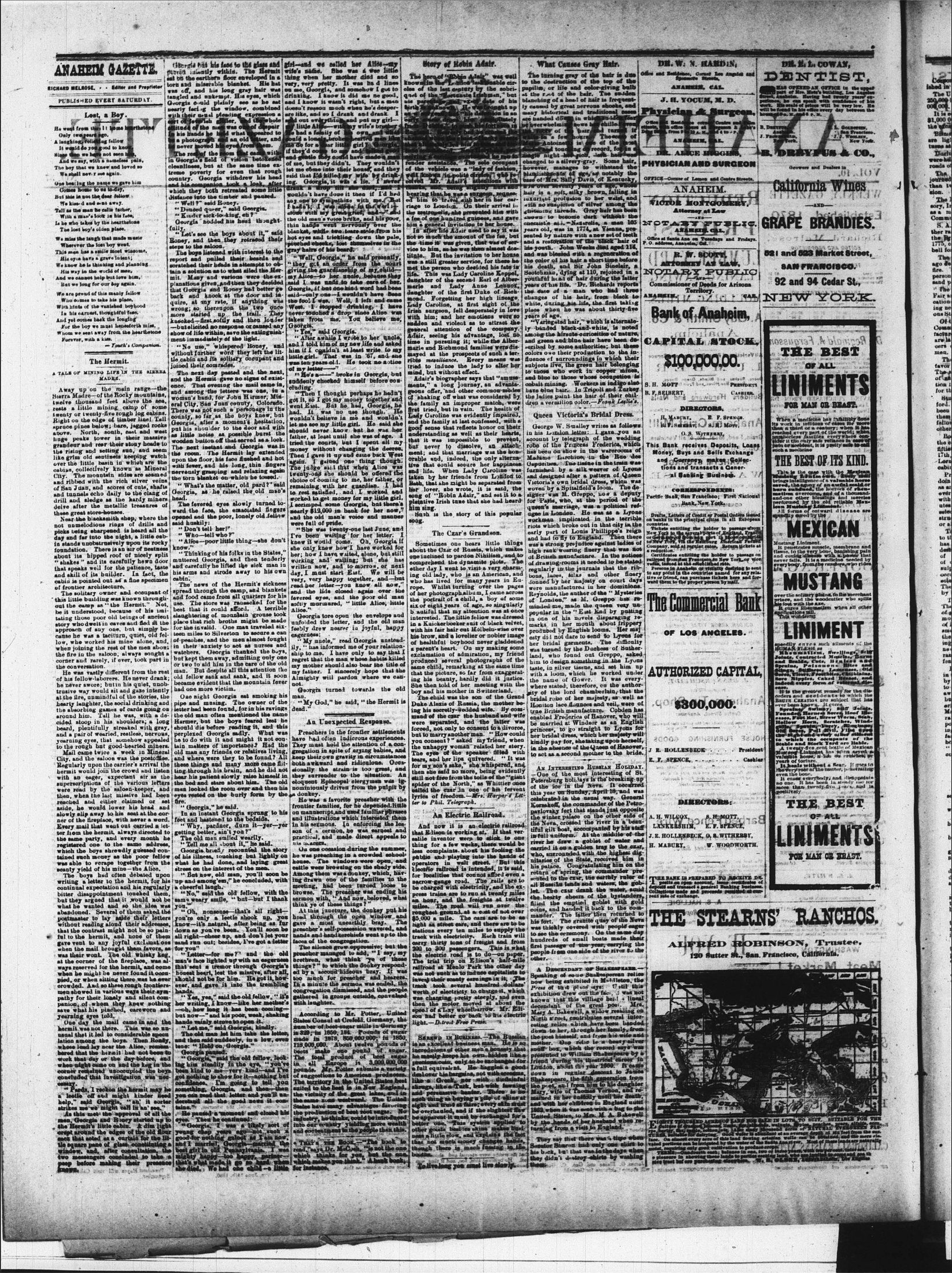
Searchable text
ANAHEIM GAZETTE.
RICHARD MELROSE. • Editor and Proprietor
PUBLISHED EVERY SATURDAY.
Lost, a Boy.
He went from the 11 home heartstone Only two years ago,
A laughing, relishing fellow
It would do you good to know.
Since then we have not seen him,
And we say, with a nameless pain,
The boy that we knew and loved so We shall never see again.
One beating the name we gave him Comes home to us today,
But this is not the dear fellow We kissed and sent away.
Tell as the man he calls father, With a man's look in his face,
Is he who takes by the heartstone The lost boy's old place.
We miss the laugh that made music Wherever the lost boy went.
This man has a smile most winsome, His eyes have a grave intent;
We know he is thinking and planning His way in the world of men,
And we cannot help but love him But we long for our boy again.
We are proud of this manly fellow Who comes to take his place,
With hints of the vanished boyhood In his earnest, thoughtful face.
And yet comes back the longing For the boy we must henceforth miss Whom we sent away from the heartstone Forever, with a kism.
— Youth's Companion.
The Hermit.
A TALE OF MINING LIFE IN THE SIERRA MADRE.
Away up on the main range—the Sierra Madre—of the Rocky mountains, twelve thousand feet above the sea, rests a little mining camp of some twenty or twenty-five rough log cabins. Right on the edge of timber lime! Tall spruce pines below; bare, jagged rocks above. North, south, east and west huge peaks tower in their massive grandeur and rear their stony heads to the rising and setting sun, and seem like grim old sentinels keeping watch over the little basin in which are the cabins, collectively known as Mineral City.
Georgia hit his face to the glass and started intently within. The Hermit sat on the earthen floor enveloped in a torn and miserable blanket. His hat was off, and his long gray hair was tangled and unkempt. His eyes, which Georgia could plainly see as he sat nearly facing the window, combined with their usual pleasing expression a sort of feverish glitter, and the whole attitude of the man was one of despair In his hands he held what appeared to be a photograph and an old writer, and he never moved his eyes from them.
The rest of the room that came with in Georgia's field of vision betokened cleanliness, but at the same time extreme poverty for even that rough country. Georgia withdrew his head and his companion took a look after which they both retreated some little distance into the timber and paused.
"Well?" said Roney.
"Deuced queer," said Georgia.
"Kinder sick-looking, eh?"
Georgia nodded his head thoughtfully.
"Let's see the boys about it," said Roney, and then they retraced their steps to the saloon.
The boys listened with interest to the report and pulled their beards and soratched their heads in attempts to obtain a solution as to what ailed the Hermit. Many and various were the explanations given, and then they decided that Georgia and Roney had better go back and knock at the door and inquire, at any rate, if anything was wrong; so thereupon the two once more started up the trail. They knuckled—first softly and then louder—but elicited no response or caused any show of life within, save the engulfment immediately of the lightst.
"No use," whispered Roney, and without further word they left the little cabin and its solitary occupant and joined their comrades.
The next day passed and the next, and the Hermit gave no signs of existence. That evening the mail came in, and among the letters was one, in a woman's hand, for John Hirmer, Mineral City, San Juan county, Colorado. There was not such a personage in the county, so far as the boys knew, but Georgia, after a moment's hesitation, put his shoulder to the door and with as little noise as possible burst the wooden button off that served as a lock. The next instant and Georgia was in the room. The Hermit lay extended upon the floor, his face flushed and hot with fever, and his long, thin fingers nervously grasping and relaxing again girl—and we called her wife's name. She was thing when her mother very, very pretty. It was on me, Georgia, and so drinking. I know it did and I know it wasn't right doesn't reason much who are like, and so I drank out everything and my little Alice—with my He had a family of him should a lonely broke me do for a near little girl if they'd come to my arm and gentle they could hear of me, but they didn't let me come into their house said that I'd killed my ing. Georgia, it was a drunk a drop till she wouldn't have done it to any one to sympathize I had it; I was alone stone with my great grief the old man's voice broke thin hands went nerve blanket while two tons hot eyes and trickling pinched cheeks; lost the gray hairs of his beard.
"Well, Georgia," he "they get an order giving the guardianship my Alice—to her uncle said I was unfit to tell Georgia, if but one kind said—only one—I would the fool! I was. Well, West. I stopped driving never toohed a drop taken from me. You Georgia.
"Yes," said Georgia.
"After awhile I wrote and I told him of my niece if I couldn't at least little girl. That was he was ten years old. He of my letter——"
"He's a——" broke suddenly checked him cluding.
"Then I thought pete got it, so I got my mom went East. But he had. It was no use wouldn't believe in me let me see my little girl should never know her father, at least until she tried the courts, but money without change Then I gave it up and again. I gained one The judge said that twenty-one she should
Away up on the main range—the Sierra Madre—of the Rocky mountains, twelve thousand feet above the sea, rests a little mining camp of some twenty or twenty-five rough log cabins. Right on the edge of timber line! Tall spruce pines below; bare, jagged rocks above. North, south, east and west huge peaks tower in their massive grandeur and rear their stony heads to the rising and setting sun, and seem like grim old sentinels keeping watch over the little basin in which are the cabins, collectively known as Mineral City. The mountain sides are seamed and ribbed with the rich silver veins of San Juan, and scores of cuts, shafts and tunnels echo daily to the clang of drill and sledge as the hardy miners delve after the metallic treasures of these great store-houses.
Near the blacksmith shop, where the not unmelodious rings of drills and picks being sharpened is heard all the day and far into the night, a little cabin stands unobtrusively upon its rocky foundation. There is an air of neatness about its hipped roof of nicely split "shakes" and its carefully hewn door that speaks well for the patience, taste and skill of its builder. In fact, the cabin is pointed out as a fine specimen of frontier architecture.
The solitary owner and occupant of this little building was known throughout the camp as "the Hermit." Not, be it understood, because of his imitating those poor old beings of ancient story who dwelt in caves and fled at the approach of any one, but simply because he was a taciturn, quiet, old fellow, who worked his mine alone, and when joining the rest of the men aboard the fire in the saloon, always sought a corner and rarely, if ever, took part in the conversation.
He was vastly different from the rest of his fellow-laborers. He never drank; he never swore; but in his quiet, unobtrusive way would sit and gaze intently at the fire, unmindful of the stories, the hearty laughter, the social drinking and the absorbing games of cards going on around him. Tall he was, with a decided stoop in his shoulders; a long beard, plentifully streaked with gray, and a pair of wearied, restless, nervous, yearning eyes, that somehow appealed to the rough but good-hearted miners.
Mail came twice a week in Mineral City, and the saloon was the postoffice. Regularly upon the carrier's arrival the hermit would join the crowd and listen with an eager, expectant air as the superscriptions of the various letters were read by the saloon-keeper, and then, when the last missive had been reached and either claimed or set aside, he would lower his head and slowly slip away to his seat at the corner of the fireplace, with never a word. Every mail that went out carried a letter from the hermit, always directed to the same party, and every month he registered one to the same address, which the boys shrewdly guessed contained such money as the poor fellow was able to verape together from the scanty yield of his mine—the Alice.
The boys had often debated upon writing a letter to the hermit, for his continual expectation and his regularly bitter disappointment touched them, but they argued that it would not be
The next day the mail came in, and among the letters was one, in a woman's hand, for John Hirmer; Mineral City, San Juan county, Colorado. There was not such a personage in the county, so far as the boys knew, but Georgia, after a moment's hesitation, put his shoulder to the door and with as little noise as possible burst the wooden button off that served as a look. The next instant and Georgia was in the room. The Hermit lay extended upon the floor, his face flushed and hot with fever, and his long, thin fingers nervously grasping and relaxing again the torn blanket on which he tossed.
"What's the matter, old pard?" said Georgia, as he raised the old man's head.
The fevered eyes slowly turned toward the face, the emaciated fingers opened and the poor, lonely old fellow said huskily:
"Don't tell her!"
"Who—tell who?"
"Alice—poor little thing—she don't know."
"Thinking of his folks in the States," muttered Georgia, and then tenderly and carefully he lifted the sick man in his arms and strode away to his own cabin.
The news of the Hermit's sickness spread through the camp, and blankets and food came from all quarters for his use. The store was ravaged for the best that it could afford. A terrible slaughtering of mountain grouse took place that rich broths might be made for the invalid. One man traveled sixteen miles to Silverton to secure a can of peaches, and the men almost fought in their anxiety to act as nurses and watchers. Georgia thanked the boys, but kept them away, admitting only one or two to aid him in the care of the old man. But despite all this attention the old fellow sank and sank, and it soon became evident that the mountain fever had one more victim.
One night Georgia sat smoking his pipe and minguing. The owner of the letter had been found, for in his ravings the old man often mentioned the name Harmer, but the boys feared lest he should dis before reading it, and this perplexed Georgia sadly. What was he to do with it and might it not contain matters of importance? Had the old man any friends or relatives living, and where were they to be found? All these things and many more came fitting through his brain, and he did not hear his patient slowly raise himself in the bed and stare about him. The old man looked the room over and then his eyes rested on the burly form by the fire.
"Georgia," he said.
In an instant Georgia sprung to his feet and hastened to the bedside.
"Why, pardner, durn it—yer—yer getting better, isn't you?"
The old man smiled wearily.
"Tell me all about it," he said.
Georgia briefly recounted the story of his illness, touching but lightly on what he had done, and laying great stress on the interest of the men.
"But now, old man you'll soon be up and among 'em," he concluded, with a cheerful laugh.
"No," said the old fellow with the Hermit gave no signs of existence. That evening the mail came in, and among the letters was one, in a woman's hand, for John Hirmer; Mineral City, San Juan county, Colorado. There was not such a personage in the county, so far as the boys knew, but Georgia, after a moment's hesitation, put his shoulder to the door and with as little noise as possible burst the wooden button off that served as a look. The next instant and Georgia was in the room. The Hermit lay extended upon the floor, his face flushed and hot with fever, and his long, thin fingers nervously grasping and relaxing again the torn blanket on which he tossed.
"What's the matter, old pard?" said Georgia, as he raised the old man's head.
The fevered eyes slowly turned toward the face, the emaciated fingers opened and the poor, lonely old fellow said huskily:
"Don't tell her!"
"Who—tell who?"
"Alice—poor little thing—she don't know."
"Thinking of his folks in the States," muttered Georgia, and then tenderly and carefully he lifted the sick man in his arms and strode away to his own cabin.
The news of the Hermit's sickness spread through the camp, and blankets and food came from all quarters for his use. The store was ravaged for the best that it could afford. A terrible slaughtering of mountain grouse took place that rich broths might be made for the invalid. One man traveled sixteen miles to Silverton to secure a can of peaches, and the men almost fought in their anxiety to act as nurses and watchers. Georgia thanked the boys, but kept them away, admitting only one or two to aid him in the care of the old man. But despite all this attention the old fellow sank and sank, and it soon became evident that the mountain fever had one more victim.
One night Georgia sat smoking his pipe and minguing. The owner of the letter had been found for in his ravings the old man often mentioned the name Harmer, but the boys feared lest he should dis before reading it, and this perplexed Georgia sadly. What was he to do with it and might it not contain matters of importance? Had the old man any friends or relatives living, and where were they to be found? All these things and many more came fitting through his brain, and he did not hear his patient slowly raise himself in the bed and stare about him. The old man looked the room over and then his eyes rested on the burly form by the fire.
"Georgia," he said.
In an instant Georgia sprung to his feet and hastened to the bedside.
"Why, pardner, durn it—yer—yer getting better,ain't you?"
The old man smiled wearily.
"Tell me all about it," he said.
Georgia briefly recounted the story of his illness, touching but lightly on what he had done,and laying great stress on the interest ofthe men.
"But now,old man,你'll soon be up和 among‘em,”he concluded,with a cheerful laugh.
"No,”saidtheoldfellowwiththeHermitgavenosignsofexistenceThateveningthemailcamein,andamongtheletterswasone,inta woman'shand,forkohnHirmer;MineralCity,SanJuancounty.ColoradoTherewasnotsuchapersonageinthecounty,sofarastheboysknew,themetewouldknowbetweenhimandmeetmygeorgewintertorest satisfied,andworktedtogetmoneyforIscrimpedsomeGeorgenearly$12000inbankandtheoldman'svoicewerefallofpride.
"Shewastwenty-oneI'vebeenwaitingfoleknownitwouldcome.她onlyknewhowlher;howIhavewaitedworkingandwaitingwrittennow,andtoday.ImuststartEveryvery,veryhappytogreadherletter-youandthelidsclosedfeveredeyes,andthesoftymurmured,"liAlice."
Georgiatoreopentherefaultforestieregerness:
"Myuncle,”readGilly,"hasinformedme shiptome.Ihaveregretthatthemanwiymymothershouldalsomefather.IsinceeremyAlmightywillpardonnot.Neorgiaturnedtoman."
"MyGod,”hesaiddead."
AnUnexpectedPreachersinfronthavehadoftenludicTheymustholdtheagregationinspiteofakeepyourowngravitybothawkwardandriallythestraininytheysurrendertotheeloquentEpiscopalelominiouslydrivenfroma donkey.Hewasafavoritefrontierfamilies,forsomanscript,anduseandillustrationswhichinhissermons.Insonofacermon,practical,andmademisearners.
Ononeoccasionduringhewaspreachinginanhouse.ThewindowcattlewerebrowsingoncAmongthemenwasadrawingoneofthemeeting,hadbeenbrowse.Thepresachersemphonwith.“Andn
reached and either claimed or set aside, he would lower his head and alowly slip away to his seat at the corner of the fireplace, with never a word. Every mail that went out carried a letter from the hermit, always directed to the same party, and every month he registered one to the same address, which the boys shrewdly guessed contained such money as the poor fellow was able to rerape together from the scanty yield of his mine—the Alice.
The boys had often debated upon writing a letter to the hermit, for his continual expectation and his regularly bitter disappointment touched them, but they argued that it would not be what he wanted and so the idea was abandoned. Several of them asked the postmaster to lay aside their letters without reading aloud their addresses, that the contrast might not be so painful to the hermit, and none of them gave vent to any joyful exclamations when the mail brought them favors, as was their wont. The old whisky keg, at the corner of the fireplace, was always reserved for the hermit, and come when he might be never found it occupied, or when sitting there was he ever crowded. And so these rough frontiersmen showed in various ways their sympathy for their lonely and silent companion, of whom they knew nothing save what his pinched, careworn and yearning eyes told.
One day the mail came in and the hermit was not there. This was so unusual that it led to considerable speculation among the boys. Then Rondy, whose load lay near the Alice, remembered that the hermit had not been to work that day or the day before, and when night came on and the key in the corner remained unoccupied the boys concluded that investigation was necessary.
"Pardon," I reckon the hermit may be a leetle off and might kinder head help," said Georgia, "an it sorter strikes me we might call in an' see."
As this met the approval of all the men, Georgia and Rondy started up to the Hermit's little cabin. A dim light crept around the edges of the old flour mack that acted as a curtain for the little square panes of glass constituting a window, and, after consultation, the two messengers concluded to take a peep before making their presence known.
"Georgia," he said.
In an instant Georgia sprung to his feet and hastened to the bedside.
"Why, pardner, durn it—yer—yer getting better, ain't you?"
The old man smiled wearily.
"Tell me all about it," he said.
Georgia briefly recounted the story of his illness, touching but lightly on what he had done, and laying great stress on the interest of the men.
"But now, old man, you'll soon be up and among 'em," he concluded, with a cheerful laugh.
"No," said the old fellow, with the same weary smile, "but—but I thank you."
"Oh, nonsense—that's all right—you're only a leetle shook up, you know—it's natural, after being as fur down as you've been. You'll soon be all right—cheer up, and don't let your sand run out; besides, I've got a letter for you."
"Letter—for me?" and the old man's face lighted up with an eagerness that sent a tremor through Georgia's honest heart, lest the missive, after all, should not be for him. He got it, however, and gave it into the trembling hands.
"Yes, yes," said the old fellow, "it's her writing. I know—like her mother's—oh, how long it has been coming—but now—" and his poor, weak, shaking hands vainly strove to open it.
"Let me," said Georgia, kindly.
The old man let him take the letter, and then said suddenly, in a low, even tone: "Hold on, Georgia."
Georgia paused.
"Georgia," said the old fellow, looking him steadily in the eye, "you've been kind to me—very kind—and I've got nothing to show for it—nothing but confidence. I'm going to tell you something, Georgia, and then—then you can read that letter and you'll understand all the good news it contains."
He paused a moment and closed his eyes. Then he continued:
"Georgia. I was a likely sort of young chap years ago—not such a good-for-nothing galoot as I am now, and I married Georgia—married the best girl in old Pennsylvania. I was mighty happy—too happy, partner—that's what made it go so hard when she died. We had one child—a little fire."
"Georgia," he said.
In an instant Georgia sprung to his feet and hastened to the bedside.
"Why, pardner, durn it—yer—yer getting better, ain't you?"
The old man smiled wearily.
"No," said the old fellow, with the same weary smile, "but—but I thank you."
"Oh, nonsense—that's all right—you're only a leetle shook up, you know—it's natural, after being as fur down as you've been. You'll soon be all right—cheer up, and don't let your sand run out; besides, I've got a letter for you."
"Letter—for me?" and the old man's face lighted up with an eagerness that sent a tremor through Georgia's honest heart, lest the missive, after all, should not be for him. He got it, however, and gave it into the trembling hands.
"Yes, yes," said the old fellow, "it's her writing. I know—like her mother's—oh, how long it has been coming—but now—" and his poor, weak, shaking hands vainly strove to open it.
"Let me," said Georgia, kindly.
The old man let him take the letter, and then said suddenly in a low, even tone: "Hold on, Georgia."
Georgia paused.
"Georgia," said the old fellow, looking him steadily in the eye, "you've been kind to me—very kind—and I've got nothing to show for it—nothing but confidence. I'm going to tell you something, Georgia, and then—then you can read that letter and you'll understand all the good news it contains."
He paused a moment and closed his eyes. Then he continued:
"Georgia. I was a likely sort of young chap years ago—not such a good-for-nothing galoot as I am now, and I married Georgia—married the best girl in old Pennsylvania. I was mighty happy—too happy, partner—that's what made it go so hard when she died. We had one child—a little fire."
girl—and we called her Alice—my wife's name. She was a wee little thing when her mother died and so very, very pretty. It was his d lines on me, Georgia, and somehow I got to drinking. I know it did me no good, and I know it wasn't right, but a man doesn't reason much when he's desperate like, and so I drank and drank. I said out everything and put my girl—my little Alice—with my wife's brother he had a family of his own, and what could a lonely broken hearted man like me do for a dear little girl? Georgia, if they'd come to me and talked good and gentle they could have made a man of me, but they didn't. They wouldn't let me come into their house, and they said that I'd killed my wife by drinking. Georgia, it was a lie. I never drank till she died, and I wouldn't have done it then if I'd had any one to sympathize with me. But I hadn't; I was alone in the war-stone with my great grief, and—and" and the old man's voice broke, and his poor, thin hands went nervously over the blanket, while two tears stole from his hot eyes and trickling down the pale, pitched cheeks, lost themselves in the gray hairs of his beard.
"Well, Georgia," he said presently, "they get an order from the court giving the guardianship of my child—my Alice—to her uncle, because they said I was unfit to take care of her. Georgia, if but one kind word had been said—only one—I wouldn't have been the fool! I was. Well, I left and came West. I stopped drinking, I have never touched a drop since Alice was taken from me. You believe me, Georgin.
"Yes," said Georgia.
"After awhile I wrote to her uncle, and I told him of my new life and asked him if I couldn't at least write to my little girl. That was in '67, and she was ten years old. He took no notice of my letter——"
"He's a——" broke in Georgia, but suddenly checked himself before concluding.
"Then I thought perhaps he hadn't got it, so I got my money together and went East. But he had, Georgia, he had. It was no use though. He wouldn't believe in me and wouldn't let me see my little girl. He said she should never know but he was her father, at least until she was of age. I tried the courts, but I spent all my money without changing the decree. Then I gave it up and came back West again. I gained one thing though. The judge said that when Alice was twenty-one she should be offered the girl—and we called her Alice—my wife's name. She was a wee little thing when her mother died and so very, very pretty. It was his d lines on me, Georgia, and somehow I got to drinking. I know it did me no good, and I know it wasn't right, but a man doesn't reason much when he's desperate like, and so I drank and drank. I said out everything and put my girl—my little Alice—with my wife's brother he had a family of his own, and what could a lonely broken hearted man like me do for a dear little girl? Georgia, if they'd come to me and talked good and gentle they could have made a man of me, but they didn't. They wouldn't let me come into their house, and they said that I'd killed my wife by drinking. Georgia, it was a lie. I never drank till she died, and I wouldn't have done it then if I'd had any one to sympathize with me. But I hadn't; I was alone in the war-stone with my great grief, and—and" and the old man's voice broke, and his poor, thin hands went nervously over the blanket, while two tears stole from his hot eyes and trickling down the pale, pitched cheeks, lost themselves in the gray hairs of his beard.
"Well, Georgia," he said presently, "they get an order from the court giving the guardianship of my child—my Alice—to her uncle, because they said I was unfit to take care of her. Georgia, if but one kind word had been said—only one—I wouldn't have been the fool! I was. Well, I left and came West. I stopped drinking, I have never touched a drop since Alice was taken from me. You believe me, Georgin.
"Yes," said Georgia.
"After awhile I wrote to her uncle, and I told him of my new life and asked him if I couldn't at least write to my little girl. That was in '67, and she was ten years old. He took no notice of my letter——"
"He's a——" broke in Georgia, but suddenly checked himself before concluding.
"Then I thought perhaps he hadn't got it, so I got my money together and went East. But he had, Georgia, he had. It was no use though. He wouldn't believe in me and wouldn't let me see my little girl. He said she should never know but he was her father, at least until she was of age. I tried the courts, but I spent all my money without changing the decree. Then I gave it up and came back West again. I gained one thing though. The judge said that when Alice was twenty-one she should be offered the girl—and we called her Alice—my wife's name. She was a wee little thing when her mother died and so very, very pretty. It was his d lines on me, Georgia, and somehow I got to drinking. I know it did me no good, and I know it wasn't right, but a man doesn't reason much when he's desperate like, and so I drank and drank. I said out everything and put my girl—my little Alice—with my wife's brother he had a family of his own, and what could a lonely broken hearted man like me do for a dear little girl? Georgia, if they'd come to me and talked good and gentle they could have made a man of me, but they didn't. They wouldn't let me come into their house, and they said that I'd killed my wife by drinking. Georgia, it was a lie. I never drank till she died, and I wouldn't have done it then if I'd had any one to sympathize with me. But I hadn't; I was alone in the war-stone with my great grief, and—and" and the old man's voice broke, and his poor, thin hands went nervously over the blanket, while two tears stole from his hot eyes and trickling down the pale, pitched cheeks, lost themselves in the gray hairs of his beard.
"Well, Georgia," he said presently, "they get an order from the court giving the guardianship of my child—my Alice—to her uncle, because they said I was unfit to take care of her. Georgia, if but one kind word had been said—only one—I wouldn't have been the fool! I was. Well, I left and came West. I stopped drinking, I have never touched a drop since Alice was taken from me. You believe me, Georgin.
"Yes," said Georgia.
"After awhile I wrote to her uncle, and I told him of my new life and asked him if I couldn't at least write to my little girl. That was in '67, and she was ten years old. He took no notice of my letter——"
"He's a——" broke in Georgia, but suddenly checked himself before concluding.
"The hero of "Ebbin Adair" was well known in the London fashionable circles of the last century by the sobriquet of the "Hortonite Irishman," but his paraphrase had written date of his birth unknown. He brought up as a migrant that "his definition in an early move down here immediately faded." He retired to work his fortune in England; he rarely had his own business until he became an assistant to his employer at the time he worked there; then he ran to render assistance. The sole occupant of the vehicle was a "lady of fashion," well known in polite circles," who received Mr. Ebbin's attention with thanks; being slightly hurt and hearing that he was a surgeon requested him to travel with her in her carriage to London. On their arrival in the metropolis, she presented him with a fee of one hundred guineas; and gave him a general invitation to her house.
In after life Adair used to say it was not so much the amount of the fee, but the time it was given; that was of service to him; as he was then almost destitute. But the invitation to her house was a still greater service for these he met the person who decided his fate in life. This was Lady Caroline Keppele daughter of the second Earl of Albermarle and Lady Anne Lehnox daughter of the first Duke of Richmond. Forgetting her high lineage, Lady Caroline, at first sight of the Irish surgeon, fell desperately in love with him; and her emotions were so sudden and violent as to attract the general attention of the company. Adair seeing his advantage lost no time in pursuing it; while the Albermarle and Richmond families were dismayed at the prospects of such a terrible mesailliance. Every means was tried to induce the lady to alter her mind; but without effect.
Adair's biographer says that "amusements," a long journey, an advantageous offer, and other common modes of shaking off what was considered by the family an improper match were first tried; but in vain. The health of Lady Caroline was evidently impaired; and the family at last confessed with a good sense that reflects honor on their understanding as well as their hearts; that it was impossible to prevent; but never to dissolve; an attachment; and that marriage was the honorable end; indeed,the only alternative that could secure her happiness and life. When Lady Caroline was furnished by a silk weaver of Queens
"Then I thought perhaps he hadn't got it, so I got my money together and went East. But he had, Georgia, he had. It was no use though. He wouldn't believe in me and wouldn't let me see my little girl. He said she should never know but he was her father, at least until she was of age. I tried the courts, but I spent all my money without changing the decree. Then I gave it up and came back West again. I gained one thing though: The judge said that when Alice was twenty-one she should be offered the choice of coming to me, her father, or remaining with her guardian. I had to rest satisfied, and I worked and worked to get money for my little girl. I scrimped some Georgia, but therea nearly $12,000 in bank for her now," and the old man's voice and manner were fall of pride.
She was twenty-one last June, and I've been waiting for her letter. I knew it would come. Oh, Georgia if she only knew how I have worked for her; how I have waited alone, but still working and waiting; but she has written now, and to morrow, or next day, I must start East. We will be very, very happy together, and—but read her letter—you know all now," and the lids closed again over the fevered eyes, and the poor old man softly murmured, "little Alice, little Alice."
Georgia tore open the envelope and unfolded the letter, and the old man feebly drew nearer in joyful, happy eagerness:
"My uncle," read Georgia unsteadily, "has informed me of your relationship to me. I have only to say that I regret that the man whose habits killed my mother should also bear the title of my father. I sincerely hope that the Almighty will pardon where we cannot.
Georgia turned towards the old man.
"My God," he said, "the Hermit is dead."
An Unexpected Response.
Preachers in the frontier settlements have had often ludicrous experiences. They must hold the attention of a congregation in spite of argying babies, and keep their own gravity in circumstances both awkward and ridiculous. Occasionally the strain is too great, and they surrender to the situation. An eloquent Episcopal clergyman was ignominiously driven from the pulpit by a donkey.
He was a favorite preacher with the frontier families, for he depended little on manuscript, and used familiar phrases and illustrations which interested them in his sermons. In enforcing the lesson of a cermon, he was earnest and practical, and made direct appeals to his readers.
On one occasion during the summer, he was preaching in a crowded schoolhouse. The windows were open, and cattle were browsing on the shady side. Among them was donkey, which, having drawn one of the families to the meeting, had been turned loose to browse. The preacher was ending his sermon with." And now, beloved, what Adair's biographer says that "amusements," a long journey, an advantageous offer, and other common modes of shaking off what was considered by the family an improper match, were first tried, but in vain. The health of Lady Caroline was evidently impaired, and the family at last confessed, with a good sense that reflects honor on their understanding as well as their hearts, that it was impossible to prevent, but never to dissolve, an attachment; and that marriage was the honorable and, indeed, the only alternative that could secure her happiness and life. When Lady Caroline was taken by her friends from London to Bath, that she might be separated from her lover, she wrote, it is said, the song of "Robin Adair," and set it to a plaintive Irish tune that she had heard him sing.
Sushi is the story of this popular song.
The Czar's Grandson.
Sometimes one hears little things about the Czar of Russia, which makes one inclined to pardon Nihilism, and to comprehend the dynamite plots. The ether day I went to visit a very charming old lady, who is an American, and who has lived for many years in Europe. Whilst turning over the pages of her photograph album, I came across the portrait of a child, a boy of some six or eight years of age, so singularly bautiful that my attention was at once interested. The little fellow was dressed in a Kaicker booker suit of black velvet, with his hair cut Holbein-wise over his brow, and a lovelier or nobler image of healthful boyhood never gladdened a parent's heart. On my making some exclamation of admiration, my friend produced several photographs of the same child, remarking at the same time that the picture, so far from exaggerating his beauty, hardly did it justice. She then told of her meeting with the boy and his mother in Switzerland.
The child was the son of the Grand Duke Alexis of Russia, the mother being his secretly-wedded wife. By command of the carr the husband and wife were separated, and the latter was forced not only to consent to a divorce, but to marry another man. "How could you consent?" asked my friend, when the unhappy woman related her story. The eyes of the speaker filled with tears, and her lips quivered. "It was for my son's sake," she whispered, and then she said no more, being evidently still not free from the toils of the "giant spider of the North," as Whittier once called the czar in one of his fervent lyrics of freedom — Mrs. Harpard's Letter to Phil. Telegraph.
An Electric Railroad.
And now it is an electric railroad that Edison is working at. If that versatile inventor were to stick to one thing for a few weeks, there would be less complaints about his fooling the public and playing into the hands of operators in walt street. But this electric railroad is intended, it is said for localities that cannot afford even a narrow-gauge road. The rails are to be charged with electricity, and the express trains are to run at twenty miles and the freights at twelve.
Queen Victoria's Bridal Dress.
George W. Smallley writes as follows in his London letter: I gave you an account by telegraph of the wedding robe of the Princess Frederica, which has been on show in the warrooms of Mahame Larchine, in the Rue des Gapouces. The tissue in the train was furnished by a silk weaver of Lyons and designed after a pattern of Queen Victoria's own bridal dress, which was woven by a Spitalfield's loom. The designer was M. Greppo, now a deputy for Paixia, who, at the period of the queen's marriage, was a political refuge in London. He was as a Lyone workman implicated in the terrible riots which broke out in that city in the early part of Louis Phillippe's reign and had to fly to England. Then there was a strong prejudice against ladies of high rank wearing finery that was not of British manufacture. In the noticees of drawing-rooms it needed to be stated regularly in the journals that the ribbons, laces, silks and other finery denied by her majesty on court days were manufactured in her dominions. Reynolds, the author of the "Mysteries of London," as M. Greppo has reminded me, made the queen very unpopular in the "East End by putting in one of his novels disparaging remarks in her mouth about frippery produced by English looms. Her majesty did not dare to send to Lyons for her bridal garments. The difficulty was tormented by the Duchess of Sutherland, who found out Greppo, asked him to design something in the Lyons taste, in silver tissue, and set him up with a loom, which he worked under the name of Gower. It was everywhere stated, therefore, on the authority of the lord chamberlain, that the bridal robe of her majesty, as well as Honiton lace doubles and veil, were of true British manufacture. Cobden has enabled Frederica of Hanover, who will be married at Windsor as an English princess*, to go straight to Lyons for her bridal dress, which her majesty will kindly pay for; she taking upon herself in the absence of the Queen of Hanover, to act as a second mother to the bride.
An Interesting Russian Holiday.
One of the most interesting of St. Petersburg holidays is the breaking up of the ice in the Neva. It occurred this year on Sunday April 18, and was celebrated in the usual way. General Korasoff, the commander of the Petropavlovsky fort that stands just opposite the winter palace on the other side of the Neva, crossed the river in a beautiful gift boat accompanied by his staff in full uniform. At the middle of the river he draw a goblet of water and carried it on a golden tray to the czar who surrounded with the highest dignitaries of the State received him in his palace. Congratulating him on the return of spring, the commander presented to the czar, the earthy ruler of all Russian lands and waters, the goblet. The czar drank the water, said the hearty cheers of the bystanders,
S.H.M.O.R.B.F.S.EIBR
This Bank Money and Tissue
Certificates railroad from New York Company,
a reduction Certificate railroad from New York
issuing Personals in any point or order thereof
He was a favorite preacher with the frontier families, for he depended little on manuscript, and used familiar phrases and illustrations which interested them in his sermons. In enforcing the lesson of a cermon, he was earnest and practical, and made direct appeals to his hearers.
On one occasion during the summer, he was preaching in a crowded school-house. The windows were open, and cattle were browsing on the shady side. Among them was a donkey, which having drawn one of the families to the meeting, had been turned loose to browse. The preacher was ending his sermon with, "And now, beloved, what think ye of these things?"
At this juncture, the donkey put his head through the open window and gave a most unearthly bray. The preacher's self-possession wavered, and hands and handkerchiefs went up to the faces of the congregation.
The silence grew oppressive; but the preacher managed to add, "I say, my brethren, what think ye of those things?" to which the donkey responded by a second hideous bray. It was too much for preacher and hearers. In a minute the sermon was ended, the congregation dismissed, and the people gathered in groups outside, convulsed with laughter.
According to Mr. Potter, United States Consul at Crefeld, Germany, the number of beet-sugar mills in Germany is 329; in 1850, 184. Pounds of sugar made in 1878, 850,600,000; in 1850, 118,000,000. About twelve pounds of beets make one pound of sugar. The total product of beet sugar in all Europe is 3,000,000,000 pounds. Mr. Potter submits a variety of suggestions to American producers. The territory in the United States best suited to the host is in New England, the vicinity of the great lakes, and in the same zone westward. The United States have many advantages favoring the production of beet root sugar. No industry, he thinks, could be introduced into our country yielding more wealth and contentment to the people than this.
That's run Book—"The book to read," says Dr. McCosh, "is not the one which thinks for you, but the one which makes you think." A bank book, for instance.
An Electric Railroad.
And now it is an electric railroad that Edison is working at. If versatile inventor wore to stick to one thing for a few weeks, there would be less complaints about his fooling the public and playing into the hands of operators in walt street. But this electric railroad is intended, it is said, for localities that cannot afford even a narrow-gauge road. The rails are to be charged with electricity, and the express trains are to run at twenty miles an hour, and the freights at twelve miles. The road will run over the roughest ground at a cost of not over $5,000 a mile. The cars are to be as light as street cars, and there are to be stations every ten miles to supply the track with electricity. Each train will carry thirty tons of freight and from 200 to 300 passengers. This is what the electric road is to do—on paper. The trial trip on Edison's half-mile railroad at Menlo Park the other day was not such as to induce capitalists to invest their scanty earnings in it. The track took several hundred dollars' worth of electricity to charge it, which was charging pretty steeply, and even then the motor moved at about the speed of a Lazy wheelbarrow. Mr. Edison had better go back to his electric light.
SHEWD IN BUSINESS. —The Russian is an excellent business man. He is so incredulous of other men a honesty that he mostly keeps his own hidden like a precious coin, only to be exchanged for a full equivalent. He haggles a good deal over his bargains, not with securities like a Greek nor with disaffinal shrugs, like a Turk, but with fawning and persuasive banter. There is no such thing as buying a pile of skins at sight and trust at fairness; every skin must be overhauled, and if the slightest flaw be apparent it must be exchanged for a better one. This system applied to other goods besides skins business a little slow, and explains the fact that not much money changes hands, though there is much running in the board.
To live long you must live slowly.
Kornakoff, the commander of the Petro-paylovsky fort that stands just opposite the winter palace on the other side of the Neva, crossed the river in a beautiful gift boat, accompanied by his staff in full uniform. At the middle of the river he drew a goblet of water and carried it on a golden tray to the czar, who surrounded with the highest dignitaries of the State, received him in his palace. Congratulating him on the return of spring, the commander presented to the czar, the earthly ruler of all Russki lands and waters, the goblet. The czar drank the water, amid the hearty cheer of the bystanders, filled the emptied goblet with gold coins, and handed it back to the commander. The latter then returned to his fort. The granite quay of the Neva was thickly covered with people eager to see the ceremony. On the same day hundreds of small boats made their first passage of the year, carrying the people from one side of the river to the other.
A DESCENDANT OF SHAKESPEAK—Speaking of some Shakespearian reflections now being exhibited in Middleton, the Press of that place says: Until this exhibition drew out the faerie was not known that this village held a line decendant of the great poet. Mrs. Mary A. Bakewell, a widow resiling on North Street contributes several interesting reflections which have been handed down to her through her family from the post himself, and from his wife and mother. One relative is a heavy silver snuff box, which the record says was presented to William Shakespeare by a friend during histheatrical career in London, about the year 1600. It came down in regular descent to James Shakespeare, the fifth generation from the poet; and from him to his daughter Mary; wife of Thomas Vernon; and remained in her custody until her death; and with her children in England until 1882 when it was sent with a bag to the United States; to Mrs. M. A. Bakewell by the hands of her husband when returning from a visit to England.
They say that there was a time when Senator Sharon had only one shirt to his back; but that was in the days when they didn't destroy shirts by washing them.
DE. W. N. HARDIN,
Office and Residence, Corner Los Angeles and
Synthetic Streets,
ANAHEIM, CAL.
J. H. YOCUM, M. D.
Physician & Surgeon.
Office and Residence corner Centre and Salm
estate, with office hours at Bergamot & Oak's
Ding Street, from 9 to 10 A.M., and 4 to 5 P.M.
ANAHEIM, CAL.
DR. ALICE HIGGINS,
PHYSICIAN AND SURGEON
OFFICE—Corner of Lemon and Centre Streets.
ANAHEIM.
VICTOR MONTGOMERY,
Attorney at Law
AND
NOTARY PUBLIC,
ANAHEIM, CAL.
Office at Santa Ana on Tuesdays and Fridays.
P.O. address, Anaheim, Cal.
R. W. SCOTT,
ATTORNEY AS LAW,
NOTARY PUBLIC
AND
Commissioner of Deeds for Arizona Territory.
ANAHEIM, CAL.
Bank of Anaheim,
CAPITAL STOCK,
$100,000.00.
S. H. MOTT
President
B. F. SEIBERT
Cashier
DIRECTORS.
H. MABURY,
E. F. SPENQR.
B. F. SHERRY.
S. H. MOTT.
O. S. WITHERRY.
This Bank receives Deposits, Loans
Money, Buys and Sells Exchange
and Currency, makes Collections and transacts a General Banking Business.
DE. E. L. COWAN,
DENTIST,
HAS OPENED AN OFFICE in the upper part of Mrs. Mater's building, Los Angeles Street, Anaheim. Having had twenty years' experience, he can speak with confidence of his work. His scale of prices will be very low. He will be found in his office every day between the hours of 9 A.M. and 6 P.M.
B. DAVIDUS,
Goldenwood,
J. PHOENIX, L.A.
New York.
B. DREYFUS & CO.
Growers and Dealers in
California Wines
AND
GRAPE BRANDIES.
521 and 523 Market Street,
SAN FRANCISCO.
92 and 94 Cedar St.
NEW YORK.
THE BEST
OF ALL
LINIMENTS
FOR MAN OR BEAST.
When a medicine has inflictibly done its work in millions of cases for more than a third of a century; when it has reached every part of the world; when numberless families everywhere consider it the only safe reliance in case of just or accident, it is pretty safe to call such a medicine.
THE BEST OF ITS KIND.
This is the case with the Mexican
S. H. MOTT
B. F. SEIBERT
CASHIER.
DIRECTORS:
H. MABURY, E. F. SPENGE,
B. F. SMITHER, S. H. MOTT,
O.S. WITHERBY,
This Bank receives Deposits, Loans Money, Buys and Selfs Exchange and Currency makes Collections and transacts a General Banking Business.
CORRESPONDENTS:
Pacific Bank, San Francisco; First National Bank, New York.
Drafts, Letters of Credit or Postal Orders issued on banks in the principal cities in all European countries.
Tickets entitling the holder to passage from New York to the several ports of England, France or Germany or Spain part in most countries to New York. Via the Hamburg American Packed Company, sold at regular rates. Return tickets at a reduction.
Certificates entitling the holder to passage on railroad from San Francisco to New York, or vice versa, issued at the established rate.
Persons in Anaheim or vicinity desiring to sent to any point in the countries named for any relative or friend, can purchase tickets here and forward them to the proper person by mail.
The Commercial Bank
OF LOS ANGELES.
AUTHORIZED CAPITAL,
$300,000.
J. E. HOLLENBECK President
E. F. SPENCE Cashler
DIRECTORS:
A. H. WILCOX, S. H. MOTT,
LANKERSHIM, E. F. SPENCE,
J. E. HOLLENBECK, O.S. WITHERBY,
H. MABURY, W. WOODWORTH.
THE BANK IS PREPARED TO RECEIVE DEPOSITS on open account, issue certificates of deposit and transact a general Banking business. Collections made and proceeds required at current rate of ezehange.
LINIMENTS
FOR MAN OR BEAST.
When a medicine has feasibly done its work in institutions of cases for more than a third of a century; when it has reached every part of the world; when numberless families everywhere consider it the only safe reliance in case of jain or accident, it is pretty safe to call such a medicine.
THE BEST OF ITS KIND.
This is the case with the Mexican Muskegonensis. Study shall bring intelligence of a valuable horse owned, the agony of an awful scald or burn subdued, the horrors of rheumatism overcame, and of a thousand-and-one other beings and creatures performed by the old relicue Mexican Muskegonensis.
All forms of outward disease are speedily cured by the MEXICAN Mustang Liniment.
It penetrates muscle, membrane and tissue, to the very bone, banishing pain and cutting disease with a power that never fails. It is a medicine needed by everybody, from the runners who ride his MUSTANG over the solitary plains, to the merchant prince, and the woodcutter who splits his foot with the axe.
It curses Rheumatism when all other applications fail.
This wonderful LINIMENT speedily enures such elements of the HUMAN PLEASHS.
Rheumatism, Swellings, Stiff Joints, Contracted Muscles, Burns and Beards, Cuts, Bruises and Sprains, Poisonous Bites and Stings, Stiffness, Lameness, Old Gear, Ticks, Feetbites, Chubblies, Sore Ripples, Caked Dusts, and indeed every form of external disease.
It is the greatest remedy for the disorders and sickness to which the Burden Creation are subject that has ever been known. It curbs.
Spraines, Swimmy, Stiff Joints, Founder, Barnes Nose, Heof Diseases, Foot Not, Screw Worm, Seah, Hollow Horn, Seratchee, Windmill, Spartan Dury, Ringnopper, Old Hoops, Pull Evil. You upon the sight and every other element to which the occupants of the Stable and Stock Yard are liable.
A twenty-five cent bottle of Mexican Muskegon Liniment has often used a valuable house in life on erudest or yeart fortune.
Heands without a fear. It goes to the very poor of the matter, penning even the bone.
It causes everybody and disappears no one. It has been in steady use for more than twenty-five years and is positively THE BEST OF ALL LINIMENTS FOR MAN OR BEAST.
DIRECTORS:
A. H. WILCOX, S. H. MOTT,
LANKERSHIM, E. P. SPENCE,
J. E. HOLLENBECK, O. S. WITHERBY,
H. MABURY, W. WOODWORTH.
THE BANK IS PREPARED TO RECEIVE DEPOSITS ON OPEN ACCOUNT, LEASE CERTIFICATES OF DEPOSIT AND TRANSACT A GENERAL BANKING BUSINESS. Collections made and proceeds submitted at current rate of exchange.
THE STEARNS' RANCHOS.
ALFRED ROBINSON, Trustee,
120 Sutter St., San Francisco, California.
EIGHTY THOUSAND ACRES OF LAND FOR SALE IN LOTS TO SUIT. SUITABLE FOR THE cultivation of draught beans, limbs, for salads, waghts, plums, peaches, pears, alfalfa corn, rye barley, flax beans, cabbage, Also many thousand acres of NATURAL EVERGREEN FABRICK suitable for drying. Good water is abundant at an average depth of six feet from the surface. On almost every area of this land sowing artesian wells can be obtained, and the more elevated portions can be irrigated by the water of the Santa Ana river. Most of these lands are naturally modest, requiring only good cultivation to produce crops.
TERMS: One-third cash; balance in one, two or three years with four percent interest set.
o pleasure in showing these lands to parties existing land who are invited to come and see the trust but are purchasing elsewhere. W. R. OLERE, NORTHAMSTER, New York