anaheim-gazette 1880-06-19
Scanned page
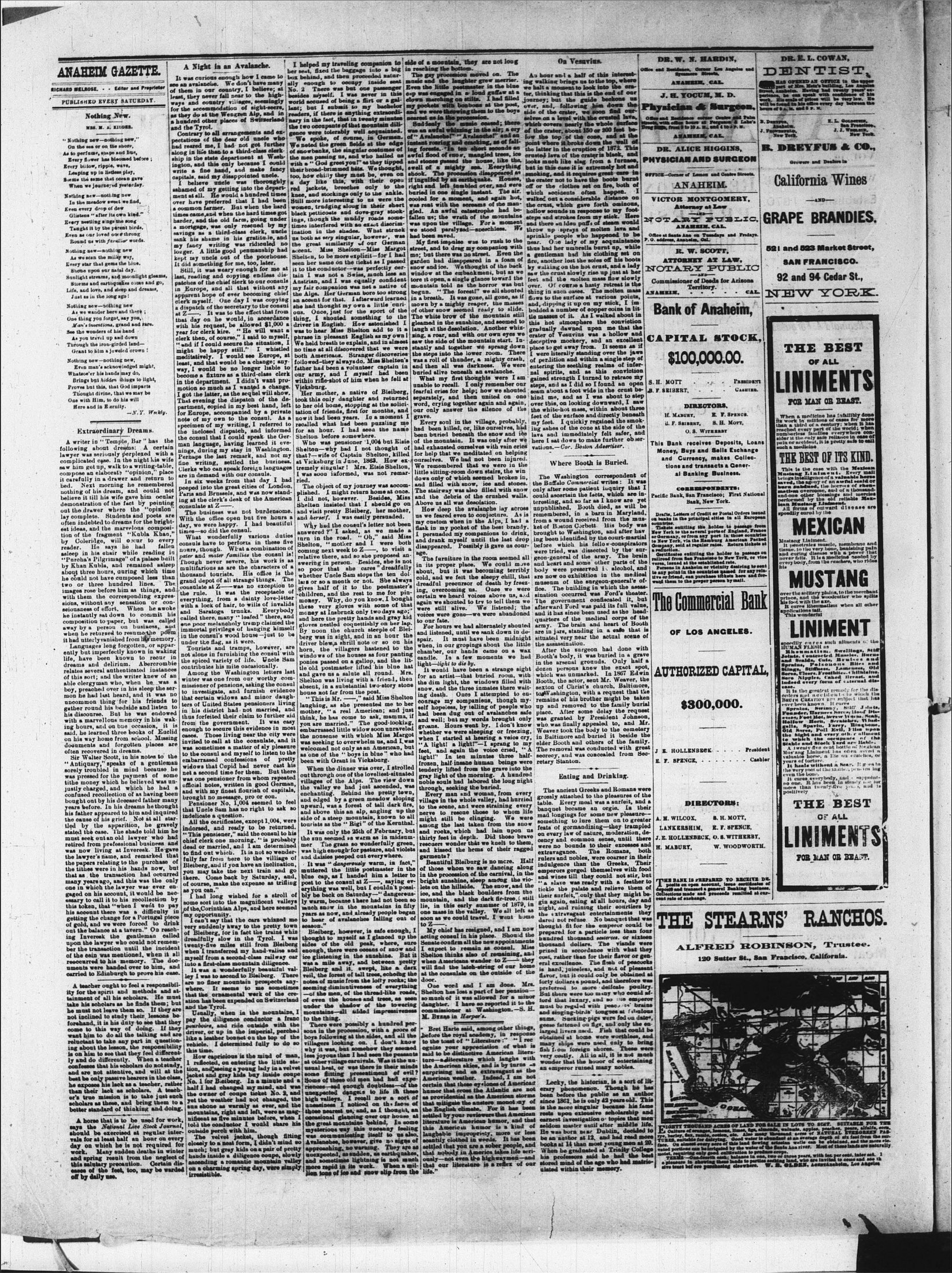
Searchable text
ANAHEIM GAZETTE.
RICHARD MELROSE. • Editor and Proprietor
PUBLISHED EVERY SATURDAY.
Nothing New.
MRS. M. A. KIIDER.
"Nothing new—nothing new,"
On the sea or on the shore,
As to perfume, shape and hue,
Every flower has bloomed before;
Every billow, ripple, wave,
Leaping up in listless play,
Beams the same that ocean gave
When we journeyed yesterday.
Nothing new—nothing new
In the meadow sweet we find,
Even every drop of dew
Glistens "after its own kind."
Every nestling sings the song
Taught it by the parent birds,
Even as our loved one throng
Bound us with farrell words.
Nothing new—nothing new
As we scan the milky way,
Every star that gems the blue.
Shone upon our natal day.
Sunlight streams, and moonlight gleams,
Storms and earthquakes come and go,
Life, and love, and sleep and dreams,
Just as in the long ago!
Nothing new—nothing new
As we wander here and there;
One thing you forgot, say you,
Man's inventions, grand and rare.
See the wonders of his hand
As you travel up and down
Through the iron-girded land—
Grant to him a jeweled crown!
Nothing new—nothing new,
Even man's acknowledged might,
Whatsoe'er his hands may do,
Bring but hidden things to light,
Proves but this, that God imparts
Thought divine, that we may be
One with Him, to do his will
Here and in Eternity.
N.Y. Weekly.
Extraordinary Dreams.
A writer in "Temple Bar" has the following about dreams: A certain lawyer was seriously perplexed with a complicated case. In the night his wife saw him get up, walk to a writing-table, compose an elaborate "opinion," place
A Night in an Avalanche.
It was curious enough how I came to see an avalanche. We don't have many of them in our country, I believe; at least, they never fall near to the highways and country villages, seemingly for the accommodation of sight-seers, as they do at the Wengren Alp, and in a hundred other places of Switzerland and the Tyrol.
Contrary to all arrangements and expectations of the dear old uncle who had reared me, I had not got further along in life than to a third-class clerkship in the state department at Washington, and this only because I could write a fine hand, and make fancy capitals, said my disappointed uncle.
I believe uncle was thoroughly ashamed of my getting into the department at all. He would a hundred times over have preferred that I had been a common farmer. But when the hard times came, and when the hard times got harder, and the old farm, going under a mortgage, was only rescued by my savings as a third-class clerk, uncle sank his shame in his gratitude, and my fancy writing was ridiculed no longer. A little good penmanship had kept my uncle out of the poorhouse. It did something for me, too, later.
Still, it was weary enough for me at last, reading and copying endless dispatches of the chief clerk to our consuls in Europe, and all that without any apparent hope of ever becoming chief clerk myself. One day I was copying a dispatch of the secretary to the consul at Z——. It was to the effect that from that day on he would, in accordance with his request, be allowed $1,000 a year for clerk hire. "He will want a clerk then, of course," I said to myself, "and if I could secure the situation, I might be happy still." I whistled meditatively. I would see Europe, at least, and that would be a change; anyway, I would be no longer liable to become a fixture as a third-class clerk in the department. I didn't want promotion so much as I wanted a change. I got the latter, as the sequel will show. That evening the dispatch of the department, copied in my best hand, left for Europe, accompanied by a private note of my own to the consul. As a specimen of my writing, I referred to the inclosed dispatch, and informed the consul that I could speak the German language, having learned it evenings, during my stay in Washington. Perhaps the last remark, and not my fine writing, settled the business. Clerks who can speak foreign languages are in demand with our consul.
I helped my traveling her seat, fixed the bagge box behind, and then pally enough to occupy No. 2 There was but besides myself. I was world accused of being lant; but I submit to readers, if there is any nary in the fact, that in the two occupants of the gence were tolerably well.
We spoke, of course. We noted the green fleece of snowbanks, the singing men passing us, and with a "God greet your broad-brimmed hat too, how chilly they made a day like this, with red jackets, breech-knee, and stockings on. Still more interesting women, trudging along black petticoats and dresses, though the mud times interfered with an institution in the shade us both as very singular the great similarity accent. Miss Shelton Shelton, to be more aware her name on the it to the conductor—wain I was not a Swan Anstrian, and I was on my fair companion with the Alpa. Her Germans an accent for that. I she had thought my cousins. Once just for thing, I shouted so driver in English. E was to hear Miss Shelton phrase in pleasant E. We held breath to expno time at all discover both Americans. St followed-they always father had been a volour army, and I am within rifle-shot of his Vicksburg.
Her mother, a na took this only daughter to her old home, stopation of friends, first now it had been years recalled what had befor an hour. I had Shelton before some Who was pension Shelton—why had I that?—wife of Captain at Vicksburg in June tremely singular! I I was soon informed
Extraordinary Dreams.
A writer in "Temple Bar" has the following about dreams: A certain lawyer was seriouslyplexed with a complicated case. In the night his wife saw him get up, walk to a writing-table, compose an elaborate "opinion," place it carefully in a drawer and return to bed. Next morning he remembered nothing of his dream, and could not believe it till his wife gave him ocular demonstration of the fact by pointing out the drawer where the "opinion" lay complete. Students and poets are often indebted to dreams for the brightest ideas, and the marvelous composition of the fragment "Kubla Khan," by Coleridge, will occur to every reader. He says he had fallen asleep in his chair while reading in "Purcha's Pilgrimage" of a palace built by Khan Kubla, and remained asleep about three hours, during which time he could not have composed less than two or three hundred lines. The images rose before him as things, and with them the corresponding expressions, without any sensation or consciousness of effort. When he awoke he instantly sat down to commit his composition to paper, but was called away by a person on business, and when he returned to resume the poem it had utterly vanished from his memory.
Languages long forgotten, or apparently but imperfectly known in waking life, have been known to recur in dreams and delirium. Abercrombie relates several authenticated instances of this sort; and the writer knew of an able clergyman who, when he was a boy, preached over in his sleep the sermon he had last heard, and it was no uncommon thing for his friends to gather round his bedside and listen to his discourse. But he was endowed with a marvellous memory in his waking hours, and on one occasion, it is said, he learned three books of Euclid on his way home from school. Missing documents and forgotten places are often recovered in dreams.
Sir Walter Scott, in his notes to the "Antiquary," speaks of a gentleman sorely troubled in mind because he was pressed for the payment of some tithe money which he believed was unjustly charged, and which he had a confused recollection of as having been bought out by his deceased father many years before. In his dreams he thought his father appeared to him and inquired the cause of his grief. Not at all starled by the apparition, he gravely stated the case. The shade told him he must seek entan an old lawyer who had retired from professional business and was now living at Inveresk. He gave the lawyer's name, and remarked that the papers relating to the purchase of the tithes were in his hands now, but that as the transaction had occurred many years ago, and this was the only one in which the lawyer was ever engaged on his account, it would be necessary to call it to his collection by become a fixture as a third-class clerk in the department. I didn't want promotion so much as I wanted a change. I got the latter, as the sequel will show. That evening the dispatch of the department, copied in my best hand, left for Europe, accompanied by a private note of my own to the consul. As a specimen of my writing, I referred to the inclosed dispatch, and informed the consul that I could speak the German language, having learned it evenings, during my stay in Washington. Perhaps the last remark, and not my fine writing, settled the business. Clerks who can speak foreign languages are in demand with our consuls.
In six weeks from that day I had peeped into the great cities of London, Paris and Brussels, and was now standing at the clerk's desk of the American consulate at Z——
The business was not burdensome. With the office open but five hours a day, we were happy. I had beautiful times—so did the consul.
What wonderfully various duties consuls have to perform in these five hours, though. What a combination of pater and mater families the consul is! Though never severe, his work is as multifarious as are the characters of a thousand tourists. His office is the grand depot of all strange things. The consulate at Z——was no exception to the rule. It was the receptacle of everything, from a dainty love-letter with a lock of hair, to wills of invalids and Saratoga trunks. Everybody called there, many "leafed" there, and one poor melancholy tramp claimed the immortal privilege of hanging himself in the consul's wood house—just to be under the flag, as it were.
Tourists and tramps, however, are not alone in furnishing the consul with the spiced variety of life. Uncle Sam contributes his mite occasionally.
Among the Washington letters last winter was one from our worthy commissioner of pensions, asking the consul to investigate, and furnish evidence that certain widows and minor daughters of United States pensioners living in his district had not married, and thus forfeited their claim to further aid from the government. It was easy enough to secure this evidence in most cases. Those living near the city were invited to call at the consulate, and it was sometimes a matter of ally pleasure to the consul and myself to listen to the embarrassed confessions of pretty widows that Cupid had never cast his net a second time for them. But there was one pensioner from whom repeated official notes, written in good German, and with my finest flourish of capitals, brought no message, pro or con.
Pensioner No. 1,004 seemed to feel that Uncle Sam has no right to ask so indelicate a question.
All the certificates, except 1,004, were indorsed, and ready to be returned. "This pensioner," said the consul to his chief clerk one morning, "is probably dead or married, and I am determined to find out which. It is not so wonderfully far from here to the village of Bleiberg, and if you have an inclination you may take the next train and go there. Come back by Saturday, and, of course, make the expense as trifling as you can."
I had long wished for a stroll of our army, and I within rifle-shot of him Vicksburg.
Her mother, a new took this only dangling to her old home, stop station of friends, first now it had been years recalled what had been for an hour. I had Shelton before some Who was pensioned Shelton—why had I that?—wife of Captain at Vicksburg in June tremely singular! I I was soon informedried.
The object of my plished. I might read I did not, however Shelton insisted that visit pretty Blench and herself. I was e
Why had the consular answered?" I asked turn in the road. Shelton, "mother coming next week to relative there, and swering in person-so poor that she whether Uncle Sam last or so a month or gives half of it to children, and the r money. Why do you these very gloves money at Insbruck and here the pretty gloves nestled coquille By noon the churberg was in sight; a driver blew a shrill horn, the villager windows of the houses passed on at tale old postmaster and gave us a salute Shelton was living absent, in a substant house not far from me.
"This is Mr.——laughing, as she put mother," "a real think, he has come you are married." embarrassed little w wthe nonsense with w was seeking to over welcomed not only as one of the "boy been with Grant inn.
When the dinner out through one of the villages of the Allt valley we had enchanting. Behind and edged by a groove upward, was a forehead above this an side of a steep moor tourists as the "Bri"
It was only the 22nd sun seemed as smerer. The grass seas was high enough for daisy peepsed.
It was "dangerous muttered the little blue cap, as I haw post to the consul'r erything was well-bly be back on Sat
bought out by his deceased father many years before. In his dreams he thought his father appeared to him and inquired the cause of his grief. Not at all startled by the apparition, he gravely stated the case. The shade told him he must seek out an old lawyer who had retired from professional business and was now living at Inveresk. He gave the lawyer's name, and remarked that the papers relating to the purchase of the tithes were in his hands now, but that as the transaction had occurred many years ago, and this was the only one in which the lawyer was ever engaged on his account, it would be necessary to call it to his recollection by this token, that "when I went to pay his account there was a difficulty in getting the change for a Portugal piece of gold, and we were forced to drink out the balance at a tavern." On reaching Inveresk the gentleman called upon the lawyer who could not remember the transaction until the incident of the coin was mentioned, when it all reoccurred to his memory. The documents were handed over to him, and carried to Edinburgh to prove his case.
A teacher ought to feel a responsibility for the spirit and methods and attainment of all his scholars. He must take his scholars as he finds them; but he must not leave them so. If they are not inclined to study their lessons beforehand, it is his duty to see that they come to this way of doing. If they want him to do all the talking and are reluctant to take any part in questioning about the lesson, the responsibility is on him to see that they feel differently and do differently. When a teacher confesses that his scholars do not study, and are not attentive, and will at the best be only passive hearers in the class, he exposes his lack as a teacher, rather than their lack as scholars. A teacher's true mission is to take just such scholars as these, and bring them to a better standard of thinking and doing.
A horse that is to be used for work, says the National Live Stock Journal, should be exercised at regular intervals for at least half an hour on every day on which he is not required for work. Many sudden deaths in winter and spring result from the neglect of this salutary precaution. Certain diseases of the feet, too, may be warded off by daily use.
Pensioner No. 1,004 seemed to feel that Uncle Sam has no right to ask so indelicate a question.
All the certificates, except 1,004, were indorsed, and ready to be returned. "This pensioner," said the consul to his chief clerk one morning, "is probably dead or married, and I am determined to find out which. It is not so wonderfully far from here to the village of Bleiberg, and if you have an inclination, you may take the next train and go there. Come back by Saturday, and, of course, make the expense as trifling as you can."
I had long wished for a stroll of some sort into the magnificent valleys of the Corinthian Alps, and here seemed my opportunity.
I can't say that the cars whizzed me very suddenly away to the pretty town of Bleiberg, for in fact the trains whiz dreadfully slow in the Tyrol. I was twenty-five miles still from Bleiberg when I transferred my hand-valise and myself from a second-class railway car into a first-class mountain diligence.
It was a wonderfully beautiful valley I was to ascend to Bleiberg. There are no finer mountain prospects anywhere. It seems to me sometimes that the ornamental work of the creation has been expended on Switzerland and the Tyrol.
Usually, when in the mountains, I pay the diligence conductor a franc pearboire, and ride outside with the driver, or up in the imperial, perched like a leather bonnet on the top of the vehicle. I determined fully to do so this time.
How capricious is the mind of man, I reflected, on entering the little station, and seeing a young lady in a velvet jacket and gray kids buy inside coupe No. 1 for Bleiberg. In a minute and a half I had changed my mind, and was the owner of coupe ticket No. 2, and yet the weather had not changed, the sun shone as warmly as ever, and the mountains, right left, were as magnificent as five minutes before, when I told the conductor I would share his outside perch with him.
The velvet jacket, though fitting closely to a neat form, I didn't mind so much; but gray kids on a pair of pretty hands inside a diligence coupe, slowly ascending a romantic mountain valley on a charming spring day, were simply irresistible.
I helped my traveling companion to her seat, fixed the baggage into a big box behind, and then proceeded naturally enough to occupy inside seat No. 2. There was but one passenger besides myself. I was never in this world accused of being a flirt or a galant; but I submit to my bachelor readers, if there is anything extraordinary in the fact, that in twenty minutes the two occupants of that mountain diligence were tolerably well acquainted.
We spoke, of course, in German. We noted the green fields at the edge of snowbanks, the singular costumes of the men passing us, and who hailed us with a "God greet you!" as they tipped their broad-brimmed hats. We thought, too, how chilly they must be, even on a day like this, with their open red jackets, breeches only to the knee, and stockings only to the ankle. Still more interesting to us were the women, trudging along in their short black petticoats and dove-gray stockings, though the muddy roads sometimes interfered with an exact discrimination in the shades. What struck us both as very singular, however, was the great similarity of our German accent. Miss Shelton—Miss Margot Shelton, to be more explicit—for I had seen her name on the ticket as I passed it to the conductor—was perfectly certain I was not a Swiss, much less an Austrian, and I was equally confident my fair companion was not a native of the Alps. Her German bore too strong an accent for that. I afterward learned she had thought my own little curious. Once, just for the sport of the thing, I shouted something to the driver in English. How astonished I was to hear Miss Shelton add to it a phrase in pleasant English as my own! We held breath to explain, and in almost no time at all discovered that we were both Americans. Stranger discoveries followed—they always do. Miss Shelten's father had been a volunteer captain in our army, and I myself had been within rifle-shot of him when he fell at Vicksburg.
Her mother, a native of Bieiberg, took this only daughter and returned to her old home, stopping at the solicitation of friends, first for months, and now it had been years. In a moment I recalled what had been puzzling me for an hour. I had seen the name Shelton before somewhere.
Who was pensioner 1,004 but Elsie Shelton—why bad I not thought of that?—wife of Captain Shelton, killed at Vicksburg in June, 1883. How extremely singular! Mrs. Elsie Shelton, I was soon informed, was not remarried of a mountain, they are not long in reaching the bottom.
The gay procession moved on. The music and the laughter grew merrier. Even the little pastmaster in the blue cap was engaged in a loud guffaw at a clown marching on stilts. I had filled my pocket with bonbons at the post, and we were throwing them to the boys nearest us in the procession.
Suddenly the music ceased; there was an awful whizzing in the air; a cry of "Avalanche!" "Avalanche!" and an instant roaring and cracking, as of falling forests. In ten short seconds an awful flood of snow, mangled trees, ice and stones passed the house, like the swell of a mighty sea. Everything shook. The procession disappeared as if ingulfed by an earthquake. Houses, right and left tumbled over, and were buried in one single instant. The air cooled for a moment, and again hot, was rent with the screams of the man-gled. An awful catastrophe had befallen us; the wrath of the mountains was upon the village. For a moment we stood paralyzed—nosechless. We had been saved.
My first impulse was to rush to the street, and to drag my companion with me; but there was no street. Even the garden had disappeared in a foam of snow and ice. We thought of the back window at the embankment, but as we tore it open, a single glance toward the mountain told us the horror was begun. "The forest!" we all shouted in a breath. It was gone, all gone, as if mown by a mighty reaper, the masses of other snow seemed ready to slide. The white brow of the mountain still gleamed in the sunshine, and seemed to laugh at the desolation. Another whizzing, a roar, and with our own eyes we saw the side of the mountain start. Instantly and together we sprang down the steps into the lower room. There was a roll of thunder, a mighty crash, and then all was darkness. We were buried alive beneath an avalanche.
What my first thoughts were I am unable to recall. I only remember our fearful cries for help; how we shouted separately, and then united on one word, crying together again and again, our only answer the silence of the grave.
Every soul in the village, probably, had been killed, or, like ourselves, had been buried beneath the snow and ice of the mountain. It was only after we had exhausted ourselves with vain cries for help that we meditated on helping ourselves. We had not been injured. We remembered that we were in the little sitting-room down stairs, the win
On Vesuvius.
An hour and a half of this interesting walking brings us to the top, where we halt a moment to look into the crater, thinking that this is the end of our journey; but the guide beckons us over, and following him down the side of the crater, we soon find ourselves on a level with the crusted lava, which covers nearly the whole surface of the crater, about 150 or 200 feet below the top of the cone, and at the point where it broke down the wall of the latter in the eruption of 1873. This crusted lava of the crater is black, and looks much like slag from a furnace, but in this case it is extremely hot and smoking, and it requires great care in the crater not to have the boots burnt off or the clothes set on fire, both of which accidents often happen. I walked out a considerable distance on the crust, which gave forth ominous, hollow sounds in response to my footsteps and strokes from my stick. Here and there an idlenuffs of steam would throw up sprays of molten lava and sprinkle people who happened to be near. One lady of my acquaintance thus had her umbrella burnt up, while a gentleman had his clothing set on fire, another lost the soles off his boots by walking on the hot crust, and a lady saw the crust slowly rise up just at her feet and the molten mass flow slowly over. Of course a hasty retreat is the thing in such cases. The molten mass flows to the surface at various points, and dipping it up on my stick, I imbedded a number of copper coins in little masses of it. As I walked about in this hot atmosphere the conviction gradually dawned upon me that the crater of Vesuvius was a hollow and deceptive mockery, and an excellent place to get away from. It seems as if I were literally standing over the jaws of perdition and within a single step of entering the seething realms of infernal spirits, and as this conviction gained strength I turned to retrace my steps, and as I did so I found an open seam about a foot wide in the crust behind me, and as I was about to step over this, on looking downward, I saw the white-hot mass, within about three feet of the surface and directly beneath my feet. I quickly regained the smoking ashes of the cone at the side of the lava and immediately felt safer, and here I sat down to make further observations.
Cor. Boston Advertiser.
within rifle-shot of him when he fell at Vicksburg.
Her mother, a native of Bleiberg, took this only daughter and returned to her old home, stopping at the solicitation of friends, first for months, and now it had been years. In a moment I recalled what had been puzzling me for an hour. I had seen the name Shelton before somewhere.
Who was pensioner 1,004 but Elisie Shelton—why had I not thought of that?—wife of Captain Shelton, killed at Vicksburg in June, 1862. How extremely singular! Mrs. Elisie Shelton, I was soon informed, was not remarried.
The object of my journey was accomplished. I might return home at once. I did not, however. Besides, Miss Shelten insisted that I should go on and visit pretty Bleiberg, her mother, herself. I was easily persuaded.
Why had the consul's letter not been answered? I asked, as we made a turn in the road. "Oh," said Miss Shelton, "mother and I were both coming next week to Z——, to visit a relative there, and so she proposed answering in person. Besides, she is not so poor that she cares dreadfully whether Uncle Sam stops the ten dollars or so a month or not. She always gives half of it to the postmaster's children, and the rest to me for pimoney. Why, do you know, I bought these very gloves with some of that money at Insbruck only two days ago; and here the pretty hands and gray kid gloves nestled coquettishly on her lap. By noon the church steeple of Bleiberg was in sight, and in an hour the driver blew a shrill note or so on his horn, the villagers hastened to the windows of the houses as four panting ponies passed on a gallop, and the little old postmaster lifted his blue hat and gave us a salute all round. Mrs. Shelton was living with a friend, then absent, in a substantial two-story stone house not far from the post.
"This is Mr. ——," said Miss Shelton laughing, as she presented me to her mother, "a real American; and just think, he has come to ask, mamma, if you are married." The good-looking, embarrassed little widow soon unraveled the nonsense with which Miss Margot was seeking to overwhelm us, and I was welcomed not only as an American, but as one of the "boys in blue" who had been with Grant in Vicksburg.
When the dinner was over, I strolled out through one of the loveliest-situated villages of the Alps. The view down the valley we had just ascended, was enchanting. Behind the pretty town, and edged by a green meadow sloping upward, was a forest of tall dark firs, and above this an alp, angling up the side of a steep mountain, known to all tourists as the "Bigi" of the Kernthal.
It was only the 25th of February, but the sun seemed as warm as in midsummer. The grass so wonderfully green, was high enough for pasture, and violets and daisies peeped out everywhere.
It was "dangerously warm, in fact," muttered the little postmaster in the blue cap, as I handed him a letter to post to the consul at Z——, saying everything was well, but I couldn't possibly be back on Saturday—"dangerous."
What my first thoughts were I am unable to recall. I only remember our fearful cries for help; how we shouted separately, and then united on one word, crying together again and again, our only answer the silence of the grave.
Every soul in the village, probably, had been killed, or, like ourselves, had been buried beneath the snow and ice of the mountain. It was only after we exhausted ourselves with vain cries for help that we meditated on helping ourselves. We had not been injured.
We remembered that we were in the little sitting-room down stairs, the windows only of which seemed broken in, and filled with snow, ice and stones. The stairway was also filled with snow and the debris of the crushed walls. Above us all was desolation.
How deep the avalanche lay across us we feared even to conjecture. As is my custom when in the Alps, I had a flask in my pocket of the best brandy. I persuaded my companions to drink, and drank myself until the last drop disappeared. Possibly it gave us courage.
The furniture in the room seemed all in its proper place. We could move about, but it was becoming terribly cold, and we felt the sleepy chill, that dreadful precursor of death by freezing, overcoming us. Once we were certain we heard voices above us, and again we shouted to try to tell them we were still alive. We listened; the voices were gone—we were abandoned to our fate.
For hours we had alternately shouted and listened, until we sank down in despair. It must have been midnight when, in our gropings about the little chamber, our hands came on a wax candle. In a few moments we had light—light to die by.
It would have been a strange sight for an artist—that buried room, with the dim light, the windows filled with snow, and the three inmates there waiting death. Once I attempted to encourage my companions, though my self hopeless, by telling of people who had been dug out of avalanches safe and well; but my words brought only groans. Hours went by. I don't know whether we were sleeping or freezing, when I started at hearing a voice cry, "A light! a light!"—I sprang to my feet, and again the voice cried, "A light!" In ten minutes three half-frozen, half-insane human beings were tenderly lifted from the grave into the gray light of the morning. A hundred noble souls had labored the long night through, seeking the buried.
Every man and woman, from every village in the whole valley, had hurried to the scene, and were straining every nerve to rescue those to whom life might still be clinging. We were among the last taken from the snow and rocks, which had lain upon us thirty feet in depth. Did those brave rescuer wonder that we knelt to them, and kissed the hems of their ragged garments?
Beautiful Bleiburg is no more. Half of those whom we saw dancing along in the procession of the carnival, in the bright sunshine, sleep among the violets on the hillside. The snow, and the ice, and the black boulders from the mountain and the dark fir-tree still gained strength I turned to retrace my steps, and as I did so I found an open seam about a foot wide in the crust behind me, and as I was about to step over this, on looking downward, I saw the white-hot mass, within about three feet of the surface and directly beneath my feet. I quickly regained the smoking ashes of the cone at the side of the lava and immediately felt safer, and here I sat down to make further observations.—Cor. Boston Advertiser.
Where Booth is Buried.
The Washington correspondent of the Buffalo Commercial writes: It was only after some patient inquiry that I could ascertain the facts, which are interesting, and so far as I know are yet unpublished. Booth died, as will be remembered, in a barn in Maryland, from a wound received from the musket of Boston Corbett. His body was brought to Washington, and after having been identified by the court-martial before which his fellow-conspirators were tried, was dissected by the surgeon-general of the army. The brain and heart and some other parts of the body were preserved in alcohol, and are now on exhibition in the medical museum of the surgeon-general's office. The building in which the assassination occurred was Ford's theater. The government confiscated it, but afterward Ford was paid its full value, and it has since been used as the headquarters of the medical corps of the army. The brain and heart of Booth are in jars, standing in a case that is situated very near the actual scene of the assassination.
After the surgeon had done with Booth's body, it was buried in a grave in the arsenal grounds. Only half a dozen persons knew the exact spot which was unmarked. In 1867 Edwin Booth, the actor, sent Mr. Weaver, the sexton of Christ's church, Baltimore, to Washington, with a request that the remains of his brother might be taken up and removed to the family burial place. After some delay the request was granted by President Johnson who was finally appealed to, and Mr. Weaver took the body to the cemetery in Baltimore and buried it beside the elder Booth and others of the family. The removal was conducted with great secrecy, and was concealed from Secretary Stanton.
Eating and Drinking.
The ancient Greeks and Romans were grossly attached to the pleasures of the table. Every meal was a surfeit, and a banquet became an orgie. In their mad longings for some new pleasure—something to lure them on to greater fights of gormandizing—they trampled on every law of nature; moderation,decency and common sense,until there were no bounds to their excesses and extravagance. The Romans,both rulers and nobles,were coarser in their indulgence than the Greeks. Their emperors gorged themselves with food and wines till they could not stir,但“a slave was ready with a feather to tickle the palate and relieve them of their surfeit,” only that they might be feel so hard so weak so tired so hurt so sick so nervous so scared so frightened so scared so frightened so scared so frightened so scared so scared so scared so scared so scared so scared so scared so scared so scared so scared so scared so scared so scared so scared so scared so scared so scared so scared so scared so scared so scared so scared so scared so scared so scared so scared so scared so scared so scared so scared so scared so scared so scared so scared so scared so scared so scared so scared so scared so scared so scared so scared so scared so scared so scaraedsoscaraedsoscaraedsoscaraedsoscaraedsoscaraedsoscaraedsoscaraedsoscaraedsoscaraedsoscaraedsoscaraedsoscaraedsoscaraedsoscaraedsoscaraedsoscaraedsoscaraedsoscaraedsoscaraedsoscaraedsoscaraedsoscaraedsoscaraedsoscaraedsoscaraedsoscaraedsoscaraedsoscaraedsoscaraedsoscaraedsoscaraedsoscaraedsoscaraedsoscaraedsoscaraedsoscaraedsoscaraedsoscaraedsoscaraedsoscaraedsoscaraedsoscaraedsoscaraedsoscaraedsoscaraedsoscaraedsoscaraedsoscaraedsoscaraedsoScaradSoScaradSoScaradSoScaradSoScaradSoScaradSoScaradSoScaradSoScaradSoScaradSoScaradSoScaradSoScaradSoScaradSoScaradSoScaradSoScaradSoScaradSoScaradSoScaradSoScaradSoScaradSoScaradSoScaradSoScaradSoScaradSoScaradSoScaradSoScaradSoScaradSoScaradSoScaradSoScaradSoScaradSoScaradSoScaradSoScaradSoScaradSoScaradSoScaradSoScaradSoScaradSoScaradSoScaradSoScaradSoScaradSoScaradSoScaradSoScaradSoScaradSoSCARADSO SCARADSO SCARADSO SCARADSO SCARADSO SCARADSO SCARADSO SCARADSO SCARADSO SCARADSO SCARADSO SCARADSO SCARADSO SCARADSO SCARADSO SCARADSO SCARADSO SCARADSO SCARADSO SCARADSO SCARADSO SCARADSO SCARADSO SCARADSO SCARADSO SCARADSO SCARADSO SCARADSO SCARADSO SCARADSO SCARADSO SCARADSO SCARADSO SCARADSO SCARADSO SCARADSO SCARADSO SCARADSO SCARADSO SCARADSO SCARADSO SCARADSO SCARADSO SCARADSO SCARADSO SCARADSO SCARADSO SCARADSO SCARADSO SCARAD SO SCARAD SO SCAR AD SO SCAR AD SO SCAR AD SO SCAR AD SO SCAR AD SO SCAR AD SO SCAR AD SO SCAR AD SO SCAR AD SO SCAR AD SO SCAR AD SO SCAR AD SO SCAR AD SO SCAR AD SO SCAR AD SO SCAR AD SO SCAR AD SO SCAR AD SO SCAR AD SO SCAR AD SO SCAR AD SO SCAR AD SO SCAR AD SO SCAR AD SO SCAR AD SO SCAR AD SO SCAR AD SO SCAR AD SO_SCARCARDSON_SCARCARDSON_SCARCARDSON_SCARCARDSON_SCARCARDSON_SCARCARDSON_SCARCARDSON_SCARCARDSON_SCARCARDSON_SCARCARDSON_SCARCARDSON_SCARCARDSON_SCARCARDSON_SCARCARDSON_SCARCARDSON_SCARCARDSON_SCARCARDSON_SCARCARDSON_SCARCARDSON_SCARCARDSON_SCARCARDSON_SCARCARDSON_SCARCARDSON_SCARCARDSON_SCARCARDSON_SCARCARDSON_SCARCARDSON_SCARCARDSON_SCARCARDSON_SCARCARDSON_SCARCARDSON_SCARCARDSON_SCARCARDSON_SCARCARDSON_SCARCARDSON_SCARCARDSON_SCARCARDSON_SCARCARDSON_SCARCARDSON_SCARCARDSON_SCARCARDSON_SCARCARDSON_SCARCARDSON_SCARCARDSON_SCARCARDSON_SCARCARDSON_SCARCARDSON_SCARCARDSON_SCARCARDSON_SCARCARDSON_SCarcardson_scarcardson_scarcardson_scarcardson_scarcardson_scarcardson_scarcardson_scarcardson_scarcardson_scarcardson_scarcardson_scarcardson_scarcardson_scarcardson_scarcardson_scarcardson_scarcardson_scarcardson_scarcardson_scarcardson_scarcardson_scarcardson_scarcardson_scarcardson_scarcardson_scarcardson_scarcardson_scarcardson_scarcardson_scarcardson_scarcardson_scarcardson_scarcardson_scarcardson_scarcardson_scarcardson_scarcardson_scarcardson_scarcardson_scarcardson_scarcardson_scarcardson_scarcardson_scarcardson_scarcardson_scarcardson_scarcardson_scarcardson_scarcardson_scarcard son_scarcard son_scarcard son_scarcard son_scarcard son_scarcard son_scarcard son_scarcard son_scarcard son_scArcard son_scArcard son_scArcard son_scArcard son_scArcard son_scArcard son_scArcard son_scArcard son_scArcard son_scArcard son_scArcard son_scArcard son_scArcard son_scArcard son_scArcard son_scArcard son_scArcard son_scArcard son_scArcard son_scArcard son_scArcard son_scArcard son_scArcاد son_scArcاد son_scArcاد son_scArcاد son_scArcاد son_scArcاد son_scArcاد son_scArcاد son_scArcاد son_scArcاد son_scArcاد son_scArcád son_scArcád son_scArcád son_scArcád son_scArcád son_scArcád son_scArcád son_scArcád son_scArcád son_sc ArcádSon_ScArdcSon_ScArdcSon_ScArdcSon_ScArdcSon_ScArdcSon_ScArdcSon_ScArdcSon_ScArdcSon_ScArdcSon_ScArdcSon_ScArdcSon_ScArdcSon_ScArdcSon_ScArdcSon_ScArdcSon_ScArdcSon_ScArdcSon_ScArdcSon_ScArdcSon_ScArdcSon_ScArdcSon_ScArdcSon_ScArdcSon_ScArdcSon_ScArdcSon_ScArdcSon_ScArdcSon_ScArdcSon_ScArdcSon_ScArdcSon_ScArdcSon_ScArdcSon_ScArdcSon_ScArdcSon_ScArDC Son_ScArDC Son_ScArDC Son_ScArDC Son_ScArDC Son_ScArDC Son_ScArDC Son_ScArDC Son_ScArDC Son_ScArDC Son_ScArDC Son_ScArDC Son_ScArDC Son_ScArDC Son_ScArDC Son_ScArDC Son_ScArDC Son_ScArDC Son_ScArDC Son_Ss ArDC Son Ss ArDC Son Ss ArDC Son Ss ArDC Son Ss ArDC Son Ss ArDC Son Ss ArDC Son Ss ArDC Son Ss ArDC Son Ss ArDC Son Ss ArDC Son Ss ArDC Son Ss ArDC Son Ss ArDC Son Ss ArDC Son Ss ArDC Son Ss ArDC Son Ss ArDC Son Ss ArDC Son Ss ArDC Son Ss ArDC Son Ss ArDC Son Ss ArDC Son Ss ArDC Son Ss ArDC Son Ss ArDC Son Ss ArDC Son Ss ArDC Son Ss ArDC Son Ss ArDC Son Ss AR DC Son Ss AR DC Son Ss AR DC Son Ss AR DC Son Ss AR DC Son Ss AR DC Son Ss AR DC Son Ss AR DC Son Ss AR DC Son Ss AR DC Son Ss AR DC Son Ss AR DC Son Ss AR DC Son Ss AR DC Son Ss AR DC Son Ss AR DC Son Ss AR DC Son Ss AR DC Son Ss AR DC Son Ss AR DC Son Ss AR DC Son Ss AR DC Son Ss AR DC Son Ss AR DC Son Ss AR DC Son Ss AR DC Son Ss AR DC Son Ss AR DC Son Ss AR DC Son Ss AR DC SonSs AR DC SonSs AR DC SonSs AR DC SonSs AR DC SonSs AR DC SonSs AR DC SonSs AR DC SonSs AR DC SonSs AR DC SonSs AR DC SonSs AR DC SonSs AR DC SonSs AR DC SonSs AR DC SonSs AR DC SonSs AR DC SonSs AR DC sonSs AR DC sonSs AR DC sonSs AR DC sonSs AR DC sonSs AR DC sonSs AR DC sonSs AR DC sonSs AR DC sonSs AR DC sonSs AR DC sonSs AR DC sonSs AR DC sonSs AR DC sonSs AR DC sonSs AR DC sonSs AR DC sonSs AR DC sonSs AR DC sonSs AR DC sonSs AR DC sonSss AR DS ar DS ar DS ar DS ar DS ar DS ar DS ar DS ar DS ar DS ar DS ar DS ar DS ar DS ar DS ar DS ar DS ar DS ar DS ar DS ar DS ar DS ar DS ar DS ar DS ar DS ar DS ar DS ar DS ar DS ar DS ar DS ar DS ar DS ar DS ar DS ar DS ar DS ar DS ar DS ar DS ar DS ar DS ar DS ar DS ar DS ar DS ar DS ar DS arc DS arc DS arc DS arc DS arc DS arc DS arc DS arc DS arc DS arc DS arcDS arcDS arcDS arcDS arcDS arcDS arcDS arcDS arcDS arcDS arcDS arcDS arcDS arcDS arcDS arcDS arcDS arcDS arcDS arcDS arcDS arcDS arcDS arcDS arcDS arcDS arcDS arcDS arcDS arcDS arcDS arcDS arcDS arcDS arcDS arcDS arcDS arcDS arcDS arcDS arcDS arcDS arcDS arcDS arcDS arcDS arcDS arcDS arcDS
and edged by a green meadow stopping upward, was a forest of tall dark firs, and above this alp, angling up the side of a steep mountain, known to all tourists as the "Bigi" of the Kernthal.
It was only the 25th of February, but the sun seemed as warm in midsummer. The grass so wonderfully green, was high enough for pasture, and violets and daisies peeped out everywhere.
It was "dangerously warm, in fact," muttered the little postmaster in the blue cap, as I handed him a letter to post to the consul at Z——, saying everything was well, but I couldn't possibly be back on Saturday—"dangerously warm, because there had not been so much snow in the mountains in fifty years as now, and already people began to hear of avalanches falling out of season."
Bleiberg, however, is safe enough, I thought to myself as I glanced up the sides of the old peak, where, sure enough, there were oceans of snow and ice glistening in the sunshine. But it was a mile away, and between pretty Bleiberg and it, swept, like a dark veil, the forest of tall trees, echoing the notes of music from the lofty rocks; the seeming diminutiveness of everything—the men, of the thread-like roads, of even the houses and trees, as seen under the shadow of the towering mountains—all added impressiveness to the thing.
There were possibly a hundred persons in the procession, with a score of boys following at the sides, and all the villagers looking on. I don't know why it was, but somehow they seemed less joyous than I had seen the peasants at other village carnivals. Was it the unusual heat, or was there in their minds some fitting presentiment of evil? Some of these old men had experiences—and enough doubtless—of the unexpected dangers to life in these high valleys. I recall now a sort of unassainess I noticed on the faces of those nearest us; and, as I thought, an occasional glancing over our house at the great mountains behind. In some mysterious way this uncanny feeling was communicating itself to us also, Avalanches, however, give no signs of approaching, no warning. They are as unexpected as sudden, as earthquakes, and sometimes lightning is not much more rapid in its work. When a million tons of ice and snow slip from the village in the whole valley, had hurried to the scene, and were straining every nerve to rescue those to whom life might still be clinging. We were among the last taken from the snow and rocks, which had lain upon us thirty feet in depth. Did those brave rescuer wonder that we knelt to them, and kissed the hems of their ragged garments?
Beautiful Bleiburg is no more. Half of those whom we saw dancing along in the procession of the carnival, in the bright sunshine, sleep among the violets on the hillside. The snow, and the ice, and the black boulders from the mountain, and the dark fir-tree still lie, in this early summer of 1879, in one mass in the valley. We all left as soon as we could travel. I went home to Z——.
My chief has resigned, and I am now acting consul in his place. Should the Senate confirm all the new appointments I expect to remain as consul. Miss Shelton thinks also of remaining, and when Americans wander to Z——they will find the latch-string of our home at the consulate on the outside of the door.
One word and I am done. Mrs. Shelton has lost a part of her pension—so much of it was allowed for a minor daughter. I have so reported it to the commissioner at Washington.—S. H. M. Byrns in Harper's.
Bret Harte said, among other things, before the royal academy, in response to the toast of "Literature:" "I recognize your appreciation of what is said to be distinctive American literature—a literature which laughs with the American skies, and is by turns surprising and as extravagant as the American weather. Indeed, I am not certain that these eyeless of American humor that cross the Atlantic are not as providential as the American storms that mitigate the anstere monotony of the English climate. For it has been settled by your reviewers that American literature is American humor, and that this American humor is a kind of laughable impropriety, more or less scantily clothed in words. It has been settled that you are a sober people, and that nobody in America takes life seriously—not even the highwaymen—and that our literature is a reflex of our life."
Lecky, the historian, is a sort of literary phenomenon. Though he has been before the public as an author since 1861, he is only 42 years old. This is the more singular because his fame rests upon extensive scholarship and earnest investigation of topics that men seldom master until after middle life. He was born near Dublin, decided to be an author at 12, and had read more books at 14 than most young men at 20. When he graduated at Trinity College his professors said he had best stored mind of the age who had matriculated within their memory.
DR. W. N. HARDIN,
Office and Residence, Corner Los Angeles and Sycamore Streets,
ANAHEIM, CAL.
J. H. YOCUM, M. D.
Physician & Surgeon,
Office and Residence corner Centre and Palm streets, with office hours at Ferguson & Lake's Drug Store, from 8 to 10 A.M., and 4 to 5 P.M.
ANAHEIM, CAL.
DR. ALICE HIGGINS,
PHYSICIAN AND SURGEON
OFFICE—Corner of Lemon and Centre Streets.
ANAHEIM.
VICTOR MONTGOMERY,
Attorney at Law
NOTARY PUBLIC,
ANAHEIM, CAL.
Office at Santa Ana on Tuesdays and Fridays.
P.O. address, Anaheim, Cal.
R. W. SCOTT,
ATTORNEY AT LAW,
NOTARY PUBLIC
Commissioner of Deeds for Arizona Territory.
ANAHEIM, CAL.
Bank of Anaheim,
CAPITAL STOCK,
$100,000.00.
S. H. MOTT President
B. F. SEIBERT Cashier
DIRECTORS.
H. MABURY, E. F. SPENCE.
S. F. SEIBERT, S. H. MOTT,
O. S. WITHERBY
This Bank receives Deposits, Loans Money, Buys and Sells Exchange and Currency, makes Collections and transacts a General Banking Business.
DR. E. L. COWAN,
DENTIST
HAS OPENED AN OFFICE in the upper part of Mrs. Mehta's building, Los Angeles Street, Anaheim. Having had twenty years' experience, he can speak with confidence of his work. His scale of prices will be very low. He will be found in his office every day between the hours of 9 A.M. and 5 P.M.
B. DREYFUS,
E. L. GOLDBERN,
Anaheim,
San Francisco,
J. F. WEIRTH,
New York.
B. DREYFUS & CO.,
Growers and Dealers in California Wines
GRAPE BRANDIES.
521 and 523 Market Street,
SAN FRANCISCO.
92 and 94 Cedar St.",
NEW YORK.
THE BEST OF ALL
LINIMENTS
FOR MAN OR BEAST.
When a medicine has infallibly done its work in millions of cases for more than a third of a century; when it has reached every part of the world; when numberless families everywhere consider it the only safe reliance in case of pain or accident, it is pretty safe to call such a medicine.
THE BEST OF ITS KIND.
This is the case with the Mexican Mustache Liniment. Every mail
LINIMENTS
FOR MAN OR BEAST.
When a medicine has infallibly done its work in millions of cases or more than a third of a century; when it has reached every part of the world; when numberless families everywhere consider it the only safe reliance in case of pain or accident, it is pretty safe to call such a medicine
THE BEST OF ITS KIND.
This is the case with the Mexican Mustang Liniment. Every mail brings intelligence of a valuable horse saved, the agency of an awful scald or burn subdued, the horrors of rheumatism overcome, and of a thousand-and-one other blessings and mercies performed by the old reliable Mexican Mustang Liniment.
All forms of outward disease are speedily cured by the MEXICAN Mustang Liniment.
It penetrates muscle, membrane and tissue, to the very bone, banishing pain and curing disease with a power that never fails. It is a medicine needed by everybody, from the rancher, who rides his MUSTANG over the solitary plains, to the merchant prince, and the woodcutter who splits his foot with the axe.
It cures rheumatism when all other applications fail.
This wonderful LINIMENT speedily cures such ailments of the HUMAN FLESH as Rheumatism, Swelling, Stiff Joints, Contracted Muscles, Burns and Scalds, Cuts, Bruises and Sprains, Tension, Rites and Stingers, Stiffness, Lameness, Old Sores, Fleas, Prostheses, Chronic Illness, Nose Nipples, Caked Breast, and induced every form of external disease.
It is the greatest remedy for the disorders not accidental to which the Braun CREATION are subject that has ever been known. It cures Sprains, Swinnery, Stiff Joints, Founder, Hernes Noses, Isood Diseases, Foot Mot, Sore Worm. Seab, Hollow Horn, Seratches, Windgalls, Spavin, Parey, Binbone, Old Sores, Poll Evil. Plum upon the Night and every other aliment to which the occupants of the Stable and Stock Yard are liable.
A twenty-five cent bottle of Mexican Mustang Liniment has often served a valuable horse, a life on crutches, or years of torture. It heals without a scar. It goes to the very root of the matter, penetrating even the bone.
It cures everybody, and is supposed no one. It has been in steady use for more than twenty-five years, and is positively THE BEST OF ALL LINIMENTS FOR MAN OR BEAST.
DIRECTORS:
A. H. WILCOX, S. H. MOTT,
LANKERSHIM, E. F. SPENCE,
J. E. HOLLENBECK, O. S. WITHERBY,
H. MABURY, W. WOODWORTH.
THE BANK IS PREPARED TO RECEIVE DEPOSITS ON OPEN ACCOUNT, ISSUE CERTIFICATES OF DEPOSITS AND TRANSACT A GENERAL BANKING BUSINESS. Collections made and proceeds remitted at current rate of exchange.
THE STEARNS' RANCHOS.
ALFRED ROBINSON, Trustee.
120 Sutter St., San Francisco, California.
EIGHTY THOUSAND ACRES OF LAND FOR SALE IN LOTS TO SUITABLE FOR THE CULTURE OF ORANGES, LEMONS, LIMES, SAGE, ALMONDS, WALNUTS, APPLES, PEACHES, PEA, ALFAFTA, CORN, RYE, BARLEY, SAX, RAMBO, COFFEE, etc. Also many thousand acres of NATURAL EVEGREENS PASTURES, suitable for dairying. Good water is abundant at an average depth of six feet from the surface. On almost every acre of this land flowing artesian wells can be obtained, and the more elevated portions can be irrigated by the water of the Santa Ana river. Most of these lands are naturally moist, requiring only good cultivation to produce crops.
TERMS—One-fourth cash; balance in one, two or three years, with tax per cent. Interest. I a pleasure in showing these lands to parties seeking land, who are invited to come and see the sive trust before purchasing elsewhere. W. S. OLDEN, AENWZÁNAHELM, Los Angeles