anaheim-gazette 1880-06-12
Scanned page
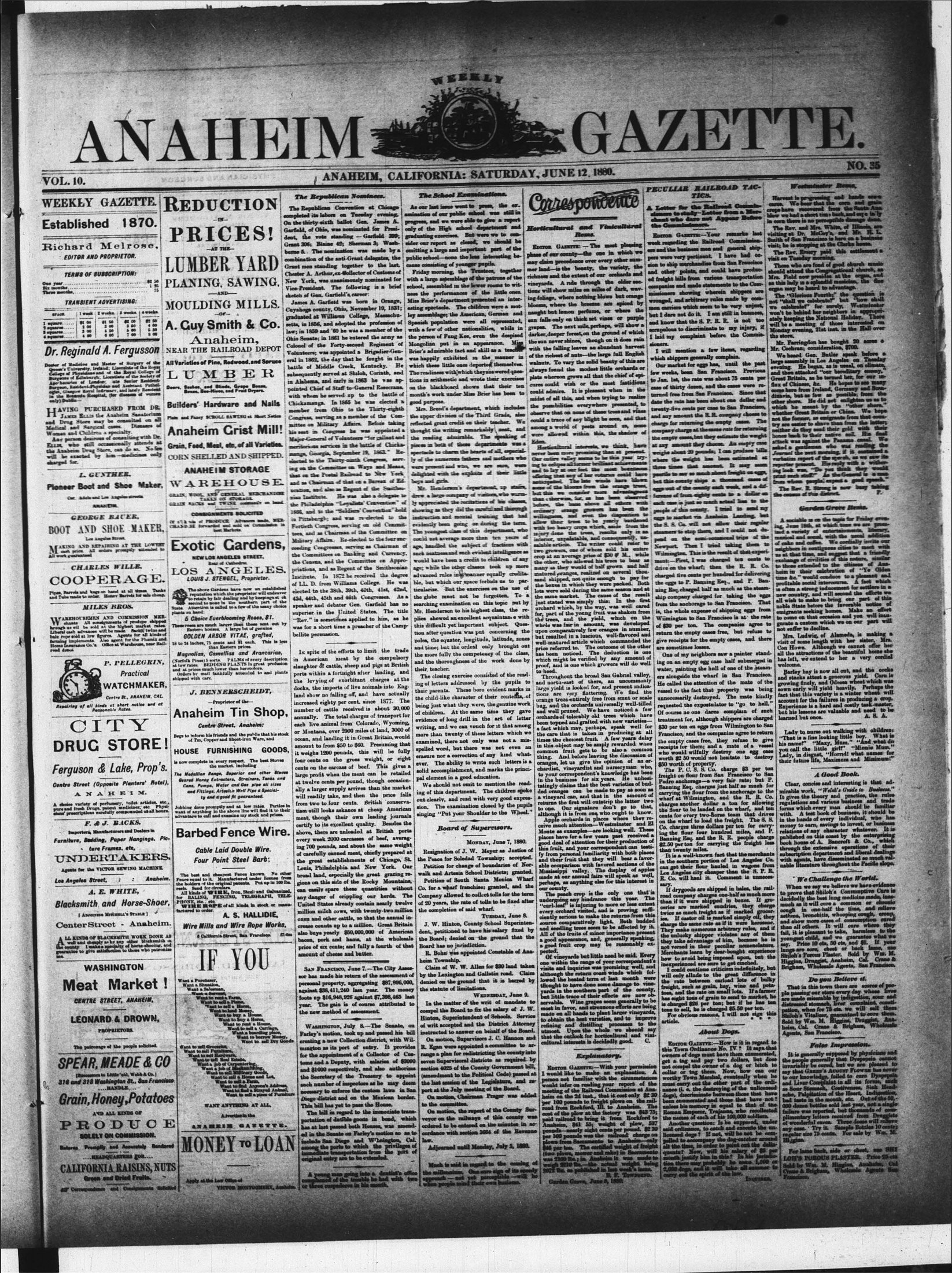
Searchable text
ANAHEIM
VOL. 10.
WEEKLY GAZETTE.
Established 1870.
Richard Melrose,
EDITOR AND PROPRIETOR.
TERMS OF SUBSCRIPTION:
One year.....$2.50
Six months.....1.25
Three months.....75
TRANSIENT ADVERTISING:
SPACE.
1 week
2 weeks
3 weeks
4 weeks
1 square.....$1.00
2 squares.....2.00
3 squares.....3.00
4 squares.....4.00
5 squares.....4.00
6 squares.....6.00
7.00
8.00
Dr. Reginald A. Fergusson
Doctor of Medicine and Master of Surgery of the Queen's University, Ireland; Lieutenant of the Royal College of Physicians and of the Royal College of Surgeons of Edinburgh; Lieutenant of the Society of Apthoriorescences of London; Late Senior Resident-Burgeon, Resident-Physician and Assistant Pathologist, Glasgow Royal Infirmary, and lately Resident in the Rotunda Hospital (for diagnosis of women only) Dublin—
HAVING PURCHASED FROM DR. JAMES ELLIS the Anaheim Sanatorium and Drug Store may be consulted on all Medical and Surgical cases. Dismisses of Woman and Children a speciality.
Any person desirous of consulting with Dr. ELLIS, who still occasionally attends at the Anaheim Drug Store, can do so. No fee will be exacted by him—medicins only charged for it.
REDUCTION IN PRICES!
AT THE LUMBER YARD PLANING, SAWING,
AND MOULDING MILLS.
OF A. Guy Smith & Co.
Anaheim,
NEAR THE RAILROAD DEPOT
All Varieties of Pine, Redwood, and Spruce LUMBER
Doors, Scaffles, and Blinds, Grape Buses,
Bones, Bee-Hives, and Fruit Dryers.
Builders' Hardware and Nails
Plain and Fancy SCROLL SAWING at Short Notion
Anaheim Crist Mill!
Grain, Feed, Meal, etc., of all Varieties.
CORN SHELLED AND SHIPPED.
ANAHEIM STORAGE
HAVING PURCHASED FROM DR. JAMES ELLIS the Anaheim Sanatorium and Drug Store may be committed on all Medical and Surgical cases. Diseases of Woman and Children a specialty.
Any person desirous of consulting with Dr. Ellis who still occasionally attends at the Anaheim Drug Store can do so. No fee will be exacted by him—medicinium only charged for.
L. GUNTHER.
Pioneer Boot and Shoe Maker,
One Ailee and Low Angeles street.
ANAHEIM.
GEORGE BAUER,
BOOT AND SHOE MAKER,
Los Angeles Street.
MAKING AND REPAIRING AT THE LOWEST cash price. All orders promptly attended to. All work guaranteed.
CHARLES WILLE.
COOPERAGE.
Pipes, Barrels and kegs on hand at all times. Tanks and Tubs made to order. Honey Barrels for sale cheap.
MILES BROS.
WAREHOUSEMEN AND COMMISSION MERCHANTS. All arrangements of produce shipped through us will be sold at the highest market rates. Liberal cash advances will be made. Sacrifice twine and bale rope sold at low figures. Agents for all kinds of farming implements. Also agent for the Phoenix and Home Insurance Co.'s Office at Warehouse, near Railroad depot.
P. PELLEGRIN,
Practical WATCHMAKER,
Centre St., ANAHEIM, CAL.
Repairing of all kinds at short notice and at Reasonable Rates.
CITY DRUG STORE!
Ferguson & Lake, Prop's.
Centre Street (Opposite Planters' Hotel),
ANAHEIM.
A choice variety of perfumery, toilet articles, etc., pure and fresh Drugs, patent mediciner, etc. Physicians' prescriptions carefully compounded as all hours.
F. & J. BACKS.
Importers, Manufacturers and Dealers in Furniture, Bedding, Paper Nangings, Picture Frames, etc.
UNDERTAKERS.
Agents for the VICTOR SEWING MACHINE.
Los Angeles Street, : Anaheim.
A. E. WHITE,
LUMBER
Doors, Sashae, and Blinds, Grape Boxes,
Boxes, Bee-Hives, and Fruit Dryers.
Builders' Hardware and Nails
Plain and Fancy SCROLL SAWING at Short Notions
Anaheim Crist Mill!
Grain, Feed, Meal, etc., of all Varieties.
CORN SHELLED AND SHIPPED.
ANAHEIM STORAGE
WAREHOUSE.
GRAIN, WOOL, AND GENERAL MERCHANDISE TAKEN ON SPACE.
GRAIN SACKS and TWINE constantly on hand.
CONSIGNMENTS SOLICITED
Of all kinds of PRODUCK Advances made, MERCHANDISE forwarded and sold at Commission in best Markets.
Exotic Gardens,
NEW LOS ANGELES STREET.
Rear of Cathedral.
LOS ANGELES.
LOUIS J. STENGEL, Proprietor.
The above Gardens have now an established reputation which the proprietor will endeavor to retain by fair dealing and by keeping at ek second to none in the southern part of the State. Attention is called to a few of the many choice plants on hand:
5 Choice Everblooming Roses, $1.
These roses are much larger than those sent out by Eastern houses. A large lot of genuine GOLDEN ARBOR VITAE, grafted,
18 to 24 inches, 75 cents and $1 each. This is less than Eastern prices.
Magnolias, Camellias and Arancarias,
(Nortfolk Pines) 5 sorts. PALMS of every description at low rates. BEDDING PLANTS in great profusion and at prices much lower than heretofore.
Orders by mail faithfully attended to and plants shipped with care.
J. BENNERSCHEIDT,
Proprietor of the Anaheim Tin Shop,
Centre Street, Anaheim:
Bege to inform his friends and the public that his stock of Tin, Copper and Shoot-Iron Ware, and HOUSE FURNISHING GOODS,
is now complete in every respect. The best Stoves the market. including
The Medallion Range, Superior and other Stoves Geared Honey Extractors, Strainers, Tanks and Cans, Pumps, Water and Gas pipe all sizes and Fittings, Artisan Well Pipe a Specialty and a good fit guarantee.
Jobbing done promptly and at low rates. Parties in want of anything in the above line will find it to their advantage to call and examine my stock and prices.
Barbed Fence Wire.
Cable Laid Double Wire.
Four Point Steel Barb;
The best and cheapest Fence known. No other Fence equal to it. Manufactured under license from the holders of the original patents. Put up in 100 lbs. reels. Send for circulars.
All kinds of WIRE, Iron, Steel and Galvanized,
for BALING, FENCING, TELEGRAPH, TELE-
In spite of the efforts in American meat slaughter & cattle sheds ports within a fortnight the levying of exorbit docks, the imports of liv land show no falling off increased eighty per cent number of cattle receiv annually. The total chck each live animal from or Montana, over 2000 ocean, and landing it in amount to from $50 to $10 weighs 1200 pounds, four cents on the carcass of large profit when the mnt at twelve cents per poultry a larger supply arrives will readily take, and trom two to four cents tism-still looks askance meat, though their o certify to its excellent taste above there are unloaded every week 2000 carcasses 700 pounds, and ab of carefully canned meat the great establishm Louis Philadelphia an broad land especially gions on this side of the can easily spare these any danger of crippling
F. & J. BACKS.
Importers, Manufacturers and Dealers in Furniture, Bedding, Paper Hangings, Picture Frames, etc.
UNDERTAKERS.
Agents for the VICTOR SEWING MACHINE.
Los Angeles Street, Anaheim.
A. E. WHITE,
Blacksmith and Horse-Shoer,
[ ARJOINING MITCHELL'S STABLE ]
Center Street - Anaheim.
ALL KINDS OF BLACKSMITH WORK DONE AS well and cheaply as by any other blacksmith in the county. I make a specialty of horse-shooting, and guarantee to give satisfaction to those who patronize me.
WASHINGTON
Meat Market!
CENTRE STREET, ANAHEIM,
LEONARD & DROWN,
PROPRIETORS.
The patronage of the people solicited.
SPEAR, MEADE & CO
[Successors to Little's old, Webb & Co.]
316 and 318 Washington St., San Francisco
Grain, Honey, Potatoes
AND ALL KINDS OF PRODUCE
SOLELY ON COMMISSION.
Horsemen Promply and Annually Rendered
...HEADQUARTERS GO...
CALIFORNIA RAISINS, NUTS
Green and Dried Fruits.
All Correspondence and Consequences Soliciled
Barbed Fence Wire.
Cable Laid Double Wire.
Four Point Steel Barb:
The best and cheapest Fence known. No other Fence equal to it. Manufactured under license from the holders of the original patents. Put up in 100 lbs. reels. Send for circulars.
All kinds of WIRE, Iron, Steel and Galvanized, for BALING, FENCING, TELEGRAPH, TELEPHONE, etc., etc.
WIRE MOPE of all kinds in stock or manufactured to order.
A. S. HALLIDIE,
Wire Mills and Wire Rope Works,
6 California Street, San Francisco.
IF YOU
Want a Purchaser,
Want a Situation,
Want a Salesman,
Want a Surgee,
Want to rent a Farm,
Want to sell a Plane,
Want to sell a Horse,
Want to land Money,
Want to buy a House,
Want to buy a Horse,
Want to rent a House,
Want to sell a Carriage,
Want a boarding place,
Want to borrow Money,
Want to sell Dry Goods
Want to sell Groceries,
Want to sell Furniture,
Want to sell Hardware,
Want to sell Real Estate,
Want a job of Carpentering,
Want a job of Blacksmithing,
Want to sell Millinery Goods,
Want to sell a House and Lot,
Want to sell a Farm,
Want to find Anyone's Address,
Want to find a Strayed Animal,
Want to sell a piece of Furniture
WANT ANYTHING AT ALL.
Advertise in the ANAMEIM GAZETTE.
MONEY TO LOAN
Apply at the Law Office of VICTOR MONTGOMERY, Anaheim.
The Republican Nominee.
The Republican Convention at Chicago completed its labors on Tuesday evening. On the thirty-sixth ballot Gen. James A. Garfield, of Ohio, was nominated for President, the vote standing — Garfield 399; Grant 306; Haine 42; Sherman 3; Washburne 5. The nomination was made by a combination of the anti-Grant delegates, the Grant men standing together to the last. Chester A. Arthur, ex-Collector of Customs of New York, was unanimously nominated for Vice-President. The following is a brief sketch of Gen. Garfield's career:
James A. Garfield was born in Orange, Cuyahoga county, Ohio, November 19, 1831; graduated at Willisau College, Massachusetts, in 1856, and adopted the profession of law; in 1859 and '60 he was a member of the Ohio Senate; in 1861 he entered the army as Colonel of the Forty-second Regiment of Volunteers; was appointed a Brigadier-General in 1862, the day that he fought in the battle of Middle Creek, Kentucky. He subsequently served at Shiloh, Corinth, and in Alabama, and early in 1863 he was appointed Chief of Staff to General Eosecrans, with whom he served up to the battle of Chickamanga. In 1865 he was elected a member from Ohio to the Thirty-eighth Congress, serving as a member of the Committee on Military Affairs. Before taking his seat in Congress he was appointed a Major-General of Volunteers "for gallant and meritorious services in the battle of Chickamanga, Georgia, September 29, 1863." Re-elected to the Thirty-ninth Congress, serving on the Committee on Ways and Means, then on the Public Railroad to New York.
The School Examinations.
As our last issue went to press, the examination of our public school was still in progress, and we were able to give a report only of the High school department and graduating exercises. But were we to consider our report as closed, we should be omitting a large and important part of the public school—none the less interesting because consisting of younger pupils.
Friday morning, the Trustees, together with a large assemblage of the patrons of the school, assembled in the lower rooms to witness the performances of the little ones. Miss Brier's department presented an interesting spectacle. The children were a motley assemblage; the American, German and Spanish population were all represented, with a few of other nationalities, while in the person of Fung Kee, even the despised Mongolian put in an appearance. Miss Brier's admirable tact and skill as a teacher was happily exhibited in the manner in which these little ones deported themselves. The readiness with which they answered questions in arithmetic and wrote their exercises on the blackboard shows that their ten month's work under Miss Brier has been to good purpose.
Mrs. Breed's department, which includes the upper division of the Third Grade, also reflected great credit on their teacher. We thought the writing remarkably neat, and the reading admirable. The speaking of pieces in both of these departments was a spectacle to charm the hearts of all, especially of the numerous fathers and mothers who were present and who we are sure, were delighted with the exploits of their little
In spite of the efforts to limit the trade in American meat by the compulsory slaughter of cattle, sheep and pigs at British ports within a fortnight after landing, and the levying of exorbitant charges at the docks, the imports of live animals into England show no falling off, and have actually increased eighty per cent. since 1877. The number of cattle received is about 30,000 annually. The total charges of transport for each live animal from Colorado, Wyoming, or Montana, over 2000 miles of land, 3000 of ocean, and landing it in Great Britain, would amount to from $50 to $60. Presuming that it weighs 1200 pounds, this will be fully four cents on the gross weight, or eight cents on the carcass of beef. This gives a large profit when the meat can be retailed at twelve cents per pound, though occasionally a larger supply arrives than the market will readily take, and then the price falls from two to four cents. British conservatism still looks askance at cheap American meat, though their own leading journals certify to its excellent quality. Besides the above, there are unloaded at British ports every week 2000 carcasses of beef, averaging 700 pounds, and about the same weight of carefully canned meat, chiefly prepared at the great establishments of Chicago, St. Louis, Philadelphia and New York. Our broad land, especially the great grazing regions on this side of the Rocky Mountains, can easily spare these quantities without any danger of crippling our herds.
Board of Supervisors.
Monday, June 7, 1880.
Resignation of J. W. Meyer as Justice of the Peace for Soledad Township; accepted.
Petition for change of boundaries of Norwalk and Artesia School Districts; granted.
Petition of South Santa Monica Wharf Co. for a wharf franchise; granted, and the Company allowed to collect tolls for the term plates whereon grows all that the chief of epices could wish or the most fastidious could admire. It is pleasant when in the midst of all this, and when trying to realize the possibilities everywhere presented, to observe that on none of these trees and vines could a trace of any blight be seen, and that among a world of pests around us, none were allowed within this, the shadow of Eden.
Horticultural interests, we think, have never been more promising than at present. Our entire valley seems to be this year trying to chop all former brilliant achievements and to lay at our foot the most humane offering that any of her returns could have anticipated. The later winds have shown some of the thinnest from the orange trees, but this we consider more advantageous than everwise; far, as has been observed before, the hone above all others with ordinary orange growers has been the willingness, and even the disposition to allow their trees to be yearly burdened with the heavy crops which, aside from the injury done the trees, results only in an interior, unpalatable, and consequently unavailable article. The writer could refer to two growers, one of whom sold his entire crop at an average price of $30 M., while the other, who allowed his trees to bear as many as he would of half grown and half matured oranges, realized on several thousand shipped, not quite enough to pay for the boxes in which they were packed. Both lots were sold during the same season and at the same market. The cause of the result just stated was simply this: In the first orchard which, by the way, was well cared for, part of the young fruit was shaken from the trees, and the yield, which on the whole was fair in amount, was developed upon comparatively few oranges in number, but resulted in a jucious, well-flavored and well-matured article which commanded the price referred to. The outcome of the other has been noticed. The deduction is one which might be verified by any amount of proof, and is one which growers will do well to heed.
Throughout the broad San Gabriel valley, and north-east of there, an uncommonly large yield is looked for, and present indications are very flattering. We find the orange trees entirely free from smut or scale bug, and the orchards universally well-tilled and well pruned. We have noticed a few orchards of tolerably old trees which have been topped and grafted with new varieties—a fact which may, perhaps, speak well for the care that is taken in producing at all times the choosiest fruit. A few years delay in this object may be amply rewarded when common fruit gets to be also a common thing. And before leaving the discussion of oranges, let us give the opinion of an orchardist, vineyardist and nurseryman who, to your correspondent's knowledge has been in the business for six years. He unhesitatingly claims that the best varieties of budded oranges can be made to pay as soon as a vineyard can, and that in the amount of returns the first will outstrip the latter two to one. Our signature don't go to that, although it is from one who ought to know.
Apple orchards in places where they receive much attention—Westminster and El Monte as examples—are looking well. These places have for a few years past received a good deal of attention for their production of this fruit, and your correspondent can testify from personal familiarity with both places and their fruit that they will bear a favorable comparison with favored sections of the Mississippi valley. The display of apples made at our annual fairs will speak as well, perhaps, as anything else for this interest in our county.
The peach crop is the only one that is enduring any indifference this year. The
SAN FRANCISCO, June 7.—The City Assessor has made his return of the assessment of personal property, aggregating $87,896,000 against $38,411,240 last year. The money foots up $16,948,926 against $7,398,465 last year. The gain is of course attributed to the new method of assessment.
WASHINGTON, July 8.—The Senate, on Farley's motion, took up and passed his bill creating a new Collection district, with Wilmington as its port of entry. It provides for the appointment of a Collector of Customs and a Deputy, with salaries of $3000 and $1000 respectively, and also authorizes the Secretary of the Treasury to appoint such number of inspectors as he may deem necessary to enforce the custom laws in San Diego district and on the Mexican border. This bill has yet to pass the House.
The bill in regard to the immediate transportation of dutiful goods in bond, which has at last passed both Houses, was amended in the Senate on Farley's motion so as to include San Diego and Winnington, Cal. among the ports to which the privileges of immediate transportation from the port of original entry are to be extended.
A young man going into a dentist's office complained of the trouble he had with two or three cuspidores in his mouth.
MONDAY, June 7, 1880.
Resignation of J. W. Meyer as Justice of the Peace for Soledad Township; accepted.
Petition for change of boundaries of Norwalk and Artesia School Districts; granted.
Petition of South Santa Monica Wharf Co. for a wharf franchise; granted, and the Company allowed to collect tolls for the term of 20 years, the rate of tolls to be fixed after the completion of said wharf.
TUESDAY, June 8.
J. W. Hinton, County School Superintendent, petitioned to have his salary fixed by the Board; denied on the ground that the Board has no jurisdiction.
R. Bohn was appointed Constable of Anaheim Township.
Claim of W. W. Allen for $30 land taken by the Lexington and Gallatin road. Claim denied on the ground that it is barred by the statute of limitations.
WEDNESDAY, June 9.
In the matter of the writ of mandate to compel the Board to fix the salary of J. W. Hinton, Superintendent of Schools. Service of writ accepted and the District Attorney instructed to answer on behalf of the Board.
On motion, Supervisors J. C. Hannon and R. Egan were appointed a committee to arrange a plan for redistricting the county into seven Supervisorial districts as required by section 4025 of the County Government bill, (amendment to the Political Code) passed at the last session of the Legislature, and report at the July meeting of the Board.
On motion, Chairman Prager was added to the committee.
On motion, the report of the County Surveyor on the railways of this county was ordered to be entered on the minutes in accordance with section 3664 of the Revenue law.
Adjourned until Monday, July 5, 1880.
Much is said in regard to the coming of the millennium. One sure sign of its speedy approach — not yet perceptible — will be when people mind their own business.
Apple orchards in places where they receive much attention—Westminster and El Monte as examples—are locking well. These places have for a few years past received a good deal of attention for their production of this fruit, and your correspondent can testify from personal familiarity with both places and their fruit that they will bear a favorable comparison with favored sections of the Mississippi valley. The display of apples made at our annual fairs will speak as well, perhaps, as anything else for this interest in our county.
The peach crop is the only one that is undergoing any hindrance this year. The "curl-leaf" is injuring to more or less extent every orchard visited, and is proving sufficiently serious to make the returns from this source comparatively light. Both budded and seedling trees seem to be affected by it. All of the fruits of minor importance present a good appearance, and generally speaking, a good fruit crop may be reasonably expected.
Of vineyards but little need be said. Every one within the range of your correspondent's visits and inquiries was promising well, and although the return coast winds which followed the heated term of last month were thought to have done some damage to vineyards in the southern part of the county, but little trace of their effects are now observable. Wine grapes seem generally to be most in favor, and strenuous efforts are being made on all hands to plant larger vineyards, to obtain the best varieties, and to improve refining and distilling processes to the utmost. Upon the whole we should say that the outlook for horticultural and vinn-cultural interests is decidedly good.
Explanatory.
EDITOR GAZETTE:—With your permission I would like to make an explanation. A person not familiar with the circumstances would infer on reading your report of the meeting of the Railroad Commission at Anaheim on the 2d inst., that it cost only $230 per 100 pounds to freight plows on the railroad from Rockford, Ill. to Anaheim. The cost of the plow at the factory was $13 75; paid railroad to bring it from Rockford to Anaheim; $41 55; weight of plow, $537 pounds—nearly eight cents per pound; $230 per 100 pounds was the railroad charge on plows from Sacramento to Anaheim—only $46 per ton. The certified weight of freight (two plows, mower and rake) in Francisco was 2100 lb.; in Anaheim it was made to weigh 2210 lb.; the actual weight being 2072 lb., an published in last week's issue.
R. F. TOWNSED.
Garden Grove, June 8, 1880.
GAZETTE.
NO. 35
PECULIAR RAILROAD TACTICS.
A Letter for the Railroad Commission to study-Letter from a Merchant who dare not Appear Before the Commissioners.
Editor Gazette:—Your remarks last week regarding the Railroad Commissioners and the business men and general shipmen were very pertinent. I have had occasion to ship merchandise from San Francisco and other points, and could have produced freight bills from various transportation companies and made statements to the Commissioners showing wherein shippers are wronged, and arbitrary rules made by common carriers which seem to be very unjust, but I dare not do it. I am still in business, and know that the S. P. R. R. is not too scrupulous to discriminate to my injury, if I laid my complaint before the Commissioners.
I will mention a few items, regarding which shippers generally complain.
Our market for eggs has, until the past few weeks, been San Francisco. Previous to Jan. 1st, the rate was about 75 cents per case of thirty dozen, and the cases were returned free from San Francisco. Since that date the rate has been about one dollar and twenty-five cents per case to San Francisco, and any amount the R.R. company chooses to charge for returning the empty cases. The company charge at the same rate for returning the empty cases, but they estimate the weight at any amount they choose. An empty case weighs about 20 pounds; I can produce bills where the weight has been estimated at three times that amount. It may seem impossible to say so much about fought on eggs.
Westminster Rema,
Harvest is progressing and hands are earnen. We hear that the corn and grain crops have recovered from the Santa Ana blow we had a short time back, and eye in ly in corn there is no perceptible damage done.
The Rev. and Mrs. White, of Illinois, are visiting at Dr. McCoy's, and Mr. H. L. Smith of San Francisco is here on a business visit; he is stopping at the Clarke house.
The Rev. Emery paid this settlement a visit on Tuesday morning.
Those who are fond of good church music should attend the Congregational church, as Mrs. Field now presides at the organ, and as this lady is a splendid musician, the fine organ may be heard to advantage.
The "Glorious Fourth," the question is not "shall we celebrate?" but "how shall we celebrate?" for surely, Westminster won't be behind her neighbors in appropriately keeping the National Holiday. There will be a meeting of those interested on Monday evening, 21st inst., in the Hall over the store.
Mr. Farringdon has bought 20 acres o Mr. Cochran; consideration, $700.
We heard Gen. Butler speak before a large assembly in Los Angeles on Tuesday evening. He began, as is usual, on climate, and then attacked "our hereditary enemy." Great Britain, as he termed her, for our influx of Chinese, &c. He hopes to see many come here from Ireland, Germany and Scandinavia, but as few as possible, from the other shore. He did not enlighten us as to which he meant by the "other shore," whether Great Britain or China. We hope not the former, as emigrants from that country are easier to shave than from the latter; neither do they send their gold with their bones back to their native soil. His final attack was against the Panama canal. We asked a gentleman who was reading the Journal the next morning, if it contained a verbatim report of the speech, as we saw its reporter present. His reply with a wittering look was, "Do you think they would
Great Britain, as he termed her, for our influx of Chinese &c. He hopes to see many come here from Ireland, Germany and Scotland, but as few as possible from the other shore. He did not enlighten us to which he meant by the "other shore." whether Great Britain or China. We hope not the former, as emigrants from that country are easier to shave than from the latter; neither do they send their gold with their bones back to their native soil. His final attack was against the Panama canal. We made a gentleman who was reading the Journal the next morning. If it contained a verbatim report of the speech, as we saw its superior present. He reply with a wilting look was, "Do you think they would print much staff?" As the General is a man from whom people expect a good speech.
The Rev. R. Strong is now busy taking the course of vice district.
Garden Grove Means.
A sociable as on the tagus for Friday evening, June 18th, at which time we are promised a variety of entertainments, literary, musical and sound, with the usual addition of cakes and coffee. We cordially invite our neighbors in contiguous cities to most with us at that time, and suggest that a friendly exchange of civilities of this nature, similar to those extended to the citizens of Anaheim in their celebration of "Ye Olden time &c." would conduce to a pleasant and profitable social intercourse. A fact which is often a strong inducement for settlers in a new country, and will second the efforts we all wish to make to bring our part of this noble State before the favorable notice of emigrants seeking homes. Make an effort to come on that occasion and you will inaugurate a custom which we on our part will not suffer to decline.
Mrs. Ludwig, of Alameda, is making a visit of some length with her sister, Mrs. Con Howe. Although we cannot offer her all the attractions of the beautiful home she has left, we extend to her a very cordial welcome.
Barley hay is now all cut, and the cocks and stacks attest a generous yield. Corn is growing finely, and Odessa wheat which was sown early will yield heavily. Perhaps the fact that this variety is a winter wheat will account for the failures in producing a crop. Experience is a hard and costly task-master, but his lessons are valuable and need to be learned but once.
A S. A.
Lady to nurse out walking with children: "That is a fine looking little boy. What is his name!" "Maxy, Mum." "And what do you call the little girl?" "Minnie Mum." Lady, in disgust, "Horrid! what names for their future life, Maximum and Minimum!"
A Good Book.
Clear, concise and interesting is that admirable work, "Welah's Guide to Business." It gives the theory and practice, the rules regulations and various business and trade forms which every man should be familiar with. A test book of business, it should be in the hands of every individual, who has money to earn, savings to invest, or business relations of any character whatever. It is published on this coast by the enterprising book house of A. Bancroft & Co., which through the extensive operations of their subscription department and liberal dealings with agents, have disseminated so much valuable literature throughout the Pacific slope.
We Challenge the World.
When we say we believe we have evidence to prove Shiloh's Consumptive Cure is decidedly the best lung medicine made, inna-
untstrip the latter two
doesn't go to that,
who ought to know.
places where they reWestminster and Elare looking well. These
past received a
for their production of
correspondent can testiarity with both places
they will bear a favorfavored sections of the
The display of apples
airs will speak as well,
also for this interest in
the only one that is
ance this year. The
to more or less extent
and is proving suffithe returns from this
light. Both budded
to be affected by it.
nor importance present
generally speaking,
may be reasonably extended need be said. Every
of your correspondent's
promising well, and
coast winds which follora of last month were
some damage to vinepart of the county,
our effects are now obseen generally to be
enumerous efforts are being
plant larger vineyards,
nities, and to improve
ing processes to the
whole we should say
horticultural and vinecidedly good.
Anatomy.
With your permission
be an explanation. A
with the circumstances
giving your report of the
and Commission at Anathat it cost only $2.30
weight plows on the railIII to Anaheim. The
factory was $23.75;
buy it from Rockford to
weight of plow, 537
cents per pound, $2.30
the railroad charge on
rate to Anaheim—only
certified weight of freight
(and rake) in Sacramento
Anaheim it was made to
actual weight being
in last week's issue.
R. E. TOWNSEND.
June 8, 1899.
Editor Gazette:—How is it in regard to this Town Ordinance No. IV? It says that owners of dogs must have them enumerated, get a tag and pay two dollars, but does not compel the owner of a dog or bitch to collar or tag them. Now, how can our worthy Town Marshal, eventually when he must carry out the other part of the ordinance (i.e., the destroying of the unlicensed dogs), discriminate between those that have been enumerated and those that have not unless his memory is equal to that of the Roman Emperor, Trajanus, who recollected the names of each of his 100,000 soldiers.
Another question: Is he supposed, under said ordinance, to catch and execute the unlicensed dogs? If not, will he not be compelled to accompany the dog-catcher around all the time, in order to point out the delinquents? Now, will his salary of $5 per month justify him in this? In his jurisdiction there may probably be none 1,000 or 2,000 dogs, and it will take all summer to carry out the spirit of the law.
LIQUIDER.
It charges another dollar a ton for allowing the flour to be landed on the wharf, and ten cents for every two-horse team that drives on the wharf to load the freight. The S. S. Co. charges three dollars per ton for carrying the flour four hundred miles, and P. Banning Eq. and the R. R. people charge $2.50 per ton for carrying the freight less than twenty miles.
It is a well-known fact that the merchants in the southern portion of Los Angeles Co. can get their flour hauled in wagons from Los Angeles city cheaper than the S. P. R. R. Co. will haul it. Comment is unnecessary.
If drygoods are shipped in bales, the railroad company charges one-half as much more than if it were shipped in boxes. It groceries are marked endries, they charge twice as much freight as if marked groceries. If castor oil is marked simply oil, they charge the same rate as if it were kerosene. They make numerous arbitrary rules, and if the unlucky shipper violates any of them they take advantage of him, because he is not versed in their peculiar nomenclature. Merchants learn by dear-bought experience how to avoid being imposed upon, but the inexperienced are sure to get cined.
I could continue criticism indefinitely, but will only allude to the great difference in the rate between carload lots of bulky freight, such as grain, hay, wine and potatoes, and the rate on small lots. If a farmer has eight tons of grain to send to market, he is charged $26 per ton; but if he has ten tons to sell, he is charged $5.50 per ton.
For obvious reasons, I will not sign this article.
About Dogs.
Editor Gazette:—How is it in regard to this Town Ordinance No. IV? It says that owners of dogs must have them enumerated, get a tag and pay two dollars, but does not compel the owner of a dog or bitch to collar or tag them. Now, how can our worthy Town Marshal, eventually when he must carry out the other part of the ordinance (i.e., the destroying of the unlicensed dogs), discriminate between those that have been enumerated and those that have not? Unless his memory is equal to that of the Roman Emperor, Trajanus, who recollected the names of each of his 100,000 soldiers.
Another question: Is he supposed, under said ordinance, to catch and execute the unlicensed dogs? If not, will he not be compelled to accompany the dog-catcher around all the time, in order to point out the delinquents? Now, will his salary of $5 per month justify him in this? In his jurisdiction there may probably be none 1,000 or 2,000 dogs, and it will take all summer to carry out the spirit of the law.
LIQUIDER.
It charges another dollar a ton for allowing the flour to be landed on the wharf, and ten cents for every two-horse team that drives on the wharf to load the freight. The S. S. Co. charges three dollars per ton for carrying the flour four hundred miles, and P. Banning Eq. and the R. R. people charge $2.50 per ton for carrying the freight less than twenty miles.
It is a well-known fact that the merchants in the southern portion of Los Angeles Co. can get their flour hauled in wagons from Los Angeles city cheaper than the S. P. R. R. Co. will haul it. Comment is unnecessary.
If drygoods are shipped in bales, the railroad company charges one-half as much more than if it were shipped in boxes. It groceries are marked endries, they charge twice as much freight as if marked groceries. If castor oil is marked simply oil, they charge the same rate as if it were kerosene. They make numerous arbitrary rules, and if the unlucky shipper violates any of them they take advantage of him, because he is not versed in their peculiar nomenclature. Merchants learn by dear-bought experience how to avoid being imposed upon, but the inexperienced are sure to get cined.
I could continue criticism indefinitely, but will only allude to the great difference in the rate between carload lots of bulky freight, such as grain, hay, wine and potatoes, and the rate on small lots. If a farmer has eight tons of grain to send to market, he is charged $26 per ton; but if he has ten tons to sell, he is charged $5.50 per ton.
For obvious reasons, I will not sign this article.
We Challenge the World.
When we say we believe we have evidence to prove that Shiloh's Consumptive Care is decidedly the best lung medicine made, inasmuch as it will cure a common or chronic cough in one-half the time, and relieve asthma, bronchitis, whooping cough, group, and show more cases of consumption cured than all others. It will cure where they fail, it is pleasant to take, harmless to the youngest child, and we guarantee what we say. Price 10 eta, 50 eta, and $1. If your lungs are sore, chest or back lame, use Shiloh's Porous Plaster. Sold by Wm. M. Higgins, Druggist, Anaheim, Cal. Crane & Brigham, Wholesale Agents, San Francisco.
Do you Believe it?
That in this town there are scores of people passing our store every day whose lives are made miserable by indigestion, sour and distressed stomach, liver complaint, constipation, when for 75 eta we will sell them Shiloh's Vitalizer, guaranteed to cure them. Sold by Wm. M. Higgins, Druggist, Anaheim, Cal. Crane & Brigham, Wholesale Agents, San Francisco.
False Impression.
It is generally supposed by physicians and the people generally that Dyspepsia cannot invariably be cured, but we are pleased to say that Green's August Flower has never to our knowledge failed to cure Dyspepsia and Liver Complaint in all its forms, such as Sour Stemach, Costivenses, Sick Headache, Palpitation of the Heart, Indigestion bad tastes in the mouth, etc. Out of the 50-, 000 dozen bottles lost last year, not a single failure was reported, but thousands of complimentary letters received from Druggists of wonderful cursees. Try it. Sample Bottles 10 centr regular size 75 cents. For sale by Wm. M. Higgins.
For lime back, side or chest, use SHI LOH'S FOROUS PLASTER. Price 25 eta Sold by Wm. M. Higgins, Anaheim, Cal Crane & Brigham, Wholesale Agents San Francisco.