anaheim-gazette 1880-06-05
Scanned page
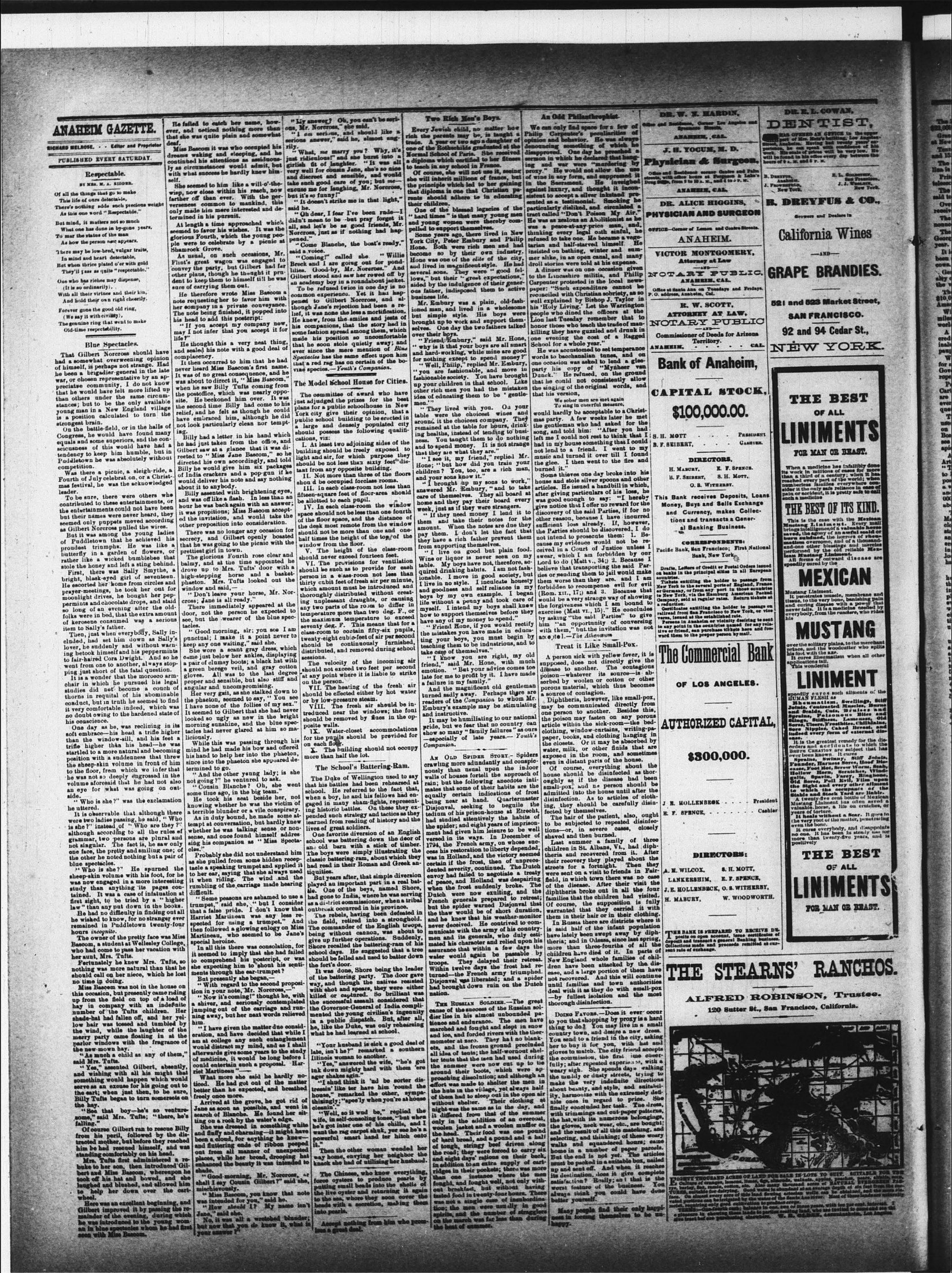
Searchable text
ANAHEIM GAZETTE.
RICHARD MELROSE. - Editor and Proprietor
PUBLISHED EVERY SATURDAY.
Respectable.
BY MRS. M. A. RIDDER.
Of all the things that go to make this life of ours delectable,
There’s nothing adds such precious weight
As this one word “Respectable.”
But mind, it matters not so much
What one has done in by-gone years,
To mar the status of the man
As how the person now appears.
There may be low-bred, vulgar traits,
In mind and heart detectable,
But when thrice plated o’er with gold
They’ll pass as quite “respectable.”
One who has riches may dispense,
(It is so ordinarily),
With all their virtues and their kin,
And hold their own right cheerily.
Forever gone the good old ring,
(We say it with civility),
The genuine ring that went to make Old-time respectability.
Blue Spectacles.
That Gilbert Norcross should have had a somewhat overweening opinion of himself, is perhaps not strange. Had he been a brigadier-general in the late war, or chosen representative by an appreciative community, I do not know that he would have felt more lifted up than others under the same circumstances; but to be the only available young man in a New England village is a position calculated to turn the strongest brain.
On the battle-field, or in the halls of Congress, he would have found many equals and some superiors, and the consciousness of this would have had a tendency to keep him humble, but in Puddletown he was absolutely without competition.
Was there a picnic, a sleigh-ride, a He failed to catch her name, however, and netted nothing more than that she was quite plain and somewhat deaf.
Miss Bascom it was who occupied his dreams waking and sleeping, and he continued his attentions as assiduously as circumstances would admit, but with what success he hardly knew himself.
She seemed to him like a will-o’the-wisp, now close within his reach, now farther off than ever. With the perverseness common to mankind, this only made him more interested and determined in his pursuit.
At length a time approached which seemed to favor his wishes. It was the glorious Fourth, which the young people were to celebrate by a picnic at Shamrock Grove.
As usual, on such occasions, Mr. Flint’s great wagon was engaged to convey the party, but Gilbert had far other plans, though he thought it prudent to keep them to himself till he was sure of carrying them out.
He therefore wrote Miss Bascom a note requesting her to favor him with her company in a private conveyance. The note being finished, it popped into his head to add this postscript:
“If you accept my company new, may I not infer that you accept it for life?”
He thought this a very neat thing, and sealed his note with a good deal of complacency.
It then occurred to him that he had never heard Miss Bascom’s first name. It was of no great consequence, and he was about to direct it, “Miss Bascom,” when he saw Billy Tufts coming from the postoffice, which was nearly opposite. He beckoned him over. It was the second time Billy had come to his relief, and he felt as though he could have embraced him, although he did not look particularly clean nor tempting.
Billy had a letter in his hand which he had just taken from the office, and Gilbert saw at a glance that it was directed to “Miss Jane Bascom,” so he directed his own accordingly, and told Billy he would give him six packages of India crackers and a pop-gun if he
“Ly answer? Oh, you ones, Mr. Norcross,” she said her rily.
“What, me marry you just ridiculous!” and she girlish fit of laughter; very well for cousin Jasmin and discreet and sensitive take such good care of excuse me for laughing but it’s so funny!”
“It doesn’t strike me said he.
“Oh dear, I fear I’ve didn’t mean to be —but all, and let’s be as good Norcross, just as if not opened.”
“Come Blanche, the said a voice.”
“Coming!” called Breeck and I are going lilies. Good-by, Mr. Gilbert stood and saw an academy boy in a robe.
To be refused twice common experience. Pened to Gilbert N. though Jane’s rejection lief, it was none the less. He knew, from the small companions, that some fashion spread around made his position sure that he soon stole quirk ever since the mere Spectacles has the same that a red rag has on vine species.—Youth’s
The Model School
The committee of just adjudged the prizes for a public school building a large and densely should possess the cations, viz:
I. At least two adjudging buildings should be light and air, for which should be not less than taint from any oppose-
he been a brigade general by an appreciative community. I do not know that he would have felt more lifted up than others under the same circumstances; but to be the only available young man in a New England village is a position calculated to turn the strongest brain.
On the battle-field, or in the halls of Congress, he would have found many equals and some superiors, and the consciousness of this would have had a tendency to keep him humble, but in Puddletown he was absolutely without competition.
Was there a picnic, a sleigh-ride, a Fourth of July celebrat on, or a Christmas festival, he was the acknowledged leader.
To be sure, there were others who contributed to these entertainments, or the entertainments could not have been but their names were never heard, they seemed only puppets moved according to Gilbert Norcross pulled the wires.
But it was among the young ladies of Puddletown that he achieved his proudest triumphs. He was like a butterfly in a garden of flowers, or rather like a wicked bumblebee that stole the honey and left a sting behind.
First, there was Sally Smythe, a bright, black-eyed girl of seventeen. He escorted her home from circles and prayer-meetings, he took her out for moonlight drives, he bought her peppermints and chocolate drops, and staid so long of an evening after the old-folks were in bed, that the extra amount of kerosene consumed was a serious item to Sally's father.
Then, just when everybody, Sally included, had set him down as Sally's lover, he suddenly and without warning betook himself and his peppermints to fair-baired Cora Dwight. And so he went from one to another, always stopping just short of the fatal question.
It is a wonder that the morocco armchair in which he pursued his legal studies did not become a couch of thorns in requital of his abominable conduct, but in truth he seemed to find it very comfortable indeed, which was no doubt owing to the hardened state of his conscience.
One day as he, was reclining in its soft embrace—his head a trifle higher than the window-sill, and his feet a trifle higher than his head—he was startled to a more natural and becoming position with a suddenness that threw the sheep-skin volume in front of him to the floor, from which we infer that he was not so deeply engrossed in the volume aforesaid that he had not also an eye for what was going on outside.
"Who is she?" was the exclamation he uttered.
It is observable that although there were two ladies passing, he said, "Who is she?" instead of "Who are they?" although according to all the rules of grammar, two persons are plural and not singular. The fact is, he saw only one face, the pretty and smiling one; of the other he noted nothing but a pair of blue spectacles.
"Who is she?" He spurned the sheep-skin volume with his foot, for he was now engaged in a more interesting study than anything its pages contained. It was a case of infatuation at the battlefield or in the halls of Congress, he would have found many equals and some superiors, and the consciousness of this would have had a tendency to keep him humble, but in Puddletown he was absolutely without competition.
Was there a picnic, a sleigh-ride, a Fourth of July celebrat on, or a Christmas festival, he was the acknowledged leader.
To be sure, there were others who contributed to these entertainments, or the entertainments could not have been but their names were never heard, they seemed only puppets moved according to Gilbert Norcross pulled the wires.
But it was among the young ladies of Puddletown that he achieved his proudest triumphs. He was like a butterfly in a garden of flowers, or rather like a wicked bumblebee that stole the honey and left a sting behind.
First, there was Sally Smythe, a bright, black-eyed girl of seventeen. He escorted her home from circles and prayer-meetings, he took her out for moonlight drives, he bought her peppermints and chocolate drops, and staid so long of an evening after the old-folks were in bed, that the extra amount of kerosene consumed was a serious item to Sally's father.
Then, just when everybody, Sally included, had set him down as Sally's lover, he suddenly and without warning betook himself and his peppermints to fair-baired Cora Dwight. And so he went from one to another, always stopping just short of the fatal question.
It is a wonder that the morocco armchair in which he pursued his legal studies did not become a couch of thorns in requital of his abominable conduct, but in truth he seemed to find it very comfortable indeed, which was no doubt owing to the hardened state of his conscience.
One day as he, was reclining in its soft embrace—his head a trifle higher than the window-sill, and his feet a trifle higher than his head—he was startled to a more natural and becoming position with a suddenness that threw the sheep-skin volume in front of him to the floor, from which we infer that he was not so deeply engrossed in the volume aforesaid that he had not also an eye for what was going on outside.
"Who is she?" was the exclamation he uttered.
It is observable that although there were two ladies passing, he said, "Who is she?" instead of "Who are they?" although according to all the rules of grammar, two persons are plural and not singular. The fact is, he saw only one face, the pretty and smiling one; of the other he noted nothing but a pair of blue spectacles.
"Who is she?" He spurned the sheep-skin volume with his foot, for he was now engaged in a more interesting study than anything its pages contained. It was a case of infatuation at the battlefield or in the halls of Congress, he would have found many equals and some superiors, and the consciousness of this would have had a tendency to keep him humble, but in Puddletown he was absolutely without competition.
Was there a picnic, a sleigh-ride, a Fourth of July celebrat on, or a Christmas festival, he was the acknowledged leader.
To be sure, there were others who contributed to these entertainments, or the entertainments could not have been but their names were never heard, they seemed only puppets moved according to Gilbert Norcross pulled the wires.
But it was among the young ladies of Puddletown that he achieved his proudest triumphs. He was like a butterfly in a garden of flowers, or rather like a wicked bumblebee that stole the honey and left a sting behind.
First, there was Sally Smythe, a bright, black-eyed girl of seventeen. He escorted her home from circles and prayer-meetings, he took her out for moonlight drives, he bought her peppermints and chocolate drops, and staid so long of an evening after the old-folks were in bed, that the extra amount of kerosene consumed was a serious item to Sally's father.
Then, just when everybody, Sally included, had set him down as Sally's lover, he suddenly and without warning betook himself and his peppermints to fair-baired Cora Dwight. And so he went from one to another, always stopping just short of the fatal question.
It is a wonder that the morocco armchair in which he pursued his legal studies did not become a couch of thorns in requital of his abominable conduct, but in truth he seemed to find it very comfortable indeed, which was no doubt owing to the hardened state of his conscience.
One day as he, was reclining in its soft embrace—his head a trifle higher than the window-sill, and his feet a trifle higher than his head—he was startled to a more natural and becoming position with a suddenness that threw the sheep-skin volume in front of him to the floor, from which we infer that he was not so deeply engrossed in the volume aforesaid that he had not also an eye for what was going on outside.
"Who is she?" was the exclamation he uttered.
It is observable that although there were two ladies passing, he said, "Who is she?" instead of "Who are they?" although according to all the rules of grammar, two persons are plural and not singular. The fact is, he saw only one face, the pretty and smiling one; of the other he noted nothing but a pair of blue spectacles.
"Who is she?" He spurned the sheep-skin volume with his foot, for he was now engaged in a more interesting study than anything its pages contained. It was a case of infatuation at the battlefield or in the halls of Congress, he would have found many equals and some superiors, and the consciousness of this would have had a tendency to keep him humble, but in Puddletown he was absolutely without competition.
Was there a picnic, a sleigh-ride, a Fourth of July celebrat on, or a Christmas festival, he was the acknowledged leader.
To be sure, there were others who contributed to these entertainments, or the entertainments could not have been but their names were never heard,they seemed only puppets moved according to Gilbert Norcross pulled the wires.
But it was among the young ladies of Puddletown that he achieved his proudest triumphs. He was like a butterfly in a garden of flowers,or rather like a wicked bumblebee that stole the honey and left a sting behind.
First,there was Sally Smythe,a bright,black-eyed girl of seventeen.He escorted her home from circles and prayer-meetings,he took her out for moonlight drives,he bought her peppermints和 chocolate drops,and staid so long of an evening after the old-folks were in bed,that the extra amount of kerosene consumed was a serious item to Sally's father.
Then,just when everybody,Sally included,had set him down as Sally's lover,he suddenly and without warning betook himself and his peppermints to fair-baired Cora Dwight. And so he went from one to another,always stopping just short of the fatal question.
It is a wonder that the morocco armchair in which he pursued his legal studies did not become a couch of thorns in requital of his abominable conduct,但in truth他 seemed到find它verycomfortableindeed,而whichamountmustthoroughlydistribuldingunpleasantdressanytwopartsofthetemperaturemorethanhalftimestheheightseventydeg.F.T.class-roomtocontaintwenty-eightcuboidshouldbecontributed,andresections.Thevelocityoftennotexceedatanypointwhereontheperson.VII.Theheatingshouldbeeffectedorbylow-pressureVIII.Thefreetreducednearthershouldberemovedpositewalls.IX.Water-closforthepupilsshowoneachfloor.X.ThebuildingmorethanhalftheSchool'S.TheDukeOfWhatthathisbattleshouldbechool.Herewhenaboy,hasgagedinmanysing historicbattlependedsuchstrainedefencesofgreatsolone favoritediaryschoolwasbatteraneoldbarnTheboyswereasclassicbatteringhadreadintheirtiquities.Buy年afterplayedanimportale.OneoftheohadgonetoIndia
"Who is she?" was the exclamation he uttered.
It is observable that although there were two ladies passing, he said, "Who is she?" instead of "Who are they?".
although according to all the rules of grammar, two persons are plural and not singular. The fact is, he saw only one face, the pretty and smiling one; of the other he noted nothing but a pair of blue spectacles.
"Who is she?" He spurned the sheep-skin volume with his foot, for he was now engaged in a more interesting study than anything its pages contained. It was a case of infatuation at first sight, to be tried by a "higher law" than any put down in the books.
He had no difficulty in finding out all he wished to know, for no stranger ever remained in Puddletown twenty-four hours incognito.
The owner of the pretty face was Miss Bascom, a student at Wellesley College, who had come to pass her vacation with her aunt, Mrs. Tufts.
Fortunately he knew Mrs. Tufts, so nothing was more natural than that he should call on her niece, which he lost no time in doing.
Miss Bascom was not in the house on this occasion, but presently came riding up from the field on top of a load of hay in company with an indefinite number of the Tufts children. Her shade-hat had fallen off, and her yellow hair was tossed and tumbled by the wind, while the laughter of the merry party came floating in at the parlor windows with the fragrance of the new-mown hay.
"As much a child as any of them," said Mrs. Tufts.
"Yes," assented Gilbert, absently, and wishing with all his might that something would happen which would serve as an excuse for his going out to the cart; when just then, to be sure, Billy Tufts began to turn somersets on the hay.
"Sea that boy—he's so venturesome," said Mrs. Tufts; "there, he's falling."
Of course Gilbert ran to rescue Billy from his peril, followed by the distracted mother, but before they reached him he had rescued himself, and was standing comfortably on his head.
Mrs. Tufts first administered a rebuke to her son, then introduced Gilbert and Miss Bascom, whereupon he took off his hat and bowed, and she laughed and blushed, and allowed him to help her down over the cart-wheel.
Here was an excellent beginning, and Gilbert improved it by passing the remainder of the evening, during which he was introduced to the young woman in blue spectacles whom he had first seen with Miss Bascom.
He took his seat beside her, knowing whether he was the victim of a terrible blunder or a vile conspiracy.
As in duty bound, he made some attempt at conversation, but hardly knew whether he was talking sense or non-sense, and once found himself addressing his companion as "Miss Spectacles."
Probably she did not understand him as she pulled from some hidden receptacle a speaking trumpet and applied it to her ear, saying that she always used it when riding. The wind and the rumbling of the carriage made hearing difficult.
"Some peasons are ashamed to use a trumpet," said she, "but I consider that a false pride. I don't know that Harriet Martineau was any less respected for using a trumpet." And then followed a glowing eulogy on Miss Martineau, who seemed to be Jane's special heroine.
In all this there was consolation, for it seemed to imply that she had failed to comprehend his postscript, or was she expecting him to shout his sentiments through the ear-trumpet?
But presently she began,
"With regard to the second proposition in your note, Mr. Norcross,"
"Now it's coming!" thought he, with a shiver, and seriously contemplated jumping out of the carriage and running away, but her next words relieved him.
"I have given the matter due consideration, and have decided that while I am at college any such entanglement would distract my mind, and as I shall afterwards give some years to the study of medicine, it would be long before I could entertain such a proposal. Harriet Martineau"
What more she said he hardly noticed. He had got out of the matter better than he expected, and breathed freely once more.
Arrived at the grove, he got rid of Jane as soon as possible, and went in search of Blanche. He found her sitting on a rock by the water's edge.
She was dressed in something white and fluffy and charming—it might have been a cloud, for anything he knew—and fluttering ends of ribbon peeped out from all manner of unexpected places, while her broad, drooping hat enhanced the beauty it was intended to shade.
"Good morning, Mr. Norcross," or shall I say Cousin Gilbert? said she, mischievously.
Miss Bascom, you know that note was intended for you," said he.
"How should I? My name isn't Jane," said she.
No, it was all a wretched blunder; but now that you do know it, what is your answer?
"Liy answer? Oh, you can't be serious, Mr. Norcross," she said.
"I am serious, and should like a serious answer," said he, almost angrily.
"What, me marry you? Why, it's just ridiculous!" and she burst into a girlish fit of laughter. "It was all very well for cousin Jane, she's so nice and discreet and sensible, and would take such good care of you; but me—excuse me for laughing, Mr. Norcross, but it's so funny!"
"It doesn't strike me in that light," said he.
"Oh dear, I fear I've been rude—I didn't mean to be—but pray forget it all, and let's be as good friends, Mr. Norcross, just as if nothing had happened."
"Come Blanche, the boat's ready," said a voice.
"Coming!" called she. "Willie Breck and I are going out for pond-lilies. Good-by, Mr. Norcross." And Gilbert stood and saw her rowed off by an academy boy in a roundabout jacket.
To be refused twice in one day is no common experience. Yet it has happened to Gilbert Norcross, and although Jane's rejection had been a relief, it was none the less a mortification. He knew, from the smiles and jests of his companions, that the story had in some fashion spread among them, which made his position so uncomfortable that he soon stole quietly away; and ever since the mere mention of Blue Spectacles has the same effect upon him that a red rag has on certain of the bo-vine species. — Youth's Companion.
The Model School House for Cities.
The committee of award who have just adjudged the prizes for the best plans for a public schoolhouse in New York city give their opinion, that a public school building to be erected in a large and densely populated city should possess the following qualifications, viz:
1. At least two adjoining sides of the building should be freely exposed to light and air, for which purpose they should not less than sixty feet distant from any opposite building.
2. Not more than three of the floors
Two Rich Men's Boys.
Every Jewish child, no matter how rich the parents may be, is taught a trade. A year or two ago a daughter of one of the Rothschilds graduated at the Normal School of Paris. She received a diploma which certified to her fitness to teach in any school in France.
Of course, she will not use it, seeing she will inherit millions of francs, but the principle which led to her gaining that diploma is one that Christian parents should adhere to in educating their children.
One of the blessed legacies of the "hard times" is that many young men and young women were thereby compelled to support themselves.
Some years ago, there lived in New York City, Peter Embury and Philip Hone. Both were rich men and had become so by their own industry. Hone was one of the elite of the city, and lived in magnificent style. He had several sons. They were "good fellows," but their "great expectations," aided by the indulgence of their generous father, indisposed them to active business life.
Mr. Embury was a plain, old-fashioned man, and lived in a wholesome but simple style. His boys were brought up to work and support themselves. One day the two fathers talked over their boys.
"Friend Embury," said Mr. Hone,
"why is it that your boys are all smart and hard-working, while mine are good for nothing except to spend money?"
"Well, Philip," replied Mr. Embury,
"you are fashionable, and move in fashionable society. You have brought up your children in that school. Like other rich men you had the mistaken idea of educating them to be 'gentlemen.'"
They lived with you. On your table were the choicest wines and around it the choicest company. They remained at the table for hours, drinking healths, instead of tending to business. You taught them to do nothing and to spend money. It is not strange that they are what they are."
"I see it, my friend," replied Mr. Hone; "but how did you train your children? You too, are a rich man,
An Odd Philanthrophist.
We can only find space for a few of Philip Carpenter's peculiarities of opinion and behavior. He was always denouncing something of which he disapproved. One day he preached a sermon in which he declared that hanging and war were "mardering by proxy." He would not allow the use of wine in any form, and suppressed it in the Sacrament. He inveigled against luxury, and thought it inconsistent to accept a silver inkstand presented as a testimonial. Smoking he particularly dialked, and circulated a tract called "Don't Poison My Air." He was as zealous an Abolitionist as he was a peace-at-any-price man, and thinking every legal oath sinful, he refused to take one. He became a vegetarian and half-starved himself. He insisted on bathing, winter and summer alike, in an open canal, and many droll stories were told at his expense.
A dinner was on one occasion given to the Lancashire militia, and Philip Carpenter protested in the local newspaper: "Such expenditure cannot be reconciled with Christian sobriety, as so well explained by Bishop J. Taylor in his 'Holy Living.' Let the Warrington people who dined the officers at the Lion last Tuesday remember that to honor those who teach the trade of man-killing they have guzzled and drunk in one evening the cost of a Ragged School for a whole year."
He was accustomed to set temperance words to bacchanalian tunes, and on one occasion was asked to lend a glee-party his copy of "Mynheer van Dunek." He refused, on the ground that he could not consistently allow the singing of the original words, and that his version,
We sober men are met again
To sing in cheerful measure,
would hardly be acceptable to a Christmas party. A few weeks later he met the gentleman who had asked for the song, and told him: "After you had left me I could not rest to think that I had in my house something that I could not lend to a friend. I went to my music and turned it over till I found the glee. I then went to the fire and burned it."
The Model School House for Cities.
The committee of award who have just adjudged the prizes for the best plans for a public schoolhouse in New York city give their opinion, that a public school building to be erected in a large and densely populated city should possess the following qualifications, viz:
I. At least two adjoining sides of the building should be trely exposed to light and air, for which purpose they should not less than sixty feet distant from any opposite building.
II. Not more than three of the floors should be occupied for class rooms.
III. In each class-room not less than fifteen-square feet of floor-area should be allotted to pupil.
IV. In each class-room the window space should not be less than one fourth of the floor space, and the distance of the desk most remote from the window should not be more than one and one-half times the height of the top of the window from the floor.
V. The height of the class-room never exceed fourteen feet.
VI. The provisions for ventilation should be such as to provide for each person in a class-room not less than thirty cubit feet of fresh air per minute, which amount must be introduced and thoroughly distributed without creating unpleasant draughts, or causing any two parts of the room to differ in temperature more than two deg. F., or the maximum temperature to exceed seventy deg. F. This means that for a class-room to contain fifty-six pupils, twenty-eight cubic-feet of air per second should be continuously furnished, distributed, and removed during school sessions.
The velocity of the incoming air should not exceed two feet per second at any point where it is liable to strike on the person.
VII. The heating of the fresh air should be effected either by hot water or by low-pressure steam.
VIII. The fresh air should be introduced near the windows; the foul should be removed by flues in the opposite walls.
IX. Water-closet accommodations for the pupils should be provided for on each floor.
X. The building should not occupy more than half the lot.
The School's Battering-Ram.
The Duke of Wellington used to say that his battles had been rehearsed at school. He referred to the fact that, when a boy, he and his fellows had engaged in many sham-fights, representing historic battles. On these they expended such strategy and tactics as they learned from reading of history and the lives of great soldiers.
One favorite diversion of an English school was battering down the door of an old barn with a stick of timber. The boys were simply illustrating the classic battering-ram, about which they had read in their Roman and Greek antiquities.
But years after, that simple diversion played an important part in a real battle. One of the boys, named Shore, had gone to India, where he was serving fashionable society. You have brought up your children in that school. Like other rich men you had the mistaken idea of educating them to be 'gentlemen.'"
They lived with you. On your table were the choicest wines and around it the choicest company. They remained at the table for hours, drinking healths, instead of tending to business. You taught them to do nothing and to spend money. It is not strange that they are what they are."
"I see it, my friend," replied Mr. Hone; "but how did you train your children? You, too, are a rich man, and your sons know it."
"I brought up my sons to work," answered Mr. Embury, "and to take care of themselves. They all board at home and they pay their board every week, just as if they were strangers."
"If they need money I lend it to them and take their notes for the amount. When the notes are due they pay them. I don't let the fact that they have a rich father prevent them from supporting themselves."
"I live on good but plain food. Wine or liquor is never seen on my table. My boys have not, therefore, acquired drinking habits. I am not fashionable. I move in good society, but I live in no style. I inculate honesty and goodness and self reliance in my boys by my own example. I began life without a penny and took care of myself. I intend my boys shall know how to support themselves before they have any of my money to spend."
"Friend Hone, if you would rectify the mistakes you have made in educating your boys, you must begin by teaching them to be industrious, and to take care of themselves."
"I know you are right, my old friend," said Mr. Hone, with much emotion. "But your advice comes too late for me to profit by it. I have made a failure in my family."
And the magnificent old gentleman turned sadly away. Perhaps there are readers of the Companion to whom Mr. Embury's example may be stimulating and instructive.
It may be humiliating to our national pride, but we fear that no country can show so many "family failures" as ours—especially of late years... Youth's Companion.
An Old Spider Story.- Spiders crawling more abundantly and conspicuously than usual upon the indoor walls of houses fortell the approach of rain; but the following anecdote intimates that some of their habits are the equally certain indications of frost being near at hand. Quartermaster Disjonval, seeking to beguile the tedium of his prison-house at Etrecht, had studied attentively the habits of the spider; and eight years of imprisonment had given him leisure to be well versed in its ways. In December of 1794, the French army, on whose success his restoration to liberty depended, was in Holland, and the victory seemed certain if the frost, then of unprecedented severity, continued. The Dutch envoy had failed to negotiate a treaty of peace, and Holland was despairing when the frost suddenly broke. The Dutch were now exulting, and the British general prepared to retreat;
We sober men are met again To sing in cheerful measure,
would hardly be acceptable to a Christmas party. A few weeks later he met the gentleman who had asked for the song, and told him: "After you had left me I could not rest to think that I had in my house something that I could not lend to a friend. I went to my music and turned it over till I found the glee. I then went to the fire and burned it."
Some thieves one day broke into his house and stole silver spoons and other articles. He issued a handbill in which, after giving particulars of his loss, he was good enough to say: "I hereby give notice that I offer no reward for the discovery of the said Parties, if for no other reason, because I have incurred sufficient loss already. If, however, the Parties should be discovered, I do not intend to prosecute them: 1. Because my evidence would not be received in a Court of Justice unless I swear, which I am forbidden by our Lord to do (Matt v., 34); 2. Because I believe that transporting the said Parries or sending them to jail would make them worse than they are; and I am forbidden to recompense evil for evil (Rom.xii., 17); and 3. Because that would be a very strange way of showing the forgiveness which I am bound to exercise (Matt vi., 15)." He concludes by asking "the said Parties" to give him "an opportunity of conversing with them," but the invitation was not accepted.
Treat it Like Small-Pox.
A person sick with yellow fever, it is supposed, does not directly give the disease to another. The contagious poison—whatever its source—is absorbed by woolen or cotton or other porous material, which thus becomes a source of contagion.
Diphtheria, however, like small-pox, may be communicated directly from one person to another. Besides this, the poison may fasten on any porous article within the sick-room—the bedclothing, window-curtains, writing-paper, books, and clothing hanging in the closets. Or it may be absorbed by water, milk, or other fluids that are exposed in the room, and sometimes even in distant parts of the house.
Of course, everything about the house should be disinfected as thoroughly as if the disease had been small-pox, and no person should be admitted into the house until after the disinfection. As to articles of clothing, they should be carefully disinfected by themselves.
The hair of the patient, also, ought to be subjected to repeated disinfections—or, in severe cases, closely shaved and then burned.
Last summer a family of three children in St. Albans, Vt., had diptheria and recovered from it. After their recovery they played about the streets for a fortnight. Then they were sent on a visit to friends in Fairfield, in which town there was no case of the disease. After their visit the diptheria broke out in all the four families that the children had visited.
One favorite diversion of an English school was battering down the door of an old barn with a stick of timber. The boys were simply illustrating the classic battering-ram, about which they had read in their Roman and Greek antiquities.
But years after, that simple diversion played an important part in a real battle. One of the beys, named Shore, had gone to India, where he was serving as a district commissioner, when a tribal outbreak occurred in his province.
The rebels, having been defeated in the field, retired into a stronghold. The commander of the English troops, being without cannon, was about to give up further operations. Suddenly, Shore recalled the battering-ram of his school days. He suggested that a tree should be felled and used to batter down the fort's door.
It was done, Shore being the leader of the battering party. The door gave way, and though the natives resisted with shot and spears, they were either killed or captured. So brilliant was the successful assault considered that the Governor-General of India complimented the young civilian's ingenuity in a public dispatch. But, after all, he, like the Duke, was only rehearsing what he had learned at school.
"Your husband is sick a good deal of labs, isn't he?" remarked a southern Illinois woman to another.
"Yes," answered the wife, "he's got tuk down mighty hard with them 'ere ager shakes again."
"I shud think it 'nd be sorter distressin' like ter have him 'round the house," remarked the other, sympa-thiningly; "speelly when you're at house cleanin'."
"Well, so it wud be," replied the wife, in self-consoling tone. "but when he's got inter one of his chills, and I want the rag carpet shink, yer see he's a powerful smart hand ter hitch onto it."
Then the other woman wended her way home, envying her neighbor the knack she had of utilizing her husband.
The Chinese, who know everything, force oysters to produce pearls by putting small beads into the shells of the live oyster and returning it again to the sea, where they soon cover the heads with a secretion, making them into pearls.
Accept nothing from him who promises a great deal.
Quartermaster Disjonval, seeking to beguile the tedium of his prison-house at Etrecht, had studied attentively the habits of the spider; and eight years of imprisonment had given him leisure to be well versed in its ways. In December of 1794, the French army, on whose success his restoration to liberty depended, was in Holland, and the victory seemed certain if the frost, then of unprecedented severity, continued. The Dutch envoy had failed to negotiate a treaty of peace, and Holland was despairing when the frost suddenly broke. The Dutch were now exulting, and the French generals prepared to retreat; but the spider warned Disjonval that the thaw would be of short duration, and he knew that his weather-monitor never deceived. He contrived to communicate with the army of his countrymen and its generals, who duly estimated his character and relied upon his assurance that within a few days the water would again be passable by troops. They delayed their retreat. Within twelve days the frost had returned—the French army triumphed. Disjonval was liberated; and a spider had brought down ruin on the Dutch nation.
The Russian Soldier.—The great cause of the success of the Russian soldier lies in his almost unbounded patience and endurance. The men have marched and fought and slept in snow and ice, and forded rivers with the thermometer at zero. They hat no blankets, and the frozen ground precluded all idea of tents; the half-wornout shelter tents that the men had used during the summer were now cut up to lie around their boots, which were approaching dissolution; and although an effort was made to shelter the men in the huts in the village, yet always half of them had to sleep out in the open air without shelter. Their clothing at night was the same as in the day, and it differed from that of the summer only in the addition of an overcoat, woolen jacket and a woolen muffler on the head. Their food was one pound of hard bread, and a pound and a half of tough, stringy beef driven along the road; they were forced to carry six and eight days' rations on their back, in addition to an extra supply of cartridges in their pockets; there was more than one instance where the men fought, and fought well, not only without breakfast, but without having tasted food in twenty-four hours. There was not a single case of insubordination; the men were usually in good spirits, and the number of stragglers on the march was far less than during the heat of summer.
As to articles for disinfection, they should be carefully disinfected by themselves.
The hair of the patient, also, ought to be subjected to repeated disinfections—or, in severe cases, closely shaved and then burned.
Last summer a family of three children in St. Albans, Vt., had diptheria and recovered from it. After their recovery they played about the streets for a fortnight. Then they were sent on a visit to friends in Fairfield, in which town there was no case of the disease. After their visit the diptheria broke out in all the four families that the children had visited. Of course, the supposition is fully warranted that they carried it with them in their hair or in their clothing.
In Russia there are districts where it is said half of the infant population have lately been swept away by diptheria; and in Odessa, since last spring, more than three-fourths of all the children have died of it. In parts of New England whole families of children have been attacked by the disease, and a large portion of them have not recovered. And this will continue until families and town authorities deal with it as they do with small-pox—by fullest isolation and most thorough disinfection.
Doing Favors.—Does it ever occur to you that shopping by proxy is a hard thing to do? You may live in a small country town, and desire a new dress. You send to a friend in the city, asking her to buy it for you, with hat and gloves to match. The city friend accepts the commission, the first time cheerfully; after repeated experience, with a weary sigh. She spends days walking the muddy or dusty streets, trying to make the very indefinite directions about beauty, and style, and suitability; harmonize with the extremely definite ones in regard to price. She finally concluded her task. The dress with trimming and cut-paper patterns, the hat, with its numerous belongings, the gloves, neck wear, etc., are bought; and the result of all this matching, and selecting, and thinking; of these weary walks and squandered hours; came home in a number of paper parcels. But the end is not yet. The articles must be packed in a suitable box, nailed up and sent off. And when it reaches its destination does it give complete satisfaction? Really; and I that is the worst feature of the business. You always think you could have done better yourself.
Many people find their only happiness in forcing themselves to be unhappy.
DR. W. HARDIN,
Office and Residence, Corner Los Angeles and Sycamore Streets.
ANAHEIM, CAL.
J. H. YOCUM, M. D.
Physician & Surgeon,
Office and Residence corner Centre and Palm streets, with office hours at Ferguson & Lake's Drug Store, from 9 to 10 A.M., and 4 to 5 P.M.
ANAHEIM, CAL.
DR. ALICE HIGGINS,
PHYSICIAN AND SURGEON
OFFICE—Corner of Lemon and Centre Streets.
ANAHEIM.
VICTOR MONTGOMERY,
Attorney at Law
AND
NOTARY PUBLIC
ANAHEIM, CAL.
Office at Santa Ana on Tuesdays and Fridays.
P.O. address, Anaheim, Cal.
R. W. SCOTT,
ATTORNEY AT LAW,
NOTARY PUBLIC
AND
Commissioner of Deeds for Arizona Territory.
ANAHEIM, CAL.
Bank of Anaheim,
CAPITAL STOCK,
$100,000.00.
S. H. MOTT . . . President
B. F. SEIBERT, . . . Cashier.
DIRECTORS,
H. MABURY, E. F. SPENCE.
DR. E. L. COWAN,
DENTIST,
HAS OPENED AN OFFICE in the upper part of Mrs. Meir's building; Los Angeles Street, Anaheim. Having had twenty years' experience, he can speak with confidence of his work. His scale of prices will be very low. He will be found in his office every day between the hours of 9 A.M. and 5 P.M.
B. DREYFUS,
E. L. GOAMMER,
Anaheim.
San Francisco.
J. POWNSMITH,
J. J. WHISKETT,
New York.
B. DREYFUS & CO.,
Growers and Dealers in
California Wines
AND
GRAPE BRANDIES.
521 and 523 Market Street,
SAN FRANCISCO.
92 and 94 Cedar St.",
NEW YORK.
THE BEST
OF ALL
LINIMENTS
FOR MAN OR BEAST.
When a medicine has infallibly done its work in millions of cases for more
CAPITAL STOCK,
$100,000.00.
S. H. MOTT . . . PRESIDENT
B. F. SEIBERT, . . . CASHIER.
DIRECTORS:
H. MABURY, E. F. SPENCE.
B. F. SEIBERT, S. H. MOTT,
O. S. WITHERBY.
This Bank receives Deposits, Loans Money, Buys and Sells Exchange and Currency, makes Collections and transacts a General Banking Business.
CORRESPONDENTS:
Pacific Bank, San Francisco; First National Bank, New York.
Drafts, Letters of Credit or Postal Orders issued on banks in the principal cities in all European countries.
Tickets entitling the holder to passage from New York to the several ports of England, France or Germany, or from any port in those countries to New York, via the Hamburg American Pacified Company, sold at regular rates. Return tickets at a reduction.
Certificates entitling the holder to passage on railroad from San Francisco to New York, or vice versa, issued as the established rate.
Persons in Anaheim or vicinity desiring to sent to any point in the countries named for any relative or friend, can purchase tickets here and forward them to the proper person by mail.
The Commercial Bank
OF LOS ANGELES.
AUTHORIZED CAPITAL,
$300,000.
J. E. HOLLENBECK . . . President
E. F. SPENCE, . . . Cashier
DIRECTORS:
A. K. WILCOX, S. H. MOTT,
LANKERSHIM, E. F. SPENCE,
J. E. HOLLENBECK, O. S. WITHERBY,
H. MABURY, W. WOODWORTH.
THE BEST OF ALL
LINIMENTS
FOR MAN OR BEAST.
When a medicine has infallibly done its work in millions of cases for more than a third of a century; when it has reached every part of the world; when numberless families everywhere consider it the only safe reliance in case of pain or accident, it is pretty safe to call such a medicine.
THE BEST OF ITS KIND.
This is the case with the Mexican Mustang Liniment. Every mail brings intelligence of a valuable horse saved, the agony of an awful scald or burn subdued, the horrors of rheumatism overcome, and of a thousand-and-one other blessings and mercies performed by the old reliable Mexican Mustang Liniment.
All forms of outward disease are speedily cured by the MEXICAN Mustang Liniment.
It penetrates muscle, membrane and tissue, to the very bone, banishing pain and curing disease with a power that never fails. It is a medicine needed by everybody, from the rancher, who rides his MUSTANG over the solitary plains, to the merchant prince, and the woodcutter who splits his foot with the axe.
It cures Rheumatism when all other applications fail.
This wonderful LINIMENT speedsly cure such ailments of the IUMAN FLEESII as Rheumatism, Swellings, Stiff Joints, Contracted Muscles, Burns and Scalds, Cuts, Bruises and Sprains, Poisonous Bites and Stings, Stiffness, Lameness, Old Sores, Ulcer, Prostheses, Chilblainis, Sore Nipples, Caked Breast, and indeed every form of external disease.
It is the greatest remedy for the disorders and accidents to which the Burm Creation are subject that has ever been known. It cures Sprains, Swinnny, Stiff Joints, Founder, Harness Sorces, Hoof Diseases, Foot Mot, Serew Worm, Seah Hollow Horn, Seratches, Windgalls, Spavin, Varey, Ringhose, Old Sores, Poll Evil, Film upon the sight and every other element to which the occupants of the Stable and Stock Field are Habit.
A twenty-five cent bottle of Mexican Mustang Liniment has often saved a valuable horse a life on crutches, or years of torture.
It heals without a Scar. It goes to the very root of the matter, penetrating even the bone.
It cures everybody, and disappoints no one. It has been in steady use for more than twenty-five years, and is positively THE BEST OF ALL
LINIMENTS
J. E. HOLLENBECK President
K. F. SPENCE, Cashier
DIRECTORS:
A. H. WILCOX, S. H. MOTT,
LANKERSHIM, E. F. SPENCE,
J. E. HOLLENBECK, O. S. WITHERBY,
H. MABURY, W. WOODWORTH.
THE BANK IS PREPARED TO RECEIVE DEPOSITS ON OPEN ACCOUNT, ISSUE CERTIFICATIONS OF DEPOSIT AND TRANSACT A GENERAL BANKING BUSINESS. Collections made and proceeds remitted at current rate of exchange.
THE STEARNS' RANCHOS.
ALFRED ROBINSON, Trustee.
120 Sutter St., San Francisco, California.
EIGHTY THOUSAND ACRES OF LAND FOR SALE IN LOTS TO SUIT. SUITABLE FOR THE Culture of oranges, lemons, limes, grapes, almonds, walnuts, apples, peaches, pears, almonds, rye, barley, sun, ramie, cotton, etc. Also many thousand acres of NATURAL EVENGREEN FARMERS, suitable for drying. Good water is abundant at average depth of six feet from the surface. On almost every area of this land flowing estuary walls can be obliterated, and the more elevated positions can be irrigated by the water of the Santa Ana river. Most of these lands are naturally moist, requiring only good cultivation to produce crops.
TERMS: One-fourth cash; balances in one, two or three years, with ten percent interest. I o pleasure in showing these lands to parties seeking land, who are invited to come and see the trust but are purchasing elsewhere. W. E. GLENN, commenaladmin., Los Angeles.