anaheim-gazette 1880-05-22
Scanned page
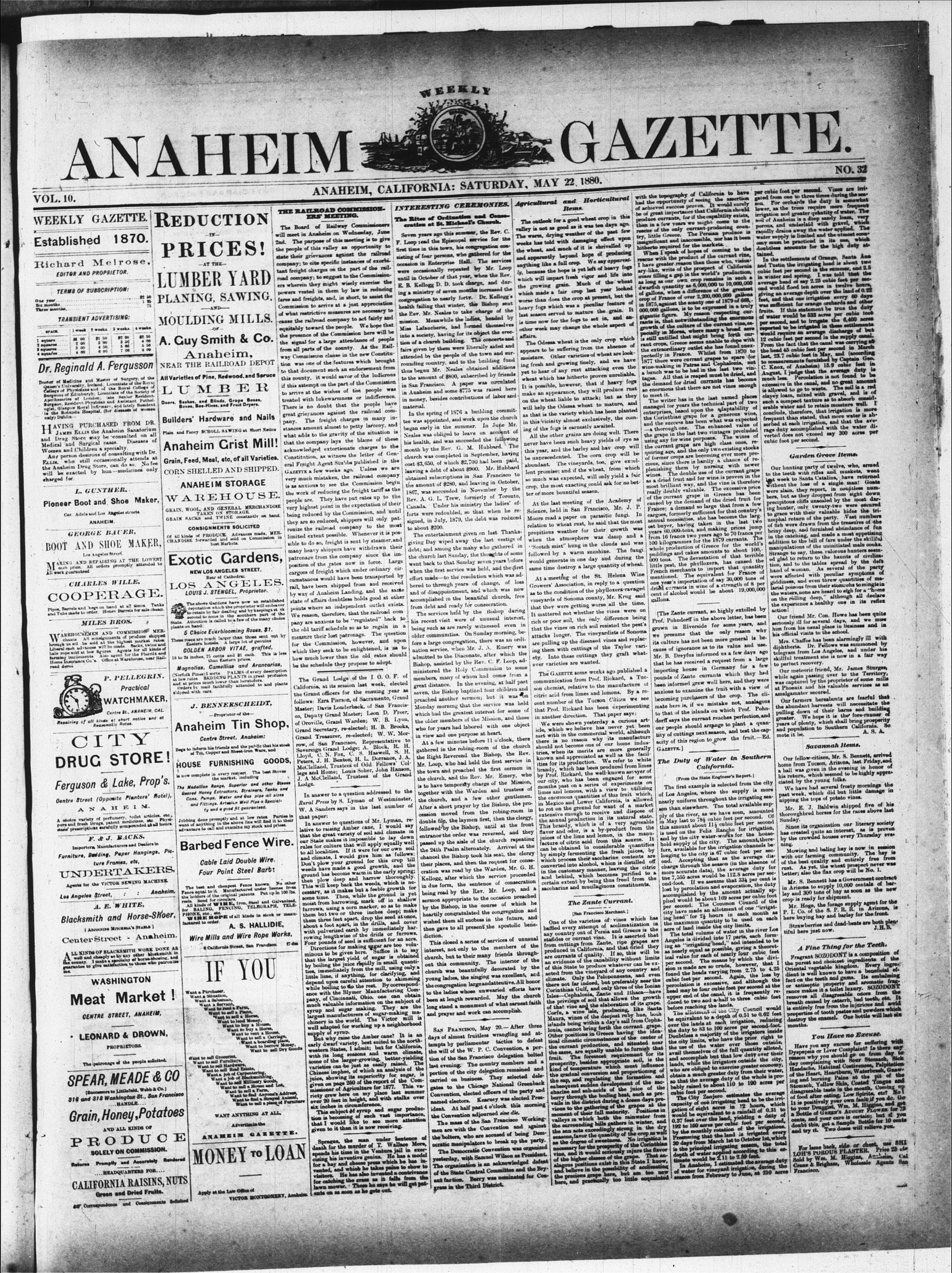
Searchable text
ANAHEIM
VOL. 10.
WEEKLY GAZETTE.
Established 1870.
Richard Melrose,
EDITOR AND PROPRIETOR.
TERMS OF SUBSCRIPTION:
One year... $2.50
Six months... 1.25
Three months... 75
TRANSIENT ADVERTISING:
SPACE
1 week
2 weeks
3 weeks
4 weeks
1 square... $1.00
2 squares... $2.00
3 squares... $3.00
4 squares... $4.00
Dr. Reginald A. Fergusson
Doctor of Medicine and Master of Surgery, of the Queen's University, Ireland; Licentiate of the Royal College of Physicians and of the Royal College of Surgeons of Edinburgh; Licentiate of the Society of Apothecaries of London; Senior Resident-Burgeon, Resident Physician and Assistant Pathologist, Glasgow Royal Infirmary, and lately Resident in the Rotunda Hospital. (for diseases of women only) Dublin.
HAVING PURCHASED FROM DR. JAMES ELLIS the Anaheim Sanatorium and Drug Store may be consulted on all Medical and Surgical cases. Diseases of Women and Children a specialty.
Any person desirous of consulting with Dr. Ellis, who still occasionally attends at the Anaheim Drug Store, can do so. No fee will be exacted by him—medicines only.
REDUCTION IN PRICES!
AT THE LUMBER YARD PLANING, SAWING, AND MOULDING MILLS.
OF
A. Guy Smith & Co.
Anaheim,
NEAR THE RAILROAD DEPOT
All Varieties of Pine, Redwood, and Spruce
LUMBER
Doors, Sashes, and Blinds, Grape Boxes,
Boxes, Bee-Hives, and Fruit Dryers.
Builders' Hardware and Nails
Plain and Fancy SCROLL SAWING at Short Notice
Anaheim Crist Mill!
Grain, Feed, Meal, etc., of all Varieties.
CORN SHELLED AND SHIPPED.
THE RAILROAD COMMISSIONERS' MEETING
The Board of Railway Company will meet in Anaheim on Wednesday 2nd. The purpose of this meeting is to the people of this valley an open state their grievances against the company; to cite specific instant freight charges on the railroad company; to suggest to the persons wherein they might wisely powers vested in them by law fares and freights, and, in short Commission to arrive at a just of what restrictive measures are cause the railroad company to equitably toward the people. The presence of the Commission the signal for a large attendance from all parts of the county. Way Commission clause in the tion was one of the features to that document such an end this county, it would savior or if this attempt on the part of it to arrive at the wishes of the treated with lukewarmness There is no doubt that the great grievances against the pany. The freight charge stances amount almost to pea what adds to the gravity of that the company lays the acknowledged extortionation Constitution, as witness theeral Freight Agent Stubbs p Gazette a few weeks ago.
HAVING PURCHASED FROM DR. JAMES ELLIS the Anaheim Sanatorium and Drug Store may be consulted on all Medical and Surgical cases. Diseases of Women and Children a specialty.
Any person desirous of consulting with Dr. Ellis, who still occasionally attends at the Anaheim Drug Store, can do so. No fee will be exacted by him—medicines only charged for.
L. GUNTHER,
Pioneer Boot and Shoe Maker,
Cor. Adele and Los Angeles streets.
ANAHEIM.
GEORGE BAUER,
BOOT AND SHOE MAKER,
Los Angeles Street.
MAKING AND REPAIRING AT THE LOWEST cash price. All orders promptly attended to All work guaranteed.
CHARLES WILLE,
COOPERAGE.
Pipes, Barrels and kegs on hand at all times. Tanks and Tubs made to order. Honev Barrels for sale cheap.
MILES BROS.
WAREHOUSEMEN AND COMMISSIONERS. All consignments of produce shipped through us will be sold at the highest market rates. Liberal cash advances will be made. Stacks, twine and hale rope sold at low figures. Agents for all kinds of farming implements. Also agent for the Phoenix and Home Insurance Co.'s Office at Warehouse, near Railroad denot.
P. PELLEGRIN,
Practical WATCHMAKER,
Centre St., ANAHEIM, CAL.
Repairing of all kinds at short notice and at Reasonable Rates.
CITY DRUG STORE!
Ferguson & Lake, Prop's.
Centre Street (Opposite Planters' Hotel),
ANAHEIM.
A choice variety of perfumery, toilet articles, etc., pure and fresh drugs, patent medicines, etc. Physicians' prescriptions carefully compounded at all hours.
F. & J. BACKS.
Importers, Manufacturers and Dealers in Furniture, Building, Paper Hangings, Picture Frames, etc,
UNDERTAKERS,
Agents for the VICTOR SEWING MACHINE.
Los Angeles Street, :: Anaheim.
All Varieties of Pine, Redwood, and Spruce
LUMBER
Doors, Sashes, and Blinds, Grape Boxes,
Boxes, Bee-Hives, and Fruit Dryers.
Builders' Hardware and Nails
Plain and Fancy SCROLL SAWING at Short Notice
Anaheim Crist Mill!
Grain, Feed, Meal, etc, of all Varieties.
CORN SHELLED AND SHIPPED.
ANAHEIM STORAGE
WAREHOUSE.
GRAIN, WOOL, AND GENERAL MERCHANDISE TAKEN ON STORAGE.
GRAIN SACKS and TWINE constantly on hand.
CONSIGNMENTS SOLICITED
Of all kinds of PRODUCE. Advances made, MERCHANTABILITY forwarded and sold on Commission in best Markets.
Exotic Gardens,
NEW LOS ANGELES STREET.
Rear of Cathedral.
LOS ANGELES.
LOUIS J. STENGEL, Proprietor.
The above Gardens have now an established reputation which the proprietor will endeavor to retain by fair dealing and by keeping at ck second to none in the southern part of the State. Attention is called to a few of the many choice plants on hand:
5 Choice Everblooming Roses, $1.
These roses are much larger than those sent out by Eastern houses. A large lot of genuine GOLDEN ARBOR VITAE, grafted,
18 to 24 inches, 75 cents and $1 each. This is less than Eastern prices.
Magnolias, Camellias and Arancarias,
(Nortfolk Pines) 5 sorts. PAULS of every description at low rates. BEIDDING PLANTS in great profusion and at prices much lower than heretofore.
Orders by mail faithfully attended to and plants shipped with care.
J. BENNERSCHEIDT,
Proprietor of the Anaheim Tin Shop,
Centre Street, Anaheim:
Begs to inform his friends and the public that his stock of Tin, Copper and Sheet-Iron Ware, and HOUSE FURNISHING GOODS,
is now complete in every respect. The best Stoves the market, including
The Medallion Range, Superior and other Stevens Geared Honey Extractors, Strainers, Tanks and Cans, Pumps, Water and Gas pipe-all sizes and Fittings. Artisan Weil Pipe a Specialty and a good fit guaranteed.
Jobbing done promptly and at low rates. Parties in want of anything in the above line will find it to their advantage to call and examine my stock and prices.
Barbed Fence Wire.
Cable Laid Double Wire.
Four Point Steel Barb;
The best and cheapest Fence known. No other Fence equal to it. Manufactured under license from the holders of the original patents. Put up in 100 lbs.
this county, it would savior if this attempt on the part of you arrive at the wishes of the treated with lakewarmness There is no doubt that the great grievances against the pany. The freight charges stances amount almost to pea what adds to the gravity of that the company lays theacknowledged extortionate Constitution, as witness the eral Freight Agent Stubba pGAZETTE a few weeks ago very much mistaken, the r is as anxious to see the C work of reducing the fr people are. They have purvey highest point in the ex being reduced by the Comm they are so reduced, shipping renize the railroad company limited extent possible. Wsible to do so, freight is se many heavy shippers have patronave from the company position of the rates now cargoes of freight which use cumstances would have been rail, have been shipped for by way of Anaheim Land state of affairs doubtless but points where an independence We reason, therefore, that pany are anxious to be "the old tariff schedule so measure their lost patron for the Commission, how they seek to be how much lower than then be the schedule they pro
The Grand Lodge of California, at its session the Grand officers for follows: Ezra Pierson, or Master; Davis Louderbeo, Deputy Grand Master of Oroville, Grand War Grand Secretary, re-ele Grand Treasurer, re-row, of San Francisco Sovereign Grand Lodge Lloyd, C. N. Fox, C. Peters, J. H. Benton, McClelland, Trustees olege and Home; Louis J. A McClelland, Tru Lodge.
In answer to a question Rural Press by S. Lyne W. A Sanders says in that paper:
In answer to question native to raising Amber that the great variety our State makes it rules for culture that to all localities. If it and climate, I would Don't plow your ground weeds have made a ground has become wide Then plow deep and This will keep back necessary as it makes some time. Then
ANAHEIM.
A choice variety of perfumery, toilet articles, etc., pure and fresh drugs, patent medicines, etc. Physicians' prescriptions carefully compounded at all hours.
F. & J. BACKS.
Importers, Manufacturers and Dealers in Furniture, Bedding, Paper Hangings, Picture Frames, etc,
UNDERTAKERS,
Agents for the VICTOR SEWING MACHINE.
Los Angeles Street, : Anaheim.
A. E. WHITE,
Blacksmith and Horse-Shoeer,
[ ANJOINING MITCHELL'S STABLE ]
Center Street - Anaheim.
ALL KINDS OF BLACKSMITH WORK DONE AS well and cheaply as by any other blacksmith in the county. I make a specialty of horse-shoeing, and guarantee to give satisfaction to those who patronize me.
WASHINGTON
Meat Market!
CENTRE STREET, ANAHEIM,
LEONARD & DROWN,
PROPRIETORS.
The patronage of the people solicited.
SPEAR, MEADE & CO
[Successors to LittleSold. Webb & Co.]
316 and 318 Washington St., San Francisco
HANDLE...
Grain, Honey, Potatoes
AND ALL KINDS OF PRODUCE
SOLELY ON COMMISSION.
Returns Promptly and Accurately Rendered
...HEADQUARTERS FOR.....
CALIFORNIA RAISINS, NUTS
Green and Dried Fruits.
Correspondence and Consignments Solicited
Barbed Fence Wire.
Cable Laid Double Wire.
Four Point Steel Barb;
The best and cheapest Fence known. No other Fence equal to it. Manufactured under license from the holders of the original patents. Put up in 100 lbs. reels. Send for circulars.
All kinds of WIRE, Iron, Steel and Galvanized, for BALING, FENCING, TELEGRAPH, TELEPHONE, etc., etc.
WIRE HOOP of all kinds in stock or manufactured to order.
A. S. HALLIDIE,
Wire Mills and Wire Rope Works,
6 California Street, San Francisco. f7-6m
IF YOU
Want a Purchaser,
Want a Situation,
Want a Salesman,
Want a Servant,
Want to rent a Farm,
Want to sell a Piano,
Want to sell a Horse,
Want to lend Money,
Want to buy a House,
Want to buy a Horse,
Want to rent a House,
Want to sell a Carriage,
Want a boarding place,
Want to borrow Money,
Want to sell Dry Goods
Want to sell Groceries,
Want to sell Furniture,
Want to sell Hardware,
Want to sell Real Estate,
Want a Job of Carpentering,
Want a Job of Blacksmithing,
Want to sell Millinery Goods,
Want to sell a House and Lot,
Want to sell a Farm,
Want to find Anyone's Address,
Want to find a Strayed Animal,
Want to sell a piece of Furniture
WANT ANYTHING AT ALL.
Advertise in the ANAHEIM GAZETTE.
MONEY TO LOAN
Apply at the Law Office of VICTOR MONTGOMERY, Anaheim.
Rural Press by S. Lynn.
W. A Sanders says in that paper:
In answer to questionative lative to raising Amber that the great variety of our State makes it impossible rules for culture that is to all localities. If it and climate, I would not plow your grow weeds have made a ground has become wide then plow deep and this will keep back the necessary, as it makes some time. Then, we moist from harrowing furrows, using a corral them but two or three them three feet apart about a foot apart, in with pulverized earth rowing lengthwise on Four pounds of seed.
Directions for man minous to be given that the largest yield by boiling the juice ties, immediately free little lime, if anything depend upon careful while boiling to silence with the Blym pany, of Cincinnati much valuable information syrup and sugar largest manufacture chinery in the work well adapted for w supply of syrup.
But why raise the early dwarf variety western States, I with its long reach some of the larger varieties can be juice Chinese imphee, or juice, showing its given on page 250 missioner of Agriculture grew here over 20 feet in he six inches in circle.
This subject affection is becoming that I would like given to it than i
THE RAILROAD COMMISSIONERS will meet in Anaheim on Wednesday, June and. The purpose of this meeting is to give the people of this valley an opportunity to taste their grievances against the railroad company; to cite specific instances of exorbitant freight charges on the part of the railroad company; to suggest to the Commissioners wherein they might wisely exercise the powers vested in them by law in reducing fares and freights, and, in short, to assist the Commission to arrive at a just appreciation of what restrictive measures are necessary to cause the railroad company to act fairly and equitably toward the people. We hope that the presence of the Commission here will be the signal for a large attendance of people from all parts of the county. As the Railway Commission clause in the new Constitution was one of the features which brought to that document such an endorsement from this county, it would savor of the ludicrous if this attempt on the part of the Commission to arrive at the wishes of the people was treated with lukewarmness or indifference. There is no doubt that the people have great grievances against the railroad company. The freight charges in many instances amount almost to petty larceny, and what adds to the gravity of the situation is that the company lays the blame of these acknowledged extortionate charges to the Constitution, as witness the letter of General Freight Agent Stubbs published in the Gazette a few weeks ago. Unless we are interested in Ceremonies, The Rites of Ordination and Conservation at St. Michael's Church.
Seven years ago this summer, the Rev. C. F. Loop read the Episcopal service for the first time in this town, his congregation consisting of four persons, who gathered for the occasion in Enterprise Hall. The services were occasionally repeated by Mr. Loop until in October of that year, when the Rev. E. B. Kellogg D. D. took charge, and during a ministry of seven months increased the congregation to nearly forty. Dr. Kellogg's health failing that winter, the Bishop sent the Rev. Mr. Neales to take charge of the mission. Meanwhile the ladies, headed by Miss Lafaucherie, had formed themselves into a society, having for its object the erection of a church building. The concerts and fairs given by them were liberally aided and attended by the people of the town and surrounding country, and to the building fund thus begun Mr. Neales obtained additions to the amount of $800, subscribed by friends in San Francisco. A paper was circulated in Anaheim and some $775 was raised here in money, besides contributions of labor and material.
In the spring of 1876 a building committee was appointed, and work upon the church began early in the summer. In June Mr. Neales was obliged to leave on account of his health, and was succeeded the following month by the Rev. G. M. Hubbard. The church was completed in September, having cost $3,650, of which $2,700 had been paid, leaving a debt of about $900. Mr. Hubbard Agricultural and Horticultural Items.
The outlook for a good wheat crop in this valley is not as good as it was ten days ago. The warm, drying weather of the past few weeks has told with damaging effect upon the wheat, and much of it is shrivelled up and apparently beyond hope of producing anything like a full crop. We say apparently, because the hope is yet left of heavy fogs which will impart fresh vigor and life into the growing grain. Much of the wheat which made a fair crop last year looked worse than does the crop at present, but the heavy fogs which was a peculiar feature of last season served to mature the grain. It is time now for the fogs to set in, and another week may change the whole aspect of affairs.
The Odessa wheat is the only crop which appears to be suffering from the absence of moisture. Other varieties of wheat are looking fresh and growing finely, and we have yet to hear of any rust attacking even the wheat which has hitherto proven unreliable. It is possible, however, that if heavy fogs make an appearance, they will produce rust on the wheat liable to attack; but as they will help the Odessa wheat to mature, and as that is the variety which has been planted in this vicinity almost exclusively, the coming of the fogs is earnestly awaited.
All the other grains are doing well. There never have been such heavy yields of rye as this year, and the barley and hay crop will be unprecedented. The corn crop will be abundant. The vineyards, too, give excellent promise; and if the wheat, from which with the topography had the opportunity of achieved success, produce currant then in a few years insignificant and hitherto requisite.
When I speak rescue with them I have greatest ary-like, writes spines filling a long as long as our dwarfish quartz of gallons, while crop of France in 1875, again 000,000 gallons gigantic figure rants is, that growth of them specially in M is still untilliantrant crops. On the extraordinary pectedly in 1877 there were wine-making a bunch was tags. All of them demand so enormous meet it.
The writer managed for enterprises, the Corinthian and the succinct—a thorough grape in using any fruit for the current quiring age of former wines since plenishing wines.
this county, it would savor of the ladieries if this attempt on the part of the Commission to arrive at the wishes of the people was treated with lukewarmness or indifference. There is no doubt that the people have great grievances against the railroad company. The freight charges in many instances amount almost to petty larceny, and what adds to the gravity of the situation is that the company lays the blame of these acknowledged extortionate charges to the Constitution, as witness the letter of General Freight Agent Stubbs published in the Gazette a few weeks ago. Unless we are very much mistaken, the railroad company is as anxious to see the Commission begin the work of reducing the freight tariff as the people are. They have put rates up to the very highest point in the expectation of their being reduced by the Commission, and until they are so reduced, shippers will only patronize the railroad company to the most limited extent possible. Whenever it is possible to do so, freight is sent by steamer, and many heavy shippers have withdrawn their patronage from the company since the imposition of the rates now in force. Large cargoes of freight which under ordinary circumstances would have been transported by rail, have been shipped from and received by way of Anaheim Landing, and the same state of affairs doubtless holds good at other points where an independent outlet exists. We reason, therefore, that the railroad company are anxious to be "regulated" back to the old tariff schedule so as to regain in a measure their lost patronage. The question for the Commission, however, and upon which they seek to be enlightened, is as to how much lower than the old rates should be the schedule they propose to adopt.
The Grand Lodge of the I.O.O.F. of California, at its session last week, elected the Grand officers for the ensuing year as follows: Ezra Pierson, of Sacramento, Grand Master; Davis Louderback, of San Francisco, Deputy Grand Master; Leon D. Freer, of Oroville, Grand Warden; W. B. Lyon, Grand Secretary, re-elected; H. B. Brooks, Grand Treasurer, re-elected; W. W. Morrow, of San Francisco, Representative to Sovereign Grand Lodge; A. Block, R. H. Lloyd, C. N. Fox, C. S. Haswell, S. H. Peters, J. H. Benton, H. L. Dorrance, J.A. McClelland, Trustees of Odd Fellows' College and Home; Louis Soher, John Hanson, J.A McClelland, Trustees of the Grand Lodge.
In answer to a question addressed to the Rural Press by S. Lyman of Westminster, W.A Sanders says in the last number of that paper:
In answer to questions of Mr. Lyman, relative to raising Amber cane, I would say that the great variety of soil and climate in our State makes it impossible to lay down rules for culture that will apply equally well to all localities. If it were for our own soil and climate, I would give him as follows: Don't plow your ground for this crop till weeds have made a good growth, and the ground has become warm in the early spring; then plow deep and harrow thoroughly. This will keep back the weeds, which is necessary, as it makes but a feeble growth for some time. Then, while the ground is yet to the amount of $800, subscribed by friends in San Francisco. A paper was circulated in Anaheim and some $775 was raised here in money, besides contributions of labor and material.
In the spring of 1876 a building committee was appointed, and work upon the church began early in the summer. In June Mr. Neales was obliged to leave on account of his health, and was succeeded the following month by the Rev. G.M.Hubbard. The church was completed in September, having cost $3,650, of which $2,700 had been paid, leaving a debt of about $900. Mr Hubbard obtained subscriptions in San Francisco to the amount of $280, and leaving in October, 1867, was succeeded in November by the Rev.A.G.L.Trew, formerly of Toronto, Canada. Under his ministry the ladies' efforts were redoubled, so that when he resigned, in July, 1879, the debt was reduced to about $200.
The entertainment given on last Thanksgiving Day wiped away the last vestige of debt; and among the mahy who gathered in the church last Sunday, the thoughts of some went back to that Sunday seven years before when the first service was held, and the first effort made—to the resolution which was adhered to through years of change, of loss and of disappointment, and which was now accomplished in the beautiful church, free from debt and ready for consecration.
The services held by the Bishop during his recent visit were of unusual interest, being such as are rarely witnessed even in older communities. On Sunday morning, before a large congregation, there was an ordination service, when Mr.J.A.Emery was admitted to the Diaconate, after which the Bishop, assisted by the Rev.C.F.Loop, administered the Holy Communion to some members, many of whom had come from a great distance. In the evening, at half past seven, the Bishop baptized four children and preached another sermon; but it was on Monday morning that the service was held which had the greatest interest for some of the older members of the Mission, and those who for years had labored with one object in view and one purpose at heart.
At a few minutes before 11 o'clock, there gathered in the robing-room of the church the Right Reverend the Bishop, the Rev.Mr.Loop, who had held the first service in the town and preached the first sermon in the church, and the Rev.Mr.Emery, who is to have temporary charge of the Mission together with the Warden and trustees of the church, and a few other gentlemen. After a short prayer by the Bishop, the process moved from the robing-room in double file, the laymen first, then the clergy followed by the Bishop, until at the front entrance the order was reversed, and they passed up the aisle of the church repeating the 24th Psalm alternately. Arrived at the chancel the Bishop took his seat, the clerky their places, and then the request for consecration was read by the Warden, Mr.G.H.Kellogg, after which the service proceeded in due form, the sentence of consecration being read by the Rev.Mr.Loop, and a few appropriate to the occasion preached wheat which has hitherto proven unreliable.
It is possible however that if heavy fogs make an appearance, they will produce rust on the wheat liable to attack; but as they will help the Odessa wheat to mature,and as that is the variety which has been planted in this vicinity almost exclusively,the coming of the fogs is earnestly awaited.
All other grains are doing well. There never have been such heavy yields of rye as this year,and the barley and hay crop will be unprecedented.The corn crop will be abundant.The vineyards,too,give excellent promise;and ifthe wheat,从which so much was expected,会only yield a fair crop,the most exacting could ask for no better or more bountiful season.
At the meeting of the Academy of Science,held in San Francisco,Mr.J.P.Moore read a paper on parasitic fungi.In relation to wheat rust,他 said that most propitions weather for their growth was whenthe atmosphere was damp anda "Scotch mist" hung inthe cloudsandwas followedbya warm sunshine.The fungiwould generatein one dayand duringthe same time destroya large quantityof wheat.
At a meeting ofthe St. Helena Wine Growers' Association,在replytoaquestionastotheconditionofthephylloxera-ravagedvineyardsofSonomacounty,Mr.Krugsaidthattheyweregettingworseallthetime.I mattered not whetherthe vineswereonrichorpoorsoil,theonlydifferencebeingthatthevinesonrichsoilresistedthepestsattackslonger.ThevineyardistsofSonomaarepullingupthe diseasedvinesandreplacingthemwithcuttingsoftheTaylorvariety.Intothesecuttingstheygraftwhatevervarietiesarewanted.
The GazettesomeweeksagopublishedacommunicationfromProf.Rickard,aTucsonchemist,relativetothemanufacturecitricacidfromlimesandlemons.ByarecentnumberoftheTucsonCitizenweseeThatProf.Rickardhasbeenexperimentinginanotherdirection Thatpapersays:
Wewereshown yesterdaya curiousarticle,whichwebelievehasneveryetmetwithinthecommercialworldalthoughthereisnoreasonwhyits manufactureshouldnotbecomeoneofourhomeindustries,whenitsmeritsaremoregenerallyknownandappreciatedaswellasthefacilitiesforitsproduction.Were refertowhitebrandy,whichhasbeenproducedfromlimesbyProf.Rickard,thewell-knownassayerofourcity,whohasbeengeneratedforsomemonthspastonaseriesofexperimentsonlimesandlemons,withaviewtoutilizingtheenormousquantitiesofthisfruitwhich,mexicoandLowerCaliforniaisallowedtorotonthegroundforwantofamarketextensiveenoughtocreceiveanddisposeoftheannualproductioninitsnaturalstateThisbrandy,whichisofaveryagreeable flavorandodor,isabyproductfromthejuicesofthelimeandlemon,inthemanufacturecitricacidfromthissource。它canobtaininconsiderablequantitiesbysimplyfermentingthefreshjuices,bychoseprocessthesaccharinecontentsareconvertedintolcohol,whichisdistilledoffinthecustomary manner,leavingthecitricacidbehind,whichbecomespurifiedtoacertainextentbybeingthusfreedfromthesaccharineandmucilaginousconstituents.
Rural Press by S. Lyman of Westminster, W. A Sanders says in the last number of that paper:
In answer to questions of Mr. Lyman, relative to raising Amber cane, I would say that the great variety of soil and climate in our State makes it impossible to lay down rules for culture that will apply equally well to all localities. If it were for our own soil and climate, I would give him as follows: Don't plow your ground for this crop till weeds have made a good growth, and the ground has become warm in the early spring; then plow deep and harrow thoroughly. This will keep back the weeds, which is necessary, as it makes but a feeble growth for some time. Then, while the ground is yet moist from harrowing, mark off in shallow furrows, using a corn marker, so as to make them but two or three inches deep; make them three feet apart, drop the seed at once, about a foot apart, in the drills, and cover with pulverized earth by immediately harrowing lengthwise of the drills or furrows. Four pounds of seed is sufficient for an acre.
Directions for making sugar are too voluminous to be given here. Suffice it to say that the largest yield of sugar is obtained by boiling the juice rapidly in small quantities, immediately from the mill, using only a little lime, if anything, for clarifying, and depend upon careful attention to skimming while boiling to do the rest. By correspondence with the Blymer Manufacturing Company, of Cincinnati, Ohio, one can obtain much valuable information on the subject of syrup and sugar making. They are the largest manufacturers of sugar-making machinery in the world. The Victor mill is well adapted for working up a neighborhood supply of syrup.
But why raise the Amber cane? It is an early dwarf variety, best suited to the northwestern States, I admit; but for California, with its long seasons and warm climate, some of the larger-growing, better-yielding varieties can be just as easily raised. The Chinese imphee, of which an analysis of the juice, showing its superiority for sugar, is given on page 250 of the report of the Commissioner of Agriculture for 1877. This variety grew here on my place last summer over 20 feet in height, and with stalks over six inches in circumference.
This subject of syrup and sugar production is becoming of such vast importance, that I would like to see more attention given to it than it is now receiving.
Sprague, the man under sentence of death for the murder of T. Wallace More, spends his time in the Ventura jail in exercising his inventive genius. He has a model for a hay and cheese press which he has invented, and which he takes pains to show to visitors. He has also invented a contrivance for catching the grass as it falls from the lawn mower. These he says he will get patients on as soon as he gets out.
SAN FRANCISCO, May 20.—After three days of almost fruitless wrangling and attempts by parliamentar tactics to defeat the will of the W. P. C. Convention, a portion of the San Francisco delegation bolted last evening. The country members and a portion of the city delegation remained and carried on business. They selected delegates to the Chicago National Greenback Convention, elected officers of the party and named electors. Kearney was elected President. At half past 4 o'clock this morning the Convention adjourned sine die.
The mass of the San Francisco Workingmen are with the Convention and against the bolters, who are accused of being Democratic manipulators to break up the party.
The Democratic Convention was organized yesterday, with Samuel Wilson as President. The organization is an acknowledged defeat of the State Central Committee and the Bryant faction. Berry was nominated for Congress in the Third District.
The Zante Currant.
[San Francisco Merchant.]
One of the varieties of vines which has baffled every attempt of acclimatization in any country out of Persia and Greece is the stafides or currant vine. It is asserted that from cuttings from Zante, ripe grapes are produced in California, and that dried they are currants of quality. If so, this will be an evidence of the capability without limits of this State to produce whatever can be expected from the vineyard of any country and climate. Only the Peloponnesus, and even there not far indeed, but preferably near the Corinthian Gulf, and only three of the Ionian Isles—Cephalonia, Zante and Ithaca—have the privilege of soil that allows the growth of that vine and the elaboration of its grape. Corfu, a wine island, producing like Santa Maura, wines of the deepest ruby hue, both islands being within a day's sail from Cephalonia, cannot bring forth the currant grape. Other positions in Greece having the identical climatic circumstances of the center of the current production, and situated near the same, are equally unable to furnish that fruit. The foremost requirement for its prosperity, besides appropriate soil, is the kind of temperature which must influence the gradual conversion and proportioning of the sap, and regulating the formation and subsequent sudden development of the saccharine and sub-acids of the juice of the berry through the boiling heat, such as previews in the district during a dozen days previous to the gathering of the grapes at the moment of their full maturity. Positions in valleys in which both the rainwater from the surrounding hills gather in winter, and the sun acts exceedingly strong in the dry seasons, favor the quantity of the crop as well as the degree of sweetness. No irrigation is necessary for the prosperity of the Corinthian vine, and it would seriously injure the flavor of the higher classes of the grape. That analogous positions exist in this State I know, and believe in the possibility of acclimatizing the precious grape here, but am too new here, and practically too little acquainted
AZETTE.
NO. 32
Agricultural
crop in this
even days ago.
the past few
effect upon
shrivelled up
of producing
say apparentof heavy fogs
and life into
the wheat
year looked
present, but the
earlier feature of
the grain. It
get in, and anwhole aspect of
only crop which
the absence of
wheat are lookand we have
licking even the
oven unreliable.
if heavy fogs
will produce rust
; but as they
to mature, and
has been planted
sively, the comwaited.
Going well. There
yields of rye as
and hay crop will
turn crop will be
too, give exceltat, from which
he would a fair
with the topography of California to have
had the opportunity of seeing the assertion
of achieved success proven. It would surely
be of great importance that California should
produce currants, for if the capability exists,
then in a few years we might come to the rescue of the only currant-producing country, little Greece. The Persian produce is insignificant and inaccessible, nor has it been hitherto required for the market.
When I speak of hopes of coming to the rescue with the product of the currant vine,
I have greater reason than those who, visionary-like, write of the prospect of California acres filling a gap in the world's production,
as long as our own crop remains in such a dwarfish quantity as 6,000,000 to 10,000,000 of gallons, when a difference of the greatest crop of France of over 2,200,000,000 gallons in 1875, against the scanty one of 1879 of 668,000,000 gallons, is to be expressed in a truly gigantic figure.
My reason respecting currants is, that notwithstanding the enormous growth of the culture of the currant vine, especially in Moresa, where many a broad sere is still untilled that might bring forth currant crops, Greece seems unable to cope with the extraordinary outlet she has found unexpectedly in France. Whilst from 1870 to 1877 there were currant grapes to spare (for wine-making in Patras and Cephalonia, not a bunch was to be had in the last two vintages). All that is reaped must be dried, and the demand for dried currants has become so enormous that there are not vines enough to meet it.
The writer has in the last named places managed for years the technical part of two enterprises, based upon the adaptability of the Corinthian grape for a generous wine, and the success has been what was expected—a thorough one. The enhanced value of the grape in the last two vintages precluded using any for wine purposes. The wines of the currant grape are high class ones, requiring age, and the only two existing stocks of former crops are becoming ever more precious, since there is hardly a chance of replenishing them by nursing with newer wines. The double use of the currant grape per cubic foot per second. Vines are irrigated from one to three times during the season. For orchards the duty is somewhat lower, as the trees require more frequent irrigation and greater quantity of water. The soil of Anaheim is a deep sandy loam, very porous, and underlaid with gravel, which rapidly drains away the water applied. The water supply is limited and the utmost economy must be practiced in its use, which doubtless accounts for the high duty attained.
In the settlements of Orange, Santa Ana and Tustin the irrigating head is about two cubic feet per second in the summer, and 2.5 in winter and spring. I was told that the average head of say 2.25 cubic feet per second would flood ten acres in twelve hours, giving an average depth over the land of 0.22 feet, and that one irrigation every 60 days was sufficient for orange orchards and other fruits. If this statement be true the duty of water would be 533 acres per cubic foot per second, and to irrigate the 6,400 acres reported to be irrigated in these settlements would require an average discharge of but 12 cubic feet per second in the supply canal. From the fact that the canal was carrying at the head 45 cubic feet per second in March last, 23.7 cubic feet in May, and (according to measurements furnished by Captain Geo. C. Knox, of Anaheim) 15.9 cubic feet in August, I judge that the average duty is much less. Percolation is not found to be excessive in the canal, and no great amount is allowed to go to waste. The soil is a red clayey loam, mixed with gravel, and is of such a compact texture as to absorb considerable water and to retain moisture well. I conclude, therefore, that irrigation is more frequent than stated, that more water is absorbed at each irrigation, and that the average duty accomplished with the water diverted does not exceed say 300 acres per cubic foot per second.
Garden Grove Items
Our hunting party of twelve, who, armed to the teeth with rifles and muskets, went
The Duty of Water in Southern California.
[From the State Engineer's Report.]
The first example is selected from the city of Los Angeles, where the supply is more nearly uniform throughout the irrigating season than elsewhere. The total available supply of the river, as we have seen, amounted in May last to 78 cubic feet per second. Of this amount about 11% cubic feet per second is used on the Feliz Rancho for irrigation, and by the city water-works for the household supply of the city. The amount, therefore, available for the irrigation channels belonging to the city is 67 cubic feet per second. Accepting that as the average discharge through the season (in the absence of more accurate data), the average duty for the 7,555 acres would be 112.8 acres per second-foot. If we assume that 33% per cent is lost by percolation and evaporation, the duty accomplished by the amount actually applied would be about 169 acres per cubic foot.
August, 14
Garden Grove Items.
Our hunting party of twelve, who, armed to the teeth with rifles and muskets, went last week to Santa Catalina, have returned without the loss of a single man! Goats were slain, they report, in countless numbers, but as they dropped from sight down precipitous cliffs unscaled by the most daring hunter, only twenty-two were secured to grace with their valuable hides the triumphal return of the party. Vast numbers of fish were drawn from the treasures of the briny deep, and furnished abundance of fun in the catching, and made a most appetizing addition to the bill of fare under the skillful manipulations of the uninitiated male cooks. Strange to say, these valorous hunters seemed glad to return to the haunts of civilization, and to the tables spread by the defensal hand of woman. As several of the party were affected with peculiar symptoms of giddiness, and even threw quantities of malarial poisons from their stomachs to mingle in the waters, none are heard to sigh for a "home on the rolling deep," although all declare the experience a healthy one in its reflex action!
Our friend Mr. Con. Howe has been quite seriously ill for several days, and we must him from his usual place in business and in his official visits to the school.
Mrs. Chaffee has been alarmingly ill with diphtheria. Dr. Fellows was summoned by telegram from Los Angeles, and under his skillful treatment she is now in a fair way to perfect recovery.
Our meteoric friend, Mr. James Sturges, while again passing over to the Territory, was captured by the proprietor of some mills at Phoenix and his valuable services as an amalgamator secured.
Our farmers hereabouts are fearful that the abundant harvests will necessitate the pulling down of their barns and building greater. We hope it is the fore-runner of years of plenty, which shall bring prosperity and population to Southern California. So mote it be.
A. S. A.
Savannah Items.
Our fellow-citizen, Mr. S. Bennett, arrived home from Tucson, Arizona, last Friday, and a ball was given in the evening in honor of his return, which seemed to be highly appreciated by the young folks.
We have had several frosty mornings the past week, which did but little damage in nipping the tops of potato vines.
Mr. E. J. Baldwin shipped five of his thoroughbred horses for the races above last Sunday.
Since its organization our literary society has created quite an interest, as is proven by the crowded houses every Thursday evening.
Mowing and baling hay is now in session with our farming community. The hay is of the best quality and entirely free from rust. As yet, the wheat prospect never was better; also the flax crop will be No. 1.
Mr. S. Bennett has a Government contract in Arizona to supply 10,000 cents of barley and 300 tons of hay as soon as the new crop is ready for shipment.
California, is allowed for want of a market receive and dispose of in its natural state. Of a very agreeable by-product from the lemon, in the manu-from this source. It considerable quantities of the fresh juices, by cocharine contents are which is distilled off further, leaving the citric becomes purified to a degree thus freel from the indigenous constituents.
The Currant.
Mexico Merchant.
Nees of vines which has not of acclimatization in Persia and Greece is the vine. It is asserted that Zante, ripe grapes are Mexico, and that dried they yield. If so, this will be capability without limits produce whatever can be ex-ward of any country and Peloponnesus, and even Sicily, but preferably near the land only three of the Ionian Zante and 17thaca—have that allows the growth of elaboration of its grape, producing, like Santa Ana, deepest ruby hue, both on a day's sail from Cephala forth the currant grape. Greece having the iden-timances of the center of motion, and situated near mostly unable to furnish that most requirement for its appropriate soil, is the ore which must influence creation and development of the saccharides of the juice of the boiling heat, such as pre-vent during a dozen days preparing of the grapes at the full maturity. Positions in both the rainwater from hills gathers in winter, and suddenly strong in the dry quantity of the crop as well sweetness. No irrigation is prosperity of the Corinthian and seriously injure the flavor masses of the grape. That an-exist in this State I know, no possibility of acclimatizing here, but am too new locally too little acquainted nearly uniform throughout the irrigating area than elsewhere. The total available supply of the river, as we have seen, amounted in May last to 78½ cubic feet per second. Of this amount about 11½ cubic feet per second is used on the Feliz Rancho for irrigation, and by the city water-works for the house-hold supply of the city. The amount, therefore, available for the irrigation channels belonging to the city is 67 cubic feet per second. Accepting that as the average discharge through the season (in the absence of more accurate data), the average duty for the 7,555 acres would be 112.8 acres per second-foot. If we assume that 33¼ per cent is lost by percolation and evaporation, the duty accomplished by the amount actually applied would be about 169 acres per cubic foot per second. The Common Council of the city have made an allotment of one "irrigating head" for 2½ hours in each month as the maximum quantity to be used on each acre of land inside the city limits.
The total volume of water in the river Los Angeles is divided into 17 parts, each forming an "irrigating head," and intended to be as nearly equal as possible, giving a theoretical value for each of nearly four cubic feet per second. The means by which the division is made are so crude, however, that I found the heads varying from 2.75 to 4.25 cubic feet per second. Again, the loss by percolation is excessive, and although the head may be four cubic feet per second at the upper end of the canal, it is frequently reduced to two and a-half to three cubic feet before reaching the lands.
The allotment of the City Council would be equivalent to a depth of 0.51 to 0.62 feet over the lands at each irrigation, reducing the duty to 83 to 100 acres per second-foot. Doubtless a majority of the irrigators inside the city limits, who have the prior right to use of the water over those outside, avail themselves of the full quantity allotted, and accomplish but that low duty over their lands, while the irrigators outside the city, who are obliged to exercise greater economy, obtain a much greater duty from their water, so that the average duty of the whole is probably raised to about 110 to 190 acres per cubic foot per second.
The City Zanjero estimates the average capacity of one irrigating head to be the irrigation of eight acres in 12 hours, which would be equivalent to a rainfall of 0.31 to 0.37 feet over the land, yielding a duty of 192 to 160 acres per cubic foot per second, by the monthly rotation of the irrigations. Preemning that the land is irrigated every 20 days from March 1st to October 1st, which is the principal irrigating season, the total depth of water applied according to this estimate would be 2.11 to 2.59 feet.
In Anaheim, I estimated the average duty of water for vineyard irrigation, during the season from February to June, at 210 acres
Mr. E. J. Baldwin shipped five of his thoroughbred horses for the races above last Sunday.
Since its organization our literary society has created quite an interest, as is proven by the crowded houses every Thursday evening.
Mowing and baling hay is now in session with our farming community. The hay is of best quality and entirely free from rust. As yet, the wheat prospect never was better; also the flax crop will be No. 1.
Mr. S. Bennett has a Government contract in Arizona to supply 10,000 centsals of barley and 300 tons of hay as soon as the new crop is ready for shipment.
Mr. Hoge, the forage supply agent for the P.I.Co. of the S.P.R.R. in Arizona, is here buying hay and barley for the front.
Strawberries and dead-beats are both plentiful here just now.
J.H.B.
A Fine Thing for the Teeth.
Fragrant SOZODONT is a composition of the purest and choiceest ingredients of the Oriental vegetable kingdom. Every ingredient is well known to have a beneficial effect on the teeth and gums. Its embalming or antiseptic property and aromatic fragrance makes it a toilet luxury. SOZODONT removes all disagreeable odors from the breath caused by catarrh, bad teeth, etc. It is entirely free from the injurious and awrid properties of tooth pastes and powders which destroy the enamel. One bottle will last six months.
You Have no Excuse.
Have you any excuse for suffering with Dyspepsia or Liver Complaint? Is there any reason why you should go on from day to day complaining with Sour Stomach, Skin Headache, Habitual Coativeness, Palpitation of Heart, Heartburn, Waterbrash, Gnawing and burning Pains at the pit of the Stomach, Yellow Skin, Coated Tongue and disagreeable taste in the mouth, Coming up of food after eating, Low Spirits, etc? No! It is positively your own fault if you do. Go to your Draggist, Wm. M. Higgins, and get a Bottle of Green's August Flower for 79 cents, and your cure is certain; but if you doubt this, get a Sample Bottle for 10 cents and try it. Two doses will relieve you.
For lame back, side or chest, use SHI LOH'S POROUS PLASTER. Price 25 ure Sold by Wm. M. Higgins, Anheims, Cal Crane & Brigham, Wholesale Agents San Francisco.