anaheim-gazette 1880-05-08
Scanned page
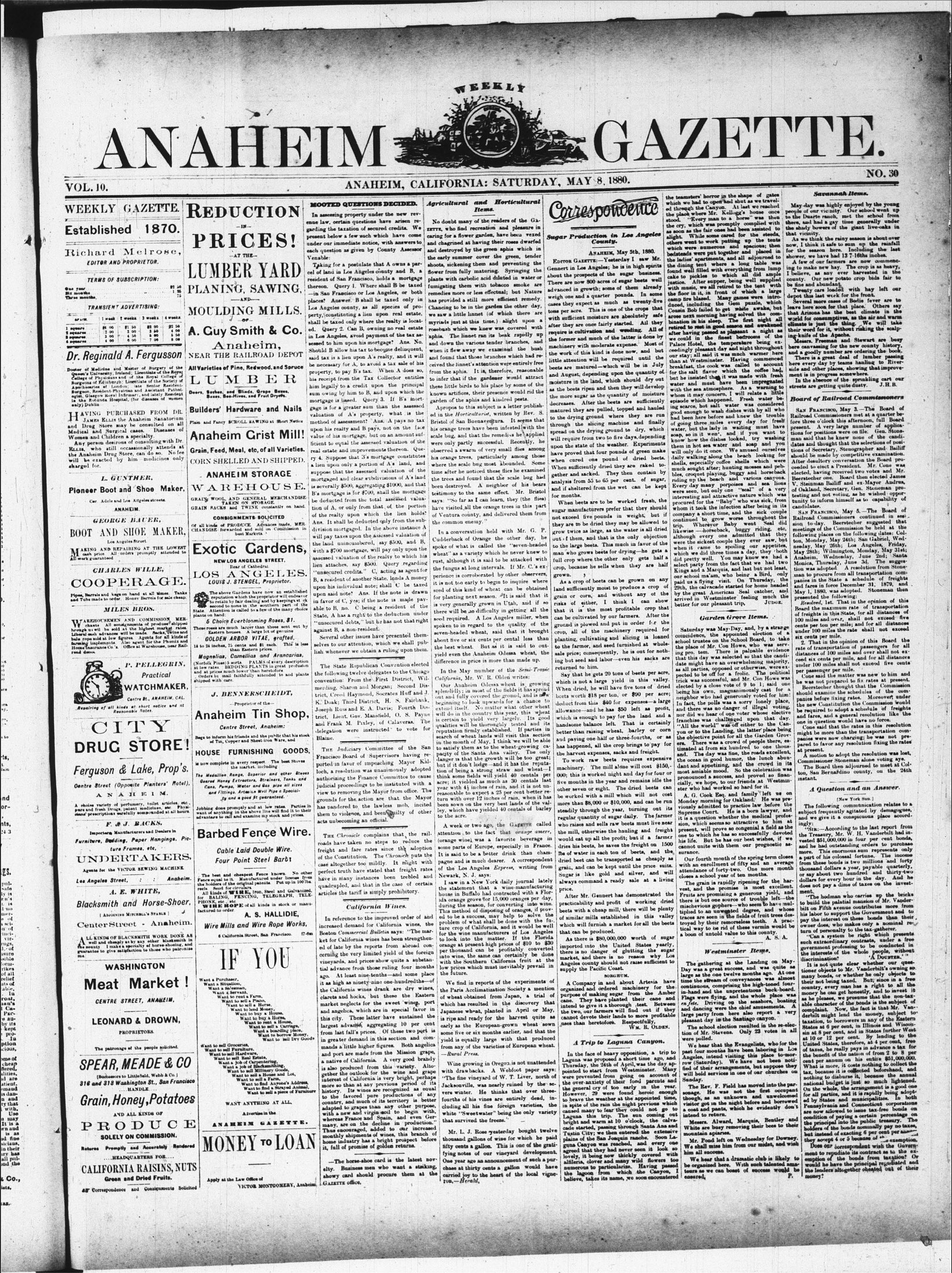
Searchable text
ANAHEIM
VOL. 10.
WEEKLY GAZETTE.
Established 1870.
Richard Melrose,
EDITOR AND PROPRIETOR.
TERMS OF SUBSCRIPTION:
One year
Six months
Three months
TRANSIENT ADVERTISING:
SPACE
1 week
2 weeks
3 weeks
4 weeks
1 square
$1.00
$1.50
$2.00
$2.50
2 squares
2.00
2.00
2.50
4.00
3 squares
3.00
4.50
6.00
5.50
4 squares
4.00
6.00
7.00
8.00
Dr. Reginald A. Fergusson
Doctor of Medicine and Master of Surgery of the Queen's University, Ireland; Licentiate of the Royal College of Physicians and of the Royal College of Surgeons of Edinburgh; Licentiate of the Society of Apothecaries of London; late Senior Resident Burgeson, Resident Physician and Assistant Pathologist, Glasgow Royal Infirmary; and lately Resident in the Rotunda Hospital, (for diseases of women only) Dublin.
HAVING PURCHASED FROM DR. JAMES KELLIS the Anaheim Sanatorium and Drug Store may be consulted on all Medical and Surgical cases. Diseases of Women and Children a specialty.
Any person desirous of consulting with Dr. KELLIS, who still occasionally attends at the Anaheim Drug Store, can do so. No fee will be exacted by him—medicines only charged for.
REDUCTION IN PRICES!
AT THE LUMBER YARD PLANING, SAWING, AND MOULDING MILLS.
OF A. Guy Smith & Co.
Anaheim,
NEAR THE RAILROAD DEPOT
All Varieties of Pine, Redwood, and Spruce LUMBER
Doors, Sashes, and Blinds, Grape Boxes, Boxes, Bee-Hives, and Fruit Dryers.
Builders' Hardware and Nails
Plain and Fancy SCROLL SAWING at Short Notice
Anaheim Grist Mill!
Grain, Feed, Meal, etc., of all Varieties.
CORN SHELLED AND SHIPPED.
ANAHEIM STORAGE
HAVING PURCHASED FROM DR. JAMES ELLIS the Anaheim Sanatorium and Drug Store may be consulted on all Medical and Surgical cases. Diseases of Women and Children a specialty. Any person desirous of consulting with Dr. Ellis, who still occasionally attends at the Anaheim Drug Store, can do so. No fee will be exacted by him medicines only charged for.
L. GUNTHER,
Ploneer Boot and Shoe Maker,
Cer. Adele and Los Angeles streets.
ANAHEIM.
GEORGE BAUER,
BOOT AND SHOE MAKER,
Los Angeles Street.
MAKING AND REPAIRING AT THE LOWEST cash price. All orders promptly attended to. All work guaranteed.
CHARLES WILLE,
COOPERAGE.
Pipes, Barrels and keys on hand at all times. Tanks and Tubs made to order. Honey Barrels for sale cheap.
MILES BROS.
WAREHOUSEMEN AND COMMISSION MERCHANTS. All consignments of produce shipped through us will be sold at the highest market rates. Liberal cash advances will be made. Backs, Twine and bale rope sold at low figures. Agents for all kinds of farming implements. Also agent for the Phoenix and Home Insurance Co.'s Office at Warehouse, near Railroad dens.
P. PELLEGRIN,
Practical WATCHMAKER,
Centre St., ANAHEIM, CAL.
Repairing of all kinds at short notice and at Reasonable Rates.
CITY DRUG STORE!
Ferguson & Lake, Prop's.
Centre Street (Opposite Planters' Hotel).
ANAHEIM.
A choice variety of perfumery, toilet articles, etc., pure and fresh Drugs, patent medicines, etc. Physicians' prescriptions carefully compounded at all hours.
F. & J. BACKS.
Importers Manufacturers and Dealers in Furniture, Bedding, Paper Hangings, Picture Frames, etc.
UNDERTAKERS.
Agents for the VICTOR SEWING MACHINE
Los Angeles Street, : Anaheim.
A. E. WHITE,
LUMBER
Doors, Sashes, and Blinds, Grape Boxes, Boxes, Bee-Hives, and Fruit Dryers.
Builders' Hardware and Nails
Plain and Fancy SCROLL SAWING at Short Notice
Anaheim Crist Mill!
Grain, Feed, Meal, etc., of all Varieties.
CORN SHELLED AND SHIPPED.
ANAHEIM STORAGE
WAREHOUSE.
GRAIN, WOOL, AND GENERAL MERCHANDISE TAKEN ON STORAGE.
GRAIN RACKS and TWINE constantly on hand.
CONSIGNMENTS: SOLICITED
Of all kinds of PRODUCE. Advances made, MERCHANDISE forwarded and sold on Commission in best Markets.
Exotic Gardens,
NEW LOS ANGELES STREET.
Rear of Cathedral.
LOS ANGELES.
LOUIS J. STENGEL, Proprietor.
The above Gardens have now an established reputation which the proprietor will endeavor to retain by fair dealing and by keeping atck second to none in the southern part of the State. Attention is called to a few of the many choice plants on hand:
5 Choice Everblooming Roses, $1.
These roses are much larger than those sent out by Eastern houses. A large lot of genuine GOLDEN ARBOR VITAE, grafted, 18 to 24 inches, 75 cents and $1 each. This is less than Eastern prices.
Magnolias, Camellias and Arancarias,
(Nortfolk Pines) 5 sorts. PALMS of every description at low rates. BEDDING PLANTS in great profusion and at prices much lower than heretofore.
Orders by mail faithfully attended to and plants shipped with care.
J. BENNERSCHEIDT,
Proprietor of the Anaheim Tin Shop,
Centre Street, Anaheim:
Begs to inform his friends and the public that his stock of Tin, Copper and Sheet-Iron Ware, and HOUSE FURNISHING GOODS,
is now complete in every respect. The best Stoves the market, including
The Medallion Range, Superior and other Stoves Geared Honey Extractors, Strainers, Tanks and Cans, Pumps, Water and Gas pipe all sizes and Fittings. Artificial Well Pipe a Speciality and a good fit guaranteed.
Jobbing done promptly and at low rates. Parties in want of anything in the above line will find it to their advantage to call and examine my stock and prices.
Barbed Fence Wire.
Cable Laid Double Wire.
Four Point Steel Barb
The best and cheapest Fence known. No other Fence equal to it. Manufactured under license from the holders of the original patents. Put up in 100 lbs reels. Send for circulars.
All kinds of WIRE, Iron, Steel and Galvanized for BALING, FENCING, TELEGRAPH, TELE-
F. & J. BACKS,
Important Manufacturers and Dealers in
Furniture, Bedding, Paper Hangings, Picture Frames, etc,
UNDERTAKERS,
Agents for the VICTOR SEWING MACHINE.
Los Angeles Street, Anaheim.
A. E. WHITE,
Blacksmith and Horse-Shoer,
[ Adjoining Mitchell's Stable ]
Center Street - Anaheim.
ALL KINDS OF BLACKSMITH WORK DONE AS well and cheaply as by any other blacksmith in the county. I make a specialty of horse-shoeing, and guarantee to give satisfaction to those who patronize me.
WASHINGTON
Meat Market!
CENTRE STREET, ANAHEIM,
LEONARD & DROWN,
PROPRIETORS.
The patronage of the people solicited.
SPEAR, MEADE & CO
[Successors to Littlefield, Webb & Co.]
316 and 318 Washington St., San Francisco
Grain, Honey, Potatoes
AND ALL KINDS OF PRODUCE
SOLELY ON COMMISSION.
Returns Promptly and Accurately Rendered
...HEADQUARTERS FOR...
CALIFORNIA RAISINS, NUTS
Green and Dried Fruits.
Correspondence and Consignments Solicited
Jobbing done promptly and at low rates. Parties in want of anything in the above line will find it to their advantage to call and examine my stock and prices.
Barbed Fence Wire.
Cable Laid Double Wire.
Four Point Steel Barb
The best and cheapest Fence known. No other Fence equal to it. Manufactured under license from the holders of the original patents. Put up in 100 lbs. reels. Send for circulars.
All kinds of WIRE, Iron, Steel and Galvanized.
for BALING, FENCING, TELEGRAPH, TELEPHONE, etc., etc.
WIRE ROPE of all kinds in stock or manufactured to order.
A. S. HALLIDIE,
Wire Mills and Wire Rope Works,
6 California Street, San Francisco.
IF YOU
Want a Purchaser,
Want a Situation,
Want a Salesman,
Want a Servant,
Want to rent a Farm,
Want to sell a Piano,
Want to sell a Horse,
Want to lend Money,
Want to buy a House,
Want to buy a Horse,
Want to rent a House,
Want to sell a Carriage,
Want a boarding place,
Want to borrow Money,
Want to sell Dry Goods
Want to sell Groceries,
Want to sell Furniture,
Want to sell Hardware,
Want to sell Real Estate,
Want a Job of Carpentering,
Want a job of Blacksmithing,
Want to sell Millinery Goods,
Want to sell a House and Lot,
Want to sell a Farm,
Want to find Anyone's Address,
Want to find a Strayed Animal,
Want to sell a piece of Furniture
WANT ANYTHING AT ALL.
Advertise in the ANAHEIM GAZETTE.
MONEY TO LOAN
Apply at the Law Office of VICTOR MONTGOMERY, Anaheim.
WEEKLY
EIM GA
ANAHEIM, CALIFORNIA: SATURDAY, MAY 8, 1880.
MOOTED QUESTIONS DECIDED.
In assessing property under the new revenue law, certain questions have arisen regarding the taxation of secured credits. We present below a few such which have come under our immediate notice, with answers to each question as given by County Assessor Venable:
Taking for a postulate that A owns a parcel of land in Los Angeles county and B, a resident of San Francisco, holds a mortgage thereon. Query 1. Where shall B be taxed—in San Francisco or Los Angeles, or both places? Answer. B shall be taxed only in Los Angeles county, as all species of property, constituting a lien upon real estate, shall be taxed only where the realty is located. Query 2. Can B, owning no real estate in Los Angeles, avoid payment of the tax assessed to him upon his mortgage? Ans. No. Should B allow his tax to become delinquent, said tax is a lien upon A's reality, and it will be necessary for A, to avoid a tax sale of his property, to pay B's tax. When A does so, his receipt from the Tax Collector entitles him legally to a credit upon the principal sum owing by him to B, and upon which the mortgage is based. Query 3. If B's mortgage is for a greater sum than the assessed valuation of A's property, what is the method of assessment? Ans. A pays no tax upon his realty and B pays, not on the face value of his mortgage, but on an amount sufficient to equal the assessed valuation of the real estate and improvements thereon. Query 4. Suppose that 3's mortgage constitutes a lien upon only a portion of A's land, and suppose that the assessed valuation of the agricultural and horticultural items.
No doubt many of the readers of the Gazette, who find recreation and pleasure in caring for a flower garden, have been vexed and chagrined at having their roses dwarfed and destroyed by the green aphis which in the early summer cover the green, tender shoots, sickening them and preventing the flower from fully maturing. Syringing the plants with carbolic acid diluted in water or fumigating them with tobacco smoke are remedies more or less effectual; but Nature has provided a still more efficient remedy. Chancing to be in the garden the other day, we saw a little linnet (of which there are myriads just at this time.) alight upon a rosebush which we knew was covered with aphis. The linnet ran its beak rapidly up and down the various tender branches, and when it flew away we examined the bush and found that those branches which had received the linnet's attention were entirely free from the aphis. It is, therefore, reasonable to infer that if the gardener would attract these little birds to his place by some of the known artifices, their presence would rid the garden of the aphis and kindred pests.
Apropos to this subject is a letter published in the Horticulturist, written by Rev. S. Bristol of San Buenaventura. It seems that his orange trees have been infested with the scale bug, and that the remedies he applied were only partly successful. Recently, he observed a swarm of very small flies among his orange trees, particularly among those where the scale bug most abounded. Some time after he noticed these flies he examined
Correspondence
Sugar Production in Los Angeles County.
ANAHEIM, May 5th, 1880.
EDITOR GAZETTE: Yesterday I saw Mr. Gennert in Los Angeles; he is in high spirits about the prospects of the sugar business. There are now 800 acres of sugar beets well advanced in growth; some of them already weigh one and a quarter pounds. In some cases they expect as much as twenty-five tons per acre. This is one of the crops that with sufficient moisture are absolutely safe after they are once fairly started. All they require is cultivation and weeding. All of the former and much of the latter is done by machinery with moderate expense. Most of the work of this kind is done now, and but little attention will be required until the beets are matured—which will be in July and August, depending upon the quantity of moisture in the land, which should dry out as the beets ripen and then they will develop the more sugar as the quantity of moisture decreases. After the beets are sufficiently matured they are pulled, topped and hauled to the drying ground where they are run through the slicing machine and finally spread on the drying ground to dry, which will require from two to five days, depending upon the state of the weather. Experiments have proved that four pounds of green make when cured one pound of dried beets. When sufficiently dried they are raked together and sacked. They then contain by
his receipt from the Tax Collector entitles him legally to a credit upon the principal sum owing by him to B, and upon which the mortgage is based. Query 3. If B's mortgage is for a greater sum than the assessed valuation of A's property, what is the method of assessment? Ans. A pays no tax upon his realty and B pays, not on the face value of his mortgage, but on an amount sufficient to equal the assessed valuation of the real estate and improvements thereon. Query 4. Suppose that 3's mortgage constitutes a lien upon only a portion of A's land, and suppose that the assessed valuation of the mortgaged and clear subdivisions of A's land is severally $500, aggregating $1000, and that B's mortgage is for $700, shall the mortgage be deducted from the total assessed valuation of A, or only from that, of the portion of the realty upon which the lien holds? Ans. It shall be deducted only from the subdivision mortgaged. In the above instance A will pay taxes upon the assessed valuation of the land unincumbered, say $500, and B, with a $700 mortgage, will pay only upon the assessed valuation of the realty to which his lien attaches, say $500. Query regarding "unsecured credits." C, acting as agent for B, a resident of another State, lends A money upon his individual note; shall C be taxed upon said note? Ans. If the note is drawn in favor of C, yes; if the note is made payable to B, no. C being a resident of the State, A has a right to the deduction under "unsecured debts," but he has not that right against B, a non-resident.
Several other issues have presented themselves to our attention, which we shall publish whenever we obtain a ruling upon them.
The State Republican Convention elected the following twelve delegates to the Chicago convention: From the First District, Wilmerding, Sharon and Morgan; Second District, Creed Haymond, Socrates Huff and J. K. Doak; Third District, H. S. Faiebank, Joseph Russ and E. A. Davis; Fourth District, Lieut. Gov. Mansfield, O. S. Payne and Frank M. Pixley, of Calaveras. The delegation were instructed to vote for Blaine.
The Judiciary Committee of the San Francisco Board of Supervisors having reported in favor of impeaching Mayor Kaloch, a resolution was unanimously adopted authorizing the Finance Committee to cause judicial proceedings to be instituted with a view to removing the Mayor from office. The grounds for the action are that the Mayor has pandered to the lawless mob, incited them to violence, and been guilty of other acts unbecoming an official.
The Chronicle complains that the railroads have taken no steps to reduce the freight and fare rates since the adoption of the Constitution. The Chronicle puts the case altogether too mildly. It might with perfect truth have stated that freight rates have in many instances been trebled and quadrupled, and that in the case of certain articles the tariff is simply prohibitory.
A week or two ago, the Gagette called attention to the fact that orange amere (orange wine) was a favorite beverage in some parts of Europe, especially in France. It is said to be a better drink than champagne and is much dearer. A correspondent of the Los Angeles Express, writing from Newark, N. J. says:
I saw in a New York daily journal lately the statement that a wine-manufacturing house in Buffalo had contracted with a Florida orange grove for 15,000 oranges per day.
A propos to this subject is a letter published in the Horticulturist, written by Rev. S. Bristol of San Buenaventura. It seems that his orange trees have been infested with the scale bug, and that the remedies he applied were only partly successful. Recently, he observed a swarm of very small flies among his orange trees, particularly among those where the scale bug most abounded. Some time after he noticed these flies he examined the trees and found that the scale bug had been destroyed. A neighbor of his bears testimony to the same effect. Mr. Bristol says: "So far as I can learn, they (the flies) have visited all the orange trees in this part of Ventura county, and delivered them from the common enemy."
In a conversation held with Mr. G. P. Cudderback of Orange other day, he spoke of what is called the "seven-headed wheat" as a variety which he never knew to rust, although it is said to be attacked with the fungus at long intervals. If Mr. C.'s experience is corroborated by other observers, it is not too early to begin to inquire where seed of this kind of wheat can be obtained for planting next season. It is said that it is very generally grown in Utah, and if so there will be no difficulty in getting all the seed required. A Los Angeles miller, when spoken to in regard to the quality of the seven-headed wheat, said that it brought about five or six cents per cent less than the best wheat. But as it is said to out-yield even the Anaheim Odessa wheat, the difference in price is more than made up.
In the May number of the Semi-Tropic California, Mr. W. R. Olden writes:
Our Anaheim Odessa wheat is growing splendidly; in most of the fields it has spread out and fully covered the ground, and is now beginning to look upwards for a chance to extend itself. No matter what other wheat will do in the country this year, this wheat is certain to yield very largely. Its good qualities will be thoroughly tested and its reputation firmly established. If parties in search of wheat lands will visit this section in the month of May, I think we will be able to satisfy them as to the wheat-growing capacity of the Santa Ana valley. The only danger is that the growth will be too great; but if it don't lodge—and it has the reputation of being a strong straw and wheat—I think some fields will yield 40 centals per acre; it yielded as much as 30 centals last year with 4½ inches of rain, and it is not unreasonable to expect a 25 per cent better return with over 12 inches of rain, when it has been sown on the very best lands of the valley, which have yielded 40 centals of barley to the acre.
A week or two ago, the Gagette called attention to the fact that orange amere (orange wine) was a favorite beverage in some parts of Europe, especially in France. It is said to be a better drink than champagne and is much dearer. A correspondent of the Los Angeles Express, writing from Newark, N. J. says:
I saw in a New York daily journal lately the statement that a wine-manufacturing house in Buffalo had contracted with a Florida orange grove for 15,000 oranges per day.
After the beets are sufficiently matured they are pulled, topped and hauled to the drying ground where they are run through the slicing machine and finally spread on the drying ground to dry, which will require from two to fire days, depending upon the state of the weather. Experiments have proved that four pounds of green make when cured one pound of dried beets. When sufficiently dried they are raked together and sacked. They then contain by analysis from 55 to 65 per cent. of sugar, and if sheltered from the wet can be kept for months.
When beets are to be worked fresh, the sugar manufacturers prefer that they should not exceed five pounds in weight, but if they are to be dried they may be allowed to grow twice as large, as the water is all dried out of them, and that is the only objection to the large beets. This much in favor of the man who grows beets for drying—he gets a full crop where the other only gets half a crop, because he sells when they are half grown.
As a crop of beets can be grown on any land sufficiently moist to produce a crop of grain or corn, and without any of the risks of either, I think I can show that it is the most profitable crop that can be cultivated by our farmers. After the ground is plowed and put in for the crop, all of the machinery required for planting, cultivating and slicing is loaned to the farmer, and seed furnished at wholesale price; consequently, he is out for nothing but seed and labor—even his sacks are returned to him.
Say that he gets 20 tons of beets per acre, which is not a large yield in this valley. When dried, he will have five tons of dried beets worth $18 per ton, or $90 per acre; deduct from this $40 for expenses—a large allowance—and he has $50 left as profit, which is enough to pay for the land and a handsome balance left. That is certainly better than raising wheat, barley or corn and paying one-half or three-fourths, or as has happened, all the crop brings to pay for the harvest expenses, sacks and freight.
To work raw beets requires expensive machinery. The mill alone will cost $150,-000; this is worked night and day for four or five months in the year and remains idle the other seven or eight. The dried beets can be worked with a mill which will not cost more than $8,000 or $10,000, and can be run steadily through the year, turning out its regular quantity of sugar daily. The farmer who raises and sells raw beets must live near the mill, otherwise she hauling and freight would eat up all the profit; but if a farmer dries his beets, he saves the freight on 1500 lb of water in each ton of beets, and the dried beet can be transported as cheaply as grain, and can be kept until the price suits. Sugar is like gold and silver, and will always command a ready sale at a living price.
After Mr. Gennert has demonstrated
The Chronicle complains that the railroads have taken no steps to reduce the freight and fare rates since the adoption of the Constitution. The Chronicle puts the case altogether too mildly. It might with perfect truth have stated that freight rates have in many instances been trebled and quadrupled, and that in the case of certain articles the tariff is simply prohibitory.
California Wines.
In reference to the improved order of and increased demand for California wines, the Boston Commercial Bulletin says: "The market for California wines has been strengthened of late by the reports from abroad concerning the very limited yield of the foreign vineyards, and prices show quite a substantial advance from those ruling four months ago. At least nine-tenths—and some place it as high as ninety-nine one-hundredths—of the California wines drank are dry wines, clarets and hocks, but these the Eastern market neglects for the sweet wines, port and angelica, which are in special favor in this city. These latter have sustained the largest advances, aggregating 10 per cent from last fall's prices. Of these two ports is in greater demand in this section and commands a little higher figures. Both angelica and port are made from the Mission grape, a native of California. A very good brandy is also produced from this variety. Altogether the outlook for the wine and grape interest of California is very bright, perhaps more so than at any previous period of its history. Its wines are recognized as equal to the favored pure productions of any country, and much of its territory is better adapted to grapes than any other purpose, with a new and virgin soil to begin with, whereas France and Spain, and even Germany, are on the decline in production."
Thus encouraged, added to our increased monthly shipments of wines, this branch of home industry has a bright prospect before it, full of promise of golden returns.
The horse-shoe card is the latest novelty. Business men who want a staking, showy card should procure them at the Gazette office.
A week or two ago, the Gazette called attention to the fact that orange amère (orange wine) was a favorite beverage in some parts of Europe, especially in France. It is said to be a better drink than champagne and is much dearer. A correspondent of the Los Angeles Express, writing from Newark, N. J., says:
I saw in a New York daily journal lately the statement that a wine-manufacturing house in Buffalo had contracted with a Florida orange grove for 15,000 oranges per day, during the season, for converting into wine. This method of disposing of oranges, if proved to be a success, may help to solve the problem of what shall be done with the future crop of California, and it would be well for the wine manufacturers of Los Angeles to look into the matter. If the Florida orange at present high prices of $10 to $30 per thousand can be profitably converted into wine, the same can certainly be done with the Southern California fruit at the low prices which must inevitably prevail in the future.
We find in reports of the experiments of the Paris Acclimatization Society a mention of wheat obtained from Japan, a trial of which has resulted in the discovery that Japanese wheat, planted in April or May, is ripe and ready for the harvest quite as early as the European-grown wheat sown some five or six months earlier, and that the yield is equally large with that produced from any of the varieties of European wheat.
Rural Press.
Wine growing in Oregon is not unattended with drawbacks. A Webfoot paper says: "The fine vineyard of W. T. Liver, north of Jacksonville, was nearly ruined by severe winter. He thinks that over three-fourths of his vines are entirely dead, including all his fine foreign varieties, the white 'Sweetwater' being the only variety that survived the freeze."
Mr. L. J. Rose yesterday bought twelve thousand gallons of wine for which he paid fifty cents a gallon. This is one of the gratifying notes of our vineyard development. One year ago an announcement of such a purchase at thirty cents a gallon would have carried joy to the heart of the local vigneron.
BORGHUM.
A Company in and about Artesia have organized and ordered machinery for the purpose of making sugar from the Amber cane. They have planted their cane and intend to give it a thorough test. Between the two, our farmers will find out if they cannot devote their lands to more profitable uses than heretofore. Respectfully,
WM. R. OLDEN.
A Trip to Laguna Canyon.
In the face of heavy opposition, a trip to Laguna was proposed a short time ago, and Thursday, the 24th of April, was the day appointed to start from Westminster. Many were prevented from going on account of the over-anxiety of their food parents and the general cry of too early in the year. However, 29 were found heroic enough to brave the weather at the appointed time in spite of the rain at the night previous which caused many to fear they could not go to Laguna this trip. The sun coming on bright and warm at 10 o'clock, the calvade started, passing through Santa Ana and Tustin City; we then entered the extensive plains of the San Joaquin ranche. Soon Laguna Canyon was reached, and every one agreed that they had never seen it look lovely, it being now thickly covered with alfieria, clover and many wild flowers to numerous to particularize. Having passed the lagoon from which the Canyon believe, takes its name, we soon encounter...
GAZETTE.
NO. 30
DEPENDENCE
Action in Los Angeles County.
HAKIM, May 5th, 1880.
—Yesterday I saw Mr. Angeles; he is in high spirits of the sugar business. acres of sugar beets well some of them already quarter pounds. In some as much as twenty-five this is one of the crops that mature are absolutely safe fairly started. All they soon and weeding. All of which of the latter is done by moderate expense. Most of land is done now, and but will be required until the which will be in July leading upon the quantity of land, which should dry out and then they will develop the quantity of moisture the beets are sufficiently pulled, topped and hauled and where they are run using machine and finally ground to dry, which two to fire days, depending on the weather. Experiments four pounds of green make a pound of dried beets, dried they are raked to bed. They then contain by the teamsters' horror in the shape of gates which we had to open and shut as we traveled through the Canyon. At last we reached the place where Mr. Kellogg's house once stood. "Every man to a horse" was then the cry, which was promptly complied with as soon as the fair ones had been assisted to alight. While some cared for the steeds, others went to work putting up the tents which were numerous and spacious; then bedsteads were put together and placed in the ladies' apartments, and all adjourned to the dining tent where a long table was found well filled with everything from lump cake to pickles to which all did ample justice. After supper, being well supplied with music, we all retired to the tent with the floor in it, in front of which a large camp fire blazed. Many games were introduced, including the Gem puzzle, which Cousin Bob failed to get white awake, but arose next morning having solved the combination in his sleep. The first night all retired to rest in good season and awakened after having passed as pleasant a night as we could in the finest bedrooms of the Palace Hotel, the temperature being exceedingly pleasant day and night throughout our stay; all said it was much warmer here than at Westminster. Having commenced breakfast, the cook was called to account for the salt flavor which the coffee had, but he insisted that it was made with fresh water and must have been impregnated with the sea atmosphere. As a warning to whom it may concern, I will relate a little episode which happened. Fresh water being scarce, hot salt water was considered good enough to wash dishes with by all who had been here before and knew the trouble of going three miles every day for fresh water, but the lady in waiting must have soap, so in it went, and if you want to know how the dishes looked, try washing them in hot sea water and soap and you will only do it once. We amused ourselves daily walking along the beach looking for shells, especially coffee shells which were much sought after; hunting mosses and pebbles crount playing, buggy and horseback
Savannah Items.
May-day was highly enjoyed by the young people of our vicinity. Our school went up to the Duarte ranch, met the school from there, and had a gay time generally under the shady bowers of the giant live-oaks in that vicinity.
As we think the rainy season is about over now, I think it safe to sum up the rainfall for the season here. Including the last shower, we have had 13 7-16ths inches.
A few of our farmers are now commencing to make new hay. The crop is as heavy, I believe, as any ever harvested in the county. Our new potato crop bids fair to be fine and abundant.
Twenty cars loaded with hay left our depot this last week for the front.
Several more cases of Bodie fever are to leave here soon for that place. Others say that Arizona has the best climate in the world for consumptives, as the air and warm climate is just the thing. We will take their word for it, without risking the scalping-knife of the Apache.
Messrs. Freeman and Stewart are busy here canvassing for the new county history, and a goodly number are ordering the book.
There is a great deal of lumber passing here every day by teams hauling to River-side and other places, showing that improvement is in progress somewhere.
In the absence of the sprinkling cart our streets are getting quite dusty.
J.H.B.
Board of Railroad Commissioners
SAN FRANCISCO, May 3.—The Board of Railroad Commissioners met at a quarter before three o'clock this afternoon, full Board present. A very large number of applications for positions were on file. Gen. Stoneman said that he knew none of the candidates and thought that the selections of positions of Secretary, Stenographer and Bailiff should be made by competitive examination. After desultory conversation the Board proceeded to elect a President. Mr. Cone was elected, having received two votes and Mr.
to be worked fresh, the farmers prefer that they should pounds in weight, but if used they may be allowed to large, as the water is all dried that is the only objection. This much in favor of the beets for drying—he gets a other only gets half a sell when they are half beets can be grown on any moist to produce a crop of and without any of the I think I can show most profitable crop that by our farmers. After the and put in order for the machinery required for planting and slicing is loaned and seed furnished at wholesale, he is out for noth labor—even his sacks are 20 tons of beeta per acre, large yield in this valley. will have five tons of dried per ton, or $90 per acre; as $40 for expenses—a large has $50 left as profit, to pay for the land and a price left. That is certainly using wheat, barley or corn half or three-fourths, or as the crop brings to pay forenses, sacks and freight.
The beets requires expensive mill alone will cost $150,-kicked night and day for four or the year and remains idle the weight. The dried beets can a mill which will not cost 100 or $10,000, and can be run with the year, turning out its way of sugar daily. The farmer sells raw beets must live near wise the hauling and freights till the profit; but if a farmer he saves the freight on 1500 each ton of beetas, and the be transported as cheaply as he kept until the price suits. gold and silver, and will and a ready sale at a livingennert has demonstrated the but he insisted then it was made with fresh water and must have been impregnated with the sea atmosphere. As a warning to whom it may concern, I will relate a little episode which happened. Fresh water being scarce, hot salt water was considered good enough to wash dishes with by all who had been here before and knew the trouble of going three miles every day for fresh water, but the lady in waiting must have soap, so in it went, and if you want to know how the dishes looked, try washing them in hot sea water and soap and you will only do it once. We amused ourselves daily walking along the beach looking for shells, especially coffee shells which were much sought after; hunting mosses and pebbles, croquet playing, buggy and horseback riding up the beach and various canyons. Every day many porpoises and sea lions were seen, but only one "seal" of a very interesting and attractive nature which was procured for the "Baby" who was sick, from whom it took the infection after being in its company a short time, and the sick couple continued to grow worse throughout the trip. Wherever Baby went Seal did likewise—horseback, buggy riding, etc., although every one admitted that they were the sickest couple they ever saw, but when it came to spoiling our appetites, which we did three times a day, they both did pretty well. You may know we had a select party from the fact that we had two Kings and a Marquis, and last but not least, our school ma'am, who being a Bird, only paid us a flying visit. On Thursday, the 29th, the calvacade started for home headed by the great American Seal catcher, and arrived in Westminster feeling much the better for our pleasant trip,
Garden Grove Items.
Saturday was May-Day, and, by a strange coincidence, the appointed election of a school trustee on the School Board, to take place of Mr. Con Howe, who was serving pro. tem. There is palpable evidence that this day was selected so that the candidate might have an overwhelming majority, as all parties, opposed or otherwise, were expected to be off for a frolie. The political trick was successful, and Mr. Con Howe was elected by a close vote of 9 to 1; said one being his own, magnanimously cast for a neighbor who had generously voted for him. In fact, the pollsa sorry lonely place, and there was no danger of illegal voting, nor did we hear of one voter whose elective franchise was challenged upon that day. "All the world" was off either to the Canyon or to the Landing, the latter place being the objective point for all the Garden Grovers. There was a crowd of people there, estimated at from six hundred to one thousand. The day was fine, the roads excellent, the ocean in good humor, the lunch abundant and appetizing, and the crowd in its most amiable mood. So the celebration was pronounced a success, and proved so financially, we hope, to our friends at Westminster who had worked so hard for it.
A. G. Cook Esq. and family left us on Monday morning for Oakland. He was previously admitted to practice law before the Supreme Court. He is a born lawyer, and it is a question whether the medical profession, which seems so attractive to him at present, will prove so congenial a field as the one to which he has so successfully devoted his life. But he has our best wishes, if we cannot unite with them our prognostic assurance.
Our fourth month of the spring term closes with an enrollment of fifty and an average attendance of forty-two. One more month closes a school year of ten months.
The grain is rapidly ripening for the harvest, and the promise is most excellent. Fruits are promising a generous yield, and but one source of trouble left—the
Board of Railroad Commissioners
SAN FRANCISCO, May 3.—The Board of Railroad Commissioners met at a quarter before three o'clock this afternoon, full Board present. A very large number of applications for positions were on file. Gen. Stoneman said that he knew none of the candidates and thought that the selections of positions of Secretary, Stenographer and Bailiff should be made by competitive examination. After desultory conversation the Board proceeded to elect a President. Mr. Cone was elected, having received two votes and Mr. Beerstcher one. Board then elected James V. Steinman Bailiff and ex-Mayer Andrus, of Oakland, Secretary, Gen. Stoneman protesting and not voting, as he wished opportunity to inform himself as to capability of candidates.
SAN FRANCISCO, May 5.—The Board of Railroad Commissioners continued in session today. Beerstcher suggested that meetings of the Commission be held at the following places on the following dates: Colton, Monday, May 24th; San Gabriel, Wednesday, May 26th; Los Angeles, Friday, May 28th; Wilmington, Monday, May 31st; Anaheim, Wednesday, June 2nd; Santa Monica, Thursday, June 3d. The suggestion was adopted. A resolution from Stoneman to procure from all transportation companies in the State a schedule of freights and fares in force December 31, 1879,and May 1, 1880 was adopted. Stoneman then presented the following:
Resolved ,lat. That in the opinion of this Board the maximum rate of transportation of freights in this State, for all distances of 100 miles and over shall not exceed five cents per ton per mile; and for all distances under 100 miles the rate shall not exceed six cents per mile.
2. That in the opinion of this Board the rate of transportation of passengers for all distances of 100 miles and over shall not exceed six cents per mile; and for all distances under 100 miles shall not exceed five cents per passenger per mile.
Cone said the matter was new to him and he was not prepared to fix rates at present.
Beerstcher thought that the Commission should examine the schedules of the companies before fixing rates. Moreover under the new Constitution the Commission would be required to adopt a schedule of freights and fares; and a general resolution like the one in question would have no force.
Cone said that the rates in this resolution might be more than the transportation companies were now charging; he was not prepared to favor any resolution fixing the rates at present.
A motion to adopt the resolution was lost Commissioner Stoneman alone voting aye.
The Board then adjourned to meet at Colton San Bernardino county ,on the 24th instant.
A Question and Answer.
[New York Sun.]
The following communication relates to a subject frequently agitated by demagogues; and we give it a conspicuous place accordingly:
"Sir:—According to the last report from The Treasury, Mr.W.H.Vanderbilt had invested $51,000,000 in four per cent bonds; and he had outstanding orders to purchase more. This enormous sum represents only a part of his colossal fortune. The income from these bonds is two millions and forty thousand dollars a year, payable quarterly; or say about two hundred and thirty-two dollars for every hour in the day. And he does not pay a dime of taxes on the investment."
"The hodman who carries up the bricks
Monday morning for Oakland. He was previously admitted to practice law before the Supreme Court. He is a born lawyer, and it is a question whether the medical profession, which seems so attractive to him at present, will prove so congenial a field as the one to which he has so successfully devoted his life. But he has our best wishes, if we cannot unite with them our prognostic assurance.
Our fourth month of the spring term closes with an enrollment of fifty and an average attendance of forty-two. One more month closes a school year of ten months.
The grain is rapidly ripening for the harvest, and the promise is most excellent. Fruits are promising a generous yield, and there is but one source of trouble left—the mischevious gophers—who seem to have multiplied to an unwanted degree, and whose traces are seen in the fields of fruit trees destroyed by their remorseless teeth. A practical way to be rid of these vermin would be a boon of untold value to this county.
A. S. A.
Westminster Items.
The gathering at the Landing on May-Day was a great success, and was quite as large as the one twelve months ago. At one time the stream of conveyances was almost continuous, comprising the high-toned four-in-hand and the unpretentious buck-board. Flags were flying, and the whole place was enfeite. Driving on the seashore, boating and dancing were the chief amusements. A large party from here also report a very pleasant day in the Santiago canyon.
The school election resulted in the re-election of Mr. Stevens. Only 23 votes in all were polled.
We hear that the Evangelists, who for the past four monthes have been laboring in Los Angeles, intend visiting this place to-morrow (Saturday). We have not been notified of their arrangements, but suppose they will hold services in one of our churches on Sunday.
The Rev. F. Field has moved into the parsonage. He was not the first occupant though, as an unknown and unwelcomed visitor got in the night before and borrowed a coat and pants, which he evidently don't intend to return.
Messrs. Alward, Marquis, Bentley and White are busy removing their bees to their mountain apiaries.
Mr. Pond left on Wednesday for Downey. We shall miss him from our midst, and wish him all success.
We hear that a dramatic club is likely to be organized here. With such talented amateurs as we can boast of success would be ensured.
[New York Sun]
The following communication relates to a subject frequently agitated by demagogues, and we give it a conspicuous place accordingly:
"SIR: According to the last report from the Treasury, Mr. W. H. Vanderbilt had invested $51,000,000 in four per cent bonds, and he had outstanding orders to purchase more. This enormous sum represents only a part of his colossal fortune. The income from these bonds is two millions and forty thousand dollars a year, payable quarterly, or say about two hundred and thirty-two dollars for every hour in the day. And he does not pay a dime of taxes on the investment.
"The hodman who carries up the bricks to build the palatial mansion of Mr. Vanderbilt on Fifth avenue contributes more from his labor to support the Government and to pay the interest on these bonds than their owner does, who makes only a nominal return of personality to the tax-gatherer.
"Can a system be right which presents such extraordinary contrasts, under a free government professing to be conducted in the interests of the whole people, without discrimination?
'A Doubter.'"
It is not quite clear whether our questioner objects to Mr. Vanderbilt's owning so many bonds, or whether he only objects to their not being taxed. But since in a free country, every man has a right to all the money he can get honestly, and to invest it as he pleases, we presume that the non-taxable character of the bonds is the subject of complaint. Now, the fact is that Mr. Vanderbilt might lend the money, subject to taxation, to borrowers in any of the Eastern States at 6 per cent, in Illinois and Wisconsin at 8 per cent, and in States further West at 10 or 12 per cent. By lending to the United States, therefore, at 4 per cent, free of taxes, he really pays in advance a tax for the benefit of the nation of from 2 to 8 per cent per annum on his entire $51,000,000. What is more, it costs nothing to collect the tax, because it is collected beforehand, and nothing to disburse it, because the annual national budget is just so much lightened. On the whole, the arrangement is a good one for all parties, and it is rapidly being adopted by States and municipalities. In both Pennsylvania and Connecticut corporations are now allowed to issue tax-free bonds on condition of paying a certain percentage on the principal into the public treasury. The holders of the bonds nominally pay no taxes, but instead of exacting 6 per cent per annum they accept 4 or 5 because of this exemption.
Does our correspondent wish the Government to repudiate its contract as to the exemption of the bonds from taxation? Or would he have the principal regulated and the lenders altogether cheated out of their money?