anaheim-gazette 1880-04-24
Scanned page
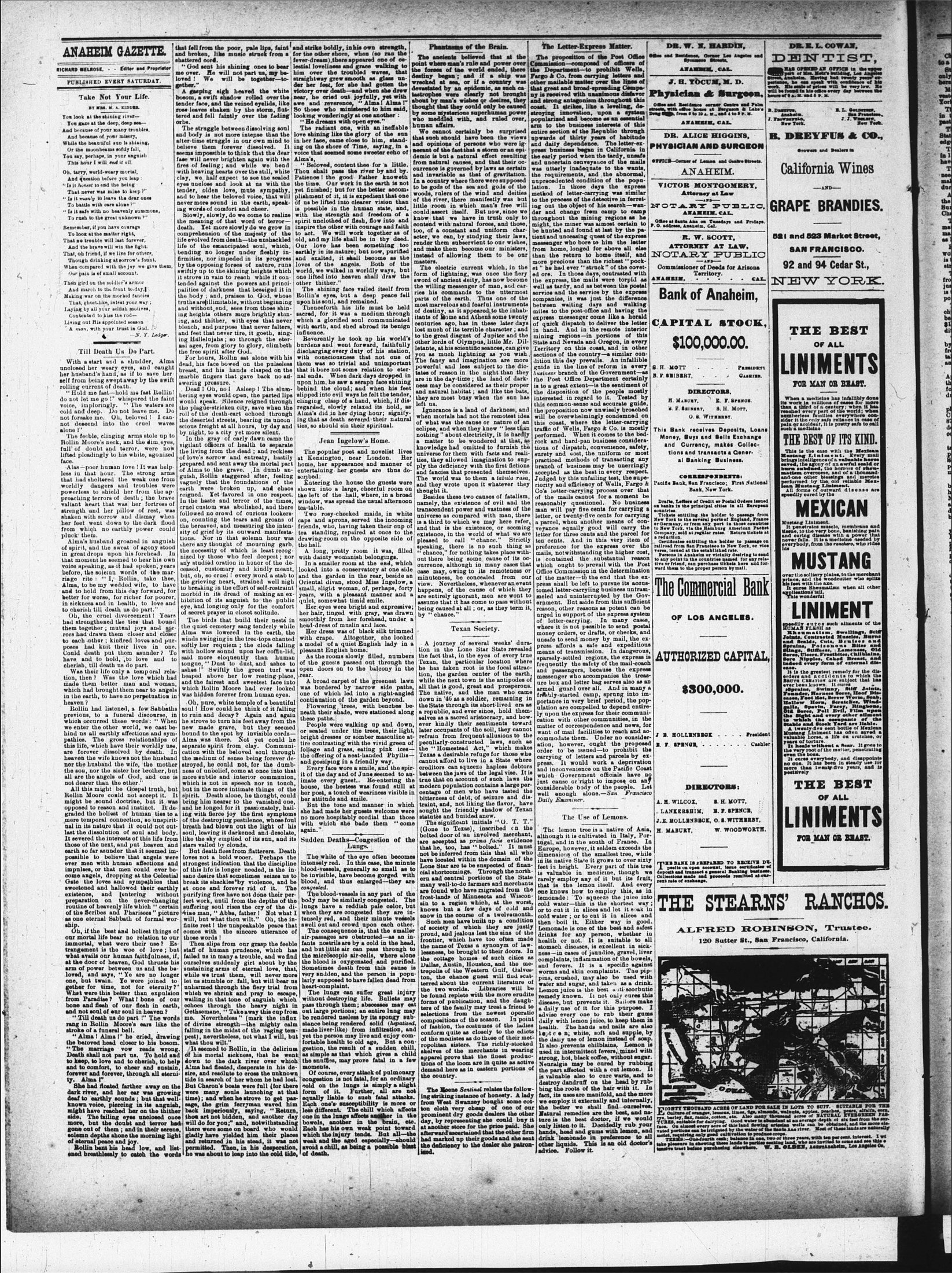
Searchable text
ANAHEIM GAZETTE.
RICHARD MELROSE. Editor and Proprietor
PUBLISHED EVERY SATURDAY.
Take Not Your Life.
BY MRS. M. A. KIDDER.
You look at the shining river—
You gaze at the deep, deep sea—
And because of your many troubles,
And because of your misery,
While the beautiful sun is shining,
Or the moonbeams softly fall,
You say, perhaps, in your anguish
This hour I will end it all.
Oh, tarry, world-weary mortal,
And question before you leap:
"Is it honest to end the being?
That never was mine to keep?"
"Is it manly to leave the dear ones
To battle with care alone?"
"Is it safe with no heavenly summons,
To rush to the great unknown?"
Remember, if you have courage
To look at the matter right,
That we trouble will last forever,
And the brave will win the fight.
That, oh friend, if we live for others,
Though drinking at sorrow's fount,
When compared with the joy we give them,
Our pain is of small account.
Then gird on the soldier's armor
And march to the front to-day.
Making war on the morbid fancies
That, ghost-like, infest your way;
Laying by all your selfish motives,
Contented to kiss the rod—
Living out His appointed season
A man, with your trust in God.
N. Y. Ledger.
Till Death Us Do Part.
With a start and a shudder, Alma unclosed her weary eyes, and caught her husband's hand, as if to save herself from being swept away by the swift rolling current of death.
"Hold me fast—hold me fast Rollin! do not let me go!" whispered the faint voice, imploringly. "The waters are cold and deep. Do not leave me. Do not forsake me. Oh, beloved! I cannot descend into the cruel waves alone!"
The feeble, clinging arms stole up to Rollin Moore's neck, and the dim eyes, full of doubt and terror, were now lifted pleadingly to his white, agonized face.
Alas—poor human love! It was helpless in that hour. The strong arms that fell from the poor, pale lips, faint and broken, like music struck from a shattered cord.
"God sent his shining ones to bear me over. He will not part us, my beloved! We will be together—together."
A gasping sigh heaved the white bosom, a swift shadow rolled over the tender face, and the veined eyelids, like rose-leaves shaken by the storm, fluttered and fell faintly over the fading orbs.
The struggle between dissolving soul and body is not more intense than the after-time struggle in our own mind to believe them forever dissolved. It seems impossible to think that the dear face will never brighten again with the fires of feeling; and while we bend with heaving hearts over the still, white clay, we half expect to see the sealed eyes unclose and look at us with the tender, olden love, mute sympathy, and to hear the beloved voice, that will never more sound in the earth, speaking words of comfort and cheer.
Slowly, slowly, do we come to realize the meaning of that word of terror—death. Yet more slowly do we grow in comprehension of the majesty of the life evolved from death—the unshackled life of the emancipated soul, which, bending no longer under fleshly infirmities, nor impeded in its progress by the opposing forces of nature, runs swiftly up to the shining heights which it strove in vain to reach while it contended against the powers and principalities of darkness that besieged it in the body; and praises to God, whose truths are illimitable, without beginning and without end, sees from those shining heights others more brightly shining, and thither, with eyes that never blench, and purpose that never falter, and feet that never tire, it goeth, singing Hallelujahs; so through the eternal ages, from glory to glory, climbeth the free spirit after God.
For hours, Rollin sat alone with his dead, his face bowed on the pulseless breast, and his hands clasped on the marble fingers that gave back no answering pressure.
Dead! Oh, no! Asleep! The slumbering eyes would open, the parted lips would speak. Silence reigned through the plague-striken city, save when the roll of the death-cart echoed through the deserted streets, bearing its unconscious freight at all hours, by day and by night, to a city yet more silent.
In the gray of early dawn came the vigilant officers of health to separate the living from the dead; and reckless of love's sorrow and entreaty, hastily prepared and sent away the mortal part of Alma to the grave. In dumb anglings boldly, in hindsight for the other shore, wipe fever-dream), there appeared lestial loveliness and a him over the troubled straightway grew smoother her feet; for she victory over death—a near, he cried out jaws awake and reverence; so those who minister looking wonderingly said:
"He dreams with owl The radiant one,
love shining like the eye in her face, came closing on the shore of T voice that seemed some Alma's,
"Beloved, content Thou shalt pass thy Patience! the good time. Our work yet finished; but for plishment of it, it is of us be lifted into chic is possible in the land with the strength a spirit unclothed of flight inspire the other with act. We will woo old, and my life shall Our love has been earthly in its nature; and exalted, it shall loves of the angel world, we walked in one lifted into heavier other thither."
The shining face of Rollin's eyes, but upon his soul, and reverence Thenceforth his sacred, for it was a which a glorified son with earth, and shed influence. Beverently he took burdens and went forth discharging every duck with consciousness as them was so trivial that it bore not some final ends. When daunt upon him he saw a behind cloud; slipped into evil way clinging clasp of a regardd, slowly reamed Alma's did in her dying that as death seized ties, so should sin thie
"Hold me fast—hold me fast Rollin! do not let me go!" whispered the faint voice, imploringly. "The waters are cold and deep. Do not leave me. Do not forsake me. Oh, beloved! I cannot descend into the cruel waves alone."
The feeble, clinging arms stole up to Rollin Moore's neck, and the dim eyes, full of doubt and terror, were now lifted pleadingly to his white, agonized face.
Alas—poor human love! It was helpless in that hour. The strong arms that had sheltered the weak one from worldly dangers and troubles were powerless to shield her from the approaching terrors of death; the brave valiant heart that was her fortress of strength and her pillow of rest, was shaken with sorrow and dismay when her feet went down to the dark flood from which no earthly power could pluck them.
Alma's husband groaned in anguish of spirit, and the sweat of agony stood in great drops upon his forehead. In that moment he seemed to hear his own voice speaking, as it had spoken, years before, the solemn words of the marriage rite: "I, Rollin, take thee, Alma, to be my wedded wife, to have and to hold from this day forward, for better for worse, for richer for poorer, in sickness and in health, to love and to cherish till death us do part."
Oh, the cruel divorcement! Years had strengthened the ties that bound them together; mutual joys and sorrows had drawn them closer and closer to each other; kindred loves and purposes had knitted their lives in one. Could death put them asunder? To have and to hold, to love and to cherish, till death us do part.
Was their life only a temporal relation, then? Was the love which had made them better man and woman, which had brought them near to angels in the earth, to have no perpetuation in heaven?
Rollin had listened, a few Sabbaths previous, to a funeral discourse, in which occurred these words: "When we enter the other world, we cast behind us all earthly affections and sympathies. The gross relationships of this life, which have their worldly use, are forever dissolved by death. In heaven the wife knows not the husband nor the husband the wife, the mother the son, nor the sister her brother, but all are the angels of God, and one is not dearer than the other."
All this might be Gospel truth, but Rollin Moore could not accept it. It might be sound doctrine, but it was opposed to reason and instinct. It degraded the holiest of human ties to a mere temporal connection, so unspiritual in its nature that it could not outlast the dissolution of soul and body. It severed the interests of this life from those of the next, and put heaven and earth so far asunder that it seemed impossible to believe that angels were ever men with human affections and impulses, or that men could ever become angels, dropping at the Celestial Gate the loves and sympathies that sweetened and hallowed their earthly existence, and entering without marble fingers that gave back no answering pressure.
Dead! Oh, no! Asleep! The slumbering eyes would open, the parted lips would speak. Silence reigned through the plague-striken city, save when the roll of the death-cart echoed through the deserted streets, bearing its unconcious freight at all hours, by day and by night, to a city yet more silent.
In the gray of early dawn came the vigilant officers of health to separate the living from the dead; and reckless of love's sorrow and entreaty, hastily prepared and sent away the mortal part of Alma to the grave. In dumb anguish, Rollin staggered after, feeling vaguely that the foundations of the earth were broken up, and chaos reigned. Yet favored in one respect. In the haste and terror of the times, cruel custom was abolished, and there followed no crowd of curious lookers on, counting the tears and groans of the bereaved, and measuring the intensity of grief by its outward manifestations. Nor in that solemn hour was there any thought of mourning garb, the necessity of which is least recognized by those who feel deepest; nor any studied oration in honor of the deceased, customary and kindly meant, but oh, so cruel! every word a stab to the grieving heart, strained well nigh to breaking in the effort of self-restraint morbid in its dread of making an exhibition of its anguish to the public eye, and longing only for the comfort of secret prayer in closet solitude.
The birds that build their nests in the quiet cemetery sang tenderly while Alma was lowered in the earth, the winds swinging in the tree-tops chanted softly her requiem; the clods falling with hollow sound upon her coffin-lid, said more eloquently than human tongue," Dust to dust, and ashes to ashes!" Swiftly the green turf was heaped above her low resting-place, and the fairest and sweetest face into which Rollin Moore had ever looked was hidden forever from human eyes.
Oh pure, white temple of a beautiful soul! How could he think of it falling to ruin and decay? Again and again he strove to turn his feet away from the new made grave, but they seemed bound to the spot by invisible cords—Alma was there. Not yet could he separate spirit from clay. Communication with the beloved soul through the medium of sense being forever destroyed, he could not, for the dumbness of unbelief, come at once into that more subtle and interior communion, which is not in speech nor in touch, but in the more intimate things of the spirit. Death alone, he thought, could bring him nearer to the vanished one, and he longed for it passionately, hailing with fierce joy the first symptoms of the destroying pestilence, whose foul breath had blown out the light of his soul, leaving it darkened and desolate, like the sky emptied of its sun, and its stars vailed by clouds.
But death flees from flatterers. Death loves not a bold wooer. Perhaps the strongest indication that the discipline of this life is longer needed, is the insane desire that sometimes seizes us to break its shackles' by violence, and be at once and forever rid of it. The purifying fires have not done their perennial ends. When daunt upon him, he saw a large left of the hall window, was spread tea-table.
Entering the hour shown into a larger left of the hall window, was spread tea-table.
Two rosy-cheeken caps and aprons, so friends, who having tea standing, repair drawing-room on tha hall.
A long, pretty hair with dainty womani
In a smaller room looked into a consort and the garden in Oriental divan; stooped small, slight woman years, with a pleasant quiet somewhat tiring.
Her eyes were brighter hair; tinged with smoothity from her head-dress of musli
Her dress was off with crape. Altos a model of a quiet pleasant English house.
As the rooms slow of the guests pass open doors on to rear.
A broad carpet owed by one of which led continuation of flowering trees neath their shade; these paths.
People were wall or seated under bright dresses or sitting tire contrasting with foliage and grass; she offering of a neat gossiping in a row.
Every face wore it of the day and often imitate every guest house; the hostess her post; a touch of her attitude and smile.
But the tone amnesia she had made her gaze no more hospitably with which she again."
might be sound doctrine, but it was opposed to reason and instinct. It degraded the holiest of human ties to a mere temporal connection, so unspiritual in its nature that it could not outlast the dissolution of soul and body. It severed the interests of this life from those of the next, and put heaven and earth so far asunder that it seemed impossible to believe that angels were ever men with human affections and impulses, or that men could ever become angels, dropping at the Celestial Gate the loves and sympathies that sweetened and hallowed their earthly existence, and lentering without preparation on the never-changing routine of heavenly life which "certain of the Scribes and Pharisees" picture as one eternal Sabbath of formal worship.
Oh, if the best and holiest things of our mortal life bear no relation to our immortal, what were their use? Estrangement is the woe of love; but what avails our human faithfulness, if, at the door of heaven, God thrusts his arm of power between us and the beloved, and says, "Ye are no longer one, but twain. Ye were joined together for time, not for eternity?" What were this better than expulsion from Paradise? What! bone of our bone and flesh of our flesh in earth, and not soul of our soul in heaven?
"Till death us do part!" The words rang in Rollin Moore's ears like the stroke of a funeral bell.
"Alma! Alma!" he cried, drawing the beloved head closer to his bosom. "The marriage vow reads wrong. Death shall not part us. To hold and to keep, to love and to cherish, to help and to comfort, to cheer and sustain, forever and forever, through all eternity. Alma!"
She had floated farther away on the dark river, and her ear was growing deaf to earthly sounds; but that well-known voice, piercing in its anguish, might have reached her on the thither side. The failing eyes unclosed once more, but the doubt and terror had gone out of them; and in their serene, solemn depths shone the morning light of eternal peace and joy.
Rollin bent his head low, and listened breathlessly to catch the words bring him nearer to the vanished one, and he longed for it passionately, hailing with fierce joy the first symptoms of the destroying pestilence, whose foul breath had blown out the light of his soul, leaving it darkened and desolate, like the sky emptied of its sun, and its stars vailed by clouds.
But death flees from flatterers. Death loves not a bold wooer. Perhaps the strongest indication that the discipline of this life is longer needed, is the insane desire that sometimes seizes us to break its shackles by violence, and be at once and forever rid of it. The purifying fires have not done their perfect work, until from the depths of the suffering soul rises the cry of the divine man, "Abba, father! Not what I will, but what thou wilt." Oh, the infinite rest! the unspeakable peace that comes with the sincere utterance of those words!
Then slips from our grasp the feeble staff of human prudence, which has failed us in many a trouble, and we find ourselves suddenly girt about by the sustaining arms of eternal love, that, while we trust them, will never more let us stumble or fall, but will bear us unharmed through the fiery trial from which we shrink and pray to escape, wailing in that tone of anguish which ochoes through the heavy night in Gethsemane, "Take away this cup from me. Nevertheless" (mark the influx of divine strength—the mighty calm falling in the midst of the raging tempest), nevertheless, not what I will, but what thou wilt."
It seemed to Rollin, in the delirium of his mortal sickness, that he went down to the dark river over which Alma had floated, desperate in his desire, and resolute to cross the unknown tide in search of her whom he had lost. But Charon's boats were full (for there were many souls launching at that time); and when he strove to get passage, the grim ferryman waved him back imperiously, saying, "Return, thou art not bidden, and another day will do for you;" and, notwithstanding there were some on board who would gladly have yielded him their places and returned in his stead, it was not permitted. Then, in his desperation, he was about to leap into the cold tide,
Sudden Deaths
Lu
and strike boldly, in his own strength, for the other shore, when (so ran the fever-dream), there appeared one of celestial loveliness and grace walking to him over the troubled waves, that straightway grew smooth as glass under her feet, for she had gotten the victory over death—and when she drew near, he cried out joyfully, yet with awe and reverence, "Alma! Alma!"
So those who ministered to him said, looking wonderingly at one another:
"He dreams with open eyes."
The radiant one, with an ineffable love shining like the glory of the sun in her face, came close to him, standing on the shore of Time, saying, in a voice that seemed some sweeter echo of Alma's,
"Beloved, content thee for a little. Thou shalt pass the river by and by. Patience! the good Father knoweth the time. Our work in the earth is not yet finished; but for the better accomplishment of it, it is expedient that one of us be lifted into clearer vision than is possible in the human state, and, with the strength and freedom of a spirit unclothed of flesh, flow into and inspire the other with courage and faith to act. We will work together as of old, and my life shall be in thy deed. Our love has been something too earthly in its nature; but now, purified and exalted, it shall become as the loves of the angels. Both of the world, we walked in worldly ways, but one lifted into heaven shall draw the other thither."
The shining face vailed itself from Rollin's eyes, but a deep peace fell upon his soul, and remained.
Thenceforth his life must be held sacred, for it was a medium through which a glorified soul communicated with earth, and shed abroad its benign influence.
Beverently he took up his world's burdens and went forward, faithfully discharging every duty of his station, with consciousness that not one of them was so trivial and unimportant that it bore not some relation to eternal ends. When dark days dropped in upon him, he saw a seraph face shining behind the cloud; and when his feet slipped into evil ways he felt the tender, clinging clasp of a hand, which, if disregarded, slowly relaxed its hold, as Alma's did in her dying hour; signifying that as death severed their natural ties, so should sin their spiritual.
Jean Ingelow's Home.
The popular poet and novelist lives at Kensington, near London. Her home, her appearance and manner of entertaining her guests are thus do-
Phantasms of the Brain.
The ancients believed that at the point where man's rule and power over the forces of the world ended, there destiny began; and if a ship was wrecked at sea, or if a country was devastated by an epidemic, as such catastrophes were clearly not brought about by man's wishes or desires, they thought that they could only be caused by some mysterious superhuman power who meddled with, and ruled over, human affairs.
We cannot certainly be surprised that such should have been the views and opinions of persons who were ignorant of the fact that a storm or an epidemic is but a natural effect resulting from natural causes, and that their occurrence is governed by laws as certain and invariable as that of gravitation. In a country where there were supposed to be gods of the sea and gods of the woods, rulers of the wind and deities of the river, there manifestly was but little room in which man's free will could assert itself. But now, since we know that we have in truth only to contend with natural forces, and those, too, of a constant and uniform character, we can, by studying their laws, render them subservient to our wishes, and make them become our ministers, instead of allowing them to be our masters.
The electric current which, in the form of lightning, was once the fiery sword of ancient deity, has now become the willing messenger of man, and carries his commands to the uttermost parts of the earth. Thus one of the most marvelous and fearful instruments of destiny, as it appeared to the inhabitants of Rome and Athens some twenty centuries ago, has in these later days lost much of its terrible character; and to the great disgust of Jupiter and the other lords of Olympus, little Mr. Dilletante, at his scientific seances, can give you as much lightning as you wish. The fancy and imagination are more powerful and less subject to the dictates of reason in the night than they are in the day-time; the land of darkness may be considered as their proper and natural habitat; and like the bats, they are most busy when the sun has left us.
Ignorance is a land of darkness, and when mortals had not the remotest idea of what was the cause or nature of an eclipse, and when they knew "less than nothing" about electricity, it is hardly a matter to be wondered at that, as knowledge had omitted to furnish the universe for them with facts and realities, they allowed imagination to supply the deficiency with the first fictions and fancies that presented themselves.
The Letter-Express Matter.
The proposition of the Post Office Commission—composed of officers of the Department—to prohibit Wells, Fargo & Co. from carrying letters and other mailable matter over the lines of that great and broad-spreading Company is received with unanimous disfavor and strong antagonism throughout this coast. It strikes, like a leveling, destroying innovation, upon a system popularized and become as an essential arm to the business interests of this entire section of the Republic through upwards of thirty years of habitude and daily dependence. The letter-express business began in California in the early period when the tardy, unsafe and uncertain conveyance of the mails was utterly inadequate to the wants, the requirements, and the abnormal, unprecedented condition of the population. In those days the express method of letter-carrying was similar to the process of the detective in ferreting out the object of his search—wander and change from camp to camp throughout the mining regions as he might; the miner was almost certain to be hunted and found at last by the patient and unceasing quest of the express messenger who bore to him the letter from home, longed for above all else than the return to home itself, and more precious than the richest "pocket" he had ever "struck" of the coveted ore. In those days, contrasted with the express, the mails were torpid as well as tardy, and as between the postal service and the service by the express companies, it was just the difference between waiting days and walking miles to the post-office and having the express messenger come like a herald of quick dispatch to deliver the letter in hand. And in the remote interior mining regions—in portions of this State and Nevada and Oregon, in every Territory on this coast, and in other sections of the country—a similar condition this day prevails. An infallible guide in the line of reform in every business branch of the Government—as the Post Office Department certainly is to a great extent—is the sentiment of the disposition of the people mostly interested in regard to it. Tested by this common-sense and accurate guide, the proposition now unwisely broached will be overwhelmingly condemned on this coast, where the letter-carrying traffic of Wells, Fargo & Co. is mostly performed. When it comes to the bedrock and hard-pan business considerations of dispatch, convenience, safety, surety and cost, the uniform or most practiced methods of transacting any branch of business may be unerringly accepted as the best in every respect.
Jean Ingelow's Home.
The popular poet and novelist lives at Kensington, near London. Her home, her appearance and manner of entertaining her guests are thus described:
Entering the house the guests were shown into a large, cheerful room on the left of the hall, where, in a broad window, was spread the usual afternoon tea-table.
Two rosy-cheeked maids, in white caps and aprons, served the incoming friends, who, having taken their cup of tea standing, repaired at once to the drawing-room on the opposite side of the hall.
A long, pretty room it was, filled with dainty womanish belongings.
In a smaller room at the end, which looked into a conservatory at one side and the garden in the rear, beside an Oriental divan, stood Miss Ingelow, a small, slight woman, of perhaps forty years, with a pleasant manner and a quiet, somewhat timid smile.
Her eyes were bright and expressive; her hair, tinged with gray, was drawn smoothly from her forehead, under a head-dress of muslin and lace.
Her dress was of black silk trimmed with crape. Altogether, she looked a model of a quiet English lady in a pleasant English home.
As the rooms slowly filled, numbers of the guests passed out through the open doors on to the balcony in the rear.
A broad carpet of the greenest lawn was bordered by narrow side paths, one of which led into a right-angled continuation of the garden beyond.
Flowering trees, with benches beneath their shade, were stationed along these paths.
People were walking up and down, or seated under the trees, their light, bright dresses or somber masculine attire contrasting with the vivid green of foliage and grass, eating pink ices—the offering of a neat-handed Phyllis—and gossiping in a friendly way.
Every face wore a smile, and the spirit of the day and of June seemed to imitate every guest. Be entering the house, the hostess was found still at her post, a touch of weariness visible in her attitude and smile.
But the tone and manner in which she had made her guests welcome were no more hospitably cordial than those with which she bade them "come again."
Sudden Deaths—Congestion of the Lungs.
The white of the eye often becomes intensely red. In this case, the minute blood-vessels, generally so small as to be invisible, have become gorged with blood, and thus enlarged—they are congested.
The blood-vessels in any part of the body may be similarly congested.
The significant initials "G. T. T." (Gone to Texas), inscribed on the bolted door of an involved merchant, are accepted as prima facie evidence that he, too, has "bolted." It must not be inferred from tails that all who have located within the domain of the Lone Star are to be suspected of financial shortcomings. Through the northern and central portions of the State many well-to-do farmers and merchants are found who have migrated from the frost-lands of Minnesota and Wisconsin.
The Post Office Department certainly is to a great extent—is the sentiment of the disposition of the people mostly interested in regard to it. Tested by this common-sense and accurate guide, will be overwhelmingly condemned on this coast, where the letter-carrying traffic of Wells, Fargo & Co. is mostly performed. When it comes to the bedrock and hard-pan business considerations of dispatch, convenience, safety, surety and cost, the uniform or most practiced methods of transacting any branch of business may be unerringly accepted as the best in every respect. Judged by this unfailing test, the superiority and efficiency of Wells, Fargo & Co.'s letter-carrying process over that of the mails cannot for a moment be reasonably questioned. No business man will pay five cents for carrying a letter, or twenty-five cents for carrying a parcel, when another means of conveyance equally good will carry the letter for three cents and the parcel for ten cents. And in this very item of preference for the express over the mails, notwithstanding the higher cost, is contained the substantial reason which ought to prevail with the Post Office Commission in the determination of the matter—to the end that the express small be left to pursue its accustomed letter-carrying business untrammeled and uninterrupted by the Government. But aside from this sufficient reason, other reasons as potent can be urged in support of the express system of letter-carrying. In many cases, where it is not possible to send postal money orders, or drafts, or checks, and unsafe to send money by mail, the express affords a safe and expeditions means of transmission. In dangerous sparsely-settled regions, the express is frequently the safety of the mail-coach and passengers, because the express messenger who accompanies the treasure box and letter bag serves also as an armed guard over all. And in many a freshly-started camp, sprung into importance in very brief period, the population are compelled to depend entirely upon the express for their communication with other communities, in the matter of correspondence and news, for want of mail facilities to reach and accommodate them. Under no consideration, however, ought the proposed order to be issued—to prohibit the carrying of letters and parcels by express. It would work a deprivation and inconvenience on the Pacific Coast which Government officials have no just cause or right to impose on any considerable body of the people. Let well enough alone.—San Francisco Daily Examiner.
The Use of Lemons.
The lemon tree is a native of Asia, although it is cultivated in Italy, Portugal, and in the south of France. In Europe, however, it seldom exceeds the dimensions of the smallest tree, while in its native State it grows to over sixty feet in height. Every part of this tree is valuable in medicine, though we rarely employ any of it but its fruit, that is the lemon itself. And every one knows how to employ this, as in lemon: To squeeze the juice into
Sudden Deaths—Congestion of the Lungs.
The white of the eye often becomes intensely red. In this case, the minute blood-vessels generally so small as to be invisible, have become gorged with blood, and thus enlarged—they are congested.
The blood-vessels in any part of the body may be similarly congested. The lungs have a reddish pale color, but when they are congested they are intensely red, and their minute vessels swell out and crowd upon each other.
The consequence is, that the smaller air-passages are obstructed—as an infants nostrils are by a cold in the head, and but little air can pass through to the microscopic air-cells, where alone the blood is oxygenated and purified. Sometimes death from this cause is very sudden, and the person is popularly supposed to have fallen dead from heart-complaint.
The lungs can suffer great injury without destroying life. Bullets may pass through them; abscesses may eat out large portions; an entire lung may be rendered useless by its spongy substance being rendered solid (hepatized, made liver-like) from infiltration, and yet the person may live and enjoy comfortable health to old age. But a congestion, the result of a sudden chill, as simple as that which gives a child the snuffles, may prove fatal in a few moments.
Of course, every attack of pulmonary congestion is not fatal, for an ordinary cold on the lungs is simply a slight form of it. Further, all are not equally liable to such fatal attacks. Each one's susceptibility is more or less different. The chill which affects one in the lungs affects another in the bowels, another in the brain, etc. Each has his own weak point toward which the injury tends. But all—the weak and the aged especially—should avoid a chill, as being a possible blast of death.
The significant initials "G. T. T." (Gone to Texas), inscribed on the bolted door of an involved merchant, are accepted as prima facie evidence that he, too, has "bolted."
It must not be inferred from this that all who have located within the domain of the Lone Star are to be suspected of financial shortcomings. Through the northern and central portions of the State many well-to-do farmers and merchants are found who have migrated from the frost-lands of Minnesota and Wisconsin to a region which, at the worst, knows but a few days of cold and snow in the course of a twelvemonth.
Such men have built up a condition of society of which they are justly proud, and jealous lest the sins of the frontier, which have too often made the name of Texas a synonym of lawlessness, be brought to their doors. In the cottage homes of such cities as Dallas, Austin, Houston, and the metropolis of the Western Gulf, Galveston, the chance guest will find scattered about the current literature of the two worlds. Libraries will be found replete with the more erudite forms of publication, and the daughters of the family may treat a friend to selections from the newest operatic compositions of the season. In point of fashion, the costumes of the ladies conform quite as closely to the edicts of the modistes as do those of their metropolitan sisters. The richly-stocked shelves of the merchants in wearing apparel prove that the finest productions of the loom are in quite as active demand here as in eastern portions of the country.
The Moene Sentinel relates the following striking instance of honesty. A lady from West Swanzey bought some cotton cloth very cheap of one of our prominent dry goods dealers the other day, by representing she could buy it at another store for the price paid. She afterward ascertained that the other firm had marked up their goods and she sent the deficiency to the dealer she patronised.
The Use of Lemons.
The lemon tree is a native of Asia, although it is cultivated in Italy, Portugal, and in the south of France. In Europe, however, it seldom exceeds the dimensions of the smallest tree, while in its native State it grows to over sixty feet in height. Every part of this tree is valuable in medicine, though we rarely employ any of it but its fruit, that is the lemon itself. And every one knows how to employ this, as in lemonade: To squeeze the juice into cold water—this is the shortest way; or to cut it in slices and let it soak in cold water; or to cut it in slices and then boil it. Either way is good. Lemonade is one of the best and safest drinks for any person, whether in health or not. It is suitable to all stomach diseases, is excellent in sickness—in cases of jaundice, gravel, liver complaints, inflammation of the bowels, and fevers. It is a specific against worms and skin complaints. The pippins, crushed, may also be used with water and sugar, and taken as a drink. Lemon juice is the best anti-scorbutic remedy known. It not only cures this disease, but prevents it. Sailors make a daily use of it for this purpose. I advise every one to rub their gums daily with lemon juice, to keep them in health. The hands and nails are also kept clean; white, soft and supple, by the daily use of lemon instead of soap. It also prevents chilblains. Lemon is used in intermittent fevers mixed with strong, hot, black coffee without sugar. Neuralgia may be cured by rubbing the part affected with a cut lemon. It is valuable also to cure warts, and to destroy dandruff on the head by rubbing the roots of the hair with it. In fact, its uses are manifold, and the more we employ it externally and internally, the better we shall find ourselves. Natural remedies are the best, and nature is the best doctor, if we would only listen to it. Decidedly rub your hands, head and gums with lemon, and drink lemonade in preference to all other liquids. This is an old doctor's advice. Follow it.
DR. W. M. HARDIN,
Office and Residence, Corner Los Angeles and Bycame Streets,
ANAHEIM, CAL.
J. H. YOCUM, M. D.
Physician & Surgeon,
Office and Residence corner Centre and Palm streets, with office hours at Bergson & Lake's Drug Store, from 8 to 10 A.M., and 4 to 5 P.M.
ANAHEIM, CAL.
DR. ALICE HIGGINS,
PHYSICIAN AND SURGEON
OFFICE—Corner of Lemon and Centre Streets.
ANAHEIM.
VICTOR MONTGOMERY,
Attorney at Law
AND
NOTARY PUBLIC.
ANAHEIM, CAL.
Office at Santa Ana on Tuesdays and Fridays.
P.O. address, Anaheim, Cal.
R. W. SCOTT,
ATTORNEY AT LAW,
NOTARY PUBLIC
AND
Commissioner of Deeds for Arizona Territory.
ANAHEIM, CAL.
Bank of Anaheim,
CAPITAL STOCK,
$100,000.00.
S. H. MOTT
President
B. F. SHIBERT,
Cashier.
DIRECTORS.
H. MABURY,
E. F. SPENCE.
M. F. SEIBERT,
S. H. MOTT,
O. S. WITHERBY.
This Bank receives Deposits, Loans Money, Buys and Sells Exchange and Currency, makes Collections and transacts a General Banking Business.
DR. E. L. COWAN,
DENTIST,
HAS OPENED AN OFFICE in the upper part of Mrs. Metr's building, Los Angeles Street, Anaheim. Having had twenty years experience, he can speak with confidence of his work. His scale of prices will be very low. He will be found in his office every day between the hours of 6 A.M. and 5 P.M.
B. DREYFUS,
Anaheim.
B. L. GOLDETER,
San Francisco.
J. FROWNSLA,
New York.
B. DREYFUS & CO.,
Growers and Dealers in California Wines
GRAPE BRANDIES.
521 and 523 Market Street,
SAN FRANCISCO.
92 and 94 Cedar St.
NEW YORK.
THE BEST OF ALL
LINIMENTS
FOR MAN OR BEAST.
When a medicine has infallibly done its work in millions of cases for more than a third of a century; when it has reached every part of the world; when numberless families everywhere consider it the only safe reliance in case of pain or accident, it is pretty safe to call such a medicine
THE BEST OF ITS KIND.
This is the case with the Mexican Mustang Liniment. Every mail brings intelligence of a valuable horse saved, the agony of an awful scald or burn subdued, the horrors of rheumatism overcome, and of a thousand-
DIRECTORS.
H. MABURY, E. F. SPENCE.
U. F. SEIBERT, S. H. MORT,
O. S. WITHERBY.
This Bank receives Deposits, Loans Money, Buys and Sells Exchange and Currency, makes Collections and transacts a General Banking Business.
CORRESPONDENTS:
Pacific Bank, San Francisco; First National Bank, New York.
Drafts, Letters of Credit or Postal Orders issued on banks in the principal cities in all European countries.
Tickets entitling the holder to passage from New York to the several ports of England, France or Germany, or from any port in those countries to New York, via the Hamburg American Packet Company, sold at regular rates. Return tickets at a reduction.
Certificates entitling the holder to passage on railroad from San Francisco to New York, or vice versa, issued at the established rate.
Persons in Anaheim or vicinity desiring to send to any point in the countries named for any relative or friend, can purchase tickets here and forward them to the proper person by mail.
The Commercial Bank
OF LOS ANGELES.
AUTHORIZED CAPITAL,
$300,000.
J. B. HOLLENBECK ... President
B. F. SPENCE, ... Cashier
DIRECTORS:
A. H. WILCOX, S. H. MOTT,
LANKERSHIM, H. F. SPENCE,
J.E. HOLLENBECK, O.S.WITHERBY,
H. MABURY, W. WOODWORTH.
THE BANK IS PREPARED TO RECEIVE DEPOSITS on open account, issue certificates of deposit and transacted a general Banking business. Collections made and proceeds remitted at current rate of exchange.
FOR MAN OR BEAST.
When a medicine has infallibly done its work in millions of cases for more than a third of a century; when it has reached every part of the world; when numberless families everywhere consider it the only safe reliance in case of pain or accident, it is pretty safe to call such a medicine.
THE BEST OF ITS KIND.
This is the case with the Mexican Mustang Liniment. Every mail brings intelligence of a valuable horse saved, the agony of an awful scald or burn subdued, the horrors of Rheumatism overcome, and of a thousand-and-one other blessings and mercies performed by the old reliable Mexican Mustang Liniment.
All forms of outward disease are speedily cured by the MEXICAN Mustang Liniment.
It penetrates muscle, membrane and tissue, to the very bone, banishing pain and curing disease with a power that never fails. It is a medicine needed by everybody, from the rancho, who rides his MUSTANG over the solitary plains, to the merchant prince, and the woodcutter who splits his feet with the axe.
It cures Rheumatism when all other applications tail.
This wonderful LINIMENT speedsily euros such amounts of the HUMAN FLESH as Rheumatism, Swellings, Stiff Joints, Contracted Muscles, Burns and Scalds, Cuts, Bruises and Sprains, Petroleum Bites and Gings, Stifhasse, Lameness, Old Sorces Nipples, Frostbites, Chillblains, Sore Nipples, Caked Breast, and indeed every form of external disease.
It is the greatest remedy for the disorders and accidents to which the Burru Creation are subject that has ever been known. It cures Sprains, Swinny, Stiff Joints, Founder, Harness Sores, Hoof Diseases, Foot Met, Screw Worm, Seab, Hollow Horn, Scratches, Windgalls, Spavin, Farey, Ringbone, Old Sorces, Poll Evil, Film upon the Sight and every other aim but to which the corpseparts of the Stable and Stook Yard are liable.
A twenty-five cent bottle of Mexican Mustang Liniment has often saved a valuable horse, a life on crutches, or years of torture.
It heals without a scar. It goes to the very root of the matter, penetrating even the bone.
It cures everybody, and disappoints no one. It has been in steady use for more than twenty-five years, and is positively THE BEST OF ALL LINIMENTS FOR MAN OR BEAST.
THE STEARNS' RANCHOS.
ALFRED ROBINSON, Trustee.
120 Sutter St., San Francisco, California.
EIGHTY THOUSAND ACRES OF LAND FOR SALE IN LOTS TO SUIT. SUITABLE FOR THE Culture of oranges, lemons, limes, figs, almonds, walnuts, apples, peaches, pears, alfalfa, corn, rye, barley, flax, ramie, cotton, etc. Also many thousand acres of NATURAL EVERGREEN PATURES, suitable for dairying. Good water is abundant at an average depth of six feet from the surface. On almost every acre of this land flowing artesian wells can be obtained, and the more elevated portions can be irrigated by the water of the Santa Ana river. Most of these lands are naturally moist, requiring only good cultivation to produce crops.
TERMS: One-fourth cash; balance in one, two or three years, with ten percent interest. I will take pleasure in showing these lands to parties seeking land, who are invited to come and see this attractive tract before purchasing elsewhere. W. H. OLDEN, AGRIZANAheim, Los Angeles Co.