anaheim-gazette 1880-04-17
Scanned page
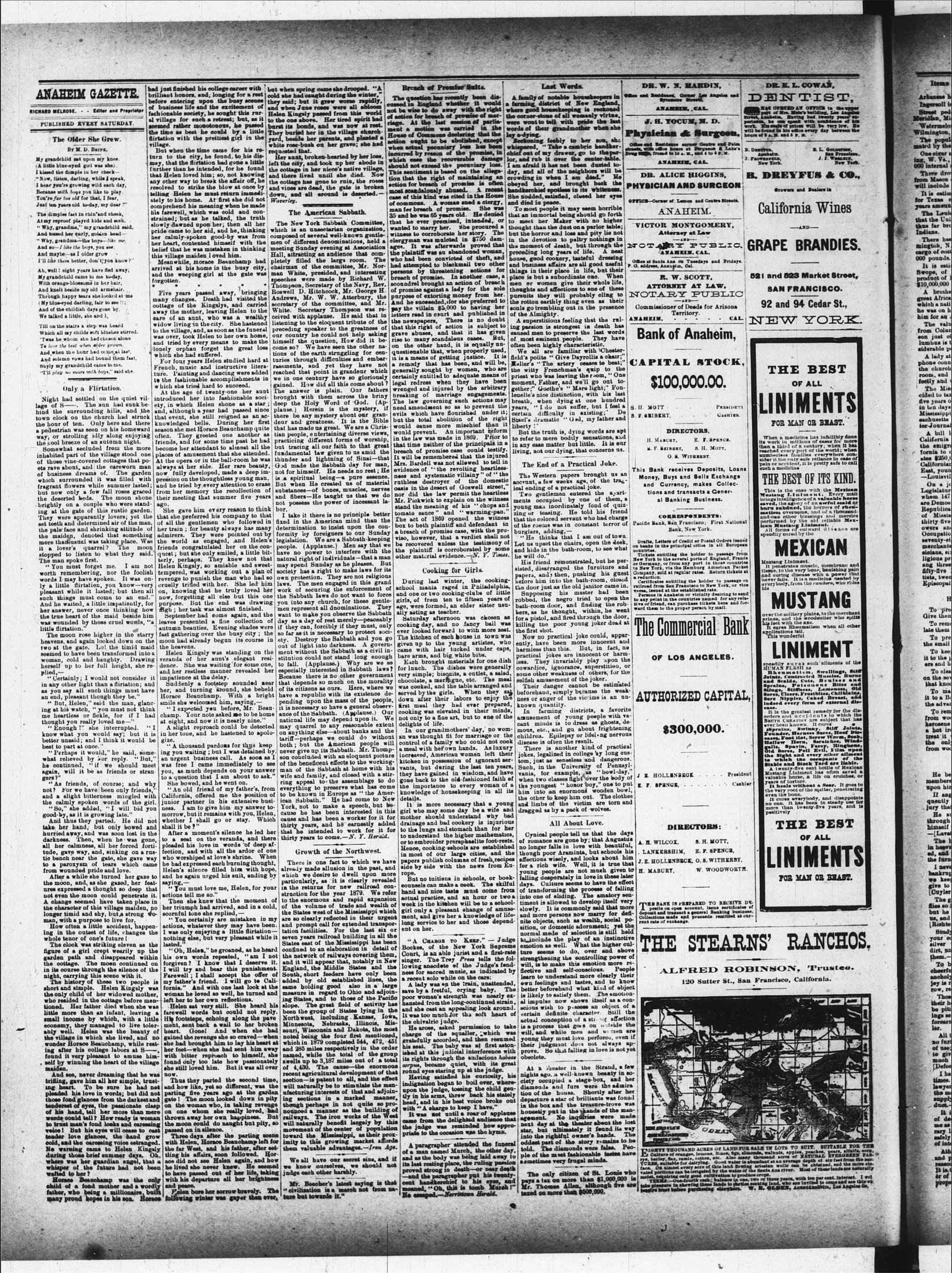
Searchable text
ANAHEIM GAZETTE.
RICHARD MELROSE. • • Editor and Proprietor
PUBLISHED EVERY SATURDAY.
The Older She Grew.
BY M. D. BRINE.
My grandchild sat upon my knee.
(A little blue-eyed girl was she).
I kissed the dimple in her cheek—
"Now, listen, darling, while I speak,
I hear you're growing wild each day,
Because with boys you like to play.
You're far too old for that, I fear,
Just ten years old to-day, my dear!"
The dimples fast in chin'and cheek,
At my reproof played hide and seek.
"Why, grandma," my grandechild said,
And tossed her early, golden head—
"Why, grandma—the boys—like me.
And so—I like the boys, you see.
And maybe—as I older grow
I'll like them better, don't you know?"
Ah, well! eight years have fled away;
My grandechild came to me to-day,
With orange-blossoms in her hair,
And knelt beside my old armhair.
Through happy tears she looked at me
(My blue-eyed darling, fair to see!");
And of the childish days gone by.
We talked a little, she and I,
Till on the stairs a step was heard
Which all my children soft blushes stirred.
"Twas he whom she had chosen alone
To love the best when older grown.
And when the hour had come at last,
And solemn vows had bound them fast,
Shyly my grandchild came to me."
"I'll play no more with boys," said she.
Only a Flirtation.
Night had settled on the quiet village of S——. The sun had sunk behind the surrounding hills, and the town clock on the church had struck the hour of ten. Only here and there a pedestrian was seen on his homeward way, or strolling idly along enjoying the cool breeze of an autumn night.
Somewhat secluded from the more inhabited part of the village stood one of those vine-covered cottages that poets rave about, and the careworn man of business dreams of. The garden had just finished his college career with brilliant honors, and, longing for a rest before entering upon the busy scenes of business life and the excitement of fashionable society, he sought this rural village for such a retreat; but, as it seemed rather monotonous, he passed the time as best he could by a little flirtation with the prettiest girl in the village.
But when the time came for his return to the city, he found, to his dismay, that the flirtation had gone a little further than he intended, for he found that Helen loved him; so, not knowing any other way to break the affair off, he resolved to strike the blow at once by telling Helen he must return immediately to his home. At first she did not comprehend his meaning when he made his farewell, which was cold and constrained; but as he talked, the truth slowly dawned upon her; then all her pride came to her aid, and he, thinking her calmly-spoken good-by was from her heart, contented himself with the belief that he was mistaken in thinking this village maiden loved him.
Meanwhile, Morace Beauchamp had arrived at his home in the busy city, and the weeping girl at the gate was forgotten.
Five years passed away, bringing many changes. Death had visited the cottage of the Kingslys, and carried away the mother, leaving Helen to the care of an aunt, who was a wealthy widow living in the city. She hastened to the village, and, as soon as the funeral was over, took Helen to her own home, and tried by every means to make the lonely orphan forget the great loss which she had suffered.
For four years Helen studied hard at French, music and instructive literature. Painting and dancing were added to the fashionable accomplishments in which she tried hard to succeed.
At the age of twenty-one her aunt introduced her into fashionable society, in which Helen shone as a star; and although a year had passed since that event, she still reigned as an acknowledged belle. During her first season she met Horace Beauchamp quite often. They greeted one another as friends, and for some time past he had become her attendant to almost all the places of amusement that she attended. At the opera or in the ball-room he was always at her side. Her rare beauty, now fully developed, made a deep imbut when spring came she drooled cold she had caught during their they said; but it grew worse and when June roses were all Helen Kingsly passed from them to the one above. Her tired burst its bonds, and was now They buried her in the village yard, beside her parents, and white rose-bush on her gravel requested that.
Her aunt, broken-hearted by left the city, and took up her place in the cottage in her niece's nation and there lived until she died the cottage has gone to ruin, and vines are dead, the gate down, and all around is deWaverley.
The American Sabbath
The New York Sabbath Church which is an unsectarian organ composed of several well-known men of different denominations meeting Sunday evening at A Hall, attracting an audience thatpletely filled the large room chairman of the committee; man White, presided; and speeches were made by R Thompson, Secretary of the N Roswell D. Hitchcock, Mr. Andrews, Mr. W. W. Atten secretary of the committee; White. Secretary Thompson received with applause. He listened to the eloquent tribes preceding speaker to the gour country he could not hear himself the question. How come so? We have seen these tions of the earth struggling turries through difficulties andrassments, and yet theyre reached that point in grandeur we in one century have so gained. How did all this cooThe answer is plain. One brought with them across deep the Holy Word of (plause.) Herein is the reason there be any mystery about deur and greatness. It is that has made us great. We tian people, entertaining dividing different forms but tracing all our faith to fundamental law given to us thunder and lightning of God made the Sabbath day not for himself. He needs
Only a Flirtation.
Night had settled on the quiet village of S——. The sun had sunk behind the surrounding hills, and the town clock on the church had struck the hour of ten. Only here and there a pedestrian was seen on his homeward way, or strolling idly along enjoying the cool breeze of an autumn night.
Somewhat secluded from the more inhabited part of the village stood one of those vine-covered cottages that poets rave about, and the careworn man of business dreams of. The garden which surrounded it was filled with fragrant flowers while summer lasted; but now only a few fall roses graced the deserted beds. The moon shone brightly on a couple who were standing at the gate of this rustic garden. They were apparently lovers; yet the set teeth and determined air of the man, the pale face and shrinking attitude of the maiden, denoted that something more than usual was taking place. Was it a lover's quarrel? The moon stopped to listen to what they said. The man spoke first.
"You must forget me. I am not worth remembering, nor the foolish words I may have spoken. It was only a little flirtation, you know—very pleasant while it lasted; but then all such things must come to an end." And he waited, a little impatiently, for her answer, never once thinking how the true heart of the maid beside him was wounded by those cruel words, "a little flirtation."
The moon rose higher in the starry heavens, and again looked down on the two at the gate. Lol, the timid maid seemed to have been transformed into a woman, cold and haughty. Drawing herself up to her full height, she replied,
"Certainly; I would not consider it in any other light than a flirtation; and as you say all such things must have an end, pleasant though they be."
"But, Helen," said the man, glancing at his watch, "you must not think me heartless or fickle, for if I had thought you really loved me—"
"Enough!" she interrupted. "I know what you would say; but it is better unsaid; and I think it would be best to part at once."
"Perhaps it would," he said, somewhat relieved by her reply. "But," he continued, "if we should meet again, will it be as friends or strangers?"
"As friends, of course; and why not? For we have been only friends," and a slight bitterness mingled with the calmly spoken words of the girl.
"So," she added, "I will bid you good-by, as it is growing late."
And thus they parted. He did not take her hand, but only bowed and hurried away, and was soon lost in the darkness. Then, when he was gone, all her calmness, all her forced fortitude, gave way, and sinking on a rustic bench near the gate, she gave way to a paroxysm of tears which came from wounded pride and love.
After a while she turned her gaze to the moon, and, as she gazed, her features expressed a thought so deep that not even the moon could penetrate it.
At the age of twenty-one her aunt introduced her into fashionable society, in which Helen shone as a star; and although a year had passed since that event, she still reigned as an acknowledged belle. During her first season she met Horace Beauchamp quite often. They greeted one another as friends, and for some time past he had become her attendant to almost all the places of amusement that she attended. At the opera or in the ball-room he was always at her side. Her rare beauty, now fully developed, made a deep impression on the thoughtless young man, and he tried by every attention to erase from her memory the recollection of their meeting that summer five years ago.
She gave him every reason to think that she preferred his company to that of all the gentlemen who followed in her train; for beauty always has many admirers. They were pointed out by the world as engaged, and Helen's friends congratulated her on the conquest; but she only smiled, a little bitterly, perhaps. They knew not that Helen Kingsly, so amiable and sweet-tempered, was working out a plan of revenge to punish the man who had so cruelly trilled with her. She led him on, knowing that he truly loved her now, forgetting all else but this one purpose. But the end was drawing high; her task was almost finished.
September had come again, and the leaves presented a fine collection of autumn beauties. Evening shades were fast gathering over the busy city; the moon had already begun its course in the heavens.
Helen Kingsly was standing on the veranda of her aunt's elegant residence. She was waiting for some one, and her restless manner revealed her impatience at the delay.
Suddenly a footstep sounded near her, and turning around, she beheld Horace Beauchamp. With a bright smile she welcomed him, saying,
"I expected you before, Mr. Beanchamp. Your note asked me to be home at eight, and now it is nearly nine."
A slight reproach could be detected in her tone, and he hastened to apologize.
"A thousand pardons for thus keeping you waiting; but I was detained by an urgent business call. As soon as I was free I came immediately to see you, as much depends on your answer to a question that I am about to ask."
She bowed, and he went on.
"An old friend of my father's from California, offered me the position of junior partner in his extensive business. I am to give him my answer tomorrow, but it remains with you, Helen, whether I shall go or stay. Which shall it be?"
After a moment's silence he led her to a seat on the veranda, and there pleaded his love in words 'of deep affection,' and with all the ardor of one who worshiped at love's shrine. When he had expressed each burning thought, Helen's silence filled him with hope, and he again urged his suit, ending by saying,
"You must love me, Helen, for your actions tell me so."
At the age of twenty-one her aunt introduced her into fashionable society, in which Helen shone as a star; and although a year had passed since that event, she still reigned as an acknowledged belle. During her first season she met Horace Beauchamp quite often. They greeted one another as friends, and for some time past he had become her attendant to almost all the places of amusement that she attended. At the opera or in the ball-room he was always at her side. Her rare beauty, now fully developed, made a deep impression on the thoughtless young man, and he tried by every attention to erase from her memory the recollection of their meeting that summer five years ago.
She gave him every reason to think that she preferred his company to that of all the gentlemen who followed in her train; for beauty always has many admirers. They were pointed out by the world as engaged, and Helen's friends congratulated her on the conquest; but she only smiled, a little bitterly, perhaps. They knew not that Helen Kingsly, so amiable and sweet-tempered, was working out a plan of revenge to punish the man who had so cruely trilled with her. She led him on, knowing that he truly loved her now, forgetting all else but this one purpose. But the end was drawing high; her task was almost finished.
September had come again, and the leaves presented a fine collection of autumn beauties. Evening shades were fast gathering over the busy city; the moon had already begun its course in the heavens.
Helen Kingsly was standing on the veranda of her aunt's elegant residence. She was waiting for some one, and her restless manner revealed her impatience at the delay.
Suddenly a footstep sounded near her, and turning around she beheld Horace Beauchamp. With a bright smile she welcomed him, saying,
"I expected you before, Mr. Beanchamp. Your note asked me to be home at eight, and now it is nearly nine."
A slight reproach could be detected in her tone, and he hastened to apologize.
"A thousand pardons for thus keeping you waiting; but I was detained by an urgent business call. As soon as I was free I came immediately to see you, as much depends on your answer to a question that I am about to ask."
She bowed, and he went on.
"An old friend of my father's from California, offered me the position of junior partner in his extensive business. I am to give him my answer tomorrow, but it remains with you, Helen, whether I shall go or stay. Which shall it be?"
After a moment's silence he led her to a seat on the veranda, and there pleaded his love in words 'of deep affection,' and with all the ardor of one who worshiped at love's shrine. When he had expressed each burning thought, Helen's silence filled him with hope, and he again urged his suit, ending by saying,
"You must love me, Helen, for your actions tell me so."
"So," she added, "I will bid you good-by, as it is growing late."
And thus they parted. He did not take her hand, but only bowed and hurried away, and was soon lost in the darkness. Then, when he was gone, all her calmness, all her forced fortitude, gave way, and, sinking on a rustic bench near the gate, she gave way to a paroxysm of tears which came from wounded pride and love.
After a while she turned her gaze to the moon, and, as she gazed, her features expressed a thought so deep that not even the moon could penetrate it. A change seemed have taken place in the character of this village maiden, no longer timid and shy, but a strong woman, with a purpose to live for.
How often a little accident, happening in the outset of life, changes the whole tenor of one's future!
The clock was striking eleven as the figure of a girl crept wearily up the garden path and disappeared within the cottage. The moon continued on in its course through the silence of the night, carrying this scene with it.
The history of these two people is short and simple. Helen Kingsly was the only child of her widowed mother, who resided in the cottage before mentioned. Her father died when she was little more than an infant, leaving a small income by which, with a little economy, they managed to live tolerably well. Helen was the beauty of the village in which she lived, and no wonder Horace Beauchamp, while resting after his college labors at S——found it very pleasant to amuse himself by winning the heart of the village maiden.
And see, never dreaming that he was trifling, gave him all her simple, trusting heart. To be sure he had not pleaded his love in words; but did not those fond glances from the darkest and tenderest of eyes, the passionate clasp of his hand, tell her more than mere words could tell? How ready is woman to trust man's fond looks and caressing voice! But his eyes will cease to cast tender love glances, the hand grow cold, and the caressing voice estranged. No warning came to Helen Kingly during those brief summer days. Oh, where was her guardian angel, that a whisper of the future had not been wafted to her?
Horace Beauchamp was the only child of a fond mother and a wordly father, who being a millionaire, built many proud hopes in his son. Horace junior partner in his extensive business. I am to give him my answer tomorrow, but it remains with you, Helen, whether I shall go or stay. Which shall it be?
After a moment's silence he led her to a seat on the veranda, and there pleaded his love in words of deep affection, and with all the ardor of one who worshiped at love's shrine. When he had expressed each burning thought, Helen's silence filled him with hope, and he again urged his suit, ending by saying,
"You must love me, Helen, for your actions tell me so."
Then she knew that the moment of her triumph had arrived, and in a cold, scornful tone she replied,
"You certainly are mistaken in my actions, whatever they may have been. I was only enjoying a little flirtation—nothing else, but very pleasant while it lasted."
"Oh, Helen," he groaned, as he heard his own words repeated, "am I not forgiven? I know that I deserve it. I will try and bear this punishment. Farewell; I shall accept the offer of my father's friend. I will go to California." And with one last look at the woman he loved so well, he turned and left her to her own reflections.
Helen sat very still. She heard his farewell words but could not reply. His footsteps, echoing along the pavement, sent back a wail to her broken heart. Gone! And when she had gained the revenge she so craved—when she had brought him to lay his heart at her feet—when she had sent him away with bitter reproach to himself, she found only too late how passionately she still loved him. But it was all over now.
Thus they parted the second time, and how like, yet so different, was the parting five years ago at the garden gate! The moon looked down in pity on the woman who, in taking revenge on one whom she really loved, had thrown away her own happiness. But the moon could do naught but pity, so passed on in silence.
Three days after the parting scene with Helen, Horace Beauchamp left for the far West, and his father, after settling his affairs, soon followed. Horace did not see Helen again, and how he lived she never knew. He seemed to have passed out of her life, taking with his departure all her brightness and peace.
Yale bore her sorrow bravely. The following winter was gayer than ever,
Growth of the Norfolk
There is one fact to we already made allusion in which we desire to dwelt particularly, as it is clear in the returns for new construction for the year 1880 to the enormous and rapid volume of trade in the States west of the Mississippi are so clearly reflected in and prompt call for extension facilities. For the seven years railroad built States east of the Mississippi confined to an elaboration the network of railways owed and it will appear that, no England, the Middle St., South, short feeders have added by old establishments same holding good alms measure in regard to Objection States, and to those slope. The great field owe been the group of States Northwest, including Minnesota, Nebraska, sourii Wisconsin and Dakota noted being the four finishes which in 1879 completed and 285 miles respectively named, while the total swells up to 3,187 miles of 4,430. The cause—recent agricultural development—is patent to all will naturally be to stimulate interests of these sections in a manner though perhaps not noticed a manner as the railways. The iron work will naturally benefit later movement of the center toward the Mississippi; imitry to this growing them valuable advantage.
We all have our scores we know ourselves, we judge each other harshly.
Mr. Beecher's latest "civilization is a marsh-ture but towards it."
when spring came she drooped. "A she had caught during the winter," he said; but it grew worse rapidly, when June roses were all abloom when Kingsley passed from this world the one above. Her tired spirit had at its bonds, and was now at rest. By buried her in the village church, beside her parents, and planted a rose-bush on her grave; she had casted that.
Her aunt, broken-hearted by her loss, the city, and took up her abode in cottage in her niece's native village, there lived until she died. Now cottage has gone to ruin, the roses vines are dead, the gate is broken down, and all around is deserted.—Overley.
The American Sabbath.
The New York Sabbath Committee, which is an unsectarian organization, imposed of several well-known gentlemen of different denominations, held a meeting Sunday evening at Association Hall, attracting an audience that completely filled the large room. The chairman of the committee, Mr. Norris White, presided, and interesting speeches were made by Richard W. Thompson, Secretary of the Navy, Rev. Aswell D. Hitchcock, Mr. George H. Andrews, Mr. W. W. Atterbury, the secretary of the committee, and Mr. White. Secretary Thompson was revived with applause. He said that in listening to the eloquent tribute of the preceding speaker to the greatness of our country he could not help asking himself the question, How did it be so? We have seen the other nations of the earth struggling for centuries through difficulties and embarrassments, and yet they have not reached that point in grandeur which lie in one century have so gloriously defined. How did all this come about? The answer is plain. Our fathers brought with them across the briny keep the Holy Word of God. (Apause.) Herein is the mystery, if there be any mystery about our grandour and greatness. It is the Bible that has made us great. We are a Christian people, entertaining diverse views, practicing different forms of worship, not tracing all our faith to that great fundamental law given to us amid the wonder and lightning of Sinai—that God made the Sabbath day for man, not for himself. He needs no rest; He
Breach of Promise Suits.
The question has recently been discussed in England whether it would not be wise to do away with the right of action for breach of promise of marriage. At the last session of parliament a motion was carried in the House of Commons declaring that the action ought to be abolished, except when actual pecuniary loss has been incurred by reason of the promise, in which case the recoverable damage should not exceed the pecuniary loss. This sentiment is based on the allegation that the right of maintaining an action for breach of promise is often most scandalously abused. A recent case of this kind was cited in the House of Commons. A woman sued a clergy, man for breach of promise. She was 35 and he was 65 years old. He denied that he ever promised, intended, or wanted to marry her. She procured a witness to corroborate her story. The clergyman was mulcted in $750 damages. It was afterwards proved that the plaintiff was an abandoned woman, who had been convicted of theft, and had attempted to blackmail two other persons by threatening actions for breach of promise. In another case, a scoundrel brought an action of breach of promise against a lady for the sole purpose of extorting money from her. And he succeeded, for she preferred to pay the villain $5,000 to having her letters read in court and published in the newspapers. There is no doubt that this right of action is subject to grave abuses, and that it has given rise to many scandalous cases. But, on the other hand, it is equally unquestionable that, when properly used, it is a means of getting justice. It is a remedy that has been, and will be, generally sought by women, who are certainly entitled to adequate means of legal redress when they have been wrenged and injured by the arbitrary breaking of marriage engagements. The law governing such actions may need amendment so as to prevent the evils which have flourished under it; but the total abolition of the right would cause more mischief than it would prevent. An important reform in the law was made in 1869. Prior to that time neither of the principals in a breach of promise case could testify. It will be remembered that the injured Mrs. Bardell was not allowed to tell in evidence of "the revolting heartlessness and systematic wilfulness" of the End of a Practical Joke.
Growth of the Northwest.
There is one fact to which we have already made allusion in the past, and which we desire to dwell upon more particularly, as it is clearly revealed in the returns for new railroad construction for the year 1879. We refer to the enormous and rapid expansion certainly entitled to adequate means of legal redress when they have been wronged and injured by the arbitrary breaking of marriage engagements. The law governing such actions may need amendment so as to prevent the evils which have flourished under it; but the total abolition of the right would cause more mischief than it would prevent. An important reform in the law was made in 1869. Prior to that time neither of the principals in a breach of promise case could testify. It will be remembered that the injured Mrs. Bardell was not allowed to tell in evidence of "the revolting heartlessness and systematic villainy" of "the ruthless destroyer of the domestic oasis in the desert of Goswell street," nor did the law permit the heartless Mr. Pickwick to explain on the witness stand the meaning of his "chops and tomato sauce" and "warming pan." The act of 1869 opened the witness box to both plaintiff and defendant in a breach of promise case, with the proviso, however, that a verdict shall not be recovered unless the testimony of the plaintiff is corroborated by some other material evidence.—N.Y.Times.
Cooking for Girls.
During last winter, the cooking-school mania raged in Philadelphia, and one or two cooking-clubs of little girls, of from ten to fifteen years of age, were formed, an elder sister usually acting as teacher.
Saturday afternoon was chosen as cooking day, and no fancy ball was ever looked forward to with more zest. The kitchen of each house in town was given up to the young artistes, who came with hair tucked under caps, bare arms, and big white bibs.
Each brought materials for one dish for lunch. The dishes were generally very simple; biscuits, a cutlet, a salad, chocolate, a merengue, etc. The meal was cooked, and the table arranged and served by the girls. When they sat down after their labors to enjoy the first meal they had ever prepared, cooking was elevated in their minds, not only to a fine art, but to one of the delights of life.
In our grandmothers' day, no woman was thought fit for marriage or the control of a family who could not cook a meal with her own hands. As luxury increased, American women left their kitchen in possession of ignorant servants, but during the last ten years, they have gained in wisdom, and have gone back to the old-fashioned faith of the importance to every woman of a knowledge of housekeeping in all its details.
It is more necessary that a young girl who may some day be a wife and mother should understand why bad drainage and bad cookery is injurious to the lungs and stomach than for her to understand the higher mathematics, or to embroider preraphaelite foot-rests. Hence, cooking schools are established in most of our large cities, and the papers publish columns of fresh recipes side by side with the news from Europe.
But no tuitions in schools, or book-counsels can make a cook. The skillful hand and nice taste must come from actual practice, and an hour or two priest who was leaving the room, "One moment, Father, and we'll go out together," Goethe's "Mare light;" Fonlenelle's nice distinction, with his last breath, when dying at one hundred years, "I do not suffer, but I feel a certain difficulty in existing." De Stael's dramatic "God, my father and liberty!"
But the truth is, dying words are apt to refer to mere bodily sensations, and in any ease matter but little. It is our living, not our dying, that concerns us.
The End of a Practical Joke.
The Western papers brought us an account, a few weeks ago, of the tragic ending of a practical joke.
Two gentlemen entered the apartments occupied by one of them, a young man inordinately fond of quizzing or teasing. He told his friend that the colored servant who had charge of the roemas was in constant terror of burglars, adding,
"He thinks that I am out of town. Let us upset the chairs, open the desk, and hide in the bath-room, to see what he will do."
His friend demonstrated, but he persisted, disarranged the furniture and papers, and then pushing his guest before him into the bath-room, closed the door just as the old janitor came in.
Supposing his master had been robbed, the negro tried to open the bathroom door, and finding the robbers, as he thought, within, he went for a pistol, and fired through the door, killing the poor young joker dead at the first shot.
Now no practical joke could apparently have been more innocent and harmless than this. But, in fact, no practical jokes are innocent or harmless. They invariably play upon the cowardice, ignorance, superstition, or some other weakness of others, for the selfish amusement of the joker.
Their danger cannot be estimated beforehand simply because the weakness or anger of the victims is an unknown quantity.
In farming districts, a favorite amusement of young people with vacant minds is to dress as ghosts, demons, etc., and go about frightening children. Epilepsy or lifelong nervous disease is often the result.
There is another kind of practical jokes, legalized in college by long custom, just as senseless and dangerous. In the University of Pennsylvania, for example, as "bowl-day," when two classes fight over the body of the youngest "honor boy," one to put him into an enormous wooden bowl, the other to keep him out. The clothes and limbs of the victim are torn and dragged as by a pack of wolves.
All About Love.
Cynical people tell us that the days of romance are gone by; that Augustus no longer falls in love with beautiful, though poor Araminta, but schools his affections wisely, and looks about him for a rich wife. Well it is true that young people are not much given to falling desperately in love in these later days. Culture seems to have the effect of transforming the process of falling into one of sliding. The amatory sen-
Growth of the Northwest.
There is one fact to which we have already made allusion in the past, and which we desire to dwell upon more particularly, as it is clearly revealed in the returns for new railroad construction for the year 1879. We refer to the enormous and rapid expansion of the volume of trade and wealth of the States west of the Mississippi which are so clearly reflected in their urgent and prompt call for extended transportation facilities. For the last six or seven years railroad building in all the States east of the Mississippi has been confined to an elaboration in detail of the network of railways covering them, and it will appear that, notably in New England, the Middle States and the South, short feeders have only been added by old established lines, the same holding good also in a large measure in regard to Ohio and adjoining States, and to those of the Pacific slope. The great field of activity has been the group of States lying in the Northwest, including Kansas, Iowa, Minnesota, Nebraska, Illinois, Missouri, Wisconsin and Dakota, the most noted being the four first mentioned, which in 1879 completed 544, 472, 451 and 285 miles respectively in the order named, while the total of the group swells up to 3,187 miles out of a total of 4,430. The cause—the enormous recent agricultural development of that section—is patent to all, and the effect will naturally be to stimulate the manufacturing interests of that and adjoining sections in a marked manner, though perhaps in not quite so pronounced a manner as the building of railways. The iron works of the West will naturally benefit largely by this movement of the center of population toward the Mississippi, as their proximity to this growing market affords them valuable advantages.—Iron Age.
We all have our secret sins, and if we know ourselves, we should not judge each other harshly.
Mr. Beecher's latest saying is that "civilization is a march not from nature but towards it."
It is more necessary that a young girl who may some day be a wife and mother should understand why bad drainage and bad cookery is injurious to the lungs and stomach than for her to understand the higher mathematics, or to embroider preraphaelite foot-rests. Hence, cooking schools are established in most of our large cities, and the papers publish columns of fresh recipes side by side with the news from Europe.
But no tuitions in schools, or book-counsels can make a cook. The skilful hand and nice taste must come from actual practice, and an hour or two a week in the kitchen will be to a schoolgirl only a pleasant change of amusement, and give her a knowledge of life-long service to her and those dependent on her.
"A Charge To Keep." — Judge Bockes, of the New York Supreme Court, is an able jurist and a first-rate singer. The Trey Press tells the following anecdote of the Judge's fondness for sacred music, as indicated by a recent solo while on the cars:
A lady was on the train, unattended, save by a fretful, crying baby. The poor woman's strength was nearly exhausted from the long-continued strain, and she cast an appealing look around. It was too much for the soft heart of the chivalric judge.
He arose, asked permission to take charge of the squaller, which was gratefully accorded, and then resumed his seat. The baby was at first astonished at this judicial interference with its rights through the audacious habeas corpus, became quiet, with its great round eyes staring up at the judge.
Having satisfied his curiosity, his indignation began to boil over, whereupon the judge, tossing the child gently in his arms, threw back his stately head, and in his best voice broke out with "A charge to keep I have."
It was not until a roar of applause came from the delighted audience that the judge was reminded how appropriate to the occasion was the hymn.
A paragrapher attended the funeral of a man named Murch, the other day, and as the body was being laid away to its last resting place, the ruling passion proved strong in death—or near death—and the paragrapher put his twenty-cent handkerchief to his eyes, and moaned, "Oh, this is tomb Murch!" He escaped.—Norristown Herald.
All About Love.
Cynical people tell us that the days of romance are gone by; that Augustus no longer falls in love with beautiful, though poor Araminta, but schools his affections wisely, and looks about him for a rich wife. Well, it is true that young people are not much given to falling desperately in love in these later days. Culture seems to have the effect of transforming the process of falling into one of sliding. The amatory sentiment is allowed to develop itself very slowly. It is commonly said that more and more persons now marry for definite objects, such as wealth, social position, or domestic adornment; yet the normal mode of selection is still held to include the play of an instinctive emotion as well. What the higher culture seems to do, over and above strengthening the controlling power of will, is to make this emotion more reflective and self-conscious. People learn to understand more clearly their own feelings and tastes, and to know better beforehand what kind of object is likely to satisfy them. The emotional impulse now shows itself as a conscious wish to possess an object of a certain definite character. Still the actual conception of a strong affection is a process that goes on outside the will, and while men and women are young they must love perforce, even if their judgment does not always approve. So that falling in love is not yet obsolete.
At a theater in the Strand, a few nights ago, a well-known beauty in society occupied a stage-box, and her diamonds and fur were the admiration of the house. Shortly after her departure a star of brilliants was found in the box and the treasure-trove was honestly put in the hands of the management. No inquiries were made next day at the theater about the lost star, but ultimately it found its way into the rightful owner's hands. The oddest part of the story remains to be told. The diamonds were false. People of the most fashionable tastes have sometimes very frugal minds.
The only citizen of St. Louis who pays a tax on more than $1,000,000 is Mr. Thomas Allen, although five are taxed on more than $500,000.
DR. W. N. HARDIN,
Office and Residence, Corner Los Angeles and Sycamore Streets,
ANAHEIM, CAL.
J. H. YOCUM, M. D.
Physician & Surgeon,
Office and Residence corner Centre and Palm streets, with office hours at Burgess & Lake's Drug Store, from 9 to 10 A.M., and 4 to 5 P.M.
ANAHEIM, CAL.
DR. ALICE HIGGINS,
PHYSICIAN AND SURGEON
OFFICE—Corner of Lemon and Centre Streets.
ANAHEIM.
VICTOR MONTGOMERY,
Attorney at Law
NOTARY PUBLIC,
ANAHEIM, CAL.
Office at Santa Ana on Tuesdays and Fridays.
P.O. address, Anaheim, Cal.
R. W. SCOTT,
ATTORNEY AT LAW,
NOTARY PUBLIC
Commissioner of Deeds for Arizona Territory.
ANAHEIM, CAL.
Bank of Anaheim,
CAPITAL STOCK,
$100,000.00.
S. H. MOTT
President
B. F. SEIBERT,
Cashier.
DIRECTORS.
H. MABURY,
E. F. SPENCE.
S. F. SEIBERT,
S. H. MOTT.
O. B. WITHERBY.
This Bank receives Deposits, Loans
DR. E. L. COWAN,
DENTIST,
Has opened an office in the upper part of Mrs. Mae's building, Los Angeles Street, Anaheim. Having had twenty years experience, he can speak with confidence of his work. His scale of prices will be very low. He will be found in his office every day between the hours of 8 A.M. and 5 P.M.
B. DREYFUS,
Anaheim.
R. L. GOLDBERGER,
San Francisco.
J. FROWENFIELD,
New York.
B. DREYFUS & CO.,
Growers and Dealers in
California Wines
AND
GRAPE BRANDIES.
521 and 523 Market Street,
SAN FRANCISCO.
92 and 94 Cedar St.",
NEW YORK.
THE BEST
OF ALL
LINIMENTS
FOR MAN OR BEAST.
When a medicine has infallibly done its work in millions of cases for more than a third of a century; when it has reached every part of the world; when numberless families everywhere consider it the only safe reliance in case of pain or accident, it is pretty safe to call such a medicine.
$100,000.00.
S. H. MOTT
PRESIDENT
B. F. SEIBERT,
CASHIER.
DIRECTORS:
H. MABURY,
E. F. SPENCE.
S. F. SEIBERT,
S. H. MOTT.
O. S. WITHERBY.
This Bank receives Deposits, Loans Money, Buys and Sells Exchange and Currency, makes Collections and transacts a General Banking Business.
CORRESPONDENTS:
Pacific Bank, San Francisco; First National Bank, New York.
Drafts, Letters of Credit or Postal Orders issued on banks in the principal cities in all European countries.
Tickets entitling the holder to passage from New York to the several ports of England, France or Germany, or from any port in those countries to New York, via the Hamburg American Packet Company, sold at regular rates. Return tickets at a reduction.
Certificates entitling the holder to passage on railroad from San Francisco to New York, or vice versa, issued at the established rate.
Persons in Anaheim or vicinity desiring to send to any point in the countries named for any relative or friend, can purchase tickets here and forward them to the proper person by mail.
The Commercial Bank
OF LOS ANGELES.
AUTHORIZED CAPITAL,
$300,000.
J. E. HOLLENBECK
President
E. F. SPENCE,
Cashier
DIRECTORS:
A. H. WILCOX,
S. H. MOTT,
LANKERSHIM,
E. F. SPENCE,
J. E. HOLLENBECK, O. S. WITHERBY,
H. MABURY,
W. WOODWORTH.
OF ALL
LINIMENTS
FOR MAN OR BEAST.
When a medicine has infiltrably done its work in millions of cases for more than a third of a century, when it has reached every part of the world; when numberless families everywhere consider it the only safe reliance in case of pain or accident, it is pretty safe to call such a medicine.
THE BEST OF ITS KIND.
This is the case with the Mexican Mustang Liniment. Every mail brings intelligence of a valuable horse saved, the agony of an awful scald or burn subdued, the horrors of new matism overcome, and of a thousand-and-one other blessings and mercoles performed by the old reliable Mexican Mustang Liniment.
All forms of outward disease are speedily cured by the MEXICAN Mustang Liniment.
It penetrates muscle, membrane and tissue, to the very bone, banning pain and curing disease with a power that never fails. It is a medicine needed by everybody, from the ranchoo, who rides his MUSTANG over the solitary plains, to the merchant prince, and the woodcutter who splits his foot with the axe.
It cures Rheumatism when all other applications fail.
LINIMENT
spreadly eases suchailments of the HUMAN FLESH as Rheumatism, Swelling, Stiff Joints, Constructed Muscles, Burns and Scalds, Cuts, Bruises and Sprains, Poisonous Bites and Stings, Stiffness, Lameness, Old Sores, Ulcers, Frostbites, Chilblains, Sore Nipples, Caked Breast, and indeed every form of external disease.
It is the greatest remedy for the disorders and accidents to which the Burmach Creation are subject that has ever been known. If curved Sprains, Swimmy, Stiff Joints, Founder, Hermes Sores, Moof Diseases, Foot Hot, Screw Worm, Seah Hollow Horn, Seratches, Windgalls, Spavin, Farey, Ringbone, Old Sores, Poll Evil, Film upon the Sight and every other aliment to which the occupants of the Stable and Stock Yard are liable.
A twenty-five cent bottle of Mexican Mustang Liniment has often saved a valuable horse, a life on crutches, or years of torture.
It heals without a Scar. It goes to the very root of the matter, penetrating even the bone.
It cures everybody, and disappoints no one. It has been in steady use for more than twenty-five years, and is positively THE BEST OF ALL
LINIMENTS
FOR MAN OR BEAST.
DIRECTORS:
A. H. WILCOX, S. H. MOTT,
LANKERSHIM, E. F. SPENCE,
J. E. HOLLENBECK, O. S. WITHERBY,
H. MABURY, W. WOODWORTH.
THE BANK IS PREPARED TO RECEIVE DEPOSITS ON OPEN ACCOUNT, ISSUE CERTIFICATES OF DEPOSIT AND TRANSACT A GENERAL BANKING BUSINESS. Collections made and proceeds remitted at current rate of exchange.
THE STEARNS' RANCHOS.
ALFRED ROBINSON, Trustee.
120 Sutter St., San Francisco, California.
EIGHTY THOUSAND ACRES OF LAND FOR SALE IN LOTS TO SUIT. SUITABLE FOR THE Culture of oranges, lemons, limes, figs, almonds, walnuts, apples, peaches, pears, alfalfa, corn, rye, barley, flax, ramie, cotton, etc. Also many thousand acres of NATURAL EVENGREEN PASTURES, suitable for dairying. Good water is abundant at an average depth of six feet from the surface. On almost every acre of this land flowing artesian wells can be obtained, and the more elevated portions can be irrigated by the water of the Santa Ana river. Most of these lands are naturally moist, requiring only good cultivation to produce crops.
TERMS: One-fourth cash; balance in one, two or three years, with ten per cent. interest. I will take pleasure in showing these lands to parties seeking land, who are invited to come and see this exquisite tract before purchasing elsewhere. W. E. QLDEN, Agnes Anselmin, Los Angeles Co.