anaheim-gazette 1880-04-03
Scanned page
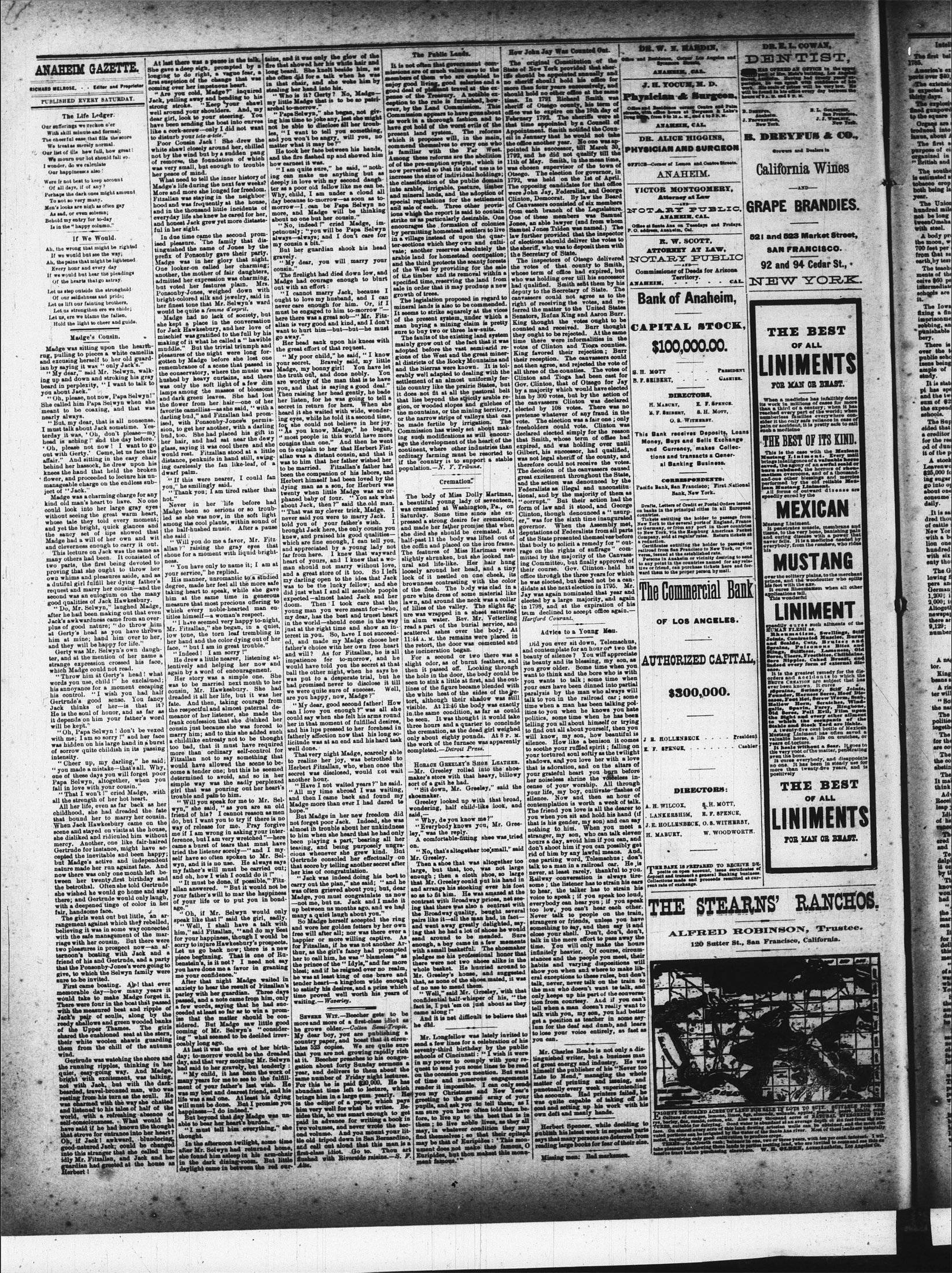
Searchable text
ANAHEIM GAZETTE.
RICHARD MELROSE. . . Editor and Proprietor
PUBLISHED EVERY SATURDAY.
The Life Ledger:
Our sufferings we reckon o'er
With skill minute and formal;
The cheerful ease that fills the score
We treat as merely normal.
Our list of lilies hew full, how great!
We mourn our lot should fall so.
I wonder, do we calculate
Our happiness also!
Were it not best to keep account
Of all days, if of any?
Perhaps the dark ones might amount
To not so very many.
Men's looks are nigh as often gay
As sad, or even solemn;
Behold my entry for to-day
Is in the "happy column."
If We Would.
Ah, the wrong that might be righted
If we would but see the way;
Ah, the pains that might be lightened
Every hour and every day
If we would but hear the pleadings
Of the hearts that go astray.
Let us step outside the stronghold
Of our selfishness and pride;
Let us lift our fainting brothers,
Let us strengthen ere we chide;
Let us, ere we blame the fallen,
Hold the light to cheer and guide.
Madge's Cousin.
Madge was sitting upon the hearth-rug, pulling to pieces a white camellia and excusing herself to her old guardian by saying it was "only Jack's."
"My dear," said Mr. Selwyn, walking up and down and stroking his gray beard in perplexity, "I want to talk to you about Jack."
"Oh, please, not now, Papa Selwyn!"
She called him Papa Selwyn when she meant to be coaxing, and that was nearly always.
"But, my dear, that is all nonsense. I must talk about Jack sometime. Yesterday it was, 'Oh, don't please—my head is aching!' and the day before.'
'Oh, please not now! I want to go out with Gerty.' Come, let us face the affair." And sitting in the easy chair behind her hassock, he drew upon his knees the hand that held the broken
At last there was a pause in the talk. She gave a deep sigh, prompted by a longing to do right, a vague fear, a first suspicion of the change that was coming over her impetuous heart.
"Are you cold, Madge?" inquired Jack, pulling away and bending to his strong stroke. "Keep your shawl well around your shoulders. And, my dear girl, look to your steering. You have been sending the boat into curves like a cork-screw—only I did not want to disturb your let-a-tete."
Poor Cousin Jack! She drew the white shawl closely around her, chilled not by the wind but by a sudden pang of remorse, the foundation of which was very small, but enough to trouble her peace of mind.
What need to tell the inner history of Madge's life during the next few weeks? More and more she longed for freedom. Fitzallan was staying in the neighbor hood and was frequently at the house, and in the thousand little incidents of everyday life she knew he cared for her, and honest Jack grew yet more distasteful in her sight.
In due time came the second promised pleasure. 'The family that distinguished the name of Jones by the prefix of Ponsonby gave their party. Madge was in her glory that night. One looker-on called her charming; another, the mother of fair daughters, admitted her expression was charming, but voted her features plain. Mrs. Ponsonby-Jones, weighed down with bright-colored silk and jewelry, said in her finest tone that Mr. Selwyn's ward would be quite a femme d'enprit.
Madge had no lack of society, but she kept a place in the conversation for Jack Hawkesbury, and her love of mischief was gratified to the full by his making of it what he called a "hawible muddle." But the trivial triumph and pleasures of the night were long forgotten by Madge before she lost one remembrance of a scene that passed in the conservatory, where the music was hushed by heavy curtains, and there was only the soft light of a few dim lamps among the masses of blossoms and dark green leaves. She had lost the flower from her hair—one of her favorite camellias—as she said, "with a darling bud," and Fitzallan had promised, with Ponsonby-Jones's permission, to get her another, with a darling bud, too. She had placed his gift in her hair, and had sat near the dewy glass, saying it was cool there and she would rest. Fitzallan stood at a little distance, penknife in hand still, swinging carelessly the fan-like-leaf, of a dwarf palm.
trains, and it was only the glow fire that showed her his white hair long beard. She knelt beside her often did for a talk when in that chair, and she woke stealing her hand into his.
"Who is it? Gerty? No, my little Madge that is to be archaal to-morrow."
"Papa Selwyn," she began ing him time to joke any, less not be able to disclose all his leses, "I want to tell you so you won't be angry, will matter what it may be?"
He took her face between his and the fire flashed up and shook earnest it was.
"I am quite sure," he said ing can make me anything deeply in love with my secondary as a poor old fellow like me. Why, child, I am under a day because to-morrow—as soon morrow—I can be Papa Selwyn more, and Madge will be about no one but her cousin.
"No, indeed!" cried Mr. petuously; "you will be Papa always—always; and I don’t my cousin a bit."
But her guardian shook gravely.
"My dear, you will my cousin."
The firelight had died down Madge had courage enough out with an effort:
"I cannot marry Jack, ought to love my husband, never care enough for him must be engaged to him here there was a great sob—allan is very good and kind; want to hurt him—but—but go away."
Her head sank upon his great effort of that requirement.
"My poor child," he said your secret. Bravely said Madge, my bonny girl! The truth out, and done no are worthy of the man thou you, and that is saying a Then raising her head genere listen, for he was go secret in return for hers. heard it she waited with wring eyes, while he told it a for she could not believe "As you know, Madge," "most people in this work cousins than one." And then on to explain to her that allan was a distant cousin was to him that her father be married. Fitzallan been the companion of his
"My dear, and up and down and stroking his gray beard in perplexity, 'I want to talk to you about Jack.'"
"Oh, please, not now, Papa Selwyn! She called him Papa Selwyn when she meant to be coaxing, and that was nearly always."
"But, my dear, that is all nonsense. I must talk about Jack sometime. Yesterday it was, 'Oh, don't please—my head is aching!' and the day before.' 'Oh, please not now! I want to go out with Gerty.' Come, let us face the affair." And sitting in the easy chair behind her hassock, he drew upon his knees the hand that held the broken flower, and proceeded to lecture his unmanageable charge on the endless subject of "Jack."
Madge was a charming charge for any kind old man's heart to have. No one could look into her large gray eyes without seeing the great warm heart, whose tale they told every moment; and yet the bright, quick glances and the saucy set of lips showed that Madge had a will of her own and wit and cleverness enough to carry it out.
This lecture on Jack was the same as many others had been. It consisted of two parts, the first being devoted to proving that she ought to throw her own whims and pleasures aside, and as a dutiful girl fulfill her dying father's request and marry her cousin—and the second was an eulogium on the many good qualities of Jack Hawkesbury.
"Do, Mr. Selwyn," laughed Madge, after he had been making out that even Jack's awkwardness came from an overplus of good nature; "do throw him at Gerty's head as you have thrown him at mine; hand him over to her, and they will be happy for life."
Gerty was Mr. Selwyn's own daughter, and at the mention of her name a strange expression crossed his face, which Madge could not read.
"Throw him at Gerty's head! what words you use, child!" he exclaimed; his annoyance for a moment escaping his control. "I wish you had half Gertrude's good sense. You fancy Jack thinks of her—is that it? He is the soul of honor, and as far as it depends on him your father's word will be kept."
"Oh, Papa Selwyn! don't be vexed with me; I am so sorry!" and her face was hidden on his large hand in a burst of sorrow quite childish in its passing intensity.
"Cheer up, my darling," he said; "you made a mistake—that's all. Why, one of these days you will forget poor Papa Selwyn, altogether, when you fall in love with your cousin."
"That I won't!" cried Madge, with all the strength of her hot heart.
All her life, even as far back as her childhood, she had dreaded the fate that bound her to marry her cousin. When Jack Hawkesbury came on the scene and stayed on visits at the house, she disliked and ridiculed him without mercy. Another, one like fair-haired Gertrude for instance, might have accepted the inevitable and been happy; but Madge's active and independent nature made her run against fate. And now there was only one month left between her twenty-first birthday and the betrothal. Often she told Gertrude she wished he would go home and stay there; and Gertrude would only laugh,
the conservatory, has hushed by heavy curtains, and there was only the soft light of a few dim lamps among the masses of blossoms and dark green leaves. She had lost the flower from her hair—one of her favorite camellias—as she said, "with a darling bud," and Fitzallan had promised, with Ponsonby-Jones's permission, to get her another, with a darling bud, too. She had placed his gift in her hair, and had sat near the dewy glass, saying it was cool there and she would rest. Fitzallan stood at a little distance, penknife in hand still, swinging carelessly the fan like-leaf, of a dwarf palm.
"It if this were nearer, I could fan you," he smilingly said.
"Thank you; I am tired rather than hot."
Never in her life before had Madge been so serious or so troubled as she was now, in the soft light among the cool plants, within sound of the half-hushed music. After a pause she said:
"Will you do me a favor, Mr. Fitzallan?" raising the gray eyes that shone for a moment with liquid brightness.
"You have only to name it; I am at your service," he replied.
His manner, unromantic to a studied degree, made her feel all the more safe taking heart to speak, while she gave him at the same time in generous measure that most precious offering to which every noble-hearted man entitles himself—a woman's respect.
"I have seemed very happy to-night, Mr. Fitzallan," she began, in a quiet, low tone, the torn leaf trembling in her hand and the color dying out of her face," but I am in great trouble."
"Indeed! I am sorry!"
He drew a little nearer, listening attentively and helping her now and again by a word of encouragement.
Her story was a simple one. She was to be married next month to her cousin, Mr. Hawkesbury. She had dreaded it all her life, but it was her fate. And then, taking courage from the respectful and almost paternal demeanor of her listener, she made the frank confession that she disliked her cousin just because she was forced to marry him; and to this she added such a childlike entreaty not to be thought too bad, that it must have required more than ordinary self-control for Fitzallan not to say something that would have allowed the scene to become a tender one; but this he seemed determined to avoid, and so in her simple way was the sadly perplexed girl that was pouring out her heart's trouble and pain to him.
"Will you speak for me to Mr. Selwyn," she said, "as you are an old friend of his? I cannot reason as men do, but I want you to try if there is no way of release for me. Pray forgive me if I am wrong in asking your interference, but I am very wretched—"here came a burst of tears that must have tried the listener sorely—"and I myself have so often spoken to Mr. Selwyn, and it is no use. He always says my father's will must be carried out; and oh, how I wish I could do it!"
"It must be done, if possible," Fitzallan answered. "But it would not be your father's will to mar the happiness of truth out, and done no worth of the man you you, and that is saying a secret in return for hers. heard it she waited with it for she could not believe." As you know, Madge," most people in this world cousins than one." And on to explain to her that I allan was a distant cousin was to him that her father be married. Fitzallan been the companion of his Herbert himself had been dying man as a son, for twenty when little Madge phased baby of four.
About Jack, then?" said "That was my clever trick never said you were to me told you of your father brought Jack here, the one knew, and praised his good which are fine enough. I am appreciated by a young far from here. I knew heart of yours, and I knew man should not marry and a great store of it that my darling open to the was to be the lucky feeder did just what I and all expected—almost hated doom. Then I took young man you were my dear, has the best aim in the world—should come just at the right time and terest in you. So, have ed, and made my Madge father's choice with her and will? As for Fitzimpatience for to-mo would have told you you ball the other night, who was put to a desperate had promised never to we were quite sure of s are you happy, now. Mr
My dear, good secon can I love you enough could say when she felt her in that moment of f and his lips pressed to f fatherly affection now thie licit度 was at an end well done.
That very night Madge to realize her joy, who Herbert Fitzallan, who secret was disclosed, another hour.
Have I not waited "All my time abroad and then I came back Madge more than ever hope."
But Madge in her na not forget poor Jack. almost in trouble about to him when she heard been playing a part-teasing,and being pious whenever she g Gertrude consoled ha that score by telling an her kiss of congratulations.
"Jack was indeed carry out the plan," she was often grieved about Madge, you must con-
All her life, even as far back as her childhood, she had dreaded the fate that bound her to marry her cousin. When Jack Hawkesbury came on the scene and stayed on visits at the house, she disliked and ridiculed him without mercy. Another, one like fair-haired Gertrude for instance, might have accepted the inevitable and been happy; but Madge's active and independent nature made her run against fate. And now there was only one month left between her twenty-first birthday and the betrothal. Often she told Gertrude she wished he would go home and stay there; and Gertrude would only laugh, with a deepened tinge of color in her fair, handsome face.
The girls went out but little, an arrangement against which they rebelled, believing it was in some way conceived with the safe management of the marriage with her cousin. But there were two pleasures in prospect now—an afternoon's boating with Jack and a friend of his and Gertrude, and a party that the Ponsonby-Jones's were going to give, to which the Selwyn family were sure to be invited.
First came boating. Ab! that ever memorable day—how many years it would take to make Madge forget it. There were four in the boat that passed with the measured beat and ripple of Jack's pair of sculls, along by the reedy shallows and green wooded banks of the Upper Thames. The girls shared the cushioned seat at the stern, their white woolen shawls guarding them from the chill of the autumn wind.
Gertrude was watching the shore and the running ripples, thinking in her quiet, easy-going way. And Madge, bright with excitement, was talking, not with Jack, but with the dark-bearded, travel-bronzed man, who was resting from his turn as the scull. He was charmed with the way she chatted and listened to his tales of half of the world, with a refreshing absence of self-consciousness. What would he have said if he had known the thought that strove for entrance into her heart? Oh, if Jack! awkward, blundering, good-natured Jack; could be changed into this stranger that she called timidly Mr. Fitzallan, and Jack and her guardian had greeted at the house as Herbert!
"Will you speak for me to Mr. Selwyn," she said, "as you are an old friend of his? I cannot reason as men do, but I want you to try if there is no way of release for me. Pray forgive me if I am wrong in asking your interference, but I am very wretched—here came a burst of tears that must have tried the listener sorely—"and I myself have so often spoken to Mr. Selwyn, and it is no use. He always says my father's will must be carried out; and oh, how I wish I could do it!"
"It must be done, if possible," Fitzallan answered. "But it would not be your father's will to mar the happiness of your life or to put you in bondage."
"Oh, if Mr. Selwyn would only speak like that!" said the girl, sadly.
"Well, I shall have a talk with him," said Fitzallan, "and do my best for your happiness, though I would be sorry to injure Hawkesbury's prospects. Let us go back now; there is a new piece beginning. That is one of Rubenstein's, is it not? I need not say you have done me a favor in granting me your confidence."
After that night Madge waited in anxiety to hear the result of Fitzallan's parley with her guardian. Three days passed, and a note came from him, only a few words, saying that he had succeeded at least so far as to win a promise that the matter should be considered. But Madge saw little good coming of Mr. Selwyn's "considering" what seemed to be decided irrevocably long ago.
At last it was the eve of her birthday; to-morrow would be the dreaded day, and that very morning Mr. Selwyn had said to her gravely, but tenderly:
"My child, it has been the work of many years for me to see to the fulfillment of your father's last wish. He was my best and dearest friend, and his life was a sad one. At least his dying will must be done. But I promise you happiness—I do indeed."
But beyond that day Madge was unable to bear her heart's burden.
"I must tell him everything," she thought.
In the afternoon twilight, some time after Mr. Selwyn had returned home, she found him sleep in his arm-chair in the dark dining-room. But little daylight came in between the red curtain.
But Madge in her naïst not forget poor Jack almost in trouble about to him when she heard been playing a part, teasing, and being pious whenever she gave Gertrude consolede that score by telling her kiss of congratulations.
"Jack was indeed duly carry out the plan," she was often grieved about Madge, you must congratulate—not me, but us. Jack up between us months many a quiet laugh abound.
So Madge herself asked and wore her golden free will after all; nor happier or more willing for Fitzallan, if he was thur, as the girl's fanher to call him, he was the prince of the "Idy blest"; and if he reignited he was at least king of tender heart—a kingdoms to satisfy his desires, time proved well waiting.—Waverley.
Severe Writh.-Become more and more of a fighter he grows older.—Coast My dear boy, you are country paper, and bates 523 copies. That you are not great at it. Beecher prescience about forty years year, and delivers same number of Friends For this he is paid abundant time left brings him in a large editor of a paper very well for which sides this, he was simply paid in advance for two volumes, and never end volume. And yet old tripod down and call out aloud first-class idiot. Grace flushed with Rivers Alta.
and it was only the glow of the that showed her his white hair and beard. She knelt beside him, as oftman did for a talk when he was that chair, and she woke him by being her hand into his.
Who is it? Gerty? No, Madge—little Madge that is to be so patrial to-morrow."
Papa Selwyn," she began, not giving him time to joke any, lest she might be able to disclose all her troubles.
"I want to tell you something, if you won't be angry, will you, no matter what it may be?" He took her face between his hands, and the fire flashed up and showed him her earnest it was.
I am quite sure," he said, "not only can make me anything but as apply in love with my second daughter as a poor old fellow like me can be. My child, I am under a cloud all my because to-morrow—as soon as to-morrow—I can be Papa Selwyn no more, and Madge will be thinking out no one but her cousin."
"No, indeed!" cried Madge, imituously; "you will be Papa Selwyn always—always; and I don't care for my cousin a bit."
But her guardian shook his head lavely.
"My dear, you will marry your cousin."
The firelight had died down low, and Madge had courage enough to blurt out with an effort:
"I cannot marry Jack, because I ought to love my husband, and I can never care enough for him. Or, if I must be engaged to him to-morrow"—there was a great sob—"Mr. Fitzellan is very good and kind, and I don't want to hurt him—but—but—he must go away."
Her head sank upon his knees with the great effort of that request.
"My poor child," he said, "I know your secret. Bravely said, my little Madge, my bonny girl! You have let the truth out, and done nobly. You are worthy of the man that is to have you, and that is saying a good deal." Then raising her head gently, he bade her listen, for he was going to tell a secret in return for hers. When she heard it she waited with wide wondering eyes, while he told it a second time, for she could not believe in her joy.
"As you know, Madge," he began, "most people in this world have more cousins than one." And then he went on to explain to her that Herbert Fitzallan was a distant cousin, and that it was to him that her father wished her to be married. Fitzallan's father had been the companion of his labors, and
The Public Lands.
It is not often that government commissions are of much value save to the members of them who are enabled to enjoy good living, good salaries and a good deal of pleasant travel at the expense of the Treasury. A notable exception to the rule is furnished, however, by the Land Commission. This Commission appears to have gone about its work in a thorough fashion and to have got hold of the worst evils of the present land system. The reforms which it proposes will, in the main, command themselves to every one who is familiar with the Far West. Among these reforms are the abolition of the pre-emption system, which is now perverted so that its chief use is to increase the size of individual holdings; the classification of the public domain into arable, irrigable, pasture, timber and mineral lands, and the adoption of special regulations for the settlement and sale of each. Three other provisions which the report is said to contain strike us as particularly desirable. One encourages the formation of colonies by permitting homestead settlers to live in a village instead of upon the quarter-sections which they own and cultivate; another reserves absolutely the arable land for homestead occupation; and the third protects the scanty forests of the West by providing for the sale of the timber and its removal within a specified time, reserving the land from sale in order that it may produce a new growth of trees.
The legislation proposed in regard to mineral lands is also to be commended. It seems to strike squarely at the vices of the present system, under which a man buying a mining claim is pretty sure to buy two or three law-suits.
The faults of the existing land system mainly grow out of the fact that it was adopted before the vast semi-arid regions of the West and the great mineral districts of the Rocky Mountains and the Sierras were known. It is tolerably well adapted to dealing with the settlement of an almost uniformly fertile country like the prairie States, but it does not fit at all the pastoral belt that lies beyond the strictly arable region, or wooded slopes and gulches of the mountains, or the mining territory, or the narrow strips of valleys that can be made fertile by irrigation. The Commission has wisely set about making such modifications as will encourage the development of the heart of the continent, where other industries than ordinary farming must be resorted to if the country is to support a stable population.—N. Y. Tribune.
How John Jay Was Counted Out.
The original Constitution of the State of New York provided that sheriffs should be appointed annually and no sheriff should hold his office for more than four years successively, and should hold no other office at the same time. In 1791 Richard Smith was sheriff of Otsego county, his term of office was to expire on the 18th day of February 1792. The sheriffs were at that time appointed by a Council of Appointment. Smith notified the Council in January that he would not take the office another year. No one was appointed his successor, till March 30, 1792, and he did not qualify till the 11th of May. Smith, in the mean time, was chosen supervisor of the town of Otsego. The election for governor, in 1792, was held on the 1st of April. The opposing candidates for that office were John Jay, Federalist, and George Clinton, Democrat. By law the Board of Canvassers consisted of six members from each branch of the Legislature. One of these members was Samuel Jones, an able lawyer (and from whom Samuel Jones Tilden was named.) The law further provided that the inspector of elections should deliver the votes to the sheriff, who was to deposit them with the Secretary of State.
The inspectors of Otsego delivered the votes of that county to Smith, whose term of office had expired, but who was holding over till his successor had qualified. Smith sent them by his deputy to the Secretary of State. The canvassers could not agree as to the right of receiving the votes, and referred the matter to the United States Senators, Rufus King and Aaron Burr. King thought the votes ought to be counted and received. Burr thought they ought to be rejected. At the same time there were informalities in the votes of Clinton and Tioga counties. King favored their rejection; Burr their reception. The canvassers could not then agree, and rejected the vote of all three of the counties. The votes of Clinton and Tioga had been cast for Gov. Clinton, that of Otsego for Jay by a majority which would have elected him by 300 votes, but by the action of the canvassers Clinton was declared elected by 108 votes. There was no pretense whatever of any fraud in the vote. The election was a fair one; only freeholders could vote. Clinton was declared elected simply for the reason that Smith, whose term of office had expired, and was holding over until Gilbert, his successor, had qualified, was not legal sheriff of the county, and therefore could not receive the votes. The decision of the canvassers caused
The truth out, and done nobly.
You are worthy of the man that is to have you, and that is saying a good deal."
Then raising her head gently, he bade her listen, for he was going to tell a secret in return for hers. When she heard it she waited with wide, wondering eyes, while he told it a second time, for she could not believe in her joy.
"As you know, Madge," he began,
"most people in this world have more cousins than one." And then he went on to explain to her that Herbert Fitzallan was a distant cousin, and that it was to him that her father wished her to be married. Fitzallan's father had been the companion of his labors, and Herbert himself had been loved by the dying man as a son, for Herbert was twenty when little Madge was an orphaned baby of four.
"You ask what about Jack, then?" said the old man.
"That was my clever trick, Madge. I never said you were to marry Jack. I told you of your father's wish. I brought Jack here, the only cousin you knew, and praised his good qualities—which are fine enough, I can tell you, and appreciated by a young lady not far from here. I knew that wayward heart of yours, and I knew that a woman should not marry without love, and a great store of it too. So I left my darling open to the idea that Jack was to be the lucky fellow; and she did just what I and all sensible people expected—almost hated Jack and her doom. Then I took care that the young man you were meant for—who, my dear, has the best and truest heart in the world—should come in the way just at the right time and show an interest in you. So, have I not succeeded, and made my Madge choose her father's choice with her own free heart and will? As for Fitzallan, he is all impatience for to-morrow, and he would have told you the secret at that ball the other night, when he says he was put to a desperate trial, but he had promised never to disclose it till we were quite sure of success. Well, are you happy, now, Madge?
"My dear, good second father! How can I love you enough?" was all she could say when she felt his arms round her in that moment of fulfilled desires, and his lips pressed to her forehead in fatherly affection now that his long solicitude was at an end and his hard task well done.
That very night Madge, scarcely able to realize her joy, was betrothed to Herbert Fitzallan, who, when once the secret was disclosed, would not wait another hour.
"Have I not waited years?" he said.
"All my time abroad I was waiting, and then I came back and found my Madge more than ever I had dared to hope."
But Madge in her new freedom did not forget poor Jack. Indeed, she was almost in trouble about her unkindness to him when she heard that he had only been playing a part, bearing all her teasing, and being purposely ungrious whenever she grew kind. But Gertrude consolled her effectually on that score by telling another secret after her kiss of congratulation.
"Jack was indeed doing his best to carry out the plan," she said; "and he was often grieved about you; but, dear Madge, you must congratulate us now"
Cremation.
The body of Miss Dolly Hartman, a beautiful young lady of seventeen, was cremated at Washington, Pa., on Saturday. Some time since she expressed a strong desire for cremation, and made her father promise that when she died she should be cremated. At half-past 11 the body was lifted out of the coffin and placed on the iron frame. The features of Miss Hartman were slightly shrunken, but she looked natural and life-like. Her hair hung loosely around her head, and a tiny lock of it nestled on one cheek, its brownness contrasting with the color of the flesh. The body was clad in a pure white dress of some material like lawn, and around the neck was a collar of lilies of the valley. The slight figure was wrapped in a sheet saturated in alum water. Rev. Mr. Vetterling read a part of the burial service, and scattered ashes over the body. At 11:44 A.M. the remains were placed in the retort, the door was cemented and the incineration began.
For a second or two there was a slight odor, as of burnt feathers, and then it passed off. Looking through the hole in the door, the body could be seen to sink a little at first, and the outlines of the figure became blended with the white heat of the sides of the grotto, although their shadow was still visible. At 12:46 the body was exact in the same condition, as far as could be seen. It was thought it would take three hours and a quarter to conclude the cremation, as the dead girl weighed only about eighty pounds. At 8 P.M. the work of the furnace was apparently completed.
Horace Greeley's Shoe Leather.
—Mr. Greeley rolled into the shoe-maker's store with that heavy, billowy sort of a gait he had.
“Sit down, Mr. Greeley,” said the shoe-maker.
Greeley looked up with that broad, wondering, half child-like look, and said,
“Why, do you know me?”
Everybody knows you, Mr. Greeley,” was the reply.
A comfortable-fitting shoe was tried on.
“No, that's altogether too small,” said Mr. Greeley.
Then a shoe that was altogether too large, but that too, was not large enough; then a cloth shoe, so large that Mr. Greeley could put his hand in and arrange his stocking ever his foetus so as to fit him. He was amazed at the erability well adapted to dealing with settlement of an almost uniformly fertile country like the prairie States, but it does not fit at all the pastoral belt that lies beyond the strictly arable region, or wooded slopes and gulches of the mountains, or the mining territory, or the narrow stripe of valleys that can be made fertile by irrigation. The Commission has wisely set about making such modifications as will encourage the development of the heart of the continent, where other industries than ordinary farming must be resorted to if the country is to support a stable population.
—N. Y. Tribune.
Cremation.
The body of Miss Dolly Hartman, a beautiful young lady of seventeen, was cremated at Washington, Pa., on Saturday. Some time since she expressed a strong desire for cremation, and made her father promise that when she died she should be cremated. At half-past 11 the body was lifted out of the coffin and placed on the iron frame. The features of Miss Hartman were slightly shrunken, but she looked natural and life-like. Her hair hung loosely around her head, and a tiny lock of it nestled on one cheek, its brownness contrasting with the color of the flesh. The body was clad in a pure white dress of some material like lawn, and around the neck was a collar of lilies of the valley. The slight figure was wrapped in a sheet saturated in alum water. Rev. Mr. Vetterling read a part of the burial service, and scattered ashes over the body. At 11:44 A.M. the remains were placed in the retort, the door was cemented and the incineration began.
For a second or two there was a slight odor, as of burnt feathers, and then it passed off. Looking through the hole in the door, the body could be seen to sink a little at first, and the outlines of the figure became blended with the white heat of the sides of the grotto, although their shadow was still visible. At 12:46 the body was exact in the same condition, as far as could be seen. It was thought it would take three hours and a quarter to conclude the cremation, as the dead girl weighed only about eighty pounds. At 8 P.M. the work of the furnace was apparently completed.
—Detroit Press.
Advice to a Young Man.
Did you ever sit down, Telemachus, and contemplate for an hour or two the beauty of silence? You will appreciate its beauty and its blessing, my son, as you grow older. Some time when you want to think and the bore who is with you wants to talk; some time when your ears have been dinned into partial paralysis by the man who always will talk to you in the railroad car; some time when a man has been talking politics to you when he knows you hate politics; some time when he has been telling you all about himself or trying to find out all about yourself; then you will know my son, how beautiful is silence. How like a benison it comes to soothe your ruffled spirit; falling on your tortured soul softly as the twilight shadows, and you love her with a love that is adoration; and on the altars of your grateful heart you burn before her noiseless shrine the voiceless incense of your worship. All through your life, my boy, cultivate flashes of silence. Now and then an hour of contemplation is worth a week of talk. The friend you love is all the dearer to you when you sit and hold his hand (if that is his gender, my son) and can say nothing to him. When you meet a stranger, my son, who can talk eleven hours a day, avoid him if you can,and don't shoot him if you can possibly get rid of him by any lawful means. And,一部分 word,Telemachus;don't talk to a man in a railroad car.His never,at least rarely,thankful to you.Railway conversation is always tiresome;the listener has to strain his ears to hear,the talker has to strain his voice to speak;如果你 speak too loud,
But Madge in her new freedom did not forget poor Jack. Indeed, she was almost in trouble about her unkindness to him when she heard that he had only been playing a part, bearing all her teasing, and being purposely ungrateful whenever she grew kind. But Gertrude consoleled her effectually on that score by telling another secret after her kiss of congratulation.
"Jack was indeed doing his best to carry out the plan," she said; "and he was often grieved about you; but, dear Madge, you must congratulate us now—not me, but us. Jack and I made it up between us months ago, and we had many a quiet laugh about you."
So Madge herself accepted the ring and wore her golden fetters by her own free will after all; nor was there ever a happier or more willing captive. As for Fitzallan, if he was not another Arthur, as the girl's fancy had prompted her to call him, he was "blameless" as the prince of the "Idyls," and far more blest; and if he reigned over no realm, he was at least king of one brave and tender heart—a kingdom wide enough to satisfy his desires, and a prize which time proved well worth his years of waiting.—Waverley.
Severe Wr.—Beecher gets to be more and more of a first-class idiot as he grows older.—Colton Semi-Tropic. My dear boy, you are publishing a country paper, and boast that it circulates 523 copies. We are quite sure that you are not growing rapidly rich at it. Beecher preaches to his congregation about forty Sunday sermons a year, and delivers to them about the same number of Friday night lectures. For this he is paid $20,000. He has abundant time left to lecture, which brings him in a large sum yearly. He is the editor of a paper, which pays him very well for what he writes. Besides this, he was smart enough to get paid in advance for writing a book in two volumes, and never wrote the second volume. And you mount your little old tripod down in San Bernardino, and call out aloud that this man is a first-class idiot. Go to Thou art flushed with Riverside raisins.—S. P. Alta.
Greeley looked up with that broad, wondering, half child-like look, and said,
"Why, do you know me?"
"Everybody knows you, Mr. Greeley," was the reply.
A comfortable-fitting shoe was tried on.
"No, that's altogether too small," said Mr. Greeley.
Then a shoe that was altogether too large, but that, too, was not large enough; then a cloth shoe, so large that Mr. Greeley could put his hand in and arrange his stocking ever his foot so as to fit him. He was amazed at the contrast with Broadway prices, not seeing that there was also a contrast with the Broadway quality, bought several pairs like it—all the man had, in fact—and went away greatly delighted, saying that he had a lot of shoes he would send around to be mended. Sure enough, a boy came in a few moments with a small basketful. The shoemaker pledges me his professional honor that there were not two shoes alike in the whole basket. He hurried around to Mr. Greeley's house, and suggested that, as none of the shoes mated, it was of no use to mend them.
"Well," said Mr. Greeley, with that confidential half-whisper of his, "the fact is, I put 'em on just about as they came along!"
And it is not difficult to believe that he did.
Mr. Longfellow was lately invited to send a few lines for a celebration of his seventy-third birthday by the public schools of Cincinnati: "I wish it were in my power to comply with your request to send you some lines to be read on the occasion you mention. But want of time and numerous engagements render it impossible. I can only send you my Christmas and New Year's greeting to the grand army of your pupils, and ask you to tell them, as I am sure you have often told them before, to live up to the best that is in them; to live noble lives, as they all may, in whatever condition they may find themselves; so that their epilaph may be that of Euripides: 'This monument does not make the famous, O Euripides, but thou makest this monument famous.'"
Now and then contemplation is worth a week of talk. The friend you love is all the dearer to you when you sit and hold his hand (if that is his gender, my son) and can say nothing to him. When you meet a stranger, my son, who can talk eleven hours a day, avoid him if you can, and don't shoot him if you can possibly get rid of him by any lawful means. And one parting word, Tolemachus; don't talk to a man in a railroad car. He is never, at least rarely, thankful to you. Railway conversation is always tiresome; the listener has to strain his ears to hear; the talker has to strain his voice to speak; if you speak too loud, everybody can hear you; if you speak too low, you can't hear each other. Never talk to people on the train, strangers or friends, unless you have something to say, and then say it and close your shell. Don't, don't, don't, talk in the mere effort to pass away the time. You will only make the hours infinitely heavier. Of course, circumstances and the people you meet, their habits and varying dispositions will show you when and where to make liberal exceptions to these rules, but don't talk, never, never talk on the train to the man who doesn't want to talk, and only keeps up his part of the conversation from courtesy. And if you can't tell when a man doesn't really want to talk with you, my son, you had better get a position as teacher in some asylum for the deaf and dumb, and learn to lose your voice entirely, as fast as you can.
Mr. Charles Reade is not only a distinguished writer, but a business man of great energy and industry. He was himself the publisher of his "Never too Late to Mend," managing the whole matter of printing and issuing, and punctually every week superintending the accounts. Had printers failed, he was quite capable of taking off his coat and setting up his work with his own deft and manly hands.
Herbert Spencer, while deciding to publish his latest work in separate parts says that many persons are deterred from reading large books for fear of their size.
Missing men: Bad marksmans.
DR. W. N. HARDIN,
Office and Residence, Corner Los Angeles and Sycamore Streets.
ANAHEIM, CAL.
J. H. YOCUM, M. D.
Physician & Surgeon,
Office and Residence corner Centre and Palm streets, with office hours at Pergamon & Lake's Drug Store, from 9 to 10 A.M., and 4 to 5 P.M.
ANAHEIM, CAL.
DR. ALICE HIGGINS,
PHYSICIAN AND SURGEON
OFFICE—Corner of Lemon and Centre Streets.
ANAHEIM.
VICTOR MONTGOMERY,
Attorney at Law
AND
NOTARY PUBLIC.
ANAHEIM, CAL.
Office at Santa Ana on Tuesdays and Fridays.
P.O. address, Anaheim, Cal.
R. W. SCOTT,
ATTORNEY AT LAW,
NOTARY PUBLIC
Commissioner of Deeds for Arizona Territory.
ANAHEIM, CAL.
Bank of Anaheim,
CAPITAL STOCK,
$100,000.00.
S. H. MOTT
President
B. F. SEIBERT,
Cashier
DIRECTORS.
H. MABURY,
E. F. SPENCH.
R. F. SEIBERT,
S. H. MOTT,
O. B. WITHERBY.
This Bank receives Deposits, Loans Money, Buys and Sells Exchange and Currency, makes Collections and transacts a General Banking Business.
DR. E. L. COWAN,
DENTIST,
HAS OPENED AN OFFICE in the upper part of its building, Los Angeles Street, Anaheim. Having had twenty years experience, he can speak with confidence of his work. His scale of prints will be very low. He will be found in his office every day between the hours of 9 A.M. and 8 P.M.
B. DREYFUS & CO.
Growers and Dealers in
California Wines
AND
GRAPE BRANDIES.
521 and 523 Market Street,
SAN FRANCISCO.
92 and 94 Cedar St., NEW YORK.
THE BEST OF ALL
LINIMENTS
FOR MAN OR BEAST.
When a medicine has infallibly done its work in millions of cases for more than a third of a century; when it has reached every part of the world; when numberless families everywhere consider it the only safe reliance in case of pain or accident, it is pretty safe to call such a medicine.
THE BEST OF ITS KIND.
This is the case with the Mexican Mustang K.A.miment. Every mail brings intelligence of a valuable horse saved, the agony of an awful scald or burn subdued, the horrors of rheumatism overcome, and of a thousand-
DIRECTORS.
H. MABURY, E. F. SPENCE.
M. F. SEIBERT, S. H. MOTT,
O. S. WITHERBY.
This Bank receives Deposits, Loans Money, Buys and Sells Exchange and Currency, makes Collections and transacts a General Banking Business.
CORBESPONDENTS:
Pacific Bank, San Francisco; First National Bank, New York.
Drafts, Letters of Credit or Postal Orders issued on banks in the principal cities in all European countries.
Tickets entitling the holder to passage from New York to the several ports of England, France or Germany, or from any port in those countries to New York, via the Hamburg American Packet Company, sold at regular rates. Return tickets at a reduction.
Certificates entitling the holder to passage on railroad from San Francisco to New York, or vice versa, issued at the established rate.
Persons in Anaheim or vicinity desiring to send to any point in the countries named for any relative or friend, can purchase tickets here and forward them to the proper person by mail.
The Commercial Bank
OF LOS ANGELES.
AUTHORIZED CAPITAL,
$300,000.
J. E. HOLLENBECK President
E. F. SPENCE Cashier
DIRECTORS:
A. H. WILCOX, S. H. MOTT,
LANKERSHIM, E. F. SPENCE,
J. E. HOLLENBECK, O. S. WITHERBY,
H. MABURY, W. WOODWORTH.
THE BANK IS PREPARED TO RECEIVE DEPOSITS on open account, issue certificates of deposit and transact a general Banking business. Collections made and proceeds remitted at current rate of exchange.
FOR MAN OR BEAST.
When a medicine has infallibly done its work in millions of cases for more than a third of a century; when it has reached every part of the world; when numberless families everywhere consider it the only safe reliance in case of pain or accident, it is pretty safe to call such a medicine.
THE BEST OF ITS KIND.
This is the case with the Mexican Mustang Kidnappers. Every mail brings intelligence of a valuable horse saved, the agony of an awful scald or burns submerged, the horrors of rheumatism overcome, and of a thousand-and-one other blessings and mercies performed by the old reliable Mexican Mustang Liniment.
All forms of outward disease are speedily cured by the MEXICAN Mustang Liniment.
It penetrates muscle, membrane and tissue, to the very bone, banishing pain and curing disease with a power that never fails. It is a medicine needed by everybody, from the rancho, who rides his MUSTANG over the solitary plains, to the merchant prince, and the woodcutter who splits his foot with the axe.
It cures Rheumatism when all other applications fail.
This wonderful LINIMENT speedily cures such alliments of the HUMAN FLESH as Rheumatism, Swellings, Stiff Joints, Contracted Muscles, Burns and Scalds, Cuts, Bruises and Sprains, Poisonous Blisters and Stings, Stiffness, Lameness, Old Serces, Ulcers, Freestones, Chillblaine, Sore Nipples, Caked Breast, and indeed every form of external disease.
It is the greatest remedy for the disorders and accidents to which the Bruns Creation are subject that has ever been known. It cures Sprains, Swimny, Stiff Joints, Founder, Harness Sores, Hoof Diseases, Foot Met, Screw Worm, Seab, Hollow Horn, Seratches, Windgalls, Spavin, Farey, Ringhone, Old Sores, Poll Evil, Film upon the Sight and every other alliment to which the occupants of the Stable and Stock Ward are liable.
A twenty-five cent bottle of Mexican Mustang Liniment has often saved a valuable horse, a life on crutches, or years of torture.
It heals without a Scar. It goes to the very root of the matter, penetrating even the bone.
Is cures everybody, and disappoints no one. It has been in steady use for more than twenty-five years, and is positively THE BEST OF ALL LINIMENTS FOR MAN OR BEAST.
THE STEARNS' RANCHOS.
ALFRED ROBINSON, Trustee.
120 Sutter St., San Francisco, California.
EIGHTY THOUSAND ACRES OF LAND FOR SALE IN LOTS TO SUIT. SUITABLE FOR THE Culture of oranges, lemons, limes, figs, almonds, walnuts, apples, peaches, pears, almonds, currants, barley, flax, ramsia, cotton, etc. Also many thousand acres of NATURAL EVENGREEN FAS-TURES, suitable for dairying. Good water is abundant at an average depth of six feet from the surface. On almost every acre of this land flowing artesian wells can be obtained, and the more elevated portions can be irrigated by the water of the Santa Ana river. Most of these lands are naturally moist, requiring only good cultivation to produce crops.
THREE: One-fourth cash; balance in one, two or three years, with ten per cent interest. I will take pleasure in showing these lands to parties seeing land, who are invited to come and see this extensive tract before purchasing elsewhere. W. M. OLBEEK, AceurAnahiem, Los Angeles Co.