anaheim-gazette 1880-03-27
Scanned page
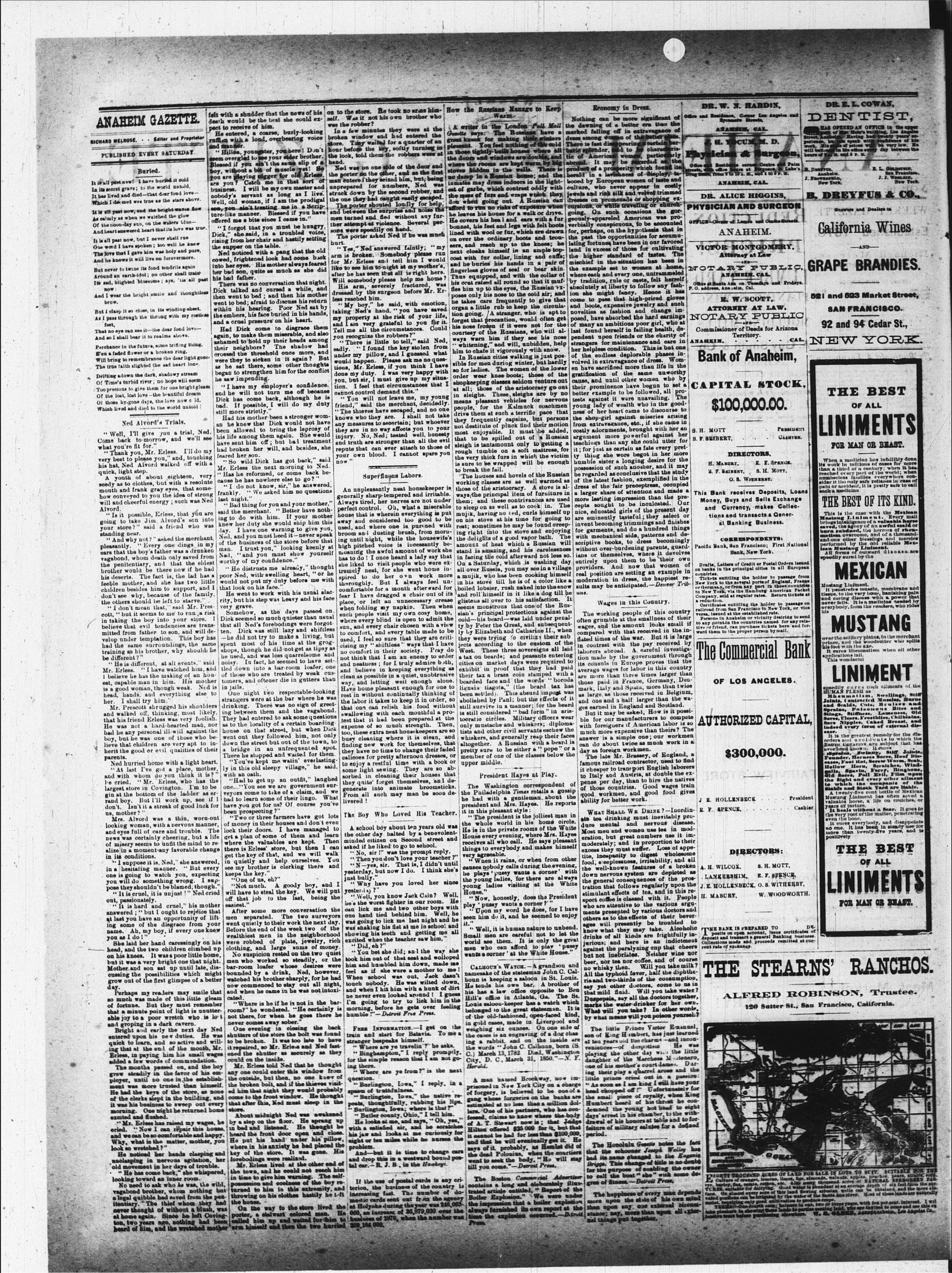
Searchable text
ANAHEIM GAZETTE.
RICHARD MELROSE. . . Editor and Proprietor
PUBLISHED EVERY SATURDAY.
Buried.
It is all past now! I have buried it cold
In its secret grave; to the world untold,
It has lived and died—that dear fond love—
Which I deemed was true as the stars above.
It is all past now, and the bright waves flow
As calmly as when we watched the glow
Of the noon-day sun, on the waters blue—
And heart answered heart that its love was true.
It is all past now, but I never shall rue
One word I have spoken; too well he knew
The love that I gave him was holy and pure,
And he knows it will live on forevermore.
But never to twine its fond tendrils again
Around an earth-idol; no other shall train
Its sad, blighted blossoms; aye, 'tis all past now:
And I wear the bright smile and thoughtless brow.
But I clasp it so close, in its winding-sheet,
As I pass through the throng with my restless feet,
That no eye can see it—the dear fond love—
And so I shall bear it to realms above.
Perchance in the future, some trifling thing,
E'en a faded flower or a broken ring.
Will bring to remembrance the dear light gone;
The true faith slighted the sad heart lone.
Drifting adown the dark, shadowy stream
Of Time's turbid river; no hope will seem
Too precious to give them for one bright gleam
Of the lost, lost love—the beautiful dream
Of those by-gone days, the love now cold.
Which lived and died to the world untold!
Ned Alvord's Trials.
"Well, I'll give you a trial, Ned.
Come back to-morrow, and we'll see what you're fit for."
"Thank you, Mr. Erless. I'll do my very best to please you," and, touching his hat, Ned Alvord walked off with a quick, light step.
felt with a shudder that the news of his death would be the best she could expect to receive of him.
He entered, a coarse, burly-looking ruffian with a loud, overbearing voice and manner.
"Hillsa, youngster, you here! Don't seem overglad to see your elder brother. Blessed if you ain't the same slip of a boy, without a bit of muscle yet! So you are playing nigger for old Erless, are you? Catch me in that sort of business. I will be my own master and nobody's servant as long as I live. Well, old woman, if I am the prodigal son, you ain't treating me in a Scripture-like manner. Blessed if you have offered me a bite since I came in."
"I forgot that you must be hungry, Dick," she said, in a troubled voice, rising from her chair and hastily setting the supper on the table.
Ned noticed with a pang that the old cowed, frightened look had come back into her eyes. His mother always feared her bad son, quite as much as she did his bad father.
There was no conversation that night. Dick talked and cursed a while, and then went to bed; and then his mother went to bed; afraid to discuss his return within his hearing. Poor Ned sat by the embers, his face buried in his hands, and a cruel pressure on his heart.
Had Dick come to disgrace them again, to make them miserable, and also ashamed to hold up their heads among their neighbors? The shadow had crossed the threshold once more, and were they to sicken in it again? But as he sat there, some other thoughts began to strengthen him for the conflict he saw impending.
"I have my employer's confidence. and he will not turn me off because Dick has come back, although he is bad. If possible, I will do my duty still more strictly."
Had his mother been a stronger woman he knew that Dick would not have been allowed to bring the leprosy of his life among them again. She would have sent him off; but bad treatment had broken her will, and besides, she feared her son.
"So wild Dick has got back," said Mr. Erless the next morning to Ned.
Has he reformed, or come back on to the self. Wash was the robe. In a few broken wrist store. To hour before the lock, hand.
Ned was the porter man enter unprepared strack down the one tucked and betwomen turned ther attentions sons were.
The poor hurt.
Yes, arm is baked for Mr. like to seethe after he Will son.
His dressed less readily.
My taking my prose and I am Tell me you recite.
"The sadly under new would hides tions. H done men you buction. I cannot not repute your o now."
Ned Alvord's Trials.
"Well, I'll give you a trial, Ned. Come back to morrow, and we'll see what you're fit for."
"Thank you, Mr. Erless. I'll do my very best to please you," and, touching his hat, Ned Alvord walked off with a quick, light step.
A youth of about eighteen, very seedy as to clothes, but with a resolute mouth and frank gray eyes, that somehow conveyed to you the idea of strong will and cheerful energy; such was Ned Alvord.
"Is it possible, Erless, that you are going to take Jim Alvord's son into your store?" said a friend who was standing near.
"And why not?" asked the merchant, pleasantly. "Every one dings in my ears that the boy's father was a drunken vagabond, whom death only saved from the penitentiary, and that the eldest brother would be there now if he had his deserts. The fact is, the lad has a feeble mother, and she has two little children besides him to support, and I don't see why, because of the family, the others should be left to starve."
"I don't mean that," said Mr. Prescott, "but it seems to me to run a risk in taking the boy into your store. I believe that evil tendencies are transmitted from father to son, and will develop under temptation. This boy has had the same surroundings, the same training as his brother, why should he be different?"
"He is different, at all events," said Mr. Erless. "I have watched him, and I believe he has the making of an honest, capable man in him. His mother is a good woman, though weak. Ned is head, hands, and everything else to her. I shall try him."
Mr. Prescott shrugged his shoulders and walked off, thinking most likely that his friend Erless was very foolish. He was not a hard-hearted man, nor had he any personal ill-will against the boy, but he was one of those who believe that children are very apt to inherit the good or evil qualities of their parents.
Ned hurried home with a light heart.
"At last I've got a place, mother, and with whom do you think it is?" he cried. "Mr. Erless, who has the largest store in Covington. I'm to be gin at the bottom of the ladder as erand boy. But I'll work up, see if I don't. Isn't it a streak of good luck for us, mother?"
Mrs. Alvord was a thin, worn-out looking woman, with a nervous manner, and eyes full of care and trouble. The news was certainly cheering, but a life of misery seems to unfit the mind to realize in a moment any favorable change in its conditions.
"I suppose it is, Ned," she answered, in a hesitating manner. "But every one is going to watch you, expecting you will do something wrong. I suppose they shouldn't be blamed, though."
"It is cruel, it is unjust!" Ned cried out intensely.
"I have my employer's confidence. and he will not turn me off because Dick has come back, although he is bad. If possible, I will do my duty still more strictly."
Had his mother been a stronger woman he knew that Dick would not have been allowed to bring the leprosy of his life among them again. She would have sent him off; but bad treatment had broken her will, and besides, she feared her son.
"So wild Dick has got back," said Mr. Erless the next morning to Ned. "Has he reformed, or come back because he has nowhere else to go?"
"I do not know, sir," he answered, frankly. "We asked him no questions last night."
"Bad thing for you and your mother," said the merchant. "Better have nothing to do with him. If your mother knew her duty she would ship him this day. I have one warning to give you, Ned, and you must heed it—never speak of the business of the store before that man. I trust you," looking keenly at Ned, "and you must show yourself worthy of my confidence."
"He distrusts me already," thought poor Ned, with swelling heart, "or he would not put my duty before me with that look on his face."
He went to work with his usual alacrity, but his step was heavy and his face very grave.
Somehow, as the days passed on, Dick seemed so much quieter than usual that all Ned's forebodings were forgotten. Dick was still lazy and shiftless—he did not try to make a living, but spent most of his time at the grogshops, though he did not get as tips as he used, and was less quarrelsome and noisy. In fact, he seemed to have settled down into a bar-room loafer, one of those who are treated by weak customers, and oftener die in gutters than in jails.
One night two respectable-looking strangers were at the bar where he was drinking. There was no sign of greeting between them and the vagabond. They had entered to ask some questions as to the locality of a certain boarding-house on that street, but when Dick went out they followed him, not only down the street but out of the town, to a bridge in an unfrequented spot. There he stopped and waited for them.
"You've kept me waln' everlastingly in this old sleepy village," he said, with an oath.
"Had to get up an outfit," laughed one. "You see we are government surveyors come to take of a claim, and we had to learn some of their lingo. What have you got for us? Of course you've been prospecting?"
"Two or three farmers have got lots of money in their houses and don't even lock their doors. I have managed to get a plan of some of them and learn where the valuables are kept. Then there is Erless' store, but then I can get the key of that, and we will walk in quietly and help ourselves. You see my brother is clerking there and keeps the key."
"One of us, eh?"
"Not much. A goody boy, and I will have to steal the key. We will put off that job to the last, being the
Mrs. Alvord was a thin, worn-out looking woman, with a nervous manner, and eyes full of care and trouble. The news was certainly cheering, but a life of misery seems to unfit the mind to realize in a moment any favorable change in its conditions.
"I suppose it is, Ned," she answered, in a hesitating manner. "But every one is going to watch you, expecting you will do something wrong. I suppose they shouldn't be blamed, though."
"It is cruel, it is unjust!" Ned cried out, passionately.
"It is hard and cruel," his mother answered; "but I ought to rejoice that at last you have an opportunity of lifting some of the disgrace from your name. Ah, my boy, if every one knew you as I do!"
She laid her hand caressingly on his head, and the two children climbed up on his knees. It was a poor little home, but it was a very bright one that night. Mother and son sat up until late, discussing the possibilities which might grow out of the first glimpse of a better day.
Perhaps my readers may smile that so much was made of this little gleam of fortune. But they must remember that a minute point of light is unutterable joy to a poor wretch who is lost and groping in a dark cavern.
Bright and early the next day Ned entered upon his new duties. He was quick to learn, and so active and willing that at the end of the month, Mr. Erless, in paying him his small wages added a few words of commendation.
The months passed on, and the boy grew steadily in the favor of his employer, until no one in the establishment was more trusted than himself. He had the keys of the store, as none of the clerks slept in the building, and it was his business to sweep out every morning. One night he returned home excited and flushed.
"Mr. Erless has raised my wages, he cried." "Now I can repair this house, and we can be so comfortable and happy. Why, what is the matter, mother, you look so wretched?"
He noticed her hands clasping and unclasping in nervous agitation, her old movement in her days of trouble.
"He has come back," she whispered, looking toward an inner room.
No need to ask who he was, the wild vagabond brother, whom nothing but a legal quibble had saved from the penitentiary. The thief whom they had never thought of without a blush, was at home again. Since he left Covington, two years ago, nothing had been heard of him, and the wretched mother had to learn some of their lingo. What have you got for us? Of course you've been prospecting?
"Two or three farmers have got lots of money in their houses and don't even lock their doors. I have managed to get a plan of some of them and learn where the valuables are kept. Then there is Erless' store, but then I can get the key of that, and we will walk in quietly and help ourselves. You see my brother is clerking there and keeps the key."
"One of us, eh?"
"Not much. A goody boy, and I will have to steal the key. We will put off that job to the last, being the easiest."
After some more conversation the men separated. The two surveyors went quietly to their work the next day. Before the end of the week two of the wealthiest men in the neighborhood were robbed of plate, jewelry, rich clothing, and large sums of money.
No suspicion rested on the two quiet men who worked so steadily, or the bar-room loafer whose desires were bounded by a drink, Ned, however, watched his brother sharply, for he had now commenced to stay out all night, and when he came in he was not intoxicated.
"Where is he if he is not in the bar-room?" he wondered. "He certainly is not there, for when he goes there he never comes away sober."
One evening in closing the back shutters of the store the bolt was found to be broken. It was too late to have it repaired, so Mr. Erless and Ned fastened the shutter as securely as they could on the inside.
Mr. Erless told Ned that he thought any one could enter this window from the outside, but then, no one knew of the broken bolt, and if the thieves visited him that night they would probably come to the front window. He thought that after this, Ned must sleep in the store.
About midnight Ned was awakened by a step on the floor. He sprang up in bed and listened. He thought he heard the front door open and close. He put his hand under his pillow, where in his anxiety he had placed the key of the store. It was gone. His forebodings were realized.
Mr. Erless lived at the other end of the town, and he could not reach him in time to give him warning. The self-possession and coolness of the boy returned to him in this extremity, and throwing on his clothes hastily he left the house.
On the way to the store lived the porter, a stalwart colored man. He called him up and waited for him to arm himself and then the two hurried
the news of his death she could exbury-looking overbearing voice
you here! Don't for older brother,
same slip of a muscle yet! So for old Erless,
that sort ofOWN master and long as I live.
am the prodigal me in a Script-based if you have come in."
must be hungry, troubled voice, and hastily setting
ang that the old man had come back
always feared much as she did
station that night.
had a while, and then his mother
discuss his return
Poor Ned sat by
cried in his hands,
in his heart.
no disgrace them miserable, and also their heads among the shadow had once more, and it again? But other thoughts him for the conflict
yer's confidence.
me off because although he is will do my duty
on to the store. He took no arms himself. Was it not his own brother who was the robber?
In a few minutes they were at the broken window and had entered the store. Tiny waited for a quarter of an hour before the key, softly turning in the lock, told them the robbers were at hand.
Ned was on one side of the door and the porter on the other, and as the first man entered they seized him, but, being unprepared for numbers, Ned was struck down by the second robber, and the one they had caught easily escaped.
The porter shouted loudly for help, and between the surprise and noise the men turned and fled without any further attempt at violence. Several persons were speedily on hand.
The porter asked Ned if he was much hurt.
"Yes," Ned answered faintly; "my arm is broken. Somebody please run for Mr. Erless and tell him I would like to see him to night at my mother's, after he has seen that all is right here. Will somebody please help me home?
His arm, severely fractured, was dressed by the surgeon before Mr. Erless reached him.
"My boy," he said, with emotion, taking Ned's hand, "you have saved my property at the risk of your life, and I am very grateful to you for it. Tell me all the circumstances. Could you recognize the robbers?"
"There is little to tell," said Ned, sadly. "I found the key stolen from under my pillow, and I guessed what would happen. Please ask me no questions, Mr. Erless, if you think I have done my duty. I was very happy with you, but sir, I must give up my situation. I feel that circumstances that I cannot control demand this."
"You will not leave me, my young friend," said the merchant, decidedly.
"The thieves have escaped, and no one knows who they are. I shall not take any measures to ascertain; but whoever they are in no way affects you to your injury. No, Ned; tested well, honesty and truth are stronger than all the evil repute that can ever attach to those of your own blood. I cannot spare you now."
How the Russians Manage to Keep Warm.
A writer in the London Pull Mall Gusette says: The Russians have a great knack for making their winters pleasant. You feel nothing of the cold in those tightly-built houses where all the doors and windows are double, and where the rooms are kept warm by big stoves hidden in the walls. There is no damp in a Russian house; and the inmates may dress indoors in the lightest of garbs, which contrast oddly with the mass of furs and wraps which they don when going out. A Russian can afford to run no risks of exposure when he leaves his house for a walk or drive. He covers his head and ears with a fur bonnet, his feet and legs with felt boots lined with wool or fur, which are drawn on over the ordinary boots and trousers, and reach up to the knees; he next cloaks himself in an ample top-coat with fur collar, lining and cuffs; and he buries his hands in a pair of fingerless gloves of seal or bear skin. Thus equipped, and with the collar of his coat raised all round so that it muffles him up to the eyes, the Russian exposes only his nose to the cold air; and he takes care frequently to give that organ a little rub to keep the circulation going. A stranger, who is apt to forget that precaution, would often get his nose frozen if it were not for the courtesy of the Russians, who will always warn him if they see his nose "whitening," and will, unbidden, help him to chase it vigorously with snow.
In Russian cities walking is just possible for men during winter, but hardly so for ladies. The women of the lower order wear knee-boots; those of the shopkeeping classes seldom venture out at all; those of the aristocracy go out in sleighs. These sleighs are by no means pleasant vehicles for nervous people, for the Kalmuck coachmen drive them at such a terrific pace that they frequently capsize, but persons not destitute of pluck find their motion most enjoyable. It must be added, that to be spilled out of a Russian sleigh is tantamount only to getting a rough tumble on a soft mattress, for the very thick furs in which the victim is sure to be wrapped will be enough to break the fail.
Economy in Dress.
Nothing can be more significant than the dawning of a better era than the marked falling off in extravagance in dress among women of the better class. There is fast disappearing a certain basic splendor, said to be characteristic of American women, particularly abroad. It may be regarded as a product of prosperity which found herald in a lavishness of display. Booed by European women of taste and culture, who never appear in coats jewels and rich silk and velvet trimmed dresses on promenade or shopping center; or while travelling or churchgoing. On such occasions the geously-appareled American was probably verbally conspicuous, to be accounted for, perhaps, on the hypothesis that the past the opportunities for acquiring fortunes have been in our favor land in excess of those for cultivation higher standard of tastes. Mischief in the situation has been the example set to women at home where each and every one, untramform by tradition, rule or caste, felt her absolutely at liberty to follow any fashion she might fancy. Hence it came to pass that high-priced gloves and boots, expensive jewelry and novelties as fashion and change posed, have absorbed the hard earnings of many an ambitious poor girl, while last found herself in failing health dependent upon friends or the charity strangers for maintenance and care her helpless condition. This is but of the endless deplorable phasesvolved in extravagance of dress. We en have sacrificed more than life in gratification of the same unworth cause, and until other women whose prominence have begun to be better example to be followed, all tests against it were unavailing. Young lady of wealth who in the grace of her heart came to discourse from extravagance, etc., if she cares costly adornments, brought with her argument more powerful against teachings than any she could utter it; for just as certain as fate every thing she wore begot in her humble sister a longing desire for possession of such another, and it he regarded as conclusive that the
Superfluous Labors.
An unpleasantly neat housekeeper is generally sharp-tempered and irritable. Always tired, her nerves are not under perfect control. Oh, what a miserable house that is wherein everything is put away and considered too good to be used, and where one is purred with broom and dusting brush, from morning until night, while the housewife's high pitched voice is incessantly becoming the awful amount of work she has to do! I once heard a lady say that she liked to visit people who were extremely neat, for she went home inspired to do her own work more thoroughly. But I always feel uncomfortable for a month afterward for fear I have dragged a chair out of its place, or left an unnecessary crease when folding my napkin. Then when such people visit my own cosy home, where every blind is open to admit the sun, and every chair chosen with a view to comfort, and every table made to be used, I feel so sure that they are criticising my "shiftless" ways that I have no comfort in their society. Pray do not think that I am an enemy to order and neatness; for I truly admire both, and believe in keeping everything as clean as possible in a quiet, unobtrusive way, and letting well enough alone. Have home pleasant enough for one to rest in without continually thinking of the labor it takes to keep it in order, so that one can relish his food without swallowing with each mouthful a protest that it had been prepared at the expense of so much strength. Then, too, these extra neat housekeepers are so busy cleaning where it is clean, and finding new work for themselves, that they have no time to change their faded calicoes for pretty afternoon dresses, or to enjoy a restful time with a book or some light sewing. They are so absorbed in cleaning their houses that they quite forget themselves, and generate intoanimate broomsticks. From all such man be soon delivered!
The Boy Who Loved His Teacher.
A school boy about ten years old was the other day halted by a benevolent-minded citizen on Second street and asked if he liked to go to school.
No, sir!" was the prompt reply.
Then you don't love your teacher?"
N—yes, sir. That is, I didn't until yesterday, but now I do. I think she's just bully."
Why have you loved her since yesterday?
Well, you know Jack Cain? Well,
The houses and hovels of the Russian working classes are as well warmed as those of the aristocracy. A stove is always the principal item of furniture in them; and these contrivances are used to sleep on as well as to cook in. The mujik, having no bed, curls himself up on his stove at his time for going to rest; sometimes he may be found creeping right into the stove and enjoying the delights of a good vapor bath. The amount of heat which a Russian will stand is amazing, and his carelessness in facing the cold afterward not less so. On a Saturday, which is washing day all over Russia, you may see in a village a mujik, who has been cooking himself in his stove till he is of a color like a boiled lobster, rush naked into the snow and roll himself in it like a dog till glistens all over to his satisfaction. It seems monstrous that one of the Russian's principal protections against the cold—his beard—was laid under penalty by Peter the Great, and subsequently by Elizabeth and Catharine II., when they were trying to civilize their subjects according to the custom of the West. These three sovereigns all laid a tax on beards; and peasants entering cities on market days were required to exhibit in proof that they had paid their tax a brass coin stamped with a bearded face and the words "boroda lignais tiagota," (the beard tax has been settled). This absurd import was abolished by Paul; but the effects of it still survive in a manner; for the beard is still considered "bad form" in aristocratic circles. Military officers wear only mustache and whiskers; diplomats and other civil servants eschew the whiskers, and generally reap their faces altogether. A Russian with a beard is pretty sure to be either a "pope" or a member of one of the classes below the upper middle.
President Hayes at Play.
The Washington correspondent of the Philadelphia Times retails a gossip he had with a gentleman about the president and Mrs. Hayes. He reports it in this pleasant style:
"The president is the jolliest man in the whole world in his home circle. He is in the private rooms of the White House every evening, where Mrs. Hayes receives all who call. He says pleasant things to everybody and makes himself very agreeable."
When it rains, or when from other causes nobody calls during the evening, he plays 'pussy wants a corner' with the young ladies, for there are always young ladies visiting at the White House."
Now honestly, does the President order wear knee books; those of the shopkeeping classes seldom venture out at all; those of the aristocracy go out in sleighs. These sleighs are by no means pleasant vehicles for nervous people, for the Kalmuck coachmen drive them at such a terrific pace that they frequently capsize, but persons not destitute of pluck find their motion most enjoyable. It must be added, that to be spilled out of a Russian sleigh is tantamount only to getting a rough tumble on a soft mattress, for the very thick furs in which the victim is sure to be wrapped will be enough to break the fail.
The houses and hovels of the Russian working classes are as well warmed as those of the aristocracy. A stove is always the principal item of furniture in them; and these contrivances are used to sleep on as well as to cook in. The mujik, having no bed, curls himself up on his stove at his time for going to rest; sometimes he may be found creeping right into the stove and enjoying the delights of a good vapor bath. The amount of heat which a Russian will stand is amazing, and his carelessness in facing the cold afterward not less so. On a Saturday, which is washing day all over Russia, you may see in a village a mujik, who has been cooking himself in his stove till he is of a color like a boiled lobster, rush naked into the snow and roll himself in it like a dog till glistens all over to his satisfaction. It seems monstrous that one of the Russian's principal protections against the cold—his beard—was laid under penalty by Peter the Great, and subsequently by Elizabeth and Catharine II., when they were trying to civilize their subjects according to the custom of the West. These three sovereigns all laid a tax on beards; and peasants entering cities on market days were required to exhibit in proof that they had paid their tax a brass coin stamped with a bearded face and the words "boroda lignais tiagota," (the beard tax has been settled). This absurd import was abolished by Paul; but the effects of it still survive in a manner; for the beard is still considered "bad form" in aristocratic circles. Military officers wear only mustache and whiskers; diplomatists and other civil servants eschew the whiskers, and generally reap their faces altogether. A Russian with a beard is pretty sure to be either a "pope" or a member of one of the classes below the upper middle.
President Hayes at Play.
The Washington correspondent of the Philadelphia Times retails a gossip he had with a gentleman about the president and Mrs. Hayes. He reports it in this pleasant style:
"The president is the jolliest man in the whole world in his home circle. He is in the private rooms of the White House every evening, where Mrs. Hayes receives all who call. He says pleasant things to everybody and makes himself very agreeable."
When it rains, or when from other causes nobody calls during the evening, he plays 'pussy wants a corner' with the young ladies, for there are always young ladies visiting at the White House."
Now honestly, does the President order wear knee books; those of the shopkeeping classes seldom venture out at all; those of the aristocracy go out in sleighs. These sleighs are by no means pleasant vehicles for nervous people, for the Kalmuck coachmen drive them at such a terrific pace that they frequently capsize, but persons not destitute of pluck find their motion most enjoyable. It must be added, that to be spilled out of a Russian sleigh is tantamount only to getting a rough tumble on a soft mattress, for the very thick furs in which the victim is sure to be wrapped will be enough to break the fail.
The houses and hovels of the Russian working classes are as well warmed as those of the aristocracy. A stove is always the principal item of furniture in them; and these contrivances are used to sleep on as well as to cook in. The mujik, having no bed, curls himself up on his stove at his time for going to rest; sometimes he may be found creeping right into the stove and enjoying the delights of a good vapor bath. The amount of heat which a Russian will stand is amazing, and his carelessness in facing the cold afterward not less so. On a Saturday, which is washing day all over Russia, you may see in a village a mujik, who has been cooking himself in his stove till he is of a color like a boiled lobster, rush naked into the snow and roll himself in it like a dog till glistens all over to his satisfaction. It seems monstrous that one of the Russian's principal protections against the cold—his beard—was laid under penalty by Peter the Great, and subsequently by Elizabeth and Catharine II., when they were trying to civilize their subjects according to the custom of the West. These three sovereigns all laid a tax on beards; and peasants entering cities on market days were required to exhibit in proof that they had paid their taxa brass coin stamped with a bearded face and the words "boroda lignais tiagota," (the beard tax has been settled). This absurd import was abolished by Paul; but the effects of it still survive in a manner; for the beard is still considered "bad form" in aristocratic circles. Military officers wear only mustache and whiskers; diplomatists and other civil servants eschew the whiskers, and generally reap their faces altogether. A Russian with a beard is pretty sure to be either a "pope" or a member of one of the classes below the upper middle.
President Hayes at Play.
The Washington correspondent of the Philadelphia Times retails a gossip he had with a gentleman about the president and Mrs. Hayes. He reports it in this pleasant style:
"The president is the jolliest man in the whole world in his home circle. He is in the private rooms of the White House every evening, where Mrs. Hayes receives all who call. He says pleasant things to everybody and makes himself very agreeable."
When it rains, or when from other causes nobody calls during the evening, he plays 'pussy wants a corner' with the young ladies, for there are always young ladies visiting at the White House."
Now honestly, does the President order wear knee books; those of the shopkeeping classes seldom venture out at all; those of the aristocracy go out in sleighs. These sleighs are by no means pleasant vehicles for nervous people, for the Kalmuck coachmen drive them at such a terrific pace that they frequently capsize, but persons not destitute of pluck find their motion most enjoyable. It must be added, that to be spilled out of a Russian sleigh is tantamount only to changing their faces altogether. A Russian with a beard is pretty sure to be either a "pope" or a member of one of the classes below the upper middle.
President Hayes at Play.
The Washington correspondent of the Philadelphia Times retails a gossip he had with a gentleman about the president and Mrs. Hayes. He reports it in this pleasant style:
"The president is the jolliest man in the whole world in his home circle. He is in the private rooms of the White House every evening, where Mrs. Hayes receives all who call. He says pleasant things to everybody and makes himself very agreeable."
When it rains, or when from other causes nobody calls during the evening, he plays 'pussy wants a corner' with the young ladies, for there are always young ladies visiting at the White House."
Now honestly, does the President order wear knee books; those of the shopkeeping classes seldom venture out at all; those of the aristocracy go out in sleighs. These sleighs are by no means pleasant vehicles for nervous people, for the Kalmuck coachmen drive them at such a terrific pace that they frequently capsize, but persons not destitute of pluck find their motion most enjoyable. It must be added, that to be spilled out of a Russian sleigh is tantamount only to changing their faces altogether. A Russian with a beard is pretty sure to be either a "pope" or a member of one of the classes below the upper middle.
President Hayes at Play.
The Washington correspondent of the Philadelphia Times retails a gossip he had with a gentleman about the president and Mrs. Hayes. He reports it in this pleasant style:
"The president is the jolliest man in the whole world in his home circle. He is in the private rooms of the White House every evening, where Mrs. Hayes receives all who call. He says pleasant things to everybody and makes himself very agreeable."
When it rains, or when from other causes nobody calls during the evening, he plays 'pussy wants a corner' with the young ladies, for there are always young ladies visiting at the White House."
Now honestly, does the President order wear knee books; those of the shopkeeping classes seldom venture out at all; those of the aristocracy go out in sleighs. These sleighs are by no means pleasant vehicles for nervous people, for the Kalmuck coachmen drive them at such a terrific pace that they frequently capsize, but persons not destitute of plock find their motion most enjoyable. It must be added, that to be spilled out of a Russian sleigh is tantamount only to changing their faces altogether. A Russian with a beard is pretty sure to be either a "pope" or a member of one of the classes below the upper middle.
President Hayes at Play.
The Washington correspondent of the Philadelphia Times retails a gossip he had with a gentleman about the president and Mrs. Hayes. He reports it in this pleasant style:
"The president is the jollest man in the whole world in his home circle. He is in the private rooms of the White House every evening, where Mrs. Hayes receives all who call. He says pleasant things to everybody and makes himself very agreeable."
When it rains, or when from other causes nobody calls during the evening, he plays 'pussy wants a corner' with the young ladies, for there are always young ladies visiting at the White House."
Now honestly, does the President order wear knee books; those of the shopkeeping classes seldom venture out at all; those of the aristocracy go out in sleighs. These sleighs are by no means pleasant vehicles for nervous people, for the Kalmuck coachmen drive them at such a terrific pace that they frequently capsize, but persons not destitute of plock find their motion most enjoyable. It must be added, that to be spilled out of a Russian sleigh is tantamount only to changing their faces altogether. A Russian with a beard is pretty sure to be either a "pope" or a member of one of the classes below the upper middle.
President Hayes at Play.
The Washington correspondent of the Philadelphia Times retails a gossip he had with a gentleman about the president and Mrs. Hayes. He reports it in this pleasant style:
"The president is the jollest man in the whole world in his home circle. He is in the private rooms ofthe White House every evening where Mrs. Hayes receives all who call." This implies that one of these sovereigns all laid tax on beards; and peasants entering cities on market days were required to exhibit in proof that they had paid their taxa brass coin stamped with a bearded face and makes himself very agreeable.
When it rains, or when from other causes nobody calls duringthe evening,the housewifeandherdmanreceivedintothecustomoftheWest.Thethreesovereignsallladetaxonbeards;andpeasantsenteringcitiesonmarketdayswererequiredtoexhibitinproofthattheyhadpaidtheirtaxabrasscoinstampedwithabeardedfaceandmakeshimselfveryagreeable.
When it rains,or when from other causes nobody calls duringthe evening,the housewifeandherdmanreceivedintothecustomoftheWest.Thethreesovereignsallladetaxonbeards;andpeasantsenteringcitiesonmarketdayswererequiredtoexhibitinproofthattheyhadpaidtheirtaxabrasscoinstampedwithabeardedfaceandmakeshimselfveryagreeable.
When it rains,or when from other causes nobody calls duringthe evening,the housewifeandherdmanreceivedintothecustomoftheWest.Thethreesovereignsallladetaxonbeards;andpeasantsenturingcitiesonmarketdayswererequiredtoexhibitinproofthattheyhadpaidtheirtaxabrasscoinstampedwithabeardedfaceandmakeshimselfveryagreeable.
When it rains,or when from other causes nobody calls duringthe evening,the housewifeandherdmanreceivedintothecustomoftheWest.Thethreesovereignsallladetaxonbeards;andpeasantsenturingcitiesonmarketdayswererequiredtoexhibitinproofthattheyhadpaidtheirtaxabrasscoinstampedwithabeardedfaceandmakeshimselfveryagreeable.
When it rains,or when from other causes nobody calls duringthe evening,the housewifeandherdmanreceivedintothecustomoftheWest.Thethreesovereignsallladetaxonbeards;andpeasantsenturingcitiesonmarketdayswererequiredtoexhibitinproofthattheyhadpaidtheirtaxabrasscoinstampedwithabeardedfaceandmakeshimselfveryagreeable.
When it rains,or when from other causes nobody calls duringthe evening,the housewifeandherdmanreceivedintothecustomoftheWest.Thethreesovereignsallladetaxonbeards;andpeasantsenturingcitiesonmarketdayswererequiredtoexhibitinproofthattheyhadpaidtheirtaxabrasscoinstampedwithabeardedfaceandmakeshimselfveryagreeable.
When it rains,or when from other causes nobody calls duringthe evening,the housewifeandherdmanreceivedintothecustomoftheWest.Thethreesovereignsallladetaxonbeards;andpeasantsenturingcitiesonmarketdayswererequiredtoexhibitinproofthattheyhadpaidtheirtaxabrasscoinstampedwithabeardedface和makeshimselfveryagreeable.
When it rains,or when from other causes nobody calls duringthe evening,the housewifeandherdmanreceivedintothecustomoftheWest.Thethreesovereignsallladetaxonbeards;andpeasantsenturingcitiesonmarketdayswererequiredtoexhibitinproofthattheyhadpaidtheirtaxabrasscoinstampedwithabeardedface和makeshimselfveryagreeable.
When it rains,or when from other causes nobody calls duringthe evening,the housewifeandherdmanreceivedintothecustomoftheWest.Thethreesovereignsallladetaxonbeards;andpeasantsenturingcitiesonmarketdayswererequiredtoexhibitinproofthattheyhadpaidtheirtaxabrasscoinstampedwithabeardedface和makeshimselfveryagreeable.
When it rains,or when from other causes nobody calls duringthe evening,the housewifeandherdmanreceivedintothecustomoftheWest.Thethreesovereignsallladetaxonbeards;andpeasantsenturingcitiesonmarketdayswererequiredtoexhibitinproofthattheyhadpaidtheirtaxabrasscoinstampedwithabeardedface和makeshimselfveryagreeable.
When it rains,or when from other causes nobody calls duringthe evening,the housewifeandherdmanreceivedintothecustomoftheWest.Thethreesovereignsallladetaxonbeards;andpeasantsenturingcitiesonmarketdayswererequiredtoexhibitinproofthattheyhadpaidtheirtaxabrasscoinstampedwithabeardedface和makeshimselfveryagreeable.
When it rains,or when from other causes nobody calls duringthe evening,the housewifeandherdmanreceivedintothecustomoftheWest.Thethreesovereignsallladetaxonbeards;andpeasantsenturingcitiesonmarketdayswererequiredtoexhibitinproofthattheyhadpaidtheirtaxabrasscoinstampedwithabeardedface和makeshimselfveryagreeable.
When it rains,or when from other causes nobody calls duringthe evening,the housewifeandherdmanreceivedintothecustomoftheWest.Thethreesovereignsallladetaxonbeards;andpeasantsenturingcitiesonmarketdayswererequiredtoexhibitinproofthattheyhadpaidtheirtaxabrasscoinstampedwithabeardedface和makeshimselfveryagreeable.
When it rains,or when from other causes nobody calls duringthe evening,the housewifeandherdmanreceivedintothecustomoftheWest.Thethreesovereignsallladetaxonbeards;andpeasantsenturingcitiesonmarketdayswererequiredtoexhibitinproofthattheyhadpaidtheirtaxabrasscoinstampedwithabeardedface和makeshimselfveryagreeable.
When it rains,or when from other causes nobody calls duringthe evening,the housewifeandherdmanreceivedinto-thecustomof-thewest.Thethreesovereignsallladetaxonbeards;andpeasantsenturingcitiesonmarketdayswererequiredtoexhibitinproofthattheyhadpaidtheirtaxabrasscoinstampedwithabeardedface和makeshimselfveryagreeable.
When it rains,or when from other causes nobody calls duringthe evening,the housewifeandherdmanreceivedinto-thecustomof-thewest.Thethreesovereignsallladetaxonbeards;andpeasantsenturingcitiesonmarketdayswererequiredtoexhibitinproofthattheyhadpaidtheirtaxabrasscoinstampedwithabeardedface和makeshimselfveryagreeable.
When it rains,or when from other causes nobody calls duringthe evening,the housewifeandherdmanreceivedinto-thecustomof-thewest.Thethreesovereignsallladetaxonbeards;andpeasantsenturingcitiesonmarketdayswererequiredtoexhibitinproofthattheyhadpaidtheirtaxabrasscoinstampedwithabeardedface和makeshimselfveryagreeable.
When it rains,or when from other causes nobody calls duringthe evening,the housewifeandherdmanreceivedinto-thecustomof-thewest.Thethreesovereignsallladetaxonbeards;andpeasantsenturingcitiesonmarketdayswererequiredtoexhibitinproofthattheyhadpaidtheirtaxabrasscoinstampedwithabeardedface和makeshimselfveryagreeable.
When it rains,or when from other causes nobody calls duringthe evening,the housewifeandherdmanreceivedinto-thecustomof-thewest.Thethreesovereignsallladetaxonbeards;andpeasantsenturingcitiesonmarketdayswererequiredtoexhibitinproofthattheyhadpaidtheirtaxabrasscoinstampedwithabeardedface和makeshimselfveryagreeable.
When it rains,or when from other causes nobody calls duringthe evening,the housewifeandherdmanreceivedinto-thecustomof-thewest.Thethreesovereignsallladetaxonbeards;andpeasantsenturingcitiesonmarketdayswererequiredtoexhibitinproofthattheyhadpaidtheirtaxabrasscoinstampedwithabeardedface和makeshimselfveryagreeable.
When it rains,or when from other causes nobody calls duringthe evening,the housewifeandherdmanreceivedinto-thecustomof-thewest.Thethreesovereignsallladetaxonbeards;andpeasantsenturingcitiesonmarketdayswererequiredtoexhibitinproofthattheyhadpaidtheirtaxabrasscoinstampedwithabeardedface和makeshimselfveryagreeable.
When it rains,or when from other causes nobody calls duringthe evening,the housewifeandherdmanreceivedinto-thecustomof-thewest.Thethreesovereignsallладетахонбезопасность и неравенство в том числе и неравенство в том числе и неравенство в том числе и неравенство в том числе и неравенство в том числе и неравенство в том числе и неравенство в том числе и неравенство в том числе и неравенство в том числе и неравенство в том числе и неравенство в том числе и неравенство в том числе и неравенство в том числе и неравенство в том числе и неравенство в том числе и неравенство в том числе и неравенство в том числе и неравенство в том числе и неявенство в том числе и неявенство в томCLUDE и неявенство в томINCLUDE и неявенство в томINCLUDE и неявенство в томINCLUDE и неявенство в томINCLUDE и неявенство в томINCLUDE и неявенство в томINCLUDE и неявенство в томINCLUDE и неявенство в томINCLUDE и неявенство в томINCLUDE и неявенство в томINCLUDE и неявенство в томINCLUDE и неявенство в томINCLUDE и неявенство в томINCLUDE или неявенство в томINCLUDE или неявенство в томINCLUDE или неявенство в томINCLUDE или неявенство в томINCLUDE или неявенство в томINCLUDE или неявенство в томINCLUDE или неявенство в томINCLUDE или неявенство в томINCLUDE или неявенство в томINCLUDE или неявенство в томINCLUDE или неявенство в этом Include или неявенство в этом Include или неявенство в этом Include или неявенство в этом Include или неявенство в этом Include или неявенство в этом Include или неявенство в этом Include или неявенство в этом Include или неявенством в этом Include или неявенством в этом Include или неявенством в этом Include или неявенством в этом Include или неявленностью в этом Include или неявленностью в этом Include или неявленностью в этом Include или неявленностью
The Boy Who Loved His Teacher.
A school boy about ten years old was the other day halted by a benevolent-minded citizen on Second street and asked if he liked to go to school.
"No, sir!" was the prompt reply.
"Then you don't love your teacher?"
"N—yes, sir. That is, I didn't until yesterday, but now I do. I think she's just bully."
"Why have you loved her since yesterday?"
"Well, you know Jack Cain? Well, he's the worst fighter in our room. He can lick me and two other boys with one hand tied behind him. Well, he was going to lick me last night and he was shaking his fist at me in school and showing his teeth and getting me all excited when the teacher saw him."
"Did, eh?"
"You bet she did; and the way she took him out of that seat and wolloped him and humbled him down, made me feel as if she were a mother to me! When school was out, Jack doesn't touch nobody. He was wilted down, and when I hit him with a hunk of dirt he never even looked around! I guess I'm going to try to lick him in the morning, before he gets over feeling humble!" — Detroit Free Press.
Free Information. — I get on the train and start for Batavia. To me a stranger bespeaks himself.
"Where are ye travelin'? he asks."
"Binghampton," I reply promptly, for the simple reason that I am not going there.
"Where are ye from?" is the next question.
"Burlington, Iowa." I reply, in a spasm of truthfulness.
"Burlington, Iowa," the native repeats, thoughtfully, rubbing his lips.
"Burlington, Iowa; where is that?"
Butler county, Ohio," I tell him.
He looks at me, and says, "Oh, yes, with a satisfied air, and he scratches his jaw and looks at me curiously for eight or ten miles while he nurses the problem.
And—but it is time to change cars and drop this in a westward bound postal car. — R. J. B., in the Hawkeye.
If the use of postal cards is any criterion, the business of the country is increasing fast. The number of domestic cards sent out from the agency at Holyoke during the year was 246,063,060, an increase of 36,879,000 over the business of 1878, when the number was 209,184,000.
The president is the jolliest man in the whole world in his home circle. He is in the private rooms of the White House every evening, where Mrs. Hayes receives all who call. He says pleasant things to everybody and makes himself very agreeable.
When it rains, or when from other causes nobody calls during the evening, he plays 'pussy wants a corner' with the young ladies, for there are always young ladies visiting at the White House."
Now, honestly, does the President play 'pussy wants a corner?'"
Upon my word he does, for I have seen him do it, and he seemed to enjoy it.
Well, it is human nature to unbend. Small men are careful not to let the world see them. It is only the great men who can afford to play 'pussy wants a corner' at the White House.
Calhoun's Watch. — A grandson and namesake of the statesman John C. Calhoun is keeping a saloon in St. Louis. He tends his own bar. A brother of his has a law office opposite to Ben Hill's office in Atlanta, Ga. The St. Louis saloon-keeper has a watch which belonged to the great statesman. It is of the old-fashioned, open-faced kind, in gold cases, made in Liverpool and weighing six ounces. On one side of the cases is an engraving of a dog chasing a rabbit, and on the inside are the words "John C. Calhoun, born (S.C.) March 13, 1782 Dead, Washington City, D.C., March 31, 1850." — N.Y. Herald.
A man named Brockway, now imprisoned in New York City on a charge of forgery, is believed to be one of a gang whose forgeries on the banks are estimated at no less than a million dollars. One of his partners, who has confessed, claims to know where the body of A.T. Stewart now is; that Judge Hilton offered $25,000 for it, but that it cannot be had for less than $100,000, and that he will eventually get it. He says of it, probably, as Hamlet did of the dead Polonius, when the courtiers went to seek the body." He will stay till you come." — Detroit Press.
The Boston Commercial Advertiser contains a long and elaborately illustrated article entitled," Report of the Boiler Explosion." We were under the impression that a boiler explosion always furnished its own report at the time the explosion occurred." — Detroit Press.
The happiness of every man more upon the state of his than upon any one external stance; nay, more upon natural things put together.
WHAT SHALL WE DRINK? — I ate tea drinking must inevitably duce mental and nervous Most men and women use tea in eration, but great numbers use moderately; and in proportion excess they must suffer. Loss title, incapacity to digest what food; sleeplessness; irritability; the well-known features of a down nervous system are depicted general consequences of this traction that follows regularly to stimulant effects of tea, and in spect coffee is classed with it. Who are attentive to the various ments presented by various doctors as to the effects of their ages will presently be troubled know what they may take. Drinks of all kinds are frightful; and here is an incision against the paralyzing cup that but not inebriates. Neither beer nor tea nor coffee, and no whisky then. Will you taste All the typhoid fever, half the ria and two-thirds of the constipation say yet other doctors, come that mild fluid. Will you take Duspepsia, say all the doctors marks the water-drinker for what will you take? In other by what means will you poison?
The little Prince Victor Eisen of King Humbert has just at ten years old the charm—an enriences—of despotism playing the other day with daughter of the Marchess Mone of his mother's court daming their play a quarrel across little prince cried out in a "As soon as I am king I will head chopped off!" Unfortunate the small piece of royalty, we Humbert heard of his threat demned the young hot head days' arrest in his chamber to drawal of his honors at table a feature of military salutes for a period.
The Honolulu Gazette notes that the schooner Joseph Wheeler has its name changed to that Briggs. This change of title is for the purpose of enabling to call the boat "she" with grease of fitness." — Detroit Press.
The happiness of every man more upon the state of his than upon any one external stance; nay, more upon natural things put together.
Economy in Dress.
It can be more significant of the rising off in extravagance of dress than the falling off in extravagance of women of the better class. It disappearing a certain barbaror, and to be character-american women, particularly it may be regarded as the prosperity which found its lavishness of display, ta-European woman of taste and who never appear in costly rich silk and velvet trimmed promenade or shopping exor while traveling or churchin such occasions the gor-pareled American was pro-conspicuous, to be accounted ups, on the hypothesis that in the opportunities for accoumunees have been in our favored excess of those for cultivating her standard of tastes. The in the situation has been in people set to women at home, both and every one, untrammeledion, rule or caste, felt herself at liberty to follow any fash-might fancy. Hence it has pass that high-priced gloves, expensive jewelry and such as fashion and change im-aware absorbed the hard earnings an ambitious poor girl, who at herself in failing health, de-cupon friends or the charity of for maintenance and care in dress condition. This is but one endless deplorable phases in extravagance of dress. Wom-sacrificed more than life in the notion of the same unworthy and until other women who by dominence have begun to set a example to be followed, all pro-inist it were unavailing. The study of wealth who in the good-heart came to discourse to girl against miseries arising extravagance, etc., if she came in尔德ments, brought with her an at more powerful against her less than any she could utter for must as certain as fate every pret-ging she wore begot in her more sister a longing desire for the son of such another, and it may led as conclusive that the study
DR. W. N. HARDIN,
Office and Residence, Corner Los Angeles and Sycamore Streets.
ANAHEIM, CAL.
J. H. YOCUM, M. D.
Physician & Burgeon,
Office and Residence corner Centre and Palm streets, with office hours at Perguson & Lake's Drug Store, from 9 to 10 A.M., and 4 to 5 P.M.
ANAHEIM, CAL.
DR. ALICE HIGGINS,
PHYSICIAN AND SURGEON
OFFICE—Corner of Lemon and Centre Streets.
ANAHEIM.
VICTOR MONTGOMERY,
Attorney at Law
AND NOTARY PUBLIC.
ANAHEIM, CAL.
Office at Santa Ana on Tuesdays and Fridays.
P.O. address, Anaheim, Cal.
R. W. SCOTT,
ATTORNEY AT LAW,
NOTARY PUBLIC
AND Commissioner of Deeds for Arizona Territory.
ANAHEIM, CAL.
Bank of Anaheim,
CAPITAL STOCK,
$100,000.00.
S. H. MOTT
President
B. F. SEIBERT,
Causten.
DIRECTORS.
H. MABURY,
E. F. SPENCE.
E. F. SEIBERT,
S. H. MOTT,
DR. E. L. COWAN,
DENTIST,
HAS OPENED AN OFFICE in the upper street, Anaheim. Having had twenty years' experience, he can speak with confidence of his work. His scale of prices will be very low. He will be found in his office every day between the hours of P.M. and 5 P.M.
B. DREYFUS & CO.
Growers and Dealers in California Wines
AND GRAPE BRANDIES.
521 and 523 Market Street,
SAN FRANCISCO.
92 and 94 Cedar St., NEW YORK.
THE BEST OF ALL
LINIMENTS
FOR MAN OR BEAST.
When a medicine has infallibly done its work in millions of cases for more than a third of a century; when it has reached every part of the world; when
CAPITAL STOCK,
$100,000.00.
S. H. MOTT
PRESIDENT
B. F. SEIBERT
CASTER.
DIRECTORS.
H. MABURY,
E. F. SPENCE.
E. F. SEIBERT,
S. H. MOTT.
O. S. WITHERBY.
This Bank receives Deposits, Loans Money, Buys and Sells Exchange and Currency, makes Collections and transacts a General Banking Business.
CORRESPONDENTS:
Pacific Bank, San Francisco; First National Bank, New York.
Drafts, Letters of Credit or Postal Orders issued on banks in the principal cities in all European countries.
Tickets entitling the holder to passage from New York to the several ports of England, France or Germany, or from any port in these countries to New York, via the Hamburg American Packet Company, sold at regular rates. Return tickets at a reduction.
Certificates entitling the holder to passage on railroad from San Francisco to New York, or vice versa, issued at the established rate.
Persons in Anasheim or vicinity desiring to send to any point in the countries named for any relative or friend, can purchase tickets here and forward them to the proper person by mail.
The Commercial Bank
OF LOS ANGELES.
AUTHORIZED CAPITAL,
$300,000.
J. E. HOLLENBECK
President
E. F. SPENCE
Cashier
DIRECTORS:
A. H. WILCOX,
S. H. MOTT,
LANKEESHIM,
E. F. SPENCE,
J. E. HOLLENBECK, O. S. WITHERBY,
H. MABURY,
W. WOODWORTH.
THE BEST OF ALL
LINIMENTS
FOR MAN OR BEAST.
When a medicine has infiltrated its work in millions of cases for more than a third of a century; when it has reached every part of the world; when numberless families everywhere consider it the only safe reliance in case of pain or accident, it is pretty safe to call such a medicine.
THE BEST OF ITS KIND.
This is the case with the Mexican Mustang Liniment. Every mail brings intelligence of a valuable horse, the agony of an awful scald or burn subdued, the horror of rheumatism overcame, and of a thousand-and-one other blemishes and meroles performed by the old reliable Mexican Mustang Liniment.
All forms of outward disease are speedily cured by the MEXICAN Mustang Liniment.
It penetrates muscle, membrane and tissue, to the very bone, banishing pain and curing disease with a power that never fails. It is a medicine needed by everybody, from the rancho, who rides his MUSTANG over the solitary plains, to the merchant prince, and the woodcutter who splits his foot with the axe.
It cures Rheumatism when all other applications fail.
This wonderful LINIMENT speedsily cures such ailments of the HUMAN FLESH as Rheumatism, Swellings, Stiff Joints, Contracted Muscles, Burns and Scalds, Cuts, Bruises and Sprains, Poisonous Bites and Stings, Stiffness, Lameness, Old Sores, Ulcers, Frostbites, Chilblains, More Nipples, Caked Breast, and indeed every form of external disease.
It is the greatest remedy for the disorders and accidents to which the Burge Creation are subject that has ever been known. It cures Sprains, Swinnny, Stiff Joints, Founder, Harness Sore; Hoof Diseases, Foot Hot, Serew Worm, Seahollow Horn, Serenthes, Windgalls, Sparin, Feary, Ringhone, Old Sores, Fell Evil; Film upon the Sight and every other aliment to which the occupants of the Stable and Stock Yard are Male.
A twenty-five cent bottle of Mexican Mustang Liniment has often saved a valuable horse, a life on crutches, or years of torture.
It heals without a Scar. It goes to the very root of the matter, penetrating even the bone.
It cures everybody, and disappoints no one. It has been in steady use for more than twenty-five years, and is positively THE BEST OF ALL
LINIMENTS
THE BEST OF ALL LINIMENTS FOR MAN OR BEAST.
DIRECTORS:
A. H. WILCOX, S. H. MOTT,
LANKERSHIM, E. F. SPENCE,
J. E. HOLLENBECK, O. S. WITHERBY,
H. MABURY, W. WOODWORTH.
THE BANK IS PREPARED TO DEPOSIT ON OPEN ACCOUNT, ISSUE CERTIFICATES OF DEPOSIT AND TRANSACT A GENERAL BANKING BUSINESS. Collections made and proceeds remitted at current rate of exchange.
THE STEARNS' RANCHOS.
ALFRED ROBINSON, Trustee.
120 Sutter St., San Francisco, California.
EIGHTY THOUSAND ACRES OF LAND FOR SALE IN LOTS TO SUIT. SUITABLE FOR THE CULTURE OF ORANGES, LEMONS, LIMES, HOPS, ALMONDS, WALNUTS, APPLES, PEARS, ALFALFA COFFEE, HARLEY, FUGS, MINTS, COTTON, etc. Also many thousand acres of NATURAL EVENGREEN PARTURES, suitable for dallying. Good water is abundant at an average depth of six feet from the surface. On almost every acre of this land flowing artesian wells can be obtained, and the more elevated portions can be irrigated by the water of the Santa Ana river. Most of these lands are naturally moist, requiring only good cultivation to produce crops.
THINGS—One-fourth cash; balance in one, two or three years, with ten per cent interest. I will take pleasure in showing these lands to parties meeting land who are invited to come and see this extensive trust before purchasing elsewhere. W. B. OLDER, AGENT ANZHEIM, Los Angeles Co.