anaheim-gazette 1880-03-20
Scanned page
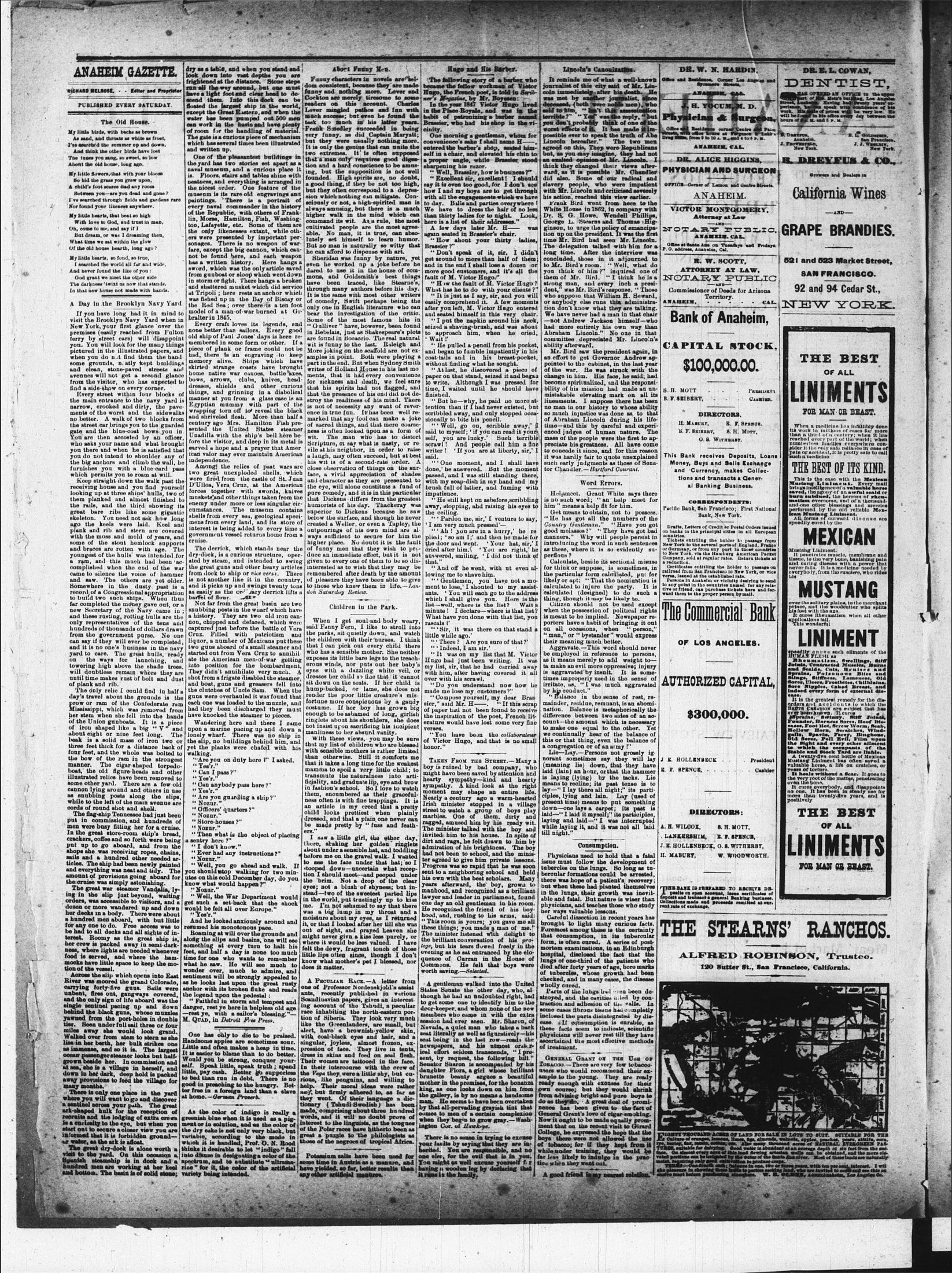
Searchable text
ANAHEIM GAZETTE.
RICHARD MELROSE, Editor and Prepistar
PUBLISHED EVERY SATURDAY.
The Old House.
My little birds, with backs as brown
As sand, and throats as white as frost,
I've searched the summer up and down,
And think the other birds have lost
The tunes you sang, so sweet, so low
About the old house, long ago.
My little flowers; that with your bloom
So hid the grass you grew upon,
A child's foot scarce dead any room
Between you—are you dead and gone?
I've searched through fields and gardens rare
Nor found your likeness anywhere.
My little hearts, that beat so high
With love to God, and trust in man,
Oh, come to me, and say if I
But dream, or was I dreaming then,
What time we sat within the glow
Of the old house hearth, long ago?
My little hearts, so fond, so true,
I searched the world all far and wide.
And never found the like of you:
God grant we meet the other side
The darkness 'twixt us now that stands,
In that new house not made with hands.
A Day in the Brooklyn Navy Yard.
If you have long had it in mind to visit the Brooklyn Navy Yard when in New York, your first glance over the premises (easily reached from Fulton ferry by street cars) will disappoint you. You will look for the many things pictured in the illustrated papers, and when you do not find them the hand some grounds, naturally kept buildings and clean, stone-paved streets and avenues will not get a second glance from the visitor, who has expected to find a side-show on every corner.
Every street within four blocks of the main entrance to the navy yard is narrow, crooked and dirty, the pavements of the worst and the sidewalks no better. A walk of two blocks from the street car brings you to the guarded gate and the blue-coat bows you in. You are then accosted by an officer, who asks your name and what brought you there and when he is satisfied that you do not intend to shoulder any of the big anchors and climb the wall, he furnishes you with a blue-card pass which permits you to roam at will dry as a table, and when you stand and look down into vast depths you are frightened at the distance. Stone steps run all the way around, but one must have a light foot and clear head to descend them. Into this dock can be floated the largest ship in the world, except the Great Eastern, and when the water has been pumped out 500 men can work in the basin and have plenty of room for the handling of material. The gate is a curious piece of mechanism which has several times been illustrated and written up.
One of the pleasantest buildings in the yard has two stories set apart as a naval museum, and a curious place it is. Floors, stairs and tables shine with neatness, and everything is arranged in the nicest order. One feature of the museum is its rare old engravings and paintings. There is a portrait of every naval commander in the history of the Republic, with others of Franklin, Morse, Hamilton, Fish, Washington, Lafayette, etc. Some of them are the only likenesses extant, while others were presented by important personages. There is no weapon of warfare, except the big cannon, which cannot be found here, and each weapon has a written history. Here hangs a sword, which was the only article saved from gunboat or sloop which went down in storm or fight. There hangs a broken and shattered musket which did service at Tripoli; here rests an anchor which was fished up in the Bay of Biscay or the Red Sea; over there is a ten foot model of a man-of-war burned at Gibralter in 1845.
Every craft loves its legends, and none better than sailors. Every good old ship of Paul Jones' days is here remembered in some form or other. If a piece of plank or frame could not be had, there is an engraving to keep memory alive. Ships which have skirted strange coasts have brought home native war canoes, battle axes, bows, arrows, clubs, knives, head-dresses, shields and other curious things, and grinning in a diabolical manner at you from a glass case is an Egyptian mummy with part of the wrapping torn off to reveal the black and shriveled flesh. More than half a century ago Mrs. Hamilton Fish presented the United States steamer Unadilla with the ship's bell here before the visitor, and deep in its metal is earved a hope and a prayer that American valor may ever maintain American independence.
Among the relics of past wars are two great unexploded shells, which aborted funny characterdom consistent, funny and nothing Cockton are mere readers on this Lover mingled much success; but task too much Frank Smedley very funny, as it but they were used It is only the genius two extremes: that a man only tion and a hard ing, but the suited founded. High s good thing, if it but they often coose which nothing seriously or not, as always amusing; higher walk in command its wit; cultivated people able. No man, lately set himself But no man is na he can afford to do Sheridan was f even he worked dared to use it mons, and Gold have been traced through many an It is the same wit of comedy, Swift only one in English bear the invest Some of the m "Gulliver" have in Rebelais, just are found in Bochs wit is funny to th More joking on th amples in point part in the end. B writes of Holland mentions, that it h for sickness and that his spirits that the presence stroy the reading is not of necessience in true fun marked that any of sacred things ness is often look wit. The man Scripture, or say vile at his neigh a laugh, may oft his wit is of a close observation face a vivid art
Every street within four blocks of the main entrance to the navy yard is narrow, crooked and dirty, the pavements of the worst and the sidewalks no better. A walk of two blocks from the street car brings you to the guarded gate and the blue-coat bows you in. You are then accosted by an officer, who asks your name and what brought you there and when he is satisfied that you do not intend to shoulder any of the big anchors and climb the wall, he furnishes you with a blue-card pass which permits you to roam at will.
Keep straight down the walk past the receiving house and you find yourself looking up at three ships' hulls, two of them planked and almost finished to the rails, and the third showing its great bare ribs like some gigantic skeleton. You need not ask how long ago the keels were laid. Keel and plank and rib and stern are covered with the moss and mold of years, and some of the stout hemlock supports and braces are rotten with age. The youngest of the hulls was intended for a ram, and this much had been accomplished when the end of the war came to silence the voice of hammer and saw. The others are yet older. Somewhere in the dusty past is a record of a Congressional appropriation to build two such ships. When thus far completed the money gave out, or a new Secretary of the Navy came in; and these rusting, rotting hulls are the only representatives of the tens and hundreds of thousands of dollars drawn from the government purse. No one can say if they will ever be completed, and it is no one's business in the navy yard to care. The great hulls, ready on the ways for launching, and towering high above the shade trees, will doubtless remain where they are until time makes rust of bolt and dust of plank and rib.
The only relic I could find in half a day's travel about the grounds is the prow or ram of the Confederate ram Mississippi, which was removed from her stem when she fell into the hands of the Union gunboats. It is a piece of iron shaped like a big "V" and about eight or nine feet long. The beak is a solid mass of iron two or three feet thick for a distance back of four feet, and the whole was bolted to the bow of the ram in the strongest manner. The cigar-shaped torpedo-boat, the old figure-heads and other illustrated relics have been removed to some other yard. There are a few old cannon lying around and others in use as snubbing posts along the slips, while to the left of the main avenue are cords of round shot and shell.
The flag-ship Tennessee had just been put in commission, and hundreds of men were busy fitting her for a cruise. In the great store-room ship's bread, crackers, coffee and so forth were being put up to go aboard, and from the shops she was receiving ropes, chains, sails and a hundred other needed articles. The ship had been newly painted and everything was neat and tidy. The amount of provisions going aboard for the cruise was simply astonishing.
The great war steamer Vandalia, lying in the slip just beyond, waiting home native war canoes, battle axes, bows, arrows, clubs, knives, head-dresses, shields and other curious things, and grinning in a diabolical manner at you from a glass case is an Egyptianummy with part of the wrapping torn off to reveal the black and shriveled flesh. More than half a century ago Mrs. Hamilton Fish presented the United States steamer Unadilla with the ship's bell here before the visitor, and deep in its metal is carved a hope and a prayer that American valor may ever maintain American independence.
Among! the relics of past wars are two great unexploded shells, which were fired from the castle of St. Juan D'Ulloa, Vera Cruz, at the American forces together with swords, knives muskets' and other things taken from the enemy under more or less singular circumstances. The museum contains shells from every sea, geological specimens from every land, and its store of interest is being added to every time a government vessel returns home from a cruise.
The derrick, which stands near the dry-dock, is a curious structure, operated by steam, and intended to swing the great guns and other heavy articles from dock to ship or vice versa. There is not another like it in the country, and it picks up and swings twenty tons as easily as the ornary derrick lifts a barrel of flour.
Not far from the great basin are two snubbing posts in the wharf which have a history. They are two old iron cannon, chipped and defaced, which were captured just before the battle of Vera Cruz. Filled with patriotism and liquor, a number of Mexicans put these two guns aboard of a small steamer and started out from Vera Cruz to annihilate the American men-of-war getting into position for the bombardment. They didn't annihilate very much. A shot from a frigate disabled the steamer, and boat, guns and greasers fell into the clutches of Uncle Sam. When the guns were overhauled it was found that each one was loaded to the muzzle, and had they been discharged they must have knocked the steamer to pieces.
Wandering here and there I came upon a marine pacing up and down a lonely wharf. There was no ship in the slip, no buildings behind him, and yet the planks were chafed with his walking.
"Are you on duty here?" I asked.
"Yes'r."
"Can I pass?"
"Yes'r."
"Can anybody pass here?"
"Yes'r."
"Are you guarding a ship?"
"Nozur."
"Officers' quarters?"
"Nozur."
"Store-houses?"
"Nozur."
"Then what is the object of placing a sentry here?"
"I don't know."
"Ever had any instructions?"
"Nozur."
"Well, you go ahead and walk. If you should stop walking for two minutes on this cold December day, do you know what would happen?"
"Nozur."
"Well, the War Department would
ments that it lends for sickness and that his spirits that the presence stroy the reading is not of necessity in true fun.
marked that any of sacred things is often look wit.
The man Scripture, or says vile at his neigh laugh may oft his wit is of a close observation face, a vivid ap art character as he eye, will alo pure comedy,and that Dickens did humorists of his superior to Dick below the surface created a Weller outpourings of ways sufficient higher place.Ne
of funny men tha duce an immediate given to every one interested as to w remembered after pleasure they to those who knew don Saturday Re
Children
When I get said Fanny Fern,the parks,sit quietthe children with that I can pick owho has a sensible exposes its little erons winds,nor eyes with a da dresses her child sit down on the shump-backed, or render the poor fortune more costume.If her enough to be ash ringlets about him not insist upon sa manliness to her.
With these views that my list of choic with sensible motions than otherwise,
that it takes a long mamma to spoil an transmute the na figiality,and grad in fashion's school them, encumbered ness often is with an article in my child looks pret dressed,and that be made pretty ers."
The flagship Tennessee had just been put in commission, and hundreds of men were busy fitting her for a cruise. In the great store-room ship's bread, crackers, coffee and so forth were being put up to go aboard, and from the shops she was receiving ropes, chains, sails and a hundred other needed articles. The ship had been newly painted and everything was neat and tidy. The amount of provisions going aboard for the cruise was simply astonishing.
The great war steamer Vandalia, lying in the slip just beyond, waiting orders, was accessible to visitors, and a dozen or more wandered up and down her decks in a body. There were about a hundred men aboard, with but little for any one to do. Free access was to be had to all decks and all sights of interest. Roomy as the great ship is, her crew is packed away in semi-darkness, where lights are needed whenever food is served, and where the hammocks have little space to keep the motion of the vessel.
Across the slip which opens into East River was moored the grand Colorado, carrying forty-five guns. Sails were unbent, fires out, gangways covered, and the only sign of life aboard was the single sentinel pacing up and down behind the black guns, whose muzzles yawned from the port-holes in double tier. Seen under full sail three or four miles away she would look grand. Walked over from stern to stern as she lies in her barth, her bulk strikes one as immense, and so it is. The largest ocean passenger steamer looks but half-grown beside her. In commission and at sea, she is a village in herself, and down in her dark, deep hold is packed away provisions to feed the village for many months.
There is only one place in the yard where you will want to go and discover a sentinel across your path. The great ark-shaped hulk for the reception of recruits and the lodging of extra crews is a curiosity to the eye, but when you start out to secure a closer view you are informed that it is forbidden ground—air water, as the ark is afloat.
The great dry-dock is alone worth a visit to the yard. On this occasion a Spanish steamship is in dock and a hundred men are working at her keel and bottom. The basin is of solid stone; "Nozur."
"Officers' quarters?"
"Nozur."
"Store-houses?"
"Nozur."
"Then what is the object of placing a sentry here?"
"I don't know."
"Ever had any instructions?"
"Nozur."
"Well, you go ahead and walk. If you should stop walking for two minutes on this cold December day, do you know what would happen?"
"Nozur."
"Well, the War Department would get such a set-back that the shock would be felt all over Europe."
"Yes'r."
And he looked anxiously around and resumed his monotonous pace.
Roaming at will over the grounds and along the slips and basins, one will see something at every turn to halt his feet, and half a day is none too much time for one who wants to remember what he saw. He will see much to wonder over, much to admire, and sentiment will be strongly appealed to as he looks last upon the great rusty anchor with its broken fluke and reads the legend upon the pedestal:
"Faithful in storm and tempest and danger, rest ye here in helpless old age—rest ye, with a sailor's blessing."—M. Quad, in Detroit Free Press.
One has only to die to be praised. Handsome apples are sometimes sour. Little and often makes a heap in time. It is easier to blame than to do better. Would you be strong, conquer yourself? Speak little, speak truth; spend little, pay cash. Better go supperless to bed than run in debt. There is no good in preaching to the hungry. Better free in a foreign land than a slave at home.—German Proverb.
As the color of indigo is really a greenish blue when it is used as a pigment or in solution, and as the color of the dry cake is not only very black, but variable, according to the mode in which it is handled, Prof. O. N. Rood thinks it desirable to let "indigo" fall into disuse in designating a color of the spectrum, and to substitute "ultramarine" for it, the color of the artificial variety being intended.
I saw a little there, shaking her about under a sense before me on the page to see the face stooped down—until I should meet the brim. Not sure eyes; not a blush stead—two of the world, put them. I'm not ashamed was a big lump of moisture about my it, or that I looked out of sight, and might never give up where it would be felt the dewy, fragile little lips often said know what mother does it matter.
A peculiar RA one of Professor Mantis, recently put Scandiavian papering account of the race inhabiting the tion of Siberia. To like the Greenland alert, have a broom with coal-black eyebulars, joyless, pression of face. Their women are tall. In their intercourse they were rious, like penguins help. Their morals naif, but firmly ad they went. Of this tionary (Tahudi-made, comprising words, and it will interest to the lingering of the Polar races by great a puzzle to those of the negroes.
Potassium salts some time in Australia have yielded, so far any other artificial
Abort Funny Men.
Funny characters in novels are seldom consistent, because they are made funny and nothing more. Lever and Cockton are merely tiresome to some readers on this account. Charles Lever mingled pathos and fun with much success; but even he found the task too much in his latter years. Frank Smedley succeeded in being very funny, as did Captain Maryatt; but they were usually nothing more. It is only the genius that can unite the two extremes. It is often supposed that a man only requires good digestion and a hard conscience to be amusing, but the supposition is not well founded. High spirits are, no doubt, a good thing, if they be not too high, but they often correspond to a depression which nothing can mitigate. Consciously or not, a high-spirited man is always amusing, but there is a much higher walk in the mind which can command its wit. As a rule, the most cultivated people are the most agreeable. No man, it is true, can absolutely set himself to learn humor. But no man is naturally so witty that he can afford to dispense with art.
Sheridan was funny by nature, yet even he worked up a joke before he dared to use it in the house of commons, and Goldsmith's best things have been traced, like Stearne's, through many authors before his day. It is the same with most other writers of comedy, Swift perhaps being the only one in English literature who can bear the investigation of the critic. Some of the most famous hits in "Gulliver" have, however, been found in Rebelais, just as Shakespeare's plots are found in Bocaccio. The real natural wit is funny to the last. Raleigh and More joking on the scaffold are not examples in point. Both were playing a part in the end. But when Sydney Smith writes of Holland House in his last months, that it had every convenience for sickness and death, we feel sure that his spirits had not flagged, and that the presence of his end did not destroy the readiness of his mind. There is not of necessity any want of reverence in true fun. It has been well remarked that any fool can make a joke of sacred things, and that mere coarseness is often looked upon as a form of wit. The man who has to distort Scripture, or say what is nasty, or revile at his neighbor, in order to raise a laugh, may often succeed, but at best his wit is of a second-rate order. A close observation of things on the surface a viridial appreciation of shades
Hugo and His Barber.
The following story of a barber who became the fellow workman of Victor Hugo, the French poet, is told in Scribner's Magazine, by Mr. Boyesen:
In the year 1847 Victor Hugo lived in the Place Royale, and was in the habit of patronizing a barber named Brassier, who had his shop in the vicinity.
One morning a gentleman, whom for convenience's sake I shall name H—— entered the barber's shop, seated himself in a chair, and elevated his chin to a proper angle, while Brassier stood sharpening his razor.
"Well, Brassier, how is business?"
"Excellent sir, excellent! I should say it is even too good, for I don't see how I and my boys are to get through with all the engagements which we have to day. Balls and parties everywhere! We have to dress the hair of no less than thirty ladies for to night. Look, here is a list of their addresses."
A few days later Mr. H—— was again seated in Brassier's chair.
"How about your thirty ladies, Brassier?"
"Don't speak of it, sir. I didn't get around to more than half of them; and in the end I shall lose a dozen or more good customers, and it's all the fault of M. Victor Hugo."
"How the fault of M. Victor Hugo? What has he to do with your clients?"
"It is just as I say, sir, and you will easily comprehend it. A few moments after you left, M. Victor Hugo entered and seated himself in this very chair.
"I put the napkin around his neck, seized a shaving-brush, and was about to approach him, when he cried, 'Wait!'
"He pulled a pencil from his pocket, and began to fumble impatiently in his coat-tails and in his breast-pocket, without finding what he sought.
"At last, he discovered a piece of paper on that stand, seized it and bega—to write. Although I was pressed for time, I waited until he should have finished.
"But he—why, he paid no more attention than if I had never existed, but scribbled away, and only stopped occasionally to bite his pencil.
"Well, go on, scribble away,' I said to myself; 'if you can read it yourself, you are lucky.' Such terrible scrawl! And people call him a fine writer! 'If you are at liberty, sir,' I said.
"One moment, and I shall have done,' he answered. But the moment reminds me of what a well-known journalist of this city said of Mr. Lincoln immediately after his death. He was met by another journalist, since deceased (both were noble men), who said to him, "I'm not this assassination terrible?" "Yes" was the reply," but you don't probably think of one of the worst effects of it. It has made it impossible ever to speak the truth of Abel Lincoln hereafter." The two men agreed on this. They were Republicans but, as you may imagine, they had not an erupted opinion of Mr. Lincoln. I think they changed their views afterward, as it is possible Mr. Chandler did also. Some of our radical and slavery people, who were impatient with Mr. Lincoln and criticised severely his action, reached this view earlier.
Frank Bird went from here to the White House in 1862, in company with Dr. S. G. Howe, Wendell Phillips, George L. Stearns and Thomas Higginson, to urge the policy of emancipation up on the president. It was the first time Mr. Bird had seen Mr. Lincoln. The delegation talked with him for a long time. After the interview was concluded, those in it adjourned to to Mr. Bird's room. "Well, what do you think of him?" inquired one of them of Mr. Bird. "I think he is a strong man, and every inch a president," was Mr. Bird's response. "Those who suppose that William H. Seward, or anybody else runs this administration don't know what they are talking. We have never had a man in that chair—not Andrew Jackson himself—who had more entirely his own way than Abraham Lincoln." No one in that committee deprecated Mr. Lincoln's ability afterward.
Mr. Bird saw the president again, in an effort to get Governor Andrew appointed to the cabinet, in the last year of the war. He was struck with the change in him. His face, he said; had become spiritualized, and the responsibility of his mission had made an unmistakable elevating mark on all its lineaments. I suppose there has been no man in our history to whose ability so much injustice was done as to that of Abraham Lincoln during his lifetime—and this by careful and experienced judges of human nature. The mass of the people were the first to appreciate his greatness. All have come to concede it since, and for this reason it was hardly fair to quote unexplained such early judgments as those of Senator Chandler. — Hartford Courant.
Children in the Park.
When I get soul-and-body weary, said Fanny Fern, I like to stroll into the parks, sit quietly down, and watch the children with their nurses. I think that I can pick out every child there who has a sensible mother. She neither exposes its little bare legs to the treachery winds, nor puts out her baby's eyes with a dazzling white veil, or dresses her child so fine that it cannot sit down on the seats. If her child is hump-backed, or lame, she does not render the poor little creature's misfortune more conspicuous by a gaudy costume. If her boy has grown big enough to be ashamed of long, girlish ringlets about his shoulders, she does not insist upon sacrificing his incipient manliness to her absurd vanity.
With these views, you may be sure that my list of children who are blessed with sensible mothers is rather limited than otherwise. Still it comforts me that it takes a long time for the weakest mamma to spoil a very little child; to transmute the naturalness into artificiality, and graduate lip, eye and brow in fashion's school. So I love to watch them, encumbered as their gracefulness often is with fine trappings. It is an article in my creed that a pretty child looks prettiest when plainly dressed, and that a plain one never can be made pretty by "fuss and feathers."
I saw a little girl, the other day, there, shaking her golden ringlets about under a sensible hat, and toddling before me on the gravel walk. I wanted to see the face under that hat; so I stooped down—uncertain what reception I should meet—and peeped under the brim. Not a drop of the clear eyes; not a blush of shyness; but instead—two of the sweetest parted lips in the world—of the trustworthy person to kiss paper on that stand, seized it and began to write. Although I was pressed for time, I waited until he should have finished.
"But he—why, he paid no more attention than if I had never existed, but scribbled away, and only stopped occasionally to bite his pencil.
'Well, go on, scribble away,' I said to myself; 'if you can read it yourself, you are lucky.' Such terrible scrawl! And people call him a fine writer! 'If you are at liberty, sir,' I said.
'One moment, and I shall have done,' he answered. But the moment passed, and I was still standing there, with my soap-dish in my hand and my brush full of lather, and fuming with impatience.
'He still kept on asbefore,scribbling away, stopping, and raising his eyes to the ceiling.
'Pardon me, sir,' I venture to say, 'I am very much pressed—'
'Ah! you are in a hurry,' he replied; 'so am I,' and then he made for the door and went. 'Your hat, sir,' cried after him. 'You are right,' he answered, smiling, 'I did not think of that."
And off he went, with ut even allowing me to shave him.
'Gentlemen, you have not a moment to lose,' I shouted to my assistants. 'You will each go to the address which I shall give you. Here is the list—well, where is the list? Wait a minute! I declare—where is that list? What have you done with that list, you rascals?
'Sir, it was there on that stand a little while ago.'
'There? Are you sure of that?'
Indeed, I am sir.
It was on my list that M. Victor Hugo had just been writing. It was my list, sir, that he had carried away with him, after having covered it all over with his scrawl.
'Do you understand now how he made me lose my customers?'
Compose yourself, my dear Brassier," said Mr. H——. "If this scrap of paper had not been found to receive the inspiration of the poet, French literature would have lost some very fine verses.
"You have been the collaborateur of Victor Hugo, and that is no small honor."
TAKEN FROM THE STREET.—Many a boy is ruined by bad company, who might have been saved by attention and hearty sympathy—kind and hearty sympathy. A kind look at the right moment may shape an entire life. Nearly a century ago a warm-hearted Irish minister stopped in a village street to watch a group of boys play marbles. One of them, dirty and ragged, amused him by his ready wit. The minister talked with the boy and invited him to his house. In spite of dirt and rags, he felt drawn to him by admiration of his brightness. The boy had not been to school, and the minister agreed to give him private lessons. Progress was so rapid that he was soon sent to a neighboring school and held his own with the best scholars. Many years afterward, the boy, grown to manhood, and recognized as a brilliant lawyer and leader in parliament, found change in him. His face, he said; had become spiritualized, and the responsibility of his mission had made an unmistakable elevating mark on all its lineaments. I suppose there has been no man in our history to whose ability so much injustice was done as, to that of Abraham Lincoln during his lifetime—and this by careful and experienced judges of human nature. The mass of the people were the first to appreciate his greatness. All have come to concede it since, and for this reason it was hardly fair to quote unexplained such early judgments as those of Senator Chandler.—Hartford Courant.
Word Errors.
Helpmeet. Grant White says there is no such word; "an help meet for him" means a help fit for him.
Get means to obtain, not to possess. "He has got all the numbers of the Country Gentleman." "Have you got good molasses?" "They have got bad manners." Why will people persist in introducing the word in such sentences as these, where it is so evidently superfluous?
Calculate, beside its sectional misuse for think or suppose, is sometimes, in the particular form calculated, put for likely or apt: "That the nomination is calculated to injure the party. It is calculated (designed) to do such a thing, though it may be likely to.
Citizen should not be used except when the possession of political rights is meant to be implied. Newspaper reporters have a habit of bringing it out on all occasions, when "person," "man," or "bystander" would express their meaning much better.
Aggravate. This word should never be employed in reference to persons, as it means merely to add weight to—a make an evil more oppressive; injury is aggravated by insult. It is sometimes improperly used in the sense of irritate, as "I was much aggravated by his conduct."
Balance in the sense of rest, remainder, residue, remnant, is an abomination. Balance is metaphorically the difference between two sides of an account—the amount which is necessary to make one equal to the other. Yet we continually hear of the balance of this or that thing, even the balance of a congregation or of an army!
Lie—Lay. Persons not grossly ignorant sometimes say they will lay (meaning lie) down, that they have laid (lain) an hour, or that the hammer is laying (lying) by the tacks. Lie means to recline; its past tense is to lay—"I lay there all night;" its participles, lying and lain. Lay (used of present time) means to put something down—one lays a carpet; its past is laid—"I laid it myself;" its participles, laying and laid—"I was interrupted while laying it, and it was not all laid till night."
Consumption.
Physicians used to hold that a fatal issue must follow the development of tubercles on the lungs. So long as tubercular formations could be arrested, there was hope of a patient's recovery; but when these had planted themselves in the lungs, their growth was inevitable and fatal. But nature is wiser than
ness often is with fine trappings. It is an article in my creed that a pretty child looks prettiest when plainly dressed, and that a plain one never can be made pretty by "fuss and feathers."
I saw a little girl, the other day, there, skating her golden ringlets about under a sensible hat, and toddling before me on the gravel walk. I wanted to see the face under that hat; so I stooped down—uncertain what reception I should meet—and peeped under the brim. Not a drop of the clear eyes; not a blush of shyness; but instead—two of the sweetest parted lips in the world, put trustingly up to kiss me. I'm not ashamed to say that there was a big lump in my throat and a moisture about my eyes, as I returned it, or that I looked after her till she was out of sight, and prayed heaven she might never give a kiss less purely, or where it would be less valued. I have felt the dewy, fragrant touch of those little lips often since, though I don't know what mother's pet I blessed, nor does it matter.
A PECULIAR RACE.—A letter from one of Professor Nordenskjold's assistants, recently published in various Scandinavian papers, gives an interesting account of the Tahudi, a peculiar race inhabiting the north-eastern portion of Siberia. They look very much like the Greenlanders, are small, but alert, have a brownish-yellow skin, with coal-black eyes and hair, and a singular, joyless, almost frozen expression of face. They live in tents, dress in skins and feed on seal flesh. Their women are tattooed in the face. In their intercourse with the crew of the Vega they were a little shy, but curious, like penguins, and willing to help. Their moral ideas were rather naif, but firmly adhered to, as far as they went. Of their language a dictionary (Tahudi-Swedish) has been made, comprising about three hundred words, and it will no doubt prove of interest to the linguists, as the tongues of the Polar races have hitherto been as great a puzzle to the philologists as those of the negroes of tropical Africa.
Potassium salts have been used for some time in Austria as a manure, and have yielded, so far, better results than any other artificial manure.
A gentleman walked into the United States Senate the other day, who, although he had an undoubted right, had to get some one to identify him to the door-keeper, and whom none of the new members who came in with the extra session had ever seen. Mr. Sharon, of Nevada, a quiet man who takes a back seat literally as well as figuratively—his seat being in the last row—reads the newspapers, and his utmost oracular effort seldom transcends, "I present, by request, the following bill." Senator Sharon is accompanied by his daughter Flora, a girl whose brilliant brunette beauty argues a beautiful mother in the premises, for the bonanza king, as one looks down on him from the gallery, is by no means a handsome man. He seems to have been overtaken by that all-pervading grayish tint that comes to men of a certain complexion when they begin to grow gray. Washington Cor. of Hawkeye.
There is no sense in trying to excuse your faults by saying that they are inherited. You are responsible, and no one else, for the evil that is in you. You might as well excuse yourself for having a wooden leg by declaring that it runs in the family.
Consumption.
Physicians used to hold that a fatal issue must follow the development of tubercles on the lungs. So long as tubercular formations could be arrested, there was hope of a patient's recovery; but when these had planted themselves in the lungs, their growth was inevitable and fatal. But nature is wiser than physicians, and teaches those who study her ways valuable lessons.
Careful dissection in recent years has brought to light many curious facts. Foremost among these is the certainty that consumption, in its tubercular form, is often cured. A series of post-mortem examinations, in an Edinburgh hospital, disclosed the fact that the lungs of one-third of the patients who died after forty years of age, bore marks of tubercles, whose growth had been checked, and in many cases, the disease wholly cured.
Parts of the lungs had even been destroyed, and the cavities filled by contraction and adhesion of the walls. In some cases fibrous tissue had completely inclosed the parts disintegrated by disease. If consumption is curable, as these facts seem to indicate, scientific physicians will never rest till they have ascertained the most effective methods of treatment.
General Grant on The Use of Tobacco.—There are very few tobacco users who would recommend their example to the young. They are ready ready enough with excuses for their own course; but they would shrink from advising bright and pure boys to do as they do. A great deal of prominence has been given to the fact of General Grant's love of cigar smoking. Now it ought to be made equally prominent that on the recent visit to Girard College, he expressed the hope that the boys there were not allowed the use of tobacco; for if they kept from it while under training, they would be far less likely to indulge in the practice when they went out.
A good friend is my nearest relation.
DR. W. N. HARDIN,
Office and Residence, Corner Los Angeles and Sycamore Streets,
ANAHEIM, CAL.
J. H. YOCUM, M. D.
Physician & Surgeon,
Office and Residence corner Centre and Palm streets, with office hours at Ferguson R. Lakht's Drug Store, from 9 to 10 A.M., and 4 to 5 P.M.
ANAHEIM, CAL.
DR. ALICE HIGGINS,
PHYSICIAN AND SURGEON
OFFICE—Corner of Lemon and Centre Streets.
ANAHEIM.
VICTOR MONTGOMERY,
Attorney at Law
AND
NOTARY PUBLIC.
ANAHEIM, CAL.
Office at Santa Ana on Tuesdays and Fridays.
P.O. address, Anaheim, Cal.
R. W. SCOTT,
ATTORNEY AT LAW,
NOTARY PUBLIC
AND
Commissioner of Deeds for Arizona Territory.
ANAHEIM, CAL.
Bank of Anaheim,
CAPITAL STOCK,
$100,000.00.
S. H. MOTT
President
B. F. SEIBERT,
Carrier.
DIRECTORS.
H. MABURY,
E. F. SPENCE.
B. F. SEIBERT,
S. H. MOTT,
O. S. WITHERBY.
This Bank receives Deposits, Loans Money, Buys and Sells Exchange and Currency, makes Collect-
DR. E. L. COWAN,
DENTIST,
HAS OPENED AN OFFICE in the upper part of Mrs. Meta's building, Los Angeles Street, Anaheim, Having had twenty years experience, he can speak with confidence of his work. His angle of prices will be very low. He will be found in his office every day between the hours of 8 A.M. and 5 P.M.
B. DANTFUS,
Anahiem,
San Francisco.
J. FROWNPELD,
New York.
New York.
R. DREYFUS & CO.
Growers and Dealers in
California Wines
AND
GRAPE BRANDIES.
521 and 523 Market Street,
SAN FRANCISCO.
92 and 94 Cedar St.
NEW YORK.
THE BEST
OF ALL
LINIMENTS
FOR MAN OR BEAST.
When a medicine has infiltribly done its work in millions of cases for more than a third of a century; when it has reached every part of the world; when numberless families everywhere consider it the only safe reliance in case of pain or accident, it is pretty safe to call such a medicine
THE BEST OF ITS KIND.
The Commercial Bank of Los Angeles.
AUTHORIZED CAPITAL,
$300,000.
J. E. HOLLENBECK President
E. F. SPENCE Cashier
DIRECTORS:
A. H. WILGOX, S. H. MOTT,
LANKEESHIM, E. F. SPENCE,
J. E. HOLLENBECK, O. S. WITHERBY,
H. MABURY, W. WOODWORTH.
The Bank is prepared to receive deposits on open account, issue certificates of deposit and transact a general banking business.
LINIMENTS FOR MAN OR BEAST.
When a medicine has infiltrated its work in millions of cases for more than a third of a century; when it has reached every part of the world; when nummerless families everywhere consider it the only safe reliance in case of pain or accident, it is pretty safe to call such a medicine.
THE BEST OF ITS KIND.
This is the case with the Mexican Mustang Liniment. Every mail brings intelligence of a valuable horse saved, the agony of an awful scald or burn subdued, the horrors of rheumatism overcome, and of a thousand-and-one other blessings and merries performed by the old reliable Mexican Mustang Liniment.
All forms of outward disease are speedily cured by the MEXICAN Mustang Liniment.
It penetrates muscle, membrane and tissue, to the very bone, banishing pain and curing disease with a power that never fails. It is a medicine needed by everybody, from the ranchoero, who rides his MUSTANG over the solitary plains, to the merchant prince, and the woodcutter who splits his foot with the axe.
It cures Rheumatism when all other applications fail.
This wonderful LINIMENT speedily curves such alliments of the HUMAN FLESH as Rheumatism, Swellings, Stiff Joints, Contracted Muscles, Burns and Scalds, Cuts, Bruises and Sprains, Poisonous Bites and Stingers, Stichness, Lameness, Old Sores, Ulcers, Frostbites, Chalazias, Sore Nipples, Caked Breast, and indeed every form of external disease.
It is the greatest remedy for the disorders and accidents to which the Burge Creation are subject that has ever been known. It cures Sprains, Swinny, Stiff Joints, Founder, Barness Sores, Hoof Diseases, Foot Blot, Screw Worm, Scab, Hollow Horn, Seratches, Windgalls, Spavin, Farcy, Ringbone, Old Sores, Poll Evil, Film upon the Sight and every other alliment to which the occupants of the Stable and Stock Tard are liable.
A twenty-five cent bottle of Mexican Mustang Liniment has often saved a valuable horse, a life on crutches, or years of torture.
It heals without a scar. It goes to the very root of the matter, penetrating even the bone.
It cures everybody, and disappoints no one. It has been in steady use for more than twenty-five years, and is positively THE BEST OF ALL LINIMENTS FOR MAN OR BEAST.
DIRECTORS:
A. H. WILCOX, S. H. MOTT,
LANKERSHIM, E. F. SPENCER,
J. K. HOLLENBECK, O. S. WITHERBY,
H. MABURY, W. WOODWORTH.
THE BEST OF ALL LINIMENTS FOR MAN OR BEAST.
THE STEARNS' RANCHOS.
ALFRED ROBINSON, Trustee.
120 Sutter St., San Francisco, California.
EIGHTY THOUSAND ACRES OF LAND FOR SALE IN LOTS TO SUIT. SUITABLE FOR THE CULTURE OF ORANGE, LEMON, LIME, SUG, ALMENDES, WALNUTS, APPLES, PATCHES, PEARS, ALFALFA, CORN, Rye, Barley, Sugar, Wine, Cotton, Oil. Also many thousand acres of NATURAL EVERGREEN PASTURES, suitable for defraying. Good water is abundant at an average depth of six feet from the surface. On almost every area of this land flowing artesian wells can be obtained, and the more elevated portions can be fenced by the waters of the Santa Ana river. Most of these lands are naturally moist, requiring only good cultivation to produce crops.
THREE—One-fourth each; Balances in one, two or three years, with ten percent interest. I will also pleasure in showing these lands to parties seeking land, who are invited to coil and see this an ancient treat before purchasing elsewhere. W. H. OLDBEN, ASHEZAMHAIM, Los Angeles Co.