anaheim-gazette 1880-03-06
Scanned page
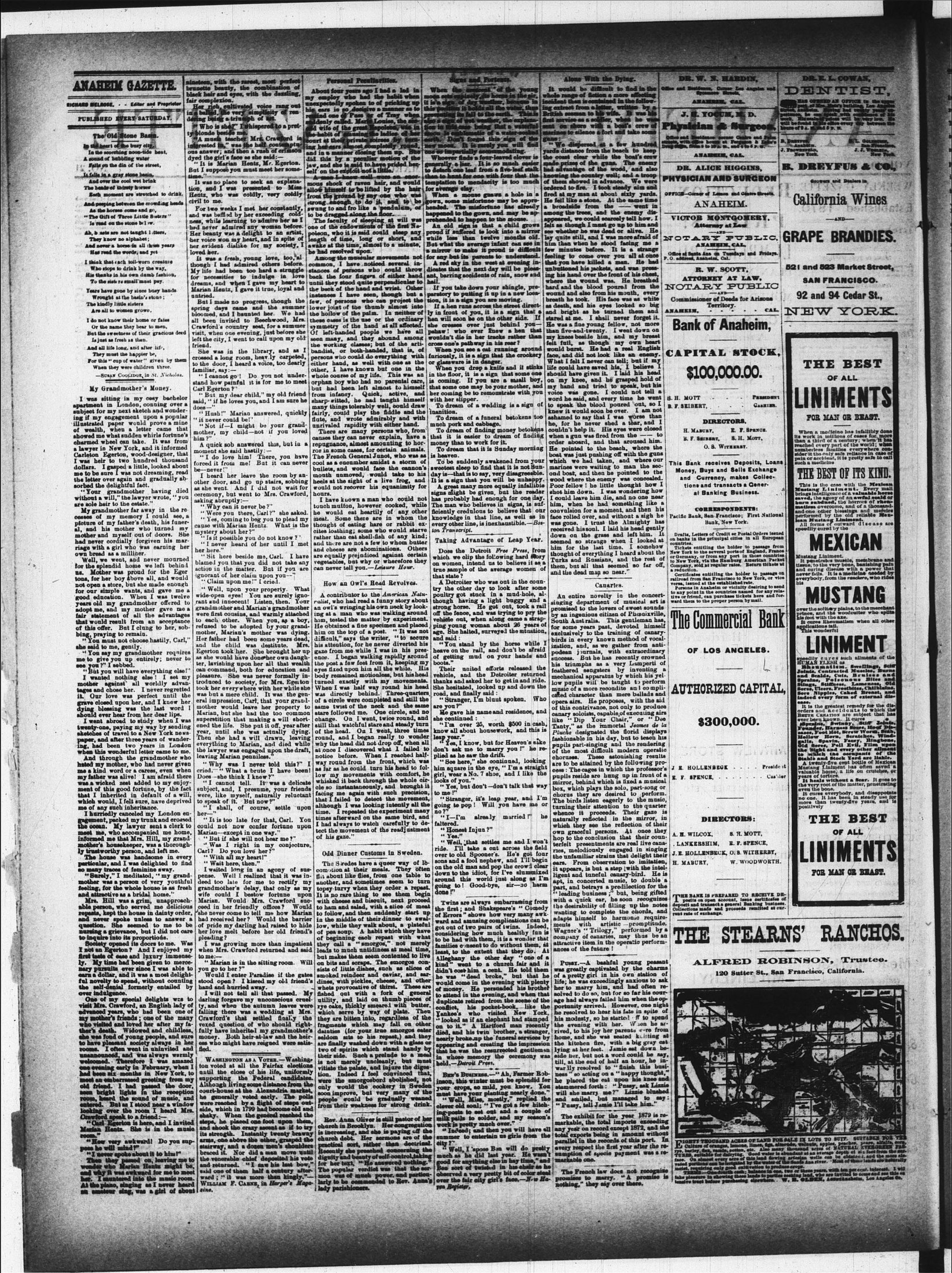
Searchable text
ANAHEIM GAZETTE.
RICHARD MELROSE, - Editor and Proprietor
PUBLISHED EVERY SATURDAY.
The Old Stone Basin.
In the heart of the busy city,
In the scorching noon-tide heat,
A sound of bubbling water
Falls on the din of the street,
It falls in a gray stone basin,
And over the cool wet brink
The heads of thirsty horses
Each moment are stretched to drink.
And peeping between the crowding heads
As the horses come and go,
"The Gift of Three Little Busters"
Is read on the stone below.
Ah, basks are not taught letters,
They know no alphabet;
And never a home in all those years
Has read the words, and yet
I think that each toll-worn creature
Who stops to drink by the way,
His thanks in his own dumb fashion,
To the sistra small must pay.
Years have gone by since busy hands
Wrought at the basin's stone;
The kindly little sisters
Are all to women grown.
I do not know their home or fates
Or the name they bear to men,
But the sweetness of their gracious deed
Is just as fresh as then.
And all life long, and after life,
They must the happier be,
For this "cup of water" given by them
When they were children three.
—SUSAN COOLIDGE, in St. Nicholas.
My Grandmother's Money.
I was sitting in my cozy bachelor apartment in London, conning over a subject for my next sketch and wondering if my engagement upon a popular illustrated paper would prove a mine of wealth, when a letter came that showed me what sudden whirls fortune's charmed wheel can take. It was from a lawyer in New York, and it informed Carleton Egerton, wood-designer, that I was heir to two hundred thousand dollars. I gasped a little, looked about me to be sure I was not dreaming, read nineteen, with the rarest, most perfect brunette beauty, the combination of black hair and eyes, with the dazzling, fair complexion.
Her rich cultivated voice rang out in a ballad, the very simplicity of rendering being a triumph of art.
"Who is she?" I whispered to a pretty blonde beside me.
"A mish teacher Mrs. Crawford is interested in," was the half contemptuous answer; and then a rush of crimson dyed the girl's face as she said:
"It is Marian Hents, Mr. Egerton. But I suppose you must meet her sometime."
It was no place to seek an explanation, and I was presented to Miss Hentz, who was coldly, very coldly civil to me.
For two weeks I met her constantly, and was baffled by her exceeding coldness, while learning to admire her as I had never admired any woman before. Her beauty was a delight to an artist, her voice won my heart, and in spite of her evident dialike for my society, I loved her.
It was a fresh, young love, too, although I had admired others before. My life had been too hard a struggle for necessities to indulge in love dreams, and when I gave my heart to Marian Hentz, I gave it true, loyal and untried.
But I made no progress, though the spring days came and the summer bloomed, and I haunted her. We had all been invited to Beechwood, Mrs. Crawford's country seat, for a summer visit, when one evening, just before she left the city, I went to call upon my old friend.
She was in the library, and as I crossed a long room, heavily carpeted, to the door, I heard a voice, too dearly familiar, say:
"I cannot go! Do you not understand how painful it is for me to meet Carl Egerton?"
"But my dear child," my old friend said, "if he loves you, and I am sure he does—"
"Hush!" Marian answered, quickly "it never could be!"
"Not if—I might be your grandmother, my child—not if you loved him?"
A quick sob answered this, but in a moment she said hastily:
"I do love him! There, you have forced it from me! But it can never be—never!"
Personal
About four years ago my employ who unexpectedly spotted his cars is so dreadful one of Pursuit suddenly called. And wife of the groom the habit of simmer court at their priring hot carars almost and in a manner did this by a paw jaw, and she is as self on the explorer.
A man I knew mous shock of not allow himself to from the ground strong enough to swung to and froze to be dragged aloft.
The faculty one of the endowment poleon, who it just length of time awake at the time he had resolved.
Among the many common, I have stances of person back the four until they stood on the back of the instances I have few, of persons lower joint of the hollow of these cases is the symmetry of the Of left-handed seen many, and the working chandelier bandist, or both persons who cover either hand, and other, I have whole course of orphan boy which but had been from infancy. sharp-witted, he many things took fairly could play flute, and wrote unrivaled rapists.
There are many causes they can repugnance, alior in some cases The French Ge cool as a cuccur bullets, and w
My Grandmother's Money.
I was sitting in my cozy bachelor apartment in London, conning over a subject for my next sketch and wondering if my engagement upon a popular illustrated paper would prove a mine of wealth, when a letter came that showed me what sudden whirls fortune's charmed wheel can take. It was from a lawyer in New York, and it informed Carleton Egerton, wood-designer, that I was heir to two hundred thousand dollars. I gasped a little, looked about me to be sure I was not dreaming, read the letter over again and gradually absorbed the delightful fact.
"Your grandmother having died without a will," the lawyer wrote, "you are sole heir to the estate."
My grandmother far away in the recesses of my memory I could see, a picture of my father's death, his funeral, and his mother who turned my mother and myself out of doors. She had never cordially forgiven his marriage with a girl who was earning her own bread as a milliner.
Well, we went, and never mourned for the splendid home we left behind us. Mother was proud for the Eger tons, for her boy above all, and would not open a store, but she made enough for our simple wants, and gave me a good education. When I was twelve years old my grandmother offered to adopt me, and my mother gave me a fair statement of all the advantages that would result from an acceptance of this offer. But I clung to her, sobbing, praying to remain.
"You must not choose hastily, Carl," she said to me, gently.
"You say my grandmother requires me to give you up entirely; never to see you?" I sebbed.
"But you will have everything else!" I wanted nothing else! I set my mother against all worldly advantages and chose her. I never regretted it. Our love was perfect until the grave closed upon her, and I knew her dying blessing was the last word I should ever hear from her dear lips.
I went abroad to study when I was twenty-one, paying my way by sending sketches of travel to a New York newspaper, and after three years of wandering, had been two years in London when this wonderful letter came to me.
And through the grandmother who hated my mother, who had never given me a kind word or a caress, even when my father was alive! I am afraid there was a wicked zeal added to my enjoyment of this good fortune, by the fact that I inherited in default of a will, which would, I felt sure, have deprived me of any such inheritance.
I hurriedly canceled my London engagement, packed my trunk and crossed the ocean. My lawyer sent a clerk to meet me, who accompanied me home, informed me that Mrs. Hill, my grandmother's housekeeper, was a thoroughly trustworthy person, and left me.
The house was handsome in every particular, and I was delighted to find so many traces of feminine sway.
"Surely," I meditated, "my grandmother was a person of very youthful feeling, for the whole house is as fresh and attractive as a bridal home."
"I cannot go! Do you not understand how painful it is for me to meet Carl Egerton?"
"But my dear child," my old friend said, "if he loves you, and I am sure he does—"
"Hush!" Marian answered, quickly "it never could be!"
"Not if—I might be your grandmother, my child—not if you loved him?"
A quick sob answered this, but in a moment she said hastily:—
"I do love him! There, you have forced it from me! But it can never be—never!"
I heard her leave the room by another door, and go up stairs, sobbing as she went. And I did not wait for ceremony, but went to Mrs. Crawford, asking abruptly:—
"Why can it never be?"
Were you there, Carl? she asked.
Yes, coming to beg you to plead my cause with Marian Hentz. What is the mystery about her?
"Is it possible you do not know?"
I never heard of her until I met her here."
Sit here beside me, Carl. I have blamed you that you did not take any action in the matter. But if you are ignorant of her claim upon you—
"Claim upon me!" I cried.
Well, upon your property. What wide-open eyes! You are surely ignorant and innocent! Listen then. Your grandmother and Marian's grandmother were first cousins, and warmly attached to each other. When you as a boy, refused to be adopted by your grandmother, Marian's mother was dying. Her father had been some years dead, and the child was destitute. Mrs. Egerton took her. She brought her up as she would have done on your daughter, lavishing upon her all that wealth can command, both for education and pleasure. She was never formally introduced to society, for Mrs. Egerton took her everywhere with her while she was but a mere child. It was the general impression, Carl, that your grandmother would leave her property to Marian, but she had the too common superstition that making a will shortened the life. She put it off, year after year, until she was actually dying. Then she had a will drawn, leaving everything to Marian, and died while the lawyer was engaged upon the draft, leaving Marian penniless."
"Why was I never told this?" I cried.—"What a brute I have been! Does—she think I knew?"
"I cannot tell. It was a delicate subject, and I presume your friends were like myself, naturally reluctant to speak of it. But now?"
"I shall, of course, settle upon her—"
"It is too late for that, Carl. You could not now confer fortune upon Marian—except in one way."
"But if she will not hear me?"
"Was I right in my conjecture, Carl? Do you love her?"
With all my heart!
Wait here, then.
I waited long in an agony of suspense. Well I realized that it was indeed too late for me to rectify my grandmother's delay, that only as my wife could I bestow fortune upon Mr. Egerton.
"I cannot go! Do you not understand how painful it is for me to meet Carl Egerton?"
"But my dear child," my old friend said, "if he loves you, and I am sure he does—"
"Hush!" Marian answered, quickly "it never could be!"
"Not if—I might be your grandmother, my child—not if you loved him?"
A quick sob answered this, but in a moment she said hastily:—
"Why can it never be?"
Were you there, Carl? she asked.
Yes, coming to beg you to plead my cause with Marian Hentz. What is the mystery about her?
"Is it possible you do not know?"
I never heard of her until I met her here."
Sit here beside me, Carl. I have blamed you that you did not take any action in the matter. But if you are ignorant of her claim upon you—
"Claim upon me!" I cried.
Well, upon your property. What wide-open eyes! You are surely ignorant and innocent! Listen then. Your grandmother and Marian's grandmother were first cousins, and warmly attached to each other. When you as a boy, refused to be adopted by your grandmother, Marian's mother was dying. Her father had been some years dead, and the child was destitute. Mrs. Egerton took her. She brought her up as she would have done on your daughter, lavishing upon her all that wealth can command, both for education and pleasure. She was never formally introduced to society, for Mrs. Egerton took her everywhere with her while she was but a mere child. It was the general impression, Carl, that your grandmother would leave her property to Marian, but she had the too common superstition that making a will shortened the life. She put it off, year after year, until she was actually dying. Then she had a will drawn, leaving everything to Marian, and died while the lawyer was engaged upon the draft, leaving Marian penniless."
"Why was I never told this?" I cried.—"What a brute I have been! Does—she think I knew?"
"I cannot tell. It was a delicate subject, and I presume your friends were like myself, naturally reluctant to speak of it. But now?"
"I shall, of course, settle upon her—"
"It is too late for that, Carl. You could not now confer fortune upon Marian—except in one way."
"But if she will not hear me?"
"Was I right in my conjecture, Carl? Do you love her?"
With all my heart!
Wait here, then.
I waited long in an agony of suspense. Well I realized that it was indeed too late for me to rectify my grandmother's delay, that only as my wife could I bestow fortune upon Mr. Egerton.
"I cannot go! Do you not understand how painful it is for me to meet Carl Egerton?"
"But my dear child," my old friend said, "if he loves you,and I am sure he does—"
"Hush!" Marian answered,quickly "it never could be!"
"Not if—I might be your grandmother,my child—not if you loved him?"
A quick sob answered this,but in a moment she said hastily:—
"Why can it never be?"
Were you there,Carl?' she asked.
Yes,coming to beg你to pleadmycausewithMarianHentz。Whatisthemysteryabouther?
"Isit possibleyoudo_notknow?"
I heardherleavetherroombyanotherdoor,andgoupstairs,sobbingashewent.AndIdidnotwaitforceremony,butwenttoMrs.Crawford,askingabruptly:—
"Whycanitneverbe?"
Wereyouthere,Carlhewouldeatupstreamandgoupstairs,sobbingashewent.AndIdidnotwaitforceremony,butwenttoMrs.Crawford,askingabruptly:—
"Whycanitneverbe?"
Wereyouthere,Carlhewouldeatupstream和goupstairs,sobbingashewent.AndIdidnotwaitforceremony,butwenttoMrs.Crawford,askingabruptly:—
"Whycanitneverbe?"
Wereyouthere,Carlhewouldeatupstream和goupstairs,sobbingashewent.AndIdidnotwaitforceremony,butwenttoMrs.Crawford,askingabruptly:—
"Whycanitneverbe?"
Wereyouthere,Carlhewouldeatupstream和goupstairs,sobbingashewent.AndIdidnotwaitforceremony,butwenttoMrs.Crawford,askingabruptly:—
"Whycanitneverbe?"
Wereyouthere,Carlhewouldeatupstream和goupstairs,sobbingashewent.AndIdidnotwaitforceremony,butwenttoMrs.Crawford,askingabruptly:—
"Whycanitneverbe?"
Wereyouthere,Carlhewouldeatupstream和goupstairs,sobbingashewent.AndIdidnotwaitforceremony,butwenttoMrs.Crawford,askingabruptly:—
"Whycanitneverbe?"
Wereyouthere,Carlhewouldeatupstream和goupstairs,sobbingashewent.AndIdidnotwaitforceremony,butwenttoMrs.Crawford,askingabruptly:—
"Whycanitneverbe?"
Wereyouthere,Carlhewouldeatupstream和goupstairs,sobbingashewent.AndIdidnotwaitforceremony,butwenttoMrs.Crawford,askingabruptly:—
"Whycanitneverbe?"
Wereyouthere,Carlhewouldeatupstream和goupstairs,sobbingashewent.AndIdidnotwaitforceremony,butwenttoMrs.Crawford,askingabruptly:—
"Whycanitneverbe?"
Wereyouthere,Carlhewouldeatupstream和goupstairs,sobbingashewent.AndIdidnotwaitforceremony,butwenttoMrs.Crawford,askingabruptly:—
"Whycanitneverbe?"
Wereyouthere,Carlhewouldeatupstream和goupstairs,sobbingashewent.AndIdidnotwaitforceremony,butwenttoMrs.Crawford,askingabruptly:—
"Whycanitneverbe?"
Wereyouthere,Carlhewouldeatupstream和goupstairs,sobbingashewent.AndIdidnotwaitforceremony,butwenttoMrs.Crawford,askingabruptly:—
"Whycanitneverbe?"
Wereyouthere,Carlhewouldeatupstream和goupstairs,sobbingashewent.AndIdidnotwaitforceremony,butwenttoMrs.Crawford,askingabruptly:—
"Whycanitneverbe?"
Wereyouthere,Carlhewouldeatupstream和goupstairs,sobbingashewent.AndIdidnotwaitforceremony,butwenttoMrs.Crawford,askingabruptly:—
"Whycanitneverbe?"
Wereyouthere,Carlhewouldeatupstream和goupstairs,sobbingashewent.AndIdidnotwaitforceremony,butwenttoMrs.Crawford,askingabruptly:—
"Whycanitneverbe?"
Wereyouthere,Carlhewouldeatupstream和goupstairs,sobbingashewent.AndIdidnotwaitforceremy,butwenttoMrs.Crawford,askingabruptly:—
"Whycanitneverbe?"
Wereyouthere,Carlhewouldeatupstream和goupstairs,sobbingashewent.AndIdidnotwaitforceremy,butwenttoMrs.Crawford,askingabruptly:—
"Whycanitneverbe?"
Wereyouthere,Carlhewouldeatupstream和goupstairs,sobbingashewent.AndIdidnotwaitforceremy,butwenttoMrs.Crawford,askingabruptly:—
"Whycanitneverbe?"
Wereyouthere,Carlhewouldeatupstream和goupstairs,sobbingashewent.AndIdidnotwaitforceremy,butwenttoMrs.Crawford,askingabruptly:—
"Whycanitneverbe?"
Wereyouthere,Carlhewouldeatupstream和goupstairs,sobbingashewent.AndIdidnotwaitforceremy,butwenttoMrs.Crawford,askingabruptly:—
"Whycanitneverbe?"
Wereyouthere,Carlhewouldeatupstream和goupstairs,sobbingashewent.AndIdidnotwaitforceremy,butwenttoMrs.Crawford,askingabruptly:—
"Whycanitneverbe?"
Wereyouthere,Carlhewouldeatupstream和goupstairs,sobbingashewent.AndIdidnotwaitforceremy,butwenntoMrs.Crawford,askingabruptly:—
"Whycanitneverbe?"
Wereyouthere,Carlhewouldeatupstream和goupstairs,sobbingashewenntoMrs.Crawford,askingabruptly:—
"Whycanitneverbe?"
Wereyouthere,Carlhewouldeatupstream和goupstairs,sobbingashewenntoMrs.Crawford,askingabruptly:—
"Whycanitneverbe?"
Wereyouthere,Carlhewouldeatupstream和goupstairs,sobbingashewenntoMrs.Crawford,askingabruptly:—
"Whycanitneverbe?"
Wereyouthere,Carlhewouldeatupstream和goupstairs,sobbingashewenntoMrs.Crawford,askingabruptly:—
"Whycanitneverbe?"
Wereyouthere,Carlhewouldeatupstream和goupstairs,sobbingashewenntoMrs.Crawford,askingabruptly:—
"Whycanitneverbe?"
Wereyouthere,Carlhewouldeatupstream和goupstairs,sobbingashewenntoMrs.Crawford,askingabruptly:—
"Whycanitneverbe?"
Wereyouhere,Carlhewouldeatupstreamandgoopstairs,sobbingashewenntoMrs.Crawford,askingabruptly:—
"Whycanitneverbe?"
Wereyouhere,Carlhewouldeatupstreamandgoopstairs,sobbingashewenntoMrs.Crawford,askingabruptly:—
"Whycanitneverbe?"
Wereyouhere,Carlhewouldeatupstreamandgoopstairs,sobbingashewenntoMrs.Crawford,askingabruptly:—
"Whycanitneverbe?"
Wereyouhere,Carlhewouldeatupstreamandgoopstairs,sobbingashewenntoMrs.Crawford,askingabruptly:—
"Whycanitneverbe?"**
Wait for clarity:
"I was too late for that," she said.
"'What a brute' I have been!"
"'Does' she think I knew?"
"'Was I right in my conjecture,'"
"'Can you love her?"
"'With all my heart!"
"'Wait here,' then."
'I waited long in an agony of suspense.'
'Well I realized that it was indeed too late for me to rectify my grandmother's delay,' that only as my wife could I bestow fortune upon Mr.Egerton.'
"'But you all my heart!"
"'Wait here,' then."
'I waited long in an agony of suspense.'
'Well I realized that it was indeed too late for me to rectify my grandmother's delay,' that only as my wife could I bestow fortune upon Mr.Egerton.'
"'But you all my heart!"
"'Wait here,' then."
'I waited long in an agony of suspence.'
'Well I realized that it was indeed too late for me to rectify my grandmother's delay,' that only as my wife could I bestow fortune upon Mr.Egerton.'
"'But you all my heart!"
"'Wait here,' then."
'I waited long in an agony of suspence.'
'Well I realized that it was indeed too late for me to rectify my grandmother's delay,' that only as my wife could I bestow fortune upon Mr.Egerton.'
"'But you all my heart!"
"'Wait here,' then."
'I waited long in an agony of suspence.'
'Well I realized that it was indeed too late for me to rectify my grandmother's delay,' that only as my wife could I bestow fortune upon Mr.Egerton.'
"'But you all my heart!"
"'Wait here,' then."
'I waited long in an agony of suspence.'
'Well I realized that it was indeed too late for me to rectify my grandmother's delay,' that only as my wife could I bestow fortune upon Mr.Egerton.'
"'But you all my heart!"
"'Wait here,' then."
'I waited long in an agony of suspence.'
'Well I realized that it was indeed too late for me to rectify my grandmother's delay,' that only as my wife could I bestow fortune upon Mr.Egerton.'
"'But you all my heart!"
"'Wait here,' then."
'I waited long in an agony of suspence.'
'Well I realized that it was indeed too late for me to rectify my grandmother's delay,' that only as my wife could I bestow fortune upon Mr.Egerton.'
"'But you all my heart!"
"'Wait here,' then."
'I waited long in an agony of suspence.'
'Well I realized that it was indeed too late for me to rectify my grandmother's delay,' that only as my wife could I bestow fortune upon Mr.Egerton.'
"'But you all my heart!"
"'Wait here,' then."
'I waited long in an agony of suspence.'
'Well I realized that it was indeed too late for me to rectify my grandmother's delay,' that only as我的 wife could I bestow fortune upon Mr.Egerton.'
"'But you all my heart!"
"'Wait here,' then."
'I waited long in an agony of suspence.'
'Well I realized that it was indeed too late for我到我母亲的女儿,我是她的女儿,她是她的女儿,她是她的女儿,她是她的女儿,她是她的女儿,她是她的女儿,她是她的女儿,她是她的女儿,她是她的女儿,她是她的女儿,她是她的女儿,她是她的女儿,她是她的女儿,她是她的女儿,她是她的女儿,她是她的女儿,她是她的女儿,她是她的女儿,她是她的女儿,她是她的女儿,她是她的女儿,她是她的女儿,她是她的女儿,她是她的女儿,她是她的女儿,
'"But if she will not hear me?"
'"Was I right in my conjecture,'"
'"Can you love her?"
'"With all my heart!"
'"Wait here,' then."
'I waited long in an agony of suspence.'
'Well I realized that it was indeed too late for我到我母亲的女儿,我是她的女儿,她是她的女儿,她是她的女儿,她是她的女儿,她是她的女儿,她是她的女儿,她是她的女儿,她是她的女儿,她是她的女儿,她是她的女儿,她是她的女儿,她是她的女儿,她是她的女儿,她是她的女儿,
'"But if she will not hear me?"
'"Was I right in my conjecture,'"
'"Can you love her?"
'"With all my heart!"
'"Wait here,' then."
'I waited long in an agony of suspence.'
'Well I realized that it was indeed too late for我到我母亲的女儿,我是她的女儿,她是她的女儿,她是她的女儿,她是她的女儿,她是她的女儿,她是她的女儿,她是她的女儿,她是她的女儿,她是她的女儿,
'"But if she will not hear me?"
'"Was I right in my conjecture,'"
'"Can you love her?"
'"With all my heart!"
'"Wait here,' then."
'I waited long in an agony of suspence.'
'Well I realized that it was indeed too late for我到我母亲的女儿,我是她的女儿,她是我的女儿,我是我的女儿,我是我的女儿,我是我的女儿,我是我的女儿,我是我的儿女,我是我的儿女,我是我的儿女,我是我的儿女,我是我的儿女,我是我的儿女,我是我的儿女,我是我的儿女,我是我的儿女,我是我的儿女,我是我的儿女,我是我的儿女,我是我的儿女,我是我的儿女,我是我的儿女,我是我的儿女,我是我的儿女,我是我的儿女,我是我的儿女,我是我的儿女,我是我的儿女,我是我的儿女,我是我的儿女,我是我的儿女,我是我的儿女,我是我的儿女,我是我的儿女,我是我的儿女,
'"But if she will not hear me?"
'"Was I right in my conjecture,'"
'"Can您love她?"
'"With all my heart!"
'"Wait here,' then."
'I waited long in an agony of suspence.'
'Well I realized that it was indeed too late for我到我母亲的女儿,我是我的女儿,我是我的女儿,我是我的女儿,我是我的女儿,我是我的女儿,我是我的儿女,我是我的儿女,我是我的儿女,我是我的儿女,我是我的儿女,我是的儿女,我的儿女,我的儿女,我的儿女,我的儿女,我的儿女,我的儿女,我的儿女,我的儿女,我的儿女,我的儿女,我的儿女,我的儿女,我的儿女,我的儿女,我的儿女,我的儿女,我的儿女,我的儿女,我的儿女,我的儿女,我的儿女,我的儿女,我的儿女,我的儿女,我的儿女,我的儿女,我的儿女,我的儿女,我的儿女,我的儿女,我的儿女,我的儿女,我的儿女,我的儿女,我的少女,我的少女,我的少女,我的少女,我的少女,我的少女,我的少女,我的少女,我的少女,我的少女,我的少女,我的少女,我的少女,我的少女,我的少女,我的少女,我的少女,我的少女,我的少女,我的少女,我的少女,我的少女,我的少女,我的少女,我的少女,我的少女,我的少女,我的少女,我的少女,我的少女,我的少女,我的少女,我的少女,我的少女,我的少女,我的少女,我的少女,我的少女,我的少女,我的少女,
'"But if she will not hear me?"
'"Was I right in my conjecture,'"
'"Can您love她?"
'"With all my heart!"
'"Wait here,' then."
'I waited long in an agony of suspence.'
'Well I realized that it was indeed too late for我到我母亲的女儿,我是我的女儿,我是我的女儿,我是我的女儿,我是我的女儿,我是我的女儿,我是我的女儿,我是我的女儿,我是我的女儿,我是我的女儿,我是我的女儿,我是我的女儿,我是我的 daughter,我是我的 daughter,我是我的 daughter,我是我的 daughter,我是我的 daughter,我是我的 daughter,我是我的 daughter,我是我的 daughter,我是我的 daughter,我是我的 daughter,我是我的 daughter,我是我的 daughter,我是我的 daughter,我是我的 daughter.我是我亲爱的儿子.我是我亲爱的儿子.我是我亲爱的儿子.我是我亲爱的儿子.我是我亲爱的儿子.我是我亲爱的儿子.我是我亲爱的儿子.我是我亲爱的儿子.我是我亲爱的儿子.我是我亲爱的儿子.我是我亲爱的儿子.我是我亲爱的儿子.我是我亲爱的儿子.我是我亲爱的儿子.我是我亲爱的儿子.我是我亲爱的儿子.我是我亲爱的儿子.我是我亲爱的儿子.我是我亲爱的儿子.我是我亲爱的儿子.我是我亲爱的儿子.我是我亲爱的儿子.我是我亲爱的儿子.我是我亲爱的儿子.我是我亲爱的儿子.我是我亲爱的儿子.我是我亲爱的儿子.我是我亲爱的儿子.我是我亲爱的儿子.我是我亲爱的儿子.我是我亲爱的儿子.我是我亲爱的儿子.我是我亲爱的儿子.我是我亲爱的儿子.我是我亲爱的儿子.我是我亲爱的儿子.我是我亲爱的儿子.我是我亲爱的儿子.我是我国亲爱的儿子.中国国家税务局.中国国家税务局.中国国家税务局.中国国家税务局.中国国家税务局.中国国家税务局.中国国家税务局.中国国家税务局.中国国家税务局.中国国家税务局.中国国家税务局.中国国家税务局.中国国家税务局.中国国家税务局.中国国家税务局.中国国家税务局.中国国家税务局.中国国家税务局.中国国家税务局.中国国家税务局.中国国家税务局.中国国家税务局.中国国家税务局.中国国家税务局.中国国家税务局.中国国家税务局.中国国家税务局.中国国家税务局.中国国家税务局.中国国家税务局.中国国家税务局.中国国家税务局.中国国家税务局.中国国家税务局.中国国家税务局.中国国家税务局.中国国家税务局.中国国家税务局。中国国家税务局.中国国家税务局.中国国家税务局.中国国家税务局.中国国家税务局.中国国家税务局.中国国家税务局.中国国家税务局.中国国家税务局.中国国家税务局.中国国家税务局.中国国家税务局.中国国家税务局.中国国家税务局.中国国家税务局.中国国家税务局.中国国家税务局.中国国家税务局.中国国家税务局。中国国家税务
which would, I felt sure, have deprived me of any such inheritance.
I hurriedly canceled my London engagement, packed my trunk and crossed the ocean. My lawyer sent a clerk to meet me, who accompanied me home, informed me that Mrs. Hill, my grandmother's housekeeper, was a thoroughly trustworthy person, and left me.
The house was handsome in every particular, and I was delighted to find so many traces of feminine sway.
"Surely," I meditated, "my grandmother was a person of very youthful feeling, for the whole house is as fresh and attractive as a bridal home."
Mrs. Hill was a grim, unapproachable person, who served me delicious repasts, kept the house in dainty order, and never spoke unless to answer a question. She seemed to me to be nursing a grievance, but I did not care to inquire into its proportions.
Society opened its doors to me. Was I not an Egerton? And I enjoyed my first taste of case and luxury immensely. My time had been given to mercenary pursuits ever since I was able to earn a dollar, and it was a most delightful novelty to spend, without counting the self-denial formerly entailed by over indulgence.
One of my special delights was to visit Mrs. Crawford, an English lady of advanced years, who had been one of my mother's friends; one of the many who visited and loved her after my father's death. Widowed and childless, she was fond of young people, and sure to have pleasant society always in her rooms. I often went in uninvited and unannounced, and was always warmly welcomed. Therefore I was amazed one evening early in February, when I had been six months in New York, to meet an embarrassed greeting from my old friend. I had passed the door, seen bright lights in the reception room, heard the sound of music, and entered. But as I stood near a window looking over the room I heard Mrs. Crawford speak to a friend:
"Carl Egerton is here, and I invited Marian Hentz. She is in the music room."
"How very awkward! Do you suppose he will mind?"
"I never spoke about it to him!"
Then they passed on, leaving me to wonder who Marian Hentz might be, and why it was awkward for me to meet her. I mourned into the music room. At the piano, singing as I never heard an amateur sing, was a girl of about
"I shall, of course, settle upon her—"
"It is too late for that, Carl. You could not now confer fortune upon Marian—except in one way."
"But if she will not hear me?"
"Was I right in my conjecture, Carl? Do you love her?"
"With all my heart!"
"Wait here, then."
I waited long in an agony of suspense. Well I realized that it was indeed too late for me to rectify my grandmother's delay, that only as my wife could I bestow fortune upon Marian. Would Mrs. Crawford succeed in her friendly offices? Would she never come to tell me how Marian had received her? Would the barrier of pride my darling had raised to hide her love melt before her old friend's pleading?
I was growing more than impatient when Mrs. Crawford returned and said to me:—
"Marian is in the sitting room. Will you go to her?"
Would I enter Paradise if the gates stood open? I kissed my old friend's hand and hurried away.
I will not tell all that passed. My darling forgave my unconscious cruelty, and when the autumn leaves were falling there was a wedding at Mrs. Crawford's that settled finally the vexed question of who should rightfully have inherited my grandmother's money. Both heir-at-law and the heiress who might have reigned were satisfied.
WASHINGTON AS A VOTER. — Washington voted at all the Fairfax elections until the close of his life, uniformly supporting the Federal candidates. Although living some distance from the court-house at the Alexandria market, he generally voted early. The polls were reached by a flight of steps outside, which in 1799 had become old and shaky. When the general reached the steps, he placed one foot upon them, and shook the crazy ascent as if to try its strength. Instantly twenty brawny arms, one above the other, grasped the stairway, and a dozen men's shoulders braced it. Nor did a man move until the venerable chief deposited his vote and returned. "I saw his last bow," said one of them half a century afterward; "it was more than kingly." — William F. Carne, in Harper's Magazine.
Personal Perilities.
About four years ago I had a lad in my employ who had the habit when unexpectedly spoken to of pricking up his ears is so decisive a manner as to remind one of Pam or of Tray when suddenly called. Maria Louise, the second wife of the great Napoleon, was in the habit of admiring the ladies of her court at their private soirees by turning her ears almost completely round, and in a manner closing them up. She did this by a peculiar motion of the jaw, and she is said to have prided herself on the exploit not a little.
A man I know well were an enormous shock of raven hair, and would allow himself to be lifted by the hair from the ground by any one who was strong enough to do it, and to be swung to and fro like a pendulum, or to be dragged along the floor.
The faculty of sleeping at will was one of the endowments of the first Napoleon, who it is said could sleep any length of time, long or short, and awake at the time, almost to a minute, he had resolved upon.
Among the muscular movements not common, I have noticed several instances of persons who could throw back the four fingers of either hand until they stood quite perpendicular to the back of the hand and wrist. Other instances I have seen, though but a few, of persons who can project the lower joint of the thumb almost into the hollow of the palm. In neither of these cases is the use or the ordinary symmetry of the hand at all affected. Of left-handed people we have all seen many, and they abound among the working classes; but of the art-bandlist, or both-handed, that is, of persons who could do everything with either hand, as well with one as the other, I have known but one in the whole course of my life. This was an orphan boy who had no parental care, but had been left almost to himself from infancy. Quick, active, and sharp-witted, he had taught himself many things tolerably well, could draw fairly, could play the fiddle and the flute, and wrote admirably and with unrivaled rapidity with either hand.
There are many persons who, from causes they can never explain, have a repugnance, almost amounting to horror in some cases, for certain animals. The French General Junot, who was as cool as a cucumber amidst a storm of bullets, and would face the cannon's mouth unarmed, would take to his
Signs and Portents.
When the sunset of the young moon sets capinely, its horns in the air, it is a sign of dry weather, because in this position it holds all the water, thus preventing its fall to the earth. This is also a sign of wet weather, the explanation in this case being that a waterful moon is emblematic of a water-coated earth. Don't forget this sign of the new moon. It is rarely you will find one so impartially accommodating.
Whoever finds a four-leaved clover is generally a jiar. It is so much easier to detach one leaf from a five-leaf stalk than to hunt for one with four that the temptation to mendacity is too much for average clay.
When a mouse gnaws a hole in a gown, some misfortune may be apprehended. The misfortune has already happened to the gown, and may be apprehended to happen to the mouse.
An old sign is that a child grows proud if suffered to look into a mirror while less than twelve months old. But what the average infant can see in a mirror to make it proud is difficult for any but its parents to understand.
A red sky in the west at evening indicates that the next day will be pleasant, barring accidents of rain, snow and hail.
If you take down your shingle, preparatory to putting it up in a new location, it is a sign you are moving.
If a hen runs across the street directly in front of you, it is a sign that a hen will soon be on the other side. If she creases over just behind you—pahaw! who ever knew a hen that wouldn't die in her tracks rather than cross one's pathway in his rear?
When you see a cat running around furiously, it is a sign that the crockery or glassware is in danger.
When you drop a knife and it sticks in the floor, it is a sign that some one is coming. If you are a small boy, that some one may be your mother, and her coming be to remonstrate with you with her slipper.
To dream of a wedding is a sign of 'inanition.
To dream of a funeral betokens too much pork and cabbage.
To dream of finding money betokens that it is easier to dream of finding money than to work for it.
To dream that it is Sunday morning is heaven.
To be suddenly awakened from your sweetest sleep to find that it is not Sunday—that is to say, very disagreeable.
Alone With the Dying.
It would be difficult to find in the whole range of fiction a more affecting incident than is contained in the following extract from a letter written by a British seaman to his wife. It was his first service as a soldier, when he was sent on shore with a boat's crew of marines to silence a fort and take some guns:
"We dispersed at a few hundred yards distance from the beach to keep the coast clear while the boat's crew made prizes of the guns. The enemy had advantage of the wood, and also knowing the country well; and a troop of them showed in advance. We were ordered to fire. I took steady aim and fired at my man at about sixty yards. He fell like a stone. At the same time a broadside from the — went in among the trees, and the enemy disappeared, we could scarcely tell how. I felt as though I must go up to him and see whether he was dead or alive. He lay quite still, and I was more afraid of him than when he stood facing me a few minutes before. It is a strange feeling to come over you all at once that you have killed a man. He had unbuttoned his jackets, and was pressing his hand over the front of his chest, where the wound was. He breathed hard and the blood poured from the wound and also from his mouth, every breath he took. His face was as white as death, and his eyes looked so big and bright as he turned them and stared at me. I shall never forget it. He was a fine young fellow, not more than five-and-twenty. I went down on my knees beside him, and my breast felt full, as though my own heart would burst. He had a real English face, and did not look like an enemy. What I felt I never can tell; but if my life could have saved his, I believe I should have given it. I laid head on my knee, and he grasped hold of my hand and tried to speak, but his voice was gone. I could not tell a word he said, and every time he went to speak the blood poured out, so I knew it would soon be over. I am not ashamed to say that I was worse than he, for he never shed a tear, and I couldn't help it. His eyes were closed when a gun was fired from the — to order aboard, and that aroused him. He pointed to the beach, where the boat was just pushing off with the guns which we had taken, and where our marines were waiting to man the second boat, and then he pointed to the
Odd Dinner Customs in Sweden.
The Swedes have a queer way of leisure at their meals. They often flit about like flies, from one table to another, and sometimes seem to turn toopsy-turvy when they order a repast. It is no rare thing to see them begin in the loor, it is a sign that someone is coming. If you are a small boy, that some one may be your mother, and her coming be to remonstrate with you with her slipper.
To dream of a wedding is a sign of inanition.
To dream of a funeral betokens too much pork and cabbage.
To dream of finding money betokens that it is easier to dream of finding money than to work for it.
To dream that it is Sunday morning is heaven.
To be suddenly awakened from your sweetest sleep to find that it is not Sunday is—that is to say, very disagreeable. It is a sign that you will be unhappy.
A great many more equally infallible signs might be given, but the reader has probably had enough for one day. The man who believes in signs, is sufficiently credulous to believe that our knowledge in that line, as well as in every other line, is inexhaustible.—Boston Transcript.
Taking Advantage of Leap Year.
Doss the Detroit Free Press, from which we clip the following hard story on women, intend us to believe it as a true sample of the average women of that state?
A Detroiter who was out in the country the other day to look after some poultry got stuck in a mud-hole, although having a light buggy and a strong horse. He got out, took a rail off the fence, and was trying to pry the vehicle out, when along came a strapping young woman about 26 years of age. She halted, surveyed the situation, and said:
"You stand by the horse while I heave on the rail, and don't be afraid of getting mud on your hands and boots."
Their united efforts released the vehicle, and the Detroiter returned thanks and asked her to get in and ride. She hesitated, looked up and down the road, and finally said:
"Stranger, I'm blunt spoken. Who are you?"
He gave his name and residence, and she continued:
"I'm over 25, worth $500 in cash, know all about housework, and this is leap year."
Yes, I know, but for Heaven's sake don't ask me to marry you!" he replied as he saw the drift.
"See here," she continued, looking him square in the eye, "I'm a straight girl, wear a No. 7 shoe, and I like the looks of you."
"Yes, but don't—don't talk that way to me!"
Stranger, it's leap year, and I'm going to pop! Will you have me or no?"
"I—I'm already married!" he faltered.
Honest Injun?"
Yes."
Well, that settles me and I won't ride. I'll take a cut across the field over to old Spooner's. He's got four sons and a fool nephew, and I'll begin on the old man and pop the crowd clear down to the idiot, for I've slummixed around this world just along as I'm going to! Good-bye, sir—no harm done!"
Canaries.
An entire novelty in the concert-singing department of musical art is promised to the lovers of sweet sounds by an ingenious citizen of Phoenixville, South Australia. This gentleman has, for some years past, devoted himself exclusively to the training of canary birds in every known method of vocalization, and, as we gather from antipodean journals, with extraordinary success. But he has recently crowned his triumphs as a very Lamperti of feathered songsters by inventing a mechanical apparatus by which his yellow pupils will be taught to perform music of a more recondite and complicated character than mere ballads and opera airs. He proposes, with the aid of this contrivance, not only to produce canary soloists, capable of executing airs like "Dip Your Chair," or "Dee Tanty," as the immortal Jeames de la Pluche designated the florid displays fashionable in his day, but to teach his pupils part-singing and the rendering of the most difficult modern operatic choruses. These astonishing results are to be attained by the following process: The cages in which the professor's pupils reside are hung up in front of a mirror, behind which is fixed a musical box, which plays the solo, part-song or chorus they are desired to perform. The birds listen eagerly to the music, turning their attention to the quarter whence it proceeds. Their gaze is naturally reflected in the mirror, in which they see the reflection of their own graceful persons. At once they hop to the conclusion that their counterfeit presentments are real live canaries, melodiously engaged in singing the unfamiliar strains that delight their ears. From observation to imitation, it appears, is but a step with the intelligent and tuneful canary-bird. He is apt, in concerted music, to double a part, and betrays a predilection for the "leading business," but, being gifted with a quick car, he soon recognizes whole course of my life. This was an orphan boy who had no parental care, but had been left almost to himself from infancy. Quick, active, and sharp-witted, he had taught himself many things tolerably well, could draw fairly, could play the fiddle and the flute, and wrote admirably and with unrivaled rapidity with either hand.
There are many persons who, from causes they can never explain, have a repugnance, almost amounting to horror in some cases, for certain animals. The French General Junot, who was as cool as an encomander amidst a storm of bullets, and would face the cannon's mouth unmoved, would take to his heels at the sight of a live frog, and would not recover his equanimity for hours.
I have known a man who could not touch mutton, however cooked, while he would heartily of any meat. Some there are in whom the thought of eating hare or rabbit excites loathing; some who would starve rather than eat shell-fish of any kind; and there are not a few to whom butter and cheese are abominations. Others are equally prejudiced against certain vegetables, but why or wherefore they can never tell you.—Leisure Hour.
How an Owl's Head Revolves.
A contributor to the American Naturalist, who had read a funny story about an owl's wringing his own neck by looking at a man who was walking around him, tested the matter by experiment. He obtained a fine specimen and placed him on the top of a post. "It was not difficult," says the writer, "to secure his attention, for he never diverted his gaze from me while I was in his presence. I began walking rapidly around the post a few feet from it, keeping my eyes fixed upon him all the while. His body remained motionless, but his head turned exactly with my movements. When I was half way round his head was directly behind. Three-quarters of a circle were completed and still the same twist of the neck and the same stare followed me. One circle, and no change. On I went, twice round, and still that watchful stare and steady turn of the head. On I went, three times round, and I began really to wonder why the head did not drop off, when all at once I discovered what I failed to notice before. When I reached half-way round from the front, which was as far as he could turn his head to follow my movements with comfort, he whisked it back through the whole circle so instantaneously, and brought it facing me again with such precision that I failed to detect the movement, although I was looking intently all the time. I repeated the experiment many times afterward on the same bird, and I had always to watch carefully to detect the movement of the readjustment of his gaze."
Odd Dinner Customs in Sweden.
The Swedes have a queer way of lbcotion at their meals. They often fit about like flies, from one table to another, and sometimes seem to turn toopsy-turvy when they order a repast. It is no rare thing to see them begin with cheese and biscuit, next proceed to ham and salad, with a slice of meat to follow, and then suddenly start up in the middle of their dinner to swallow, while they walk about, a plasteful of pea soup. A habit which they have of beginning each repast with what they call a "smorgos," not merely leads to much untidiness at meal time, but makes them seem contented to live on bits and scraps. The smorgos consists of little dishes, such as slices of smoked reindeer and caviar, and sardines, with pickles, cheese, and other whets provocative of thirst. These are fished out with a fork of general utility, and laid on thumb pieces of rye cake, thickly smeared with butter, which serve by way of plate. Then they are bitten into, regardless of the fragments which may fall on other dainties (for your true amorgos cater seldom sits to his repast.) and they are finally washed down with a glass or two of spirits which stand handy by their side. Such a prelude to a meal is not merely uncleanly, but must vitiate the palate, and injure the digestion. Indeed I feel convinced that, were the amorgosbord abolished, not only would the cookery in Sweden soon improve, but very many of the people would be gradually weaned from their weakness for strong drink.
Rev. Anna Oliver is still pastor of her church in Brooklyn. Her congregation is increasing, and she is paying off the church debt. Her sermons are of the practical sort, rather than doctrinal. Recently she preached concerning the dignity and beauty of self-control, taking for her text, "He answered nothing." The popular verdict was that the sermon was of much power, and particularly to be commended to Rev. Anna's lady parishioners.
Stranger, it's leap year, and I'm going to pop! Will you have me or no?"
"I—I'm already married!" he faltered.
"Honest Injun?" "Yes."
Well, that settles me and I won't ride. I'll take a cut across the field over to old Spooner's. He's got four sons and a fool nephew, and I'll begin on the old man and pop the crowd clear down to the idiot, for I've slummixed around this world just along as I'm going to! Good-bye, sir—no harm done!"
Twins are always embarrassing from the first; and Shakspeare's "Comedy of Errors" shows how very many awkward and amusing complications can be got out of two pairs of twins. Indeed, considering how much healthy fun is to be had with them, it is a wonder that families consent to do without them, at least, to the extent that they do. At Alleghany the other day "one of a kind" went to a church fair and it didn't cost him a cent. He told them he was "dead broke," but that he would come in the evening with plenty of money. He persuaded his brother to attend in the evening, and when that duplicate retired from the scene of the conflict, his pocket-book, like the Yankee's who visited New York," looked as if an elephant had stamped on to it." A Hartford man recently died, and his twin brother, a stranger, nearly broke up the funeral services by appearing and creating the impression that he was the resurrected gentleman in whose memory the ceremony was held.—Detroit Press.
Ben's Business.—"Ah, Farmer Robinson, this winter must be splendid for your crops, so mild, you know. You must have your planting nearly done."
"Well, Miss, mostly," replied the clever old son; "I've got a few hitching-posts to set out and a couple of milk pails to solder, and my season's work is pretty much over."
Indeed; and then you will have all summer to entertain us girls from the city?"
Well, I'spose Ben will do pretty much as he did last year. He wasn't good for anything else in hay time," and Ben sort of twisted in his chair as he observed a very pretty bit of color steal over the fair city girl's face.—New Haven Register,
The birds listen eagerly to the music, turning their attention to the quarter whence it proceeds. Their gaze is naturally reflected in the mirror, in which they see the reflection of their own graceful persons. At once they hop to the conclusion that their counterfeit presentments are real live canaries, melodiously engaged in singing the unfamiliar strains that delight their ears. From observation to imitation, it appears, is but a step with the intelligent and tuneful canary-bird. He is apt, in concerted music, to double a part, and betrays a predilection for the "leading business;" but, being gifted with a quick ear, he soon recognizes the desirability of filling up the notes wanting to complete the chords, and adapts himself to harmonic requirements with artistic promptitude. Wagner's "Trilogy," performed by a company of canaries, may thus be an attractive item in the operatic performances of the future!
Pussy.—A bashful young peasant was greatly captivated by the charms of a pretty girl in his own station of life; he was exceedingly anxious to ask her to marry him, and had often resolved to do so, but for so far his courage had always failed him when the opportunity arrived. However, one night he resolved to hear his fate in spite of his modesty, so he started off to spend the evening with her. When he arrived, to his joy her parents were from home, and she was seated knitting at the kitchen fire, with a big gray cat lying at her feet. Jamie sat down beside her, but not a word could he say, till at the end of half an hour, he inwardly resolved to "finish this business" so acting on a "happy thought," he placed the cat upon his knee and stammered forth: "Pussy, ask Lizzie will she marry me?" Lizzie blushed and smiled, but managed to say: "Pussy, tell Jamie I'll take him."
The exhibit for the year 1879 is remarkable any year on record except 1872, and the total exports being in amount without parallel in the records of this port. In every respect the first year after the resumption of specie payment was a remarkable one.
The French law does not recognize promises to marry. "A promise is nothing," they say over there.
DR. W. N. HARDIN,
Office and Residence, Corner Los Angeles and
Syracuse Streets.
ANAHEIM, CAL.
J. H. YOGUM, M. D.
Physician & Surgeon.
Office and Residence corner Centre and Palm
streets, with office house at Pergamon & Lake's
Drug Store, from 9 to 10 a.m., and 4 to 5 p.m.
ANAHEIM, CAL.
DR. ALICE HIGGINS,
PHYSICIAN AND SURGEON
OFFICE—Corner of Lemon and Centre Streets.
ANAHEIM.
VICTOR MONTGOMERY,
Attorney at Law
AND
NOTARY PUBLIC,
ANAHEIM, CAL.
Office at Santa Ana on Tuesdays and Fridays.
P.O. address, Anaheim, Cal.
R. W. SCOTT,
ATTORNEY AT LAW,
NOTARY PUBLIC
AND
Commissioner of Deeds for Arizona Territory.
ANAHEIM, CAL.
Bank of Anaheim,
CAPITAL STOCK,
$100,000.00.
S. H. MOTT
President
B. F. SEIBERT,
Cashier.
DIRECTORS.
H. MABURY,
E. F. SPENCE.
B. F. SHIBERT,
S. H. MOTT,
O. S. WITHERBY.
This Bank receives Deposits, Loans
Money, Buys and Sells Exchange
DR. E. L. COWAN,
DENTIST,
HAS OPENED AN OFFICE in the upper
park of New Haven's building, Los Angeles
Street, Anaheim. Having had twenty years of
experience, he can speak with confidence of his
work. His special profession will be very low. He
will be found in his office every day between the
house of 9 A.M. and 8 P.M.
B. DANVERS,
H. L. GORMAN,
Anabtim.
J. PHONERSOHO,
J. J. WHITEKE,
New York.
B. DREYFUS & CO,
Growers and Dealers in
California Wines
AND
GRAPE BRANDIES.
521 and 523 Market Street,
SAN FRANCISCO.
92 and 94 Cedar St.",
NEW YORK.
THE BEST
OF ALL
LINIMENTS
FOR MAN OR BEAST.
When a medicine has infallibly done its work in millions of cases for more than a third of a century; when it has reached every part of the world; when numberless families everywhere consider it the only safe reliance in case of pain or accident, it is pretty safe to call such a medicine
OF ALL
LINIMENTS
FOR MAN OR BEAST.
When a medicine has infallibly done its work in millions of cases for more than a third of a century; when it has reached every part of the world; when numberless families everywhere consider it the only safe reliance in case of pain or accident, it is pretty safe to call such a medicine
THE BEST OF ITS KIND.
This is the case with the Mexican Mustang Liniment. Every mail brings intelligence of a valuable horse saved, the agony of an awful cold or burns subdued, the horrors of rheumatism overcome, and of a thousand-and-one other blessings and merces performed by the old reliable Mexican Mustang Liniment.
All forms of outward disease are speedily cured by the MEXICAN Mustang Liniment.
It penetrates muscle, membrane and tissue, to the very bone, banishing pain and curing disease with a power that never fails. It is a medicine needed by everybody, from the rancho, who rides his MUSTANG over the solitary plains, to the merchant prince, and the woodcutter who splits his foot with the axe.
It cures Rheumatism when all other applications fail.
This wonderful LINIMENT speedily cures such ailments of the HUMAN FLESH as Rheumatism, Swelling, Stiff Joints, Contracted Muscles, Burns and Scalds, Cuts, Bruises and Sprains, Poisonous Bites and Biting, Stiffness, Lameness, Old Sore, Ulcers, Frostbites, Chalblains, Sore Nipples, Caked Breast, and indeed every form of external disease.
It is the greatest remedy for the disorders and accidents to which the Burrow Creation are subject that has ever been known. It cures Aspirin, Swimny, Stiff Joints, Founder, Barnes Sores, Moof Diseases, Foot Mot, Screw Worm, Seab, Mollow Horn, Scratches, Windgalls, Spavin, Farsey, Ringbone, Old Sore, Poll Evil, Flim upon the Night and every other aliment to which the occupants of the Stable and Stock Yard are liable.
A twenty-five cent bottle of Mexican Mustang Liniment has often saved a valuable horse, a life on crutches, or years of torture.
It heals without a Scar. It goes to the very root of the matter, penetrating even the bones.
It cures everybody, and disappoints no one. It has been in steady use for more than twenty-five years, and is positively THE BEST OF ALL LINIMENTS FOR MAN OR BEAST.
DIRECTORS:
A. H. WILCOX, S. H. MOTT,
. LANKERSHIM, E. F. SPENCE,
J. E. HOLLENBECK, O. S. WITHERBY,
H. MABURY, W. WOODWORTH.
THE BANK IS PREPARED TO RECEIVE DEPOSITS ON OPEN ACCOUNT, ISSUE CERTIFICATES OF DEPOSIT AND TRANSACT A GENERAL BANKING BUSINESS. Collections made and proceeds remitted at current rate of exchange.
THE STEARNS' RANCHOS.
ALFRED ROBINSON, Trustee.
120 Sutter St., San Francisco, California.
EIGHTY THOUSAND ACRES OF LAND FOR SALE IN LOTS TO SUIT. SUITABLE FOR THE Culture of oranges, lemons, limes, figs, almonds, walnuts, apples, peaches, pears, alfalfa, corn, rye, barley, flax, ramie, sorghum, etc. Also many thousand acres of NATURAL EVENGREEN PASTURES suitable for dairying. Good water is abundant at an average depth of six feet from the surface. On almost every acre of this land flowing artesian wells can be obtained, and the more elevated portions can be irrigated by the water of the Santa Ana river. Most of these lands are naturally moist, requiring only good cultivation to produce crops.
THINGS: One-fourth cash; balance in one, two or three years, with ten per cent interest. I will take pleasure in showing these lands to parties seeking land, who are invited to come and see this extensive trust before purchasing elsewhere. W. H. OLDBEN, AgnewAnahaim, Los Angeles Co.