anaheim-gazette 1880-02-21
Scanned page
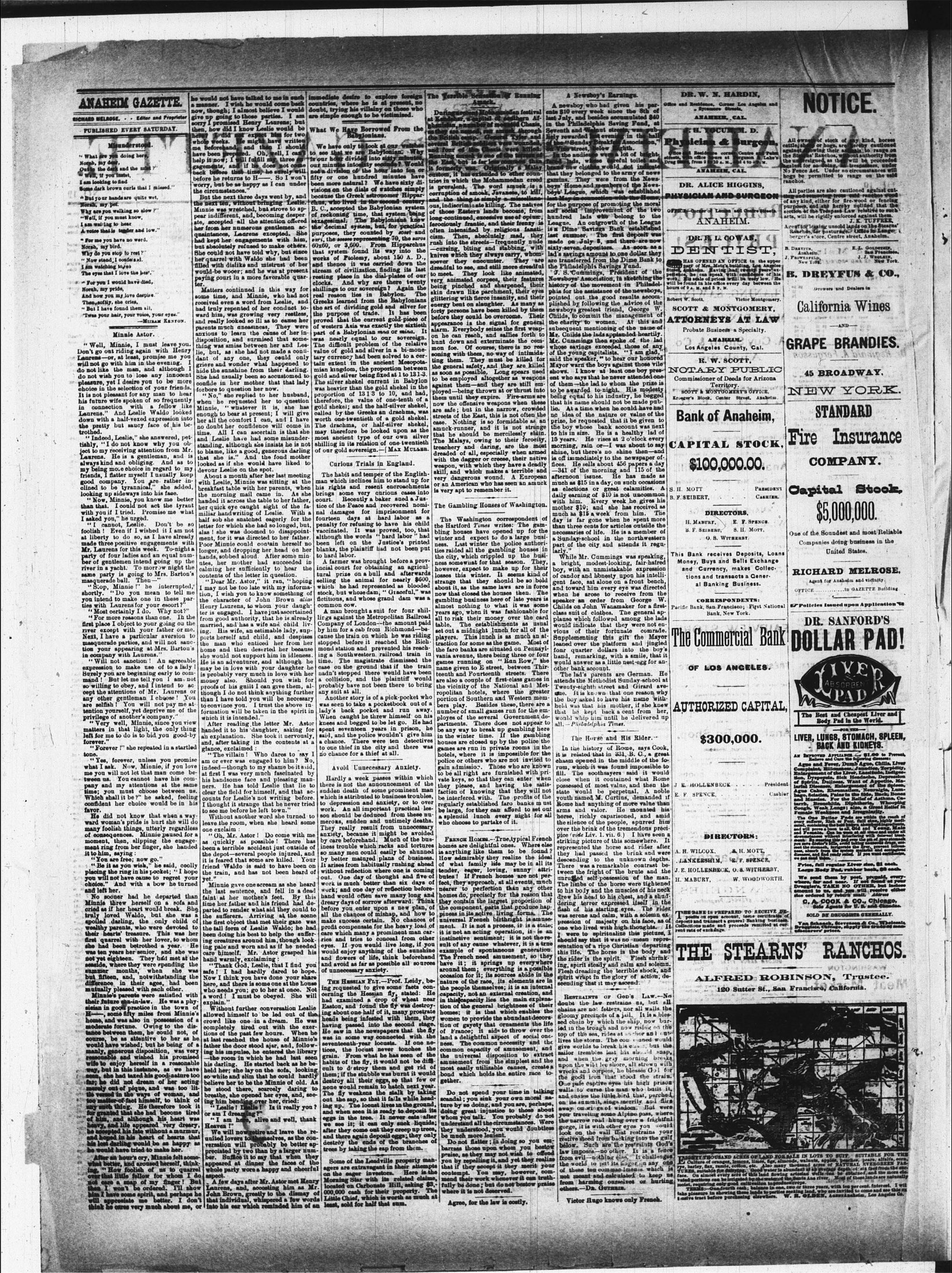
Searchable text
ANAHEIM GAZETTE.
RICHARD MELROSE. - Editor and Proprietor
PUBLISHED EVERY SATURDAY.
Misunderstood.
"What are you doing here, Norah, my dear,
Out to the dark and the mist?"
"Well, if you insist,
I am looking to find
Some dark brown curls that I missed."
"But your hands are quits wet, Norah, my pet.
Why are you walking so slow?"
"Well, if you must know,
I am waiting to hear
A voice that is tender and low."
"For me you have no word, Norah, my bird.
Why do you stop to rest?"
"Now stand, I confess.
I am watching to see
The eyes that I love the best."
"For you I would have died, Norah, my pride,
And now you my love despite."
Than, softly, she cries,
"But I have found them all,
Twas your hair, your voice, your eyes."
—MIRAM KENFON.
Minnie Astor.
"Well, Minnie, I must leave you. Don't go out riding again with Henry Laurens—or, at least, promise me you will not go with him in the evening. I do not like the man, and although I do not wish you to lose any innocent pleasure, yet I desire you to be more choice in the selection of your friends. It is not pleasant for any man to hear his future wife spoken of so frequently in connection with a fellow like Laurens." And Leslie Waldo looked down with a half-vexed expression into the pretty but saucy face of his betrothed.
"Indeed, Leslie," she answered, pettishly, "I do not know why you object to my receiving attention from Mr. Laurens. He is a gentleman, and is always kind and obliging. And as to my being more choice in regard to my friends, I flatter myself. I usually keep he would not have talked to me in such a manner. I wish he would come back now, though; I almost believe I would give up going to those parties. I am sorry I promised Henry Laurens; but then, how did I know Leslie would be here? I did not expect him for two whole weeks. He might have written me beforehand, and then I should have been prepared. Oh, well, I can't help it now; I will fulfill my three engagements, and if he does not come back before that time, he surely will before he returns to H——. So I won't worry, but be as happy as I can under the circumstances."
But the next three days went by, and the next ten, without bringing Leslie. Minnie was wretched, but strove to appear indifferent, and becoming desperate, accepted all the attention offered her from her numerous gentlemen acquaintances. Laurens excepted. She had kept her engagements with him, but absolutely refused to make others. She could not have told why, but since her quarrel with Waldo she had been filled with dislike and mistrust of her would-be wooer; and he was at present paying court in a more favorable quarter.
Matters continued in this way for some time, and Minnie, who had not received even a word from Leslie, and had truly repented of her conduct toward him, was growing very restless, and really looked so ill as to cause her parents much uneasiness. They were anxious to learn the cause of her indisposition, and surmised that something was amiss between her and Leslie, but, as she had not made a candid of any one, they could only grieve and wonder what happened to hide the sunshine from their darling. She had usually been so accustomed to confide in her mother that that lady forbore to question her now.
"No," she replied to her husband, when he requested her to question Minnie, "whatever it is, she has enough to bear at present; I will give her all the comfort I can, and I have no doubt her confidence will come in time. All I can ascertain is that she and Leslie have had some misunderstanding, although she insists he is not to blame, like a good, generous darling that she is." And the fond mother looked as if she would have liked to devour Leslie on the spot.
immediate design countries, where doubt trying his are simple enough.
What We Have Been
We have only to see that we are our hour dividing our minutes into not a division of fifty or one hour been more natural visions on the earth because the Great chus, who lived B. C., accepted of reckoning the sexagesimal. The decimal system purposes, they sorti,the seasons m 60x60,或3,60 that system for works of Ptolemy and thence its stream of civil resting place in clocks. And shillings to our real reason life Greeks learned the art of dividing the purpose o proved that the part of a Baby was nearly ee The difficult value of gold tary currency wtain extent in mian kingdom gold and silver The silver sheer was heavier than proportion of therefore,the gold shekel;a called by the worth one-twelf The drachma;may therefore most ancient shilling in its of our gold so
do not wish you to lose any innocent pleasure, yet I desire you to be more choice in the selection of your friends. It is not pleasant for any man to hear his future wife spoken of so frequently in connection with a fellow like Laurens.” And Leslie Waldo looked down with a half-vexed expression into the pretty but saucy face of his betrothed.
“Indeed, Leslie,” she answered, petishly, “I do not know why you object to my receiving attention from Mr. Laurens. He is a gentleman, and is always kind and obliging. And as to my being more choice in regard to my friends, I flatter myself I usually keep good company. You are rather inclined to be tyrannical,” she added, looking up sideways into his face.
“Now, Minnie, you know me better than that. I could not act the tyrant with you if I tried. Promise me what I asked you,” he urged.
“I cannot, Leslie. Don’t be so foolish! Even if I wished it I am not at liberty to do so, as I have already made three positive engagements with Mr. Laurens for this week. To-night a party of four ladies and an equal number of gentlemen intend going up the river in a yacht. To morrow night the same party is going to Mrs. Barton’s masquerade ball. Then—”
“Stop, Minnie!” he interrupted, shortly. “Do you mean to tell me you intend to make one in these parties with Laurens for your escort?”
“Most certainly I do. Why not?”
For more reasons than one. In the first place I object to your going on the river except with your father or me. Next, I have a particular aversion to masquerade parties, and will not sanction your appearance at Mrs. Barton’s in company with Laurens.”
“Will not sanction! An agreeable expression to make use of to a lady! Surely you are beginning early to command! But let me tell you I am not so willing to obey, and I intend to accept the attentions of Mr. Laurens or any other gentleman I choose! You are selfish! You will not pay me attention yourself, yet deprive me of the privilege of another’s company.”
“Very well, Minnie, since you view matters in that light, the only thing left for me to do is to bid you good-by forever.”
“Forever!” she repeated in a startled tone.
“Yes, forever, unless you promise what I ask. Now, Minnie, if you love me you will not let that man come between us. You cannot have his company and my attentions at the same time; you must choose between us. Which shall it be?” he asked, feeling confident her choice would be in his favor.
He did not know that when a wayward woman’s pride is hurt she will do many foolish things, utterly regardless of consequences. Minnie paused for a moment, then, slipping the engagement ring from her finger, she handed it to him, saying:
“You are free; now go.”
“Be it as you wish,” he said, coolly placing the ring in his pocket; “I hope you will not have cause to regret your choices.” And with a bow he turned and left her.
No sooner had he departed than She had usually been so accustomed to confide in her mother that that lady forbore to question her now.
“No,” she replied to her husband, when he requested her to question Minnie, “whatever it is, she has enough to bear at present; I will give her all the comfort I can, and I have no doubt her confidence will come in time. All I can ascertain is that she and Leslie have had some misunderstanding, although she insists he is not to blame, like a good, generous darling that she is.” And the fond mother looked as if she would have liked to devour Leslie on the spot.
About a month after her last meeting with Leslie, Minnie was sitting at the breakfast table with her parents, when the morning mail came in. As she handed it across the table to her father, her quick eye caught sight of the familiar handwriting of Leslie. With a half sob she snatched eagerly for the letter for which she had so longed, but, alas! she was doomed to disappointment, for it was directed to her father. Poor Minnie could contain herself no longer, and dropping her head on her hands, sobbed aloud. After some minutes, her mother had succeeded in calming her sufficiently to hear the contents of the letter in question.
“Dear Mr. Astor,” it ran, “hoping I may not be too late with my information, I wish you to know something of the character of John Brown alias Henry Laurens, to whom your daughter is engaged. I have just ascertained from good authority, that he is already married, and has a wife and child living. His wife, an estimable lady, supports herself and child, and despises the man who enticed her from her home and then deserted her because she would not support him in idleness. He is an adventurer, and although he may be in love with your daughter he is probably very much in love with her money also. Should you wish for proofs of his guilt I can give them, although I do not think anything further than I have told you will be necessary to convince you. I trust the above information will be taken in the spirit in which it is intended.”
After reading the letter Mr. Astor handed it to his daughter, asking for an explanation. She took it nervously, and, after taking in the contents at a glance, exclaimed:
“The villain! Who dares to say I am or ever was engaged to him? No, indeed—though to my shame be it said, at first I was very much fascinated by his handsome face and pleasing manners. He has told Leslie that lie to clear the field for himself, and that accounts for Leslie’s not writing before. I thought it strange that he never tried to see me before he left town.”
Without another word she turned to leave the room, when she heard some one exclaim:
“Oh, Mr. Astor! Do come with me as quickly as possible! There has been a terrible accident just outside of the depot—several people injured, and it is feared that some are killed. Your friend Waldo is said to have been on the train, and has not been heard of yet.”
Minnie gave one scream as she heard the last sentence, and fell in a dead faint at her mother’s feet. By this gold and silver The silver sheer was heavier than proportion of therefore, the gold sheke; called by the worth one-twist The drachma; may therefore most ancient shilling in its of our gold souls
He did not know that when a wayward woman's pride is hurt she will do many foolish things, utterly regardless of consequences. Minnie paused for a moment, then, slipping the engagement ring from her finger, she handed it to him, saying:
"You are free; now go."
"Be it as you wish," he said, coolly placing the ring in his pocket; "I hope you will not have cause to regret your choice." And with a bow he turned and left her.
No sooner had he departed than Minnie threw herself on a sofa and cried as if her heart would break. She truly loved Waldo, but she was a spoiled darling, the only child of wealthy parents, who were devoted to their hearts' treasure. This was her first quarrel with her lover, to whom she had been betrothed a year. He was ten years her senior, and she was not yet eighteen. They had met at the seaside, where they were spending the summer months, when she was but fifteen, and, notwithstanding the difference in their ages, had been mutually pleased with each other.
Minnie's parents were satisfied with their future son-in-law. He was a physician in good practice in the town of H——, some fifty miles from Minnie's home, and was also in possession of a moderate fortune. Owing to the distance between them, he could not, of course, be as attentive to her as he would have wished; but he being of a manly, generous disposition, was very reasonable and wished his promised wife to enjoy herself in a reasonable way, but in this instance, as we have seen, she had taxed his good nature too far; he did not dream of her acting merely out of pique, and was too lithe vexed in the ways of woman, and too matter-of-fact himself, to think of any such thing. He therefore took it for granted that she had become tired of him, and although his heart was heavy, and life appeared very dreary, he accepted his fate without a murmur, and hoped in his heart of hearts that his last darling would be as happy as he would have tried to make her.
After an hour's cry, Minnie felt somewhat better, and aroused herself, thinking: "How foolish of us to quarrel over that little fellow for whom I do not care a snap of my finger! But then I won't be ordered. I'll show him I have some spirit, and perhaps he will appreciate me better. I don't think he cares very much about me, or counts for Leslie not writing before. I thought it strange that he never tried to see me before he left town."
Without another word she turned to leave the room, when she heard some one exclaim:
"Oh, Mr. Astor! Do come with me as quickly as possible! There has been a terrible accident just outside of the depot—several people injured, and it is feared that some are killed. Your friend Waldo is said to have been on the train, and has not been heard of yet."
Minnie gave one scream as she heard the last sentence, and fell in a dead faint at her mother's feet. By this time her father and his friend had departed to render what aid they could to the sufferers. Arriving at the scene the first object that met their gaze was the tall form of Leslie Waldo; he had been doing his best to help the suffering creatures around him, though looking pale and worn and as if he needed care himself. Mr. Astor grasped his hand warmly, exclaiming:
"Thank God, Leslie, that I find you safe! I had hardly dared to hope. Now I think you have done your share here, and there is some one at the house who needs you; go to her at once. Not a word! I must be obeyed. She will explain."
Without further conversation Leslie allowed himself to be led out of the crowd like one in a dream. He was completely tired out with the exertions of the past few hours. When he at last reached the house of Minnie's father the door stood ajar, and following his impulse, he entered the library—the room in which he had last seen his darling. He started back as he held her; she lay on the sofa, looking so white and slim that he could hardly believe her to be the Minnie of old. As he stood there, scarcely daring to breathe, she opened her eyes, and seeing him bending over her, cried:
"Leslie! Leslie! Is it really you? or am I dreaming?"
"I am here, alive and well, thank Heaven!"
We will now retire and leave the reunited lovers to themselves, as the conversation will probably be better appreciated by two than by a larger number. Suffice it to say that when they appeared at dinner the faces of the whole party wore a happy and cheerful aspect.
A few days after Mr. Astor met Henry Laurens, and accompanying him as Mr. John Brown, greatly to the dismay of that individual, whispered a few words into his ear which reminded him of an
What We Have Borrowed From the Babylonians.
We have only to look at our watches to see that we are Babylonian. Why is our hour divided into sixty minutes, our minutes into sixty seconds? Would not a division of the hour into ten or fifty or one hundred minutes have been more natural? We have sixty divisions on the dials of watches simply because the Greek astronomer Hipparchus, who lived in the second century B.C., accepted the Babylonian system of reckoning time, that system being sexagesimal. The Babylonians knew the decimal system, but, for practical purposes, they counted by soot and sirt, the soot representing 70, the seros 60x60, or 3,600. From Hipparchus that system found its way into the works of Ptolemy, about 150 A.D., and thence it was carried down the stream of civilization, finding its last resting place in the dial-plates of our clocks. And why are there twenty shillings to our sovereign? Again the real reason lies in Babylon. The Greeks learned from the Babylonians the art of dividing gold and silver for the purpose of trade. It has been proved that the current gold-piece of western Asia was exactly the sixtieth part of a Babylonian mina or mina. It was nearly equal to our sovereign. The difficult problem of the relative value of gold and silver in a bi-monetary currency had been solved to a certain extent in the ancient Mesopotamian kingdom, the proportion between gold and silver being fixed at 1 to 131-3. The silver shekel current in Babylon was heavier than the gold shekel in the proportion of 131/3 to 10, and had, therefore, the value of one-tenth of a gold shekel; and the half-silver shekel, called by the Greeks an drachma, was worth one-twentieth of a gold shekel. The drachma, or half-silver shekel, may therefore be looked upon as the most ancient type of our own silver shilling in its relation of one-twentieth of our gold sovereign.—[Max Muller]
Curious Trials in England.
The habit and temper of the English
The Terrible Sensation Of Running Attack.
During ancient Mohammedan festival at Kandahar, a capital of southern Afghanistan, a number of mounted Chassis, as they are named, run amok through the British camp. General Tyler and several British soldiers were wounded, and four of the Chassis were killed. Running attack is one of the turms of the East, but is far less common than it formerly was. Originally a Malay custom, it has extended to other countries in which the Mohammedan creed is prevalent. The word amuck is a corruption of amoak, Javanese, to kill, and the thing is simply a miscellaneous, indiscriminate killing. The natives of those Eastern lands become, from long-continued, excessive use of opium, ferociously frantic, and their frenzy is often intensified by religious fanaticism. Then, absolutely mad, they rush into the streets—frequently nude—cursing, biting and stabbing, with knives which they always carry, whom-soever they encounter. They are dreadful to see, and still more dreadful to meet. They look like animated, very animated corpses, their features being pinched and sharpened, their skin drawn like parchment, their eyes glittering with fierce insanity, and their energy bent on slaughter. As many as forty persons have been killed by them before they could be overcome. Their appearance is the signal for general alarm. Everybody seizes the first weapon he can reach, and sallies forth to hunt down and exterminate the common foe. Of course, there is no reasoning with them, no way of intimidating them. They must be killed for the general safety, and they are killed as soon as possible. Long spears used to be employed altogether as weapons against them—and they are still employed—being thrown at or thrust into them until they expire. Fire-arms are now the offensive weapons when these are safe; but in the narrow, crowded streets of the East, this is not often the case. Nothing is so formidable as an amuck-runner, and it is not strange that he should be mercilessly shain. The Malays, owing to their ferocity, treachery and daring, are the most dreaded of all, especially when armed with the dagger or creese, their native weapon, with which they have a deadly skill, and which makes a terrible and
A Newsboy's Earnings.
A newsboy who had given his parents $10 every week since the 8th of last July, and besides accumulated $40 in the Philadelphia Savings Fund, at Seventh and Walnut streets, was publicly rewarded last evening in the hall of the "Sunday Breakfast Association," on Vine street below Eighth.
In the audience were a lot of bright-faced lads whose careful toilet and brand new clothes would not indicate that they belonged to the army of news gamins. They were from the Newsboys' Home and members of the Newsboys' League, which was established last May in connection with the Home; for the purpose of promoting the moral and social improvement of the two hundred lads who belong to the League. An outgrowth of the League is a Dime Savings Bank established last summer. The first deposit was made on July 8, and there are now sixty-seven depositors. As soon as a lad's savings amount to one dollar they are transferred from the Dime Bank to the Philadelphia Savings Fund.
J. S. Cummings, President of the Newsboys' Association, in sketching the history of the movement in Philadelphia for the assistance of the newsboys, pointed out the good results accomplished by following the advice of the newsboys greatest friend, George W. Childs, to commit the management of the charity to women. At this and subsequent mentioning of the name of Mr. Childs the lads applauded heartily. Mr. Cummings then spoke of the lad whose savings exceeded those of any of the young capitalists. "I am glad," said the speaker," to hear our honored Mayor warn the boys against those vile shows. I know at least one boy present who says that he never attended one of them—the lad to whom the prize is to be awarded to night. His modesty being equal to his industry, he begged that his name should not be made public. At a time when he could have had no idea of the nature or value of the prize, he requested that it be given to the boy whose bank account was next to his in size. He is a healthy lad of 15 years. He rises at 2 o'clock every morning, rain or—I was about to say shine, but there's no shine then—and is off immediately to the newspaper offices. He sells about 456 papers a day—341 of the morning and 115 of the
The silver shekel current in Babylon was heavier than the gold shekel in the proportion of 1313 to 10, and had, therefore, the value of one-tenth of a gold shekel; and the half-silver shekel, called by the Greeks an drachma, was worth one-twentieth of a gold shekel. The drachma, or half-silver shekel, may therefore be looked upon as the most ancient type of our own silver shilling in its relation to one-twentieth of our gold sovereign.—[Max Muller.
Curious Trials in England.
The habit and temper of the Englishman which inclines him to stand up for his rights and resent encroachments brings some very curious cases into court. Recently a baker sued a Justice of the Peace and recovered nominal damages for imprisonment for fourteen days at hard labor as a penalty for refusing to have his child vaccinated. It was proved, too, that although the words "hard labor" had been left on the Justice's printed blanks, the plaintiff had not been put to hard labor.
A farmer was brought before a provincial court for obtaining an agricultural prize on a bull and afterwards selling the animal for nearly $600, which he had represented as blooded stock, but whose dam, "Graceful," was fictitious, and whose grand dam was a common cow.
A man brought a suit for four shillings against the Metropolitan Railroad Company of London—the amount paid by him for a cab from Richmond—because the train on which he was riding stopped before it reached the Richmond station and prevented his reaching a Southwestern railroad train in time. The magistrate dismissed the case on the ground that if the train hadn’t stopped there would have been a collision, and the plaintiff would probably have not been there to bring any suit at all.
Another story is of a pick-pocket who was seen to take a pocketbook out of a lady’s back pocket and run away. When caught he threw himself on his knees and begged to be let go. He had spent seventeen years in prison, he said, and the police wouldn’t give him a chance. There were ten detectives to one thief in the city and there was no chance for a thief at all.
Avoid Unnecessary Anxiety.
Hardly a week passes within which there is not the announcement of the sudden death of some prominent man which is attributed to business troubles, to depression and anxiety, or to over work. An all important practical lesson should be deduced from these numerous, sudden and untimely deaths. They really result from unnecessary anxiety, because it might be avoided by care beforehand. Much of the business trouble which racks and tortures so many men could easily be shunned by better matured plans of business. It arises from habitually rushing ahead without reflection where one is coming out. One day of thought and five of work is much better than six days of work; and one day of reflection before-hand would often save many long and to be employed altogether as weapons against them—and they are still employed—being thrown at or thrust into them until they expire. Fire-arms are now the offensive weapons when these are safe; but in the narrow, crowded streets of the East, this is not often the case. Nothing is so formidable as an amuck-runner, and it is not strange that he should be mercilessly slain. The Malays, owing to their ferocity, treachery and daring, are the most dreaded of all, especially when armed with the dagger or creepe, their native weapon, with which they have a deadly skill, and which makes a terrible and very dangerous wound. A European or an American who has seen an amuck is very apt to remember it.
The Gambling Houses of Washington.
The Washington correspondent of the Hartford Times writes: The gambling houses have opened up for the winter and expect to do a large business. Last winter the police authorities raided all the gambling houses in the city, which crippled up the business somewhat for that season. They however, expect to make up for their losses this winter. It seems kind of strange that they should be so bold about it, as the same laws are in force now that closed the houses then. The gambling business here of late years is almost nothing to what it was some years ago, when it was fashionable for all to risk their money over the card table. The establishments as usual set out a midnight lunch for all of the players. This lunch is as much an attraction for some as the game. Most of the faro banks are situated on Pennsylvania avenue, there being three or four games running on "Run Row," the name given to E street, between Thirteenth and Fourteenth streets. There are also a couple of first-class games in the vicinity of the National and Metropolitan hotels, where the greater portion of Southern and Western members play. Besides these, there are a number of small games run for the employees of the several Government departments. There does not appear to be any way to break up gambling here in the winter time. If the gambling houses are closed up by the police or others who are not invited to gain admission. Those who are known to be all right are furnished with private keys, so that they can enter when they please, and having the satisfaction of knowing that they will not be interfered with. The profits of the regularly established faro banks must be large, for they can afford to set out a splendid lunch every night for all who choose to partake of it.
French Homes...True, typical French homes are delightful ones. Where else is anything like them to be found? How admirably they realize the ideal of what family life may be in all its tender, eager, loving, sunny attributes! If French homes are not perfect, they approach, at all events, much nearer to perfection than any other homes do, precisely for the reason that ent who says that he never attended one of them—the lad to whom the prize is to be awarded to night. His modesty being equal to his industry, he begged that his name should not be made public. At a time when he could have had no idea of the nature or value of the prize, he requested that it be given to the boy whose bank account was next to his size. He is a healthy lad of 15 years. He rises at 2 o'clock every morning, rain or—I was about to say shine, but there's no shine then—and is off immediately to the newspaper offices. He sells about 456 papers a day—341 of the morning and 115 of the afternoon issues. He has made as much as $15 in a day, on such occasions as elections or great calamities. A daily earning of $10 is not uncommon with him. Every week he gives his mother $10; and she has received as much as $15 a week from him. The day is far gone when he spent more than three cents for articles outside the necessaries of life. He is a member of a Sunday-school in the northwestern part of the city and attends it regularly."
While Mr. Cummings was speaking, a bright, modest-looking, fair-haired boy, with an unmistakable expression of candor and honeyness upon his intelligent face, sat alone on a front bench, and toward him every eye was directed when he arose to receive from the speaker an order from George W. Childs on John Wanamaker for a first-class suit of clothes. The general applause which followed among the lads would indicate that they were not envious of their fortunate comrade. Supplementing this gift the Mayor leaned over the platform and jingled four quarter dollars into the boy’s hand, remarking, with a smile, that it would answer as a little nest-egg for another bank account.
The lad’s parents are German. He attends the Methodist Sunday-school at Twenty-eighth street and Girard avenue. It is known that one reason why the boy asked to have his name withheld was that his mother, if she knew that he kept back a cent from her, would whip him until he delivered up all.—Philadelphia Times.
The Horse and His Rider.
In the history of Rome, says Cook, it is related that in 831 B.C., a great chasm opened in the middle of the forum, which it was found impossible to fill. The soothsayers said it would close when it contained what Rome possessed of most value, and then the state would be perpetual. A noble youth named M. Curtius, demanded if Rome had anything of more value than arms and valor. He mounted his horse, richly caparisoned, and amid the silence of the people, spurred him over the brink of the tremendous precipice (vide Liv. 1.vii. 6.) I have seen a striking picture of this somewhere. It represented the horse and rider after they had passed the brink and were descending to the unknown depths. There was a remarkable contrast between the fright of the brute and the unruffled self-possession of the man. The limbs of the horse were tightened to his body and the muscles of his neck drew his head to his chest, and a shud-
There has been a great outside of injury and mallet. Your have been on keen heard of as she heard all in a dead at. By this end had deceived they could to the scene their gaze was salo; he had so the suffer though look he needed his grasped his that I find you need to hope. Be your share at the house that once. Not sad. She will station Leslie out of the arm. He was with the exercius. When he be of Minnie's and follow, followed the library last seen back as he befoa, looking should hardly hide of old. As daring to eyes, and see cried: it really you?
Well, thank leave the recess, as the cone be better ap- larger num- when they faces of the and cheerful for met Henry him as Mr. the dismay of a few words ded him of an
The Hessian Fly.—Prof. Leidy, being requested to give some facts concerning the Hessian fly, stated: He had examined a crop of wheat near Easton, and found the fly was destroying about one-half of it, many prostrate heads being infested with them, they having passed into the second stage. He saw in the newspapers that the fly was in some way connected with the seventeenth-year locusts. If one notices, the locust never touches the grain. From what he has seen of the habits of the fly, it would not be difficult to destroy them and get rid of them; if the stubble was burnt it would destroy all their eggs, so that few or none would remain to hatch next year. The fly weakens the stalk by taking out the sap, so that it falls while heading up. The locust lives in the ground, and when seen it is ready to deposit its eggs in the tree. It never eats after we see it; it can only suck liquids; after they come out they creep up trees, and there again deposit eggs; they only destroy the ends of the branches of trees by taking the sap from them.
Some of the Leadville property managers are extravagant in their attempts on the eager investors. Here is the Morning Star with its related claims, located on Carbonate Hill, asking $3.,000,000 cash for their property. The Little Chief, which is worth as much at least, sold for half that sum.
French Homes.—True, typical French homes are delightful ones. Where else is anything like them to be found? How admirably they realize the ideal of what family life may be in all its tender, eager, loving, sunny attributes! If French homes are not perfect, they approach, at all events, much nearer to perfection than any other homes do, precisely for the reason that they contain the largest proportion of the component parts that produce happiness in its active living forms. The universal French birthright is amusement. It is not a process, it is a state; it is not an acting operation, it is an instinctive sentiment; it is not the result of any cause whatever, it is a true example of spontaneous generation. The French need amusement, so they have it; it springs up everywhere around them; everything is a possible occasion for it; its sources abide in the nature of the race, its elements are in the people themselves; it is an internal capacity, not an external creation, and in this capacity lies the main explanation of the general brightness of their homes; it is that which enables the women to provide the abundant decoration of gayety that ornaments the life of France; it aids to throw over the land a delightful aspect of social ones. The common necessity and the common capacity of amusement, and the universal disposition to extract amusement from the simplest and the most easily utilizable causes, create a bond which holds the entire race together.
Do not spend your time in talking scandal; you sink your own moral nature by so doing, and you are, perhaps, doing great injustice to those about whom you talk. You probably do not understand all the circumstances. Were they understood, you would doubtless be much more lenient.
Do not flatter; in doing so you embarrass those upon whom you bestow praise, as they may not wish to offend you by repelling it, and yet they realize that if they accept it they merit your contempt. You may, however, commend their work whenever it can truthfully be done; but do not bestow praise where it is not deserved.
Agree, for the law is costly.
Victor Augo knows only French.
DR. W. N. HARDIN,
Office and Residence, Corner Los Angeles and
Rycamore Streets,
ANAHEIM, CAL.
J. H. YOCUM, M. D.
Physician & Surgeon,
Office and Residence corner Centre and Palm
streets, with office hours at Pergamon & Lake's
Drug Store, from 9 to 10 A.M., and 4 to 5 P.M.
ANAHEIM, CAL.
DR. ALICE HIGGINS,
PHYSICIAN AND SURGEON
OFFICE—Corner of Lamen and Centre Streets.
ANAHEIM.
DR. R. L. COWAN,
DENTIST,
HAS OPENED AN OFFICE in the upper
part of Mrs. Metra's building, Los Angeles
Street, Anaheim. Having had twenty years' expience, he can speak with confidence of his
work. His scale of prices will be very low. He
will be found in his office every day between the
hours of 9 A.M. and 5 P.M.
Robert W. Scott, Victor Montgomery.
SCOTT & MONTGOMERY,
ATTORNEYS AT LAW
Probate Business a Specialty.
ANAHEIM.
Los Angeles County, Cal.
R. W. SCOTT,
NOTARY PUBLIC
Commissioner of Deeds for Arizona Territory.
SCOTT & MONTGOMERY'S OFFICE,
Kroeger's Block, Center Street, Anaheim.
Bank of Anaheim,
CAPITAL STOCK,
$100,000.00.
NOTICE.
All owners of stock of any kind, horses cattle, sheep or hogs, are hereby cautioned against showing their animals to range on the Stearns' Ranchos without authority from the undersigned, as they will be proceeded against for so doing, in trespassers, under No Fence Act. Under no circumstances will hogs be permitted to range on the said ranchos.
All parties are also cautioned against cutting and removing from wild ranches wood of any kind, either for fire-wood or fencing purposes, and are hereby notified that the section of the Trepass Law relative to such acts, will be rigidly enforced against them.
Agree for leasing unsold lands on the Stearns' Ranchos, for pasturage. Office in Langeberger's store, Centre street, Anaheim.
B. DREYFUS,
Anaheim.
E. L. GOLDSTEIN,
San Francisco.
J. FROWSFIELD,
New York.
B. DREYFUS & CO.,
Drowers and Dealers in
California Wines
AND
GRAPE BRANDIES.
45 BROADWAY.
NEW YORK.
STANDARD
Fire Insurance COMPANY.
Bank of Anaheim,
CAPITAL STOCK,
$100,000.00.
S. H. MOTT
President
B. F. SEIBERT,
Cashier
DIRECTORS:
H. MABURY,
E. F. SPENCE.
B. F. SEIBERT,
S. H. MOTT,
O. S. WITHERBY.
This Bank receives Deposits, Loans Money, Buys and Sells Exchange and Currency, makes Collections and transacts a General Banking Business.
CORRESPONDENTS:
Pacific Bank, San Francisco; First National Bank, New York.
The Commercial Bank
OF LOS ANGELES.
AUTHORIZED CAPITAL,
$300,000.
J. E. HOLLENBECK
Präsident
E. F. SPENCE,
Cashier
DIRECTORS:
A. H. WILCOX,
S. H. MOTT,
LANKERSHIM,
E. F. SPENCE,
J. E. HOLLENBECK, O. S. WITHERBY,
H. MABURY,
W. WOODWORTH.
NEW YORK.
STANDARD Fire Insurance COMPANY.
Capital Stock,
$5,000,000.
One of the Soundest and most Reliable Companies doing business in the United States.
RICHARD MELROSE,
Agent for Anaheim and vicinity.
OFFICE...in GAZETTE Building.
Policies Issued upon Application
DR. SANFORD'S DOLLAR PAD!
The Best and Cheapest Liver and Body Pad in the World.
LIVER, LUNGS, STOMACH, SPLEEN, BACK AND KIDNEYS.
An Improved Appliance $1.00 to Prevent Believe and Care the following diseases:
Agne and Fever, Dumb Ague, Chills, Livus Complaint, Billionsense, Jaundice, Tocpidity, Enlargement of the Liver, Lasthade, Indigestion, Dysporsia, Stick Headache, Depression of Spirits, Duliness, Want of Appetite, Malarial Disease, Enlargement of the Spleen, Agnes Cake, Rheumatism, Neuralgia, Lumbargage, Sciatica, Pain in the Side, Back, Bones and Muscles.
For the Relief of Asthma, Cararthrine, Bronchitis, Diaphtheria, Whoooping Cough, Weak Lungs; also a Great Relief in Female Weakness and Irregularity.
The One Dollar Pads are within the reach of every sufferer Risk a Poor Call short highly medicated, excluding the best known abbreviations, and will prove a boon to all Old and Young, Male and Female.
Can he wear at all times and under all circumstances without interfering with future treatments that pad gives the patient stomach you have doctor's Will avoid taking numerous drugs, correct the stomach, invigorate the liver, prevent biliousness, absorb from the system material and contiguous diseases, and find ready relief. If you want continuation we can send them.
Price, full regular Liver due, $1 each.
Large Body Pad, rubber back, $2 each.
We send them by post, propaid everywhere far and near. If found at your Druggist's TAKE NO OTHER but indoles amount to us, and you will receive either also ordered by return mail. Address
DIRECTORS:
A. H. WILCOX, S. H. MOTT,
LANKERSHIM, E. F. SPENCE,
J. E. HOLLENBECK, O. S. WITHERBY,
H. MABURY, W. WOODWORTH.
THE BANK IS PREPARED TO RECEIVE DEPOSITS ON OPEN ACCOUNT, ISSUE CERTIFICATES OF DEPOSITS AND TRANSIT A GENERAL BANKING BUSINESS. COLLECTIONS MADE AND PROCEDURES REMITTED AT CURRENT RATE OF EXCHANGE.
THE STEARNS' RANCHOS.
ALFRED ROBINSON, Trustee.
120 Sutter St., San Francisco, California.
EIGHTY THOUSAND ACRES OF LAND FOR SALE IN LOTS TO SUIT. SUITABLE FOR THE Culture of oranges, lemons, limes, figs, almonds, walnuts, apples, pears, alfalfa, corn, rye, barley, flax, ramie, cotton, etc. Also many thousand acres of NATURAL EVERGREEN FARMS, suitable for drying. Good water is abundant at six feet from the surface. On almost every acre of this land flowing artesian wells can be obtained, and the more elevated portions can be irrigated by the waters of the Santa Ana river. Most of these lands are naturally moist, requiring only good cultivation to produce crops.
TERMS—One-fourth cash; balance in one, two or three years, with ten per cent. interest. I will take pleasure in showing these lands to parties seeking land, who are invited to come and see this extensive tract before purchasing elsewhere. W. H. OLDEN, AGENT ANAHEIM, Los Angeles Co.