anaheim-gazette 1880-02-14
Scanned page
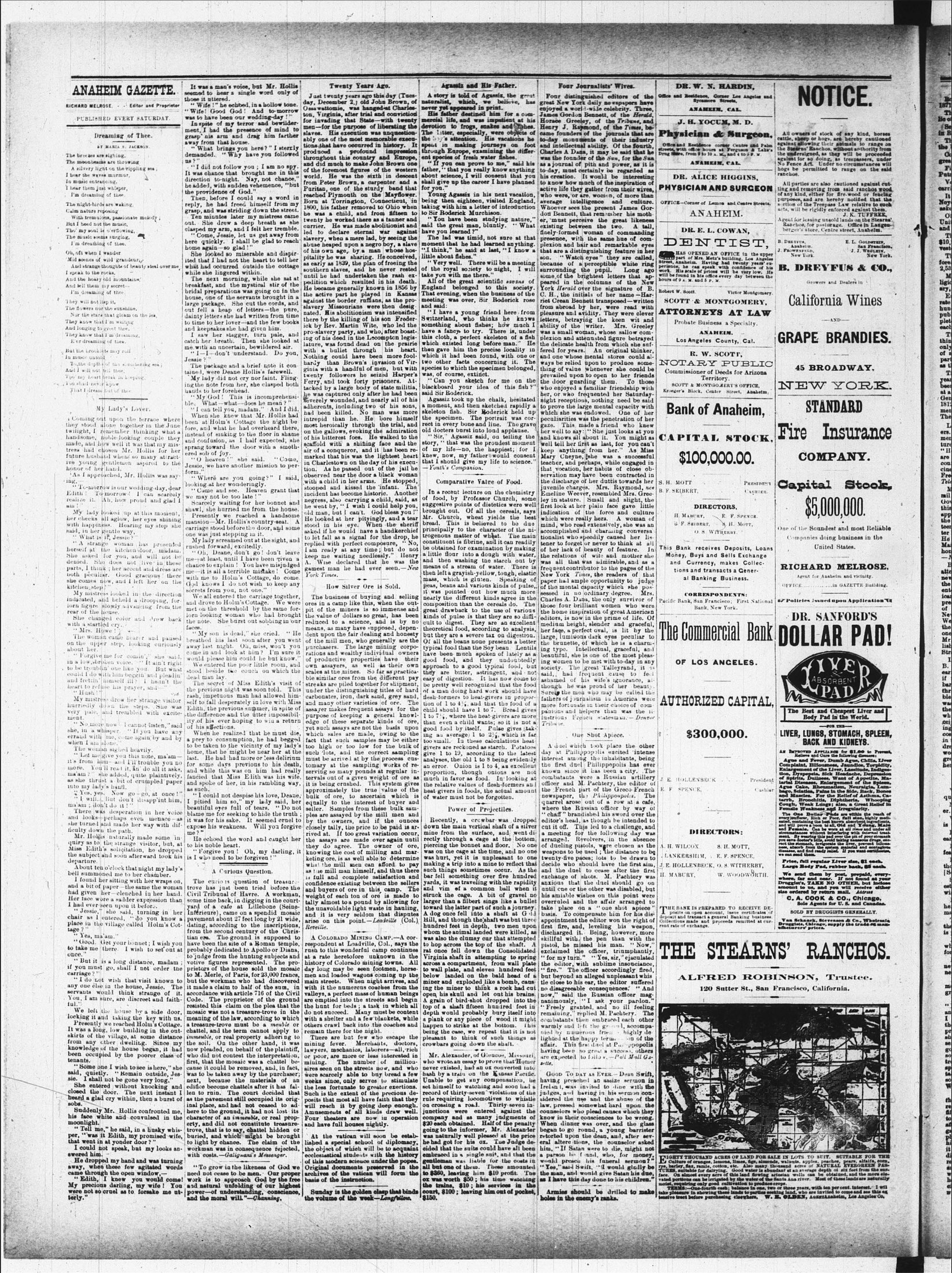
Searchable text
ANAHEIM GAZETTE.
RICHARD MELROSE. Editor and Proprietor
PUBLISHED EVERY SATURDAY.
Dreaming of Thee.
BY MARIA E. JACKSON.
The breezes are sighing.
The moonbeams are throwing
A silvery light on the rippling sea;
I hear the waves murmur,
In music entrancing,
I hear them just whisper,
I'm dreaming of thee.
The night-birds are waking,
Calm nature reposing
With tremulous, passionate melody;
But I beed not the music,
Tho' my soul is overflowing,
The music seems surging,
I'm dreaming of thee.
Oh, oft when I wander
Mid scenes of wild grandeur,
And strange thoughts of beauty steal over me,
I speak to the rocks,
And the hoary old mountains,
And well them my secret—
I'm dreaming of thee.
They will not hap it,
The flowers nor the sunshine,
Nor the stars that gleam on the lea,
They know that I'm waiting
And longing to greet thee,
They know that I'm dreaming,
Ever dreaming of thee.
But the brooklets may roll
In music untold
To the depths of the summerting sea;
And I will not tell thee,
Too my heart break in keeping.
You shall never know
That I dream out of thee.
My Lady's Lover.
Coming out upon the terrace where they stood alone together in the June twilight, I remember thinking what a handsome, noble-looking couple they made, and how well it was that my mistress had chosen Mr. Hollis for her future husband when so many attractive young gentlemen aspired to the honor of her hand.
As I approached Mr. Hollis, it was a man's voice, but Mr. Hollis seemed to hear a single word only of those it uttered.
"Wife!" he echoed, in a hollow tone.
"Wife! Good God! And to-morrow was to have been our wedding-day!"
In spite of my terror and bewilderment, I had the presence of mind to grasp his arm and drag him farther away from that house.
"What brings you here?" I sterrily demanded. "Why have you followed us?"
"I did not follow you; I am no spy. It was chance that brought me in this direction to-night. Nay, not chance," he added, with sudden vehemence, "but the providence of God."
Then, before I could say a word in reply, he had freed himself from my grasp, and was striding down the street.
Ten minutes later my mistress came out. She drew a deep breath as she clasped my arm, and I felt her tremble.
"Come, Jessie, let us get away from here quickly. I shall be glad to reach home again—so glad!"
She looked so miserable and dispirited that I had not the heart to tell her what had occurred outside the cottage while she lingered within.
The next morning, while she sat at breakfast, and the mystical stir of the bridal preparations was going on in the house, one of the servants brought in a large package. She cut the cords, and out fell a heap of letters—the pure, dainty letters she had written from time to time to her lover—and the few books and keepsakes she had given him.
I saw her stagger, turn pale, and catch her breath. Then she looked at me with an uncertain, bewildered air.
"I-I—don't understand. Do you, Jessie?"
The package and a brief note it contained, were Deane Hollis's farewell.
My lady did not cry nor faint. Flinging the note from her, she clasped both hands to her forehead.
"My God! This is incomprehensible. What—what—does he mean?"
"I can tell you, madam." And I did.
When she knew that Mr. Hollis had been at Holm's Cottage the night before, and what he had overheard there, instead of sinking to the floor in shame and confusion, as I half expected, she sprang toward the door with a smothered sob of joy.
"O heaven!" she said. "Come, Jessie, we have another mission to perform."
Twenty years after twenty day, December 21st, Ossawattomie, wrote to ton, Virginia, after for invading that men—for the purity slaves. His executiveably one of the masters that have owed produced a pro- throughout this city and did much to mark of the foremost fight world. He was taken from Peter Brown Puritan, one of the reached Plymouth Born at Torrington 1800, his father relied on him as a child; twenty he worked currier. He was led to declare slavery, when a male abuse heaped upon his own age, but pitality he was sheared as early as 1839, the southern slaves, until he had underpled it by Rev. Martin Pro-slavery party; ing of his deed in lature, was found with a bullet thru Nothing could hurt hardly than Brown with a hand twenty followers Ferry, and took it tacked by a large he was captured or severely wounded adherents, including had been killed. Intrepid than he most heroically threw on the gallows, even of his bitterest foot scaffold with a sigh of a conqueror marked that his wife in Charlestown orion. As he passed observed near the
My Lady's Lover.
Coming out upon the terrace where they stood alone together in the June twilight, I remember thinking what a handsome, noble-looking couple they made, and how well it was that my mistress had chosen Mr. Hollis for her future husband when so many attractive young gentlemen aspired to the honor of her hand.
As I approached, Mr. Hollis was saying,
"To morrow is our wedding day, dear Edith! To morrow! I can scarcely realize it. Ah, how proud and glad I am!"
My lady looked up at this moment, her cheeks all aglow, her eyes shining with happiness. Hearing my step she said, in her gentle way,
"What is it, Jessie?"
"A strange woman has presented herself at the kitchen door, madam. She asked for you, and will not be denied. She does not live in these parts, I think; her accent and dress are both peculiar. Good gracious! there she comes now, and I left her on the kitchen step!"
My mistress looked in the direction indicated, and beheld a drooping, forlorn figure slowly advancing from the rear of the house.
She changed color and drew back with a startled cry.
"Mrs. Howe!"
The woman came nearer and paused on the upper step, looking curiously about her.
"Forgive me for comin'," she said, in a low, broken voice. "It ain't right to be troubled one like you. But what could I do with him begind and pleadin' and frettin' himself ill? I hain't the heart to refuse his prayer, and—"
"Hush!"
My mistress drew her strange visitor hurriedly down the steps. She was very pale, and trembled with excitement.
"No more now—I cannot listen," said she, in a whisper. "If you have any errand with me, come again by and by when I am alone."
The woman sighed heavily.
"Let me give you this note, ma'am—it's from him—and I'll trouble you no more. You'll read it, an do all it asks, ma'am?" she added, quite plaintively, as she thrust a bit of crumpled paper into my lady's hand.
"Yes, yes. Now go—go, at once!"
"I will. But don't disappoint him, ma-am; don't do it!"
There was desperation in her voice and looks—perhaps even monace—as she turned and made her way with difficulty down the path.
Mr. Hollis naturally made some inquiry as to the strange visitor, but, at Miss Edith's solicitation, he dropped the subject and soon afterward took his departure.
About ten o'clock that night my lady's bell summoned me to her chamber.
I found her sitting with her wraps on, and a bit of paper—the same the woman had given her—clenched in her hand. Her face wore a sad expression then.
My lady did not cry nor faint. Flinging the note from her, she clasped both hands to her forehead.
"My God! This is incomprehensible. What—what—does he mean?"
"I can tell you, madam." And I did.
When she knew that Mr. Hollis had been at Holm's Cottage the night before, and what he had overheard there, instead of sinking to the floor in shame and confusion, as I half expected, she sprang toward the door with a smothered sob of joy.
"O heaven!" she said. "Come, Jessie, we have another mission to perform."
"Where are you going?" I said, looking at her wonderingly.
"Come and see. Heaven grant that we may not be too late!"
Scarcely waiting for her bonnet and snail, she hurried me from the house.
Presently we reached a handsome mansion—Mr. Hollis's country-seat. A carriage stood before the door, and some one was just stepping in it.
My lady screamed out at the sight, and rushed forward, excitedly.
"Oh, Deane, don't go! don't leave me—at least, until I have been given a chance to explain! You have misjudged me—it is all a terrible mistake! Come with me to Holm's Cottage, do come. God knows I do not wish to keep any secrets from you, not one."
We all entered the carriage together, and drove to Holm's Cottage. We were met on the threshold by the same forlorn looking woman who had brought the note. She burst out sobbing in our faces.
"My son is dead," she cried. "He breathed his last soon after you went away last night. Oh, miss, won't you come in and look at him? I'm sure it would please him could he but know."
We entered the poor little room, and stood beside the couch on which the dead man lay.
The secret of Miss Edith's visit of the previous night was soon told. This rush, impetuous man had allowed himself to fall desperately in love with Miss Edith, the previous summer, in spite of the difference and the utter impossibility of his ever hoping to win a return of his affections.
When he realized that he must die, a prey to consumption, he had begged to be taken to the vicinity of my lady's home, that he might be near her at the last. He had had more or less delirium for some days previous to his death, and while this was on him had really fancied that Miss Edith was his wife, and spoke of her, in his rambling way, as such.
"I could not despise his love, Deane; I pitied him so," my lady said, her beautiful eyes full of tears. "Do not blame me for seeking to hide the truth; it was for his sake. It seemed cruel to expose his weakness. Will you forgive me?"
He echoed the word and caught her to his noble heart.
"Forgive you! Oh, my darling, it is I who need to be forgiven!"
A Curious Question.
The curious question of treasure trove has just been tried before the Civil Tribunal of Havre. A workman,
twenty followers Ferry, and took by a large he was captured or severely wounded adherents, including had been killed. intrepid than he most heroically on the gallows, even of his bitterest foil scaffold with a air of a conqueror marked that his wrist in Charlestown orientation. As he passed observed near them with a child in her stooped and kissed incident has become necgress, also carried he went by. "I was old man, but I can He looked at her stood in his eye asked if he would let fall as a sign replied with perfect I am ready at an keep me waiting A. Wise declared gamest man he York Times.
How Silver
The business ores in a camp lily pit of the mine reduced to a scant means, as many benthent upon the faim of the mill men,purchasers.The rations and wealthof productive prunewassayers,a scales at the mines similar ores frst streaks are piled under the disting carbonates, iron,and many other vassayer makes free purpose of keeping edge of these seeyet such assays arewhich sales arefact that such seo too high or too much lots,andmust be arrived tomary at the sideserving so many terrvals out of a gifit is being crushedapproximately th bulk of ore,toughequally tothe n seller.Samples plies are assayed bythe owners,cloosely tally,the riveted at. If toothe assays are notthey do agree knowing the costketing ore.is aswwhatthe mill manasfull and compconfidence existingbuyers of oreweight of each ton
"I will... but don't disappoint him, ma'am; don't do it!"
There was desperation in her voice and looks—perhaps even menace—as she turned and made her way with difficulty down the path.
Mr. Hollis naturally made some inquiry as to the strange visitor, but, at Miss Edith's solicitation, he dropped the subject and soon afterward took his departure.
About ten o'clock that night my lady's bell summoned me to her chamber.
I found her sitting with her wraps on, and a bit of paper—the same the woman had given her—clenched in her hand. Her face wore a sadder expression than I had ever seen upon it before.
"Jessie," she said, turning in her chair as I entered, "do you know a place in the village called Holm's Cottage?"
"Yes, ma'am."
"Good. Get your bonnet; I wish you to take me there. I wish to set out at once."
"But it is a long distance, madam; if you must go, shall I not order the carriage?"
"I do not wish that visit known to any one else in the house, Jessie. The servants would think strange of it. You, I am sure, are discreet and faithful."
We left the house by a side door, locking it and taking the key with us.
Presently we reached Holm's Cottage. It was a long, low building in the outskirts of the village, at some distance from any other dwelling. Since my knowledge of the house began, it had been occupied by the poorer class of tenants.
"Some one I wish to see is here," she said, quietly. "Kemain outside, Jessie. I shall not be gone very long."
She entered without knocking and closed the door. The next instant I heard a glad cry within, then a burst of sobs.
Suddenly Mr. Hollis confronted me, his face white and convulsed in the moonlight.
"Tell me," he said, in a husky whisper, "was it Edith, my promised wife, that went in at yonder door?"
I could not speak, but my looks answered him.
He dropped my hand and was turning away, when these few agitated words came through the open window,
"Edith, I knew you would come! My precious darling, my wife! You were not so cruel as to forsake me utterly."
I pitied him so," my lady said, her beautiful eyes full of tears. "Do not blame me for seeking to hide the truth; it was for his sake. It seemed cruel to expose his weakness. Will you forgive me?"
He echoed the word and caught her to his noble heart.
"Forgive you! Oh, my darling, it is I who need to be forgiven!"
A Curious Question.
The curious question of treasure trove has just been tried before the Civil Tribunal of Havre. A workman, some time back, in digging in the courtyard of a cafe at Lillebone (Seine-Inférieure), came on a spendid mosaic pavement about 27 feet long by 21 wide, dating, according to the inscriptions, from the second century of the Christian era. The ground is supposed to have been the site of a Roman temple, probably dedicated to Apollo or Diana, to judge from the hunting subjects and votive figures represented. The proprietors of the house sold the mosaic to M. Merle, of Paris, for 23,000 francs, but the workman who had discovered it made a claim to half of the sum, in accordance with article 716 of the Civil Code. The proprietor of the ground resisted this claim on the plea that the mosaic was not a treasure-trove in the meaning of the law, according to which a treasure-trove must be a meuble or chattel, and the term cannot apply to immobile, or real property adhering to the soil. On the other hand, it was now pleaded, on behalf of the plaintiff, who did not contest the interpretation, first, that the mosaic was a chattel because it could be removed, and, in fact, was to be taken away by the purchaser; next, because the materials of an edifice become chattels after it has fallen to rhinn. The court decided that as the pavement still occupied its original place, and had not ceased to adhere to the ground, it had not lost its character of an immobile, or real property, and did not constitute treasure-trove, that is to say, chattel hidden or buried, and which might be brought to light by chance. The claim of the workman was in consequence rejected, with costs.—Galignani's Messenger.
To grow in the likeness of God we need not cease to be men. Our proper work is to approach God by the free and natural unfolding of our highest power—of understanding, conscience, and the moral will."—Channing.
Twenty Years Ago.
Just twenty years ago this day (Tuesday, December 2.) old John Brown, of Osawattomie, was hanged at Charleston, Virginia, after trial and conviction for invading that State—with twenty men—for the purpose of liberating the slaves. His execution was unquestionably one of the most memorable executions that have occurred in history. It produced a profound impression throughout this country and Europe, and did much to make John Brown one of the foremost figures of the western world. He was the sixth in descent from Peter Brown, a carpenter and a Puritan, one of the sturdy band that reached Plymouth on the Mayflower. Born at Torrington, Connecticut, in 1800, his father removed to Ohio when he was a child, and from fifteen to twenty he worked there as a tanner and currier. He was made abolitionist and led to declare eternal war against slavery, when a mere lad, by seeing the abuse heaped upon a negro boy, a slave of his own age, by a man whose hospitality he was sharing. He conceived, as early as 1839, the plan of freeing the southern slaves, and he never rested until he had undertaken the rash expedition which resulted in his death. He became generally known in 1856 by the active part he played in Kansas against the border ruffians, as the pro-slavery Missourians were then designated. His abolitionism was intensified there by the killing of his son Frederick by Rev. Martin Wite, who led the pro-slavery party, and who, after boasting of his deed in the Lecompton legislature, was found dead on the prairie with a bullet through his heart. Nothing could have been more foolhardy than Brown's invasion of Virginia with a handful of men, but with twenty followers he seized Harper's Ferry, and took forty prisoners. Attacked by a large body of state militia, he was captured only after he had been severely wounded, and nearly all of his adherents, including two of his sons, had been killed. No man was more intrepid than he. He bore himself most heroically through the trial, and on the gallows, evoking the admiration of his bitterest foes. He walked to the scaffold with a shining face and the air of a conqueror, and it has been remarked that his was the lightest heart in Charlestown on the day of his execution. As he passed out of the jail he observed near the door a black woman
Agassiz and His Father.
A story is told of Agassiz, the great naturalist, which, we believe, has never yet appeared in print.
His father destined him for a commercial life, and was impatient at his devotion to frogs, snakes and fishes. The latter, especially, were objects of the boy's attention. His vacations he spent in making journeys on foot through Europe, examining the different species of fresh water fishes.
"If you can prove to me," said his father, "that you really know anything about science, I will consent that you shall give up the career I have planned for you."
Young Agassiz in his next vacation, being then eighteen, visited England, taking with him a letter of introduction to Sir Roderick Murchison.
"You have been studying nature," said the great man, bluntly. "What have you learned?"
The lad was timid, not sure at that moment that he had learned anything. "I think," he said at last, "I know a little about fishes."
"Very well. There will be a meeting of the royal society to night, I will take you with me there."
All of the great scientific savans of England belonged to this society. That evening, when the business of the meeting was over, Sir Roderick rose and said:
"I have a young friend here from Switzerland, who thinks he knows something about fishes; how much I have a fancy to try. There is, under this cloth, a perfect skeleton of a fish which existed long before man." He then gave him the precise locality in which it had been found, with one or two other facts concerning it. The species to which the specimen belonged, was, of course, extinct.
"Can you sketch for me on the blackboard your idea of this fish?" said Sir Roderick.
Agassiz took up the chalk, hesitated a moment, and then sketched rapidly a skeleton fish. Sir Roderick held up the specimen. The portrait was correct in every bone and line. The grave old doctors burst into loud applause.
"Sir," Agassiz said, on telling the story, "that was the proudest moment of my life—no, the happiest; for I knew now, my father would consent that I should give my life to science."
"Youth's Companion."
Four Journalists' Wives.
Four distinguished editors of the great New York daily newspapers have enjoyed a world-wide celebrity. Three, James Gordon Bennett, of the Herald, Horace Greeley, of the Tribune, and Henry J. Raymond, of the Times, became founders of the journals that are to-day monuments of their industry and intellectual ability. Of the fourth, Charles A Dana, it may be said that he was the founder of the Sun, for the Sun as a journal of pith and power, as it is to-day, must certainly be regarded as his creation. It would be interesting to know how much of the inspiration of active life they gather from their wives, who were, or are women, of more than average intelligence and culture. Whoever sees the present James Gordon Bennett, that remember his mother, must perceive the great likeness existing between the two. A tall, finely-formed woman of commanding presence, with the same hue of complexion and hair and remarkable eyes that are a distinguishing feature in her son. "Watch eyes" they are called because of a perceptible white ring surrounding the pupil. Long ago some of the brightest letters that appeared in the columns of the New York Herald over the signature of B. C. H., the initials of her name—Harriet Crean Bennett transposed—written from abroad by her, were read with pleasure and avidity. They were clever letters, betraying the keen wit and ability of the writer. Mrs. Greeley was a small woman whose sallow complexion and attenuated figure betrayed the delicate health from which she suffered for years. An original thinker, and one whose mental stores could always be relied upon to produce something of value whenever she could be prevailed upon to open to her friends the door guarding them. To those who enjoyed a familiar friendship with her, or who frequented her Saturday-night receptions, nothing need be said to prove the large mental capacity with which she was endowed. One of her peculiarities was the penetration of her gaze. This made a friend who knew her well to say: "She just looks at you and knows all about it. You might as well tell her first as last, for you can't keep anything from her." As Miss Mary Cheyne, she was a successful teacher, and perhaps, while engaged in that vocation, her habits of close observation may have been contracted in
twenty followers he seized Harper's Ferry, and took forty prisoners. Attacked by a large body of state militia, he was captured only after he had been severely wounded, and nearly all of his adherents, including two of his sons, had been killed. No man was more intrepid than he. He bore himself most heroically through the trial, and on the gallows, evoking the admiration of his bitterest foes. He walked to the scaffold with a shining face and the air of a conqueror, and it has been remarked that his was the lightest heart in Charlestown on the day of his execution. As he passed out of the jail he observed near the door a black woman with a child in her arms. He stopped, stooped and kissed the infant. The incident has become historic. Another negress, also carrying a child, said, as he went by, "I wish I could help you, old man, but I can't. God bless you!" He looked at her pityingly, and a tear stood in his eye. When the sheriff asked if he would have a handkerchief to let fall as a signal for the drop, he replied with perfect composure, "No, I am ready at any time; but do not keep me waiting needlessly." Henry A. Wise declared that he was the gamest man he had ever seen.—New York Times.
How Silver Ore is Sold.
The business of buying and selling ores in a camp like this, when the outpit of the miners is so immense and the value of dollars so great, has been reduced to a science, and is by no means, as many have supposed, dependent upon the fair dealing and honesty of the mill men, who generally are the purchasers. The large mining corporations and wealthy individual owners of productive properties have their own assayers, as well as their own scales at the mines. So far as practicable similar ores from the different pay streaks are piled together for shipment, under the distinguishing titles of hard carbonates, iron, dark sand, grey sand, and many other varieties of ore. The assayer makes frequent assays for the purpose of keeping a general knowledge of these separate kinds of ore, yet such assays are not the basis upon which sales are made, owing to the fact that such samples may be either too high or too low for the bulk of such lots, and the correct sampling must be arrived at by the process customary at the sampling works of serving so many pounds at regular intervals out of a given weight of ore as it is being crushed. This system gives approximately the true value of the bulk of ore, to ascertain which is equally to the interest of buyer and seller. Samples from these bulk samples are assayed by the mill men and by the owners, and if the ounces closely tally, the price to be paid is arrived at. If too great variation occur, the assays are made over again until they do agree. The owner of ore, knowing the cost of milling and marketing ore, is as well able to determine what the mill men can afford to pay as the mill man himself, and thus there is full and complete satisfaction and confidence existing between the sellers and buyers of ore in this camp. The weight of each ton of ore is made to
"Can you sketch for me on the blackboard your idea of this fish?" said Sir Boderick.
Agassiz took up the chalk, hesitated a moment, and then sketched rapidly a skeleton fish. Sir Boderick held up the specimen. The portrait was correct in every bone and line. The grave old doctors burst into loud applause.
"Sir," Agassiz said, on telling the story, "that was the proudest moment of my life—no, the happiest; for I knew now, my father would consent that I should give my life to science."
—Youth's Companion.
Comparative Value of Food.
In a recent lecture on the chemistry of food, by Professor Church, some suggestive points of dietetics were well brought out. Of all the cereals, says Mr. Church, wheat yields the best bread. This is believed to be due principally to the character of the nitrogenous matter of wheat. The main constituent is fibrine, and it can readily be obtained for examination by making a little flour into a dough with water, and then washing the starch out by means of a stream of water. There is then left a grayish-yellow, tough, elastic mass, which is gluten. Speaking of peas, beans and various kinds of pulse, it was pointed out how much more nearly the different kinds agree in the composition than the cereals do. The great drawback to the use of various kinds of pulse is that they are so difficult to digest. They are an excellent theoretical food, according to analysis, but they are a severe tax on digestion. Of all the beans none presents a better typical food than the Soy bean. Lentils have been much spoken of lately as a good food, and they undoubtedly approach to a good typical food, but they are bitter, astringent, and not easy of digestion. It has now come to be pretty well recognized that the food of a man doing hard work should have flesh-formers to heat-givers in proportion of 1 to 4%, and that the food of a child should have 1 to 7. Bread gives 1 to 7%, where the heat-givers are more than even a child wants; so it is not a good food by itself. Pulse gives (taking an average) 1 to 2%, which is far too small. In these calculations heat-givers are reckoned as starch. Potatoes give 1 to 19, according to the latest analyses, the old 1 to 8 being evidently an error. Onion is 1 to 4%, an excellent proportion, though onions are not much in favor as food. In looking at the relative values of flesh-formers and heat-givers in foods, the actual amount of water must not be forgotten.
Power of Projectiles.
Recently, a crowbar was dropped down the main vertical shaft of a silver mine from the surface, and went directly through a cage at the bottom piercing the bonnet and floor. No one was on the cage at the time, and no one was hurt, yet it is unpleasant to one making a trip into a mine to reflect that such things sometimes occur. As the bar fell something over five hundred yards, it was traveling with the rapidity and vim of a common ball when it struck the cage. A bit of gravel no prevailed upon to open to her friends the door guarding them. To those who enjoyed a familiar friendship with her, or who frequented her Saturday-night receptions, nothing need be said to prove the large mental capacity with which she was endowed. One of her peculiarities was the penetration of her gaze. This made a friend who knew her well to say: "She just looks at you and knows all about it. You might as well tell her first as last, for you can't keep anything from her." As Miss Mary Cheyne, she was a successful teacher, and perhaps, while engaged in that vocation, her habits of close observation may have been contracted in the discharge of her duttiis towards her juvenile charges. Mrs. Raymond, new Emeline Weever, resembled Mrs. Greeley in stature. Small and slight, the first look at her plain face gave little indication of the force and culture which were really hers. A woman of mind, who read extensively, she was an accomplished and charming conversationalist who speedily caused her listener to forget or never to think at all of her lack of beauty of feature. In the relations of wife and mother she was all that was admirable, and as a frequent contributor to the pages of the New York Times, the readers of that paper had ample opportunity to judge of the mental capacity which she possessed in no ordinary degree. Mrs. Charles A. Dana, the only survivor of those four brilliant women who were home inspiration of great American editors, is now in prime of life. Of medium height, slender and graceful, her face, a perfect oval, is lit by the large luminous dark eyes peculiar to the brunette, of which he is a charming type. Intellectual, graceful, and beautiful, she is one of the most pleasing women to be met with to-day in any society. The great Talleyrand, it said, had frequent cause to feel ashamed of his wife's ignorance; although he was proud of her beauty. Surely the men who may be called the fathers of journalism in America were more fortunate in their choice of companions and helpers than was the insturious French statesman.
One Shot Apiece.
A duel which took place other day at Philippopolis excited intense interest among the inhabitants, being the first duel Philippopolis has ever known since it has been a city. The combatants were a Russian artillery officer and M.Pachtery, the editor of French part of the Greco-French newspaper, the Philippoupolis. The quarrel arose out of a row at a cafe, where the Russian officer by way of "chaff" brandished his sword over the editor's head, as though he intended to cut it off. This led to a challenge, and a meeting for the following day was arranged. Revolvers, in the absence of dueling pistols, were chosen as the weapons to be used; the distance to be twenty-five paces; lots to be drawn to decide who should have first aim; and the duel to cease after the first exchange of shots. M.Pachtery was anxious that the duel should go on until one or the other was disabled, but his amiable wishes on this point were
A Colorado Mining Camp.—A correspondent at Leadville, Col., says the rush to this wonderful camp continues at a rate heretofore unknown in the history of Colorado mining towns. All day long may be seen footmen, horsemen and loaded wagons coming up the main streets. When night arrives, and with it the numerous coaches from the valleys, a perfect mass of human beings are emptied into the streets and begin the hunt for beds; a task in which all do not succeed. Many must be content with a shelter and a few blankets, while others crawl back into the coaches and remain there for the night.
There are but few who escape the mining fever. Merchants, doctors, lawyers, mechanics, laborers—all, rich or poor, are more or less interested in mining. The number of millionaires seen on the streets now, and who were scarcely able to buy bread a few weeks since, only serves to stimulate the less fortunate to greater exertions. Such is the extent of the precious deposits that most all have faith that they will reach it by going deep enough. Amusements of all kinds draw well. Four theaterers are now in operation and have full houses nightly.
At the vatican will soon be established a special school of diplomacy, the object of which will be to acquaint ecclesiastical students with the history of this modern science under the popes. Original documents preserved in the archives of the vatican will form the basis of the instruction.
Sunday is the golden clasp that binds the volume of the week—Longfollow.
Power of Projectiles.
Recently, a crowbar was dropped down the main vertical shaft of a silver mine from the surface, and went directly through a cage at the bottom, piercing the bonnet and floor. No one was on the cage at the time, and no one was hurt, yet it is unpleasant to one making a trip into a mine to reflect that such things sometimes occur. As the bar fell something over five hundred yards, it was traveling with the rapidity and vim of a common ball when it struck the cage. A bit of gravel no larger than a filbert sings like a bullet toward the latter part of such a journey. A dog once fell into a shaft at Gold Hill, and though the shaft was but three hundred feet in depth, two men upon whom the animal landed were killed, as was also the clumsy cur that attempted to hop across the top of the shaft. A rat once fell down the Consolidated Virginia shaft in attempting to spring across a compartment, from wall plate to wall plate, and eleven hundred feet below landed on the bald head of a miner and exploded like a bomb, causing the miner to think a rock had cut open his skull and let out his brains. A grain of bird-shot dropped into the top of a shaft fifteen hundred feet in depth would probably bury itself into a plank or any piece of wood it might happen to strike at the bottom. This being the case, we repeat that it is not pleasant to think of such things as crowbars going down the shaft.
Mr. Alexander, of Glencoe, Missouri, who wrote an essay to prove that Homer never existed, had an ox converted into hash by a train on the Kansas Pacific. Unable to get any compensation, he set himself to watching and soon had a record of thirty-seven violations of the rule requiring locomotives to whistle on crossing a road. Thirty-seven injunctions were entered against the company and as many judgments of $20 each obtained. Half of the penalty going to the informer, Mr. Alexander was naturally well pleased at the price he had got for his ox. The Judge decided that the suits could have all been embraced in a single suit, and that the gentleman was liable for the costs in all but one of them. These amounted to $360, leaving him $10 profit. The ox was worth $50; his time watching the trains, $10; his services in the court, $100; leaving him out of pocket, $150.
Good Today as Ever.—Dean Swift, having preached an assize sermon in Ireland, was invited to dine with the judges, and having in his sermon considered the use and the abuse of the law, pressed somewhat hard upon the counselors who plead causes which they know in their consciences to be wrong. When dinner was over, and the glass began to go round, a young barrister retorted upon the dean, and after several alterations, the counselor asked him, "If Satan were to die, might not a parson be found, who, for money, would prescn his funeral sermon?" "Yes," said Swift, "I would gladdly be the man, and would give Satan his due, as I have this day done to his children."
Armies should be drilled to make holes in the enemy's ranks.
DR. W. N. HARDIN,
Office and Residence, Corner Los Angeles and Sycamore Streets,
ANAHEIM, CAL.
J. H. YOCUM, M. D.
Physician & Surgeon.
Office and Residence corner Centre and Palm streets, with office hours at Verguson & Lake's Drug Store, from 9 to 10 A.M., and 4 to 5 P.M.
ANAHEIM, CAL.
DR. ALICE HIGGINS,
PHYSICIAN AND SURGEON
OFFICE—Corner of Lemon and Centre Streets.
ANAHEIM.
DR. E. L. COWAN,
DENTIST,
HAS OPENED AN OFFICE in the upper part of Mrs. Metz's building, Los Angeles Street, Anaheim. Having had twenty years' experience, he can speak with confidence of his work. His scale of prices will be very low. He will be found in his office every day between the hours of 9 A.M. and 5 P.M.
Robert W. Scott.
Victor Montgomery.
SCOTT & MONTGOMERY,
ATTORNEYS AT LAW
Probate Business a Specialty.
ANAHEIM.
Los Angeles County, Cal.
R. W. SCOTT,
NOTARY PUBLIC
Commissioner of Deeds for Arizona Territory.
SCOTT & MONTGOMERY'S OFFICE,
Kroeger's Block, Center Street, Anaheim,
Bank of Anaheim,
CAPITAL STOCK,
$100,000.00.
NOTICE.
All owners of stock of any kind, horses cattle, sheep or hogs, are hereby cautioned against allowing their animals to range on the Stearns' Ranchos without authority from the undersigned, as they will be proceeded against for so doing, as trespassers, under No Fence Act. Under no circumstances will hogs be permitted to range on the said ranchos.
All parties are also cautioned against cutting and removing from said ranchos wood of any kind, either for fire-wood or fencing purposes, and are hereby notified that the section of the Trespass Law relative to such acts, will be rigidly enforced against them.
J. K. TUFFREE,
Agent for leasing unsold lands on the Stearns' Ranchos, for pasturage. Office in Langenberger's store, Centre street, Anaheim.
B. DREYFUS,
ANAHEIM,
San Francisco.
J. PROWENFIELD,
New York.
J. WEGLEIN,
New York.
B. DREYFUS & CO.,
Growers and Dealers in
California Wines
AND
GRAPE BRANDIES.
45 BROADWAY,
NEW YORK.
STANDARD
Fire Insurance COMPANY.
Bank of Anaheim,
CAPITAL STOCK,
$100,000.00.
S.H. MOTT President
B.F. SEIBERT Cashier
DIRECTORS:
H.MABURY, E.F.SPENCE.
S.F.SEIBERT, S.H.MOTT,
O.S.WITHERBY.
This Bank receives Deposits, Loans Money, Buys and Sells Exchange and Currency, makes Collections and transacts a General Banking Business.
CORRESPONDENTS:
Pacific Bank, San Francisco; First National Bank, New York.
The Commercial Bank
OF LOS ANGELES.
AUTHORIZED CAPITAL,
$300,000.
J.E. HOLLENBECK President
E.F. SPENCE Cashier
DIRECTORS:
A.H.WILCOX S.H.MOTT,
J.LANKERSHIM, E.F.SPENCE,
J.E. HOLLENBECK, O.S.WITHERBY,
H.MABURY, W.WOODWORTH.
NEW YORK.
STANDARD Fire Insurance Company.
Capital Stock,
$5,000,000.
One of the Soundest and most Reliable Companies doing business in the United States.
RICHARD MELROSE,
Agent for Anaheim and vicinity.
OFFICE...in GAZETTE Building.
Policies issued upon Application to Dr. SANFORD'S DOLLAR PAD!
LIVER ABSORBENT PAD
The Best and Cheapest Liver and Body Pad in the World.
FOR THE LIVER, LUNG8, STOMACH, SPLEEM, BACK AND KIDNEYS.
An Improved Appliance for $1.90 to Prevent Relief and Cure the following Diseases:
Ague and Fever, Dumb Ague, Chills, Liver Complaint, Billiousness, Jaundice, Torsipidity, Enlargement of the Liver, Laatitude, Indigestion, Dysppepsia, Sick Headache, Depression of Spirits, Duliness, Want of Appetite, Malarial Diseases, Enlargement of the Spleen, Ague Cake, Rheumatism, Neuralgia, Lumbago, Sciatic Pain in the Side, Back, Bones and Muscles. For the Relief of Asthma, Catarrh, Bronchitis, Diphtheria, Whooping Cough, Weak Lungs; also, a Great Relief in Female Weakness and Irregularity.
The One Dollar-Pads are within the reach of every sufferer, Rich or Poor, full size, highly mediated, containing the best known absorbent ingredients, and will prove to be all Old and Young Adults and Females. Can be worn at all times and under all circumstances without interfering with internal treatment. By wearing this pad over the pit of your stomach you may be deceased full well; would taking pressure rest the stomach; invigorates the liver; prevents biliousness; absorbs from the system malaria and contagious diseases; and find ready relief. If you want certificates we can send them.
Price: full regular Liver size; $1 each.
Large Body Pad; rubber back; $2 each.
We send them by post, prepaid everywhere, far and near. If not found at your Druggist's TAKE NO OTHER, but indicate amount to us, and you will receive either size ordered by return mail. Address:
C.A.COOK & CO., Chicago.
DIRECTORS:
A. H. WILCOX
S. H. MOTT,
LANKERSHIM,
E. F. SPENCE,
J. E. HOLLENBECK, O. S. WITHERBY,
H. MABURY,
W. WOODWORTH.
THE BANK IS PREPARED TO RECEIVE DEPOSITS ON OPEN ACCOUNT, ISSUE CERTIFICATES OF DEPOSIT AND TRANSACT A GENERAL BANKING BUSINESS. Collections made and proceeds remitted at current rate of exchange.
THE STEARNS' RANCHOS.
ALFRED ROBINSON, Trustee.
120 Sutter St., San Francisco, California.
EIGHTY THOUSAND ACRES OF LAND FOR SALE IN LOTS TO SUIT. SUITABLE FOR THE Culture of oranges, lemons, limes, figs, almonds, walnuts, apples, peaches, pears, alfalfa, corn, rye, barley, flax, ramie, cotton, etc. Also many thousand acres of NATURAL EVERGREEN PASTURES, suitable for dairying. Good water is abundant at an average depth of six feet from the surface. On almost every acre of this land flowing artesian wells can be obtained, and the more elevated portions can be irrigated by the water of the Santa Ana river. Most of these lands are naturally moist, requiring only good cultivation to produce crops.
TERMS: One-fourth cash; balance in one, two or three years, with ten per cent. interest. I will take pleasure in showing these lands to parties seeking land, who are invited to come and see this extensive tract before purchasing elsewhere. W. E. OLDEN, Ackermann, Los Angeles Co.