anaheim-gazette 1880-02-07
Scanned page
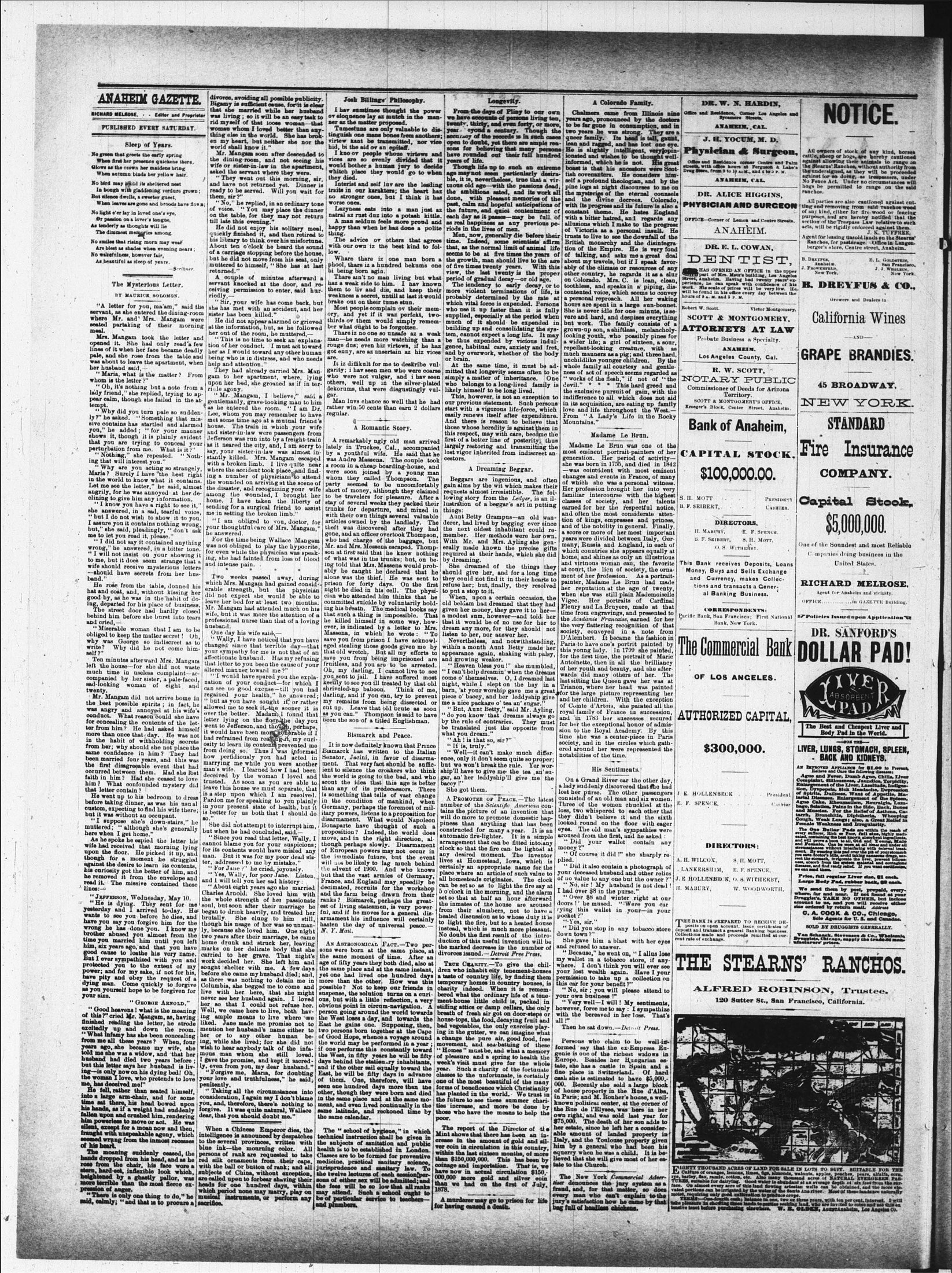
Searchable text
ANAHEIM GAZETTE.
RICHARD MELROSE. . . Editor and Proprietor
PUBLISHED EVERY SATURDAY.
Sleep of Years.
No green that greets the early spring
When first her presence quickens there,
Glows as the crown her maidens bring
When autumn binds her yellow hair.
No bird may build its sheltered nest
In bough with gladdening verdure grown;
But silence dwells, a sweetest guest,
When leaves are gone and broods have flowed;
No light e'er lay in loved one's eye,
Or passion on a lover's tongue,
As tenderly as thoughts will lie
The dimmost memories among.
No smiles that rising morn may weak
Are blest as shades when evening nears;
No wakefulness, however fair,
As beautiful as sleep of years.
Scribner.
The Mysterious Letter.
BY MAURICE SOLOMON.
"A letter for you, ma'am," said the servant, as she entered the dining-room where Mr. and Mrs. Mangam were seated partaking of their morning meal.
Mrs. Mangam took the letter and opened it. She had only read a few lines of it when her face became deadly pale, and she rose from the table and was about to leave the apartment, when her husband said,—
"Maria, what is the matter? From whom is the letter?"
"Oh, it's nothing but a note from a lady friend," she replied, trying to appear calm, though she failed in the attempt.
"Why did you turn pale so suddenly?" he asked. "Something that missive contains has startled and alarmed you," he added; "for your manner shows it, though it is plainly evident that you are trying to conceal your perturbation from me. What is it?"
"Nothing," she repeated. "Nothing that will interest you."
"Why are you acting so strangely, Maria? Surely I have the best right divorce, avoiding all possible publicity. Bigamy is sufficient cause, for it is clear that she married while her husband was living; so it will be an easy task to rid myself of that loose woman—that woman whom I loved better than anything else in the world. She has broken my heart, but neither she nor the world shall know it."
Mr. Mangam soon after descended to the dining-room, and not seeing his wife or sister-in-law in the apartment, asked the servant where they were.
"The they went out this morning, sir, and have not returned yet. Dinner is ready to be served. Will you wait for them, sir?"
"No," he replied, in an ordinary tone of voice. "You may place the dinner on the table, for they may not return till late this evening."
He did not enjoy his solitary meal, quickly finished it, and then retired to his library to think over his misfortune. About ten o'clock he heard the sound of a carriage stopping before the house, but he did not move from his seat, only muttered to himself, "She has at last returned."
A couple of minutes afterward a servant knocked at the door, and receiving permission to enter, said hurriedly,
"Sir, your wife has come back, but she has met with an accident, and her sister has been killed."
He did not appear alarmed or grieved at the information, but, as he followed her out of the room, he muttered,
"This is no time to seek an explanation of her conduct. I must act toward her as I would toward any other human being who is in distress, and who needs help and attention."
They had already carried Mrs. Mangam to her apartment, where, lying upon her bed, she groaned as if in terrible agony.
"Mr. Mangam, I believe," said a gentlemanly, grave-looking man to him as he entered the room. "I am Dr. Lee, whom you may remember to have met some time ago at a mutual friend's house. The train in which your wife and sister-in-law were passengers from Jefferson was run into by a freight-train as it neared the city, and, I am sorry to say, your sister-in-law was almost instantly killed. Mrs. Mangam escaped with a broken limb. I live quite near where the accident took place," and find...
"Maria, what is the matter? From whom is the letter?"
"Oh, it's nothing but a note from a lady friend," she replied, trying to appear calm, though she failed in the attempt.
"Why did you turn pale so suddenly?" he asked. "Something that missive contains has startled and alarmed you," he added; "for your manner shows it, though it is plainly evident that you are trying to conceal your perturbation from me. What is it?"
"Nothing," she repeated. "Nothing that will interest you."
"Why are you acting so strangely, Maria? Surely I have the best right in the world to know what it contains. Let me see the letter," he said, almost angrily, for he was annoyed at her declining to give him any information.
"I know you have a right to see it," she answered, in a sad, tearful voice, "but I do not wish to show it to you. I assure you it contains nothing wrong, but," she said, pleadingly, "don't ask me to let you read it, please."
"I did not say it contained anything wrong," he answered, in a bitter tone. "I will not insist on your showing it to me, but it does seem strange that a wife should receive mysterious letters—should have secrets from her husband."
He rose from the table, donned his hat and coat, and without kissing her good-bye, as he was in the habit of doing, departed for his place of business.
The street door had hardly closed behind him before she burst into tears and cried.
"Miserable woman that I am to be obliged to keep the matter secret! Oh, why was George so indiscreet as to write? Why did he not come himself?"
Ten minutes afterward Mrs. Mangam left the house—for she did not waste much time in useless complaint—accompanied by her sister, a pale-faced, sad-looking woman of eight and twenty.
Mr. Mangam did not arrive home in the best possible spirits; in fact, he was angry and annoyed at his wife's conduct. What reason could she have for concealing the contents of the letter from him? He had asked himself more than once that day. He was not in the habit of withholding secrets from her; why should she not place the same confidence in him? They had been married four years, and this was the first disagreeable event that had occurred between them. Had she lost faith in him? Had she ceased to love him? What confounded mystery did that letter contain?
He went up to his bedroom to dress before taking dinner, as was his usual custom, expecting to find his wife there; but it was without an occupant.
"I suppose she's down-stairs," he muttered; "although she's generally here when I get home."
As he spoke he espied the letter his wife had received that morning lying upon the floor. He picked it up, and though for a moment he struggled against the desire to learn its contents, his curiosity got the better of him, and he removed it from the envelope and read it. The missive contained these lines:
"Maria, what is the matter? From whom is the letter?"
"Oh, it's nothing but a note from a lady friend," she replied, trying to appear calm, though she failed in the attempt.
"Why did you turn pale so suddenly?" he asked. "Something that missive contains has startled and alarmed you," he added; "for your manner shows it, though it is plainly evident that you are trying to conceal your perturbation from me. What is it?"
"Nothing," she repeated. "Nothing that will interest you."
"Why are you acting so strangely, Maria? Surely I have the best right in the world to know what it contains. Let me see the letter," he said, almost angrily, for he was annoyed at her declining to give him any information.
"I know you have a right to see it," she answered, in a sad, tearful voice, "but I do not wish to show it to you. I assure you it contains nothing wrong, but," she said, pleadingly, "don't ask me to let you read it, please."
"I did not say it contained anything wrong," he answered, in a bitter tone. "I will not insist on your showing it to me, but it does seem strange that a wife should receive mysterious letters—should have secrets from her husband."
He rose from the table, donned his hat and coat, and without kissing her good-by, as he was in the habit of doing, departed for his place of business.
The street door had hardly closed behind him before she burst into tears and cried.
"Miserable woman that I am to be obliged to keep the matter secret! Oh, why was George so indiscreet as to write? Why did he not come himself?"
Ten minutes afterward Mrs. Mangam left the house—for she did not waste much time in useless complaint—accompanied by her sister, a pale-faced, sad-looking woman of eight and twenty.
Mr. Mangam did not arrive home in the best possible spirits; in fact, he was angry and annoyed at his wife's conduct. What reason could she have for concealing the contents of the letter from him? He had asked himself more than once that day. He was not in the habit of withholding secrets from her; why should she not place the same confidence in him? They had been married four years, and this was the first disagreeable event that had occurred between them. Had she lost faith in him? Had she ceased to love him? What confounded mystery did that letter contain?
He went up to his bedroom to dress before taking dinner, as was his usual custom, expecting to find his wife there; but it was without an occupant.
"I suppose she's down-stairs," he muttered; "although she's generally here when I get home."
As he spoke he espied the letter his wife had received that morning lying upon the floor. He picked it up, and though for a moment he struggled against the desire to learn its contents, his curiosity got the better of him, and he removed it from the envelope and read it. The missive contained these lines:
"Maria, what is the matter? From whom is the letter?"
"Oh, it's nothing but a note from a lady friend," she replied, trying to appear calm, though she failed in the attempt.
"Why did you turn pale so suddenly?" he asked; "Something that missive contains has startled and alarmed you," he added; "for your manner shows it, though it is plainly evident that you are trying to conceal your perturbation from me. What is it?"
"Nothing," she repeated. "Nothing that will interest you."
"Why are you acting so strangely, Maria? Surely I have the best right in the world to know what it contains. Let me see the letter," he said, almost angrily, for he was annoyed at her declining to give him any information.
"I know you have a right to see it," she answered, in a bitter tone. "I will not insist on your showing it to me, but it does seem strange that a wife should receive mysterious letters—should have secrets from her husband."
He rose from the table, donned his hat and coat, and without kissing her good-by, as he was in the habit of doing, departed for his place of business.
The street door had hardly closed behind him before she burst into tears and cried.
"Miserable woman that I am to be obliged to keep the matter secret! Oh, why was George so indiscreet as to write? Why did he not come himself?"
Ten minutes afterward Mrs. Mangam left the house—for she did not waste much time in useless complaint—accompanied by her sister, a pale-faced, sad-looking woman of eight and twenty.
Mr. Mangam did not arrive home in the best possible spirits; in fact, he was angry and annoyed at his wife's conduct. What reason could she have for concealing the contents of the letter from him? He had asked himself more than once that day. He was not in the habit of withholding secrets from her; why should she not place the same confidence in him? They had been married four years, and this was the first disagreeable event that had occurred between them. Had she lost faith in him? Had she ceased to love him? What confounded mystery did that letter contain?
He went up to his bedroom to dress before taking dinner, as was his usual custom, expecting to find his wife there; but it was without an occupant.
"I suppose she's down-stairs," he muttered; "although she's generally here when I get home."
As he spoke he espied the letter his wife had received that morning lying upon the floor. He picked it up, and though for a moment he struggled against the desire to learn its contents, his curiosity got the better of him, and he removed it from the envelope and read it. The missive contained these lines:
"Maria, what is the matter? From whom is the letter?"
"Oh, it's nothing but a note from a lady friend," she replied, trying to appear calm, though she failed in the attempt.
"Why are you acting so strangely, Maria? Surely I have the best right in the world to know what it contains. Let me see the letter," he said, almost angrily, for he was annoyed at her declining to give him any information.
"I know you have a right to see it," she answered, in a bitter tone. "I will not insist on your showing it to me, but it does seem strange that a wife should receive mysterious letters—should have secrets from her husband."
He rose from the table, donned his hat and coat, and without kissing her good-by, as he was in the habit of doing, departed for his place of business.
The street door had hardly closed behind him before she burst into tears and cried.
"Miserable woman that I am to be obliged to keep the matter secret! Oh, why was George so indiscreet as to write? Why did he not come himself?"
Ten minutes afterward Mrs. Mangam left the house—for she did not waste much time in useless complaint—accompanied by her sister, a pale-faced, sad-looking woman of eight and twenty.
Mr. Mangam did not arrive home in the best possible spirits; in fact, he was angry and annoyed at his wife's conduct. What reason could she have for concealing the contents of the letter from him? He had asked himself more than once that day. He was not in the habit of withholding secrets from her; why should she not place the same confidence in him? They had been married four years, and this was the first disagreeable event that had occurred between them. Had she lost faith in him? Had she ceased to love him? What confounded mystery did that letter contain?
He went up to his bedroom to dress before taking dinner, as was his usual custom, expecting to find his wife there; but it was without an occupant.
"It suppose she's down-stairs," he muttered; "although she's generally here when I get home."
As he spoke he espied the letter his wife had received that morning lying upon the floor. He picked it up, and though for a moment he struggled against the desire to learn its contents, his curiosity got the better of him, and he removed it from the envelope and read it. The missive contained these lines:
"AWMERMAN: Wednesday.May 10."
before taking dinner, as was his usual custom, expecting to find his wife there; but it was without an occupant.
"I suppose she's down-stairs," he muttered; "although she's generally here when I get home."
As he spoke he espied the letter his wife had received that morning lying upon the floor. He picked it up, and though for a moment he struggled against the desire to learn its contents, his curiosity got the better of him, and he removed it from the envelope and read it. The missive contained these lines:
"JEFFERSON, Wednesday, May 10.
He is dying. They sent for me yesterday and I arrived to-day. He wants to see you before he dies, and have you say you forgive him for the wrong he has done you. I know my brother abused you almost from the time you married him until you left him, six years ago, and that you have good cause to loathe his very name. But I ever sympathized with you and protected you to the extent of my power; and for my sake, if not for his, have pity and obey the request of a dying man. Come quickly to forgive as you yourself hope to be forgiven for your sins.
GEORGE ARNOLD."
"Good heavens! what is the meaning of this?" cried Mr. Mangam, as having finished reading the letter, he strode excitedly up and down the room.
"What infamy has she been concealing from me all these years? When, four years ago, she became my wife, she told me she was a widow, and that her husband had died two years before; but this letter says her husband is living—is only now on his dying bed! Oh, the woman I love, who pretends to love me, has deceived me!"
He fell, rather than seated himself into a large arm-chair, and for some time sat there, his head bowed upon his hands, as if a weight had suddenly fallen upon and crushed him, rendering him powerless to move or act. He was silent, except for a moan now and then, fraught with unspeakable agony, which seemed wrung from the inmost recesses of his heart.
The moaning suddenly ceased, the hands dropped from his head, and as he rose from the chair, his face wore a stern, hard-set, inflexible look which, heightened by a ghastly pallor, was more terrible than the most fierce expression of anger.
"There is only one thing to do," he said, calmly; "and that is to procure a Pardon me for speaking to you plainly in your present state of health, but it is better for us both that I should do so."
She did not attempt to interrupt him, but when he had concluded, said—
"Since you read that letter, Wally, I cannot blame you for your suspicions; for its contents would have misled any man. But it was for my poor dead sister, addressed to me by mistake."
"For Jane?" he cried, joyously.
Yes, Wally, for poor Jane. Listen and I will tell you her sad history:
"About eight years ago she married Charles Arnold. She loved him with the whole strength of her passionate soul, but soon after their marriage he began to drink heavily, and treated her brutally. She clung to him still, though his usage of her was so unmanly, because she loved him. One night two years after their marriage, he came home drunk and struck her, leaving marks on her delicate body that she carried to her grave. That night's work decided her. She left him and sought shelter with me. A few days before she came my husband died; and, as there was nothing to detain me in Columbia, she begged me to come and live with her here, that she might never see her husband again. I loved her so that I could not refuse her. Well, we came here to live, both having ample means to live where we liked. Jane made me promise not to mention her husband's name either to her or to any other human being, while she lived; for she did not wish to hear anybody talk of the infamous man whom she still loved. I gave the promise, and kept it sacredly, even from you, my dear husband."
"Forgive me, Maria, for doubting your love and truthfulness," he said, penitently.
"Taking all the circumstances into consideration, I again say I don't blame you, and therefore there's nothing to forgive. It was quite natural, Wallace dear, that you should doubt me."
When a Chinese Emperor dies, the intelligence is announced by despatches to the several provinces, written with blue ink—the mourning color. All persons of rank are requested to take red silk ornaments from their caps, with the ball or button of rank; and all subjects of China, without exception, are called upon to forbear shaving their heads for one hundred days, within which period none may marry, play on musical instruments, or perform any sacrifice.
An Astronauts were born in the same month of fifty years the same place yet one had more than ten possible? No suspense; thusous but with obvious point person going the West loss East he gains two persons of Good Hope the world may if one performs the West in days behind and if the other East, he will of them. Of seen one hunter other, though in the same place medicine prince jurisprudence the twelve lee sons of either the fees will may attend. Be of particular and plumber
Josh Billing's Philosophy.
I hav sumtimes thought the power ov eloquence lay az mutch in the manner az the matter proposed.
Tumestuns are only valuable to distinguish one mans bones from another; virtew kant be transmitted, nor vice hid, bi the aid ov an epitaff.
I kno ov people whoze virtews and vices are so evenly divided that it would bother a human jury to decide which place they would go to when they died.
Interist and self luv are the leading traits in our karakters; the heart haz no stronger ones, but I think it has worse ones.
Lazyness eats into a man just az natral az rust duz into a potash kittle.
A man seldum feels more proud and happy than when he haz done a polite thing.
The advice ov others that agrees with our own iz the best kind to follow.
Whare thare iz one man born a phool, thare iz a hundred bekums one bi being born agin.
Thare ain't no man living but what haz a weak to him. I hav known them to liv and die, and keep their weakness a secret, untill at last it would brake out on their tume stun.
Most people complain ov their memory, and yet if it waz perfekt, two-thirds ov them would simply remember what ought to be forgotten.
Thare iz no one so unsafe az a weak man—he needs more watching than a rouge dus; even hiz virtews, if he haz got enny, are az unsertain az hiz vices are.
It iz diflikult for me to deskribe vulgarity; i hav seen men who were coarse who were not vulgar, and i hav seen others, well up in the silver-plated dekorums, that were disgustingly vulgar.
Man luvs chance so well that he had rather win 50 cents than earn 2 dollars regular.
A Romantic Story.
A remarkably ugly old man arrived lately in Truckee, Cal., accompanied by a youthful wife. He said that he was Andre Massena. The couple took a room in a cheap boarding-house, and were soon joined by a young man
Longevity.
From the days of Pliny to our own we have accounts of persons living ten, twenty, thirty, and even forty, or more, year beyond a century. Though the accuracy of the records is in such cases open to doubt, yet there are ample reasons for believing that many persons have rounded out their full hundred years of life.
Though life up to such an extreme age may not seem particularly desirable, it is, nevertheless, true that a virtuous old age—with the passions dead, the ambitions sated, and its work all done, with pleasant memories of the past, calm and hopeful anticipations of the future, and quiet contentment of each day as it passes—may be full of as real happiness as any previous periods in the lives of men.
Men, now, generally die before their time. Indeed, some scientists affirm that, as the normal limit of animal life seems to be at five times the years of the growth, man should live to the age of five times twenty years. With this view, the last twenty is the proper period of gradual decay—or old age.
The tendency to early decay, or to more violent terminations of life, is probably determined by the rate at which vital force is expended. Persons who use it up faster than it is fully supplied, especially at the period when much of it should be expended in building up and consolidating the system, cannot expect a long life. It may be thus expended by vicious indulgence, habitual care, anxiety and fret, and by overwork, whether of the body or brain.
At the same time, it must be admitted that longevity seems often to be simply a matter of inheritance. One who belongs to a long-lived family is likely himself to be long lived.
This, however, is not an exception to our previous statement. Such persons start with a vigorous life-force, which easily renews itself after expenditure. And there is reason to believe that those whose heredity is against them in this respect, may with care, become the first of a better line of posterity, thus largely restoring and transmitting the lost vigor inherited from indiscreet ancestors.
A Colorado Family.
Chalmers came from Illinois nine years ago, pronounced by the doctor to be far gone in consumption, and two years he was strong. They are queer family. Its head is tall, gaunt lean and ragged, and has lost one eye. He is slightly intelligent, very opinionated and wishes to be thought well informed, which he is not. His great boast is that his ancestors were Scotish covenanters. He considers himself a profound theologian, and by the pine logs at night discourses to me of the mysteries of the eternal counsellor and the divine decrees. Colorado with its progress and its failure is also constant theme. He hates England with a bitter hatred, and regards any allusions which I make to the progress of Victoria as a personal insult. He trusts to live to see the downfall of the British monarchy and the disintegration of the Empire. He is very fond of talking, and asks me a great deal about my travels, but if I speak favorably of the climate or resources of any other country, he regards it as a slur on Colorado. Mrs. C. is lean, clean toothless, and speaks in a piping, distressed voice, which seems to convey a personal reproach. All her waking hours are spent in a large sun-bouncer. She is never idle for one minute, is soveree and hard, and despises everything but work. The family consists of four grown-up sons, a shiftless, melancholy-looking youth, who possibly pines for a wider life; a girl of sixteen, a sound repellent-looking creature, with a much manners as a pig; and three hard unchildlike younger children. By the whole family all courtesy and gentleness of act of speech seems regarded as "works of the flesh," if not of "the devil." * * * This hard greed and the exclusive pursuit of gain, with the indifference to all which does not air in its acquisition, are eating up familial love and life throughout the West. From "A Lady's Life in the Rock Mountains."
Madame Le Brun.
Madame Le Brun was one ot th most eminent portrait-painters of her generation. Her period of activity she was born in 1755, and died in 1843—was cointident with most eminent
A Romantic Story.
A remarkably ugly old man arrived lately in Truckee, Cal., accompanied by a youthful wife. He said that he was Andre Massena. The couple took a room in a cheap boarding-house, and were soon joined by a young man whom they called Thompson. The party seemed to be uncomfortably short of money, although they claimed to be travelers for pleasure. After a stay of several weeks they packed their trunks for departure, and mixed in with their own things several valuable articles owned by the landlady. The theft was discovered after they had gone, and an officer overtook Thompson, who had charge of the baggage, but Mr. and Mrs. Massena escaped. Thompson at first said that he knew nothing of what was in the trunks; but, on being told that Mrs. Massena would probably be caught he declared that he alone was the thief. He was sent to prison for forty days. On the first night he died in his cell. The physician who attended him thinks that he committed suicide by voluntarily holding his breath. The medical books say that such a thing is impossible. That he killed himself in some way, however, is indicated by a letter to Mrs. Massena, in which he wrote: "To save you from prison I have acknowledged stealing those goods given me by that old wretch. But all my efforts to save you from being imprisoned are fruitless, and you are to be arrested. Oh, my darling, I cannot live to see you sent to jail. I have suffered most keenly to see you ill treated by that old shriveled-up baboon. Think of me, darling, and if you can, try to prevent my remains from being dissected or cut up. Leave that old brute as soon as you can." Thompson is said to have been the son of a titled Englishman.
Bismarck and Peace.
It is now definitely known that Prince Bismarck has written to the Italian Senator, Jacini, in favor of disarmament. That very fact should be sufficient to silence the croakers who think the world is going to the bad, and who scout the idea that this age is better than any of its predecessors. There is something that tells of vast change in the condition of mankind, when Germany, perhaps the foremost of military powers, listens to a proposition for disarmament. What would Napoleon Bonaparte have thought of such a proposition? Indeed, the world does move, and in the right direction, although perhaps slowly. Disarmament of European powers may not occur in the immediate future, but the event will not be likely to lag much behind the advent of 1900. And who knows but that the vast armies of Germany, France, and England may speedily be decimated, recruits for the workshop and the farm being drawn from their simply a matter of inheritance. One who belongs to a long-lived family is likely himself to be long lived.
This, however, is not an exception to our previous statement. Such persons start with a vigorous life-force, which easily renews itself after expenditure. And there is reason to believe that those whose heredity is against them in this respect, may with care, become the first of a better line of posterity, thus largely restoring and transmitting the lost vigor inherited from indiscreet ancestors.
A Dreaming Beggar.
Beggars are ingenious, and often gain alms by the wit which makes their requests almost irresistible. The following story from the Ledger, is an illustration of a beggar's art in putting things:
Aunt Betty Grampus—an old wanderer, had lived by begging ever since the next oldest inhabitant could remember. Her methods were her own. With Mr. and Mrs. Ayling she generally made known the precise gifts required at their hands, which she did by dreaming.
She dreamed of the things they should give her, and for a long time they could not find it in their hearts to refuse her; but finally, they resolved to put a stop to it.
When upon a certain occasion, the old beldam had dreamed that they had given her money, they gave it to her—a modest sum, however—and told her that it would be of no use for her to dream any more, for they should not listen to her, nor answer her.
Nevertheless, and notwithstanding, within a month Aunt Betty made her appearance again, shaking with palsy, and growing weaker.
"Heaven bless you!" she mumbled, "I can't help dreamin' when the dreams come o' themselves. O, I dreamed last night, while I slept on the hay in a barn,' at your worship gave me a great piece o' baccy, and her leddyship give me a nice package o' tea an' sugar."
"But, Aunt Betty," said Mr. Ayling, "do you know that dreams always go by the rule of contraries. They must be translated just the opposite from what you dream."
"Ah! is that so, sir?"
"It is, truly."
Well—it can't make much difference, only it don't seem quite so proper; but we won't break the rule. Yer worship'll have to give me the tea an' sugar, an' her leddyship'll give me the baccy!"
She got them.
A Promoter of Peace.—The latest number of the Scientific American contains the picture of an invention that will do more to promote domestic happiness than anything that has been constructed for many a year. It is an automatic fire-lighter. It is a simple arrangement that can be fitted into any clock so that the fire can be lighted at any desired moment. The inventor lives at Homestead, Iowa, which is certainly an appropriate name for the place where an article of such value to all homesteads originates. The clock can be set so as to light the fire say at 5 o'clock in the morning, and the alarm set so that at half an hour afterward simply a matter of inheritance. One who belongs to a long-lived family is likely himself to be long lived.
This, however, is not an exception to our previous statement. Such persons start with a vigorous life-force, which easily renews itself after expenditure. And there is reason to believe that those whose heredity is against them in this respect, may with care, become the first of a better line of posterity, thus largely restoring and transmitting the lost vigor inherited from indiscreent ancestors.
Madame Le Brun.
Madame Le Brun was one ot th most eminent portrait-painters of her generation. Her period of activity—she was born in 1755,and died in 184—was cointident with most eminen changes and events in France,of many of which she was a personal witness. Her profession brought her into very familiar intercourse with the highest classes of society,and her talent earned for her the respectful notice and often the most considerate attention of kings, empresses and princes and of the nobility in general.Finally a score or more of her most important years were divided between Italy,Ger many,Russia and England,在 each of which countries she appears equally a home,and shines as only an illustrious and virtuous woman can,the favorite at court,the licen of society,the ornament of her profession.As a portrait painter,Madame Le Brun had made her reputation at the age of twenty when she was still plain Mademoiselle Vigee.Her portraits of Cardinal Fleury and La Bruyere,made at that time from engravings,and presented to the Acadamie Francaise,earned for her the very flattering recognition of that society.conveyed in a note from D'Alembert.I became the fashion in Paris to have one's portrit painted by this young lady.In 1799 she painted for the first time,the portrait of Marie Antoinette,thein allthe brilliancy of her youth and beauty,and she afterwards did many others of her.The last sitting the Queen gave her was at Trianon,name head was painted for the large picture representing her and her children.With the exception of Comte d'Artois,she painted all the royal family of France in succession,and in 1783 her suscesses secured for her the exceptional honor of admission to the Royal Academy.By this time she was a center-piece in Paris society,and in the circles which gathered around her were represented the notabilities of the time.
His Sentiments.
On a Grand River car the other day,a lady suddenly discovered that she had lost her purse.The other passengers consisted of an old man and six women.Tree of the women chuckled at the loss,two whispered to each other that they didn't believe it and the sixth looked round on the floor with eager eyes.The old man's sympathies were aroused from the first,and he asked:
"Did your wallet contain any money?"
"Of course it did!"she sharply replied.
"Did it also contain a photograph of your deceased husband and other relics of no value to any one but the owner?"
"No,sir! My husband is not dead! I had over $8 in the purse."
"Over $8 and winter right at our..."
in the condition of mankind, when Germany, perhaps the foremost of military powers, listens to a proposition for disarmament. What would Napoleon Bonaparte have thought of such a proposition? Indeed, the world does move, and in the right direction, although perhaps slowly. Disarmament of European powers may not occur in the immediate future, but the event will not be likely to lag much behind the advent of 1900. And who knows but that the vast armies of Germany, France, and England may speedily be decimated, recruits for the workshop and the farm being drawn from their ranks? Bismarck, perhaps the greatest of living statesmen, is very powerful, and if he moves for a general disarmament his influence will certainly hasten the day of universal peace.
N.Y.Mail.
AN ASTROOMICAL FACT.—Two persons were born at the same place, at the same moment of time. After an age of fifty years they both died, also at the same place and at the same instant, yet one had lived one hundred days more than the other. How was this possible? Not to keep our friends in suspense, the solution turns on a curious, but with a little reflection, a very obvious point in circum-navigation. A person going around the world towards the West loses a day, and towards the East he gains one. Supposing then, two persons born together at the Cape of Good Hope, whence a voyage around the world may be performed in a year; if one performs this constantly toward the West, in fifty years he will be fifty days behind the stationary inhabitants, and if the other sail equally toward the East, he will be fifty days in advance of them. One, therefore, will have seen one hundred days more than the other, though they were born and died in the same place and at the same moment, and even lived continually in the same latitude, and reckoned time by the same calendar.
The "school of hygiene," in which technical instruction shall be given in the subjects of sanitation and public health is to be established in London. Classes are to be formed for preventive medicine, practical sanitary science, jurisprudence and sanitary law. To the twelve lectures of each session persons of either sex will be admitted; and the fees will be so low that all ranks may attend. Such a school ought to be of particular service to teachers—and plumbers.
A PROMOTER OF PEACE.—The latest number of the Scientific American contains the picture of an invention that will do more to promote domestic happiness than anything that has been constructed for many a year. It is an automatic fire-lighter. It is a simple arrangement that can be fitted into any clock so that the fire can be lighted at any desired moment. The inventor lives at Homestead, Iowa, which is certainly an appropriate name for the place where an article of such value to all homesteads originates. The clock can be set so as to light the fire say at 5 o'clock in the morning, and the alarm set so that at half an hour afterward the inmates of the house are aroused from their slumbers, not to have a heated discussion as to whose duty it is to light the fire, but to a heated house instead, which is much more pleasant. No doubt the first result of the introduction of this useful invention will be the marked decrease in the number of divorces issued. Detroit Free Press.
TRUE CHARITY.—To give the children who inhabit city tenement-houses a taste of country life, by finding them temporary homes in country houses, is charity indeed. When it is remembered what the ordinary life of a tenement-house little child is, packed in stifling attics or damp cellars, the only breath of fresh air got on door-steps or house-tops, the food, decaying fruit and bad vegetables, the only exercise playing in the gutter, we can imagine what a change the pure air, good food, free movement, and sea-bathing of these "Homes" must be, and what a memory of pleasure and a spring to health the week's visit must give for the whole year. Such a charity of the fortunate classes to the unfortunate, is certainly one of the most beautiful of the many forms of beneficence which Christianity has planted in the world. We trust in the future to see these summer charities increase, and more be done by those who have the means to help the poor.
The report of the Director of the Mint shows that there has been an increase in the amount of gold and silver coin in circulation in this country, within the last sixteen months, of more than $150,000,000. This has been by coinage and importation. That is, we have now in actual circulation $150,000,000 more gold and silver coin than we had on the first of July, 1878.
A murderer may go to prison for life for having caused a death.
Three of the women chuckled at the loss, two whispered to each other that they didn't believe it and the sixth looked round on the floor with eager eyes. The old man's sympathies were aroused from the first, and he asked:
"Did your wallet contain any money?"
"Of course it did!" she sharply replied.
"Did it also contain a photograph of your deceased husband and other relics of no value to any one but the owner?"
"No, sir! My husband is not dead! I had over $8 in the purse."
"Over $8 and winter right at our doors!" he mused.
"Were you carrying this wallet in your—in your pocket?"
"Yes, sir."
"Did you stop in any tobacco store down town?"
She gave him a blast with her eyes and refused to answer.
"Because," he went on, "I allus lose my wallet in a tobacco store, if anywhere. I don't think you will ever see your lost wealth again. Have I your permission to take up a collection on this car for your benefit?"
"No, sir; you will please attend to your own business!"
"Very well—I will! My sentiments, however, force me to say: I sympathize with the bereaved in her loss. That's all!"
Then he sat down. Detroit Press.
Persons who claim to be well-informed say that the ex-Empress Eugenie is one of the richest widows in Europe. Besides her Hungarian estate, she has a castle in Spain and a fine place in Switzerland. Of hard cash she is estimated to have $5,000,-000. Recently she sold a large block of house property in the Rue d'Alba, Paris; and M.Rouher's house, a well-known political center, at the corner of the Rue de l'Elysee, was hers in her own right, and was sold last year for $75,000. The death of her son adds to her estate since he left her a considerable amount of landed property in Italy, and the Toulouse property given him by a general who had been his equerry when he was a child. It is believed that she will give most of her estate to the Church.
The New York Commercial Advertiser denounces the jury system as a fraud, and, for that matter, so does every man who can't explain to the jury's satisfaction how he came by that bag full of headless chickens.
Colorado Family.
It came from Illinois nine pronounced by the doctors one in consumption, and in the was strong. They are a lady. Its head is tall, gaunt, rugged, and has lost one eye. Brightly intelligent, very joplin-wishes to be thought well-which he is not. His great hat his ancestors were Scotch hunters. He considers him round theologian, and by the night discourses to me on pages of the eternal counsels divine decrees. Colorado progress and its future is also a theme. He hates England her hatred, and regards any which I make to the progress as a personal insult. He lives to see the downfall of the monarchy and the disintegrative Empire. He is very fond and asks me a great deal travels, but if I speak favor-climate or resources of any story, he regards it as a slur. Mrs. C. is lean, clean, and speaks in a piping, dis-tionice, which seems to convey reproach. All her waking spent in a large sun-bonnet, her idle for one minute, is seard, and despises everything.
The family consists of a son, a shiftless, melancholy-south, who possibly pines for life; a girl of sixteen, a sour, smoking creature, with as many as a pig; and three hard, younger children. By the only all courtesy and gentle-of speech seems regarded as the flesh," if not of "the * This hard greed and the pursuit of gain, with the to all which does not aid situation, are eating up family throughout the West.—Lady's Life in the Rocky
Le Brun.
Le Brun was one of the most portrait-painters of her Her period of activity—in 1755, and died in 1842 incident with most eminent
DR. W. N. HARDIN,
Office and Residence, Corner Los Angeles and Sycamore Streets,
ANAHEIM, CAL.
J. H. YOCUM, M. D.
Physician & Surgeon,
Office and Residence corner Centre and Palm streets, with office hours at Ferguson & Lake's Drug Store, from 9 to 10 A.M., and 4 to 5 P.M.
ANAHEIM, CAL.
DR. ALICE HIGGINS,
PHYSICIAN AND SURGEON
OFFICE—Corner of Lemon and Centre Streets.
ANAHEIM.
DR. E. L. COWAN,
DENTIST,
HAS OPENED AN OFFICE in the upper part of Mrs. Metre's building, Los Angeles Street, Anaheim. Having had twenty years' experience, he can speak with confidence of his work. His scale of prices will be very low. He will be found in his office every day between the hours of 9 A.M. and 5 P.M.
Robert W. Scott.
Victor Montgomery,
SCOTT & MONTGOMERY,
ATTORNEYS AT LAW
Probate Business a Specialty.
ANAHEIM.
Los Angeles County, Cal.
R. W. SCOTT,
NOTARY PUBLIC
Commissioner of Deeds for Arizona Territory.
SCOTT & MONTGOMERY'S OFFICE,
Kroeger's Block, Center Street, Anaheim.
Bank of Anaheim,
CAPITAL STOCK,
$100,000.00
NOTICE.
All owners of stock of any kind, horses cattle, sheep or hogs, are hereby cautioned against allowing their animals to range on the Stearns' Ranchos without authority from the undersigned, as they will be proceeded against for so doing, as trespassers, under No Fence Act. Under no circumstances will hogs be permitted to range on the said ranchos.
All parties are also cautioned against cutting and removing from said ranchos wood of any kind, either for firewood or fencing purposes, and are hereby notified that the section of the Trespass Law relative to such acts, will be rigidly enforced against them.
J. K. TUFFREE,
Agent for leasing unsold lands on the Stearns' Ranchos, for pastureage. Office in Langenberger's store, Centre street, Anaheim.
B. DREYFUS & CO.,
Growers and Dealers in
California Wines
AND
GRAPE BRANDIES.
45 BROADWAY.
NEW YORK.
STANDARD
Fire Insurance COMPANY
NOTARY PUBLIC
Commissioner of Deeds for Arizona Territory.
SCOTT & MONTGOMERY'S OFFICE.
Kroeger's Block, Center Street, Anaheim.
Bank of Anaheim,
CAPITAL STOCK,
$100,000.00.
S. H. MOTT
President
B. F. SEIBERT,
Cashier.
DIRECTORS.
H. MABURY,
E. F. SPENCE.
B. F. SEIBERT,
S. H. MOTT,
O. S. WITHERBY.
This Bank receives Deposits, Loans Money, Buys and Sells Exchange and Currency, makes Collections and transacts a General Banking Business.
CORRESPONDENTS:
Pacific Bank, San Francisco; First National Bank, New York.
The Commercial Bank
OF LOS ANGELES.
AUTHORIZED CAPITAL,
$300,000.
J. E. HOLLENBECK
President
E. F. SPENCE,
DIRECTORS:
A. H. WILCOX,
S. H. MOTT,
LANKERSHIM,
E. F. SPENCE,
J.E. HOLLENBECK, O.S.WITHERBY,
H.MABURY,
W.WOODWORTH.
45 BROADWAY.
NEW YORK.
STANDARD
Fire Insurance COMPANY.
Capital Stock,
$5,000,000.
One of the Soundest and most Reliable Companies doing business in the United States.
RICHARD MELROSE,
Agent for Anaheim and vicinity.
OFFICE...in GAZETTE Building.
Policies Issued upon Application
DR. SANFORD'S
DOLLAR PAD!
LIVER
ABSORBENT
PAD
The Best and Cheapest Liver and Body Pad in the World.
LIVER, LUNGS, STOMACH, SPLEEN,
BACK AND KIDNEYS.
An Improved Appliance for $1.00 to Prevent, Relieve and Cure the following diseases:
Ague and Fever, Dumb Ague, Chills, Liver Complaint, Billiousness, Jaundice, Tortility, Enlargement of the Liver, Lasitude, Indigestion, Dysppepsis, Sick Headache, Depression of Spleen, Dullness, Want of Appetite, Malarial Diseases, Enlargement of the Spleen, Ague Cake, Rheumatism, Nervalgia, Lumbargia, Sedation, Pain in the Side, Back, Muscles, For the Relief of Asthma, Cararthrh, Bronchitis, Diphtheria, Whopping Cough, Weak Lungs; also, a Great Relief in Female Weakness and Irregularity.
The One Dollar Pads are within the reach of every sufferer, Rich or Poor, full size, highly medicated, containing the best known absorbent ingredients, and will prove a boon to all, Old and Young. Male and Female can be waved at with ease and under all circumstances without interfering with their treatment. By wearing this pad over the pit of your stomach you save doctor's bills, avoid taking nauseous drugs, correct the stomach, invigorate the liver, prevent biliousness, absorb from the system immediately and contagious diseases, and find ready relief. If you want certificates we can send them.
Price, full regular Liver size,$1 each.
Large Body Pad,rubber back,$9 each.
We send them by post, prepaid everywhere far and near. If not found at your Drugstreet,TAKEN NO OTHER but indoles.
E. F. SPENCE,
Cashier
DIRECTORS:
A. H. WILCOX, S. H. MOTT,
LANKERSHIM, E. F. SPENCE,
J. E. HOLLENBECK, O. S. WITHERBY,
H. MABURY, W. WOODWORTH.
THE BANK IS PREPARED TO RECEIVE DEPOSITS ON OPEN ACCOUNT, ISSUE CERTIFICATES OF DEPOSIT AND TRANSACT A GENERAL BANKING BUSINESS. Collections made and proceeds remitted at current rate of exchange.
THE STEARNS' RANCHOS.
ALFRED ROBINSON, Trustee.
120 Sutter St., San Francisco, California.
EIGHTY THOUSAND ACRES OF LAND FOR SALE IN LOTS TO SUIT. SUITABLE FOR THE CULTURE OF ORANGES, LEMONS, LIME, AGG, ALMonds, WALNUTS, APPLES, PEACHES, Pears, Alfalfa, Corn, rye, barley, flax, ramie, cotton, etc. Also many thousand acres of NATURAL EVERGREEN FATTURES, suitable for dairying. Good water is abundant at an average depth of six feet from the surface. On almost every acre of this land flowing artesian wells can be obtained, and the more elevated portions can be irrigated by the water of the Santa Ana river. Most of these lands are naturally moist, requiring only good cultivation to produce crops.
TERMS: One-fourth cash; balance in one, two or three years, with ten per cent interest. I will take pleasure in showing these lands to parties seeking land, who are invited to come and see this extensive tract before purchasing elsewhere. W. E. OLDEN, AgnetAnahaim, Los Angeles Co.