anaheim-gazette 1880-01-31
Scanned page
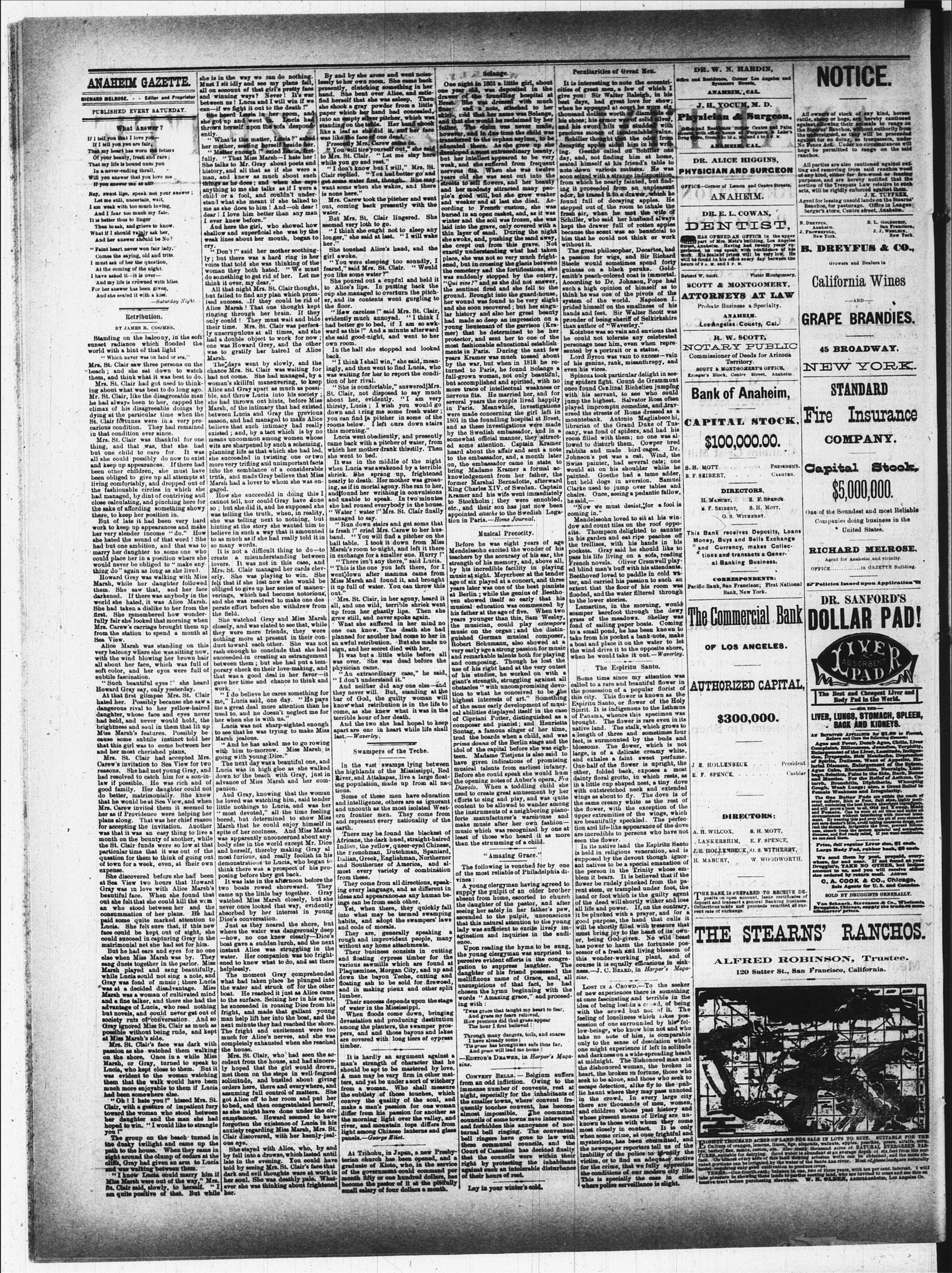
Searchable text
ANAHEIM GAZETTE.
RICHARD MELROSE. Editor and Proprietor
PUBLISHED EVERY SATURDAY.
What Answer?
If I tell you that I love you—
If I tell you you are fair,
That my heart has worn the fetters
Of your beauty, fresh and rare;
That my life is bound unto you
In a never-ending thrall,
Will you answer that you love me
If you answer me at all?
May, sweet lips, speak not your answer;
Let me still, uncertain, wait,
I am weak with too much loving,
And I fear too much my fate.
It is better thus to linger
Than to sak, and grieve to know.
What if I should vainly ask her,
And her answer should be No?
"Faint heart never won fair lady."
Comes the saying, old and trite.
I must ask of her the question,
At the coming of the night.
I have asked it—it is over—
And my life is crowned with bliss.
For her answer has been given,
And she sealed it with a kiss.
—Saturday Night.
Retribution.
BY JAMES B. COOMBS.
Standing on the balcony, in the soft sunset radiance which flooded the world with a hint of that light
"Which never was on land or sea."
Mrs. St. Clair saw three persons on the beach; and she sat down to watch them, and think what it was best to do.
Mrs. St. Clair had got used to thinking about what was best to do long ago.
Mr. St. Clair, like the disagreeable man he had always been to her, capped the climax of his disagreeable doings by dying at the particular time when the St. Clair fortunes were in a very precarious condition. They had remained in that condition ever since.
Mrs. St. Clair was thankful for one thing, and that was, that she had but one child to care for. It was all she could possibly do now to exist and keep up appearances. If there had been other children, she must have she is in the way we can do nothing.
Must I sit idly and see my plans fail, all on account of that girl's pretty face and winning ways? Never! It's war between us! Lucia and I will win if we can—if we fight it out to the death!
She heard Lucia in her room, and she got up and went in. Lucia had thrown herself upon the sofa despondently.
"What is the matter, Lucia?" asked her mother, sealing herself beside her.
"Matter enough!" cried Lucia, fretfully. "That Miss Marsh—I hate her! She talks to Mr. Gray about poets and history, and all that as if she were a man, and knew as much about such things as he does; and when she says anything to me she talks as if I were a child or a fool, and couldn't understand what she meant if she talked to me as she does to him! And—oh dear! dear! I love him better than any man I ever knew before."
And here the girl, who showed how shallow and superficial she was by the weak lines about her mouth, began to cry.
"Don't!" said her mother soothingly; but there was a hard ring in her voice that told she was thinking of the woman they both hated. "We must do something to get rid of her. Let me think it over, my dear."
All that night Mrs. St. Clair thought, but failed to find any plan which promised success. If they could be rid of Alice Marsh! That one thought kept ringing through her brain. If they only could! They must wait and bide their time. Mrs. St. Clair was perfectly unscrupulous at all times, and she had a double object to work for now; one was Howard Grey, and the other was to gratify her hatred of Alice Marsh.
The days went by slowly, and the chance Mrs. St. Clair was waiting for had not come. She had managed, by a woman's skillful maneuvering, to keep Alice and Gray apart as much as possible, and throw Lucia into his society; she had thrown out hints, before Miss Marsh, of the intimacy that had existed between Lucia and Gray the previous season, and had managed to make Alice believe that such intimacy had really existed; and, by a tact which is by no means uncommon among women whose wits are sharpened by such a scheming, planning life as that which she had led, she succeeded in twisting one or two more very trifling and unimportant facts into the semblance of a considerable
By and by lessly to her presently on hand. She fled herself to she shook a paper which into an empty standing on the like a leaf as was like the Presently.
"You will to Mrs. St. Clair while you go."
"I don't have Clair replied get some way want some way is none here.
Mrs. Care out, coming water.
But Mrs. seemed very "I think longer," she her."
She touched girl awoken "You we feared," said you like so She poured to Alice's cup she made er, and its the floor.
"How o' evidently had better ward as that she said get own room In the back.
"I think ingly, and was waiting tion of her."
"She is St. Clair, about her thirsty, L down and you can fill rooms below this morning Lucia w came back which here she went It was when Luci shriek
Mrs. St. Clair had got used to thinking about what was best to do long ago. Mr. St. Clair, like the disagreeable man he had always been to her, capped the climax of his disagreeable doings by dying at the particular time when the St. Clair fortunes were in a very precarious condition. They had remained in that condition ever since.
Mrs. St. Clair was thankful for one thing, and that was, that she had but one child to care for. It was all she could possibly do now to exist and keep up appearances. If there had been other children, she must have been obliged to give up all attempts at living comfortably, and dropped out of the fashionable circles in which she had managed, by dint of contriving and close calculating, and pinching here for the sake of affording something showy there, to keep her position in.
But of late it had been very hard work to keep up appearances and make her very slender income "do." How she hated the sound of that word! She had but one ambition, and that was to marry her daughter to some one who could place her in a position where she would never be obliged to "make anything do" again as long as she lived.
Howard Grey was walking with Miss Marsh, while her daughter followed them. She saw that, and her face darkened. If there was anybody in the world she hated, it was Alice Marsh. She had taken a dislike to her from the first. She remembered how wonderfully fair she looked that morning when Mrs. Carew's carriage brought them up from the station to spend a month at Sea View.
Alice Marsh was standing on this very balcony where she was sitting now, with the wind blowing her brown hair all about her face, which was full of soft color, and her eyes were full of subtile fascination.
"Such beautiful eyes!" she heard Howard Gray say, only yesterday.
At that first glimpse Mrs. St. Clair hated her. Possibly because she saw a dangerous rival to her yellow-haired daughter, whose face and eyes never had held, and never would hold, the brightness and soul in them that lit up Miss Marsh's features. Possibly because some subtile instinct told her that this girl was to come between her and her most cherished plans.
Mrs. St. Clair had accepted Mrs. Carew's invitation to Sea View for two reasons. She had met young Gray, and had resolved to catch him for a son-in-law if possible. He was rich and of good family. Her daughter could not do better, matrimonially. She knew that he would be at Sea View, and when Mrs. Carew invited them it seemed to her as if Providence were helping her plans along. That was her chief reason for accepting the invitation. Another was that it was an easy thing to live a month on the bounty of another, while the St. Clair funds were so low at that particular time that it was out of the question for them to think of going out of town for a week, even, at their own expense.
She discovered before she had been at Sea View two hours that Howard Gray was in love with Alice Marsh's beautiful face. When she found that them, and think what it was best to do.
Mrs. St. Clair had got used to thinking about what was best to do long ago. Mr. St. Clair, like the disagreeable man he had always been to her, capped the climax of his disagreeable doings by dying at the particular time when the St. Clair fortunes were in a very precarious condition. They had remained in that condition ever since.
Mrs. St. Clair was thankful for one thing, and that was, that she had but one child to care for. It was all she could possibly do now to exist and keep up appearances. If there had been other children, she must have been obliged to give up all attempts at living comfortably, and dropped out of the fashionable circles in which she had managed, by dint of contriving and close calculating, and pinching here for the sake of affording something showy there, to keep her position in.
But of late it had been very hard work to keep up appearances and make her very slender income "do." How she hated the sound of that word! She had but one ambition, and that was to marry her daughter to some one who could place her in a position where she would never be obliged to "make anything do" again as long as she lived.
Howard Grey was walking with Miss Marsh, while her daughter followed them. She saw that, and her face darkened. If there was anybody in the world she hated, it was Alice Marsh. She had taken a dislike to her from the first. She remembered how wonderfully fair she looked that morning when Mrs. Carew's carriage brought them up from the station to spend a month at Sea View.
Alice Marsh was standing on this very balcony where she was sitting now, with the wind blowing her brown hair all about her face, which was full of soft color, and her eyes were full of subtile fascination.
"Such beautiful eyes!" she heard Howard Gray say, only yesterday.
At that first glimpse Mrs. St. Clair hated her. Possibly because she saw a dangerous rival to her yellow-haired daughter, whose face and eyes never had held, and never would hold, the brightness and soul in them that lit up Miss Marsh's features. Possibly because some subtile instinct told her that this girl was to come between her and her most cherished plans.
Mrs. St. Clair had accepted Mrs. Carew's invitation to Sea View for two reasons. She had met young Gray, and had resolved to catch him for a son-in-law if possible. He was rich and of good family. Her daughter could not do better, matrimonially. She knew that he would be at Sea View, and when Mrs. Carew invited them it seemed to her as if Providence were helping her plans along. That was her chief reason for accepting the invitation. Another was that it was an easy thing to live a month on the bounty of another, while the St. Clair funds were so low at that particular time that it was out of the question for them to think of going out of town for a week, even, at their own expense.
She discovered before she had been at Sea View two hours that Howard Gray was in love with Alice Marsh's beautiful face. When she found that them, and think what it was best to do.
Mrs. St. Clair had got used to thinking about what was best to do long ago. Mr. St. Clair, like the disagreeable man he had always been to her, capped the climax of his disagreeable doings by dying at the particular time when the St. Clair fortunes were in a very precarious condition. They had remained in that condition ever since.
Mrs. St. Clair was thankful for one thing, and that was, that she had but one child to care for. It was all she could possibly do now to exist and keep up appearances. If there had been other children, she must have been obliged to give up all attempts at living comfortably, and dropped out of the fashionable circles in which she had managed, by dint of contriving and close calculating, and pinching here for the sake of affording something showy there, to keep her position in.
But of late it had been very hard work to keep up appearances and make her very slender income "do." How she hated the sound of that word! She had but one ambition, and that was to marry her daughter to some one who could place her in a position where she would never be obliged to "make anything do" again as long as she lived.
Howard Grey was walking with Miss Marsh, while her daughter followed them. She saw that, and her face darkened. If there was anybody in the world she hated, it was Alice Marsh. She had taken a dislike to her from the first. She remembered how wonderfully fair she looked that morning when Mrs. Carew's carriage brought them up from the station to spend a month at Sea View.
Alice Marsh was standing on this very balcony where she was sitting now, with the wind blowing her brown hair all about her face, which was full of soft color, and her eyes were full of subtile fascination.
"Such beautiful eyes!" she heard Howard Gray say, only yesterday.
At that first glimpse Mrs. St. Clair hated her. Possibly because she saw a dangerous rival to her yellow-haired daughter, whose face and eyes never had held, and never would hold, the brightness and soul in them that lit up Miss Marsh's features. Possibly because some subtile instinct told her that this girl was to come between her and her most cherished plans.
Mrs. St. Clair had accepted Mrs. Carew's invitation to Sea View for two reasons. She had met young Gray, and had resolved to catch him for a son-in-law if possible. He was rich and of good family. Her daughter could not do better, matrimonially. She knew that he would be at Sea View, and when Mrs. Carew invited them it seemed to her as if Providence were helping her plans along. That was her chief reason for accepting the invitation. Another was that it was an easy thing to live a month on the bounty of another, while the St. Clair funds were so low at that particular time that it was out of the question for them to think of going out of town for a week, even, at their own expense.
She discovered before she had been at Sea View two hours that Howard Gray was in love with Alice Marsh's beautiful face. When she found that them, and think what it was best to do.
Mrs. St. Clair had got used to thinking about what was best to do long ago. Mr. St. Clair, like the disagreeable man he had always been to her, capped the climax of his disagreeable doings by dying at the particular time when the St. Clair fortunes were in a very precarious condition. They had remained in that condition ever since.
Mrs. St. Clair was thankful for one thing, and that was, that she had but one child to care for. It was all she could possibly do now to exist and keep up appearances. If there had been other children, she must have been obliged to give up all attempts at living comfortably, and dropped out of the fashionable circles in which she had managed, by dint of contriving and close calculating, and pinching here for the sake of affording something showy there, to keep her position in.
But of late it had been very hard work to keep up appearances and make her very slender income "do." How she hated the sound of that word! She had but one ambition, and that is if it is not really difficult thing to do—to create a misunderstanding between lovers. It was not in this case, and Mrs. St. Clair managed her cards cleverly。她 felt it if she lost now she would be obliged to give up her series of maneuverings,which had become notorious,and she was resolved to make one desperate effort before she withdraw from the field.
She watched Gray and Miss Marsh closely,and was elated to see that,while they were mere friends,they were nothing more at present in their conduct toward each other.她 was not rash enough to conclude that she had succeeded in creating an estrangement between them;but she had put a temporary check on their love-making,and that was a good deal in her favor—it gave her time and chance to think and work.
"I do believe he cares something for me," Lucia said,one day.“He pays me a great deal more attention than he used to,and he doesn't neglect me for her when she is with us.”
Lucia was not sharp-sighted enough to see that he was trying to make Miss Marsh jealous.
“And he has asked me to go rowing with him to-morrow.Miss Marsh is going with young Dice.”
The next day was a beautiful one,and Lucia was in high glee as she walked down to the beach with Gray,just in advance of Miss Marsh and her companion.
And Gray,knowing that the woman he loved was watching him,said tender little nothings to Lucia,and was her "most devoted,”all the time feeling bored,but determined to show Miss Marsh that he could enjoy himself in spite of her coolness。And Miss Marsh was apparently unconcerned about anybody else in the world except Mr.Dice和 herself,thereby making Gray al most furious,and really foolish in his demonstrations to Lucia,who began to think there was a prospect of his proposing before they got back.
It was late in the afternoon before the two boats rowed shoreward。They came up the little bay together.Miss Marsh closely,but she waited for health of her.
"She is st.,Clair,went downgraceMarsh it up full out."
Mrs.S全 all,and up from grew still What one can planned an awful sign,and It was over physicis An I don’t I don’t I don’t I don’t I don’t I don’t I don’t I don’t I don’t I don’t I don’t I don’t I don’t I don’t I don’t I don’t I don’t I don’t I don’t I don’t I don’t I don’t I don’t I don’t I don’t I don’t I don’t I don’t I don’t I denote."
In therest River,s ing popuities Some and inthe unrn frm reap earth.The African Indianthe rr Italianand S most from t They ing eve ideas s
that he would be at Sea View, and when Mrs. Carew invited them it seemed to her as if Providence were helping her plans along. That was her chief reason for accepting the invitation. Another was that it was an easy thing to live a month on the bounty of another, while the St. Clair funds were so low at that particular time that it was out of the question for them to think of going out of town for a week, even, at their own expense.
She discovered before she had been at Sea View two hours that Howard Gray was in love with Alice Marsh's beautiful face. When she found that out she felt that she could kill the woman who stood between her and the consummation of her plans. He had paid some quite marked attention to Lucia. She felt sure that, if this new face could be kept out of sight, she could succeed in capturing Gray in the matrimonial net she had set for him.
But he had ears and eyes for no one else when Miss Marsh was by. They sang duets together in the parlor. Miss Marsh played and sang beautifully, while Lucia could not sing a note, and Gray was fond of music; there Lucia was at a decided disadvantage. Miss Marsh was a woman of cultivated mind and a fine talker, and there she had the advantage of Lucia, who read nothing but novels, and could never get out of society ruts of conversation. And so Gray ignored Miss St. Clair as much as possible without being rude, and kept at Miss Marsh's side.
Mrs. St. Clair's face was dark with passion as she watched them walking on the shore. Once in a while Miss Marsh, or Gray, turned to speak to Lucia, who kept close to them. But it was evident to the woman watching them that the walk would have been much more enjoyable to them if Lucia had been somewhere else.
"Oh! I hate you!" hissed Mrs. St. Clair, with a gesture of impatient fury toward the woman who stood between her daughter and the man she had hoped to win. "I would like to strangle you!"
The group on the beach turned in the dusky twilight and came up the path to the house. When they came in sight around the clump of cedars at the cliffs, Gray had given an arm to Lucia and was walking between them.
"I know Lucia could marry him if Miss Marsh were out of the way," Mrs. St. Clair said, slowly, to herself. "I am quite positive of that. But while he loved was watching him, said tender little nothings to Lucia, and was her "most devoted," all the time feeling bored, but determined to show Miss Marsh that he could enjoy himself in spite of her coolness. And Miss Marsh was apparently unconcerned about anybody else in the world except Mr. Dice and herself, thereby making Gray almost furious, and really foolish in his demonstrations to Lucia, who began to think there was a prospect of his proposing before they got back.
It was late in the afternoon before the two boats rowed shoreward. They came up the little bay together. Gray watched Miss Marsh closely, but she never once looked that way, evidently absorbed by her interest in young Dice's conversation.
Just as they neared the shore, but where the water was dangerously deep—how, no one knew clearly—Dice's boat gave a sudden lurch, and the next instant Alice was struggling in the water. Her companion was too frightened to know what to do, and sat there helplessly.
The moment Gray comprehended what had taken place he plunged into the water and struck off for the other boat. He reached it just as Alice came to the surface. Seizing her in his arms, he succeeded in rousing Dice from his fright, and made that gallant young man help lift her into the boat, and the next minute they had reached the shore. The fright and excitement were too much for Alice's nerves, and she was completely exhausted when she reached the house.
Mrs. St. Clair, who had seen the accident from the house, and had sincerely hoped that the girl would drown, met them on the steps in well-feigned solicitude, and bustled about giving orders here, there and everywhere, and assuming full control of matters. She got Alice off to her room and put her to bed, and then congratulated herself, as she might have done under the circumstances. Howard seemed to have forgotten the existence of Lucia in his anxiety regarding Miss Marsh, Mrs. St. Clair discovered, with her keenly-jealous eye.
She stayed with Alice, who, by and by fell into a drowze, which lasted until late in the evening. You could have told by seeing Mrs. St. Clair's face that dark and evil thoughts ware at work in her soul. She was deathly pale. Whatever she was thinking about frightened her.
No nothing. We plans fail, we pretty face her! It's war will win if we die death!"
Room, and Lucia had fa despondent Lucia?" asked beside her.
I hate Lucia, freet-I hate poets and she were a about such men she says as if I were a didn't under-she talked to and oh dear than any man
showed how he was by the truth, began to bother soothing ring in her thinking of the "We must be her. Let me Clair thought, a which promo- would be rid of thought kept brain. If they wait and bide air was perfect times, and she work for now; and the other tired of Alice
nowly, and the was waiting for managed, by a wavering, to keep much as possi- to his society; Ms., before Miss that had existed by the previous to make Aliceracy had really which is by no women whose such a scheming, which she had led, long one or two important facts a considerable believe that Miss
By and by she arose and went noiselessly to her own room. She came back presently, clutching something in her hand. She bent over Alice, and satisfied herself that she was asleep. Then she shook a gray powder from a little paper which her hand had concealed, into an empty silver pitcher, which was standing on the table. Her hand shook like a leaf as she did it, and her face was like the face of one dead.
Presently Mrs. Carew came in.
"You will tire yourself out," she said to Mrs. St. Clair. "Let me stay here while you go and rest."
"I don't know but I will," Mrs. St. Clair replied. "You had better go and get some water first, though. She may want some when she wakes, and there is none here."
Mrs. Carew took the pitcher and went out, coming back presently with the water.
But Mrs. St. Clair lingered. She seemed very loth to go.
"I think she ought not to sleep any longer," she said at last. "I will wake her."
She touched Alice's hand, and the girl awoke.
"You were sleeping too soundly, I feared," said Mrs. St. Clair. "Would you like some water?"
She poured out a cupful and held it to Alice's lips. In putting back the cup she managed to overturn the pitcher, and its contents went gurgling to the floor.
"How careless!" said Mrs. St. Clair, evidently much annoyed. "I think I had better go to bed, if I am so awkward as this!" And a minute afterward she said good-night, and went to her own room.
In the hall she stopped and looked back.
"I think I shall win," she said, meaningly, and then went to find Lucia, who was waiting for her to report the condition of her rival.
"She is comfortable," answered]Mrs. St. Clair, not disposed to say much about her, evidently. "I am very thirsty, Lucia; I wish you would go down and bring me some fresh water; you can find a pitcher in some of the rooms below. I left our down stairs this morning."
Lucia went obediently, and presently came back with a pitcher of water, from which her mother drank thirstily. Then she went to bed.
It was in the middle of the night when Lucia was awakened by a terrible shriek. She sprang up, frightened
Selange.
One night in 1801 a little girl, about one year old, was deposited in the drawer of the foundling hospital at Breast. She was dressed with much finer: and a note, attached to her skirt, told that her name was Solange, and that she would be reclaimed by her father. The claim was never made, however, and in due time the child was transferred to the orphan syllum, to be educated there. As she grew up she developed a most extraordinary beauty, but her intellect appeared to be very weak, and she suffered from frequent nervous fits. When she was twelve years old she was sent out into the streets to sell flowers, and her beauty and her modesty attracted many people's good will, but she grew weaker and weaker and at last she died.
According to French custom, she was buried in an open casket, and, as it was winter and the soil was frozen, she was laid into the grave, only covered with a thin layer of sand. During the night she awoke, and pushing the sand away, she crept out from this grave. Not exactly understanding what had taken place, she was not so very much frightened, but in crossing the glacis between the cemetery and the fortifications, she was suddenly stopped by the outcry, "Qui vive?" and as she did not answer, the sentinel fired and she fell to the ground. Brought into the guard-house, her wound was found to be very slight and she soon recovered; but her singular history and also her great beauty had made so deep an impression on a young lieutenant of the garrison (Kramer) that he determined to be her protector, and sent her to one of the most fashionable educational establishments in Paris. During the next few years Kramer was much tossed about by the war, but when in 1818 he returned to Paris, he found Solange a full-grown woman, not only beautiful, but accomplished and spirited, with no more trace of intellectual weakness or nervous fits. He married her, and for several years the couple lived happily in Paris. Meanwhile, investigations were made concerning the girl left in 1801 in the foundling hospital at Brest, and as these investigations were made by the Swedish embassador, and in a somewhat official manner, they attracted some attention. Captain Kramer heard about the affair and sent a note to the embassador, and, a month later on, the embassador came in state to bring Madame Kramer a formal account from her father.
Peculiarities of Great Men.
It is interesting to note the eccentricities of great men, a few of which I give you: Sir Walter Raleigh, in his best days, had great love for show; when he appeared at court he wore six thousand dollars worth of diamonds on his shoes; his armor was of solid silver; and his sword hilt was studded with precious stones of imminent value.
Schiller thought that the odor from decaying apples aided him in his writing. Goethe called on Schiller one day, and not finding him at home, seated himself at his friend's table to note down various matters. He was soon seized with a strange indisposition from which he nearly fainted, but finding it proceeded from an unpleasant odor, he traced it to a drawer, which he found full of decaying apples. He stepped out of the room to inhale the fresh air, when he met the wife of Schiller, who said her husband always kept the drawer full of rotten apples because the scent was so beneficial to him that he could not think or work without it.
The great philosopher, Decartes, had a passion for wigs, and Sir Richard Steele would sometimes spend forty guineas on a black peruke. Goldsmith's peach-colored coat is immortal. According to Dr. Johnson, Pope had such a high opinion of himself as to think he was one of the pivots of the system of the world. Napoleon II prided himself on the smallness of his hands and feet. Sir Walter Scott was proudder of being sheriff of Selirkshirthan author of "Waverley."
Kotzwe was so vain and envious that he could not tolerate any celebrate personage near him, even when repressed by a portrait or a statue.
Lord Byron was vain to excess—vain of his genius, rank, misanthropy, and even his vices.
Spinoza took particular delight in seeing spiders fight. Count de Grammond once found Cervilinal Richelieu jumping with his servant; to see who could jump the highest. Salvator Rosa often played impromptu comedies, and traversed the streets of Rome dressed as montebank. Antonio Magliabecchi librarian of the Grand Duke of Tran cany, was fond of spiders, and had him filled with them; no one was allowed to disturb them. Cowper brabbits and made bird cages.
Johnson's pet was a cat. Wind, t Swiss painter, had several cats; o would sit on his shoulder while Gothea had a tame add
In doing this I may have done the supposed when, in reality, but not wanted him to that it amounted really told it in thing to do—to standing between this case, and her cards clevage to win. She by she would beeries of maneuver become notorious, so make one des withdrew from Miss Marsh to see that, while he werent in their concer. She was not made that she had an estrangement he had put a temove-making, and in his favor—itance to think and resomething for day. "He pays attention than he neglect me for miss." Up-sighted enough thing to make Miss me to go rowing Miss Marsh is bee.
Beautiful one, and three as she walked with Gray, just in ash and her comthat the woman him, said tendericia, and was her time feeling to show Miss enjoy himself in And Miss Marsh concerned about any except Mr. Dice making Gray ally foolish in hisancia, who began to suspect of his proot back.
Afternoon before the shoreward. They lay together. Gray closely but she women whose such a scheming, which she had led, bring one or two important facts that Miss believe that Miss room she was enmilong women whose such a scheming, which she had led, bring one or two important facts that Miss believe that Miss room she was enmilong women whose such a scheming, which she had led, bring one or two important facts that Miss believe that Miss room she was enmilong women whose such a scheming, which she had led, bring one or two important facts that Miss believe that Miss room she was enmilong women whose such a scheming, which she had led, bring one or two important facts that Miss believe that Miss room she was enmilong women whose such a scheming, which she had led, bring one or two important facts that Miss believe that Miss room she was enmilong women whose such a scheming, which she had led, bring one or two important facts that Miss believe that Miss room she was enmilong women whose such a scheming, which she had led, bring one or two important facts that Miss believe that Miss room she was enmilong women whose such a scheming, which she had led, bring one or two important facts that Miss believe that Miss room she was enmilong women whose such a scheming, which she had led, bring one or two important facts that Miss believe that Miss room she was enmilong women whose such a scheming, which she had led, bring one or two important facts that Miss believe that Miss room she was enmilong women whose such a scheming, which she had led, bring one or two important facts that Miss believe that Miss room she was enmilong women whose such a scheming, which she had led, bring one or two important facts that Miss believe that Miss room she was enmilong women whose such a scheming, which she had led, bring one or two important facts that Miss believe that Miss room she was enmilong women whose such a scheming, which she had led, bring one or two important facts that Miss believe that Miss room she was enmilong women whose such a scheming, which she had led, bring one or two important facts that Miss believe that Miss room she was enmilong women whose such a scheming, which she had led, bring one or two important facts that Miss believe that Miss room she was enmilong women whose such a scheming, which she had led, bring one or two important facts that Miss believe that Miss room she was enmilong women whose such a scheming, which she had led, bring one or two important facts that Miss believe that Miss room she was enmilong women whose such a scheming, which she had led, bring one or two important facts that Miss believe that Miss room she was enmilong women whose such a scheming, which she had led, bring one or two important facts that Miss believe that Miss room she was enmilong women whose such a scheming, which she had led, bring one or two important facts that Miss believe that Miss room she was enmilong women whose such a scheming, which she had led, bring one or two important facts that Miss believe that Miss room she was enmilong women whose such a scheming, which she had led, bring one or two important facts that Miss believe that Miss room she was enmilong women whose such a scheming, which she had led, bring one or two important facts that Miss believe that Miss room she was enmilong women whose such a scheming, which she had led, bring one or two important facts that Miss believe that Miss room she was enmilong women whose such a scheming, which she had led, bring one or two important facts that Miss believe that Miss room she was enmilong women whose such a scheming, which she had led, bring one or two important facts that Miss believe that Miss room she was enmilong women whose such a scheming, which she had led, bring one or two important facts that Miss believe that Miss room she was enmilong women whose such a scheming, which she had led, bring one or two important facts that Miss believe that Miss room she was enmilong women whose such a scheming, which she had led, bring one or two important facts that Miss believe that Miss room she was enmilong women whose such a scheming, which she had led, bring one or two important facts that Miss believe that Miss room she was enmilong women whose such a scheming, which she had led, bring one or two important facts that Miss believe that Miss room she was enmilong women whose such a scheming, which she had led, bring one or two important facts that Mrs. St. Clair finally managed to say."
"Run down stairs and get some that is fresh!" cried Mrs. Carew to her husband. "You will find a pitcher on the hall table. I took it down from Mrs Marsh's room to night, and left it there in exchange for a smaller one. Hurry!" "There isn't any there," said Lucia. "This is the one you left there, for I went down after mamma came from Mrs Marsh and found it, and brought it up full of water. You can throw this out."
Mrs. St. Clair, in her agony, heard it all, and one wild, terrible shriek went up from her ghastly lips. Then she grew still, and never spoke again.
What she suffered in her mind no one can know. The deathshe had planned for anotherhad come to her in awful retribution. Butshe made no sign,andher secret died with her.
It was but a little while before allwas over. Shewas deadbeforethe physician came.
"An extraordinary case,"he said,"I don't understand it."
And neither did anyone else—and they never will. Butstandingat the bar of God,the guiltywomanwillknowwhatretributionisin thelifetocomeas,she knew whatitwasin the terrible hourofherdeath.
And thetwoshehadhopedtokeepapartareoneinheartwhilelifeshalllast.-Waverley.
Swampers of the Teche.
In the vast swamps lying between the highlands of the Mississippi,Red River,and Attakapas;livea large floating population,madeupfromalnations.
Some ofthesemenhaveeducationandintelligence,theothersareasignorantanduncouthasthemostisolatedWesternfrontiermen.Theycomefromandrepresenteverynationalityoftheearth.
TheremaybefoundtheblackestofAfricans,thedark-huedstraight-hairedIndian,theyellow,queer-eyedChinese,thekrenchman,Dutchman,SpaniardItalian,Greek,Englishman,NorthernerandSouthernerofAmerica,and almosteveryvarietyofcombinationfromthese.
Theycomefromall directions,speakingeverylanguage,andasdifferentinideasandappearance-asanyhumanbehindgrownwoman,nothonlybeautifulbutacomplishedandspiritedwithnomoretraceof intellectualweaknessornervousfits.Hewarledher,andforseveralyearsthecouple lived happilyinParis.Meanwhile investigationsweremadeconcerningthegirlleftin1801inthefoundling hospital atBrest,andas these investigationsweremadebytheSwedishembassador,andsomewhatofficial manner,theattractedsomeattention.CaptainKramerheardabouttheaffairandsenta note totheembassador,and,amonth lateron,theembassadorcameinstatetobringMadameKrameraformalacnowledgementfromhisfather,theformerMarshalBernadotte,afterKingCharlesXIV.ofSweden.CaptainKramerandhiswifewentimmediatelytoStockholm;theywereennobledetc.,andtheirsonhasjustnowbeappointedattachetoTheSwedishLegationinParis.-HomeJournal.
Musical Precocity.
BeforehewaseightyearsofageMendelsohnexcitedthewonderofhisteachersbytheaccuracyofhiscar,e strengthofhismemory,andaboveallbyhisincrediblefacilityinplayingmusicat sixplayedataconcert,andthreeyearslaterwasoneofthebestpianistsatBerlin;而thegeniusofBeethovenshoweds itselfsoearlythathismusicaleducationwascommencedbyhisfatherattheageof fiveWhenyearsyoungerthanthis,SamWesley,themusician,couldplayextempore musicontheorgan;andthedistinguishedGermanmusicalcomposerRobertSchumannalso showedataveryearlyageastrongpassionformusicandremarkabletalentsbothforplayingandcomposing.Thoughhe lostuseofhisrighthandattheveryoutsetofhisstudies,heworkedonwitha giant'sstrengthstrugglingagainstall obstacles"withuncompromisingdeviationtowhatheconceivedtobeshehighestinterestsofart."SomethingofthesameearlydevelopmentofmusicalabilitiesdisplayeditselfinthecaseofCiprianiPotter,distinguishedacomposerandpianist;andHenriTodiano,famous singer ofhertime,trodtheboardswhenachild,andwasprima donnaoftheBerlinstageandtheidolofthecapitalbeforeshewaseighteen.MadameTietjensisalso saidtohave givenindicationsofpromisingmusicaltalentsfrom earliestinfancy.BeforeshecouldspeakshewouldhumtheopeningnotesOfAuber'sopera,FraDiarolo.Whena toddlingchildsheusedtocreategreatamusementbyhereffortstosingandplay,andwasquitecontenttobeallowedtowander amongtheinstructionsofaneighboringpiano-forte manufacturer'swarehouseandmakemusieafterherown fashion-musicwhichwasrecognizedbyoneatleastofthosewhohearditasmorethanthestrummingofa child.
"Amazing Grace."
Thefollowingisvouchedforbyoneofthe mostreliableofPhiladelphiadivines:
Ayoung clergyman having agreedtosupplythe pulpit ofan olderbrotherabsentfromhome escortedtochurch
Spinoza tookparticulardelightiningspiders fight.Count de Gramme once foundGorginalRichelieu jumpingwith his servant;to see who couldjump the highest.Salvator Rosa oftenplayedimpromptu comedies,andtracedthestreets of Rome dressed asmountebank.Antonio Magliabeco librarian of theGrandDuke ofTuccanywas fond of spiders,andhad bedroom filled with them;no one waslowed to disturb them.Cowperbr rabbits and made bird cages.DJohnson'spet wasa cat.Wind,Tswiss painter,had several cats;o would sit on hisshoulder while painted.Goethe had a tame addedbuthelddogs in aversionButhe dogsinaversionSam Clarkused to jump over tablesacchains.Once seeingapedantic fellowhe said-"Nowwemustdesist,forsoomcomingin."
Mendelssohn loved to sit at hiswowdow and count tiles on the roof opensite.Thompson delighted to saunain his garden and eat ripe peaches the trellises,swith his hands inpockets.Gray said he should like pass his life living ona sofa.readFrench novels.Oliver Cromwell played blind man's buff with his attendantBeethover loved to paddle in coldter,and carried his passion tosuch extentthat the floor of hisroom flooded,and thewaterfilteredthrowto lower stories.
Lamartine,inthe morning,woscamper barefoot through thed grass of the meadows.Shelley found of sailing paper boats.Comepa to small pond,here has known take from his pocketa bank-note,m boat and place it on the water to the wind drive it to the opposite shorewhen he would take it out.-Wave
The Espiritu Santo.
Some time since my attentioncalledtoa rare and beautifulflowerthe possession ofa popular floristthis city.This floweris knownasEspiritu Santo,或花Oliver Spiraitum,或花OfTheSpiraitum,它是 indigenous to the IsthanaSpainwhence this specimenbrought.The flower is rare even native land.The stalk,bwhich growsa length of three and sometimesfeet,sisurmounted by the budsblossoms.The flower islarge,iisal戎acemywishand exhalesafaint sweetperfectOne-half of the floweris uprightother,foldedback.exposesadaintyfloral grotto,在which restina little cup shaped nest,a tinywith outstretched neck and extenglis wings as aboutfly.The doveofthesame creamy white as the reeflower.with the exceptionof upper extremities of the wings.ware beautifully speckled.The petion and life-like appearance of themare incredible to persons who have seen the flower.
In its native land the Espiritu Santois held in religious veneration,a supposed by the devout though intant natives to be a special emanationthe person in the Trinity whoseblem is the Trinitywhoseblem is the Trinitywhoseblem is the Trinitywhoseblem is the Trinitywhoseblem is the Trinitywhoselemma is the Trinitywhoselemma is the Trinitywhoselemma is the Trinitywhoselemma is the Trinitywhoselemma is the Trinitywhoselemma is the Trinitywhoselemma is the Trinitywhoselemma is the Trinitywhoselemma is the Trinitywhoselemma is the Trinitywhoselemma is the Trinitywhoselemma is the Trinitywhoselemma is theTrinitywhoselemma is the Trinitywhoselemma is the Trinitywhoselemma is the Trinitywhoselemma is the Trinitywhoselemma is the Trinitywhoselemma is the Trinitywhoselemma is the Trinitywhoselemma is the Trinitywhoselemma is the Trinitywhoselemma is the Trinitywhoselemma is the Trinitywhoselemma is the Trinitywhoselemma is
And Miss Marsh concerned about any odd except Mr. Dice making Gray ally foolish in hisacia, who began to suspect of his propt back.
Afternoon before the shoreward. They may together. Gray can closely, but she that way, evidently interest in young gray comprehended he plunged into rock off for the other just as Alice came along her in his arms, using Dice from his that gallant young boat, and the old reached the shore. Recruitment were tooerves, and she was ad when she reached no had seen the acse, and had sincere girl would drown, trips in well-feigned settled about giving land everywhere, and control of matters. She room and put her gratulated herself, done under the cirard seemed to have chance of Lucia in his Miss Marah, Mrs. St. with her keenly-jealous Alice, who, by and vice, which lasted until you could have St. Clair's face that rights ware at work in deathly pale. Whating about frightened and intelligence, others are as ignorant and uncoath as the most isolated Western frontier men. They come from and represent every nationality of the earth.
There may be found the blackest of Africans, the dark-hued, straight-haired Indian, the yellow, queer-eyed Chinese, the Frenchman, Dutchman, Spaniard, Italian, Greek, Englishman, Northerner and Southerner of America, and almost every variety of combination from these.
They come from all directions, speaking every language, and as different in ideas and appearance as any human beings can be from each other.
Yet, when there, they quickly fall into what may be termed swamping habits, and adopt the swampers' laws and code of morals.
They are, generally speaking a rough and improvident people, many without any home attachments.
Their business consists in cutting and floating cypress timber for the various sawmills which are found at Plaquemines, Morgan City, and up and down the bayou Teche, cutting and floating ash to be sold for firewood, and in making pieux and other split lumber.
Their success depends upon the stage of water in the Mississippi.
When floods come down, bringing devastation and producing destitution among the planters, the swamper prospers, and and those bayous and lakes are covered with long tiers of cypress timber.
It is hardly an argument against a man's strength of character that he should be apt to be mastered by love. A man may be very firm in other matters, and yet be under a sort of witchery from a woman. Who shall measure the subtlety of those touches, which convey the quality of the soul, and make a man's passion for one woman differ from his passion for another as the morning light over the valley, and river, and mountain tops differs from light among Chinese lanterns and glass panels.—George Eliot.
At Trihohu, in Japan, a new Prebystarian church has been opened, and a graduate of Kioto, who, in the service of the government could command per month fifty or one hundred dollars, has become the pastor of it as the pitifully small salary of four dollars a month.
"Amazing Grace."
The following is vouched for by one of the most reliable of Philadelphia divines:
A young clergyman having agreed to supply the pulpit of an older brother absent from home, escorted to church the daughter of the pastor, and after seeing her safely in her father's pew, ascended to the pulpit, unconscious that this natural attention to the young lady was sufficient to excite lively imagination and inquiries in the audience.
Upon reading the hymn to be sung, the young clergyman was surprised to perceive evident efforts in the congregation to suppress laughter. The daughter of his friend possessed the mellifluous name of Grace, and, all unsuspicious of that fact, he had chosen the hymn beginning with the words "Amazing grace," and proceeding with:
"Twas grace that taught my heart to fear,
And grace my fears relieved,
How precious did that grace appear
The hour I first believed!
Through many dangers, toils, and sares
I have already come;
Tis grace has brought me safe thus far,
And grace will lead me home!
—Editor's Drawer, in Harper's Magazine.
Convent Bells. — Belgium suffers from an odd infliction. Owing to the immense number of convents, rest at night, especially for the inhabitants of the smaller towns where convent frequently touches convent, has become almost impossible. The communal councils of some towns have intervened and forbidden this annoyance of no-turnal bell ringing. The conventual bell ringers have gone to law with these communal councils, and the Court of Cassation has decided finally that the councils were within their right by protecting the inhabitants against such an intolerable disturbance of their hours of rest.
Lay in your winter's cold.
NOTICE.
All owners of stock of any kind, horses cattle, sheep or hogs, are hereby cautioned against allowing their animals to range on the Stearns' Ranchos without authority from the undersigned, as they will be proceeded against for so doing, as trespassers, under No Fence Act. Under no circumstances will hogs be permitted to range on the said ranchos.
All parties are also cautioned against cutting and removing from said ranchos wood of any kind, either for fire-wood or fencing purposes, and are hereby notified that the section of the Trespass Law relative to such acts, will be rigidly enforced against them.
J. K. TUFFREE,
Agent for leasing unsold lands on the Stearns' Ranchos, for pasturage. Office in Langen: berger's store, Centre street, Anaheim.
B. DREYFUS & CO.,
Growers and Dealers in California Wines AND GRAPE BRANDIES.
45 BROADWAY, NEW YORK.
STANDARD Fire Insurance COMPANY.
Capital Stock,
$100,000.00.
S. H. MOTT
PREMIDENT.
CASHIER.
Bank of Anaheim,
CAPITAL STOCK,
$100,000.00.
S. H. MOTT
PRESIDENT.
B. F. SEIBERT,
CASHIER.
DIRECTORS.
H. MABURY,
E. F. SPENCE.
E. F. SEIBERT,
S. H. MOTT,
O. S. WITHERBY.
This Bank receives Deposits, Loans Money, Buys and Sells Exchange and Currency, makes Collections and transacts a General Banking Business.
CORESPONDENTS:
Pacific Bank, San Francisco; First National Bank, New York.
The Commercial Bank
OF LOS ANGELES.
AUTHORIZED CAPITAL,
$300,000.
J. E. HOLLENBECK
President
E. F. SPENCE,
Cashier
DIRECTORS:
A. H. WILCOX,
8. H. MOTT,
LANKERSHIM,
E. F. SPENCE,
J.E. HOLLENBECK, O.S.WITHERBY,
H.MABURY,
W.WOODWORTH.
THE BANK IS PREPARED TO RECEIVE DEPOSITS on open account, Issue certificates of
STANDARD Fire Insurance COMPANY.
Capital Stock,
$5,000,000.
One of the Soundest and most Reliable Companies doing business in the United States.
RICHARD MELROSE,
Agent for Anaheim and vicinity.
OFFICE...in GAZETTE Building.
DR. SANFORD'S DOLLAR PAD!
LIVER ABSORBENT PAD
The Best and Cheapest Liver and Body Pad in the World.
LIVER, LUNGS, STOMACH, SPLEEN, BACK AND KIDNEYS.
An Improved Appliance for $1.60 to Prevent Believe and Care the following Diseases:
Agree and Fever, Dumb Ague, Chills, Liver Complaint, Billionsense, Jaundice, Torsipity, Enlargement of the Liver, Lauditude, Indigestion, Dyspnea, Stick Headache, Depression of Spinal Cord, Dulness, Want of Appetite, Marital Diseases, Enlargement of the Spleen, Arterial Diseases, Enlargement of the Liver, Neuralgia, Lumbar Pain, Sedation, Pains in the Side, Back, Hemus and Muscles. For the Relief of Asthma, Carotrb, Bronchitis, Diphtheria, Whooping Cough, Weak Lungs; also, a Great Relief in Female Weariness and Irregularity.
The One Dollar Pads are within the reach of every sufferer Rich or Poor, full size, highly medicated, containing the best known absorbent ingredients and will prove a boon to all Old and Young Men and Women. Can be worn at all times and under all circumstances without interfering with internal treatment. By wearing this pad over the pit of your stomach you save doctor's bills, avoid taking mannose drops against the stomach, invigorate the liver material and contagious diseases, and find ready relief. If you want certification we can send them.
Price, full regular Liver size,$1 each.
Large Body Pad, rubber back,$9 each.
We send them by post, prepaid everywhere, far and near. If not found at your Druggist's TAKE NO OTHER, but indicate amount to us, and you will receive other size ordered by return mail.
O.A.COOK & CO., Chicago,
Sole Agents for U.S. and Canada.
SOLD BY DRUGGISTS GENERALLY.
IN A CROWD...To the seeker experiences there is something fascinating and terrible in being lost in a crowd, of being the crowd but not of it. The sense of loneliness which takes place of one surrounded by his feelings, who know him not and who note of him, is comparable to the sense of desolation which might experience if left in solitude darkness on a wide-spreading heath night. The dishonored man and unhonored woman, the broken in the broken in fortune, those who are alone, and those who seek to detection, alike fly to the public where they may pass unnoted the crowd. In every large city are thousands of men, women, children whose past history and present means of living are unknown to those with whom they come closely in contact. It is only some crime, at once frightful and serious, has been committed, and newspaper reporters tell us of the city of the police to identify the person or to find an adequate motive for the crime, that we fully appreciate conditions of our modern city life.
The police surveillance is slight.
DIRECTORS:
A. H. WILCOX, 8. H. MOTT,
LANKERSHIM, E. F. SPENCE,
J. E. HOLLENBECK, O. S. WITHERBY,
H. MABURY, W. WOODWORTH.
THE BANK IS PREPARED TO RECEIVE DEPOSITS ON OPEN ACCOUNT, ISSUE CERTIFICATES OF DEPOSIT AND TRANSACT A GENERAL BANKING BUSINESS. Collections made and proceeds remitted at current rate of exchange.
THE STEARNS' RANCHOS.
ALFRED ROBINSON, Trustee.
120 Sutter St., San Francisco, California.
EIGHTY THOUSAND ACRES OF LAND FOR SALE IN LOTS TO SUITE. SUITABLE FOR THE Culture of oranges, lemons, limes, figs, almonds, walnuts, apples, peaches, pears, alfalfa, corn, rye, barley, flax, ramie, cotton, etc. Also many thousand acres of NATURAL EVERGREEN PATURES suitable for daisying. Good water is abundant at an average depth of six feet from the surface. On almost every area of this land flowing artesian wells can be obtained, and the most elevated portions can be irrigated by the water of the Santa Ana river. Most of these lands are naturally moist, requiring only good cultivation to produce crops.
TERMS: One-fourth cash; balance in one, two or three years, with ten per cent interest. I will take pleasure in showing these lands to parties seeking land, who are invited to come and see this extensive tract before purchasing elsewhere. W. H. OLDEN, AgreezAnheim; Los Angeles Co.