anaheim-gazette 1880-01-17
Scanned page
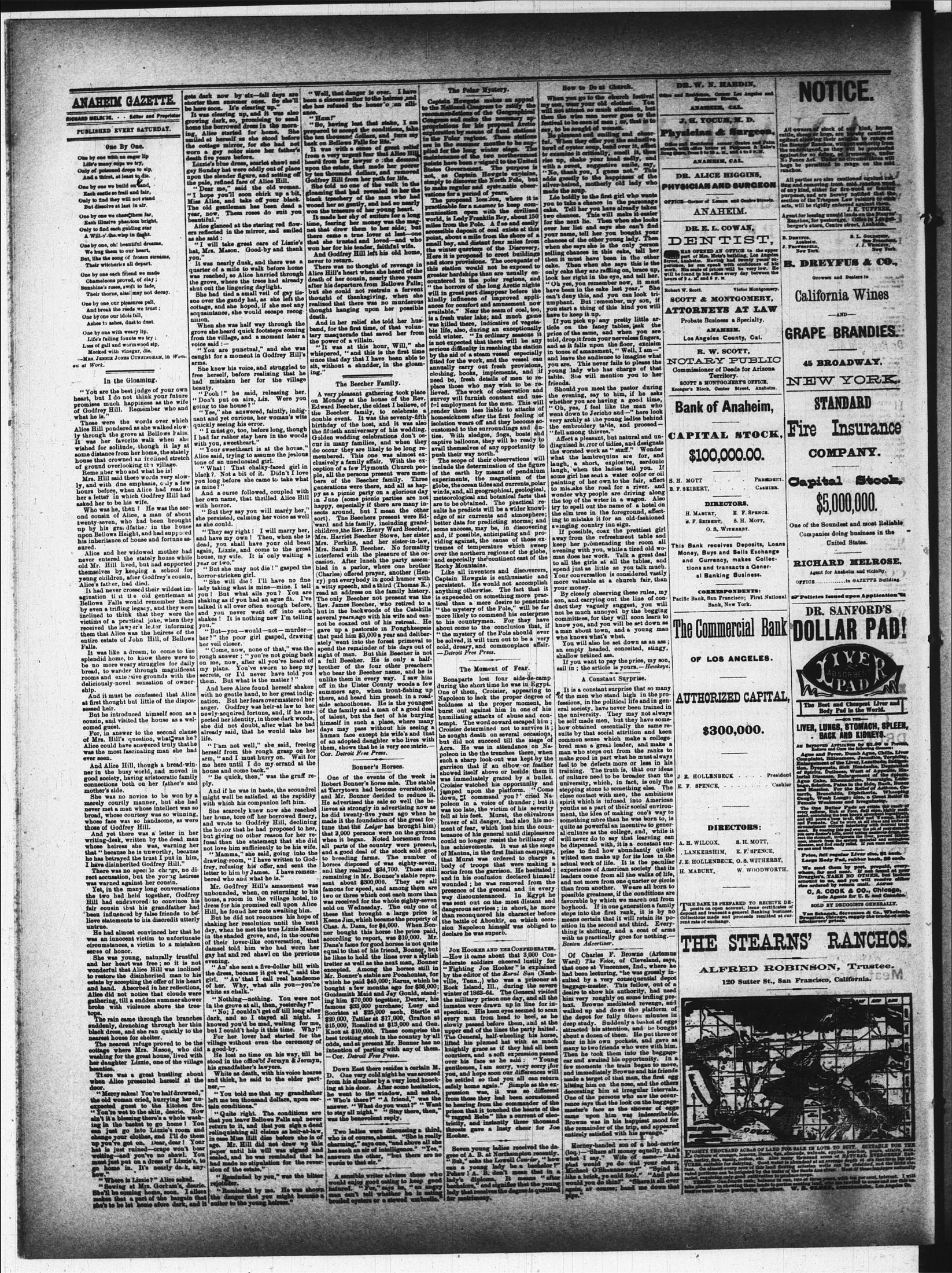
Searchable text
ANAHEIM GAZETTE.
RICHARD MELACZE. - Editor and Proprietor
PUBLISHED EVERY SATURDAY.
One By One.
One by one with an eager lip
Life's many cups we try,
Only of poisoned drops to sip,
And a thirst, at least to die.
One by one we build on sand,
Each castle so frail and fair,
Only to find they will not stand
But dissolve at last in air.
One by one we chase them far,
Each illusive phantom bright,
Only to find each guiding star
A Will-o'-the-wisp in flight.
One by one, oh! beautiful dreams,
We hug them to our heart,
But, like the song of frozen streams,
Their witchery all depart.
One by one each friend we made
Chameleons proved, of clay;
Sunshine's roses, swift to fade;
Their thorns, alas! may not decay.
One by one our pleasures pall,
And break the reeds we trust;
One by one our idols fall,
Ashes to ashes, dust to dust.
One by one with weary lip.
Life's failing founts we try;
Loss of gall and wormwood sip,
Mocked with vinegar, die.
—Mrs. JENNIE JONES CUNNINGHAM, in Woman at Work.
In the Gloaming.
"You are the best judge of your own heart, but I do not think your future promises much happiness as the wife of Godfrey Hill. Remember who and what he is."
These were the words over which Alice Hill pondered as she walked slowly through the grove at Bellows Falls. It was her favorite walk when she wished for solitude, though it lay at some distance from her home, the stately house that crowned an inclined stretch of ground overlooking the village.
Remember who and what he is!
gets dark now by six—fall days are shorter than summer ones. So she'll be here soon. It's clearing up."
It was clearing up, and it was also growing dark, so promising to send home the borrowed dress in the morning, Alice started for home. She smiled at herself as she stood before the cottage mirror, for she had not worn a gay color since her father's death five years before.
Lizzie's blue dress, scarlet shawl and gay Sunday hat were oddly out of place upon the slender figure, and setting off the pale, refined face of Alice Hill.
"Dear me," said the old woman. "I hope you'll soon chirk up a bit, Miss Alice, and take off your black. The old gentleman has been dead a year, now. They rose do suit you beautiful."
Alice glanced at the staring red flowers reflected in the mirror, and smiled as she said:
"I will take great care of Lizzie's hat, Mrs. Mason. Good-by and thank you."
It was nearly dusk, and there was a quarter of a mile to walk before home was reached, so Alice hurried through the grove, where the trees had already shut out the lingering daylight.
She had tied a small veil of gay tissue over the gaudy hat, as she left the cottage, and she hoped, if she met any acquaintance, she would escape recognition.
When she was half way through the grove she heard quick footsteps coming from the village, and a moment later a voice said: —
"You are punctual," and she was caught for a moment in Godfrey Hill's arms.
She knew his voice, and struggled to free herself, before realizing that he had mistaken her for the village beauty.
"Pooh!" he said, releasing her. "Don't put on airs, Lizz. Were you going to the house?"
"Yes," she answered, faintly, indignant and yet curious, her woman's wits quickly seeing his error.
"I must go, too, before long, though I had far rather stay here in the woods with you, sweetheart."
"Your sweetheart is at the house." Alice said, trying to assume the jealous tone of an uneducated girl.
"What! That chalky-faced girl in black? Not a bit of it. Didn't I love..."
In the Gloaming.
"You are the best judge of your own heart, but I do not think your future promises much happiness as the wife of Godfrey Hill. Remember who and what he is."
These were the words over which Alice Hill pondered as she walked slowly through the grove at Bellows Falls. It was her favorite walk when she wished for solitude, though it lay at some distance from her home, the stately house that crowned an inclined stretch of ground overlooking the village.
Remember who and what he is!
Mrs. Hill said these words very slowly, and with due emphasis, only a few hours before, when Alice had read to her a letter in which Godfrey Hill had asked her to be his wife.
Who was he, then? He was the second cousin of Alice, a man of about twenty-seven, who had been brought up by his great father in the house upon Bellows Height, and had supported his inheritance of house and fortune assured.
Alice and her widowed mother had never entered the stately house while old Mr. Hill lived, but had supported themselves by keeping a school for young children, after Godfrey's cousin, Alice's father, had died.
It had never crossed their wildest imagination that the old gentleman at Bellows Falls would remember them by even a trifling legacy, and they were inlined to think that they were the victims of a practical joke, when they received the lawyer's letter informing them that Alice was the heiress of the entire estate of John Hill, of Bellows Falls.
It was like a dream, to come to the splendid home, to know there were to be no more weary struggles for daily bread, to wander through magnificent rooms and extensive grounds with the deliciously-novel sensation of ownership.
And it must be confessed that Alice at first thought but little of the dispossessed heir.
But he introduced himself soon as a cousin, and visited the house as a welcomed guest.
For, in answer to the second clause of Mrs. Hill's question, what was he? Alice could have answered truly that he was the most fascinating man she had ever seen.
And Alice Hill, though a bread-winner in the busy world, nad moved in good society, having aristocratic family connections both on her father's and mother's side.
She was no novice to be won by a merely courtly manner, but she had never met a man whose intellect was so broad, whose courtesy was so winning, whose face was so handsome, as were those of Godfrey Hill.
And yet there was a letter in her writing-desk, written by the dead man whose heiress she was, warning her that "because he is unworthy, because he has betrayed the trust I put in him, I have disinherited Godfrey Hill."
There was no specie charge, no direct accusation, but the young heiress was warned against her cousin.
Yet, in the many long conversations the two had held together, Godfrey free herself before realizing that he had mistaken her for the village beauty.
"Pooh!" he said, releasing her. "Don't put on airs, Liz. Were you going to the house?"
"Yes," she answered, faintly, indignant and yet curious, her woman's wit quickly seeing his error.
"I must go, too, before long, though I had far rather stay here in the woods with you, sweetheart."
"Your sweetheart is at the house." Alice said, trying to assume the jealous tone of an uneducated girl.
"What! That chalky-faced girl in black? Not a bit of it. Didn't I love you long before she came to take what is mine?"
And a curse followed, coupled with her own name, that thrilled Alice Hill with horror.
"But they say you will marry her," she persisted, calming her voice as well as she could.
"They say right! I will marry her, and have my own! Then, when she is dead, you shall have your old beau again, Lizzie, and come to the great house, my wife. It is only waiting a year or two."
"But she may not die!" gasped the horror-stricken girl.
"She will die! I'll have no fine lady taking what is mine—mine. I tell you! But what ails you? You are shaking as if you had an ague fit. I've talked it all over often enough before, and you never went off into such shakes! It is nothing new I'm telling you."
"But—you—would—not—murder—her?" the poor girl gasped, drawing her veil closer.
"Come now, none of that," was the rough answer; "you're not going back on me, now, after all you've heard of my plans. You've sworn to keep my secrets, or I'd never have told you them. But what is the matter?"
And here Alice found herself shaken with no gentle hand, to her great indignation. But her fears overmastered her anger. Godfrey was heir-at-law to her newly-acquired fortune, and, if he suspected her identity, in those dark woods, she did not doubt, after what he had already said, that he would take her life.
"I am not well," she said, freeing herself from the rough grasp on her arm," and I must hurry on. Wait for me here until I do my errand at the house and come back."
"Be quick, then," was the gruff reply.
And if he was in haste, the scoundrel might well be satisfied at the rapidity with which his companion left him.
She scarcely knew now she reached her home, tooreff her borrowed finery, and wrote to Godfrey Hill, declining the honor that he had proposed to her, but giving no other reason for her refusal than the statement that she did not love him sufficiently to be his wife.
"Mamma," she said, going into the drawing-room," I have written to Godfrey, refusing his offer, and sent the letter to him by James. I have remembered who and what he is."
Mr. Godfrey Hill's amazement was unbounded, when on returning to his home a room in the village hotel,
The Beecher
A very pleased on Monday at Edward Beecher the Beecher for double event. birthday of the fifth anniversary Golden wedding cur in many franks do occur they membered. The clusively a famcaption of a few plea all the perers bers of the generations wepy as a picnic in June (some happy especially sects around sort). The Beecher and his children,the B Mrs.Harriet M Mrs.Perkins Mrs.Sarah B interfered with cason. Afterbled in a pa(Charles) offer) put everya witty speechread an addressThe only Beecher Rev.James Bbut in the ba several yearsnot be coaxedgave up a pthat paid himately went intspend the reap sight of man,a full Beecher brother ofwho bear ther unlike themm off in the U summers agerethere,and heside schoolofthe familyof talent,buthimself in sdaysmay human faceofan adoptemthem,showscor.Detroit
merely courtly manner, but she had never met a man whose intellect was so broad, whose courtesy was so winning, whose face was so handsome, as were those of Godfrey Hill.
And yet there was a letter in her writing-desk, written by the dead man whose heiress she was, warning her that "because he is unworthy, because he has betrayed the trust I put in him, I have disinherited Godfrey Hill."
There was no specific charge, no direct accusation, but the young heiress was warned against her cousin.
Yet, in the many long conversations the two had held together, Godfrey Hill had endeavored to convince his fair cousin that his grandfather had been influenced by false friends to believe statements to his discredit utterly untrue.
He had almost convinced her that he was an innocent victim to unfortunate circumstances, a victim to a mistaken sense of honor.
She was young, naturally trustful and her heart was free; so it is not wonderful that Alice Hill was inclined to restore the disinheritited man to his estate by accepting the offer of his heart and hand. Absorbed in her reflections, Alice did not notice that clouds were gathering, till a sudden summer shower broke with violence above the tree-tops.
The rain came through the branches suddenly, drenching through her thin black dress, and she ran quickly to the nearest house for shelter.
The nearest refuge proved to be the cottage where Mrs. Mason, who did washing for the great house, lived with her daughter Lizzie, one of the village beauties.
There was a great bustling about when Alice presented herself at the door.
"Mercy sakes! You're half drowned," the old woman cried, hurrying her unexpected guest to the kitchen fire.
"You're wet to the skin, dearie. Now isn't it a blessing there's a whole washing in the basket to go home! You can just go into Lizzie's room and change your clothes, and I'll do them up you've got on. Dear, dear! Your hat is just ruined—crapes won't bear wetting—and you've no shawl. You must just put on a dress of Lizzie's, to go home in. It's nearly dark, anyhow."
"Where is Lizzie?" Alice asked.
"Sewing at Mrs. Gorkam's, dearie. She'll be coming home soon. I allow makes that a part of the bargain that she's to be let home after dark, and it
She scarcely knew now she reached her home, tore off her borrowed finery, and wrote to Godfrey Hill, declining the honor that he had proposed to her, but giving no other reason for her refusal than the statement that she did not love him sufficiently to be his wife.
"Mamma," she said, going into the drawing-room, "I have written to Godfrey, refusing his offer, and sent the letter to him by James. I have remembered who and what he is."
Mr. Godfrey Hill's amazement was unbounded, when, on returning to his home, a room in the village hotel, to dress for his promised call upon Alice Hill, he found her note awaiting him.
But he did not renounce his hope of shaking her resolution until the next day, when he met the true Lizzie Mason in the shaded grove, and, in the course of their lover-like conversation, that damsel told him who had worn her gay hat and red shawl on the previous evening.
"An' she sent a five-dollar bill with the dress, because it got wet," said the girl. "An' that I call real handsome of her. Why, what ails you—you're white as chalk."
"Nothing—nothing. You were not in the grove at all, then, yesterday?"
"No; I couldn't get off till long after dark, and so I stayed all night. I knowed you'd be mad, waiting for me, but I couldn't help it this time. Why!"
For her lover had started for the village without even the ceremony of a good-by.
He lost no time on his way, till he stood in the office of Jermyn & Jermyn, his grandfather's lawyers.
White as death, with his voice hoarse and thick, he said to the elder partner,
"You told me that my grandfather left me ten thousand dollars, upon certain conditions."
"Quite right. The conditions are that you leave Bellows Falls and never return to it, and that you sign a deed relinquishing all claims as heir-at-law, in case Miss Hill dies before she is of age. Mr. Hill did not draw up this paper until his will was signed and sealed, and he was reminded that he had made no stipulation for the reversion of the estate."
"Reminded by you," was the bitter rejoinder.
"Reminded by me. He was shown the danger that you might become a suitor to the young heiress."
"Well, that danger is over. I have been a sincere suitor to the heiress and she has refused the honor'o an alliance.
"Hum!"
"So, having lost that stake, I am prepared to accept the conditions, take the ten thousand dollars, and turn my back on Bellows Falls for life."
It was with a sense of great relief from a very urgent fear that Alice Hill heard from her lawyer o; the demand upon the estate, that made her poorer by ten thousand dollars, and removed Godfrey Hill from her path for life.
She told no one of the walk in the gloaming that had revealed to her the black treachery of the man who had wooed her so gently, and had so nearly won the treasure of her young heart.
It made her shy of suitors for a long time, fearing her money was the magnet that drew them to her side; but there came a true lover at last—one that she trusted and loved—and who won her for his tender, faithful wife.
And Godfrey Hill left his old home, never to return.
There was no thought of revenge in Alice Hill's heart when she heard of the death of her cousin, nearly three years after his departure from Bellows Falls; but she could not restrain a fervent thought of thanksgiving, when she realized that there was no murderous thought hanging upon her possible death.
And in her relief she told her husband, for the first time, of that voluntary masquerade that saved her from the power of a villain.
"It was at this hour, Will," she whispered, "and this is the first time since that day that I have been able to sit, without a shudder, in the gloaming."
The Beecher Family.
A very pleasant gathering took place on Monday at the house of the Rev. Edward Beecher, the eldest I believe, of the Beecher family, to celebrate a double event. It was the seventy-fifth birthday of the host, and it was also the fifteenth anniversary of his wedding. Golden wedding celebrations don't occur in many families, and when they do occur they are likely to be long remembered. This one was almost exclusively a family affair. With the exception of a few Plymouth Church people all the persons present were mem-
The Polar Mystery.
Captain Howgate makes an appeal to the National Congress to ratify the recommendations of the Geographical Congress and make the necessary appropriations for his proposed Arctic exploration by means of fixed stations in the Polar regions. These stations are in the summer months to be supplied for the long winter sings. The maintenance of the two northernmost points have been assigned to the United States Government. The purpose is not, as Captain Howgate explains, simply to discover the North Pole, but to make regular and systematic observations for a period of years.
The proposed location, where it is practicable for a seamer to keep communication open with the civilized world, is Lady Franklin Bay, about 150 miles from the Pole. A free and easily accessible deposit of coal exists at this point, about a mile from the shore of a small bay, and distant four miles from the winter quarters of the Discovery. Here it is proposed to erect buildings and store provisions. The occupants of this station would not be exposed to greater hardships than are usually encountered in the polar regions, and "the horrors of the long Arctic nights will in great part disappear before the kindly influence of improved appliances for comfort and amusement now available." Near the seam of coal, too, is a fresh water lake; and much game was killed there, indicative of vegetable life, also during an exceptionally cold winter. "In ordinary seasons it is not expected that there will be any serious difficulty in reaching the station by the aid of a steam vessel especially fitted for the work, and the vessel can annually carry out fresh provisions, clothing, books, implements, and if need be, fresh details of men to replace those who may wish to be relieved. The work of observation and survey will furnish constant and useful employment for the men. This will render them less liable to attacks of homesickness after the first feeling of isolation wears off and they become accustomed to the surroundings and duties. With sledges, dogs, boats and captive balloons, they will be ready to avail themselves of any opportunity to push their way north."
The scope of their observations will include the determination of the figure of the earth by means of pendulum.
How to Do at Church.
When you go to the church festival my son wear your old clothes. You will not attract so much attention, but then the wise man never goes to the festival to be seen of men; or, that is to say, to be sought of women.
Be pleasant and smiling and cheerful. When they offer you the seductive bowl of oyster soup, bend over it, affect to examine it critically, small it, then rise up, shake your head sadly, and with a sweet, suggestive smile, say,
"No, thank you, I guess not." This adds greatly to the happiness of the silver-haired, motherly old lady who made the soup.
Lie boldly to the first girl who wants you to take a chance in the parsonage cake. Tell her you have already taken two chances. This will make it easier for the next lie. Then when she looks over her list and says she can't find your name, tell her you bought your chances of the other young lady. Then when she says she is the only person selling chances in this cake, tell her then it must have been in the other cake. Then when she says this is the only cake they are raffling on, brace up, look her right in the eye, and tell her.
"Oh yes, you remember now, it must have been in the cake last year." She can't deny this, and you can look triumphant. But remember, my son, if you start a thing of this kind you will have to keep it up.
If you pick up any pretty little article on the fancy tables ask the price of the same, and when you are told, drop it from your nerveless fingers, and as it falls upon the floor, exclaim in tones of amazement," Well, I am—" and leave the audience to imagine what you are. This never fails to please the young lady who has charge of that table. She will mention you to her friends.
Should you meet the pastor during the evening, say to him, if he asks whether you are having a good time,
"Oh yes, I feel like the man who went down to Jericho and—" here look very archly at the young ladies behind the embroidery table, and proceed—" fell among thieves."
Affect a pleasant, but natural and undisguised horror of tidies, and designates the worsted work as "stuff." Wonder what the lambrequins are for, and laugh, a short, explosive, sardonic laugh, when the ladies tell you. If
The Beecher Family.
A very pleasant gathering took place on Monday at the house of the Rev. Edward Beecher, the eldest I believe, of the Beecher family, to celebrate a double event. It was the seventy-fifth birthday of the host, and it was also the fifteenth anniversary of his wedding. Golden wedding celebrations don't occur in many families, and when they do occur they are likely to be long remembered. This one was almost exclusively a family affair. With the exception of a few Plymouth Church people, all the persons present were members of the Beecher family. Three generations were there, and all as happy as a picnic party on a glorious day in June (some pionic parties are not happy, especially if there are many insects around, but I mean the other sort). The Beechers present were Edward and his family, including grandchildren, the Rev. Henry Ward Beecher, Mrs. Harriet Beecher Stowe, her sister Mrs. Perkins, and her sister-in-law Mrs. Sarah B. Beecher. No formality interfered with the pleasure of the occasion. After lunch the party assembled in a parlor, where one brother (Charles) offered prayer, another (Henry) put everybody in good humor with a witty speech, and a third (Thomas K.) read an address on the family history. The only Beecher not present was the Rev. James Beecher, who retired to a hut in the backwoods of the Catskills several years ago with his wife and cannot be coaxed out of his retreat. He gave up a pastorate in Poughkeepsie that paid him $3,000 a year and deliberately went into the forest primeval to spend the remainder of his days out of sight of man. But this Beecher is not a full Beecher. He is only a half-brother of the four other preachers who bear the Beecher name, and he is unlike them in every way. I saw him off in the Ulster County woods a few summers ago, when trout-fishing up there, and heard him preach in a roadside schoolhouse. He is the youngest of the family and a man of a good deal of talent, but the fact of his burying himself in such a place, where many days may pass without his seeing a human face except his wife's and that of an adopted daughter who lives with them, shows that he is very eccentric.—Cor. Detroit Free Press.
Bonner's Horses.
One of the events of the week is Robert Bonner's horse sale. The stable at Tarrytown had become overstocked, and Mr. Bonner decided to reduce it. He advertised the sale so well (he believes as strongly in advertising now as he did twenty-five years ago when he made it the foundation of the great fortune that the Ledger has brought him) that 3,000 persons were on the ground when it began. Noted horsemen from all parts of the country were present, and a good deal of the stock sold goes to breeding farms. The number of horses disposed of was eighty-seven, and they realized $34,700. Those still remaining in Mr. Bonner's stable represent about $300,000. They are all famous for speed, and among them are two or three which cost each more than clothing, books, implements, need be, fresh details of men to replace those who may wish to be relieved. The work of observation and survey will furnish constant and useful employment for the men. This will render them less liable to attacks of homesickness after the first feeling of isolation wears off and they become accustomed to the surroundings and duties. With sledges, dogs, boats and captive balloons, they will be ready to avail themselves of any opportunity to push their way north.
The scope of their observations will include the determination of the figure of the earth by means of pendulum experiments, the magnetism of the globe, the ocean tides and currents, polar winds, and all geographical, geological, meteorological and botanical facts that are to be obtained. The practical results he predicts will be a wider knowledge of air currents and atmosphere; better data for predicting storms; and some success may be, in discovering and, if possible, anticipating and providing against, the cause of those extremes of temperature which sweep over the northern regions of the globe, and especially the continent east of the Rocky Mountains.
Like all inventors and discoverers, Captain Howgate is enthusiastic and persistent. He would not accomplish anything otherwise. The fact that it is expended on something more practical than a mere desire to penetrate "the mystery of the Pole," will be far more likely to commend his enterprise to his countrymen. For they have about come to the conclusion that, if "the mystery of the Pole should ever be solved, it will turn out to be a very cold, dreary, and commonplace affair."—Detroit Free Press.
The Moment of Fear.
Bonaparte lost four aids-de-camp during the short time he was in Egypt. One of them, Croisier, appearing to Napoleon to lack the proper degree of boldness at the proper moment, he burst out against him in one of his humiliating attacks of abuse and contempt. The word coward escaped him; Croisier determined not to survive it; he sought death on several occasions, but did not succeed till the siege of Acra. He was in attendance on Napoleon in the trenches there, when such a sharp look-out was kept by the garrison that if an elbow-or feather showed itself above or beside them it was immediately grazed by a bullet. Croisier watched his opportunity and jumped upon the platform." Come down, I command you?" cried Napoleon in a voice of thunder; but it was too late, the victim of his severity fell at his feet. Murat, the chivalrous braver of all danger, had also his moment of fear, which lost him the countenance of his general until displeasure could no longer resist the brilliancy of his achievements. It was at the siege of Mantua, in the first Italian campaign, that Murat was ordered to charge a body of troops that were making a sortie from the garrison. He hesitated; and in his confusion declared himself wounded; he was removed from the presence of the general and in every way discountenanced. In Egypt he table. She will mention you to her friends.
Should you meet the pastor during the evening, say to him, if he asks whether you are having a good time,
"Oh yes, I feel like the man who went down to Jericho and—" here look very archly at the young ladies behind the embroidery table, and proceed—" fell among thisves."
Affect a pleasant, but natural and undisguised horror of tidies, and designats the worsted work as "stuff." Wonder what the lambrequins are for, and laugh, a short, explosive, sardonic laugh, when the ladies tell you. If some girl has sent a water color or oil painting of her own to the fair, affect to mistake the road for a river, and wonder why people are driving along the top of the writer in a wagon. Also try to spell out the name of a hotel on the elm tree in the foreground, affecting to mistake it for an old-fashioned swinging country inn sign.
If possible, coax the prettiest girl away from the refreshment table and keep her promenading the room all evening with you, while a tired old woman does her work. Talk a great deal to all the girls at all the tables, and spend just as little as you talk much. Your conversation is considered vastly more valuable at a church fair, than your money.
By closely observing these rules, my son, and carrying out the line of conduct they vaguely suggest, you will not be much annoyed by the begging committees, for they will soon learn to know you, and you will be set down as a man about town, and a young man who knows what's what.
You will also be set down as an ass; an empty headed, conceited, stingy, shallow brained ass.
If you want to pay the price, my son sail in; the article is yours.—Hawkeye.
A Constant Surprise.
It is a constant surprise that so many of the men who stand high in the professions, in the political life and in general society, have never been trained in the university. They may not always be self-made men, but they have somehow obtained essentially the same results by that social attrition and keen common sense which make a college-bred man a great leader, and make a man who steps out from the ranks to make good in part what he must always feel to be defects more or less in his training. The truth is, that our ideas of culture need to be broader than the university, which, in fact, is only the stepping stone to something else. The close contact with men, the ambitious spirit which is infused into American youths as a part of their social environment, the idea of making one's way to something more than he was born to, is quite as powerful an incentive to general culture as the college, and while it will never do to say that learning can be dispensed with, it is a constant surprise to find how abundantly quick witted men make up for its loss in actual work of life. It is the peculiar experience of American society that its leaders come from all the walks of life and not more from one quarter or circle than from another. We all born to possible greatness; if the conditions are
He advertised the sale so well (he believes as strongly in advertising now as he did twenty-five years ago when he made it the foundation of the great fortune that the Ledger has brought him) that 3,000 persons were on the ground when it began. Noted horsemen from all parts of the country were present, and a good deal of the stock sold goes to breeding farms. The number of horses disposed of was eighty-seven, and they realized $34,700. Those still remaining in Mr. Bonner's stable represent about $300,000. They are all famous for speed, and among them are two or three which cost each more than was received for the whole eighty-seven sold on Wednesday. The only one of these that brought a large price is Keene Jim, which became the property of Chas. A. Dana, for $4,000. When Bonner bought this horse the price paid, according to report, was $10,000. Mr. Dana's fame for good horses is not quite equal to that of his friend, Bonner, but he likes to hold the lines over a stylish tretter as well as the next man. Bonner excepted. Among the horses still in Mr. Bonner's stable are Pocahontas, for which he paid $45,000; Rarus, which he bought a few months ago for $36,000; Goldsmith Maid and Jay Gould, standing him $70,000 together; Dexter, his famous $33,000 purchase; Lucey and Soorates at $25,000 each. Startle at $20,000; Tattler at $17,000; Grafton at $15,000; Rosalind at $13,000 and Gen. Knox at $10,000. These comprise the best trotting stock in the country by all odds, and at present Mr. Bonner has no intention of parting with any of them.
Cor. Detroit Free Press.
Down East there resides a certain M. D. One very cold night he was aroused from his slumber by a very loud knocking at his door. After some hesitation, he went to the window, and asked, "Who's there?" "A friend," was the answer. "What do you want?" "Want to stay all night." "Stay there, then," was the benevolent reply.
Two ladies were discussing a third who is of course, absent. "She is really charming," says one, "and above all she has such an air of intelligence." "Yes," answers the other, "but there are no words to that air."
A sensible writer advises those who would enjoy good eating to keep good natures. "For," says he, "an angry man can't tell whether he is eating broiled oysters or a stewed umbrella."
Joe Hooker and the Confederates.
—How it came about that 3,000 Confederate soldiers cheered lustily for "Fighting Joe Hooker" is explained by the editor of the Rural Sun (Nashville, Tenn.) who was a prisoner at Bock Island, Ill., during the severe winter of 1863-64. The General visited the military prison one day, and all the inmates were drawn up in line for inspection. His keen eyes seemed to scan every man from head to heel, as he slowly passed before them, and at the upper end of the lines the party halted. The General, half-wheeling his horse, lifted his plumed hat with as much knightly grace as if they had all been courtiers, and a soft expression passed over his face as he said: "Young gentlemen, I am sorry, very sorry for you, and hope soon our differences will be settled so that you can return safely home again." Simple as the expression was, it was so different from those they had been accustomed to hearing from the commander of the prison that it touched the hearts of the "ragged Bebs" like a current of electricity, and instantly three thousand throats gave a lusty cheer for Joe Hooker.
Seven young ladies received the degree of A. B. at Northampton recently. "But," asks the Lowell Courier, "how can a young lady be a bachelor? Puhaw! A. B. don't mean that in a lady's diploma. It means 'after bachelors,' and signifies that the young lady that receives the degree is qualified for matrimony.
spirit which is infused into American youths as a part of their social environment, the idea of making one's way to something more than he was born to, is quite as powerful an incentive to general culture as the college, and, while it will never do to say that learning can be dispensed with, it is a constant surprise to find how abundantly quickly witted men make up for its loss in the actual work of life. It is the peculiar experience of American society that its leaders come from all the walks of life and not more from one quarter or circle than from another. We are all born to possible greatness, if the conditions are favorable by which we march out from boyhood. If in one generation a family steps into the first rank, it is by no means certain that it will retain its position in the second and third. Every thing is shifting, and a coat of arm with us practically goes for nothing.
Boston Advertiser.
Of Charles F. Browne (Artemus Ward) The Voice, of Cleveland, says that once at Vincennes, Ind., where he had been lecturing, "he was grossly insulted by a very consequential deputy baggage-master. This fellow, out of desire to show his authority, had used him very roughly on some trifling protext. Browne meditated revenge, and walked up and down the platform on the depot for fully fifteen minutes in deep study. Suddenly a basket of eggs attracted his attention, and he bought about a dozen of them. He put three or four in his own pockets, and gave many to two friends who were with him. Then he took them into the baggage-car and awaited his opportunity. In few moments the train began to move and immediately Browne and his friend made a target of that man, the first egg hitting him on the nose, and the other decorating him at irregular intervals. One of the persons who saw the occurrence says that the look on the baggage-master's face as the shower of eggs came upon him was indescribably Browne was in his happiest mood for the remainder of the trip, and appears entirely satisfied with his revenge."
DR. W. N. HARDIN,
Office and Residence, Corner Los Angeles and
Anaheim, Cal.
J. H. YOCUM, M. D.
Physician & Surgeon,
Office and Residence corner Centre and Palm
street, with office hours at Pleasant & Law's
Drug Store, From 9 to 10 A.M., and 4 to 5 P.M.
Anaheim, Cal.
DR. ALICE HIGGINS,
PHYSICIAN AND SURGEON
OFFICE—Corner of Lemon and Centre Streets.
Anaheim.
DR. E. L. COWAN,
DENTIST,
HAS OPENED AN OFFICE in the upper
part of Mrs. Metra's building, Los Angeles
Street, Anaheim. Having had twenty years' experience, he can speak with confidence of his work. His scale of practice will be very low. He will be found in his office every day between the hours of 9 A.M. and 5 P.M.
Robert W. Scott. Victor Montgomery.
SCOTT & MONTGOMERY,
ATTORNEYS AT LAW
Probate Business a Specialty.
Anaheim.
Los Angeles County, Cal.
R. W. SCOTT,
NOTARY PUBLIC
Commissioner of Deeds for Arizona Territory.
SCOTT & MONTGOMERY'S OFFICE,
Kroeger's Block, Center Street, Anaheim.
Bank of Anaheim,
CAPITAL STOCK,
$100,000.00.
NOTICE.
All owners of stock of any kind, horses cattle, sheep or hogs, are hereby cautioned against allowing their animals to range on the Steamer Ranchos, without authority from the undersigned, as they will be proceeded against for so doing, at trespassers, under No Fence Act. Under no circumstances will hogs be permitted to range on the said ranchos.
All parties are also cautioned against cutting and removing from said ranchos wood of any kind, either for firewood or fencing purposes, and are hereby notified that the section of the Traspass Law relative to such acts, will be rigidly enforced against them.
Agent for leasing unsold lands on the Steamer Ranchos, for pesturage. Office in Langemberger's store, Centre street, Anaheim.
B. DREYFUS.
Anheim.
J. FROWSERLO,
New York.
B. DREYFUS & CO.
Growers and Dealers in
California Wines
AND
GRAPE BRANDIES.
45 BROADWAY.
NEW YORK.
STANDARD
Fire Insurance COMPANY.
Territory.
SCOTT & MONTGOMERY'S OFFICE,
Kroeger's Block, Center Street, Anaheim.
Bank of Anaheim,
CAPITAL STOCK,
$100,000.00.
S. H. MOTT
President.
B. F. SEIBERT,
Cashier.
DIRECTORS.
H. MABURY,
E. F. SPENCE.
M. F. SEIBERT,
S. H. MOTT,
O. S. WITHERBY.
This Bank receives Deposits, Loans Money, Buys and Sells Exchange and Currency, makes Collections and transacts a General Banking Business.
CORRESPONDENTS:
Pacific Bank, San Francisco; First National Bank, New York.
The Commercial Bank
OF LOS ANGELES.
AUTHORIZED CAPITAL,
$300,000.
J. E. HOLLENBECK
President
E. F. SPENCE,
Cashler
DIRECTORS:
A. H. WILCOX,
S. H. MOTT,
LANKERSHIM,
E. F. SPENCE,
J. E. HOLLENBECK, O. S. WITHERBY,
H. MABURY,
W. WOODWORTH.
NEW YORK.
STANDARD Fire Insurance COMPANY.
Capital Stock,
$5,000,000.
One of the Soundest and most Reliable Companies doing business in the United States.
RICHARD MELROSE.
Agent for Anaheim and vicinity.
OFFICE...in GAZETTE Building.
Policies Issued upon Application
DR. SANFORD'S DOLLAR PAD!
ABSORBER PAD
The Best and Cheapest Liver and Body Pad in the World.
LIVER, LUNGS, STOMACH, SPLEEN, BACK AND KIDNEYS.
An Improved Appliance for $1.00 to Prevent Believe and Oure the following diseases:
Ague and Fever, Dumb Ague, Chilla, Liver Complaint, Billiousness, Jaundice, Tortility, Enlargement of the Liver, Latitude, Indigestion, Dyspupnea, Sick Headache, Digestion of Spirits, Duliness, Want of Apples, Mental Disease, Enlargement of the Diaphragm, Ague Cake, Rheumatism, Nervalgia, Lamenage, Sedation, Pain in the Bide, Back, Bones and Muscles.
For the Relief of Aartha, Carrath, Bronchitis, Diphtheria, Whooping Cough, Weak Lungs; also a Great Relief in Female Weakness and Irregularity.
The One Botulin Pads are within the reach of every adult: Bite or Poor, full size, highly medicated, containing the best known abnormals ingredients, and will prove a boon to all Old and Young Adults and Females.
Can be worn at all times and over all circumstances without interfering with external treatment.
By wearing this pad over the pit of your stomach you save doctor's bills, avoid taking maximal drugs to correct the stomach, invigorate the liver, prevent inflammation, absorb from the system material substances and find ready relief. If you want assistance we can send them.
Price, full regular Liver size, $1 each.
Large Body Pad, rubber back, $2 each.
We send them by post, prepaid everywhere far and near. If not found at your Drugstore, TAKE NO OTHER, but incumbent to us, and you will receive either also ordered by return mail.
C. A. COOK & CO., Chicago,
Sole Agents for U.S. and Canada.
DIRECTORS:
A. H. WILCOX, S. H. MOTT,
.LANKERSHIM, E. F. SPENCE,
J. E. HOLLENBECK, O. S. WITHERBY,
H. MABURY, W. WOODWORTH.
THE BANK IS PREPARED TO RECEIVE DEPOSITS ON OPEN ACCOUNT, ISSUE CERTIFICATES OF DEPOSIT AND TRANSACT A GENERAL BANKING BUSINESS. Collections made and proceeds remitted at current rate of exchange.
THE STEARNS' RANCHOS.
ALFRED ROBINSON, Trustee.
120 Sutter St., San Francisco, California.
EIGHTY THOUSAND ACRES OF LAND FOR SALE IN LOTS TO SUIT. SUITABLE FOR THE Culture of oranges, lemons, limes, figs, almonds, valleys, apples, peaches, pears, alfalfa, corn, rye, barley, flax, rapeseed, etc. Also many thousand acres of NATURAL, EVERGREEN PASTURE suitable for drying. Good water is abundant at an average depth of six feet from the surface. On almost every acre of this land sowing artesian wells can be obtained, and the high elevated portions can be irrigated by the water of the Santa Ana river. Most of these lands are naturally moist, requiring only good cultivation to produce crops.
TERMS: One-fourth cash; balance in one, two or three years, with ten per cent interest. I will take pleasure in showing these lands to partisans seeking land who are invited to come and see this enlightening town before purchasing elsewhere. W. E. GLENN, Annapolis City, Leo Angleton Co.