anaheim-gazette 1880-01-10
Scanned page
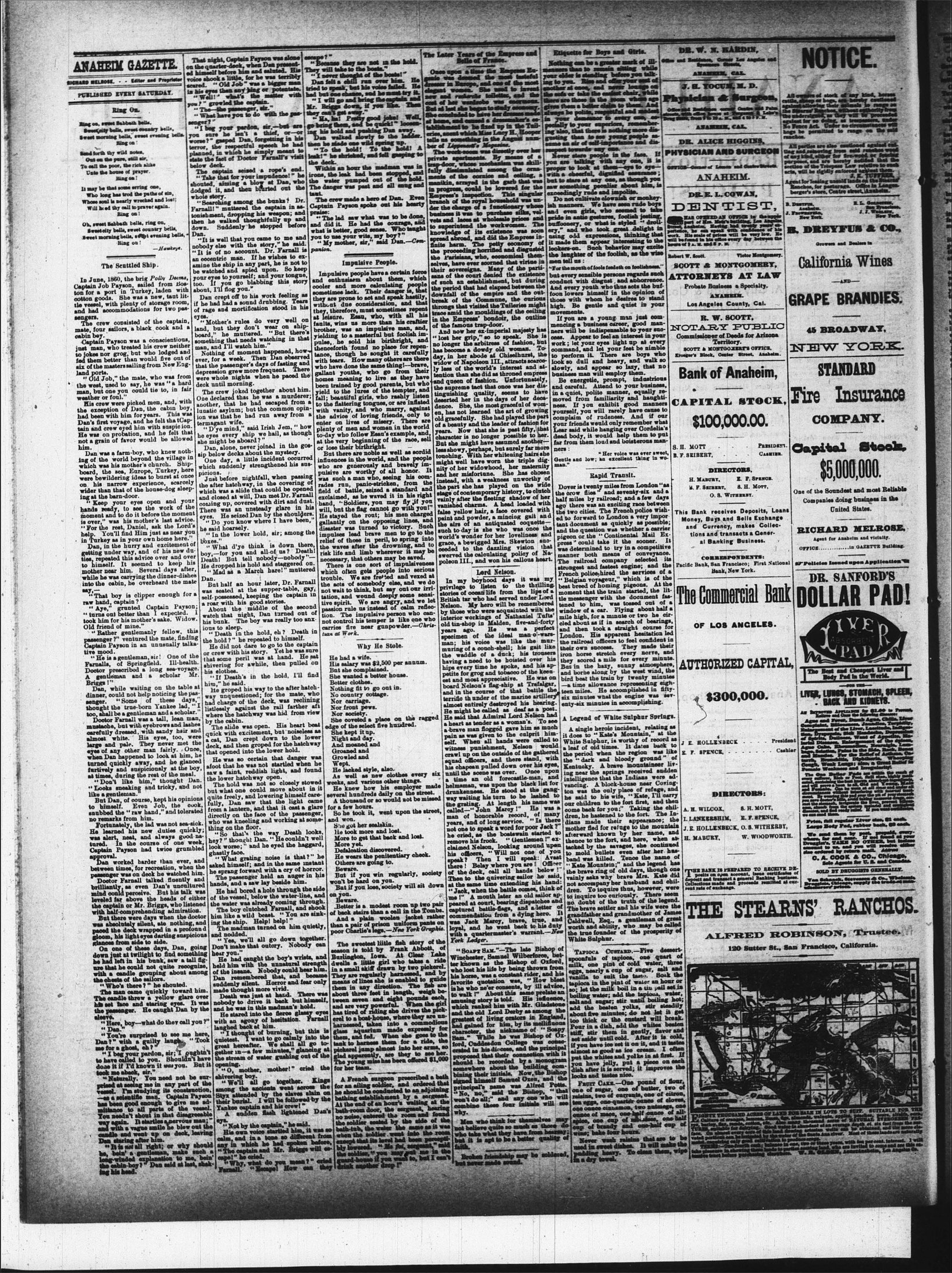
Searchable text
ANAHEIM GAZETTE.
RICHARD MELROSE. - Editor and Proprietor
PUBLISHED EVERY SATURDAY.
Ring On.
Ring on, sweet sabbath bells,
Sweet city bells, sweet country bells,
Sweet morning bells, sweet evening bells.
Ring on!
Send forth thy wild notes,
Out on the pure, still air,
To call the poor, the rich alike
Unto the house of prayer.
Ring on!
It may be that some erring one,
Who long has trod the paths of sin,
Whose soul is nearly wrecked and lost!
Will heed thy call to prayer again.
Ring on!
Oh, sweet sabbath bells, ring on,
Sweet city bells, sweet country bells,
Sweet morning bells, sweet evening bells,
Ring on!
—Hawkeye.
The Scuttled Ship.
In June, 1860, the brig Polly Deems,
Captain Job Payson, sailed from Boston for a port in Turkey, laden with cotton goods. She was a new, taut little vessel, with plenty of storage room, and had accommodations for two passengers.
The crew consisted of the captain, mate, four sailors, a black cook and a cabin boy.
Captain Payson was a conscientious, just man, who treated his crew neither to jokes nor grog, but who lodged and fed them better than would five out of six of the masters sailing from New England ports.
"Old Job," the mate, who was from the west, used to say, he was "a hard man, but one you could tie to, in fair weather or foul."
His crew were picked men, and, with the exception of Dan, the cabin boy, had been with him for years. This was Dan's first voyage, and he felt that Captain and crew eyed him with suspicion. He was on probation, and he felt that not a grain of favor would be allowed him.
Dan was a farm-boy, who knew nothing of the world beyond the village in which was his mother's church. Shipboard, the sea, Europe, Turkey, here
That night, Captain Payson was alone on the quarter-deck, when Dan presented himself before him and saluted. His voice shook a little, for he was terribly scared. "Old Job" was a bigger man in his eyes than any king or potentate.
"Well!" what's the matter with you? growled the captain.
"The—the passenger, sir."
What have you to do with the passenger?
"I beg your pardon, air—but are you sure he isn't a thief, or worse?" gasped Dan, forgetting in his terror, the respectful speech he had planned, in which he simply meant to state the fact of Doctor Farnall's visit below deck.
The captain seized a rope's end.
"Take that for your impudence!" he shouted, aiming a blow at Dan, who dodged it, and then blurted out the whole story.
"Searching among the bunks? Dr. Farnall!" muttered the captain in astonishment, dropping his weapon; and then he walked thoughtfully up and down. Suddenly he stopped before Dan.
"It is well that you came to me and nobody else with the story," he said.
"It is of no account. Dr. Farnall is an eccentric man. If he wishes to examine the ship in any part, he is not to be watched and spied upon. So keep your eyes to yourself; and your tongue, too. If you go blabbing this story about I'll flog you."
Dan crept off to his work feeling as if he had had a sound drubbing. Tears of rage and mortification stood in his eyes.
"Mother's rules do very well on land, but they don't wear on shipboard," he muttered. "But there's something that needs watching in that man, and I'll watch him."
Nothing of moment happened, however, for a week. Then Dan observed that the passenger's days of fasting and depression grew more frequent. There were whole nights when he paced the deck until morning.
The crew joked together about him. One declared that he was a murderer; another, that he had escaped from a lunatic asylum; but the common opinion was that he had run away from a termagant wife.
"Dye mind," said Irish Jem," how he eyes every ship we hail, as though she might be aboard?"
Dan, alone, never joined in the gossip below decks about the mystery.
One day, a little incident occurred which suddenly strengthened his suspicions.
escape?"
Because they They will take to
I never thought Dan felt a child tried to speak, but had but one chance.
I will go and Mr. Briggs down they can't get awake.
Ha! Ha! Pride bring them, acting his hold and Dan walked then he made one.
To the hollow leak! he shrinks the deck.
Within an hour irons, the leak in the water punts The danger was taunt.
The crew made Captain Payson praise:
"The lad saw and did it. He what is better, give you to use your "My mother panion."
"Old Job," the mate, who was from the west, used to say, he was "a hard man, but one you could tie to, in fair weather or foul."
His crew were picked men, and, with the exception of Dan, the cabin boy, had been with him for years. This was Dan's first voyage, and he felt that Captain and crew eyed him with suspicion. He was on probation, and he felt that not a grain of favor would be allowed him.
Dan was a farm-boy, who knew nothing of the world beyond the village in which was his mother's church. Shipboard, the sea, Europe, Turkey, here were bewildering ideas to burst at once on his narrow experience, scarcely wider than that of the house-dog sleeping at the barn-door.
"Keep your eyes open and your hands ready, to see the work of the moment and to do it before the moment is over," was his mother's last advice. "For the rest, Daniel, ask the Lord's help. You'll find Him just as near you in Turkey as in your own home here."
Dan, in the hurry and excitement of getting under way, and of his new duties, repeated this advice over and over to himself. It seemed to keep his mother near him. Several days after, while he was carrying the dinner-dishes into the cabin, he overheard the mate say,
"That boy is clipper enough for a raw hand, captain?"
"Aye," grunted Captain Payson; "turns out better than I expected. I took him for his mother's sake. Widow. Old friend of mine."
"Rather gentlemanly fellow, this passenger?" ventured the mate, finding Captain Payson in an unusually talkative mood.
"He is a gentleman, sir! One of the Farnalls, of Springfield. Ill-health. Doctor prescribed a long sea-voyage. A gentleman and a scholar Mr. Briggs!"
Dan, while waiting on the table at dinner, could not help noticing the passenger. "Some of these days," thought the true-born Yankee lad, "I too, shall be a gentleman and a scholar."
Doctor Farnall was a tall, lean man, mustache, but with eyebrows and lashes carefully dressed, with sandy hair and almost white. His eyes, too, were large and pale. They never met the eyes of any other man fairly. Once when Dan happened to look at him, he turned quickly away, and he glanced fartively and suspicionally at the boy, at times, during the rest of the meal.
"Don't like him," thought Dan. "Looks sneaking and tricky, and not like a gentleman."
But Dan, of course, kept his opinions to himself. Even Job, the cook, snubbed the "raw hand," and tolerated no remarks from him.
Fortunately, the lad was not sea-sick. He learned his new duties quickly; was alert, neat, and always good-natured. In the course of one week, Captain Payson had twice grumbled approval.
Dan worked harder than ever, and between times, for recreation, when the passenger was on deck he watched him.
Doctor Farnall talked fluently and brilliantly, as even Dan's uncultured mind could perceive. But his talk was louder for above the heads of either
The crew joked together about him. One declared that he was a murderer; another, that he had escaped from a lunatic asylum; but the common opinion was that he had run away from a termagant wife.
"Dye mind," said Irish Jem., "how he eyes every ship we hail, as though she might be aboard?"
Dan alone, never joined in the gossip below decks about the mystery.
One day, a little incident occurred which suddenly strengthened his suspicions.
Just before nightfall, when passing the after hatchway, in the covering of which was a slide that could be opened and closed at will, Dan met Dr. Farnall coming up, covered with dirt and dust. There was an unsteady glare in his eyes. He seized Dan by the shoulders.
"Do you know where I have been," he said hoarsely.
"In the lower hold, sir; among the boxes."
"What d'ye think is down there, boy—for you and all-of us? Death! Death! But tell nobody—nobody!" He dropped his hold and staggered on.
"Mad as a March hare!" muttered Dan.
But half an hour later, Dr. Farnall was seated at the supper-table, gay, self-possessed, keeping the captain in a roar with his good stories.
About the middle of the second watch that night, Dan turned out of his bunk. The boy was really too anxious to sleep.
"Death in the hold, eh? Death in the hold?" he repeated to himself.
He did not dare to go to the captain or crew with his story. Yet he was sure that some peril was at hand. He sat shivering for awhile, then pulled on his elothes.
"If Death's in the hold, I'll find him," he said.
He grouped his way to the after hatchway unquestioned; for the mate, who had charge of the deck, was reclining listlessly against the rail farther afft where the hatchway was hid from view by the cabin.
The slide was open. His heart beat quick with excitement, but noiseless as a cat. Dan crept down to the lower deck, and then groped for the hatchway that opened into the lower hold.
He was so certain that danger was afoot that he was not startled when he saw a faint, reddish light, and found the lower hatchway open.
The hold was not so closely stowed but what one could move about in it quite freely, and lowering himself carefully. Dan saw that the light came from a lantern, and that it cast a glare directly on the face of the passenger, who was kneeling and working at something on the floor.
"So that's the way Death looks, hey?" thought Dan. "He couldn't well look worse;" and he eyed the haggard, ghastly face.
"What grating noise is that?" he asked himself; and in the same instant he sprang forward with a cry of horror.
The passenger held an auger in his hands, and a saw lay beside him.
He had bored a hole through the side of the vessel, below the water-line, and were whole nights when he paced the deck until morning.
The crew joked together about him. One declared that he was a murderer; another, that he had escaped from a lunatic asylum; but the common opinion was that he had run away from a termagant wife.
"Dye mind," said Irish Jem., "how he eyes every ship we hail, as though she might be aboard?"
Dan alone, never joined in the gossip below decks about the mystery.
One day, a little incident occurred which suddenly strengthened his suspicions.
Just before nightfall, when passing the after hatchway, in the covering of which was a slide that could be opened and closed at will, Dan met Dr. Farnall coming up, covered with dirt and dust. There was an unsteady glare in his eyes. He seized Dan by the shoulders.
"Do you know where I have been," he said hoarsely.
"In the lower hold, sir; among the boxes."
"What d'ye think is down there, boy—for you and all-of us? Death! Death! But tell nobody—nobody!" He dropped his hold and staggered on.
"Mad as a March hare!" muttered Dan.
But half an hour later, Dr. Farnall was seated at the supper-table, gay, self-possessed, keeping the captain in a roar with his good stories.
About the middle of the second watch that night, Dan turned out of his bunk. The boy was really too anxious to sleep.
"Death in the hold, eh? Death in the hold?" he repeated to himself.
He did not dare to go to the captain or crew with his story. Yet he was sure that some peril was at hand. He sat shivering for awhile, then pulled on his elothes.
"If Death's in the hold, I'll find him," he said.
He grouped his way to the after hatchway unquestioned; for the mate, who had charge of the deck, was reclining listlessly against the rail farther afft where the hatchway was hid from view by the cabin.
The slide was open. His heart beat quick with excitement, but noiseless as a cat. Dan crept down to the lower deck,and then groped for the hatchway that opened into the lower hold.
He was so certain that danger was afoot that he was not startled when he saw a faint, reddish light,and found the lower hatchway open.
The hold was not so closely stowed but what one could move about in it quite freely,and lowering himself carefully. Dan saw that the light came from a lantern,and that it cast a glare directly on the face of the passenger,who was kneeling and working at something onthe floor.
"So that'sthewayDeathlookshey?"thoughtDan."Hecouldn'twelllookworse;"andheeyedthehaggardghastlyface."
"Whatgratingsnoiseisthat?"heaskedshimself;andinthesameinstanthesprangforwardwithacryofhorror."
Thepassengerheldanaugerinhishands,anda sawlaybesidehim.
Hehadboredahollewhroughthelideofthevessel,belowthewater-line,andwerewholenightwhenhepacedthedeckuntilmorning.
Thecrewjokedinbethethereymighttothehfall;beautifultolittlemomentoftomodayoftheartation,andtivespiritpassionrulesition.ThenotcontrolcarriesfireuanatWork
But Dan, of course, kept his opinions to himself. Even Job, the cook, snubbed the "raw hand," and tolerated no remarks from him.
Fortunately, the lad was not sea-sick. He learned his new duties quickly; was alert, neat, and always good-natured. In the course of one week, Captain Payson had twice grumbled approval.
Dan worked harder than ever, and between times, for recreation, when the passenger was on deck he watched him.
Doctor Farnall talked fluently and brilliantly, as even Dan's uncultured mind could perceive. But his talk was leveled far above the heads of either the captain or Mr. Briggs, who listened with half-comprehending admiration.
But there were days when the doctor was absolutely silent, ate nothing, and paced the deck wrapped in a profound gloom, his light eyes darting suspicious glances from side to side.
On one of these days, Dan, going down just at twilight to find something he had left in his bunk, saw a tall figure that he could not quite recognize, with a candle grouping about among the chests of the sailors.
"Who's there?" he shouted.
The man came quickly toward him. The candle threw a yellow glare over his set face and staring eyes. It was the passenger. He caught Dan by the sleeve.
"Here, boy—what do they call you?"
"Dan."
"You're surprised to see me here, Dan?" with a guilty laugh. "Took me for a ghost, eh?"
"I bag your pardon, sir; I oughtn't to have called to you. Shouldn't have done it if I'd known it was you. But it took me aback, sir."
Naturally. You need not be surprised at seeing me in any part of the vessel. I'm studying its construction,—as a scientific man. Captain Payson has been good enough to give me admittance to all parts of the vessel. You needn't shout in that disagreeable way again; It starts a nervous man; and with a vague smile he blew out the candle and went up on deck, leaving Dan staring after him.
"It is not all right; or why should he, bein' a gentleman, make such a long-winded explanation to me, bein' the cabin-boy?" Dan said at last, shaking his head.
Dan saw that the light came from a lantern, and that it cast a glare directly on the face of the passenger, who was kneeling and working at something on the floor.
"So that's the way Death looks, hey?" thought Dan. "He couldn't well look worse;" and he eyed the haggard, ghastly face.
"What grating noise is that?" he asked himself; and in the same instant he sprang forward with a cry of horror.
The passenger held an auger in his hands, and a saw lay beside him.
He had bored a hole through the side of the vessel, below the water-line, and the water was already coming through.
The boy clutched Farnall, and shook him like a wild beast. "You are sinking the ship. Help! help!"
The madman turned on him quietly, and nodded.
"Yes, we'll all go down together. Don't make that outcry. Nobody can hear you."
He had caught the boy's wrists, and held him with the unnatural strength of the insane. Nobody could hear him. Dan remembered that, and became suddenly silent. Horror and fear only made thought more vivid.
Death was just at hand. There was nobody to drive it back but himself, and he was in this madman's hold.
He stared into the fierce glassy eyes with an agony of hesitation. Farnall laughed back at him.
"I thought of burning, but this is quietest. I want to go calmly into the great hereafter. We shall all go together in—a few minutes." glancing at the stream of water gushing out of the opening.
"O, mother, mother!" cried the shivering boy.
"We'll all go together. Kings among the ancients went across the Styx attended by the slaves slain on their burial. I will be followed by the Yankee captain and his crew!"
A sudden flash lightened Dan's eyes.
"Not by the captain," he said.
His own voice startled him, it was so calm, and in a tone so different from any which he had spoken before,
"The captain and Mr. Briggs will escape!" he cried.
"Why, what do you mean?" cried Farnall. "Escape! How can they fully, Dan saw that the light came from a lantern, and that it cast a glare directly on the face of the passenger, who was kneeling and working at something on the floor."
"So that's the way Death looks, hey?" thought Dan. "He couldn't well look worse;" and he eyed the haggard, ghastly face.
"What grating noise is that?" he asked himself; and in the same instant he sprang forward with a cry of horror.
The passenger held an auger in his hands, and a saw lay beside him.
He had bored a hole through the side of the vessel, below the water-line, and the water was already coming through.
The boy clutched Farnall, and shook him like a wild beast. "You are sinking the ship. Help! help!"
The madman turned on him quietly, and nodded.
"Yes, we'll all go down together. Don't make that outcory. Nobody can hear you."
He had caught the boy's wrists, and held him with the unnatural strength of the insane. Nobody could hear him. Dan remembered that, and became suddenly silent. Horror and fear only made thought more vivid.
Death was just at hand. There was nobody to drive it back but himself, and he was in this madman's hold.
He stared into the fierce glassy eyes with an agony of hesitation. Farnall laughed back at him.
"I thought of burning, but this is quietest. I want to go calmly into the great hereafter. We shall all go together in—a few minutes." glancing at the stream of water gushing out of the opening.
"O, mother, mother!" cried the shivering boy.
"We'll all go together. Kings among the ancients went across the Styx attended by the slaves slain on their burial. I will be followed by the Yankee captain and his crew!"
A sudden flash lightened Dan's eyes.
"Not by the captain," he said.
His own voice startled him, it was so calm, and in a tone so different from any which he had spoken before,
"The captain and Mr. Briggs will escape!" he cried.
"Why, what do you mean?" cried Farnall. "Escape! How can they fully
was alone present-ed. His miserably our man instentate. over with the gas-but are or-or-ging in his he had meant to hall's visit one's end. once!" he Dan, who out the kks? Dr. Din in in asapon; and up and before me and he said. Farnall is nee to exe is not to So keep our tongue, this story feeling as long. Tears good in his well on on ship-out there's ing in that ened, how-own observedasting and ant. There paced the about him. murderer; need from a common opin-away from a Jem, "how, as though in the gos-mystery.nt occurred his sus-But there are noble as well as sordid influences in the world, and the people who are generously and bravely impulsive are worthy of all honor. It escape?"
"Because they are not in the hold. They will take to the boats."
"I never thought of the boats!"
Dan felt a chill run over him. He tried to speak, but his voice failed. He had but one chance, and he must try it.
"I will go and bring the captain and Mr. Briggs down, if you like. Then they can't get away."
"Ha, ha! Pretty good joke! Well, go bring them, and be quick!" locensing his hold and pushing Dan away.
Dan walked slowly to the ladder then he made one wild spring up.
"To the hold! To the hold! A leak! he shrinked, and fell gasping to the deck.
Within an hour the madman was in irons, the leak had been stopped, and the water pumped out of the hold. The danger was past and all smug and taut.
The crew made a hero of Dan. Even Captain Payson spoke out his hearty praise:
"The lad saw what was to be done, and did it. He had the courage, and what is better, good sense. Who taught you to use your wits, my boy?"
"My mother, sir," said Dan.—Companion.
Impulsive People.
Impulsive people have a certain force and enthusiasm about them, which cooler and more calculating people sometimes lack. Their danger is, that they are prone to act and speak hastily, without due consideration, and that they, therefore, must sometimes repent at leisure. Esau, who, with all his faults, wins us more than his craftier brother, was an impulsive man, and, yielding to a masterful but foolish impulse, he sold his birthright, and thenceforth found no place for repentance, though he sought it carefully with tears. How many others are there who have done the same thing!—brave, gallant youths, who go from their homes meaning to live as they have been trained by good parents, but who yield to the lures of the tempter, and fall; beautiful girls, who rashly listen to the flattering tongues, or are inflected with vanity, and who marry, against the advice of loving friends, only to enter on lives of misery. There are plenty of men and women in the world to-day who follow Esau's example, and, at the very beginning of the race, sell or lose their birthright.
But there are noble as well as sordid influences in the world, and the people who are generously and bravely impulsive are worthy of all honor. It
The Later Years of the Empress and Bella of France.
Once upon a time the Empress Eugenie was deemed the most tasteful dresser in Europe, and one of the most elegant women. She used to invent new and research triletter, and the cost of her wardrobe was enormous. But at last she began to study economy. She considered to have her dresses made at home, and omitted a dressmaker's establishment to be fixed up in the Tuileries, annot which Miss Lucy H., Hooper tells us something in the August number of Lippenett's Magazine.
The work-zoom was directly over her private apartments. By means of a trap-door, whose mechanism was skillfully diminulated among the ornaments of the cornice and ceiling, a manikin, arrayed in the garb that was in progress, could be lowered for the Empress's inspection. This singular branch of the royal household was under the charge of a functionary whose business it was to purchase silks, velves and lace at wholesale prices and to superintend the workwomen. The knowledge of its existence was soon spread abroad, and did the Empress infinite harm. The petty economy of the proceeding horrified and disgusted the Parisians, who, economical themselves, have ever scorned that virtue in their sovereigns. Many of the partisans of the court denied the existence of such an establishment, but during the period that had elapsed between the downfall of the empire and the outbreak of the Commune, the curious throngs that visited the Tuilleries might trace amid the mouldings of the ceiling in the Empress' boudoir, the outline of the famous trap-door.
And now her ex-imperial majesty has "lost her grip," so to speak. She is no longer the arbitress of fashion, but has become a dowdy old woman. Today, in her abode at Chiselhurst, the widow of Napoleon III., attracts scarcely less of the world's interest and attention than she did as throned empress and queen of fashion. Unfortunately, the supreme tact that once was her distinguishing quality seems to have deserted her in the days of her decadence. She, the most graceful of women, has not learned the art of growing old gracefully. She had played the part of a beauty and the leader of fashion for years. Now that she is past fifty, that character is no longer possible to her. But she might have assumed another—less showy, perhaps, but surely far more touching. With her whitening hairs she might well have worn the triple dignity of her widowhood, her maternity and her misfortune. She has chosen
Etiquette for Boys and Girls.
Nothing can be a greater mark of ill-manner than to remain sitting while your elder is standing before you talking to you. Rise and offer your seat of another at once, and never lounges on the safe or takes the easiest chair, while there are those in the room where age gives them a better claim to them. And always be polite, respectful and modest in your demeanor to every one, especially to your superiority, remembering also that there is nothing more disgusting than to see young people assume an air of self-importance and disrespect towards any one.
Never stare people in the face. If you are talking with any one, it is proper to look at them—eye to eye—with a cheerful, dignified assurance; but to share at any one, as though you saw something peculiar about him, is exceedingly rude and impolite.
Do not cultivate clownish or monkeyish manners. We have seen rude boys and even girls, who seemed to take pride in antie gestures, foolish jesting, buffoonery, or what is styled "drollery," and who took great delight in using old expressions, thinking that it made them appear interesting to the lookers-on. Such behavior may excite the laughter of the foolish, as the wise men tell us:
"For the mouth of fools feedeth on foolish news." but every sensible persons regards such conduct with disgust and abhorrence. And every youth who thus acts the buffoon lowers himself in the opinion of those with whom he desires to stand high. Be gentle and quiet in your movements.
If you are a young man just commencing a business career, good manners will be indispensable to your success. Appear to feel an interest in your work; let your eyes light up at every command; and let your feet be nimble to perform it. There are boys who look so dull and heavy, and walk so slowly, and appear so lazy; that no business man will employ them.
Be energetic, prompt, industrious and careful. Attend to your business in a quiet, polite manner, equally removed from familiarity and haughtiness. If you exhibit good manners yourself, you will rarely have cause to complain of rudeness. And if our friends would only remember what Lear said while hanging over Cordelia's dead body, it would help them to put far from them loud and boisterous manners:
"Her voice was ever sweet,
Gentle and low; an excellent thing in woman."
about him. He murderer; died from a common opinion away from a Jem, "how, as though in the gos-mystery. It occurred his sus-
en passing discovering of he opened Dr. Farnall art and dust. Share in his shoulders. Have been," among the down there, us? Death!—nobody"—saggered on!!" muttered
Dr. Farnall or table, gay, the captain in hold. He sat behind the mate, who was reclining till farther aft from view. His heart beat noiseless as to the lower for hatchway or hold. That danger wasurtled when he sight, and found closely stowed about in it himself care-me light came it cast a glare the passenger, working at some.
Death looks, he couldn't well be the haggard, is that?" he the same instant a cry of horror. An auger in his side him. Through the side water-line, and homes meaning to live as they have been trained by good parents, but who yield to the lures of the tempter, and fall; beautiful girls, who rashly listen to the flattering tongue, or are inflated with vanity, and who marry, against the advice of loving friends, only to enter on lives of misery. There are plenty of men and women in the world to-day who follow Esau's example, and, at the very beginning of the race, sell or lose their birthright.
But there are noble as well as sordid influences in the world, and the people who are generously and bravely impulsive are worthy of all honor. It was such a man who, seeing his comrades run, panic-stricken, from the field of battle, seized a standard and exclaimed, as he waved it in his right hand, "Soldiers, you may fly if you will, but the flag cannot go with you!" He stayed the rout; his men charged gallantly on the opposing lines, and disaster was turned to victory. Such impulses lead brave men to go to the relief of those in peril, to spring into the waves after the drowning, and to risk life and limb wherever it may be necessary, that others may be saved.
There is one sort of impulsiveness which often gets people into serious trouble. We are freeted and vexed at the acts of somebody else, and we do not wait to think, but say out our irritation, and wound deeply some sensitive spirit. We are angry, and we let passion rule us instead of calm reflection. The impulsive person who cannot control his temper is like one who carries fire near gunpowder.—Christian at Work.
Why He Stole.
He had a wife.
His salary was $2,500 per annum.
But she complained.
She wanted a better house.
Better clothes.
Nothing fit to go out in.
No country cottage.
Nor carriage.
Nor front pews.
Nor society.
She coveted a place on this ragged edge of the select five hundred.
She kept it up.
Night and day.
And moaned and Growned and Growned and Wept.
He lacked style, also.
As well as new clothes every six weeks, and various other things.
He knew how his employer made several hundreds daily on the street.
A thousand or so would not be missed for a few hours.
So he took it, went upon the street, and won.
She got her sealakin.
He took more and lost.
More to get that back and lost.
More yet.
Defalcation discovered.
He wears the penitentiary check.
Others are going to.
Beware.
But if you win regularly, society won't be hard on you.
But if you lose, society will sit down on you.
Lerd Nelson.
In my boyhood days it was my privilege to listen to the thrilling stories of ocean life from the lips of British tar who had served under Lord Nelson. My hero will be remembered by those who were acquainted with the interior workings of Nathaniel Tufts' old tin-shop in Malden, five-and-forty years ago. He was a perfect specimen of the ideal man of warman; his voice was like the murmuring of a conch-shell; his gait like the waddle of a duck; his trousers having a need to be hoisted over his hips every time he spoke, and his appetite for grog and tobacco of the keenest and most appreciative. He was on board Nelson's flagship at Trafalgar, and in the course of that battle the terrible thunder of the marine artillery almost entirely destroyed his hearing. He might be called as deaf as a post. He said that Admiral Lord Nelson had a heart as tender as a woman's. To see a brave man flogged gave him as much pain as was given to the culprit himself. When all hands were called to witness punishment, Nelson would crawl up on the outside of the gathered squad officers, and there stand, with his chapeau pulled down over his eyes until the scene was over. Once upon a time an old forecastle-man, and helmsman, was upon the black list for drunkenness. He stood at the gangway waiting his turn to be lashed to the grating. At length his name was called—"John Marey!" He was a man of honorable record, of many years, and of long service. "Is there not one to speak a word for poor Jack?" he cried, as the boastawain started to remove his frock. "Gentlemen!" exclaimed Nelson, looking around upon his officers, "Will not one of you speak? Then I will speak: Avast there! Belay where you are! Officer of the deck, call all hands below!" Then to the quivering sailor he said, at the same time extending his hand: "Jack, when the battle comes, think of me!" A month later an old sailor appented than she did as thrown empress and queen of fashion. Unfortunately, the supreme tact that once was her distinguishing quality seems to have deserted her in the days of her decence. She, the most graceful of women, has not learned the art of growing old gracefully. She had played the part of a beauty and the leader of fashion for years. Now that she is past fifty, that character is no longer possible to her. But she might have assumed another—less showy, perhaps, but surely far more touching. With her whitening hair she might well have worn the triple dignity of her widowhood, her maternity and her misfortune. She has chosen instead, with a weakness unworthy of the part she has played on the wide stage of contemporary history, to clutch vainly after the fleeting shadow of her vanished charms. A head loaded with false yellow hair, a face covered with paint and powder, a mincing gait and the airs of an antiquated coquette—such to-day is she who was once the world's wonder for her loveliness and grace, a bewigged Mrs. Skewton succeeded to the dazzling vision that swerved the calculating policy of Napoleon III., and won his callous heart.
Lerd Nelson.
In my boyhood days it was my privilege to listen to the thrilling stories of ocean life from the lips of British tar who had served under Lord Nelson. My hero will be remembered by those who were acquainted with the interior workings of Nathaniel Tufts' old tin-shop in Malden, five-and-forty years ago. He was a perfect specimen of the ideal man of warman; his voice was like the murmuring of a conch-shell; his gait like the waddle of a duck; his trousers having a need to be hoisted over his hips every time he spoke, and his apetite for grog and tobacco of the keenest and most appreciative. He was on board Nelson's flagship at Trafalgar, and in the course of that battle the terrible thunder of the marine artillery almost entirely destroyed his hearing. He might be called as deaf as a post. He said that Admiral Lord Nelson had a heart as tender as a woman's. To see a brave man flogged gave him as much pain as was given to the culprit himself. When all hands were called to witness punishment, Nelson would crawl up on the outside of the gathered squad officers, and there stand, with his chapeau pulled down over his eyes until the scene was over. Once upon a time an old forecastle-man, and helmsman, was upon the black list for drunkenness. He stood at the gangway waiting his turn to be lashed to the grating. At length his name was called—"John Marey!" He was a man of honorable record, of many years, and of long service. "Is there not one to speak a word for poor Jack?" he cried, as the boastawain started to remove his frock. "Gentlemen!" exclaimed Nelson, looking around upon his officers, "Will not one of you speak? Then I will speak: Avast there! Belay where you are! Officer of the deck, call all hands below!" Then to the quivering sailor he said, at the same time extending his hand: "Jack, when the battle comes, think of me!" A month later an old sailor appended than she did as thrown empress and queen of fashion. Unfortunately, the supreme tact that once was her distinguishing quality seems to have deserted her in the days of her decence. She, the most graceful of women, has not learned the art of growing old gracefully. She had played with false yellow hair, a face covered with paint and powder, a mincing gait and the airs of an antiquated coquette—such to-day is she who was once the world's wonder for her loveliness and grace, a bewigged Mrs. Skewton succeeded to the dazzling vision that swerved the calculating policy of Napoleon III., and won his callous heart.
A Legend of White Sulphur Springs.
A single heroic incident, relating it does to "Kate's Mountain," at the White Sulphur is worthy of record as a leaf of old times. It dates back to the period when the region was likened near the springs received sudden intelligence that The Indians were seizing. A block-house near Covington was only place of refuge,and he said to his wife," Kate I'll carry our children to the fort first,and then come back for you;" Takingthe childen,hhe hastenedtothe fort.The Indian mothersmade their appearance;thi mother fled for refugetothe mountainafterwardknownbyhername,andthencetothefort,andherewhenattackedbythesavages,shecontinueto mold bullets even after herhandwas killed.Tencethenameof"KateMountsin;"andthelegendhhebrave ringofolddaysthougho vainlyaskswhybraveMrs.Katednotaccompanyherhusbandandchildren.Inquirethushow,theywouldinquiretocuriously.Theresee
Death looks, he couldn't well and the haggard, is that?" he same instant cry of horror. An auger in his side him. Through the side water-line, and coming through. Cornall, and shook "You are sink-help!" On him quietly, down together. Nobody can boy's wrists, and natural strength could hear him. Hat, and became poor and fear only grid. Sand. There was back but himself, man's hold. Horse glassy eyesitation. Farnall ing, but this is so calmly into the shall all go toites," glancing at cushing out of the other!" cried the together. Kings went across the slaves shin on followed by the crew! Lightened Dan's said. Sold him, it was so different from spoken before, Mr. Briggs will mean?" cried How can they A thousand or so would not be missed for a few hours. So he took it, went upon the street, and won. She got her sealskin. He took more and lost. More to get that back and lost. More yet. Defalcation discovered. He wears the penitentiary check. Others are going to. Beware. But if you win regularly, society won't be hard on you. But if you lose, society will sit down on you. Beware. Better is a modest room up two pair of back stairs than a cell in the Tombs. And a plain woolen jacket rather than a pair of prison uniform pants on poor Charlie's legs.—New York Graphic.
The sweetest little fish story of the season is told by Frank Abbott, of Burlington, Iowa. At Clear Lake dwells a little girl who takes a ride in a small skiff drawn by two pickerel. They are regularly harnessed, and by means of lines she is enabled to guide them in any direction. The fish are about three feet in length, weigh between seven and eight pounds each, and are very powerful. When the girl has tired of riding she drives the pickerel to a boat-house, where they are unharnessed, taken into a commodious glass aquarium made expressly for them, and fed. When she goes to the tank to harness them for a ride, the pickerel jump almost into her arms, so glad apparently, are they to see her. The young miss has been offered $1,000 for her team.
A French surgeon prescribed a bath for an sailing soldier, and ordered that he should be conducted to an adjoining bathing establishment by a surgeon. At the end of an hour's waiting at the bath-room door, the surgeon, hearing no noise, entered the room and found the soldier seated by the side of the bath-tub, the water the same as it was when the soldier went into the room except that its level had been perceptibly lowered. "Me fur, surgeon," said the soldier, "you may get me in the guard-house if you want to, but I can't drink another drop!"
Soap Sam."—The late Bishop of Winchester, Samuel Wilberforce, better known as the Bishop of Oxford, who lost his life by being thrown from his horse, was a constant rider, and his favorite quotation was, "How blest is he who ne'er consents, by ill advice, to walk!" About this same prelate an amusing story is told. His influence, which ranked him with Mr. Gladstone and the old Lord Derby as among the greatest of living orators in England, had gained for him, by its mellifluous character, the nickname of "Soapy Sam." While he was Bishop of Oxford, Cuddesdon College was consecrated in his diocese, and the principal proposed that their connection with it should be recorded by a monogram somewhere about the building combining their initials. Now, the Bishop signed himself Samuel Oxen, and the principal's name was Alfred Potts. "No, no," said the Bishop, "that won't do all;" and any one who will combine these four initials will see why.
Men who think for themselves may not believe quite so much as those do who take what they have from hearay; but it is apt to be a better quality of faith.
Broken friendship may be soldered, but never made sound.
TAPIoca Custard.-Five desserts spoonfuls of tapioca, one quart milk, one pint of cold water, the eggs, nearly a cup of sugar, salt vanilla to suit the taste. Soak tapioca in the pint of water an hour so; let the milk boil in a tin pail as boiling water; add the tapioca, salt and sugar; stir until boiling H add the beaten yolks, stir steamed about five minutes; do not let it too thick or the custard will break Pour in a dish, add the whites best stiff, stir them in gently, flavor set aside until cold. After it is cooled if you have ice set it on it, and it takes almost as good as ice cream. I omit put the whites and yolks in at first; you have jelly, put a piece on a dish after it is served; it improves looks and tastes nice.
Fruit Cake.-One pound of fruit one of sugar, one of butter, two raisins, two of currants, one of citron eggs, one-quarter ounce of clo one ounce cinnamon, two nutmegs ounce of mace, one-half ounce of apices, one cup of brandy and one-half cup wine; bake four hours.
Never wash raisins that are used in sweet dishes. It will make pudding heavy. To clean them in a dry towel.
NOTICE.
All owners of stock of any kind, horse cattle, sheep or hogs, are hereby contained against allowing their animals to range in the San Rafael Ranches without authority from the undersigned, as they will be presented against for so doing, at bureaux, under No Pence Act. Under no circumstances will hogs be permitted to range on the said ranches.
All parties are also contained against cutting and屠杀 from said ranches used of any kind, either for firewood or fencing purposes, and are hereby notified that the section of the Trumpets Law relative to such acts, will be rigidly enforced against them.
Agent for leasing unsold lands on the San Rafael Ranches, for pesturage. Office in Langunberger's store, Centre street, Anaheim.
B. Dawfrum,
Anaheim.
J. F. Woollett,
New York.
B. DREYFUS & CO.,
Growers and Dealers in
California Wines
AND
GRAPE BRANDIES.
45 BROADWAY,
NEW YORK.
Bank of Anaheim,
CAPITAL STOCK,
$100,000.00.
S. H. MOTT
PRESIDENT.
B. F. SEIBERT,
CASHIER.
DIRECTORS.
BANK OF ANAHOMIA,
CAPITAL STOCK,
$100,000.00.
S. H. MOTT PRESIDENT.
B. F. SEIBERT, CASHIER.
DIRECTORS.
H. MABURY, E. F. SPENOR.
E. F. SHIBERT, S. H. MOTT,
O. S. WITHERBY.
This Bank receives Deposits, Loans Money, Buys and Sells Exchange and Currency, makes Collections and transacts a General Banking Business.
CORRESPONDENTS:
Pacific Bank, San Francisco; First National Bank, New York.
The Commercial Bank
OF LOS ANGELES.
AUTHORIZED CAPITAL,
$300,000.
J. E. HOLLENBECK President
E. F. SPENCE, Cashier
DIRECTORS:
A. H. WILCOX, S. H. MOTT,
I. LANKERSHIM, E. F. SPENCE,
J. E. HOLLENBECK, O. S. WITHERBY,
H. MABURY, W. WOODWORTH.
THE BANK IS PREPARED TO RECEIVE DEPOSITS on open account, issue certificates of deposit and transact a general Banking business. Collections made and proceeds remitted at current rate of exchange.
FIRE INSURANCE COMPANY.
Capital Stock,
$5,000,000.
One of the Soundest and most Reliable Companies doing business in the United States.
RICHARD MELROSE,
Agent for Anaheim and vicinity.
OFFICE...in GAZETTE Building.
DR. SANFORD'S DOLLAR PAD!
LIVER, LUNGS, STOMACH, SPLEEN,
BACK AND KIDNEYS.
AN IMPROVED APPLIANCE BY $149 to Prentice Believe and One the following diseases:
Agnes and Fevers, Dumb Agnes, Chills, Liver Compaction, Bilateral Junctions, Junction Torsion,
Renal impairment of the Liver, Lasthade, Indigenous Diseases, Dyspnecosis Skin Handouts, Depression of Serbia, Delhi, West of Appalachia, Mariners Disease, Renal Impairment of the Spleen, Agnes Calix, Rheumatism, Neurighbours, Lumbar Solution, Pupils in the Silee Back, Burns and Hurties.
For the Relief of Arthritis, Carruthers, Diphtheria, Whippergough, Worn Lungs; also a Great Relief in Female Weakness and Irregularity.
The One Dollar Pad are within the reach of every sufferer: Rich or Poor, Fall else may be treated, containing the best home sleep remedies and will prove a good aid to Old and Young Males and Females. Can be worn at all times and under all disabilities without interfering with internal treatment.
By wearing this pad you can doctor bills avoid the damage that comes from the system that prevents diseases and find ready relief. If you want continuation we can send it full regular Liver size, $2 each.
Large Body Pad, rubber back, $9 each.
We and them by post, prepaid everywhere for and near. If not found at your Druggist's TAKE NO OTHER, but indicate amount to us, and you will receive either order by return mail.
C. A. COOK & CO., Chicago,
Sole Agent for U.S. B. and Canada.
SOLD BY DRUGGISTS GENERALLY.
Van Schaack, Stevenson & Co., Wheaton,
Druggists, Chicago, supply the trade of multichirurgery prices.
THE STEARNS' RANCHOS.
ALFRED ROBINSON, Trustee.
120 Sutter St., San Francisco, California.
EIGHTY THOUSAND ACRES OF LAND FOR SALE IN LOTS TO SUIT. SUITABLE FOR THE CULTURE OF ORANGE, LEMON, LIME, TEA, ALMONDS, WALNUTS, APPLES, PANCHES, PEARS, ALDINO, CURRY, BARLEY, FLAX, RUMBLE, COTTON, etc. Also many thousand acres of NATURAL EVERGREEN FABRICK, suitable for drying. Good water is abundant at an average depth of six feet from the surface. On almost every corner of this land dripping artesian wells can be obtained, and the more elevated portions can be treated by the water of the Santa Ana river. Most of these lands are naturally marked, requiring only good cultivation to produce crops.
THEN: One-fourth cent; balance in one, two or three years, with ten percent interest. I will take pleasure in showing them lands to present seating land, who are invited to come and see this extensive tract before purchasing elsewhere. W. H. OLDEN, Ames/Anheim, Los Angeles Co.