anaheim-gazette 1879-12-19
Scanned page
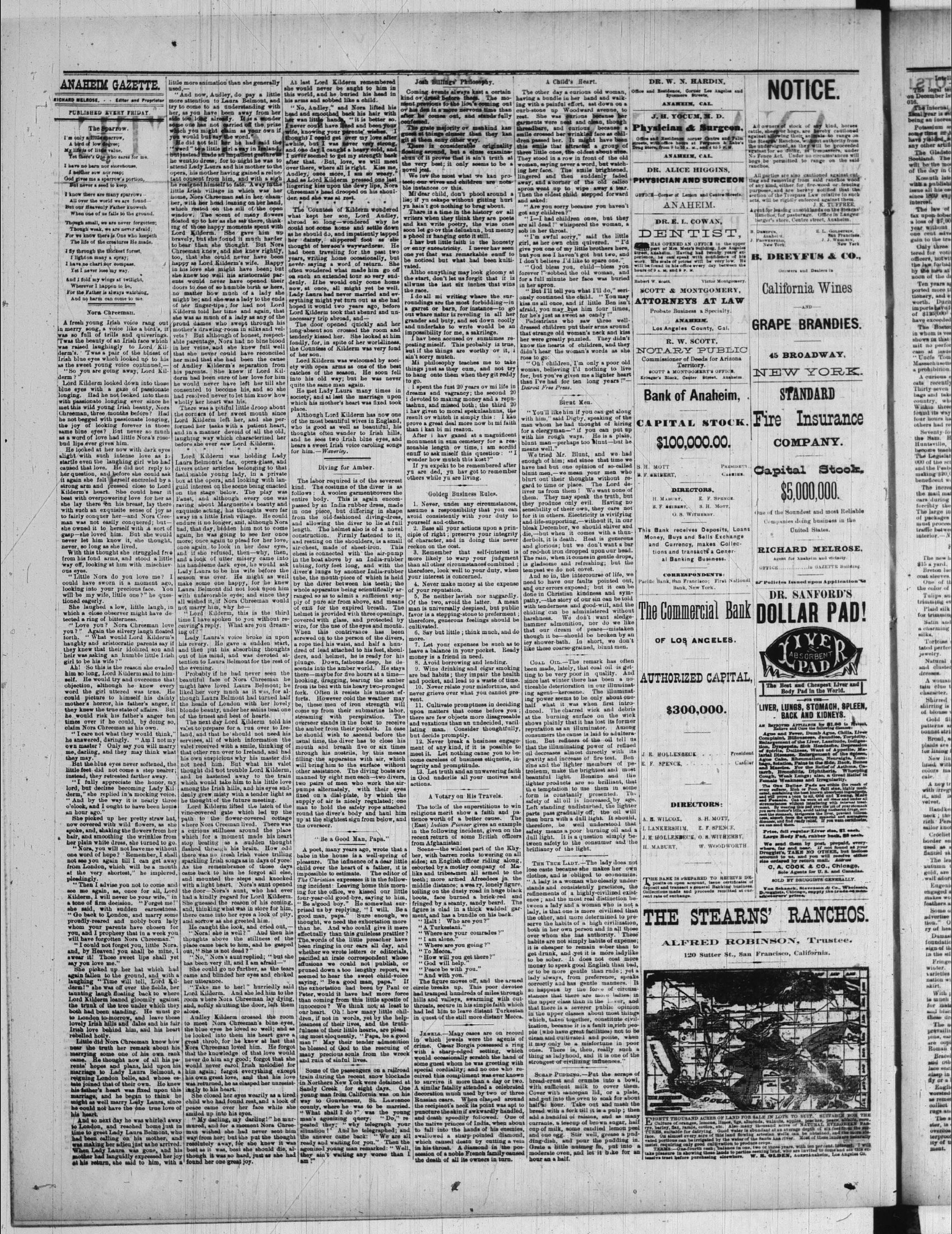
Searchable text
ANAHEIM GAZETTE.
RICHARD MELROSE. Editor and Proprietor
PUBLISHED EVERY FRIDAY.
The Sparrow.
I'm only a little sparrow,
A bird of low degree;
My life is of little value,
Yet there's One who cares for me.
I have no barn nor storehouse,
I neither sow nor reap;
God gives me a sparrow's portion,
But never a seed to keep.
I know there are many sparrows—
All over the world we are found—
But our Heavenly Father knoweth
When one of us falls to the ground.
Though small, we are never forgotten;
Though weak, we are never afraid;
For we know there is One who keepeth
The life of the creatures He made.
I fly through the thickest forest,
I light on many a spray;
I have no chart nor compass,
Yet I never lose my way.
And I fold my wings at twilight,
Wherever I happen to be,
For the Father is always watching,
And no harm can come to me.
Nora Chreeman.
A fresh young Irish voice rang out in merry song, a voice like a bird's, it was so full of trills and quiverings. Twas the beauty of an Irish face which was raised laughingly to Lord Kilderm's. "Twas a pair of the blinest of Irish blue eyes which looked up to his as the sweet young voice continued," "So you are going away, Lord Kilderm?"
Lord Kilderm looked down into those blue eyes with a gaze of passionate longing. Had he not looked into them with passionate longing ever since he met this wild young Irish beauty, Nora Chreeman, three months before? Had he not begged with passionate longing, the joy of looking forever in those same blue eyes? But never so much as a word of love had little Nora's rosebud lips ever given him.
He looked at her now with dark eyes alight with such intense love as to little more animation than she generally used.
"And now, Audley, do pay a little more attention to Laura Belmont, and try to come to an understanding with her, as you have been away from her side too long already. It is a wonder some one has not carried off the prize which you might claim as your own if you would but say the word."
He did not tell her he had said the "word" to a little girl away in Ireland, but instead made an impatient gesture as he went to dress; for to-night he was to attend Lady Laura and his mother to the opera, his mother having gained a reluctant consent from him, and with a sigh he resigned himself to fate. Away in the little Irish village in which was her home, Nora Chreeman sat in her chamber, with her head leaning on her hand, which rested on the sill of the open window. The scent of many flowers floated up to her as she sat there, thinking of those happy moments spent with Lord Kilderm. She gave him up bravely, but she found it much harder to bear than she thought. But Nora Chreeman knew, and she knew rightly, too, that she could never have been happy as Lord Kilderm's wife. Happy in his love she might have been; but she knew too well his aristocratic parents would never have opened their doors to one of so humble birth as hers, no matter how much of a lady she might be; and she was a lady to the ends of her finger-tips; for had not Lord Kilderm told her time and again, that she was as much of a lady as any of the proud dames who swept through his mother's drawing-room in silks and velvets? But although of honest, respectable parentage, Nora had no blue blood in her veins, and she knew full well that she never could have reconciled her mind that she had been the cause of Audley Kilderm's separation from his parents. She knew if Lord Kilderm had been sure of her love for him he would never have left her till she consented to become his, and so she had resolved never to let him know how wholly her heart was his.
There was a pitiful little droop about the corners of her sweet mouth since Lord Kilderm left her, and she performed her tasks with a patient heart, and in a manner devoid of all the old, laughing way which characterized her before she ever saw Lord Kilderm.
Lord Kilderm was holding Lady At last Lord Kilderm she would never be august this world, and he buried his arms and sobbed like "No, Audley," and No head and smoothed back her wan little hands." I never could have lived wife, knowing your parent thought I could get over awhile, but I was naive and one day I caught a bishop seemed to get my after that. But, love, over there, where all is rudely Audley, once more, I And as Lord Kilderm pledging kiss upon the Countess's head drooper, and she was at rest.
The Countess of Kilkenny what kept her son, abroad so long—wonder could not come home as he should do, and imply her dainty, slippered thought of her son's way had been traveling four years, writing home often wondered what man on such an extended ten deny. If he would now, at once, all might Lady Laura had never yet turned hoped it would two ye Lord Kilderm took that necessary trip abroad,
The door opened quietly with open arms as catches of the season; into his old way; but quite the same man again. He met Lady Laura society, and at last the which his mother's heart place.
Although Lord Kilde of the most beautiful woman who is good as well thoughts often wanders and he sees two Irish hearts a sweet Irish voice for him. — Waverley.
as the sweet young voice continued,—"So you are going away, Lord Kilderm?"
Lord Kilderm looked down into those blue eyes with a gaze of passionate longing. Had he not looked into them with passionate longing ever since he met this wild young Irish beauty, Nora Chreeman, three months before? Had he not begged with passionate longing, the joy of looking forever in those same blue eyes? But never so much as a word of love had little Nora's rosebud lips ever given him.
He looked at her now with dark eyes alight with such intense love as to startle even the laughing girl who had caused that love. He did not reply to her question, and before she could ask it again she felt herself encircled by a strong arm and pressed close to Lord Kilderm's heart. She could hear it beat with overpowering love for her as she lay there on his breast, lay there with such an exquisite sense of joy as to fairly conquer her—and Nora Creeman was not easily conquered; but she owned it to herself with a sort of gasp—she loved him. But she would never let him know it, she thought, never, so long as she lived.
With this thought she struggled free from his fond arms, and stood a little way off, looking at him with mischievous eyes.
"Little Nora do you love me? I could have sworn it a moment ago, looking into your precious face. You will be my wife, little one?" he questioned eagerly.
She laughed a low, little laugh, in which a close observer might have detected a ring of bitterness.
"Love you? Nora Chreeman love you?" Again the silvery laugh floated forth. "What would Lord Kilderm's haughty and aristocratic parents say if they knew that their idolized son and heir was asking an humble little Irish girl to be his wife?"
Ah! So this is the reason she evaded him so long, Lord Kilderm said to himself. He would try and overcome that objection, although he knew every word the girl uttered was true. He could picture to himself his dainty mother's horror, his father's anger, if they knew the true state of affairs. But he would risk his father's anger ten times over if he could, by doing so, oblime Nora Chreeman as his own.
"I care not what they would think," he answered, daringly. "Am I not my own master? Only say you will marry me, darling, and they may think what they may."
But the blue eyes never softened, the little feet did not come a step nearer; instead, they retreated farther away.
"I fully appreciate the honor, my lord, but decline becoming Lady Kilderm," she replied in a mocking voice. "And by the way it is nearly three o'clock, and I ought to have been home an hour ago."
She picked up her pretty straw hat, now covered with wild flowers, as she spoke, and shaking the flowers from her hair, and smoothing the wrinkles from her plain white dress, she turned to go.
"Nora, you will not leave me without one word of hope? Remember, I shall not see you again till I can get away from London, which will be a month of Audley Kilderm's separation from his parents. She knew if Lord Kilderm had been sure of her love for him he would never have left her till she consented to become his, and so she had resolved never to let him know how wholly her heart was his.
There was a pitiful little droop about the corners of her sweet mouth since Lord Kilderm left her, and she performed her tasks with a patient heart, and in a manner devoid of all the old, laughing way which characterized her before she ever saw Lord Kilderm.
Lord Kilderm was holding Lady Laura Belmont's fan, opera-glass, and divers other articles belonging to that fashionable young lady, in a private box at the opera, and looking with languid interest on the scene being enacted on the stage below. The play was Faust, and although every one was raving about Marguerite's beauty and exquisite acting, his thoughts were far away in a little Irish village. He could endure it no longer, and although Nora had that day, bidden him not to come again, he was going to see her once more; once again to plead for her love, once again to look in her dear eyes, and if she refused, then—why, then, and a look of utter misery came into his handsome dark eyes, he would ask Lady Laura to be his wife before the season was over. He might as well make some one happy, for he knew Laura Belmont did not look upon him with unfavorable eyes; and since they all wished it, if Nora Chreeman would not marry him, why he—
"Lord Kilderm, this is the third time I have spoken to you without receiving a reply. What are you dreaming of?"
Lady Laura's voice broke in upon his reverie. He gave a sudden start, and then put his absorbing thoughts out of his mind, and was devoted attention to Laura Belmont for the rest of the evening.
Probably if he had never seen the beautiful face of Nora Chreeman he might have loved Laura Belmont; he liked her very much as it was, for although Laura Belmont had turned half the heads of London with her lovely blonde beauty, under her satins beat one of the truest and best of hearts.
The next day Lord Kilderm told his valet to prepare for a run over to Ireland, and that he should not need his services, all of which information the valet received with a smile, thinking of that other run over to Ireland, and had his own suspicions why his master did not need him. But what his valet thought did not trouble Lord Kilderm, and he hastened away to the train which would take him to his little love among the Irish hills, and his eyes suddenly grew misty with a tender light as he thought of the future meeting.
Lord Kilderm lifted the latch of the vine-covered gate which led up the path to the flower-covered cottage where Nora Creeman lived. There was a curious stillness around the place which for a moment made his heart stop beating as a sudden thought flashed through his brain. How odd there was no fresh Irish voice trilling sparkling Irish songs as in days of yore! As the remembrance of those days came back to him he forgot all else
Diving for A
The labor required in kind. The costume of follows: A woolen garment body. This is passed by an India rule in one piece, but divided from the old-fashioned and allowing the divider length. The helmet construction. Firmly and resting on the show air-chest, made of silk chest is connected with in the boat above by tubing, forty feet long diver's lungs by another tube, the mouth-piece by the diver between whole apparatus being ranged so as to admit ply of pure air from a of exit for the expired helmet is provided with covered with glass, a wire, for the use of tha When this contrivive screwed on to the peris rope tied his waist, dred of lead attached ders, and helmet; he plunge. Down,fatho scends into the amber there—maybe for five hooking,dragging,t te from its bed with his b fork. Often it resists forts. However cold be,these men of irre come up from their streaming with pe overseer stands in the amber from their he should wish to a usual time,the diver mouth and breath through his nostrils filling the apparatus will bring him to the other assistance. The manned by eight men two pairs of men w pumpes alternately fixed on a dial-plate supply of air is nice man to hold the sae round the diver's boo up at the slightest sign this overseer.
Be a Good M
A poet,many years babe in the house in pleasure.The infine child over the heart
I fully appreciate the honor, my lord, but decline becoming Lady Kilderm," she replied in a mocking voice.
And by the way it is nearly three o'clock, and I ought to have been home an hour ago."
She picked up her pretty straw hat, now covered with wild flowers, as she spoke, and shaking the flowers from her hair, and smoothing the wrinkles from her plain white dress, she turned to go.
Nora, you will not leave me without one word of hope? Remember, I shall not see you again till I can get away from London, which will be a month at the very shortest," he implored, pleadingly.
Then I advise you not to come and see me again, as once for all, Lord Kilderm, I will never be your wife," in a tone of firm decision. "Forget me!" she said, with sudden earnestness.
Go back to London, and marry some proudly-reared and nobly born lady whom your parents have chosen for you, and I prophesy that in a week you will have forgotten Nora Chreeman."
I could not forget you, little Nora, and, by Heaven! you shall be mine, I swear it! Those sweet lips shall yet say you love me."
She picked up her hat which had again fallen to the ground, and with a laughing "Time will tell, Lord Kilderm!" she was off over the fields, her taunting laugh floating back to where Lord Kilderm leaned gloomily against the trunk of the tree under which they both had been standing. He must go to London to-morrow, and leave these lovely Irish hills and dales and his fair Irish love behind him, and his heart rebelled hotly.
Little did Nora Chreeman know how near the truth her remark about his marrying some one of his own rank came. He thought now of all his parents' hopes and plans, laid upon his marriage to Lady Laura Belmont, a reigning London belle, and whose estate joined that of their own. He knew his father's heart was fixed upon this marriage, and he began to think he might as well marry Lady Laura, since he could not have the one true love of his heart.
And so next day he was whirled away to London, and reached home just in time to greet Lady Laura Belmont, who had been calling on his mother, and was making her adieu just as he arrived. When Lady Laura was gone, and his mother had languidly expressed her joy at his return, she said to him, with aand he hastened away to the train which would take him to his little love among the Irish hills, and his eyes suddenly grew misty with a tender light as he thought of the future meeting.
Lord Kilderm lifted the latch of the vine-covered gate which led up the path to the flower-covered cottage where Nora Creeman lived. There was a curious stillness around the place which for a moment made his heart stop beating as a sudden thought flashed through his brain. How odd there was no fresh Irish voice trilling sparkling Irish songs as in days of yore! As the remembrance of those days came back to him he forgot all else, and mounted the steps and knocked with a light heart. Nora's aunt opened the door—Nora's aunt, who had ever had a kindly regard for Lord Kilderm. She guessed the reason of his coming, and thinking what was in store for him, there came into her eyes a look of pity, and sorrow as she greeted him.
He caught the look, and cried out,
"Noral she is well?" And then his thoughts above the stillness of the place came back to him, and he gasped out, "She is not dead?"
No," Nora's aunt replied; "but she has been very ill, and I am afraid—"
She could go no further, as the tears came and blinded her eyes and choked her utterance.
"Take me to her!" hurriedly said Lord Kilderm. And she led him to the room where Nora Creeman lay dying, and softly shutting the door, left them alone.
Audley Kilderm crossed the room to meet Nora Chreeman's blue eyes, the blue eyes he loved so well; and as he looked into them his heart gave a great throb, for he knew at last that Nora Chreeman loved him. He forgot that the knowledge of that love would never do him any good; forgot that she would never carol Irish melodies for him again; forgot everything except his own great love, and that his love was returned, he as elapsed her unresistingly to his heart.
She closed her eyes wearily as a tired child who had found rest, and a look of peace came over her face while she smiled up into his eyes.
"My darling, my darling!" he murmured, and for a moment Nora Chreeman wished she had never sent him way from her; but she put the thought resolutely away, for she knew it was best as it was, best she should die, although it was so hard, just as she had found her one great joy.
manned by eight men two pairs of men who pumps alternately fixed on a dial-plate supply of air is nice man to hold the same round the diver's boo up at the slightest sign the overseer.
"A be a Good M
A poet, many years babe in the house in pleasure. The infused child over the heart impossible to estimate The Christian expressing incident: Leaving for the office, we four-year-old good-bye. Be a good boy." I prised us by replying good man, papa. thought, we need them than he. And who effectually than this The words of the little been ringing in our whether we wrote let pacified an irate coo effusions we could pruned down a too seemed to hear the saying," Be a good exhortation had Peter, would it have than coming from the innocence? We thrust our heart. Oh! how drenn, if not in words lessness of their life fulness of their little ing most eloquently man!" May their be blessed of God to many precious souls and ruin of sinful l
Some of the passed train during the recount in Northern New York Sandy Creek for young man from Caraway way to Gouverneur county, where he wi What shall I do? man's agonizing pealed they; "wh sit situation!" And he the answer came be ready and waiting for agonized young man they ain't waiting am!"
At last Lord Kilderm remembered she would never be aught to him in this world, and he buried his head in his arms and sobbed like a child.
"No, Audley," and Nora lifted his head and smoothed back his hair with her wan little hands, "it is better so. I never could have lived and been your wife, knowing your parents' wishes. I thought I could get over my love after awhile, but I was never very strong, and one day I caught a heavy cold, and I never seemed to get my strength back after that. But, love, we will meet over there, where all is right. Kiss me, Audley, once more, I am so weary." And as Lord Kilderm pressed one last lingering kiss upon the dewy lips, Nora Chreeman's head drooped on his shoulder, and she was at rest.
The Countess of Kilderm wondered what kept her son, Lord Audley, abroad so long—wondered why he could not come home and settle down as he should do, and impatiently tapped her dainty, slippered foot as she thought of her son's waywardness. He had been traveling for the past two years, writing home occasionally, but never saying a word of return. She often wondered what made him go off on such an extended tour so very suddenly. If he would only come home now, at once, all might yet be well. Lady Laura had never married and everything might yet turn out as she had hoped it would two years ago, before Lord Kilderm took that absurd and unnecessary trip abroad, and—
The door opened quickly and her long-absent son crossed the room and tenderly kissed her. She looked at him fondly, for, in spite of her worldliness, the Countess of Kilderm was very fond of her son.
Lord Kilderm was welcomed by society with open arms as one of the best catches of the season. He soon fell into his old way; but he was never quite the same man again.
He met Lady Laura many times in society, and at last the marriage upon which his mother's heart was fixed took place.
Although Lord Kilderm has now one of the most beautiful wives in England, who is good as well as beautiful, his thoughts often wander to Irish hills, and he sees two Irish blue eyes, and hears a sweet Irish voice caroling songs for him.—Waverley.
Josh Billings' Philosophy.
Coming events always kast a certain kind ov dread before them. The moment previous to the lion's coming out ov his den iz a more nervous time than after he comes out, and stands fully confessed.
The grate majority ov mankind kan guest at things cluser than they kan git at them enny other way.
There iz considerable originality floating around, but a class examina-shun of it proves that it ain't truth at the very best; it only seems to be a novel jest.
We invet the most what we kan protest; our wives and children are notable instances ov this.
Mi dear child, don't phool around a lie; if yu escape without gitting hurt yu hains't got nothing to brag about.
Thare iz a time in the history ov all writers when they think they are poets and kan write poetry, the wize ones soon let go ov this delushun, but menny a phool iz hanging onto it still.
I hav but little faith in the honesty ov envny excentricity. I never hav seen one yet that wax remarkable enuff to be noticed but what had been kultivated.
Altho ennothing may look gloomy at the start, don't let us forgit that it iz allwuss the last six inches that wins the race.
I do all mi writing whare the surroundings are the most forbidding—in a garret or barn, for instance—to go out whare natur iz reveling in all her grander and buty, and set down coolly and undertake to write would be an impossibility for me, a sakrilege.
I hav been accused ov sumtimes repeating miself. This probably iz true, but if the things are worthy ov it, i ain't sorry mutch.
Mi philosophy teaches me to take things just as they cum, and not try to hang onto them when they git reddy to go.
I spent the fust 20 years ov mi life in dreams and vagrancy; the second 20 i devoted to making money and a reputashun, and missed both; the third 20 i hav given to moral speakulashuns, the result ov whitch iz simply this: I kan prove a great deal more now bi mi faith than i kan bi mi reazon.
After i hav gazed at a magnificent monument in sum cemetery for a reasonable length ov time, i am sordid enuff to ask miself this question: "I wonder how mutch this kost?"
A Child's Heart.
The other day a curious old woman, having a bundle in her hand and walking with a painful effort, sat down on a curb-stone up Woodward avenue, to rest. She was curious because her garments were neat and clean, though threadbare, and curious because a smile crossed her wrinkled face as children passed her. It might have been this smile that attracted a group of three little ones, the oldest about nine. They stood in a row in front of the old woman, saying never a word, but watching her face. The smile brightened, lingered and then suddenly faded away, and a corner of the old calico apron went up to wipe away a tear. Then the eldest child stepped forward and asked:
"Are you sorry because you haven't got any children?"
"I—I had children once, but they are all dead!" whispered the woman, a sob in her throat.
"I'm awful sorry," said the little girl, as her own chin quivered. "I'd give you one of my little brothers here, but you see I haven't got but two, and I don't believe I'd like to spare one."
God bless you, child—bless you forever!" sobbed the old woman, and for a full minute her face was buried in her apron.
"But I'll tell you what I'll do," seriously continued the child. "You may kissa us all once, and if little Ben isn't afraid, you may kiss him four times, for he's just as sweet as canny!"
Pedestrians who saw three well-dressed children put their arms around that strange old woman's neck and kiss her were greatly puzzled. They didn't know the hearts of children, and they didn't hear the woman's words as she rose to go:
"Oh! children, I'm only a poor old woman, believing I'd nothing to live for, but you've given me a lighter heart than I've had for ten long years!"—Detroit Free Press.
Blunt Men.
"You'll like him if you can get along with him," said Digby, speaking of the man whom he had thought of hiring for a clergyman—"if you can put up with his rough ways. He is a plain, blunt man—perhaps too blunt—but he means well."
We tried Mr. Blunt, and we had enough of him; and since that time we
Diving for Amber.
The labor required is of the severest kind. The costume of the diver is as follows: A woolen garment covers the entire body. This is again encompassed by an India-rubber dress, made in one piece, but differing in shape from the old-fashioned diving-dress, and allowing the diver to lie at full length. The helmet also is of a novel construction. Firmly fastened to it, and resting on the shoulders, is a small air-chest, made of sheet-iron. This chest is connected with the air-pump in the boat above by an India-rubber tabbing, forty feet long, and with the diver's lungs by another India-rubber tube, the mouth-piece of which is held by the diver between his teeth; the whole apparatus being scientifically arranged so as to admit a sufficient supply of pure air from above, and means of exit for the expired breath. The helmet is provided with three openings, covered with glass, and protected by wire, for the use of the eyes and mouth. When this contrivance has been screwed on to the person of the divers, a rope tied his waist, and half a hundred of lead attached to his feet, shoulders, and helmet, he is ready for his plunge. Down, fathoms deep, he descends into the amber world. He stays there—maybe for five hours at a time—hooking, dragging, tearing the amber from its bed with his heavy two-pronged fork. Often it resists his utmost efforts. However cold the weather may be, these men of iron strength will come up from their submarine labor, streaming with perspiration. The overseer stands in the boat to receive the amber from their pockets. In case he should wish to ascend before the usual time, the diver has to close his mouth and breathe five or six times through his nostrils, by this means filling the apparatus with air, which will bring him to the surface without other assistance. The diving boats are manned by eight men each—two divers, two pairs of men who work the air-pumps alternately, with their eyes fixed on a dial-plate, by which the supply of air is nicely regulated; one man to hold the safety rope attached round the diver's body and haul him up at the slightest sign from below, and the overseer.
"Be a Good Man, Papa."
A poet, many years ago, wrote that a babe in the house is a well-spring of pleasure. The influence of a dear little child over the heart of a father, it is
MI philosophy teaches me to take things just as they cum, and not try to hang onto them when they git reddy to go.
I spent the fust 20 years ov mi life in dreams and vagrancy; the second 20 i devoted to making money and a repu-tashun, and missed both; the third 20 i have given to moral spekulashuns, the result ov whitch iz simply this: I kan prove a great deal more now bi mi faith than i kan bi mi reason.
After i hav gazed at a magnificent monument in sum cemetery for a reazonable length ov time, i am sordid enuff to ask miself this question: "I wonder how mutch this kost?"
If yu expekt to be remembered after yu are ded, yu hav got to remember others while yu are living.
Golden Business Rules.
1. Never under any circumstances, assume a responsibility that you can avoid consistently with your duty to yourself and others.
2. Base all your actions upon a principle of right; preserve your integrity of character, and in doing this never reckon on the cost.
3. Remember that self-interest is more likely to warp your judgment than all other circumstances combined; therefore, look well to your duty, when your interest is concerned.
4. Never make money at the expense of your reputation.
5. Be neither lavish nor niggardly. Of the two, avoid the latter. A mean man is universally despised, but public favor is a stepping-stone to preferment; therefore, generous feelings should be cultivated.
6. Say but little; think much, and do more.
7. Let your expenses be such as to leave a balance in your pocket. Ready money is a friend in need.
8. Avoid borrowing and lending.
9. Wine drinking and cigar smoking are bad habits; they impair the health and pocket, and lead to a waste of time.
10. Never relate your misfortune, and never grieve over what you cannot prevent.
11. Cultivate promptness in deciding upon matters that come before you; there are few objects more disagreeable and vexatious than an undecided, vacillating man. Consider thoughtfully, but decide promptly.
12. Never break a business engagement of any kind, if it is possible to meet it. Let nothing cause you to become careless of business etiquette, integrity and promptitude.
13. Let truth and an unwavering faith in God underlie all your motives and actions.
A Voltary on His Travels.
The tools of the superstititions to win religious merit show a faith and patience worth of a better cause. The (East) Indian Pioneer gives an example in following incident, given on the recent return of some British officers from Afghanistan:
Scene—the wildest part of the Khyber, with barren rocks towering on all sides; an English officer riding along, escorted by a motley company of Ma-coal Oil.—The remark has often been made, lately, that coal oil is getting to be very poor in quality. And since last winter there has been a noticeable deterioration in our illuminating agent—kerosene. The illuminating power seems to be only about one-half what it was when first introduced. The charred wick and debris at the burning surface on the wick shows plainly that it has lost its former reputation as an illuminator. Among consumers the cause is laid to adulteration. But refiners of the oil tell us that the illuminating power of refined oil decreases almost directly with its gravity and increase of fire test. Benzine and the lighter members of petroleum, make the brightest and most beautiful light. Benzine and the lighter products are so brilliant, that the temptation to use them in some form is constantly presented. The safety of all oil is increased by age. Left standing undisturbed, the lighter parts pass gradually off; the oil will then burn with a dull light. It should, therefore, be well understood that safety means a poor burning oil and a dull light. It is a question simply between safety to the consumer and the brilliancy of the light.
THE TRUE LADY.—The lady does not lose caste because she makes her own
manned by eight men each—two divers, two pairs of men who work the air-pumps alternately, with their eyes fixed on a dial-plate, by which the supply of air is nicely regulated; one man to hold the safety rope attached round the diver's body and haul him up at the slightest sign from below, and the overseer.
"Be a Good Man, Papa."
A poet, many years ago, wrote that a babe in the house is a well-spring of pleasure. The influence of a dear little child over the heart of a father, it is impossible to estimate. The editor of The Christian expresses it in the following incident: Leaving home this morning for the office, we kissed our little four-year-old good-bye, saying to him, "Be a good boy." He somewhat surprised us by replying, "I will. Be a good man, papa." Sure enough, we thought, we need the exhortation more than he. And could give it more effectually than this guileless prattler? The words of the little preacher have been ringing in our ears all day, and whether we wrote letters or editorials, pacified an irate correspondent whose effusions we could not publish, or pruned down a too lengthy report, we seemed to hear the sweet child-voice saying, "Be a good man, papa." If the exhortation had been by Paul or Peter, would it have had more force than coming from this little apostle of innocence? We think not; at least to our heart. Oh! how many little children, if not in words, yet by the helplessness of their lives, and the truthfulness of their little hearts, are pleading most eloquently, "Papa, be a good man!" May their tender admonition be blessed of God to the rescuing of many precious souls from the wreck and ruin of sinful lives.
Some of the passengers on a railroad train during the recent snow blockade in Northern New York were detained at Sandy Creek for eight days. One young man from California was on his way to Gouverneur, St. Lawrence county, where he was to be married. "What shall I do?" was the young man agonizing query. "Do," repeated they; "why telegraph your situation!" And he telegraphed; and the answer came back: "We are all ready and waiting for you." Then the agonized young man remarked: "Well, they ain't waiting any worse than I am!"
A Votary on His Travels.
The tools of the superstitious to win religious merit show a faith and patience worth of a better cause. The (East) Indian Pioneer gives an example in the following incident, given on the recent return of some British officers from Afghanistan:
Scene—the wildest part of the Khyber, with barren rocks towering on all sides; an English officer riding along, escorted by a motley company of Malkis and tribesmen all armed to the teeth; more armed Afreedees in the middle distance; a weary, lonely figure, toiling on the dusty road in huge black boots, face burned a brick-red and fringed by a scanty, sandy beard. The figure is clad in a thick wadded garment, and has a bundle on his back.
"Halt! Who are you?"
"A Turkestani."
"Where are your comrades?"
"I am alone."
"Where are you going?"
To Mecca."
"How will you get there?"
God will help."
Peace be with you."
And with you."
The figure moves off, and the armed circle breaks up. This poor devotee had tramped hundreds of miles through hills and valleys, swarming with out-throats, secure in his simple faith which had led him to leave distant Turkestan in quest of the still more distant Mecca.
Jewels.—Many cases are on record in which jewels were the agents of crime. Caesar Borgia possessed a ring with a sharp-edged setting, which would occasionally scratch the hand of some guest whom he was greeting with special cordiality; and no one who received this compliment was ever known to survive it more than a day or two. A similar fatality attended a celebrated decoration much used by two or three Russian caers. When chased around the recipient's neck its point was apt to puncture the skin if awkwardly handled, and death speedily followed. One of the native princes of India, when about to fall into the hands of his enemies, swallowed a sharp-pointed diamond, which caused death by cutting a vein in his throat. A diamond in the possession of a noble French family caused the death of all its owners in turn.
Benzine and the lighter products are so brilliant, that the temptation to use them in some form is constantly presented. The safety of all oil is increased by age. Left standing undisturbed, the lighter parts pass gradually off; the oil will then burn with a dull light. It should therefore, be well understood that safety means a poor burning oil and a dull light. It is a question simply between safety to the consumer and the brilliancy of the light.
THE TRUE LADY.—The lady does not lose caste because she makes her own clothes, and is obliged to economize. "A lady is a woman who clearly understands and consistently practices, the refinements of a highly-civilized existence; and the most real distinction between a lady and a woman who is not a lady, is that one is more civilized than the other, and more determined to preserve the habits of a high civilization, both in her own person and in all those over whom she has authority. These habits are not simply habits of expense; it is cheaper to remain sober than to get drunk, and yet it is more ladylike to be sober. It does not cost more money to speak good English than bad, or to be more gentle than rude; yet a lady always, from preference, speaks correctly and has gentle manners. It so happens by the force of circumstances that there are more ladies in the upper class than in the lower, and that there is a severer public opinion in the upper classes about most things which taken together constitute civilization, because it is a fault in rich people (who have great facilities) not to be clean and cultivated and poitee, when it may only be a misfortune in poor ones. There is, then, really such a thing as ladyhood, and it is one of the strongest of civilizing influences."
SCRAP PUDDING.—Put the scraps of bread-crust and crumbs into a bowl, with sufficient milk to cover them. Cover with saucepan lid, or a plate, and put into the oven to soak for about half an hour. Take out and mash the bread with a fork till it is a pulp; then add a handful of raindrops, and as many currants, a teaspoon of brown sugar, half cup of milk, some candied lemon peel and one egg. Stir well, grease a pudding-dish, and pour the pudding in. Grate a little nutmeg fn., put into a moderate oven, and let it bake for an hour an half.
DR. W. N. HARDIN,
Office and Residence, Corner Los Angeles and Sycamore Streets,
ANAHEIM, CAL.
J. H. YOCUM, M. D.
Physician & Surgeon,
Office and Residence corner Centre and Palm streets, with office hours at Ferguson & Lake's Drug Store, from 9 to 10 A.M., and 4 to 5 P.M.
ANAHEIM, CAL.
DR. ALICE HIGGINS,
PHYSICIAN AND SURGEON
OFFICE—Corner of Lemon and Centre Streets.
ANAHEIM.
DR. E. L. COWAN,
DENTIST,
HAS OPENED AN OFFICE in the upper part of Mrs. Metz's building, Los Angeles Street, Anaheim. Having had twenty years' experience, he can speak with confidence of his work. His scale of prices will be very low. He will be found in his office every day between the hours of 9 A.M. and 8 P.M.
Robert W. Scott. Victor Montgomery.
SCOTT & MONTGOMERY,
ATTORNEYS AT LAW
Probate Business a Specialty.
ANAHEIM.
Los Angeles County, Cal.
R. W. SCOTT,
NOTARY PUBLIC
Commissioner of Deeds for Arizona Territory.
SCOTT & MONTGOMERY'S OFFICE.
Kroeger's Block, Center Street, Anaheim.
Bank of Anaheim,
CAPITAL STOCK.
$100,000.00.
NOTICE.
All owners of stock of any kind, horses cattle, sheep or hogs, are hereby cautioned against allowing their animals to range on the Stearns' Ranchos without authority from the undersigned, as they will be proceeded against for so doing, at trespassers, under No Fence Act. Under no circumstances will hogs be permitted to range on the said ranchos.
All parties are also cautioned against cutting and removing from said ranchos wood of any kind, either for firewood or fencing purposes, and are hereby notified that the section of the Trespass Law relative to such acts will be rigidly enforced against them.
J. K. TUFFREE,
Agent for leasing unsold hands on the Stearns' Ranchos, for pasturage. Office in Langenberger's store, Centre street, Anaheim.
B. DREYFUS &
CO.,
Growers and Dealers in
California Wines
AND
GRAPE BRANDIES.
45 BROADWAY,
NEW YORK.
STANDARD
Fire Insurance COMPANY.
Territory.
SCOTT & MONTGOMERY'S OFFICE.
Kroeger's Block, Center Street, Angheim.
Bank of Anaheim,
CAPITAL STOCK,
$100,000.00.
S. H. MOTT
President.
B. F. SHIBERT,
Cashier.
DIRECTORS:
H. MABURY,
E. F. SPENCE.
E. F. SHIBERT,
S. H. MOTT,
O. S. WITHERBY.
This Bank receives Deposits, Loans Money, Buys and Sells Exchange and Currency, makes Collections and transacts a General Banking Business.
CORRESPONDENTS:
Pacific Bank, San Francisco; First National Bank, New York.
The Commercial Bank
OF LOS ANGELES.
AUTHORIZED CAPITAL,
$300,000.
J. E. HOLLENBECK
President
E. F. SPENCE,
Cashier
DIRECTORS:
A. H. WILCOX,
S. H. MOTT,
L. LANKERSHIM,
E. F. SPENCE,
J. E. HOLLENBECK, O. S. WITHERBY,
H. MABURY,
W. WOODWORTH.
NEW YORK.
STANDARD
Fire Insurance COMPANY.
Capital Stock,
$5,000,000.
One of the Soundest and most Reliable Companies doing business in the United States.
RICHARD MELROSE.
Agent for Anaheim and vicinity.
OFFICE... In GAZETTE Building.
Policies Issued upon Application
DR. SANFORD'S
DOLLAR PAD!
LIVER, LUNGS, STOMAOH, SPLEEN,
BACK AND KIDNEYS.
AN IMPLOYED APPELLENCES FOR $1.00 to Prevent Helicops and Ours the following diseases:
Agne and Fever, Dumb Agree, Chills, Liver Complaint, Billiousness, Jaundice, Torsidity, Enlargement of the Liver, Lassitude, Indigestion, Dysppepsia, Nick Headache, Depression of Spirits, Dullness, Want of Appetite, Material Diseases, Enlargement of the Spleen, Ague Cake, Rheumatism, Neuralgia, Lambago, Sedation, Pains in the Side, Back, Bones and Muscles.
For the Relief of Asthma, Catarrh, Bronchitis, Diphtheria, Whooping Cough, Weak Lungs; also, a Great Relief in Female Weakness and Irregularity.
The One Dollar Pads are within the reach of every sufferer, Rich or Poor, full size, highly medicated, containing the best known antihistamines and will prevent you to fall to old and Young, Male and Female. Can be worn at all times and under all circumstances without interfering with internal treatment.
By wearing this pad over the pit of pear stomach you save doctor's bills, avoid taking drugs seriously that may harm the liver, prevent illnenses, absorb from the system material and contagious diseases, and find ready relief.
If you want antibiotics we can send them by post, prepaid everywhere, far and near.
If not found at your Druggist's TAKE NO OTHER, but insoluble amount to us, and you will receive either size ordered by return mail.
C. A. COOK & CO., Chicago,
Sale Agents for U.S. and Canada.
DIRECTORS:
A. M. WILCOX, S. H. MOTT,
I. LANKERSHIM, E. P. SPENCE,
J. E. HOLLENDECK, O. S. WITHERBY,
H. MABURY, W. WOODWORTH.
THE BANK IS PREPARED TO RECEIVE DEPOSITS ON OPEN ACCOUNT, ISSUE CERTIFICATES OF DEPOSIT AND TRANSACT A GENERAL BANKING BUSINESS. Collections made and proceeds remitted at current rate of exchange.
THE STEARNS' RANCHOS.
ALFRED ROBINSON, Trustee.
120 Sutter St., San Francisco, California.
EIGHTY THOUSAND ACRES OF LAND FOR SALE IN LOTS TO SUIT. SUITABLE FOR THE Culture of oranges, lemons, limes, taps, almonds, walnuts, apples, peaches, pears, alfalfa, sorghum, barley, flax, ramie, cotton, etc. Also many thousand acres of NATURAL EVERGREEN FARMERS, suitable for dairying. Good water is abundant at an average depth of six feet from the surface. On almost every acre of this land flowing artesian wells can be obtained, and the more elevated portions can be irrigated by the water of the Santa Ana river. Most of these lands are naturally moist, requiring only good cultivation to produce crops.
TERMS: One-fourth cash; balance in one; two or three years, with ten percent interest. I will take pleasure in showing these lands to parties seeking land, who are invited to come and see this extensive trust before purchasing elsewhere.
W. E. OLDEN, AGENT ANAHEIM, Los Angeles Co.