anaheim-gazette 1879-11-07
Scanned page
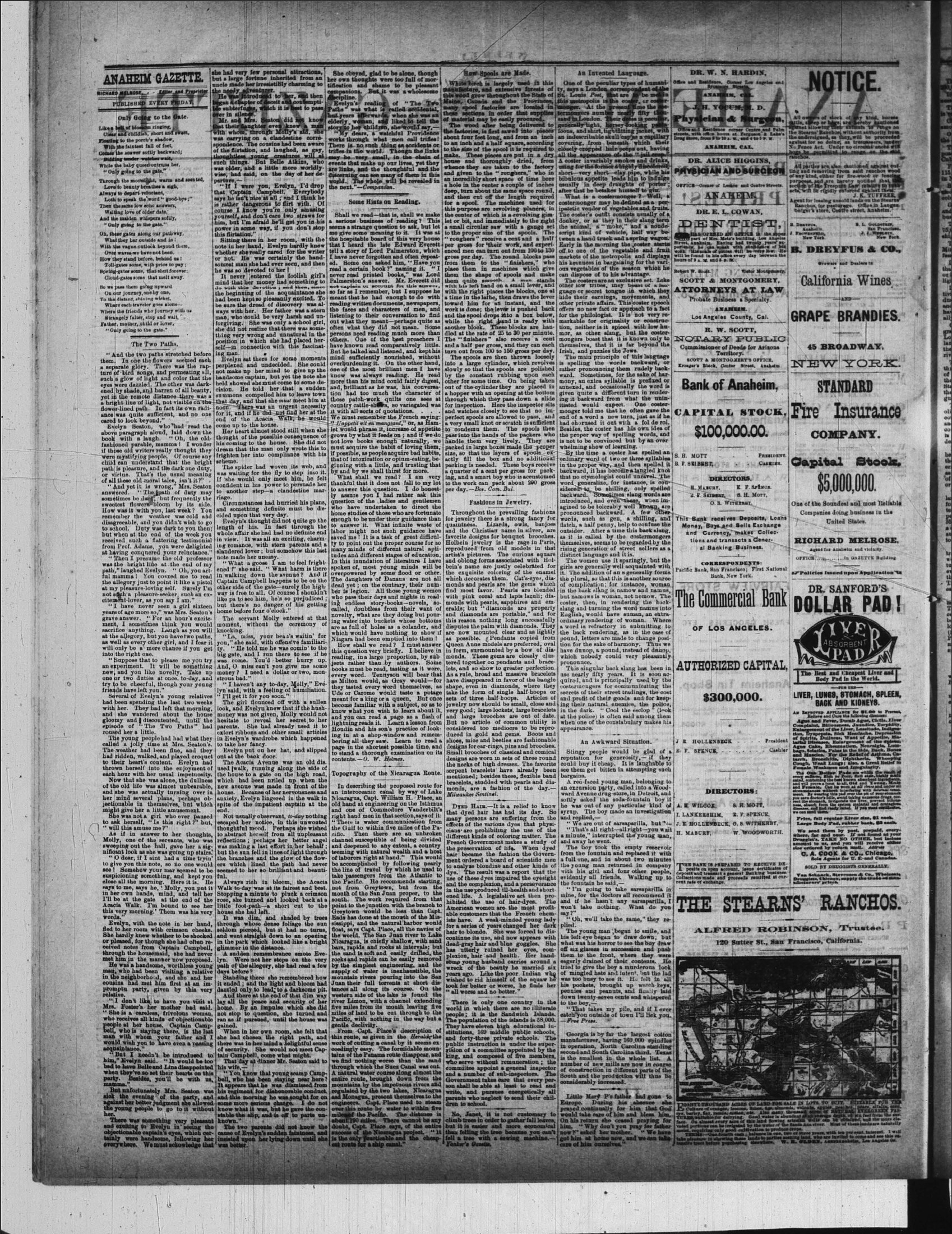
Searchable text
ANAHEIM GAZETTE.
RICHARD MELROSE... Editor and Prepistler
PUBLISHED EVERY FRIDAY.
Only Going to the Gate.
Like a bell of blossom ringing,
Clear and childish, short and sweet,
Floating to the porch's shadow,
With the faintest fall of feet,
Comes the answer softly backward;
Bidding tender watcher wait,
While the baby queen outruns her,
"Only going to the gate."
Through the moonlight, warm and saunted,
Love to beauty breathes a sigh,
Always to depart reflectant,
Loth to speak the word "good-bye;"
Then the same low echo answers,
Waiting love of older date,
And the maiden whispers softly,
"Only going to the gate."
Oh, these gates along our pathway,
What they bar outside and in!
With the vague outlook beyond them,
Over waves we have not been.
How they stand before, behind us!
Toll-gates some, with price to pay;
Spring-gates some, that shut forever:
Cloud-gates some, that melt away.
So we pass them going upward
On our journey, one by one,
To the distant, shining wicket.
Where each traveler goes alone—
Where the friends who journey with us
Strangely falter, stop and wait,
Father, mother, child or lover,
"Only going to the gate."
The Two Paths,
"And the two paths stretched before them. In one the flowers seemed each a separate glory. There was the rapture of bird songs, and permeating all, such a glow of light and color that the eyes were dazzled. The other was darkened by shade, and barren of all beauty, yet in the remote distance there was a bright line of light, not visible on the flower-lined path. In fact its own radiance was quite sufficient, and no one cared to look beyond."
Evelyn Seaton, who had read the above paragraph aloud, laid down the book with a laugh. "Oh, the old-fashioned parable, mamma! I wonder if those old writers really thought they were mystifying people. Of course any she had very few personal attractions, but a large fortune inherited from an uncle made her irresistibly charming to the needy adventurer.
He was introduced to her, and then began a chapter of deceit and contemptible subterfuges, which it is best to pass over in silence.
Mr. and Mrs. Seaton did not know that their daughter even knew a man with whom, through Molly's aid, she was carrying on a clandestine correspondence. The consins had been aware of the flirtation, and laughed, as gay, thoughtless young creatures will at such things. But Belle Atkins, who was older, and a little more worldly-wise, had said, on the day of her departure,
"If I were you, Evelyn, I'd drop that Captain Campbell. Everybody says he isn't nice at all; and I think he is rather dangerous to flirt with. Of course I know you're only amusing yourself, and don't care two straws for him, but I'm afraid he'll get you in his power in some way, if you don't stop this flirtation."
Sitting there in her room, with the note in her hand, Evelyn hardly knew whether she really cared for the writer or not. He was certainly the handsome man she had ever seen, and then he was so devoted to her!
It never entered the foolish girl's mind that her money had something to do with this devotion; and then she became keen so pleasantly excited. To be sure the dread of discovery was always with her. Her father was a stern man, who could be very harsh and unforgiving. She was only a school girl, she did not realize that there was something very wrong and unnatural in the position in which she had placed herself—in connection with this fascinating man.
Evelyn sat there for some moments perplexed and undecided. She could not make up her mind to give up the handsome captain, but yet the note she held showed she must come to some decision. He told her that a sudden summons compelled him to leave town that day, and that she must meet him at noon. There was an urgent necessity for it, and if he did not find her at the end of the Acacia Walk, he would come up to the house.
Her heart almost stood still when she thought of the possible consequence of his coming to the house. She did not dream that the man only wrote this to frighten her into compliance with his
She obeyed her own tiffination companion discipline.
Evelyn's Paths" would years elderly, story to be told.
My dear works thrived. There is no trifles in my events that are links to discerning world.
The next."
Evelyn Seaton, who had read the above paragraph aloud, laid down the book with a laugh. "Oh, the old-fashioned parable, mamma! I wonder if those old writers really thought they were mystifying people. Of course any child can understand that the bright path is pleasure, and the dark one duty, or virtue. That's the usual meaning of all these old moral tales, isn't it?"
"And yet it is wrong," Mrs. Seaton answered. "The path of duty may sometimes be dark, but frequently the sweetest flowers bloom by its side. How was it with you, last week? You remember the weather was cold and disagreeable, and you didn't wish to go to school. Duty was dark to you then; but when at the end of the week you received such a flattering testimonial from Prof. Adams, you were delighted at having conquered your reluctance."
"Then I presume the old professor was the bright line at the end of my path," laughed Evelyn. "Oh, you artful mamma! You coaxed me to read the allegory just to point it like a pistol at my pleasure-loving self. Surely I'm not such a pleasure-seeker, such an excitement-lover, as you say I am."
"I have never seen a girl sixteen years of age more so," was Mrs. Seaton's grave answer. "For an hour's excitement, I sometimes think you would sacrifice anything. Laugh as you will at the allegory, but you have two paths, as well as every other girl, and I fear it will only be a mere chance if you get into the right one."
"Suppose that to please me you try an experiment. It will be something new, and you like novelty. Take up one or two duties at once, to-day, and try to be cheerful, though your young friends have left you."
Several of Evelyn's young relatives had been spending the last two weeks with her. They had left that morning, and she wandered about the house gloomy and discontented, until the episode of "The Two Paths" had roused her a little.
The young people had had what they called a jolly time at Mrs. Seaton's. The weather had been fine, and they had ridden, walked, and played croquet to their heart's content. Evelyn had thrown herself into the enjoyment of each hour with her usual impetuosity.
Now that she was alone, the dullness of the old life was almost unbearable, and she was actually turning over in her mind several plans, perhaps objectionable in themselves, but which might give her a little amusement.
She was not a girl who ever paused to ask herself, "Is this right?" but, "will this amuse me?"
As if in answer to her thoughts, Molly, one of the servants, who was sweeping out the hall, gave her a significant look as she was going up stairs.
"O dear, if Iaint had a time tryin' to give you this note, so no one would see! Somehow your mar seemed to be perplexed and undecided. She could not make up her mind to give up the handsome captain, but yet the note she held showed she must come to some decision. He told her that a sudden summons compelled him to leave town that day, and that she must meet him at noon. There was an urgent necessity for it, and if he did not find her at the end of the Acacia Walk, he would come up to the house.
Her heart almost stood still when she thought of the possible consequence of his coming to the house. She did not dream that the man only wrote this to frighten her into compliance with his scheme.
The spider had woven its web, and was waiting for the fly to step into it. If she would only meet him, he felt confident in his power to persuade her to another step—a clandestine marriage.
Circumstances had hurried his plans, and something definite must be decided upon that very day.
Evelyn's thought did not quite go the length of his. In fact through the whole affair she had had no definite end in view. It was all an exciting, charming romance, with stern parents and a slandered lover; but somehow this last note made her uneasy.
“What a goose I am to feel frightened!” she said. “What harm is there in walking down the avenue? And if Captain Campbell happens to be on the other side of the gate—surely the highway is free to all. Of course I shouldn't like pa to see him, he's so prejudiced; but there's no danger of his getting home before four o'clock.”
The servant Molly entered at that moment, without the ceremony of knocking.
“La, miss, your bear's waitin' for you,” she said, with offensive familiarity. "He told me he was comin' to the big gate, and I run there to see if he was come. You'd better hurry up. And, O miss can't you give me some money? I need a dollar or two, monstrous bad.”
“I haven’t any to-day, Molly,” Evelyn said, with a feeling of humiliation. "I'll get it for you soon."
The girl flounced off with a sullen look, and Evelyn knew that if the hush-money was not given, Molly would not hesitate to reveal her secret to her parents. She had already used it to extort ribbons and other small articles in Evelyn's wardrobe which happened to take her fancy.
Evelyn put on her hat, and slipped out at the back door.
The Acacia Avenue was an old disused walk, running along the side of the house to a gate on the high road, which had been nilled up when the new avenue was made in front of the house. Because of her nervousness and anxiety, Evelyn lingered in the walk in spite of the impatient captain at the end.
Not usually observant, to-day nothing escaped her notice, in this unwonted thoughtful mood. Perhaps she wished to abstract herself from all unpleasant reflections; perhaps her better angel was making a last effort in her behalf; but the sun fell in lines of light through the branches and the glow of the flowers which lined the path had never seemed to her so brilliant and beauti-
Now that she was alone, the dullness of the old life was almost unbearable, and she was actually turning over in her mind several plans, perhaps objectionable in themselves, but which might give her a little amusement.
She was not a girl who ever paused to ask herself, "Is this right?" but, "will this amuse me?"
As if in answer to her thoughts, Molly, one of the servants, who was sweeping out the hall, gave her a significant look as she was going up stairs.
"O dear, if Iaint had a time tryin' to give you this note, so no one would see! Somehow your mar seemed to be suspicioning something, and kept you close all the morning. Here it is. He says to me, says he, 'Molly, you pnt it in her own hands, mind, and tell her I'll be at the gate at the end of the Acacia Walk. I'm bound to see her this very morning.' Them was his very words."
Evelyn, with the note in her hand, fled to her room with crimson cheeks. She hardly knew whether to be shocked or pleased, for though she had often received notes from Captain Campbell, through the housemaid, she had never met him in the manner now proposed.
He was a handsome, worthless young man, who had been visiting a relative in the neighborhood, and she and her cousins had met him first at an impromptu party, given by this very relative.
"I don't like to have you visit at Mrs. Foster's her mother had said." She is a careless, frivolous woman, who receives all kinds of objectionable people at her house. Captain Campbell, who is staying there, is the last man with whom your father and I would wish you to have even a passing acquaintance."
"But I needn't be introduced to him," Evelyn said. "It would be too bad to have Belle and Lina disappointed when they've so set their hearts on this party. Besides you'll be with us, mamma."
But unfortunately Mrs. Seaton was sick the evening of the party, and against her better judgment she allowed the young people to go to it without her.
There was something very pleasant and exciting to Evelyn in seeing the objectionable captain's eyes, which certainly were handsome, following her everywhere. We must acknowledge that
Not usually observant, to-day nothing escaped her notice, in this unwonted thoughtful mood. Perhaps she wished to abstract herself from all unpleasant reflections; perhaps her better angel was making a last effort in her behalf; but the sun fell in lines of light through the branches and the glow of the flowers which lined the path had never seemed to her so brilliant and beautiful.
Always rich in bloom, the Acacia Walk to-day was at its fairest and best. Stopping a minute to pluck a crimson rose, she turned and looked back at a little foot-path—a short cut to the house she had left.
It was dim, and shaded by trees through whose dense foliage the sun seldom pierced, but it had no turns, and went straight down to an opening in the park which looked like a bright glimmer in the distance.
A sudden remembrance smote Evelyn. Were not her steps on the very path of the allegory, she had read a few days before?
Standing there she remembered how it ended; and the light and bloom had dazzled only to lead to a darksome pit.
And there at the end of that dim way lay all the peace and security of her home. By an impulse which she did not stop to question, she turned and ran as if puraned, until the house was gained.
When in her own room, she felt that she had chosen the right path, and there was in her mind a delightful sense of security. She would not meet Captain Campbell, come what might.
That day at dinner Mr. Seaton said to his wife,
"You know that young scamp Campbell, who has been staying near here? It appears that he was dismissed from his regiment for dishonorable conduct, and this morning he was sought for on some more serious charge. I do not know what it was, but he gave the constable the slip, and is off to parts unknown."
The two parents did not know the cause of Evelyn's sudden faintness, and insisted upon her lying down until she was better.
She obeyed, glad to be alone, though her own thoughts were too full of modification and shame to be pleasant companions. But it was a wholesome discipline.
Evelyn's reading of "The Two Paths" was what is called accidental, but years afterwards, when she was an elderly woman, and liked to tell the story to her children, she would say,—
"My dear, a watchful Providence works through what men call trifles! There is no such thing as accidents or trifles in the world. Though the links may be very small, in the chain of events that make up our lives, yet they are links, and the thoughtful and the discerning can see many of them in this world. The whole will be revealed in the next."—Companion.
Some Hints on Reading.
Shall we read—that is, shall we make a serious business of reading? This seems a strange question to ask, but let me give some meaning to it. It was at the hospitable board of this very house that I heard the late Edward Everett tell a story of Lord Palmerston, which I have never forgotten and often repeated. Some one asked him, "Have you read a certain book?" naming it. "I never read printed books," was Lord Palmerston's answer. Mr. Everett did not explain or account for this answer, so far as I remember, but I suppose he meant that he had enough to do with reading written documents, newspapers, the faces and characters of men, and listening to their conversation to find out what they meant—perhaps quite as often what they did not mean. Some persons need reading much more than others. One of the best preachers I have known read comparatively little. But he talked and listened, and kept his mind sufficiently nourished without overburdening it. On the other hand, one of the most brilliant men I have know was always reading. He read more than his mind could fairly digest, and, brilliant as he was, his conversation had too much the character of those patch-work quilts one sees at country cattle-shows, so variegated was it with all sorts of quotations.
We must remember the French saying: "L'appetit vit en mangeant," or, as Hamlet would phrase it, increase of appetite grows by what it feeds on; and if we do not love books enough naturally, we must acquire the habit of loving them, if possible, as people acquire bad habits, that of intoxication or opium-eating, be careful attractions, mercifully charming to her, and then confess that it is best to pass on her knowledge.
Did not know a manolly's aid, she indestine corrections had been aware of, as gay features will at least Atkins, who moreworldly day of her devellyn, I'd drop well. Everybody and I think he first with. Of only amusing two straws for all get you in his you don't stop room, with the Evelyn hardly knew for the writer mainly the hand-hear seen, and then ever!
The foolish girl's read something to acquaintance she discovered was alther was a stern harsh and unnaturally school girl, there was someunnatural in the had placed herself with this fascination some moments added. She could tell to give up the yet the note she come to some de-that a sudden him to leave town must meet him at urgent necessity not find her at the Walk; he would good still when she consequence of case. She did not only wrote this to appliance with his
How Spools are Made.
White birch is largely used in this manufacture, and extensive forests of this wood grow throughout the State of Maine, Canada and the Provinces, many spool factories are located in these sections in order that supplies of material may be easily procured.
The wood after being delivered to the factories, is first sawed into pieces about four feet long, and from an inch to an inch and a half square, according to the size of the spool it is required to make. These pieces are put in a dry house and thoroughly dried, from whence they are taken to the factory and given to the "roughers," who in an incredibly short space of time bore a hole in the center a couple of inches deep, turn about the same space round, and then cut off the length required for a spool. The machines used for this purpose are revolving planers, in the center of which is a revolving gimlet or bit, and immediately to the right a small circular saw with a gauge set to the proper size of the spools.
"The roughers" receive a cent and a half per gross for their work, and experienced men can turn out from 100 to 130 gross per day. The round blocks pass from them to the "finishers," who place them in machines which give them the shape of spools and make them quite smooth. A man stands with his left hand on a small lever, and with the right places the blocks, one at a time in the lathe, then draws the lever toward him for an instant, and the work is done; the lever is pushed back and the spool drops into a box below, while the right hand is ready with another block. These blocks are handled at the rate of 25 to 30 per minute. The "finishers" also receive a cent and a half per gross, and they can each turn out from 100 to 150 gross per day.
The spools are then thrown loosely into a large cylinder, which revolves slowly so that the spools are polished by the constant rubbing upon each other for some time. On being taken out of the cylinder they are placed in a hopper with an opening at the bottom through which they pass down a slide for inspection. Here the inspector sits and watches closely to see that no imperfect spools are allowed to pass, and a very small knot or scratch is sufficient to condemn them. The spools then pass into the hands of the packers who handle them very lively. They are packed in large boxes made the proper size, so that the layers of spools exactly fill the box and no additional
An Invented Language.
One of the peculiar types of humanity says a London correspondent of the St. Louis Post That are so be met in this metropolis is the coster or costermonger. At the present time the costermongers number nearly fifty thousand in London. Their dress is peculiar generally tight, horse-looking pantsoons, and shirt,tight-fitting jacket, with an indescribable skull capa's capillary covering, from beneath which their closely-cropped hair peeps out, having all the appearance of the "jail crop." A coster invariably smokes and drinks using for the former a highly discolored short—very short—clay pipe, while his bibulous appetite leads him to indulge usually in deep draughts of porter; after that he betakes himself to gin.
What is a costermonger? Well,a costermonger may be defined as a perpetual vender of vegetables and fruits.The coster's outfit consists usually of a donkey, or as they in their slang term the animal,a "moke,"and a nondescript kind of vehicle,half way between a hand truck and a spring wagon.Early in the morning the coster starts off to one of the vegetable and fruit markets of the metropolis and displays his keenness in bargaining for the various vegetables of the season which he can dispose of to his advantage.
The costers are an exclusive set.Lake other low tribes,they blaze or a language or secret tongue in which they hide their earnings,movements,and other private affairs.This coster speech offers no new fact or approach to a fact for the philologist.It is not very remarkable for originality or construction,nothereis it spiced with low humor.as other slang,but the costermongers boast that it is known only to themselves,that it is far beyond the Irish,and puzzles the Jews.
The main principle of this language is spelling the words backward,rather pronouncing them rudely backward.Sometimes,forks of harmony-an extra syllable is prefixed or annexed,and occasionallythe word is given quite a different turn in rendering it backward from what the uninitiated would expect.One costermonger told me that he often gave the end of a word a new turn,just as if he had chorused it out with a fol de rol.Besides,the coster has his own idea of the proper way of spelling words,and is not to be convinced but by an overwhelming show of learning.
By the time a coster has spelled an ordinary word of two or three syllables
She could not give up the note she came to some detainment meet him at urgent necessity not find her at the Walk, he would good still when she the consequence of use. She did not only wrote this to appliance with his even its web, and by step into it, he felt him, he felt to persuade her landestine marurried his plans, it must be delay. It not quite go the act through the had no definite end, charm parents and a somehow this last am to feel fright that harm is there avenue? And if opens to be on the -surely the high-course I shouldn't was so prejudiced; or of his getting clock."
entered at that the ceremony of Pearl's waitin' for offensive familiarity was comin' to the here to see if he better hurry up. You give me some dollar or two, monday, Molly," Eve-ing of humiliation, son."
off with a sullen that if the hush-Molly would not her secret to her already used it to other small articles which happened that, and slipped was an old dis- along the side of the high road, and up when the in front of the nervousness and died in the walk in captain at thent, to-day nothing in this unwonted perhaps she wished all unpleasant better angel art in her behalf; as of light through glow of the flow-path had never giant and beauti-
Topography of the Nicaragua Route.
In describing the proposed route for an interoceanic canal by way of Lake Nicaragua, Capt. William H. Place, an old hand at engineering on the Isthmus and one of Commodore Vanderbilt's right hand men in that section, says of it: "There is water communication from the Gulf to within five miles of the Pacific. Then there are an unbroken channel susceptible of being divided and deepened to any extent, a country teeming with natural wealth and a host of laborers right at hand." This would be accomplished by following nearly all sorts of quotations.
We must remember the French saying: "L'appetit cit en manqueant," or, as Hamlet would phrase it, increase of appetite grows by what it feeds on; and if we do not love books enough naturally, we must acquire the habit of loving them, if possible, as people acquire bad habits, that of intoxication or opium-eating, beginning with a little, and trusting that by and by we shall thirst for more.
What shall we read? I am very thankful that it does not fall to my lot to answer this question. I do honestly assure you I had rather ask this question of the ladies and gentlemen who have undertaken to direct the home studies of those who are fortunate enough to be under their guidance than to answer it. What infinite waste of labor might not such guidance have saved me! It is a task of great difficulty to point out the proper course for so many minds of different natural aptitudes and different stages of education. In this inundation of literature I have spoken of Danaus are not all dead yet; on the contrary, their number is legion. All those young women who pass their days and nights in reading endless story-books—novels, so-called, doubtless from their want of novelty, what are they doing but pouring water into buckets whose bottoms are as full of holes as a colander, and which would have nothing to show if Niagara had been emptied into them!
How shall we read? I must answer this question very briefly. I believe in reading, in a large proportion, by subjects rather than by authors. Some books must be read, tasting as it were, every word. Tennyson will bear that as Milton would, as Gray would—for they tasted every word themselves, as Ude or Carome would taste a potage meant for a king or a queen. But once become familiar with a subject, so as to know what you wish to learn about it, and you can read a page as a flash of lightning reads it. Learn a lesson from Houdin and his son's practice of looking in at a shop-window and remembering all they saw. Learn to read a page in the shortest possible time, and to stand a thorough examination on its contents.—O. W. Holmes.
Topography of the Nicaragua Route.
In describing the proposed route for an interoceanic canal by way of Lake Nicaragua, Capt. William H. Place, an old hand at engineering on the Isthmus and one of Commodore Vanderbilt's right hand men in that section, says of it: "There is water communication from the Gulf to within five miles of the Pacific. Then there are an unbroken channel susceptible of being divided and deepened to any extent, a country teeming with natural wealth and a host of laborers right at hand." This would be accomplished by following nearly all sorts of quotations.
We must remember the French saying: "L'appetit cit en manqueant," or, as Hamlet would phrase it, increase of appetite grows by what it feeds on; and if we do not love books enough naturally, we must acquire the habit of loving them, if possible, as people acquire bad habits, that of intoxication or opium-eating, beginning with a little, and trusting that by and by we shall thirst for more.
What shall we read? I am very thankful that it does not fall to my lot to answer this question. I do honestly assure you I had rather ask this question of the ladies and gentlemen who have undertaken to direct the home studies of those who are fortunate enough to be under their guidance than to answer it. What infinite waste of labor might not such guidance have saved me! It is a task of great difficulty to point out the proper course for so many minds of different natural aptitudes and different stages of education. In this inundation of literature I have spoken of Danaus are not all dead yet; on the contrary, their number is legion. All those young women who pass their days and nights in reading endless story-books—novels, so-called, doubtless from their want of novelty, what are they doing but pouring water into buckets whose bottoms are as full of holes as a colander, and which would have nothing to show if Niagara had been emptied into them!
How shall we read? I must answer this question very briefly. I believe in reading, in a large proportion, by subjects rather than by authors. Some books must be read, tasting as it were, every word. Tennyson will bear that as Milton would, as Gray would—for they tasted every word themselves, as Ude or Carome would taste a potage meant for a king or a queen. But once become familiar with a subject, so as to know what you wish to learn about it, and you can read a page as a flash of lightning reads it. Learn a lesson from Houdin and his son's practice of looking in at a shop-window and remembering all they saw. Learn to read a page in the shortest possible time, and to stand a thorough examination on its contents.—O. W. Holmes.
Topography of the Nicaragua Route.
In describing the proposed route for an interoceanic canal by way of Lake Nicaragua, Capt. William H. Place, an old hand at engineering on the Isthmus and one of Commodore Vanderbilt's right hand men in that section, says of it: "There is water communication from the Gulf to within five miles of the Pacific. Then there are an unbroken channel susceptible of being divided and deepened to any extent, a country teeming with natural wealth and a host of laborers right at hand." This would be accomplished by following nearly all sorts of quotations.
We must remember the French saying: "L'appetit cit en manqueant," or, as Hamlet would phrase it, increase of appetite grows by what it feeds on; and if we do not love books enough naturally, we must acquire the habit of loving them, if possible, as people acquire bad habits, that of intoxication or opium-eating, beginning with a little, and trusting that by and by we shall thirst for more.
What shall we read? I am very thankful that it does not fall to my lot to answer this question. I do honestly assure you I had rather ask this question of the ladies and gentlemen who have undertaken to direct the home studies of those who are fortunate enough to be under their guidance than to answer it. What infinite waste of labor might not such guidance have saved me! It is a task of great difficulty to point out the proper course for so many minds of different natural aptitudes and different stages of education. In this inundation of literature I have spoken of Danaus are not all dead yet; on the contrary, their number is legion. All those young women who pass their days and nights in reading endless story-books—novels, so-called, doubtless from their want of novelty, what are they doing but pouring water into buckets whose bottoms are as full of holes as a colander, and which would have nothing to show if Niagara had been emptied into them!
How shall we read? I must answer this question very briefly. I believe in reading, in a large proportion, by subjects rather than by authors. Some books must be read, tasting as it were, every word. Tennyson will bear that as Milton would, as Gray would—for they tasted every word themselves, as Ude or Carome would taste a potage meant for a king or a queen. But once become familiar with a subject, so as to know what you wish to learn about it, and you can read a page as a flash of lightning reads it. Learn a lesson from Houdin and his son's practice of looking in at a shop-window and remembering all they saw. Learn to read a page in the shortest possible time, and to stand a thorough examination on its contents.—O. W. Holmes.
Topography of the Nicaragua Route.
In describing the proposed route for an interoceanic canal by way of Lake Nicaragua, Capt. William H. Place, an old hand at engineering on the Isthmus and one of Commodore Vanderbilt's right hand men in that section,says of it: "There is water communication from the Gulf to within five miles of the Pacific. Then there are an unbroken channel susceptible of being divided and deepened to any extent,a country teeming with natural wealth and a host of laborers right at hand." This would be accomplished by following nearly all sorts of quotations.
We must remember the French saying: "L'appetit cit en manqueant," or, as Hamlet would phrase it, increase of appetite grows by what it feeds on; and if we do not love books enough naturally, we must acquire the habit of loving them,vice laden with each other for some time. On being taken out of the cylinder they are placed in a hopper with an opening at the bottom through which they pass down a slide for inspection. Here the inspector sits and watches closely to see that no imperfect spools are allowed to pass,and a very small knot or scratch is sufficient to condemn them. The spools then pass into the hands of the packers who handle them very lively. They are packed in large boxes made the proper size,sо that the layers of spools exactly fill the box and no additional packing is needed. These boys receive a quarter of a cent per gross for packing,and a smart boy who is accustomed to the work can pack about 200 gross per day.-Bos.Com.Bul.
Fashions in Jewelry.
Throughout the prevailing fashions for jewelry there is a strong fancy for quaintness. Lizards, owls,banjos and Christian name in silver,jare favorite designs for bouquet brooches.Holbein jewelry is the rage in Paris reproduced from old models in that artist's pictures.The curious square and oblong forms associated with Holbein's name are justly celebrated for the exquisite coloring of the enamel which decorates them.Oat's eyes,diamonds and pearls are the gems which find most favor.Pearls are blended with pink coral and lapis lazuli; diamonds with pearls,sapphires and emeralds;but “diamonds are property and diamonds are portable,”and for this reason nothing long successfully disputes the palm with diamonds They are now mounted clear and as lightly as possible.Pendant copies from Queen Anne models are preferred,oval in form,surmounted by a bow of diamonds.The these gems are closely clustered together on pendant and bracelets,and so show to greater perfection.As a rule,broad and massive bracelets have disappeared in favor of the bangle shape,even in diamonds,they take the form of single half-heops or sets of three half-heops.Jurtlesof jewelry now should be small,close and very good;large lockets,大型 bracelets和大型 brooches are out of date。但 no article of common utility is considered too mediocre to be reproduced in gold and gems.Boots and shoes,mice and beetles are fashionable designs for ear-rings,pins and brooches.Small brooches of classical and comical designs are worn in sets of three roundthe necks of high dresses.The favorite serpent bracelets have already been mentioned; besides these,flexible band bracelets,studded with pearls和 diamonds,are a fashion of the day.-Milwaukee Sentinel.
DYED HAIR.-It is a relief to know that dyed hair has had its day.So many persons are suffering from the effects of the various dyes that physicians are prohibitingthe useofthe different kindsof coloring matter.The French Government makesa studyofthe preservationof life When dyed hair becamethe fashionTheGovernment ordereda boardof scientificmento analyze blondineand other kindsof die.
The result wasa reportthatthe spellinspellingthe words backward,and neither pronouncingthem rudelybackward.Sometimes,forsaleof harmony,nexthey often gavethe endofa worda new turn,justasifhehadchurneditoutwitheachknotthatno etymologistcouldunravelthewordgeneralize.forinstance.isconsideredtobeshillingonlyspelledbackward.Sometimesslangwordsareintroduced,andeventhesewhenimaginedtobe tolerablywellknownarenpronouncedbackward.A fewotherwordssuchasgenuity,-iftheycouldbuyitcheap.Itslaughabletoseehemgetbitteninattemptsingbargains.
A red-faced young man belongingtan excursionpart,yalledintoaWoodwardAvenue drug-store,intDetroit,andsoftlyaskedthe soda-fountainboyifhewasoutofanyparticularkindofsyrup.Theboymadean investigationandreplied—
"Weareoutofsarsaparilla,但"—“That'sallright-allright-youwaita minute,"interruptedtheyoungman,andawaywent.Theboy tooktheempty reservoirfromthefountainand replaceditwithafullone,andinabouttwominutesyougainmanreturnincompanywithhisgirlandfourotherpeople."
In describing the proposed route for an interoceanic canal by way of Lake Nicaragua, Capt. William H. Place, an old hand at engineering on the Isthmus and one of Commodore Vanderbilt's right hand men in that section, says of it: "There is water communication from the Gulf to within five miles of the Pacific. Then there are an unbroken channel susceptible of being divided and deepened to any extent, a country teeming with natural wealth and a host of laborers right at hand." This would be accomplished by following nearly the line of travel by which he used to take passengers from the Atlantic to the Pacific. He recommends starting, not from Greytown, but from the month of the San Juan proper, to the south. The work required from that point to the junction with the branch to Greytown would be less than Capt. Eads has done at the mouth of the Mississippi, and the natural harbor would float, says Capt. Place, all the navies of the world. The San Juan river to Lake Nicaragua, is chiefly shallow, with sand bars, rapids and rocks at intervals; but the sand is soft and easily drilled, the rocks and rapids can be easily removed by the simplest engineering, and the supply of water is inexhaustible, the mountain rivers pouring into the San Juan their full torrents at short distances all along its course. On the western side of the lake is found the river Limon, with a channel extending five miles from its mouth leaving five miles of land to be cut through to the Pacific, with nothing in the way but a gentle declivity.
From Capt. Place's description of this route, as given in the Heraldy, the work of cutting a canal by it seems exceedingly easy. The formidable mountains of the Panama route disappear, and we find nothing worse than the sand through which the Suez Canal was cut. A natural water course along almost the entire route, brought down from the mountains by the impetuous rivers and regulated by the two lakes, Nicaragua and Monagua, present themselves to the engineers. Capt. Place used to steam over this route by water to within five miles of the Pacific. The distance is about 190 miles. There cannot be any doubt, Capt. Place says, of the entire success of the Nicaragua project. "It is the only practicable and cheapest route for a ship canal."
Dyed hair. It is a relief to know that dyed hair has had its day. So many persons are suffering from the effects of the various dyes that physicians are prohibiting the use of the different kinds of coloring matter. The French Government makes a study of the preservation of life. When dyed hair became the fashion the Government ordered a board of scientific men to analyze blondine and other kinds of dye. The result was a report that the use of these dyes impaired the eyesight and the complexion, and a perseverance in the use produced ill-health and shortened life. A legislative act then prohibited the use of hair-dyes. The American women are the most profitable customers that the French chemists have. A weak-minded young lady for a series of years changed her dark hair to blonde. She was forced to discontinue its use, and now appears with dead-gray hair and blue goggles. She has utterly ruined her eyes, complexion, hair and health. Her handsome young husband carries around a wreck of the beauty he married six years ago. Like the poor Indian who wished to rid himself of the squaw he took for better or worse, he finds her "all worse and no better."
There is only one country in the world in which there are no illiterate people; it is the Sandwich Islands. The population of the islands is 58,000. They have eleven high educational institutions, 169 middle public schools, and forty-three private schools. The public instruction is under the supervision of a committee appointed by the king, and composed of five members, who serve without remuneration; the committee appoints a general inspector and a number of sub-inspectors. The Government takes care that every person shall be able at least to read and write, and purposes energetically all parents who neglect to send their children to school.
No, Janet, it is not customary to climb trees in order to gather fall leaves, but it is easier and more economical than falling the tree because you can't fell a tree with a sowing machine.
A red-faced young man, belonging to an excursion party, called into a Woodward Avenue drug-store, in Detroit, and softly asked the soda-fountain boy if he was out of any particular kind of syrup. The boy made an investigation and replied,
"We are out of sarsaparilla, but"—
"That's all right—all right—you wait a minute," interrupted the young man, and away he went.
The boy took the empty reservoir from the fountain and replaced it with a full one, and in about two minutes the young man returned in company with his girl and four other people, evidently all friends. Walking up to the fountain he said,
"I'm going to take sarsaparilla in mine, for the doctors all recommend it and if he hasn't any sarsaparilla, I won't take nothing. What do you say?"
Oh, we'll take the same," they replied.
The young man began to smile, and his left eye began to draw down, but what was his horror to see the boy draw off six glasses in succession and push them to the front, where they were eagerly drained of their contents. He tried to give the boy a murderous look of mingled hate and intent, but the lad was too busy to see it. He felt in all his pockets, brought up watch-keys, pennies and peanuts, and finally laid down twenty-seven cents and whispered to the boy:
"That takes my pile, and if I ever catch you outside of town I'll lick you."
Georgia is by far the largest cotton manufacturer, having 160,000 spindles in operation, North Carolina standing second and South Carolina third. Texas is the smallest in the whole list. A number of new mills are now in course of construction in different parts of the South and the production will thus be considerably increased.
Little Mary P's father had gone to Europe. During his absence she prayed continually for him that God would take care of him and bless him. On his return she ceased praying for him.
Why don't you pray for father now?" asked her mother.
"We have got him at home now, and we can take care of him ourselves."
DR. W. N. HARDIN,
Office and Residence, Corner Los Angeles and
Sacramento Streets.
ANAHEIM, CAL.
J. H. YOCUM, M. D.
Physician & Surgeon.
Office and Residence corner Center, and Palm
street, with office hours at Ferguson, A Lake's
Drag Store, from 9 to 10 a.m., and 4 to 5 p.m.
ANAHEIM, CAL.
DR. ALICE HIGGINS,
PHYSICIAN AND SURGEON
OFFICE—Corner of Leiden and Centre Streets.
ANAHEIM.
DR. E. L. COWAN,
DENTIST,
HAS OPENED AN OFFICE in the upper
part of Mrs. Mettr's building, Los Angeles
Street, Anaheim. Haying had twenty years' expience, he can speak with confidence of his work. His scale of prices will be very low. He will be found in his office every day between the
hours of 9 a.m. and 8 p.m.
Robert W. Scott.
Victor Montgomery,
SCOTT & MONTGOMERY,
ATTORNEYS AT LAW
Probate Business a Specialty.
ANAHEIM.
Los Angeles County, Cal.
R. W. SCOTT,
NOTARY PUBLIC
Commissioner of Deeds for Arizona Territory.
SCOTT & MONTGOMERY'S OFFICE,
Kroeger's Block, Center Street, Anaheim.
Bank of Anaheim,
CAPITAL STOCK,
$100,000.00.
S. H. MOTT
PRESIDENT.
NOTICE.
All owners of stock of any kind, horses
cattle, sheep or hens are hereby cautioned
against allowing their animals to range on
the Stearns' Ranchos without authority from
the undersigned, as they will be proceeded
against for so doing, as trespassers, under
No Pence Act. Under no circumstances will
hogs be permitted to range on the said
ranchoes.
All parties are also cautioned against cutting and removing from said ranchoes wood
of any kind, either for firewood or lumber
purpose, and are hereby notified that the
section of the Trespass Law requires to subjects it be rigidly enforced against them.
J. K. TUFFREK,
Agent for leasing unsold lands on the Stearns'
Ranchos, for pasturage. Office in Langueberger's store, Centre street, Anaheim.
B. DREYFUS.
Anaheln.
J. POWERSMAN,
New York.
B. DREYFUS & CO.,
@rowers and Dealers in
California Wines
GRAPE BRANDIES.
45 BROADWAY,
NEW YORK.
STANDARD
Fire Insurance COMPANY.
Bank of Anaheim,
CAPITAL STOCK,
$100,000.00.
S. H. MOTT
PRESIDENT.
B. F. SEIBERT,
CASHIER.
DIRECTORS:
H. MABURY,
E. F. SPENCE.
B. F. SEIBERT,
S. H. MOTT,
O. S. WITHERBY.
This Bank receives Deposits, Loans Money, Buys and Sells Exchange and Currency, makes Collections and transacts a General Banking Business.
CORRESPONDENTS:
Pacific Bank, San Francisco; First National Bank, New York.
The Commercial Bank
OF LOS ANGELES.
AUTHORIZED CAPITAL,
$300,000.
J. R. HOLLENBECK
President
E. F. SPENCE,
Cashier
DIRECTORS:
A. H. WILCOX,
S. H. MOTT,
L. LANKERSHIM,
E. F. SPENCE,
J. E. HOLLENBECK, O. S. WITHERBY,
H. MABURY,
W. WOODWORTH.
THE BANK IS PREPARED TO RECEIVE DEPOSITS on open account, issue certificates of
STANDARD Fire Insurance COMPANY.
Capital Stock,
$5,000,000.
One of the Soundest and most Reliable Companies doing business in the United States.
RICHARD MELROSE,
Agent for Anaheim and vicinity.
OFFICE... IN GAZETTE BUILDING.
Policies Issued upon Application
DR. SANFORD'S DOLLAR PAD!
ABSORBENT PAD
The Best and Cheapest Liver and Body Pad in the World.
FOR THE LIVER, LUNGS, STOMACH, SPLEEN, BACK AND KIDNEYS.
An Improved Appliance for $1.99 to Prevent Rebeds and Oure the following diseases:
Agnes and Fever, Dumb Ague, Chilla, Liver Complaint, Billiousness, Jaundies, Tangidity, Enlargement of the Liver, Leastickade, Indigestion, Dyspnea, Sick Headache, Depression of Spirits, Dulces, Want of Appetite, Marital Disease, Enlargement of the spleen, Agne Cake, Rheumatism, Neuralgia, Lumbago, Sedation, Pains in the Side, Back, Hones and Muscles, For the Relief of Asthma, Catarrh, Bronchitis, Diphtheria, Whipping Cough, Weak Lungs; also, a Great Relief in Female Weakness and Irregularity.
The One Boiler: Pads are within the reach of every sufferer; High or Poor; Fall size; highly math asked; containing the best known absorbent ingredients; and will prove a good to all sizes; Used and Worn and Verailles. Can be worn at all times and under all circumstances without interfering with internal treatment. By wearing this pad over the pit of your stomach you can doctor's bills, avoid taking nauseous drugs, correct the stomach, invigorate their liver, prevent blood from the spleen material and contagious diseases, and find ready relief. If you want certification we can send them.
Price, full regular Liver size,$1 each.
Large Body Pad,rubber back,$2 each.
We send them by post, prepaid everywhere, far and near. If not found at your Druggist's TAKE NO OTHER, but inclose amount to us, and you will receive either also ordered by return mail.
O. A. COOK & CO., Chicago,
Sola Agents for U.S. and Canada.
SOLD BY DRUGGISTS GENERALLY.
DIRECTORS:
A. H. WILCOX, S. H. MOTT,
I. LANKERSHIM, E. F. SPENCE,
J. E. HOLLENBECK, O. S. WITHERBY,
H. MABURY, W. WOODWORTH.
THE BANK IS PREPARED TO RECEIVE DEPOSITS ON OPEN ACCOUNT, ISSUE DERTIFICIES OF DEPOSIT AND TRANSACT A GENERAL BANKING BUSINESS COLLECTIONS MADE AND PROCEDURES REMITTED AT CURRENT RATE OF EXCHANGE.
THE STEARNS' RANCHOS.
ALFRED ROBINSON, Trustee.
120 Sutter St., San Francisco, California.
EIGHTY THOUSAND ACRES OF LAND FOR SALE IN LOTS TO SUIT. SUITABLE FOR THE CULTURE OF COUNGNE, LEONA, LIMES, GIPS, ALMONDS, WALNuts, APPLES, PINEAPPLE, YEARS, ALFALFA, CORN, WHEAT, Barley, Farms, Ranches, etc. Also many thousand acres of NATURAL EVERGREEN FARMERS suitable for dairying. Good water is abundant at an average depth of six feet from the surface. On almost every acre of this land flowing artesian wells can be obtained, and the more elevated portions can be irrigated by the water of the Santa Ana river. Most of these lands are naturally moist, requiring only good cultivation to produce drops.
TERMS—One-fourth cash; balance in one, two or three years, with ten percent interest. 1 will take pleasure in showing these lands to parties meeting land, who are invited to come and see this extensive tract before purchasing elsewhere. W. H. OLDER, Amor Anahalie, Los Angeles Co.