anaheim-gazette 1879-10-31
Scanned page
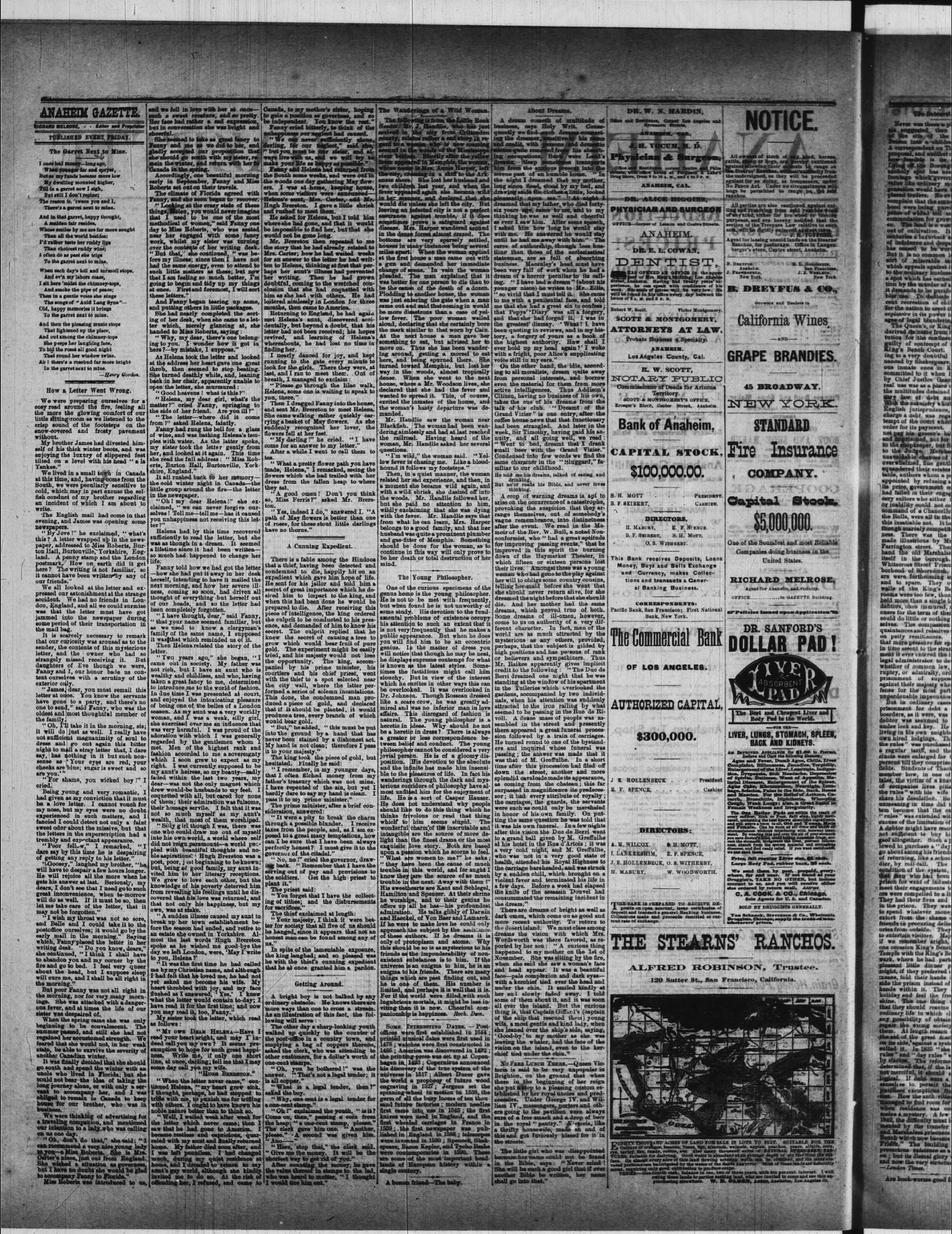
Searchable text
ANAHEIM GAZETTE.
RICHARD MELROSE. . . Letter and Proprietor
PUBLISHED EVERY FRIDAY.
The Garret Next to Mine.
I once had money—long ago,
When younger far and spryer,
But as my funds became more low
My dwelling mounted higher,
Till in a garret now I sigh,
But still I don’t repine;
The reason is, ‘tween you and I,
There’s a garret next to mine.
And in that garret, happy thought,
A maiden fair resides,
Whose smiles by me are far more sought
Than all the world besides;
I’d rather taste her ruddy lips
Than choicest ruddy wine;
I often do as past she trips
To the garret next to mine.
When each day’s toll and turmoil stops,
And ev'n my labors cease,
I sit here ’midst the chimney-tops,
And smoke the pipe of peace;
Then in a gentle voice she sings
The songs of “Auid Lang Syne”—
Old, happy memories it brings
To the garret next to mine.
And then the pleasing music stops
That lightened up the place,
And out among the chimney-tops
She peeps her laughing face,
To bid the roses all good night
That round her window twine.
Ab ! there’s a rosebud far more bright
In the garret next to mine.
—Henry Gordon.
How a Letter Went Wrong.
We were preparing ourselves for a cozy read around the fire, feeling all the more the glowing comfort of our little sitting-room as we listened to the crisp sound of the footsteps on the snow-covered and frosty pavement without.
My brother James had divested himself of his thick winter boots, and was enjoying the luxury of slippered feet tilted on a lace with his tea and we fell in love with her at once—such a sweet creature, and so pretty. Her face had rather a sad expression, but in conversation she was bright and cheerful.
She seemed to take as great fancy to Fanny and me as we did to her, and gladly accepted our proposition that she should go south with my sister, remain the winter, and return with her to Canada in the spring.
Accordingly, one beautiful morning early in September, Fanny and Miss Roberts set out on their travels.
The climate of Florida agreed with Fanny, and she soon began to recover.
“Looking at the crazy state of these things, Helen, you would never imagine that I need to be one of the most methodical of women,” said Fanny one day to Miss Roberts, who was seated near her engaged with some fancy work, whilst my sister was turning over the contents of her writing desk.
“But that,” she continued, “was before my illness; since then I have not had the same energy, even to attend to such little matters as these; but now that I am feeling so much better, I going to begin and tidy up my things at once. First and foremost, I will sort these letters.”
And Fanny began tearing up some, and putting others in little packages.
She had nearly completed the sorting of her desk, when she came to a letter which merely glancing at, she handed to Miss Roberts, saying:
“Why, my dear, there’s one belonging to you. I wonder how it got in here?—by mistake, I suppose.”
As Helena took the letter and looked at the address her heart gave one great throb, then seemed to stop beating. She turned deathly white, and, leaning back in her chair, apparently unable to open the letter, she murmured:
“Good heavens! what is this?”
Helena, my dear girl, what’s the matter?” cried Fanny, springing to the side of her friend. Are you ill?
“The letter—where did it come from?” asked Helena, faintly.
Fanny had rung the bell for a glass of wine, and was bathing Helena’s temples with water. As the latter spoke, my sister took the letter gently from her, and looked at it again. This time she read the full address: “Miss Robe Canada, to my mother’s sister, I have to gain a position as governess, so be independent. You know the unhappiness our neglect had caused.”
“We can never sufficiently darling, for our neglect,” said “but you must be our sister, so ways live with us, and we will make your life as happy as possible.”
Fanny and Helena had returned the South some weeks, and were the woods one day gathering Mayers. I was at home, keeping watch when some visitors were announced Helena’s aunt, Mrs. Carter, and Hugh Brereton. I gave a little rushed to meet them.
He asked for Helena, but I told where she had gone, and that it be impossible to find her, but that would not be gone long.
Mr. Brereton then repeated the story that he had already relied on Mrs. Carter; how he had waited for an answer to the letter he had ten to Helena, thinking at first that haps her aunt’s illness had prevailed her writing. Then he had doubtful, coming to the wretched clusion that she had coquetted him as she had with others. He loitered aimlessly in London four months, then came to America.
Returning to England, he had met Helena’s aunt, discovered dentally, but beyond a doubt, the letter had not been received; his revived, and learning of Hugh Brereton’s whereabouts, he had lost no finding her.
I nearly danced for joy, and running to the gate every minute look for the girls. There they went last, and I ran to meet them. Breath, I managed to exclaim:
“Please go through the lilac Helena, some one is waiting to spy you, there.”
Then I dragged Fanny into the room and sent Mr. Brereton to meet Helen. She came walking rather quietly trying a basket of May flowers. Suddenly recognized her lovely flowers fell at her feet.
“My darling!” he cried. “Come for an answer to my letter.” After a while I went to call the tea.
How a Letter Went Wrong.
We were preparing ourselves for a cosy read around the fire, feeling all the more the glowing comfort of our little sitting-room as we listened to the crisp sound of the footsteps on the snow-covered and frosty pavement without.
My brother James had divested himself of his thick winter boots, and was enjoying the luxury of slippered feet tilted on a level with his head "a la Yankee."
We lived in a small town in Canada at this time, and having come from the South, we were peculiarly sensitive to cold, which may in part excuse the selfish conduct of my brother regarding an incident of which I am about to write.
The English mail had come in that evening, and James was opening some newspapers.
"By Jove!" he exclaimed, "what's this? This letter wrapped up in the newspaper, addressed to Miss Roberts, Burton Hall, Burtonville, Yorkshire, England. A penny stamp and the London postmark. How on earth did it get here? The writing is not familiar, so it cannot have been written by any of our friends."
We all looked at the letter and expressed our astonishment at the strange accident. We had no friends in London, England, and all we could surmise was that the letter must have got jammed into the newspaper during some period of their transportation in the mail bag.
It is scarcely necessary to remark that our curiosity was aroused as to the sender, the contents of this mysterious letter, and the owner who had so strangely missed receiving it. But daughters of Eve though we were, Fanny and I, our honor bade us content ourselves with a scrutiny of the exterior only.
"James, dear, you must remail this letter at once. You know the servants have gone to a party, and there's no one to send," said Fanny, who was the oldest and most thoughtful member of the family.
"Oh, I'll take it in the morning, sis; it will do just as well. I really have not sufficient magnanimity of soul to dress and go out again this bitter night to mail a stray letter that, I dare say, has nothing in it but such non-sense as 'Your eyes are red, your cheeks are blue; sugar is sweet and so are you.'"
"For shame, you wicked boy!" I oried.
Being young and very romantic, I had given as my conviction that it must be a love letter. I cannot vouch for my nose, but my eyes were no doubt experienced in such matters, and I fancied I could detect not only a faint sweet odor about the missive, but that the letters in the superscription had a trembling and expectant appearance.
"I poor fellow," I remarked, "I dare say by this time he is despairing of getting any reply to his letter."
"Goosey," laughed my brother, "he will have to despair a few hours longer.
at the address her heart gave one great throb, then seemed to stop beating. She turned deathly white, and, leaning back in her chair, apparently unable to open the letter, she murmured:
"Good heavens! what is this?"
Helena, my dear girl, what's the matter?" cried Fanny, springing to the side of her friend. Are you ill?
"The letter—where did it come from?" asked Helena, faintly.
Fanny had rung the bell for a glass of wine, and was bathing Helena's temples with water. As the latter spoke, my sister took the letter gently from her, and looked at it again. This time she read the full address: "Miss Roberts, Burton Hall, Burtonville, Yorkshire, England."
It all rushed back to her memory—the cold winter night in Canada—the little group around the fire—the letter in the newspaper.
"Oh! my dear Helena!" she exclaimed, "we can never forgive ourselves! Tell me—tell me—has it caused you unhappiness not receiving this letter?
Helena had by this time recovered sufficiently to read the letter, but she was as though in a dream. It seemed a lifetime since it had been written—so much had happened to change her life.
Fanny told how we had got the letter—how she had put it away in her desk herself, intending to have it mailed the next morning, and how her severe illness, coming so soon, had driven all thought of everything—but herself out of our heads, and so the letter had been completely forgotten.
"I have thought, dear," said Fanny, "that your name seemed familiar, but as we used to know a clergyman's family of the same name, I supposed it was that which reminded us of it.
Then Helena related the story of the letter.
"Two years ago," she began, "I came out in society. My father was not rich, but I have an aunt who is wealthy and childless, and who, having taken a great fancy to me, determined to introduce me to the world of fashion. In due time I was presented at court, and enjoyed the intoxicating pleasure of being one of the belles of a London season. As my aunt was a very worldly woman, and I was a weak, silly girl, she exercised over me an influence that was very harmful. I was proud of the adoration with which I was generally regarded by the gentlemen whom I met. Men of the highest rank and fashion accorded to me a sovereignty which I soon grew to expect as my right. I was currently supposed to be my aunt's heiress, so my beauty—sadly faded within the last two years, my dear—was not the only magnet which drew would-be husbands to my feet. I coquetted with all, but cared for none of them; their admiration was fulsome, their homage servile. I felt that it was not so much myself as my aunt's wealth, that most of them worshiped.
"Silly girl though I was, there was one who could draw me out of myself into his own-world, a world where self did not reign paramount—a world people with beautiful thoughts and noble aspirations." Hugh Brereton was a poet, poor, just beginning to be known; but, being of good family, my aunt in
at the address her heart gave one great throb, then seemed to stop beating. She turned deathly white, and, leaning back in her chair, apparently unable to open the letter, she murmured:
"Good heavens! what is this?"
Helena, my dear girl, what's the matter?" cried Fanny, springing to the side of her friend. Are you ill?
"The letter—where did it come from?" asked Helena, faintly.
Fanny had rung the bell for a glass of wine, and was bathing Helena's temples with water. As the latter spoke, my sister took the letter gently from her, and looked at it again. This time she read the full address: "Miss Roberts, Burton Hall, Burtonville, Yorkshire, England."
It all rushed back to her memory—the cold winter night in Canada—the little group around the fire—the letter in the newspaper.
"Oh! my dear Helena!" she exclaimed, "we can never forgive ourselves! Tell me—tell me—has it caused you unhappiness not receiving this letter?
Helena had by this time recovered sufficiently to read the letter, but she was as though in a dream. It seemed a lifetime since it had been written—so much had happened to change her life.
Fanny told how we had got the letter—how she had put it away in her desk herself, intending to have it mailed the next morning, and how her severe illness, coming so soon, had driven all thought of everything—but herself out of our heads, and so the letter had been completely forgotten.
"I have thought, dear," said Fanny,
"that your name seemed familiar, but as we used to know a clergyman's family of the same name, I supposed it was that which reminded us of it.
Then Helena related the story of the letter.
"Two years ago," she began,
"I came out in society. My father was not rich, but I have an aunt who is wealthy and childless, and who having taken a great fancy to me, determined to introduce me to the world of fashion. In due time I was presented at court, and enjoyed the intoxicating pleasure of being one of the belles of a London season. As my aunt was a very worldly woman, and I was a weak,silly girl,she exercised over me an influence that was very harmful. I was proud of the adoration with which I was generally regarded by the gentlemen whom I met. Men of the highest rank and fashion accorded to me a sovereignty which I soon grew to expect as my right. I was currently supposed to be my aunt's heiress,so my beauty—sadly faded within the last two years,my dear—was not the only magnet which drew would-be husbands to my feet. I coquetted with all,but cared for none of them; their admiration was fulsome,their homage servile. I felt that it was not so much myself as my aunt's wealth,that most of them worshiped.
"Silly girl though I was,there was one who could draw me out of myself into his own-world,a world where self did not reign paramount—a world people with beautiful thoughts and noble aspirations." Hugh Brereton was a poet,poor,just beginning to be known; but,being of good family,my aunt in
at the address her heart gave one great throb,then seemed to stop beating. She turned deathly white,and,leaning back in her chair,apparently unable to open the letter,她 murmured:
"Good heavens!what is this?"
Helena,my dear girl,what's the matter?" cried Fanny,springing to the side of her friend. Are you ill?
"The letter—where did it come from?" asked Helena,faintly.
Fanny had by this time recovered sufficiently to read the letter,但她 was as though in a dream. It seemed a lifetime since it had been written—so much had happened to change her life.
Fanny told how we had got the letter—how she had put it away in her desk herself,intending to have it mailed the next morning,and how her severe illness,coming so soon,had driven all thought of everything—but herself out of our heads,and so the letter had been completely forgotten.
"I have thought,dear," said Fanny,
"that your name seemed familiar,但我 used to know a clergyman's family of the same name,I supposed it was that which reminded us of it.
Then Helena related the story of the letter.
"Two years ago,” she began,“I came out in society. My father was not rich,but I have an aunt who is wealthy and childless,and who having taken a great fancy to me,determined to introduce me to the world of fashion. In due time I was presented at court,and enjoyed the intoxicating pleasure of being one of the belles of a London season. As my aunt was a very worldly woman,and I was a weak,silly girl,她 exercised over me an influence that was very harmful. I was proud of the adoration with which I was generally regarded by the gentlemen whom I met. Men of the highest rank and fashion accorded to me a sovereignty which I soon grew to expect as my right. I was currently supposed to be my aunt's heiress,so my beauty—sadly faded within the last two years,my dear—was not the only magnet which drew would-be husbands to my feet. I coquetted with all,but cared for none of them; their admiration was fulsome,their homage servile. I felt that it was not so much myself as my aunt's wealth,that most of them worshiped."
"It were a pity to break these through a possible blunder. I taxes from the people,and as I have repented of the sin,但 hardly dare to say my hand is old pass it to my prime minister."
The prime minister,after a brief sidereation,answered:
"It were a pity to break these through a possible blunder. I taxes from the people,and as I have repented of the sin,但 hardly dare to say my hand is old pass it to my prime minister."
The prime minister,after a brief sidereation,answered:
"It were a pity to break these through a possible blunder. I taxes from the people,and as I have repented of the sin,但 hardly dare to say my hand is old pass it to my prime minister."
The prime minister,after a brief sidereation,answered:
"It were a pity to break these through a possible blunder. I taxes from the people,and as I have repented of the sin,但 hardly dare to say my hand is old pass it to my prime minister."
The prime minister,after a brief sidereation,answered:
"It were a pity to break these through a possible blunder. I taxes from the people,and as I have repented of the sin,但 hardly dare to say my hand is old pass it to my prime minister."
The prime minister,after a brief sidereation,answered:
"It were a pity to break these through a possible blunder. I taxes from the people,and as I have repented of the sin,但 hardly dare to say my hand is old pass it to my prime minister."
The prime minister,after a brief sidereation,answered:
"It were a pity to break these through a possible blunder. I taxes from the people,and as I have repented of the sin,但 hardly dare to say my hand is old pass it to my prime minister."
The prime minister,after a brief sidereation,answered:
"It were a pity to break these through a possible blunder. I taxes from the people,and as I have repented of the sin,但 hardly dare to say my hand is old pass it to my prime minister."
The prime minister,after a brief sidereation,answered:
"It were a pity to break these through a possible blunder. I taxes from the people,and as I have repented of the sin,但 hardly dare to say my hand is old pass it to my prime minister."
The prime minister,after a brief sidereation,answered:
"It were a pity to break these through a possible blunder. I taxes from the people,and as I have repented of the sin,但 hardly dare to say my hand is old pass it to my prime minister."
The prime minister,after a brief sidereation,answered:
"It were a pity to break these through a possible blunder. I taxes from the people,and as I have repented of the sin,但 hardly dare to say my hand is old pass it to my prime minister."
The prime minister,after a brief sidereation,answered:
"It were a pity to break these through a possible blunder. I taxes from the people,and as I have repented of the sin,但 hardly dare to say my hand is old pass it to my prime minister."
The prime minister,after a brief sidereation,answered:
"It were a pity to break these through a possible blunder. I taxes from the people,and as I have repented of the sin,但 hardly dare to say my hand is old pass it to my prime minister."
The prime minister,after a brief sidereation,answered:
"It were a pity to break these through a possible blunder. I taxes from the people,and as I have repented of the sin,但 hardly dare to say my hand is old pass it to my prime minister."
The prime minister,after a brief sidereation,answered:
"It were a pity to break these through a possible blunder. I taxes from the people,and as I have repented of the sin,但 hardly dare to say my hand is old pass it to my prime minister."
The prime minister,after a brief sidereation,answered:
"It were a pity to break these through a possible blunder. I taxes from the people,and as I have repented of the sin,但 hardly dare to say my hand is old pass it to my prime minister."
The prime minister,after a brief sidereation,answered:
"It were a pity to break these through a possible blunder. I taxes from the people,and as I have repented of the sin,但 hardly dare to say my hand is old pass it to my prime minister."
The prime minister,after a brief sidereation,answered:
"It were a pity to break these through a possible blunder. I taxes from the people,and as I have repented of the sin,但 hardly dare to say my hand is old pass it to my prime minister."
The prime minister,after a brief sidereation,answered:
"It were a pity to break these through a possible blunder. I taxes from the people,and as I have repented of the sin但 hardly dareTo say my hand is old pass it to my prime minister."
The prime minister,后面有更多内容继续扩展。
"For shame, you wicked boy!" I oried.
Being young and very romantic, I had given as my conviction that it must be a love letter. I cannot vouch for my nose, but my eyes were no doubt experienced in such matters, and I fancied I could detect not only a faint sweet odor about the missive, but that the letters in the superscription had a trembly and expectant appearance.
"Poor fellow," I remarked, "I dare say by this time he is despairing of getting any reply to his letter."
"Goosey," laughed my brother, "he will have to despair a few hours longer. He will rejoice all the more when he gets his answer at last. Seriously, my dears, I don't see that I need go to such great inconvenience, when te-morrow will do as well. If it must be so, then let me take care of the letter, that it may not be forgotten."
"I wish my throat was not so sore, and Belle and I could take it to the postoffice ourselves; it would go by the early mail in the morning." Saying which, Fanny placed the letter in her writing desk. "Do you know, dears," she continued, "I think I shall have to abandon you and my corner by the fire and go to bed. I feel very queer about the head, but I suppose sleep will cure me, and I shall be all right in the morning."
But poor Fanny was not all right in the morning, nor for very many mornings. She was attacked with a dangerous fever, and at times the life of our sister was despaired of.
When the spring came she was only beginning to be convalescent. The summer passed, and still she had not regained her accustomed strength. We feared that she would not, in her weak state, be able to survive the severity of another Canadian winter.
It was finally decided that she should go south and spend the winter with an uncle who lived in Florida; but she could not bear the idea of taking the long journey alone, or with only a servant to accompany her, and I was obliged to remain in Canada to keep house for our brother, who was in business.
We were thinking of advertising for a traveling companion, and mentioned our intention to a lady who was calling on us one day.
"Oh, don't do that," she said; "I can recommend a very nice young lady to you—a Miss Roberta. She is Mrs. Carter's niece, just out from England. She wished a situation as governess, but I have no doubts she would be glad to accompany Fanny to Florida."
Miss Roberta was introduced to us,
faded within the last two years, my dear—was not the only magnet which drew would-be husbands to my feet. I coquetted with all, but cared for none of them; their admiration was fulsome, their homage servile. I felt that it was not so much myself as my aunt's wealth, that most of them worshiped.
"Silly girl though I was, there was one who could draw me out of myself into his own world, a world where self did not reign paramount—a world people with beautiful thoughts and noble aspirations." Hugh Brereton was a poet, poor, just beginning to be known; but, being of good family, my aunt invited him to her literary receptions. We grew to love each other, but the knowledge of his poverty deterred him from revealing his feelings until he discovered that his love was returned, and that not only his happiness, but my own, was at stake.
"A sudden illness caused my aunt to break up her town establishment before the season had ended, and retire to an estate she owned in Yorkshire. Almost the last words Hugh Brereton spoke as he wished me good-bye the day we left London, were 'May I write to you, Helena?'
"It was the first time he had called me by my Christian name, and although I had felt that he loved me, he had not yet asked me become his wife. My heart throbbed with joy, and my face flushed as I answered,' Yes.' I knew what the letter would contain to-day; I have read it for the first time; and now you may read it, too, Fanny."
My sister took the letter, which read as follows:
"My own Dead Helena—Have I read your heart aright, and may I indeed call you my own? It seems presumption to hope for such great happiness. Write me, if only one short line, at once, darking; tell me that I may some day call you my wife."
"Hugh Brereton."
"When the letter never came," continued Helena, "my heart grew sick. I thought, perhaps, he had stopped to trifle with me, to punish me for trifling with others. I ought to have known his noble nature better than to think so.
"Well, I waited week after week for the letter which never came; then I saw that he had gone to America. I became restless and capricious, quarreled with my aunt and finally returned home. My father died soon after, and I was left penniless. I had changed much, during my quiet residence at home, and I dreaded to return to my aunt's gay world, although she kindly invited me to do so. At the risk of offending her, I refused, and came to that I often filched money from father's treasury which was not in my hands; but hardly dare to say my hand is old pass it to my prime minister."
The prime minister, after a brief sidération, answered:
"It were a pity to break the through a possible blunder. I taxes from the people, and as I posed to a great many temptation can I be sure that I have been perfectly honest? I must give it governor of the citadel."
"No, no!" cried the governor ing back. "Remember that I have served out of pay and provision the soldiers. Get the high pr plant it."
The priest said:
"You forget that I have the ing of tithes; and the disbursement for sacrifices."
The thief exclaimed at length:
"Your majesty, I think it we ter for society that all five of us be hanged, since it appears that honest man can be found among us."
In spite of the lamentable expulsion the king laughed; and so please he with the thief's cunning extent that he at once granted him a p
Getting Around.
A bright boy is not balked ordinary obstacle. He knows more ways than to cross a lowing will serve:
The other day a sharp-looking walked up quickly to the courtyard office in a country town emptying a bag of copperers thieved the clerk, who was attending other customers, for a dollar's worth one-cent stamps.
"Oh you be bothered!" w answer. "That's not a legal tenure is all copper."
What is a legal tender asked the boy.
Why, one cent is a legal tenure is one-cent stamp."
Oh!!" exclaimed the youth Come on, then," passing a coin the heap; "a one-cent stamp, put The clerk gave him one." And please." A second was given "Ano——"
Here, stop that," the clark "Give me the money. It will shortest way to get rid of you."
After counting the money, he the value thereof in stamps to t who was heard to mutter," "I t would tire him out."
to my mother's sister, hoping in a position as governess, and so independent. You know the rest." Any cried bitterly, to think of the happiness our neglect had caused. We can't never sufficiently stone, gag, for our neglect," said she, you must be our slafer, and alive with us, and we will try to your life as happy as possible." Any and Helena had returned from both some weeks, and were out in woods one day gathering May flowering. I was at home, keeping house, some visitors were announced—Aunt Sue, Mrs. Carter, and Mr. Brereton. I gave a little shriek unshaken to meet them.
Brereton then repeated to me story that he had already related to Carter; how he had waited weeks to answer to the letter he had written to Helena, thinking at first that per her aunt's illness had prevented writing. Then he had grown fufful, coming to the wretched conspiracy that she had coquetted with as she had with others. He had led aimlessly in London for three days, then came to America.
Turning to England, he had again Helena's aunt, discovered acciably, but beyond a doubt, that his had not been received; his hopes had died, and learning of Helena's seabouts, he had lost no time in oging her.
Nearly danced for joy, and kept going to the gate every minute to for the girls. There they were, at and I ran to meet them. Out of it, I managed to exclaim: "Please go through the lilac walk, ma, some one is waiting to speak to there."
When I dragged Fanny into the house, sent Mr. Brereton to meet Helena, same walking rather quickly carved a basket of May flowers. As she only recognized her lover, the ears fell at her feet.
My darling!" he cried. "I have for an answer to my letter."
After a while I went to call them to The Wanderings of a Wild Woman.
The following is from the Little Book Geeder: Mr. J. Handlie, who has just arrived in the city from Crittenden county, relates rather a sad story in regard to a woman who is now roaming around in the woods of the Mississippi river bottom. Shortly after the yellow fever appeared in Memphis, the woman, whose name is Mrs. Annie Harper, left the city, crossing in a skiff to the Arkansas shore. She lost her husband and two children last year, and when the fever appeared again she became wild in her manner, and declared that she would die unless she left the city. But leaving an infected city is not a perfect assurance against trouble, if it does sometimes prove a safeguard against disease. Mrs. Harper wandered around in the dense forest almost crazed. The bottoms are very sparsely settled, houses in many instances being several miles apart. When the woman applied at the first house a man came out with a gun and demanded her immediate change of scene. In vain the woman pleaded. The man explained that it was better for one person to die than to be the cause of the death of a dozen. Plodding to another house, the woman was just entering the gate when a man came out and said that coming in would be more disastrous than a case of yellow fever. The poor woman wailed aloud, declaring that she certainly bore the mark similar to that worn by Cain. At the next house a man gave her something to eat, but advised her to move on. Thus she has been wandering around, getting a morsel to eat here, and being spurned there. She turned toward Memphis, but lost her way in the woods, almost tropically dense. When she went to the next house, where a Mr. Woodson lives, she declared that she had the fever and wanted to spread it. This, of course, excited the inmates of the house, and the woman's hasty departure was demanded.
Mr. Handlie saw the woman near Blackfish. The woman had been wandering aimlessly and had at last reached the railroad. Having heard of the woman, Mr. Handlie asked her several questions.
"I'm wild," the woman said.
About Dreams.
A dream cometh of multitude of business, says Holy Writ. Consequently we find each dreams connecting the dreamer, sensitive to his name and credit, with persons and domestic scenes quite removed from his absorbing occupations. Such were Land's dreams. Sleep sometimes transports him from the anxious present into the serene past of an humble home. "In the night I dreamed that my mother long since dead, stood by my bed, and drawing aside the clothes a little, looked pleasantly upon me." "At night I dreamed that my father, who died forty-six years age, came to me, and to my thinking he was as well and cheerful as ever I saw him. After some speech, I asked him how long he would stay with me. He answered he would stay until he had me away with him." The cares of authorship, though less bustling than those of the ecclesiastical statesman, are as full of absorbing business. Macauley's head must have been very full of work when he had a dream of a horror peculiar to its calling. "I have had a dream" (about his younger niece) he writes to Mr. Ellis, "so vivid that I must tell it. She came to me with a penitential face, and told me that she had a great sin to confess; that Pepys' 'Diary' was all a forgery, and that she had forged it. I was in the greatest dismay.' What! I have been quoting in reviews, and in my history, a forgery of yours as a book of the highest authority. How shall I ever hold up my head again?' I woke with a fright, poor Alice's supplicating voice still in my ears."
On the other hand, the idle, according to all moralists, dream quite away from personal interests, and borrow even the material for them from more active intelligences. Thus Addison's Citizen, having no business of his own, takes the cue of his dreams from the talk of his club. "Dreamt of the Grand Vizier" is one entry after the coffee house news that that functionary had been strangled. And later in the week, Sir Timothy, having paid his annuity, and all going well, we read: "Went to bed, dreamt that I drank small beer with the Grand Vizier." Condensed into few words we find the
turned toward Memphis, but lost her way in the woods, almost tropically dense. When she went to the next house, where a Mr. Woodson lives, she declared that she had the fever and wanted to spread it. This, of course, excited the inmates of the house, and the woman's hasty departure was demanded.
Mr. Handlie saw the woman near Blackfish. The woman had been wandering aimlessly and had at last reached the railroad. Having heard of the woman, Mr. Handlie asked her several questions.
"I'm wild," the woman said. "Yellow fever is chasing me. Like a bloodhound it follows my footsteps."
Then, in a quiet manner, the woman related her sad experience, and then, in a moment she became wild again, and with a wild shriek, she dashed off into the woods. Mr. Handlie followed her, but she paid no attention to him, wildly exclaiming that she was dying with the fever. Mr. Handlie says that from what he can learn, Mrs. Harper belongs to a good family, and that her husband was quite a prominent plumber and gas-fitter of Memphis. Something should be done for the woman, as to continue in this way will only prove to be her death or total destruction of her mind.
The Young Philosopher.
One of the curious specimens of the genus homo is the young philosopher. He is not to be met with frequently, but when found he is not unworthy of some study. His devotion to the fundamental problems of existence occupies his attention to such an extent that it is not very frequently that he makes a public appearance. But when he does you will find him to be an eccentric genius. In the matter of dress you will notice that though he may be neat, he displays supreme contempt for what is known as the latest styles. Sometimes the fastidious might call him slouchy. But in view of the interest which he excites in other ways this can be overlooked. It was overlooked in Dr. Johnson. Though Rosseau dressed like a scare crow, he was greatly admired and was no inferior man in love affairs. This disregard of fashion is natural. The young philosopher is a heretic in ideas. Why should he not be a heretic in dress? There is always a greater or less correspondence between belief and conduct. The young philosopher cannot be considered a very jovial person. He is of a gloomy disposition. His devotion to the absolute and the infinite has made him insensible to the pleasures of life. In fact his wanderings through the dark and mysterious corridors of philosophy have almost unfitted him for the enjoyment of life. He is a sort of Casper Hauser. He does not understand why people should like to do this thing which he thinks frivolous or read that thing which to him seems stupid. The wonderful charm of the inscrutable and intangible are the source of more delight than the finest drama or the most exquisite love story. Both are based upon a passion which he scorns to feel.
"What are women to me?" he asks; "they have been the cause of much trouble in this world, and for aught I"
On the other hand, the idle, according to all moralists, dream quite away from personal interests, and borrow even the material for them from more active intelligences. Thus Addison's Citizen, having no business of his own, takes the oue of his dreams from the talk of his club. "Dreamt of the Grand Vizier" is one entry, after the coffee house news that that functionary had been strangled. And later in the week, Sir Timothy, having paid his annuity, and all going well, we read: "Went to bed, dreamt that I drank small beer with the Grand Vizier." Condensed into few words we find the same character in the "Sluggard," familiar to our childhood.
He told me his dreams, talked of eating and drinking. But never reads his Bible, and never loves thinking.
A crop of warning dreams is apt to arise on the occurrence of a catastrophe, provoking the suspicion that they arrange themselves, out of somebody's vague remembrance, into distinctness after the event. We read in the Memoir of the Rev. W. Bull, a noted Nonconformist, who "had a great aptitude for improving passing events," that he improved in this spirit the burning down of the Haymarket Theater, in which fifteen or sixteen persons lost their lives. Amongst these was a young woman who had gone to the play against her will to oblige some country cousins, telling her maid before she went that she should never return alive, for she dreamed the night before that she should die. And her mother had the same dreams, which proved true of both. Some dreams of ill-omen, however, come to us on authority of a very different character. In fact, men of the world are as much attracted by the mysterious as any others, provided, perhaps, that the subject is gilded by high positions and has persons of rank or believers and sympathizers. Thus Mr. Raikes apparently gives implicit credit to the following: "The Duc de Berri dreamed one night that he was standing at the window of his apartment in the Tuileries which overlooked the gardens, accompanied by two individuals, when his attention was suddenly attracted to the iron railing by what seemed to be passing in the Rue de Rivoli. A deuse mass of people was assembled in the street and presently there appeared a great funeral procession followed by a train of carriages. He turned round to one of the bystanders and inquired whose funeral was passing; the answer was made that it was that of M. Greffulhe. In a short time after this procession had filed off down the street, another and more splendid cavalcade made its appearance, as coming from the chateau; this far surpassed in magnificence its predecessor; it had every attribute of royalty; the carriages, the guards, the servants were such as could only be marshaled in honor of his own family. On putting the same question he was told that it was his own funeral. In a few nights after this vision the Duc de Berri went to a grand ball given by M. Greffulhe at his hotel in the Rue d'Artois; it was a very cold night, and M. Greffulhe, who was not in a very good state of health, attended his Royal Highness to the carriage bareheaded, and was struck
often filched money from my treasury which was not mine. He repented of the sin, but yet I only dare to say my hand is clean. I sit to my prime minister."
The prime minister, after a brief conversation, answered:
It were a pity to break the charm through a possible blunder. I receive from the people, and, as I am exiled to a great many temptations, how be sure that I have been always strictly honest? I must give it to the governor of the citadel.
No, no!" cried the governor, drawback. "Remember that I have the long out of pay and provisions to soldiers. Get the high priest to it."
The priest said:
You forget that I have the collection of tithes; and the disbursements sacrifices."
The thief exclaimed at length:
Your majesty, I think it were betrayed by our society that all five of us shouldanged, since it appears that not an old man can be found among any of us spite of the lamentable exposure, being laughed; and so pleased was with the thief's cunning expedient he at once granted him a pardon.
Getting Around.
A bright boy is not balked by any mary obstacle. He knows there are always than one to cross a stream. Illustration of this fact, the folling will serve:
On other day a sharp-looking youth led up quickly to the counter of post-office in a country town, and laying a bag of coppers thereon, the clerk, who was attending to customers, for a dollar's worth of cent stamps.
Oh, you be bothered!" was the mer. "That's not a legal tender; it copper."
What is a legal tender, then?" is the boy.
Why, one cent is a legal tender for cent stamp."
Exclaims the youth, "is it? on, then," passing a coin from cap;" a one-cent stamp, please." clerk gave him one." Another, so." A second was given him.
Here, stop that," the clark said. We me the mony. It will be the best way to get rid of you."
Our counting the money, he gave value thereof in stamps to the lad, was heard to mutter, "I thought told tire him out."
Some Interesting Dates. — Post-offices were first established in 1644; printed musical dates were first used in 1478; watches were first constructed in 1496; America was discovered in 1492; the printing press was set up at Copenhagen in 1493; Copernicus announced his discovery of the true system of the universe in 1517; Albert Durer gave the world a prophecy of future wood engraving in 1527; Jergens set the spinning-wheel in motion in 1538, the germ of all the busy looms of ten thousand future factories; modern needles first came into use in 1545; the first knives were used in England, and the first wheeled carriages in France in 1559; the first newspaper was published in England in 1588; telescopes were invented in 1590; Spences, Shakespeare, Bacon Kepler, and Tycho Bahe were contemporaries in 1590. These are some of the most important headlands of European history within a single century.
A bosom friend—The baby.
Splendid cavalcade made its appearance, as coming from the chateau; this far surpassed in magnificence its predecessor; it had every attribute of royalty; the carriages, the guards, the servants were such as could only be marshaled in honor of his own family. On putting the same question he was told that it was his own funeral. In a few nights after this vision the Duo de Berri went to a grand ball given by M. Greffulhe at his hotel in the Rue d'Artois; it was a very cold night, and M. Greffulhe, who was not in a very good state of health, attended his Royal Highness to the carriage bareheaded, and was struck by a sudden chill, which brought on a violent fever and terminated his life in a few days. Before a week had elapsed the knife of the assassin Donvel had consummated the remaining incident in the dream."
There are dreams of bright as well as dark omen, which come on as good and more recent authority. To return to the desert island. We must class among dreams the vision with which Mrs. Wordsworth was there favored, as reported by her son: "A curious thing happened to my mother on the 1st of November. She was sitting by the fire, when she said she saw a woman's face and head appear. It was a beautiful face—pale complexion and dark eyes—with a kerchief tied ever the head and under the chin. It smiled kindly at her and slowly faded away. I told some of them about it, and it was soon all over the island. But the curious thing is, that Captain Giffard's (captain of the ship that rescued them) young wife, a most gentle and kind lady, when she leaned over the ship's side, saying, 'Good-by' to my mother as she was leaving the whaler, had the face of the vision on the island, even to the kerchief tied under the chin."
No Fare Lunch There.—Queen Victoria is said to be very unpopular in Brighton, on the ground that when there in the beginning of her reign she put a stop to a pleasing custom established by her royal uncles and predecessors. Under George IV., and William IV., messengers, porters and others going to the pavilion were always sure of a free snack and a drop of beer in the royal "pantry." Victoria, like a thrifty housewife, made an end of this and got furiously hissed for it in the streets.
The little girl who was disappointed because her name could not be found in the Bible, says: "Never mind! She will be such a good girl that if ever another Bible be written, her name shall go into that."
DR. W. N. HARDIN,
Office and Residence, Corner Los Angeles and Nycamore Streets.
ANAHEIM, CAL.
J. H. YOCUM, M. D.
Physician & Surgeon,
Office and Residence, corner Centre and Palm streets, with office hours at Pergamon & Lake's Drug Store, from 9 to 10 A.M., and 4 to 5 P.M.
ANAHEIM, CAL.
DR. ALICE HIGGINS,
PHYSICIAN AND SURGEON
OFFICE—Corner of Lemon and Centre Streets.
ANAHEIM.
DR. E. L. COWAN,
DENTIST,
HAS OPENED AN OFFICE in the upper yard of Mrs. Meyer's building, Los Angeles Street, Anaheim. Having had twenty years' experience, he can speak with confidence of his work. His needs of prices will be very low. He will be found in his office every day between the hours of 9 A.M. and 5 P.M.
Robert W. Scott. Victor Montgomery.
SCOTT & MONTGOMERY, ATTORNEYS AT LAW.
Probate Business & Specialty.
ANAHEIM.
Los Angeles County, Cal.
R. W. SCOTT,
NOTARY PUBLIC
Commissioner of Deeds for Arizona Territory.
SCOTT & MONTGOMERY'S OFFICE,
Kroeger's Block, Center Street, Anaheim.
Bank of Anaheim,
CAPITAL STOCK,
NOTICE.
All owners of stock of any kind, horses, cattle, sheep or hogs, are hereby cautioned against allowing their animals to range on the Stearus' Ranchos without waiverly from the undersigned, as they will be proceeded against for no doing, as trespassers, under No Fence Act. Under no circumstances will hogs be permitted to range on the said ranches.
All parties are also cautioned against cutting and removing from and ranching wood of any kind, either for fire-wood or fencing purposes, and are hereby notified that the section of the Trespass Law relative to such acts will be rigidly enforced against them.
J. R. TUFFNER,
Agent for leasing unsold lands on the Stearus' Ranchos, for pasturage. Office in Langueberger's store, Centre street, Anaheim.
B. DREYFUS & CO.
Growers and Dealers in
California Wines
AND
GRAPE BRANDIES.
45 BROADWAY,
NEW YORK.
STANDARD
Fire Insurance
The Delaware
Never was there a plan suggested than of the site of the Prison into a children'
A correspondent on The proposal, and another o how feasible is its Lying off the Borough anholy spot has no feenings which govern value like ordinary mannation would have placed traders. No ever complain that the amuhood were being purse of widled toll commotion for growers en. The land is a want out of cultivation. It centuries a luxuriant state of indolence and despair has caused to be worst But it is no common sort of miserable snatch which appeals against it to the ordinary business a spot which has earned tion by the murder of a it demands to be purified bluer use. To delimitent recreation of child for the nation to assert the expiiration in its power in ages of legal blundering The Queen's, or King derived its name from tution for the confinement guilty of contempt of the King's Banch Court. ing to a very doubtful nanced by Shakespeare our inmate once in K committed to it when by Chief Justice Gauss real use was as a place of the multitudes detained mary law of debt an With the casanistry which English jurisprudence, charge a debt was rega tempt of the court which order for its payment not pay his grocer's bail and imprisoned, not for to the shopkeeper, but for to the Judge. Merchants unavoidable chances of
R. W. SCOTT,
NOTARY PUBLIC
Commissioner of Deeds for Arizona Territory.
SCOTT & MONTGOMERY'S OFFICE,
Kroeger's Block, Center Street, Anaheim.
Bank of Anaheim,
CAPITAL STOCK,
$100,000.00.
S. H. MOTT
President.
B. F. SEIBERT,
Cashier.
DIRECTORS:
H. MABURY,
E. F. SUNCE.
B. F. SHIBERT,
S. H. MOTT,
O. S. WITHERBY.
This Bank receives Deposits, Loans Money, Buys and Sells Exchange and Currency, makes Collections and transacts a General Banking Business.
CORRESPONDENTS:
Pacific Bank, San Francisco; First National Bank, New York.
The Commercial Bank
OF LOS ANGELES.
AUTHORIZED CAPITAL,
$300,000.
J. E. HOLLENBECK
President
E. F. SPENCE,
Cashier
DIRECTORS:
A. H. WILCOX,
S. H. MOTT,
I. LANKERSHIM,
E. F. SPENCE,
J. E. HOLLENBECK, O. S. WITHERBY,
45 BROADWAY.
NEW YORK.
STANDARD
Fire Insurance COMPANY.
Capital Stock,
$5,000,000.
One of the Soundest and most Reliable Companies doing business in the United States.
RICHARD MELROSE,
Agent for Anaheim and vicinity.
OFFICE.....in GAZETTE Building.
Polteles Issued upon Application to DR. SANFORD'S DOLLAR PAD!
ABSORBENT PAD
The Best and Cheapest Liver and Body Pad in the World.
FOR THE LIVER, LUNGS, STOMACH, SPLEEN, BACK AND KIDNEYS.
AM IMPROVED APPLIANCE for $1.99 to Preserve Kelpure and Ours the following diseases:
Agua and Fever, Dumb Ague, Chills, Lives Complaint, Billiousness, Jaundice Temporary, Management of the Liver, Latitude, Indication, Dyspnea, Nick Headache, Depression of Spirits, Dullness, Want of Appetite, Mental Diseases, Enlargement of the Spleen, Agne Cake, Rheumatism, Neuralgia, Lumbarage, Sedation, Palms in the Side, Back, Bones and Muscles.
For the Roller of Asthma, Cararth, Bronchitis, Diphtheria, Whooping Gough, Weak Lungs; also, a Great Roller in Female Weakness and Irregularity.
The One Roller Pads are within the reach of every sufferer, Rich or Poor, full size, highly medicated, containing the best known absorbsible ingredients, and will give you peace to all, old and new life and Female. Can be worn at all times and under all circumstances without interfering with internal treatment.
By wearing this pad over the pit of your stomach you save doctor's bills avoid falling unconscious drugs, corrosive liquids increase the liver function, starch from the system material and contagious diseases, and find ready relief. If you want certificate we can send them.
Price: full regular Liver size $2 each.
Large Body Pad: rubber back $2 each.
We send them by post, prepaid every inmate once in K committeed to it when he by Chief Justice Gauss real use was as a place of the multitudes detained mary law of debt and With the cannistry which English jurisprudence charge a debt was rega tempt of the court which order for its payment not pay his grocer's bill and imprisoned, not for to the shopkeeper, but for to the Judge. Merchant unavoidable chances of overwhelming fine gentle squandered their estates table, authors whom a appointed by refusing its price, government or had failed in their engagement suitors who either or inability could not command of a Chancellor the Rolls, were all in this insatiable net. It has though scarcely competitive there was the made illustrious by Mr Farrington street. There hand the old Marshallse itself in the borough Whitecross Street Prison borhood of Shoreditchers were forthcoming en and to spare. They ow walls of the King's Bed rooms were too few, thom hold more than a single debtors, once immured, oners for the term of their could do little or nothing selves. The compassion quaintances and relatives on petty remittances that more pressure for spain in time assent to the straint ment it ever entered the legal administrator to det whether of common law, ruptey, or admiralty, ord prisonment of suppose against their majesty when fence for the most part unpardonable impecunious But in ordinary cases prisonment for debt a boarders, as it were, was debtor was assumed to under lock and key. He living in his own neighborhood hired lodgings. This the rules" was purchased a regular tariff, and the since were enlarged for persons till they comprise fields. Students of Thack member how, in one of tales,the victim of a knaw of companies lives pits the rules" with his wife share his desolation. So unmeaning in time did tem become that the cu "rules" was extended with excuse of the limitation of A debtor might have reason not sufficient to buy his gao altogether. Such a lowed to purchase a "day go about among his friends of returning like a school dier, by roll-call. The condition of the system
J. E. HOLLENBECK President
E. F. SPENCE, Cashier
DIRECTORS:
A. H. WILCOX, & H. MOTT,
I. LANKERSHIM, E. F. SPENCE,
J. E. HOLLENBECK, O. S. WITHERBY,
H. MABURY, W. WOODWORTH.
THE BANK IS PREPARED TO RECEIVE DEPOSITS ON OPEN ACCOUNT, ISSUE CERTIFICATES OF DEPOSIT AND TRANSACTION A GENERAL BANKING BUSINESS. COLLECTIONS MADE AND PROCEDURES REMITTED AT CURRENT RATE OF EXCHANGE.
THE STEARNS' RANCHOS.
ALFRED ROBINSON, Trustee.
120 Sutter St., San Francisco, California.
EIGHTY THOUSAND ACRES OF LAND FOR SALE IN LOTS TO SUIT. SUITABLE FOR THE CULTURE OF ORANGES, LEMONS, LIME, EPS, ALMONDS, WALNUTS, APPLES, PEACHES, Pears, Almonds, Corn, Rye, Barley, Sax, Ramie, Cotton, etc. Also many thousand acres of NATURAL EVERGREEN TATURES suitable for dairying. Good water is abundant at an average depth of six feet from the surface. On almost every acre of this land dwelling artesian wells can be obtained, and the more elevated portions can be irrigated by the water of the South Anriver. Most of these lands are naturally moist, requiring only good cultivation to produce crops.
TERMS—One-fourth cash; balance in one, two or three years, with ten percent interest. I will owing these lands to parties seeking land, who are invited to come and see this purchasing elsewhere.
W. E. OLDEN, Asmer, Anshaim, Los Angeles Co.