anaheim-gazette 1879-10-24
Scanned page
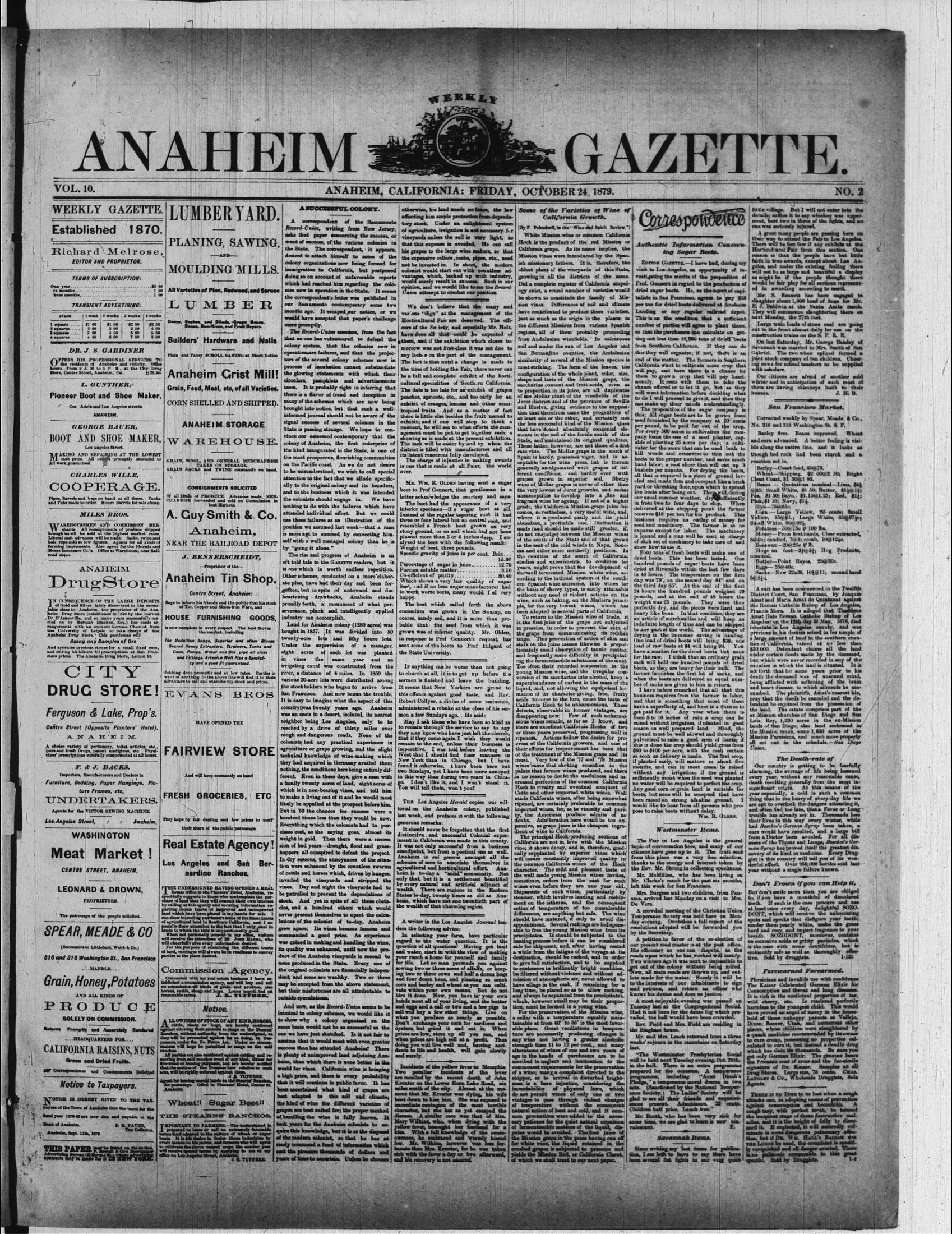
Searchable text
ANAHEIM
VOL. 10.
WEEKLY GAZETTE.
Established 1870.
Richard Melrose,
EDITOR AND PROPRIETOR.
TERMS OF SUBSCRIPTION:
One year.....$3.00
five months.....1.50
three months.....1.00
TRANSIENT ADVERTISING:
SPACE
1 square.....$1.00
2 squares.....2.00
3 squares.....3.00
4 squares.....4.00
5 squares.....5.00
6 squares.....6.00
7 squares.....7.00
8 squares.....8.00
DR. J. S. GARDINER
OFFERS HIS PROFESSIONAL SERVICES TO the residents of Anaheim and vicinity. Office hours: From 9 A.M to 5 P.M., at the City Drug Store, Centre Street, Anaheim, Cal.
jy20.2m
L. GUNTHER,
Ploneer Boot and Shoe Maker,
Cor. Adela and Los Angeles streets.
ANAHEIM.
GEORGE BAUER,
BOOT AND SHOE MAKER,
Los Angeles Street.
MAKING AND REPAIRING AT THE LOWEST cash price. All orders promptly attended to.
LUMBER YARD.
PLANING, SAWING,
AND MOULDING MILLS.
All Varieties of Pine, Redwood, and Spruce
LUMBER
Doors, Sashes, and Blinds, Grape Bases,
Bones, Bee-Hives, and Fruit Dryers.
Builders' Hardware and Nails
Plain and fancy SCROLL SAWING at Short Notice
Anaheim Crist Mill!
Grain, Feed, Meal, etc., of all Varieties.
CORN SHELLED AND SHIPPED.
ANAHEIM STORAGE
WAREHOUSE.
A SUCCESSFUL OFFER
A correspondent of the Record-Union, writing from asks that paper concerning want of success, of the variety the State. The corresponded desired to attach himself to colony organizations now being immigration to California, doing so on account of unfail which had reached him regains now in operation in the correspondent's letter writing our Sacramento contemporaneous months ago. It escaped purport would have accepted that more promptly.
The Record-Union assumes that no one has volunteered the colony system, that the operation are failures, and thatitors of the several colony process of incubation cannot the glowing statements with circulars, pamphlets and teem. It is probably right there is a flavor of fraud and many of the schemes which brought into notice, but that informed journal should not signal success of several State is passing strange. We vince our esteemed contemporary colony of Anaheim, the first kind inaugurated in the most prosperous, flourishing
L. GUNTHER,
Pioneer Boot and Shoe Maker,
Cor. Adele and Los Angeles streets.
ANAHEIM.
GEORGE BAUER,
BOOT AND SHOE MAKER,
Los Angeles Street.
MAKING AND REPAIRING AT THE LOWEST cash price. All orders promptly attended to. All work guaranteed.
CHARLES WILLE,
COOPERAGE.
Pipes, Barrels and kegs on hand at all times. Tanks and Tubs made to order. Honev Barrels for sale cheap.
MILES BROS.
WAREHOUSEMEN AND COMMISSION MERCHANTS. All conglomerations of produce shipped through us will be sold at the highest market rates. Liberal cash advances will be made. Sacks, twine and bale rope sold at low figures. Agents for all kinds of farming implements. Also agent for the Phoenix and Home Insurance Co.'s. Office at Warehouse, near Railroad depot.
ANAHEIM
DrugStore
IN CONSEQUENCE OF THE LARGE DEPOSITS of Gold and Silver lately discovered in the mountains close to Anaheim, the proprietor of the Anaheim Drug Store (established in 1870 by the learned Dr. D Assonville, and so many years successfully carried on by Hermann Blanken, Eq.) has made arrangements with an eminent German Chemist from the University of Leipse to take charge of the Anaheim Drug Store. This gentleman will Assay any Samplos of Ore And appraise precious stones for a small fixed sum, and during his leisure fill prescriptions at San Francisco prices. The Anaheim Drug Store, Lemon St.
CITY DRUG STORE!
Ferguson & Lake, Prop's.
Centre Street (Opposite Planters' Hotel).
ANAHEIM.
A choice variety of perfumery, toilet articles, etc., pure and fresh Drugs, patent medigines, etc. Physicians' prescriptions carefully compounded at all hours.
F. & J. BACKS.
Importers, Manufacturers and Dealers in Furniture, Bedding, Paper Hangings, Picture Frames, etc,
UNDERTAKERS.
Agents for the VICTOR SEWING MACHINE.
Los.Angeles Street, : Anaheim.
WASHINGTON
Meat Market!
CENTRE STREET, ANAHEIM.
Anaheim Crist Mill!
Grain, Feed, Meal, etc., of all Varieties.
CORN SHELLED AND SHIPPED.
ANAHEIM STORAGE
WAREHOUSE.
GRAIN, WOOL AND GENERAL MERCHANDISE TAKEN ON STORAGE.
GRAIN RACKS and TWINE constantly on hand.
CONSIGNMENTS SOLICITED
Of all kinds of PRODUCE. Advances made, MERCHANDISE forwarded and sold on Commission in best Markets.
A. Guy Smith & Co.
Anaheim,
NEAR THE RAILROAD DEPOT.
J. BENNERSCHEIDT,
—Proprietor of theAnaheim Tin Shop,
Centre Street, Anaheim:
Begs to inform his friends and the public that his stock of Tin, Copper and Sheet-Iron Ware, and HOUSE FURNISHING GOODS, is now complete in every respect. The best Stoves the market, including
The Medallion Range, Superior and other Stevens Geared Honey Extractors, Strainers, Tanks and Cans, Pumps, Water and Gas pipe all sizes and Fittings. Artesian Writt Pipe a Specialty and a good fit guarantee.
Jobbing done promptly and at low rates. Parties in want of anything in the above line will find it to their advantage to call and examine my stock and prices.
EVANS BROS
HAVE OPENED THE FAIRVIEW STORE
And will keep constantly on hand.
FRESH GROCERIES, ETC
They hope by fair dealing and low prices to merit their share of the public patronage.
Real Estate Agency!
Los Angeles and San Ber-
WASHINGTON
Meat Market!
CENTRE STREET, ANAHEIM,
LEONARD & DROWN,
PROPRIETORS.
The patronage of the people solicited.
SPEAR, MEADE & CO
[Successors to Littlefield, Webb & Co.]
816 and 318 Washington St., San Francisco
HANDLE...
Grain, Honey, Potatoes
AND ALL KINDS OF PRODUCE
SOLELY ON COMMISSION.
Returns Promptly and Annually Handed
HEADQUARTERS FOR...
CALIFORNIA RAISINS, NUTS
Green and Dried Fruits.
Correspondence and Consequences Sollected
Notice to Taxpayers.
NOTICE IS HEREBY GIVEN TO THE TAX-Payers of the Town of Anaheim that the taxes for the final year 1879-80 are now due and payable at the Bank of Anaheim.
D. R. PAYNE,
Tax Collector,
Anahaim, Sept. 11th, 1879.
THIS PAPER may be round on file at Goa Advertising Bureau (90 Serrana St.) where advertising contracts may be made for it in New York.
FRESH GROCERIES, ETC
They hope by fair dealing and low prices to merit their share of the public patronage.
Real Estate Agency!
Los Angeles and San Bernardino Ranchos.
THE UNDERSIGNED HAVING OPENED A REAL Estate Office in the Plaster's Hotel, Anaheim, respectfully suggests to those who contemplate the purchase of land that they will consult their own interest by calling at this agency and securing information regarding choice tracts of improved and unimproved land which have been placed in my hands for sale. I can show intending purchasers some of the finest tracts of agricultural land in Southern California, and I especially draw attention to the fact that I only deal in lands to which the title is unquestionably good.
When not personally present in my office, visitors will receive the attentions of Mr. John Hayne, who will cheerfully give every information desired.
For the purpose of examining the different tracts of land, carriages will always be in readiness to convey parties to the place desired.
Commission Agency.
Connected with my real estate business I have established a commission agency, and will buy and sell on commissions all kinds of grain and produce, also horses, cattle, sheep and hogs. Loans negotiated on reasonable terms.
Notice.
ALL OWNERS OF STOCK OF ANY KIND, HORSES, Cattle, sheep or hogs, are hereby confined against allowing their animals to range on the Shores' Ranches, without authority from the undersigned, so they will be proceeded against for so doing, as trustees, under the No Place Act. Under no circumstances will hogs be permitted to range on the said ranches.
All parties are also conditioned against cutting and removing from said ranches wool of any kind, either for firewood or housing purposes, and are hereby notified that the section of the Truman Law relative to such acts, will be rightly enforced against them.
J. R. TUFFREE.
Agent for leasing unused lands on the Shores' Ranches.
for pastures. Office in Plaster's Hotel, Center St.
Anahaim.
Wheat!! Sugar Beet!!
THE STEARNS' RANCHOS.
IMPORTANT TO FARMERS.—The undersigned is prepared to lease or sell on extremely favorable terms land adapted to the culture of wheat or sugar beets. It is his desire to foster these industries by every means in his power, and farmers who will agree to cultivate the above named crops the coming year will receive special terms by applying to me at my office on Los Angeles Street, Anahaim.
J. R. TUFFREE.
A SUCCESSFUL COLONY.
A correspondent of the Sacramento Record-Union, writing from New Jersey, asks that paper concerning the success, or want of success, of the various colonies in the State. The correspondent, it appears, desired to attach himself to some of the colony organizations now being formed for immigration to California, but postponed doing so on account of unfavorable reports which had reached him regarding the colonies now in operation in the State. It seems the correspondent's letter was published in our Sacramento contemporary some two months ago. It escaped our notice, or we would have accepted that paper's challenge more promptly.
The Record-Union assumes, from the fact that no one has volunteered to defend the colony system, that the colonies now in operation are failures, and that the projectors of the several colony schemes now in process of incubation cannot substantiate the glowing statements with which their circulars, pamphlets and advertisements teem. It is probably right in inferring that there is a flavor of fraud and deception in many of the schemes which are now being brought into notice, but that such a well-informed journal should not be aware of the signal success of several colonies in the State is passing strange. We hope to convince our esteemed contemporary that the colony of Anaheim, the first enterprise of the kind inaugurated in the State, is one of the most prosperous, flourishing communities
otherwise, his land needs no fence, the law affording him simple protection from depredatory stock. Under an enlightened system of agriculture, irrigation is not necessary for vineyards unless the soil is very light, so that this expense is avoided. He can sell his grapes to the large wine makers, so that the expensive cellars, casks, pipes, etc., need not be invested in. In short, the modern colonist would start out with countless advantages, which backed up with industry, would surely result in success. Such is our opinion, and we would like to see the Record-Union attempt to combat our position.
We don't believe that the many and variosa "digs" at the management of the Horticultural Fair are deserved. The officers of the Society, and especially Mr. Holt, have done all that could be expected of them, and if the exhibition which closes tomorrow was not first-class it was not due to any lachs on the part of the management. The fact is that until a change is made in the time of holding the Fair, there never can be a full and complete exhibit of the horticultural specialities of Southern California. The date is too late for an exhibit of grapes peaches, apricots, etc., and too early for an exhibit of oranges, lemons and other semitropical fruits. And as a matter of fact there is little else besides the fruit named to exhibit; and if one will stop to think a moment, he will see to what efforts the management must be put to get together such a showing as is made at the present exhibition. The task will be easier by and by when the district is filled with manufactories and all its latent resources fully developed.
Some of the Varieties of Wine of California Growth.
[By F. Pohdorff, in the "Wine and Spirit Review."]
White Mission-wine or common California Hock is the product of the red Mission or California grape. As its name implies, the Mission vines were introduced by the Spanish missionary fathers. It is, therefore, the oldest plant of the vineyards of this State, growing in all the districts of the same. Did a complete register of California amphology exist, a round number of varieties would be shown to constitute the family of Mission vines. Differences of soil and climate have contributed to produce these varieties, just as much as the origin in the plants in the different Missions from various Spanish regions, all of them probably proceeding from Andalusian winefields. In calcareous soil and under the sun of Los Angeles and San Bernadino counties, the Andalusian similarity of several of the Mission species is most striking. The form of the leaves, the configuration of the whole plant, color, size, shape and taste of the Mission grape, the saccharine content and fruit acids, even as to proportion in its juice, are all duplicates of the Mollar plant of the vinefields of the Jerez district and of the province of Seville and Huelva, giving evidence to the supposition that therefrom came the progenitors of at least one or other, and certainly not the less successful kind of the Mission vines that have found absolutely congenial elements in the soil of the fertile south of this State, and maintained its original qualities. These latter, however, are not those of a first-rate vine. The Mollar grape in the south of Spain is hardy, possesses vigor, and is ac-
process of incubation cannot substantiate the glowing statements with which their circulars, pamphlets and advertisements teem. It is probably right in inferring that there is a flavor of fraud and deception in many of the schemes which are now being brought into notice, but that such a well-informed journal should not be aware of the signal success of several colonies in the State is passing strange. We hope to convince our esteemed contemporary that the colony of Anaheim, the first enterprise of the kind inaugurated in the State, is one of the most prosperous, flourishing communities on the Pacific coast. As we do not desire to be misunderstood, we wish to call special attention to the fact that we allude specifically to the original colony and its founders, and to the business which it was intended the colonists should engage in. We have nothing to do with the failures which have attended individual effort. But we could use these failures as an illustration of the position we assumed last week—that a man is more apt to succeed by connecting himself with a well managed colony than he is by "going it alone."
The rise and progress of Anaheim is an oft told tale to the Gazette readers, but it is one which is worth endless repetition. Other schemes, conducted on a more elaborate plan, have had their day and been forgotten, but in spite of untoward and disheartening drawbacks, Anaheim stands proudly forth, a monument of what perseverance, pluck and intelligently applied industry can accomplish.
Land for Anaheim colony (1280 acres) was bought in 1857. It was divided into 50 twenty-acre lots and fifty house lots. Under the supervision of a manager, eight acres of each lot was planted in vines the same year and an irrigating canal was constructed from the river, a distance of 4 miles. In 1859 the various 20-acre lots were distributed among the stockholders who began to arrive from San Francisco. And now began the trouble. It is easy to imagine what the aspect of this country was twenty years ago. Anaheim was an oasis in a desert, isolated, its nearest neighbor being Los Angeles, only to be reached by a drive of thirty miles over rough and dangerous roads. None of the colonists had any practical experience in agriculture or grape growing, and the slight technical knowledge of wine-making which they had acquired in Germany availed them nothing, the conditions here being entirely different. Even in these days, give a man with a family twenty acres of land, eight acres of which is in non-bearing vines, and tell him to make a living out of it and he would most likely be appalled at the prospect before him. But in '59 the chances for success were a hundred times less than they would be now. Everything which the colonists had to purchase cost, as the saying goes, almost its weight in gold. Then there were a succession of bad years—drought, flood and grasshoppers all conspired to defeat the project. In dry seasons, the annoyances of the situation were enhanced by the countless swarms made in the time of holding the Fair, there never can be a full and complete exhibit of the horticultural specialities of Southern California. The date is too late for an exhibit of grapes peaches, apricots, etc., and too early for an exhibit of oranges, lemons and other semiotical fruits. And as a matter of fact there is little else besides the fruit named to exhibit; and if one will stop to think a moment, he will see to what efforts the management must be put to get together such a showing as is made at the present exhibition. The task will be easier by and by when the district is filled with manufactories and all its latent resources fully developed.
The charge of injustice in making awards is one that is made at all Fairs, the world over.
Mr. Wm. R. Olden having sent a sugar beet to Prof Gennert, that gentleman in a letter acknowledges the courtesy and says:
The beet has the appearance of a very inferior specimen—if a sugar beet at all. Instead of the regular tapering root it had three or four lateral but no central root, and resembled a French beet grown on very stony ground, or on soil which had not been plowed more than 3 or 4 inches deep. I analyzed the beet with the following result: Weight of beet, three pounds. Specific gravity of juice in per cent. Brix...15.80
Percentage of sugar in juice...12.70
Foreign soluble matter...3.10
Co-efficient of purity...80.40
Which shows a very fair quality of sugar beet, and if no beet sugar manufacturer had to work worse beets, many would f el very happy.
The beet which called forth above encomium was grown in the Swamp, on coarse, sandy soil, and it is more than probable that the seed from which it was grown was of inferior quality. Mr. Olden, in response to Prof Gennert's request, has sent some of the beets to Prof Hilgard of the State University.
If anything can be worse than not going to church at all, it is to get up before the sermon is finished and leave the building. It seems that New Yorkers are prone to this offence against good taste, and Rev Robert Collyer, a divine of some eminence, administered a rebuke at the close of his sermon a few Sundays ago. He said:
May I ask those who have been so kind as to remain through the service to say to any they may know who have just left the church, that if they come again I wish they would remain to the end, unless their business is imperative. I was told before leaving the West that I should find finer manners in New York than in Chicago, but I have found it otherwise. I have been here but two Sundays, yet I have been more annoyed in this way than during two years in Chicago. I don't like it, and I won't stand it. You will tell them, won't you?
The Los Angeles Herald copies our editorial on the Anaheim colony, published last week, and prefaces it with the following generous remarks:
It should never be forgotten that the first distinctive and successful Colonial experiment in California was made in this county. It was not only successful from a business standpoint, but from a poetical one as well. Anaheim is sui generis amongst all the schemes of men to associate themselves in agricultural and horticultural effort.
The principal Hock-producing sections of California are not in love with the Mission vine; it shows decay, and is, therefore, gradually supplanted by superior vines which will insure constantly improved quality in the common California wines of the Hock character. The mild and pleasant taste of California winters will pay, and they will grow somely. It really chance offered will want information to do I will promise to make up this proposition.
This sugar: All sugar seed furnished per pound by every 500 pansy loans that enable planting vator for the beetles received $18 per business requirement seed and machine expense except loaned and adDED of each set of mills show how to use.
Four tobs of fresh dried beets: Hundred pounds dried at Riverside at 48 hours. Day was 79° northward third day 80° southward fourth day 80° northward fifth day 80° southward sixth day 80° northward seventh day 80° southward eighth day 80° northward ninth day 80° southward tenth day 80° northward eleventh day 80° northward twelfth day 80° northward thirteenth day 80° northward thirteenth day 80° northward thirteenth day 80° northward thirteenth day 80° northward thirteenth day 80° northward thirteenth day 80° northward thirteenth day 80° northward thirteenth day 80° northward thirteenth day 80° northward thirteenth day 80° northward thirteenth day 80° northward thirteenth day 80° northward thirteenth day 80° northward thirteenth day 80° northward thirteenth day 80° northward thirteenth day 80° northward thirteenth day 80° northward thirteenth day 80° northward thirteenth day 80° northward thirteenth day 80° northward thirteenth day 80° northward thirteenth day 80° northward thirteenth day 80° northward thirteenth day 80° northward thirteenth day 80° northward thirteenth day 80° northward thirteenth day 80° northward thirteenth day 80° northward thirteenth day 80° northward thirteenth day 80° northward thirteenth day 80° northward thirteenth day 80° northward thirteenth day 80° northward thirteenth day 80° northward thirteenth day 80° northward thirteenth day 80° northward thirteenth day 80° northward thirteenth day 80° northward thirteenth day 80° northward thirteenth day 80° northward thirteenth day 80° northward thirteenth day 80° northward thirteenth day 80° northward thirteenth day 80° northward thirteenth day 80° northward thirteenth day 80° Northwards from this place to another location where you can raise bees.
Westside
Even in these days, give a man with a family twenty acres of land, eight acres of which is in non-bearing vines, and tell him to make a living out of it and he would most likely be appalled at the prospect before him. But in 159 the chances for success were a hundred times less than they would be now. Everything which the colonists had to purchase cost, as the saying goes, almost its weight in gold. Then there were a succession of bad years—drought, flood and grasshoppers all conspired to defeat the project. In dry seasons, the annoyances of the situation were enhanced by the countless swarms of cattle and horses which, driven by hunger, invaded the vineyards and stripped the vines. Day and night the vineyards had to be patrolled to prevent the deprudations of stock. And yet in spite of all these obstacles, and a hundred others which would never present themselves to upset the calculations of the colonist of to-day, Anaheim grew apace. Its wines became famous and commanded a good price. As experience was gained in making and handling the wine, its quality was enhanced, until now the product of the Anaheim vineyards is second to none produced in the State. Every one of the original colonists are financially independent, and some are wealthy. Two or three may be excepted from the above statement, but their misfortunes are all attributable to outside speculations.
And now, as the Record-Union seems to be unimical to colony schemes, we would like it to show why a colony organized on the same basis would not be as successful as the one we have just sketched. Is it not fair to assume that it would meet with even greater success than has attended Anaheim? There is plenty of unimproved hand adjoining Anaheim, than which there is none better in the world for vines. California wine is bringing high price, and there is every probability that it will continue in public favor. It has been ascertained what kind of grapes are best adapted to this soil and climate; the kind of wine the different varieties of grapes are best suited for; the proper method of handling the wine is fully known. It took years for the Anaheim colonists to acquire this knowledge, but it is at the disposal of the modern colonist, so that he has at ready command a fund of information which must the pioneers thousands of dollars and years of time to accertain. Unless he chooses in this way than during two years in Chicago. I don't like it, and I won't stand it. You will tell them, won't you?
The Los Angeles Herald copies our editorial on the Anaheim colony, published last week, and prefaces it with the following generous remarks:
It should never be forgotten that the first distinctive and successful Colonial experiment in California was made in this county. It was not only successful from a business standpoint, but from a poetical one as well. Anaheim is sui generis amongst all the schemes of men to associate themselves in agricultural and horticultural effort. Anaheim is to-day a "solid" community. Not only that, but it is a settlement beautified by every natural and artificial adjunct of wealth. There are regions in the Eastern States to-day, twenty times as old as Anaheim, which have not one twentieth part of the wealth of that charming region.
A writer in the Los Angeles Journal tends the following advice:
In selecting your farm, have particular regard to the water question. It is the question of all questions! Having got land and water, start in with the view of making your ranch a home for yourself and family for life. Let no man persuade you against sowing two or three acres of alfalfa, or keeping two or three cows and half a dozen hogs and four dozen hens, and planting so much corn and barley and wheat as you can cultivate within your own means. But do not hire it done. Now, you have in your own hands most all of your living, and the butter and eggs and a calf or two and a few pigs to sell will buy a few other things. Live on what you produce as nearly as possible. Don't exchange your corn for sardines and oysters, but grind it and eat it. When prices are low, store up all you can, and when prices are high sell at a profit. Thus doing you will live well and, barring accidents to life and health, will gain slowly and surely.
Incidents of the yellow fever in Memphis: Two peculiar incidents of the fever are recalled by the recent death of John Kreuter on the Lower Horn Lake Road, six miles south of the city. Almost at the moment that Mr. Kreuter was dying, his wife bent down to kiss him. She was exposed to immediate contagion of the most terrible character, but she has as yet escaped the disease. A similar case was that of Mrs. Mary Wilkins, who, when dying with the yellow fever, besought her husband for a kiss. With a full knowledge of the consequences, he embraced and warmly kissed her. Mr. Wilkins, however was less fortunate than Mrs. Kreuter, for he was taken sick with the fever a day or two afterward, and his recovery is not assured.
The principal Hock-producing sections of California are not in love with the Mission vine; it shows decay, and is therefore gradually supplanted by superior vines which will insure constantly improved quality in the common California wines of the Hock character. The mild and pleasant taste of the well made young Mission wines invites sometimes, orders from the east for such wines even before they are one year old. Shipments of such wines, particularly by steamer, which involves landing and reshipment on the isthmus, and the consequent action of temperature of too considerable differences, are anything but safe. The wine should have matured, if only to avoid disappointment. Several rackings are indispensable to free the young Mission wine from its precipitates. It should be subjected to the heating process before it can be considered safe for shipment, and, after having rested a while from the fatigue of the voyage at its destination, should be racked, and in order to give full satisfaction, and to be supplied to customers in brilliantly bright condition, be filtered without violence and without admission of atmospheric air, never allowed to have ullage in the cask, if remaining for a long time, be placed so as to allow racking, and always be separated from its precipitates, which, however small may be their proportion, must be formed in a young wine.
For the preservation of the Mission wine, a cellar with a temperature equally maintainable at from 40° to 55° is the most favorable place. Great vacillations in temperature are necessarily producing changes in any wine not having a greater alcoholic strength than 11 to 12 per cent., and many alterations of wines of one and two years of age in the hands of purchasers are to be ascribed to neglect and inattention to the commonest requirements for the preservation of a wine; many a complaint directed to the shipper, so to arrival in disturbed brightness, is a bare injustice, considering the immutability of physical laws, which do not permit wines of only one or two vintages to pass through violent changes of temperature without the consequent natural action of heat and cold, and if common precautions were added to the necessary patience for the quiet natural expulsion of fermentious matters of the liquid, disputes would be avoided. The first juice of the Mission grape in the press having run off for white wine, the liquid retained in the enriched grapes is subjected to pressure and yields the Mission Red, or California Claret, of which we shall treat in our next paper.
The Fair in Lost topic of conversions citizens have gone from this place thanks to the end Rev. Mr. Sturgeon left this week for Mrs. Burgess arrives last De Vere.
A crowded meeting Temperance Society day evening. Resolutions adopted by the Secretary.
A petition in favor our present road name His efficiency no roads upon which Two winters ago get out of the colony Now, all main routes made for those tothe interests of said petition,and knows his duties.
A most enjoyable Tuesday last at Hast it not been vailed,the hall wreath Rev. Field andthe Bingham houseMr. and Mrs.I weeks' sojourn in last.
"The Westminster will be held next in the hall.The prepared for these programmes,iinc Pledge,"a temper act.(Sanctioneance Society.)Tgl glad to see all tha ances present.Children half princeMr.Boothwhose some timeweare valuedcent.
Since writing mentionI am loth ttobe several fist
GAZETTE.
Correspondence
Authentic Information Concerning Sugar Beets.
EDITOR GAZETTE.—I have had, during my visit to Los Angeles, an opportunity of investigating the merits of the proposition of Prof. Gennert in regard to the production of dried sugar beets. He, as the agent of capitalists in San Francisco, agrees to pay $18 per ton for dried beets delivered at Anaheim Landing or any regular railroad depot. This is on the condition that a sufficient number of parties will agree to plant them, so that the purchasers can calculate on getting not less than 15,000 tons of dried beets from Southern California. If they can do this they will organize; if not, there is an end of the matter. The farmers in Southern California want to cultivate some crop that will pay, and here there is a chance for them to grow a crop that will pay handsomely. It rests with them to take the chance offered or to let it go, but as they will want information before deciding what to do I will proceed to give it, and then they can make up their minds understandingly.
The proposition of the sugar company is this: All sugar beets are to be grown from seed furnished by the company at 20 cents per pound, to be paid for out of the crop. For every 500 acres in cultivation the company loans the use of a seed planter, capable of planting 25 acres per day; a cultivator for the same that can be used both to kill weeds and crosswise to thin out the beets to the proper number, and saves much little village. But I will not enter into the details; unless it to say whiskey was uppermost, best two in three of the lights, and no one was seriously injured.
A great many people are passing here on their way to attend the Fair in Los Angeles. There will be but few if any exhibits at the Horticultural Fair from this section. One reason is that the people have but little faith in true awards, except about Los Angeles, and under the existing feeling there will not be as large and beautiful a display as might be if the people thought there would be fair play for all sections represented in awarding according to merit.
Mr. S. Bennett has been engaged to slaughter about 1,000 head of hogs for Mr. E. J. Baldwin at the Santa Anita ranch. They will commence slaughtering there on next Monday, the 27th inst.
Large train loads of stone coal are going out to the front almost daily for use on the construction trains on the S. P. R. K.
On last Saturday, Mr. George Bailey of Savannah was married to Mrs. Smith of San Gabriel. The two when spliced formed a joint stock company of ten children. Cheering news for school teachers to be supplied with scholars.
Our citizens are afraid of another cold winter and in anticipation of such most of them are having chimneys built to their houses.
J. H. B.
San Francisco Market.
Corrected weekly by Spear, Meade & Co., No. 316 and 318 Washington St. S. P.
Barley firm. Beans improved. Wheat and corn advanced. A better feeling is visible along the entire line, and it looks as though bed rock had been sturck and a
California want to cultivate some crop that will pay, and here there is a chance for them to grow a crop that will pay handsomely. It rests with them to take the chance offered or to let it go, but as they will want information before deciding what to do I will proceed to give it, and then they can make up their minds understandingly.
The proposition of the sugar company is this: All sugar beets are to be grown from seed furnished by the company at 20 cents per pound, to be paid for out of the crop. For every 500 acres in cultivation the company loans the use of a seed planter, capable of planting 25 acres per day; a cultivator for the same that can be used both to kill weeds and crosswise to thin out the beets to the proper number, and saves much hand labor; a root slicer that will cut up 3 bushels per minute. For drying the beets, all that is required is a piece of ground leveled and made firm and compact like a brick yard or threshing floor, upon which to spread the beets after being cut. There will during our usual summer weather, dry efficiently in from two to four days to ship. When delivered at the shipping point the farmer receives $18 per ton for his product. This business requires no outlay of money for seed and machinery. The farmer is at no expense except for labor. The machinery is loaned and a man will be sent in charge of each set of machinery to take care of and show how to use it.
Four tohs of fresh beets will make one of dried beets. This has been tested. One hundred pounds of sugar beets have been dried at Riverside within the last few days in 48 hours. The temperature on the first day was 79°, on the second day 84° and on the third day 85°. At the end of the first 24 hours the hundred pounds weighed 29 pounds, and at the end of 48 hours the weight was 25 pounds. They were then perfectly dry, and the pieces were hard and heavy like bone. In that condition they are an article of merchandise and will keep an indefinite length of time and can be shipped to any part of the world. The advantage of drying is the immense saving in hauling. One load of dried beets will bring $36; one load of raw beets at $4 will bring $8. You have a market for dried beets but none for the raw. I think that an ordinary grain sack will hold one hundred pounds of dried beets, as they are heavy for their bulk. The farmer furnishes the first lot of sacks, and when the beets are delivered an equal number of sacks are given to him in return.
I have before remarked that all that this business requires from the farmer is labor, and that is something that most of them have a superfluity of, and here is a chance to get paid for it. Any year when there is from 8 to 10 inches of rain a crop can be raised without irrigation, if planted in good season on well prepared land. Mind, the ground must be well plowed and thoroughly pulverized to raise a good crop of beets; if this is done the crop should yield gross from $60 to $100 per acre, with the cash certain as soon as delivery is made. The first crop, if planted early, will mature in about five months, and can in most cases be raised without any irrigation; if the ground is sufficiently moist when the seed was planted no water will be required to perfect the crop. Any good corn or grain land is suitable for beets, but none will be accepted that have been raised on strong alkaline ground. I would like to hear from all persons who propose to raise beets without delay.
Wm. R. Olden.
Westminster Items.
The Fair in Los Angeles is the general topic of conversation here, and many of our citizens have gone up to it. The fruit sent from this place was a very fine selection, thanks to the energy and interest taken by the Rev. Mr. Strong in collecting specimens.
Our citizens are afraid of another cold winter and in anticipation of such most of them are having chimneys built to their houses.
San Francisco Market.
Corrected weekly by Spear, Meade & Co., No. 316 and 318 Washington St. S. F.
Barley firm. Beans improved. Wheat and corn advanced. A better feeling is visible along the entire line, and it looks as though bed rock had been sturck and a reaction set in.
Barley—Coast feed, 65@75.
Wheat—Shipping, $2 00@2 10; Bright Clean Coast, $1 50@1 80.
Beans — Quotations nominal—Lima, $4½@35; Small White, $1 50; Butter, $1¼@12; Pea, $1 50; Bayo, $1.15@1.25; Red, $1¼; Pink, $1 10; Navy, $1¼.
Rye—75@85c.
Corn—Large Yellow, 85 cents; Small Yellow, 93@$1.; Large White, 85@87½c; Small White, 90@92½c.
Potatoes—50@75c ¥100 fba.
Honey—From first hands, Clear extracted, 8@9c; candied, 7@8; comb, 10@12½c.
Beewax—20@25c ¥1 lb.
Hogs on foot—3½@3½c; Hog Products, nominal.
Butter—Point Reyes, 28@30c.
Eggs—35@40c.
Sacks—New 22x36, 10½@11; second hand 8@8½c.
A suit has been commenced in the Twelfth District Court, San Francisco, by Joaquin Amat and Maria Amat de Quintanat against the Roman Catholic Bishop of Los Angeles, Francis Mora. It is alleged that Thaddeus Amat (late Roman Catholic Bishop of Los Angeles) on the 12th day of May, 1878, died intestate in Los Angeles county, and was previous to his demise seized in fee simple of a large amount of land in the southern counties of California, valued at no less than $50,000. Defendant claims all the land under certain deeds made by the deceased, but which were never recorded in any of the counties in which the land is situated. It is set forth that for some years prior to his death the deceased was of unsound mind, being afflicted with softening of the brain and heart disease, to which ailments be succumbed. The plaintiffs, Amat's nearest kin, pray that the deeds be canceled and the defendant be enjoined from the possession of the land. The estate comprises part of the ex-Mission churches of San Diego and San Luis Rey, 1,230 acres in the ex-Mission lands of San Diego; also land embraced in the Mission ranch, some 1,600 acres of the Mission Pursisima, and much more property all set out in the schedule.-San Diego Union.
The Death-rate of
Our country is getting to be fearfully alarming, the average of life being lessened every year, without any reasonable cause, death resulting generally from the most insignificant origin. At this season of the year especially, a cold is such a common thing that in the harry of every-day life we are apt to overlook the dangers attending it, and often find too late, that a Fever or Lang trouble has already set in. Thousands lose their lives in this way every winter, while had Boschee's Germania Syrup been taken, a cure would have resulted, and a large bill from a Doctor been avoided. For all diseases of the Threat and Lung, Boschee's German Syrup has proved itself the greatest discovery of its kind in medicine. Every Drugist in this country will tell you of its wonderful effect. Over 950,000 bottles sold last year without a single failure known.
Westminster Items.
The Fair in Los Angeles is the general topic of conversation here, and many of our citizens have gone up to it. The fruit sent from this place was a very fine selection, thanks to the energy and interest taken by the Rev. Mr. Strong in collecting specimens.
Mr. McMillan, who has been living on Mr. Clarke's ranch for the past six months, left this week for San Francisco.
Mrs. Burgess and two children, from Panama, arrived last Monday on a visit to Mrs. De Vere.
A crowded meeting of the Christian Union Temperance Society was held here on Monday evening. Doubtless a full report of the resolutions adopted will be forwarded you by the Secretary.
A petition in favor of the re-election of our present road master is at the post office. His efficiency no one can dispute, as the roads upon which he has worked will testify. Two winters ago it was next to impossible to get out of the colony without being mired. Now, all main roads are thrown up, and outlets made for the water. Surely it will be to the interests of our inhabitants to sign said petition, and return an officer who knows his duties and does us justice.
A most enjoyable evening was passed on Tuesday last at the Congregational Social. Had it not been for the dense fog which prevailed, the hall would have been crowded.
Rev. Field and Mrs. Field are residing in the Bingham house.
Mr. and Mrs. Leach returned from a three weeks' sojourn in the mountains on Saturday last.
"The Westminster Presbyterian Social will be held next Tuesday evening, Oct. 28th, in the hall. There is an extra programme prepared for the occasion. A temperance programme, including "Annt Dinah's Pledge," a temperance moral drama in two acts. (Sanctioned by the National Temperance Society.) The Ladies' Society will be glad to see all their friends and acquaintances present. Admittance, 25 cents. Children half price. Lunch free."
Mr. Booth, who has been very sick for some time, we are glad to learn is now convalescent.
Savannah Items.
Since writing my last items for publication, I am loth to have to say there have been several fist fights in our very quiet every year, without any reasonable cause, death resulting generally from the most insignificant origin. At this season of the year especially, a cold is such a common thing that in the hurry of everyday life we are apt to overlook the dangers attending it, and often find too late, that a Fever or Lang trouble has already set in. Thousands lose their lives in this way every winter, while had Boschee's Germania Syrup been taken, a cure would have resulted, and a large bill from a Doctor been avoided. For all diseases of the Throat and Lung, Boschee's German Syrup has proved itself the greatest discovery of its kind in medicine. Every Drug-gist in this country will tell you of its wonderful effect. Over 950,000 bottles sold last year without a single failure known.
Don't Frown if you can Help it,
But don't smile more than you are obliged to, if you have a monthful of discolored teeth. If such is the case procure and use at least once every day, delightful SOZODONT, which will remove the unbecoming spots and specks that disfigure your teeth; render them pearly white, make the gums hard and rosy, and impart fragrance to your breath. SOZODONT, moreover, contains no corrosive acids or gritty particles, which is the case with some dentifrices, but is eminently safe as well as thoroughly effective. Sold by druggists.
Forewarned Forearmed.
Physicians and invalids use with confidence The Kaiser Celebrated German Elixir for Consumption and throat and lung disease. It is rich in the medicinal properties of tar, wild cherry, etc. Is rendered perfectly harmless to the youngest child. This would have proved an angel of mercy in the household of those unhappy parents at Valleja, Dixon, Beaver, Utah, and numerous other places, whose children were slaughtered by a quack medicine recommended by its owner to cure croup, possessing no properties calculated to cure it, but instead a deadly drug which has slain its thousands. Be sure you get only German Elixir. The genuine bears the Frussian coat of arms and the fac-simile signature of Dr. Kaiser. Samples at all Drug Stores. Large size, 75 cents. Chas. LANGLEY & Co., Wholesale Druggists, Sola Agents.
There is no Time to be lost when a cough attacks one, in adopting means of prevention against consumption and bronchitis. A cough may, with perfect teeth, be termed the incipient stage of those destructive maladies, and it is the height of folly to dismiss it. If neglected, it will assuredly culminate in some dangerous pulmonary affection, but if Dr. Wm. Halle's Balram MHR Lunon be used, the complaint is specifically vanquished and all danger averted. There is no palinonic comparable to this great specific. Sold by druggists.