anaheim-gazette 1879-10-10
Scanned page
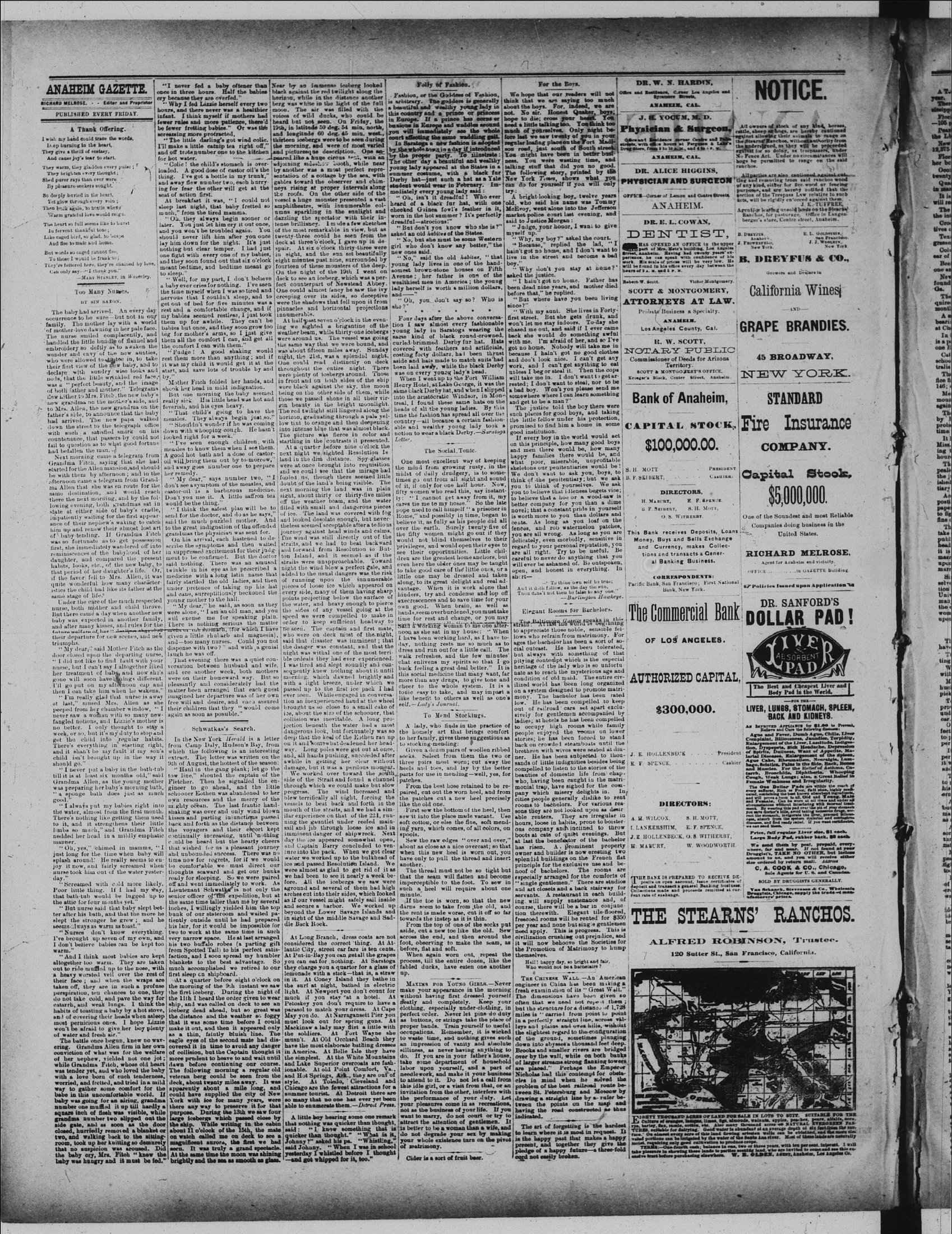
Searchable text
ANAHEIM GAZETTE.
RICHARD MELROSE. - Editor and Proprietor
PUBLISHED EVERY FRIDAY.
A Thank Offering.
I wish my hand could trace the words,
Deep burning in the heart,
They give a thrill of ecstasy,
And cause joy's tear to start.
They warm, they gladden every pulse;
They brighten every thought;
Shed purer rays than ever were.
By pleasure-seekers sought.
So deeply buried in the heart,
Yet glow through every vein;
Then back again, to tremble when
Warm grateful love would reign.
The heart so full seems like to burst
In fervent thankful tone;
Like caged bird, so glad, to escape
And flee to mate and home.
But words so caged cannot flee,
To those I would be frank to;
They're fettered here, they're chained by love,
Can only say—"I thank you."
MARY STANLEY, in Waverley.
Too Many Nurses.
BY SIN BAXON.
The baby had arrived. An everyday occurrence to be sure—but not in our family. The mother lay with a world of mother-love dawning in her pale face. The nurse smiled complacently, and handled the little bundle of flannel and embroidery so deftly as to awaken the wonder and envy of the new aunties, who were allowed to do too in, to take their first view of the new baby, and to declare with sundry wise looks and nods, that the little wrinkled red face, was a "perfect beauty," and the image of both father and mother." Telegrams flew hither to Mrs. Fitch, the new baby's new grandma on the mother's side, and to Mrs. Allen, the new grandma on the father's side, to announce that the baby had arrived. The new papa walked down the street to the telegraph office with such a satisfied smirk on his countenance, that passers-by could not fail to question as to what good fortune had befallen the man.
Next morning came a telegram from
"I never fed a baby oftener than once in three hours. Half the babies cry because they are overfed."
"Why I fed Lizzie herself every two hours, and there never was a healthier infant. I think myself if mothers had fewer rules and more patience, there'd be fewer fretting babies." Or was the screaming more protracted,
"The little darling's got wind colic. I'll make a little catnip tea right off," and off trots number one to the kitchen for hot water.
"Colic! the child's stomach is overloaded. A good dose of castor oil's the thing. I've got a bottle in my trunk," and away flew number two, each hurrying for fear the other will get at the seat of action first.
At breakfast it was, "I could not sleep last night, that baby fretted so much," from the tired mamma.
"Oh, they always begin sooner or later. You just let him cry it out once, and you won't be troubled again. You should never lift him after you once lay him down for the night: It's just nothing but clear temper. I had just one fight with every one of my babies, and they soon found out that six o'clock meant bedtime, and bedtime meant go to sleep."
"Well, for my part, I don't believe a baby ever cries for nothing. I've seen the time myself when I was so tired and nervous that I couldn't sleep, and to get out of bed for five minutes was a rest and a comfortable change, and if my babies seemed restless, I just took them up for awhile. They can't be babies but once, and they soon grow too big for mother's arms, so I just give them all the comfort I can, and get all the comfort I can with them."
"Fudge! A good shaking would rest them more than anything; and if it was my child it would get it at the start, and save lots of trouble by and by."
Mother Fitch folded her hands, and shook her head in mild indignation.
But one morning the baby seemed really sick. His little head was hot and feverish, and his eyes heavy.
"That child's going to have the measles. They always begin just so."
"Shouldn't wonder if he was coming down with whooping cough. He hasn't looked right for a week."
I've seen enough children, with measles to know them when I see them. A good hot bath and a dose of castor oil bring them out by to-morrow."
Near by an immense iceberg black against the red twilight horizon, while in the distance berg was white in the light of moon. The air was filled with voices of wild ducks, who heard but not seen. On Friday 19th, in latitude 59 deg. 54 m and longitude 60 deg. 45 m thirteen icebergs were to be seen the morning, and were of me and picturesque description peared like a huge circus tent adjoining sideshow booth, wily by another was a most perfec tionation of a cottage by the gables toward the observer neys rising at proper inter se roofs. On the other s e vessel a huge monster present amphitheatre, with innumerable numbs sparkling in the sun dazzling the spectator with tense brilliancy. I made a fe ef of the most remarkable in vi e twenty-three could be seen deck at three o'clock, I gave spair. At six o'clock thirty in sight, and the sun set eight minutes past nine, surre fourteen of these monsters on On the night of the 19th deck to see an iceberg, which fact counterpart of Newsteel One could almost fancy he be creeping over its sides, so were the shadows that fell up pinnacles and horizontal innumerable.
At half past seven o'clock ing we sighted a brigant weather beam, while thirty-o' were around us. The vessel she same way that we were was about fifteen miles away night, the 21st, was a splend One could read distinctly throughout the entire ni were plenty of icebergs arow in front and on both sides were black against the sky being on the other side of those we passed shone in a gun beauty in the bright The red twilight still linger horizon, graduating through low tint to orange and then into intense blue that was a The picture was fierce in startling in the contrasts i
At a quarter before nine next night we sighted Red land in the dim distance.
their first view of the new baby, and to declare with sundry wise looks and nods, that the little wrinkled red face, was a "perfect beauty, and the image of both father and mother." Telegrams flew hither to Mrs. Fitch, the new baby's new grandma on the mother's side, and to Mrs. Allen, the new grandma on the father's side, to announce that the baby had arrived. The new papa walked down the street to the telegraph office with such a satisfied smirk on his countenance, that passers by could not fail to question as to what good fortune had befallen the man.
Next morning came a telegram from Grandma Fitch, saying that she had started for the Allen mansion, and should be with them by afternoon; and in the afternoon came a telegram from Grandma Allen that she was en route for the same destination, and would reach there the next morning, and by the following evening, both grandmas sat in state at either side of baby's cradle, impatiently waiting for the first appearance of their nephew's waking to catch him up and renew their almost lost art of baby tending. If Grandma Fitch was so fortunate as to get possession first, she immediately wandered off into reminiscences of the babyhood of her daughter, and compared the present habits, looks, etc., of the new baby, to that period of her daughter's life. Or, if the favor fell to Mrs. Allen, it was quite wonderful how many characteristics the child had like its father at the same stage of life.
Under the care of the much respected nurse, both mother and child throve. But there came a day when another new baby was expected in another family, and after many kisses, and rules for the future waltrace of her "dealies that soon their departure for new scenes, and new triumphs."
"My dear," said Mother Fitch as the door closed upon the departing nurse, "I did not like to find fault with your nurse, but I can't say I altogether liked her treatment of baby, and now she's gone will soon have things different. I'll go put on my afternoon cap and then I can take him when he wakens."
"I'm really glad that nurse is away at last," mused Mrs. Allen as she peeped from her chamber window, "I never saw a woman with so many new-fangled notions, and Lizzie's mother is no better. I only thought to stay a week, or so, but it's my duty to stop and get the child into regular habits. There's everything in starting right, and it shan't be my fault if my son's child isn't brought up in the way it should go."
"I never put a baby in the bath-tub till it is at least six months old," said Grandma Allen, as the young mother was preparing her baby's morning bath, "a sponge bath does just as much good."
"I always put my babies right into the water, almost from the first month. There's nothing like getting them used to it, and it strengthens their little limbs so much," and Grandma Fitch nodded her head in a mildly emphatic manner.
"Oh, yes," chimed in mamma, "I just long for the time when baby will splash around! He really seems to enjoy it now, and fairly screamed when nature took him out of the water yesterday."
It was my child it would get it at the start, and save lots of trouble by and by."
Mother Fitch folded her hands, and shook her head in mild indignation.
But one morning the baby seemed really sick. His little head was hot and feverish, and his eyes heavy.
"That child's going to have the measles. They always begin just so."
"Shouldn't wonder if he was coming down with whooping cough. He hasn't looked right for a week."
"I've seen enough children, with measles to know them when I see them. A good hot bath and a dose of castor-oil will bring them out by to-morrow," and away goes number one to prepare her remedy.
"My dear," says number two, "I don't see a symptom of the measles, and castor-oil is a barbarous medicine. Don't you use it. A little saffron tea would be the thing."
"I think the safest plan will be to send for the doctor, and do as he says," said the much puzzled mother. And to the great indignation of the offended grandmother the physician was sent for.
On his arrival, each hastened to describe the symptoms and then waited in suppressed excitement for their judgment to be confirmed. But the doctor said nothing. There was an amused twinkle in his eye as he prescribed a medicine with a long latin name that fairly startled the old ladies, and then under pretence of taking up his hat and cane, surreptitiously beckoned the young mother to the hall.
"My dear," he said, as soon as they were alone, "I am an old man, and you will excuse me for speaking plain. There is nothing serious the matter more or less stomach, (for which I have given a little rhubarb and magnesia), and—too many nurses. Could you not dispense with two?" and with a genial laugh he was off.
That evening there was a quiet conversation between husband and wife, and ere another week, both mothers were on their homeward way. But so pleasantly and considerably had the matter arranged that each guest imagined her departure was of her own free will and desire, and each assured their children that they would come again as soon as possible."
Schwatkas's Search.
In the New York Herald is a letter from Camp Daly, Hudson's Bay, from which the following is an interesting extract. The letter was written on the 9th of August, the hottest of the season:
"Haul in the gang plank; let go the tow line," shouted the captain of the Fletcher. Then he signalled the engineer to go ahead, and the little schooner Eothen was abandoned to her own resources and the mercy of the mighty ocean. The last frantic hand-shaking was over and only wind blown kisses and parting injunctions passed back and forth as the distance between the voyagers and their escort kept continually increasing, until nothing could be heard but the hearty cheers that wished for us a pleasant journey and unbounded success. There was no time now for regrets, for if we would be comfortable we must direct our thoughts seaward and get our bunks
One could real distance throughout the entire night were plenty of icebergs arcing in front and on both sides were black against the sky being on the other side of those we passed shone in a gin beauty in the bright light. The red twilight still lingered horizon, graduating through low tint to orange and then into intense blue that was a picture was fierce in startling in the contrasts in At a quarter before nine next night we sighted Resolution in the dim distance were at once brought into and we could see that they fooled us, though there is doubt of the land's being next morning the land was sight, about thirty or thirtieth of the weather beam, and filled with small and dangling ice. The land was covey and looked desolate enough—theless seemed acceptable as journey against head wind. The wind was still direct straits, and we had to be forward from Resolution Island, and it seem straits were unapproachable night the wind blew a perk added to the usual dangers of running upon them pieces of loose ice which every side, many of them points projecting below this water, and heavy endure deep that keel of the land it and somewhat deaden way. Long poles were got and all hands pushing, so awhile in getting her damage, but it was a perk.
We worked over towards side of the Strait and four through which we could progress. The wind blew terrifically all night vessels to beat back and mouth of the straits, andilar experience on that owing the gauntlet under sail and jib through loot imminent danger of ship day die ice appeared soon Captain Barry conceive into the pack. When water we worked up to this ice and passed Resolution were almost as glad to go
till it is at least six months old," said Grandma Allen, as the young mother was preparing her baby's morning bath,
"a sponge bath does just as much good."
"I always put my babies right into the water, almost from the first month. There's nothing like getting them used to it, and it strengthens their little limbs so much," and Grandma Fitch nodded her head in a mildly emphatic manner.
"Oh, yes," chimed in mamma, "I just long for the time when baby will splash around. He really seems to enjoy it now, and fairly screamed when nurse took him out of the water yesterday."
"Screamed with cold more likely. Poor little thing. If I had my way, that bath-tub would be lugged up to the attic for four months yet."
But nurse said that baby slept better after his bath, and that the more he slept the stronger he grew; and he seems always as warm as toast."
Nurses don't know everything. I've brought up seven of my own, and I don't believe babies can be kept too warm."
And I think most babies are kept altogether too warm. They are taken out to ride muffled up to the nose, with a heavy worsted veil over the rest of their face; and when the wraps are taken off, they are in such a profuse perspiration, ten chances to one, they do not take cold, and pave the way for catarrh, and weak lungs. I think the habits of toasting a baby by a hot stove, and of covering their heads when asleep most pernicious ones. I hope Lizzie won't be afraid to give her boy plenty of water and fresh air."
The battle once begun, knew no wavering. Grandma Allen firm in her own conviction of what was for the welfare of her nephew, yielded not one jot; while Grandma Fitch, whose old heart was tender yet, and who loved the baby with a love born of such tenderness, worried, and fretted, and tried in a mild way to gather some comfort for the babe in this uncomfortable world. If baby was going for an airing, grandma number one muffled it up till hardly a square inch of flesh was visible, while grandma number two slipped out the side gate, and as soon as the door closed, hurriedly removed a blanket or two, and walking back to the sitting-room, took up her knitting so demurely that no suspicion was aroused. Did the baby cry, Mrs. Fitch "knew the baby was hungry and it must be fed." shouted the captain of the Pletcher. Then he signalled the engineer to go ahead, and the little schooner Eothen was abandoned to her own resources and the mercy of the mighty ocean. The last frantic hand-shaking was over and only wind blown kisses and parting innunctions passed back and forth as the distance between the voyagers and their escort kept continually increasing, until nothing could be heard but the hearty cheers that wished for us a pleasant journey and unbounded success. There was no time now for regrets, for if we would be comfortable we must direct our thoughts seaward and get our bunks ready for sleeping. So we were paired off and went immediately to work. As Lieutenant Schwatka is not only the senior officer of the expedition, but at the same time taller than me by several inches, I willingly yielded him the top bunk of our stateroom and waited patiently outside until he had prepared his lair, for it would be impossible for two to work at the same time in such very narrow space. He at last arranged his two buffalo robes (a parting gift from Spotted Tail) to his perfect satisfaction, and I soon spread my humbler blankets to the best advantage. So much accomplished we retired to our first sleep on shipboard.
At a quarter before eight o'clock on the morning of the 9th instant we saw the first iceberg. During the night of the 11th I heard the order given to wear ship, and was called on deck to see an iceberg dead ahead, but so great was the distance and the weather so foggy that it was some time before I could make it out, and then it appeared only as a thin, faintly bluish line. The eagle eyes of the second mate had discovered it in time to avoid any danger of collision, but the Captain thought it more prudent to heave to and wait until dawn before continuing our course. The following morning a regular old veteran berg could be seen from the deck, about twenty miles away. It was apparently about a mile long, and could have supplied the city of New York with ice for many years, where any way to preserve it for that purpose. During the 13th we saw four large icebergs which passed close by the ship. While writing in the cabin about 11 o'clock of the 15th, the mate on watch called me on deck to see a magnificent aurora, the first we had seen. It was truly a grand spectacle. At the same time the moon was shining brightly and the sea as smooth as glass.
We worked over town side of the Strait and found through which we could progress. The wind blew terrifically all night vessels to beat back and mouth of the straits, and illar experience on that owing the gauntlet under sail and jib through loo imminent danger of ship day the ice appeared soon and Captain Barry concure into the pack. When water we worked up to the ice and passed Resolution were almost as glad to go we had been to see it near fore. All the icebergs aground and several of the arches cut into their sides as if our vessel might safe and secure a harbor. We beyond the Lower Savage in sight of the middle Sand Back Rock.
At Long Branch, dress considered the correct lantie City, street car fare. At Put-in-Bay you can get you can eat for nothing; they charge you a quarter lemonade with a stick—thein it. At Coney Island the surf at night,bath light. At Newport you do much if you stay "at Petoskey you don't require parasol to match your dress May you do. At Narragansett look out for spri Mackinaw a lady may finishthe soldiers. At Fort musn't. At Old Orchard have the most elaborate boi in America. At Belle Isle the simplest. At The White Lake Superior over ionable. At old Point Gand Hot Springs, Ark.,the style. At Toledo,City Chicago are the fewest at summer tourist. At Detroit so many that no one has able to enumerate them—
A little boy hearing son that nothing was quicker said: "I know some quicker than thought." Johnny?" asked his pa-said Johnny. "When I yesterday I whistled before—and got whipped for it—
A year by an immense iceberg looked back against the red twilight along the horizon, while in the distance another berg was white in the light of the full moon. The air was filled with the pieces of wild ducks, who could be heard but not seen. On Friday, the 12th, in latitude 59 deg. 54 min. north, and longitude 60 deg. 45 min. west, thirteen icebergs were to be seen during the morning, and were of most varied and picturesque description. One appeared like a huge circus tent, with an joining sideshow booth, while near another was a most perfect representation of a cottage by the sea, with tables toward the observer and chimneys rising at proper intervals along the roofs. On the other side of the vessel a huge monster presented a vast amphitheatre, with innumerable columns sparkling in the sunlight andazzling the spectator with their intense brilliance. I made a few sketches of the most remarkable in view, but as twenty-three could be seen from the deck at three o'clock, I gave up in depair. At six o'clock thirty-three were in sight, and the sun set beautifully eight minutes past nine, surrounded by fourteen of these monsters of the deep. On the night of the 19th I went on deck to see an iceberg, which was a perfect counterpart of Newstead Abbey. One could almost fancy he saw the ivy creeping over its sides, so deceptive were the shadows that fell upon it from pinnacles and horizontal projections annumerable.
At half past seven o'clock in the evening we sighted a brigantine off the weather beam, while thirty-one icebergs were around us. The vessel was going the same way that we were bound, and was about fifteen miles away. Sunday night, the 21st, was a splendid night. One could read distinctly on deck throughout the entire night. There were plenty of icebergs around. Those in front and on both sides of the ship were black against the sky, the moon being on the other side of them, while those we passed shone in all their virgin beauty in the bright moonlight. The red twilight still lingered along the horizon, graduating through a pale yellow tint to orange and then deepening into intense blue that was almost black. The picture was fierce in color and startling in the contrasts it presented.
At a quarter before nine o'clock the next night we sighted Resolution Is land in the dim distance. Spy-glasses
Folly of Fashion.
Fashion, or the Goddess of Fashion, is arbitrary. The goddess is generally a beautiful and wealthy young lady in this country and a prince or princess in Europe. If a prince has corn or banions in Europe and waddles around you will immediately see the whole court affecting the same waddling gait.
In Saratoga a new fashion is adopted by the whole town in a day if introduced by the proper party. To illustrate: The other day a beautiful and wealthy young lady appeared at the States in a summer costume, with a black fur Derby hat—just such a hat as a Yale student would wear in February. Immediately every young lady said:
"Oh, isn't it dreadful! Who ever heard of a black fur hat, with one checked Guinea fowl's feather in it, worn in the hot summer? It's perfectly dreadful—atrocious!"
"But don't you know who she is?" asked an old habitue of the States.
"No, but she must be some Western girl who don't know any better," the new ones said.
"No," said the old habitue, "that young lady lives in one of the handsomest brown-stone houses on Fifth Avenue; her father is one of the wealthiest men in America; the young lady herself is worth a million dollars, and——"
"Oh, you don't say so? Who is she?"
Four days after the above conversation I saw almost every fashionable young lady in Saratoga wearing the same kind of black round-crowned, curled-brimmed Derby fur hat. Hats covered with feathers and artificials, costing forty dollars, had been thrust aside and hats made to match suits had been laid away, while the black Derby was on every young lady's head.
When I went up to the Fort William Henry Hotel, at Lake George, it was the same black Derby hat, and when I slipped into the aristocratic Windsor, in Montreal, I found these same hats on the heads of all the young ladies. By this time the fashion has spread all over the country—all because a certain fashionable and wealthy young lady took a notion to wear a black Derby.—Saratoga Letter.
For the Boys.
We hope that our readers will not think that we are saying too much about the boys. For indeed, we are not. No air. Honest Quaker, boys; hope to die; cross your heart. You need a little talking too. You think too much of yourselves. Only night before last we saw twenty of you in your regular loafing place on the Fort Madison road, just south of South street. You might have been in better business. You were wasting time, and talking stuff that did you no good. The following story, printed by the New York Times, shows what you can do for yourself if you will only try:
A bright-looking boy, twelve years old, who said his name was Tommy McEvoy, went alone into the Jefferson market police court last evening, and said to Justice Morgan:
"Judge, your honor, I want to give myself up."
"Why, my boy?" asked the court.
"Because," replied the lad, "I hain't got no home, and I don't want to live in the street and become a bad boy."
"Why don't you stay at home?" asked the justice.
"I hain't got no home. Father has been dead nine years, and mother died before that," he replied.
"But where have you been living since?"
With my aunt. She lives in Fort-first street. But she gets drunk, and won't let me stay indoors. To-day she ebased me out, and said if I ever came back she would do something awful with me. I'm afraid of her, and so I've got no home. Nobody will take me in because I hain't got no good clothes and don't look nice. I can't get any work, and I can't get anything to eat unless I beg or steal it. Then the cops will take me in. I don't want to get arrested; I don't want to steal, nor to be a bad boy. Won't you please send me somewhere where I can learn something and get to be a man?"
The justice told the boy there were such places for good boys, and taking the little fellow under his protection, promised to find him a home in some good institution.
If every boy in the world would act on this principle, how many good boys and men there would be, how many happy families there would be, and
One could read distinctly on deck throughout the entire night. There were plenty of icebergs around. Those in front and on both sides of the ship were black against the sky, the moon being on the other side of them, while those we passed shone in all their virgin beauty in the bright moonlight. The red twilight still lingered along the horizon, graduating through a pale yellow tint to orange and then deepening into intense blue that was almost black. The picture was fierce in color and startling in the contrasts it presented.
At a quarter before nine o'clock the next night we sighted Resolution Is land in the dim distance. Spy glasses were at once brought into requisition and we could see that the mirage had fooled us, though there seemed little doubt of the land's being visible. The next morning the land was in plain sight, about thirty or thirty-five miles off the weather beam, and the water filled with small and dangerous pieces of ice. The land was covered with fog and looked desolate enough, but nevertheless seemed acceptable after a tedious journey against head winds and calms. The wind was still directly out of the straits, and we had to beat backward and forward from Resolution to Button Island, and it seemed as if the straits were unapproachable. Toward night the wind blew a perfect gale, and added to the usual dangers was the risk of running upon the innumerable pieces of loose ice which appeared on every side, many of them having sharp points projecting below the surface of the water, and heavy enough to pierce the sides of any vessel going at the speed we were compelled to make in order to keep sufficient headway to be seen. The captain and first mate, who were on deck most of the night, said that disaster was imminent; that the danger was constant, and that the night was withal one of the most terrible ordeals they had ever experienced. I was tired and slept soundly and consequently knew nothing about it until morning, which dawned brightly and with a light breeze, under which we passed up to the first ice pack I had ever seen. While engaged in conversation an inexperienced hand at the wheel brought us so close to a small cake of ice, about the size of the schooner, that collision was inevitable. A long projection beneath the water had a most dangerous look, but fortunately was so deep that the keel of the Eutheen up on it and somewhat deadened her headway. Long poles were got out at once, and all hands pushing, succeeded after awhile in getting her clear without damage, but it was a perilous moment.
We worked over toward the south side of the Strait and found a channel through which we could make but slow progress. The wind increased and blew terrifically all night, forcing the vessels to beat back and forth in the mouth of the straits, and we had a similar experience on that of the 221, running the gauntlet under reefed mainsail and jib through loose ice and in imminent danger of shipwreck. Next day the ice appeared somewhat open, and Captain Barry concluded to venture into the pack. When we got clear water we worked up to the bulkhead of ice and passed Resolution Island. We were almost as glad to get rid of it as been laid away, while the black Derby was on every young lady's head.
When I went up to the Fort William Henry Hotel, at Lake George, it was the same black Derby hat, and when I slipped into the aristocratic Windsor, in Montreal, I found these same hats on the heads of all the young ladies. By this time the fashion has spread all over the country—all because a certain fashionable and wealthy young lady took a notion to wear a black Derby.—Saratoga Letter.
The Social Tonic.
One most excellent way of keeping the mind from growing rusty, in the midst of daily drudgery, is to sometimes go out from all sight and sound of it, if only for one half hour. Now, fifty women who read this, say instantly: "I cannot get away from it, my cares tie me to my home." So the late pope used to call himself "a prisoner in Rome," and possibly in time, began to believe it, as fully as his people did all over the earth. Surely twenty-five of the fifty women might go out if they would not blind themselves to their privileges, and would open their eyes to see their opportunities. Little children are the greatest home anchors, but even here the older ones may be taught to take good care of the little ones, or a little one may be dressed and taken along, to its great delight and real advantage. When it is work alone that hinders, try and condense and loop off excrescences and to save time for your own good. When brain, as well as hands, seem overburdened, you must take time for rest and change, or you may said & working woman to me one afternoon as she sat in my house: "When I have been working hard, as I have today, nothing rests me so much as to dress and run out for a little call. The walk refreshes, and the few minutes chat enliven my spirits so that I go back feeling a great deal better." It is this social medicine that many want, far more than any drugs, to give tone and cheer to the whole system. It is a tonic easy to take, and may impart a like benefit to others as well as one's self.—Lady's Journal.
To Mend Stockings.
A lady, who finds in the practice of the homely art that brings comfort to her family, gives these suggestions as to stocking-mending:
Given a dozen pairs of woollen ribbed socks. Select from them the two or three pairs most worn; cut away the heels and toes, and lay by the better parts for use in mending—well, yes, for patches.
From the best hose retained to be repaired, cut out the worn heel, and from the patches cut a new heel precisely like the old one.
First sew the bottom of the heel, then sew it into the place made vacant. Use soft cotton, or else fine, soft mending yarn, which comes, of all colors, on spools.
Sew the raw edges "over and over," about as close as a nice overcast; so that when this new heel is worn out, you have only to pull the thread and insert another.
The thread must not be so tight but work, and I can't get anything to eat unless I beg or steal it. Then the cops will take me in. I don't want to get arrested; I don't want to steal, nor to be a bad boy. Won't you please send me somewhere where I can learn something and get to be a man?
The justice told the boy there were such places for good boys, and taking the little fellow under his protection, promised to find him a home in some good institution.
If every boy in the world would act on this principle, how many good boys and men there would be, how many happy families there would be, and what poor, miserable, unprofitable skeletons our penitentiaries would be! We don't want to ask you, boys, to think of-the-penitentiary; but we ask you to think of yourselves. We ask you to believe that idleness begets vice; to believe that a hoe or a wood-saw is better company for you than a dime novel; that a constant pride in yourself is worth more to you than dollars and cents. As long as you are delicately, even morbidly, sensitive in regard to your personal reputation, you are all right. Try to be useful. Be careful to never do anything that you will ever be ashamed of. Be outspoken, open, and honest in everything. In short—
To thine own self be true;
And it doth follow, as the day the sun,
Thou cann't not then be false to any one."
—Burlington Hawkeye.
Elegant Rooms for Bachelors.
The Baltimore Gazette speaks in this strain: At last the world is beginning to appreciate those noble, sensible fellows who refrain from matrimony. For ages the bachelor has been a sort of social outcast. He has been tolerated, but always with something of that pitying contempt which is the especial heritage of the lady who is so unfortunate as to reach the mysterious age and condition of old maid. The entire civilized world has been long organized on a system designed to promote matrimony. The bachelor has been rated low. He has been compelled to keep out of railroad cars set apart exclusively for gentlemen accompanied by ladies; at hotels he has been compelled to occupy high rooms while family people enjoyed the rooms on lower stories; he has been forced to stand back on crowded steamboats until the brethren with wives were seated at dinner. He has been subjected to thousands of little indignities besides being compelled to listen to the stories of the beauties of domestic life from chaphe who, having been caught in the matrimonial trap, have sighed for the company which misery delights in. In cities people generally dislike rent rooms to bachelors. For various reasons they are not looked upon as desirable renters. They are irregular in hours, loose in habits, prone to boisterous company and incarned to throw boots at cats of quiet evenings. But at last the benefactor of the bachelor has risen. A prominent property owner and builder is now erecting two splendid buildings on the French flat principle for the exclusive use and behoof of bachelors. The rooms are
We worked over toward the south side of the Strait and found a channel through which we could make but slow progress. The wind increased and blew terrifically all night, forcing the vessels to beat back and forth in the mouth of the straits, and we had a similar experience on that of the 221, running the gauntlet under reefed mainsail and jib through loose ice and in imminent danger of shipwreck. Next day the ice appeared somewhat open, and Captain Barry concluded to venture into the pack. When we got clear water we worked up to the bulkhead of ice and passed Resolution Island. We were almost as glad to get rid of it as we had been to see it nearly a week before. All the icebergs we saw were aground and several of them had high arches cut into their sides, which looked as if our vessel might safely sail inside and secure a harbor. We worked up beyond the Lower Savage Islands and in sight of the middle Savage and Saddle Back Rock.
At Long Branch, dress coats are not considered the correct thing. At Atlantic City, street car fare is ten cents. At Put-in-Bay you can get all the grapes you can eat for nothing. At Saratoga they charge you a quarter for a glass of lemonade with a stick—that is, a straw in it. At Coney Island they bathe in the surf at night, bathed in electric light. At Newport you don't count for much if you stay at a hotel. At Petoskey you don't require to have a parasol to match your dress. At Cape May you do. At Narragansett Pier you must look out for spring guns. At Mackinaw a lady may flirt a little with the soldiers. At Fort Wayne she mustn't. At Old Orchard Beach they have the most elaborate bathing dresses in America. At Belle Isle they have the simplest. At the White Mountains and Lake Superior overcoats are fashionable. At old Point Comfort, Va., and Hot Springs, Ark., they are out of style. At Toledo, Cleveland and Chicago are the fewest attractions for a summer tourist. At Detroit there are so many that no one has ever yet been able to enumerate them.—Detroit Press.
A little boy hearing some one remark that nothing was quicker than thought, said: "I know something that is quicker than thought." "What is it, Johnny?" asked his pa. "Whistling," said Johnny. "When I was in school yesterday I whistled before I thought—and got whipped for it, too."
From the best hose retained to be repaired, cut out the worn heel, and from the patches cut a new heel precisely like the old one.
First sew the bottom of the heel, then sew it into the place made vacant. Use soft cotton, or else the fine, soft mending yarn, which comes, of all colors, on spools.
Sew the raw edges "over and over," about as close as a nice overcast; so that when this new heel is worn out, you have only to pull the thread and insert another.
The thread must not be so tight but that the seam will flatten and become imperceptible to the foot. To sew in such a heel will require about one minute.
If the toe is worn, so that the new darns seem to take from the old, and the rent is made worse, cut it off so far towards the instep as it is thin.
From the top of one of the socks put aside, cut a new toe like the old. Sew across the end, and then around the foot, observing to make the seam, as before, flat and soft.
When again worn out, repeat the process, till the entire dozen, like the fabled ducks, have eaten one another up.
Maxims for Young Girls.—Never make your appearance in the morning without having first dressed yourself neatly and completely. Keep your clothing, especially under-clothing, in perfect order. Never let pins do duty as buttons, or strings take the place of proper bands. Train yourself to useful occupations. Remember, it is wicked to waste time, and nothing gives such an impression of vanity and absoluteilliness, as never having anything to do. If you are in your father's house, take some department of household labor upon yourself, and a part of needlework, and make it your business to attend to it. Do not let a call from this idle girl, or a visit from that, or an invitation from the other, interfere with the performance of your duty. Let your pleasures come in as recreations, not as the business of your life. If you want to marry, do not court or try to attract the attention of gentlemen. It is better to be a woman than a wife, and do not degrade your sex by making your whole existence turn on the pivot of matrimony.
Cider is a sort of fruit bear.
The Chinese Wall.—An American engineer in China has been making a fresh examination of its "Great Wall." The dimensions have been given so often that we need not repeat them; but the structure for a distance of 1,728 miles is "carried" from point to point in perfectly straight line, across valleys and plains and over hills, without the slightest regard to the configuration of the ground, sometimes plunging down into abysses a thousand feet deep. Brooks and smaller rivers are bridged over by the wall, while on both banks of larger streams strong flanking towers are placed." Perhaps the Emperor Nicholas had this contempt for obstacles in mind when he solved the problem of the best railroad route between St. Petersburg and Moscow by drawing a straight line by a ruler between the points on the map and having the road constructed as thus indicated.
The art of forgetting is the hardest to learn where it is most in request. It is the happy past that makes a happy present, and together they give the pledge of a happy future—a three-fold cord not easily broken.
DR. W. N. HARDIN,
Office and Residence, Corner Los Angeles and Sycamore Streets,
ANAHEIM, CAL.
J. H. YOCUM, M. D.
Physician & Surgeon,
Office and Residence corner Centre and Palm streets, with office hours at Pergamon & Lake's Drug Store, from 9 to 10 A.M., and 4 to 5 P.M.
ANAHEIM, CAL.
DR. ALICE HIGGINS,
PHYSICIAN AND SURGEON
OFFICE—Corner of Lemon and Centre Streets,
ANAHEIM.
DR. E. L. COWAN,
DENTIST,
HAS OPENED AN OFFICE in the upper part of Mrs. Metta's building, Los Angeles Street, Anaheim. Having had twenty years' experience, he can speak with confidence of his work. His scale of prices will be very low. He will be found in his office every day between the hours of 9 A.M. and 5 P.M.
Roberts W. Scott. Victor Montgomery.
SCOTT & MONTGOMERY, ATTORNEYS AT LAW.
Probate Business a Specialty.
ANAHEIM.
Los Angeles County, Cal.
R. W. SCOTT,
NOTARY PUBLIC
Commissioner of Deeds for Arizona Territory.
SCOTT & MONTGOMERY'S OFFICE, Kroeger's Block, Center Street, Anaheim.
Bank of Anaheim,
CAPITAL STOCK,
$100,000.00.
NOTICE.
All owners of stock of any kind, horses, cattle, sheep or hogs, are hereby cautioned against allowing their animals to range on the Stearns' Ranchos without authority from the undersigned, as they will be proceeded against for so doing, as trespassers, under No Fence Act. Under no circumstances will hogs be permitted to range on the said ranchos.
All parties are also cautioned against cutting and removing from said ranchos wood of any kind, either for firewood or fencing purposes, and are hereby notified that the section of the Trespass Law relative to such acts, will be rigidly enforced against them.
Agent for leasing unsold lands on the Stearns' Ranchos, for pasturage. Office in Langenberger's store, Centre street, Anaheim.
B. DREYFUS & CO.,
Growers and Dealers in
California Wines
AND
GRAPE BRANDIES.
45 BROADWAY,
NEW YORK.
STANDARD
Fire Insurance COMPANY.
Territory.
SCOTT & MONTGOMERY'S OFFICE.
Kroeger's Block, Center Street, Anaheim.
Bank of Anaheim,
CAPITAL STOCK,
$100,000.00.
S. H. MOTT
PRESIDENT
B. F. SEIBERT,
CASHIER:
DIRECTORS.
H. MABURY,
E. F. SPENCE.
B. F. SEIBERT,
S. H. MOTT,
O. S. WITHERBY.
This Bank receives Deposits, Loans Money, Buys and Sells Exchange and Currency, makes Collections and transacts a General Banking Business.
CORRESPONDENTS:
Pacific Bank, San Francisco; First National Bank, New York.
The Commercial Bank
OF LOS ANGELES.
AUTHORIZED CAPITAL,
$300,000.
J. E. HOLLENBECK
President
E. F. SPENCE,
Cashier
DIRECTORS:
A. H. WILCOX,
S. H. MOTT,
I. LANKERSHIM,
E. F. SPENCE,
J. E. HOLLENBECK, O. S. WITHERBY,
H. MABURY,
W. WOODWORTH.
NEW YORK.
STANDARD
Fire Insurance COMPANY.
Capital Stock,
$5,000,000.
One of the Soundest and most Reliable Companies doing business in the United States.
RICHARD MELROSE,
Agent for Anaheim and vicinity.
OFFICE...in GAZETTE Building
SP Policies Issued upon Application No.
DR. SANFORD'S
DOLLAR PAD!
LIVER
ABSORBENT
PAD
The Best and Cheapest Liver and Body Pad in the World.
FOR THE
LIVER, LUNGS, STOMACH, SPLEEN, BACK AND KIDNEYS.
An Improved Appliance for $1.00 to Prevent Kelley and Cure the following diseases:
Ague and Fever, Dumb Ague, Chills, Liver Complaint, Billiousness, Jaundice, Tendidity, Enlargement of the Liver, Lasthunde, Indigestion, Dyspepeta, Sick Headache, Depression of Spirits, Dulcisers, Want of Appetite, Material Diseases, Enlargement of the spleen, Ague, Cake, Rheumatism, Neuralgia, Lumbargesis, Satatica, Pains in the Side, Back, Hones and Muscles. For the Relief of Asthma, Catarrh, Bronchitis, Diphtheria, Whopping Cough, Weak Lungs; also, a Great Relief in Female Weariness and Irregularity.
The One Dollar Pads are within the reach of every sufferer, Rich or Poor, full size, highly medicated, containing the best known absorbent ingredients, and will prove a boon to all Old and Young. Masses and Females. Can be worn at all times and under all circumstances without interfering with internal treatment. By wearing this pad over the pit of your stomach you save doctor's bills, avoid taking numerous drugs, correct the stomach, invigorate the liver, prevent follow-ups, absolete from the system; material and contagious diseases; and find ready relief. If you want certificates, we can send them.
Price: full regular Liver size, $1 each.
Large Body Pad, rubber back, $2 each.
We send them by post, prepaid everywhere, far and near. If not found at your Drugstreet's TAKE NO OTHER, but include amount to us, and you will receive either size ordered by return mail.
C. A. COOK & CO., Chicago.
DIRECTORS:
A. H. WILCOX, S. H. MOTT,
I. LANKERSHIM, E. F. SPENCE,
J. Z. HOLLENBECK, O. S. WITHERBY,
H. MABURY, W. WOODWORTH.
THE BANK IS PREPARED TO RECEIVE DEPOSITS ON OPEN ACCOUNT, ISSUE CERTIFICATES OF DEPOSIT AND TRANSACT A GENERAL BANKING BUSINESS. Collections made and proceeds remitted at current rate of exchange.
THE STEARNS' RANCHOS.
ALFRED ROBINSON, Trustee.
120 Sutter St., San Francisco, California.
EIGHTY THOUSAND ACRES OF LAND FOR SALE IN LOTS TO SUIT. SUITABLE FOR THE Culture of oranges, lemons, limes, figs, almonds, walnuts, apples, peaches, pears, alfalfa, corn, rye, barley, flax, ramie, cotton, etc. Also many thousand acres we NATURAL EVERGREEN FARMERS, suitable for drying. Good water is abundant at an average depth of six feet from the surface." On almost every acre of this land flowing artesian wells can be obtained, and the more elevated portions can be irrigated by the water of the Santa Ana river. Most of these lands are naturally moist, requiring only good cultivation to produce crops.
TERMS: One-fourth cash; balance in one, two or three years, with ten per cent interest. I will take pleasure in showing these lands to parties seeking land, who are invited to come and see this extensive tract before purchasing elsewhere. W. H. OLDEN, Adeny, Anahaim, Los Angeles Co.