anaheim-gazette 1879-10-03
Scanned page
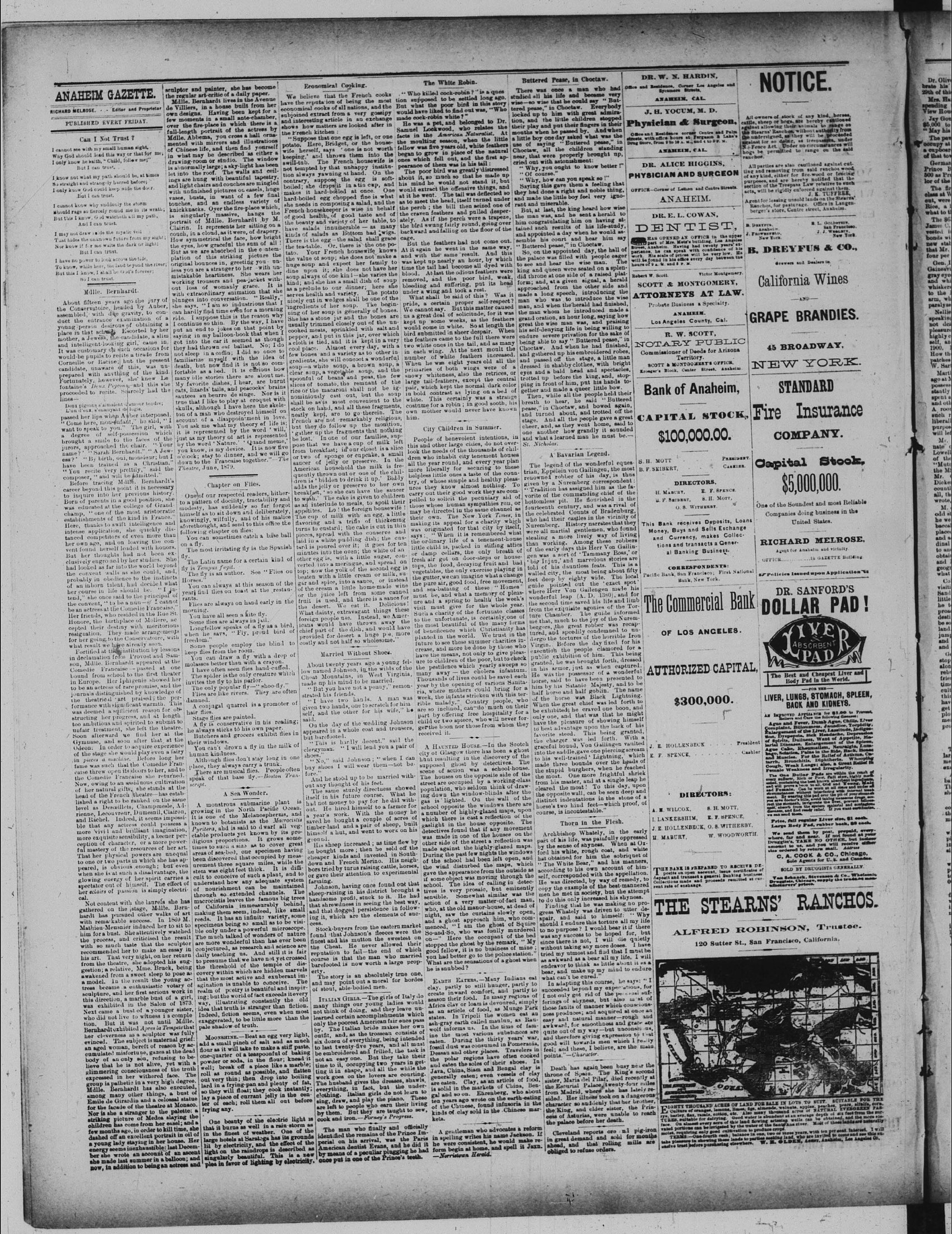
Searchable text
ANAHEIM GAZETTE.
RICHARD MELROSE. . . Editor and Proprietor
PUBLISHED EVERY FRIDAY.
Can I Not Trust?
I cannot see with my small human sight,
Why God should lead this way or that for me;
I only know he saith, "Child, follow me;"
But I can trust.
I know not what my path should be, at times
No straight and strangely barred before;
I only know God could keep wide the door.
But I can trust.
I cannot know why suddenly the storm
should rags so fiercely round me in its wrath;
But this I know, God watcheth all my path,
And I can trust.
I may not draw aside the myatic veil
That hides the unknown future from my sight;
Nor know if for me waits the dark or light;
But I can trust.
I have no power to look across the tide,
To know, while here, the land beyond the river;
But this I know, I shall be God's forever;
So I can trust.
Mdlle. Bernhardt.
About fifteen years ago the jury of
the Conservatoire, headed by Anber,
assembled, with due gravity, to conduct
the entrance examination of a young person desirous of obtaining a place in that school.
Escorted by her mother, a Jewess, the candidate, a slim and intelligent-looking girl, came in.
It was customary on such occasions for would-be pupils to recite a trade from Corneille or Racine; but the present candidate, unaware of this, was unprepared with anything of the kind.
Fortunately, however, she knew Le fontaine's Deux Pigeons—and this she proceeded to recite. Scarcely had the lines—
Deux pigeons à aimant d'amour tendre;
L'un d'eux s'enauyant de logis,
passed her lips when Anber interposed.
"Come here, mon-enfant," he said, "I want to speak to you." The girl, with a degree of self-possession which brought a smile to the faces of the jurors, approached the chair. "Your name?" "Sarah Bernhardt." "A Jewess?" "By birth, out, monsieur; but I sculptor and painter, she has become the regular art-critic of a daily paper.
Mdlle. Bernhardt lives in the Avenue de Villiers, in a house built from her own designs. Having been kept for a few moments in a small ante-chamber, over the fire-place in which there is a full-length portrait of the actress by Mdlle. Abbema, you cross a hall ornamented with mirrors and illustrations of Chinese life, and then find yourself in what may be described as either a drawing-room or studio. The window is normally large; a sky-light has been let into the roof. The walls and ceilings are hung with beautiful tapestry, and light chairs and couches are mingled with unfinished pictures on easels, huge vases, busts, in want of a few final touches, and an endless variety of knickknacks. Over the fire-place which is singularly massive, hangs the portrait of Mdlle. Bernhardt by M. Clairin. It represents her sitting on a couch, in a cloud, as it were, of drapery. How symmetrical the face, how bright the eyes, how graceful the sum of all! But as we are absorbed in the contemplation of this striking picture the original bounces in, greeting you unless you are a stranger to her with unmistakable heartiness. She wears her working trousers and pea-jacket without loss of womanly grace. It is with extraordinary animation that she plunges into conversation. "Really," she says, "I am so industrious that I can hardly find time even for a morning ride. I suppose this is the reason why I continue so thin. By the way, I have put an end to jokes on that point by saying in my balloon-book that when I got into the car it seemed as though they had thrown out ballast. No; I do not sleep in a coffin; I did so once to familiarize myself with the idea of death, but now find it is not so comfortable as a bed. It is curious how many idle stories there are about me. My favorite dishes, I hear, are burnt cats, lizards' tails, and peacocks' brains sautees an beurre de singe. Nor is it true that I like to play at croquet with skulls, although I have here the skeleton of a man who destroyed himself on account of a disappointment in love. You ask me what theory of life is; it is represented by the word 'will,' just as my theory of art is represented by the word 'Nature.' Quand meme, you know, is my device. It is now five o'clock; stay to dinner, and we will go economical Cooke.
We believe that the French have the reputation of being economical cooks of all nations subjoined extract from a vast and interesting article in shows how matters are located in the French kitchen:
"Suppose that one egg is potato. Here, Bridget, our wife herself, says 'one keeping,' and throws the swill-tub. The French not tempted by that unnatural always yawning at his contrary, suppose the boiled; she drops it in a makes it hard-boiled at hard-boiled egg chopped; she needs in composing an French housekeeper is wise of good health of good taste; she beauty and variety of have salads innumerable kinds of salads as Bottle There is the egg—the salt tea-table. Or, there is tartato. Your French honour the value of soup; she demeasures soup and expects dine upon it; she does soup always of one kin-kind; and she has a small as a prelude to our dinner serves health and variety nicely cut in welges shades ingredients of her soup ning of her soup is genie She has a stone jar and usually trimmed closely cooked meats, sprinkled pepper, and put in this cloth is tied, and it is cool place. Almost every few bones and a variety gradients, she will concen soup—a white soup, a clear soup, a vegetable spoonful of beans and slices of tomato, the rice or the macaroni shannoniously cast out shall be as is most common stock on hand, and all neatly kept, are to go French are not remarkable but they do follow up gather up the fragment be lost. In one of our pose that we have a copy from breakfast; if one or two of sponge or
Deux pigeons aiment l'amour tendre;
L'un d'eux a enouyait de logis,
passed her lips when Auger interposed.
"Come here, mon enfant," he said, "I want to speak to you." The girl, with a degree of self-possession which brought a smile to the faces of the jurors, approached the chair. "Your name?" "Sarah Bernhardt." "A Jewess?" "By birth, our monsieur; but I have been trained as a Christian."
"You recite very prettily," said the composer, "and will be admitted."
Before tracing Mdlie, Bernhardt's career beyond this point it is necessary to inquire into her previous history. Born of parents in a good position, she was educated at the college of Grand-champ, "one of the most aristocratic establishments of the kind in France." Here, thanks to swift intelligence and intense application, she quickly distanced competitors of even more than her own age, and on leaving the convent found herself loaded with honors. But her thoughts had not been exclusively engrossed by her studies. She had looked as far into the world beyond the convent walls as she could, and probably in obedience to the instincts of an inborn talent, had decided what her course in life should be. "I intend," she once said to the principal of the convent, "to be a nun—if I cannot be an actress at the Comedie Francaise." Her friends, who resided in the Rue St. Honore, the birthplace of Moliere, accepted their destiny with meritorious resignation. They made arrangements for her going to the Conservatoire, with what result we have already seen.
Fortified at the institution by lessons in declamation from Provost and Samson, Mdlie, Bernhardt appeared at the Comedie Francaise — passed at one bound from school to the first theater in Europe. Her Iphigenie showed her to be an actress of rare promise, and the journals distinguished by knowledge of the theatrical art praised the performance with significant warmth. This was deemed a sufficient reason for constructing her progress, and at length too ambitious and spirited to submit to unfair treatment, she left the theatre. Soon afterward we find her at the Gymnase, and soon after that, at the Odeon. In order to acquire experience of the stage she would play even a fairy in pieces a machine. Before long her fame was such that the Comedie Francaise threw open its doors to her, and to the Comedie Francaise she returned. Now, owing to an assiduous cultivation of her natural gifts, she stands at the head of the French theatre — has established a right to be ranked on the same level as Descaillets, Champmesle, Adrienne, Lecouvreur, Dumesnil, Clairon, and Rachel. Indeed, it seems impossible that any actress could possess a more vivid and brilliant imagination, more exquisite sensibility, a keener perception of character, or a more powerful mastery of the resources of her art. That her physical powers are unequal to one or two parts in which she has appeared, is obvious enough; but even death, but now find it is not so comfortable as a bed. It is curious how many idle stories there are about me. My favorite dishes, I hear, are burnt cats, lizards' tails, and peacocks' brains santee an beurre de singe. Nor is it true that I like to play at croquet with skulls, although I have here the skeleton of a man who destroyed himself on account of a disappointment in love. You ask me what my theory of life is; it is represented by the word 'will,' just as my theory of art is represented by the word 'Nature.' Quand meme, you know, is my device. It is now five o'clock; stay to dinner, and we will go down to the Francaise together." — The Theatre, June, 1879.
Chapter on Flies.
One of our respected readers, hitherto a pattern of docility, tractability and modesty, has suddenly so far forgot himself as to sit down and deliberately knowingly, wilfully, and of his malice aforethought, and send to this office the following chapter on flies:
You can sometimes catch a base ball on a fly.
The most irritating fly is the Spanish fly.
The Latin name for a certain kind of fly is Tempus fugit.
The fly is an author. See "Flies on Horses."
You can always at this season of the year find flies on toast at the restaurants.
Flies are always on hand early in the morning.
You have all seen a kite fly.
Some flies are always in jail.
Longfellow speaks of a fly as a bird, when he says, "Fly, proud bird of freedom."
Some people employ the blind to keep flies from the room.
You can draw a fly with a drop of molasses better than with a crayon.
I have often seen flies hand-cuffed.
The spider is the only creature which invites the fly to his parlor.
The only popular fly—"shoo-fly."
Flies are like rivers. They are often damned.
A conjugal quarrel is a promoter of hair flies.
Stage flies are painted.
A fly is conservative in his reading; he always sticks to his own paper.
Butchers and grocers exhibit flies in their windows.
You can't drown a fly in the milk of human kindness.
Although flies don't stay long in one place they always carry a trunk.
There are musical flies. People often speak of that base fly. — Boston Transcript.
A Sea Wonder.
A monstrous submarine plant is growing in the North Pacific Ocean. It is one of the Melanospheres, and known to botanists as the Macrocistis Pyritera, and is said to dwarf all vegetable products yet known by its prodigious proportions. It grows sometimes to such a size as to cover great areas of sea-beef; one specimen having been discovered that occupied by measurement three square miles, while the stem was eight feet thick. It is difficult out any thought of itself in his future had not money to out. He hired a year's work. saved he bought timber-land and himself a hut, and ground.
His sheep increb e bought more cheaper kinds and down and French bors tried by turn
Now, owing to an assiduous cultivation of her natural gifts, she stands at the head of the French theatre—has established a right to be ranked on the same level as Descaillets, Champmesle, Adrienne, Lecouvreur, Dumesnil, Clairon, and Richel. Indeed, it seems impossible that any actress could possess a more vivid and brilliant imagination, more exquisite sensibility, a keener perception of character, or a more powerful mastery of the resources of her art. That her physical powers are unequal to one or two parts in which she has appeared, is obvious enough; but even when she is at such a disadvantage, the glowing energy of her spirit carries a spectator out of himself. The effect of her eclairs of passion is simply electrical.
Not content with the laurels she has gathered on the stage, Mdille. Bernhardt has pursued other walks of art with remarkable success. In 1869 M. Mathieu-Meusnier induced her to sit to him for a bust. She attentively watched the process, and criticised the result with so much taste that the sculptor recommended her to make an essay in his art. That very night, on her return from the theatre, she adopted his suggestion; a relative, Mme. Bruck, being awakened from a sweet sleep to pose as a model. In the result the young actress became a enthusiastic volary of sculpture, and her first serious work in this direction, a marble bust of a girl, was exhibited in the Salon of 1873. Next came a bust of a younger sister, who did not live to witness its completion. But it was not until Mdille. Bernhardt exhibited Apres la Tempete that her cleverness as a sculptor was fully evinced. The subject is maternal grief: an aged woman, bereft of reason by accumulated misfortune, gazes at the dead body of an only son, refusing to believe that he is not alive, yet with a glimmering consciousness of the truth expressed in her withered face. The group is pathetic in a very high degree. Mdille. Bernhardt has also executed, among many other things, a bust of Emile de Girardin and a celosal statue for the facade of the theatre at Monaco. Nor is she a stranger to the palette: a striking picture of Medea slaying the children has come from her easel; and a few months ago, in order to kill time, she dashed off an excellent portrait in oil of a young lady staying in her house. Her energy seems inexhaustible: last December she wrote an account of an ascent she made last summer in a balloon; and now, in addition to being an actress and speak of that base fly—Boston Transcript.
A Sea Wonder.
A monstrous submarine plant is growing in the North Pacific Ocean. It is one of the Melanosphermis, and known to botanists as the Macrocistis Pyritera, and is said to dwarf all vegetable products yet known by its prodigious proportions. It grows sometimes to such a size as to cover great areas of sea-bed, one specimen having been discovered that occupied by measurement three square miles, while the stem was eight feet thick. It is difficult to conceive of such a plant, and to understand how any adequate system of nourishment can be maintained through so extended channels. The macrocistis leaves the famous big trees of California immeasurably behind, making them seem, indeed, like small reeds. It has an infinite variety, some specimens being so small as to be visible only under a powerful microscope. The much talked of wonders of nature are more wonderful than has ever been conjectured, as research and science are daily teaching us. And still it is fair to presume that we have not yet crossed the threshold of the temple of discovery within which are hidden marvels that the most active and exuberant imagination is unable to conceive. The realm of poetry is beautiful and inspiring; but the world of fact exceeds it every way, illustrating constantly the old idea that truth is stranger than fiction. Indeed, fiction seems, even when most exaggerated, to be little more than the pale shadow of truth.
Moonshine.—Beat an egg very light, add a small pinch of salt and as much flour as it will take to make a stiff paste, one-quarter of a teaspoonful of baking powder or soda, in the flour; knead it well; break off a piece like a marble; roll as round as possible, and flatten out very thin; then drop into boiling lard in a frying-pan and plenty of fat, so they will float; they cook instantly; lay a piece of currant jelly in the center of each; roll them all out before frying any.
One beauty of the electric light is that it burns as well in a rain-storm as in the finest of weather. One of the large hotels at Saratoga has its grounds lit by electricity, and the effect of the light on the raindrops is described as singularly beautiful. This is a new plea in favor of lighting by electricity.
Economical Cooking.
We believe that the French cooks have the reputation of being the most economical cooks of all nations, and the subjoined extract from a very gossipy and interesting article in an exchange shows how matters are looked after in the French kitchen:
"Suppose that one egg is left, or one potato. Here, Bridget, or the housewife herself, says 'one is not worth keeping,' and throws them into the swill-tub. The French housewife is not tempted by that unhappy institution always yawning at hand. On the contrary, suppose the egg is soft-boiled; she drops it in a tin cup, and makes it hard-boiled at once. One hard-boiled egg chopped fine is what she needs in composing a salad, and the French housekeeper is wise in behalf of good health, of good taste and of the beauty and variety of her table, to have salads innumerable—as many kinds of salads as Bottom had wigs. There is the egg—the salad shall grace the tea-table. Or, there is the one potato. Your French housewife knows the value of soup; she does not make a huge soup and expect her family to dine upon it; she does not have her soup always of one kind—she varies the kind; and she has a small dish of soup as a prelude to our dinner; here she serves health and variety. The potato nicely cut in wedges shall be one of the ingredients of her soup. The beginning of her soup is generally of bones. She has a stone jar and the bones are usually trimmed closely out of the uncooked meats, sprinkled with salt and pepper, and put in this jar, over which a cloth is tied, and it is kept in a very cool place. Almost every day, with a few bones and a variety as to other ingredients, she will concoct a wonderful soup—a white soup, a brown soup, a clear soup, a vegetable soup, and the spoonful of beans and peas, the few slices of tomato, the remnant of the rice or the macaroni shall not be ignominiously cast out, but the soup shall be as most convenient to the stock on hand, and all these fragments, neatly kept, are to go therein. The French are not remarkably religious, but they do follow up the monition, 'gather up the fragments that nothing be lost.' In one of our families, suppose that we have a cup of milk left from breakfast; if our closet is a slice or two of sponge or cupcake, a small
The White Robin.
"Who killed cock-robin?" is a question supposed to be settled long ago. But what the poor bird in this story would have liked to find out was, "Who made cock-robin white?"
He was a pet, and belonged to Dr. Samuel Lockwood, who relates the facts in the American Naturalist. At the moulting season, when the little fellow was five years old, white feathers began to grow in place of the natural ones which fell out, and the first appearance of them was in his tail:
The poor bird was greatly distressed about it, so much so that he made up his mind he would not stand it, but would extract the offensive things, and at it he went. The tail was deflected so as to meet the head, itself turned under the perch; the bill then seized one of the craven feathers and pulled desperately. As if the perch were a trapeze, the bird swung fairly round, going over backward and falling on the floor of the cage.
But the feathers had not come out. At it again he went in the same way, and with the same result. And this was kept up nearly an hour, by which time the tail had become all dyed with blood. At last the odious feathers were removed, and the poor bird, weak, bleeding and suffering, put its head under a wing and took a rest.
What shall be said of this? Was it pride, a certain proper self-respect? We cannot say. But this matter caused us a great deal of solicitude, for it was kept up some weeks, as the feathers would come in white. So at length the bird submitted in sheer despair. When the feathers came to the full there were two white ones in the tail, and as many in each wing. At the next mount the number of white feathers increased. When he was eight years old all the primaries of both wings were of a snowy whiteness, also the retrices, or large tail-feathers, except the central pair, which kept the normal dark color in bold contrast as lying on a bed of white. This certainly was a strange costume for a robin; in good sooth, his own mother would never have known him.
City Children in Summer.
People of benevolent intentions, in this and other large cities, do not overlook the needs of the thousands of children who inhabit city tenement houses.
Buttered Pease, in Choctaw.
There was once a man who had studied all his life and became very wise—so wise that he could say "Buttered pease," in Choctaw. Everybody locked up to him with great admiration, and the little children stopped their play and put their fingers in their months when he passed by. And when a little boy one day asked what was the use of saying "Buttered pease," in Choctaw, all the children standing near that were properly brought up, cried out with astonishment:
"Why, you ought to know better!"
"Of course."
"Why, how can you speak so!"
Saying this gave them a feeling that they had done a right and noble thing, and made the little boy feel very ignorant and miserable.
But, at last, the king heard how wise the man was, and he sent a herald to him congratulating him on having attained such results of his life-study, and appointed a day when he would assemble his court and hear him say "Buttered pease," in Choctaw.
So, on the appointed day, the hall of the palace was filled with people eager to see and hear the wise man. The king and queen were seated on a splendid throne at one side of a raised platform; and, at a given signal, a herald approached from the other side and made a long speech, introducing the man who was to introduce the wise man, and when her herald had finished, the man whom he introduced made a grand oration, an hour long, saying how great the wise man was, and praising his self-denying life in being willing to endure severe privation for the sake of being able to say "Buttered pease," in Choctaw. And when he had finished, and gathered up his embroidered robes, and passed off the stage, a little man dressed in shabby clothes, with bright eyes and a bald head and spectacles, trotted up before the king,and stopping in front of him,put his hands together and made a queer little bow.
Then, while all the people held their breath to hear,他 said "Buttered pease," in Choctaw,and bowed again,and turned about,and trotted offthe stage.And allthepeoplegavea great cheer,andastheywenthome,saidto one anotherhowgrandlyit soundedandwhatalearnedmanhemustbe.-St.Nicholas.
A Bavarian Legend.
Married Without Shoes.
About twenty years ago a young fellow named Johnson, in the wilds of the Cheat Mountains, in West Virginia, made up his mind to be married.
But you have not a penny," remonstrated his friends.
"I have two hands. A man was given two hands, one to scratch for him self, and the other for his wife," he said.
On the day of the wedding Johnson appeared in a whole coat and trousers, but barefooted.
"This is hardly decent." said the clergyman. "I will lend you a pair of shoes."
No," said Johnson; "when I can buy shoes I will wear them—not before."
And he stood up to be married without any thought of his feet.
The same sturdy directness showed itself in his future course. What he had not money to pay for he did without. He hired himself to a farmer for a year's work. With the money he saved he bought a couple of acres of timber-land and a pair of sheep, built himself a hut, and went to work on his ground.
His sheep increased; as time flew by he bought more; then he sold off the cheaper kinds and invested in Southdown and French Merino. His neighbors tried by turns raising cattle, horses, and experimenting with soup—a white soup, a brown soup, a clear soup, a vegetable soup, and the spoonful of beans and peas, the few slices of tomato, the remnant of the rice or the macaroni shall not be ignominiously cast out, but the soup shall be as is most convenient to the stock on hand, and all these fragments, neatly kept, are to go therein. The French are not remarkably religious, but they do follow up the monition, 'gather up the fragments that nothing be lost.' In one of our families, suppose that we have a cup of milk left from breakfast; if our closet is a slice or two of sponge or cupcake, a small saucer of jelly or preserve. In the American household the milk is frequently thrown out or one of the children is 'bidden to drink it up.' Bidily adds the jelly or preserve to her own breakfast, 'so she can have the saucer to wash.' The cake is given to children as an interlude to meals, to spoil their appetites. Lo! the foreign housewife! The cup of milk with an egg, a little flavoring and a trifle of thickening turns to custard; the cake is cut in thin pieces, spread with the conserve and laid in a white pudding dish; the custard is poured over it; it goes for ten minutes into the oven; the white of an other egg is, with a little sugar, converted into a meringue, and spread on top; now the yolk of the second egg is beaten with a little cream or milk, sugar and spice, into a sauce, or instead of the cream a little home-made wine or the juice left from some canned fruit is used, and there is a sauce for the desert. We eat it. Delicious! What dainty, extravagant things these foreign people use. Instead, we Americans would have thrown away the chief part of the dish, and would have provided for desert a huge pie, more costly and not half so wholesome."
Married Without Shoes.
About twenty years ago a young fellow named Johnson, in the wilds of the Cheat Mountains, in West Virginia, made up his mind to be married.
But you have not a penny," remonstrated his friends.
"I have two hands. A man was given two hands, one to scratch for him self, and the other for his wife," he said.
On the day of the wedding Johnson appeared in a whole coat and trousers, but barefooted.
"This is hardly decent." said the clergyman. "I will lend you a pair of shoes."
No," said Johnson; "when I can buy shoes I will wear them—not before."
And he stood up to be married without any thought of his feet.
The same sturdy directness showed itself in his future course. What he had not money to pay for he did without. He hired himself to a farmer for a year's work. With the money he saved he bought a couple of acres of timber-land and a pair of sheep, built himself a hut, and went to work on his ground.
His sheep increased; as time flew by he bought more; then he sold off the cheaper kinds and invested in Southdown and French Merino. His neighbors tried by turns raising cattle, horses, and experimenting with soup—a white soup, a brown soup, a clear soup, a vegetable soup, and the spoonful of tomatoes shall not be ignominiously cast out, but the soup shall be as is most convenient to the stock on hand, and all these fragments, neatly kept, are to go therein. The French are not remarkably religious, but they do follow up the monition, 'gather up the fragments that nothing be lost.' In one of our families, suppose that we have a cup of milk left from breakfast; if our closet is a slice or two of sponge or cupcake, a small saucer of jelly or preserve. In the American household the milk is frequently thrown out or one of the children is 'bidden to drink it up.' Bidily adds the jelly or preserve to her own breakfast, 'so she can have the saucer to wash.' The cake is given to children as an interlude to meals, to spoil their appetites. Lo! the foreign housewife! The cup of milk with an egg, a little flavoring and a trifle of thickening turns to custard; the cake is cut in thin pieces, spread with the conserve and laid in a white pudding dish; the custard is poured over it; it goes for ten minutes into the oven; the white of an other egg is, with a little sugar, converted into a meringue, and spread on top; now the yolk of the second egg is beaten with a little cream or milk, sugar and spice, into a sauce, or instead of the cream a little home-made wine or the juice left from some canned fruit is used, and there is a sauce for the desert. We eat it. Delicious! What dainty, extravagant things these foreign people use. Instead, we Americans would have thrown away the chief part of the dish, and would have provided for desert a huge pie, more costly and not half so wholesome."
Married Without Shoes.
About twenty years ago a young fellow named Johnson, in the wilds of the Cheat Mountains, in West Virginia, made up his mind to be married.
But you have not a penny," remonstrated his friends.
"I have two hands. A man was given two hands, one to scratch for him self, and the other for his wife," he said.
On the day of the wedding Johnson appeared in a whole coat and trousers, but barefooted.
"This is hardly decent." said the clergyman. "I will lend you a pair of shoes."
No," said Johnson; "when I can buy shoes I will wear them—not before."
And he stood up to be married without any thought of his feet.
The same sturdy directness showed itself in his future course. What he had not money to pay for he did without. He hired himself to a farmer for a year's work. With the money he saved he bought a couple of acres of timber-land and a pair of sheep, built himself a hut, and went to work on his ground.
His sheep increased; as time flew by he bought more; then he sold off the cheaper kinds and invested in Southdown and French Merino. His neighbors tried by turns raising cattle, horses, and experimenting with soup—a white soup, a brown soup, a clear soup, a vegetable soup, and the spoonful of tomatoes shall not be ignominiously cast out, but the soup shall be as is most convenient to the stock on hand, and all these fragments, neatly kept, are to go therein. The French are not remarkably religious, but they do follow up the monition, 'gather up the fragments that nothing be lost.' In one of our families, suppose that we have a cup of milk left from breakfast; if our closet is a slice or two of sponge or cupcake, a small saucer of jelly or preserve. In the American household the milk is frequently thrown out or one of the children is 'bidden to drink it up.' Bidily adds the jelly or preserve to her own breakfast, 'so she can have the saucer to wash.' The cake is given to children as an interlude to meals, to spoil their appetites. Lo! the foreign housewife! The cup of milk with an egg, a little flavoring and a trifle of thickening turns to custard; the cake is cut in thin pieces, spread with the conserve and laid in a white pudding dish; the custard is poured over it; it goes for ten minutes into the oven; the white of an other egg is, with a little sugar, converted into a meringue, and spread on top; now the yolk of the second egg is beaten with a little cream or milk, sugar and spice into a sauce, or instead of the cream a little home-made wine or the juice left from some canned fruit is used,and there is a sauce for the desert. We eat it. Delicious! What dainty, extravagant things these foreign people use. Instead, we Americans would have thrown away the chief part of the dish,and would have provided for desert a huge pie,more costly and not half so wholesome."
Thorn in the Flesh.
Archbishop Whately, in early part of his life, was painfully oppressed by the sense of shyness. When at Oxford his white,rough coat,and white hat obtained for himthe sobriquetof "The White Bear,"and his manners,and accordingto his own accountof him
And he stood up to be married without any thought of his feet.
The same sturdy directness showed itself in his future course. What he had not money to pay for he did without. He hired himself to a farmer for a year's work. With the money he saved he bought a couple of acres of timber-land and a pair of sheep, built himself a hut, and went to work on his ground.
His sheep increased; as time flew by he bought more; then he sold off the cheaper kinds and invested in South-down and French Merino. His neighbors tried by turns raising cattle, horses, or gave their attention to experimental farming.
Johnson, having once found out that sheep-raising in his district brought a handsome profit, stuck to it. He had that shrewdness in seeing the best way, and that dogged persistence in following it, which are the elements of success.
Stock-buyers from the eastern market found that Johnson's fleeces were the finest and his mutton the sweetest on the Cheat. He never allowed their reputation to fail—the end of which course is that the man who married barefooted is now worth a large property.
The story is an absolutely true one, and may point out a moral for hordes of stout, able-bodied men.
ITALIAN GIRLS.—The girls of Italy do many things our young ladies would not think of doing, and they leave unlearned certain accomplishments which only the poorest American fair ones pass by. The Italian bride makes her own outfit, and, as the trosscean consists of six dozen of everything, being intended to last twenty-five years, and all must be embroidered and frilled, the task is not an easy one. But they take their time to it, occupying two years in getting it in shape, and all the while the work goes on the lovers are courting. The husband gives the dresses, shawls, everything, in fact, but the underclothing. Italian girls do not learn to sing, draw, and play the piano. These are left to people who earn their living by them. But they are taught to sew, cook and iron.—Porney's Progress.
The man who finally and officially identified the remains of the Prince Imperial on his arrival, was the Paris American dentist Evans, and he did it by means of a peculiar plugging he had once put in one of the Prince's teeth.
The houses on the opposite side of the street are occupied by a working-class population, who seldom think of drawing down the window-blinds after the gas is lighted. On the wall of the school opposite the windows there are a number of highly-glazed maps, upon which there is cast a reflection of the gaslight in the house opposite. The detectives found that if any movement was made in one of the houses on the other side of the street a reflection was made against the highly-glazed maps. During the past few nights the windows of the school had been left open, and the wind disturbed the maps, which gave the appearance from the outside as if some object was moving through the school. The idea of calling in detectives is very prosaic, but eminently sensible. Somewhat similar was the action of a very matter-of-fact man, who at the old manor-house, at dead of night, saw the curtains slowly open, and a ghost approach him, who commenced, "I am the ghost of Squire So-and-So, who was foully murdered on—" Here the occupant of the bed stopped the ghost by the remark, "My good fellow, it is no business of mine; you had better go to the police station." What are the sensations of a ghost when he is snubbed?
EARTH EATERS.—Many Indians eat clay, partly to still hunger, partly to create inward comfort, and partly to season their food. In many regions of Africa clay or loam is devoured, simply as an article of food, as Munge Park states. In Tripoli the women eat an ash-gray earth called maulun, as Ranwolf informs us. In the time of famine the most various substances are eaten. During the thirty years' war, fossil dust was consumed in Pomerania, Dessau and other places. Travelers in the polar regions have often cooked and eaten the soles of their shoes. In Java, China, Siam and Bengal clay is generally eaten; even vessels of clay are eaten. Clay, as an article of food, is solid in the markets of China, Bengal and so on. Ehrenberg, who about ten years ago wrote on the earth-eating of the Chinese, found infusoria in the kinds of clay sold in the Chinese markets.
A gentleman who advocates a reform in spelling writes his name Jackson. If he were consistent, he would make reform begin at home, and spell it Jaxn.—Norristown Herald.
Archbishop Whately, in the early part of his life, was painfully oppressed by the sense of shyness. When at Oxford his white, rough coat, and white hat obtained for him the sobriquet of "The White Bear," and his manners, according to his own account of himself, corresponded with the appellation. He was directed, by way of remedy, to copy the example of the best-mannered men he met in society, but the attempt to do this only increased his shyness.
Finding that he was making no progress Whately was driven to utter despair, and said to himself: "Why should I endure this torture all my life to no purpose? I would bear it if there was any success to be hoped for, but since there is not, I will die quietly without taking any more doses. I have tried my utmost and find that I must be as awkward as a bear all my life. I will endeavor to think as little about it as a bear, and make up my mind to endure what can't be cured."
In adapting this course, he says: "I succeeded beyond my expectations, for I not only got rid of the personal sufferings of shyness, but also most of those faults of manner which consciousness produces; and acquired at once an easy and natural manner—rough and awkward, for smoothness and grace are quite out of my way—but unconscious, and therefore giving expression to that good will towards men which I really feel; and these I believe, are the main points."—Character.
Death has again been busy near the throne of Spain. The King's second sister, Maria del Pilar, died recently at the Escorial Palace twenty-four miles from Madrid where she has lately resided. Her illness took on a dangerous character so suddenly that her brother, the King, and elder sister, the Princess of Asturias, were unable to reach the palace before her death.
Cleveland reports ore and pig-iron in great demand and sold for months ahead, and that rolling mills are obliged to refuse orders.
DR. W. N. HARDIN,
Office and Residence, Corner Los Angeles and
Bycamere Streets,
ANAHEIM, CAL.
J. H. YOCUM, M. D.
Physician & Surgeon,
Office and Residence corner Centre and Palm
street, with office hours at Ferguson & Lake's
Drug Store, from 9 to 10 A.M., and 4 to 5 P.M.
ANAHEIM, CAL.
DR. ALICE HIGGINS,
PHYSICIAN AND SURGEON
OFFICE—Corner of Lehon and Centre Streets.
ANAHEIM.
DR. E. L. COWAN,
DENTIST,
HAS OPENED AN OFFICE in the upper
part of Mrs. Metra's building, Los Angeles
Street, Anaheim. Having had twenty years' expience, he can speak with confidence of his
work. His scale of prices will be very low. He
will be found in his office every day between the
hours of 9 A.M. and 5 P.M.
Robert W. Scott. Victor Montgomery.
SCOTT & MONTGOMERY,
ATTORNEYS AT LAW.
Probate Business & Specialty.
ANAHEIM.
Los Angeles County, Cal.
R. W. SCOTT,
NOTARY PUBLIC
Commissioner of Deeds for Arizona Territory.
SCOTT & MONTGOMERY'S OFFICE,
Kroeger's Block, Canter Street, Anaheim.
Bank of Anaheim,
CAPITAL STOCK,
$100,000.00.
NOTICE.
All owners of stock of any kind, horses,
cattle, sheep or hogs, are hereby cautioned
against allowing their animals to range on
the Stearns' Ranchos without authority from
the undersigned, as they will be proceeded
against for so doing, as trespassers, under
No-Fence Act. Under no circumstances will
hogs be permitted to range on the said
ranchos.
All parties are also cautioned against cutting and removing from said ranchoes wood
of any kind, either for firewood or fencing
purposes, and are hereby notified that the
section of the Trespass Law relative to such
acts, will be rigidly enforced against them.
J. K. TUFFREE,
Agent for leasing unsold lands on the Stearns'
Ranchos, for pasturage. Office in Langenberger's store, Centre street, Anaheim.
B. DREYFUS & CO.,
Grawers and Dealers in:
California Wines
AND
GRAPE BRANDIES.
45 BROADWAY,
NEW YORK.
STANDARD
Fire Insurance COMPANY.
Bank of Anaheim,
CAPITAL STOCK,
$100,000.00.
S. H. MOTT
PRESIDENT.
B. F. SEIBERT,
CASHIER.
DIRECTORS:
H. MABURT,
E. F. SPENCE.
B. F. SEIBERT,
S. H. MOTT,
O. S. WITHERBY.
This Bank receives Deposits, Loans Money, Buys and Sells Exchange and Currency, makes Collections and transacts a General Banking Business.
CORRESPONDENTS:
Pacific Bank, San Francisco; First National Bank, New York.
The Commercial Bank
OF LOS ANGELES.
AUTHORIZED CAPITAL,
$300,000.
J. E. HOLLENBECK
President
E. F. SPENCE,
Caabler
DIRECTORS:
A. M. WILCOX,
S. H. MOTT,
L. LANKERSHIM,
E. F. SPENCE.
J. E. HOLLENBECK, O. S. WITHERBY.
H. MABURY,
W. WOODWORTH.
THE BANK IS PREPARED TO RECEIVE DEPOSITS, issue certificates of
STANDARD Fire Insurance COMPANY.
Capital Stock,
$5,000,000.
One of the Soundest and most Reliable Companies doing business in the United States.
RICHARD MELROSE,
Agent for Anaheim and vicinity.
OFFICE...in GAZETTE Building.
Policies Issued upon Application
DR. SANFORD'S DOLLAR PAD!
LIVER ABSORBENT PAD
The Best and Cheapest Liver and Body Pad in the World.
FOR THE LIVER, LUNG8, 8TOMACH, 8PLEEN, BAOK AND KIDNEYS.
An Improved Appliance for $1.00 to Prevent Believe and Care the following diseases:
Ague and Fever, Dumb Ague, Chilla, Liver Complaint, Billiousness, Jaundice, Torsipidity, Enlargement of the Liver, Lasitude, Indigestion, Dyspnea, Sick Headache, Depression of Spirits, Dullness, Want of Appetite, Material Diseases, Enlargement of the Spleen, Ague Cake, Rheumatism, Neuralgia, Lumhago, Sedatica, Palms in the Side, Back, Hones and Muscles. For the Relief of Asthma, Carrth, Bronchitis, Diphtheria, Whoooping Cough, Weak Lung; also, a Great Relief in Female Weakness and Irregularity.
The One Dollar Pads are within the reach of every sufferer ill or Poor, full size, highly marked, containing the best known absorbent ingredients and will prove a boon to all Old and Young and Female. Can be worn at all times and under all circumstances without interfering with internal treatment. By wearing this pad over the pit of your stomach you will avoid taking numerous drugs without irritating the Stomach, invigorate the Liver, prevent its growth, absorb from the system material and contagious diseases, and find ready relief. If you want assistance we can send them.
Price, full regular Liver size, $1 each.
Large Body Pad, rubber back, $2 each.
We send them by post, prepaid everywhere far and near. If not found at your Druggist's TAKE NO OTHER but indicate amount to us, and you will receive affiner size ordered by return mail.
C. A. COOK & CO., Chicago,
Sole Agents for U.S. and Canada.
SOLD BY DRUGGISTS GENERALLY.
DIRECTORS:
A. M. WILCOX, S. H. MOTT,
I. LANKERSHIM, E. F. SPENCE,
J. E. HOLLENBECK, O. B. WITHERBY,
H. MABURY, W. WOODWORTH.
THE BANK IS PREPARED TO RECEIVE DEPOSITS ON OPEN ACCOUNT, ISSUE CERTIFICATION OF COLLECTIONS MADE AND PROCESS REMITTED AT CURRENT RATE OF EXCHANGE.
THE STEARNS' RANCHOS.
ALFRED ROBINSON, Trustee.
120 Sutter St., San Francisco, California.
EIGHTY THOUSAND ACRES OF LAND FOR SALE IN LOTS TO SUIT. SUITABLE FOR THE Culture of oranges, lemons, limes, figs, almonds, walnuts, apples, peaches, pears, alfalfa, corn rye, barley, sax, ramie, cotton, etc. Also many thousand acres of NATURAL EVENGREEN PASTURES, suitable for dairying. Good water is abundant at an average depth of six feet from the surface. On almost every acre of this land flowing artesian wells can be obtained, and the more elevated portions can be irrigated by the water of the faint Ana river. Most of these lands are naturally moist, requiring only good cultivation to produce crops.
TERMS: One-fourth cash; balance in one, two or three years, with ten percent interest. I will take pleasure in showing these lands to parties seating land, who are invited to come and see this extensive trust before purchasing elsewhere. W. E. OLDEN, Amesr, Anahaim, Los Angeles Co.