anaheim-gazette 1879-09-26
Scanned page
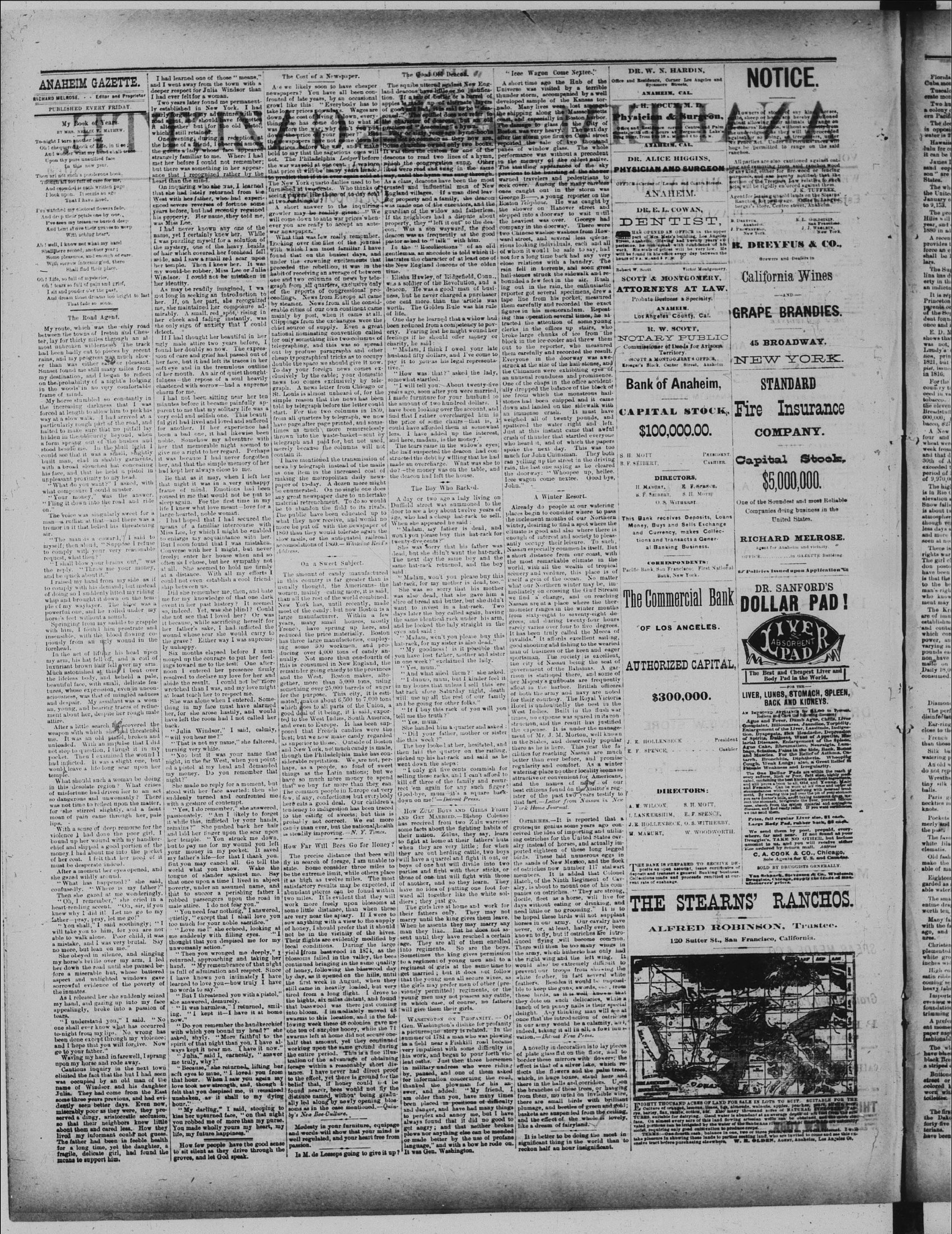
Searchable text
ANAHEIM GAZETTE.
RICHARD MELROSE. - Editor and Proprietor
PUBLISHED EVERY FRIDAY.
My Book of Years.
BY MRS. NELLIE W. MAThew.
To-night I turn another leaf,
Oh! chequered book of Life, in time;
And wonder what my hand shall trace
Upon thy pure unsuillied face
In this new year.
Then art not such a ponderous book,
Though all too full of care for me,
And exodus is each written page
I look upon. It seems an age
That I have lived.
I've watched my choosest flowers fade,
And drop their petals one by one.
I've seen my treasures buried deep
And bent at ove their graves to weep
With aching heart.
Ah! well, I know not what my sand
Shall here record, another year;
Some pleasures, and enough of care.
With sorrow intermingled, there
Shall find their place.
Oh! Life, so full of mystery,
Oh! tears so full of pain and grief,
I sit and ponder over the past,
And dream those dreams too bright to last
That fade so soon.
The Road Agent.
My route, which was the only road between the towns of Ireton and Chester, lay for thirty miles through an almost unbroken wilderness. The track had been badly cut to pieces by recent rains, and my progress was much slower than was either safe or pleasant. Sunset found me still many miles from my destination, and I began to reflect on the probability of a night's lodging in the woods in no very comfortable frame of mind.
My horse stumbled so constantly in the increasing darkness that I was forced at length to allow him to pick his way at a slow walk. I had arrived at a particularly rough part of the road, and halted to make sure that no pitfall lay hidden in the obscurity beyond, when a form sprang out of the bushes and stood beside me. In the dull light I could see that it was a small, slightly built man, clad in shabby garments,
I had learned one of those "means," and I went away from the town with a deeper respect for Julia Windsor than I had ever felt for a woman.
Two years later found me permanently established in New York. I had nearly forgotten my adventure with the road agent, and should have forgotten it altogether but for the old pistol, which I still retained.
One evening, during a reection at the house of a friend, I observed among the guests a lady whose face appeared strangely familiar to me. Where I had met her before I could not remember; but there was something in her appearance that I recognized rather by the heart than the mind.
On inquiring who she was, I learned that she had lately returned from the West with her father, who had experienced severe reverses of fortune some years before, but had recently regained his property. Her name, they told me, was Miss Lee.
I had never known any one of the name, yet I certainly knew her. While I was puzzling myself for a solution of the mystery, one of the heavy braids of hair which covered her forehead fell aside, and I saw a small red scar upon her temple. Then I knew her. It was my would-be robber, Miss Lee or Julia Windsor. I could not be mistaken in her identity.
As may be readily imagined, I was not long in seeking an introduction to her. If, on her part, she recognized me, she maintained her composure admirably. A small, red spot, rising in her cheek and fading instantly, was the only sign of anxiety that I could detect.
If I had thought her beautiful in her ugly male attire two years before, I found her doubly so now. The expression of care and grief had passed out of her face, but it had left its traces in her soft eye and in the tremulous outline of her mouth. An air of quiet thoughtfulness—the repose of a soul heavily chastened with sorrow—had a supreme charm for me.
I had not been sitting near her ten minutes before it became painfully apparent to me that my solitary life was a very cold and selfish one. This beautiful girl had lived and loved and suffered for another. If her experience had been a bad one, it had likewise been noble. Somehow my adventure with her that memorable night seemed to give me a right to her regard. Perhaps it was because I had never forgotten
The Cost of a Newspaper.
Are we likely soon to have our newspapers? You have all been fronted of late years, by an occult like this: "Everybody will take lower prices nowadays." We down the cost of living in down things else has come down to was before the war; why don't down the price of your paper? The newspapers have not come up the prices before the war, and bold to say that the sagacious ones not. The Philadelphia Ledger the war was sold at one cent. If that price it will be many years to predict that if it is ever again The New York quarto dailies unfirmed at two cents. Who sees papers like those of today at two confinements?
A short answer to the inquiry growler may be readily given will come down to ants war price ever you are ready to accept war newspaper."
What that was few really reeling over the files of the with which I am most familiar found that on the busiest day under the crowning excitement preceded the rebellion, it was habit of receiving an average of one and two columns of news graph from all quarters, exclusive of the reports of congressionalceedings. News from Europe by steamer. News from all the erable cities of our own continuation mainly by post, when it can Clippings from the exchanges chief source of supply. Every national nominating convention for only something like two telegraphing, and this was sent out by profuse paragraphs on cheap typographical tricks as double the space we should give To day your foreign news or elusively by the cable; your news too comes exclusively graph. A news letter from C. St. Louis is almost unheard of simple reason that the news told by telegraph before the last start. For the two columns from all quarters by telegraph have page after page printed times as much more thrown into the waste-basket telegraph and paid for, but merely because the column contain it.
I have mentioned the trans-
Sunset found me still many miles from my destination, and I began to reflect on the probability of a night's lodging in the woods in no very comfortable frame of mind.
My horse stumbled so constantly in the increasing darkness that I was forced at length to allow him to pick his way at a slow walk. I had arrived at a particularly rough part of the road, and halted to make sure that no pitfall lay hidden in the obscurity beyond, when a form sprang out of the bushes and stood beside me. In the dull light I could see that it was a small, slightly built man, elad in shabby garments, with a broad slouched hat concealing his face, and that he held a pistol in unpleasant proximity to my head.
"What do you want?" I asked, with what composure I could muster.
"Your money," was the answer. "Fling it down into the road and ride on."
The voice was singularly sweet for a man—a rutilan at that—and there was a tremor in it that belied his threatening air.
"The man is a coward," I said to myself; then aloud, "Suppose I refuse to comply with your very reasonable request, what then?"
"I shall blow your brains out," was the reply. "Throw me your money, and be quick about it."
I raised my hand from my side as if to comply with his demand; but instead of doing so I suddenly litted my riding whip and brought it down on the temple of my waylayer. The blow was a powerful one, and he rolled under my horse's feet without a sound.
Springing from my saddle to grapple with him, I found him prostrate and insensible, with the blood flowing copiously from an ugly wound in the forehead.
In the act of lifting his head upon my arm, his hat fell off, and a coil of luxuriant brown hair fell over my arm. Much astonished at this, I bent over the lifeless body, and beheld a pale, beautiful face, with small, delicate features, whose expression, even in unconsciousness, was that of mingled sadness and despair. My assailant was a woman, young, and bearing traces of refinement about her, despite her rough male attire.
After a little search I discovered the weapon with which she had threatened me. It was an old pistol, broken and unloaded. With an impulse that I did not stop to question, I thrust it in my pocket. Then I examined the wound I had inflicted. It was a slight one, but would leave a life-long scar upon her temple.
What should such a woman be doing in this desolate region? What crises of misfortune had driven her to an act so dangerous and unwomanly? There was not time to reflect upon the matter, for she stirred slightly, and a faint moan of pain came through her, pale lips.
With a sense of deep remorse for the violence I had done the poor girl, I bound up her wound with my handkerchief and slippsed a good portion of the money I had about me into the pocket of her coat. I felt that her need of it must be desperate indeed.
After a moment her eyes opened, and I had not been sitting near her ten minutes before it became painfully apparent to me that my solitary life was a very cold and selfish one. This beauti ful girl had lived and loved and suffered for another. If her experience had been a bad one, it had likewise been noble. Somehow my adventure with her that memorable night seemed to give me a right to her regard. Perhaps it was because I had never forgotten her, and that the simple memory of her had kept her always close to me.
Be that as it may, when I left her that night it was in a very unhappy frame of mind. Emotions had been in me that would not be put to sleep again. For the first time in my life I knew what love meant—love for a large-hearted, noble woman.
I had hoped that I had secured the means of a familiar intercourse with Miss Lee, by which I might be enabled to enlarge my acquaintance with her. But I soon found that I was mistaken. Converse with her I might, but never freely; enter her house when and so often as I chose, but her sympathy not at all. She seemed to hold me firmly at a distance. With all my efforts I could not even establish a cool friendship between us.
Did she remember me, then, and hate me for my knowledge of that one dark event in her past history? It seemed so indeed. Yet, was she blind? Could she not see that I loved her? Or was it because, while sacrificing herself for her father's sake, I had inflicted the wound whose scar she would carry to the grave? Either way I was supremely unhappy.
Six months elapsed before I summoned up the courage to put her feelings toward me to the test: One afternoon I entered her presence firmly resolved to declare my love for her and abide the result. I could not be more wretched than I was, and my love might at least teach her to respect me.
She was alone when I entered. Something in my face must have alarmed her, for she arose hastily, and would have left the room had I not called her back.
"Julia Windsor," I said, calmly, "will you hear me?"
"That is not my name," she faltered, turning very white.
"No; but it was your name that night, in the far West, when you pointed a pistol at my head and demanded my money. Do you remember that night?"
She made no reply for a moment, but stood with her face awered: then she suddenly turned and confronted me with a gesture of contempt.
"Yes, I do remember," she answered passionately. "Am I likely to forget it while this, inflicted by your hands, remains?" She pushed back her hair and laid her finger upon the scar upon her temple. "You struck me down, but to pay me for my wound you left your money in my pocket. It saved my father's life—for that I thank you. But you may cancel all. Go tell the world what you know. Wake the face, but it is not easy to touch."
To day your foreign news cloaked by the cable; your news too comes exclusively graph. A news letter from C St. Louis is almost unheard of simple reason that the news told by telegraph before the last start. For the two columns from all quarters by telegraph have page after page printed, times as much more thrown into the waste-basket telegraph and paid for, but merely because the column contain it.
I have mentioned the transcripts news by telegraph instead of as one item in the increase making the metropolitan di paper of today. A dozen run be enumerated. On no single any great newspaper dare to material retrenchment. To be to abandon the field to The public have been educated what they now receive, and more be put off with the new 1860 than they would tolerate slow mails, or the antiquities accommodations of 1860.
How Far Will Bees Go
The amount of candy made in this country is far greater usually thought, the American women, mainly eating more than all the rest of the world's New York has, until recently most of the candy; but now large manufacturer. With years, many small hour French have sprung up reduced the price material has three large manufacturers ducing over 4,000 tons annually. Not more than once this is consumed in New York remainder going chiefly to New York and Boston gether; more than 5,000 something over 25,000 barrels for the purpose. This citizen made, makes about 6,500 which goes to all parts of good deal of it being; it ted to the West Indies, So even and even to Europe. It has posed that French candies best; but we now make can as superior to those. Outside New York, not much care though the Philadelphia ri siderable reputation. We haps as a people, so few things as the Latin natives have so much more more that we buy far more than The common people in England; if any, confections here eats a good deal. O tendency to indigestion har to the eating of sweets probably not correct. W candy than ever, but the n is steadily improving.
How Far Will Bees Go
The precise distance fly in search of forage; I state. Some consider th
What should such a woman be doing in this desolate region? What crises of misfortune had driven her to an act so dangerous and unwomanly? There was not time to reflect upon the matter, for she stirred slightly, and a faint moan of pain came through her, pale lips.
With a sense of deep remorse for the violence I had done the poor girl, I bound up her wound with my handkerchief and slipped a good portion of the money I had about me into the pocket of her coat. I felt that her need of it must be desperate indeed.
After a moment her eyes opened, and she gazed wildly around.
"What has happened?" she said, confusedly. "Where is my father?"
Then she gazed at me wonderingly.
"Oh, I remember," she cried in a heart-rending accent. "Oh, sir, if you knew why I did it! Let me go to my father—pray, pray, let me go!"
"You shall," I said soothingly; "I will take you to him, for you are not able to walk alone. Poor child, it was a mistake, and I was very brutal. Say no more, but lean on me."
She obeyed in silence, and slinging my horse's bridle over my arm, I led her down the road until she paused before a miserable hut, whose battered aspect and unlighted windows gave sorrowful evidence of the poverty of the inmates.
As I released her she suddenly seized my hand, and gazing up into my face appealingly, broke into a passion of tears.
"I understand you," I said. "No one shall ever know what has occurred to-night from my lips. No wrong has been done except through my violence; and I hope that you will forgive. Now go to your father."
Waving my hand in farewell, I sprang upon my horse and rode away.
Cautious inquiry in the next town elicited the fact that the hut I had seen was occupied by an old man of the name of Windsor and his daughter Julia. They had come from the East some three years previous, and had evidently seen better days. Even now, miserably poor as they were, they preserved a dingy, aristocratic seclusion, so that their neighbors knew little about them and cared less. How they lived my informant could not guess. The father had been in feeble health for a long time, yet the daughter, a fragile, delicate girl, had found the means to support him.
She made no reply for a moment, but stood with her face averted: then she suddenly turned and confronted me with a gesture of contempt.
"Yes, I do remember," she answered passionately. "Am I likely to forget it while this, inflicted by your hands, remains?" She pushed back her hair and laid her finger upon the scar upon her temple. "You struck me down, but to pay me for my wound you left your money in my pocket. It saved my father's life—for that I thank you. But you may cancel all. Go tell the world what you know. Wake the tongue of slander against me. Say that once upon a time I lived in abject poverty, under an assumed name, and that to succor a perishing father I robbed passengers upon the road in male attire. I do not fear you."
"You need fear nothing," I answered quietly, "except that I shall love you too much for your noble sacrifice."
"Love me!" she echoed, looking at me suddenly with filling eyes. "I thought that you despised me for my unwomanly action."
"Then you wronged me deeply," I returned, approaching and taking her hand. "My remembrance of that night is full of admiration and respect. Since I have known you intimately I have learned to love you—how truly I have no words to say."
"But I threatened you with a pistol," she answered, demurely.
"It was harmless," I returned, smiling. "I kept it—I have it at home now."
"Do you remember the handkerchief with which you bound my head?" she asked, shyly. "More faithful to the spirit of that night than you. I have always kept it near me. I have it now."
"Julia," said I, earnestly, "answer me truly, why?
"Because," she returned, lifting her scf eyes to mine. "I loved you from that hour. When I saw you again my love took new strength, and though I felt that you despised me, it remained unshaken, as it shall to my dying hour."
"My darling," I said, stooping to kiss her upturned face, "on that night you robbed me of more than my purse. You made wholly yours my heart, my life, my future happiness."
How few people have the good sense to sit silent as they drive through the groves, and let God speak.
The precise distancefly in search of forage, I state. Some consider there be extreme limit, while it as high as twelve miles satisfactory results may be abundant stores can be two miles. It is evident work more freely upon some little distance than are very near the apiary. Sow anything with a view of honey. I should prefer not be in the vicinity. Their flights are evidently local conditions. Dariy yield from basswood in blossoms failed in the winter continued bringing in the honey following the day; as it opened on the first week in August still came in heavily lored from a long flight the hights, six miles distant that basswood was there into bloom. I immediate swarms to this location, lowing week these 48 colonies one ton of surplus honey swarms left at home did half that amount, yet working upon the same entire period. Thistration of the advantage forage within a reasona tance. I have never hateto the effect, yet there is belief that, if honey found nearer bees wore distance named without ally led along by newly soms as in the case men by's New Bee-Culture.
Modesty in your furnishings and words will show therel well regulated,and your passion.
Is M. de Lesseps going
The Cost of a Newspaper.
We likely soon to have cheaper newspapers? You have all been consumed of late years, by an occasional sell like this: "Everybody has to lower prices nowadays. Wages are on the cost of living it down, every person has come down to what it before the war; why don't you put in the price of your paper?" But newspapers have not come down to prices before the war, and I make no attempt to say that the sagacious ones will war was sold at one cent. I venture price it will be many years hence. Predict that if it is ever again sold at New York quarto dailies used to be issued at two cents. Who thinks of long papers like those of to-day sold two cents again?
A short answer to the inquiry may be readily given: "We come down to antis war prices when you are ready to accept an ante-newspaper."
What that was few really remember. Taking over the files of the journal which I am most familiar I have and that on the busiest days, and under the crowning excitement that preceded the rebellion, it was in the fit of receiving an average of between two columns of news by telegraph from all quarters, exclusive only the reports of congressional proceedings. News from Europe all came steamer. News from all the considerable cities of our own continent came ninly by post, when it came at all,ipps from the exchanges were the best source of supply. Even a great national nominating convention called only something like two columns of telegraphing, and this was so spread out by profuse paragraphs and other cheap typographical tricks as to occupy the space we should give it now. Day your foreign news comes extensively by the cable; your domestic news too comes exclusively by telegraph.
A news letter from Chicago or Louis is almost unheard of, for the simple reason that the news has been told by telegraph before the letter could start. For the two columns in 1899, from all quarters by telegraph, we now page after page printed, and sometimes as much more remorselessly grown into the waste-basket—sent by telegraph and paid for, but not used, merely because the columns will not contain it.
I have mentioned the transmission of
The Good Old Deacon.
The squibs uttered against New England deacons have little or no justification. If a tab of butter or a barrel of apples is made up of alternate layers of good and bad, it is said to be "deconed." The opinion does not refer to the character of deacons, but an old practice of "deconning" a hymn.
Fifty or sixty years ago hymn-books were not so common as they now are. Some churches owned only two books. It was then the custom for one of the deacons to read two lines of a hymn, which the congregation sung. Other lines were read and sung in the same way, until the hymn was sung through. As a class, deacons have been the most trusted and influential men of New England villages. If a man died leaving property and a family, the deacon was made one of the executors, and the guardian of the widow and fatherless. If the neighbors had a dispute about property, they "left it out" to the deacon. Was a son wayward, the good deacon was as frequently as the good pastor asked to "talk" with him.
In the "Recollections" of an old gentleman, an anecdote is told which illustrates the character of at least one of the New England deacons of the oldest time.
Elisha Hawley, of Ridgefield, Conn., was a soldier of the Revolution, and a deacon. He was a good man of business, but he never charged a purchaser one cent more than the article was worth. The Golden Rule was his rule of life.
One day he learned that a widow had been reduced from a competency to poverty. Fearing lest he might wound her feelings if he should offer money or charity, he said:
"Malam, I think I owed your late husband fifty dollars, and I've come to pay it to you as his legal representative."
"How was that?" asked the lady, somewhat startled.
"I will tell you... About twenty-five years ago, soon after you were married, I made furniture for your husband to the amount of two hundred dollars. I have been looking over the account, and find that I rather overcharged him in the price of some chairs—that is, I could have afforded them at somewhat less. I have added up the interest, and here, madam, is the money."
The tears came in the widow's eyes; she half-suspected the deacon had constructed the debt by willing that he had
"Icee Wagon Come Nextee."
A short time ago by the Hub of the Universe was visited by a terrible thunder storm, accompanied by a well developed sample of the Kansas tornado. Many lives were lost amongst the shipping along the Massachusetts coast, and especially in Boston harbor. The damage to glass in the City of Boston was very heavy. The next day after the storm one firm on Canal street reported the sale of two thousand panes of window glass. The whole performance was without a precedent in the memory of the oldest native. The stallting appearance of the sky previous to the bursting of the shower warned travelers and pedestrians to seek cover. Among the many careless ones caught out in the storm was George B., a young reporter on the Boston Telephone. He was caught by the shower on Hanover street and stepped into a doorway to wait until the heaviest was over. George had company in the doorway. There were two Chinese washer-washers from Howard street, and several less queneous looking individuals, each and all of whom it would be safe to say, had not for a long time back had any very close relations with a laundry. The rain fell in torrents, and soon great hail-stones struck the sidewalk and rebounded a few feet in the air. Rushing out in the rain, the enthusiastic reporter got several specimens, drew a tape line from his pocket, measured them carefully and recorded the exact figures in his memorandum. Repeating this operation several times, he attracted the attention of some young clerks in the offices up stairs, who broke large chunks of ice from the block in the ice-cooler and threw them out to the reporter, who measured them carefully and recorded the result. Everyone in the doorway was sweetsuck at the size of the hail-stones, and the Chinamen were exhibiting eyes of an unusual roundness and prominence. One of the chaps in the office accidentally dropped the balance of the block of ice from which the monstrous hailstones had been chipped and it came down and landed on the sidewalk with an immense crash. It must have weighed all of twenty pounds, and spattered the water right and left. Just at this instant came that awful crash of thunder that startled everyone who heard it, and of which the papers spoke the next day. This was too much for John Chinaman. They both
How Far Will Bees Go for Honey?
The precise distance that bees will fly in search of forage, I am unable to state. Some consider three miles to while others place it.
"How was that?" asked the lady, somewhat startled.
"I will tell you. About twenty-five years ago, soon after you were married, I made furniture for your husband to the amount of two hundred dollars. I have been looking over the account, and find that I rather overcharged him in the price of some chairs—that is, I could have afforded them at somewhat less. I have added up the interest, and here, madam, is the money."
The tears came in the widow's eyes; she half-suspected the deacon had constructed the debt by willing that he had made an overcharge. What was she to do?—the money was on the table, and the deacon had left the house.
The Boy Who Back-d.
A day or two ago a lady living on Duffield street was summoned to the door to see a boy about twelve years of age, who had a cheap hat-rack to sell. When she appeared he said:
"Madam, my father is dead, and won't you please buy this hat-rack for twenty-five cents?"
She was sorry that his father was dead, but she didn't want the hat-rack. The next day the same boy and the same hat-rack returned, and the boy said:
"Madam, won't you please buy this hat-rack, for my mother is dead, too."
She was so sorry that his mother was also dead, that she gave him a slice of bread and butter, but she didn't want to invest in a hat-rack. Two days later the boy called again, having the same identical rack under his arm, and he looked the lady straight in the eyes and said:
"Madam, won't you please buy this hat-rack, for my sister is also dead."
My goodness! is it possible that you have lost father, mother and sister in one week?" exclaimed the lady.
"Yes, mum."
And what ailed them?" she asked.
"I dunno, mum, but I kinder feel it in my bones that unless I sell this ere hat rack after Saturday night, death will use up all the rest of our family and be going for other folks."
"It I buy this rack of you will tell me the truth?"
"Yes, mum."
She handed him a quarter and asked:
"Did your father, mother or sister die this week?"
The boy looked at her, hesitated, and then laid the quarter on the railing, picked up his hat-rack and said as he went down the steps:
"I only git five cents commish for selling these racks, and I can't afford to kill off three of the family and resurrect 'em again for any such figger." Good-bye, mum—it's a square back-down on me!"—Detroit Press.
How Zulu Boys and Girls Fight and Get Married—Bishop Colenso has received from two Zulu warriors some facts about the fighting habits of their nation. Zulus, they say, learn to fight at home at their fathers' huts when they are very little; for when they are out herding cattle, two boys will have a quarrel and fight it out, or boys of one hut will divide into two parties and fight with their sticks, or struck at the size of the hail-stones, and the Chinamen were exhibiting eyes of an unusual roundness and prominence. One of the chaps in the office accidentally dropped the balance of the block of ice from which the monstrous hailstones had been chipped and it came down and landed on the sidewalk with an immense crash. It must have weighed all of twenty pounds, and spattered the water right and left. Just at this instant came that awful crash of thunder that startled everyone who heard it, and of which the papers spoke the next day. This was too much for John Chinaman. They both ran yelling up the street in the driving rain, the last one saying as he cleared the doorway: "Whoopee up, hellee. Ice wagon come nextee. Good bye, John."
A Winter Resort.
Already do people at our watering places begin to consider where to pass the inclement months of our Northern winter, desiring to find a spot where the climate is good and also where there is enough of interest and society to pleasantly occupy their leisure. To such, Nassan especially comments itself. But a short distance from our coast, with the most remarkable climate in the world, with all the wealth of tropical scenery and verdure, this place is of itself a gem of the ocean. No matter what our Northern winter may be, immediately crossing the Gulf Stream we find a change, and on reaching Nassan are at a place where the thermometer ranges in the winter months from sixty-eight to seventy-eight degrees, and during twenty-four hours rarely varies over four to five degrees. It has been truly called the Mecca of invalids. It affords excellent sailing, good shooting and fishing to the wearied man of business or the keen and eager sportsman. The society is excellent, the city of Nassau being the seat of government of the Bahamas. A garison is stationed there, and some of her Majesty's gunboats are frequently afloat in the harbor. British officers of both army and navy are noted for their courtesy. The Royal Victoria Hotel is undoubtedly the best in the West Indies. Built in the flush war times, no expense was spared in its construction, and the result has justified the expense. It is under the management of Mr. J. M. Morton, well known in the States, and deservedly popular there as he is here. This year the facilities for reaching Nassau are much better than ever before, and promise regularity and comfort. As a winter watering place no other locality seems so attractive or convenient for Americans, and the names of many of our best citizens found on the visitor's register of the past two years testify to that fact. Letter from Nassau in New York Home Journal.
Ostriches. It is reported that a grotesque genius some years ago conceived the idea of importing and utilizing ostriches for the United States cavalry instead of horses, and actually imported eighteen of these long-legged birds. These haired numerous eggs in the sands of New Mexico, and the flock of ostriches now number 117 stalks
How Far Will Bees Go for Honey?
The precise distance that bees will fly in search of forage, I am unable to state. Some consider three miles to be the extreme limit, while others place it as high as twelve miles. The most satisfactory results may be expected, if abundant isteres can be found within two miles. It is evident that they will work more freely upon blossoms at some little distance, than when these are very near the apiary. If I were to sow anything with a view to the supply of honey, I should prefer that it should not be in the vicinity of the hives. Their flights are evidently modified by local conditions. During the large yield from basswood in 1874, as the blossoms failed in the valley, the bees continued bringing in the same quality of honey, following the basswood day by day, as it opened on the hills, until the first week in August, when they still came in heavily loaded, but very tired from a long flight. I drove to the hights, six miles distant, and found that basswood was there just coming into bloom. I immediately moved 48 swarms to this location, and in the following week these 48 colonies gave me one ton of surplus honey, while the 71 swarms left at home did not secure one-half that amount, yet they continued working upon the same ground during the entire period. This is a fine illustration of the advantage of obtaining forage within a reasonably short distance. I have never had direct proof to the effect, yet there is ground for the belief that, if honey could not be found nearer, bees would not fly the distance named without being gradually led along by newly opening blossoms as in the case mentioned.—Quinby's New Bee-Culture.
Modesty in your furniture, equipage and words will show that your mind is well regulated, and your heart free from passion.
Is M. de Lesseps going to give it up?
How Zulu Boys and Girls Fight and Get Married.—Bishop Colenso has received from two Zulu warriors some facts about the fighting habits of their nation. Zulus, they say, learn to fight at home at their fathers' huts when they are very little; for when they are out herding cattle, two boys will have a quarrel and fight it out, or boys of one hut will divide into two parties and fight with their sticks, or those of one hut will fight with those of another, and so they learn. They have no idea of putting one foot forward all together like the white soldiers; they just go.
The girls live at home and work for their fathers only. They may not marry until the king gives them leave. When he assents they may marry any man they like. But he does not assent until they have reached a certain age. They are all of them enrolled into regiments. So are the boys. Sometimes the king gives permission to a regiment of young men and to a regiment of girls at the same time to get married; but it does not follow that the young men all secure wives, as the girls may prefer men of other (previously permitted) regiments, or the young men may not possess any cattle, in which case, of course, no fathers will give them their girls.
WASHINGTON ON PROFANITY.—Of Gen. Washington's dislike for profanity a picturesque story is related. In the summer of 1781 a man who was plowing in a field near a Fishkill road became very impatient with some difficulty in his work, and began to pour forth violent oaths. Just then three horsemen in military undress who were riding by, paused, and one of them asked for information concerning the road, thanked the plowman for his answer, and added: "My friend, I am older than you, have many times been placed in positions of difficulty and danger, and have had many things to perplex and annoy me, but I have always found that it did no good to get angry; and that neither broken plows nor anything else can be mended or made better by the use of profane language," and with a bow he rode on. It was Gen. Washington.
Ostriches.—It is reported that a grotesque genius some years ago conceived the idea of importing and utilizing ostriches for the United States cavalry instead of horses, and actually imported eighteen of these long legged birds. These haid numerous eggs in the sands of New Mexico, and the flock of ostriches now number 117 stalwart members. It is added that Colonel Hatch, of the Ninth Regiment of Cavalry, is about to mount one of his companies on ostriches. "They are strong, docile, fleet as a horse, will live for days without eating or drinking, and need little or no grooming." It is to be hoped these birds will not supplant horses in our army. Our cavalry have never, or at least, hardly ever, been known to fly, but if ostriches are introduced flying will become common. There will then be too many wings in the army, which hitherto has only had the right wing and the left wing. It would also be extremely difficult to prevent our troops from showing the white feather, in fact several white feathers. Besides it would be impossible to keep the guns, swords, earl from these birds, as it is well known that they dote on such delicacies, while a lunch of ten penny nails is their special delight. Any thinking man will see at once that the introduction of ostriches in our army would be a calamity, and indeed, taking it all in all, a few innervation.—Detroit Free Press.
A novelty in decoration is to lay pieces of plate glass flat on the floor, and to border these mirrors with flowers; the effect is that of a silver lake, which reflects the flowers and the palm trees, which, in huge boxes, stand here and there in the halls and corridors. Upon the branches of these trees, or hanging from them, mounted on invisible wire, there are small birds with brilliant plumage, and beetles of green and gold; baskets are suspended from the ceiling, and the effect of the whole is lovely, like a dream of fairyland.
It is better to be doing the most significant thing in the world than to reckon half an hour insignificant.
DR. W. N. HARDIN,
Office and Residence, Corner Los Angeles and Sycamore Streets,
ANAHEIM, CAL.
J. H. VOCUM, M. D.
Physician & Surgeon,
Office and Residence corner Centre and Palm streets with office hours at Bergusen & Lake's Ding Store, from 6 to 10 a.m. and 4 to 8 a.m.
ANAHEIM, CAL.
DR. ALICE HIGGINS,
PHYSICIAN AND SURGEON
OFFICE-Corner of Lemon and Centre Streets.
ANAHEIM.
DR. E. L. COWAN,
DENTIST,
HAS OPENED AN OFFICE in the upper part of Mrs. Meta's building, Los Angeles Street, Anaheim. Having had twenty years' experience, he can speak with confidence of his work. His scale of prices will be very low. He will be found in his office every day between the hours of 9 a.m. and 5 p.m.
Robert W. Scott. Victor Montgomery.
SCOTT & MONTGOMERY,
ATTORNEYS AT LAW.
Probate Business & Specialty.
ANAHEIM.
Los Angeles County, Cal.
R. W. SCOTT,
NOTARY PUBLIC
Commissioner of Deeds for Arizona Territory.
SCOTT & MONTGOMERY'S OFFICE,
Kroeger's Block, Center Street, Anaheim.
Bank of Anaheim,
CAPITAL STOCK,
$100,000.00.
S. H. MOIT
PRESIDENT.
NOTICE.
Owners of stocks of any kind, horses, cattle, sheep or horses are hereby cautioned against allowing their animals to range on the Grahams' Ranchos without authority from the undersigned as they will be proceeded against for so doing, as trespassers, under Wy Pence Act. Under no circumstances will hogs be permitted to range on the said ranches.
All parties are also cautioned against cutting and removing from said rancho wood of any kind, either for firewood or fencing purposes, and are hereby notified that the section of the Trespass Law relative to such acts will be rigidly enforced against them.
J. K. TUFFREE,
Agent for Leasing unold lands on the Stearns' Ranch, for property. Office in Langeberger's store, Centre street, Anaheim.
B. DREYFUS &
CO.,
Grawhorses and Dealers in
California Wines
AND
GRAPE BRANDIES.
45 BROADWAY.
NEW YORK.
STANDARD
Fire Insurance COMPANY.
Capital Stock
Bank of Anaheim,
CAPITAL STOCK,
$100,000.00.
S. H. MOIT
PRESIDENT.
B. F. SEIBERT,
CASHIER.
DIRECTORS.
H. MABURY,
E. F. SPENCE.
B. F. SEIBERT,
S. H. MOIT
O. S. WITHERBY.
This Bank receives Deposits, Loans Money, Buys and Sells Exchange and Currency, makes Collections and transacts a General Banking Business.
CORRESPONDENTS:
Pacific Bank, San Francisco; First National Bank, New York.
The Commercial Bank
OF LOS ANGELES.
AUTHORIZED CAPITAL,
$300,000.
J. E. HOLLENBECK
President
E. F. SPENCE
Cashier
DIRECTORS:
A. W. WILCOX,
S. H. MOIT,
L. LANKERSHIM,
E. F. SPENCE,
J. E. HOLLENBECK, O. S. WITHERBY,
H. MABURY,
W. WOODWORTH.
THE BANK IS PREPARED TO RECIVE DEPOSITS on open account, issue certificates of deposit.
STANDARD Fire Insurance COMPANY.
Capital Stock,
$5,000,000.
One of the Soundest and most Reliable Companies doing business in the United States.
RICHARD MELROSE.
Agent for Anaheim and vicinity.
OFFICE... IN GAZETTE BUILDING.
77 Policies Issued upon Application.
DR. SANFORD'S DOLLAR PAD!
LIVER ABSORBENT PAD
The Best and Cheapest Liver and Body Pad in the World.
FOR THE LIVER, LUNGS, STOMACH, SPLEEN, BACK AND KIDNEYS.
An Improved Appliance for $1,00 to Prevent Ischemia and Cure the following diseases:
Ague and Fever, Dumb Ague, Chills, Liver Complaint, Billiousness, Jaundice, Torpidity, Enlargement of the Liver, Lasitude, Indigestion, Dysparella, Skin Headache, Depression of Spirits, Dulness, Want of Appetite, Miarrial Diseases, Enlargement of the Spleen, Acute Cake, Rheumatism, Neuralgia, Lumbarago, Sciatica, Pains in the Side, Back, Bones and Muscles. For the Relief of Asthma, Carrath, Bronchitis, Diphtheria. Whooping Cough, Weak Lungs; also, a Great Relief in Female Weakness and Irregularity.
The One Dollar Pads are within the reach of every sufferer, Rich or Poor, full size, highly profiled, containing the best known abnormals (headaches and will prostrate down to the Oral and Young Male and Female). Can be worn all time and under all circumstances without interfering with internal treatment. By wearing this pad over the pit of your stomach you save doctor's bills, avoid taking man-made drugs that connect the stomach, irritate the liver, prevent biliorrhosis (thrombosis from the system material and contagious diseases), and find ready relief. If you want certificates we can send them.
Price: full regular Liver size; $1 each.
Large Body Pad; rubber back; $2 each.
We send them by post, prepaid everywhere, far and near. If not found as your Druggist's TAKE NO OTHER, but incuse amount to us, and you will receive either size ordered by return mail.
Address:
C. A. COOK & CO., Chicago,
Sole Agents for U.S. and Canada.
SOLD BY DRUGGISTS GENERALLY.
DIRECTORS:
A. W. WILCOX, S. H. MOTT,
L. LANKERSHIM, E. F. SPENCE,
J. K. HOLLENBECK, O. S. WITHERBY,
H. MAURY, W. WOODWORTH.
THE BANK IS PREPARED TO RECIVE DEPOSITS ON OPEN ACCOUNT, ISSUE CERTIFICATES OF DEPOSIT AND TRANSACT A GENERAL BANKING BUSINESS. COLLECTIONS MADE AND PROCEDURES REMITTED AT CURRENT RATE OF EXCHANGE.
Prices, full regular Liver size, $1 each.
Large Body Pad, rubber back, $8 each.
We send them by post, prepaid, everywhere, far and near. If not found as your Druggist's TAKE NO OTHER, but incognito amount to us, and you will receive either size ordered by return mail.
C. A. COOK & CO., Chicago,
Sole Agents for U.S. and Canada.
SOLD BY DRUGGISTS GENERALLY.
Van Schanck, Stevenson & Co., Washington, Druggists, Chicago, supply the trade of manufacturers' prices.
THE STEARNS' RANCHOS.
ALFRED ROBINSON, Trustee.
120 Sutter St., San Francisco, California.
EIGHTY THOUSAND ACRES OF LAND FOR SALE IN LOTS TO SUIT. SUITABLE FOR THE Culture of orange, lemons, limes, figs, almonds, walnuts, apples, pears, pearls, almonds, rye, barley, flax, raisin, cotton, etc. Also many thousand acres of NATURAL EVERGREEN AUTUMNES suitable for drying. Good water is abundant at an average depth of six feet from the surface. On almost every acre of this land flowing artesian wells can be obtained, and the more elevated portions can be irrigated by the water of the Santa Ana river. Most of times these are naturally moist, requiring only good cultivation to produce crops.
TERMS: One-fourth cash; balance in one, two or three years with no perennial interest. I will take pleasure in showing these lands to parties seeking land who are invited to come and see this extensive tract before purchasing elsewhere. W. R. OLDEN, ACKNY, Anaheim, Los Angeles Co.