anaheim-gazette 1879-09-19
Scanned page
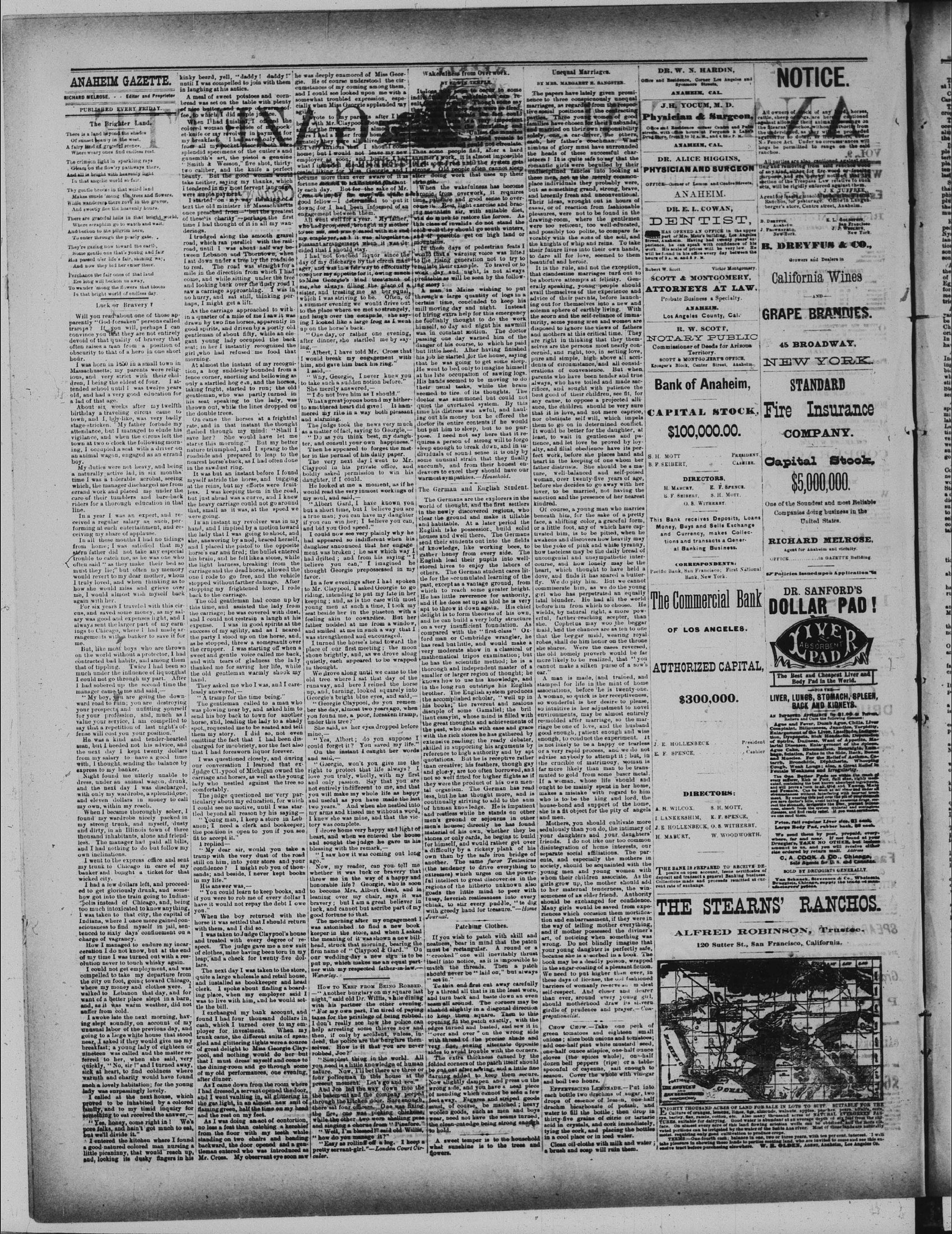
Searchable text
ANAHEIM GAZETTE.
RICHARD MELROSE. Editor and Proprietor
PUBLISHED EVERY FRIDAY.
The Brighter Land.
There is a land beyond the shadows
Of sunset beauty in the west.
A fairy land of graceful scenes,
Where weary ones find endless rest.
The crimson light in sparkling rays
Gleams on the flow'ry pathways there,
And all is bright with heavenly light
In that angelic world so fair.
Thy gentle breeds in that weird land
Makes music among the trees and flowers.
While wanderers there rove in the groves,
And sweetly fire the heavenly hours.
There are graceful hills in that bright world,
Where scraphim go to watch and wait.
And beckon to the pilgrim here,
To enter through the pearly gate.
They're gazing now toward the earth,
Some gentle one that's young and fair
Has passed over life's fair, shining way,
And now they bid her enter there.
Perchance the fair ones of that land
Ere long will beckon us away,
To wander mong the flowers that bloom
In that bright world of endless day.
Luck or Bravery?
Will you read about one of those apparently "God-forsaken" persons called trairps? If you will, perhaps I can convince you that they are not entirely devoid of that quality of bravery that often raises a ream from a position of obscurity to that of a hero in one short hour.
I was born in 1850 in a small town in Massachusetts; my parents were religious, and very strict with their children, I being the eldest of four. I attended school until I was twelve years old, and had a very good education for a lad of that age.
About six weeks after my twelfth birthday a traveling circus came to town, and I, holy-like, was very badly stage-stricken. My father forbade my attendance, but I managed to elude his vigilance, and when the circus left the town at two o'clock the following morning, I occupied a seat with a driver on an animal wagon, engaged as an errand man.
kinky beard, yell, "daddy! daddy!" until I was compelled to join with them in laughing at his antics.
A meal of sweet potatoes and corn-bread was set on the table with plenty of nice butter, and a cup of warm coffee, to which I did simple justice.
When I had finished, I offered the colored woman the choice of my pocket knife or my revolver in payment for my breakfast. I had saved only these from all my pocket pieces; both were splendid specimens of the cutler's and gunsmith's art, the pistol a genuine Smith & Wesson," five shot, thirty-two caliber, and the knife a perfect beauty. But the good woman would take neither, saying my thanks, which I tendered in my most fervent language, were ample payment.
I started on my way thinking of a text the old minister in Massachusetts once preached from—"but the greatest of these is charity"—perhaps the first time I had thought of it in all my wanderings.
I trudged along the smooth gravel road, which ran parallel with the railroad, until I was about half way between Lebanon and Thorntown, when I sat down under a tree by the roadside to rest. The road was straight for a mile in the direction from which I had come, and while sitting under the tree and looking back over the dusty road I saw a carriage approaching. I was in no hurry, and sat still, thinking perhaps, I might get a lift.
As the carriage approached to within a quarter of a mile of me I saw it was drawn by two fine horses, apparently in good spirits, and driven by a portly old gentleman of about fifty, while an elegant young lady occupied the back seat; in her I instantly recognized the girl who had refused me food that morning.
At almost the instant of my recognition, a hog suddenly bounded from a fence corner, snorting and bellowing as only a startled hog can, and the horses, taking fright, started to run; the old gentleman, who was partly turned in his seat speaking to the lady, was thrown out, while the lines dropped on the double trees.
On came the horses at a frightful rate, and in that instant the thought flashed through my mind: "Shall I save her? She would have let me starve this morning." But my better nature triumphed, and I sprang to the roadside and prepared to leap to the he was deeply enamored gie. He of course unmistakes of my com
and I could see looked somewhat troubled cically when Miss George agilier.
I wrote to my pa
beer with Mr. Claypye
and for the first time yerls I had a letter frac
imately they were ad
and very anxious tha
home; but I would en
employer as soon
what I included she
cled liking for Mi
became more than efortune assured wi
dy each day. But for Cross-write by fine good fellow—I detdown; for I had beengagement between
All went well for s
who had prospered, t
to see me, and was p
my employer, and i
pleasant arrangement cided that I should e
I had not touched day of my discharge ager, and was in a fa
conquer my appetite to Miss Georgia's b
me, she always fill
sister, and treating which I was striving a summer evening wi
to the place where wi
and laugh over tha
ing I looked like a lup
up on the horse's ba
"One day, or ra
after dinner, she si
ing,
"Albert, I have I would break my him, and gave him l
I said,
"Why, Georgie, to take such a sudden She merely answer ¢
I do not love hie What a great joyo¢ to smothered heart mered my ribs in s¢ and alarming.
The judge took t¢ as a matter of fact, s¢
"Do as you thi ter, and consult yo¢
Then he appeared ter in the perusal o¢
I was born in 1850 in a small town in Massachusetts; my parents were religious, and very strict with their children, I being the eldest of four. I attended school until I was twelve years old, and had a very good education for a lad of that age.
About six weeks after my twelfth birthday a traveling circus came to town, and I, boy-like, was very badly stage-stricken. My father forbade my attendance, but I managed to elude his vigilance, and when the circus left the town at two o'clock the following morning, I occupied a seat with a driver on an animal wagon, engaged as an errand boy.
My duties were not heavy, and being a naturally active lad, in six months' time I was a tolerable acrobat, seeing which, the manager discharged me from errand work and placed me under the care of their tumblers and bare-back riders for a thorough education in that line.
In a year I was an expert, and received a regular salary as such, performing at each entertainment, and receiving my share of applause.
In all these months I had no tidings from home; I was satisfied that my stern father did not take any especial trouble to catch me, as he was one who often said "as they make their bed so must they lie;" but often my memory would revert to my dear mother, whom I truly loved, and when thinking as to how she would miss and grieve over me, I would almost wish myself back again with her.
For six years I traveled with this circus, and saved some money, as my salary was good and expenses light, and I always sent the larger part of my earnings to Chicago, where I had made arrangements with a banker to save it for me.
But, like most boys who are thrown on the world without a protector, I had contracted bad habits, and among them that of tippling. Twice I had been so much under the influence of liquor that I could not go through my part. After I had sobered up the second time the manager came to me and said,
"My boy, you are going the downward road to ruin; you are destroying your prospects and unfitting yourself for your profession, and much as I value your service, I am compelled to say that a repetition of last night's offense will cost you your position."
He was a kind and tender-hearted man, but I heeded not his advice, and the next day I kept twenty dollars from my salary to have a good time with, I thought, sending the balance by express to my banker.
Night found me utterly unable to dress, under an animal wagon, drunk, and the next day I was discharged, with only my wardrobe, a splendid one, and eleven dollars in money to call my own, within my reach.
When I became thoroughly sober, I found my wardrobe nicely packed in my strong trunk, and myself, dusty and dirty, in an Illinois town of three thousand inhabitants, alone and friendless. The manager had paid all bills, and I had nothing to do but follow my own inclinations.
I went to the express office and sent my trunk to Chicago in care of my banker and bought a ticket for that
At almost the instant of my recognition, a hog suddenly bounded from a fence corner, snorting and bellowing as only a startled hog can, and the horses, taking fright, started to run; the old gentleman, who was partly turned in his seat speaking to the lady, was thrown out, while the lines dropped on the double trees.
On came the horses at a frightful rate, and in that instant the thought flashed through my mind: "Shall I save her? She would have let me starve this morning." But my better nature triumphed, and I sprang to the roadside and prepared to leap to the nearest horse's back, as I had often done in the sawdust ring.
It was but an instant before I found myself astride the horse, and tugging at the reins, but my efforts were fruitless. I was keeping them in the road, but just ahead was a curve, and I knew the heavy carriage could not go around that, small as it was, at the speed we were going.
In an instant my revolver was in my hand, and I implied by a motion toward the lady that I was going to shoot, and she, answering by a nod, braced herself, and placed the pistol to the opposite horse's ear and fired; the bullet entered his brain, and he fell like a stone, while the light harness breaking from the carriage and the dead horse allowed the one I rode to go free, and the vehicle stopped without farther damage. After stopping my frightened horse, I rode back to the carriage.
The old gentleman had come up by this time, and assisted the lady from the carriage; he was covered with dust, and I could not restrain a laugh at his expense. I was in good spirits at the success of my agility, and as I neared the party I stood up on the horse, and as he stopped, threw a somersault over the crupper. I was starting off when a sweet and gentle voice called me back, and with tears of gladness the lady thanked me for saving her life, while the old gentleman warmly shook my hand.
They asked me who I was, and I carelessly answered,
"A tramp for the time being."
The gentleman called to a man who was plowing near by, and asked him to send his boy back to town for another horse, and leading the lady to a shady spot, requested me to be seated and tell them my story. I did so, not even omitting the fact that I had been discharged for inviobriety, nor the fact also that I had foresworn liquor forever.
I was questioned closely, and during our conversation I learned that ex-Judge Claypool of Michigan owned the carriage and horses, as well as the young lady who nestled against the tree so comfortably.
The judge questioned me very particularly about my education for which I could see no motive, until I was starled beyond all reason by his saying—
"Young man, I keep a store in Lebanon; I need a clerk and bookeeper; the position is open to you if you see fit to accept it."
I replied—
"My dear sir, would you take a trump with the very dust of the road still on him, into your store and your confidence? I might rob you of thou him," said,
"Why, Georgie; to take such a sudden She merely answer "I do not love him What a great joyo to smothered heart mered my ribs in ala alarming.
The judge took ta as a matter of fact; she tered at you then tered at you consult you Then he appeared tered in the perusal o The very next Claypool in his boldly asked per daughter; if I could He looked at me would read the very my soul, and said," Albert Gard,
but a short time; but a true man; you ca if you can win her bid you God said
I could now see had appeared so daughter announcement was broken; had drifted; and believe you can thought Georgie favor.
In a few evening to Mr. Claypool, I riding, intending keeping; and as young men at sea seat beside her in feeling akin to father nodded at me was strengthened! I turned the hood place of our first shone brightly; an quietly each appl in thought.
We drove along old tree where I runaway; and he up; and turning. Georgie's bright!
"Georgie Clayber the day; almost you found me; under this tree?" She said; as ha mine,
"Yes, Albert could forget it? On the instan said,
"Georgie; wo right to protect love you truly; and only passion not entirely indify you will make me and useful as ye two years." And my arms and kiss I knew she was mory was completed. I drove home heart,and whenand soughtthe blessingwiththe "I sawhowit ago." Now,my rea
Night found me utterly unable to dress, under an animal wagon, drunk, and the next day I was discharged, with only my wardrobe, a splendid one, and eleven dollars in money to call my own, within my reach.
When I became thoroughly sober, I found my wardrobe nicely packed in my strong trunk, and myself, dusty and dirty, in an Illinois town of three thousand inhabitants, alone and friendless. The manager had paid all bills, and I had nothing to do but follow my own inclinations.
I went to the express office and sent my trunk to Chicago in care of my banker and bought a ticket for that wicked city.
I had a few dollars left, and proceeded to get gloriously drunk, and somehow got into the train going to Indianapolis instead of Chicago, and being too much intoxicated to know anything, I was taken to that city, the capital of Indiana, where I once more gained consciousness to find myself in jail, sentenced to sixty days' confinement on a charge of vagrancy.
How I managed to endure my incarceration I do not know, but at the end of my time I was turned out with a resolution never to touch whisky again.
I could not get employment, and was compelled to take my departure from the city on foot, going toward Chicago, where my money and clothes were. I walked to Lebanon that day, and for want of a better place slept in a barn, and, as it was warm weather, did not suffer from cold.
I awoke late the next morning, having slept soundly, on account of my unusual labor of the previous day, and going to a large white house that stood near. I asked if they would give me my breakfast; a young lady of eighteen or nineteen was called and the matter referred to her, when she said, very quickly, "No, sir!" and I turned away, sick at heart, to find coldness where warmth and charity would have found such a lovely habitation; for the young lady was surpassingly lovely.
I called at the next house, which proved to be inhabited by a colored family, and to my timid inquiry for something to eat received the answer,
"Yes, honey, come right in! We's pore folks, and hain't got much to eat, but we'll divide it."
I entered the kitchen where I found a good-natured colored man nursing a little picaninny, that would reach up, and locking its dusky fingers in his carriage and horses, as well as the young lady who nestled against the tree so comfortably.
The judge questioned me very particularly about my education, for which I could see no motive, until I was star-tled beyond all reason by his saying—
"Young man, I keep a store in Lebanon; I need a clerk and bookkeeper; the position is open to you if you see fit to accept it."
I replied—
"My dear sir, would you take a tramp with the very dust of the road still on him, into your store and your confidence? I might rob you of thousands; and beside, I never kept books in my life."
His answer was,
"You could learn to keep books, and if you were to rob me of every dollar I have it would not repay the debt I owe you."
When the boy returned with the horse it was settled that I should return with them, and I did so.
I was taken to Judge Claypool's house and treated with every degree of respect. The judge gave me a new suit of clothes, mine having been torn in my leap, and a check for twenty-five dollars.
The next day I was taken to the store, quite a large wholesale and retail house, and installed as bookkeeper and head clerk. I spoke about finding a boarding place, when my employer said I was to live with him, and he would settle the bill.
I exchanged my bank account, and found I had four thousand dollars in cash, which I turned over to my employer for investment. When my trunk came, the different suits of spangled and glittering tights were a source of great delight to Miss Georgie Claypool, and nothing would do her but that I must dress myself and come to the dining-room and go through some of my old performances, one evening, after dinner.
As I came down from the room where I had dressed a servant opened the door, and I went vaulting in, all glittering in the gas light, in an almost new suit of flaming green, half the time on my head and the rest on my feet.
As I was doing an act of contortion, no less a feat than catching a kerchief from the floor with my teeth while standing on two chairs and bending backward, the door opened and a gentleman entered who was introduced as Mr. Cross. My observant eye soon saw love you truly,
and only passion not entirely indifferent you will make me useful as you two years." Anna my arms and kisses. I knew she was my story was complete.
I drove home with heart, and when sought the blessing with the "I saw how it ago."
Now, my real whether it was threw me in the honorable life? To become Mrs. leaning over my bravery; but I luck, and cannot good fortune to.
The morning was astonished by keeper in the same meaning of head, struck that firm name of "our wedding-dress put up which mer with my reverie Waverley.
How to Kexn—" Another bus night," said old with his partnert "For my own taxes for the prince I don't really help arresting then, if only be deed, the police selves. How i robbed Joe?" "Simplest that you need is a little nature. Now. Four policemen present moment And Joe led the basement through the kit there sat four o'clock fire. One while the other and singing a song." "Well I'm how do you mote" "Easy as roll pretty servant-gacular."
he was deeply enamored of Miss George. He of course understood the circumstances of my coming among them, and I could see looked upon me with a somewhat troubled expression, especially when Miss Georgia applauded my agility.
I wrote to my parents after I had been with Mr. Claypool bought me and for the first time in almost years I had a letter from home. Immediately they were all alive and very anxious that I should come home; but I would not leave my new employer as soon, and beside I had what I intended should be a well-conceived liking for Miss Georgia and I became more than ever aware of it as fortune seemed to hold usistantly each day. But for the sake of Mr. Crosswhite by the way was quite a good fellow—I determined to put it down; for I had been informed of an engagement between them.
All went well for a year. My father, who had prospered, brought my mother to see me, and was pleased with me and my employer, and it was altogether a pleasant arrangement when it was decided that I should stay.
I had not touched liquor since the day of my discharge by the circus manager, and was in a fair way to effectually conquer my appetite for it, owing much to Miss Georgia's kind treatment of me, she always filling the place of a sister, and treating me as her equal, which I was striving to be. Often, of a summer evening we would drive out to the place where we met so strangely, and laugh over the escapade, she saying I looked like a large frog as I went up on the horse's back.
"One day, or rather one evening, after dinner, she startled me by saying,
"Albert, I have told Mr. Cross that I would break my engagement with him, and gave him back his ring."
I said,
"Why, Georgie, I never knew you to take such a sudden notion before."
She merely answered,
"I do not love him as I should."
What a great joyous bound my hitherto smothered my ribs in a way both pleasant and alarming.
The judge took the news very much as a matter of fact, saying to George,
"Do as you think best, my daughter, and consult your own happiness."
Then he appeared to forget the matter in the perusal of his daily paper.
Wakefulness from Overwork.
BY EDWIN TEMPLE.
It does not seem to occur to some individual that wakefulness can result from sleep. Though some say they cannot sleep they were so tired, others believe the fact could cause them to be very important in the circulating and breathing systems. Unless the muscles and blood vessels to these organs could not circulate. Thus some people find, after a hard summer's work, it is almost impossible to get sound rest until the system gets strong. Old people often cannot sleep after doing work that uses up their strength.
When the wakefulness has become chronic from overwork, it requires time, patience and good sense to overcome it. Best light exercise and bracing mountain air, with suitable diet, will do much to restore the forces. As this class of invalids do not stand the cold well they should go south winters, and it possible get on high land or mountains.
In these days of pedestrian feats I would that a warning voice was lifted to the rising generation not to try to emulate their example. To travel or to work day and night, is not always profitable as will be seen by the following story:
A man in Maine wishing to put through a large quantity of logs in a certain time, concluded to keep his mill moving day and night. Instead of hiring extra help for this emergency he foolishly thought to do the work himself, so day and night his sawmill was in constant motion. The doctor passing one day warned him of the danger of his course, to which he paid but little heed. After having finished his job he started for the house, saying that he was going to get some sleep. He went to bed only to imagine himself at his late occupation of sawing logs. His hands seemed to be moving to do their usual tasks, while the brain seemed to tire of its thoughts. The doctor was summoned but could not quiet the overtaxed system. By this time his distress was awful, and hauling out his money box he offered the doctor its entire contents if he would but put him to sleep, but no purpose. I need not say here that it requires a person of strong will to forgo sleep enough to break down, and in individuals of sound sense it is only by some unusual strain that they finally
Unequal Marriages.
BY MRS. MARGARET E. SANGSTER.
The papers have lately given prominence to three conspicuously unequal marriages, as regarded from the respective social positions of the contracting parties. Three young women of good families have chosen for their husbands, and married on their own responsibility solely, one, a car-driver, the others, each, her father's coachman. What nimbus of glory must have surrounded the heads of these successful charities! It is quite safe to say that the romantic girls were beguiled by their undisciplined fancies into looking at these men, not as the merely commonplace individuals they probably were, but as something grand, strong, brave, and breezy fresh and unconventional. Their ideas, wrought out in hours of cannus, or of reaction from fashionable pleasures, were not to be found in the drawing-room, where the gentlemen were too reticent, too well-educated, and possibly too polite, to compare favorably with the sons of the soil, and the knights of whip and reins. To take their future lives into their own hands, to dare all for love, seemed to them beautiful and heroic.
It is the rule, and not the exception, that clandestine marriages turn out to be abortive attempts at felicity. Generally speaking, young people should avail themselves of the experience and advice of their parents, before launching out for themselves into a new and solemn sphere of earthly living. With the scorn and the self-reliance of immaturity, some young men and women are disposed to ignore the views of fathers and mothers at this critical time. They are right in thinking that they themselves are the persons most nearly concerned, and right, too, in setting love, pure and simple, high above all accidents of circumstance, and all considerations of convenience. But when parents who have been tender and true always, who have toiled and made sacrifices, and sought with patience the best good of their children, see fit, for any cause, to oppose a projected alliance, the children should be very sure that it is love, and not mere caprice, nor obstinate self will, which impels them to go on in determined conflict. It would be better for the daughter, at least, to wait in gentleness and patience, and let love be proved by loyalty, and filial obedience have its perfect work, before she places hand and heart in the knowing of one whom
him, and gave him back his ring.
I said,
"Why, Georgie, I never knew you to take such a sudden notion before."
She merely answered,
"I do not love him as I should."
What a great joyous bound my hitherto smothered heart did give! It hammered my ribs in a way both pleasant and alarming.
The judge took the news very much as a matter of fact, saying to Georgie,
"Do as you think best, my daughter, and consult your own happiness."
Then he appeared to forget the matter in the perusal of his daily paper.
The very next day I went to Mr. Claypool in his private office, and boldly asked permission to win his daughter, if I could.
He looked at me a moment, as if he would read the very innest workings of my soul, and said,
"Albert Gard, I have known you but a short time, but I believe you are a true man; you can have my daughter if you can win her; I believe you can, and bid you God speed."
I could now see very plainly why he had appeared so indifferent when his daughter announced that her engagement was broken; he saw which way I had drifted; and from his saying "I believe you can," I imagined he thought Georgie prepossessed in my favor.
In a few evenings after I had spoken to Mr. Claypool, I asked Georgie to go riding, intending to put my fate in her keeping; and, as is the case with most young men at such a time, I took my seat beside her in the phaeton with a feeling akin to cowardice. But her father nodded at me from a window, and smiled at me in such a way that I was strengthened and encouraged.
I turned the horse's head toward the place of our first meeting; the moon shone brightly, and as we drove along quietly, each appeared to be wrapped in thought.
We drove along until we came to the old tree where I sat that day of the runaway, and here I reined the horse up, turning, looked squarely into Georgia's bright blue eyes, and said,
"George Claypool, do you remember the day, almost two years ago, when you found me, a poor, forsaken tramp, under this tree?"
She said, as her eyes dropped before mine,
"Yes, Albert; do you suppose I could forget it? You saved my life."
On the instant I caught her words and said,
"Georgie, won't you give me the right to protect that life always? I love you truly, wholly, with my first and only passion. Say that you are not entirely indifferent to me, and that you will make my whole life as happy and useful as you have made the last two years." And when she nestled into my arms and kissed me without a word, I knew she was mine, and that the victory was complete.
I drove home very happy and light of heart, and when we entered the house and sought the judge he gave us his blessing with the remark,
"I saw how it was coming out long ago."
Now, my reader, can you tell me whether it was luck or bravery that he was going to get some sleep?
He went to bed only to imagine himself at his late occupation of sawing logs. His hands seemed to be moving to do their usual tasks, while the brain seemed to tire of its thoughts. The doctor was summoned but could not quist the overtaxed system. By this time his distress was awful, and hauling out his money box he offered the doctor its entire contents if he would but put him to sleep, but to no purpose. I need not say here that it requires a person of strong will to forgo sleep enough to break down, and in individuals of sound sense it is only by some unusual strain that they finally succumb, and from their honest endeavors to excel they should have our warmest sympathies.—Household.
The German and English Student.
The Germans are the explorers in the world of thought, and the first settlers in the newly discovered regions, who clear the ground and make it tillable and habitable. At a later period the English take possession, build solid houses and dwell there. The Germans send their students out into the fields of knowledge, like working bees, to gather honey from every side. The English lead their pupils into well-tended hives to enjoy the labors of others. The German student cares little for the accumulated learning of the past, except as a vantage ground, from which to reach some greater height. He has little reverence for authority, and if he does set up an idol he is very apt to throw it down again. His chief delight is to form theories of his own, and he can build a very lofty structure on a very insufficient foundation. As compared with the "first-class" Oxford man or Cambridge wrangler, he has read but little, and would make a very moderate show in a classical or mathematical trios examination; but he has the scientific method; he is a thorough and independent master of a smaller or larger region of thought; he knows how to use his knowledge, and in the long run outstrips his English brother. The English system produces the accomplished scholar, "well up in his books;" the reverent and zealous disciple of some Gamaliel; the brilliant essayist, whose mind is filled with the great thoughts and achievements of the past, who deals with ease and grace with the rich stores he has gathered by extensive reading; the ready debater, skilled in supporting his arguments by reference to high authority and by apt quotations. But he is receptive rather than creative; his feathers, though gay and glos-y, are too often borrowed, and not so well fitted for higher flights as if they were the product of his own mental organism. The German has read less, but he has thought more, and is continually striving to add to the sum of human knowledge. He is impatient and restless while he stands on other men's grounds or sojourns in other men's houses; directly he has found material of his own, whether they be stones or only cards, he begins to build for himself, and would rather get over a difficulty by a rickety plank of his own than by the safe iron bridge of another. The same furor Teutonicus (the tendency to drive everything to that he was going to get some sleep).
He went to bed only to imagine himself at his late occupation of sawing logs. His hands seemed to be moving to do their usual tasks, while the brain seemed to tire of its thoughts. The doctor was summoned but could not quist the overtaxed system. By this time his distress was awful, and hauling out his money box he offered the doctor its entire contents if he would but put him to sleep, but to no purpose. I need not say here that it requires a person of strong will to forgo sleep enough to break down, and in individuals of sound sense it is only by some unusual strain that they finally succumb, and from their honest endeavors to excel they should have our warmest sympathies.—Household.
Of course, a young man who marries beneath him, for the sake of a pretty face, a shifting color, a graceful form, or a little foot, any of which have captivated him, is to be pitted, when he awakens and discovers how heavily may be the yoke of pink and white tyranny, how tasteless may be the daily bread of uncongenial and unsympathetic intercourse, and how lonely may be the heart, which thought to have held a dove, and finds it has snared a butterfly. We do pity him. But we cannot commiserate him, as we do the young girl who has perpetrated an equally fatal blunder. He had all the world before him from which choose. He wields, by natural right, a more powerful farther-reaching scepter, than she. Cophetua may woo the beggar maid, and the chances are as ten to one that the beggar maid, wearing royal robes, shall do him honor on the throne she shares. Were the cases reversed, the old homely proverb would be far more likely to be realized, that "you cannot make a silken purse of a sow's ear."
A man is made, and trained, and stamped for life in the mint of home associations, before he is twenty-one. A woman, so quick is her receptiveness, so wonderful is her desire to please, so intuitive is her adjustment to novel environments, may be almost entirely re-molded after marriage, so the marriage be one of love, and the husband good enough, patient enough and wise enough, to conduct the experiment. It is not likely to be a happy or tearless or a very rapid process, and we do not advise anybody to attempt it; but, in the crucible of matrimony, woman is far more likely than man to be transmuted to gold from some baser metal. If a woman, whose life should and ought to be mainly spent in her home makes a mistake with regard to him who is to be the king and lord, the house-bond and support of the home,她 is a fit object for the pity of angels and men.
Mothers you should cultivate more sedulously than you do,the intimacy of your daughters and your daughters' friends. I do not like our too common disintegration of home interests,our separate social affiliations.The parents,and especially the mothers in society,should be acquainted with the young men and young women with
love you truly, wholly, with my first and only passion. Say that you are not entirely indifferent to me, and that you will make my whole life as happy and useful as you have made the last two years." And when she nestled into my arms and kissed me without a word, I knew she was mine, and that the victory was complete.
I drove home very happy and light of heart, and when we entered the house and sought the judge he gave us his blessing with the remark,—
"I saw how it was coming out long ago."
Now, my reader, can you tell me whether it was luck or bravery that threw me in the way of a happy and honorable life? Georgie, who is soon to become Mrs. Albert Gard, and is leaning over my chair, says it was bravery; but I am a great believer in luck, and cannot but ascribe part of my good fortune to that.
The morning after my engagement I was astonished to find a new book keeper in the store, and when I asked the meaning of it was shown a new billhead, struck that morning, bearing the firm name of "Claypool & Gard." On our wedding-day a new sign is to be put up, which makes me an equal partner with my respected father-in-law.—Waverley.
How to Keep From Being Robbed.—"Another burglary on my square last night," said old Dr. Willis, while dining with his partner the other evening. "For my own part, I'm tired of paying taxes for the privilege of being robbed. I don't really see how the police can help arresting some thieves now and then, if only by accident, unless, indeed, the police are the burglar themselves. How is it that you are never robbed, Joe?"
"Simplest thing in the world. All you need is a little knowledge of human nature. Now, I'll bet there are three or four policemen in this house at the present moment. Let's go and see."
And Joe led the way down into the basement and the company peeped through the kitchen door. Sure enough, there sat four officers. One was fixing the fire, one was picking chickens, while the other two were shelling pears and singing a chorus from "Pinafore."
"Well, I'm blessed!" said old Willis, "how do you manage it?"
"Easy as rolling off a log. I keep a pretty servant-girl."—London Court Circular.
If you wish to patch with skill and neatness, bear in mind that the patch must be rectangular. A round or a crooked one will inevitably thrust itself into notice, as it is impossible to match the threads. Then a patch should never be "laid on," but always "not in."
To this end first cut away carefully by a thread all that is in the least wore, and turn back and baste down an even seam all around. The corners may be slashed slightly in a diagonal direction to keep them square. Then to this opening fit the patch exactly, with the edges turned and basted, and sew it in "over and over" on the wrong side with thread of the precise shade and very fine, sewing alternate opposite sides to avoid trouble with the corners.
The extra thickness caused by the folded corners of the patch itself should be cut out after sewing, and a little fine darning added to keep them secure. Now slightly dampen and press on the wrong side, and you have a neat piece of mending which cannot be seen a few feet away. Figures and striped goods must, of course, be matched; heavy woolen goods, such as men and boys wear, need not have the seams turned, the clean-out edge being strong enough to hold.
A sweet temper is to the household what sunshine is to the trees and flowers.
Mothers, you should cultivate more sedulously than you do, the intimacy of your daughters and your daughters' friends. I do not like our too common disintegration of home interests, our separate social affiliations. The parents, and especially the mothers in society, should be acquainted with the young men and young women with whom their children associate. As the girls grow up, the mother should add to her maternal tenderness, the win-someness of an elder friend. Authority should be exchanged for confidence. Many girls would be saved from experiences which occasion them mortification and embarrassment, if they were in the way of telling mother everything, and if mother possessed the diviner's art, of noticing when something was wrong. Do not blindly imagine that your young daughter is perfectly safe, because she is absorbed in a book. The book may be a deadly poison, wrapped in the sugar-coating of a pleasant fiction. We need to put higher than ever, in these days of license, the old fashioned barriers of womanly reserve an imdest self-respect. And closer and dearer than ever, around every young girl, should motherhood draw its silver girdle of prudence and prayer.
Chew Chow.—Take one peek of green tomatoes and eighteen small onions; since both onions and tomatoes; add one-half pint white mustard seed, one-half ounce alspice, one-half ounce cloves (the spices whole), one-half dozen bell peppers (ripe) or a table-spoonful of cayenne; salt enough to season. Cover the whole with vinegar and boil two hours.
EFFERVESCING LEMONADE.—Put into each bottle two drachms of sugar, two drops of essence of lemon, one-half drachm bicarbonate of potash, and water to fill the bottle; then drop in thirty-five grains of citric or tartaric acid in crystals, and cork immediately, tying the cork, and placing the bottles in a cool place or in lead water.
Clean oil-cloths with milk and water; a brush and soap will ruin them.
DR. W. N. HARDIN,
Office and Residence, Corner Los Angeles and Sycamore Streets,
ANAHEIM, CAL.
J.H. YOCUM, M.D.
Physician & Surgeon,
Office and Residence corner Centre and Palm streets, with office hours at Ferguson & LABELS Drug Store, from 9 to 10 A.M., and 4 to 5 P.M.
ANAHEIM, CAL.
DR. ALICE HIGGINS,
PHYSICIAN AND SURGEON
OFFICE—Corner of Lemon and Centre Streets.
ANAHEIM.
DR. E. L. COWAN,
DENTIST,
HAS OPENED AN OFFICE in the upper part of Mrs. Mena's building, Los Angeles Street, Anaheim. Having had twenty years' experience, he can speak with confidence of his work. His scale of prices will be very low. He will be found in his office every day between the hours of 9 A.M. and 8 P.M.
Robert W. Scott Victor Montgomery.
SCOTT & MONTGOMERY, ATTORNEYS AT LAW.
Probate Business a Specialty.
ANAHEIM.
Los Angeles County, Cal.
R. W. SCOTT,
NOTARY PUBLIC
Commissioner of Deeds for Arizona Territory.
SCOTT & MONTGOMERY'S OFFICE.
Kroeger's Block, Center Street, Anaheim.
Bank of Anaheim,
CAPITAL STOCK,
$100,000.00.
S. H. MOTT President
NOTICE.
All owners of stock of any kind, horses, cattle, sheep or dogs, are hereby cautioned against allowing their animal ownership on the Stearns' Beachos without authority from the undersigned, as they will be prohibited against for so doing. By trespassing under No. Pence Act. Under no circumstances will hogs be permitted to range on the said ranchos.
All parties are also cautioned against cutting and removing from said ranchos wood of any kind, either for firewood or fencing purposes, and are hereby notified that the section of the Treepass Law relative to such acts will be rigidly enforced against them.
Agent for leasing unsold land in the Ranchos, for pasturage. Office in Langenberger's store, Centre street, Anaheim.
B. DARFUS.
ANAHEIM.
J. POWERSRAIN.
New York.
B. DREYFUS & CO.,
Growers and Dealers in
California Wines
AND
GRAPE BRANDIES.
45 BROADWAY,
NEW YORK.
STANDARD
Fire Insurance COMPANY.
Bank of Anaheim,
CAPITAL STOCK,
$100,000.00.
S. H. MOTT
PRESIDENT
B. F. SEIBERT,
CASHIER
DIRECTORS.
H. MABURY,
E. F. SPENCE.
B. F. SEIBERT,
S. H. MOTT,
O. S. WITHERBY.
This Bank receives Deposits, Loans Money, Buys and Sells Exchange and Currency, makes Collections and transacts a General Banking Business.
CORRESPONDENTS:
Pacific Bank, San Francisco; First National Bank, New York.
The Commercial Bank
OF LOS ANGELES.
AUTHORIZED CAPITAL,
$300,000.
J. E. HOLLENBECK
President
E. F. SPENCE,
DIRECTORS:
A. H. WILCOX,
S. H. MOTT,
I. LANKERSHIM,
E. F. SPENCE,
J. E. HOLLENBECK, O. S. WITHERBY,
H. MABURY,
W. WOODWORTH.
THE BANK IS PREPARED TO RECEIVE DEPOSITS, LOANS, MONEY, BUYS AND SELLS EXCHANGE AND CURRENCY, MAKES COLLECTIONS AND TRANSACTS A GENERAL BANKING BUSINESS.
STANDARD
Fire Insurance COMPANY.
Capital Stock,
$5,000,000.
One of the Soundest and most Reliable Companies doing business in the United States.
RICHARD MELROSE,
Agent for Anaheim and vlcinity.
OFFICE...in GAZETTE Building.
DR. SANFORD'S
DOLLAR PAD!
LIVER
ABSORBENT
PAD!
The Best and Cheapest Liver and Body Pad in the World.
FOR THE
LIVER, LUNGS, STOMACH, SPLEEN,
BACK AND KIDNEYS.
AN IMPROVED APPARATUS FOR $1.00 or PAYMENT.
Relieves and Cures the following diseases:
Ague and Fever, Dumb Ague, Chills, Liver Complaint, Billiousness, Jaundice, Torsipidity, Enlargement of the Liver, Lasitude, Indigestion, Dyspasia, Nick Headache, Depression of Spirits, Duliness, Want of Appetite, Marital Diseases, Enlargement of the Spleen, Ague Cake, Rheumatism, Neuralgia, Lamage, Sedation, Pains in the Side, Back, Been and Muscles.
For the Relief of Asthma, Catarrh, Bronchitis, Diaphtheria, Whipworm Cough, Weak Lungs; also a Great Redefinition in Female Weakness and Irregularity.
The One Dollar Pads are within the reach of every sufferer. Rich or Poor, full size or half size contained, containing the best bony absorbent ingredients and will prove to be all-aged and young male and female. Can be worn at all times and under all circumstances without interfering with internal treatment. By wearing this pad over the plexiglass surface you have doctor's bills; would take excessive drugs; serviced by stomach; invigorate the liver; present illnenses; absorb from the system malarial and contagious diseases; and find ready relief. If you want certification we can send them.
Price: full regular Liver size; $2 each.
Large Body Pad; rubber back; $9 each.
We send them by post, prepaid everywhere, far and near. If not found at your Drurgist's TAKE NO OTHER but insume amount to us, and you will receive either size ordered by return mail.
Address:
C. A COOK & DO., Chicago,
Sales Agents for U.S. and Canada.
SOLD BY DRUGGISTS GENERALLY.
DIRECTORS:
A. H. WILCOX. S. H. MOTT,
I. LANKERSHIM, E. F. SPENCE,
J. E. HOLLENBECK, O. S. WITHERBY,
H. MABURY, W. WOODWORTH.
THE BANK IS PREPARED TO RECEIVE DEPOSITS ON OPEN ACCOUNT, ISSUE CERTIFICATES OF DEPOSIT AND TRANSACT A GENERAL BANKING BUSINESS. Collections made and proceeds remitted at current rate of exchange.
THE STEARNS' RANCHOS.
ALFRED ROBINSON, Trustee.
120 Sutter St., San Francisco, California.
EIGHTY THOUSAND ACRES OF LAND FOR SALE IN LOTS TO SUIT. SUITABLE FOR THE Culture of oranges, lemons, limes, grapes, almonds, walnuts, apples, peaches, pears, alfalfa, corn, rye, barley, flax, ramie, cotton, etc. Also many thousand acres of NATURAL EVENGREEN PUTURES suitable for dairying. Good water is abundant at an average depth of six feet from the surface. On almost every acre of this land flowing artesian wells can be obtained; and the more elevated portions can be irrigated by the water of the banks Ana river. Most of these lands are naturally moist, requiring only good cultivation to produce crops.
TERMS—One-fourth cash; balances in one, two or three years, with ten per cent. interest. I will take pleasure in showing these lands to partisan seating land, who are invited to come and see this extensive tract before purchasing elsewhere. W. E. OLDEN, Anzur, Anaheim, Los Angeles Co.