anaheim-gazette 1879-07-19
Scanned page
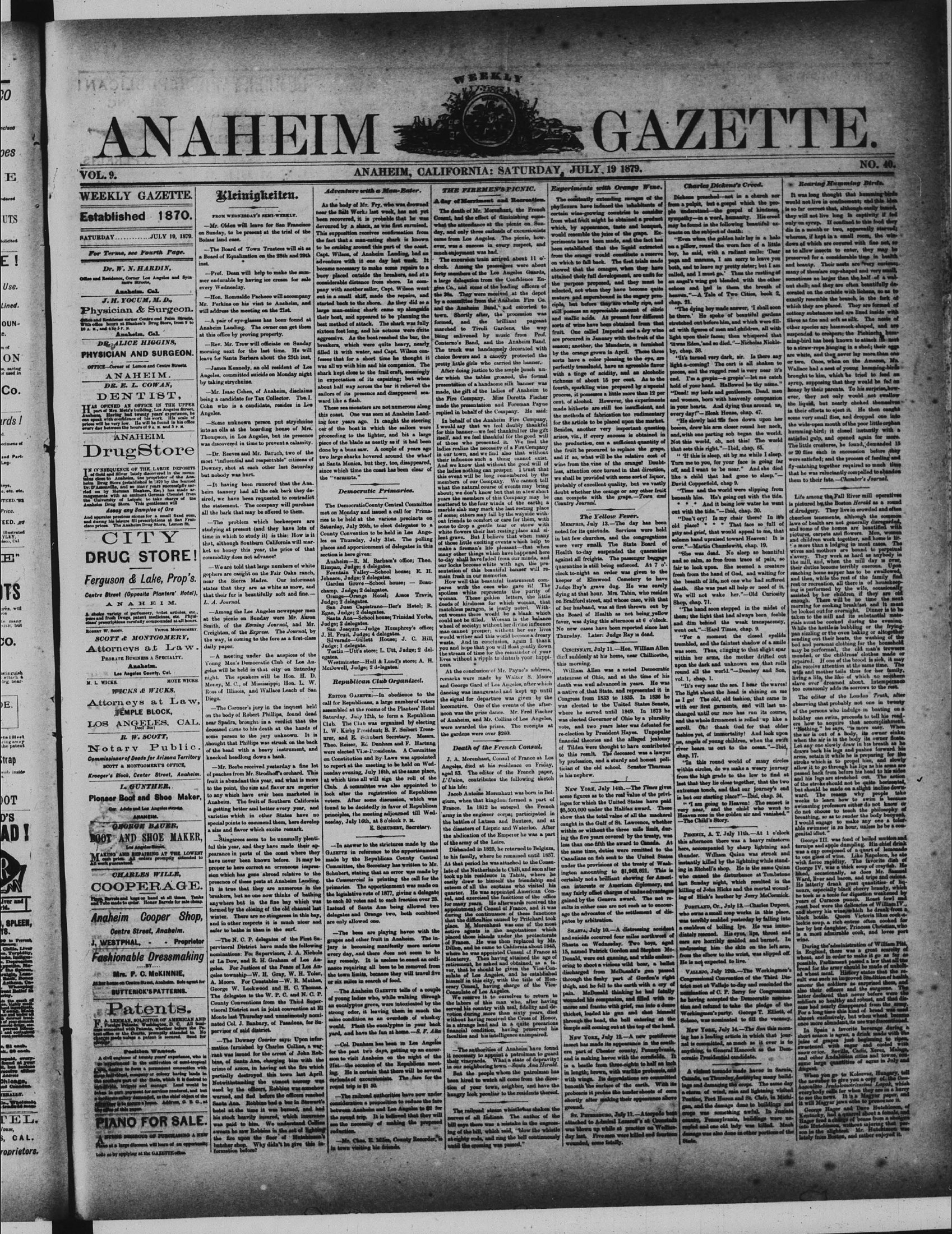
Searchable text
ANAHEIM
VOL. 9.
WEEKLY GAZETTE.
Established 1870.
SATURDAY...JULY 19, 1879.
For Terms, see Fourth Page.
Dr. W. N. HARDIN.
Office and Residence, Corner Los Angeles and Sycamore Streets,
Anaheim. Cal.
J. H. YOCUM, M. D., Physician & Surgeon.
Office and Residence corner Centre and Palm Nureta,
With office hours at Shanken's Drug Store, from 9 to 10 a.m., and 4:30 p.m.
Anaheim. Cal.
DR. ALICE HIGGINS,
PHYSICIAN AND SURGEON.
OFFICE—Corner of Lemon and Centre Streets.
ANAHEIM.
DR. E. L. COWAN,
DENTIST,
HAS OPENED AN OFFICE IN THE UPPER part of Mrs. Meta's building, Los Angeles Street, Anaheim. Having had twenty years' experience, he can speak with confidence of his work. His scale of prince will be very low. He will be found in his office every day between the hours of 9 a.m. and 5 p.m.
ANAHEIM
DrugStore
Kleinigkeiten.
FROM WEDNESDAY'S SEMI-WEEKLY.
Mr. Olden will leave for San Francisco on Sunday, to be present at the trial of the Bolaas land case.
The Board of Town Trustees will sit as a Board of Equalization on the 28th and 29th inst.
Prof. Dean will help to make the summer endurable by having ice cream for sale every Wednesday.
Hon. Romualdo Pacheco will accompany Mr. Perkins on his visit to Anaheim, and will address the meeting on the 21st.
A pair of eye-glasses has been found at Anaheim Landing. The owner can get them at this office by proving property.
Rev. Mr. Trew will officiate on Sunday morning next for the last time. He will leave for Santa Barbara about the 25th inst,
James Kennedy, an old resident of Los Angeles, committed suicide on Monday night by taking strychnine.
Mr. Isaac Cohen, of Anaheim, disclaims being a candidate for Tax Collector. Tha.I. Cohn who is a candidate, resides in Los Angeles.
Some unknown person put strychnine into an olla at the boarding house of Mrs. Thompson, in Los Angeles, but its presence was discovered in time to prevent a calamity.
Dr. Reeves and Mr. Baruch, two of the most influential and respectable" citizens of Adventure.
As the body of near the Salt Wheel been recovered, devoured by a This supposition the fact that a to be cruising Capt. Wilson, adventure with became necessary buoy placed on considerable dishany with another out in a small started back to large man-eating their boat, and best method of sixteen feet long aggressive. As breakers, which filled it with fesses that for was all up with shark kept close in expectation about half way sailors of its ward like a flask.
These sea monsters this coast. Or ing four years oar of the book proceeding to piece of the blade done by a buzzer two large sharks
ANAHEIM.
DR. E. L. COWAN,
DENTIST,
HAS OPENED AN OFFICE IN THE UPPER
part of Mrs. Mott's building, Los Angeles Street,
Anaheim. Having had twenty years' experience, he
can speak with confidence of his work. His scale of
prices will be very low. He will be found in his office
every day between the hours of 9 A.M. and 5 P.M.
ANAHEIM
DrugStore
IN CONSEQUENCE OF THE LARGE DEPOSITS
of Gold and Silver lately discovered in the mountains close to Anaheim, the proprietor of the Anaheim Drug Store (established in 1870 by the learned Dr. Farnoville, and so many years successfully carried on by Herman Blanken, Esq.) has made arrangements with an eminent German Chemist from the University of Leipzig to take charge of the Anaheim Drug Store. This gentleman will Assay any Samples of Ore
And appraise precious stones for a small fixed sum, and during his leisure fill prescriptions at San Francisco prices. The Anaheim Drug Store, Lemon St.
CITY DRUG STORE!
Ferguson & Lake, Prop's.
Centre Street (Opposite Planters' Hotel).
ANAHEIM.
A choice variety of perfumery, toilet articles, etc., pure and fresh Drugs, patent medicines, etc. Physicians' prescriptions carefully compounded at all hours.
ROBERT W. BOOTT.
VICTOR MONTGOMERY.
SCOTT & MONTGOMERY,
Attorneys at Law.
PROBATE BUSINESS & SPECIALTY.
Anaheim.
Los Angeles County, Cal.
M. L. WICKS.
MOYE WICKS.
WICKS & WICKS,
Attorneys at Law,
EMPLE BLOCK,
LOS ANGELES, CAL.
Dec 7 Sun.
R. W. SCOTT,
Notary Public.
Commissioner of Deeds for Arizona Territory
SCOTT & MONTGOMERY'S OFFICE,
Kroeger's Block, Center Street, Anaheim.
L. GUNTHER,
Pioneer Boot and Shoe Maker,
Our Adelaide and Los Angeles streets.
ANAHEIM.
GEORGE BAUER,
BOOT AND SHOE MAKER,
Los Angeles Street.
MAKING AND REPAIRING AT THE LOWEST cash price. All orders promptly attended to All work guaranteed.
James Kennedy, an old resident of Los Angeles, committed suicide on Monday night by taking strychnine.
Mr. Isaac Cohen, of Anaheim, disclaims being a candidate for Tax Collector. The I. Cohn who is a candidate, resides in Los Angeles.
Some unknown person put strychnine into an olla at the boarding house of Mrs. Thompson, in Los Angeles, but its presence was discovered in time to prevent a calamity.
Dr. Reeves and Mr. Baruch, two of the most "influential and respectable" citizens of Downey, shot at each other last Saturday but nobody was hurt.
It having been rumored that the Anaheim tannery had all the oak bark they desired, we have been requested to contradict the statement. The company will purchase all the bark that may be offered to them.
The problem which beckeepers are studying at present (and they have lots of time in which to study it) is this: How is it that, although Southern California will market no honey this year, the price of that commodity does not advance?
We are told that large numbers of white gophers are caught on the Fair Oaks ranch, near the Sierra Madre. Our informant states that they are as white as snow, and that their fur is beautifully soft and fine.—L. A. Journal.
Among the Los Angeles newspaper men at the picnic on Sunday were Mr. Aaron Smith, of the Evening Journal, and Mr. Creighton, of the Express. The Journal, by the way, is coming to the fore as a first-class daily paper.
A meeting under the auspices of the Young Men's Democratic Club of Los Angeles will be held in that city on Saturday night. The speakers will be Hon. H. D. Money, M. C., of Mississippi; Hon. L. W. Ross of Illinois, and Wallace Leach of San Diego.
The Coroner's jury in the inquest held on the body of Robert Phillips, found dead near Spadra, brought in a verdict that the deceased came to his death at the hands of some person to the jury unknown. It is thought that Phillips was struck on the back of the head with a heavy instrument, and knocked headlong down a bank.
Mr. Beebe received yesterday a fine lot of peaches from Mr. Strodhoff's orchard. This fruit is abundant this year, and what is more to the point, the size and flavor are superior to any which have ever been marketed in Anaheim. The fruit of Southern California is getting better and better every year, and varieties which in other States have no special points to commend them, here develop a size and flavor which excite remark.
Stingarees seem to be unusually plentiful this year, and they have made their appearance in parts of the coast where they have never been known before. It may be proper to here correct an erroneous impres-
L. GUNTHER,
Ploneer Boot and Shoe Maker,
Cor. Adelaide and Los Angeles streets.
GEORGE BAUER,
ROOT AND SHOE MAKER,
Los Angeles Street.
MAKING AND REPAIRING AT THE LOWEST
money price. All orders promptly attended to
All work guaranteed.
CHARLES WILLE,
COOPERAGE.
Pioneer Barrels and bags on hand at all times. Tanks
and Tubes made to order. Honev Barrels for sale cheap.
Anaheim Cooper Shop,
Centre Street, Anaheim.
J. WESTPHAL, - Proprietor
Fashionable Dressmaking
BY...
Mrs. P. C. McKINNIE,
Author house on Centra Street, Anaheim. Stole agent for
BUTTERIOK'S PATTERNS.
Patents.
F. A. LEHMAN, SOLICITOR OF AMERICAN AND
PURCHASE PATENTS. Washington, D.C. All business connected with Patents, whether before the Patent office or the Courts, promptly attended to. No
charges made unless a patent is secured. Send for
clearing.
Position Wanted.
A civil engineer of twenty years' experience, who is
no experienced in the cultivation of semi-tropical
plants, desire to form a permanent connection with
some industrial company or colony having hands in
the southern part of the State, which it is desired to
inhabit, trifecta and manage. Land would be
baken in part payment for services rendered, and build a boilerate salary demanded, as the chief object of the
advertising is to acquire a home. Addrem, G. R. G., at
the office of this paper.
PIANO FOR SALE.
ANYONE DESIRED OF PURCHASING A NEW
Piano at a large discount will learn of an opportunity
to be so by applying at the GAUNTTE office.
Stingarees seem to be unusually pleniful this year, and they have made their appearance in parts of the coast where they have never been known before. It may be proper to here correct an erroneous impression which has gone abroad relative to the presence of these pests at Anaheim Landing. It is true that they are numerous in the breakers, but no one now thinks of bathing anywhere but in the fine hay which was formed by the closing of the old channel last winter. There are no stingarees in this hay, and in other respects it is much nicer and safer to bathe in than in the surf.
The N. C. P. delegates of the First Supervisorial District have made the following nominations: For Supervisors, J. A. Nichols
of La Dow, and R. H. Graham of Los Angles.
For Justices of the Peace of Los Angeles township—W. H. Gray, W. H. Toler,
A. Moore. For Constables—W. R. Mathes,
George W. Lockwood and H. C. Thomas.
The delegates to the W. P. C. and N. C. P.
County Conventions from the Third Supervisorial District met in joint convention at El Monte last Thursday and unanimously nominated Col. J. Banbury, of Pasadena, for Supervisor of said district.
The Downey Courier says: Upon information furnished by Charles Collina, a warrant was issued for the arrest of John Robbins,
of Santa Ana, charging him with the crime of arson, in having set the fire which partially destroyed this town last April.
Notwithstanding the utmost severity was used by the officers, Robbins was somehow warned, and fled before the officers reached Santa Ana. Robbins had a bar in Stewart's hotel at the time it was burned, and had his stock heavily insured, which insurance was paid to him. We understand Collins swears he saw Robbins in the set of lighting the fire upon the floor of Mutahimna's butcher shop. Why didn't he give this information before?
WEEKLY
EIM GA
ANAHEIM, CALIFORNIA: SATURDAY, JULY 19 1879.
Adventure with a Man-Eater.
As the body of Mr. Fry, who was drowned near the Salt Works last week, has not yet been recovered, it is probable that he was devoured by a shark, as was first surmised. This supposition receives confirmation from the fact that a man-eating shark is known to be cruising around this part of the coast. Capt. Wilson, of Anaheim Landing, had an adventure with it one day last week. It became necessary to make some repairs to a buoy placed outside the breakers, and at a considerable distance from shore. In company with another sailor, Capt. Wilson went out in a small skiff, made the repairs, and started back to the shore. As they did so a large man-eating shark came up alongside their boat, and appeared to be planning the best method of attack. The shark was fully sixteen feet long, and his actions were quite aggressive. As the boat reached the bar, the breakers, which were quite heavy, nearly filled it with water, and Capt. Wilson confesses that for a short time he thought it was all up with him and his companion. The shark kept close to the frail craft, seemingly in expectation of its capsize; but when about half way across the bar it relieved the sailors of its presence and disappeared seaward like a flash.
These sea monsters are not numerous along this coast. One was seen at Anaheim Landing four years ago. It caught the steering oar of the boat in which the sailors were proceeding to the lighter, and bit a large piece of the blade as neatly as if it had been done by a buzz saw. A couple of years ago two large sharks hovered around the wharf.
THE FIREMEN'S PICNIC.
A day of Merriment and Recreation.
The death of Mr. Morenhant, the French Consul, had the effect of diminishing somewhat the attendance at the picnic on Sunday, and only three carloads of excursionists came from Los Angeles. The picnic, however, was a success in every respect, and much enjoyment was had.
The excursion train arrived about 11 o'clock. Among the passengers were about forty members of the Los Angeles Guards, a large delegation from the Confidence Engine Co., and some of the leading officers of the 38a. They were received at the depot by a committee from the Anaheim Fire Co. and the Anaheim Band, and escorted to town. Shortly after, the procession was formed, and the brilliant pageant marched to Tivoli Gardens, the way being enlivened by music from Prof. Conterno's Band, and the Anaheim Band. The truck was handsomely decorated with choice flowers and a canopy protected the pretty little girls who carried the banner.
After doing justice to the ample lunch under which the tables groaned, the formal presentation of a handsome silk banner was made, the gift of the ladies of Anaheim to the Fire Company. Miss Doretta Fischer made the presentation and Foreman Payne replied in behalf of the Company. He said:
In behalf of the Anaheim Fire Company, I would say that we feel doubly thankful for this banner—we feel thankful for the gift itself, and we feel thankful for the good will of those who presented it. We find the ladies realize the necessity of a FireCompany in our town, and we find also that without their influence such a thing cannot exist.
Experiments with Orange Wine.
The constantly extending ravages of the phylloxera have induced the inhabitants of certain wine-growing countries to consider from what fruit might be obtained a product which, by appearance, taste and bouquet, would resemble the juice of the grape. Experiments have been made, and the fact has been established that the liquid extracted from the orange would constitute a reserve on which to fall back. The first trials made showed that the oranges, when they have attained their full development, are unfit for the purpose proposed, and they must be selected, not when they have become quite mature and superabound in the sugary principle, but before they are wholly ripe, and still possess an appreciable amount of citric and mallic acids. At present four different sorts of wine have been obtained from that fruit. One called Imperial and a dry wine are procured in January with the fruit of the season; another, the Mandarin, is furnished by the orange grown in April. Those three sorts have a color pleasing to the eye, are perfectly translucid, have an agreeable flavor with a tinge of acidity, and an alcoholic richness of about 15 per cent. As to the fourth, sparkling wine prepared by a special process, it possesses a little more than 12 per cent. of alcohol. However, the experiments made hitherto are still too insufficient, and the methods of fabrication too rudimentary for the article to be placed upon the market. Besides another very important question arises, viz., if every success is obtained in the production, can a sufficient quantity of the fruit be procured to replace the grape, and if so, what will be the relative cost of
Democratic Primaries.
The Democratic County Central Committee met on Monday and issued a call for Primaries to be held at the various precincts on Saturday, July 26th, to elect delegates to a County Convention to be held in Los Angeles on Thursday, July 31st. The polling places and apportionment of delegates in this section is here given:
Anaheim—R. M. Barham's office; Theo. Rimpin, Judge; 4 delegates.
Fountain Valley—School house; E. H. Johnson, Judge; 2 delegates.
Garden Grove—School house; — Beauchamp, Judge; 2 delegates.
Orange—Orange Hotel; Amos Travis, Judge; 2 delegates.
San Juan Capistrano—Iler's Hotel; R. Egan, Judge; 2 delegates.
Santa Ana—School house; Trinidad Yorba, Judge; 2 delegates.
San Joaquin—Judge Humphrey's office;
J. H. Fruit, Judge; 4 delegates.
Silverado—Gillett House; J. C. Hill, Judge; 1 delegate.
Tustin—Utt's store; L. Utt, Judge; 2 delegates.
Westminster—Hull & Lund's store; A. H. McDowell, Judge; 2 delegates.
Republican Club Organized.
Editor Gazette: In obedience to the call for Republicans, a large number of voters assembled at the rooms of the Planters' Hotel Saturday, July 12th, to form a Republican Club. The Club was organized by electing L. W. Kirby President; B. F. Seibert Treasurer, and E. Schubert Secretary. Messrs. Theo. Reiser, Ed Dunham and F. Hartung were elected Vice-Presidents. A Committee on Constitution and By-Laws was appointed to report at the meeting to be held on Wednesday evening, July 16th, at the same place, at which time all will sign the roll of the Club. A committee was also appointed to look after the registration of Republican voters. After some discussion, which was found to be decidedly in favor of Republican principles, the meeting adjourned till Wednesday, July 16th, at 8 o'clock P.M.
E. Schubert, Secretary.
In answer to the strictures made by the Gazette in reference to the apportionment made by the Republican County Central Committee, the Secretary has written Mr. Schoebert that an error was made by pretty little girls who carried the banner.
After doing justice to the ample June under which the tables groaned, the formal presentation of a handsome silk banner was made, the gift of the ladies of Anaheim to the Fire Company. Miss Doretta Fischer made the presentation and Foreman Payne replied in behalf of the Company. He said:
In behalf of the Anaheim Fire Company, I would say that we feel doubly thankful for this banner—we feel thankful for the gift itself, and we feel thankful for the goodwill of those who presented it. We find the ladies realize the necessity of a Fire Company in our town, and we find also that without their influence such a thing cannot exist. And we know that without the good will of the ladies nothing can prosper. I trust that this event will be long remembered by the members of our Company. We cannot tell what the natural course of events may bring about; we don't know but that in afew short years the members of this Company may be scattered to the four winds of the earth; a marble slab may mark the last resting place of some; others may fall by the wayside without friends to comfort or care for them, with none to drop a gentle tear or strew with white flowers their last resting place and silent grave. But I believe that when many of those little exciting events which help to make a fireman's life pleasant—that when many other things which have happened here-to-day shall have faded from our minds, and our locks become white with age, the presentation of this beautiful banner will remain fresh in our memories.
How well this beautiful instrument compares with the ones who gave it! The spotless white represents the purity of woman. Those golden letters, the little deeds of kindness for which woman, that matchless paragon, is justly noted. Without woman there would be a blank which could not be filled. Woman is the balance wheel of society; without her divine influence man cannot prosper; without her lives would wither and this world become a dreary waste. And in conclusion, again I thank you and hope that you will float gently down the stream of time for the remainder of your lives without a ripple to disturb your happiness.
At the conclusion of Mr. Payne's address, remarks were made by Walter S. Moore and George Gard of Los Angeles, after which dancing was inaugurated and kept up until the signal for departure was given by the locomotive. One of the events of the afternoon was the prize dance. Mr. Fred Fischer of Anaheim, and Mr. Collins of Los Angeles, were awarded the prizes. The receipts at the gardens were over $260.
Death of the French Consul.
J. A. Morenhaut, Consul of France at Los Angeles, died at his residence on Friday, aged 83. The editor of the French paper, L'Union, contributes the following sketch of his life:
Jacob Antoine Morenhaut was born in Belgium, when that kingdom formed a part of France. In 1812 he entered the French army in the engineer corps; participated in the battles of Lutzen and Bautzen, and at the disasters of Liepzic and Waterloo. After the abdication of the Emperor he was a part of the army of the Loire.
Disbanded in 1825, he returned to Belgium, to his family, where he remained until 1857. At that period he was attached to the Consulate of the Netherlands to Chili, and soon after perfectly translucid, have an agreeable flavor with a tinge of acidity, and an alcoholic richness of about 15 per cent. As to the fourth, sparkling wine prepared a special process, it possesses a little more than 12 per cent. of alcohol. However, the experiments made hitherto are still too insufficient, and the methods of fabrication too redimension for the article to be placed upon the market. Besides, another very important question arises, viz., if every success is obtained in the production, can a sufficient quantity of the fruit be procured to replace the grape, and if so, what will be the relative cost of wine from the vine of the orange? Doubtless, attention once turned in that direction, we shall be provided with some sort of liquor, probably of excellent quality, but we vastly doubt whether the orange or any other fruit can compete with the grape.- Town and Country Journal.
The Yellow Fever.
Memphis, July 13.-The day has been noted for its quietude. Services were held in but few churches, and the congregations were very small. The State Board of Health-to-day suspended the quarantine against all freights. The passenger baggage quarantine is still being enforced. At 7 o'clock to-night an order was given to the keeper of Elmwood Cemetery to have Judge Ray's grave dug. He was surely dying at that hour. Mrs Tabin, who resides on Bradford street, and whose case, with that of her husband, was at first thrown out by the Board of Health as not being yellow fever, was dying this afternoon at 6 o'clock.No new cases have been reported since last Thursday.Later: Judge Ray is dead.
Cincinnati, July 11.-Hon.William Allen died suddenly at his home, near Chillicothe, this morning.
William Allen was a noted Democratic statesman of Ohio, and at the time of his death was well advanced in years. He was a native of that State,and represented it in Congress from 1833 to 1835.In 1836 he was elected to the United States Senatewhere he served until 1849.In 1873 he was elected Governor of Ohio by a plurality vote,and two years later was defeated for re-election by President Hayes.Unpopular financial theories and the alleged jealousy of Tilden were thought to have contributed to this result.The deceased was a lawyer by profession,and a sturdy and honest politician of the old school.Senator Thurman is his nephew.
New York, July 14th.-The Times gives some figures as to the real value of the privileges for which the United States have paid $5,500,000 under the Halifax award. These show that the total value of all the mackerel caught in the Gulf of St.Lawrence,the whether within or without three mile limit,during five years covered by the treaty,a less than one-fifth the award to Canada.At the same time,duties were remitted to the Canadians on fish sent to the United States under the provisions of the treaty of Washington amounting to $1,963,821.这
at which time all will sign the roll of the Club. A committee was also appointed to look after the registration of Republican voters. After some discussion, which was found to be decidedly in favor of Republican principles, the meeting adjourned till Wednesday, July 16th, at 8 o'clock P.M.
K. Schubert, Secretary.
—In answer to the strictures made by the Gazette in reference to the apportionment made by the Republican County Central Committee, the Secretary has written to Mr. Schubert, stating that an error was made by the Commercial in printing the call for the primaries. The apportionment was made on the legislative vote of 1877, giving a delegate to each 50 votes and to each fraction over 25. Instead of Santa Ana being allowed two delegates and Orange two, both combined are only allowed one.
—The bees are playing havoc with the grapes and other fruit in Anaheim. The injury is becoming manifestly more serious every day, and there does not seem to be any remedy. It is useless to enact an ordinance requiring all bees to be removed from the town limits, because they will travel five or six miles in search of food.
—The Anaheim Gazette tells of a couple of young ladies who, while walking through an eucalyptus grove, were intoxicated by the strong odor, it leaving them in much the same condition as an overdose of whiskey would. Plant the eucalyptus in your back yard, and have the fun at home.—S. F. Allan
—Col. Dunham has been in Los Angeles for the past two days, getting up an excursion to visit Anaheim on the night of the 21st—the occasion of the Republican meeting. He is certain that there will be several carloads of excursionists. The fare for the round trip is $150.
—The railroad authorities have now under consideration a proposition to reduce the fare between Anaheim and Los Angeles to $2 for the round trip. It is believed that they will see the necessity of making the proposed reduction.
—Mr. Chas, K. Miles, County Recorder, is in town visiting his friends.
L'Union, contributes the following sketch of his life:
Jacob Antoine Morenhaut was born in Belgium, when that kingdom formed a part of France. In 1812 he entered the French army in the engineer corps; participated in the battles of Lutzen and Bautzen, and at the disasters of Liepzic and Waterloo. After the abdication of the Emperor he was a part of the army of the Loire.
Disbanded in 1825, he returned to Belgium, to his family, where he remained until 1857. At that period he was attached to the Consulate of the Netherlands to Chili, and soon after took up his residence in Tahiti, where he easily drew to himself the friendship and esteem of all the captains who visited his quarter. He was appointed American Consul, and exercised the functions of the office for many years. He afterwards received the appointment of Consul of France, and it was during the continuance of these functions that the difficulties caused by Pritchard took place. M. Morenhaut was one of the most active agents in the negotiations which placed those islands under the protectorate of France. He was then replaced by Mr. Dillon, and he came to California about 1845, where he was appointed Consul of France at Monterey. Then having attained the age of retirement, he asked and obtained, as a favor, that he should be given the Vice-Consulate of Los Angeles, and he established himself in this city, with the title of Honorary Consul, having charge of the Vice-Consulate of Los Angeles.
We reserve it to ourselves to return to the labors of this man who, after having served his country with zeal, fidelity and devotion during more than sixty years, died without having received the Cross of Honor, in a strange land and in a quite precarious financial condition, having preserved his faculties and his intelligence unimpaired.
—The authorities of Anaheim have found it necessary to appoint a patrolman to guard their vineyards. What a state of depravity! in our neighboring town...Santa Ana Herald.
But the people whom the patrolman has been hired to watch all come from the direction of your town, neighbor, and have the hungry look peculiar to the residents thereof.
The railroad steam whistle has shaken the nerves of all Indiana. The author of the bill says there was a mistake in the engrossing of the bill, which said, "blow the whistle at eighty rods, and ring the bell continuously until the crossing was passed."
New York, July 14th.—The Times gives some figures as to the real value of the privileges for which the United States have paid $5,500,000 under the Halifax award. These show that the total value of all the mackerel caught in the Gulf of St. Lawrence, whether within or without the three mile limit, during the five years covered by the treaty, was less than one-fifth the award to Canada. At the same time, duties were remitted to the Canadians on fish sent to the United States under the provisions of the treaty of Washington amounting to $1,963,621. This is certainly not a brilliant showing for American interests or American diplomacy, and may fairly offset charges of undue advantages gained by the Geneva award. The net results in either case are not such as to encourage the advocates of the settlement of disputes by arbitration.
Shanty, July 10.—A distressing accident and suicide occurred four miles northwest of Shasta on Wednesday. Two boys, aged 15, named Patrick Gordon and Stephen McDonald, were outgunning and while endeavoring to shoot a vicious wild bear, a bullet discharged from McDonald's gun passed through the fleshy part of Gordon's right thigh, and he fell to the earth with a cry or pain. McDonald thinking he had fatally wounded his companion, and filled with rage and frantic with grief, ran into a dense thicket, loaded his gun and shot himself through the head, the ball entering at the temple and coming out at the top of the head.
New York, July 12.—A new pestiferous insect has made its appearance in the southern part of Chester county, Pennsylvania and is making havoc with the cornfields. It is a beetle from three-eight to half an inch in length; brown, with warlike proboscis, and with wings. Its dehydrations are committed beneath the surface of the earth. With it proboscis it probes the tender shoots of cone shortly after making their appearance above ground.
St. Peteraburno, July 11.—Atorpede has attached to Admiral Lesseau's at Welford was blown up while at practice on Welford day last. Five men were killed and fourteen wounded, some fatally.
GAZETTE.
Y. 19 1879.
With Orange Wine.
extending ravages of the introduced inhabitants of being countries to consider might be obtained a product finance, taste and bouquet, the juice of the grape. Exeon made, and the fact has that the liquid extracted would constitute a reserve stock. The first trials made oranges, when they have development, are unfit for use, and they must be so they have become quite abound in the sugary prussi- they are wholly ripe, and appreciable amount of citric acid. At present four different wines been obtained from that Imperial and a dry wine January with the fruit of the Mandarin, is furnished down in April. Those three wines pleasing to the eye, are mild, have an agreeable flavor acidity, and an alcoholic content 15 per cent. As to the wine prepared by a special process a little more than 12 per cent. However, the experiments still too insufficient, and fabrication too rudimentary be placed upon the market. A very important question very success is obtained in can a sufficient quantity of juice to replace the grape, will be the relative cost of
Charles Dickens's Creed.
Dickens preached—not in a church nor from a pulpit, but a gospel which the people understand—the gospel of kindness, sympathy—in a word, humanity. His creed may be found in the following beautiful extracts on the subject of death:
"Even when the golden hair lay in a halo on a pillow, round the worn face of a little boy, he said, with a radiant smile: 'Dear papa and mamma, I am sorry to leave you both, and to leave my pretty sister; but I am called, and I must go.' Thus the rastling of an angel's wing got blended with the other echoes and had in them the breath of heaven."—A Tale of Two Cities, book 2, chap. 21.
"The dying boy made answer, 'I shall soon be there.' He spoke of beautiful gardens stretched out before him, and which were filled with figures of men and children, all with light upon their faces; then whispered that 'it was Eden,' and so died."—Nicholas Nickleby, chap. 58.
"It's turned very dark, air. Is there any light a coming? The cart is all shaken to pieces, and the rugged road is very near its end. I'm a gropin—a gropin'—let me catch hold of your hand. Hallowed be thy name."
"Dead! my lords and gentlemen. Dead, men and women, born with heavenly compassion in your hearts. And dying thus around us, every day!"—Bleak House, chap. 47.
"He slowly laid this face down upon her bosom, drew his arm closer round her neck, and with one parting sob began the world. Not this world, oh, not this! The world that sets this right."—Ibid, chap. 65.
"'If this is sleep, sit by me while I sleep.
Rearing Humming Birds.
It was long thought that humming-birds would not live in confinement; and this idea is so far correct that, although easily tamed, they will not live long in captivity if fed only on syrup. If confined to this food they die in a month or two, apparently starved; whereas, if kept in a small room, the windows of which are covered with fine net, so as to allow insects to enter, they may be preserved for a considerable time in health and beauty. Their nests are very curious; many of them are cup-shaped and very small, sometimes no larger than the half of a walnut shell; and they are often beautifully decorated on the outside with lichens, so as to exactly resemble the branch, in the fork of which they are placed. They are formed of cottony substances and are lined inside with fibres as fine and soft as silk. The nests of other species are hammock-shaped, and are suspended to creepers; the Pishincha humming-bird has been known to attach its nest to a straw-rope hanging in a shed; their eggs are white, and they never lay more than once or two. Once, when on the Amazon, Mr Wallace had a nest of young humming-birds brought to him, which he tried to feed on syrup, supposing that they would be fed on honey by their parents. To his surprise, however, they not only would not swallow the liquid, but nearly choked themselves in their efforts to eject it. He then caught some very small flies, and dropped one into the wide-open mouth of the poor little orphan humming-bird; it closed instantly with a satisfied gulp, and opened again for more. The little creatures, he found, demanded 15 or 20 flies each in succession before they were satisfied; and the process of feeding and
Yellow Fever.
July 13.—The day has been attitude. Services were held churches, and the congregations fell. The State Board of suspended the quarantine laws. The passenger baggage being enforced. At 7 o'clock an order was given to the Wood Cemetery to have dug. He was surely hurt. Mrs. Tabin, who resides at, and whose case, with that was at first thrown out by Health as not being yellow for this afternoon at 6 o'clock. Have been reported since last week: Judge Ray is dead.
July 11.—Hon. William Allen at his home, near Chillioothe, Ohio, and at the time of his advanced in years. He was State. and represented it in 1833 to 1835. In 1836 he led the United States Senate, died until 1849. In 1873 he governor of Ohio by a plurality years later was defeated for President Hayes. Unpopular laws and the alleged jealousy thought to have contributed to the deceased was a lawyer and a sturdy and honest poli- old school. Senator Thurman
July 14th.—The Times gives to the real value of the privi- lence the United States have paid over the Halifax award. These total value of all the mackerel Gulf of St. Lawrence, whether out the three mile limit, dur- ears covered by the treaty, was fifth of the award to Canada. At duties were remitted to the British sent to the United States divisions of the treaty of Washington to $1,926,821. This is Wallace had a nest of young humming-birds brought to him, which he tried to feed on syrup, supposing that they would be fed on honey by their parents. To his surprise, however, they not only would not swallow the liquid, but nearly choked themselves in their efforts to eject it. He then caught some very small flies, and dropped one into the wide-open mouth of the poor little orphan humming-bird; it closed instantly with a satisfied gulp, and opened again for more. The little creatures, he found, demanded 15 or 20 flies each in succession before they were satisfied; and the process of feeding and fly-catching together required so much time that he was reluctantly compelled to abandon them to their fate. Chamber's Journal.
Life among the Fall River mill operatives is pictured by the Boston Herald as a round of drudgery. They live in crowded and often cheerless tenements, although the common laws of health are not generally disregarded, and some of the homes are beautified with pictures, carpets and flowers. Men, women and children work together, and home is lit more than a lodging in most cases. The wives and mothers are bound to perpetual slavery. They work as hard as anybody in the mill, and when the mill day is over, their duties become terribly onerous. Upon reaching home supper has to be swallowed, and then, while the rest of the family find rest or recreation, all there is of housekeeping is performed by the wife, occasionally assisted by her children if they are old enough. There will be no time the next morning for cooking breakfast and it must be looked out for overnight. Dinner is to be taken to the mill and its substantial materials must be cooked during the evening. While the kettle is bubbling or the frying-pan sizzling or the oven baking or altogether sending out their heats, the washing of the bed and personal clothing for the household may be performed, the old man's trowers mended, or the children's clothes made or repaired. If one of the brood is sick, it may also receive attention at the same time. The wife and mother toils thus for her family, living a life, like of which no southern slave ever dreamed about. Intemperance too commonly adds its sorrows to the rest.
The editor of the London Truth, after observing that probably not one in twenty of the persons who indulge in boating on a holiday can swim, proceeds to tell his readers how to acquire thus accomplishment. "Nothing," he says, "is more easy. When the air is out of a body, its owner sinks; when the air is in the body its owner floats. Let any one slowly draw in his breath as he draws back his legs and pushes forward his arms, retain it while he is preparing for the stroke which is to propel him, and slowly allow it to go through his lips as his arms are passed back from before his head to his sides and his legs are stretched out. The action of the stroke should not be quite horizontal, but should be made on a slight incline downward. The reason why people take weeks to learn how to swim is because swimming professors either do not know or do not choose to teach the philosophy of breathing, so as to render the body buoyant. I would engage to make any one a tolerable swimmer in an hour, unless he be a congenital idiot."
George III. was fond of boiled mutton and turnips and apple dumpling. His chief drink was a cup composed of a quart of lemonade to one glass of wine. Like Napoleon, he ate with fierce rapidity. The favorite dish of George IV. was a thick soup of crayfish. He originally served it with Mr. Samuel
July 14th.—The Times gives to the real value of the privilege of the United States have paid under the Halifax award. These total value of all the mackerel Gulf of St. Lawrence, whether about the three mile limit, durations covered by the treaty, was fifth the award to Canada. At the duties were remitted to the Irish sent to the United States divisions of the treaty of Washington to $1,963,821. This is a brilliant showing for American or American diplomacy, and not charges of undue advantages Geneva award. The not release are not such as to encourage the settlement of disarray.
July 10.—A distressing accident occurred four miles northwest of Wednesday. Two boys, aged Brick Gordon and Stephen McGout gunning, and while endeavoring a vicious wild boar, a bullet from McDonald's gun passed neatly part of Gordon's right fell to the earth with a cry of Donald thinking he had fatally companion, and filled with zealistic with grief, ran into a dense hedge his gun and shot himself dead, the ball entering at the opening out at the top of the head.
July 12.—A new pestiferous made its appearance in the south-Chester county, Pennsylvania, having havoc with the cornfields. It from three-eights to half an inch down, with warlike probesis, and its depredations are committed surface of the earth. With its invasions the tender shoots of corn making their appearance above.
July 11.—At torpedo best Admiral Lennox's at Chester county while at practice on Wendell man were killed and fourteen men fatally.
PENNIX, A. T. July 11th.—At 1 o'clock this afternoon there was a heavy rainstorm here, accompanied by sharp lightning and thunder. William Quinn was struck and instantly killed by the lightning while standing in Etchell's shop. He is the same Quinn who caused the disturbance at Tombetone last Sunday night, which resulted in the killing of John Hicks and the mortal wounding of Hick's brother by Jerry McCormick.
PORTLAND, Or., July 12.—Charles Dupont, who owns a small soap works in this place, was terribly scalded yesterday by falling into a childron of boiling lye. He was immediately rescued. His eyes, lips, throat and ears are horribly scalded and burned. In undressing him the skin on the left arm, from the elbow to the wrist, was slipped off. He is not expected to live.
VALLEJO, July 12th.—The Workingmen's Congressional Convention of the Third District met at Vallejo to-day and resigned the nomination of C. P. Berry for Congressman he having accepted the Democratic nomination and refused to take the pledge of the Workingmen's party. George T. Elliott, of Solane, was nominated to fill the vacancy.
NEW YORK, July 14.—The Sun this morning has a leading article in which that journal is committed, so much as it ever is to anything, to General Hancock as the Democratic Presidential candidate.
A violent tornado made havoc in Sarnia, Canada, on Thursday, destroying many buildings and damaging the crops. The same day a storm of wind, rain and lightning visited Pontine, Port Huron and St. Clair, in Michigan, and the damage done to buildings and crops was something awful. In Juniata county, Pennsylvania, buildings were unroared and one old lady was killed. Much damage was also done in other portions of the State.
George III. was fond of boiled mutton and turnips and apple dumpling. His chief drink was a cup composed of a quart of lemonade to one glass of wine. Like Napoleon, he ate with fierce rapidity. The favorite dish of George IV. was a thick soup of crayfish. His liked, occasionally, as does Mr. Samuel Ward, liver and bacon, and tripe and cutlime. He latterly drank great quantities of liquorra, especially black cherry brandy, which he took as a tonic for digestion weakened by years of Curacoa panch. Roast fowl and roast beef were the delicacies of William IV., and sherry his wine, which he drank from a black bottle. Queen Victoria likes cook-a-leekie soup, a rich entree often cooked farther by her daughter, Princess Christian, who is most admirable cook, and loves port wine.
During the administration of William Pitt, in England, there was a great scare of wheat, and in order to make it go as far as possible, Parliament passed a law that all the bread for the army should be made of unhidled wheat meal. History states that the result was such an improved condition of health among the soldiers as surprised them, and also their officers and the surgeons. The latter declared that never before were the soldiers so healthy and robust, and that disease had nearly disappeared from the army. For a long time this kind of bread was used almost exclusively, but when wheat became once more abundant, its use was discontinued.
In Spain a favorite beverage during a short season is agranza, a drink made with juices of grapes just beginning to ripen, sweetened with sugar and cooled with snow or ice. Sevilla, Cadiz, Xerez, Malaga, and other Andalusian cities and towns consume large quantities of agranza in July and August.
When you go to Kolesvar, Hungary, tell the newsboy to give you a copy of the Ouanhaoalito Irodalomotrinenal Leopak, which everybody calls for when they are in a hurry to see the news. It is a Magyar paper, and it will Magyar jaws ache to pronounce it.
George Hager and Dave Hutchinson, of Kentucky, had a quarrel about a female, and Hager tired a change of beans from a shepherd into Hutchinson without injuring that person in the alightest. Mr. Hutchinson was lately from Boston, and rather enjoyed it.