anaheim-gazette 1879-06-14
Scanned page
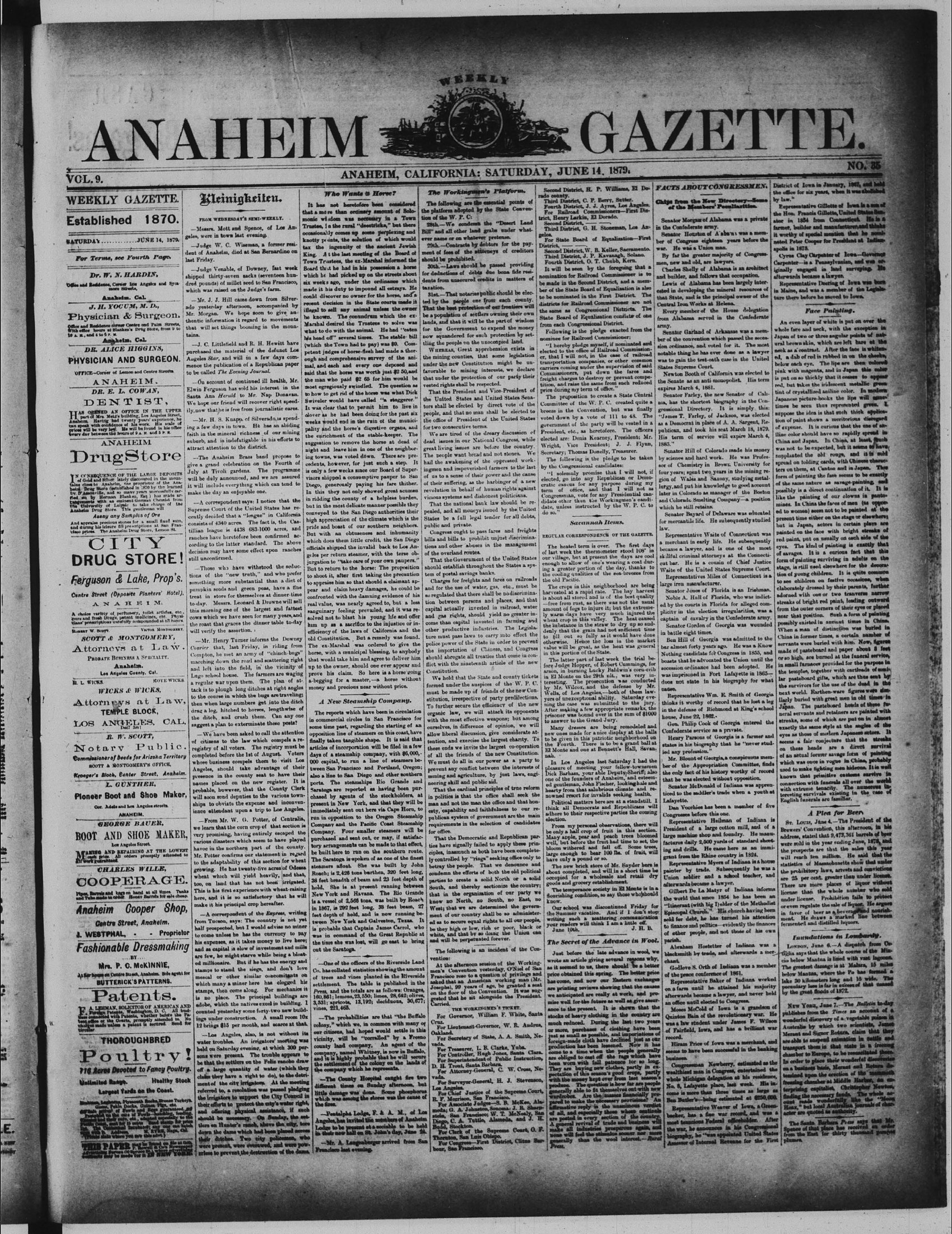
Searchable text
ANAHEIM
VOL. 9.
WEEKLY GAZETTE.
Established 1870.
SATURDAY...JUNE 14, 1870.
For Terms, see Fourth Page.
Dr. W. N. HARDIN,
Office and Residence, Corner Los Angeles and Sycamore Streets,
Anaheim, Cal.
J. H. YOCUM, M. D., Physician & Surgeon.
Office and Residence corner Centre and Palm Streets,
With office hours at Blanken's Drug Store, from 9 to 10 A.M., and 4 to 5 P.M.
Anaheim, Cal.
DR. ALICE HIGGINS,
PHYSICIAN AND SURGEON.
OFFICE—Corner of Lemon and Centre Streets.
ANAHEIM.
DR. E. L. COWAN,
DENTIST,
Has opened an office in the upper part of Mrs. Metta's building, Los Angeles Street, Anaheim. Having had twenty years' experience, he can speak with confidence of his work. His scale of prices will be very low. He will be found in his office every day between the hours of 9 A.M. and 5 P.M.
ANAHEIM
DrugStore
Kleinigkeiten.
FROM WEDNESDAY'S SEMI-WEEKLY.
Messrs. Mott and Spence, of Los Angeles, were in town last evening.
Judge W. C. Wiseman, a former resident of Anaheim, died at San Bernardino on last Friday.
Judge Venable, of Downey, fast week shipped thirty-seven sacks (seventeen hundred pounds) of millet seed to San Francisco, which was raised on the Judge's farm.
Mr. J. J. Hill came down from Silverado yesterday afternoon, accompanied by Mr. Morgan. We hope soon to give authentic information it regard to movements that will set things booming in the mountains.
J. C. Littlefield and R. H. Hewitt have purchased the material of the defunct Los Angeles Star, and will in a few days commence the publication of a Republican paper to be called The Evening Journal.
On account of continued ill health, Mr. Elwin Ferguson has sold his interest in the Santa Ana Herald to Mr. Nap Donavan. We hope our friend will recover right speedily, now that he is free from journalistic cares.
Mr. H. S. Knapp of Silverado, is spending a few days in town. He has an abiding faith in the mineral richness of our mining suburb, and is indefatigable in his efforts to attract attention to the district.
The Anaheim Braas band propose to Who Was It has not here that a more than or monic wisdom was Trustee, in the rural occasionally comes knotty points, the tax the ingenuity King. At the last m Town Trustees, the Board that he had in which he had picked six weeks ago, unda made it his duty to could discover no recent decision in the illegal to sell any be known. The co Marshal desired the what to do with the man who paid most egregiously swow to how to get rid of Swiveler would have It was clear that to olver as he had b weeks would end in pality and the horse the enrichment of suggestion to remove night and leave him ing towns, was voted
OFFICE—Corner of Lemon and Centre Streets.
ANAHEIM.
DR. E. L. COWAN,
DENTIST,
HAS OPENED AN OFFICE IN THE UPPER
part of Mrs. Metta's building, Los Angeles Street,
ANAheim. Having had twenty years' experience, he
can speak with confidence of his work. His scale of
prices will be very low. He will be found in his office
every day between the hours of 9 A.M. and 5 P.M.
ANAHEIM
DrugStore
IN CONSEQUENCE OF THE LARGE DEPOSITS
of Gold and Silver lately discovered in the mountains close to Anaheim, the proprietor of the Anabein Drug Store (established in 1870 by the learned
Dr. D'Amonville, and so many years successfully carried on by Herman Blanked Bee) has made artigements with an eminent German Chemist from
the University of Leipzig to take charge of the
ANAheim Drug Store. This gentleman will
Assay any Samples of Ore
And appraise precious stones for a small fixed sum,
and during his leisure fill prescriptions at San Franviso prices. The Anaheim Drug Store, Lemon St.
CITY DRUG STORE!
Ferguson & Lake, Prop's.
Centre Street (Opposite Planters' Hotel),
ANAHEIM.
A choice variety of perfumery, toilet articles, etc.
pure and fresh Drugs, patent medicines, etc. Physicians' prescriptions carefully compounded at all hours.
ROBERT W. SCOTT.
VICTOR MONTGOMERY.
SCOTT & MONTGOMERY,
Attorneys at Law.
PROBATE BUSINESS & SPECIALTY.
ANAheim.
Los Angeles County, Cal.
M. L. WICKS.
MOYE WICKS.
WICKS & WICKS,
Attorneys at Law,
TEMPLE BLOCK,
LOS ANGELES, CAL.
Dec 7 3am
R. W. SCOTT,
Notary Public.
Commissioner of Deeds for Arizona Territory
SCOTT & MONTGOMERY'S OFFICE,
Kroeger's Block, Center Street, Anaheim.
L. GUNTHER,
Pioneer Boot and Shoe Maker,
Ocr. Adela and los Angeles streets.
ANAHEIM.
GEORGE BAUER,
BOOT AND SHOE MAKER,
Los Angeles Street.
MAKING AND REPAIRING AT THE LOWEST
cash price. All orders promptly attended to
work guaranteed.
CHARLES WILLE,
mence the publication of a Republican paper
to be called The Evening Journal.
On account of continued ill health, Mr.
Elwin Ferguson has sold his interest in the
Santa Ana Herald to Mr. Nap Donavan.
We hope our friend will recover right speedily, now that he is free from journalistic cares.
Mr. H. S. Knapp, of Silverado, is spending a few days in town. He has an abiding faith in the mineral richness of our mining suburb, and is indefatigable in his efforts to attract attention to the district.
The Anaheim Brass band propose to give a grand celebration on the Fourth of July at Tivoli gardens. The programme will be duly announced, and we are assured it will include everything which can tend to make the day an enjoyable one.
A correspondent says: I notice that the Supreme Court of the United States has recently decided that a "league" in California consists of 4340 acres. The fact is, the Castillian league is 4438 683-1000 acres, and ranches have heretofore been confirmed according to the latter standard. The above decision may have some effect upon ranches still unconfirmed.
Those who have withstood the seductions of the "new truth," and who prefer something more substantial than a diet of pumpkin seeds and green peas, have a fine treat in store for themselves at dinner-time to-day. Messrs. Leonard & Drowne will sell this morning one of the largest and fattest cows which we have seen for many years, and the roast that graces the dinner table to-day will verify the assertion.
Mr. Henry Turner informs the Downey Courier that, last Friday, in riding from Compton, he met an army of "chinch-bugs" marching down the road and scattering right and left into the field, in the vicinity of Lugo school house. The farmers are waging a regular war upon them. The plan of attack is to plough long ditches at right angles to the course in which the bugs are traveling; then when large numbers get into the ditch drag a log, hitched to horses, lengthwise of the ditch, and crush them. Can any one suggest a plan to exterminate these pests?
We have been asked to call the attention of citizens to the law which compels a registry of all voters. The registry must be completed before the 1st of August. Voters whose business compels them to visit Los Angeles, should take advantage of their presence in the county seat to have their names placed on the new register. It is probable, however, that the County Clerk will soon send deputies to the various townships to obviate the expense and inconvenience attendant upon a trip to Los Angeles.
From Mr. W. G. Potter, of Centralia, we learn that the corn crop of that section is very promising, having entirely escaped the various disasters which seem to have played havoc in the northern part of the county. Mr. Potter confirms our statement in regard to the adaptability of this section for wheat growing. He has twenty-five acres of Odessa
L. GUNTHER,
Pioneer Boot and Shoe Maker,
Our Adela and Los Angeles streets.
GEORGE BAUER,
BOOT AND SHOE MAKER,
Los Angeles Street.
CHARLES WILLE,
COOPERAGE.
Pigens, Barrels and kegs on hand at all times. Tanks and Tubes made to order. Honey Barrels for sale cheap.
Anaheim Cooper Shop,
Centre Street, Anaheim.
J. WESTPHAL, - Proprietor
Fashionable Dressmaking
BY.
Mrs. P. C. McKINNIE,
At her house on Centre Street, Anaheim. Sole agent for BUTTERICK'S PATTERNS.
Patents.
F. A. LEHMAN, SOLICITOR OF AMERICAN AND Pursuit Patents. Washington, D.C. All businesses connected with Patents, whether before the Patent office or the Courts, promptly attended to. No charges made unless a patent is secured. Send for circular.
THOROUGHBRED
Poultry!
710 Acres Devoted to Fancy Poultry.
Unlimited Range. Healthy Stock
Largest Yards on the Coast.
THIS PAPER may be found on file at G.O.
Advertising Bureau (No Service St.) where advertising commences may be made for it in NEW YORK.
From Mr. W. G. Potter, of Centralia, we learn that the corn crop of that section is very promising, having entirely escaped the various disasters which seem to have played havoc in the northern part of the county. Mr. Potter confirms our statement in regard to the adaptability of this section for wheat growing. He has twenty-five acres of Odessa wheat which will yield heavily, and that, too, on land that has not been irrigated. This is his first experience with wheat-raising here, and it is so satisfactory that he will make it his principal crop hereafter.
A correspondent of the Express, writing from Tucson, says: The country is not yet half Prospected, but I would advise no miner to come unless he has the currency to pay his expenses, as it takes money to live here; and as capital is slow of investment and mills are few, he might starve while being a bloated millionaire. But if he has the energy and stamps to stand the siege, and don't love mescal or other similar concomitants on which many a miner here has clogged his stamps, then come along. For mechanics it is no place. The principal buildings are adobe, which the natives excel in building. I counted yesterday some forty-two new buildings under construction. A small room 10x12 brings $15 per month, and scarce at that.
Los Angeles, also, is not without its water troubles. An irrigator's meeting was held on Saturday evening, at which 300 persons were present. The trouble appears to be that the settlers on the Feliz rancho draw off a large quantity of water (which they claim they have a right to do), to the detriment of the city irrigators. At the meeting referred to, a resolution was passed pledging the irrigators to support the City Council in their efforts to protect the city's water right, and offering physical assistance, if such should be necessary. On Sunday, the settlers on Hunter's ranch, above the city, turn down the dams which had been placed across their ditches. Two city policemen, who were present, were overawed, and were powerless to prevent the destruction of the dama.
ANAHEIM, CALIFORNIA: SATURDAY, JUNE 14, 1879.
Who Wants to Horse?
It has not heretofore been considered that a more than ordinary amount of Solomonic wisdom was necessary in a Town Trustee, in the rural "deestricks," but there occasionally comes up some perplexing and knotty points, the solution of which would tax the ingenuity of the ancient Jewish King. At the last meeting of the Board of Town Trustees, the ex-Marshal informed the Board that he had in his possession a horse which he had picked up on the streets about six weeks ago, under the ordinance which made it his duty to impound all estrays. He could discover no owner for the horse, and a recent decision in the State courts made it illegal to sell any animal unless the owner be known. The conundrum which the ex-Marshal desired the Trustees to solve was what to do with the animal. He had "eaten his head off" several times. The stable bill (which the Town had to pay) was $0. Competent judges of horse-flesh had made a thorough and comprehensive survey of the animal, and each and every one deposed and said that the horse was worth just $250, and the man who paid $265 for him would be most egregiously swindled. The question as to how to get rid of the horse was what Dick Swiveler would have called "a staggerer." It was clear that to permit him to live in clover as he had been doing for the past six weeks would end in the ruin of the municipality and the horse's digestive organs, and the enrichment of the stable-keeper. The suggestion to remove the horse at dead of night and leave him in one of the neighboring towns, was voted down. There are pre-
The Workingmen's Platform.
The following are the essential points of the platform adopted by the State Convention of the W. P. C:
28th.—We condemn the "Desert Land Bill" and all other land grabs under whatever name or on whatever pretense.
29th.—Contracts by debtors for the payment of fees of the attorneys of creditors should be prohibited.
30th.—Laws should be passed providing for deductions of debts due bona fide residents from unsecured credits in matters of taxation.
31st.—That notaries public should be elected by the people one from each county. That the best protection of our frontiers will be a population of settlers owning their own lands, and that it will be the part of wisdom for the Government to expend the money now squandered for such protection by settling the people on the unoccupied land.
Whereas, Great apprehension exists in the mining counties, that some legislation under the new Constitution might be unfavorable to mining interests, we declare that under the protection of our party theirvested rights shall be respected.
That the President and Vice-President of the United States and United States Senators shall be elected by direct vote of the people, and that no man shall be elected to the office of President of the United States for two consecutive terms.
We are tired of the dreary discussion of dead issues in our National Congress, while great living issues are before the country. The people want bread and not stones. We Second District, H. P. Williams, El Dorado county.
Third District, C. P. Berry, Sutter.
Fourth District, J. J. Ayres, Los Angeles.
For Railroad Commissioners—First District, Henry Larkin, El Dorado.
Second District, _____
Third District, G. H. Stoneman, Los Angeles.
For State Board of Equalization—First District, _____
Second District, W. B. Keller, Sacramento.
Third District, J. P. Kavanagh, Solano.
Fourth District, O. T. Chubb, Kern.
It will be seen by the foregoing that a nomination for Railroad Commissioner is to be made in the Second District, and a member of the State Board of Equalization is also to be nominated in the First District. The districts for Railroad Commissioner are not the same as Congressional Districts. The State Board of Equalization consists of one from each Congressional District.
Following is the pledge exacted from the nominee for Railroad Commissioner:
"I hereby pledge myself, if nominated and elected to the office of Railroad Commissioner, that I will not, in the case of railroad transportation companies, or other common carriers coming under the supervision of said Commissioners, put down the fares and freight charges to destroy or prevent competition, and raise the same from such reduced price during my term of office."
The proposition to create a State Central Committee of the W. P. C. created quite a breeze in the Convention, but was finally voted down by a vote of 111 to 48. The government of the party will be vested in a President, etc., as heretofore. The officers elected are: Denis Kearney, President; Mr. Wright, Vice President; J. J. Flynn, Secretary; Thomas Donelly, Treasurer.
The following is the pledge to be taken
A New Steamship Company.
The reports which have been in circulation in commercial circles in San Francisco for some time past, regarding the starting of an opposition line of steamers on this coast, have finally taken tangible shape. It is said that articles of incorporation will be filed in a few days of a steamship company, with $6,000,000 capital, to run a line of steamers between San Francisco and Portland, Oregon; also a line to San Diego and other southern ports. The steamships Rio Grande and Saratoga are reported as having been purchased by agents of the stockholders, at present in New York, and that they will be immediately sent out here via Cape Horn, to run in opposition to the Oregon Steamship Company and the Pacific Coast Steamship Company. Four smaller steamers will be purchased and sent out, or may, if satisfactory arrangements can be made to that effect, be built here to run on the southern route. The Saratoga is spoken of as one of the finest steamers afloat. She was built by John Dewney from much-bugs” during right timing of vicinity of mere waging man of at night angles travelling; at the ditch otherwise of any one pests?
Regular correspondence of the Gazette.
The heated term is over. The first days of last week the thermometer stood 108° in our village, but at present the days are cool enough to allow of one's wearing a coat during a greater portion of the day, thanks to the cooling qualities of the sea-breezes from the old Pacific.
The crops in this neighborhood are being harvested at a rapid rate. The hay harvest is about all stored and is of the best quality—free from rust, as there was not the usual amount of fogs to injure it; but the extremely warm days have very much injured the wheat crop in this valley. The heat caused the substance in the straw to dry up so suddenly that the grain had not sufficient time to till out so fully as it would have done otherwise. Hence the loss in the market value will be great, as the heat was general in this portion of the State.
The latter part of last week the trial before Judge Hopper, of Robert Cummings, for arson, in burning Lucky Baldwin's corn-crib in El Monte on the 29th ntl., was very interesting. The prosecution was conducted by Mr. Wilcox, and the defense by Mr. Wells, of Los Angeles,—both of them lawyers of unexceptional ability. Saturday evening the case was submitted to the jury. After making a few appropriate remarks, the prisoner was bound over in the sum of $1000 to answer to the Grand Jury.
Many dresses are being remodeled and new ones made for a nice display at the balls to be given in this patriotic neighborhood on the Fourth. There is to be a grand ball at El Monte and one at Bennett's Hall, Savannah.
In Los Angeles last Saturday I had the pleasure of meeting your fellow-townmen Dick Barham, your able Deputy Sheriff; also one of the founders of Anaheim, and esteemed gentleman, John Fischer, looking hale and hearty from that salubrious climate and renowned resort for invalids seeking health.
Political matters here are at a standstill. I think all Democrats and Republicans will adhere to their respective parties the coming election.
From my personal observations, there will be only a half crop of fruit in this section. Many apple, pear and peach trees bloomed well, but before the fruit had time to set, the bloom withered and fell off. Some trees large enough to bear 100 lbs. of fruit will have only a pound or so.
The new brick store of Mr. Snyder here is about completed, and will in a short time be under the new Constitution might be unfavorable to mining interests, we declare that under the protection of our party theirvested rights shall be respected.
That the President and Vice-President of the United States and United States Senators shall be elected by direct vote of the people, and that no man shall be elected to the office of President of the United States for two consecutive terms.
We are tired of the dreary discussion of dead issues in our National Congress, while great living issues are before the country. The people want bread and not stones. We hail the awakening of the oppressed workingmen and impoverished farmers to the last us to a sense of their power and the cause of their suffering, as the harbinger of a new revolution in behalf of human rights against vicious systems and dishonest politicians.
That the national bank law should be repealed, and all moneys issued by the United States be a full legal tender for all debts, public and private.
Congress ought to pass fares and freights bills and bills to prohibit unjust discriminations and other abuses in the management of the overland routes.
That the Government of the United States should establish throughout the States a system of postal savings banks.
Charges for freights and fares on railroads and for the use of water, gas, etc., must be so regulated that there shall be no discrimination between persons and places, and that capital actually invested in railroad, water and gas rights, should yield no greater income than capital invested in farming and other productive industries. The Legislature must pass laws to carry into effect the police power of the State in order to prevent the importation of Chinese, and Congress should abrogate all treaties that come in conflict with the nineteenth article of the new Constitution.
We hold that the State and county tickets formed under the auspices of the W. P. C. must be made up of friends of the new Constitution, irrespective of party predilections. To further secure the efficiency of the new organic law, we will attack its opponents with the most effective weapons; but among ourselves, in difference of opinion, we will allow liberal discussion, give considerate attention, and exercise the largest charity. To these ends we invite the largest co-operation of all the friends of the new Constitution. We must do all in our power as a party to prevent any conflict between the interests of mining and agriculture, by just laws, engineering skill and public aid.
That the cardinal principles of true reform in politics is that the office shall seek the man and not the man the office and that honesty, capability and faithfulness to our republican system of government are the main requirements in the selection of candidates for office.
That the Democratic and Republican parties have signally failed to apply these principles, insinuas both have been completely controlled by “rings” seeking office only to betray the people. That we denounce and affords to both the old political efforts.
One of the officers of the Riverside Land Co. has collated statistics showing the amount of trees and vines planted in the Riverside settlement. The table is published in the Press, and the totals are as follows: Oranges, 160,861; lemons, 23,550; limes, 28,642; olives, 3,531; apricots, 13,192; deciduous, 30,677; vines, 221,465.
The probabilities are that "the Buffalo colony," which we, in common with many of our citizens, had hoped would settle in this vicinity, will be "corralled" by a Fresno county land company. An agent of the company, named Whitney, is now in Buffalo, and it is highly probable that he will secure the settlement of the colony on the lands of the company which he represents.
The County Hospital caught fire two different times on Sunday afternoon, but little damage was done. Some phosphorus which was among the stores was the cause of the fires.
Pentalpha Lodge, F. & A. M., of Los Angeles, has invited the members of Anaheim Lodge to be present at a sociable to be held in their new hall on St. John's day, June 24.
Mr. A. Langenberger arrived from San Francisco last evening.
That the cardinal principles of true reform in politics is that the office shall seek the man and not the man the office and that honesty, capability and faithfulness to our republican system of government are the main requirements in the selection of candidates for office.
That the Democratic and Republican parties have signally failed to apply these principles, inasmuch as both have been completely controlled by "rings" seeking office only to betray the people. That we denounce and condemn the efforts of both the old political parties to create a solid North or a solid South, and thereby sectionize the country; that in the organization of our party we know no North, no South, no East, no West; that we are determined the government of our country shall be so administered as to secure equal rights to all our people, be they high or low, rich or poor, black or white, and that by so doing the Union can and will be perpetuated forever.
The following is an incident of the Convention:
At the afternoon session of the Workingmen's Convention yesterday, O'Niel of San Francisco rose to a question of privilege and asked that an American working man (Mr. Josephs), 99 years of age, be granted a seat on the floor of the Convention. It was suggested that he sit alongside the President. Carried.
THE WORKINGMEN'S TICKET.
For Governor, William F. White, Santa Cruz.
For Lieutenant-Governor, W. R. Andrus, Oakland.
For Secretary of State, A. A. Smith, Nevada.
For Treasurer, L. B. Clarke, Yuba.
For Controller, Hugh Jones, Santa Clara.
For Superintendent of Public Instruction, D. H. Trout, Santa Barbara.
For Attorney-General, C. W. Cross, Nevada.
For Surveyor-General, H. J. Stevenson, Los Angeles.
For Chief Justice of the Supreme Court, R. F. Morrison, San Francisco.
For Associate Judges—S. B. McKee, Alameda; G. A. Johnston, Sonoma; J. R. Sharpstein, San Francisco; W. T. McNealy, San Diego; C. A. Tuttle, Alameda, and J. H. Budd, Stockton.
For Clerk of the Supreme Court, O. F. Theruton, San Luis Obispo.
For Congress—First District, Clitna Barbour, San Francisco.
Just before the late advance in wool, we wrote an article giving several reasons why, as it seemed to us there should be a better price obtained this spring. The better price has come, and now our Eastern exchanges are printing reviews showing that the causes we anticipated are really at work, and promise well for the future as well as give assurance to the present. It is shown that the stocks of heavy clothing in the country are much reduced. During the last two years or more, purchases of clothing have been just as small as possible, and importations of foreign-made cloth have declined just as our production has been lessened. Now it has come to a time when the people generally are obliged to cast off the rags which have been worn with full patience for so long. They are buying new clothes partly in expectation of this season's good crops, partly with the money kept over from last season's produce. The question is how far are people generally able to fit themselves out with new wardrobes. Are the masses financially prepared to make the necessary provisions? An affirmative reply is the unanimous verdict of all, and especially those whose sentiments are posted in every section of the country. A general revival of trade and business will make all industries prosperous again, and none will feel the stimulus sooner nor more generally than the wool interest—Rural Press.
GAZETTE.
4. 1879.
FACTS ABOUT CONGRESSMEN.
Chips from the New Directory—Some of the Members' Peculiarities.
Senator Morgan of Alabama was a private in the Confederate army.
Senator Houston of Alabama was a member of Congress eighteen years before the war. He was a Union man.
By far the greater majority of Congressmen, new and old, are lawyers.
Charles Shelly of Alabama is an architect and builder, and follows that occupation.
Lewis of Alabama has been largely interested in developing the mineral resources of that State, and is the principal owner of the Central Iron Works at Helena.
Every member of the House delegation from Alabama served in the Confederate army.
Senator Garland of Arkansas was a member of the convention which passed the secession ordinance, and voted for it. The most notable thing he has ever done as a lawyer was to gain the test-oath case in the United States Supreme Court.
Newton Booth of California was elected to the Senate as an anti-monopolist. His term expires March 4, 1881.
Senator Farley, the new Senator of Calhoun, has the shortest biography in the Congressional Directory. It is simply this: "James T. Farley, of Jackson, was elected as a Democrat in place of A. A. Sargent, Republican, and took his seat March 18, 1879. His term of service will expire March 4, 1885."
District of Iowa in January, 1867, and held the office for six years, when it was abolished by law."
Representative Gillette of Iowa is a son of the Hon. Francis Gillette, United States Senator in 1834 from Connecticut. He is a farmer, builder and manufacturer, and thinks it worthy of special mention that he nominated Peter Cooper for President at Indianapolis in 1875.
Cyrus Clay Carpenter of Iowa—Governor Carpenter—is a Pennsylvanian, and was originally engaged in land surveying. He afterwards became a lawyer.
Representative Deering of Iowa was born in Maine, and was a member of the Legislature there before he moved to Iowa.
Face Painting.
An even layer of white is put on over the whole face and neck, with the exception in Japan of two or three angular points of natural brown skin, which are left bare at the neck as a contrast. After the face is whitened, a dab of red is rubbed in on the cheeks below each eye. The lips are then colored pink with magenta, and in Japan this color is put on so thickly that it ceases to appear red, but takes the iridescent metallic green tint of crystallized aniline color. In modern Japanese picture-books the lips will sometimes be seen thus represented green. I suppose the idea is that such thick application of paint shows a meritorious disregard of expense. It is curious that the use of aniline color should have so rapidly spread in China and Japan. In China, at least, Such was not to be expected, but it seems to have supplanted the old rouge, and it is sold
Create a State Central
P. C. created quite a
rection, but was finally
of 111 to 48. The
terry will be vested in a
retrofore. The officers
Barney, President; Mr.
Student; J. J. Flynn,
Nelly, Treasurer.
The pledge to be taken
candidates:
Case that I will not, if
Republican or Democrat purpose during my
that I will not as any Presidential canWorkingmen's candid
by the W. P. C. to
Shah Items,
ENCE OF THE GAZETTE.
Over. The first days
monometer stood 108° in
the days are cool
in the wearing a cost durof the day, thanks to
of the sea-breezes from
Neighborhood being being state. The hay harvest
is of the best quality
there was not the usual
sure it; but the extremevery much injured the
Valley. The heat caused
straw to dry up so sudhad not sufficient time
as it would have done
the loss in the market
as the heat was general
State.
Last week the trial befid Robert Cummings, for
Rocky Baldwin's corn-crib
9th nlt., was very insecution was conducted
the defense by Mr.
Messas—both of them lawability. Saturday evensubmitted to the jury.
Appropriate remarks, the
over in the sum of $1000
and Jury.
Being remodeled and
service display at the balls
attriotic neighborhood on
is to be a grand ball at
Bennett's Hall, Savan-
Last Saturday I had the
your fellow-townmen
table Deputy/Sheriff; also
of Anaheim, and esteemFischer, looking hale and
abrarious climate and revalids seeking health.
There are at a standstill. I
and Republicans will
active parties the coming
Observations, there will
of fruit in this section.
And peach trees bloomed
fruit had time to set, the
fall off. Some trees,
ear 100 ft. of fruit, will
so.
Of Mr. Snyder here is
will in a short time be
States Supreme Court.
Newton Booth of California was elected to
the Senate as an anti-monopolist. His term expires March 4, 1881.
Senator Farley, the new Senator of Calinia, has the shortest biography in the Congresional Directory. It is simply this:
"James T. Farley, of Jackson, was elected as a Democrat in place of A. A. Sargent, Republican, and took his seat March 18, 1879. His term of service will expire March 4,
1885."
Senator Hill of Colorado made his money by science and hard work. He was Professor of Chemistry in Brown University for four years; spent two years in the mining regiion of Wales and Saxony, studying metallurgy, and put his knowledge to good account later in Colorado as manager of the Boston and Colorado Smelting Company—a position which he still retains.
Senator Bayard of Delaware was educated for mercantile life. He subsequently studied law.
Representative Waite of Connecticut was a merchant in early life. He subsequently became a lawyer, and is one of the most skillful criminal attorneys at the Connecticut bar. He is a cousin of Chief Justice Waite of the United States Supreme Court.
Representatives Miles of Connecticut is a large iron manufacturer.
Senator Jones of Florida is an Irishman.
Noble A. Hull of Florida, who was indicted by the courts in Florida for alleged complicity in the election irregularities, was a captain of cavalry in the Confederate army.
Senator Gordon of Georgia was wounded in battle eight times.
Ben Hill of Georgia was admitted to the bar almost forty years ago. He was a Know Nothing candidate for Congress in 1855, and boasts that he advocated the Union until the secession ordinance had been adopted. He was imprisoned in Fort Lafayette in 1865—doos not state in his biography for what cause.
Representative Wm. E. Smith of Georgia thinks it worthy of record that he lost a leg in the defense of Richmond at King's school house, June 22, 1862.
Gen. Philip Cook of Georgia entered the Confederate service as a private.
Henry Parsons of Georgia is a farmer and states in his biography that he "never studied any profession."
Mr. Blount of Georgia, a conspicuous member of the Appropriation Committee, finds the only fact of his history worthy of record that he was elected without opposition.
Senator McDonald of Indiana was appreniced to the saddler's trade when a youth at Lafayette.
Dan Voorhies has been a member of five Congresses before this one.
Representative Heilman of Indiana is President of a large cotton mill, and of a large machine shop and foundry. He manufactures daily 2,500 yards of standard sheeting and drills. He came here as an immigrant from the Rhine country in 1824.
Representative Myers of Indiana is a house painter by trade. Subsequently he was a below each eye. The tips are then colored pink with magenta, and in Japan this color is put on so thickly that it ceases to appear red, but takes the iridescent metallic green tint of crystallized aniline color. In modern Japanese picture-books the lips will sometimes be seen thus represented green. I suppose the idea is that such thick application of paint shows a meritorious disregard of expense. It is curious that the use of aniline color should have so rapidly spread in China and Japan. In China, at least, such was not to be expected, but it seems to have supplanted the old rouge, and it is sold spread on folding cards, with Chinese characters on them, at Canton and in Japan. This form of painting the face seems to be exactly of the same nature as savage-painting, and possibly is a direct continuation of it. It is like the painting of our clowns in pantomines. In China the faces of men (as opposed to women) seem not to be painted at the present time either on the stage or elsewhere but in Japan, actors in certain plays are painted on the face with bright streaks of red paint, put on usually on each side of the eyes. The kind of painting is exactly that of savages. It is a curious fact that this form of painting surviving in adults on the stage, is still used elsewhere for the decoration of young children. It is quite common to see children on festive occasions, when elaborately dressed by their parents, further adorned with one or two tranverse narrow streaks of bright red paint, leading outward from the outer corners of their eyes or placed near that position. Such a form of painting possibly existed in ancient times in China. When a man of distinction was buried in China in former times, a certain number of servants were buried with him. Now, figures made of pasteboard and paper about 8 feet or so high, are burned at the funeral service, in small furnaces provided for the purpose in the temples, together with cartloads of similar pasteboard gifts, which are thus sent by the survivors for the use of the dead in the next world. Earthen-ware figures are similarly buried with great men in old times in Japan. The pasteboard heads of these funeral servants and retainers are painted with streaks, some of which are put on in almost exactly the same style at the angles of the eyes as those of modern Japanese actors. It seems a fair conjecture that the streaks on these heads are a direct survival of an actual former savage form of painting which was once in vogue in China, probably used to make fighting men hideous. It is well known that primitive customs survive in connection with funerals all over the world with extreme tenacity. The numerous interesting survivals existing in the case of English funerals are familiar.
A Plea for Beers
St. Louis, June 4—The President of the Brewers' Convention, this afternoon, in his address, stated that 9,473,361 barrels of beer were sold in the year ending June, 1878, and the prospects are that the sales this year will reach ten million. He said that the statistics of Massachusetts show that under the prohibitory laws, arrests and convictions
Senator McDonald of Indiana was apprenticed to the saddler's trade when a youth at Lafayette.
Dan Voorhies has been a member of five Congresses before this one.
Representative Heilman of Indiana is President of a large cotton mill, and of a large machine shop and foundry. He manufactures daily 2,500 yards of standard sheeting and drills. He came here as an immigrant from the Rhine country in 1824.
Representative Myers of Indiana is a house painter by trade. Subsequently he was a Union soldier and a school teacher, and afterwards became a lawyer.
Gilbert De La Matyr of Indiana informs the world that since 1854 he has been an "Itinerant (with big I) elder of the Methodist Episcopal Church." His church having been sold for debt, he has turned his attention to finance and politics—evidently the finances of other people, and not those of his own parish.
Abraham Hostetter of Indiana was a blacksmith by trade, and afterwards a merchant.
Godlove S. Orth of Indiana was a member of the peace conference of 1861.
Representative Baker of Indiana worked on a farm until he attained his majority afterwards became a lawyer, and never held an office until elected to Congress.
Moses McCold of Iowa is a grandson of Quinton Bain of the revolutionary war. He was a law student under James P. Wilson of Fairfield, Iowa, and has a brilliant war record.
Hiram Price of Iowa was a merchant, and seems to have been successful in the banking business.
Congressman Newberry, estimated as the wealthiest man in Congress, entertained the whole Michigan delegation at his residence, No. 8, Lafayette place, last week. His income is more than three times as large as Ben Butler's—being estimated at $250,000.
Representative Weaver of Iowa, a Greenbacker, has a fine war record, and was a most tenacious Federal officerholder. After the war, he announces in his Congressional biography, he "was appointed United States Assessor of Internal Revenue for the First known that primitive customs survive in connection with funerals all over the world with extreme tenacity. The numerous interesting survivals existing in the case of English funerals are familiar.
A Plea for Beer
St. Louis, June 4.—The President of the Brewers' Convention, this afternoon, in his address, stated that 9,473,361 barrels of beer were sold in the year ending June, 1878, and the prospects are that the sales this year will reach ten million. He said that the statistics of Massachusetts show that under the prohibitory laws, arrests and convictions are 25 per cent. greater than under license. There are more places of liquor without license than the whole number who sold under license. Prohibition fails to protect or even regulate the sale of liquor. He argues in favor of beer as a beverage and nourishment. He draws a marked line between fermented and distilled liquors.
Inundations in Lombardy.
London, June 6.—A dispatch from Onglia says that the whole course of the Mincio below Mantua is lined with vast lagoon. The greatest damage is at Malara, 15 miles below Mantua, where the Po has formed a lake 30 kilometers long and 15 wide. The peculiar loss is far in excess of that caused by the great floods of 1872.
New York, June 7.—The Bulletin to-day publishes from the Times an account of a wonderful discovery of a vegetable poison in Australia by which two scientists, James Merant and Signor Rotura, claim that they are able to suspend animation in cattle and transport them in that state in a freezing chamber to Europe, to be resuscitated there. In order to place their wonderful discoveries on a business basis, Merant and Rotura determined upon the erection of the mammoth framing chamber at Middle Harbor, an enterprising capitalist, Christopher Newton, finding the necessary funds. The whole amount reads wonderfully like the "Moan Hoax," but local Australian journals of character are quoted as authority.
The Santa Barbara Press says that Mr. Spencer of that place has received an order from the East for thirty thousand pumps plums.