anaheim-gazette 1879-04-12
Scanned page
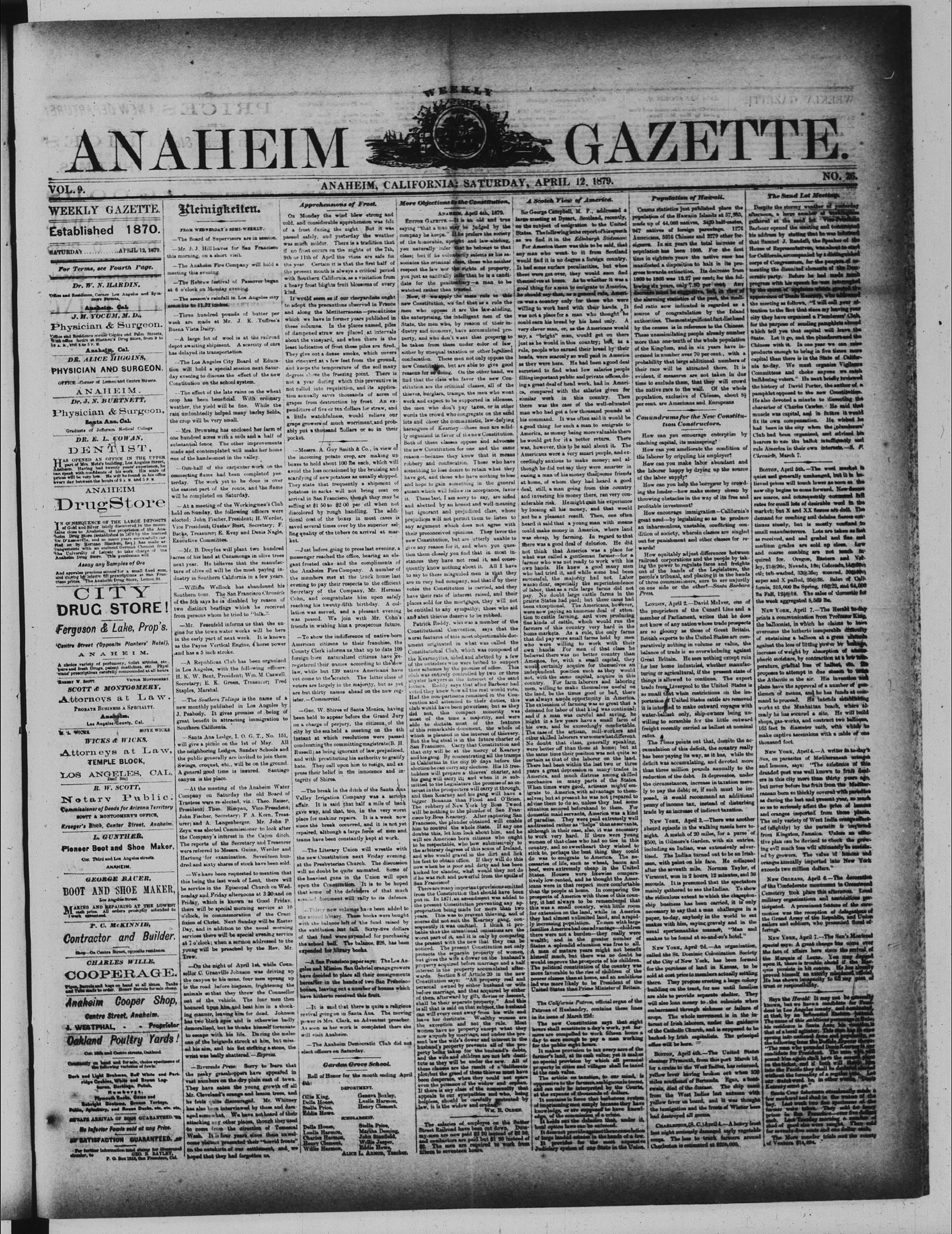
Searchable text
ANAHEIM
VOL. 9.
WEEKLY GAZETTE.
Established 1870.
SATURDAY...APRIL 12, 1879.
For Terms, see Fourth Page.
Dr. W. N. HARDIN,
Office and Residence, Corner Los Angeles and Sycamore Streets.
ANAHEIM, Cal.
J. H. YOCUM, M. D., Physician & Surgeon.
Office and Residence corner Capra on Palm Streets.
With office hotels at Hanken's Drug Store, from 9 to 10 A.M., until 5 P.M.
ANAHEIM, Cal.
DR. ALICE HIGGINS,
PHYSICIAN AND SURGEON.
OFFICE—Corner of Lemon and Centre Streets.
ANAHEIM.
Dr. J. N. BURTNETT,
Physician & Surgeon,
Santa Ana, Cal.
Graduate of Jefferson Medical College
DR. E. L. COWAN,
DENTIST,
STAR OPENED AN OFFICE IN THE UPPER
Kleinigkeiten.
FROM WEDNESDAY'S SEMI-WEEKLY.
The Board of Supervisors are in session.
Mr. J. J. Hill leaves for San Francisco this morning, on a short visit.
The Anaheim Fire Company will hold a meeting this evening.
The Hebrew festival of Passover began at 6 o'clock on Monday evening.
The season's rainfall in Los Angeles city amounts to 11.52 inches.
Three hundred pounds of butter per week are made at Mr. J. K. Tuffree's Buena Vista Dairy.
A large lot of wool is at the railroad depot awaiting shipment. A scarcity of cars has delayed its transportation.
The Los Angeles City Board of Education will hold a special session next Saturday evening to discuss the effect of the new Constitution on the school system.
The effect of the late rains on the wheat crop has been beneficial. With ordinary weather, the yield will be fine. While the rain undoubtedly helped many barley fields, the crop will be very small.
Mrs. Browning has enclosed her farm of one hundred acres with a mile and a half of substantial fence. The other improvements made and contemplated will make her home one of the handsome in the valley.
Apprehensions of
On Monday the wind blew cold, and considerable apprehension of a frost during the night passed safely, and yesterday was much milder. There is if no frost occurs on the night 9th or 11th of April the view the year. Certain it is that the present month is always with Southern California, as a heavy frost blights fruit blue kind.
It would seem as if our vision to adopt the precautions observed along the Mediterranean which we have in former years these columns. In the place of dampened straw are placed about the vineyard, and when least indication of frost these They give out a dense smoke the vineyard at a few feet fright and keeps the temperature degrees above the freezing not a year during which it not called into requisition, tion annually saves thousands grapes from destruction by penditure of five or ten dollars a little watchfulness, wo grape growers of much workably put a thousand dollars pocket.
Messrs. A. Guy Smith the incoming potato crop.
PHYSICIAN AND SURGEON.
OFFICE - Corner of Lemon and Centre Streets.
ANAHEIM.
Dr. J. N. BURTNETT,
Physician & Surgeon,
Santa Ana, Cal.
Graduate of Jefferson Medical College.
DR. E. L. COWAN,
DENTIST,
HAS OPENED AN OFFICE IN THE UPPER part of Mrs. Metra's building, Los Angeles Street, Anaheim. Having had twenty years' experience, he can speak with confidence of his work. His scale of prices will be very low. He will be found in his office every day between the hours of 9 A.M. and 5 P.M.
ANAHEIM
Drug Store
IN CONSEQUENCE OF THE LARGE DEPOSITS OF Gold and Silver lately discovered in the mountains close to Anaheim, the proprietor of the Anaheim Drug Store (established in 1870 by the learned Dr. D. Amontille, and so many years successfully carried on by Herman Blanken, Esq.) has made arrangements with an eminent German Chemist from the University of Leipzig to take charge of the Anaheim Drug Store. This gentleman will Assay any Samples of Ore And appraise precious stones for a small fixed sum, and during his leisure fill prescriptions at San Francisco prices. The Anaheim Drug Store, Lemon St.
CITY DRUG STORE!
Ferguson & Lake, Prop's.
Centre Street (Opposite Planters' Hotel),
ANAHEIM.
A choice variety of perfumery, toilet articles, etc., pure and fresh Drugs, patent medicines, etc. Physicians prescriptious carefully compounded at all hours.
ROBERT W. SCOTT.
VICTOR MONTGOMERY.
SCOTT & MONTGOMERY,
Attorneys at Law.
PROBATE BUSINESS A SPECIALTY.
ANAHEIM,
Los Angeles County, Cal.
M. L. WICKS.
MOYE WICKS.
WICKS & WICKS,
Attorneys at Law,
TEMPLE BLOCK,
LOS ANGELES, CAL.
Dec 31st
R. W. SCOTT,
Notary Public.
Commissioner of Deeds for Arizona Territory
SCOTT & MONTGOMERY'S OFFICE,
Kroeger's Block, Center Street, Anaheim.
L. GUNTHER,
Pioneer Boot and Shoe Maker,
Cor. Third and Los Angeles streets.
ANAHEIM.
The Los Angeles City Board will hold a special session next Saturday evening to discuss the effect of the new Constitution on the school system.
The effect of the late rains on the wheat crop has been beneficial. With ordinary weather, the yield will be fine. While the rain undoubtedly helped many barley fields, the crop will be very small.
Mrs. Browning has enclosed her farm of one hundred acres with a mile and a half of substantial fence. The other improvements made and contemplated will make her home one of the handsome in the valley.
One-half of the carpenter work on the connecting flume had been completed yesterday. The work yet to be done is over the easiest part of the route, and the flume will be completed on Saturday.
At a meeting of the Workingmen's Club held on Sunday, the following officers were elected: John Fischer, President; H. Werder, Vice President; Gustav Rust, Secretary; F. Backs, Treasurer; E. Evey and Denis Nagle, Executive Committee.
Mr. B. Dreyfus will plant two hundred acres of his land at Cucamonga in olive trees next year. He believes that the manufacture of olive oil will be the most paying industry in Southern California in a few years.
William Wellock has abandoned his Southern tour. The San Francisco Chronicle of the 5th says he is disabled by reason of two distinct beatings which he received from persons whom he tried to "bulk."
Mr. Fesenfeld informs us that the engine for the town water works will be here in the early part of next week. It is known as the Payne Vertical Engine, four horse power and has a 5 inch stroke.
A Republican Club has been organized in Los Angeles, with the following officers: H. K. W. Bent, President; Wm. M. Caswell, Secretary; E. K. Green, Treasurer; Fred Staples, Marshal.
The Southern Tulings is the name of a new monthly published in Los Angeles by J. Peabody. It gives promise of being of great benefit in attracting immigration to Southern California.
Santa Ana Lodge, I. O. G. T., No. 151, will give a picnic on the 1st of May. All the neighboring Lodges, Sunday Schools and the public generally are invited to join them Swings, croquet, etc., will be on the ground. A general good time is insured. Santiago canyon is the place.
At the meeting of the Anaheim Water Company on Saturday the old Board of Trustees were re-elected, viz.: Theo. Reiser, President; Theo. Rimpau, Vice-President; John Fischer, Secretary; F. A. Korn, Treasurer; and A. Langenberger. Mr. John P. Zeyn was elected Commissioner to look after the Company's interest in the Cajon ditch. The reports of the Secretary and Treasurer were referred to Messrs. Guinn, Werder and Hartung for examination. Seventeen hundred and sixty shares of stock have been sold.
Messrs. A. Guy Smith is the incoming potato crop, boxes to hold about 100 lb., avoid the loss occasioned by scarifying of new potatoes and They state that frequently potatoes in sacks will not arrive in San Francisco, thus discolored by rough handling or tional cost of the boxes saved several times over by ling quality of the tubers ocket.
Just before going to press messenger reached the office giant frosted cake and they the Anaheim Fire Company members met at the evening to pay their reservation of the Company Cohn, and congratulate reaching his twenty-fifth lation was served, and a was passed. We join friends in wishing him a
To show the indifference American citizens to the County Clerk informs us that foreign born naturalized registered their names as law, while but 139 native vet come to the scratch voters are largely in the area but thirty names abbreviate.
Geo. W. Shires of Santa Been held to appear before on a charge of perjury, city by the sea held an instant at which resolved condemning the committee Russell) as being ignorant and with prostituting his hate. They call upon him press their belief in the integrity of Shirez.
The break in the Valley Irrigation Company affair. It is said that gave way, and that, too, place for making repairs since the break occurred repaired, although a large teams have been constant.
The Literary Union at the Presbyterian Church will no doubt be quite
R. W. SCOTT,
Notary Public.
Commissioner of Deeds for Arizona Territory
SCOTT & MONTGOMERY'S OFFICE,
Kroeger's Block, Center Street, Anaheim.
L. GUNTHER,
Pioneer Boot and Shoe Maker,
Con. Third and Los Angeles streets.
ANAHEIM.
GEORGE BAUER,
BOOT AND SHOE MAKER,
Los Angeles Street.
MAKING AND REPAIRING AT THE LOWEST
cash price. All orders promptly attended to
I work unanticipated.
P. C. McKINNIE,
Contractor and Builder.
Shop—On Centre Street, opposite residence.
CHARLES WILLE,
COOPERAGE.
Pipe, Barrels and bags on hand at all times. Tanks
and Tubes made to order. Honest Barrels for sale cheap.
Anaheim Cooper Shop,
Centre Street, Anaheim.
J. WESTPHAL, - Proprietor
Oakland Poultry Yards!
Our 10th and Centre streets, Oakland.
Commonly on hand and for sale, choice specimens of
the following variation of fowls:
Dark and Light Brahms, Bell White and Partridge Cochine, White and Brown Leghorns, Dorsalings, Polish,
Hemburgt.
Plymouth Reckn, Game and
Sabright Bentama, Bronze Turkeys,
Pohin, Aphibury, and Rosen Ducks, etc., etc., etc.
SAFE ARRIVAL OF EOOS QUARANTEED.
No Inferior Fowls sold at any Price.
SATISFACTION GUARANTEED.
For further information send stamp for illustrated circular, to
GEO. R. BAYLEY,
P. O. Box 1215, San Francisco, Cal.
At the meeting of the Anaheim Water
Company on Saturday the old Board of
Trustees were re-elected, viz.: Theo. Reiser,
President; Theo. Rimpau, Vice-President;
John Fischer, Secretary; F. A. Korn, Treasurer;
and A. Langenberger. Mr. John P.
Zeyn was elected Commissioner to look after
the Company's interest in the Cajon ditch.
The reports of the Secretary and Treasurer
were referred to Messrs. Guinn, Werder and
Hartung for examination. Seventeen hundred and sixty shares of stock have been sold.
We have been requested to mention that this being the last week of Lent, there will be service in the Episcopal Church on Wednesay and Friday afternoons at 3:30; and on Friday, which is known as Good Friday, there will be special morning service at 10 o'clock, in commemoration of the Cruci fixion of Christ. Next Sunday will be Easter Day, and in addition to the usual morning services there will be special evening service at 7 o'clock; when a sermon addressed to the young will be preached by the Rev. Mr. Trew.
On the night of April 1st, while Coun-sellor C. Granville Johnson was driving up the canyon to his mine, four men sprang up in the road before his team, frightening the animals so that they threw the Counsellor out of the vehicle. The four men then bounced upon him and beat him in a shocking manner, leaving him for dead. Johnson has two black eyes and is otherwise badly demoralized, but he thinks himself fortunate to escape with his life. During the melee one of the brigands struck at him, but missed his aim, and his list striking a stone, the wrist was badly shattered. — Express.
Riverside Press: Sorry to learn that the peaky grasshopper have appeared in vast numbers on the dry plain east of town. They have eaten the young growth off all Mr. Cleveland's orange and lemon trees, and he feels quite discouraged. Mr. Whitney has also been interviewed by them and damaged somewhat. We have not heard of their attacking any other places, though they used to come from the direction of Temasecal Wash. It is four years since these unwelcome visitors presented their "horrid fronds" on the outskirts of our settlement, and we hoped that they had forgotten us.
Apprehensions of Frost.
On Monday the wind blew strong and cold, and considerable apprehension was felt of a frost during the night. But it was passed safely, and yesterday the weather was much milder. There is a tradition that if no frost occurs on the nights of the 7th, 9th or 11th of April the vines are safe for the year. Certain it is that the first half of the present month is always a critical period with Southern California, as a visitation from a heavy frost blights fruit blossoms of every kind.
It would seem as if our vineyardists ought to adopt the precautions observed in France and along the Mediterranean—precautions which we have in former years published in these columns. In the places named, piles of dampened straw are placed at intervals about the vineyard, and when there is the least indication of frost these piles are fired. They give out a dense smoke, which covers the vineyard at a few feet from the ground, and keeps the temperature of the soil many degrees above the freezing point. There is not a year during which this preventive is not called into requisition, and its application annually saves thousands of acres of grapes from destruction by frost. An expenditure of five or ten dollars for straw, and a little watchfulness, would relieve our grape growers of much worriment, and probably put a thousand dollars or so in their pocket.
Messrs. A. Guy Smith & Co., in view of the incoming potato crop, are making up
More Objections to the Constitution.
ANAHEIM, April 4th, 1879.
EDITOR GAZETTE — It is an old and true saying "that a man may be judged by the company he keeps." If he prefers the society of the honorable, upright and law-abiding, you naturally infer that he belongs to that class; but if he voluntarily selects as his associates the criminal class, those who neither respect the law nor the rights of property, you just as naturally infer that he is a candidate for the penitentiary—a man to be watched rather than trusted.
Now, if we apply the same rule to this new Constitution, we find that as a rule the men who oppose it are the law-abiding, the enterprising, the intelligent men of the State, the men who, by reason of their industry and economy, have accumulated property, and who don't want that property to be taken from them under color of law, either by unequal taxation or other legalized confiscation. These men not only oppose the new Constitution, but are able to give good reasons for so doing. On the other hand, we find that the class who favor the new Constitution are the criminal classes, all of the thieves, burglars, tramps, the men who won't work and expect to be supported in idleness, the men who don't pay taxes, or in other words the crowd who congregate on the sand lots and cheer the communistic, law-defying harangues of Kearney—these men are solidly organized in favor of the new Constitution. Both of these classes oppose and advocate the new Constitution for one and the same reason—because they know that it means
A Scotch View of America.
Sir George Campbell, M. P., addressed a large meeting at Dysart, Scotland, recently, on the subject of emigration to the United States. The following is the report of his speech as we find it in the Edinburgh Scotsman:
For America there was this to be said, that any man who went to it from Scotland would find it in no degree a foreign country. It had some surface peculiarities, but when these were got over, they would soon find themselves at home. As to whether it was a good thing for a man to emigrate to America, he should say that, as a general rule, America was a country only for those who were willing to work hard with their hands. It was not a place for a man who thought he could earn his bread by his head only. A very clever man, or, as the Americans would say, a "bright" man, would get on there just as he would in this country; but, as a rule, people who earned their bread by their heads, were scarcely so well paid in America as they were here. He had been a good deal surprised to find what low salaries people filling important public and private offices, doing a great deal of head work, had in America, compared with the salaries given for similar work in this country. Then there was the case of the well-educated man who had got a few thousand pounds at his command. It was often said it would be a good thing for such a man to emigrate to America, as money being more valuable there he would get for it a better return. There was, however, this to be said about it. The Americans were a very smart people, and exerted serious efforts to make money; and al-
and keeps the temperature of the soil many degrees above the freezing point. There is not a year during which this preventive is not called into requisition, and its application annually saves thousands of acres of grapes from destruction by frost. An expenditure of five or ten dollars for straw, and a little watchfulness, would relieve our grape growers of much worriment, and probably put a thousand Dollars or so in their pocket.
—Messrs. A. Guy Smith & Co., in view of the incoming potato crop, are making up boxes to hold about 100 lbs each, which will avoid the loss occasioned by the bruising and scarifying of new potatoes as usually shipped. They state that frequently a shipment of potatoes in sacks will not bring cost on arrival in San Francisco, though they may be selling at $150 to $200 per ct when not discolored by rough handling. The additional cost of the boxes in most cases is saved several times over by the superior selling quality of the tubers on arrival at market.
—Just before going to press last evening, a messenger reached the office, bearing an elegant frosted cake and the compliments of the Anaheim Fire Company. A number of the members met at the truck house last evening to pay their respects to the efficient Secretary of the Company, Mr. Herman Cohn, and congratulate him upon safely reaching his twenty-fifth birthday. A collation was served, and a pleasant evening was passed. We join with Mr. Cohn's friends in wishing him a prosperous future.
—To show the indifference of native-born American citizens to their franchise, the County Clerk informs us that up to date 109 foreign born naturalized citizens have registered their names according to the new law, while but 139 native Americans have yet come to the scratch. The latter class of voters are largely in the majority, but as yet are but thirty names ahead on the new register. —Commercial.
—Geo. W. Shires of Santa Monica, having been held to appear before the Grand Jury on a charge of perjury, the citizens of the city by the sea held a meeting on the 4th instant at which resolutions were passed condemning the committing magistrate(B. H. Russell) as being ignorant of law, prejudiced, and with prostituting his authority to gratify hate. They call upon him to resign, and express their belief in the innocence and integrity of Shires.
—the break in the ditch of the Santa Ana Valley Irrigation Company was a serious affair. It is said that half a mile of bank gave way, and that, too, in the very worst place for making repairs. It is a week now since the break occurred, and it is not yet repaired, although a large force of men and teams have been constantly kept at work.
—the Literary Union will wrestle with the new Constitution next Friday evening. at the Presbyterian Church. The discussion no doubt be quite animated. Some of new Constitution, but are able to give good reasons for so doing. On the other hand, we find that the class who favor the new Constitution are the criminal classes, all of the thieves, burglars, tramps, the men who won't work and expect to be supported in idleness, the men who don't pay taxes, or in other words the crowd who congregate on the sand lots and cheer the communistic, law-defying harangues of Kearney—these men are solidly organized in favor of the new Constitution. Both of these classes oppose and advocate the new Constitution for one and the same reason—because they know that it means robbery and confiscation. Those who have something to lose desire to retain what they have got, and those who have nothing to lose and hope to gain something in the general smash which will follow its acceptance, favor it. These last, I am sorry to say, are aided and abetted by an honest and well-meaning but ignorant and prejudiced class, whose prejudices will not permit them to listen to any argument which does not agree with their preconceived opinions. They favor the new Constitution, but are utterly unable to give any reason for it, and when you question them closely you find that in most instances they have not read it, and consequently know nothing about it. All I have to say to these misguided men is that they are in very bad company, and that if by their votes the Constitution is carried, and they have their rate of interest raised, and their places sold for the mortgages, they will not be entitled to any sympathy; those who aid and abet thieves deserve to be robbed.
Patrick Reddy, who was a member of the Constitutional Convention, says that the worst features of this most objectionable document originated in what was called the Constitutional Club, which was composed of the Kearneyites, aided and abetted by a few outsiders who were bribed to support their schemes by the promise of office. This club was entirely controlled by two or three shyster lawyers in the interest of the sand litters. Reddy says that after Barbour had voted they knew how all the rest would vote. Had the non-partisan remained in the Convention and to their duties, this club would have been powerless; but as they did not, this compact minority was most of the time a majority, and were able to dictate most of the features of this remarkable document, the whole of which is planned in the interest of thievery. But the big steal is in the future charter of San Francisco. Carry that Constitution and that city will be at the mercy of Kearney and his gang. By concentrating all the tramps in California in the city 90 days before the election he can carry any election. His 15 treeholders will prepare a thieves' charter, and his gang will carry it; and when it is submitted to the Legislature the promise of an interest in the prospective will carry it through, and then Kearney and his gang will have a bigger Bonanza than Flood and O'Brien. The robbery of New York by Boss Tweed will be nothing to the plunder of San Francisco by Boss Kearney. After capturing San Francisco, the plunder obtained will enable him to control the whole State. If any one doubts this, let him look about him, and he will see Americanborn citizens who ought to be respectable, who bow submissively to the arbitrary degrees of this sum of Ireland, and who would gravel in the dirt and lick his feet to obtain office. If they will do this now when he is poor and dirty and has been kicked for slaughter, what would they not do
as they were here. He had been agile dear surprised to find what low salaries people filling important public and private offices, doing a great deal of head work, had in America, compared with the salaries given for similar work in this country. Then there was the case of the well-educated man who had got a few thousand pounds at his command. It was often said it would be a good thing for such a man to emigrate to America, as money being more valuable there he would get for it a better return. There was, however, this to be said about it. The Americans were a very smart people, and exceedingly anxious to make money; and although he did not say they were smart in easing a man of his money than some friends at home, of whom they had heard a good deal still, a man going from this country and investing his money there, ran very considerable risk. He might gain his experience by loosing all his money, and that would not be a pleasant result. Then, one often heard it said that a young man with means could make money in America, where land was cheap, by farming. In regard to that there was a good deal of defusion. He did not think that America was a place for what was called a gentleman farmer—for a farmer who was not ready to work with his own hands. He knew a good many men who had tried it, and while some had been successful, the majority had not. Labor was so dear, especially the superintendence of labor, that as a rule large farms did not pay. No doubt large cattle farms in the prairie States had paid; but these cases had been exceptional. The Americans, however, were now paying an immense deal of attention to cattle farming, and were producing fine kinds of cattle, which would run the farmers of this country very hard in the home markets. As a rule, only farms that did pay were small farms held by men who were willing to work with their own hands: For men of that class he believed there was no better country than America; for, with a small capital, they would certainly acquire for themselves an independent position such as they would not, with the same capital, acquire in this country. For farm laborers and laboring men, willing to make themselves useful on the land, be the times good or bad, there was always ample opportunity in America. The extension of farming was so great that a demand for labor of that kind was continual; and if a man was careful and saving, he might in a few years have a small farm of his own, and be exceedingly comfortable. The case of the artisan, mill-workers and other skilled laborers was somewhat different. No doubt that class generally speaking were better off than those at home; but at same time their position was not quite so certain as that of the laborer on the land. There had been within the last two or three years a great depression in many trades in America, and much distress among skilled mechanics in many parts of the States. When times were good, artisans might emigrate to America with advantage to themselves; but at present he was not prepared to advise them to do so, unless they had some situation secured beforehand to them. For domestic maid servants, America was a kind of paradise. They were paid extremely well and treated rather as "helps" than assavests although in their case also it was necessary to work very hard. If there were young women of that class who had no ties in this country, and no sweetheart they wished to stick to, perhaps best thing they could do was to emigrate to America. The necessities of life, such as wheat, bacon and beef, were extremely cheap in the United
Conundrum tion
How can you cinching capitals?
How can youthe laborer by
How can youthe laborer hortofhe people's tribunefor three commons on one side o Press.
LONDON,A
the proprietor member of Pa
not know of al
are so gloo
British export
paratively no
balance of tra
Great Britain
for her home
toring or ag
thing is allow
trade from L
so small that
portation b
it is internec
water-ballast
willing to se
freight recent
rates.
The Times cumulation has been pay deficit was at than three reduction ofthe circumctuityto pay tha posed.it pennyofin trade by an
New York absurd episode night.A
$500,mill including arised.The man.withpainaftertheso
The break in the ditch of the Santa Ana Valley Irrigation Company was a serious affair. It is said that half a mile of bank gave way, and that, too, in the very worst place for making repairs. It is a week now since the break occurred, and it is not yet repaired, although a large force of men and teams have been constantly kept at work.
The Literary Union will wrestle with the new Constitution next Friday evening. At the Presbyterian Church, the discussion will no doubt be quite animated. Some of the heaviest guns in the Union will open upon the Constitution. It is to be hoped that some of the defenders of that much assaulted document will rally to its defence.
Three new volumes have been added to the school library. These books were bought with the balance left of the fund raised by the exhibition last fall. Sixty-five dollars of that fund were expended for purchasing the school bell. The balance, $26, has been expended for library books.
A San Francisco paper says: The Los Angeles and Mission San Gabriel orange growers have decided to place all their consignments hereafter in the hands of two San Francisco houses, leaving out a number of houses which have hitherto received this fruit.
It is said that there is quite a religious revival going on in Santa Ana. The moving power is Mrs. Clark, an Adventist preacher. As soon as her work is completed there she will visit Anaheim.
The Anaheim Democratic Club did not elect officers on Saturday.
Garden Grove School.
Roll of Honor for the month ending April 4th:
DEPORTMENT.
Ollie King,
Della House,
Stella Price,
Henry Clement,
Eddie Howe.
SCHOLARSHIP.
Della House,
Stella Price,
Della Harmon,
Martha Deming,
Charles Harmon,
John Stanfield,
Henry Clement,
Willie Jasper,
Willie Harmon,
Eddie Howe,
ALICE L. ARMOR, Teacher.
The salaries of employees on the Sutter Street Railroad have been cut down. Danny-men are now paid $220 instead of $250, and conductors are paid but $195 instead of $22. The men are required to work from fifteen to seventeen hours.
America, and much distress among skilled mechanics in many parts of the States. When times were good, artisans might emigrate to America, with advantage to themselves; but at present he was not prepared to advise them to do so, unless they had some situation secured beforehand to them. For domestic maid servants, America was a kind of paradise. They were paid extremely well and treated rather as "helps" than as servants, although in their case, also, it was necessary to work very hard. If there were young women of that class who had no ties in this country, and no sweetheart they wished to stick to, perhaps the best thing they could do was to emigrate to America. The necessities of life, such as wheat, bacon and beef, were extremely cheap in the United States. Houses were likewise comparatively low-rented, and he thought the Americans were in that respect more comfortable than the people at home. In comparing the prospects of America with those of this country, it had always to be remembered that this was a small country, with little room for extension on the land, while in America they had almost unlimited land, and rapidly increasing population. To men with large families America had one advantage—children there were not a burden—they really were wealth; and in the greater number of States a splendid education was free to all. A man of mature years might not benefit himself much, but there was no doubt he would improve the prospects of his children. The political constitution of the country was more favorable to the rise of children of the poorer classes than at home, and an ambitious lad was more likely to be President of the United States than Prime Minister of Britain.
The California Patron, official organ of the Patrons of Husbandry, contains these lines in its issue of March 22d:
The new Constitution says that eight hours shall constitute a day's work, yet farmers are compelled to work fifteen hours a day to earn enough to pay a man working for the public eight hours.
It makes provision to tax every nore of the farmer's land, at its cash value; yet it makes no special provision by which all personal property in cities and villages shall be taxed at the cash value.
The article on taxation, to our mind, is oppressive to the farmers, ambiguous in terms, and can only be interpreted by the Courts, at the expense of thousands of dollars.
It contains in force that barbatons system of imprisoning men simply because they have knowledge, or are supposed to have knowledge, of the commission of a crime.
It holds out the delusion thus, under it, local option laws can be enforced.
It does not provide against the accumulation of large landed estates in the hands of a few.
It provides for the most expensive Judiciary system of any State in the Union.
GAZETTE.
NO. 26.
Population of Hawaii.
Census statistics just published place the population of the Hawaiian Islands at 57,985, made up of 44,088 natives, 3420 half-castes, 947 natives of foreign parentage. 1276 Americans, 5916 Chinese and 3279 other foreigners. In six years the total increase of population has been 1088. For the first time in eighteen years the native race has manifested a disposition to halt in its progress towards extinction. Its decrease from 1860 to 1865 was 12.27 per cent; for the following six years, only 7.80 per cent. Any decrease must be suggestive, but in view of the alarming statistics of the past, the modified ratio now indicated is regarded as a source of congratulation by the Island authorities. The most significant fact disclosed by the census is in reference to the Chinese. These unassimilating people already number more than one-tenth of the whole population of the Kingdom, and in six years have increased in number over 70 per cent., with a probability that large additional numbers of their race will be attracted there. It is evident, if measures are not taken in due time to exclude them, that they will crowd the native race to the wall. Of the whole population, exclusive of Chinese, about 51 per cent. are Americans and Europeans.
Conundrums for the New Constitution Constructors.
How can you encourage enterprise by cinching capital, its mainspring?
How can you ameliorate the condition of the laborer by crippling his employer?
The Sand Lot Meeting.
Despite the stormy weather of yesterday afternoon, a large number of workingmen gathered at the sand lot. Vice-President Barbour opened the meeting and constituted his address by stating that he was informed that Samuel J. Randall, the Speaker of the House of Representatives, was about to start for California, accompanied by a distinguished corps of Congressmen, for the purpose of amending the dismited elements of the Democratic party. Before he had made much progress with his speech he was interrupted by the noise of applause which greeted the appearance of David Kearney, who attended the meeting as follows: "I will call your attention to the fact that since my leaving your city they have organized a Plunderer's Club, for the purpose of sending pamphlets abroad which tell you that capital will leave the State. Let it go, and the plunderers and the Chinese with it. In one year we can raise products enough to bring in five times more capital than there is in the State of California to-day. We must organize Vigilance Committees and choke anyone we catch bulldozing voters." He next briefly reviewed the history of David Porter, the author of a pamphlet opposed to the new Constitution. He also devoted a minute to discussing the character of Charles Cawker. He said that muscle was capital, and in future it would fix its own compensation. He wished he had been in the city when the plunderers' Club had been organised, and advised him hearers to use the ballot intelligently and rule America in their own interests.—S. F. Chronicle, March 7.
Conundrums for the New Constitution Constructors.
How can you encourage enterprise by cinching capital, its mainspring?
How can you ameliorate the condition of the laborer by crippling his employer?
How can you make labor abundant and the laborer happy by drying up the source of the labor supply?
How can you help the borrower by crowding the lender—how make money cheap by throwing obstacles in the way of its free and profitable investment?
How equitably adjust differences between railroad corporations and the people by taking the power to regulate fares and freights out of the hands of the Legislature, the people's tribunal, and placing it in the hands of three commissioners, sure to err unjustly on one side or the other?—Santa Barbara Press.
London, April 2.—David McIver, one of the proprietors of the Cunard Line and a member of Parliament, writes that he does not know of any nation whose trade prospects are so gloomy as those of Great Britain. British exports to the United States are comparatively nothing in volume or value, the balance of trade is so overwhelming against Great Britain. He sees nothing except ruin for her home industries, whether manufacturing or agricultural, if the present state of things is allowed to continue. The export trade from Liverpool to the United States is so small that when restrictions on the importation of United States cattle are removed it is intended to make outward voyages with water-ballast only, ship-owners being unwilling to scramble for the little outward freight recently carried as ballast at nominal rates.
The Times points out that, despite the accumulation of this deficit, the country really has been paying its way, as it has, while the deficit was accumulating, and devoted more than three million pounds annually to the reduction of the debt. It deprecates, under the circumstances, increase in taxation merely to pay the debt; or, if such must be imposed, it would recommend an additional penny of income tax, instead of disturbing trade by an increase of indirect taxation.
New York, April 3.—There was another absurd episode in the walking mania here tonight. A match of 20 miles, for a purse of $500, in Gilmore's Garden, with six entries, including an Indian, was extensively advertised. The Indian turned out to be an Irishman, with paint on his face. He collapsed after the seventh mile. Norman Taylor, ofnia to-day. We must organize Vigilance Committees and choke anyone we catch bulldozing voters." He next briefly reviewed the history of David Porter, the author of a pamphlet opposed to the new Constitution. He also devoted a minute to dissecting the character of Charles Cawker. He said that muscle was capital, and in future it would fix its own compensation. He wished he had been in the city when the plunderers' Club had been organised, and advised his hearers to use the ballot intelligently and rule America in their own interests.—N. F. Chronicle, March 7.
Boston, April 5th.—The wool market is quiet and generally unchanged, but it is believed prices will touch lower as soon as the new clip begins to come forward. New diseases are scarce, and consequently command full rates for small lots of desirable wool in the market; but X and XX fleeces are dull. The demand for combing and delaine fleeces continues steady, but is mostly confined to small manufacturers. Lots are taken as fast as received, and graded and fine and medium grades are sold up close. Low and coarse combing are not much required for Oregon, Eastern Valley, 21@28c, Nevada, 18c; Colorado, 14@29c; ctl; tub-washed, 33@35e; scoured. 50@60c; super and X pulled, 25@28. Sales of California, 315,000 lbs Spring, 16@22, and 64,000 lbs Fall, 124@18. The sales of domestic for the week aggregated 8,569 lbs.
New York, April 7.—The Herald today prints a communication from Professor King, the balloonist, in which he claims to have overcome the hitherto insuperable difficulty of sustaining a balloon at a great altitude against the loss of lifting power by leakage, increase of weight by absorption of atmospheric moisture, by contraction as a low temperature, gradual loss of ballast, etc. He proposes to attempt in due stanchion to teach the Atlantic in the air. His invention and plans have the approval of a number of gentlemen of means, and he has funds at command to proceed. He intends establishing works at the Manhattan beach, where already he has secured a site. He will build shops, gas-works, and construct two balloons, 165 feet in diameter each, with which he make captive ascensions with a cable of one thousand feet.
New York, April 4.—A writer in to-day's Sun, on parasites of Mediterranean oranges and lemons, says: "The existence of this dreaded pest was well known to fruit dealers in this city more than thirty years ago, but never before has fruit from the Mediterranean been so thickly covered with parasites as during the last and present year, so much so as to seriously affect the price of lemons and oranges imported from these places. The only variety of West India orange affected (slightly) by the parasite is imported from Kingston, Jamaica. Unless an effective plan can be devised to check the growing evil much less will ultimately be sustained by growers. The value of lemons and oranges annually imported into New York exceeds two million dollars."
New York, April 3.—There was another absurd episode in the walking mania here tonight. A match of 20 miles, for a purse of $500, in Gilmore's Garden, with six entries, including an Indian, was extensively advertised. The Indian turned out to be an Irishman, with paint on his face. He collapsed after the seventh mile. Norman Taylor, of Vermont, won in 2 hours, 12 minutes, and 36 seconds. It is presumed that the spectators mainly gathered to see the Indian. To show the ridiculous extent to which the championship business has been carried, it is only necessary to say that a man challenges in a paper, to-day, anybody in the world to eat snakes with him, saying gravely and in the usual sportsmanlike manner, "Man and snakes to be found at so-and-so's hotel."
New York, April 2d.—An organization called the St. Dominic Colonization Society of the City of New York, has been formed for the purchase of land in Kansas, to be sold at cost price to members actually settling there. They propose erecting a large colony building on the tract, for use until families are able to provide separate shelter. They will also loan money to the colonists when embarrassed through sickness or failure of crops. The whole movement is in the interest of Irish laborers, under the guidance of the Catholic Church, and is supposed to be backed by Irish capitalists. The principal office will be here.
Boston, April 4th.—The United States cleaner Plymouth, from this port March 18, for a cruise to the West Indies, has returned, yellow fever having broken out when 520 miles southeast of Bermuda. Egan, a bushewnain, died of the disease. The ship came from the West Indies last autumn with yellow fever on board, and it was thought the fumigation and the frosts of Winter here had destroyed all germs.
CHARLESTON (S.C.) April 4.—A heavy frost last night seriously damaged early vegetable crops. The loss to truck farmers around Charleston is estimated at $250,000.