anaheim-gazette 1879-04-05
Scanned page
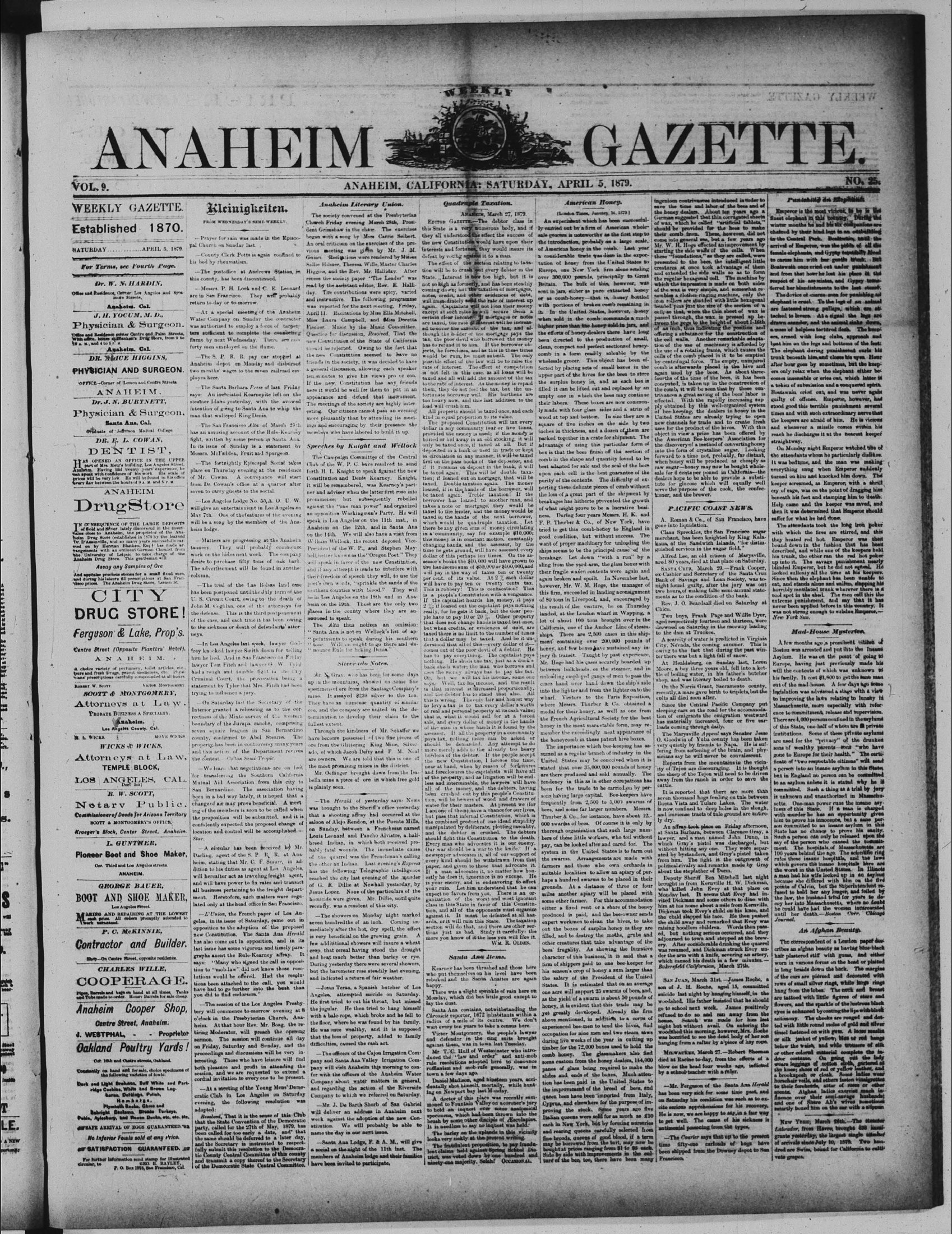
Searchable text
WEEKLY GAZETTE.
Established 1870.
SATURDAY...APRIL 5, 1879.
For Terms, see Fourth Page.
Dr. W. N. HARDIN,
Office and Residence, Corner Los Angeles and Sycamore Streets,
Anaheim, Cal.
J. H. YOCUM, M. D., Physician & Surgeon.
Office and Residence corner Centre and Palm Streets,
With office, hours at Bunker’s Drug Store, from 9 to 10 A.M., and 4 to 5 P.M.
Anaheim, Cal.
DR. RICE HIGGINS,
PHYSICIAN AND SURGEON.
OFFICE—Corner of Lemon and Centre Streets.
ANAHEIM.
Dr. J. N. BURTNETT,
Physician & Surgeon,
Santa Ana, Cal.
Graduate of Jefferson Medical College
DR. E. L. COWAN,
DENTIST,
Kleinigkeiten.
FROM WEDNESDAY’S SEMI-WEEKLY.
— Prayer for rain was made in the Episcopal Church on Sunday last.
— County Clerk Potts is again confined to his bed by rheumatism.
— The postoffice at Andrews Station, in this county, has been discontinued.
— Messrs. P. H. Look and C. E. Leonard are in San Francisco. They will probably return to-day or to-morrow.
— At a special meeting of the Anaheim Water Company on Sunday the contractor was authorized to employ a force of carpenters sufficient to complete the connecting flume by next Wednesday. There are now forty men employed on the flume.
— The S. P. R. R. pay car stopped at Anaheim depot on Monday and disbursed two months’ wages to the seven railroad employees here.
— The Santa Barbara Press of last Friday says: An inepted Kearneyite left on the steamer Idaho yesterday, with the avowed intention of going to Santa Ana to whip the man that walloped King Denis.
— The San Francisco Alta of March 29th has an amusing account of the Rule-Kearney fight, written by some person in Santa Ana. In its issue of Sunday is a statement by Messrs. McFadden, Fruit and Spurgeon.
Anaheim L.
The society convenes Church Friday evening;udent Grimshaw in the began with a song b.An oral criticism on previous meeting was Guinn. Recognition of Sallie Hilmer, There Higgins, and the Recess the society p read by the assistant day. The contributi and instructive. This was reported for the April 11. Recitation Miss Laura Campa Fischer. Music by Question for discussion new Constitution of should be rejected. The new Constitution friends in the society a general discussion ten minutes to give If the new, Constitunere it would be we appearance and d.The meetings of the eating. Our citizens more pleasantly than things and encouraging members who have
PHYSICIAN AND SURGEON.
OFFICE—Corner of Lemon and Centre Streets.
ANAHEIM.
Dr. J. N. BURTNETT,
Physician & Surgeon,
Santa Ana, Cal.
Graduate of Jefferson Medical College.
DR. E. L. COWAN,
DENTIST,
Has opened an office in the upper part of Mrs. Matz's building, Los Angeles Street, Anaheim. Having had twenty years' experience, he can speak with confidence of his work. His scale of prices will be very low. He will be found in his office every day between the hours of 9 A.M. and 5 P.M.
ANAHEIM
Drug Store
In consequence of the large deposits of gold and silver lately discovered in the mountains close to Anaheim, the proprietor of the Anaheim Drug Store (established in 1870 by the learned Dr. D'Asonville, and so many years successfully carried on by Herman Blankenship) has made arrangements with an eminent German Chemist from the University of Leipzig to take charge of the Anaheim Drug Store. This gentleman will Assay any Samples of Ore And appraise precious stones for a small fixed sum, and during his leisure fill prescriptions at San Francisco prices. The Anaheim Drug Store, Lemon St.
CITY DRUG STORE!
Ferguson & Lake, Prop's.
Centre Street (Opposite Planters' Hetel).
ANAHEIM.
A choice variety of perfumery, toilet articles, etc., pure and fresh Drugs, patent medicines, etc. Physicians' prescriptions carefully compounded at all hours.
ROBERT W. SCOTT.
VICTOR MONTGOMERY.
SCOTT & MONTGOMERY,
Attorneys at Law.
PROBATE BUSINESS A SPECIALTY.
Anaheim,
Los Angeles County, Cal.
M. L. WICKS.
MOYE WICKS
WICKS & WICKS,
Attorneys at Law,
TEMPLE BLOCK,
LOS ANGELES, CAL.
Deed San
R. W. SCOTT,
Notary Public.
Commissioner of Deeds for Arizona Territory
SCOTT & MONTGOMERY'S OFFICE.
Kroeger's Block, Center Street, Anaheim.
L. GUNTHER.
Pioneer Boot and Shoe Maker,
Corv. Third and Los Angeles streets.
The Santa Barbara Press of last Friday says: An inebriated Kearneyite left on the steamer Idaho yesterday, with the avowed intention of going to Santa Ana to whip the man that walloped King Denis.
The San Francisco Alta of March 29th has an amusing account of the Rule-Kearney fight, written by some person in Santa Ana. In its issue of Sunday is a statement by Messrs. McFadden, Fruit and Spurgeon.
The fortnightly Episcopal Social takes place on Thursday evening at the residence of Mr. Cowan. A conveyance will start from Dr. Cowan's office at a quarter after seven to carry guests to the social.
Los Angeles Lodge No. 55, A. O. U. W. will give an entertainment in Los Angeles on May 7th. One of the features of the evening will be a song by the members of the Anaheim lodge.
Matters are progressing at the Anaheim tannery. They will probably commence work on the hides next week. The company desire to purchase fifty tons of oak bark. The advertisement will be found in another column.
The trial of the Las Bolsas land case has been postponed until the July term of the U.S. Circuit Court, owing to the death of John M. Coghlan, one of the attorneys for the defense. This is the third postponement of the case, and each time it has been owing to the sickness or death of defendants' attorneys.
In Los Angeles last week, lawyer Godfrey knocked lawyer Smith down for telling him he led. And in San Francisco on Friday lawyer Tom Fitch and lawyer G. W. Tyler had a rough and tumble fight in the City Criminal Court, the prosecution being a statement by Tyler that Mrs. Fitch had been trying to influence a jury.
On Saturday last the Secretary of the Interior granted a rehearing as to the correctness of the Minto survey of the western boundary of the Jurupa ranch, comprising seven square leagues in San Bernardino county, confirmed to Abel Stearns. The property has been in controversy many years and this action of the Department revives the contest. Colton Semi Tropic.
We learn that negotiations are on foot for transferring the Southern California Mutual Aid Association from this city to San Bernardino. The association having been in a bad way lately, it is hoped that a change of air may prove beneficial. A meeting of the members is soon to be called when the proposition will be submitted, and it is confidently expected the proposed change of location and control will be accomplished.
Star.
A circular has been received by Mr. Darling, agent of the S. P. R. R. at Anaheim, stating that Mr. C. F. Sourr, in addition to his duties as agent at Los Angeles, Anaheim depot on Monday and disbursed two months' wages to the seven railroad employees here.
The Santa Barbara Press of last Friday says: An inebriated Kearneyite left on the steamer Idaho yesterday, with the avowed intention of going to Santa Ana to whip the man that walloped King Denis.
The San Francisco Alta of March 29th has an amusing account of the Rule-Kearneyite left on the steamer Idaho yesterday, with the avowed intention of going to Santa Ana to whip the man that walloped King Denis.
The San Francisco Alta of March 29th has an amusing account of the Rule-Kearneyite left on the steamer Idaho yesterday, with the avowed intention of going to Santa Ana to whip the man that walloped King Denis.
The San Francisco Alta of March 29th has an amusing account of the Rule-Kearneyite left on the steamer Idaho yesterday, with the avowed intention of going to Santa Ana to whip the man that walloped King Denis.
The Santa Barbara Press of last Friday says: An inebriated Kearneyite left on the steamer Idaho yesterday, with the avowed intention of going to Santa Ana to whip the man that walloped King Denis.
The Santa Barbara Press of last Friday says: An inebriated Kearneyite left on the steamer Idaho yesterday, with the avowed intention of going to Santa Ana to whip the man that walloped King Denis.
The Santa Barbara Press of last Friday says: An inebriated Kearneyite left on the steamer Idaho yesterday, with the avowed intention of going to Santa Ana to whip the man that walloped King Denis.
The Santa Barbara Press of last Friday says: An inebriated Kearneyite left on the steamer Idaho yesterday, with the avowed intention of going to Santa Ana to whip the man that walloped King Denis.
The Santa Barbara Press of last Friday says: An inebriated Kearneyite left on the steamer Idaho yesterday, with the avowed intention of going to Santa Ana to whip the man that walloped King Denis.
The Santa Barbara Press of last Friday says: An inebriated Kearneyite left on the steamer Idaho yesterday, with the avowed intention of going to Santa Ana to whip the man that walloped King Denis.
The Santa Barbara Press of last Friday says: An inebriated Kearneyite left on the steamer Idaho yesterday, with the avowed intention of going to Santa Ana to whip the man that walloped King Denis.
The Santa Barbara Press of last Friday says: An inebriated Kearneyite left on the steamer Idaho yesterday, with the avowed intention of going to Santa Ana to whip the man that walloped King Denis.
The Santa Barbara Press of last Friday says: An inebriated Kearneyite left on the steamer Idaho yesterday, with the avowed intention of going to Santa Ana to whip the man that walloped King Denis.
The Santa Barbara Press of last Friday says: An inebriated Kearneyite left on the steamer Idaho yesterday, with the avowed intention of going to Santa Ana to whip the man that walloped King Denis.
The Santa Barbara Press of last Friday says: An inebriated Kearneyite left on the steamer Idaho yesterday, with the avowed intention of going to Santa Ana to whip the man that walloped King Denis.
The Santa Barbara Press of last Friday says: An inebriated Kearneyite left on the steamer Idaho yesterday, with the avowed intention of going to Santa Ana to whip the man that walloped King Denis.
The Santa Barbara Press of last Friday says: An inebriated Kearneyite left on the steamer Idaho yesterday, with the avowed intention of going to Santa Ana to whip the man that walloped King Denis.
The Santa Barbara Press of last Friday says: An inebriated Kearneyite left on the steamer Idaho yesterday, with the avowed intention of going to Santa Ana to whip the man that walloped King Denis.
The Santa Barbara Press of last Friday says: An inebriated Kearneyite left on the steamer Idaho yesterday, with the avowed intention of going to Santa Ana to whip the man that walloped King Denis.
The Santa Barbara Press of last Friday says: An inebriated Kearneyite left on the steamer Idaho yesterday, with the avowed intention of going to Santa Ana to whip the man that walloped King Denis.
The Santa Barbara Press of last Friday says: An inebriated Kearneyite left on the steamer Idaho yesterday, with the avowed intention of going to Santa Ana to whip the man that walloped King Denis.
The Santa Barbara Press of last Friday says: An inebriated Kearneyite left on the steamer Idaho yesterday, with the avowed intention of going to Santa Ana to whip the man that walloped King Denis.
The Santa Barbara Press of last Friday says: An inebriated Kearneyite left on the steamer Idaho yesterday, with the avowed intention of going to Santa Ana to whip the man that walloped King Denis.
The Santa Barbara Press of last Friday says: An inebriated Kearneyite left on the steamer Idaho yesterday, with the avowed intention of going to Santa Ana to whip the man that walloped King Denis.
The Santa Barbara Press of last Friday says: An inebriated Kearneyite left on the steamer Idaho yesterday, with the avowed intention of going to Santa Ana to whip the man that walloped King Denis.
The Santa Barbara Press of last Friday says: An inebriated Kearneyite left on the steamer Idaho yesterday, with the avowed intention of going to Santa Ana to whip the man that walloped King Denis.
The Santa Barbara Press of last Friday says: An inebriated KearneyITE left onthesteamerIdaho yesterday,theavowingsandprominence;butagainstthe"onemimeanoppositionWorkspaint洛AngelesAnheimonthe14th.WewillWilliamWellock,tPresidentoftheW.Bell,betterknownasmwillspaintin favorandifanyattempttheirfreedomofspeechpoet'sownwords,southerncountieswouldbeinLosAngelesohemonthe19thplacesinthecountrynouncedtospeak.TheAlta thus"Santa Ana is notpointmentsto speechtour.WilliamowernounceRulefortheSilverMr.N.Gray.wupinthemountainspecimensoforefromminime.itassayedTheyhaveanimmune,andthecompartmentationtodevelfullestextThroughthekindhavebecomepossessedorefromtheGlitterado,fwhichJacobareowners.WethemostpromisingMr.Oefflingerbhbella minea pieceislainplyseen.-TheHeraldwas broughttothethataphotographsaloonofAlejoRenonSunday.betweenLouisLeonardandbreedIndian.inhabablyfatalwoundsofthequarrelwiththeotheranIndianhasthefollowingzonesphysicaldiscussiontenoilseasonanddisbursedtwomonths'wagestotheserainlodemployeeshere.Athesaleignesspecialdiscussiontenoilseasonanddisbursedtwomonths'wagestotheserainlodemployeeshere.Athesaleignesspecialdiscussiontenoilseasonanddisbursedtwomonths'wagestotheserainlodemployeeshere.Athesaleignesspecialdiscussiontenoilseasonanddisbursedtwomonths'wagestotheserainlodemployeeshere.Athesaleignesspecialdiscussiontenoilseasonanddisbursedtwomonths'wagestotheserainlodemployeeshere.Athesaleignesspecialdiscussiontenoilseasonanddisbursedtwomonths'wagestotheserainlodemployeeshere.Athesaleignesspecialdiscussiontenoilseasonanddisbursedtwomonths'wagestotheserainlodemployeeshere.Athesaleignesspecialdiscussiontenoilseasonanddisbursedtwomonths'wagestotheserainlodemployeeshere.Athesaleignesspecialdiscussiontenoilseasonanddisbursedtwomonths'wagestotheserainlodemployeeshere.Athesaleignesspecialdiscussiontenoilseasonanddisbursedtwomonths'wagestotheserainlodemployeeshere.Athesaleignesspecialdiscussiontenoilseasonanddisbursedtwomonths'wagestotheserainlodemployeeshere.Athesaleignesspecialdiscussiontenoilseasonanddisbursedtwomonths'wagestotheserainlodemployeeshere.Athesaleignesspecialdiscussiontenoilseasonanddisbursedtwomonths'wagestotheserainlodemployeeshere.Athesaleignesspecialdiscussiontenoilseasonanddisbursedtwomonths'wagestotheserainlodemployeeshere.Athesaleignesspecialdiscussiontenoilseasonanddisbursedtwomonths'wagestotheserainlodemployeeshere.Athesaleignesspecialdiscussiontenoilseasonanddisbursedtwomonths'wagestotheserainlodemployeeshere.Athesaleignesspecialdiscussiontenoilseasonanddisbursedtwomonths'wagestotheserainlodemployeeshere.Athesaleignesspecialdiscussiontenoilseasonanddisbursedtwomonths'wagestotheserainlodemployeeshere.Athesaleignesspecialdiscussiontenoilseasonanddisbursedtwomonths'wagestotheserainlodemployeeshere.Athesaleignesspecialdiscussiontenoilseasonanddisbursedtwomonths'wagestotheserainlodemployeeshere.Athesaleignesspecialdisussiontenoilseasonanddisbursedtwomonths'wagestotheserainlodemployeeshere.Athesaleignesspecialdisussiontenoilseasonanddisbursedtwomonths'wagestotheserainlodemployeeshere.Athesaleignesspecialdisussion tenoilseasonanddisbursedtwomonths'wagestotheserainlodemployeeshere.Athesaleignesspecialdisussion tenoilseasonanddisbursedtwomonths'wagestotheserainlodemployeeshere.Athesaleignesspecialdisussion tenoilseasonanddisbursedtwomonths'wagestotheserainlodemployeeshere.Athesaleignesspecialdisussion tenoilseasonanddisbursedtwomonths'wagestotheserainlodemployeeshere.Athesaleignesspecialdisussion tenoilseasonandDISBURTSSTORE!
Ferguson & Lake, Prop's.
Centre Street (Opposite Planters' Hetel).
ANAHEIM.
Los Angeles County, Cal.
Deet San.
R.W.WICKS.
M.L.WICKS.
WICKS & WICKS.
Attorneys at Law,
TEMPLE BLOCK,
LOS ANGELES,CAL.
Deet San.
R.W.WICKS.
M.L.WICKS.
WICKS & WICKS.
Attorneys at Law,
TEMPLE BLOCK,
LOS ANGELES,CAL.
Deet San.
R.W.WICKS.
M.L.WICKS.
WICKS & WICKS.
Attorneys at Law,
TEMPLE BLOCK,
LOS ANGELES,CAL.
Deet San.
R.W.WICKS.
M.L.WICKS.
WICKS & WICKS.
Attorneys at Law,
TEMPLE BLOCK,
LOS ANGELES,CAL.
Deet San.
R.W.WICKS.
M.L.WICKS.
WICKS & WICKS.
Attorneys at Law,
TEMPLE BLOCK,
LOS ANGELES,CAL.
Deet San.
R.W.WICKS.
M.L.WICKS.
WICKS & WICKS.
Attorneys at Law,
TEMPLE BLOCK,
LOS ANGELES,CAL.
Deet San.
R.W.WICKS.
M.L.WICKS.
WICKS & WICKS.
Attorneys at Law,
TEMPLE BLOCK,
LOS ANGELES,CAL.
Deet San.
R.W.WICKS.
M.L.WICKS.
WICKS & WICKS.
Attorneys at Law,
TEMPLE BLOCK,
LOS ANGELES,CAL.
Deet San.
R.W.WICKS.
M.L.WICKS.
WICKS & WICKS。
Attorneys at Law,
TEMPLE BLOCK,
LOS ANGELES,CAL。
Deet San。
R.W.WICKS。
M.L.WICKS。
WICKS & WICKS。
Attorneys at Law,
TEMPLE BLOCK,
LOS ANGELES,CAL。
Deet San。
R.W.WICKS。
M.L.WICKS。
WICKS & WICKS。
Attorneys at Law,
TEMPLE BLOCK,
LOS ANGELES,CAL。
Deet San。
R.W.WICKS。
M.L.WICKS。
WICKS & WICKS。
Attorneys at Law,
TEMPLE BLOCK,
LOS ANGELES,CAL。
Deet San。
R.W.WICKS。
M.L.WICKS。
WICKS & WICKS。
Attorneys at Law,
TEMPLE BLOCK,
LOS ANGELES,CAL。
Deet San。
R.W.WICKS。
M.L.WICKS。
WICKS & WICKS。
Attorneys at Law,
TEMPLE BLOCK,
LOS ANGELES,CAL。
Deet San。
R.W.WICKS。
M.L.WICKS。
WICKS & WICKS。
Attorneys at Law,
TEMPLE BLOCK,
LOS ANGELES,CAL。
Deet San、
R.W.WICKS、
M.L.WICKS、
WICKS &
WICKS。
Attorneys at Law,
TEMPLE BLOCK,
LOS ANGELES,CAL。
Deet San、
R.W.WickS、
M.L.WickS、
WickS &
WickS。
Attorneys at Law,
TEMPLE BLOCK,
LOS ANGELES,CAL。
Deet San、
R.W.WickS、
M.L.WickS、
WickS &
WickS。
Attorneys at Law,
TEMPLE BLOCK,
LOS ANGELES,CAL。
Deet San、
R.W.WickS、
M.L.WickS、
WickS &
WickS。
LOS ANGELES, CAL.
Dept. Sun.
R. W. SCOTT,
Notary Public.
Commissioner of Deeds for Arizona Territory
SCOTT & MONTGOMERY'S OFFICE.
Kroeger's Block, Center Street, Anaheim.
L. GUNTHER,
Pioneer Boot and Shoe Maker,
Cor. Third and Los Angeles streets.
ANAHEIM.
GEORGE BAUER,
BOOT AND SHOE MAKER,
Los Angeles Street.
MAKING AND REPAIRING AT THE LOWEST
mash price. All orders promptly attended to
work unlimited.
P. C. McKINNIE,
Contractor and Builder.
Shop—On Centre Street, opposite residence.
CHARLES WILLE,
COOPERAGE.
Pipe, Barrels and kegs on hand at all times. Tanks
and Tube made to order. Honev Barrels for sale cheap.
Anaheim Cooper Shop,
Centre Street, Anaheim.
J. WESTPHAL, - Proprietor
Oakland Poultry Yards!
Oct. 16th and Cantro streets, Oakland.
Courtnally on hand and for sale, choice specimens of
the following varieties of pouls:
Dark and Light Brahmas, Beef White and Partridge Cochine, White and Brown Laghera, Dorkings, Polish,
Hamburg,
Plymouth Bochs, Game and
Behright Beahams, Brunke Turkeys,
Pubin, Aylesbury, and Raven Duchs, etc., etc.
RAFE ARRIVAL OF EGGS QUARANTEED WA
No Inferior Fowls sold at any price.
SATISFACTION GUARANTEED.
For further information send stamp for illustrated
circular, to
GEO. B. BAYLEY,
P. O. Box 1918, San Francisco, Cal.
for transferring the Southern California Mutual Aid Association from this city to San Bernardino. The association having been in a bad way lately, it is hoped that a change of air may prove beneficial. A meeting of the members is soon to be called when the proposition will be submitted, and it is confidently expected the proposed change of location and control will be accomplished. — Star.
— A circular has been received by Mr. Darling, agent of the S. P. R. R. at Anaheim, stating that Mr. C. F. Smurr, in addition to his duties as agent at Los Angeles, will hereafter act as traveling freight agent, and will have power to fix rates and transact all business pertaining to the freight department. Heretofore, such matters were regulated only at the head office in San Francisco.
— L'Union, the French paper of Los Angeles, in its issue of Saturday, came out in opposition to the adoption of the proposed new Constitution. The Santa Ana Herald has also come out in opposition, and in its last issue has some vigorous and timely paragraphs anent the Rule-Kearney affray. It says: "Many who signed the call in opposition to 'mob-law' did not know those resolutions would be offered. Had the resolutions been attached to the call, you would have had to go further into the bush than you did to find endorsers."
— The session of the Los Angeles Presbytery will commence to-morrow evening at 8 o'clock in the Presbyterian Church, Anaheim. At that hour Rev. Mr. Boag, the retiring Moderator, will preach the opening sermon. The session will continue all day on Friday, Saturday and Sunday, and the proceedings and discussions will be very interesting. Those who have leisure will find both pleasure and profit in attending the session, and we are requested to extend a cordial invitation to every one to be present.
— At a meeting of the Young Mens' Democratic Club in Los Angeles on Saturday evening, the following resolution was adopted:
Resolved, That it is the sense of this Club that the State Convention of the Democratic party, called for the 27th of May, 1879, has been called for too early a date, and that the same should be deferred to a later day, and the Secretary is instructed to respectfully submit this resolution to the Democratic County Central Committee of this county and transmit a copy thereof to the Secretary of the Democratic State Central Committee.
ANAHEIM, CALIFORNIA: SATURDAY, APRIL 5, 1879.
Anaheim Literary Union.
The society convened at the Presbyterian Church Friday evening March 28th, President Grimshaw in the chair. The exercises began with a song by Miss Carrie Seibert. An oral criticism on the exercises of the previous meeting was given by Mr. J. M. Gninn. Recitations were rendered by Miss Sallie Hilmer, Theresa Wille, Master Charles Higgins, and the Rev. Mr. Halliday. After recess the society paper "The Leader" was read by the assistant editor, Rev. E. Halliday. The contributions were spicy, varied and instructive. The following programme was reported for the next meeting, Friday, April 11. Recitations by Miss Ella Mitchell, Miss Laura Campbell, and Miss Doretta Fischer. Music by the Music Committee. Question for discussion, Resolved That the new Constitution of the State of California should be rejected. Owing to the fact that the new Constitution seemed to have no friends in the society, it was decided to have a general discussion allowing each speaker ten minutes to give his views pro or con. If the new Constitution has any friends here it would be well for them to put in an appearance and defend that instrument. The meetings of the society are highly interesting. Our citizens cannot pass an evening more pleasantly than by attending its meetings and encouraging by their presence the members who have labored to build it up.
Spreches by Knight and Wellock
The Campaign Committee of the Central
Quadruple Taxation.
ANAHEIM, March 27, 1879.
EDITOR GAZETTE—The debtor class in this State is a very numerous body, and if they all understood the effect the success of the new Constitution would have upon their interests and fortunes, they would insure its defeat by voting against it to a man.
The effect of the section relating to taxation will be to crush out every debtor in the State. Interest is now too high, but it is not so high as formerly, and has been steadily coming down; but the taxation of mortgages, notes, credit, and other evidences of debt, will immediately solid the rate of interest up again. Capitalists will not loan their money except at such rates as will secure them a certain clear income. If mortgages or notes are taxed, the rate of interest will be increased to cover the amount of the tax, and although the holder of the mortgage pays the tax, the poor devil who borrowed the money has to refund it to him. If the borrower objects, he forecloses, and as this in these times would be ruin, he must submit. The only possible effect of the law will be to raise the rate of interest. The effect of competition is not felt in this case, as all loans will be taxed and all will add the amount of the tax to the rate of interest. As the money is repaid them, they do not feel the tax, but the unfortunate borrower will. His burthens are too heavy now, and this last addition to the load will crush him.
All property should be taxed once, and each kind in equal proportion to its value.
The proposed Constitution will tax every dollar in any community four or five times, provided the money is used; if the money is buried or hid away in an old stocking, it will only be taxed once, if taxed at all. But if deposited in a bank or used in trade or kept in circulation in any manner, it will be taxed
American Honey.
(London Times, January 14, 1879)
An experiment which has been successfully carried out by a firm of American wholesale grocers is noteworthy as the first stop to the introduction, probably on a large scale, of American honey in the comb. Last year a considerable trade was done in the exportation of honey from the United States to Europe, one New York firm alone sending over 300,000 pounds, principally to Great Britain. The bulk of this, however, was sent in jars, either as pure extracted honey or as comb-honey—that is, honey bottled with portions of broken comb remaining in it. In the United States, however, honey when sold in the comb commands a much higher price than the honey sold in jars, and the efforts of honey-dealers there have long been directed to the production of small, clean, compact and perfect sections of honeycomb in a form readily saleable by the wholesale grocer. This object has been effected by placing sets of small boxes in the upper part of the hives for the bees to store the surplus honey in, and as each box is filled it can be lifted out and replaced by an empty one in which the bees may continue their labor. These boxes are now commonly made with four glass sides and a strip of wood at top and bottom. In size they are a square of five inches on the side by two inches in thickness, and a dozen of them are packed together in a crate for shipment. The advantage of using this particular form of box is that the bees finish off the section of comb in the shape and quantity found to be
The Campaign Committee of the Central Club of the W. P. C. have resolved to send forth H. L. Knight to speak against the new Constitution and Denis Kearney. Knight, it will be remembered, was Kearney's partner and adviser when the latter first rose into prominence; but subsequently rebelled against the "one man power" and organized an opposition Workingmen's Party. He will speak in Los Angeles on the 11th inst., in Anaheim on the 12th, and in Santa Ana on the 14th. We will also have a visit from William Wellock, the recent deposed Vice-President of the W. P. C., and Stephen Maybell, better known as the "Oregon Poet." They will speak in favor of the new Constitution, and if any attempt is made to interfere with their freedom of speech they will, to use the poet's own words, "sprinkle the sands of the southern counties with blood." They will be in Los Angeles on the 18th and in Anaheim on the 19th. These are the only two places in the county where they are announced to speak.
The Alta thus notices an omission: "Santa Ana is not on Wellock's list of appointments to speak during his southern tour. William ought to go there and announce Rule for liking Denia."
Silverado Notes.
Mr. N. Grav, who has been for some days up in the mountains, showed us some fine specimens of ore from the Santiago Company's mine. It assayed $230 silver to the ton. They have an immense quantity of similar ore, and the company are united in the determination to develop their claim to the fullest extent.
Through the kindness of Mr. Schafer we have become possessed of two fine pieces of ore from the Glittering King Mine, Silverado, of which Jacob Deity and F. M. Neal are owners. We are told that this is one of the most promising mines in the district.
Mr. Oelinger brought down from the Isabella mine a piece of ore in which free gold is plainly seen.
The Herald of yesterday says: News was brought to the Sheriff's office yesterday that a shooting affray had occurred at the saloon of Alejo Rendon, at the Puente Mills, on Sunday, between a Frenchman named Louis Leonard and Pancho Alvistre, a half-breed Indian, in which both received probably fatal wounds. The immediate cause of the quarrel was the Frenchman's calling the other Indian. Last evening's Express has the fellowship: Telegraphic intelligence affected by placing sets of small boxes in the upper part of the hives for the bees to stave the surplus honey in, and as each box is filled it can be lifted out and replaced by an empty one in which the bees may continue their labors. These boxes are now commonly made with four glass sides and a strip of wood at top and bottom. In size they are a square of five inches on the side by two inches in thickness, and a dozen of them are packed together in a crate for shipment. The advantage of using this particular form of box is that the bees finish off the section of comb in the shape and quantity found to be best adapted for sale and the seal of the bees upon each cell is the best guarantee of the purity of the contents. The difficulty of exporting these delicate pieces of comb without the loss of a great part of the shipment by breakages has hitherto prevented the growth of what might prove to be a lucrative business. During four years Messrs. H. K. and F. Thurber & Co., of New York, have tried to get this comb-honey to England in good condition, but without success. The want of proper machinery for unloading the ships seems to be the principal cause of the breakage. Let down "with a run" by a sling from the yard-arm, the glass boxes with their fragile waxen contents were again broken and spoilt. In November last, however, Mr. W. M. Hoge, the manager of this firm, succeeded in landing a consignment of 80 tons in Liverpool, and encouraged by the result of the venture, he on Thursday landed, at the London wharf in Wapping, a lot of about 100 tons brought over in California, one of the Anchor Line of steamships. There are 2,500 cases in this shipment containing over 200,000 pounds of honey, and few boxes have sustained any injury transit. Taught by past experience, Mr. Hoge had his cases securely boarded up between bulkheads on the steamer, and in unloading employed gangs of men to pass the cases hand over hand down the ship's side into the lighter and from the lighter on to the wharf. Visitors to the Paris Exposition, where Messrs. Thurber & Co., obtained a medal for their honey, as well as one from the French Agricultural Society for the best honey in the most marketable form, may remember the exceedingly neat appearance of the honeycomb in these patent hive boxes.
The importance which bee-keeping has assumed as a regular branch of industry in the United States may be conceived when it is stated that over 35,000,000 pounds of honey are there produced and sold annually. The tendency in this as in other occupations has been for the trade to be carried on by persons having large capital. Bee-keepers have frequently from 2,500 to 5,000 swarms of bees, and some far larger numbers. Messrs. Thurber & Co., for instance, have about 12,000 swarms of bees. Of course it is only by thorough organization that such large numbers of these little workers, who toil without pay, can be looked after and cared for. The system in the United States is to farm out the swarms. Arrangements are made with farmers and those who own orchards in various localities to allow an array of rare...
The Herald of yesterday says: News was brought to the Sheriff's office yesterday that a shooting affray had occurred at the saloon of Alejo Rendon, at the Puente Mills, on Sunday, between a Frenchman named Louis Leonard and Pancho Alvistre, a half-breed Indian, in which both received probably fatal wounds. The immediate cause of the quarrel was the Frenchman's calling the other an Indian. Last evening's Express has the following: Telegraphic intelligence reached the city last evening of the murder of G. R. Dillie at Newhall yesterday, by Jesus Lopez. None of the particulars of the homicide were given. Mr. Dillie, until quite recently, was a resident of this city.
The showers on Monday night marked seven hundredths of an inch. Coming immediately after the hot, dry spell, the effect is very beneficial on the growing grain. A few additional showers will insure a wheat crop, that cereal having stood the drought and heat much better than barley or rye. During yesterday there were several showers, but the barometer rose steadily last evening, and indicated a return of fair weather.
Jesus Teran, a Spanish butcher of Los Angeles, attempted suicide on Saturday. He first tried to cut his throat, but missed the jugular. He then tried to hang himself with a bale-rope, which broke and he fell to the floor, where he was found by his family. He was once wealthy, and it is supposed that the loss of property, added to family difficulties, caused the rash act.
The officers of the Cajon Irrigation Company and Santa Ana Valley Irrigation Company will visit Anaheim this morning to confer with the officers of the Anaheim Water Company about water matters in general, and regarding the action of the Riverside Company to which we referred on Saturday.
Mr. J. De Barth Shorb of San Gabriel will deliver an address in Anaheim next week against the adoption of the new Constitution. We will probably be able to name the day in our next issue.
Santa Ana Lodge, F. & A. M., will give a social on the night of the 11th inst. The members of Anaheim lodge and their families have been invited to participate,
The law and order" and anti-mob rule resolutions adopted here to denounce ruffianism and mob-rule generally, was in town a few days ago.
Daniel Madison, aged nineteen years, accidentally shot himself, mortally, while hunting on Newport bay last Monday.
A doctor of this place was recently summoned to Fountain Valley on acorner's jury to hold an inquest over some anatomical specimens, which had been thrown into the brush by some other disciple of Asculapius. It is needless to say no inquest was held."
The barley on the uplands in this vicinity looks very sickly at the present writing.
The fraudulent proposition, to pay fraudulent claims held against Spring School District, was voted down by one hundred and ninety-one majority. Selah! Occasional.
tendency in this as in other occupations has been for the trade to be carried by persons having large capital. Bee-keepers have frequently from 2,500 to 5,000 swarms of bees, and some far larger numbers. Messrs Thurber & Co., for instance, have about 12,000 swarms of bees. Of course it is only by thorough organization that such large numbers of these little workers who toil without pay can be looked after and cared for. The system in the United States is to farm out the swarms. Arrangements are made with farmers and those who own orchards in suitable localities to allow an apiary of perhaps a hundred swarms to be placed in their grounds. At a distance of three or four miles another apiary will be placed with some other farmer. For this accommodation either a fixed rent or a share of the honey produced is paid, and the bee-owner sends expert workmen to clean the hives, to take out the boxes of surplus honey as they are filled, and to destroy the moths, grubs and other creatures that take advantage of the bees' frugality. As showing the lucrative character of this business, it is said that a firm of shippers paid to one bee-keeper for his season's crop of honey a sum larger than the salary of the President of the United States. It is estimated that on an average one acre will support 25 swarms of bees, and as the yield of a swarm is about 50 pounds of honey, it is evident that this trade may be yet greatly developed. Already the firm above mentioned, in addition to a corps of experienced bee-men to tend the hives, find occupation for nine men and two steam saws during five weeks of the year in cutting up timber for the 72,000 boxes used to hold the comb honey. The glassmakers also find some custom from the honey dealers, 144,000 panes of glass being required to make the slides and ends of the boxes. Much attention has been paid in the United States to the improvement of the breed of bees, and queen bees have been imported from Italy, Cyprus, and elsewhere for the purpose of improving the stock. Some years ago five Italian queens were sold for as much as £10 each in New York, but by forming nurseries and rearing queens carefully selected from fine broods, queens of good blood, if a term may be borrowed from the tart; may now be bought at prices ranging from $1 to $5 each. Side by side with improvements in the culture of the bee, too, there have been many
GAZETTE.
February 14, 1879
Honey.
It has been successful of American wholesale as the first step to daily on a large scale, the comb. Last year was done in the export of the United States to work firm alone sealing principally to Great Britain this, however, was pure extracted honey that is, honey bottled from comb remaining in states, however, honey commands a much money sold in jars, andellers there have long production of small, direct sections of honey easily saleable by the object has been effected in small boxes in the for the bees to store and as each box is kept and replaced by an bee may continue boxes are now common sides and a strip of it. In size they are a on the side by two and a dozen of them are mate for shipment. The particular form of fish off the section of quantity found to be ingenious contrivances introduced in order to save the time and labor of the bees and of the honey dealers. About ten years ago a German suggested that thin corrugated sheets of wax, which he called "artificial tablets," should be provided for the bees to make their comb from. These, however, did not come into general use, but a few years ago Mr. W. H. Hoge effected an improvement by starting the side walls of the cells. When these "foundations," as they are called, were presented to the bees, the intelligent little creatures at once took advantage of them and extended the side walls so as to form the regular hexagonal cell. The machine by which the impression is made on both sides of the wax is very simple, and somewhat resembles a clothes-ringing machine, only the iron rollers are stood with little hexagonal headed pins just the size of the section of a cell; so that, when the thin sheet of wax is passed through, the wax is pressed up between the pegs to the height of about 1.16th of an inch, thus indicating the position and offering a substance for the construction of the cell walls. Another remarkable adaptation of the use of machinery is afforded by the use of a rotating frame, which causes the cells of the comb placed in it to be emptied by centrifugal force. The empty, uninjured comb is afterwards placed in the hive and again used by the bees. As about three-fourths of the time of the bees, it has been computed, is taken up in the construction of the comb, it will be seen that by these contrivances a great saving of the bees' labor is effected. With the rapidly increasing supply obtained by this well-organized system of bee-keeping, the dealers in honey in the United States are already trying to open new channels for trade and to create fresh uses for the product of the hives. With this object in view a prize has been offered by the American Bee-keepers' Association for the discovery of a method of converting honey into the form of crystalline sugar. Looking forward to a time not, probably, far distant,
Punishment de Mappitia
Emperor is the most vicious he be in his finest elephant in this country. During this winter months he and his six companions are chained by their hind legs in an establishment in the Central Park. Boatswain, until the arrival of Emperor, was the public of all the female elephants, and Gypy especially liked to carve him with her gentle trunk. But Boatswain once cried out under punishment and from that hour he lost his place in the respect of his associates, and Gypy transferred her blandishments to the last climax.
The device of ciervus men for punishing an elephant is cruel. To the logs of an animal are fastened strong pullage, which are attached to lavera. At a signal the legs are drawn snuggely, and the animal sinks down, a mass of helpless tortured flesh. The keepers, armed with long clubs, approach and beat him on the legs and bottoms of the feet: The elephant during punishment curls his trunk beneath him, and closes his eyes. Hour after hour goes by sometimes, but the keepers only relax when the elephant either becomes insensible or cries out, which latter is a token of submission and a conquered spirit. Boatswain cried out, and was never again guilty of offense. Emperor, however, had stood good this terrible punishment several times and with such extraordinary nerve that the keepers are afraid of him. He is victorious and whenever a missile comes within his reach he discharges it at the nearest keeper straightway.
On Monday night Emperor watched one of the attendants whom he particularly dialkes.
PACIFIC COAST NEWS.
A. Roman & Co., of San Francisco, have gone into liquidation.
Claus Spreckles, the San Francisco sugar merchant, has been knighted by King Kalakaua, of the Sandwich Islands, "for distinguished services in the sugar field."
Alfred Lee, an old citizen of Marysville, saved 80 years, died at that place on Saturday.
Santa Cruz, March 20.—Frank Cooper, ex-Cashier and Secretary of the Santa Cruz Bank of Savings and Loan Society, was tonight found guilty, after the jury was out two hours, of making false semi-annual statements as to the condition of the bank.
Rev. J. O. Beardsall died on Saturday at Chico.
Two boys, Frank Page and Willie Dyer, aged respectively fourteen and thirteen, were drowned on Saturday in the raceway leading to the dam at Truckee.
A scarcity of water is predicted in Virginia City, Nevada, the coming summer. This is owing to the fact that during the past winter there was but a light fall of snow.
At Healdsburg, on Sunday last, Loren Moore, a boy three years old, fell into a kettle of boiling water, in his father's butcher shop, and was literary boiled to death.
On the Norris Grant, Sacramento county, recently, a mare gave birth to triplets, but the colts all died soon after.
Since the Central Pacific Company put sleeping cars on the road for the accommodation of emigrants the emigration westward has materially increased, four or five carloads coming through daily.
The Marysville Appeal says Senator Jesse O. Goodwin of Yuba county has been taken very quietly by friends to Napa. He is suffering from softening of the brain, and physicians say he will never be convalescent.
Reports from the mountains in the vicinity of Tejon are discouraging. It is thought the sheep of the Tejon will need to be driven away from the ranch in order to save the cattle.
It is reported that there are more than seven thousand hogs feeding on tule between Euena Vista and Tulare Lakes. The water is now confined to deep holes in the slough, and immense tracts of tule ground are entirely dry.
An affray took place on Friday afternoon, at Santa Barbara, between Clarence Gray, a lawyer, and a man named John Dunn, in which Gray's pistol was discharged, but without hitting any one. They were separated by bystanders, and Gray's pistol taken from him. The fight is outgrowth of political rivalry and remarks made by Gray about the steward of Dunn.
After hour goes by sometimes, but the keepers only relax when the elephant either becomes insensible or eries out, which latter is a token of submission and a conquered spirit. Boatainc哭出声,和被永远的guilty of offense。Emperor,however,had stood good this terrible punishment several times and with such extraordinary nerve that the keepers are afraid of him。He is vicious and whenever a missile comes within his reach he discharges it at the nearest keeper straightway。
On Monday night Emperor watched one of the attendants whom he particularly dialkos. It was bedtime,and the man was making everything snug when Emperor suddenly turned on him and knocked him down。The keeper screamed,as Emperor,with a shrill cry of rage,was on the point of dragging him beneath his feet and stamping him to death。Help came and the keeper was saved,and then it was determined that Emperor should suffer for what he had done。
The attendants took the long iron poker with which the fires are stirred,and this they heated red hot。Emperor was then bound down in the fashion that has been described,and while one of the keepers held his trunk,the other ran the red hot poker up into it。The savage punishment nearly blinded Emperor,but he did not squelch。He looked sulently all the time at his keepers。Since then the elephant has been unable to eat,and stands alone and sullen,shapping his horribly mutilated trunk wherever there is a cool spot in the shed。The men call this the extreme punishment,and say that it has never been applied before in this country。It was not strong enough to subdue Emperor,—New York Sun。
Mad-House Mysteries
A few months ago a prominent citizen of Boston was arrested and put into the Insane Asylum。He was on the point of going to Europe,having just previously made his will the contents of which was unknown to his family。它 cost $1,800 to get the same man out of the mad-house。A few days ago some legislation was advanced a stage with a view to improving the laws relating to lunacy in Massachusetts,more especially with reference to commitment,release and supervision。There are 4,000 persons confined in the asylums of this State,一半-half of whom are private institutions。Some of these private asylums are used for the "privacy" of the drunken sons of wealthy parents—sons who have gone to Europe for their health." The certificate of "two respectable citizens" will send a person into an insane asylum in this State,但 in England no person can be committed to an insane unless it is stated why he is committed。Sueh a thing as a trial by jury is unknown and unauthorized in Massachusetts。一O-man power runs the insane asylums of this State。If a man is charged with murder he has an opportunity given him to prove his innocence,但 a same person committed to an insane asylum in this State has no change to prove his sanity。Such a person can only be released upon the say of the person who caused the commitment。The hospitals of Massachusetts are 100 years behind the age。The scientific ring rules these insane hospitals,and the laws which govern this insane hospitals here are the worst in the United States。In Illinois
It is reported that there are more than seven thousand hogs feeding on tule between Euena Vista and Tulare Lakes. The water is now confined to deep holes in the slough, and immense tracts of tule ground are entirely dry.
An affray took place on Friday afternoon, at Santa Barbara, between Clarence Gray, a lawyer, and a man named John Dunn, in which Gray's pistol was discharged, but without hitting any one. They were separated by bystanders, and Gray's pistol taken from him. The fight is the outgrowth of political rivalry and remarks made by Gray about the stepfather of Dunn.
Deputy Sheriff Ben Mitchell last night brought in from Kernville H. W. Dickman, who killed John Evey at that place on Monday last. It seems that Evey had invited Dickman and some others to dine with him at his home about a mile from Kernville. Dickman took Evey's child on his knee, and the child slapped his face. He then pushed the child away and remarked that Evey was raising hoodlum children. Words then passed, but nothing serious occurred, and they adjourned to town and stopped at the brewery. After considerable drinking the quarrel was resumed, and Dickman struck Evey under the arm with a knife, severing an artery, which caused his death in a few minutes.
Bakersfield Californian, March 27th.
SAN JUAN, March 31st. — James Roche, a son of J. H. Roche, aged 15, committed suicide last night by hanging himself in the woodshed. His father insisted that he should go to school next week. James positively refused to do so and ran away from the house. Search was made for him last night but without avail. On entering the woodshed this morning, however, Mrs. Roche was horrified to see the dead body of her son hanging from a rafter by a piece of hay rope.
MILWAUKEE, March 27. — Robert Shoenan died at Racine to-day, from the effects of a blow on the head four weeks ago, inflicted by a school-teacher with a ruler.
— Mr. Ferguson of the Santa Ana Herald has been very sick for some time past, and on Saturday his condition was such as to excite serious apprehensions for his recovery. He is now, we are happy to say, in a fair way to get well. The cause of his sickness is antimonial poisoning from the types.
— The Courier says that up to the present time fifty-one carloads of hogs have been shipped from the Downey depot to San Francisco.
but in England no person can be committed to an asylum unless it is stated why he is committed. Such a thing as a trial by jury is unknown and unauthorized in Massachusetts. One-man power runs the insane asylums of this State. If a man is charged with murder he has an opportunity given him to prove his innocence, but a same person committed to an insane asylum in this State has no chance to prove his sanity. Such a person can only be released upon the say of the person who caused the commitment. The hospitals of Massachusetts are 100 years behind the age. The scientific ring rules these insane hospitals, and the laws which govern the insane hospitals here are the worst in the United States. In Illinois a man had his wife locked up in an asylum because she differed with him on the five points of Calvin, but the Superintendent refused to hold her any longer, and foiled by the law, the husband tribed for years to decoy her into Massachusetts, where no doubts he could have had the woman incarcerated until her death. — Boston Corr. Chicago Journal.
An Afghan Beauty.
The correspondent of a London paper describes an Afghan beauty as having blue-black hair plastered stiff with gums, and either worn in various forms on the head or plaited in long braids down the back. The margins of the ears are pierced and decorated with rows of small silver rings, while large rings hang from the lobes. The neck and breast are tattooed with little figures of stars and flowers, and the sparkle of the lustrous black eyes is enhanced by coating the lips with black antimony. The cheeks are ronged and doted with little round moles of gold and silver tinsel fastened on with gum. A hare muslin or silk jacket of yellow; blue or red hung below the waist, and white trommets of silk or other colored material complete the indoor costume. On going out the lady wears leggings of cotton cloth, gartered at the knees; shoes of red or yellow leather, and a brookapesh or cloak. Some ladies wear horsehair veils, and others fasten vinalgrettes to their foreheads, attar of roses or other aments. Afghan ladies exorcise much influence over their semi-savage husbands; and one of Shire Ah's wives sometimes smartly boxed him on the ear with a silppan.
New York; March 26th. — The stainer Labrador, from Havre, thought 498 inmigrants yesterday, the largest single number of arrivals since July 10, 1878. Two hundred are Swiss, bound for California to cultivate grapea.