anaheim-gazette 1879-03-22
Scanned page
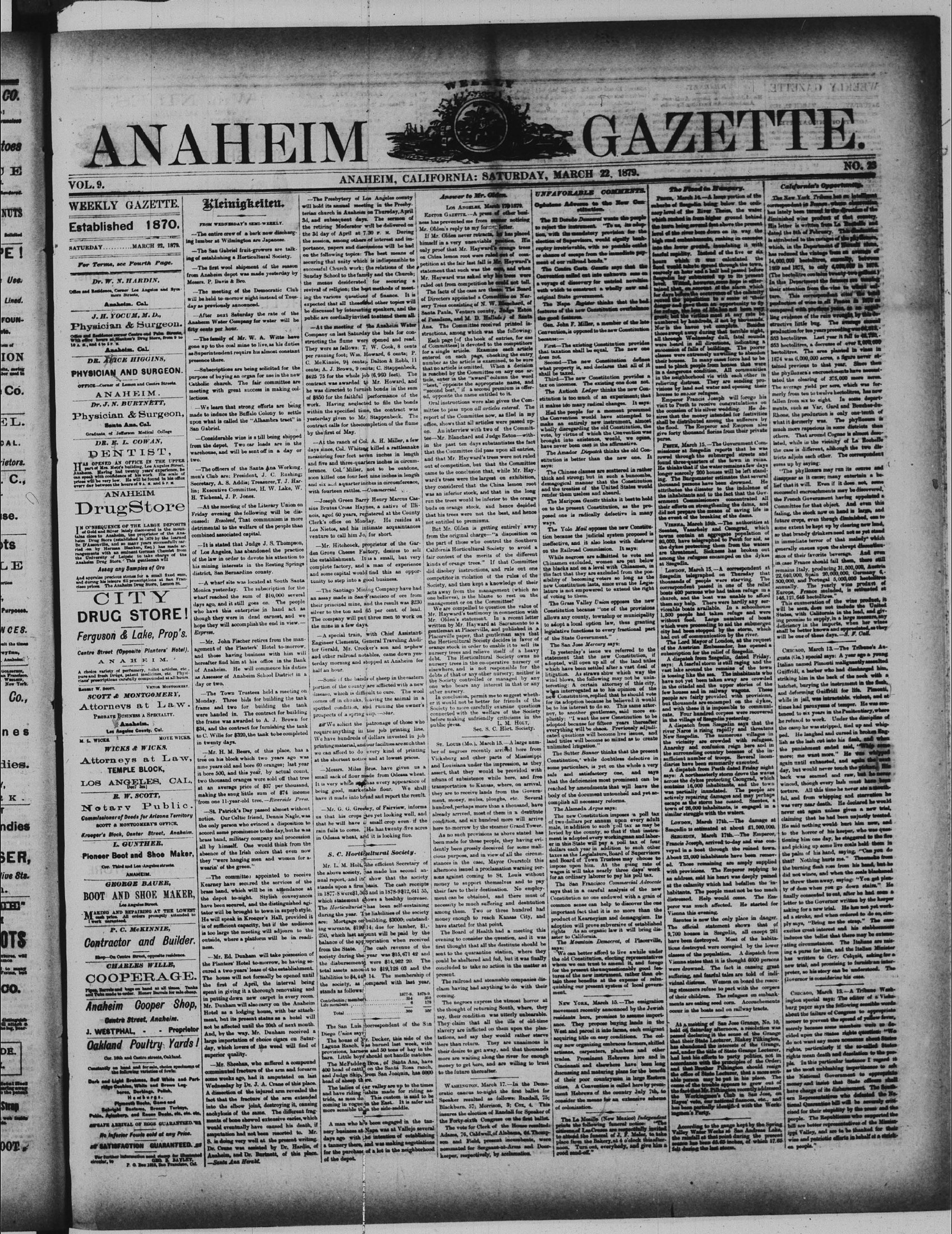
Searchable text
ANAHEIM
VOL. 9.
WEEKLY GAZETTE.
Established 1870.
SATURDAY...MARCH 22, 1879.
For Terms, see Fourth Page.
Dr. W. N. HARDIN,
Office and Residence, Corner Los Angeles and Byronmore Streets,
Anaheim. Cal.
J. H. YOCUM, M. D., Physician & Surgeon.
Office and Residence corner Centre and Palm Streets,
With office hours at Blanken's Drug Store, from 9 to 10 A.M., and 4 to 5 P.M.
Anaheim. Cal.
DR. ALICE HIGGINS,
PHYSICIAN AND SURGEON.
OFFICE—Corner of Lemon and Centre Streets.
ANAHEIM.
Dr. J. N. BURTNETT,
Physician & Surgeon,
Santa Ana, Cal.
Graduate of Jefferson Medical College
DR. E. L. COWAN,
DENTIST,
Kleinigkeiteu.
FROM WEDNESDAY'S SEMI-WEEKLY.
The entire crew of a bark now discharging lumber at Wilmington are Japanese.
The San Gabriel fruit-growers are talking of establishing a Horticultural Society.
The first wool shipment of the season from Anaheim depot was made yesterday by Messrs. P. Davis & Bro.
The meeting of the Democratic Club will be held to-morrow night instead of Tuesday as previously announced.
After next Saturday the rate of the Anaheim Water Company for water will be fifty cents per hour.
The family of Mr. W. A. Witte have gone up to the coal mine to live, as his duties as Superintendent require his almost constant presence there.
Subscriptions are being solicited for the purpose of buying an organ for use in the new Catholic church. The fair committee are meeting with great success in making collections.
We learn that strong efforts are being made to induce the Buffalo Colony to settle upon what is called the "Alhambra tract" in San Gabriel.
Considerable wine is still being shipped from the depot. Two car loads are in the warehouse, and will be sent off in a day or two.
The Presbytery will hold its annual terian church in Anaheim 3d, and subsequent the retiring Moderate the 31 day of April the session, among other portance, papers and on the following topic securing that unity w successful Church work Sunday School to the means desider revival of religion; th ing the various ques expected that all th be discussed by inter public are cordially in At the meeting Company on last Sat structuring the flume They were as fellow per running foot; W C. McKinnie, 9½ cents; A. J. Brown, $425 75 for the who contract was awarded he was directed to f of $850 for the faith work. Having nex within the specified yesterday given to contract calls for th by the first of May.
At the ranch o days since, Col. Wh measuring four feet
PHYSICIAN AND SURGEON.
OFFICE—Corner of Lemon and Centre Streets.
ANAHEIM.
Dr. J. N. BURTNETT,
Physician & Surgeon,
Santa Ana, Cal.
Graduate of Jefferson Medical College
DR. E. L. COWAN,
DENTIST,
HAS OPENED AN OFFICE IN THE UPPER part of Mrs. Melt's building, Los Angeles Street, Anaheim. Having had twenty years' experience, he can speak with confidence of his work. His scale of prices will be very low. He will be found in his office every day between the hours of 9 A.M. and 5 P.M.
ANAHEIM
DrugStore
IN CONSEQUENCE OF THE LARGE DEPOSITS of Gold and Silver lately discovered in the mountains close to Anaheim, the proprietor of the Anaheim Drug Store (established in 1879 by the learned Dr. D'Amasonville, and so many years successfully carried on by Herman Blanken, Esq.) has made arrangements with an eminent German Chemist from the University of Leipzig to take charge of the Anaheim Drug Store. This gentleman will Assay any Samples of Ore And appraise precious stones for a small fixed sum, and during his leisure fill prescriptions at San Francisco prices. The Anaheim Drug Store, Lemon St.
CITY DRUG STORE!
Ferguson & Lake, Prop's.
Centre Street (Opposite Planters' Hotel).
ANAHEIM.
A choice variety of perfumery, toilet articles, etc., pure and fresh brushes, patent medicines, etc. Physicians' prescriptions carefully compounded at all hours.
Reamay W. Scott.
VICTOR MONTGOMERY.
SCOTT & MONTGOMERY,
Attorneys at Law.
PROBATE BUSINESS A SPECIALTY.
Anaheim.
Los Angeles County, Cal.
M. L. WICKS.
MOYE WICKS.
WICKS & WICKS,
Attorneys at Law,
TEMPLE BLOCK,
LOS ANGELES, CAL.
Dec 7 Amj
R. W. SCOTT,
Notary Public.
Commissioner of Deeds for Arizona Territory
SCOTT & MONTGOMERY'S OFFICE,
Kroeger's Block, Center Street, Anaheim.
L. GUNTHER.
Pioneer Boot and Shoe Maker,
Corr. Third and Los Angeles streets.
—Subscriptions are being solicited for the purpose of buying an organ for use in the new Catholic church. The fair committee are meeting with great success in making collections.
—We learn that strong efforts are being made to induce the Buffalo Colony to settle upon what is called the "Alhambra tract" in San Gabriel.
—Considerable wine is a till being shipped from the depot. Two car loads are in the warehouse, and will be sent off in a day or two.
—the officers of the Santa Ana Working men's Club are: President, J. C. Rushing; Secretary, A. S. Addis; Treasurer, T. J. Harlin; Executive Committee, H. W. Lake, W. H. Tichenal, J. P. Jones.
—At the meeting of the Literary Union on Friday evening the following will be discussed: Resolved That communism is more detrimental to the welfare of the people than combined associated capital.
—It is stated that Judge J. S. Thompson, of Los Angeles, has abandoned the practice of the law in order to devote his attention to his mining interests in the Resting Springs district, San Bernardino county.
—a wharf site was located at South Santa Monica yesterday. The subscription for the wharf reached the sum of $10,000 several days ago, and it still goes on. The people who have this enterprise in hand act as though they were in dead earnest, and we hope they will accomplish the end in view.
—Express.
Mr. John Fischer retires from the management of the Planters' Hotel to-morrow, and those having business with him will hereafter find him at his office in the Bank of Anaheim. He will commence his duties as Assessor of Anaheim School District in a day or two.
—the Town Trustees held a meeting on Monday. Three bids for building the tank frame and two for building the tank were handed in. The contract for building the frame was awarded to A. J. Brown for $34, and the contract for furnishing the tank to C. Wille for $320, the tank to be completed in twenty days.
Mr. H. M. Beers, of this place, has a tree on his block which two years ago was nine years old and bore 60 oranges; last year it bore 500, and this year, by actual count, two thousand oranges were sold off that tree at an average price of $37 per thousand, making the snug little sum of $74 income from one 11-year-old tree.
St. Patrick's Day passed almost without notice. Our Celtic friend, Dennis Nagle, was the only person who evinced a disposition to accord some prominence to the day, but he was brass band, military company and procession all by himself. One would think from the absence of the Irish colors that even now they "were hanging men and women for a wearin' of the green."
LOS ANGELES, CAL.
Dec 7, 1834
R. W. SCOTT,
Notarv Public.
Commissioner of Deeds for Arizona Territory
SCOTT & MONTGOMERY'S OFFICE,
Kroeger's Block, Center Street, Anaheim.
L. GUNTHER,
Pioneer Boot and Shoe Maker,
Cor. Third and Los Angeles streets.
ANAHEIM.
GEORGE BAUER,
BOOT AND SHOE MAKER,
Los Angeles Street.
MAKING AND REPAIRING AT THE LOWEST
much price. All orders promptly attended to
I work guaranteed.
P. C. McKINNIE,
Contractor and Builder.
Shop—On Centre Street, opposite residence.
CHARLES WILLE,
COOPERAGE.
Plans, Barrels and bags on hand at all times. Thanks
and Tabs made to order. Honey Barrels for sale cheap.
Anaheim Cooper Shop,
Centre Street, Anaheim.
J. WESTPHAL, - - Proprietor
Oakland Poultry Yards!
Cor. 10th and Centro streets, Oakland.
Constantly on hand and for sale, choice specimens of
the following varieties of poults:
Dark and Light Brahmas, Buff White and Partridge Cochins, White and Brown Legheres, Durbings, Polish,
Hunt burgs.
Plymouth Beaks, Game and
Sebright Bantams, Bronze Turkeys,
Pahle, Aglesbury, and Rosen Duck, etc., etc.
NO INFERior Fouls sold at any Price.
SATISFACTION QUARANTEED.
For further information send stamp for illustrated
circular to:
GEO. K RAYLEY,
F. O. Box 1918, San Francisco, Cal.
St. Patrick's Day passed almost without notice. Our Celtic friend, Dennis Nagle, was the only person who evinced a disposition to accord some prominence to the day, but he was brass band, military company and procession all by himself. One would think from the absence of the Irish colors that even now they "were hanging men and women for a wearin' of the green."
The committee appointed to receive Kearney have secured the services of the brass band, which will be in attendance at the depot to-night. Stylish conveyances have been secured, and the distinguished agitator will be brought to town in superb style. He will speak in Kroeger's Hall, provided it is of sufficient capacity, but if the audience is too large the meeting will adjourn to the outside, where a platform will be in readiness.
Mr. Ed. Dunham will take possession of the Planters' Hotel to-morrow, he having secured a two-years' lease of the establishment. The house will not formally be opened until the first of April, the interval being spent in giving it a thorough renovating and in putting down new carpet in every room. Mr. Dunham will also carry on the Anaheim Hotel as a lodging house, with bar attachment, but its present status as a hotel will not be affected until the 20th of next month. And, by the way, Mr. Dunham received a large importation of choice cigars on Saturday, which lovers of the weed will find of superior quality.
Mr. Sheehan, who suffered a compound comminuted fracture of the arm and forearm some weeks ago, had it amputated on last Wednesday by Dr. J. A. Crane of this place. A dissection of the injured arm revealed the fact that the fracture of the arm extended into the elbow joint, destroying it, causing anchylosis of the same. The different fragments of bone showed extensive caries, which would eventually have caused his death, if amputation had not been resorted to. Mr. S. in doing very well at the present writing. Dr. Crane was assisted by Dr. Hardin, of Anaheim, and Dr. Burnett, of this place.
Santa Ana Herald.
ANAHEIM, CALIFORNIA: SATURDAY, MARCH 22, 1879.
The Presbytery of Los Angeles county will hold its annual meeting in the Presbyterian church in Anaheim on Thursday, April 3rd, and subsequent days. The sermon of the retiring Moderator will be delivered on the 3rd day of April at 7:30 p.m. During the session, among others of interest and importance, papers and discussions will be had on the following topics: The best means of securing that unity which is indispensable to successful Church work; the relations of the Sunday School to the family and the Church; the means desiderated for securing a revival of religion; the best methods of meeting the various questions of finance. It is expected that all these and other topics will be discussed by interesting speakers, and the public are cordially invited to attend them all.
At the meeting of the Anaheim Water Company on last Saturday the bids for constructing the flume were opened and read. They were as follows: T. W. Cook, 8 cents per running foot; Win. Howard, 6 cents; P. C. McKinnie, 9½ cents; Dalton & Robb, 11 cents; A. J. Brown, 9 cents; C. Stappenbeck, $425 75 for the whole job (6,960 feet). The contract was awarded to Mr. Howard, and he was directed to furnish bonds in the sum of $850 for the faithful performance of the work. Having neglected to file the bonds within the specified time, the contract was yesterday given to Mr. Stappenbeck. The contract calls for the completion of the flume by the first of May.
At the ranch of Col. A. H. Miller, a few days since, Col. Whiting killed a rattlesnake measuring four feet seven inches in length.
Answer to Mr. Olden.
Los Angeles, March 17th 1879.
EDITOR GAZETTE—A press of other business has prevented me from sooner noticing Mr. Olden's reply to my former letter.
If Mr. Olden never retracts, he has placed himself in a very unenviable position. His only proof that Mr. Hayward's orange trees on China lemon root were ruled out of competition at the fair last fall is Mr. Hayward's statement that such was the case, and when Mr. Hayward was asked why his trees were ruled out from competition he could not tell.
The facts of the case are these: The Board of Directors appointed a Committee on Nursery Trees consisting of N. W. Blanchard, of Santa Paula, Ventura county, Judge Eaton of Pasadena, and M. D. Hallady of Santa Ana. The Committee received printed instructions, among which was the following:
Each page [of the book of entries, for use of Committees] is devoted to the competitors for a single article. Examine each article entered on each page, checking the entry number as the article is examined, to be sure that no article is omitted. When a decision is reached by the Committee on any one article, enter in the "award" column the word "best," opposite the appropriate name, and "second best," if a second premium is offered, opposite the name entitled to it.
Oral instructions were also given the Committee to pass upon all articles entered. The report of the Committee now, as filed in my office, shows that all articles were passed upon. An interview with two of the Committee—Mr. Blanchard and Judge Eaton—within the past ten days substantiates the fact that the Committee did pass upon all entries, and that Mr. Hayward's trees were not ruled
UNFAVORABLE COMMENTS.
The El Dorado Democrat wants the people to reject the instrument. "To us, its adoption, with the mandatory provision for the election of Supervisors, would signify bankruptcy irretrievable, with no possible entitlement or chance of escape from the immediate payment of our railroad bonds."
The Contra Costa Gentle says that the Convention sailed out into unknown areas with which to construct a wholly new and original State government.
The Napa Register thinks that the bad features of the new Constitution overbalance the good features.
Gen. John F. Miller, a member of the late Convention, is opposed to the new Constitution because:
First—The existing Constitution provides that taxation shall be equal. The new one does not.
Second—The new Constitution defines what property is, and declares that all of it shall be taxed.
Third—The new Constitution provides a tax on incomes. The existing one does not.
The Antioch Ledger thinks the new Constitution is too much of an experiment; that it makes too many radical changes. It says:
Had the people for a moment presumed the Convention would have attempted to make an entirely new instrument, almost wholly disregarding the old Constitution, the vote, by virtue of which the Convention was brought into existence, would, we opine, have never been cast in the affirmative.
The Amador Dispatch thinks the old Constitution is better than the new one. It
The new Constitution imposes a poll tax of two dollars per annum upon every adult male, in addition to such poll tax as may be levied by the county, so that if that instrument is adopted every workingman and laborer in this State will pay a poll tax of four dollars each year in addition to such other taxes as the Legislature, Board of Supervisors and Board of Town Trustees may choose to impose upon him. At the going rate of wages it will take nearly three days' work
---
**S. C. Horticultural Society.**
Mr. L. M. Holt, the efficient Secretary of the share society, has made his second annual meeting on the tank for building the tank completed.
In the man-to-morrow, he will join the Bank for his duties district in a meeting on the tank for building the tank completed.
Some of the bands of sheep in the eastern portion of the county are afflicted with a new disease, which is difficult to cure. The wool comes off in chukks, leaving the animal in a spotted condition, and running the owner's prospects of a spring clip. Star.
We solicit the patronage of those who require anything in the job printing line. We have hundreds of dollars invested in job printing material, and our facilities are such that we can afford to do every kind of printing at the shortest notice and at lowest prices.
Messrs. Miles Bros. have given us a small sack of flour made from Odessa wheat. It is very white and has every appearance of being good, marketable flour. We shall have it made into bread and report the result.
Mr. G. G. Greedy, of Fairview, informs us that his crops are yet looking well, and that he will have 1 small crop even if the rain fails to come. He has twenty-five acres in Odessa wheat, and it is looking fine.
The Antioch Ledger thinks the new Constitution is too much of an experiment; that it makes too many radical changes. It says: Had the people for a moment presumed the Convention would have attempted to make an entirely new instrument, almost wholly disregarding the old Constitution, the vote, by virtue of which the Convention was brought into existence, would we opine, have never been cast in the affirmative.
The Amador Dispatch thinks the old Constitution is better than the new one. It says: The Chinese clauses are scattered in rather thick and strong; but in such a buncombe, demagogical manner that the Constitution and the treaties of the United States would render them useless and absurd.
The Mariposa Gazette thinks it best to hold on to the present Constitution, as the proposed one is radically defective in many ways.
The Yolo Mail opposes the new Constitution because the judicial system proposed is ineffective, and it also looks with disfavor on the Railroad Commission. It says:
While negroes are admitted to vote and Chinamen excluded, women are put below the blacks and on a level with Chinamen, in the fact that they are excluded from the possibility of becoming voters so long as the new Constitution lasts, since even the Legislature is not empowered to extend the right of voting to them.
The Grass Valley Union opposes the new Constitution because "one of the provisions allows any county, township or municipality to adopt a local option law, thus granting legislative functions to every fractional part of the State Government."
The San Jose Mercury says:
In yesterday's issue we referred to the statement that the new Constitution, if adopted, will open up all of the land titles which have been settled after a vast deal of litigation. As straw show which way the wind blows, the following may not be interesting: A certain attorney of this city, when interrogated as to his opinion of the new Constitution, replied that he should vote for its adoption because he believed it would be to his interest to do so. This same attorney, to another gentleman, said more explicitly: "I want the new Constitution to be adopted because for fifteen years thereafter everything will be chaos. Previously adjudicated questions will become live issues, and land titles will become so mixed as to create unlimited litigation."
The Sutter Banner thinks that the present Constitution, while doubtless defective in some particulars, is yet on the whole a very safe and satisfactory one, and says that the deficiencies most prominent can be reached by amendments that will leave the body of the document untouched and yet accomplish all necessary reforms.
The Alameda Argus says:
The new Constitution imposes a poll tax of two dollars per annum upon every adult male, in addition to such poll tax as may be levied by the county, so that if that instrument is adopted every workingman and laborer in this State will pay a poll tax of four dollars each year in addition to such other taxes as the Legislature, Board of Supervisors and Board of Town Trustees may choose to impose upon him. At the going rate of wages it will take nearly three days' work
Mr. G. G. Greeley, of Fairview, informs us that his crops are yet looking well, and that he will have a small crop even if the rain fails to come. He has twenty-five acres in Odeasa wheat, and it is looking fine.
S. C. Horticultural Society.
Mr. L. M. Holt, the efficient Secretary of the above society, has made his second annual report, and it shows that the society stands upon a firm basis. The cash receipts in 1877-8 were $1,503 and in 1878-9 were $12,641.55, which statement shows a healthy increase. The Horticulturist has been self-sustaining during the year. The liabilities of the society are: Mortgage on building, $3000; outstanding warrants, $199.14; due for lumber, $1,250, which last amount will be paid by the balance of the appropriation when received from the State. The cash revenue of the society during the year was $15,671.42 and the disbursements were $14,902.20. The total assets amount to $19,128.03 and the liabilities to $4,448.14. The membership of the society, as compared with last year, stands as follows:
Contributing members: 354
Life members: 0
Total: 369
The San Luis correspondent of the San Diego Union says:
The house of Mr. Decker, this side of the Laguna Ranch, was burned last week, with provisions, harnesses and 50 tons of hay in the barn. Little boys should not handle matches.
The McFadden Bro., of Santa Ana, have 400 head of cattle on the Santa Rosa ranch, and Judge Skip, from San Joaquin, has 6000 head of sheep there.
The ladies of our valley are up to the times and have riding habits made for riding astride, as men do. This custom is said to be coming in vogue in the East. It is safer and more sensible than the side-saddle.
A man who has been engaged in the tannery business at Napa was at Vallejo several days ago with the intention of establishing a tannery there, and was making negotiations for the purchase of a lot in the neighborhood of the depot.
WASHINGTON, March 17.—In the Democratic caucus to-night the first ballot for Speaker resulted as follows: Randall, 75; Blackburn, 57; Morrison, 3; Cox, 4. This insures the election of Randall for Speaker of the Forty-sixth Congress on the first ballot.
The vote for Clerk of the House resulted: Adams, 76; Caldwell, of Alabama, 64. Thompson and Field, present incumbents, were nominated for Sergeant-at-Arms and Doorkeeper, respectively, by acclamation.
The Alameda Argus says:
The new Constitution imposes a poll tax of two dollars per annum upon every adult male, in addition to such poll tax as may be levied by the county, so that if instrument is adopted every workingman and laborer in this State will pay a poll tax of four dollars each year in addition to such other taxes as the Legislature, Board of Supervisors and Board of Town Trustees may choose to impose upon him. At the going rate of wages it will take nearly three days' work for an ordinary laborer to pay his poll tax.
The San Francisco Commercial Advocate says that in a careful analysis of the new Constitution no one endowed with a grain of common sense can help to discover the important fact that it is no more than the product of Kearneyism and demagogism. Its adoption will prove subversive of established rights. As an organic law it will bring disaster to California.
The Mountain Democrat, of Placerville, says:
We can better afford to live awhile under the old Constitution, electing representatives whom we can trust to amend it, and forego for the present unquestionably good features of the new instrument, rather than obtain these benefits at the expense of reliquishing our present system of local government.
New York, March 15.—The emigration movement recently announced by the Jewish residents here, promises to assume importance. They propose buying lands in the West and parcel it into farms, each emigrant acquiring title on easy conditions. The colony now organizing embraces farmers, skilled artisans, carpenters, plumbers and other trades. Prominent Hebrews here and in Cincinnati and elsewhere have been long discussing and maturing plans for the benefit of their poor countrymen in large Eastern cities. A Convention is called here by prominent Hebrews of the country July 7th, to consider the means for an extensive scheme of colonization.
The La Mesilla (New Mexico) Independent prints the following funeral notice: "The citizens of Las Cruces are respectfully invited to attend the funeral of J. F. Malek, to take place from the Bakery at 4 o'clock this afternoon. Turn out everybody, and give him a good send-off."
GAZETTE.
22, 1879. NO. 23
COMMENTS.
To the New Constitution.
wants the people
"To us, its adoption provision for the would signify benefit no possible outlet the immediate payda."
Gaetzte says that the unknown ass on our untried novelties a wholly new and untalks that the bad constitution overbalance a member of the late to the new Constitution Constitution provides equal. The new one Constitution defines declares that all of it institution provides a existing one does not. thinks the new Con- of an experiment; that local changes. It says: a moment presumed have attempted to new instrument, almost the old Constitution, the which the Convention was would, we opine, in the affirmative. thinks the old Con- the new one. It
The Flood in Hungary.
Pearson, March 14.—A huge portion of the enclosure of Singodin being below the ordinary level of the River Theis, the water which ranhed in from higher ground behind the town being several feet above the present level of the river runs down on its way the high sand embankments, rushing in oceans into the lower ground, invading it with fearful rapidity. Instead of the five or six hours which it was calculated the flood would take to spread through the towns, severely an hour and a half had passed before Singodin lay submerged up to its present level. Wittal, however, some hope is entertained that an account of the alarm which for days before the occurrence of the calamity rowed the population to a sense of their danger and gave them an opportunity to fly for refuge, the loss of life has not been very great; but the victims must at any rate be numbered by hundreds, if not by thousands. Nor in the haven yet complete. Besides those swept away during that terrible night, all through Wednesday dull, fatal sounds were heard in all directions, indicating a succession of falls of buildings. The poorer clauses were extremely unwilling to abandon their houses. In many cases force had to be used to pluck people from houses that were in a dangerous condition. All communities in the neighborhood vie with each other in relieving distress. They are sending provisions by land and water and opening their houses to another refugee.
Emperor Francis Joseph will forego his visit to Peeth to receive congratulations on the occasion of his silver wedding. He desires that the money intended for festivities shall be distributed among the sufferers by the flood. The Emperor and Empress also give forty thousand florins from their private purse.
PEETH, March 15.—The Government Commissioner at Szegedin reports that he was rowed through the submerged streets and town in ruins.
California's Opportunities.
The New York Tribune has an intelligent correspondent in Europe whose observation has lately been turned in the direction of the diminished wine product of that country. His letter is written from La Bochelle and dated the 8th of February. This distribution is attributed to the ravages of the phyllotrites, which, in the Department of Illinois alone, has redened the vintage from an average of 14,000,000 hectolitres, annually, between 1809 and 1875, to only 4,000,000 in 1875 (The hectolitre contains twenty-two gallons.) In this Department the farces are tending their attention from the vine to which culture. This correspondent cited the total production of wine in all France in 1876 as compared with previous years, as an equalling evidence of the rain wrought by this destructive little bug. The average annual production for ten years preceding was 60,613 hectolitres. Last year it fell to 48,792 hectolitres, a decrease of over 8,000,000 hectolitres. The area planted in vines in 1874 was 6,000,000 acres, a figure never attained previous to that year. Since then the phylloxera's encroachments have manifested the clearing of 375,000 more acres. The average yield per acre, which was formerly from ten to twelve hectolitres, has now fallen from six to eight. In some departments, such as Var, Gard and Bouches-du-Rhone, the production is only one-tenth of what it formerly was. The phylloxera is much more rapacious in some districts than others. That around Cogne is almost denoted, while in the vicinity of La Bochelle the case is different, although the two districts adjoin each other. The correspondent
the new Constitution provides a new instrument, almost the old Constitution, which the Convention was would, we opine, be affirmative.
which thinks the old Constitution is new one. It are scattered in rather in such a buncombe, that the Constitution the United States would and abound.
we think it best to hold institution, as the pro-ly defective in manyoses the new Constitu-tional system proposed is too looks with disfavormission. It says:
admitted to vote and women are put below level with Chinamen, in excluded from the post-voters so long as the since even the Legis-lered to extend the right Union opposes the new "one of the provisions township or municipality law, thus granting to every fractional partment."
bury says:
we were referred to the new Constitution, if up all of the land titles led after a vast deal of show which way the showing may not be unin-attorney of this city, to his opinion of the related that he should vote house he believed it would do so. This same attor-ttleman, said more ex-ienew Constitution to be fifteen years thereafter masos. Previously adjudi-come live issues, and some so mixed as to create"
our thinks that the present doubtless defective in yet on the whole a very history one, and says most prominent can be incidents that will leave the untouched and yet ac-cry reforms.
rus says:
nution imposes a poll tax annum upon every adult such poll tax as may be pay a poll tax of four addition to such other feature, Board of Supervisors Trustees may choose to At the going rate of nearly three days' work
used to pluck people from houses that were in a dangerous condition. All communities in the neighborhood vie with each other in relieving distress. They are sending provisions by land and water and opening their houses to auxor refugees.
Emperor Francis Joseph will forego his visit to Pesth to receive congratulations on the occasion of his silver wedding. He desires that the money intended for festivities shall be distributed among the sufferers by the flood. The Emperor and Empress also give forty thousand florins from their private purse.
PENTH, March 15.—The Government Commissioner at Szegedin reports that he was rowed through the submerged streets and found three-quarter of the town in ruins. He thinks that if the water remains a few days longer scarcey 200 houses will be left standing. The Burgomaster estimates that several thousand persons have been drowned. He attributes the disaster to the indolence of the inhabitants and to the fact that the Government Commissioners concentrated all their efforts on strengthening the dams, and did not prepare the means of saving life in the event of the breaking of the dams.
VIENNA, March 15th.—The authorities at Szegedin, Vaarahely and Coongrad, which towns contain an aggregate population of 80,000, have telegraphed to Pesth for aid, as the dykes protecting them from the waters are threatened. Sickness has broken out among the refugees encamped on the dykes at Szegedin.
LONDON, March 15.—A correspondent at Szegedin telegrammed on Thursday that thousands of people were starving. The correspondent passed in one of the relief boats 400 persons who had taken refuge in a church, and the boat was unable to afford them any help. There were hardly any serviceable boats available. In a schoolhouse 1,500 people had taken refuge and were without food. Large numbers of boats which were proceeding to aid the submerged city had been stopped by the storm, which had cut off communication by the river.
The Lord Mayor of London, at the request of the Austrian Embassador, has opened a subscription for the relief of Szegedin.
A dispatch from Szegedin, dated Friday, says: A fearful storm is still raging and the vast lake around the remains of the town is toeing like the sea. The inhabitants who have not yet been taken away are crowded in the citadel and the upper stories of the few houses and in railway wagons. These people are fairly provided with provisions, but thousands are encamped on the dykes, and with these it is impossible to communicate. Four hundred corps were recovered in the village of Szegedin yesterday.
A dispatch from Szegedin says that the river Narva is rising rapidly and threatens New Szegedin. The numerous villages in the vicinity are crowded with refugees. Anarchy and confusion reign here and in the surrounding country because of the insufficient number of troops. Several incendiaries have been summarily executed.
A dispatch from Pesth dated Friday night says: A northeasterly storm drove the waves across the dykes protecting Coongrad, which contains 16,000 inhabitants, and the town was partially inundated. The people are actively repairing damages and may perhaps escape as the storm has ceased. Szenges, a town of 28,000 inhabitants, is engaged in a similar struggle with the waters.
LONDON, March 17th.—The damage at Szegedin is estimated at about £1,500,000.
SzEGEDIN, March 17th.—The Emperor, Francis Joseph, arrived to-day and was conveyed in a boat through the ruined town. About 23,000 inhabitants have been removed. Those remaining are amply supplied with provisions. The Emperor replying to taimed previous to that year. Since then the phylloxera's encroachments have accumulated the clearing of 375,000 more acres. The average yield per acre, which was formerly from ten to twelve hectolitres, has now fallen from six to eight. In some departments, such as Var, Gard and Boushee-dRhone, the production is only one-tenth of what it formerly was. The phylloxera is much more rapacious in some districts than others. That around Cognae is almost de-lated, while in the vicinity of La Rochelle the case is different, although the two districts adjoin each other. The correspondent sums up by saying:
"The phylloxera may run its course and disappear as it cause; many entertain a belief that it will. Even if it does not, some successful encroachments may be discovered, the French Government having appointed a Committee for that object. And even this failing, the stock now on hand is large, and future crops, even though diminished, can to some extent be kept up by clearing new land, so that brandy drinkers need not as yet stand in immediate terror of that malady" which generally ensues upon the abrupt discontinuance of their favorite beverage. And even in case France should fail them, there still remains Italy, producing 31,500,000, Austria 22,640,000, Spain 20,000,000, Germany 6,-500,000,and Portugal 5,000,000 hectolitres annually. The yearly wine product of Europe, France included, is estimated at 146,121,645 hectolitres."
This enumeration of the wine product, it will be seen, does not include the United States, with California in the lead, and giving promise to supply, in a large measure, any deficiency in the imports, when her wines shall be better known and appreciated, as they will be one of these days.-B. F. Call.
CHICAGO, March 13.—The Tribune's Augusta (Ga.) special says: A year ago a young Italian named Pimonti malignantly assaulted Guiffridi, a barber who had discharged him, striking him in the back of the neck with a hatchet; burying the instrument in the flash, and deforming Guiffridi for life. Pimonti, while in jail, was intractable. vicious, and at times had paroxyma of temper. He was sentenced to six years in the Penitentiary where he refused to work. Under the disciplinary of the camp he was stripped,tied up and whipped. He laughed and cursed in broken English as the lash cut into his flesh,and when the punishment ended said,"Whip came more; me want more." He was whipped again until exhausted,and againthe next day,but would never touch the pithon.Him back was seamed and raw,but he never winced,they every lash must have been torture.All this time he never ate a mouthful,and from whipping and starvation he was very near death.He declared he would never eat unless given a new trial claiming that he had been unjustly treated.He said nothing would hurt him now,and to the horror of his keeperwho was questioning him one day,hastagered to dieand picking up some live coals held them inthe palm of his hand,saying,"Can you do that? Nothing hurts me."These make fromthe burning flesh rose from his hand,both
At a meeting of San Jose Grange, No. 10, held on Saturday afternoon, a resolution was passed declaring it the sense of the Grange that their State Lecturer, Blakey Pilkington, has abandoned the interests of the Grange, and under the title of State Grange Lecturer, had lent his efforts to party politics, not in accordance with the principles of the Order; and that Breather Pilkington should resign the office of State Lecturer, that a more suitable person may be put in his place. The cause of the trouble appears to grow out of the fact that Mr. Pilkington recently addressed the Workingman's Club in San Jose, on Hayes' vote, our national finances, etc., and has been partially identified with the Workingman's Party.
According to the same kept by the Spring Valley Water Works at San Andreas Lake, the rainfall at that point during the present season has been 45.65 inches, of which 17.65 fell during the last storm.
London, March 17th.—The damage at Szegedin is estimated at about $1,500,000. Szegedin, March 17th.—The Emperor, Francis Joseph, arrived to-day and was conveyed in a boat through the ruined town. About 23,000 inhabitants have been removed. Those remaining are amply supplied with provisions. The Emperor replying to an address, said his heart was deeply pained at the calamity which had befallen the inhabitants. The people must not be too much distressed. Help would come. The Emperor was much affected. He started for Vienna this evening.
Szentes is now the only place in danger. The official statement shows that of 9,700 houses in Szegedin, all except 261 have been destroyed. Most of the habitations destroyed were occupied by the lower classes of the population. A dispatch from Vienna states that it is thought 6000 persons were drowned. The fact is causing great suffering, and fearful tales are told of individual distress. Women on board the rescue steamers refuse to part with the corpses of their children. The refugees on embankments are eating seed corn. Accouchements occur in the boats and on railway tracts.
At a meeting of San Jose Grange, No. 10, held on Saturday afternoon, a resolution was passed declaring it the sense of the Grange that their State Lecturer, Blakey Pilkington, has abandoned the interests of the Grange, and under the title of State Grange Lecturer, had lent his efforts to party politics, not in accordance with the principles of the Order; and that Breather Pilkington should resign the office of State Lecturer, that a more suitable person may be put in his place. The cause of the trouble appears to grow out of the fact that Mr. Pilkington recently addressed the Workingman's Club in San Jose, on Hayes' vote, our national finances, etc., and has been partially identified with the Workingman's Party.
Chicago, March 13.—A Tribune Washington special says: The editor of a Vinkburg paper says the following sensible words about the failure of Congress to appropriate money to prevent the spread of yellow fever, merely because some members were so decided upon the States rights question: "We do not want any more nominees about State rights, particularly if the so-called Statute rights mean death and desolation to the people. In this particular instance I regard it as the most unblushing impartinence to such the National Government to appropriate money and insist that State officers shall have charge of its disbursement. The Southern Representatives who defeated the National Quarantine bill will be severely criticised for their stupidity by the press and the people. The Republican who supported the bill are better representatives of the Mississippi Valley, and are to be thanked for their wise and patriotic efforts in behalf of a stricter people."