anaheim-gazette 1879-03-08
Scanned page
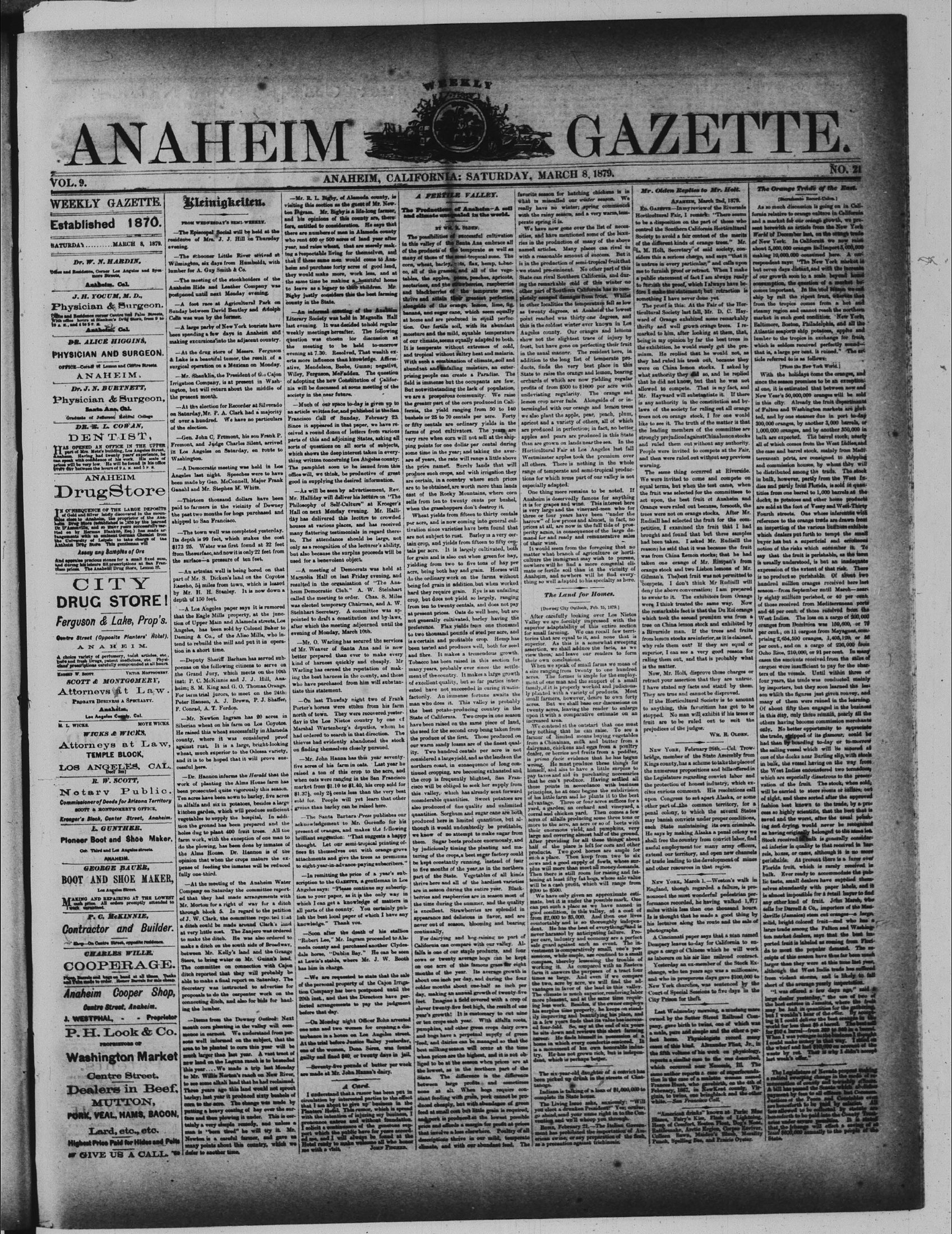
Searchable text
ANAHEIM
VOL. 9.
WEEKLY GAZETTE.
Established 1870.
SATURDAY...MARCH 8, 1879.
Dr. W. N. HARDIN,
Office and Residence, Corner Los Angeles and Byronmore Streets,
Anahiem, Cal.
J. H. YOCUM, M. D.,
Physician & Surgeon.
Office and Residence corner Centre Real Palm Streets,
With office hours at Blanken's Drug Store, from 9 to 10 A.M., and 4 to 5 P.M.
DR. ALICE HIGGINS,
PHYSICIAN AND SURGEON.
OFFICE—Corridor of Lemon and Centra Streets.
ANAHEIM.
Dr. J. N. BURTNETT,
Physician & Surgeon,
Santa Ana, Cal.
Graduate of Jefferson Medical College
DR. E. L. COWAN,
DENTIST,
HAS OPENED AN OFFICE IN THE UPPER part of Mr. Meta's building, Los Angeles Street, Anahiem. Having had twenty years' experience, he two weeks with confidence of his work. His scale of Kleinigkeiten.
FROM WEDNESDAY'S REMI-WEEKLY.
The Episcopal Social will be held at the residence of Mrs. J. J. Hill on Thursday evening.
The schooner Little River arrived at Wilmington, six days from Humboldt, with lumber for A. Guy Smith & Co.
The meeting of the stockholders of the Anaheim Hide and Leather Company was postponed until next Monday evening.
A foot race at Agricultural Park on Sunday between David Bentley and Adolph Cells was won by the former.
A large parly of New York tourists have been spending a few days in Anaheim and making excursions into the adjacent country.
At the drug store of Messrs. Ferguson & Lake is a beautiful tumor, the result of a surgical operation on a Mexican on Monday.
Mr. Shanklin, the President of the Cajon Irrigation Company, is at present in Washington, but will return about the middle of the present month.
At the election for Recorder at Silverado on Saturday, Mr. P. A. Clark had a majority of over a hundred. We have no particulars of the election.
Gen. John C. Fremont, his son Frank P. Fremont, and Judge Charles Silent, arrived in Los Angeles on Saturday, en route to Washington.
Mr. R. L. Bigby, of Ala., visiting this section as the great Pilgrim. Mr. Bigby is a man and his opinions of this course, entitled to consideration there are numbers of men in who rent 400 or 500 acres of year, and raise wheat, that being a respectable living for that if these same men would heim and purchase forty acres they would make more, we the same time be making a to leave as a legacy to the Bigby justly considers this county in the State.
An informal meeting Literary Society was held in last evening. It was decided weekly meetings hereafter; question was chosen for the meeting to be held evening at 7:30; Resolved,erta more influence than kinative, Mendelson, Beebe, Wiley, Ferguson, McFadden of adopting the new Constitution will be discussed at society in the near future.
Much of our space to an article written for, and Francis Call of Sundays Since it appeared in that part of this and adjoining sorts of questions on all which shows the deep interest thing concerning la
ANAHEIM.
Dr. J. N. BURTNETT,
Physician & Surgeon,
Santa Ana, Cal.
Graduate of Jefferson Medical College
DR. E. L. COWAN,
DENTIST,
HAS OPENED AN OFFICE IN THE UPPER part of Mr. Meta's building, Los Angeles Street, Anaheim. Having had twenty years' experience, he can speak with confidence of his work. His scale will be very low. He will be found in his office every day between the hours of 9 A.M. and 5 P.M.
ANAHEIM DrugStore
IN CONSEQUENCE OF THE LARGE DEPOSITS of Gold and Silver lately discovered in the mountains close to Anaheim, the proprietor of the Anaheim Drug Store (established in 1870 by the learned Dr. D'Anselmville), and so many years successfully married on by Herman Blanket, Esq.) has made arrangements with an eminent German Chemist from the University of Leipzig to take charge of the Anaheim Drug Store. This gentleman will Assay any Samples of Ore And appraise precious stones for a small fixed sum, and during his leisure fill prescriptions at San Francisco prices. The Anaheim Drug Store, Lemon St.
CITY DRUG STORE!
Ferguson & Lake, Prop's.
Centre Street (Opposite Planters' Hotel),
ANAHEIM.
A choice variety of perfumery, toilet articles, etc., herbs and fresh Drugs, patent medicines, etc. Physicians' prescriptions carefully compounded at all hours.
KOSMET W. SCOTT.
VICTOR MONTGOMERY.
SCOTT & MONTGOMERY,
Attorneys at Law.
PROBATE BUSINESS A SPECIALTY.
ANAheim,
Los Angeles County, Cal.
M. L. WICKS.
MOYE WICKS.
WICKS & WICKS,
Attorneys at Law,
TEMPLE BLOCK,
LOS ANGELES, CAL.
Dee7 Sm.
R. W. SCOTT,
Notary Public.
Commissioner of Deeds for Arizona Territory
SCOTT & MONTGOMERY'S OFFICE.
Kreager's Block, Center Street, Anaheim.
L. GUNTHER.
Pioneer Boot and Shoe Maker,
On Third and Los Angeles streets.
ANAHEIM.
GEORGE BAUER,
Mr. Shanklin, the President of the Cajon Irrigation Company, is at present in Washington, but will return about the middle of the present month.
At the election for Recorder at Silverado on Saturday, Mr. P. A. Clark had a majority of over a hundred. We have no particulars of the election.
Gen. John C. Fremont, his son Frank P. Fremont, and Judge Charles Silent, arrived in Los Angeles on Saturday, en route to Washington.
A Democratic meeting was held in Los Angeles last night. Speeches were to have been made by Gen. McConnell, Major Frank Ganahl and Mr. Stephen M. White.
Thirteen thousand dollars have been paid to farmers in the vicinity of Downey the past two months for hogs purchased and shipped to San Francisco.
The town well was completed yesterday. Its depth is 99 feet, which makes the cost $173 25. Water was first found at 32 feet from the surface, and now it is only 22 feet from the surface—a pressure of ten feet.
An artesian well is being bored on that part of Mr. S. Dicken's land on the Coyotes Kaneho, 5½ miles from town, which is leased by Mr. H. H. Stanley. It is now down a depth of 150 feet.
A Los Angeles paper says it is rumored that the Eagle Mills property, at the junction of Upper Main and Alameda streets, Los Angeles, has been sold by Colonel Baker to Deming & Co., of the Aliso Mills, who intend to rebuild the mill and put it in operation in a short time.
Deputy Sheriff Barham has served subpoenas on the following citizens to serve on the Grand Jury, which meets on the 10th instant: P. C. McKinnie and J. J. Hill, Anaheim; S. M. King and G. O. Thomas. Orange For term trial jurors, to meet on the 24th: Peter Hansen, A. J. Brown, P. J. Shaffer, F. Conrad, A. T. Ferdon.
Mr. Newton Ingram has 20 acres in Siberian wheat on his farm on Los Coyotos. He raised this wheat successfully in Alameda county, where it was considered proof against rust. It is a large, bright-looking wheat, much superior to the Olessa variety, and it is to be hoped that it will prove successful here.
Dr. Hannon informs the Herald that the work of planting the Alms House farm has been prosecuted quite vigorously this season. Ten acres have been sown to barley, five acres in alfalfa and six in potatoes, besides a large kitchen garden, which will produce sufficient vegetables to supply the hospital. In addition the ground has been prepared and the holes dug to plant 400 fruit trees. All the farm work, with the exception of one man to do the plowing, has been done by inmates of the Alms House. Dr. Hannon is of the opinion that when the crops mature the expense of feeding the inmates will be reduced surgical operation on a Mexican on Monday.
Mr. Shanklin, the President of the Cajon Irrigation Company, is at present in Washington, but will return about the middle of the present month.
At the election for Recorder at Silverado on Saturday, Mr. P. A. Clark had a majority of over a hundred. We have no particulars of the election.
Gen. John C. Fremont, his son Frank P. Fremont, and Judge Charles Silent, arrived in Los Angeles on Saturday, en route to Washington.
A Democratic meeting was held in Los Angeles last night. Speeches were to have been made by Gen. McConnell, Major Frank Ganahl and Mr. Stephen M. White.
Thirteen thousand dollars have been paid to farmers in the vicinity of Downey the past two months for hogs purchased and shipped to San Francisco.
The depth is 99 feet, which makes the cost $173 25. Water was first found at 32 feet from the surface, and now it is only 22 feet from the surface—a pressure of ten feet.
An artesian well is being bored on that part of Mr. S. Dicken's land on the Coyotes Kaneho, 5½ miles from town, which is leased by Mr. H. H. Stanley. It is now down a depth of 150 feet.
A Los Angeles paper says it is rumored that the Eagle Mills property, at the junction of Upper Main and Alameda streets, Los Angeles, has been sold by Colonel Baker to Deming & Co., of the Aliso Mills, who intend to rebuild the mill and put it in operation in a short time.
Deputy Sheriff Barham has served subpoenas on the following citizens to serve on the Grand Jury, which meets on the 10th instant: P. C. McKinnie and J. J. Hill, Anaheim; S. M. King and G. O. Thomas. Orange For term trial jurors, to meet on the 24th: Peter Hansen, A. J. Brown, P. J. Shaffer, F. Conrad, A.T.Ferdon.
Mr.Newton Ingram has 20 acres in Siberian wheat on his farm on Los Coyotos.Here raised this wheat successfully in Alameda county where it was considered proof against rust.it is a large bright-looking wheat,much superior tothe Olessa variety,and it is to be hoped that it will prove successful here.
Dr.Hannon informstheHeraldthattheworkofplantingtheAlmsHousefarmhasbeenprosecutedquitevigorouslythisseason.Tenacreshavebeensowntobarley,fiveacresinalalfalfaandsixinpotatoesbesidesalargitikitchengardenwhichwillproduce suficientvegetablestosupplythehospital.Inadditionthegroundhasbeenpreparedandtheholesdugtoplant400fruittrees.Alltarmworkwiththeexceptionofonemantodotheplowing,hasbeendonebyinmatesoftheAlmsHouse.Dr.Hannonisoftheopinionthatwhenthecropsmaturetheexpenseoffeedingtheinmateswillbereduced
Mr.Shanklin,thePresidentoftheCajonIrrigationCompanyisatpresentinWashingtonbutwillreturnaboutthemiddleofthepresentmonth.
Atthe选举forRecorderatSilveradoonSaturdayMr.P.A.Clarkhadapartmajorofthemiddleofthepresentmonth.
Gen.JohnC.Fremont,hissonfFrankP.Fremont,andJudgeCharlesSilentarrivedinLosAngelesonsSaturdayenroutetoSanFrancisco.
TheDemocraticmeetingwasheldinthesmallspacetoadanarticlewrittenfor,andp FranciscoCallofSundaySinceitappearedinthatpartceivedarounddezenofleathartsofquestionsonallwhichshowsthedeepinterningwrittenconcerningLa.Thepamphletsoftobebofficewillwethinkbegoodinsupplyingthedesire.
AswillbeseenbyadMr.HallidaywilldeliverbPhilosophyofSelf-CultureHallonnextMondayeverydayhas deliveredthisleahousesatvariousplaces,manyflatteringtestimonialsto.Theattendanceshowonlyasrecognitionofthebutalsobecausethesurpriseusedforabenevolentobject.
AmeetingDemos MagnoliaHallonlastFresultedintheorganizationDemocraticClub."calledthemeetingtoorderwaselectedtemporaryChieSteinhartSecretary.Apointedto draftaconstitutionafterwhichthemeetingateeveningofMonday,March.
Mr.O.WarlinghassignedoffMr.WeaverofSantaBetterpreparedthaneverkindofharnessquicklyWarlinghasearnedtherestingthebeatharnessinthewhohavepurchasedfromtiata statement.
OnlastThursdaynPorter'shorseswerestuurtorthoafront.oftown TheyweredayintheLosNietosoMarshalWartenberg'scityhadorderedtosearchinthethieveshad evidentlyabovedefiningthemselvesclosely
Mr.JohnHannahasfiveacresofhisfarminraiseda tonofthiscreaturewhenoatswere ranginginmarketfrom$1.10to$1.$137,\only2centslesssoldfor.Peoplewillgrainshanberableycanbeusedtoeight-year-in-advenience
R. W. SCOTT,
Notary Public.
Commissioner of Deeds for Arizona Territory
SCOTT & MONTGOMERY'S OFFICE,
Kreager's Block, Center Street, Anaheim.
L. GUNTHER.
Pioneer Boot and Shoe Maker,
Oct. Third and Los Angeles streets.
ANAHEIM.
GEORGE BAUER,
BOOT AND SHOE MAKER,
Los Angeles Street.
MAKING AND REPAIRING AT THE LOWEST
much price. All orders promptly attended to
work guaranteed.
P. C. McKINNIE,
Contractor and Builder.
Shop—On Centre Street, opposite residence.
CHARLES WILLE,
COOPERAGE.
Plants, barns and bays on hand at all times. Thanks and thanks made to order. Hume Burrels for this chapel.
Anaheim Cooper Shop,
Centre Street, Anaheim.
J. WESTPNAL, - - Proprietor
P. H. Look & Co.
reorganizes or
Washington Market
Centre Street.
Dealers in Beef,
MUTTON,
PORK, VEAL, HAMS, BACON,
Lard, etc., etc.
Highest Price Paid for Hides and Pelts
GIVE US A CALL.
Dr. Hannon informs the Herald that the work of planting the Alms House farm has been prosecuted quite vigorously this season. Ten acres have been sown to barley, five acres in alfalfa and six in potatoes, besides a large kitchen garden, which will produce sufficient vegetables to supply the hospital. In addition the ground has been prepared and the holes dug to plant 400 fruit trees. All the farm work, with the exception of one man to do the plowing, has been done by inmates of the Alms House. Dr. Hannon is of the opinion that when the crops mature the expense of feeding the inmates will be reduced fully one-third.
At the meeting of the Anaheim Water Company on Saturday the committee reported that they had made arrangements with Mr. Morton for a right of way for a ditch through block 5. In regard to the petition of J. W. Clark, the committee reported that a ditch could be made around Clark's land at very little cost. The Zanjero was ordered to make the ditch. He was also ordered to make a ditch on the south side of Broadway, between Mr. Kelly's land and the Grange Store, to bring water on Mr. Guinn's land. The committee on connection with Cajon ditch reported that they will probably be able to make a final report on Saturday. The Secretary was instructed to advertise for proposals to do the carpenter work on the connecting ditch, and also for bids for hauling the lumber.
Items from the Downey Outlook: Next month corn planting in the valley will commence in earnest. We understand from persons well informed on the subject, that the area to be planted to corn this year will be much larger than last year. A vast tract of new land on the Laguna ranch is to be needed this year... We made a trip last Monday to Mr. Willis Norton's ranch on New River, to see some alkali land that he had reclaimed. Three years ago this land would not sprout barley; last year it produced sixty bushels of corn to the acre. The change was made by putting a heavy coating of hay over the surface and then plowing it under. This is certainly a very simple remedy, and unless a man is "burn tired" he will try it. Mr. Newton is a careful farmer, and gave us many points about this country, which we defer to another time.
The Santa Barbara acknowledgement to Mrs. present of oranges, and to brilliant suggestion: "To thought. Let our semifine fit themselves out attachments and give them to eight-year-in-advance.
In remitting the prescription to the Gazette Angeles says: "Please omit tion to your paper, as it which I can get a know all parts of the county. lish the best local paper knowledge." Thank you.
Soon after the day "Robert Lee," Mr. Ingle meda county and parchale horse, "Dublin B at Lewis's stable, where has him in charge.
We are requested of the personal property Company has been 20th inst., and that thieved arrangements before that day.
On Monday night one man and two women turbance in a house on At the trial before Just one of the women, Do guilty and fined $40.
Seventy-five pounds are made at Mr. John.
I understand that a circulation by interweave that I am abogot to give Planters' Hotel. This with the intention of pronounce untrue and I solicit a continuation part which the public ad me, and I will allow Hotel ready to make me with a visit.
Mr. R. L. Bigby, of Alameda county, is visiting this section as the guest of Mr. Newton Figram. Mr. Bigby is a life-long farmer, and his opinions of this county are, therefore, entitled to consideration. He says that there are numbers of men in Alameda county who rent 400 or 500 acres of land year after year, and raise wheat, that are merely making a respectable living for themselves, and that if these same men would come to Anaheim and purchase forty acres of good land, they would make more, work less, and at the same time be making a beautiful home to leave as a legacy to their children. Mr. Bigby justly considers this the best farming county in the State.
An informal meeting of the Anaheim Literary Society was held in Magnolia Hall last evening. It was decided to hold regular weekly meetings hereafter. The following question was chosen for discussion at the meeting to be held to-morrow evening at 7:30: Resolved, That wealth exerts more influence than knowledge. Affirmative, Mendelson, Beebe, Guinn; negative, Wiley, Ferguson, McFadden. The question of adopting the new Constitution of California will be discussed at some meeting of the society in the near future.
Much of our space to-day is given up to an article written for, and published in the San Francisco Call of Sunday, February 23. Since it appeared in that paper, we have received a round dozen of letters from various parts of this and adjoining States, asking all sorts of questions on all sorts of subjects, which shows the deep interest taken in every written concernning Los Angeles county.
A FERTILE VALLEY.
The Productions of Anaheim—A soil and climate unequaled in the world.
BY WM. R. SADEN.
The possibilities of successful cultivation in this valley of the Santa Ana embrace all of the products of the temperate as well as many of those of the semi-tropical zone. The corn, wheat, barley, oats, flax, hemp, tobacco, all of the grasses, and all of the vegetables, the apples, pears, peaches, apricots, nectarines, and the strawberries, raspberries and blackberries of the temperate zone, thrive and attain their greatest perfection alongside of the orange, lemon, lime, fig, banana, and sugar cane, which seem equally at home and are produced in equal perfection. Our fertile soil, with its abundant moisture and the mild, equable temperature of our climate, seems equally adapted to both. It is temperate without extremes of cold, and tropical without saltry heat and malaria. With such a combination of climate, soil and abundant and unfailing moisture, an enterprising people can create a Paradise. The field is immense but the occupants are few. But notwithstanding the lack of population, we are a prosperous community. We raise the greater part of the corn produced in California, the yield ranging from 50 to 140 bushels or 25 to 70 centals per acre. Forty or fifty centals are ordinary yields in the farms of good cultivators. The years are very rare when corn will not sell at the shipping points for one dollar per cental during some time in the year; and taking the average of years, the rate will range a little above favorite season for hatching chickens is in what is miscalled our winter season. We really have no winter; spring commences with the rainy season, and a very warm, temperate spring it is.
We have now gone over the list of necessities, and have mentioned some of the luxuries in the production of many of the above named articles. Many places can rival us with a reasonable amount of success. But it is in the production of semi-tropical fruit that we stand pre-eminent. No other part of this State can rival Southern California, and during the remarkable cold of this winter no other part of Southern California has so completely escaped damage from frost. Whilst in other localities the temperature fell as low as twenty degrees, at Anaheim the lowest point reached was thirty-one degrees, and this is the coldest winter ever known in Los Angeles county. Our oranges and lemons show not the slightest trace of injury by frost, but have gone on perfecting their fruit in the usual manner. The resident here, in addition to the long list of temperate products, finds the very best place in this State to raise the orange and lemon, bearing orchards of which are now yielding regular profits of from $500 to $1600 per acre with undeviating regularity. The orange and lemon crop never fails. Alongside of or intermingled with our orange and lemon trees we also plant the apple, pear, peach, plum, apricot and a variety of others, all of which are produced in perfection; in fact, no better apples and pears are produced in this State than are grown on lands near the sea. In the Horticultural Fair at Los Angeles last fall Westminster apples took the premium over
Mr. Oldenberg
Ed. Gazette-Horticultural Press to be a dispositive control of the South Society to avoid of the different L.M. Holt,
siders this a seer is untrue in every me to furnish p public statement to furnish the fore I make sure something I ha
The proof is ticultural Society ward of Orange thrifty and w marked to him being in my opthe exhibition mium. He re they had rules were on China what authority that he did not allowed to co Mr. Hayward is any authori laws of the trees not on o like to see it. The leading n strongly prejuand ruled People were th and then were
Mendelson, Beebe, Guinn; negative, Wiley, Ferguson, McFadden. The question of adopting the new Constitution of California will be discussed at some meeting of the society in the near future.
Much of our space to-day is given up to an article written for, and published in the San Francisco Call of Sunday, February 23. Since it appeared in that paper, we have received a round dozen of letters from various parts of this and adjoining States, asking all sorts of questions on all sorts of subjects, which shows the deep interest taken in everything written concerning Los Angeles county: The pamphlet soon to be issued from this office will, we think, be productive of great good in supplying the desired information.
As will be seen by advertisement, Rev. Mr. Halliday will deliver his lecture on "The Philosophy of Self-Culture" at Krooger's Hall on next Monday evening. Mr. Halliday has delivered this lecture to crowded houses at various places, and has received many flattering testimonials in regard there to. The attendance should be large, not only as a recognition of the lecturer's ability, but also because the surplus proceeds will be used for a benevolent object.
A meeting of Democrats was held at Magnolia Hall on last Friday evening, and resulted in the organization of "The Anaheim Democratic Club." A. W. Steinhart called the meeting to order. Chas. S. Miles was elected temporary Chairman, and A. W. Steinhart Secretary. A committee was appointed to draft a constitution and by-laws, after which the meeting adjourned until the evening of Monday, March 10th.
Mr. O. Warling has secured the services of Mr. Weaver of Santa Ana and is now better prepared than ever to make every kind of harness quickly and cheaply. Mr Warling has earned the reputation of making the best harness in the county, and those who have purchased from him will substantiate this statement.
On last Thursday night two of Frank Porter's horses were stolen from his farm north of town. They were recovered yesterday in the Los Nietos country by one of Marshal Wartenberg's deputies, whom he had ordered to search in that direction. The thieves had evidently abandoned the stock on finding themselves closely pursued.
Mr. John Hanna has this year seventy-five acres of his farm in oata. Last year he raised a ton of this crop to the acre, and when oats were ranging in the San Francisco market from $1.10 to $1.40, his crop sold for $1.37, only 2½ cents less than the very best sold for. People will yet learn that other grains than barley can be raised here.
The Santa Barbara Press publishes our acknowledgement to Mr. Gorenflo for his present of oranges, and makes the following brilliant suggestion: "That suggests a happy thought. Let our semi-tropical printing offices fit themselves out with orange-grove attachments and give the trees as premiums to eight-year-in-advance-paying subscribers."
abundant and unfailing moisture, an enterprising people can create a Paradise. The field is immense but the occupants are few. But notwithstanding the lack of population, we are a prosperous community. We raise the greater part of the corn produced in California, the yield ranging from 50 to 140 bushels or 25 to 70 centals per acre. Forty or fifty centals are ordinary yields in the farms of good cultivators. The years are very rare when corn will not sell at the shipping points for one dollar per cental during some time in the year; and taking the average of years, the rate will range a little above the price named. Surely lands that will produce such crops, and with irrigation they are certain, in a country where such prices are to be obtained, are worth more than lands east of the Roekey Mountains, where corn sells from ten to twenty cents per bushel, when the grasshoppers don't destroy it.
Wheat yields from fifteen to thirty centals per acre, and is now coming into general cultivation since varieties have been found that are not subject to rust. Barley is a very certain crop, and yields from fifteen to fifty centals per acre. It is largely cultivated, both for grain and is also cut when green for hay, yielding from two to five tons of hay per acre, being both hay and grain. Horses will do the ordinary work on the farms without being fed grain in addition, but when worked hard they require grain. Kye is an unfailing crop, but does not yield so largely, ranging from ten to twenty centals, and does not pay at present prices. Oats do well here, but are not generally cultivated, barley having the preference. Flax yields from one thousand to two thousand pounds of seed per acre, and is a certain and profitable crop. Hemp has been tested and produces well, both for seed and fibre. It makes a tremendous growth. Tobacco has been raised in this section for many years, probably ever since the settlement of the country. It makes a large growth of excellent quality, but so far parties interested have not succeeded in curing it satisfactorily. An immense fortune awaits the man who does it. This valley is probably the best potato-producing country in the State of California. Two crops in one season have been raised on the same piece of land, the seed for the second crop being taken from the produce of the first. Those produced on our warm sandy loams are of the finest quality. Two hundred centals per acre is not considered a large yield, and as the lands on the northern coast, in consequence of long continued cropping, are becoming exhausted and the crop is frequently blighted, San Francisco will be obliged to seek her supply from this valley, which has already sent forward considerable quantities. Sweet potatoes are also produced of fine quality and unlimited quantities. Sorghum and sugar cane are both produced here in limited quantities, but although it would undoubtedly be profitable, we know of no attempt to make sugar from them. Sugar beets produce enormously, and by judiciously timing the planting and maturing of the crops, a beet sugar factory could be kept constantly running, instead of four to five months of the year, as in the northernDUCTS, finds the very best place in this State to raise the orange and lemon, bearing orchards of which are now yielding regular profits of from $500 to $1600 per acre with undeviating regularity. The orange and lemon crop never fails. Alongside of or intermingled with our orange and lemon trees we also plant the apple, pear, peach, plum, apricot and a variety of others, all of which are produced in perfection; in fact, no better apples and pears are produced in this State than are grown on lands near the sea. In the Horticultural Fair at Los Angeles last fall Westminster apples took the premium over all others. There is nothing in the whole range of temperate and semi-tropical productions for which some part of our valley is not especially adapted.
One thing more remains to be noted. If Anaheim is deservedly famous for anything it is very large and the vineyard-men who for three or four years have been "under harrow" of low prices and almost, in fact, no prices at all, are now in the full tide of prosperity again, in consequence of the large demand for and ready and remunerative sales of their wine.
It would seem from the foregoing that no matter what branch of agriculture or horticulture the immigrant may wish to pursue, nowhere will he find a more congenial climate or fertile soil than in the vicinity of Anaheim, and nowhere will he find every thing so well adapted to his specialty as here.
The Land for Homes.
[Downey City Outlook, Feb. 15, 1879.] After carefully looking over Los Nietos Valley we are forcibly impressed with the superior adaptability of this entire section for small farming. We can recall few territories that are equal to it, and none that is superior. As this is a somewhat sweeping assertion, we shall adduce the facts, as we view them; and leave our readers to form their own conclusions.
When we speak of small farms we mean of size ranging from twenty to one hundred acres. The former is ample for the employment of one man and the support of a small family; if it is properly worked and judiciously planted with a variety of products. Most small farmers, however, desire to own forty acres. But we shall base our discussions on twenty acres, leaving the reader to enlarge upon it with a comparative estimate on an increased area.
We contend at the outstart that one must buy nothing that he can raise. To see a farmer of limited means buying vegetables from a Chinainan, milk and butter from a dairyman, chickens and eggs from a poultry dealer, or berries and fruits from a peddler, is prima facie evidence that he has begun wrong. He must produce these things for himself, and aim to have a little surplus to pay taxes and aid in purchasing necessities that he can't produce. Having settled all these points in accordance with business principles, he at once begins the subdivision of his little farm and he plants it to the best advantage. Three or four acres suffices for a yard, a garden, an orchard and vineyard, a corral and chicken yard. Then comes a few acres of alfalfa producing some three tons or more to the acre, an acre or so of beets with their enormous yield, and pumpkins, very large and covering almost half of the ground. After providing for all these things about half of the place is left for corn and other products. Two good horses are ample for such a place. Then keep from two to six cows and a good supply of fowls whose plus will more than meet all money demands.
New York bridge; memorial Kings county; numberthe Legislature; protect cities curious upon Congo other part o penal color may banish each State; He says by shall free ther useful emplore extend our trade lessand other re
when oats were ranging in the San Francisco market from $1.10 to $1.40, his crop sold for $1.37, only 2½ cents less than the very best sold for. People will yet learn that other grains than barley can be raised here.
The Santa Barbara Press publishes our acknowledgement to Mr. Gorenflo for his present of oranges, and makes the following brilliant suggestion: "That suggests a happy thought. Let our semi-tropical printing offices fit themselves out with orange-grove attachments and give the trees as premina to eight-year-in-advance-paying subscribers."
In remitting the price of a year's subscription to the Gazette, a gentleman in Los Angeles says: "Please continue my subscription to your paper, as it is the only way in which I can get a knowledge of matters in all parts of the county. You certainly publish the best local paper of which I have any knowledge." Thank you.
Soon after the death of his stallion "Robert Lee," Mr. Ingram proceeded to Alameda county and purchased another Clydesdale horse, "Dublin Bay." He can be seen at Lewis's stable, where Mr. J. W. Booth has him in charge.
We are requested to state that the sale of the personal property of the Cajon irrigation Company has been postponed until the 20th inst., and that the Directors have perfected arrangements to pay the judgment before that day.
On Monday night Officer Bohn arrested one man and two women for creating a disturbance in a house on Los Angeles street. At the trial before Justice Bailey yesterday, one of the women, Dona Seres, was found guilty and fined $40, or twenty days in jail.
Seventy-five pounds of butter per week are made at Mr. John Hanna's dairy.
A Card.
I understand that a rumor has been put in circulation by interested parties to the effect that I am about to give up business in the Planters' Hotel. This rumor, which is spread with the intention of injuring my business, I pronounce untrue and without foundation. I solicit a continuation of the generous support which the public have for years accorded me, and I will always be found at the Hotel ready to make welcome all who honor me with a visit.
John Pinecker.
The crop is frequently blighted, San Francisco will be obliged to seek her supply from this valley, which has already sent forward considerable quantities. Sweet potatoes are also produced of fine quality and unlimited quantities. Sorghum and sugar cane are both produced here in limited quantities, but although it would undoubtedly be profitable, we know of no attempt to make sugar from them. Sugar beets produce enormously, and by judiciously timing the planting and maturing of the crops, a beet sugar factory could be kept constantly running, instead of four to five months of the year, as in the northern part of the State. Vegetables of all kinds thrive here and all of the hardiest varieties are in season during the entire year. Blackberries and raspberries are in season most of the time during the summer, and the quality is excellent. Strawberries are splendid in appearance and delicious in flavor, and are never out of season, blooming and bearing continually.
For dairying and hog-raising no part of California can compare with our valley. Alfalfa is one of our staple products, and four cows or twenty average hogs can be kept on one acre of this famous grass for eight months of the year. Its average growth is about one inch per day, and during the four colder months about one-half an inch per day, making an annual growth of twenty-five feet. Imagine a field covered with a crop of clover twenty-five feet high, the result of one year's growth! It is customary to cut nine or ten crops each year. With alfalfa roots, pumpkins, and other green crops dairy cows and hogs have a perpetual supply of green feed, and dairies can be managed so that the best milking season will occur at the time when prices are the highest, and it is not obliged to be at the season when prices are at the lowest, as in the northern part of the State. The difference is the difference between large profits and sometimes none at all. When hogs require constant feeding with grain, pork cannot be produced cheaply, but with abundance of green feed at small cost but little grain is required, and pork is produced at the lowest possible price and affords a margin for profit as prices that involve a loss elsewhere. Poultry of all descriptions thrive in our mild, temperate climate, and with our abundant feed. The pay taxes and aid in purchasing necessities that he can't produce. Having settled all these points in accordance with business principles, he at once begins the subdivision of his little farm and he plants it to the best advantage. Three or four acres suffices for a yard, a garden, an orchard and vineyard, a corral and chicken yard. Then comes a few acres of alfalfa producing some three tons or more to the acre, an acre or so of beets with their enormous yield, and pumpkins, very large and covering almost half of the ground. After providing for all these things; about half of the place is left for corn and other products. Two good horses are ample for such a place. Then keep from two to six cows and a good supply of fowls, whose surplus will more than meet all money demands. Then there is still room for raising and fattening at least fifty fat hogs, whose sale value will be a cash profit, which will range from $200 to $500.
We have only given an approximate estimate, but it is under the possible mark. One can put such a place as we have named in good condition, in this valley, at a cost of $2,000 to $5,000. And then one lives comfortably and is so thoroughly independent. He has the best of everything; and is never harassed by anticipating failure. Proper care, industry and economy are a perfect sale guard against such an event. The investment is comparatively small, one's possessions, while simple, are confined to a small compass, thereby lessening the trouble of working it. As compared with an Eastern farm it answers the purposes of a tract four times as large. And even if we compare the two acres by acre, we will find the advantages in favor of the land in this valley. The climate is much superior; rendering labor more pleasant; and at the same time requiring less work. Besides, if the owner employs his surplus time properly, he keeps on steadily improving and beautifying his place, and in a few years finds that its value has increased four-fold. So, say at the end of six years he sits down and reviews this short farming career. He finishes himself in possession of a home in which every comfort is considered. It is a monument of his own honorable indulgence. He has not grown rich, but is independent, which is perhaps better.
The six-year-old daughter of a convict has been picked up drunk in the streets of Chastanova.
Indiana is talking of a loan of $1,000,000 to complete its State house.
The Living Issue asks, anxiously: "Will you elect a drunken President?" Yes; courses; go ahead; send your name right in to the Convention and we'll whoope you through.
Rome, February 21.-The Italian Government has prohibited the importation of American swine; or any preparation of the flesh, as a precaution against trichinosis.
GAZETTE.
NO. 21
Mr. Olden Replies to Mr. Holt.
ANAHEIM, March 2nd, 1879.
ED. GAZETTE—In my review of the Riverside Horticultural Fair, I remark: "There seems to be a disposition on the part of those who control the Southern California Horticultural Society to avoid a fair contest of the merits of the different kinds of orange trees." Mr. L. M. Holt, Secretary of said society, considers this a serious charge, and says "that it is untrue in every particular," and calls upon me to furnish proof or retract. When I make a public statement of fact I am always ready to furnish the proof, which I always have before I make the statement; but retraction is something I have never done yet.
The proof is this: At the Fair of the Horticultural Society last fall, Mr. D. C. Hayward of Orange exhibited some remarkably thrifty and well grown orange trees. I remarked to him, after looking at them, that, being in my opinion by far the best trees in the exhibition, he would surely get the premium. He replied that he would not, as they had ruled his trees out, because they were on China lemon stocks. I asked by what authority they did so, and he replied that he did not know, but that he was not allowed to compete. That is my fact, and Mr. Hayward will substantiate it. If there is any authority in the constitution and by-laws of the society for ruling out all orange trees not on orange stock, I for one would like to see it. The truth of the matter is that the leading members of the committee are strongly prejudiced against China lemon stocks and ruled them out without any authority. People were invited to compete at the Fair, and then were ruled out without any previous
The Orange Trends of the East.
(Marshall Record-Union)
As so much discussion is going on in California relative to orange culture in California and a market for our orange growth, we present herewith an article from the New York World of December last, on the orange trade of New York. In California we now raise about 5,000,000 oranges and import 5,000,000 making 10,000,000 consumed here. A correspondent says: "The New York market is but seven days distant, and with the increase of our growth soon to a scale beyond bound consumption, the question of a market becomes important. In the tool business we call ship by rail the ripest fruit, whence that from the tropics comes from a hot and steamy region and cannot reach the northern market in such good condition." New York, Baltimore, Boston, Philadelphia, and all the Atlantic seaports ship potatoes, apples and lumber to the tropics in exchange for fruits which is seldom received perfectly sound—that is, a large per cent. is ruined." The article referred to is as follows:
[From the New York World]
With the holidays come the oranges, and since the season promises to be an exception: al one, it is estimated that between now and New Year's 50,000,000 oranges will be sold in this city. Already the fruit departments of Fulton and Washington markets are glutted, and by one steamer due in port to-day 300,000 oranges, by another 3,000 barrels, or 1,000,000 oranges, and by another 350,000 in bulk are expected. The barrel stock; nearly all of which comes from the West Indies, and the case and barrel stock, mainly from Mediterranean ports, are consigned to shipping
place in this lemon, bearing holding regular per acre with orange and outside of or inside lemon trees peach, plum, all of which fact, no better in this State the sea. In the Angeles last fall premium over in the whole tropical produce our valley is not be noted. If for anything this interest here men who for them "under the most, in fact, no full tide of prosaic the large de-operative sales going that no culture or horti-ish to pursue, congenial cli-ing the vicinity of the find every-specialty as here.
omes.
15, 1879.
Never Los Nietos issued with the entire section recall few terri-rial none that is now what sweeping facts, as we readers to form arms we mean of one hundred for the employ-port of a small and judicious-products. Most are to own forty discussions on reader to enlarge estimate on an it that one must raise. To see buying vegetables butter from a poultry from a peddler, that he has begun these things for little surplus to issuing necessaries having settled all ease with business the subdivision cents it to the best acres suffices for a and vineyard, a then comes a few some three tons or so of beets with pumpkins, very half of the ground. These things about corn and other are ample for from two to six fowls, whose sur-ful money demands, raising and fat were on China lemon stocks. I asked by what authority they did so, and he replied that he did not know, but that he was not allowed to compete. That is my fact, and Mr. Hayward will substantiate it. If there is any authority in the constitution and by-laws of the society for ruling out all orange trees not on orange stock, I for one would like to see it. The truth of the matter is that the leading members of the committee are strongly prejudiced against China lemon stocks and ruled them out without any authority. People were invited to compete at the Fair, and then were ruled out without any previous warning.
The same thing occurred at Riverside. We were invited to come and compete on equal terms, but when the test came, when the fruit was selected for the committees to act upon, the best fruit of Anaheim and Orange were ruled out because, forsooth, the trees were not on orange stocks. After Mr. Rudisill had selected the fruit for the competition, I examined the fruit that I had brought and found that but three samples had been taken. I asked Mr. Rudisill the reason; he said that it was because the fruit was from China Lemon stocks; that he had taken one orange of Mr. Rimpat's from orange stock and two Lisbon lemons of Mr. Gilman's. The best fruit was not permitted to compete. I don't think Mr Rudisill will deny the above conversation; I am prepared to swear to it. The exhibitors from Orange were I think treated the same way. Now the remarkable fact is that the Du Roi orange which took the second premium was from a tree on China lemon stock and exhibited by a Riverside man. If the trees and fruits from lemon stocks are inferior, as it is claimed, why rule them out? If they are equal or superior, I can see a very good reason for ruling them out, and that is probably what is the matter.
Now, Mr. Holt, disprove these charges or retract your assertion that they are untrue. I have stated my facts and stand by them. They are true and cannot be disproved.
If the Horticultural Society is to amount to anything, this favoritism has got to be stopped. No man will exhibit if his trees or fruit are to be ruled out to suit the prejudices of the judges.
Wm. R. Olden.
New York, February 26th.—Col. Trowbridge, member of the State Assembly from Kings county, has a scheme to take the place of numerous propositions and bills offered in the Legislature regarding convict labor and the protection of honest industry, which excites curious comment. His resolutions call upon Congress to set apart Alaska, or some other part of the common territory, for a penal colony, to which the several States may banish convicts under proper conditions, each State maintaining its own criminals. He says by making Alaska a penal colony we shall free the country from convict labor, find useful employment for many army officers, extend our territory, and open new channels of trade leading to the development of mines and other resources in that region.
With the holidays come the oranges, and since the season promises to be an exception: one, it is estimated that between now and New Year's 50,000,000 oranges will be sold in this city. Already the fruit departments of Fulton and Washington markets are glut-ted, and by one steamer due in port to day 300,000 oranges, by another 3,000 barrels, or 1,000,000 oranges, and by another 350,000 in bulk are expected. The barrel stock; nearly all of which comes from the West Indies, and the case and barrel stock, mainly from Mediterranean ports, are consigned to shipping and commission houses, by whom they will be distributed among the trade. The stock in bulk, however, partly from the West Indies and partly from Florida, is sold in quantities from one barrel to 1,000 barrels at the docks; as potatoes and other home products are sold at the foot of Veney and West Thirty Fourth streets. One whose inferentials wish reference to the orange trade are drawn from an inspection of the various business exhibits which dealers put forth to tempt the small buyer has but a superficial and errific notion of the risks which encumber it. To say that the fruit is perishable, as the term is usually understood, is but an inadequate expression of the extent of that risk. There is no product so perishable. Of about two hundred million oranges received here last season—from September until March—nearly eighty millions perished, or 40 per cent. of those received from Mediterranean ports and 46 per cent. of those received from the West Indies. The loss on a cargo of 200,000 oranges from Dominica was 159,600, or 79 per cent., on 11 cargoes from Mayagues, comprising 2,654,590 oranges, 1,405,129, or 56 per cent., and on a cargo of 230,000 from Ocho Rios, 210,000, or 91 per cent. In many cases the amounts received from the sales of cargoes were insufficient to pay for the charters of the vessels. Until within three or four years, the trade was conducted mainly by importers, but they soon learned the lesson which the figures just given conveyed,and many of them were ruined in the learning.Of about fifty then engaged in the business in this city; only three remain; nearly all the others having become commission merchants only. No better opportunity to appreciate the trade; shipped of its glamour; could be had than by boarding to-day or to-morrowthe sailing vessel which will be moored at one of the docks near Burling slip,with stock in bulk,the vessel having on the way fromthe West Indies encountered two tornadoeswhich are especially disastrous to the preservation of the fruit.The stock;when soldwill be carried to store rooms or billars;out of sight,and there sorted afterthe approved fashion best known to the trade,bYa process so highly scientific,the best that is saved and the worst,after the usual polishingand dryingwould never be recognizedas having originally belonged tothe same lot Stock received in bulk is generally considered inferior in quality to that received in harbels,boxes,或cases although it is no more perishable.At present there is a furer over Florida fruit,which is rarely received in
the Legislature regarding convict labor and the protection of honest industry, which excites curious comment. His resolutions call upon Congress to set apart Alaska, or some other part of the common territory, for a penal colony, to which the several States may banish convicts under proper conditions, each State maintaining its own criminals. He says by making Alaska a penal colony we shall free the country from convict labor, find useful employment for many army officers, extend our territory, and open new channels of trade leading to the development of mines and other resources in that region.
New York, March 1.—Weston's walk in England, though regarded a failure, is pronounced the most wonderful pedestrian performance recorded, he having walked 1,977 miles within less than one thousand hours. Is it thought that he made a good thing by his lectures along the route and the sale of photographs.
A Cincinnati paper says that a man named Dempsey leaves to-day for California to engage a cargo of Chinese which he will work as laborers on his air line railroad contract.
Yesterday an ex-member of the Stock Exchange, who ten years ago was a millionaire, and who in prosperous days gave $100,000 to New York churches, was sentenced by the Court of Special Sessions to five days in the City Prison for theft.
Last Wednesday morning, a mustang mare owned by the Sutter Street Railroad Company, gave birth to twins, one of which was a male, pure and simple and the other a perfect home. Physiologists record many cases of this kind. Alexander Flint, Jr., in the fifth volume of his work on physiology, reports a similar case to the one described, which occurred near Neocamia, Ill. The same author reports a case of superfounded in the case of a malate woman named Frances Hunt, who quashed birth, on the 4th of February, 1857, in New Kent county, Virginia, to twine one bevingblack and the other white.—San Francisco Call.
"American drinks" known at Paris: Blue Elms, Fairy's Kime, Finch of Lightning, Heap of Comfort, Boston Fleet, Dog's Nose, Battleunahe, Arctic Region, Oregon Hariver, Colleen Bawn, Maiden's Finish, Morality Punch, Spelling Bee, and Prairie Oyster.
The Legislature of Nevada proposes staking a radical swapping change in the state of renunciation of county and township offices. A bill has pummed the Senate which allowed payment by fee to all offenses but Commissions of the Penitent and Constabulary even are hereforth to be paid by emigrants. All fees allowed to be collected by statute are hereforth to be paid into the County Treasurer under secure penalties. It is stated that the change will effect a saving of at least $600,000 annually to the people of the State.