anaheim-gazette 1879-02-22
Scanned page
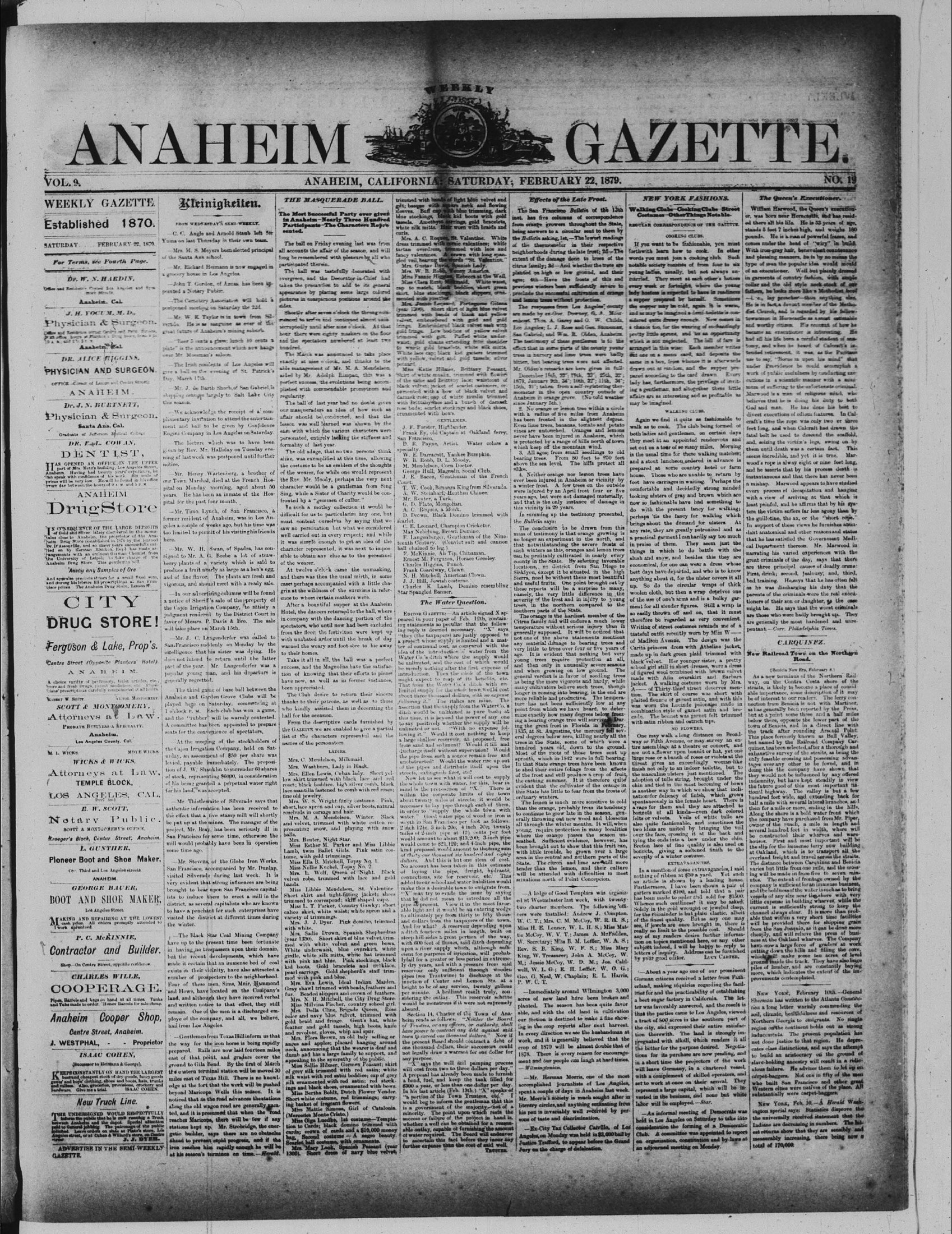
Searchable text
ANAHEIM
VOL. 9.
ANAHEIM
WEEKLY GAZETTE.
Established 1870.
SATURDAY. FEBRUARY 22, 1879.
For Terms, see Fourth Page.
Dr. W. N. HARDIN,
Officer and Registrar Corner Los Angeles and San Francisco.
Anakeim. Cal.
J. H. YOCUM, M. D.
Physician & Surgeon.
Anakeim. Cal.
DR. ALICE RIGGINS.
PHYSICIAN AND SURGEON.
OFFICE - Corner of Lenox and Centre Street.
ANAHEIM.
Dr. J. N. BURTNETT,
Physician & Surgeon.
Santa Ana, Cal.
Graduate of Jefferson Medical College.
DR. F. L. COWAN,
DENTIST,
Kleinigkeiten.
FROM WEDNESDAY'S SEMI-WEEKLY.
C. C. Angle and Arnold Staub left Yuina on last Thursday in their own team.
Mrs. M. S. Meyers been elected principal of the Santa Ana school.
Mr. Richard Heimann is now engaged in a grocery house in Los Angeles.
John T. Gordon, of Azusa, has been appointed a Notary Public.
The Cemetery Association will hold a postponed meeting on Saturday the 22d.
Mr. W. E. Taylor is in town from Silverado. He is a singer as ever of the great feature of Anakeim's mining suburb.
"Four cents a piece; lunch 40 cents a plate" is the announcement which now hangs over Mr. Moosman's saloon.
The Irish residents of Los Angeles will give a ball on the evening of St. Patrick's Day, March 17th.
Mr. J. de Barth Shorb, of San Gabriel, is shipping orange largely to Salt Lake City this season.
We acknowledge the receipt of a complimentary invitation to attend the entertainment and ball to be given by Confidence Engine Company in Los Angeles on Saturday.
The lecture which was to have been given by Rev. Mr. Halliday on Tuesday evening of last week was postponed until further
THE MASQUERAD
The Most Successful Party in Anakeim—Nearly Three Participants—The Characters Sented.
The ball on Friday evening all accounts the affair of the seconde long be remembered with pleasant participation therein.
The hall was tastefully decorated evergreen, and the Decorator taken the precaution to add appearance by placing some pictures in conspicuous position sides.
Shortly after seven o'clock the method to arrive and continue discreetly until after nine o'clock there were eighty manikins and the spectators numbered hundred.
The March was announced exactly at nine o'clock, and able management of Mr. M. Aided by Mr. Adolph Eimpala perfect success, the evolutions plished with commendable regularity.
The ball of last year had no our masqueraders an idea of affair should be conducted, lesson was well learned was ease with which the various personated, entirely lacking tformality of last year.
The old adage, that no two alike, was exemplified at this
PHYSICIAN AND SURGEON.
OFFICE - Corner of Lenox and Centre Street.
ANAHEIM.
Dr. J. N. BURTNETT,
Physician & Surgeon.
Santa Ana, Cal.
Graduate of Jefferson Medical College.
DR. E. L. COWAN,
DENTIST,
AS OPENED AN OFFICE IN THE UPPER part of Mrs. Metz's building, Los Angeles Street, Anaheim. Having had twenty years' experience, he can speak with confidence of his work. His scale of prices will be very low. He will be found in his office every day between the hours of 9 A.M. and 5 P.M.
ANAHEIM
Drug Store
IN CONSEQUENCE OF THE LARGE DEPOSITS of Gold and Silver lakes discovered in the mountains close to Anaheim, the premier of the Anaheim Drug Store (established in 1870 by the learned Dr. D'Assouville) and so many years successfully carried on by Herman Blanken, Esq.) has made arrangements with an eminent German Chemist from The University of Leipzig to Lake charge of the Anaheim Drug Store. This gentleman will assist any Samples of Ore and appraise precious stones for a small fixed sum, and during his leisure fill prescriptions as San Francisco prices. The Anaheim Drug Store, Lemon St.
CITY DRUG STORE!
Ferguson & Lake, Prop's.
Centre Street (Opposite Planters' Hotel).
ANAHEIM.
A choice variety of perfumery, toilet articles, etc.,oure and fresh Drugs, patent medicines, etc., Physicians' prescriptions carefully compounded at all hours.
ROBERT W. SCOTT.
Victor Montgomery.
SCOTT & MONTGOMERY,
Attorneys at Law.
PROBATE BUSINESS A SPECIALTY.
Anaheim.
Los Angeles County, Cal.
M. L. WICKS.
MOYE WICKS.
WICKS & WICKS,
Attorneys at Law,
TEMPLE BLOCK,
LOS ANGELES, CAL.
Dee7 3m1
R. W. SCOTT,
Notary Public.
SCOTT & MONTGOMERY'S OFFICE.
Kroeger's Block, Center Street, Anaheim.
L. GUNTHER,
Pioneer Boot and Shoe Maker,
Co. Third and Los Angeles streets.
The Irish residents of Los Angeles will give a ball on the evening of St. Patrick's Day, March 17th.
Mr. J. de Barth Shorb, of San Gabriel, is shipping oranges largely to Salt Lake City this season.
We acknowledge the receipt of a complimentary invitation to attend the entertainment and ball to be given by Confidence Engine Company in Los Angeles on Saturday.
The lecture which was to have been given by Rev. Mr. Halliday on Tuesday evening of last week was postponed until further notice.
Mr. Henry Wartenberg, a brother of our Town Marshal, died at the French Hospital on Monday morning, aged about 50 years. He has been an inmate of the Hospital for the past four month.
Mr. Timo Lynch, of San Francisco, a former resident of Anaheim, was in Los Angeles a couple of weeks ago, but his time was too limited to permit of his visiting his friends here.
Mr. W. H. Swan, of Spadra, has signed to Mr. A. G. Beebe a lot of strawberry plants of a variety which is said to produce a fruit nearly as large as a hen's egg, and of fine flavor. The plants are fresh and vigorous, and should meet with a ready sale.
In our advertising columns will be found a notice of Sheriff's sale of the property of the Cajon Irrigation Company, to satisfy a judgment rendered by the District Court in favor of Messrs. P. Davis & Bro. The sale will take place on March 15th.
Mr. J. C. Langenderfer was called to San Francisco suddenly on Monday by the intelligence that his sister was dying. He does not intend to return until the latter part of the year. Mr. Langenderfer was a popular young man, and his departure is generally regretted.
The third game of base ball between the Anaheim and Garden Grove Clubs will be played here on Saturday, commencing at 1 o'clock P.M. Each club has won a game, and the "rubber" will be warmly contested. A committee has been appointed to prepare seats for the convenience of spectators.
At the meeting of the stockholders of the Cajon Irrigation Company, held on Saturday, an assessment of $50 per share was levied, payable immediately. The proposition of J. W. Shanklin to surrender 60 shares of stock, representing $6000, in consideration of his being granted a perpetual water right for his land, was accepted.
Mr. Thistlewaite of Silverado says that authentic information has been received to the effect that a five stamp mill will shortly be put up at the mines. The manager of the project, Mr. Bray, has been seriously ill in San Francisco for some time, otherwise the mill would probably have been in operation some time ago.
Mr. Stevens, of the Globe Iron Works, San Francisco, accompanied by Mr. Dunlap,
Mrs. C. Mendelson, Milkman,
Mrs. Washburn, Lady in Hearn,
Mrs. Ellen Lewis, Cuban lace trimmed with black rosebuds in corsage and hair,
Mrs. M. A. Mendelson, and velvet trimmed with woven presenting snow, and playful balls,
Mrs. Reuter, Night Star,
Miss Esther M. Parker a Lamb, twin Ballet Girls,
tume, with gold trimmings,
Miss Ella B. Mitchell, Topper,
Miss Nellie Knueche, Topper
TEMPLE BLOCK,
LOS ANGELES, CAL.
Dec 7, 3m1
R. W. SCOTT,
Notary Public.
SCOTT & MONTGOMERY'S OFFICE.
Kroeger's Block, Center Street, Anaheim.
L. GUNTHER,
Ploneer Boot and Shoe Maker,
Co: Third and Los Angeles streets.
ANAHEIM.
GEORGE BAUER,
BOOT AND SHOE MAKER,
Los Angeles Street.
MAKING AND REPAIRING AT THE LOWEST
cash price. All orders promptly attended to
I work guaranteed.
P. C. McKINNIE,
Contractor and Builder.
Shop—On Centre Street, opposite residence.
CHARLES WILLE,
COOPERAGE.
Pipe, Barrels and kegs on hand at all times. Tanks
and Tubs made to order. Honey Barrels for sale cheap.
Anaheim Cooper Shop,
Centre Street, Anaheim.
J. WESTPHAL, - Proprietor
ISAAC COHEN,
(Successor to Heinmann & George).
KEEP CONSTANTLY ON HAND THE LARGEST
bestrand cheapest stock of dry goods, fancy goods
gentle' and boys' clothing, shoes and boots, hats, trunks
and vests. Also, groceries, provisions, crockery and
hardware. Give me a trial.
New Truck Line.
THE UNDERSIGNED WOULD RESPECTFULLY
Inform the public that he is now running a Truck
between Anaheim and the depot. Special attention
paid to General jobbing. The patronage of the public
included. Leave orders on shake at Plato's store, Los
Angeles street, or at Ochen & Willard's store, on Centre
street.
ADVERTISE IN THE SEMI-WEEKLY
GAZETTE.
Mr. Thistlewaite of Silverado says that authentic information has been received to
the effect that a five stamp mill will shortly be put up at the mines. The manager of the
project, Mr. Bray, has been seriously ill in San Francisco for some time, otherwise the
mill would probably have been in operation some time ago.
Mr. Stevens, of the Globe Iron Works.
San Francisco, accompanied by Mr. Dunlap,
visited Silverado during last week. It is very evident that strong influences are being
brought to bear upon San Francisco capitalists to induce them to erect a mill in the
district, as several capitalists who are known
to have a penchant for such enterprises have
visited the district at different times during
the winter.
The Black Star Coal Mining Company
have up to the present time been fortunate
in having no trespassers upon their domain,
but the recent developments, which have
made it certain that an immense bed of coal
exists in their vicinity, have also attracted a
number of prospectors to the neighborhood.
Four of these men, Sims, Muir, Hammond
and Howe, have located on the Company's
land, and although they have received verbal
and written notice to that effect, they still
remain. One of the men is a discharged employee of the company, and all, we believe,
hail from Los Angeles.
Gentlemen from Texas Hill inform us that
the way for the iron horse is being rapidly prepared. Rails are now laid fourteen miles
east of that point, and graders cover the
ground to Gila Bend. By the first of March
the eastern terminal station will be moved 30
miles east of Texas Hill. There is no knowledge at the fort that the work will be pushed
beyond Maricopa Wells this season. It is
noticed that as the road advances the stations
along the old wagon road are generally vacated,
and it is presumed that when the road
reaches Maricopa, there will be few if any
stations kept up. Mr. Strobridge, the energetic builder, says there are no obstacles
ahead to prevent rapid progress, and if the
iron reaches him rapidly enough he will be
at his season's terminus on time.—Herald.
Mrs. Eva Lewis, Ideal
Gray shawl trimmed with bead;
fur. Beaded slippers and creeMrs. N.H. Mitchell, the CreeMiss Malvina Fischer, comMrs. Della Cline, Brigade
color and navy blue velvet,
gold braid and fringe.
Gel feather and gold tassels, lime
and revolver, gloves, whip aMrs. Flora Brown, an old
anges and apples; placard
neck, announcing that the w
dumb and has a large family,
appealing to the sympathy oMiss Sallie Hilmer, Germen
of grey silk trimmed with nsilk waist with red satin boosilk ornamented with red seings and black shoes, ornamMiss Bertha Boldt, Dutch
Short white costume, red triing basket of fragrant flower.
Miss Mattie Simona, GiMercedes Monte Cristo.)
Miss Olga Luedke, lat coction to Cards; black dominocards; crown of cards and bag.
Second costume — A Seaglet ball costume, with oMrs Mary Look, Spanish1300). Short dress of n
THE MASQUERADE BALL.
The Most Successful Party ever given in Anaheim—Nearly Three Hundred Participants—The Characters Represented.
The ball on Friday evening last was from all accounts the affair of the season, and will long be remembered with pleasure by all who participated therein.
The hall was tastefully decorated with evergreen, and the Decorator-in-Chief had taken the precaution to add to its general appearance by placing some large colored pictures in conspicuous positions around the sides.
Shortly after seven o'clock the throng commenced to arrive and continued almost uninterrupted until after nine o'clock. At that hour there were eight maskers on the floor and the spectators numbered at least two hundred.
The Match was announced to take place exactly at nine o'clock, and thanks to the able management of Mr. M. A. Mundelson added by Mr. Adolph Eimpan, this was a perfect success, the evolutions being accomplished with commendable promptness and regularity.
The ball of last year had no doubt given our masqueraders an idea of how such an affair should be conducted, and that the lesson was well learned was shown by the ease with which the various characters were personated, entirely lacking the stiffness and formality of last year.
The old adage, that no two persons think alike, was exemplified at this time, allowing trimmed with bands of light blue velvet and gilt; basque with square neck and flowing sleeves. Buff cap with blue trimming, dark blue stockings, black kid boots with gold tassels. Amethyst earrings, gold bracelets, white silk mitts. Hair worn with braids and curls.
Mrs. A. C. Roques, St. Valentine. White dress trimmed with comic valentines; white tartan overdress, trimmed with lace and fancy valentines. A crown with long spangled veil, bearing the words "St. Valentine."
Mrs. Gustav Davis, Spanish Lady.
Mrs. W. B. Robb, Young America.
Miss Fannie Higgins, Rebecca at the Well.
Miss Clara Renta Milmaid. White waist, cap to match, black bodice, short green skirt, blue stockings, black slippers, ornamented with rosette.
Mrs. Jenine Lequard, Portuguese Gritana (year 1879). Short skirt of light blue velvet trimmed with bands of black and yellow velvet, embroidered with gold and gold fringe. Embroidered black velvet each with gold fringe. Low bodice of yellow satin trimmed with gilt. Puffet white underwear; gold chains extending from shoulder to waist; gold bracelet; white silk manta. White lace cap black kid gutters trimmed with yellow, velvet and gold tassel; silver ponder.
Miss Katie Hilmer, Brittany Peasant. Shirt of white muslin, trimmed with flowers of the same and Brentney lace; waistcoat of black velvet; jacket of scarlet cashmere, ornamented with a bow of black velvet and damask rose; gap of white muslin trimmed with Brittany lace and a bunch of damask rose buds; scarlet stockings and black shoes, ornamented with bows.
GENTLEMAN.
J. F. Forster, Highlander.
Frank Ey, old Captain at Oakland ferry, San Francisco.
D. R. Payne, Artist. Water colors a specialty.
W. E. Darracott, Yankee Bumpkin.
W. R. Bob D. L. Moody.
Effects of the Late Frost.
The San Francisco Bulletin of the 13th inst., has five columns of correspondence from orange growers throughout the State, being answers to a circular sent to them by the Bulletin asking, 1st—The lowest readings of the thermometer in their respective neighborhoods during the late frost; 2d—The extent of the damage done to trees of citrus family; 3d—and whether the trees are planted on high or low ground, and their ages; 4th—Have the frosts of this and previous winters been sufficiently severe to preclude the successful cultivation of orange and lemon trees without protection.
The responses from Los Angeles county are made by ex-Gov. Downey, G. A. Moore-enhort. Then, A. Garvey and O. W. Childa, Los Angeles; L. J. Rose and Gen. Simmons, San Gabriel; and Win. R. Olden, Anaheim.
The testimony of those gentlemen is to the effect that in some parts of the county young trees in nursery and lime trees were badly hurt but bearing trees were not affected.
Mr. Olden's remarks are here given in December 16th: 38°; 19th: 32°; 25th: 32°; 1879, January 9th: 34°; 10th: 32°; 11th: 34°; 15th: 31°; taken from a self-registering thermometer in the open country outside of Anaheim in orange grove. (No cold weather since January 5th).
2. No orange or lemon tree within a circle with a radius of five miles from Anaheim has been frosted in the slightest degree. Even lime trees, bananas, tomato and potato vines are untouched. Oranges and lemons never have been injured in Anaheim, which is protected by a range of hills north of town which keep off the mountain wind.
3. All agos; from small seedlings to old bearing trees. From 80 feet to 250 feet
NEW YORK Walking Club Costumes—OREGONAL CORRESPONDING COORDINATES
If you want to forthwith learn words you must not notable society coo young ladies sauna married. They may every week or for lady hostess in ex-superior supper prepared the supper may be and may be imminent quite drawn a chance too, for pretty little apples which is not angled arranged in this way one on a box, first drawn out at random paired according to lady has, further ing a gentleman affairs are as inter- may be imagined.
Again we find walk as to cook both ladies and go they meet at an set out on a tour is the usual time
The management of Mr. M. A. Mendelson added by Mr. Adolph Eimpan, this was a perfect success, the evolutions being accomplished with commendable promptness and regularity.
The tail of last year had no doubt given our masqueraders an idea of how such an affair should be conducted, and that the lesson was well learned was shown by the ease with which the various characters were personated, entirely lacking the stiffness and formality of last year.
The old adage, that no two persons think alike, was exemplified at this time, allowing the costume to be an emblem of the thoughts of the weaker, for while one would represent the Rev. Mr. Moody, perhaps the very next character would be a gentleman from Sing Sing, while a Sister of Charity would be confronted by a "gemmen of cullur."
In such a motley collection it would be difficult for us to particularize any one, but must content ourselves by saying that we saw no personation but what we considered well carried out in every respect; and while it was simple enough to get an idea of the character represented, it was next to impossible to obtain any clue as to the personnel of the wearer.
At twelve o'clock came the unmasking, and there was then the usual mirth, in some case perhaps accompanied with a little chgrin at the wildness of the surmises in reference to whom certain maskers were.
After a bountiful supper at the Anaheim Hotel, the dancers returned to the hall, where in company with the dancing portion of the spectators, who until now had been excluded from the floor, the festivities were kept up with unabated ardor until the break of day warned the weary and foot sore to he away to their homes.
Take it all in all, the ball was a perfect success, and the Magnolias have the satisfaction of knowing that their efforts to please have now, as well as in former instances, been appreciated.
The Club desire to return their sincere thanks to their patrons, as well as to those who kindly assisted them in decorating the hall for the occasion.
From the descriptive cards furnished by the Gazette we are enabled to give a partial list of the characters represented and the names of the personators.
LADIES
Mrs. C. Mendelson, Milkmaid.
Mrs. Washburn, Lady in Black.
Mrs. Ellen Lewis, Cuban lady. Short yellow skirt trimmed with black lace and red rose; black bodice, high silver comb, black lace mantilla fastened to comb with red roses; fine old jewelry.
Mrs. W. S. Wright fancy costume. Pink short, lace apron and cap, silver boots, natural rosebuds in corsage and hair.
Mrs. M. A. Mendelson, Winter. Black and velvet, trimmed with white cotton representing snow, and playing with snow balls.
Mrs. Reuter, Night Star.
Miss Esther M. Parker and Miss Libbie Lamb, twin Ballet Girls. Pink satin costume, with gold trimming.
Missella B. Mitchell, Topsy No. 1.
Miss Nellie Kuchel, Topsy No. 2.
Miss Katie Hilmer, Brittany Peasant.
Start of white muslin, trimmed with flowers of the same and Brittany lace; waistcoat of black velvet; jacket of scarlet cashmere, ornamented with a bow of black velvet and damask rose; gap of white muslin trimmed with Brittany lace and a bunch of damask rose buds; scarlet stockings and black shoes, ornamented with bows.
GENTLEMAN.
J. F. Forster, Highlander.
Frank Ey, old Captain at Oakland ferry, San Francisco.
D. R. Payne, Artist. Water colors a specialty.
W. E. Darracott, Yankee Bumpkin.
W. B. Robb, D. L. Moody.
M. Mendelson, Corn Doctor.
George Hull, Magnetia Social Club.
J. E. Bacon, Gentleman of the French Court.
T. W. Cook, Bonanza King from Silverado.
A. W. Steinhart, Heathen Chinee.
Mr. Reuter, a Turk.
G. D. Plato, Mongolian.
A. C. Roques, a Monk.
D. Drawn, Black Domino trimmed with scarlet.
C. E. Leonard, Champion Cricketer.
Max Nebeldung, Brown Domino.
F. Langenberger, Gentleman of the Nineteenth Century. (Convict suit and cannon ball chained to leg.)
S. McKinnie, Ab Tip, Chinaman.
Ernest M. Ferguson, Horace Greeley.
Charles Higgins, Punch.
Frank Coardway, Clown.
N. H. Mitchell, American Clown.
J. J. Hill, Jewish costume.
Charles K. Lamb, Domino resembling Star Spangled Banner.
The Water Question.
EDITOR GAZETTE:—An article signed X appeared in your paper of Feb. 12th, containing statements so peculiar that the following reply is deemed necessary. "X" says "they (the taxpayers) are justly opposed to a project whose supply is limited and a matter of continual cost, as compared with the idea of the introduction of water from the Water Co.'s ditch where the supply would be unlimited, and the cost of which would be merely nothing after the first expense of introduction. Then the whole of the town might expect to reap its benefits, etc.. That from the Water Co.'s ditch with unlimited supply for the whole town would cost about three thousand dollars, with no expense following it." The italics are mine. The assertion that the supply from the Water Co.'s ditch would be unlimited is pure bomb; at this time, it is beyond the power of any one to say positively whether the supply will be unlimited or not." With no expense following it." Would it cost nothing to keep a large shallow reservoir, as proposed, free from sand and sediment? Would it fill and discharge itself without supervision? Would the pipe from such a source remain free and unobstructed? Would the water rise up out of the pipes and distribute itself upon the streets, extinguish fires, etc.. Now let us see what it will cost to supply the whole town with water; for this, bear in mind is the proposition of "X." There is within the corporate limits of the town to twenty miles of streets; it would be necessary to lay pipe through each of them in order to "supply the whole town with water." Good water pipe of wood or iron is worth in San Francisco per foot as follows: 2 inch 12¢e; 3 inch 20¢e; 4 inch 30¢e; twenty miles of 2-inch pipe at 12¢ cents per foot would amount to about $13,200; 3-inch pipe would come to $21,200; and 4-inch pipe, the kind proposed would amount to the amount of thirty-one thousand six hundred and eighty dollars. And this is but one item of cost.No account has been taken in this estimate of laying the nine freight hydrants,
Mr. Olden's remarks are here given in December 19th; 27th; 29th; 25th; 32th; 1879; January 9th; 34th; 10th; 11th; 34th; 15th; 31th; taken from a self-referencing monometer in the open country outside of Anabeim in orange grove. (No cold weather since January 5th).
2. No orange or lemon tree within a circle with a radius of five miles from Anabeim has been frosted in the slightest degree.Even lime trees, bananas, tomato and potato vines are untouched. Oranges and lemons never have been injured in Anabeim, which is protected by a range of hills north of town which keep off the mountain wind.
3. All ages; from small seedlings to old bearing trees.From 80 feet to 250 feet above the sea level.The hills protect all alike.
4. Neither orange nor lemon trees have ever been injured in Anabeim or vicinity by a winter frost.A few trees on the outside were injured by an April frost four or five years ago,但 were not damaged materially,and that is only instance of damage in this vicinity in 29 years.In summing up the testimony presented,the Bulletin says:
The conclusion is to be drawn from this mass of testimony is that orange growing is no longer an experiment in the north,and that notwithstanding the severe frosts of such winters as this,或anges and lemon trees can be profitably cultivated in nearly every county in the State.BY selecting favorable locations,_no district from San Diego to Siskiyou_except it be situated in the high Sierra_need be without these most beautiful and useful fruits。One point brought out by these reports will be a surprise to many,namely,the very little difference in the severity of the frost and in injury_to young trees_in the northern compared to the southern parts of the State.The orange is the hardiest member of the Citrus family and will endure a much lower temperature without serious injury than is generally supposed。它 will be noticed that not one of the above statements mentions any material damage to bearing trees and very little to trees over four or five years of age。它 is evident that nothing but very young trees require protection at all,and then only in unusually severe seasonsand when growing on low ground.The general verdict is in favor of seedling treesas being the more vigorous and hardy,而 many cultivators believe such trees,though longer in coming into bearing,在the end are more reliable and productive.The temperature has not been sufficiently low at any point from which we have heard,todermine exactly how many degrees below freezinga bearing orange tree will survive.During the great frost in Florida in February,1835,at St.Augustine,the mercury fell several degrees below zero,killing nearly allthe trees in the State,some of which were a hundred years old,down to the ground.Most of the roots of those trees sent up sprouts,which in 1842 were in full bearing.In that State orange trees have been knownto shed their entire foliage from the effectsof the frost and still produce a crop of fruit,the ensuing summer。它 is therefore quite evident that the cultivator of the orange in this State has little to fear from the frosts_of ordinary winters.The lemon is much more sensitive to cold than the orange,born from its tendencyto continue to grow late in the season,generally throwing out new wood and blossomsall through the winter months.I willwhenyoung,require protection in many localitieswherethe orange passesthe seasonunsecathed.Sufficient evidence,however,has been brought out to show that this fruit canwith little trouble,be grown over a large areain the central and northern parts oftheState.The citron and lime are stillmore tender than the lemon,and their culturedrawn out at astarmedaccordingto lady has,furtheringa gentleman.in affairsare as interestmay be imagined.WA
Again we findwalk as to cook.both ladies and girlsthey meet at anset out on a tourisnda stout lunchprepared at sourelhouse Those whofoot have carriagecomfortableandlooking ulstersofnowso fashionabledowiththepriperhaps'tis theremainany rate,they area practical garmentin praiseofthe thingsin whichslush and snow,economical.forourbest dayshavedeadthingaboutitup.So do theywoolen cloth,butoftheuseofone'mentforall stendeasso easily thrownthereforebe regaleWritingof street tastefuloutreofMadison AvenueCarita princessdmadeupindarkblackvelvet.Highschool girl stillinfigured wool coatmadewithAlinjack.A walkA-ofThirty-tion.The skirtplaited flouncesofwas wornthecombinationstylecade.The bonenwithsatin ribbon
One may walkway or Fifth Avenueassemblageasee nota flowerlargeroseorbaltwointheatgivesaninfinishnotonlythemasculineupperoftuilleftels或veltatasalsoquite fashiontwo ideas are usedovertheface,cryingtheendaBreton laceofbonnets,givingseveracityofa win
Mrs. Elena Lewis, Victoria Harbor, low skirt trimmed with black lace and red rosette; black bodice, high silver comb, black lace mantilla fastened to comb with red roses; fine old jewelry.
Mrs. W. S. Wright fancy costume. Pink, short, lace apron and cap, silver boots, natural rosebuds in corsage and hair.
Mrs. M. A. Mendelson, Winter Black and velvet, trimmed with white cotton representing snow, and playing with snow balls.
Mrs. Reuter, Night Star.
Miss Esther M. Parker and Miss Libbie Lamb, twin Ballet Girls. Pink satin costume, with gold trimmings.
Miss Ella B. Mitchell, Topsy No. 1.
Miss Nellie Kuchel, Topsy No. 2.
Mrs. L. Wolf, Queen of Night. Black velvet robe, trimmed with lace and gold bands.
Miss Libbie Mendelson, St. Valentine Short skirt and tight-fitting jacket; shoes trimmed to correspond; skiff shaped cape.
Miss L. T. Parker, Country Gawky; short calico skirt, white waist; white apron and a variety of trimmings.
Mrs. J. J. Dyer. Pink domino, trimmed with white.
Mrs. Sadie Drown, Spanish Shepherdess (year 1350). Short skirt of blue velvet, trimmed with white velvet and green bows. White underwaist, blue overkirt, white girdle, white silk mitts, white hat trimmed with pink and blue. Pink stockings, black kid boots. Gold bracelets and necklace, pearl earrings. Gold shepherd's staff trimmed with pink and blue.
Mrs. Eva Lewis, Ideal Indian Maiden. Gray shawl trimmed with beads, feathers and fur. Beaded slippers and crown of feathers.
Mrs. N. H. Mitchell, the City Drug Store.
Miss Malvina Fischer, country school girl.
Mrs. Della Cline, Brigade Queen, Rose color and navy blue velvet, trimmed with gold braid and fringe.
Gent's hat, white feather and gold tassels, high boots, knife and revolver, gloves, whip and spur.
Mrs. Flora Brown, an old lady selling oranges and apples; placard hanging around neck, announcing that the wearer is deaf and dumb and has a large family to support, and appealing to the sympathy of the public.
Miss Sallie Hilmer, German Peasant; skirt of grey silk trimmed with red satin; white silk waist with red satin bodice; cap of grey silk ornamented with red satin; red stockings and black shoes, ornamented with bows.
Miss Bertha Boldt, Dutch Flower Vender. Short white costume, red trimmings; carrying basket of fragrant flowers.
Miss Mattie Simons, Girl of Catalonia (Merocites Monte Cristo.)
Miss Olga Luedke, 1st costume—Temptation to Cards; black domino trimmed with cards; crown of cards and a $10,000 money bag. Second costume—A nagro beauty. Scarlet ball costume with ornaments.
Mrs. Mary Look, Spanish Peasant (year 1300). Short dress of navy blue velvet,
Now let us see what it will cost to supply the whole town with water, for this bear in mind is the proposition of "X." There is within the corporate limits of the town about twenty miles of streets; it would be necessary to lay pipe through each of them in order to "supply the whole town with water."
Good water pipe of wood or iron is worth in San Francisco per foot as follows: 2 inch 12c., 3 inch 20c., 4 inch 30c.; twenty miles of 2-inch pipe at 12 cents per foot would amount to about $13,200; 3-inch pipe would come to $21,120; and 4-inch pipe, the kind proposed would amount to the snugsum of thirty one thousand sir hundred and eighty dollars.
And this is but one item of cost. No account has been taken in this estimate of laying the pipe, freight, hydrants, connections, site for reservoir, etc. This added to our school and water liabilities would make this a desirable town to emigrate from.
"X may try to evade the issue by saying that he did not mean to introduce all the pipes at present. View it in the most favorable light and it would be an entering wedge to ultimately pry from thirty to fifty thousands from the taxpayers of the town.
And for what? A reservoir depending upon a ditch fourteen miles in length, built on steep hill-sides a great portion of the way, with 600 feet of flumes, said ditch depending upon a river supply which, although sufficient for purposes of irrigation, will probably fail for a greater or less period in extremely dry years, and with a pressure from said reservoir only sufficient through wooden pipes (see Trantwine) to discharge at the junction of Center and Lemon Sts. at a height to be of any service, twenty gallons per minute. A brilliant result truly considering the outlay. This reservoir scheme would be monstrous if it were not supremely absurd.
Section 14. Charter of the Town of Anaheim reads as follows:
"Neither the Board of Trustees, or any officers, or authority shall have power to contract any debt against said town to exceed one thousand dollars."
Now if the present Board should contract a debt of one thousand dollars their successors could not legally draw a warrant for one dollar for any purpose.
"X" says the well and pumping process will cost from two to three dollars per day."
A proposal has already been made to furnish a bond, fuel, and keep the tank filled for $300 a year, or less than one dollar per day. In his last article (Feb. 13th.) "X" speaks of "a portion of the Town Trustees," etc."
I would beg to inform the gentleman that this is a government of the majority—not of a minority. The point upon which rests the success or failure of the project in hand is whether a well can be obtained for a reasonable outlay capable of furnishing the amount of water required. The Board will endeavor to ascertain this fact before they incur any further expense than the cost of said well.
TRUSTER
—A lodge of Good Templars was organized at Westminster last week, with twenty-two charter members. The following officers were installed: Andrew J. Compton, W.C.T.; Mrs.C.M.McCoy,W.R.H.S.; Miss H.E.Lenner,L.W.H.S.; Miss Matte McCoy,V.V.T.; James A.McFeldden.W.Secretary; Miss B.M.Lefler.W.A.S.; Rev.S.B.King,F.F.S.; Miss Mary King.W.Treasurer; John A.McCoy,M.; Jessie McCoy,D.D.M.; Jos.Caldwell.W.L.G.; E.H.Lefler.W.O.G.; Geo.G.Neal.W Chaplain; R.L.Harris,P.W.C.T.
—Immediately around Wilmington 3,000 acres of new land have been broken and planted. The season has been quite favorable, and with the old land in cultivation our section is destined to make a fine showing in the crop reports after next harvest. In every direction we see the husbandman at work, and it is generally believed that the crop of 1879 will be almost double that of 1878. There is every reason for encouragement and our people can laugh at hard times.
—Wilmingtonian.
—Mr. Hermann Morris, one of the most accomplished journalists of Los Angeles, spent a couple of days in Anaheim last week. Mr. Morris's society is much sought after in literary circles,and anything eminating from his pen is invariably well received by persons of taste and discrimination.
—Ex-City Tax Collector Carrillo, of Los Angeles.on Monday was held in $3,000 bail by Justice Trafford,to appear before the Grand Jury on the charge of defalcation.
NEW YORK FASHIONS.
Walking Clubs—Cooking Clubs—Street Costumes—Other Things Notable.
REGULAR CORRESPONDENCE OF THE GAZETTE.
COOKING CLUBS.
If you want to be fashionable, you must forthwith learn how to cook. In other words you must join a cooking club. Such notable society consists of from four to six young ladies, usually, but not always unmarried. They meet at each other's houses every week or fortnight, where the young lady hostess is expected to have in readiness a supper prepared by herself. Sometimes the supper may be cold, again it is warm, and as may be imagined a delicate tartlette is considered quite dreary enough. New comes in a chance too, for the wearing of outstandingly pretty little aprons, and has an opportunity which is not neglected. The hall of fare is arranged in this wine. Each member writes out one on a menu card, and depends the name in a box, from whence it is afterwards drawn out at random, and the supper prepared according to the card drawn. Every lady has, furthermore, the privilege of inviting a gentleman, and altogether these little affairs are as interesting and as profitable as may be imagined.
WALKING CLUBS.
Again we find it quite as fashionable to walk as to cook. The club being formed of both ladies and gentlemen, on certain days they meet at an appointed rendezvous and set out on a tour of so many miles. Morning is the usual time for these walking matches; and the last luncheon ordered in advance is
The Queen's Executioner.
William Harwood, the Queen's executioner, was born near Horncastle, and has resided there all his life. He is 53 years of age, stands 5 feet 7 inches high, and weighs 180 pounds. He is a man of powerful frame, and comes under the head of "wiry" in build. With iron-gray hair, benevolent countenance and pleasing manners, he is by no means the type of man the popular idea would mould of an executioner. Well but plainly drummed in garments of country fashion, with single collar and the old style neck-stock of our fathers, he looks more like a Methodist local — i.e., lay preacher—than anything else. He is in fact a devout member of the Methodist Church, and is regarded by his fellow-townman in Horncastle as a most amiable and worthy citizen. His tenure of how he became an executioner is interesting. He had all his life been a careful student of mathematics, and when he heard of Calcraft's attained retirement, it was, as the Puritan use to say, "Borne upon his mind" that under Providence he would accomplish a work of public usefulness by conducting executions in a scientific manner with a minimum of suffering to the unfortunate criminal. Marwood is a man of religious mind, who believes that he is doing his duty to both God and man. He has done his best to divest executions of odious features. In Calcraft's time the rope was only two or three feet long, and when Calcraft had drawn the fatal bolt he used to descend the scaffold, and seizing the victim's legs, swing on by them until death was a certain fact. This seems incredible, and yet it is true.
WALKING CLUBS.
Again we find it quite as fashionable to walk as to cook. The club being formed of both ladies and gentlemen, on certain days they meet at an appointed rendezvous and set out on a tour of so many miles. Morning in the usual time for these walking matches; and a stout luncheon ordered in advance is prepared at some country hotel or farm house. Those who are unable to return by foot have carriages in waiting. Perhaps the comfortable and decidedly strong minded looking ulsters of gray and brown which are now so fashionable have had something to do with the present fancy for walking; perhaps 'tis the fancy for walking which brings about the demand for ulsters. At any rate, they are greatly patronized and as a practical garment I can hardly say too much in praise of them. They seem just the things in which to do battle with the alush and snow, and besides this they are economical, for one can wear a dress whose best days have departed, and who is to know anything about it, for the ulster covers it all up. So do the circular wraps of thick woolen cloth, but then a wrap deprives one of the use of one's arms and is a bulky garment for all slender figures. Still a wrap is so easily thrown off and on, that it must therefore be regarded as very convenient. Writing of street costumes reminds me of a tasteful outfit recently worn by Miss W.—of Madison Avenue. The design was the Carita princess dress with Atheline jacket, made up in dark green plaid trimmed with black velvet. Her younger sister, a pretty school girl still in short dresses, wore a dress of figured wool combined with brown velvet made with Alin overakirt and Barbara jacket. A walking costume worn by Mrs. A.—of Thirty-third street deserves mention. The skirt of course was short with plaited flounce of garnet satin, and with this was worn the Lucinde polonage made in combination style of garnet satin and brocade. The bonnet was garnet felt trimmed with satin ribbon and ostrich tips.
NO FLOWERS.
One may walk a long distance on Broadway or Fifth Avenue, or may survey an entire assemblage at a theatre or concert, and see not a flower upon bonnet or hat, yet one large rose or a bunch of roses or violets at the throat gives an exceedingly woman-like finish not only to an indoor toilette, but to the masculine ulsters just mentioned. The adoption of tulle string, brought under the chin and tied in the most becoming of bows is another way in which we show that inclination for delicacy of finish, which grows spontaneously in the female heart. There is a rage for them and they are attached to bonnets of all kinds—even dark colored felts or velveta. Veils of white tulle are also quite fashionable, and sometimes the two ideas are united by bringing the veil over the face, crossing it at the back and tying the ends into a bow under the chin. Breton lace of fine quality is also used on bonnets, giving a softened finish to the severity of a winter costume.
EXTRAAGANCES.
In a mention of some extravagancies, I said
under Providence he would accomplish a work of public usefulness by conducting executions in a scientific manner with a minimum of suffering to the unfortunate criminal. Marwood is a man of religious mind, who believes that he is doing his duty to both God and man. He has done his best to divest executions of odious features. In Calcraft's time the rope was only two or three feet long, and when Calcraft had drawn the fatal bolt he used to descend the scaffold, and seizing the victim's legs, swing on by them until death was a certain fact. This seems incredible, and yet it is true. Marwood's rope is always eight or nine feet long, and he asserts that by his process death is instantaneous and that there has never been a mishap. Marwood appears to have studied every process of decapitation and hanging with a view of arriving at that which is least painful, and he affirms that by his system the victim suffers far less agony than by the guillotine, the ax, or the "short rope." In support of these views he furnishes abundant anatomical and other reasons and states that he has satisfied the Government Medical Department thereon. Mr. Marwood in narrating his varied experiences with the great criminals of the day, says that there are three principal causes of deadly crime: First, drink; second, jealousy; and third, bad training. He says that he has often felt as he was discharging his duty that the parents of the criminals were the real executors of their son or daughter, as the case might be. He says that the worst criminals are those who were badly brought up. They are generally the most hardened and unrepentant.—Corr. Philadelphia Times.
CARQUINEZ.
New Railroad Town on the Northern Road.
(Benicia New Era, February 8)
As a new terminus of the Northern Railway, on the Contra Costa shore of the straits, is likely to become a place of considerable importance, some description of it may be of interest to our readers. The ferry connection from Benicia is not with Martimer, as has generally been reported by the Press, but at a point some three and a half miles below there, opposite the lower part of the town of Benicia, and in a direct line with the track after rounding Arsenal Point. This place formerly known as Bull Valley, but named by the Railroad Company Carquines, has been selected after a thorough and exhaustive survey of the straits, as being the only feasible crossing and possessing advantages over any other to be found, and in doing this the company have shown that they would not be influenced by any offered indemnity, but have kept steadily in view the future good of this most important national highway. The valley is but a few hundred feet wide, and extending back for half a mile with several lateral branches, and then for a mile or more, ending in the hills. Along the shore is a bold water front which the company have purchased from Mr. Piper, owner of the ranch, a mile in length and several hundred feet in width, where will be constructed their wharves and warehouses. First and most important will be the slip for the immense ferry now building at Oakland, which is to transport all the overland freight and travel across the straits. The distance between Carquines and Benicia varies but little from one mile, and the cross-
the masculine masters just mentioned adoption of tulle string, brought under the chin and tied in the most becoming of bows is another way in which we show that inclination for delicacy of finish, which grows spontaneously in the female heart. There is a rage for them and they are attached to bonnets of all kinds—even dark colored felts or velveta. Veils of white tulle are also quite fashionable, and sometimes the two ideas are united by bringing the veil over the face, crossing it at the back and tying the ends into a bow under the chin. Breton lace of fine quality is also used on bonnets, giving a softened finish to the severity of a winter costume.
EXTRAVAGANCIES.
In a mention of some extravagancies, I said nothing of ribbon at $30 a yard. Yet such an article is shown by a leading house. Furthermore, I have been shown a pair of garters marked $100, and told that a pair has been made to order and sold for $1500. Whence such costliness? it may be asked. Solely in the gold wrought or jeweled clasp, for the remainder is but plain elastic, albeit of the finest quality. But as any one may see, if jewels are once brought in, there is really no limit to the possible cost. Should any of my readers desire further information on topics mentioned here, or any other subject indeed, I will be happy to reply to letters of inquiry. Address can be furnished by your good editor. Lucy Carter.
About a year ago one of our prominent German citizens received a letter from Fatherland, making inquiries regarding the facilities for and the practicability of establishing a beet sugar factory in California. The letter was favorably answered, and the result is that the parties came to Los Angeles, viewed a tract of 800 acres in the southern part of the city, and expressed their entire satisfaction therewith. The land is strongly impregnated with alkali, which renders it all the better for the purpose desired. Negotiations for its purchase are now pending, and in a short time the projectors of the work will leave Germany, in a chartered vessel, with a complement of skilled operators, and set to work at once on their arrival. They represent a large capital, which will be invested in the business, and none but white labor will be employed. Star.
An informal meeting of Democrats was held in Los Angeles on Saturday to take into consideration the forming of a Democratic Club. A committee was appointed to report on organization, constitution and by-laws at an adjourned meeting on Monday.
New York, February 10th. General Sherman has written to the Atlanta Constitution a long letter warmly commending the soil, climate, healthfulness and resources of Northern Georgia to emigrants. No single region on the continent holds out as strong inducements. The present population has not done justice to that region. He depreciates class distinctions, and says the attempt to build an aristocracy on the ground of slave-holding ancestry will result in a ridiculous failure. He advises them to let up on carpet-baggers. Not one in fifty of the men who built San Francisco and other great Western cities were natives of the place. All substantially were carpet-baggers.
New York, Feb. 10. Herald Washington special says: Statistics disprove the universally received statement that the Indians are decreasing in numbers. The latest returns show that they are sensibly and measurably increasing, there being now a total of 170,000.