anaheim-gazette 1879-02-15
Scanned page
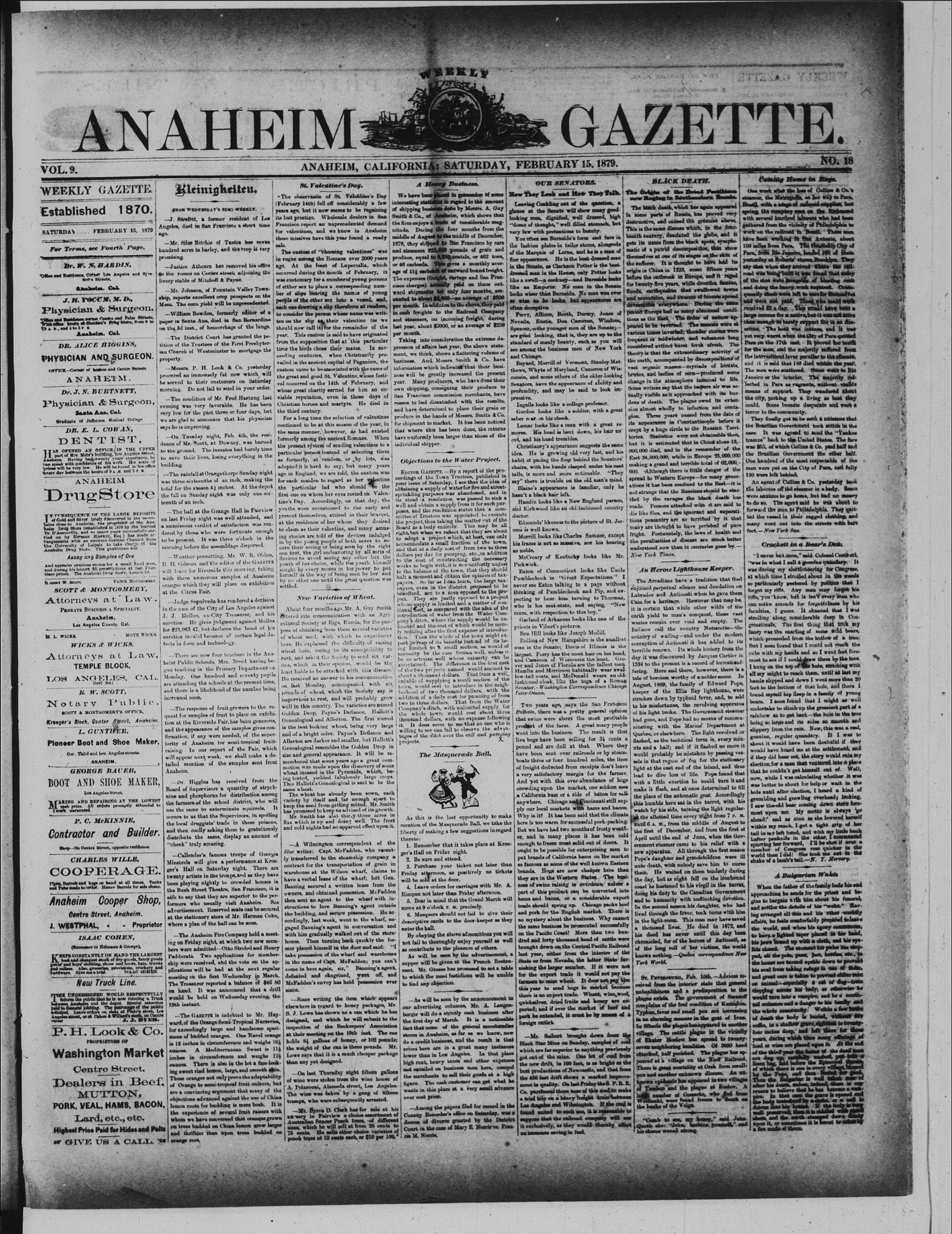
Searchable text
ANAHEIM
VOL. 9.
WEEKLY GAZETTE.
Established 1870.
SATURDAY... FEBRUARY 15, 1879
For Terms, see Fourth Page.
Dr. W. N. HARDIN,
Office and Residence, Cotter Street, Los Angeles and Sycamore Streets,
Anahiem, Cal.
J. H. YOCUM, M. D., Physician & Surgeon,
Office and Residence, Cotter Street, Los Angeles and Sycamore Streets,
Anahiem, Cal.
DR. ALICE HIGGINS,
PHYSICIAN AND SURGEON.
OFFICE—Corner of Lemon and Centre Streets.
ANAHETM.
Dr. J. N. BURTNETT,
Physician & Surgeon,
Santa Ana, Cal.
Graduate of Jefferson Medical College
DR. E. L. COWAN,
DENTIST,
AS OPENED AN OFFICE IN THE UPPER part of Mrs. Meta's building, Los Angeles Street,
Anahiem, Having had twenty years experience, he
Kleinigheiten.
FROM WEDNESDAY'S SEMI-WEEKLY.
J. Strelitz, a former resident of Los Angeles, died in San Francisco a short time ago.
Mr. Silas Ritchie of Tustin has seven hundred acres in barley, and the crop is very promising.
Justice Athearn has removed his office to the rooms on Centre street, adjoining the livery stable of Mitchell & Payne.
Mr. Johnson, of Fountain Valley Township, reports excellent crop prospects on the Mesa. The corn yield will be unprecedented.
William Bowden, formerly editor of a paper in Santa Ana, died in San Bernardino on the 3d inst., of hemorrhage of the lungs.
The District Court has granted the petition of the Trustees of the First Presbyterian Church of Westminster to mortgage the property.
Messrs. P. H. Look & Co. yesterday procured an immensely fat cow which will be served to their customers on Saturday morning. Do not fail to send in your order.
The condition of Mr. Fred Hartung last evening was very favorable. He has been very low for the past three or four days, but we are glad to announce that his physician says he is improving.
On Tuesday night, Feb. 4th, the residence of Mr. Scott, at Downey, was burned to the ground. The inmates had barely time to save their lives, losing everything in the
OFFICE—Corner of Boston and Centre Streets.
ANAHETM.
Dr. J. N. BURTNETT,
Physician & Surgeon,
Santa Ana, Cal.
Graduate of Jefferson Medical College
DR. E. L. COWAN,
DENTIST,
HAS OPENED AN OFFICE IN THE UPPER part of Mrs. Metra's building, Los Angeles Street, Anaheim. Having had twenty years experience, he can speak with confidence of his work. His scale of prince will be very low. He will be found in his office every day between the hours of 9 A.M. and 5 P.M.
ANAHEIM DrugStore
IN NONSEQUENCE OF THE LARGE DEPOSITS of Gold and Silver lately discovered in the mountains close to Anaheim, the proprietor of the Anaheim Drug Store (established in 1870 by the learned Dr. D'Assonville, and so many years successfully carried on by Herman Blakken, Esq.) has made arrangements with an eminent German Chemist from the University of Leipzig to take charge of the Anaheim Drug Store. This gentleman will Assay ang Samples of Ore And appraise precious stones for a small fixed sum, and during his leisure fill prescriptions at San Francisco prices. The Anaheim Drug Store, Lemon St.
ROBERT W. SCOTT. VICTOR MONTGOMERY.
SCOTT & MONTGOMERY,
Attorneys at Law.
PROBATE BUSINESS A SPECIALTY.
Anaheim.
Los Angeles County, Cal.
M. L. WICKS. MOYE WICKS.
WICKS & WICKS,
Attorneys at Law,
TEMPLE BLOCK,
LOS ANGELES, CAL.
Deef 3ml.
R. W. SCOTT,
Notary Public.
SCOTT & MONTGOMERY'S OFFICE,
Kroeger's Block, Center Street, Anaheim.
L. GUNTHER,
Pioneer Boot and Shoe Maker,
Cor. Third and Los Angeles streets.
ANAHEIM.
GEORGE BAUER,
BOOT AND SHOE MAKER,
Los Angeles Street.
MAKING AND REPAIRING AT THE LOWEST cash price. All orders promptly attended to work guaranteed.
P. C. McKINNIE,
Contractor and Builder.
Shop—On Centre Street, opposite residence.
CHARLES WILLE,
COOPERAGE.
Messrs. P. H. Look & Co. yesterday procured an immensely fat cow which will be served to their customers on Saturday morning. Do not fail to send in your order.
The condition of Mr. Fred Hartung last evening was very favorable. He has been very low for the past three or four days, but we are glad to announce that his physician says he is improving.
On Tuesday night, Feb. 4th, the residence of Mr. Scott, at Downey, was burned to the ground. The inmates had barely time to save their lives, losing everything in the building.
The rainfall at Orangethorpe Sunday night was three-sixteenths of an inch, making the total for the season 4½ inches. At the depot the fall on Sunday night was only one-sixteenth of an inch.
The ball at the Grange Hall in Fairview on last Friday night was well attended, and a unanimous verdict of satisfaction was rendered by those who were fortunate enough to be present. It was three o'clock in the morning before the assemblage dispersed.
Weather permitting, Mr. W. R. Olden, R. H. Gilman and the editor of the Gazette will leave for Riverside this morning, taking with them numerous samples of Anaheim oranges which they will place on exhibition at the Citrus Fair.
Judge Sepulveda has rendered a decision in the case of the City of Los Angeles against J. J. Mellus, ex-City Treasurer, and his sureties. He gives judgment against Mellus for $23,083 47, but declares the bond of his sureties invalid because of certain legal defects in form and technology.
There are now four teachers in the Anaheim Public Schools, Mrs. Breed having begun teaching in the Primary Department on Monday. One hundred and seventy pupils are attending the schools at the present time, and there is a likelihood of the number being increased soon.
The response of fruit growers to the request for samples of fruit to place on exhibition at the Riverside Fair, has been generous, and the appearance of the samples gives confirmation, if any were needed, of the superiority of Anaheim for semi-tropical fruit-raising. In our report of the Fair, which will appear next week, we shall make a detailed mention of the samples sent from Anaheim.
Dr. Higgins has received from the Board of Supervisors a quantity of strychine and phosphorus for distribution among the farmers-of-the school district, who will use the same to exterminate squirrels. It occurs to us that the Supervisors, in spoiling the local druggists' trade in these poisons, and then coolly asking them to gratuitously distribute the same, display an amount of "cheek" truly amazing.
Callender's famous troupe of Georgia Minstrels will give a performance at Kroeger's Hall on Saturday night. There are varied in the ancient capital of Rome custom came to be associated with the great and good St. Valentine val occurred on the 14th of April whose great charity earned for viable reputation, even in the Christian heroes and martyrs; the third century.
For a long time the selection continued to be at this season only; the same manner, however, and formerly among the ancient Romans; the present system of sending particular person instead of seas as formerly, at random, or adopted it; is hard to say; but ago in England, we are told, that for each maiden to regard as the particular lad who she first one on whom her eyes restine's Day. Accordingly, on youths were accustomed to present themselves, attired in at the residence of her whom to claim as their valentine, and ing stories are told of the devil in by the young people of both cure their seeing or being seen one first, the girl endeavoring devices to avoid seeing any youth of her choice, while she sought by every means in his himself in the way of being seen by no other one until the greatest settled.
New Varieties of Wheat
About four months ago, Mr. entered into communication with cultural Society at Riga, Russia pose of obtaining from them some of wheat seed, with which here. He explained the difficulty wheat here, owing to its siltrust, and asked the Society to teach it which in their opinion least liable to be attacked with He received an answer to his on last Monday, accompany pounds of wheat, which the impervious to rust, and will well in this country. The various Golden Drop, Payne's Definite Genealogical and Allerton. That is best looking wheat, bead and of a bright color. Payne's Allerton are darker and smaller Genealogical resembles the G size and general appearance membered that some years ago motion was made upon the dread wheat incased in the Pyramid ing tested, yielded fabulous This Hallett's Genealogical is same wheat.
The wheat has already been variety by itself and far earmark keep the seed from getting more promised to keep us advise Mr. Smith has also thirsty flax which is up and doing cold nights had no apparel.
A Wilmington corresponde Star writes: Capt. McFadden transferred to the steamship contract for the transportation warehouse at the Wilson w
BOOT AND SHOE MAKER,
Los Angeles Street.
MAKING AND REPAIRING AT THE LOWEST
cash price. All orders promptly attended to
I work warranted.
P. C. McKINNIE,
Contractor and Builder.
Shop—On Centre Street, opposite residence.
CHARLES WILLE,
COOPERAGE.
Pipe, Barrels and keys on hand at all times. Tanks
and Tube made to order. Honey Barrels for sale cheap.
Anaheim Cooper Shop,
Centre Street, Anaheim.
J. WESTPHAL, - Proprietor
ISAAC COHEN,
(Successor to Heimann & George).
KEPS CONSTANTLY ON HAND THE LARGEST
best and cheapest stock of dry goods, fancy goods
gifts and boy's clothing, shoes and books, hats, trunks
and valises. Also, groceries, provisions, crockery and
hardware. Give me a trial. ISAAC COHEN.
New Truck Line.
THE UNDERSIGNEDWOULD RESPECTFULLY
Inform the public that he is now running a Truck
between Anaheim and the depot. Special attention
paid to General jobbing. The patronage of the public
solicited. Leave orders on slate at Plato's store, Los
Angeles street, or at Cahen & Willard's store, on Centre
street.
P. H. Look & Co.
PROPRIETORS OF
Washington Market
Centre Street.
Dealers in Beef,
MUTTON,
PORK, VEAL, HAMS, BACON,
Lard, etc., etc.
Highest Price Paid for Hides and Pelts
GIVE US A CALL.
Dr. Higglins has received from the
Board of Supervisors a quantity of strychine
and phosphorus for distribution among
the farmers of the school district, who will
use the same to exterminate squirrels. It
occurs to us that the Supervisors, in spoiling
the local druggists' trade in these poisons,
and then coolly asking them to gratuitously
distribute the same, display an amount of
"cheek" truly amazing.
Callender's famous troupe of Georgia
Minstrels will give a performance at Kroeger's Hall on Saturday night. There are twenty artists in the troupe, and as they have been playing nightly to crowded houses in the Bush Street Theatre, San Francisco, it is safe to say that they are superior to the performers who usually visit Anaheim. See advertisement. Reserved seats can be secured at the stationery store of Mr. Herman Cohn,
where a plan of the hall can be seen.
The Anaheim Fire Company held a meeting on Friday night, at which two new members were admitted—Otto Strobel and Henry Padderata. Two applications for membership were received, and the vote on the applications will be had at the next regular meeting on the first Wednesday in March. The Treasurer reported a balance of $46 80 on hand. It was announced that a drill would be held on Wednesday evening, the 19th instant.
The Gazette is indebted to Mr. Hayward, of the Orange Semi-Tropical Nurseries, for exceedingly large and handsome specimens of budded oranges. One Navel orange is 13 inches in circumference and weighs 16½ ounces. A Mediterranean Sweet is 11½ inches in circumference and weighs 12½ ounces. There is also in the lot a fine-looking sweet rind lemon, large, and smooth skin. These oranges not only prove the adaptability of Orange to semi-tropical fruit culture, but are a convincing argument that many of the objections advanced against the use of China lemon roots for budding is mere bosh. It is the experience of several fruit raisers with whom we have conversed that oranges grown on trees budded on China lemon grow larger and thriftier than upon trees budded on orange root,
A Wilmington correspondeStar writes: Capt. McFadden,
only transferred to the steamcontract for the transportation
warehouse at the Wilson whave a verbal lease of the wBanning secured a written nowners, and obtained possesthen sent an agent to the
structions to lure Banning'
the building, and secure poscordingly, last week, went tgaged Banning's agent in cowith him gradually walked oohouse. Then turning back
mer placed himself in the dotake possession of the wharf,
in the name of Capt. McFadden
come in here again, sir," defeated and chagrined,
McFadden's envoy has held
since.
Since writing the item
elsewhere in regard to homeS. J. Lowe has shown us a codesigned, and which he w
inspection of the Beekeeper
at their meeting on the 19th
holds 8½ gallons of honey,
the weight of the can is thaLowe says that it is a much
than any yet designed.
On last Thursday night
of wine were stolen from thaA. Pelanconi, Alameda street.
The wine was taken by a
tramps, who were subsequent
Mr. Byron O. Clark han nursery in Fairview a chieAustralian Saucer Peach tree
size, which he will sell at tha75 cents. He sells other oepeach trees at 12 cents each
WEEKLY
EIM GAZ
ANAHEIM, CALIFORNIA: SATURDAY, FEBRUARY 15, 1879.
M. Valentine's Day.
The observance of St. Valentine's Day February 14th fell off considerably a few years ago, but it now seems to be regaining its lost prestige. Wholesale dealers in San Francisco report an unprecedented demand for valentines, and we know in Anaheim these missives have this year found a ready sale.
The custom of "choosing valentines" was a vogue among the Romans over 2000 years ago. At the feast of Lupercalia, which occurred during the month of February, it was customary for a number of young persons of either sex to place a corresponding number of slips bearing the names of young people of the other sex into a vessel, and each one drawing a slip therefrom at random, to consider the person whose name was written on the slip as their valentine (as we should now call it) for the remainder of the year. This custom is said to have originated from the supposition that at this particular time the birds chose their mates. In succeeding centuries, when Christianity prevailed in the ancient capital of Paganism, the custom came to be associated with the name of the great and good St. Valentine, whose festival occurred on the 14th of February, and whose great charity earned for him an enviable reputation, even in those days of Christian heroes and martyrs. He died in the third century.
For a long time the selection of valentines continued to be at this season of the year, in the same manner, however, as had existed formerly among the ancient Romans. When the present system of sending valentines to a particular person instead of selecting them as formerly, at random, or by lots, was
A Heavy Business.
We have been placed in possession of some interesting statistics in regard to the amount of shipping business done by Mestis. A. Guy Smith & Co., of Anaheim, which shows that the firm enjoys a trade of considerable magnitude. During the four months from the middle of August to the middle of December, 1878, they shipped to San Francisco by cars and steamers 925,000 pounds of grain and produce, equal to 9,250 centals, or 462 tons, or 46 carloads. This gives a monthly average of 11½ carloads of untward bound freight. The expenses (freight, cartage and San Francisco charges) actually paid on these outward shipments for only four months, amounted to about $2,600—an average of $700 per month. In addition to the above, they paid in cash freights to the Railroad Company and steamers, on incoming freight, during last year, about $3000, or an average of $250 per month.
Taking into consideration the extreme depression of affairs last year, the above statement, we think, shows a flattering volume of business. And Messrs. Smith & Co. have information which indicates that their business will be greatly increased the present year. Many producers, who have done their own shipping, consigning their produce to San Francisco commission merchants, have reason to feel dissatisfied with the results, and have determined to place their grain or produce in the hands of Messrs. Smith & Co. for shipment to market. It has been noticed that where this has been done, the returns have uniformly been larger than those of the individual shipper.
OUR SENATORS.
How They Look and How They Talk.
Leaving Conkling out of the question, a glance at the Senate will show many good-looking men, dignified, well dressed, high "dome of thought," well filled stomach, but very few with pretensions to beauty.
You often see Burnside's form and face in the fashion plates in tailor stores, alongside of the Marquis of Lorne, and he is a man of fine appearance. He is the best-dressed man in the Senate, as Clarkson Potter is the best-dressed man in the House; only Potter looks like a swell—a cockney—and Burnside looks like an Emperor. No man in the Senate looks wiser than Burnside. No man was ever so wise as he looks, but appearances are often deceptive.
Perry, Allison, Booth, Dorsey, Jones of Nevada, Eustia, Don Cameron, Windom, Spencer—the younger men of the Senate; are good looking, that is, they are up to the standard of manly beauty, such as you will see among the business men of New York and Chicago.
Bayard, Morrill of Vermont, Stanley Matthews, Whyte of Maryland, Cameron of Wisconsin, and some others of the older-looking Senators, have the appearance of ability and profundity, and may be said to look impressive.
Ingalls looks like a college professor.
Gordon looks like a soldier, with a great saber seak on his cheek.
Lamar looks like a man with a great remorse. His head is bent down, his hair uncut, and his hand trembles.
Christianey's appearance suggests the same idea. He is growing old very fast, and his habit of racing the floor behind the Senators'
For a long time the selection of valentines continued to be at this season of the year, in the same manner, however, as had existed formerly among the ancient Romans. When the present system of sending valentines to a particular person instead of selecting them was formerly, at random, or by lots, was adopted it is hard to say; but many years ago in England, we are told, the custom was for each maiden to regard as her valentine the particular lad who should be the first one on whom her eyes rested on Valentine's Day. Accordingly, on that day, the youths were accustomed to rise early and present themselves, attired in their bravest, at the residence of her whom they desired to claim as their valentine, and many amusing stories are told of the devices indulged in by the young people of both sexes to secure their seeing or being seen by the right one first, the girl endeavoring by all sorts of devices to avoid seeing any other but the youth of her choice, while the youth himself sought by every means in his power to put himself in the way of being seen by her and by no other one until the great question was settled.
New Varieties of Wheat.
About four months ago Mr. A. Guy Smith entered into communication with an Agricultural Society at Riga, Russia, for the purpose of obtaining from them several varieties of wheat seed, with which to experiment here. He explained the difficulty of raising wheat here, owing to its susceptibility to rust, and asked the Society to send six varieties, which in their opinion, would be the least liable to be attacked with this disease. He received an answer to his communication on last Monday, accompanied with six pounds of wheat, which the Society says is impervious to rust, and will probably grow well in this country. The varieties are named Golden Drop, Payne's Defiance, Hallett's Genealogical and Allerton. The first named is the best looking wheat, being very large and of a bright color. Payne's Defiance and Allerton are darker and smaller, but Hallett's Genealogical resembles the Golden Drop in size and general appearance. It will be remembered that some years ago a great comotion was made upon the discovery of some wheat incased in the Pyramids, which, being tested, yielded fabulously large crops. This Hallett's Genealogical is said to be the same wheat.
The wheat has already been sown, each variety by itself and far enough apart to keep the seed from getting mixed. Mr. Smith has promised to keep us advised of its growth.
Mr. Smith has also thir-y-three acres in flax which is up and doing well. The frost and cold nights had no apparent effect upon it.
A Wilmington correspondent of the Star writes: Capt. McFadden, who recently transferred to the steamship company a contract for the transportation of grain in warehouse at the Wilson wharf, claims to
Objections to the Water Project.
Editor Gazette.—By a report of the proceedings of the Town Trustees, published in your issue of Saturday, I see that the idea of obtaining a supply of water for fire and street-sprinkling purposes was abandoned, and in its stead a resolution was passed to sink a well and obtain a supply from it for such purposes, and the resolution states that a committee of Trustees was appointed to execute the project, thus taking the matter out of the Board as a body entirely. This may be all right, but when we reflect that they are about to adopt a project which, at best, can only accommodate a small fraction of the town, and that at a daily cost of from two to three dollars per day for pumping, etc., in addition to the cost of constructing the necessary works to begin with, it is so manifestly unjust to the balance of the town, that they should halt a moment and obtain the opinion of taxpayers. So far as I can learn, the large tax-sayers, even in the district proposed to be benefited, are to a man opposed to the project. They are justly opposed to a project whose supply is limited and a matter of continual cost, as compared with the idea of the introduction of water from the Water Company's ditch, where the supply would be unlimited and the cost of which would be merely nothing after the first expense of introduction. Then the whole of the town might expect so much of its benefits instead of its being limited to a small section, as would necessity be the case from a well, unless it be an artesian well whose capacity can be ascertained. The difference in the first cost of the two projects named would amount to about a thousand dollars. That from a well, capable of supplying a small section of the town, would cost to introduce in the neighborhood of two thousand dollars, with the addition of a daily cost for pumping from two to three dollars. That from the Water Company's ditch, with unlimited supply for the whole town, would cost about three thousand dollars, with no expense following it. It does seem to me that no one who is willing to see can fail to observe the advantages of the ditch over the well and pumping projects.
The Masquerade Ball.
As this is the last opportunity to make mention of the Masquerade Ball, we take the liberty of making a few suggestions in regard thereto:
1. Remember that it takes place at Kroger's Hall on Friday night.
2. Be sure and attend.
3. Purchase your ticket not later than
Bayard, Morrill or Vermont, Stanley Macthews, Whyte of Maryland, Cameron of Wisconsin, and some others of the older-looking Senators, have the appearance of ability and profundity, and may be said to look impressive.
Ingalls looks like a college professor.
Gordon looks like a soldier with a great saber seat on his cheek.
Lamar looks like a man with a great remorse. His head is bent down, his hair uncut, and his hand trembles.
Christianey's appearance suggests the same idea. He is growing old very fast, and his habit of pacing the floor behind the Senators' chairs, with his hands clasped under his coat tails, is more and more noticeable. "They say" there is trouble on the old man's mind.
Blaine's appearance is familiar, only he hasn't a black hair left.
Hamlin looks like a New England parson, and Kirkwood like an old-fashioned country doctor.
Edmunds'hkeness to the picture of St. Jerome is well known.
Morrill looks like Charles Sumner, except his frame is not so massive, nor his bearing so noble.
McCreary of Kentucky looks like Mr. Pickwick.
Eaton of Connecticut looks like Uncle Pumblechook in "Great Expectations." I never see Eaton talking to a page without thinking of Pumblechook and Pip, and expecting to hear him turning to Thurman, who is his seat-mate, and saying, "Now mum, with respection to this boy."
Garland of Arkansas looks like one of the priests in Vibert's pictures.
Ben Hill looks like Joseph Medill.
Rolling of New Hampshire is the smallest man in the Senate; Davis of Illinois is the largest. Ferry has the most hair on his head, and Cameron of Wisconsin is the least. Grover and Jones of Florida are the tallest men. Hamlin and Merrimon habitually wear swallow-tail coats, and McDonald wears an old-fashioned cloak, like the toga of a Roman Senator.-Washington Correspondence Chicago Inter-Ocean.
Two years ago, says the San Francisco Bulletin, there was a pretty general opinion that swine were about the most profitable product of the farm. A great many people went into the business. The result is that live hogs have been selling for 3½ cents a pound and are dull at that. Where they have been sent over railroads or by steamboats three or four hundred miles, the item of freight deducted from receipts don't leave a very satisfactory margin for the farmer. And yet with this over-abundance of hog crowding upon the market, one seldom sees a California ham or a side of bacon for sale anywhere. Chicago and Cincinnati still supply our local markets with hams and bacon. Why is it? It has been said that the climate here is too warm for successful pork-packing. But we have had two months of frosty weather, and in many places it has been cold enough to freeze meat solid out of doors. It ought to be possible for enterprising men to put brands of California hams on the market as famous as some of the well-known Eastern hams are now cheaper here than death.
An Heroe
The Arcadians enjoined perpetual Labrador and A Cain for a heritage it is certain that earth yield to new wastes remain Indian calls this country of wailing corruption of An terrible renown day it was discovered 1534 to the press fering. Here an tale of heroism was August, 1869, that keeper of the stricken down bank to his misfortune of his light broke had gone and P nicating with Q Quebec, or else flashed as the tute and probably sels in that regu light at the east lead to dire lion with a little ex make it flash; at the place of this humble her watch by his side at allotted till until 6 A.M., from the first of Decem April until then eernment steamed apparelus Pope's daughter unto death within
A Wilmington correspondent of the Star writes: Capt. McFadden, who recently transferred to the steamship company a contract for the transportation of grain in warehouse at the Wilson wharf, claims to have a verbal lease of the wharf; but Gen. Banning secured a written lease from the owners, and obtained possession. McFadden then sent an agent to the wharf with instructions to lure Banning's agent outside the building, and secure possession. He accordingly, last week, went to the wharf, engaged Banning's agent in conversation and with him gradually walked out of the storehouse. Then turning back quickly the former placed himself in the door and said: "I take possession of the wharf and warehouse in the name of Capt. McFadden; you can't come in here again, sir," Banning's agent, defeated and chagrined, went off, and McFadden's envoy has held possession ever since.
Since writing the item which appears elsewhere in regard to honey packages, Mr. S. J. Lowe has shown us a can which he has designed, and which he will submit to the inspection of the Beekeepers' Association at their meeting on the 19th inst. The can holds $1 gallons of honey, or 102 pounds; the weight of the can is three pounds. Mr. Lowe says that it is a much cheaper package than any yet designed.
On last Thursday night fifteen gallons of wine were stolen from the wine house of A. Pelanconi, Alameda street, Los Angeles. The wine was taken by a gang of fifteen tramps, who were subsequently arrested.
Mr. Byron O. Clark has for sale at his nursery in Fairview a choice assortment of Australian Sancer Peach trees, of different sizes, which he will sell at from 25 cents to 75 cents. He sells other choice varieties of peach trees at 12 cents each, or $10 per 100."
As this is the last opportunity to make mention of the Masquerade Ball, we take the liberty of making a few suggestions in regard thereto:
1. Remember that it takes place at Kroger's Hall on Friday night.
2. Be sure and attend.
3. Purchase your ticket not later than Friday afternoon, as positively no tickets will be sold at the door.
4. Leave orders for carriages with Mr. A. Rimpau not later than Friday afternoon.
5. Bear in mind that the Grand March will move at 9 o'clock p.m. precisely.
6. Masquers should not fail to give their descriptive cards to the door-keeper as they enter the hall.
By obeying the above admonitions you will not fail to thoroughly enjoy yourself as well as contribute to the pleasure of others.
As will be seen by the advertisement, a supper will be given at the French Restaurant. Mr. Grezes has promised to set a table to which the most fastidious will be unable to find any objection.
As will be seen by the announcement in our advertising column, Mr. A. Langenberger will do a strictly cash business after the first day of March. It is a noticeable fact that none of the general merchandise stores in Anaheim, as far as we know, now do a credit business, and the result is that prices here are in a great many instances lower than in Los Angeles. In that place high rent, heavy taxes and other expenses not entailed on business men here, compel the merchants to sell their goods at a high figure. The cash customer can get what he wants in this place at a very small advance over cost price.
Among the papers filed for record in the County Recorder's office on Saturday, was a decree of divorce granted by the District Court in the case of Mary E. Norris va. Francis M. Norris.
And yet with this over-abundance of hogs crowding upon the market, one seldom sees a California ham or a side of bacon for salo anywhere. Chicago and Cincinnati still supply our local markets with hams and bacon. Why is it? It has been said that the climate here is too warm for successful pork-packing. But we have had two months of frosty weather, and in many places it has been cold enough to freeze meat solid out of doors. It ought to be possible for enterprising men to put brands of California hams on the market as famous as some of the well known Eastern brands. Hogs are now cheaper here than they are in the Western States. The business of swine raising is overdone, unless a part of this product can be converted into hams and bacon, or a considerable export trade should spring up. Chicago packs beef and pork for the English market. There is no mystery about the business. Why cannot the same business be prosecuted successfully on the Pacific Coast? More than two hundred and forty thousand head of cattle were brought down on the Central Pacific Railroad last year, either from the interior of the State or from Nevada, the latter State furnishing the larger number. If it were not for the export trade it would not pay the farmers to raise wheat. It does not pay him this year to send hogs to market because there is no export trade. Wheat, wine, wool, quicksilver, dried fruits and honey are exported; and if ever the market of beef and pork be extended, it must be by means of a foreign outlet.
Mr. Seibert brought down from the Black Star Mine on Sunday, samples of coal which are far superior to anything previously got out of the mine. One lot of coal from the new drift, in 100 feet, is as bright as the best productions of Newcastle, and that from the 450 feet drift shows a marked improvement in quality. On last Friday the S. P. R.R. Co., purchased three tons of this coal to make a trial trip on a heavy freight train between Los Angeles and Wilmington. If the coal is found suited to such use, it is reasonable to suppose that the railroad company will use it exclusively, as they would thereby effect an immense saving in fuel.
St. Petersburg coived from these unhealthiness plague exists complains of the Typhus fever in an alarming In Siberia the village. The co.of Ekster Mo seven neighbor attacked, half peared at a viii There is great pox and another known epidemic of Tambco and large number Wetlinaki, wethe banks of th
"Comb to Quoth she: 'his shame waxes"
AZETTE.
1879. NO. 18
BLACK DEATH.
The Origin of the Broad Fustiliness now Raging in Southeastern Russia.
The black death, which has again appeared in some parts of Russia, has proved very destructive, and caused the greatest alarm. This is the same disease which, in the fourteenth century, desolated the globe, and it gets its name from the black spots, symptomatic of a putrid decomposition, that show themselves at one of its stages on the skin of the sufferer. It is thought to have had its origin in China in 1333, some fifteen years before the outbreak in Europe, and it raged for twenty-five years, while droutha, famine, floods, earthquakes that swallowed towns and mountains, and swarms of locusta spread devastation everywhere. During the same period Europe had as many abnormal conditions as the East. The order of nature appeared to be reversed. The seasons were at various times inverted; thunder storms were frequent in midwinter, and volcanoes long considered extinct burst forth afresh. The theory is that the extraordinary activity of the earth, accompanied by decompositions of vast organic masses—myriads of locusta, brutes, and bodies of men—produced some change in the atmosphere imminent to life. Some writers say that the impure air was actually visible as it approached with its burdens of death. The plague owed its extension almost wholly to infection and contagion. Three years passed from the date of its appearance in Constantinople before it crept by a huge circle to the Russian Territories. Statistics were not obtainable then, but it is estimated that in China alone 13,000,000 died, and in the remainder of the East 34,000,000, while in Europe 25,000,000.
Coming Home in Huge.
One week after the loss of Collins & Co.'s steamer, the Metropolis, on her way to Para, Brazil, with a cargo of railroad supplies, last agring, the company sent on the Richmond with several hundred laborers who had been gathered from the vicinity of Philadelphia to work on the railroad in Brazil. These men have been working in San Antonio, about 100 miles from Para. The Seattle City of Para, from Rio Janeiro, landed 160 of them yesterday at Roberts' stores, Brooklyn. They say that when they arrived where the railroad was being built it was found that many of the men were incapable of blasting rock and doing the heavy work required. Consequently these were left to care for themselves and were not paid. Those who could work received $2 a day. This would have been a large income for a native, but it was not enough to barely support life in an American. The heat was intense, and it was yet very warm when the City of Para quitted Para on the 17th inst. It proved too much for the men, and the majority suffered from the intermittent fever peculiar to the climate, and it is said that 185 died within the year. The men were scattered. Some went to Rio Janeiro or the interior. The majority collected in Para as vagrants, without visible means of support. They wandered about the city, picking up a living as best they could. Some became desperate and were a terror to the community.
They finally got to be such a nuisance that the Brazilian Government took action in the case. It was agreed to send the "Yankee tramps" back to the United States. The fare was $55, of which Collins & Co., paid half and the Brazilian Government the other half. One hundred of the most unsettle of the
vast organic masses—myriads of locusta, brutes, and bodies of men—produced some change in the atmosphere inimical to life. Some writers say that the impure air was actually visible as it approached with its burdens of death. The plague owed its extension almost wholly to infection and contagion. Three years passed from the date of its appearance in Constantinople before it crept by a huge circle to the Russian Territories. Statistics were not obtainable then, but it is estimated that in China alone 13,000,000 died, and in the remainder of the East 34,000,000, while in Europe 25,000,000 making a grand and terrible total of 62,000,000. Although there is little danger of the spread to Western Europe—for many generations it has been confined to the East—it is not strange that the Russians should be starved by the ravages the black death has made. Persons attacked with it are said to die like flies, and the ignorant and superstitious peasantry are so terrified by it that many are thought to have perished of pure fright. Fortunately, the laws of health and the peculiarities of disease are much better understood now than in centuries gone by.—New York Times.
An Heroic Lighthouse Keeper.
The Arcadians have a tradition that God enjoined perpetual silence and desolation on Labrador and Anticosti when he gave them Cain for a heritage. However that may be, it is certain that while other wilds of the earth yield to man's conquest, these vast wastes remain ever void and empty. The Indians call the country Natiscotto—the country of wailing—and under the modern corruption of Anticosti it has added to its terrible renown. Its whole history from the day it was discovered by Jacques Cartier in 1534 to the present is a record of human suffering. Here and there, however, there is a tale of heroism worthy of a nobler scene. In August, 1869, the family of Edward Pope, keeper of the Ellis Bay lighthouse, were stricken down by typhoid fever, and, to add to his misfortunes, the revolving apparatus of his light broke. The Government steamer had gone, and Pope had no means of communicating with the Marine' Department at Quebec, or elsewhere. The light revolved or flashed, as the technical term is, every minute and a half; and if it flashed no more it would probably be mistaken by passing vessels in that region of fog for the stationary light at the east end of the island, and thus lead to dire loss of life. Pope found that with a little exertion he could turn it and make it flash, and at once determined to fill the place of the automatic gear. Accordingly this humble hero sat in the turret, with his watch by his side, turning the light regular at the allotted time every night from 7 P.M. until 6 A.M., from the middle of August to the first of December, and from the first of April until the end of June, when the Government steamer came to his relief with a new apparatus. All through the first season Pope's daughter and grandchildren were ill unto death, with nobody save him to nurse them. He waited on them tenderly during vast organic masses—myriads of locusta, brutes, and bodies of men—produced some change in the atmosphere inimical to life. Some writers say that the impure air was actually visible as it approached with its burdens of death. The plague owed its extension almost wholly to infection and contagion. Three years passed from the date of its appearance in Constantinople before it crept by a huge circle to the Russian Territories. Statistics were not obtainable then, but it is estimated that in China alone 13,000,000 died, and in the remainder of the East 34,000,000, while in Europe 25,000,000 making a grand and terrible total of 62,000,.000. Although there is little danger of the spread to Western Europe—for many generations it has been confined to the East—it is not strange that the Russians should be starved by the ravages the black death has made. Persons attacked with it are said to die like flies, and the ignorant and superstitious peasantry are so terrified by it that many are thought to have perished of pure fright. Fortunately, the laws of health and the peculiarities of disease are much better understood now than in centuries gone by.—New York Times.
Crockett in a Bear's Den:
"I move but once," said Colonel Crockett, "was in what I call a genuine quandary. It was during my electioning for Congress, at which time I strolled about in the woods so particularly pestered by politics that I forgot my rifle. Any man may forget his rifle, you know, but it isn't every man who can make amends for forgetfulness by his faculties, I guess. It chanced that I was strolling along considerable deep in Congressals, The first thing that took my fandy was the snarling of some wild bears, which proceeded from the hollow of a tree. But I soon found that I could not reach the cubs with my hands and so I went feet foremost to see if I could draw them by the toes. I hung on the top of the hole, straining with all my might to reach them, until at last my hands slipped and down I went more than 20 feet to the bottom of that hole, and there I found myself hip deep in a family of young bears. I soon found that I might as well undertake to climb up the greasiest part of a rainbow as to get back—the hole in the tree being so large and its sides so smooth and slippery from the rain. Now, this was a real, genuine, regular quandary. If I was to shout it would have been doubtful if they would have heard me at the settlement; and if they did hear me, the story would rain my election, for a man that ventured into a place that he couldn't get himself out of. Well, now, while I was calculating whether it was better to shout for help or wait in the hole until after election, I heard a kind of grumbling and growling overhead; looking, I saw the old bear coming down steep foremost upon me. My motto is always 'go ahead!" and as soon as she lowered herself within my reach, I got a tight grip of her tail in my left hand, and with my little buck later pennknife in the other, I commented sparring her forward. I'll be shot if ever a member of Congress rose quicker in the world than I did! She took me out in the shake of a lamb's tail.—N.Y.Mercury."
A Bulgarian Wake
When the father of the family feels his end approaching he sends for the priest and begins to bargain with him about his funeral, and settles the details of his "wake." Having arranged all this and his other worldly affairs, he feels comfortably prepared to leave the world, and when his agony commences, to have a lighted taper placed in his hand, his jaws bound up with a cloth, and his eyelids closed. The moment his pulse has stopped, all the pots, pans, jars, kettles, etc., in the house are turned upside down to prevent his soul from taking refuge in one of them, and great care is taken to prevent either man on animal—especially a cat or dog—from stepping across his body, as otherwise he would turn into a vampire, and be a continual nuisance and a danger to his family and the whole community.
Within a few hours of death the body is buried, without any coffin, in a shallow grave, eight feet to twenty-four inches deep, and left there for three years, during which time many offerings of food or wine are placed upon it. At the end of the third year the home of the dead man are dug up carefully washed, put into a linen bag, laid before the Episcopal throne of which there is one in every village, blessed by the Pope, and then buried for good. Thus the Bulgarian is well taken care of after his death, unless indeed there is any reason to believe that he has become a vampire. In that case the grave is opened and the body transferred by a staircase, or a nail is driven into his breast. If the body in very well preserved, then it is riddled with wounds, and the earth stamped down firmly upon it, or sometimes it is burnt to ash by a fire made of thorns.