anaheim-gazette 1879-01-04
Scanned page
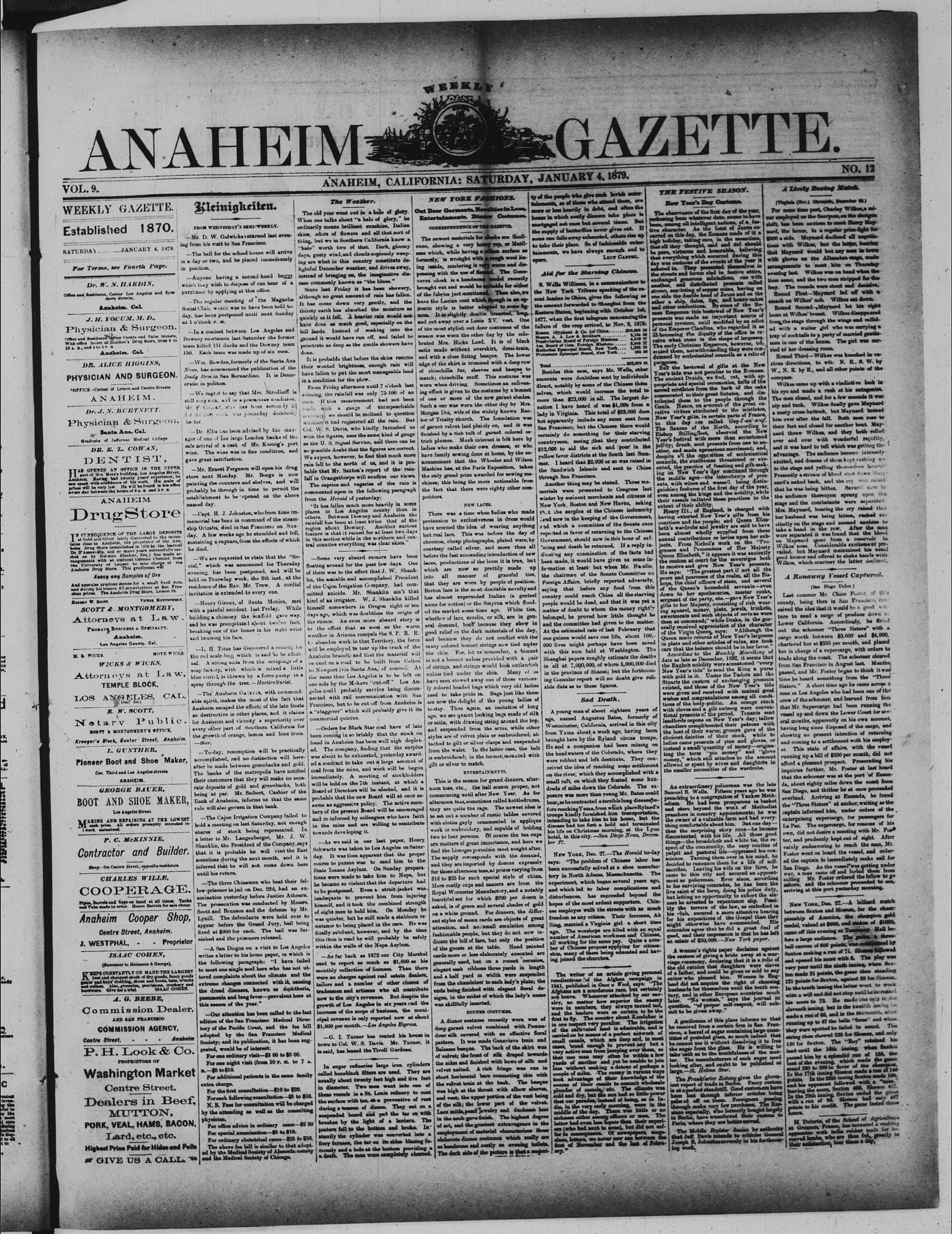
Searchable text
ANAHEIM
VOL. 9.
WEEKLY GAZETTE.
Established 1870.
SATURDAY...JANUARY 4, 1879.
For Terms, see Fourth Page.
Dr. W. N. HARDIN,
Office and Residence, Corner Los Angeles and Sycamore Streets,
Anahiem. Cal.
J. H. YOCUM, M. D., Physician & Surgeon.
Office and Residence, corner Centre and Palm Streets,
With office hours at Blanken's Drug Store, from 9 to 10 A.M., and 4 to 5 P.M.
Anahiem. Cal.
DR. ALICE HIGGINS,
PHYSICIAN AND SURGEON.
OFFICE - Corner of Lemon and Centre Streets.
ANAHEIM.
Dr. J. N. BURTNETT.
Physician & Surgeon.
Santa Ana, Cal.
Graduate of Jefferson Medical College
DR. E. L. COWAN,
DENTIST.
Kleinigkeiten.
FROM WEDNESDAY'S SEMI-WEEKLY.
Mr. D. W. Gelwicks returned last evening from his visit to San Francisco.
The bell for the school house will arrive in a day or two, and be placed immediately in position.
Anyone having a second-hand buggy which they wish to dispose of can hear of a purchaser by applying at this office.
The regular meeting of the Magnolia Social Club, which was to have been held today, has been postponed until next Sunday at 1 o'clock P.M.
In a contest between Los Angeles and Downey sportmen last Saturday the former team killed 151 ducks and the Downey team 150. Each team was made up of six men.
Win. Bowden, formerly of the Santa Ana News, has commenced the publication of the Daily Item in San Bernardino. It is Democratic in politics.
We regret to say that Mrs. Strodhoff is still very sick, and in a precarious condition. Mr. F. Connell who has been seriously ill for the past week, was yesterday decidedly better.
Dr. Ellis has been advised by the manager of one of the large London banks of the safe arrival of a cask of Mr. Koenig's port wine. The wine was in fine condition, and gave great satisfaction.
The Wee
The old year went out
When one talks about it ordinarily means brilliskies, odors of flowers thing, but we in Southern "halo" worth two of days, gusty wind, and eing are what in this c lightful December we instead of bringing on ease commonly known
Since last Friday it although no great amo
It has come down w thirsty earth has abso quickly as it fell. A have done as much hill lands. Instead o ground it would have penetrate as deep as the done.
It is probable that b their wonted brightte have fallen to put th in a condition for the From Friday after evening, the rainfall w inch. If this measu made with a gauge accuracy, we should whether it had regist Col. W. S. Davis, w with the figures, users as the U. S. Signal S no possible doubt th We expect, however
DR. ALICE HIGGINS,
PHYSICIAN AND SURGEON.
'OFFICE—Corner of Lemon and Centre Streets.
ANAHEIM.
Dr. J. N. BURTNETT.
Physician & Surgeon.
Santa Ana, Cal.
Graduate of Jefferson Medical College
DR. E. L. COWAN,
DENTIST,
HAS OPENED AN OFFICE IN THE UPPER part of Mrs. Matt's building, Los Angeles Street, Anaheim. Having had twenty years' experience, he can speak with confidence of his work. His scale of prices will be very low. He will be found in his office every day between the hours of 9 A.M. and 5 P.M.
ANAHEIM
DrugStore
IN CONSEQUENCE OF THE LARGE DEPOSITS OF Gold and Silver lately discovered in the mountains close to Anaheim, the proprietor of the Anaheim Drug Store (established in 1870 by the learned Dr. D Assenville, and so many years successfully carried on by Herman Blanken, Eq.) has made arrangements with an eminent German Chemist from the University of Leipzig to take charge of the Anaheim Drug Store. This gentleman will assay any Samples of Ore and appraise precious stones for a small fixed sum, and during his leisure fill prescriptions at San Francisco prices. The Anaheim Drug Store, Lemon St.
ROBERT W. SCOTT.
VICTOR MONTGOMERY.
SCOTT & MONTGOMERY,
Attorneys at Law.
PROBATE BUSINESS A SPECIALTY.
Anaheim.
Los Angeles County, Cal.
M. R. WICKS.
MOYE WICKS.
WICKS & WICKS,
Attorneys at Law,
TEMPLE BLOCK,
LOS ANGELES, CAL.
Dec 7 2m1]
R. W. SCOTT,
Notary Public.
BOOT & MONTGOMERY'S OFFICE,
Kreeger's Block, Center Street, Anaheim.
L. GUNTHER.
Pioneer Boot and Shoe Maker,
Cer. Third and Los Angeles streets.
ANAHEIM.
GEORGE BAUER,
BOOT AND SHOE MAKER,
Los Angeles Street.
MAKING AND REPAIRING AT THE LOWEST cash price. All orders promptly attended to I work guaranteed.
P. C. McKINNIE,
Contractor and Builder.
Shop—On Centre Street, opposite residence.
Win. Bowden, formerly in the News, has commenced the publication of the Daily Item in San Bernardino. It is Democratic in politics.
We regret to say that Mrs. Strodhoff is still very sick, and in a precarious condition. Mr. P. Chalmak who has been seriously ill for the past week was yesterday decidedly better.
Dr. Ellis has been advised by the manager of one of the large London banks of the safe arrival of a cask of Mr. Koenig's port wine. The wine was in fine condition, and gave great satisfaction.
Mr. Ernest Ferguson will open his drug store next Monday. Mr. Boege is now painting the counters and shelves, and will probably be through in time to permit the establishment to be opened on the above named day.
Capt. H. J. Johnston, who from time immemorial has been in command of the steamship Orizaba, died in San Francisco on Sunday. A few weeks ago he stumbled and fell, sustaining a rupture, from the effects of which he died.
We are requested to state that the "Social," which was announced for Thursday evening, has been postponed, and will be held on Thursday week, the 9th inst., at the residence of the Rev. Mr. Trew. A cordial invitation is extended to everyone.
Henry Giroux, of Santa Monica, met with a painful accident last Friday. While building a chimney the scaffold gave way, and he was precipitated about twelve feet, breaking one of the bones in his right wrist and bruising his face.
L. H. Titus has discovered a remedy for the red scale-bug, which is said to be effectual. A strong suds from the scrapings of a soap factory, with which is mixed a little blue vitriol, is thrown by a force-pump in a spray through the tree.-Horticulturist.
The Anaheim Gatekeeper, with commendable spirit, makes the most of the fact that Anaheim escaped the effects of the late frosts so destructive in other places, and it claims for Anaheim and vicinity a superiority over every other part of Southern California for the growth of orange, lemon and lime trees.-Star.
To-day, resumption will be practically accomplished, and no distinction will hereafter be made between greenbacks and gold. The banks of the metropolis have notified their customers that they will make no separate deposits of gold and greenbacks, both being at par. Mr. Seibert, Cashier of the Bank of Anaheim, informs us that the same rule will also govern in that bank.
The Cajon Irrigation Company failed to hold a meeting on last Saturday, not enough shares of stock being represented. In a letter to Mr. Langenberger, Mr. J. W. Shanklin, the President of the Company,says that it is probable he will visit the East sometime during the next month, and it is inferred that he will not come down here their wonted brightness have fallen to put them in a condition for the day.
From Friday afternoon evening, the rainfall was inch. If this measure made with a gauge accuracy, we should not whether it had registered Col. W. S. Davia, with the figures, used as the U. S. Signal Service no possible doubt that We expect, however, rain fell to the north bable that Mr. Saxton fall in Orangethorpe.
The caprice and womens commented upon in from the Herald of New York.
"It has fallen much places in Los Anos others. Between Rainfall has been at its region about Downtown feature is that it rains in this section while tral counties everywhere."
Some very abo floating around for all of them was to the east lin, the amiable and of the Cajon Irrigation mitted suicide.M kind of an irrigator himself somewhere days ago, which was the rumor.An even to the effect that weather in Arizona to abandon work it will be employed to Anaheim branch)a be used on a road to Newport (via Saxton same time Los one side by the Moeles could probably nected with rail Francisco, but to be a "staggerer" which commercial quietu
Orders for Bla been coming in so hand in Anaheim ed.The company was about to be en el contract to tra coal from the min immediately.A will be held on th Board of Directors probable that she some an aggressive bers of the present and re-inforced by in the mine and towards developi
As we said i Schwartz was talk day.It was there course to pursue State Insane Asy
GEORGE BAUER,
BOOT AND SHOE MAKER,
Los Angeles Street.
MARKING AND REPAIRING AT THE LOWEST
cash prices. All orders promptly attended to
work guaranteed.
P. C. McKINNIE,
Contractor and Builder.
CHARLES WILLE,
COOPERAGE.
Figs, Barrels and Kegs on hand at all times. Tanks
and Tube made to order. Honey Barrels for sale cheap.
Anaheim Cooper Shop,
Centre Street, Anaheim.
J. WESTPHAL, - Proprietor
ISAAC COHEN,
(Successor to Heimann & George).
KEEPS CONSTANTLY ON HAND THE LARGEST
best and cheapest stock of dry-goods, fancy goods
guides and boys' clothing, shoes and boots, hats, trunks
and vests. Also, groceries, provisions, crackery and
hardware. Give me a trial.
ISAAC COHEN.
A. G. BEEBE,
Commission Dealer,
AND SAN FRANCISCO
COMMISSION AGENCY,
Centre Street, Anaheim.
P. H. Look & Co.
PROPRIETORS OF
Washington Market
Centre Street.
Dealers in Beef,
MUTTON,
PORK, VEAL, HAMS, BACON,
Lard, etc., etc.
Highest Price Paid for Hides and Pelts
GIVE US A CALL.
The customers that they will make no separate deposits of gold and greenbacks, both being at par. Mr. Seibert, Cashier of the Bank of Anaheim, informs us that the same rule will also govern in that bank.
The Cajon Irrigation Company failed to hold a meeting on last Saturday, not enough shares of stock being represented. In a letter to Mr. Langenberger, Mr. J. W. Shanklin, the President of the Company, says that it is probable he will visit the East sometime during the next month, and it is inferred that he will not come down here until his return.
The three Chinamen who beat their fellow-prisoner in jail on Dec. 22d, had an examination yesterday before Justice Athearn. The prosecution was conducted by Messrs. Scott and Brunson and the defense by Mr. Lynill. The defendants were held over to appear before the Grand Jury, bail being fixed at $300 for each. The bail was furnished and the prisoners released.
A San Diegan on a visit to Los Angeles writes a letter to his home paper, in which is the following paragraph: "I have failed to meet one single soul here who has not uttered complaints about the climate and the extreme changes connected with it, causing the dread diseases, known as diphtheria, pneumonia and lung fever—prevalent here at this season of the year."
Our attention has been called to the last edition of the San Francisco Medical Directory of the Pacific Coast, and the fee bill adopted by the San Francisco Medical Society; and its publication, it has been suggested, would be of interest:
For one ordinary visit—$3 00 to $5 00.
For one night visit (from 10 p.m. to 7 a.m.)—$5 to $10.
For additional patients in the same family extra charge.
For the first consultation—$10 to $20.
For each following consultation—$5 to $10.
N. B. Fees for consultation will be charged by the attending as well as the consulting physician.
For office advice in ordinary cases—$2 50
For special examination—$5 to $10.
For ordinary obstetrical cases—$25 to $50.
The above fee bill is similar to that adopted by the Medical Society of Alameda county and the Medical Society of Chicago.
As far back used to report monthly collections were no charges tailors and a few tradesmen and now to the city growth of Los Angeles is said, has leased them their customers that they will make no separate deposits of gold and greenbacks, both being at par. Mr. Seibert, Cashier of the Bank of Anaheim, informs us that the same rule will also govern in that bank.
Schwartz was taken day. It was there course to pursue State Insane Asylums were made he became so visiable postponed inadequate to himself, and it to eight men to be quieter, but instance to being finally subdued, this item is read within the walls.
In sugar relied boneblack usually about in diameter these vessels in the surface with during a season suspended bores brushes by the pantern fell to stantly the cyclic furnace, normally and a draft. The
WEEKLY
CIM GAZI
ANAHEIM, CALIFORNIA: SATURDAY, JANUARY 4, 1879.
The Weather.
The old year went out in a halo of glory. When one talks about "a halo of glory," he ordinarily means brilliant sunshine, Italian skies, odors of flowers and all that sort of thing, but we in Southern California know a "halo" worth two of that. Dark, gloomy days, gusty wind, and clouds copiously weeping are what in this country constitute delightful December weather, and drives away, instead of bringing on, the imaginative disease commonly known as "the blues."
Since last Friday it has been showery, although no great amount of rain has fallen. It has come down very gently, and the thirsty earth has absorbed the moisture as quickly as it fell. A heavier rain would not have done as much good, especially on the hill lands. Instead of soaking into the ground it would have run off, and failed to penetrate as deep as the gentle showers have done.
It is probable that before the skies resume their wonted brightness, enough rain will have fallen to put the most manageable land in a condition for the plow.
From Friday afternoon until 7 o'clock last evening, the rainfall was only 75-100 of an inch. If this measurement had not been made with a gauge of unimpeachable accuracy, we should be inclined to question whether it had registered all the rain. But Col. W. S. Davis, who kindly furnished us with the figures, uses the same kind of gauge as the U. S. Signal Service, and there can be no possible doubt that the figures are correct. We expect, however, to find that much more
NEW YORK FASHIONS.
Out Door Garments, Newtown in Lone,
Entertainments, Dinner Costumes.
CORRESPONDENCE OF THE GAZETTE.
The newest materials for cloaks are Sicilienne, showing a very heavy rep., or Matilasse which, while having a silken surface as formerly, is wrought with a rough wool lining inside, rendering it very warm and dispensing with the use of flannel. The Genoveva cloak is a handsome model recently brought out and would be suitable for either of the fabrics just mentioned. Then also, we have the Lucian coat which though in an opposite style is better adapted to some figures. It is slightly double breasted, long and cut away over a Louis XV. vest. One of the most stylish out door costumes of the season was worn the other day by the celebrated Mrs. Hicks Lord. It is of black satin made without overskirt, demi-train, and with a close fitting basque. The lower edge of the skirt is trimmed with a deep row of chinchilla fur, sleeves and basque to match; chinchilla muff. This costume was worn when driving. Sometimes an enlivening effect is given to the costume by a bonnet of one or more of the new garnet shades. Such a one was worn the other day by Mrs. Morgan Dix, wife of the widely known Recorder of Trinity church. The foundation was of garnet velvet laid plainly on, and it was finished by a rich tuft of garnet colored ostrich plumes. Much interest is felt here by ladies who make their own dresses, or who have family sewing done at home, by the anty of the people who give such lavish entertainments, as of those who attend them, are more or less heavily in debt, and often the house in which costly dinners take place is mortgaged not once but several times. But the supply of butterflies never gives out. If some one falls away exhausted, others rise up to take their place. So of fashionable entertainments, we have always enough and to spare.
Aid for the Starving Chinese.
S. Wells Williams, in a communication to the New York Tribune speaking of the recent famine in China, gives the following as the amount forwarded to Shanghai from the Eastern States, beginning with October 1st, 1877, when the first telegram announcing the failure of the crop arrived, to Nov. 9, 1878:
Mensura Olyphant & Co. (of China) $10,850 18
Mensura A. A. Low & Brothars 2,134 56
Prusbyterian Board of Foreign Missions 4,519 97
Am. Board of Com. Foreign Missions 2,963 27
Methodist Episcopal Board, New York 1,923 29
Protestant Episcopal Board, New York 164 56
Total $22,670 01
Besides this sum, says Mr. Wells, other amounts were doubtless sent by individuals direct, notably by some of the Chinese them selves, which would increase the total to more than $23,000 in all. The largest donation I have heard of was $1,000 from a lady in Virginia. This total of $23,000 does not apparently include any sums sent from San Francisco; but the Chinese there would certainly do something for their starving countrymen, seeing that they contributed $12,000 to aid the sick and poor in the yellow fever districts at the South last Summer.
New Year's to this The Bishop Year's jollity; other... despite...
their wonted brightness, enough rain will have fallen to put the most manageable land in a condition for the plow.
From Friday afternoon until 7 o'clock last evening, the rainfall was only 75-100 of an inch. If this measurement had not been made with a gauge of unimpeachable accuracy, we should be inclined to question whether it had registered all the rain. But Col. W. S. Davis, who kindly furnished us with the figures, uses the same kind of gauge as the U. S. Signal Service, and there can be no possible doubt that the figures are correct. We expect, however, to find that much more rain fell to the north of us, and it is probable that Mr. Saxton's report of the rainfall in Orangethorpe will confirm our views.
The caprice and vagaries of the rain is commented upon in the following paragraph from the Herald of yesterday:
"It has fallen much more heavily in some places in Los Angeles county than in others. Between Downey and Anaheim the rainfall has been at least twice that of the region about Downey. Another serious feature is that it rained for at least two days in this section while in the northern and central counties everything was clear skies."
Some very absurd rumors have been floating around for the past few days. One of them was to the effect that J. W. Shanklin, the amiable and accomplished President of the Cajon Irrigation Company, had committed suicide. Mr. Shanklin ain't that kind of an irrigator. W. J. Shanklin killed himself somewhere in Oregon eight or ten days ago, which was doubtless the origin of the rumor. An even more absurd story is to the effect that as soon as the warm weather in Arizona compels the S. P. R. R. to abandon work in that Territory, the force will be employed to tear up the track of the Anaheim branch; and that the material will be used on a road to be built from Colton to Newport (via Santa Ana, of course). At the same time Los Angeles is to be left on one side by the Mohave "cut-off." Los Angeles could probably survive being disconnected with rail communication with San Francisco, but to be cut off from Anaheim is a "staggerer" which will probably give it its commercial quietus.
Orders for Black Star coal have of late been coming in so briskly that the stock on hand in Anaheim has been well nigh depleted. The company, finding that the surplus was about to be exhausted, yesterday awarded a contract to take out a large amount of coal from the mine, and work will be begun immediately. A meeting of stockholders will be held on the 7th instant, at which a Board of Directors will be elected, and it is probable that the new Board will at once assume an aggressive policy. The active members of the present Board will be encouraged and re-inforced by colleagues who have faith in the mine and are willing to contribute towards developing it.
As we said in our last paper, Henry Schwartz was taken to Los Angeles on Saturday. It was then apparent that the proper course to pursue was to send him to the State Insane Asylum. On Sunday prepara-
edge of the skirt is trimmed with a deep row of chinchilla fur, sleeves and basque to match; chinchilla muff. This costume was worn when driving. Sometimes an enlivening effect is given to the costume by a bonnet of one or more of the new garnet shades. Such a one was worn the other day by Mrs. Morgan Dix, wife of the widely known Recorder of Trinity church. The foundation was of garnet velvet laid plainly on, and it was finished by a rich tuft of garnet colored ostrich plumes. Much interest is felt here by ladies who make their own dresses, or who have family sewing done at home, by the announcement that the Wheeler and Wilson Machine has, at the Paris Exposition, taken the only grand prize awarded for sewing machines; this being the more noticeable from the fact that there were eighty other competitors.
NEW LACES.
There was a time when ladies who made pretension to exclusiveness in dress would have scorned the idea of wearing anything but real lace. This was before the day of chromos, cheap photographs, plated ware, by courtesy called silver, and more than all before the fast succeeding introduction of new laces, productions of the loom it is true, but which are now so prettily made up into all manner of graceful ties, that they are worn by people of position. Breton lace is the most desirable novelty and has almost superseded Italian (a genteel name for cotton) or the Smyrna which flooded the market some time ago. White ties, whether of lace, muslin, or silk, are in general demand, both because they show in good relief on the dark materials of the day, and because they do not conflict with the many colored bonnet strings now tied under the chin. For, let us remember, a bonnet is not a bonnet unless provided with a pair of strings, and strings would look outlandish unless tied under the chin. Many of us have seen stowed away one of those variously colored beaded bags which very old ladies used to take pride in. Bags just like them are now the delight of the young ladies of today. Then again, an imitation of long ago, we see quaint looking bags made of silk or satin, with drawing string around the top, and suspended from the arms, while other styles are of velvet plain or embroidered, attached to gilt or silver clasps and suspended from the waist. In the latter case, the belt is embroidered; in the tormer, mounted with gilt or silver to match.
ENTERTAINMENTS.
This is the season for grand dinners, afternoon teas, etc., the ball season proper, not commencing until after New Year. As for afternoon teas, sometimes called kettledrums, they are quite rage. The newest idea is to set out a number of rustic tables covered with cloths gayly ornamented in applique work or embroidery, and capable of holding two to four persons. Of course the tea cups are matters of great importance, and here we find the Limoges porcelain most sought after. The supply corresponds with the demand, and they are imported by dozens expressly for those afternoon teas, at prices varying from
Total.
Besides this sum, says Mr. Wella, other amounts were doubtless sent by individuals direct, notably by some of the Chinese them selves, which would increase the total to more than $23,000 in all. The largest donation I have heard of was $1,000 from a lady in Virginia. This total of $23,000 does not apparently include any sums sent from San Francisco; but the Chinese there would certainly do something for their starving countrymen, seeing that they contributed $12,000 to aid the sick and poor in the yellow fever districts at the South last Summer. I heard that $2,000 or so was raised in the Sandwich Islands and sent to China through San Francisco.
Another thing may be stated. Three memorials were presented to Congress last winter by eminent merchants and citizens of New York, Boston and New Haven, asking that they surplus of the Chinese indemnity land now in the keeping of the Government, and which a committee of the Senate once reported in favor of returning to the Chinese Government, should now in this hour of suffering and death be returned. If a reply indicating any examination of the facts had been made, it would have given us some information at least: but when Mr. Painlin chairman of the Senate Committee on Foreign Affairs, briefly reported adversely, saying that before any food from this country could reach China all the starving people would be dead, and that it was yet a matter of doubt to whom the money rightly belonged, he proved how little thought he and the committee had given to the matter. At the estimated rate of last February that one guinea would save one life, about 100,-000 lives might perhaps have been saved with this sum held at Washington. The Shanghai papers roughly estimate the deaths in all at 7,000,000, of whom 5,000,000 died in the province of Shansi; but the forthcoming Consular report will no doubt give reliable data as to these figures.
Sad Death.
A young man of about eighteen years of age named Augustus Bates, formerly of Westminster, California, arrived in this city from Yuma about a week ago, having been brought here by the Ryland circus troupe. He and a companion had been mining on the headwaters of the Colorado, where they were robbed and left destitute. They conceived the idea of reaching some settlement on the river, which they accomplished with a small raft, on which they floated some hundreds of miles down the Colorado. The exposure was more than young Mr. Bates could bear, as he contracted a terrible lung disease before reaching Yuma, from which place Ryland's troupe kindly furnished him transportation, intending to take him to his home, but the disease had too firm a hold and terminated his life on Christmas morning, at the Lyon hotel, in this city.-San Diego News December 27.
New York, Dec. 27.-The Herald to-day says: "The problem of Chinese labor has been successfully solved at a shoe manufactory."
A meeting of stockholders will be held on the 7th instant, at which a Board of Directors will be elected, and it is probable that the new Board will at once assume an aggressive policy. The active members of the present Board will be encouraged and re-inforced by colleagues who have faith in the mine and are willing to contribute towards developing it.
As we said in our last paper, Henry Schwartz was taken to Los Angeles on Saturday. It was then apparent that the proper course to pursue was to send him to the State Insane Asylum. On Sunday preparations were made to take him to Napa, but he became so violent that the departure had to be postponed. Even a strait-jacket was inadequate to prevent him from injuring himself, and it took the combined strength of eight men to hold him. On Monday he was quieter, but he still made a stubborn resistance to being placed in the cara. He was finally subdued, however, and by the time this item is read he will probably be safely within the walls of the Napa Asylum.
As far back as 1872 our City Marshal used to report as much as $1,600 as his monthly collection of licenses. Then there were no charges against real estate dealers, tailors and a number of other classes of tradesmen and artisans who all contribute now to the city's revenues. But despite the growth of Los Angeles in six years and the increase of the scope of business, the municipal revenue is only reported now at about $1,800 per month. —Los Angeles Express.
G. I. Turner has rented his house in town to Col. W. S. Davia. Mr. Turner, it is said, has leased the Tivoli Gardens.
In sugar refineries large iron cylinders called boneblack filters are used. They are usually about twenty feet high and five feet in diameter. Two men went into one of these vessels in a St. Louis refinery to coat the surface with tax, a preventive of rust during a season of disuse. They sat on a suspended board and put the tar on with brushes by the light of a lantern. The pantern fell to the bottom and broke. Instantly the cylinder was converted into a fiery furnace, the tar on its sides blazing furiously and a hole at the bottom providing a draft. The men were completely charred.
This is the season for grand dinners, afternoon teas, etc., the ball season proper, not commencing until after New Year. As for afternoon teas, sometimes called kettledrums, they are quite the rage. The newest idea is to set out a number of rustic tables covered with cloths gayly ornamented in appliqué work or embroidery, and capable of holding two to four persons. Of course the tea cups are matters of great importance, and here we find the Limoges porcelain most sought after. The supply corresponds with the demand, and they are imported by dozens expressly for those afternoon teas, at prices varying from $16 to $25 for such special style of china. More costly cups and saucers are from the Royal Worcester Manufactory, and a notably beautiful set for which $200 per dozen is asked, is of green and several shades of gold on a white ground. For dinners, the different styles of menu cards are objects of great attention, and no small emulation among fashionable people, but they do not now indicate the bill of fare, but only the position of the guests at the table. Hand painted cards more or less elaborately executed are generally used, but on a recent occasion, elegant sash ribbons three yards in length and a half yard in width were suspended from the chandelier to each lady's plate; the ends being finished with elegant floral designs, in the midst of which the lady's name was skillfully inserted.
DINNER COSTUMES
A dinner costume recently worn was of deep garnet velvet combined with Pompa-dour silk covered with an effective floral pattern. It was made Genevieve train and Balsams basque. The back of the skirt was of velvet; the front of silk draped towards the sides and finished with bows of silk and velvet united. A rich fringe was run in short horizontal bars connecting this with the velvet train at the back. The basque was high at the throat with elbow sleeves, and vest; the upper portion of the vest being of the silk; the lower part of the velvet. Lace mitts, poarl jewelry and duchess lace in the neck-gave finish. The highest degree of art, and the greatest extravagance in the employment of material characterizes these elaborate dinner costumes which really are as handsome and costly as evening toilets. The dark side of the picture is that a majori-
New York, Dec. 27.—The Herald to-day says: "The problem of Chinese labor has been successfully solved at a shoe manufactory in North Adams, Massachusetts. The experiment, which began several years ago, and which led to labor complications and disturbances, has succeeded beyond the hopes of the most ardent supporters. Chinese employes walk the streets with as much freedom as any citizen. Their foreman, Ah Sing, married a Virginia girl a short time ago. The workshops are filled with an equal number of American workmen and Chinese, all working for the same pay. Quite a number of Chinese propose applying for citizenship, many of them being educated and having joined the churches."
The writer of an article giving personal recollections of the Afghan campaign in 1841, published in Once a Week, says: "The Afghans are a murderous race, but certainly not brave. Whenever attacked by our cavalry, no matter how superior the enemy were in numbers, they always turned tail, and the leaders were as certain to be the first to fly. The country about Kandahar is in one respect very peculiar. The irrigation of the cultivated land is admirable, and is carried on by means of a perfect network of small canals, which are deep and, in most cases, broad enough to prevent any but a very active man from jumping over them, so that one man may often be within a few yards of another and yet be unable to join him without making a detour of perhaps a couple of miles. The enemy in various ways took advantage of their knowledge of the course of their canals to commit wholesale plunder of camels, etc. The climate was cold and dry, but the sun had so little power that our parade instead of being, as in India, in the very early morning, were in the middle of the day. There was little or no sickness either among officers or men. The latter had even less liquor than their superiors (who had next to none), but did not suffer in consequence. Of newspapers, magazines, letters, we never saw one between the first of November and the last of February."
AZETTE.
NO. 12
THE FESTIVE SEASON.
New Year's Day Customs.
The observance of the first day of the year, reckoning from whatever date, seems to have been, among all intelligent nations, of a festive character. As the feast of Janus occurred on this day, the Romans made of it a high holiday, taking care in the meantime, that all they thought, said and did should be pure, virtuous and honorable, believing that everything which occurred during this day was ominous of the events of the year it ushered in. They presented themselves in the streets and forum clad in festive attire, exchanged generous salutations, one with another, and distributed presents called strenge, consisting of copper coins, having on one side the double head of Janus and on the other a ship, dates, figs, and honey-cakes and other confections. By some of the Roman Emperors this bestowal of New Year's presents was made an important source of personal revenue, until modified by an edict of the Emperor Claudius, who regarded it as ill-becoming the dignity of the office to receive what came in the shape of largesse. The early Christian Emperors, however, tolerated them, notwithstanding they were condemned by ecclesiastical councils as a relic of paganism.
But the bestowal of gifts at the New Year's tide was not peculiar to the Romans. The ancient Drina, we find, out, with appropriate and special ceremonies, tufts of the sacred mistletoe from the bark of the oaks consecrated to their great Sutates, and distributed them to the people through the Gaula. Hence, on account of the great curative virtues attributed to the mistletoe, New Year's gifts, in certain parts of France, to this day are called Guy-l'an-naufl. The Saxons of the North, according to Bishop Stillingfleet, observed the New Year's festival with more than accustomed jollity; drank, sent presents from one to another, and made uproarious merriment; and, despite all the opposition of ecclesiastical leaders, the seamen threatened or exe-
But the bestowal of gifts at the New Year's tide was not peculiar to the Romans. The ancient Druids we find, cut, with appropriate and special ceremonies, tufts of the sacred mistletoe from the bark of the oaks consecrated to their great Sutates, and distributed them to the people through the Ganla. Hence, on account of the great curative virtues attributed to the mistletoe, New Year's gifts, in certain parts of France, to this day are called Guy-l-an-nsfuf. The Saxons of the North, according to Bishop Stillingfeet, observed the New Year's festival with more than accustomed jollity; drank, sent presents from one to another, and made uproarious merriment; and, despite all the opposition of ecclesiastical councils, the anathemas threatened or executed, the practice of feasting and gift-making on New Year's day continued through the middle ages—the interchange of presents, with wines and wassail being distinguishing features of the first day of the year, even among the kings and the nobility, while their vassals imitated these practices to the extent of their ability.
Henry III., of England, is charged with having extorted New Year's gifts from his courtiers and the people; and Queen Elizabeth's wardrobe and jewelry are said to have been almost wholly supplied from these annual contributions or levies upon her subjects. From Nichol's work on the "Progresses and Processions of Her Majesty Queen Elizabeth," it appears it was anciently the custom at court for the sovereigns both to receive and give New Year's presents. He says: "The greatest part if not all the peers and peeresses of the realm, all the Bishops, the chief officers of state, and several of the Queen's household servants—even down to her apothecaries, master cooks, sergeant of the party, etc.—gave New Year's gifts to her Majesty, consisting of rich wearing apparel, money, plate, jewels, trinkets, sweetmeats and such objects of verbs as were then at command;" while Drake, in the generally received appreciation of the character of the Virgin Queen, says: "Although the Queen made returns of New Year's largesses in plate and other articles of value, she took care that the balance should be in her favor."
According to the Monthly Miscellany of date as late as December, 1692, it seems that the English nobility were accustomed "every New Year's tide" to send the King a purse with gold in it. Under the Tudors and the Stuarts the custom of exchanging presents existed, and those of the New Year's tide were given and received with mutual good wishes and congratulations among all conditions of the body-politic. An orange stuck with cloves and a gilt nutmeg were conventional presents of the period. Tenants sent landlords capons on New Year's day; tallow chandlers complimented their patrons with the best of their wares; grocers gave of the choiceest dainties of their stock, while ladies came presents of pins and gloves, or instead a small quantity of money—originating the term "pin money" and "glove money," which still attaches to the amount allowed or spent by wives and daughters in the smaller necessities of the wardrobe.
An extraordinary policeman was the late Samuel B. Wells. Fifteen years ago he was preaching to a congregation of Yankee Methodists. He had been prosperous in basket and store beyond the worth of Methodist preachers in country appointments; he was the owner of a valuable farm and had everything comfortable about him. But one day thus the surprising story runs—he became discontented with his life. All these good things—the broadcloth and white tie, the respect of the community, the easy routine of pulpit and pastoral life—oppressed his conscience. Turning them over in his mind, he decided to renounce them for a life of self-sacrifice. Leaving his wife on the farm, he
Wilkes came up with a vindictive look in his eye and made a rush at his antagonist. The men closed, and for a few seconds it was nip and tuck. Wilkes finally gave Maynard a nasty cross-buttock, but Maynard turned him over after the fall. Both men rose to their feet and closed for another bout. Maynard threw Wilkes, and they both rolled over and over with wonderful rapidity, and it was hard to tell which was getting the advantage. The audience became intensely excited, and dozens of them kept rushing up to the stage and yelling themselves hoarse! Presently a stream of blood shot down Maynard's naked back, and the cry was raised that he was being bitten. Several men in the audience thereupon sprang upon the stage and the combatants were separated. Mrs. Maynard, hearing the cry raised that her husband was being bitten, rushed excitedly on the stage and seemed anxious to take a hand in the row. After the men were separated it was found that the blood on Maynard came from a reservoir in Wilkes nose. Considerable excitement prevented, but Maynard maintained his usual good humor and offered to shake hands with Wilkes, which courtesy the latter declined.
A Runaway Vessel Captured.
[San Diego Union.]
Last summer Mr. Chico Foster, of this county, being then in San Francisco, conceived the idea that it would be a good venture to send a cargo of produce down to Lower California. Accordingly, he fitted out the schooner "Three Sisters" with a cargo worth between $3,000 and $4,000, chartered her at $350 per month, and placed her in charge of a supercargo, with orders to trade along the coast. The schooner cleared from San Francisco in August last. Months passed, and Mr. Foster began to think it was time he heard something from the "Three Sisters." A short time ago he came across a man in Los Angeles who had been one of the crew of the schooner, and learned from him that Mr. Supercargo had been running the vessel up and down the Lower Coast for several months, apparently on his own account, having long since disposed of the cargo, and showing no present intention of returning and coming to a settlement with his employer. This state of affairs, with the vessel running up a bill of $350 per month, did not afford a pleasant prospect. Prosecuting his inquiries further, Mr. Foster at last heard that the schooner was at the port of Ensenada, about eight miles down the coast from San Diego, and thither he at once proceeded overland. Arriving at Ensenada, he found the "Three Sisters" at anchor, waiting as the captain informed him, under orders of the enterprising supercargo, tor passengers for La Paz. The supercargo, for reasons of his own, did not desire a meeting with Mr. Foster, and prudently kept out of sight. After vainly endeavoring to reach the man, Mr. Foster went on board the vessel, and ordered the captain to immediately make sail for San Diego. As the vessel was getting under
An extraordinary policeman was the late Samuel B. Wells. Fifteen years ago he was preaching to a congregation of Yankee Methodists. He had been prosperous in basket and store beyond the worth of Methodist preachers in country appointments; he was the owner of a valuable farm and had everything comfortable about him. Sat one day—thus the surprising story runs—he became discontented with his life. All these good things—the broadcloth and white tie, the respect of the community, the easy routine of pulpit and pastoral life—oppressed his conscience. Turning them over in his mind, he decided to renounce them for a life of self-sacrifice. Leaving his wife on the farm, he came to this city and secured an appointment as policeman. Ever since, according to his surviving comrades, he has been the live saint of the force, doing his police duty, but letting no opportunity to exhort the sinners he arrested to repentance slip. Possibly the terrors of the law, as embodied in his club, secured a more attentive hearing for his expositions of the Gospel than they might otherwise have commanded. His comrades agree that he did a great deal of good, and their impression is that he has left an estate of $50,000.—New York paper.
A woman's rights paper declaims against the custom of giving a bride away at a marriage ceremony, declaring that it is a relic of the old opinion that daughters were slaves of a father, and could be given or sold to any suitor who pleased him. Women in England did not acquire the right of choosing husbands for themselves until the tenth century, and in other European countries much later. "No woman," says the journal in question, "of proper self-respect, will submit to be given away."
A gentleman of this place informs us that he received from a certain firm in San Francisco, a barrel of sugar containing large quantities of pounded glass, so much indeed that he cannot use it without dissolving it to free the sugar from the glass. He is willing to take oath as to the truthfulness of the matter. The manufacturers of such sugar need looking after, and ought to be published at large.—St. Helena Star.
The Frankfurter Zeitung gives the gloomiest report of trade in Berlin. Fancy custom is at a perfect standstill. Good customers have been lost through inferior articles being palmed off on them. Foreigners passing through make very few purchases. The Russians especially, who formerly bought largely in Berlin, have transferred their custom to Paris, where they are better served.
The Mobile Register denies by authority that Jeff Davis intends to criticize General Joseph R. Johnston several days in his forthcoming work.
that the schooner was at the port of Ensenada, about eighty miles down the coast from San Diego, and thither he at once proceeded overland. Arriving at Ensenada, he found the "Three Sisters" at anchor, waiting as the captain informed him, under orders of the enterprising supercargo, for passengers for La Paz. The supercargo, for reasons of his own, did not desire a meeting with Mr. Foster, and prudently kept out of sight. After vainly endeavoring to reach the man, Mr. Foster went on board the vessel, and ordered the captain to immediately make sail for San Diego. As the vessel was getting under way, a man came off and forbid them from sailing Mr. Foster ordered the fellow to go ashore, and the schooner proceeded to sea, arriving at this port yesterday morning.
NEW YORK, Dec. 27.—A billiard match between Sexton and Slosson, for the championship of America, the champion gold medal, valued at $600, and similar to $1000, came off this evening at Tammany Hall before a large audience. The game, a three-ball carrom of 600 points, was committed by Sexton making a run of 71. Slosson followed and opened his score with 8. The play was very poor until the ninth inning, when Sexton made 31 points, the game then standing 121 points for Sexton, against 29 for Slosson. In the tenth inning the latter went to work with a will and did not stop until he increased his score to 73. He made one only in his eleventh inning, but in the twelfth inning he made a run of 65, and in the thirteenth, after running up to 67 the balls "froze" and when they were spotted he failed to count. The string then showed 225 for Slosson, and only 130 for Sexton. The "Boy" retained his lead until the 16th inning, when Sexton passed him by a splendid run of 158, the best of the evening, which made the game stand 295 to 268 in favor of the champion. In the 17th inning Slosson made a run of 140 points. In the 26th inning Slosson made 108, and his opponent followed with a "miser," leaving the score, Sexton 485, Slosson 407. In the 29th inning Sexton ended the game with a run of 99. Slosson had only 467 points to his credit. The game lasted three hours.
M. Duterte, of the School of Agriculture at Gwennan, France, has invented a smoking apparatus with india rubber teals for beavered lambs, who are thus fed, greatly to their satisfaction four times a day.