anaheim-gazette 1878-10-19
Scanned page
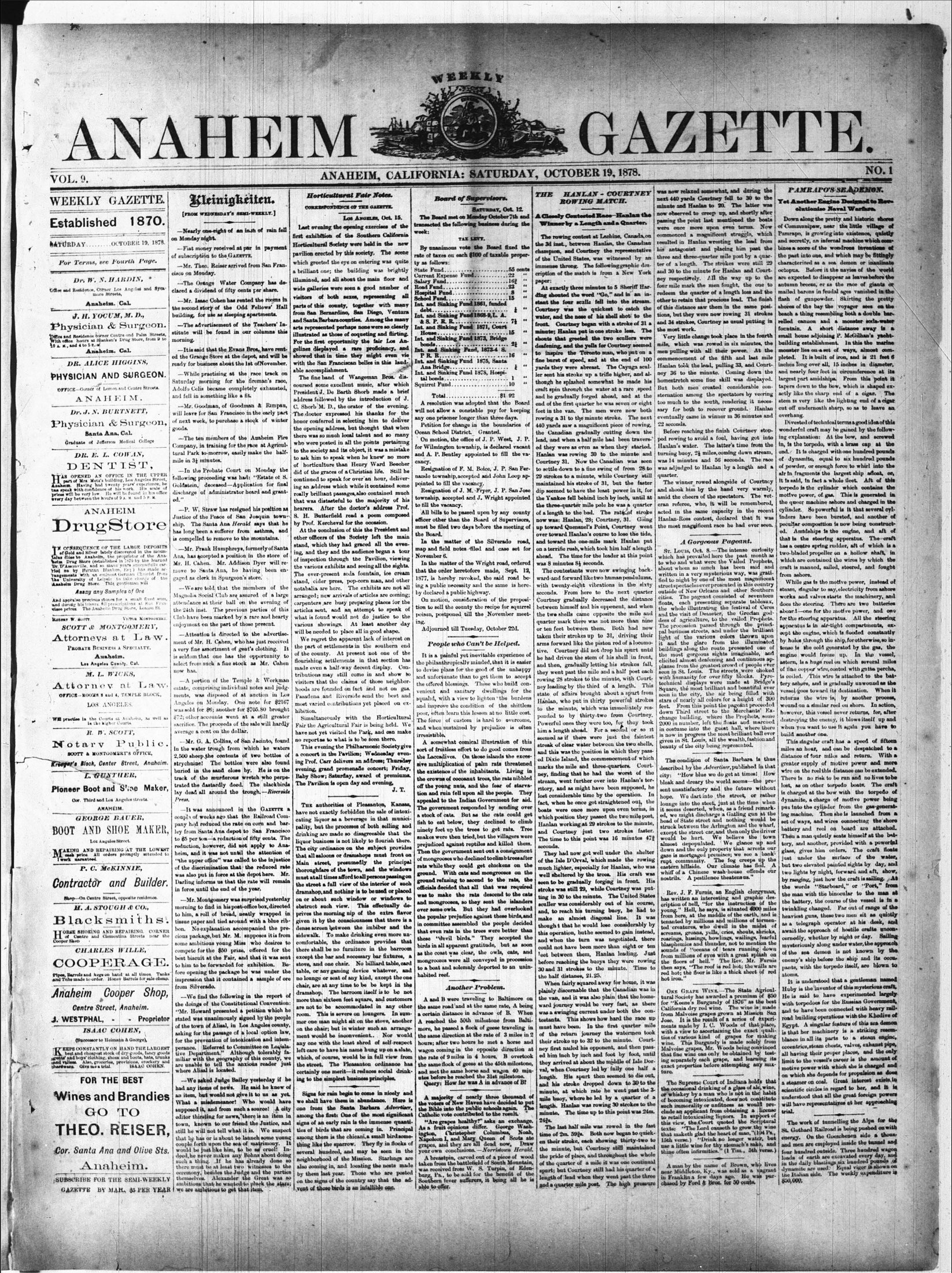
Searchable text
ANAHEIM
VOL. 9.
WEEKLY GAZETTE.
Established 1870.
SATURDAY...OCTOBER 19, 1878.
For Terms, see Fourth Page.
Dr. W. N. HARDIN,
Office and Residence, Corner Los Angeles and Sycamore Streets,
Anaheim, Cal.
J. H. YOCUM, M. D., Physician & Surgeon.
Office and Residence corner Centra and Palm Streets,
With office hours at Banken's Drug Store, from 9 to 10 A.M., and 4 to 5 P.M.
Anaheim, Cal.
DR. ALICE HIGGINS,
PHYSICIAN AND SURGEON.
OFFICE—Corner of Lemon and Centre Strots.
ANAHEIM.
Dr. J. N. BURTNETT,
Physician & Surgeon,
Santa Ana, Cal.
Graduate of Jefferson Medical College
DR. E. L. COWAN,
DENTIST,
Kleinigkeiten.
[FROM WEDNESDAY'S SEMI-WEEKLY.]
—Nearly one-eight of an inch of rain fell on Monday night.
—Fiat money received at par in payment of subscription to the Gazette.
—Mr. Theo Reiser arrived from San Francisco on Monday.
—The Orange Water Company has declared a dividend of fifty cents per share.
—Mr. Isaac Cohen has rented the rooms in the second story of the Odd Fellows' Hall building, for use as sleeping apartments.
—The advertisement of the Teachers' Institute will be found in our columns this morning.
—It is said that the Evans Bros. have rented the Grange Store at the depot, and will be ready for business about the 1st of November.
—While practising at the race track on Saturday morning for the fireman's race, Adolfo Celis became completely exhausted, and fell in something like a fit.
—Mr. Goodman, of Goodman & Rumpau, will leave for San Francisco in the early part of next week, to purchase a stock of winter goods.
—the ten members of the Anaheim Fire Company, in training for the race at Agricultural Park to-morrow, easily make the half-mile in 3½ minutes.
—In the Probate Court on Monday the
Horticultural
CORRESPONDENCE OF
Los Angeles
Last evening the open first exhibition of the Horticultural Society was pavilion erected by this which greeted the eye on a brilliant one; the building illuminated, and all about wide galleries were seen visitors of both sexes parts of this county, from San Bernardino, and Santa Barbara counties arts represented perhaps illustrated as those of course For the first opportunity gelines displayed a rerun showed that in time with the San Franciscan able accomplishment.
The fine band of Wine coursed some excellent President J. De Barth address followed by the C. Shorb M. D., the orator expressed honor conferred in select the opening address, but there was so much local who were posted in all to the society and its objection to ask him to speak when of horticulture than did of the graces of a Ch
PHYSICIAN AND SURGEON.
OFFICE—Correct of Lemon and Centre Streets.
ANAHEIM.
Dr. J. N. BURTNETT,
Physician & Surgeon,
Santa Ana, Cal.
Graduate of Jefferson Medical College
DR. E. L. COWAN,
DENTIST,
HAS OPENED AN OFFICE IN THE UPPER
part of Mrs Metz's building, Los Angeles Street,
Anahiem. Having had twenty years' experience, he
tens speak with confidence of his work. His scale of
prices will be very low. He will be found in his office
every day between the hours of 9 A.M. and 5 P.M.
ANAHEIM
DrugStore
CONSEQUENCE OF THE LARGE DEPOSITS
of Gold and Silver lately discovered in the mountains close to Anahiem, the proprietor of the Anahiem
Drug Store (established in 1870 by the learned
Dr. D'Amontville, and so many years successfully carried on by Herman Blanken, Kep) has made arrangements with an eminent German Chemist from
the University of Leipzig to take charge of the
Anahiem Drug Store. This gentleman will
Assay any Samples of Ore
And appraise precious stones for a small fixed sum,
and during his lifetime fill prescriptions at San Francisco prices.
ROBERT W. SCOTT.
VICTOR MONTGOMERY.
SCOTT & MONTGOMERY,
Attorneys at Law.
PROBATE BUSINESS & SPECIALTY.
Anahiem.
Los Angeles County, Cal.
M. L. WICKS,
Attorney at Law,
OFFICE—ROOMS 3 and 4, TEMPLE BLOCK,
LOS ANGELES.
Will practise in the Courts at Anahiem, as well as in the higher Courts.
R. W. SCOTT,
Notary Public.
BOOT & MONTGOMERY'S OFFICE,
Kreeger's Block, Center Street, Anahiem.
L. GUNTHER,
Pioneer Boot and Shoe Maker,
Ovr. Third and Los Angeles streets.
ANAHEIM.
GEORGE BAUER,
BOOT AND SHOE MAKER,
Los Angeles Street.
MAKING AND REPAIRING AT THE LOWEST
cash price. All orders promptly attended to
work guaranteed.
P. C. McKINNIE,
Contractor and Builder.
While practising at the race track on Saturday morning for the fireman's race, Adolfo Celis became completely exhausted, and fell in something like a fit.
Mr. Goodman, of Goodman & Rimpau, will leave for San Francisco in the early part of next week, to purchase a stock of winter goods.
The ten members of the Anahheim Fire Company, in training for the race at Agricultural Park to morrow, easily make the half-mile in 3½ minutes.
In the Probate Court on Monday the following proceeding was halt: "Estate of S. Goldstein, deceased—Application for final discharge of administrator heard and granted."
P. W. Straw has resigned his position as Justice of the Peace of San Joquin township. The Santa Ana Herald says that he has long been a sufferer from asthma, and is compelled to remove to the mountains.
Mr. Frank Humphreys, formerly of Santa Ana, has accepted a position in the store of Mr. H. Cahen. Mr. Addison Dyer will remove to Santa Ana, he having been engaged as clerk in Spurgeon's store.
We are told that the members of the Magnolia Social Club are assured of a large attendance at their ball on the evening of the 24th inst. The previous parties of this Club have been marked by a rare and hearty enjoyment on the part of those present.
Attention is directed to the advertisement of Mr. H. Cahen, who has just received a very fine assortment of gent's clothing. It is seldom that one has the opportunity to select from such a fine stock as Mr. Cahen now has.
A portion of the Temple & Workman estate, comprising individual notes and judgments, was disposed of at auction in Los Angeles on Monday. One note for $2167 was sold for $6; another for $705.80 brought $72; other accounts went at a still greater sacrifice. The proceeds of the sale will hardly average a cent on the dollar.
Mr. G. A. Collins, of San Jacinto, found in the water trough from which he waters 2,500 sheep the contents of two bottles of strychnine! The bottles were also found buried in the sand close by. He is on the track of the murderous wretch who perpetrated the dastardly deed. The blackbirds lay dead all around the trough. —Riverside Press.
It was announced in the Gazette a couple of weeks ago that the Railroad Company had reduced the rate on corn and barley from Santa Ana depot to San Francisco to $5 per ton—a reduction of fifty cents. The reduction, however, did not apply to Anahiem, and it was not until the attention of "the upper office" was called to the injustice of the discrimination that the reduced rate was also put in force at the depot here. Mr. Darling informs us that the rate will remain in force until the end of the year.
The fine band of Wives coursed some excellent President J. De Barth followed by C. Shorb M.D., the orator The doctor expressed his honor conferred in select the opening address, but there was so much local who were posted in all to the society and its object to ask him to speak when of horticulture than H did of the graces of a Chieftain continued to speak for owing an address which would really brilliant passages, that was distasteful to hearers. After the door S. H. Butterfield read by Prof. Kercheval for A.
At the conclusion of the other officers of the Society stand, which they had standing, and they and the act of inspection through them The various exhibits and The ever-present soda stand, cider press, pop notabalia are here. The arranged; new arrivals or carpenters are busy preparing articles sent, and an what is found would not various showings. A will be needed to place We regret the appearance of the part of settlements in of the county. At present flourishing settlements made even a half-way distribution may still continue visitors that the claimantshood are founded on for Pasadena and Riverside most varied contribution exhibition.
Simultaneously with Fair the Agricultural Farm have not yet visited them no reports as to what is there This evening the Philia concert in the Pavilioning Prof. Carr delivers evening, grand promotion Baby Show; Saturday; The Pavilion is open daily
The authorities of have not exactly forbid eating liquor as a beverage, but the processes drinking are made so liquor business is not limited The city ordinance on that all saloons or dram Main street, presumethoroughfare of the town must at all times afford that the street a full view of dramshop,and nothing on or about such win
FOR THE BEST Wines and Brandies GO TO THEO. REISER,
Cor. Santa Ana and Olive Sts.
Anaheim.
SUBSCRIBE FOR THE SEMI-WEEKLY GAZETTE BY MAM, $5 PER YEAR
—It was announced in the Gazette a couple of weeks ago that the Railroad Company had reduced the rate on corn and barley from Santa Ana depot to San Francisco to $5 per ton—a reduction of fifty cents. The reduction, however, did not apply to Anaheim, and it was not until the attention of "the upper office" was called to the injustice of the discrimination that the reduced rate was also put in force at the depot here. Mr. Darling informs us that the rate will remain in force until the end of the year.
—Mr. Montgomery was surprised yesterday morning to find in his post-office box, directed to him, a roll of bread, neatly wrapped in tissue paper and tied around with a blue ribbon. No explanation accompanied the precious package, but Mr. M. supposes it is from some ambitious young Miss who desires to compete for the $30 prize, offered for the best biscuit at the Fair, and that it was sent to him to be forwarded for exhibition. Before opening the package he was under the impression that it contained a sample of ore from Silverado.
—We find the following in the report of the doings of the Constitutional Convention: "Mr. Howard presented a petition which he stated was unanimously signed by the people of the town of Alisal, in Los Angeles county, asking for the passage of a local option law, for the prevention of intoxication and intemperance. Referred to Committee on Legislative Department." Although tolerably familiar with the geography of this county, we are unable to tell the anxious reader just where Alisal is located.
—We asked Judge Bailey yesterday if he had any items of news. He said he knew of an item, but would not give it to us as yet. What a misdemeanor! Who would have supposed it, and from such a source! A city editor thirsting for news, there is an item in town, known to our friend the Justice, and still he will not tell what it is. We suspect that he has or is about to launch some young couple forth upon the sea of matrimony. It would be just like him, to be so cruel! Indeed, he never makes any Bohns about doing such a thing. If he has already done so there must be at least two witnesses to the ceremony, besides the Judge and the parties themselves. Alexander the Great was so ambitious that he wanted to pluck the stars; we are ambitious to get that item.
The authorities of the city ordinance on all saloons or dramasMain street, presumably thoroughfare of the town must at all times afford the street a full view of drama shop, and nothing on or about such winery obstruct such view. Prives the morning nip given it by the conscious dense screen between sidewalk. To make dinner comfortable, the ordinance there shall be no furnishing except the bar and necropsy stove, and one chair. Table, or any gaming device no lounge or seat of any chair, are at any time to dramshop. The barroom more than sixteen feet away are not to be accommodated room. This is severe over one man might sit on the chair; but in winter would be inconvenient any one with the least left care to have his name which, of course, would be the street. The Please certainly one merit—it being to the simplest business.
Signs for rain begin when we shall have them in one from the Santa Ana among the first: One sign of an early rain hides ties of birds that are among them is the chinching thing like the sparrow several hundred, and a neighborhood of the Mona also coming in, and looming by them last year. The signs of the county vent of those birds is a
WEEKLY
GAZE
ANAHEIM, CALIFORNIA: SATURDAY, OCTOBER 19, 1878.
Horticultural Fair Notes.
CORRESPONDENCE OF THE GAZETTE.
Los Angeles, Oct. 15.
Last evening the opening exercises of the first exhibition of the Southern California Horticultural Society were held in the new pavilion erected by this society. The scene which greeted the eye on entering was quite a brilliant one; the building was brightly illuminated, and all about the main floor and wide galleries were seen a good number of visitors of both sexes, representing all parts of this county, together with many from San Bernardino, San Diego, Ventura and Santa Barbara counties. Among the many arts represented perhaps none were so clearly illustrated as those of coqueting and flirting. For the first opportunity the fair Los Angeles displayed a rare proficiency, and showed that in time they might even vie with the San Francisco belles in this laudable accomplishment.
The fine band of Wangeman Bros. discussed some excellent music, after which President J. De Barth Shorb made a brief address followed by the introduction of J. C. Shorb M. D., the orator of the evening. The doctor expressed his thanks for the honor conferred in selecting him to deliver the opening address, but thought that when there was so much local talent and so many who were posted in all the points pertaining to the society and its object, it was a mistake to ask him to speak when he knew no more of horticulture than Henry Ward Beecher did of the graces of a Christian life. Still he
Board of Supervisors.
SATURDAY, Oct. 12.
The Board met on Monday October 7th and transacted the following business during the week:
TAX LEVY.
By unanimous vote the Board fixed the rate of taxes on each $100 of taxable property as follows:
State Fund...55 cents
Current Expense Fund...22
Salary Fund...16½
Road Fund...23
Hospital Fund...8
School Fund...15
Int. and Sinking Fund 1861, funded debt...¼
Int. and Sinking Fund 1868-9, L. A. & S. P. R. R...7½
Int. and Sinking Fund 1871, Court House...15
Int. and Sinking Fund 1873, Bridge bonds...2½
Int. and Sinking Fund, 1873-4 S. P.R.R...16
Int. and Sinking Fund 1875, Santa Ana Bridge...¼
Int. and Sinking Fund 1878, Hospital bonds...1
Squirrel Fund...10
Total...$1 92
A resolution was adopted that the Board will not allow a constable pay for keeping any one prisoner longer than three days.
Petition for change in the boundaries of Ocean School District. Granted.
On motion, the office of J. P. West, J. P. for Wilmington township, is declared vacant and A. P. Bentley appointed to fill the vacancy.
Resignation of F. M. Bolce, J. P. San Ferreira.
THE HANLAN - COURTNEY ROWING MATCH.
A Clearly Contested Race—Hanlan the Winner by a Length and a Quarter.
The rowing contest at Lachine, Canada, on the 3d inst., between Hanlan, the Canadian champion, and Courtney the representative of the United States, was witnessed by an immense throng. The following graphic description of the match is from a New York paper:
At exactly three minutes to 5 Sheriff Harding shouted the word "Go," and in an instant the four scullers fell into the stream. Courtney was the quickest to catch the water, and the nose of his shell shot to the front. Courtney began with a stroke of 31 a minute; Hanlan put in one stroke less. The shouts that greeted the two scullers were deafening, and the yells for Courtney seemed to inspire the Toronto man, who put on a fine burst of speed, and at the end of 100 yards they were abreast. The Cayuga sculler sent his stroke up a trifle higher, and although he splashed somewhat he made his craft spin through the water at a rare speed and he gradually forged ahead, and at the end of the first quarter he was seven or eight feet in the van. The men were now both rowing a 31 to the minute stroke. The next 440 yards saw a magnificent piece of rowing, the Canadian gradually cutting down the lead, and when a half mile had been traversed they were as even as when they started. Hanlan was rowing 30 to the minute and Courtney 31. Now the Canadian was seen to settle down to a fine swing of from 28 to
The fine band of Wangeman Broa. discoursed some excellent music, after which President J. De Barth Shorb made a brief address followed by the introduction of J. C. Shorb M. D., the orator of the evening. The doctor expressed his thanks for the honor conferred in selecting him to deliver the opening address, but thought that when there was so much local talent and so many who were posted in all the points pertaining to the society and its object, it was a mistake to ask him to speak when he knew no more of horticulture than Henry Ward Beecher did of the graces of a Christian life. Still he continued to speak for over an hour, delivering an address which while it contained some really brilliant passages, also contained much that was distasteful to the majority of his hearers. After the doctor's address Prof. S. H. Butterfield read a poem composed by Prof. Kercheval for the occasion.
At the conclusion of this the President and other officers of the Society left the main stand, which they had graced all the evening, and they and the audience began a tour of inspection through the Pavilion, viewing the various exhibits and seeing all the sights. The ever-present soda fountain, ice cream stand, cider press, pop-corn man, and other notabalia are here. The exhibits are not all arranged; new arrivals of articles are coming; carpenters are busy preparing places for the articles sent, and an attempt to speak of what is found would not do justice to the various showings. At least another day will be needed to place all in good shape.
We regret the apparent lack of interest on the part of settlements in the southern end of the county. At present not one of the flourishing settlements in that section has made even a half-way decent display. Contributions may still come in and show to visitors that the claims of those neighborhoods are founded on fact and not on gas. Pasadena and Riverside send the best and most varied contributions yet placed on exhibition.
Simultaneously with the Horticultural Fair the Agricultural Fair is being held. We have not yet visited the Park, and can make no reportas to what is to be seen there.
This evening the Philharmonic Society give a concert in the Pavilion; Wednesday evening, grand promenade concert; Friday, Baby Show; Saturday, award of premiums. The Pavilion is open day and evening.
J. T.
The authorities of Pleasanton, Kansas, have not exactly forbidden the sale of intoxicating liquor as a beverage in that municipality, but the processes of both selling and drinking are made so disagreeable that the liquor business is not likely to flourish there. The city ordinance on the subject provides that all saloons or dramshops must front on Main street, presumedly the principal thoroughfare of the town, and the windows must atall times afford to all persons passing on the street a full view of the interior of such dramshop, and nothing is to be used or placed on or about such window or windows to
Total $192
A resolution was adopted that the Board will not allow a constable pay for keeping any one prisoner longer than three days.
Petition for change in the boundaries of Ocean School District. Granted.
On motion, the office of J. P. West, J. P. for Wilmington township, is declared vacant and A. P. Bentley appointed to fill the vacancy.
Resignation of F. M. Bolec, J. P. San Fernando township, accepted and John Loop appointed to fill the vacancy.
Resignation of J. M. Fryer, J. P. San Jose township, accepted and J. Wright appointed to fill the vacancy.
All bills to be passed upon by any county officer other than the Board of Supervisors, must be filed two days before the meeting of the Board.
In the matter of the Silverado road, map and field notes filed and case set for November 6.
In the matter of the Wright road, ordered that the order heretofore made, Sept. 12, 1877, is hereby revoked, the said road being a public necessity and the same is hereby declared a public highway.
On motion, consideration of the proposition to sell the county the recipe for squirrel poison, postponed till the November meeting.
Adjourned till Tuesday, October 22d.
People who Can't be Helped.
It is a painful yet inevitable experience of the philanthropically minded, that it is easier to devise plans for the good of the unhappy and unfortunate than to get them to accept the offered blessings. Those who build convenient and sanitary dwellings for the squald, with a view to lighten the burdens and improve the condition of the shiffless poor, often learn this lesson at no little cost. The force of custom is hard to overcome, and when sustained by prejudice is often irresistible.
A somewhat comical illustration of this sort of fruitless effort to do good comes from the Laccadives. On those islands the excessive multiplication of palm rats threatened the existence of the inhabitants. Living in the crowns of coconut trees, the rats nibbled off the young nuts, and the fear of starvation and ruin fell upon all the people. They appealed to the Indian Government for aid. The government responded by sending over a stock of cats. But as the cats could get fish to eat below, they declined to climb ninety feet up the trees to get rats. Tree snakes were then tried, but the villagers were prejudiced against reptiles and killed them. Then the government sent out a consignment of mongroes who declined to climb trees after rats while they could get chickens on the ground. With cats and mongroes on the ground refusing to ascend to the rats, the officials decided that all that was required was to make the rats descend to the cats
The contestants were now swinging backward and forward like two human pendulums, with twenty-eight vibrations in the sixty seconds. From here to the next quarter Courtney gradually decreased the distance between himself and his opponent, and when the two shells came opposite the mile and quarter mark there was not more than nine or ten feet between them. Both had now taken their strokes up to 31, driving their arms forward like the piston rod of a locomotive. Courtney did not drop his spurt until he had driven the stem of his shell in front, and then, gradually letting his strokes fall, they went past the mile and a half post each rowing 28 strokes to the minute, with Courtney leading by the third of a length. This state of affairs brought about a spurt from Hanlan, who put in thirty powerful strokes to the minute, which was immediately responded to by thirty-two from Courtney. Powerful ones they were too, for they took him a length ahead. For a second or so it seemed as if there were just the faintest streak of clear water between the two shells, and this was the position in which they passed Dixie Island, the commencement of which marks the mile and three-quarters. Courtney, finding that he had the worst of the stream, went further over into Hanlan's territory, and as might have been supposed, he lost considerable time by the operation. In fact, when he once got straightened out, the boats were once more upon even terns, in which position they passed the two mile post, Hanlan working at 29 strokes to the minute, and Courtney just two strokes faster. The time to this point was 16 minutes 47 seconds.
They had now got well under the shelter of Isle D'Orval, which made the rowing much lighter, especially for Hanlan, who was well sheltered by the trees. His craft was seen to be gradually forging in front. His stroke was still 29, while Courtney was putting in 30 to the minute. The United States
The authorities of Pleasanton, Kansas, have not exactly forbidden the sale of intoxicating liquor as a beverage in that municipality, but the processes of both selling and drinking are made so disagreeable that the liquor business is not likely to flourish there. The city ordinance on the subject provides that all saloons or dramshops must front on Main street, presumably the principal thoroughfare of the town, and the windows must at all times afford to all persons passing on the street a full view of the interior of such dramshop, and nothing is to be used or placed on or about such window or windows to obstruct such view. This effectually deprives the morning nip of the extra flavor given it by the consciousness that there is a dense screen between the imbiber and the sidewalk. To make drinking even more uncomfortable, the ordinance provides that there shall be no furniture in the barroom except the bar and necessary bar fixtures, a stove, and one chair. No billiard table, card table, or any gaming device whatever, and no lounge or seat of any kind, except the one chair, are at any time to be kept in the dramshop. The barroom itself is to be not more than sixteen feet square, and customers are not to be accommodated in any other room. This is severe on loungers. In summer one man might sit on the stove, another on the chair; but in winter such an arrangement would be inconvenient.. Nor would any one with the least shred of self-respect left care to have his name hung up on a slate, which, of course, would be in full view from the street. The Pleasanton ordinance has certainly one merit—it reduces social drinking to the simplest business principles.
Signs for rain begin to come in nicely and we shall have them in abundance. Here is one from the Santa Barbara Advertiser, among the first: One of the most significant signs of an early rain is the immense quantities of birds that are coming in. Principal among them is the chicani, a small bird something like the sparrow. They fly in flocks of several hundred, and may be seen in the neighborhood of the Mission. Starlings are also coming in, and locating the nests made by them last year. Those who are posted on the signs of the country say that the advent of those birds is an infallible one.
The government responded by sending over a stock of cats. But as the cats could get fish to eat below, they declined to climb ninety feet up the trees to get rats. Tree snakes were then tried, but the villagers were prejudiced against reptiles and killed them. Then the government sent out a consignment of mongroes who declined to climb trees after rats while they could get chickens on the ground. With cats and mongroes on the ground refusing to ascend to the rats, the officials decided that all that was required was to make the rats descend to the cats and mongroes, so they sent the islanders over some owls. But they had overlooked the popular prejudice against these birds, and in committee assembled the people decided that even rats in the trees were better than these "devil birds." They accepted the birds in all apparent gratitude, but as soon as the coast was clear, the owls, cats, and mongroes were all conveyed in procession to a boat and solemnly deported to an uninhabited reef.
Another Problem.
A and B were traveling to Baltimore on the same road and at the same rate, A being a certain distance in advance of B. When A reached the 50th milestone from Baltimore, he passed a flock of geese traveling in the same direction at the rate of 3 miles in 2 hours; after two hours he met a horse and wagon coming in the opposite direction at the rate of 9 miles in 4 hours. B overtook the same flock of geese at the 45th milestone, and met the same horse and wagon 40 minutes before he reached the 31st milestone.
Query: How far was A in advance of B?
A majority of nearly three thousand of the voters of New Haven have decided to put the Bible into the public schools again. The Catholic vote contributed to the result.
"Are grapes healthy?" asks an exchange. As a fruit opinions differ. George Washington, Christopher Columbus, Noah Napoleon I, and Mary Queen of Scots ate grapes, and they are all dead now. Draw your own conclusions. — Norristown Herald.
A breastpin, carved out of a piece of wood taken from the battlefield of South Mountain, was received from W. S. Turpin, of Edenburg, Pa., to be sold for the benefit of the Southern fever sufferers, it being all he is able to offer.
fact, when he once got straightened out, the boats were once more upon even terms, in which position they passed the two mile post, Hanlan working at 29 strokes to the minute, and Courtney just two strokes faster. The time to this point was 16 minutes 47½ seconds.
They had now got well under the shelter of the Isle D'Orval, which made the rowing much lighter, especially for Hanlan, who was well sheltered by the trees. His craft was seen to be gradually forging in front. His stroke was still 29, while Courtney was putting in 30 to the minute. The United States sculler was considerably out of his course, and, to reach his turning buoy, he had to make an almost diagonal line. It was thought that he would lose considerably by this operation, but he seemed to gain instead, and when the turn was negotiated, there could not have been more than eight or ten feet between them, Hanlan leading. Just before reaching the buoys they were rowing 30 and 31 strokes to the minute. Time to the half distance, 21.25.
When fairly squared away for home, it was plainly discernable that the Canadian was in the van, and it was also plain that the homeward journey would be very fast, as there was a swinging current under both the contestants. This shows how hard the race up must have been. In the first quarter mile of the return journey the watermen took their stroke up to 32 to the minute. Courtney first nailed his opponent, and then passed him inch by inch and foot by foot, until they arrived at about the middle of Isle Dorval, when Courtney led by fully one half a length. His spur then seemed to die out, and his stroke dropped down to 30 to the minute, at which rate he went past the 3-mile buoy, where he led by a quarter of a length. Hanlan was rowing 30 strokes to the minute. The time up to this point was 24m. 24¾.
The last half mile was rowed in the fast time of 2m. 59¾. Both now began to quicken their stroke, each showing thirty-two to the minute, but Courtney still maintained the pride of place, and throughout the whole of the quarter of a mile it was one continual spurt; but Courtney still had his quarter of a length of lead when they went past the three and a quarter mile post. The high pressure
GAZETTE.
MAR 19, 1878.
NO. 1
- COURTNEY MATCH.
- Race—Hanlan the fourth and a Quarter.
- At Lachine, Canada, on Hanlan, the Canadian representative was witnessed by an following graphic descent from a New York marina to 5 Sheriff Harper's Go," and in an in-shell into the stream. Quickest to catch the fish shell shot to the sea with a stroke of 31 a minute stroke less. The two scullers were for Courtney seemed too man, who put on a suit at the end of 100 feet. The Cayuga sculled a trifle higher, and almost what he made his water at a rare speed ahead, and at the time was seven or eight men were now both late stroke. The next significant piece of rowing, they cutting down the mile had been traversed when they started. To the minute and Canadian was seen sailing of from 28 to 28 miles of from 28 to 28 seconds.
was now relaxed somewhat, and during the next 440 yards Courtney fell to 30 to the minute and Hanlan to 20. The latter was now observed to creep up, and shortly after passing the point last mentioned the boats were once more upon even terms. Now commenced a magnificent struggle, which resulted in Hanlan wrestling the lead from his antagonist and placing him past the three and three-quarter mile post by a quarter of a length. The strokes were still 29 and 30 to the minute for Hanlan and Courtney respectively. All the way up to the four mile mark the men fought, the one to redeem the quarter of a length loss and the other to retain that precious lead. The finish of this distance saw them in the same positions, but they were now rowing 31 strokes and 34 strokes, Courtney as usual putting in the most work.
Very little change took place in the fourth mile, which was rowed in six minutes, the men pulling with all their power. At the commencement of the fifth and last mile Hanlan took the lead, pulling 33, and Courtney 36 to the minute. Coming down the homestretch some fine skill was displayed. But both men created considerable consternation among the spectators by veering too much to the south, rendering it necessary for both to recover ground. Hanlan eventually came in winner in 36 minutes and 22 seconds.
Before reaching the finish Courtney stopped rowing to avoid a foul, having got into Hanlan's water. The latter's time from the turning buoy, 2¼ miles, coming down stream, was 14 minutes and 56 seconds. The race was adjudged to Hanlan by a length and a quarter.
PAMRAPO'S SEA DEMON.
Yet Another Engine Designed to Revolutionize Naval Warfare.
Down along the pretty and historic shores of Communipaw, near the little village of Pamrapo, is growing into existence, quietly and secretly, an infernal machine which combines a score of the wondrous inventions of the past into one, and which may be fittingly characterized as a sea demon or inanimate octopus. Before it the navies of the world are expected to disappear as leaves before the autumn breeze, or as the race of giants or mailed barons in feudal ages vanished in the flash of gunpowder. Skirting the pretty shores of the bay the voyager sees on the beach a thing resembling both a double barrelled cannon and a monster soda-water fountain. A short distance away is a small house adjoining P. McGilhan's yacht-building establishment. In this the marine monster lies on a set of ways, almost completed. It is built of iron, and is 21 feet 6 inches long over all, 15 inches in diameter, and nearly four feet in circumference at its largest part amidships. From this point it tapers down to the bow, which is shaped exactly like the sharp end of a cigar. The stem is very like the lighting end of a cigar cut off underneath sharp, so as to leave an overhang.
Divested of technical terms a good idea of this wonderful craft may be gained by the following explanation: At the bow, and screwed in, is the torpedo, with a brass cap at the end. It is charged with one hundred pounds of dynamite, equal to six hundred pounds of powder, or enough force to whirl into the air in fragments the largest ship afloat or
A Gorgeous Pageant.
St. Louis, Oct. 8.—The intense curiosity which has provoked here the past month as to who and what were the Vailed Prophets, about whom so much has been said and written in a very mysterious way, was gratified to night by one of the most magnificent street spectacles ever presented in this country outside of New Orleans and other Southern cities. The pageant consisted of seventeen floats, each presenting separate tableaux, the whole illustrating the festival of Ceres and the visit of Deneter, the Grecian goddess of agriculture, to the vailed Prophets. The procession passed through the principal business streets, and under the brilliant light of the various colors thrown upon it and the glare from the illuminated buildings along the route presented one of the most gorgeous sights imaginable, and elicited almost deafening and continuous applause from the greatest crowd of people ever seen in St. Louis. The streets were choked with humanity for over fifty blocks. Pyrotechnical displays were made at Bridge's Square, the most brilliant and beautiful ever seen in the city, the air being filled with stars of nearly all colors for a height of 300 feet. From this point the pageant proceeded down Third Street to the Merchants' Exchange building, where the Prophets, some 2000 in number, left the floats and marched in costume into the guest hall, where there is now in progress the most brilliant ball ever given in St. Louis, all the wealth, fashion and beauty of the city being represented.
The condition of Santa Barbara is thus described by the Advertiser, published in that city: "How blue we do get at times! How bleak and dreary the world seems—the present unsatisfactory and the future without hope. We dart into the street, or rather lounge into the street, just at the time when it seems deserted, when, as a friend remarked, we might discharge a Gatling gun at the head of State street and nothing would be struck between the Arlington and the wharf, except the street car, and then only the driver would be hurt. We believe the town almost depopulated. We glance up and down and the only property that arrests our gaze is mortgaged premises; we see a bankrupt community. The fog creeps up the eastern hillside. Our climate has fled. A whiff of a Chinese wash-house offends our nostrils. A pestilencethetatusus."
Rev. J. F. Furnis, an English clergyman, has written an interesting and graphic description of his experience cutting down the mille had been traversed when they started. He noted that he was seven or eight men were now both male stroke. The next decent piece of rowing, by cutting down the mille had been traversed when they started.
Before reaching the finish Courtney stopped rowing to avoid a foul, having got into Hanlan's water. The latter's time from the turning buoy, 24 miles, coming down stream, was 14 minutes and 56 seconds. The race was adjudged to Hanlan by a length and a quarter.
The winner rowed alongside of Courtney and shook him by the hand very warmly, amid the cheers of the spectators. The veteran referee, who, it will be remembered, acted in the same capacity in the recent Hanlan-Ross contest, declared that it was the most magnificent race he had ever seen.
A wonderful craft may be gained by the following explanation: At the bow, and screwed tn., is the torpedo, with a brass cap at the end. It is charged with one hundred pounds of dynamite, equal to six hundred pounds of powder, or enough force to whirl into the air in fragments the largest ship afloat, or it is said, in fact a whole fleet. Aft of this torpedo is the cylinder which contains the motive power, of gas. This is generated in the queer machine ashore and charged in the cylinder. So powerful is it that several cylinders have been bursted, and another of peculiar composition is now being constructed. Amidships is the engine, and aft of that is the steering apperatus. The craft has a centre spring rudder, aft of which is a two-bladed propeller on a hollow shaft, in which are contained the wires by which the craft is manned, sailed, steered, and fought from ashore.
While gas is the motive power, instead of steam, singular to say, electricity from ashore works and valves starts the machinery, and does the steering. There are two batteries aboard—one for the motive power, and one for the steering apparatus. All the steering apparatus is in air-tight compartments, except the engine, which is flooded constantly by holes through the ship; for otherwise, so intense is the cold generated by the gas, the engine would freeze up. In the vessel, astern, is a huge reel on which several miles of fine copper wire, coated with gutta percha, is coiled. This wire is attached to the battery ashore, and is gradually unwound as the vessel goes toward its destination. When it returns the wire is by another process, wound on a similar reel on shore. In action, however, this vessel never returns, for after destroying the enemy, it blows itself up and when you want to use it again you have to build another one.
This singular craft has a speed of fifteen miles an hour, and can be despatched to a distance of four miles and return. With a greater supply of motive power and more wire on the reel this distance can be extended. There is no risk to run and no lives to lose, as on other torpedo boats. The craft is charged at the bow with the torpedo of dynamite, a charge of motive power being put into the cylinder from the gas-generating machine. Then she is launched from a set of ways, and wires connecting the shore battery and reel on board are attached. Then a man quietly seats himself at the battery, and another provided with a powerful glass, gives him orders. The craft floats just under the surface of the water, but two elevated painted sights by day, and two lights by night, forward and aft, show, by ranging, just how the craft is sailing. At words "Starboard," or "Port," from the man with the binocular to the man at
well under the shelter which made the rowing day for Hanlan, who was strokes to the minute, and two strokes faster. It was 16 minutes 47¾.
The United States only out of his course, being buoy, he had to negotiate a line. It was lost considerably by seemed to gain instead, was negotiated. There more than eight or ten Hanlan leading. Just boys they were rowing the minute. Time to leave for home, it was at the Canadian was in no plain that the home is very fast, as there under both the confluence how hard the race up the first quarter mile by the watermen took to the minute. Court-appointment, and then pass and foot by foot, until the middle of Isle Dorr by fully one half a then seemed to die out, down to 30 to the date he went past the 3-ended by a quarter of a rowing 30 strokes to the point was 24m.
was rowed in the fast bath now began to quicken showing thirty-two to Hartney still maintained throughout the whole it was one continual still had his quarter of a day went past the three it. The high pressure lounge into the street, just at the time when it seems deserted, when, as a friend remarked, we might discharge a Gatling gun at the head of State street and nothing would be struck between the Arlington and the wharf, except the street car, and then only the driver would be hurt. We believe the town almost depopulated. We glance up and down and the only property that arrests our gaze is mortgaged premises; we see a bankrupt community. The fog creeps up the eastern hillside. Our climate has fled. A whiff of a Chinese wash-house offends our nostrils. A pestilence theatens us."
Rev. J. F. Furnis, an English clergyman, has written an interesting and graphic description of hell, "for the instruction of the young." Hell, he says, is situated 4000 miles from here, at the middle of the earth, and is tenanted by millions and millions of tormented creatures, who dwell in the midst of screams, groans, yells, cries, shouts, shrieks, roarings, hissings, howlings, wallings, fearful blasphemies and thunder, not to mention the sounds of "oceans of tears running down from millions of eyes with a great splash on the floors of hell." The Rev. Mr. Furnis then says, "The roof is red hot; the walls are red hot; the floor is like a thick sheet of red hot iron."
ONE GRAPE WINE—The State Agricultural Society has awarded a premium of $50 for "Keene's Burgundy of 1876" as the best California dry red wine. The wine is made from Malvoise grapes grown at Mission San Jose. It is the result of a series of experiments made by I.C. Woods of that place, with a view to ascertaining the exact qualities of various kind of grapes for making wine. This Burgundy is made solely from Malvoise grapes, Mr. Woods being convinced that fine wine can only be obtained by testing separately each grape, and learning its exact properties before attempting any mixture.
The Supreme Court of Indiana holds that the occasional drinking of a glass of ale, wine, or whiskey by a man who is not in the habit of becoming intoxicated, does not constitute such immorality or unfitness as would preclude an applicant from obtaining a license to retail intoxicating liquors. In support of this view, the Court quoted the Scriptural texts: "The Lord causeth to grow thy wine that maketh glad the heart of man." (194 Ps., 15th verse.) "Drink no longer water, but use a little wine for thy stomach's sake, and thine often infirmities." (1 Tim., 5th verse.)
A man by the name of Brown, who lives near Middleton, Ky., was sold as a vagrant in Franklin a few days ago. He was purchased by Ford & Bros. for 50 cents.
dynamicite, a charge of motive power being put into the cylinder from the gas-generating machine. Then she is launched from a set of ways, and wires connecting the shore battery and reel on board are attached. Then a man quietly seats himself at the battery, and another, provided with a powerful glass, gives him orders. The craft floats just under the surface of the water, but two elevated painted sights by day, and two lights by night, forward and aft, show, by ranging, just how the craft is sailing. At the words "Starboard," or "Port," from the man with the binocular to the man at the battery, the course of the vessel is in a twinkling changed. Far out of range of the heaviest guns, these two men sit as quietly as a telegraph operator at his desk, and await the approach of hostile crafts unconcernedly, whether by night or day. Sailing mysteriously along under water,the approach of the sea demon is not known by the enemy's ship before the ship and its occupants, with the torpedo itself, are blown to atoms.
It is understood that a gentleman named Huby is the inventor of this mysterious craft. He is said to have experimented largely with torpedoes for the Russian Government, and to have been connected with heavy railroad building operations with the Khedive of Egypt. A singular feature of this sea demon is that her machinery is a striking resemblance in all its parts to a steam engine, eccentricity, steam chests, valves, exhaust pipes, all having their proper places,and the only limit to the vessel's career is the amount of motive power with which she is charged and on which she depends for propulsion as does a steamer on coal. Great interest exists in scientific circles in regard to bar,and it is understood that all the great foreign powers will have representatives at her approaching trial.
The work of tunnelling the Alps for the St. Gothard Railroad is being pushed on with energy. On the Goezchenen side a thousand men are employed inside the tunnel and four hundred outside. Three hundred wagon loads of earth are excavated every day,and in the daily blastings six hundred pounds of dynamite are used. Equal vigor is shown on the Italian side. The weekly expenditure is $50,000.