anaheim-gazette 1878-08-24
Scanned page
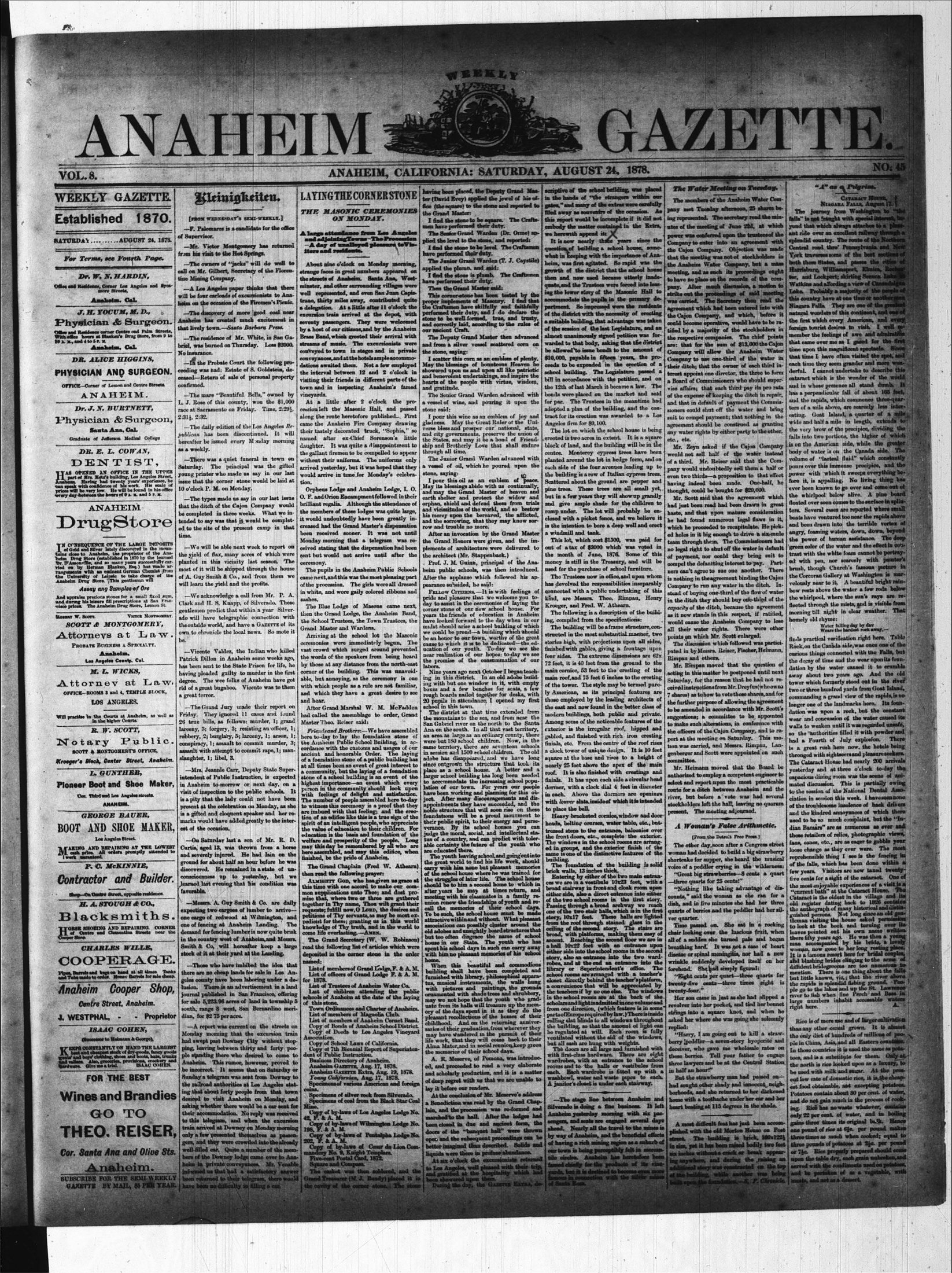
Searchable text
ANAHEIM
VOL. 8.
WEEKLY GAZETTE.
Established 1870.
SATURDAY...AUGUST 24, 1878.
For Terms, see Fourth Page.
Dr. W. N. HARDIN,
Office and Residence, Corner Los Angeles and Sycamore Streets,
Anaheim. Cal.
J. H. YOCUM, M. D., Physician & Surgeon.
Office and Residence corner Centre on Palm Streets, With office hours at Blanken's Drug Store, from 9 to 10 A.M., and 4 to 5 P.M.
Anaheim, Cal.
DR. ALICE HIGGINS,
PHYSICIAN AND SURGEON.
OFFICE—Corner of Lemon and Centre Streets.
ANAHEIM.
Dr. J. N. BURTNETT,
Physician & Surgeon,
Santa Ana, Cal.
Graduate of Jefferson Medical College
DR. E. L. COWAN,
DENTIST,
ITAS OPENED AN OFFICE IN THE UPPER
Kleinigkeiten.
[FROM WEDNESDAY'S SEMI-WEEKLY.]
F. Palomares is a candidate for the office of Supervisor.
Mr. Victor Montgomery has returned from his visit to the Hot Springs.
The owners of "jacks" will do well to call on Mr. Gilbert, Secretary of the Florentine Mining Company.
A Los Angeles paper thinks that there will be four carloads of excursionists to Anaheim on the occasion of the Firemen's Picnic.
The discovery of more good coal near Anaheim has created much excitement in that lively town. Santa Barbara Press.
The residence of Mr. White, in San Gabriel, was burned on Thursday. Loss $2000. No insurance.
In the Probate Court the following proceeding was had: Estate of S. Goldstein, deceased—Return of sale of personal property confirmed.
The mare "Beautiful Bella," owned by L. J. Rose of this county, won the $1,000 race at Sacramento on Friday. Time, 2:29½, 2:31½, 2:32.
The daily edition of the Los Angeles Republican has been discontinued. It will hereafter be issued every Monday morning as a weekly.
There was a quiet funeral in town on Saturday. The principal was the gifted young printer who made us say in our last LAYING THE CITY
THE MASONIC ON MO
A large attendance and adjoining ToA day of unallieditors and residents
About nine o'clock strange faces in great the streets of Anaheim minister, and other su well represented, and trano, thirty miles away a delegation. At a li excursion train arrive seventy passengers by a host of our citizen Brass Band, which g streams of music. T conveyed to town in convevances, and at th dations awaited them the interval between visiting their friends town and in inspect vineyards.
At a little after session left the Mass along the route hereto came the Anaheim I their tastely decorated named after ex-Ch daughter. It was qu the gallant firemen to without their uniform arrived yesterday, bu would arrive in time.
OFFICE—Corner of Lemon and Centre Streets.
ANAHEIM.
Dr. J. N. BURTNETT,
Physician & Surgeon,
Santa Ana, Cal.
Graduate of Jefferson Medical College
DR. E. L. COWAN,
DENTIST,
AS OPENED AN OFFICE IN THE UPPER part of Mrs. Hats's building, Los Angeles Street, Anaheim. Having had twenty years' experience, he can speak with confidence of his work. His scale of prices will be very low. He will be found in his office every day between the hours of 9 A.M. and 5 P.M.
ANAHEIM DrugStore
IN CONSEQUENCE OF THE LARGE DEPOSITS of Gold and Silver lately discovered in One mountains close to Anaheim, the proprietor of the Anaheim Drug Store (established in 1870 by the learned Dr. D'Assonville, and so many years successfully carried on by Herman Blanken, Esq.) has made arrangements with us eminent German Chemist from the University of Leipzig to take charge of the Anaheim Drug Store. This gentleman will Assay any Samples of Ore And appraise precious stones for a small fixed sum, and during his leisure fill prescriptions at San Francisco prices. The Anaheim Drug Store, Lemon St.
ROBERT W. SCOTT. VICTOR MONTGOMERY.
SCOTT & MONTGOMERY, Attorneys at Law.
PROBATE BUSINESS A SPECIALTY.
Anaheim, Los Angeles County, Cal.
M. L. WICKS,
Attorney at Law,
OFFICE—ROOMS 3 and 4, TEMPLE BLOCK,
LOS ANGELES.
Will practice in the Courts at Anaheim, as well as in the higher Courts.
R. W. SCOTT,
Notary Public.
SCOTT & MONTGOMERT'S OFFICE,
Kroeger's Blech, Center Street, Anaheim.
L. GUNTHER,
Pioneer Boot and Shoe Maker,
Oct. Third and Los Angeles streets.
ANAHEIM.
GEORGE BAUER,
BOOT AND SHOE MAKER,
Los Angeles Street.
MAKING AND REPAIRING AT THE LOWEST cash price. All orders promptly attended to I work guaranteed.
P. C. McKINNIE,
Contractor and Builder.
Shop—On Centre Street, opposite residence.
The mare "Beautiful Bella," owned by L. J. Rose of this county, won the $1,000 race at Sacramento on Friday. Time, 2:29½, 2:31½, 2:32.
The daily edition of the Los Angeles Republican has been discontinued. It will hereafter be issued every Monday morning as a weekly.
There was a quiet funeral in town on Saturday. The principal was the gifted young printer who made us say in our last issue that the corner stone would be laid at 10 o'clock P. M. on Monday.
The types made us say in our last issue that the ditch of the Cajon Company would be completed in three weeks. What we intended to say was that it would be completed to the site of the present camp in that time.
We will be able next week to report on the yield of flax, many acres of which were planted in this vicinity last season. The most of it will be shipped through the house of A. Guy Smith & Co., and from them we will learn the yield and the profits.
We acknowledge a call from Mr. P. A. Clark and H. S. Knapp, of Silverado. These gentlemen predict that within a year Silverado will have telegraphic connection with the outside world, and have a GAZETTE of its own to chronicle the local news. So mote it be.
Vicente Valdez, the Indian who killed Patrick Dillon in Anaheim some weeks ago, has been sent to the State Prison for life, he having pleaded guilty to murder in the first degree. The wee folks of Anaheim have got rid of a great bugaboo. Vicente was to them a great terror.
The Grand Jury made their report on Friday. They ignored 11 cases and found 26 true bills, as follows: murder, 1; grand larceny, 3; forgery, 3; resisting an officer, 1; robbery, 2; burglary, 5; larceny, 1; arson, 1; conspiracy, 1; assault to commit murder, 3; assault with attempt to commit rape, 1; man-slaughter, 1; libel, 3.
Mrs. Jeannie Carr, Deputy State Superintendent of Public Instruction, is expected in Anaheim to-morrow or next day, on a visit of inspection to the public schools. It is a pity that the lady could not have been present at the celebration on Monday, as she is a gifted and eloquent speaker and her remarks would have added greatly to the interest of the occasion.
On Saturday last a son of Mr. R. D. Curtia, aged 13, was thrown from a horse and severely injured. He had lain on the ground for about half an hour before he was discovered. He remained in a state of unconsciousness up to yesterday, but we learned last evening that his condition was favorable.
At a little after cession left the Mass along the route hereto came the Anaheim Mine their tastely decorated named after ex-Chief daughter. It was quail the gallant firemen to without their uniform arrived yesterday, but would arrive in time.
Orpheus Lodge and O.F. and Orion Encamp brilliant regalia. Altithe members of these it would undoubtedly creased had the Grant been received soon Monday morning that received stating that the sent but would not be ceremony.
The pupils in the A came next,and this was way of the procession. The in white, and wore gaishes.
The Blue Lodge once then the Grand Lodge the School Trustees, Grand Master and Warrring at the secrecions were imminent vast crowd which sued the words of the speeches by those at any distance corner of the building able, but annoying, with which people asd with which they have and hear.
After Grand Marsh had called the assene Master Theo. Reiser
Friends and Brothers here to-day to lay the Anaheim Public cordance with the coancient and honorable of a foundation stone at all times been an en e community, but tha stone of a school built highest importance—person in the commun with feelings of de The number of people to witness this ceremony are imbued with that tion of an edifice like spirit of an intelligent value of education is the basic welfare and prosperity may this day be remaine assembled,and finished.be the pride
The Grand Chaplai then read the followi ALmighty God, w this time with one mon supplications unmei that where two
ANAHEIM.
GEORGE BAUER,
BOOT AND SHOE MAKER,
Los Angeles Street.
MAKING AND REPAIRING AT THE LOWEST
cash price. All orders promptly attended to
work guaranteed.
P. O. McKINNIE,
Contractor and Builder.
Shop—On Centre Street, opposite residence.
H. A. STOUGH & CO.
Blacksmiths.
HORSE SHOEING AND REPAIRING. CORNER
of Centre and Clementina Streets near the
Cooper Shop.
CHARLES WILLE,
COOPERAGE.
Pipe, Barrels and kept on hand at all times. Tanks
and Tube made to endet. Money Barrels for sale cheap.
Anaheim Cooper Shop,
Centre Street, Anaheim.
J. WESTPHAL, - Proprietor
ISAAC COHEN,
(Successor to Helmann & George).
KEEP CONSTANTLY ON HAND THE LARGEST
best and cheapest stock of dry goods, fancy goods
grain and bays' clothing, shoes and boots, hats, trunks
and valises. Also, groceries, provisions, crushery and
hardware. Give me a trial. ISAAC COHEN.
FOR THE BEST
Wines and Brandies
GO TO
THEO. REISER,
Cor. Santa Ana and Olive Sts.
Anaheim.
SUBSCRIBE FOR THE SEMI-WEEKLY
GAZETTE BY MAIL, $5 PER YEAR.
On Saturday last a son of Mr. R. D.
Curtis, aged 13, was thrown from a horse
and severely injured. He had lain on the
ground for about half an hour before he was
discovered. He remained in a state of unconsciousness up to yesterday, but we learned last evening that his condition was favorable.
Messra A. Guy Smith & Co. are daily expecting two cargoes of lumber to arrive—one cargo of redwood at Wilmington, and one of fencing at Anaheim Landing. The demand for fencing lumber is now quite brisk in the country west of Anaheim, and Messra Smith & Co, will hereafter keep a large stock of it at their yard at the Landing.
Those who have imbibed the idea that there are no cheap lands for sale in Los Angeles county have been laboring under a defusion. There is an advertisement in a land journal published in San Francisco, offering for sale 5,223.96 acres of land in township 5 south; range 8 west, San Bernardino meridian, for $275 per acre.
A report was current on the streets on Monday morning that the excursion train had swept past Downey City without stopping, leaving between thirty and forty people standing there who desired to come to Anaheim. This rumor, however, proved to be incorrect. It seems that on Saturday or Sunday a telegram was sent from Downey to the railroad authorities at Los Angeles stating that about forty people from that town desired to visit Anaheim on Monday, and asking whether there would be a car sent for their accommodation. No reply was received to this telegram, and when the excursion train arrived at Downey on Monday morning only a few presented themselves as passengers, and they were crowded into the already well-filled car. Quite a number of the members of the Downey lodge came over to Anaheim in private conveyances. Mr. Venable informed us that had a satisfactory answer been returned to their telegram, there would have been no difficulty in filling a car.
The number of people to witness this ceremony are imbued with that tion of an edifice like spirit of an intelligence the value of education education is the basic welfare and prosperity may this day be remained here assembled, and finished, be the pride The Grand Chaplain then read the following line deposited in the corner named:
List of members of List of officers of G for 1878.
List of Trustees of Last of children schools of Anaheim of this stone Town Ordinances List of members of Copy of Bonds of Copy of Deeds to Association.
Copy of School Law Copy of 7th Biennial dent of Public Instructions Business Directory Anaheim Gazette Anaheim Gazette Young California Specimens of various coins.
Specimens of silver Specimens of coal Mine.
Copy of by-laws of 42, F. & A. M.
Copy of by-laws of 198, F. & A. M.
Copy of by-laws 202, F. & A. M.
Copy of by-laws mandate No. 9 Knit Five-cent Postal Square and Company.
The casket was Grand Treasurer (M the cavity of the c
LAYING THE CORNER STONE
THE MASONIC CEREMONIES ON MONDAY.
A large attendance from Los Angeles and adjoining towns - The Precension - A day of unalloyed pleasure to visitors and residents.
About nine o'clock on Monday morning, strange faces in great numbers appeared on the streets of Anaheim. Santa Ana, Westminster, and other surrounding villages were well represented, and even San Juan Capistrano, thirty miles away, contributed quite a delegation. At a little after 11 o'clock the excursion train arrived at the depot, with seventy passengers. They were welcomed by a host of our citizens, and by the Anaheim Brass Band, which greeted their arrival with streams of music. The excursionists were conveyed to town in stages and in private conveyances, and at the hotels sample accommodations awaited them. Not a few employed the interval between 12 and 2 o'clock in visiting their friends in different parts of the town and in inspecting Anaheim's famed vineyards.
At a little after 2 o'clock the procession left the Masonic Hall, and passed along the route heretofore published. First came the Anaheim Fire Company drawing their tastely decorated truck, "Sophia," so named after ex-Chief Sorenson's little daughter. It was quite a disappointment to the gallant firemen to be compelled to appear without their uniforms. The uniforms only arrived yesterday, but it was hoped that they would arrive in time for Monday's celebration having been placed, the Deputy Grand Master (David Evey) applied the jewel of his office (the square) to the stone and reported to the Grand Master:
I find the stone to be square. The Craftsmen have performed their duty.
The Senior Grand Warden (Dr. Orme) applied the level to the stone, and reported:
I find the stone to be level. The Craftsmen have performed their duty.
The Junior Grand Warden (T. J. Caystile) applied the plumb, and said:
I find the stone is plumb. The Craftsmen have performed their duty.
Then the Grand Master said:
This corner-stone has been tested by the proper implements of Masonry. I find that the Craftsmen have skillfully and faithfully performed their duty, and I do declare the stone to be well formed, true, and trusty, and correctly laid, according to the rules of our ancient Craft.
The Deputy Grand Master then advanced and from a silver vessel scattered corn on the stone, saying:
I scatter this corn as an emblem of plenty. May the blessings of bounteous Heaven be showered upon us and upon all like patriotic and benevolent undertakings, and inspire the hearts of the people with virtue, wisdom, and gratitude.
The Senior Grand Warden advanced with a vessel of wine, and pouring it upon the stone said:
I pour this wine as an emblem of joy and gladness. May the Great Ruler of the Universe bless and prosper our national state, and city governments, preserve the union of the States, and may it be a bond of Friendship and Brotherly Love that shall endure through all time.
The Junior Grand Warden advanced with a vessel of oil, which he poured upon the stone, saying:
scriptive of the school building, was placed in the hands of "the strangers within our gates," and many of the extras were carefully filed away as souvenirs of the occasion. As this report would be incomplete if it did not embody the matter contained in the Extra, we herewith append it:
It is now nearly three years since the question of building a school house, somewhat in keeping with the importance of Anaheim, was first agitated. So rapid was the growth of the district that the school house then and now used became utterly inadequate, and the Trustees were forced into leasing the lower story of the Masonic Hall to accommodate the pupils in the primary department. So impressed were the residents of the district with the necessity of erecting a suitable building, that advantage was taken of the session of the last Legislature, and an almost unanimously signed petition was forwarded to that body, asking that the district be allowed to issue bonds to the amount of $10,000, payable in fifteen years, the proceeds to be expended in the erection of a school building. The Legislature passed a bill in accordance with the petition, and on the 12th of last March it became a law. The bonds were placed on the market and sold for par. The Trustees in the meantime had adopted a plan of the building, and the contract for its erection was awarded to a Los Angeles firm for $9,100.
The lot on which the school house is being erected is two acres in extent. It is a square block of land, and the building will be in the centre. Monterey cypress trees have been planted around the lot in hedge form, and on each side of the four avenues leading up to the building is a row of Italian cypress trees.
The image contains a newspaper article with several columns of text. The headline is "At a little after 2 o'clock the procession left the Masonic Hall, and passed along the route heretofore published." Below this, there is a paragraph describing an event where members of the Anaheim Fire Company drew their tastely decorated truck, "Sophia," so named after ex-Chief Sorenson's little daughter. It was quite a disappointment to the gallant firemen to be compelled to appear without their uniforms. The uniforms only arrived yesterday, but it was hoped that they would arrive in time for Monday's celebration.
Orpheus Lodge and Anaheim Lodge, I. O. O. F. and Orion Encampment followed in their brilliant regalia. Although the attendance of the members of these lodges was quite large, it would undoubtedly have been greatly increased had the Grand Master's dispensation been received sooner. It was not until Monday morning that a telegram was received stating that the dispensation had been sent but would not arrive until after the ceremony.
The pupils in the Anaheim Public Schools came next, and this was the most pleasing part of the procession. The girls were all dressed in white, and wore gaily colored ribbons and saashes.
The Blue Lodge of Masons came next, then the Grand Lodge, the Anaheim Band, the School Trustees, the Town Trustees, the Grand Master and Wardens.
Arriving at the school lot the Masonic ceremonies were immediately begun. The vast crowd which surged around prevented the words of the speakers from being heard by those at any distance from the north-east corner of the building. This was unavoidable, but annoying, as the ceremony is one with which people as a rule are not familiar, and which they have a great desire to see and hear.
After Grand Marshal W. M. McFadden had called the assemblage to order, Grand Master Theo. Reiser said:
**Friends and Brothers:** We have assembled here to-day to lay the foundation stone of the Anaheim Public School Building, in accordance with the customs and usages of our ancient and honorable Order. The laying of a foundation stone of a public building has at all times been an event of great interest to a community, but the laying of a foundation stone of a school building is an event of the highest importance—an event which every person in the community should look upon with feelings of delight and satisfaction. The number of people assembled here to-day to witness this ceremony is a proof that they are imbued with that feeling; and the erection of an edifice like this is a true sign of the spirit of an intelligent people, who appreciate the value of education to their children. For education is the basis and foundation of the welfare and prosperity of the people. Long may this day be remembered by all who are here assembled, and may this edifice, when finished, be the pride of Anaheim.
The Grand Chaplain (Fred W. Athearn) then read the following prayer:
**ALMIGHTY GOD, who has given us grace at this time with one accord to make our common supplications unto Thee; and dost promise that where two or three are gathered**
The Senior Grand Warden advanced with a vessel of wine, and pouring it upon the stone said:
I pour this wine as an emblem of joy and gladness. May the Great Ruler of the Universe bless and prosper our national state, and city governments, preserve the union of the States, and may it be a bond of Friendship and Brotherly Love that shall endure through all time.
The Junior Grand Warden advanced with a vessel of oil, which he poured upon the stone, saying:
I pour this oil as an emblem of peace. May its blessings abide with us continually, and may the Grand Master of heaven and earth shelter and protect the widow and orphan, shield and defend them from trials and vicissitudes of the world, and so bestow his mercy upon the bereaved, the afflicted, and the sorrowing, that they may know sorrow and trouble no more.
After an invocation by the Grand Master the Grand Honors were given, and the implements of architecture were delivered to the architect (Mr. Stappenback).
Prof. J. M. Guinni, principal of the Anaheim public schools, was then introduced. After the applause which followed his appearance subsided, he said:
**FELLOW CITIZENS:** It is with feelings of pride and pleasure that we welcome you today to assist in the ceremonies of laying the corner stone of our new school house. For years the friends of education in Anaheim have looked forward to the day when in our midst should arise a school building of which we could be proud—a building which should be an honor to our town, worthy of the great cause to which it is to be dedicated—the education of our youth. To-day we see the near realization of our hopes: to-day we see the promise of the consummation of our labora.
Nine years ago next October I began teaching in this district. In an old adobe building with but one window in it, with empty boxes and a few benches for seats, a few rough boards nailed together for deks, with 20 pupils in attendance. I opened my first school in this town.
The district at that time extended from the mountains to the sea, and from near the San Gabriel river on the north to the Santa Ana on the south. In all that vast territory, an area as large as an ordinary county, there were but 180 school children. Now, in the same territory, there are seventeen schools in session and 1500 schoolchildren. The old adobe has disappeared, and we have long since outgrown the structure that took its place as a school house. A better and a larger school building has long been needed to accommodate the increasing school population of our town. For years our people have been working and planning for this object. After many discouragements and disappointments they have succeeded, and the noble structure that will soon rise on these foundations will be a proud monument to their public spirit, to their energy and perseverance. By its school houses you can judge moral, social, and intellectual status of a country, and can predict with tolerable certainty the future of the youth who are educated there.
The youth leaving school, and going out into the great world to find his life work, should carry with him none but pleasant memories of the school house where he was trained for the struggles of later life. The school house should be to him a second home to which in after years he may at times return, and meeting with his classmates in a family re-establishment.
The bill in accordance with the petition, and on the 12th of last March it became a law. The bonds were placed on the market and sold for par. The Trustees in the meantime had adopted a plan of the building, and the contract for its erection was awarded to a Los Angeles firm for $9,100.
The lot on which the school house is being erected is two acres in extent. It is a square block of land, and the building will be in the centre. Monterey cypress trees have been planted around the lot in hedge form, and on each side of the four avenues leading up to the building is a row of Italian cypress trees. Scattered about the ground are pepper and pine trees. These trees are all small yet, but in a few years they will show up grandly and give ample shade for the children to romp under. The lot will probably be enclosed with a picket fence, and we believe it is the intention to bore a deep well and erect a windmill and tank.
This lot, which cost $1500, was paid for out of a tax of $3000 which was voted in the month of June, 1876. Some of this money is still in the Treasury, and will be used for the purchase of school furniture.
The Trustees now in office, and upon whom has devolved the responsibilities inseparably connected with a public undertaking of this kind are Mesara. Theo. Rimpau, Henry Kroeger, and Fred. W. Athearn.
The following is a description of the building, compiled from the specifications:
The building will be a frame structure constructed in the most substantial manner, two stories high, with projections upon all sides, finished with gables, giving a frontage upon four sides. The extreme dimensions are 62x72 feet; it is 40 feet from the ground to the main cornice; 53 feet to the cresting of the main roof; and 75 feet 6 inches to the cresting of the tower. The style may be termed purely American, as its principal features are those employed by the leading architects of the east and now found in the better class of modern buildings, both public and private.
Among some of the noticeable features of the exterior is the irregular roof, hipped and gabled, and finished with rich iron cresting finials, etc. From the centre of the roof rises a clock tower of unique design. It is 10 feet square at the base and rises to a height of nearly 25 feet above the apex of the main roof. It is also finished with crestings and finials. It has upon each side a circular head dormer, with a clock dial 4 feet in diameter in each. Above the dormers are openings with louver slats inside of which it is intended to place the bell.
Heavy bracketed cornice window and door heads belting courses water table etc., but stressed steps to the entrance balconies over front doors etc., complete the exterior. The windows in the school rooms are arranged in groups, andthe exterior finish ofthe same is one ofthe distinctive featuresofthe building.
The foundation is solid brick walls; 13 inches thick.
Entering by either ofthe two main entrances we are in a vestibule 10x23 feet, with a broad stairway in front and cloak room upon either side; also a direct entrance into either side ofthe two school rooms inthe first story
The number of people assembled here to-day to witness this ceremony is a proof that they are imbued with that feeling; and the erection of an edifice like this is a true sign of the spirit of an intelligent people, who appreciate the value of education to their children. For education is the basis and foundation of the welfare and prosperity of the people. Long may this day be remembered by all who are here assembled, and may this edifice, when finished, be the pride of Anaheim.
The Grand Chaplain (Fred W. Athearn) then read the following prayer:
Almighty God, who has given us grace at this time with one accord to make our common supplications unto Thee; and dost promise that, where two or three are gathered together in Thy name, Thou wilt grant their requests; fulfill now, O LORD, the desires and petitions of Thy servants, as may be most expedient for them; granting us in this world knowledge of Thy truth, and in the world to come life everlasting.—Amen.
The Grand Secretary (W. W. Robinson) read the following list of articles which were deposited in the corner stone in the order named:
List of members of Grand Lodge, F. & A. M.
List of officers of Grand Lodge, F. & A. M. for 1878.
List of Trustees of Anaheim Water Co.
List of children attending the public schools of Anaheim at the date of the laying of this stone.
Town Ordinances and Charter of Anaheim.
List of members of Magnolia Club.
List of members of Anaheim Cornet Band.
Copy of Bonds of Anaheim School District.
Copy of Deeds to Los Angeles Vineyard Association.
Copy of School Laws of California.
Copy of 7th Biennial Report of Superintendent of Public Instruction.
Business Directory of Anaheim.
Anahiem Gazette, Aug. 17, 1878.
Anahiem Gazette Extra, Aug. 19, 1878.
Young Californian, Aug. 17, 1878.
Specimens of various American and foreign coins.
Specimens of silver rock from Silverado.
Specimens of coal from the Black Star Coal Mine.
Copy of by-laws of Los Angeles Lodge No. 42, F. & A. M.
Copy of by-laws of Wilmington Lodge No. 198, F. & A. M.
Copy of by-laws of Pentalpha Lodge No. 202, F. & A. M.
Copy of by-laws of Cour de Lion Commandery No. 9, Knight Templars.
Five-cent Postal Card, 1872.
Square and Compass.
The easel was then soldered, and the Grand Treasurer (M. J. Bundy) placed it in the cavity of the corner stone. The stone
After many discouragements and disappointments they have succeeded, and the noble structure that will soon rise on these foundations will be a proud monument to their public spirit, to their energy and perseverance. By its school houses you can judge the moral, social, and intellectual status of a country, and can predict with tolerable certainty the future of the youth who are educated there.
The youth leaving school, and going out into the great world to find his life work, should carry with him none but pleasant memories of the school house where he was trained for the struggles of later life. The school house should be to him a second home to which in after years he may at times return, and meeting with his classmates in a family reunion renew the friendships of youth and recall the memories of their school days. To be such, the school house must be made attractive within and without. What pleasant associations can possibly cluster around the old adobe and unsightly board structures that but too often disgrace the name of school house in our State. The youth who has spent his school days in such can carry away with him no pleasant memories of his school home.
When this beautiful and commodious building shall have been completed and furnished with library, philosophical apparatus, musical instruments, the walls hung with pictures and paintings, the grounds ornamented with shade trees and shrubbery, may we not hope that the youth who graduate from its halls will treasure up the memory of the days spent in it as they do the pleasant recollections of the homes of their childhood. And on the returning anniversary of their graduation, from wherever they may have wandered in the pursuit of their life work, that they will come back to their Alma Mater, and in social reunion keep green the memories of their school days.
A R. Meserve, of Pomona, was introduced, and proceeded to read a very elaborate and scholarly production, and it is a matter of deep regret with us that we are unable to lay it before our readers.
At the conclusion of Mr. Meserve's address a Benediction was read by the Grand Chaplain, and the procession was re-formed and marched to the hall. After the lodges had been closed in due and ancient form, the doors of the "hanquet hall" were thrown open and the subsequent proceedings can be better imagined than described. Solids and liquids were there in profuse abundance.
At six o'clock the excursionists returned to Los Angeles well pleased with their trip, and gratified at the hospitality which had been showered upon them.
During the day, the Gazette Extra, de-
Heavy bracketed cornice, window and door-heads, belting courses, water table, etc., but stressed steps to the entrance, balconies over the front doors, etc., complete the exterior. The windows in the school rooms are arranged in groups, and the exterior finish of the same is one of the distinctive features of the building.
The foundation of the building is solid brick walls, 13 inches thick.
Entering by either of the two main entrances we are in a vestibule 10x23 feet, with a broad stairway in front and cloak room upon either side, also a direct entrance into either of the two school rooms in the first story.
Passing through a broad archway we reach one of the two stair halls, which is in the first story, 10x17 feet. These halls are lighted from the roof through stained glass in the ceiling of the second story. The stairs are broad, with platforms, making them easy of ascent. Reaching the second floor we are in a hall 10x22 feet with an entrance upon either side into the school rooms in the second story, also an entrance into the two wardrobes, and at the end an entrance into the library or Superintendent's office. The school rooms are arranged with a teacher's closet directly behind the teacher's platform, a convenience that will be appreciated by the teachers if by no one else. The windows in the school rooms are at the back of the scholars and light is admitted in one volume and from one direction, (which feature is in some parts Europe required by law.) There is inside rolling slat blinds to all windows throughout the building, so that the amount of light can be regulated at will. Each room is fully ventilated without the aid of the windows, but all sash are hung with weights.
The doors are all large and furnished with first-class hardware. There are eight wardrobes, with an entrance to the school rooms and to the halls or vestibules from each. Each wardrobe is fitted up with a wash bowl, water and waste papers to each. A janitor's closet is under each stairway.
—The stage line between Anaheim and Silverado is doing a fine business. It left Anaheim yesterday morning with six passengers, and seats are engaged several days ahead. Nearly all the travel to the mines is by way of Anaheim, and the beneficial effects of having a rich mining region as a suburb of our town is being perceptibly felt in mercantile circles. Anaheim has herefore been fused chiefly for the products of its vineyards, but it is destined to become even more famous in connection with the silver mines of Santa Rosa.
GAZETTE.
T 24, 1878.
NO: 45
The Water Meeting on Tuesday.
The members of the Anaheim Water Company met Tuesay afternoon, 25 shares being represented. The secretary read the minutes of the meeting of June 22d, at which power was conferred upon the trustees of the Company to enter into an agreement with the Cajon Company. Objection was made that the meeting was not of stockholders in the Anaheim Water Company, but a mass meeting, and as such its proceedings ought to have no place on the records of the company. After much discussion, a motion to strike out the proceedings of said meeting was carried. The Secretary then read the agreement which had been entered into with the Cajon Company, and which, before it could become operative, would have to be ratified by a majority of the stockholders in the respective companies. The chief points are: that for the sum of $13,000 the Cajon Company will allow the Anaheim Water Company to use one-third of the water in their ditch; that the owner of each third interest appoint one director, the three to form a Board of Commissioners who should supervise affairs; that each third pay its pro rata of the expense of keeping the ditch in repair, and that in default of payment the Commissioners could shut off the water and bring suit to compel payment; that nothing in the agreement should be construed as granting any water rights by either party to the other, etc., etc.
Mr. Zeyn asked if the Cajon Company would not sell half of the water instead of a third. Mr. Reiser said that the Company would undoubtedly sell them a half or more.
"A" as a Pilgrim.
CATARACT HOUSE,
NIAGARA FALLS, August 17.
The journey from Washington to "the falls" is not fraught with special interest, beyond that which always attaches to a pleasant ride over an excellent railway through a splendid country. The route of the Northern Central road thro' Pennsylvania and New York traverses some of the best sections of both these States, and passes the cities of Harrisburg, Williamport, Elmira, Rechester, and Lockport; skirting Seneca Lake in Watkins and affording a view of Canandaigua Lake. Probably a majority of the people of this country have at one time or another seen Niagara Falls. They are one of the greatest natural wonders of this continent, and one of the first which every American, and every foreign tourist desires to visit. I well remember the feelings of awa and admiration that came over me as I gasped for the first time upon this magnificent spectacle. Since that time I have often visited the spot, and each time they seem grander and more wonderful. I cannot undertake to describe this cataract which is the wonder of the world and in whose presence all stand dumb. It has a perpendicular fall of about 105 feet, and the rapids, which commence three-quarters of a mile above, are scarcely less interesting. Goat Island, a quarter of a mile wide and half a mile in length, extends to the very brow of the precipice, dividing the falls into two portions, the higher of which is on the American side, while the greater body of water is on the Canada side. The volume of "lacteal fluid" which constantly pours over this immense precipice, and the power with which it sweeps everything be-
with the petition, and on which it became a law. The town the market and sold trees in the meantime had the building, and the concession was awarded to a Los Angeles school house is being built in extent. It is a square building will be in the cypress trees have been planted in hedge form, and on our avenues leading up to the ground are pepper and trees are all small yet they will show up grandly made for the children to not will probably be enforced, and we believe it more a deep well and erect rock.
Cost $1500, was paid for 100 which was voted in June, 1876. Some of this Treasury, and will be use of school furniture.
In office, and upon whom responsibilities inseparably public undertaking of this Theo. Rimpau, Henry W. Athearn.
Description of the build: the specifications:
be a frame structure, substantial manner, two projections upon all sides, giving a frontage upon extreme dimensions are 62x from the ground to the cresting of the most 6 inches to the cresting style may be termed principal features are the leading architects of land in the better class of both public and private noticeable features of the regular roof, hipped and with rich iron cresting the centre of the rooftopsque design. It is 10 feet and rises to a height of the apex of the main washed with crestings and each side a circular head dial 4 feet in diameter dormers are openings side of which it is intended cornice, window and door frames, water table, etc., but entrance, balconies over complete the exterior. School rooms are arranged the exterior finish of the distinctive features of the building is solid wood thick.
Of the two main entrances 10x23 feet, with a front and cloak room upon direct entrance into either room in the first story.
Mr. Zeyn asked if the Cajon Company would not sell half of the water instead of a third. Mr. Reiser said that the Company would undoubtedly sell them a half or even two thirds—a proposition to that effect having indeed been made. One-half, he thought, could be bought for $20,000.
Mr. Scott said that the agreement which had just been read had been drawn in great haste, and that upon mature consideration he had found numerous legal flaws in it, which he proceeded to recapitulate. He picked holes in it big enough to drive a six-mule team through them. The Commissioners had no legal right to shut off the water in default of payment, nor could they bring suit to compel the defaunting interest to pay. Partners can't agree to sue one another. There is nothing in the agreement binding the Cajon Company to run any water in the ditch. Instead of buying one-third of the flow of water in the ditch they should buy one-third of the capacity of the ditch, because the agreement as it now stands in this respect, if ratified, would cause the Anaheim Company to lose all their water rights. There were other points on which Mr. Scott enlarged.
The discussion which followed was participated by Messrs. Reiser, Fischer, Heimann, Rimpau and others.
Mr. Rimpau moved that the question of acting in this matter be postponed until next Saturday, for the reason that he had not received instructions from Mr. Dreyfus (who owns 7 shares) as to how to vote those shares, and for the further purpose of allowing the agreement to be amended in accordance with Mr. Scott's suggestions; a committee to be appointed to make such alterations, in conference with the officers of the Cajon Company, and to report at the meeting on Saturday. This motion was carried, and Messrs. Rimpau, Langenberger and Scott were appointed on such committee.
Mr. Heimann moved that the Board be authorized to employ a competent engineer to select and report upon the most practicable route for a ditch between Anaheim and the river, but before a vote was had several stockholders left the hall, leaving no quorum present. The meeting adjourned.
A Woman's False Arithmetic.
[From the Detroit Free Press]
The other day, soon after a Congress street woman had decided to build a big strawberry shortcake for supper, she heard the musical voice of a peddler crying in the wilderness: "Great big strawberries—8 cents a quart—three quarters for 25 cents!"
"Nothing like taking advantage of discounts," said the woman as she ran for a Board of Commissioners who should supervise affairs; that each third pay its pro rata of the expense of keeping the ditch in repair, and that in default of payment the Commissioners could shut off the water and bring suit to compel payment; that nothing in the agreement should be construed as granting any water rights by either party to the other, etc., etc.
Mr. Zeyn asked if the Cajon Company would not sell half of the water instead of a third. Mr. Reiser said that the Company would undoubtedly sell them a half or even two thirds—a proposition to that effect having indeed been made. One-half, he thought, could be bought for $20,000.
Mr. Scott said that the agreement which had just been read had been drawn in great haste, and that upon mature consideration he had found numerous legal flaws in it, which he proceeded to recapitulate. He picked holes in it big enough to drive a six-mule team through them. The Commissioners had no legal right to shut off the water in default of payment, nor could they bring suit to compel the defaunting interest to pay. Partners can't agree to sue one another. There is nothing in the agreement binding the Cajon Company to run any water in the ditch. Instead of buying one-third of the flow of water in the ditch they should buy one-third of the capacity of the ditch, because the agreement as it now stands in this respect, if ratified, would cause the Anaheim Company to lose all their water rights. There were other points on which Mr. Scott enlarged.
The discussion which followed was participated by Messrs. Reiser, Fischer, Heimann, Rimpau and others.
Mr. Rimpau moved that the question of acting in this matter be postponed until next Saturday, for the reason that he had not received instructions from Mr. Dreyfus (who owns 7 shares) as to how to vote those shares, and for the further purpose of allowing the agreement to be amended in accordance with Mr. Scott's suggestions; a committee to be appointed to make such alterations, in conference with the officers of the Cajon Company, and to report at the meeting on Saturday. This motion was carried, and Messrs. Rimpau, Langenberger and Scott were appointed on such committee.
Mr. Heimann moved that the Board be authorized to employ a competent engineer to select and report upon the most practicable route for a ditch between Anaheim and the river, but before a vote was had several stockholders left the hall, leaving no quorum present. The meeting adjourned.
Water falling day by day
Wears the hardest rock away,
finds practical verification right here. Table Rock, on the Canada side, was once one of the curious things connected with the Falls, but the decay of time and the wear upon its foundation by the water caused it to crumble away about two years ago. And the old tower which formerly stood out in the river two or three hundred yards from Goat Island, commanding a grand view of the rapids, is no longer one of the landmarks here. Its foundation was upon a rock, but the constant wear and concussion of the water caused its walls to weaken until it was regarded unsafe, so the authorities filled it with powder and had a Fourth of July explosion. There is a great rush here now, the hotels being thronged with sightseers and pleasure seekers. The Cataract House had nearly 200 arrivals yesterday and at three o'clock to-day the capacious dining room was the scene of animated discussion. This is partially owing to the session of the National Dental Association in session this week. I have seen none of the troublesome insolence of hawk drivers and the kindred annoyances of which there used to be so much complaint, but the "Indian Bazaars" are as numerous as ever and these retailers of relics, photographic views, fans canes, etc., are as eager to gobble your loose change as they ever were. The most reprohensible thing I see is the fencing in of the falls, which has been done within a few years. Visitors are now taxed twenty-five cents for a sight of the cataract. One of the most enjoyable experiences of a visit is a "current bath" at the Cataract House. The Cataract is the oldest in the village and its
A Woman's False Arithmetic.
[From the Detroit Free Press.]
The other day, soon after a Congress street woman had decided to build a big strawberry shortcake for supper, she heard the musical voice of a peddler crying in the wilderness:
"Great big strawberries—8 cents a quart—three quarts for 25 cents!"
"Nothing like taking advantage of discounts," said the woman as she ran for a dish, and in five minutes she had her three quartes of berries and the peddler had her silver quarter.
Time passed on. She sat in a rocking chair looking over the luscious fruit, when all of a sudden she turned pale and began breathing hard. It was pot a case of heart disease or spinal meningitis, nor had a new wrinkle suddenly developed itself on her forehead. She had simply figured:
"Eight cents per quart—three quarts for twenty-five cents—three times sight is twenty-four."
Her son came in just as she had slipped a revolver into her pocket, and tied her bonnet strings into a square knot, and when he asked her where she was going she solemnly replied:
"Harry, I am going out to kill a strawberry peddler—a seven-story byoperate and deceiver, who gave me wholesale rates on these berries. Tell your father to engage three lawyers and be at the Central Station in half an hour!"
But the strawberry man had passed on—had sought other shady and innocent neighborhoods, and she returned to her darkened home with a toothache under her ear and her heart beating at 115 degrees in the shade.
A most difficult feat has just been accomplished with the old Morton House on Post Street. The building is brick, 100x122½ in size, yet it has been raised bodily two feet six inches without a crack or break appearing anywhere, and during the raising an additional story was constructed on the top of the building, while another was being built upon the foundation. —S. P. Chronicle.
Rice is of more use and of larger cultivation than any other cereal grown. It is almost the only diet of hundreds of millions of people in China, Asia, and all Eastern countries. In those countries it is used the same as potatoes, and is a substitute for them. Only at the north is rice looked upon as a luxury, to be used with milk and sugar. At the present low rate of domestic rice, it is the cheapest food obtainable, not excepting potatoes. Potatoes contain about 30 per cent. of water, and do not gain much in the process of cooking. Rice has no waste whatever, contains only 22 per cent. of water, and in boiling gains three times its original back. Hance one pound of rice at 6½ c. per pound makes three times as much when cooked; equal to three pounds of potatoes at 2½ c. per pound or 7½ c. Rice properly prepared should come upon the table dry, each grain unbroken, and served with the condiments used on potatoes, and be partaken of as a vegetable, with meats, and not as a dessert.