anaheim-gazette 1878-07-13
Scanned page
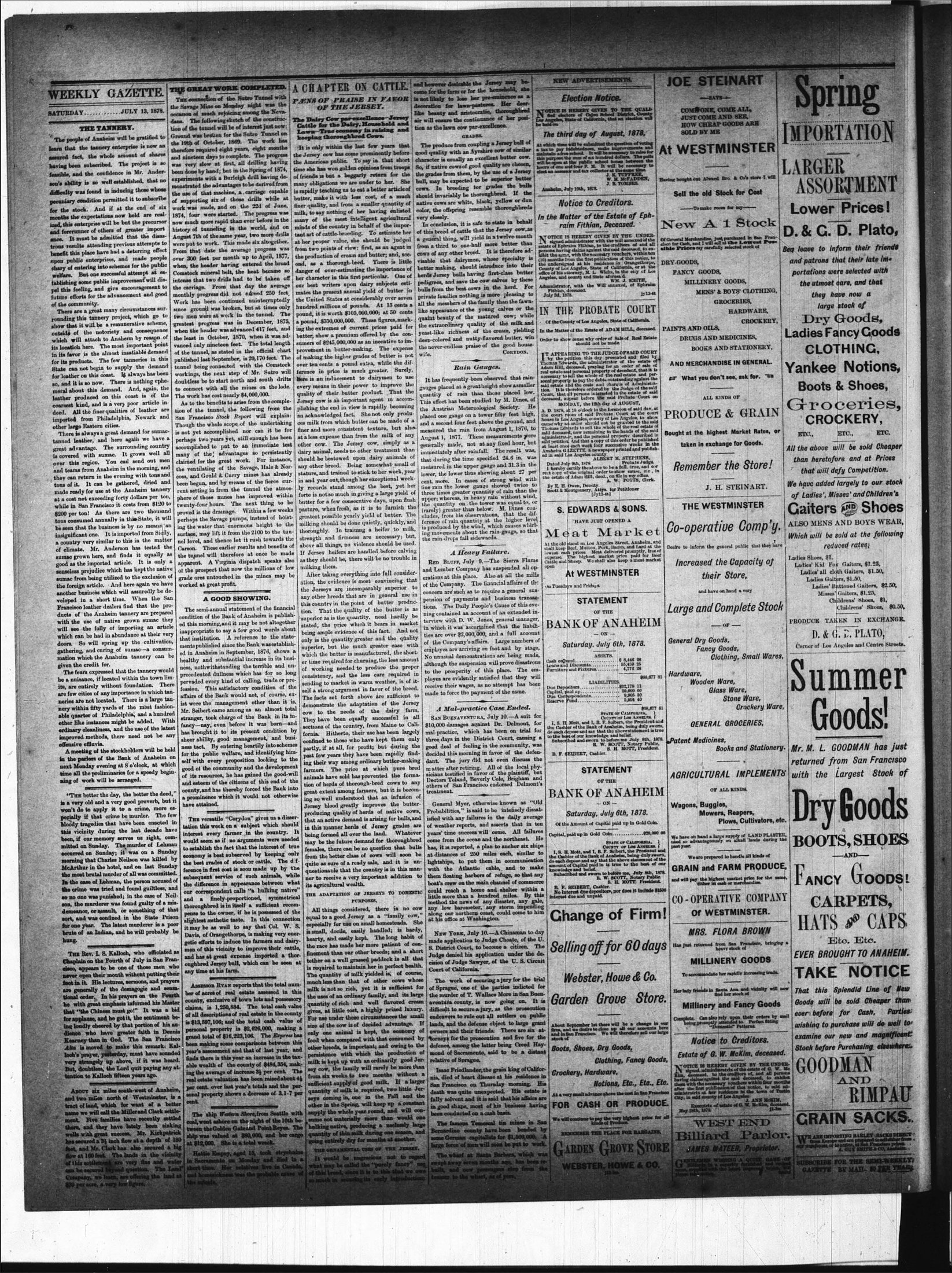
Searchable text
WEEKLY GAZETTE.
SATURDAY... JULY 13, 1878.
THE TANNERY.
The people of Anaheim will be gratified to learn that the tannery enterprise is now an assured fact, the whole amount of shares having been subscribed. The project is so feasible, and the confidence in Mr. Anderson's ability is so well established, that no difficulty was found in inducing those whose pecuniary condition permitted it to subscribe for the stock. And if at the end of six months the expectations now held are realized, this enterprise will be but the precursor and forerunner of others of greater importance. It must be admitted that the disastrous results attending previous attempts to benefit this place have had a deterring effect upon public enterprises, and made people chary of entering into schemes for the public welfare. But one successful attempt at establishing some public improvement will dispel this feeling, and give encouragement to future efforts for the advancement and good of the community.
There are a great many circumstances surrounding this tannery project, which go to show that it will be a remunerative scheme, outside of the notoriety and consequence which will attach to Anaheim by reason of its location here. The most important point in its favor is the almost insatiable demand for its products. The few tanneries in this State can not begin to supply the demand for leather on this coast. It always has been so, and it is so now. There is nothing ephemeral about this demand. And, again, the leather produced on this coast is of the coarsest kind, and is a very poor article indeed. All the finer qualities of leather are imported from Philadelphia, Newark and other large Eastern cities.
There is always a great demand for sumac-tanned leather, and here again we have a great advantage. The surrounding country is covered with sumac. It grows well all over this region. You can send out men and teams from Anaheim in the morning, and continue with tons and miles.
THE GREAT WORK COMPLETED.
The connection of the Sutro Tunnel with the Savage Mine on Monday night was the occasion of much rejoicing among the Nevadans. The following sketch of the construction of the tunnel will be of interest just now: Ground was broken for the Sutro Tunnel on the 19th of October, 1860. The work has therefore required eight years, eight months and nineteen days to complete. The progress was very slow at first, all drilling having been done by hand; but in the Spring of 1874, experiments with a Burleigh drill having demonstrated the advantages to be derived from the use of that machine, a carriage capable of supporting six of those drills while at work was made, and on the 22d of June, 1874, four were started. The progress was now much more rapid than ever before in the history of tunneling in the world, and on August 7th of the same year, two more drills were put to work. This made six altogether. From that date the average progress was over 300 feet per month up to April, 1877, when, the header having entered the broad Comstock mineral belt, the heat became so intense that two drills had to be taken off the carriage. From that day the average monthly progress did not exceed 250 feet. Work has been continued uninterruptedly since ground was broken, but at times only two men were at work in the tunnel. The greatest progress was in December, 1875, when the header was advanced 417 feet, and the least in October, 1870, when it was advanced only nineteen feet. The total length of the tunnel, as stated in the official chart published last September, is 20,170 feet. The tunnel being connected with the Comstock workings, the next step of Mr. Sutro will doubtless be to start north and south drifts to connect with all the mines on the lode. The work has cost nearly $4,000,000.
As to the benefits to arise from the completion of the tunnel, the following from the San Francisco Stock Report will explain: Though the whole scope of the undertaking is not yet accomplished nor can it be for perhaps two years yet, still enough has been accomplished to put to an immediate test many of the advantages so persistently claimed for the great work. For instance, the ventilating of the Savage, Hale & Norland & Curry mines has already
A CHAPTER
PLANS OF PRAIRIE OF THE JUNGLE
The Dairy Cow parcel Cattle for the Dairy Lawn—True economy keeping thoroughhands.
It is only within the Jersey cow has come into American public. Time she has won golden friends is but a beguiling many obligations we are rapidly teaching us to butter, make it with leftover quality, and from milk, to say nothing of many of the most intriguing minds of the country in tant art of cattle-breeding at her proper value, since from two points of view the production of cream end, as a thorough-bound danger of over-estimation her character in this fine our best writers upon mates the present annals of United States at co-hundred millions of pounds, it is worth $105 a pound, $350,000,000; ing the extremes of curt butter, show a premature sumers of $245,000,000; provement in butter-making of making the higher grade over ten cents a pound;ference in price is mere here is an inducement every means in their quality of their butter; Jersey cow is an import plishing the end in view an acknowledged fact; ces milk from which biner and more consist at a less expense than any other cow. The Jersey dairy animal, needs no should be bestowed upon any other breed. Bein stature, and trained to
for leather on this coast. It always has been so, and it is so now. There is nothing ephemeral about this demand. And, again, the leather produced on this coast is of the coarsest kind, and is a very poor article indeed. All the finer qualities of leather are imported from Philadelphia, Newark and other large Eastern cities.
There is always a great demand for sumac-tanned leather, and here again we have a great advantage. The surrounding country is covered with sumac. It grows well all over this region. You can send out men and teams from Anaheim in the morning, and they can return in the evening with tons and tons of it. It can be gathered, dried and made ready for use at the Anaheim tannery at a cost not exceeding forty dollars per ton, while in San Francisco it costs from $120 to $200 per ton! As there are two thousand tons consumed annually in this State, it will be seen that the business is by no means an insignificant one. It is imported from Sicily, a country very similar to this in the matter of climate. Mr. Anderson has tested the sumac grown here, and finds it equally as good as the imported article. It is only a senseless prejudice which has kept the native sumac from being utilized to the exclusion of the foreign article. And here again we have another business which will assuredly be developed in a short time. When the San Francisco leather dealers find that the products of the Anaheim tannery are prepared with the use of native grown sumac they will see the folly of importing an article which can be had in abundance at their very doors. So will spring up the cultivation, gathering, and curing of sumac—a consumption which the Anaheim tannery can be given the credit for.
The fears expressed that the tannery would be a nuisance, if located within the town limits, are entirely without foundation. There are few cities of any importance in which tanneries are not located. There is a large tannery within fifty yards of the most fashionable quarter of Philadelphia, and a hundred other like instances might be added. With ordinary cleanliness, and the use of the latest improved methods, there need not be any offensive effluvia.
A meeting of the stockholders will be held in the parlors of the Bank of Anaheim on next Monday evening at 8 o'clock, at which time all the preliminaries for a speedy beginning of work will be arranged.
"The better the day, the better the deed," is a very old and a very good proverb, but it won't do to apply it to a crime, more especially if that crime be murder. The few bloody tragedies that have been enacted in this vicinity during the last decade have been, if our memory serves us right, committed on Sunday. The murder of Lehman occurred on Sunday; it was on a Sunday morning that Charles Neilson was killed by McArthur in the hotel, and on last Sunday the most brutal murder of all was committed. In the case of Lehman, the person accused of the crime was tried and found guilty, and so no one was punished; in the case of Neilson's versatile "Corydon" gives us a dissertation this week on a subject which should interest every farmer in the country. It would seem as if no arguments were needed to establish the fact that the interest of true economy is best subserved by keeping only the best grades of stock or cattle. The difference in first cost is soon made up by the subsequent service of such animals, while the difference in appearance between what our correspondent calls "a hulking native" and a finely-naportioned, symmetrical workings, the next step of Mr. Corydon doubtless be to start north and south drifts to connect with all the mines on the lode. The work has cost nearly $4,000,000.
As to the benefits to arise from the completion of the tunnel, the following from the San Francisco Stock Report will explain: Though the whole scope of the undertaking is not yet accomplished nor can it be for perhaps two years yet, still enough has been accomplished to put to an immediate test many of the advantages so persistently claimed for the great work. For instance, the ventilating of the Savage, Hale & Norcoss, and Gould & Curry mines has already begun, and by means of the fierce current setting in from the tunnel the atmosphere of those mines has improved within twenty-four hours. The next thing to be proved is the drainage. Within a few weeks perhaps the Savage pumps, instead of hoisting the water that enormous height to the surface, may lift it from the 2100 to the tunnel level, and thence let it rush towards the Carson. These earlier results and benefits of the tunnel will therefore at once be made apparent. A Virginia dispatch speaks also of the prospect that now the millions of low grade ores untouched in the mines may be worked at great profit.
A GOOD SHOWING.
The semi-annual statement of the financial condition of the Bank of Anaheim is published this morning, and it may be not altogether inappropriate to say a few good words about that institution. A reference to the statements published since the Bank was established in Anaheim in September, 1876, shows a healthy and substantial increase in its business, notwithstanding the terrible and unprecedented dullness which has for so long pervaded every kind of calling, trade or profession. This satisfactory condition of the affairs of the Bank would not, of course, exist were the management other than it is. Mr. Seibert came among us an almost total stranger, took charge of the Bank in its infancy—nay, even before it was born—and has brought it to its present condition by sheer ability, good management, and business tact. By entering heartily into schemes for public welfare, and identifying himself with every proposition looking to the good of the community and the development of its resources, he has gained the good-will and esteem of the citizens of this end of the county,and has thereby forced the Bank into a prominence which it would not otherwise have attained.
The versatile "Corydon" gives us a dissertation this week on a subject which should interest every farmer in the country. It would seem as if no arguments were needed to establish the fact that the interest of true economy is best subserved by keeping only the best grades of stock or cattle. The difference in first cost is soon made up by the subsequent service of such animals, while the difference in appearance between what our correspondent calls "a hulking native" and a finely-naportioned, symmetrical workings,the next step of Mr. Corydon doubtless be to start north and south drifts to connect with all the mines on the lode. The work has cost nearly $4,000,000.
As to the benefits to arise from the completion of the tunnel, the following from the San Francisco Stock Report will explain: Though the whole scope of the undertaking is not yet accomplished nor can it be for perhaps two years yet, still enough has been accomplished to put to an immediate test many of the advantages so persistently claimed for the great work. For instance, the ventilating of the Savage, Hale & Norcoss, and Gould & Curry mines has already begun, and by means of the fierce current setting in from the tunnel the atmosphere of those mines has improved within twenty-four hours. The next thing to be proved is the drainage. Within a few weeks perhaps the Savage pumps, instead of hoisting the water that enormous height to the surface, may lift it from the 2100 to the tunnel level, and thence let it rush towards the Carson. These earlier results and benefits of the tunnel will therefore at once be made apparent. A Virginia dispatch speaks also of the prospect that now the millions of low grade ores untouched in the mines may be worked at great profit.
After taking everything into account,the evidence is that Jersey's are increasing any other breeds that this country in this position that an active demand in this manner herds being formed all over may bethe future ores femalesthere can be fromthe better class quite as sureofa requestionable that theynerto receivea veriits agricultural wea
THE ADAPTATION OF
is a very old and a very good proverb, but it won't do to apply it to a crime, more especially if that crime be murder. The few bloody tragedies that have been enacted in this vicinity during the last decade have been, if our memory serves us right, committed on Sunday. The murder of Lehman occurred on Sunday; it was on a Sunday morning that Charles Neilson was killed by McArthur in the hotel, and on last Sunday the most brutal murder of all was committed. In the case of Lehman, the person accused of the crime was tried and found guiltless, and so no one was punished; in the case of Neilson, the murderer was found guilty of a misdemeanor, or assault, or something of that sort, and was confined in the State Prison for one year. The latest murderer is a poor brute of an Indian, and he will probably be hung.
The Rev. I. S. Kalloch, who officiated as Chaplain on the Fourth of July in San Francisco, appears to be one of those men who never open their mouth without putting their feet in it. His lectures, sermons, and prayers are generally of the demagogic and sensational order. In his prayers on the Fourth he with great emphasis informed his Master that "the Chinese must go!" It was a bid for applause, and he got it, the sentiment being loudly cheered by that portion of his audience who have greater faith in Dennis Kearney than in God. The San Francisco Alta is moved to make this remark: Kalloch's prayer, yesterday, must have sounded very strangely up above, if it was heard. But, doubtless, the Lord quit paying any attention to Kalloch fifteen years ago.
About six miles south-west of Anaheim, and two miles north of Westminster, is a tract of land, which for want of a better name we will call the Miller and Clark settlement. Five families have recently settled there, and they have lately been sinking wells with great success. Mr. Kirkpatrick has secured a 3½ inch flow at a depth of 180 feet, and Mr. Clark has also secured a big flow at 190 feet. The lands in the vicinity of this settlement are very fine and water can be assured beyond question. The Land Company, we learn, are offering the land at $30 per acre, a very low figure.
The versatile "Corydon" gives us a dissertation this week on a subject which should interest every farmer in the country. It would seem as if no arguments were needed to establish the fact that the interest of true economy is best subserved by keeping only the best grades of stock or cattle. The difference in first cost is soon made up by the subsequent service of such animals, while the difference in appearance between what our correspondent calls "a hulking native" and a finely-proportioned, symmetrical thoroughbred is in itself a sufficient recompense to the owner, if he is possessed of the slightest aesthetic taste. In this connection it may be as well to say that Col. W. S. Davis, of Orangethorpe, is making very energetic efforts to induce the farmers and dairy-men of this vicinity to improve their cattle, and has at great expense imported a thoroughbred Jersey bull, which can be seen at any time at his farm.
Assessor Ryan reports that the total number of acres of real estate assessed in this county, exclusive of town lots and possessory claims, is 1,250,884. The total cash value of all descriptions of real estate in the county is $13,597,106; and the total cash value of personal property is $2,626,000, making a grand total of $16,223,106. The Express has been making some comparisons between this year's assessment and that of last year, and finds there is this year an increase in the taxable wealth of the county of $484,354, making the average of increase 3½ per cent. The real estate valuation has been raised about 4½ per cent. over last year's totals and the personal property shows a decrease of 3.1-7 per cent.
The ship Western Shore, from Seattle with coal, went ashore on the night of the 10th between the Golden Gate and Point Reyes. The ship was valued at $80,000, and her cargo at $12,000. She is a total wreck.
Hattie Empey, aged 15, took strychnine in Sacramento on Monday and died in a short time. Her relatives live in Canada, and homesickness was the probable cause of her suicide.
All things consider equal to a good Jew especially for use owing to its small docile size hearty and easily penetrated than our tether on a well grained quantity of milk is not so rich as uses of an ordinary quantity of rich milk gives at little cost. For use under these sizes of the cow is only one animal food when compared with other breeds; is imprecision with milk is kept up with seey cow; the family from six weeks to sufficient supply of milk says coming in; or other in the Spring supply the whole sume not materially hulking native; per quantity of thin meat going entirely dry.
THE ORNAMENTAL
It would be what may be called of this land; since so much in southerne
A CHAPTER ON CATTLE.
PENS OF PRAISE IN FAVOR OF THE JERSEY.
The Dairy Cow par excellence—Jersey Cattle for the Dairy, Household and Lawn—True economy in raising and keeping thoroughbred Cows.
It is only within the last few years that the Jersey cow has come prominently before the American public. To say in that short time she has won golden opinions from troops of friends is but a beggarly return for the many obligations we are under to her. She is rapidly teaching us to eat a better article of butter, make it with less cost, of a much finer quality, and from a smaller quantity of milk, to say nothing of her having enlisted many of the most intelligent agricultural minds of the country in behalf of the important art of cattle-breeding. To estimate her at her proper value, she should be judged from two points of view: first, as an agent in the production of cream and butter; and, second, as a thorough-bred. There is little danger of over-estimating the importance of her character in this first particular. One of our best writers upon dairy subjects estimates the present annual yield of butter in the United States at considerably over seven hundred millions of pounds. At 15 cents a pound, it is worth $105,000,000; at 50 cents a pound, $350,000,000. These figures, marking the extremes of current prices paid for butter, show a premium offered by the consumers of $245,000,000 as an incentive to improvement in butter-making. The expense of making the higher grades of butter is not over ten cents a pound extra, while the difference in price is much greater. Surely, here is an inducement to dairymen to use every means in their power to improve the quality of their butter product. That the Jersey cow is an important agent in accomplishing the end in view is rapidly becoming an acknowledged fact. She not only produces milk from which butter can be made of a finer and more consistent texture, but also at a less expense than from the milk of any other cow. The Jersey cow, simply as a dairy animal, needs no other treatment than should be bestowed upon dairy animals of any other breed. Being somewhat small of stature, and trained to stick to her work, year and however desirable the Jersey may become for the farm or for the household, she is not likely to lose her pre-eminence as a decoration for lawn-pastures. Her deer-like beauty and aristocratic, thoroughbred air will ensure the continuance of her position as the lawn cow par-excellence.
GRADES.
The produce from coupling a Jersey bull of good quality with an Ayrshire cow of similar character is usually an excellent butter cow. So, if native cows of good quality are chosen, the grades from them, by the use of a Jersey bull, may be expected to be superior butter cows. In breeding for grades the bulls should invariably be thoroughbred. If the native cows are white, black, yellow or dun color, the offspring resemble thoroughbreds very closely.
In conclusion, it is safe to state in behalf of this breed of cattle that the Jersey cow, as a general thing, will yield in a twelve-month from a third to one-half more butter than cows of any other breed. It is therefore advisable that dairymen, whose specialty is butter making, should introduce into their herds Jersey bulls having first-class butter pedigrees, and save the cow calves by these bulls from the best cows in the herd. For private families nothing is more pleasing to all the members of the family than the fawn-like appearance of the young calves or the quaint beauty of the matured cow; while the extraordinary quality of the milk and yeast-like richness of the cream, yielding deep-colored and nutty-flavored butter, win the never-endless praise of the good housewife.
CORYDON.
Rain Gauges.
It has frequently been observed that rain-gauges placed at a great height show smaller quantity of rain than those placed low. This effect has been studied by M. Dines, of the Austrian Metereological Society. He placed one gauge on a tower fifty feet high, and a second four feet above the ground, and measured the rain from August 1, 1876, to August 1, 1877. These measurements were generally made, not at any fixed hour, but immediately after rainfall. The result was that during the time specified 24.6 in. was measured in the upper gauge and 31.3 in lower the lower thus showing about 27 per cent.
NEW ADVERTISEMENTS.
Election Notice.
NOTICE IS HEREBY GIVEN TO THE QUALIFIED electors of Caloum School District, County Los Angeles, State of California, that an election will be held on
The third day of August, 1878,
At which time will be submitted the question of voting a tax to pay indebtedness, make improvements and maintain a free school. It will be necessary to raise for this purpose the sum of six hundred dollars. The polls will be open at the public school house between the hours of one and four P.M. It will be necessary to elect an assessor and tax collector at the same time.
J.K.TUFFREE,
W.M.McFADDEN,
J.R.TOMBES.
Notice to Creditors.
In the Matter of the Estate of Ephraim Fithian, Deceased.
NOTICE IS HEREBY GIVEN BY THE UNDERSIGNED administrator with the will annexed of the estate of Ephraim Fithian, to the creditors of and all persons having claims against the said deceased, to exhibit the same, with the necessary vouchers, within ten (10) months from the first publication of this notice, to the undersigned at his residence in Orangthorpe, County of Los Angeles, State of California, or at the office of his attorney, M.L.Wich, in the city of Los Angeles, and county and State aforead.
WM.J.SMITH,
Administrator, with the Will annexed, of Ephraim Fithian, deceased.
July 3d, 1878.
jy13-4t
IN THE PROBATE COURT
Of the County of Los Angeles, State of California.
In the Matter of the Estate of ADAM HILL, deceased.
Order to show cause why order of Sale of Real Estate should not be made.
IT APPEARING TO THE JUDGE OF SAID COURT by the petition this day presented and filed by Thomas Edwards, the administrator of the estate of Adam Hill, deceased, praying for an order of sale of real estate and personal property of decedent, that it is necessary to sell whole of the real estate and personal property to pay the debts outstanding against the said estate and costs and charges of Administration. It is therefore ordered by the Judge of the said Court, that all persons interested in the estate of said deceased appear before the said Probate Court on Monday,the 12th day of AUGUST,
A.D. 1878,a 10 o'clock in the forenoon of said day,a at the court room of said Probate Court at the court house in Los Angeles,county of Los Angeles,tow show cause why an order should not be granted to the said Thomas Edwards to sell whole of the real estate of said deceased,now remaining in hands of the said administrator,and the personal property described in said petition.And that a copy of this order be published at least once each week four successive weeks in the Araheim GAZETTE,a newspaper printed and published in said Los Angeles county.
ALBERT M. STEPHENS,
Probate Judge.
I hereby certify that above to be a full true,and correct copy of the original order to show cause ,etc.,in
here is an inducement to dairymen to use every means in their power to improve the quality of their butter product. That the Jersey cow is an important agent in accomplishing the end in view is rapidly becoming an acknowledged fact. She not only produces milk from which butter can be made of a finer and more consistent texture, but also at a less expense than from the milk of any other cow. The Jersey cow, simply as a dairy animal, needs no other treatment than should be bestowed upon dairy animals of any other breed. Being somewhat small of stature, and trained to stick to her work, year in and year out, though her exceptional weekly records stand among the best, yet her forte is not so much in giving a large yield of butter for a few consecutive days, upon flush pasture, when fresh, as it is to furnish the greatest possible yearly yield of butter. The milking should be done quietly, quickly, and thoroughly. In training a heifer to milk, strength and firmness are necessary; but, above all things, no violence should be used. If Jersey heifers are handled before calving as they should be, there will be no trouble in milking them.
After taking everything into full consideration, the evidence is most convincing that the Jerseys are incomparably superior to any other breeds that are in general use in this country in the point of butter production. That the quality of the butter is as superior as is the quantity, need hardly be stated, the price which it bears in market being ample evidence of this fact. And not only is the quantity greater and the quality superior, but the much greater ease with which the butter is manufactured, the shorter time required for churning, the less amount of working needed to produce the proper consistency, and the less care required in sending to market in warm weather, is of itself a strong argument in favor of the breed. The facts set forth above are sufficient to demonstrate the adaptation of the Jersey cow to the needs of the dairy farm. They have been equally successful in all sections of the country, from Maine to California. Hitherto, their use has been largely confined to those who have kept them only partly, if at all, for profit; but during the past few years they have been rapidly finding their way among ordinary butter-making farmers. The price at which pure bred animals have sold has prevented the formation of herds of thorough-bred cows to any great extent among farmers, but it is becoming so well understood that an infusion of Jersey blood greatly improves the butter-producing quality of herds of native cows, that an active demand is arising for bulls, and in this manner herds of Jersey grades are being formed all over the land. Whatever may be the future demand for thoroughbred females, there can be no question that bulls from the better class of cows will soon be quite sure of a ready sale, and it is unquestionable that the country is in this manner to receive a very important addition to its agricultural wealth.
THE ADAPTATION OF JERSEYS TO DOMESTIC ITS Frequently been observed that rain-gauges placed at a great height show smaller quantity of rain than those placed low. This effect has been studied by M. Dines, of the Austrian Meterological Society. He placed one gauge on a tower fifty feet high, and a second four feet above the ground, and measured the rain from August 1, 1876, to August 1, 1877. These measurements were generally made, not at any fixed hour, but immediately after rainfall. The result was that during the time specified 24.6 in. was measured in the upper gauge and 31.3 in. lower, the lower thus showing about 27 per cent. more. In cases of strong wind with fine rain the lower gauge showed twice to three times greater quantity of rain than the upper; whereas, in heavy rain without wind, the quantity on the tower was equal to, or (rarely) greater than below. M. Dines concludes, from his observations, that the difference of rain quantity at the higher level is produced by the wind, which causes whirling movements about the rain-gauge, so that the rain-drops fall sidewards.
A Heavy Failure.
RED BLUFF, July 9.—The Sierra Flume and Lumber Company has suspended all operations at this place. Also at all the mills of the Company. The financial affairs of the concern are such as to require a general suspension of payments and business transactions. The Daily People's Cause of this evening contained an account of an extended interview with D. W. Jones, general manager, in which it was ascertained that the liabilities are over $2,000,000, and a full account of the Company's affairs. Large numbers of employees are arriving on foot and by stage. No unusual demonstrations are being made, although the suspension will prove disastrous to the prosperity of this place. The employees are evidently satisfied that they will receive their wages, as no attempt has been made to force the payment of the same.
A Mal-practice Case Ended.
SAN BUENAVENTURA, July 10.—A suit for $10,000 damages against Dr. Delmont, for mal-practice, which has been on trial for three days in the District Court, causing a good deal of feeling in the community, was decided this morning in favor of the defendant. The jury did not even discuss the matter after retiring. All of the local physicians testified in favor of the plaintiff, but Dectors Toland, Beverly Cole, Brigham and others of San Francisco endorsed Delmont's treatment.
General Myer, otherwise known as "Old Probabilities," is said to be intensely dissatisfied with any failures in the daily average of weather reports, and asserts that in ten years' time success will come. All failures come from the ocean and the northeast. He has, it is reported, a plan to anchor six ships at distances of 250 miles each, similar to lightships, to put them in communication with the Atlantic cable, and to make them floating harbors of refuge, so that any boat's crew on the main channel of commerce could reach a home and shelter within a little more than a hundred miles. By this necessity to sell the whole of the real estate and personal property to pay the debts outstanding against the said estate and costs of Administration. It is therefore ordered by the Judge of the said Court, that all persons interested in the estate of said deceased, appear before the said Probate Court on Monday, the 12th day of AUGUST,
A D. 1878, at 10 o'clock in the foreground of said day, at court room of Sold Probe Court at the court house in Los Angeles, county of Los Angeles, to show how an order should not be granted to the said Thomas Edwards to sell the whole of the real estate of said deceased, now remaining in hands of the said administrator, and the personal property described in said petition. And that a copy of this order be published at least once each week four successive weeks in the Anaheim GAZETTE is newspaper printed and published in said Los Angeles county.
ALBERT M. STEPHENS,
Probate Judge.
I hereby certify that above to be a full true, and correct copy of the original order to show cause, etc., in the estate of Adam Hill, dec., on file in my office.
A W. POTTS, Clerk.
By E. H. Dwen, Denulty.
Scott & Montgomery, Attys for Petitioner (Jy13-4t)
S. EDWARDS & SONS.
HAVE JUST OPENED A Meat Market
At the old stand on Los Angeles Street, Anaheim, and shall keep Beef, Mutton, Pork, Bacon, and Lard at the lowest cash prices. Meat delivered promptly, free of expense. The highest market price paid for Beef Cattle and Sheep. We shall also keep a meat market open
AT WESTMINSTER
On Tuesday and Fridays.
STATEMENT
OF THE
BANK OF ANAHEIM
ON -
Saturday, July 6th, 1878.
ASSETS.
Cash on hand.....$ 8,440 28
Loans and Discounts.....55,459 25
Furniture and Fixtures.....4,772 28
LIABILITIES.
Dues Depositors.....$32,778 11
Capital paid up.....20,000 00
Due Correspondents.....9,906 30
Reserve Fund.....5,494 40
STATE OF CALIFORNIA,
COUNTY OF Los Angeles
I. S. H. Mott,and I. B. F. Sebert,the President and the Cashier of the Bank of Anaheim being duly sworn do each deposition and say that the above statement is true to the best of our knowledge and belief.
Subscribed and sworn to before me July 8th, 1878.
R.W.SCOTT,Notary Public,
S.H.MOTT,President.
STATEMENT
OF THE
BANK OF ANAHEIM
ON -
Saturday, July 6th, 1878.
Of the Amount of Capital paid up in Gold Coin.
Capital paid up in Gold Coin.....$20,000 00
STATE OF CALIFORNIA,
COUNTY OF Los Angeles
I. S. H. Mott,and I. B.F.Sebert,the President and the Cashier of the Bank of Anaheim being duly sworn do each deposition and say that the above statement is true to the best of our knowledge and belief.
Subscribed and sworn to before me July 8th, 1878.
R.W.SCOTT,Notary Public,
S.H.MOTT,President.
B.F.SEBERT,Cashier.
No interest due depositors; nor does it include $1500 interest due and unpaid
THE ADAPTATION OF JERSEYS TO DOMESTIC PURPOSES.
All things considered, there is no cow equal to a good Jersey as a "family cow," especially for use on small homesteads. She is small, docile, easily handled; is hardy, hearty, and easily kept. The long habit of the race has made her more patient of confinement than our other breeds; and a short tether on a well grassed paddock is all that is required to maintain her in perfect health. The quantity of milk yielded is, of course, much less than that of other cows whose milk is not so rich, yet it is sufficient for the uses of an ordinary family, and its large quantity of rich and well flavored cream gives, at little cost, a highly prized luxury. For use under these circumstances the small size of the cow is of decided advantage. If only one animal is kept, the economy of food when compared with that consumed by other breeds, is important; and owing to the persistence with which the production of milk is kept up with an ordinarily good Jersey cow, the family will rarely be more than from six weeks to two months without a sufficient supply of good milk. If a larger quantity of milk is required, two little Jerseys coming in, one in the Fall and the other in the Spring, will keep up a constant supply the whole year round, and will consume not materially more than would one hulking native, producing a uselessly large quantity of thin milk during one season, and going entirely dry for months at another.
THE ORNAMENTAL USES OF THE JERSEY.
It would be ungracious not to regard what may be called the "purely fancy" tag of this breed, since it is to this that we own so much in securing its early introduction.
General Myer, otherwise known as "Old Probabilities," is said to be intensely dissatisfied with any failures in the daily average of weather reports, and asserts that in ten years' time success will come. All failures come from the ocean and the northeast. He has, it is reported, a plan to anchor six ships at distances of 250 miles each, similar to lightships, to put them in communication with the Atlantic cable, and to make them floating harbors of refuge, so that any boat's crew on the main channel of commerce could reach a home and shelter within a little more than a hundred miles. By this method the news of any disaster, any gale, any low barometer, any storm impending along our northern coast, could come to him at his office at Washington.
NEW YORK, July 10.—A Chinaman to-day made application to Judge Choate, of the U.S. District Court, to become a citizen. The Judge denied his application under the decision of Judge Sawyer, of the U.S. Circuit Court of California.
The work of securing a jury for the trial of Sprague, one of the parties indicted for the murder of T. Wallace More in San Buenaventura county, is now going on. It is difficult to secure a jury, as the prosecution endeavors to rule out all settlers on public lands, and the defense object to large grant owners and their friends. There are six attorneys for the prosecution and five for the defence, among the latter being Creed Haymond of Sacramento, said to be a distant relative of Sprague.
Isaac Friedlander, the grain king of California, died of heart disease at his residence in San Francisco on Thursday morning. His death was quite unexpected. His estate is fully solvent and it is said that his affairs are in good shape, most of his business having been conducted on a cash basis.
The famous Temescal tin mines in San Bernardino county have been bonded by some German capitalists for $1,500,000. A large force of men will soon be put to work.
The wharf at Santa Barbara, which was swept away seven months ago, has been rebuilt, and new passengers step from the teamer to the wharf, as of years.
NOTICE.
GIVEN TO THE QUALIFIED SCHOOL DISTRICT, County of California, that an election will be held on August, 1878.
Creditors.
THE ESTATE OF EPHRAIM, DECEASED.
BATE COURT
ANGLES, State of California.
OF ADAM HILL, deceased.
ORDER OF SAID COURT
May presented and filed by administrator of the estate of probate Court at the court county of Los Angeles, to show not be granted to the said whole of the real estate of being in the hands of the said personal property described in copy of this order be published four successive weeks in the newspaper printed and publish-
LBERT M. STEPHENS,
Probate Judge.
JOE STEINART
SAYS
COMMON, COME ALL,
JUST COME AND SEE,
HOW CHEAP GOODS ARE SOLD BY ME
At WESTMINSTER
Having bought out Alward Bro. & Co.'s store I will sell the old Stock for Cost
To make room for my New A 1 Stock
Of General Merchandise, just purchased in San Francisco for Cash, and I will sell at the Lowest Possible Prices my carefully selected stock of DRY-GOODS,
FANCY GOODS,
MILLINERY GOODS,
MENS' & BOYS' CLOTHING,
GROCERIES,
HARDWARE,
CROCKERY,
PAINTS AND OILS,
DRUGS AND MEDICINES,
BOOKS AND STATIONERY,
AND MERCHANDISE IN GENERAL.
What you don't see, ask for.
ALL KINDS OF PRODUCE & GRAIN
Bought at the highest Market Rates, or taken in exchange for Goods.
Remember the Store!
Spring IMPORTATION
LARGER ASSORTMENT
Lower Prices!
D. & G. D. Plato,
Beq leave to inform their friends and patrons that their late importations were selected with the utmost care, and that they have now a large stock of Dry Goods,
Ladies Fancy Goods CLOTHING,
Yankee Notions,
Boots & Shoes,
Groceries,
CROCKERY,
ETC., ETC., ETC.
All the above will be sold Cheaper than heretofore and at Prices that will defy Competition.
ALL KINDS OF
PRODUCE & GRAIN
Bought at the highest Market Rates, or taken in exchange for Goods.
Remember the Store!
J. H. STEINART.
THE WESTMINSTER
Co-operative Comp'y.
Desire to inform the general public that they have increased the Capacity of their Store,
and have on hand a very Large and Complete Stock
OF —
General Dry Goods,
Fancy Goods,
Clothing, Small Wares,
Hardware,
Wooden Ware,
Glass Ware,
Stone Ware,
Crockery Ware,
GENERAL GROCERIES,
Patent Medicines,
Books and Stationery.
AGRICULTURAL IMPLEMENTS
OF ALL KINDS.
Wagons, Buggies,
Mowers, Reapers,
Plows, Cultivators, etc.
We have on hand a large supply of LAND PLASTER, used so advantageously on allcalt lands during the past year.
We are prepared to handle all kinds of GRAIN and FARM PRODUCE, and will pay the highest market price for the same, either in cash or merchandise.
Boots & Shoes,
Groceries,
CROCKERY,
ETC., ETC., ETC.
All the above will be sold Cheaper than heretofore and at Prices that will defy Competition.
We have added largely to our stock of Ladies', Misses' and Children's Gaiters AND Shoes
ALSO MENS AND BOYS WEAR,
Which will be sold at the following reduced rates:
Ladies Shoes, $1.
Ladies' Kid Fox Gaiters, $1.25.
Ladies' all cloth Gaiters, $1.50.
Ladies Gaiters, $1.50.
Ladies' Buttoned Gaiters, $2.50.
Misses' Gaiters, $1.25.
Childrens' Shoes, $1.
Childrens' Shoes, $0.50.
PRODUCE TAKEN IN EXCHANGE.
D. & G. D. PLATO,
Corner of Los Angeles and Centre Streets.
Summer Goods!
Mr. M. L. GOODMAN has just returned from San Francisco with the Largest Stock of Dry Goods
BOOTS, SHOES
AND
FANCY GOODS!
Wagons, Buggies,
Mowers, Reapers,
Plows, Cultivators, etc.
We have on hand a large supply of LAND PLASTER,
used so advantageously on alkali lands during the past year.
We are prepared to handle all kinds of
GRAIN and FARM PRODUCE,
and will pay the highest market price for the same,
either in cash or merchandise.
CO-OPERATIVE COMPANY
OF WESTMINSTER.
MR8. FLORA BROWN
Has just returned from San Francisco, bringing a heavy stock of
MILLINERY GOODS
To accommodate her rapidly increasing trade.
Her lady friends in Santa Ana and vicinity will now find her stock of
Millinery and Fancy Goods
Complete. Can also rely upon their orders by mail being promptly attended to. Perfect fitting "Domestic" Patterns.
Notice to Creditors.
Estate of G. W. McKim, deceased.
NOTICE IS HEREBY GIVEN BY THE UNDERsigned, administratrix of the estate of G. W. McKim, deceased, to the creditors of, and all persons having claims against the said deceased, to exhibit them with the necessary vouchers within four months after the first publication of this notice, to mild adminstratrix at her residence in the town of Tustin City, in said county of Los Angeles.
J. ANN McKIM,
Exentritix of estate of G. W. McKim, deceased.
May 28th, 1878.
WEST END
Billiard Parlor.
JAMES MATEER, Proprietor.
GENTLEMAN WISHING A QUIET GAME OF BILLIARD IN a mercantile furnished and rented house, supplied with the latest improvements, will please inhabitants.
Dry Goods
BOOTS, SHOES
AND
FANCY GOODS!
CARPETS,
HATS AND CAPS
Etc. Etc.
EVER BROUGHT TO ANAHEIM.
TAKE NOTICE
That this Splendid Line of New Goods will be sold Cheaper than ever before for Cash. Parties wishing to purchase will do well to examine our new and magnificent Stock before Purchasing elsewhere.
GOODMAN
AND
RIMPAU
GRAIN SACKS.
WE ARE IMPORTING BARLEY SACKS DIRECT FROM Europe and are prepared to sell either from our warehouse, or to artists, at San Francisco reprint.
A. GUY SMITH & CO., Anheim.
SUBSCRIBE FOR THE SEMI-WEEKLY
GAZETTE BY MAIL NO PER YEAR.