anaheim-gazette 1878-06-29
Scanned page
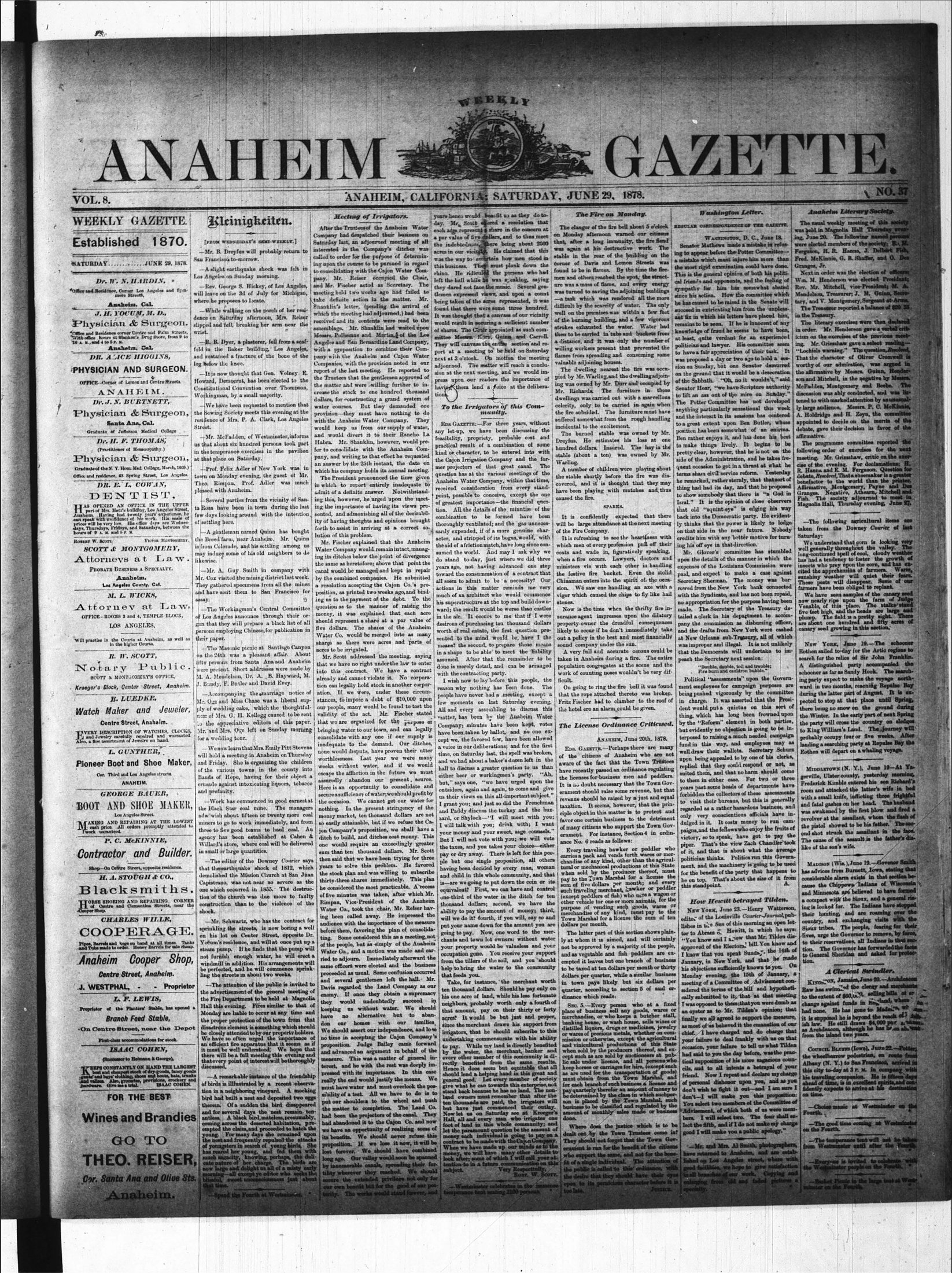
Searchable text
ANAHEIM
VOL. 8.
WEEKLY GAZETTE.
Established 1870.
SATURDAY...JUNE 29, 1878.
Dr. W. N. HARDIN.
Office and Residence, Corner Los Angeles and Sycamore Streets,
Anaheim, Cal.
J. H. YOCUM, M. D., Physician & Surgeon.
Office and Residence corner Centre and Palm Streets,
With office hours at Blankenstein's Drug Store, from 9 to 10 A.M., and 4 to 5 P.M.
Anaheim, Cal.
DR. A. ICE HIGGINS,
PHYSICIAN AND SURGEON.
OFFICE—Corner of Lemon and Centre Streets.
ANAHEIM.
Dr. J. N. BURTNETT,
Physician & Surgeon,
Santa Ana, Cal.
Graduate of Jefferson Medical College
Dr. H. F. THOMAS;
(Practitioner of Homoeopathy.)
Physician & Surgeon,
Graduate of the N. Y. Hom. Med. College, March, 1860.
Kleinigkeiten.
[FROM WEDNESDAY'S SEMI-WEEKLY.]
Mr. B. Dreyfus will probably return to San Francisco to-morrow.
A slight earthquake shock was felt in Los Angeles on Sunday morning.
Rev. George S. Hickey, of Los Angeles, will leave on the 3d of July for Michigan, where he proposes to locate.
While walking on the porch of her residence on Saturday afternoon, Mrs. Reiser slipped and fell, breaking her arm near the wrist.
R. B. Dyer, a plasterer, fell from a scaffold in the Baker building, Los Angeles, and sustained a fracture of the bone of the leg below the knee.
It is now thought that Gen. Volney E. Howard, Democrat, has been elected to the Constitutional Convention over Thompson, Workingman, by a small majority.
We have been requested to mention that the Sewing Society meets this evening at the residence of Mrs. P. A. Clark, Los Angeles Street.
Mr. McFadden, of Westminster, informs us that about six hundred persons took part in the temperance exercises in the pavilion at that place on Saturday.
Prof. Felix Adler of New York was in
MeetuAfter the Trust Company had done Saturday last, and interested in the called to order lying upon the court to consolidating company Mr. Reeder and Mr. Fischer meeting held two take definite a Snanklin's letter which the meeting received and its assemblage. Mr Messrs. Polhemm Angeles and San with a proposition pany with the Companies, with report of the last the Trustees that the matter and increase the stock dollars, for conserve water courses provision—they with the Anaheim would keep up and would divi Habra. Mr Shfer to consolidate pany, and writing an answer by the which his compa
OFFICE—Corner of Lemon and Centre Streets.
ANAHEIM.
Dr. J. N. BURTNETT,
Physician & Surgeon,
Santa Ana, Cal.
Graduate of Jefferson Medical College
Dr. H. F. THOMAS,
(Practitioner of Homoeopathy.)
Physician & Surgeon,
Graduate of the N.Y.Hom.Med.College,March,1869.
Office and residence, 63 Spring Street, Los Angeles.
DR. E. L. COWAN,
DENTIST,
Has opened an office in the upper part of Mrs. Metz's building, Los Angeles Street, Anaheim. Having had twenty years' experience, he can speak with confidence of his work. His scale of prices will be very low. His office days are Wednesdays, Thursdays, Fridays, and Saturdays, between the hours of 9 A.M. and 5 P.M.
ROBERT W. SCOTT.
Victor Montgomery.
SCOTT & MONTGOMERY,
Attorneys at Law.
PROBATE BUSINESS A SPECIALTY.
Anaheim.
Los Angeles County, Cal.
M. L. WICKS,
Attorney at Law,
OFFICE—ROOMS 3 and 4, TEMPLE BLOCK,
LOS ANGELES.
Will practise in the Courts at Anaheim, as well as in the higher Courts.
R. W. SCOTT,
Notary Public.
SCOTT & MONTGOMERY'S OFFICE.
Kroeger's Block, Center Street, Anaheim.
B. LUEDKE.
Watch Maker and Jeweler,
Centre Street, Anaheim.
EVERY DESCRIPTION OF WATCHES, CLOCKS, AND JEWELRY carefully repaired and warranted. Also, a fine assortment of Jewelry on hand.
L. GUNTHER,
Pioneer Boot and Shoe Maker,
Cor. Third and Los Angeles streets.
ANAHEIM.
GEORGE BAUER,
BOOT AND SHOE MAKER,
Los Angeles Street.
MAKING AND REPAIRING AT THE LOWEST cash price. All orders promptly attended to work guaranteed.
P. C. McKINNIE,
Contractor and Builder.
Shop—On Centre Street, opposite residence.
H. A. STOUGH & CO., Blacksmiths.
His now thought that Gen. Volney B. Howard, Democrat, has been elected to the Constitutional Convention over Thompson, Workingman, by a small majority.
We have been requested to mention that the Sewing Society meets this evening at the residence of Mrs. P. A. Clark, Los Angeles Street.
Mr. McFadden, of Westminster, informs us that about six hundred persons took part in the temperance exercises in the pavilion at that place on Saturday.
Prof. Felix Adler of New York was in town on Monday evening, the guest of Mr. Theo. Rimpau, Prof. Adler was much pleased with Anaheim.
Several parties from the vicinity of Santa Rosa have been in town during the last few days looking around with the intention of settling here.
A gentleman named Quinn has bought the Breed farm, near Anaheim. Mr. Quinn is from Colorado, and his settling among us may induce some of his old neighbors to do likewise.
Mr. A. Guy Smith in company with Mr. Cox visited the mining district last week. They gathered specimens from all the mines and have sent them to San Francisco for assay.
The Workingmen's Central Committee of Los Angeles announce through their organ that they will prepare a black list of all persons employing Chinese, for publication in their paper.
The Masonic picnic at Santiago Canyon on the 24th was a pleasant affair. About fifty persons from Santa Ana and Anaheim were present. Short addresses were made by M. A. Mendelson, Dr. A., B. Hayward, M. J. Bundy, F. Butler and David Evey.
Accompanying the marriage notice of Mr. Oge and Miss Chase was a liberal supply of wedding cake, which the thoughtfulness of Mrs. G. H. Kellogg caused to be sent to the appreciative editors of this paper. Mr. and Mrs. Oge left on Sunday morning for a wedding tour.
We now learn that Mrs. Emily Pitt Stevens will hold a meeting in Anaheim on Thursday and Friday. She is organizing the children of the various towns in the county into Bands of Hope, having for their object a crusade against intoxicating liquors, tobacco and profanity.
Work has commenced in good earnest at the Black Star coal mine. The managers now wish about fifteen or twenty more coal miners to go to work immediately, and from three to five good teams to haul coal. An agency has been established at Cahen & Willard's store, where coal will be delivered in small or large quantities.
The editor of the Downey Courier says that the earthquake shock of 1812, which demolished the Mission Church at San Juan Capistrano, was not near so severe as the one which occurred in 1855. The destruction of the church was due more to faulty
BOOT AND SHOE MAKER,
Los Angeles Street.
MAKING AND REPAIRING AT THE LOWEST
eash price. All orders promptly attended to
I work guaranteed.
P. C. McKINNIE,
Contractor and Builder.
Shop—On Centre Street, opposite residence.
H. A. STOUGH & CO., Blacksmiths.
HORSE SHOKING AND REPAIRING. CORNER
of Centre and Clementina Streets, near the
Cooper Shop.
CHARLES WILLE,
COOPERAGE.
Pipe, Barrels and tegs on hand at all times. Tanks
and Tubs made to order. Honey Barrels for sale cheap.
Anaheim Cooper Shop,
Centre Street, Anaheim.
J. WESTPHAL, - Proprietor
L. F. LEWIS,
Proprietor of the Planters' Stable, has opened a
Branch Feed Stable,
On Centre Street, near the Depot
First-class accommodations for stock.
ISAAC COHEN,
(Successor to Helmann & George).
KEEPS CONSTANTLY ON HAND THE LARGEST
best and cheapest stock of dry goods, fancy goods
grants and boys' clothing, shoes and boots, hats, trunks
and valises. Also, groceries, provisions, crockery and
hardware. Give me a trial. ISAAC COHEN.
FOR THE BEST
Wines and Brandies
GO TO
THEO. REISER,
Cor. Santa Ana and Olive Sts.
Anaheim.
Work has commenced in good earnest at
the Black Star coal mine. The managers
now wish about fifteen or twenty more coal
miners to go to work immediately, and from
three to five good teams to haul coal. An
agency has been established at Cahen &
Willard's store, where coal will be delivered
in small or large quantities.
The editor of the Downey Courier says that the earthquake shock of 1812, which demolished the Mission Church at San Juan Capistrano, was not near so severe as the one which occurred in 1855. The destruction of the church was due more to faulty construction than to the violence of the shock.
Mr. Schwartz, who has the contract for sprinkling the streets, is now boring a well on his lot on Center Street, opposite Dr. Yoenum's residence, and will at once put up a steam pump. If he finds that the pump will not furnish enough water, he will erect a windmill in addition. His arrangements will be perfected, and he will commence sprinkling the streets in about two weeks.
The attention of the public is invited to the advertisement of the general meeting of the Fire Department to be held at Magnolia Hall this evening. Fires similar to that of Monday are liable to occur at any time and the proper protection of the town from that disastrous element is something which should be closely attended to by our property holders. We have so often urged the importance of an efficient fire apparatus that it seems as if it must be well understood: We hope that there will be a full meeting this evening and that every point of interest will be thoroughly discussed.
A remarkable instance of the friendship of birds is illustrated by a recent observation in a neighboring vineyard. A mocking bird had built a nest and deposited two eggs therein. Of a sudden the bird disappeared and for several days the nest remain tenantless. A black bird, mateloss, presumably coming across the deserted habitation, preempted the claim, and proceeded to hatch the young. For many days she remained upon the nest and frequently repulsed the attacks of youngsters in search of young birds. She has reared her young, and fed them with much sagacity, knowing perhaps the delicate nature of her charge. The birds are now large and delight us all of a misty early morning—all except ye editor who seeks the blissful, sweet unconsciousness just about that time.
Spend the Fourth at Westminster.
WEEKLY
EIM GA
ANAHEIM, CALIFORNIA: SATURDAY, JUNE 29, 1878.
Meeting of Irrigators.
After the Trustees of the Anaheim Water Company had despatched their business on Saturday last, an adjourned meeting of all interested in the Company's ditches was called to order for the purpose of determining upon the course to be pursued in regard to consolidating with the Cajon Water Company. Mr. Reiser occupied the Chair, and Mr. Fischer acted as Secretary. The meeting held two weeks ago had failed to take definite action in the matter. Mr. Shanklin's letter (pending the arrival of which the meeting had adjourned) had been received and its contents were read to the assemblage. Mr. Shanklin had waited upon Messrs. Polhemas and Martin of the Los Angeles and San Bernardino Land Company, with a proposition to combine their Company with the Anaheim and Cajon Water Companies, with the provision noted in our report of the last meeting. He reported to the Trustees that the gentlemen approved of the matter and were willing further to increase the stock to one hundred thousand dollars, for constructing a grand system of water courses. But they demanded one provision—they must have nothing to do with the Anaheim Water Company. They would keep us from our supply of water, and would divert it to their Rancho La Habra. Mr. Shanklin, however, would prefer to consolidate with the Anaheim Company, and writing to that effect he requested an answer by the 25th instant, the date on which his company holds its annual meeting.
The Fire on Monday.
The clangor of the fire bell about 5 o'clock on Monday afternoon warned our citizens that, after a long immunity, the fire fland was again at his destructive work. The stable in the rear of the building on the corner of Davis and Lemon Streets was found to be in flames. By the time the firemen and others reached the spot, the structure was a mass of flame, and every energy was turned to saving the adjoining buildings—a task which was rendered all the more difficult by the scarcity of water. The only well on the premises was within a few feet of the burning building, and a few vigorous strokes exhausted the water. Water had then to be carried in tubs and buckets from a distance, and it was only the number of willing workers present that prevented the flames from spreading and consuming some valuable adjoining houses.
To the Irrigators of this Community.
EDS GAZETTE:—For three years, without any let-up, we have been discussing the feasibility, propriety, probable cost and practical result of a combination of some kind or character, to be entered into with the Cajon Irrigation Company and the former projectors of that great canal. The question has at the various meetings of the
the Trustees that the gentlemen approved of the matter and were willing further to increase the stock to one hundred thousand dollars, for constructing a grand system of water courses. But they demanded one provision—they must have nothing to do with the Anaheim Water Company. They would keep us from our supply of water, and would divert it to their Rancho La Habra. Mr. Shanklin, however, would prefer to consolidate with the Anaheim Company, and writing to that effect he requested an answer by the 25th instant, the date on which his company holds its annual meeting.
The President pronounced the time given in which to report entirely inadequate to admit of a definite answer. Notwithstanding this, however, he urged upon the meeting the importance of having its views presented, and admonishing all of the desirability of having thoughts and opinions brought forth to assist in arriving at a correct solution of this problem.
Mr. Fischer explained that the Anaheim Water Company would remain intact, managing its ditches below the point of divergence the same as heretofore; above that point the canal would be managed and kept in repair by the combined companies. He submitted a resolution accepting the Cajon Co.'s proposition, as printed two weeks ago, and binding us to the payment of the debt. To the question as to the manner of raising the money, it was explained that each acre should represent a share at a par value of five dollars. The shares of the Anaheim Water Co. would be merged into as many shares as there were acres and parts of acres to be irrigated.
Mr. Scott addressed the meeting, saying that we have no right under the law to enter into this contract. We have a contract already and cannot violate it. No corporation can legally hold stock in another corporation. If we were, under these circumstances, to impose a debt of $10,000 upon our people, many would be found to test the validity of the act. Mr. Fischer stated that we are organized for the purpose or bringing water to our town, and can legally consolidate with any one if our supply is inadequate to the demand. Our ditches, none would dispute, have proven their utter worthlessness. Last year we were many weeks without water, and if we would escape the affliction in the future we must assuredly abandon our present source. Here is an opportunity to consolidate and secure a sufficiency of water; we should profit by the occasion. We cannot get our water for nothing. In the present stringency of the money market, ten thousand dollars are not so easily attainable, but if we refuse the Cajon Company's proposition, we shall have a ditch to build, and ditches cost money. This one would require an exceedingly greater sum than ten thousand dollars. Mr. Scott then said that we have been trying for three years to solve this problem. He favored the stock plan and was willing to subscribe thirty-three shares immediately. This plan he considered the most practicable. A recess of five minutes was taken, after which Mr.
To the Irrigators of this Community.
EDS GAZETTE:—For three years, without any let-up, we have been discussing the feasibility, propriety, probable cost and practical result of a combination of some kind or character, to be entered into with the Cajon Irrigation Company and the former projectors of that great canal. The question has at the various meetings of the Anaheim Water Company, within that time, received consideration from every standpoint, possible to conceive, except one of greatest importance—the financial question. All the details of the minutiae of the combination to be formed have been thoroughly ventilated; and the gas unnecessarily expended, if of a more genuine character, and stripped of its bogus, would, with the aid of a friction match, have long since consumed the world. And may I ask why we do stand to-day, just where we did three years ago, not having advanced one step toward the consummation of a contract that all seem to admit to be a necessity? Our actions in this matter remind me very much of an architect who would commence his superstructure at the top and build downward; the result would be worse than castles in the air. It occurs to me that if I were desirous of purchasing ten thousand dollars worth of real estate, the first question presented to the mind would be, have I the means? the second, to prepare those means in a shape to be able to meet the liability assumed. After that remainder to be done is merely detail, and can be arranged with the contracting party.
I wish now to lay before this people, the reason why nothing has been done. The people have never had a meeting, except a few moments on last Saturday evening. All and every assembling to discuss this matter, has been by the Anaheim Water Company; minutes have been kept, votes have been taken by ballot, and no one except we, the favored few, have been allowed a voice in our deliberations; and for the first time, on Saturday last, the spell was broken, and we had about a baker's dozen left in hall to discuss a greater question to us than either beer or workingmen's party. "Ah, but," says one, "we have urged upon the outsiders, again and again, to come and give us their views on this all-important subject." I grant you; and just so did the Frenchman and Paddy discuss the turkey and the buzard, or Shylock—"I will meet with you; I will talk with you; drink with; I want your money and your sweet, sage counsels." But I will not vote with you; we will vote the taxes, and you takes your choice—either pay or dry away. There is left for this people but one single proposition, all others having been decided by every man, woman and child in this whole community, and that is—are we going to put down the coin or its equivalent? First, we can have and control one-third of the water in the ditch for ten piled by Mr. Warling and the dwelling adjoin ing was owned by Mr. Durr and occupied by Mr. Richards. The furniture in these dwellings was carried out with a marvellous celerity, only to be carried in again when the fire subsided. The furniture must have suffered somewhat from the rough handling incidental to the excitement.
The burned stable was owned by Mr. Dreyfus. He estimates his loss at one hundred dollars. Insured. The hay in the stable (about a ton) was owned by Mr. Warling.
A number of children were playing about the stable shortly before the fire was discovered, and it is thought that they may have been playing with matches and thus caused the fire.
SPARKS.
It is confidently expected that there will be large attendance at the next meeting of the Fire Company.
It is refreshing to see the heartiness with which men of every profession pull off their coats and wade in, figuratively speaking, when a fire occurs. Lawyers, doctors and ministers vie with each other in handling the festive fire bucket. Even the stolid Chinaman enters into the spirit of the occasion. We saw one handling an axe with a vigor which caused the chips to fly like hail stones.
Now is the time when the thrifty fire insurance agent impresses upon the dilatory property-owner the dreadful consequences likely to occur if he don't immediately take out a policy in the best and most financially sound company under the sun.
A very fall and accurate census could be taken in Anaheim during a fire. The entire population congregates at the scene and the work of counting noses wouldn't be very difficult.
On going to ring the fire bell it was found that the rope attached thereto was broken. Fritz Fischer had to clamber to the roof of the hotel ere an alarm could be given.
The License Ordinance Criticised.
ANAHEIM, June 20th, 1878.
EDS GAZETTE—Perhaps there are many of the citizens of Anaheim who are not aware of the fact that the Town Trustees have recently passed an ordinance regulating the licenses for business men and peddlers. It is no doubt necessary that the Town Government should raise some revenue, but that revenue should be raised by a just and equal taxation. It seems, however, that the principle object in this matter is to protect and favor one certain business to the detriment of many citizens who support The Town Gov ernment. For instance, Section 4 in ordinance No. 6 reads as follows:
Every traveling hawker or peddler who carries a pack and vends forth wares or men chandise of any kind, other than the agricul tural or mechanical productions of this State when sold by the producer thereof; must pay to the Town Marshal for a license (sum of five dollars per month); and ever such traveling merchant, hawker or peddle (except peddlers of fish) who uses a wagon o
We cannot get our water for nothing. In the present stringency of the money market, ten thousand dollars are not so easily attainable, but if we refuse the Cajon Company's proposition, we shall have a ditch to build, and ditches cost money. This one would require an exceedingly greater sum than ten thousand dollars. Mr. Scott then said that we have been trying for three years to solve this problem. He favored the stock plan and was willing to subscribe thirty-three shares immediately. This plan he considered the most practicable. A recess of five minutes was taken, after which Mr. Rimpau, Vice-President of the Anaheim Water Co., took the chair. Mr. Relser having been called away. He impressed the audience with the importance of the measure before them, favoring the plan of consolidating. Some considered this as a meeting, not of the people, but as simply of the Anaheim Water Co., and a motion was made and carried to adjourn. Immediately afterward the same officers were elected and the business proceeded as usual. Some confusion occurred and several gentlemen left the hall. Mr. Davis regarded the Land Company as our enemy. If once they obtain a supremacy they would undoubtedly succeed in keeping us without water. We should have no alternative but to abandon our homes with our families. We should assert our independence, and lose no time in accepting the Cajon Company's proposition. Judge Bailey came forward and advanced an argument in behalf of the measure. This was a matter of general interest, and he with the rest was deeply impressed with its importance. In this case really the end would justify the means. We must have water and must overlook the possibility of a test. All we have to do is to put our shoulders to the wheel and push the matter to completion. The Land Co. had been the projectors of the canal. They had abandoned it to the Cajon Co. and now we have an opportunity of realizing some of its benefits. We should never refuse this proposition. If we lose it now, it will be lost forever. We should have combined long ago. Our valley would soon be spanned by innumerable canals, spreading their fertility wherever they reached. We should secure the extended privilege not only for our own benefit but for the good of our posterity. The works would stand forever, and I grant you; and just so did the Frenchman and Paddy discuss the turkey and the buzzard, or Shylock—"I will meet with you; I will talk with you; drink with; I want your money and your sweet, sage counsels." But I will not vote with you; we will vote the taxes, and you takes your choice—either pay or dry away. There is left for this people but one single proposition, all others having been decided by every man, woman and child in this whole community, and that is—are we going to put down the coin or its equivalent? First, we can have and control one-third of the water in the ditch for ten thousand dollars; second, we have the ability to pay the amount of money; third, will we do it? fourth, if you will, say so and put your name down for the amount you are going to pay. Now, one word to the merchants and town lot owners: without water your property would be valueless and your occupation gone. You receive your support from the tillers of the soil, and you should help to bring the water to the community that feeds you.
Take, for instance, the merchant worth ten thousand dollars. Should he pay only on his one acre of land, while his less fortunate neighbors, probably worth only a fourth of that amount, pay on their thirty or forty acres? It would be but just and proper, since the merchant draws his support from irrigators, that he should subscribe to this undertaking commensurate with his ability to pay. While my land is directly benefited by the water, the merchant, banker and every other member of this community is directly benefited from the same results. Hence it does seem but equitable that all should lend a helping hand in this great and general good. Let every member of society give what he can towards this enterprise, not stand back because he has no land. The nonland owners must remember that after the ten thousands are paid, the irrigators will but have just commenced their outlay. Now let us on Saturday see at Kroeger's Hall, all and every man who irrigates one foot of land in this whole community; and let the paramount question be the amount of money each individual is going to pay on a contract to be made with the Cajon Company. When we have made up our minds as to the money, we will have many other details to look after; some of which I will call your attention to in a future communication on this subject.
Very Respectfully,
Roy W. Scott.
Westminster celebrates in immense temperance tent sealing 2100 persons.*
Every traveling hawker or peddler who carries a pack and vends forth wares or merchandise of any kind, other than the agricultural or mechanical productions of this State when sold by the producer thereof, must pay to the Town Marshal for a license that sum of five dollars per month; and even such traveling merchant, hawker or peddler (except peddlers of fish) who uses a wagon or other vehicle for one or more animals, for the purpose of vending such goods, wares or merchandise of any kind, must pay to the Town Marshal for a license the sum of ten dollars per month.
The latter part of this section shows plainly at whom it is aimed, and will certainly not be approved by a majority of the people and as vegetable and fish peddlers are exempted it leaves but one branch of business to be taxed at ten dollars per month or thirty dollars per quarter, while a similar business in town pays likely but six dollars per quarter, according to section 5 of said ordinance which reads:
Sec. 5.-Every person who at a fixed place of business sell any goods, wares or merchandise, or who keeps a butter stall banking house, or wash house, sells wines or distilled liquors, drugs or medicines, jewellery or wares of precious metals, whether on commission or otherwise, except the agriculture and vinicultural productions of this State when sold by the producers thereof, and except such as are sold by auctioneers at public sale under license, and all persons who keep horses or carriages for hire (except such as are used for the transportation of goods must obtain from the Town Marshal, and for each branch of such business a license may be determined by the class in which such person is placed by the Town Marshal, such business to be classified and regulated by the amount of monthly sales made or business done.
Where does the justice which is to be dealt out by the Town Trustees come in? They should not forget that the Town Government is run for the benefit of the citizens who support the same, and not for the benefit of a single individual. The attention of the public is called to this ordinance, with the desire that they should have their eyes open to its pernicious character before it too late.
Jessica
GAZETTE.
NO. 37
Fire on Monday.
the fire bell about 5 o'clock
morning warned our citizens
strong immunity, the fire fiend
his destructive work. The
ear of the building on the
hills and Lemon Streets was
games. By the time the firereached the spot, the structof flame, and every energy
moving the adjoining buildings
was rendered all the more
carcity of water. The only
raises was within a few feet
building, and a few vigorous
died the water. Water had
been in tubs and buckets from
it was only the number of
represent that prevented the
reading and consuming some
houses.
nearest the fire was occuplling, and the dwelling adjoinby Mr. Durr and occupied by
The furniture in these
carried out with a marvellous
to be carried in again when
The furniture must have
that from the rough handling
the excitement.
stable was owned by Mr.
estimates his loss at one
Insured. The hay in the
ton) was owned by Mr.
children were playing about
Washington Letter.
REGULAR CORRESPONDENCE OF THE GAZETTE.
WASHINGTON, D. C., June 18.
Senator Mathews made a mistake in refusing to appear before the Potter Committee—a mistake which must injure him more than the most rigid examination could have done.
This is the general opinion of both his political friends and opponents, and the feeling of sympathy for him has somewhat abated since his action. How the committee which he has caused to be raised in the Senate will succeed in extricating him from the unpleasant fix in which his letters have placed him, remains to be seen. If he is innocent of any knowledge of fraud he seems to have been, at least, quite verdant for an experienced politician and lawyer. His committee seem to have a fair appreciation of their task. It was proposed a day or two ago to hold a session on Sunday, but one Senator demurred on the ground that it would be a desecration of the Sabbath. "Oh, no it wouldn't," said Senator Hoar, "we have Scripture authority to lift an ass out of the mire on Sunday."
The Potter Committee has not developed anything particularly sensational this week and the interest in its sessions has centered to a great extent upon Ben Butler, whose position has been somewhat of an enigma. Ben rather enjoys it, and has done his best to make things lively. It begins to be pretty clear, however, that he is not on the side of the Administration, and he takes frequent occasion to get in thrust at what he terms sham civil service reform. Yesterday
Anaheim Literary Society.
The usual weekly meeting of this society was held in Magnolia Hall Thursday evening, June 20. The following named persons were elected members of the society: R. M. Ferguson, H. R. Hanna, J. Delbert Fish, Fred. McKinnie, G. B. Shaffer, and O. Des Granges, Jr.
Next in order was the election of officers: Wm. M. Henderson was elected President; Rev. Mr. Mitchell, vice-President; M. A. Mandelson, Treasurer; J. M. Guinn, Secretary, and V. Montgomery, Sergeant-at-Arma.
The Treasurer reported a balance of $20 $5 in the Treasury.
The literary exercises were then declared in order. Mr. Henderson gave a verbal criticism on the exercises of the previous meeting. Mr. Grimshaw gave a select reading—"Lochiels warning." The question, Resolved,
That the character of Oliver Cromwell is worthy of our admiration, was argued in the affirmative by Messrs. Guinn, Henderson and Mitchell, in the negative by Messrs. McFadden, Montgomery and Boebe.
The discussion was ably conducted, and was listened to with marked attention by an unusually large audience. Messrs. P. C. McKinnie, A. Holdridge and H. Zeyn, the committee appointed to decide on the merits of the debate, gave their decision in favor of the affirmative.
The programme committee reported the following order of exercises for the next meeting. Mr. Grimshaw, critic on the exercise of the evening. For declamations: H. R. Hanna and E. M. Ferguson. Question for
The following agricultural items are taken from the Downey Courier of last Saturday:
We understand that corn is looking very well generally throughout the valley. The long-continued spell of cool, cloudy weather has had a tendency to foster the growth of insects who prey upon the corn, and has excited the apprehension of farmers. Warm, sunny weather will quiet their fears. These pests will disappear. Some of our farmers have been obliged to replant.
We have seen samples of the canary seed now nearly ripe upon the farm of Judge Venable, of this place. The stalks stand five feet high, and the heads are large and plump. The field is a pretty sight. There are about one hundred and fifty acres of canary seed growing in this section.
New York, June 19.—The schooner Eothen sailed to-day for the Artic regions to search for the relics of Sir John Franklin. A distinguished party accompanied the schooner as far as Sandy Hook. The searching party expect to make the voyage northward in two months, reaching Repulse Bay during the latter part of August. It is expected to stop at that place until Spring, there being no snow on the ground during the Winter. In the early part of next Spring the party will cross the country on sledges to King William’s Land. The journey will probably occupy four or five weeks. After landing a searching party at Repulse Bay the Eothen will depart on a whaling voyage.
MIDDLETOWN (N.Y.), June 19—At Yagerville, Ulster county, yesterday morning, Frederick Kimble entered his son Richard’s room and attacked the latter’s wife in bed with a small knife, inflicting three frightful and fatal gashes on her head. The husband was awakened by the first blow and fired a revolver at the assailant, whom the flash of the pistol showed to be his father. The second shot struck the assailant in the face. The cause of the assault is the father’s dislike of the son’s wife.
MADISON (Wis.), June 19.—Govener Smith has advice from Burnett, Iowa, stating that considerable alarm exists in that section because the Chippewa Indians of Wisconsin and Minnesota are believed to have formed compact with the Sioux, and a general ris-
How Hewitt betrayed Tilden.
New York, June 23.—Henry Watterson, editor of the Louisville Courier-Journal, publishes in the Sun of this morning an open letter to Abram S. Hewitt, in which he says: "You know and I know that Mr. Tilden disapproved of the Electoral bill. You know and I know that you spent Sunday, the 14th of January, in New York, and that he made his objections sufficiently known to you. On Monday evening, the 15th of January, a meeting of a Committee of Advisement considered the terms of the bill and hypothetically submitted to it; that at that meeting I was opposed to them; that you were dumb as an oyster as to Mr. Tilden's opinion; that finally we all agreed to support the measure, as most of us believed it the emanation of our chief. I have charged and do charge that your failure to deal frankly with us on that occasion, your failure to tell us what Tilden had said to you the day before, was the practical supposition of his more sagacious councils, and to all intents a betrayal of your friend. Now I repeat and declare my charge of personal dishonor upon you, and as you don't wish to fight it out—and I am sure I don't—I will make you this proposition: You select two members of the Committee of Advisement, of which both of us were members. I will select two. The four shall select the fifth, and if I do not make my charge good I will make you a public apology."
Mr. and Mrs. Al Smith, photographers, have returned to Anabalm, and are established on Los Angeles street, where with good facilities, we hope to give satisfaction in all branches of our work. Copying and enlarging from old and faded pictures a specialty.
Madison (Wis.), June 19.—Govener Smith has advice from Burnett, Iowa, stating that considerable alarm exists in that section because the Chippawa Indians of Wisconsin and Minnesota are believed to have formed a compact with the Sioux, and a general rising is looked for. The Indians have stopped their hunting, and are roaming over the country, and exchanging visits with the Sioux tribes. The people, fearing for their lives, urge the Governor to remove, by force, to their reservation, all Indians in that section. The Governor has forwarded the facts to General Sheridan and asked for protection.
A Clerical Swindler.
Kingsdon, Jamaica, June 20.—Archdeacon Raw has swined the clergy and merchants to the extent of $60,000, selling bills of or change against funds in England, where he had none. He has gone to Madison, wi it is supposed he is beyond the reach of Irish law. He still draws $4,000 per annum as Archdeacon, although he has been abused from the island two years.
Council Bluffs (Iowa), June 22.—Potter, the wheelbarrow pedestrian, on route from Albany (N.Y.) to San Francisco, arrived in this city to-day at 3 p.m. in company with his traveling companion. He is fifteen days ahead of time, is in excellent spirits, and confidently expects to arrive at his destination on time.
Choice music at Westminster on the Fourth.
The good time coming at Westminster on the Fourth.
The temperance tent will not be taken from Westminster until after the Fourth.
Everyone is invited to celebrate with the Westminster people on the Fourth.
Harbot Pemble in the large tent at Westminster on the Fourth.