anaheim-gazette 1878-06-15
Scanned page
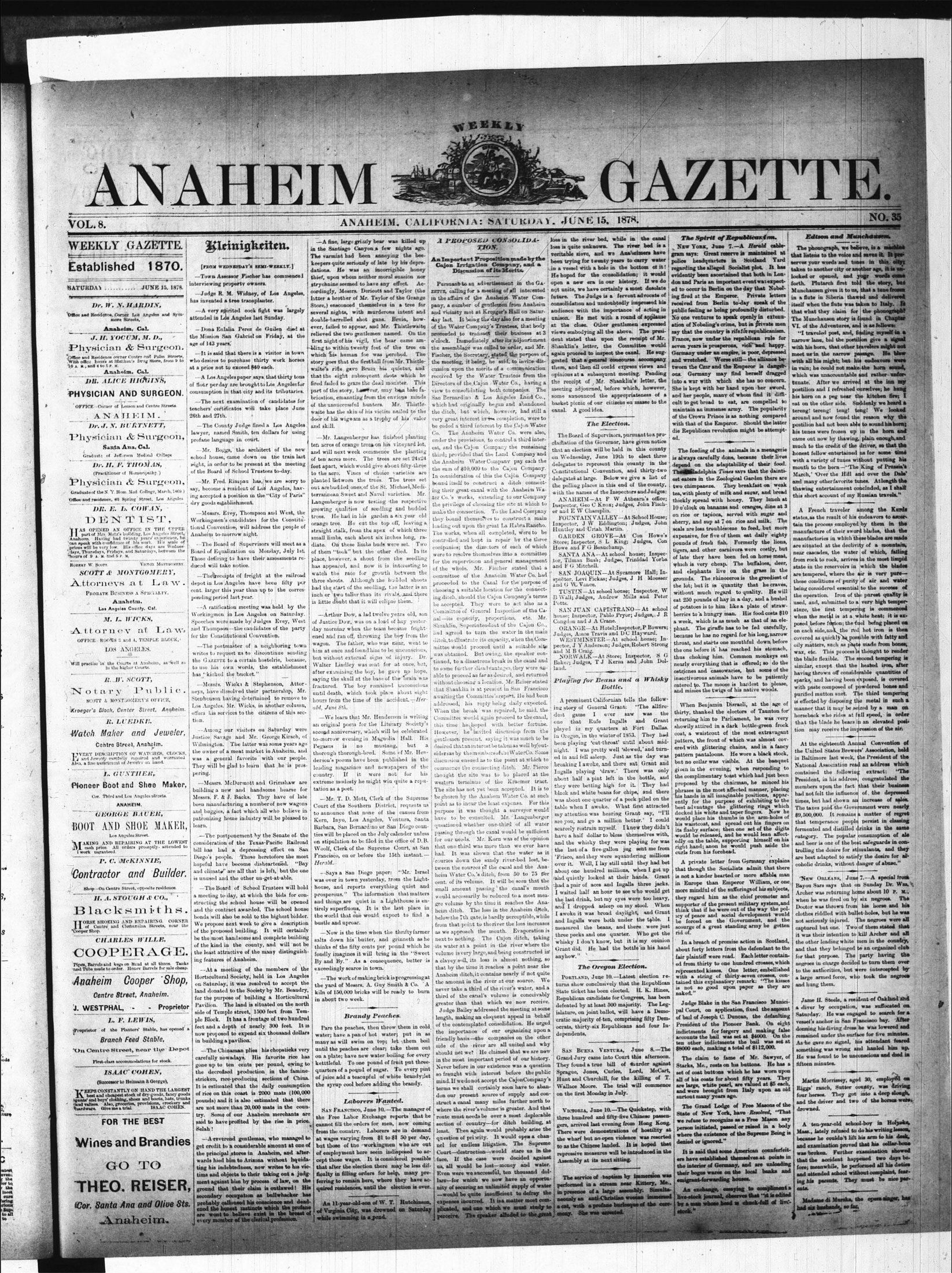
Searchable text
ANAHEIM
VOL. 8.
WEEKLY GAZETTE.
Established 1870.
SATURDAY ... JUNE 15, 1878.
Dr. W. N. HARDIN,
Office and Residence, Corner Los Angeles and Sycamore Streets,
Anaheim, Cal.
J. H. YOCUM, M. D.,
Physician & Surgeon.
Office and Residence corner Centre and Palm Streets,
With office, koura at Hankan's Drug Store, from 9 to 10 a.m., and 4 to 5 p.m.
Anaheim, Cal.
DR. ALICE HIGGINS,
PHYSICIAN AND SURGEON.
OFFICE - Corner of Lemon and Centre Streets.
ANAHEIM.
Dr. J. N. BURTNETT,
Physician & Surgeon,
Santa Ana, Cal.
Graduate of Jefferson Medical College
Dr. H. F. THOMAS,
(Practitioner of Homoeopathy)
Kleinigkeiten.
[FROM WEDNESDAY'S SEMI-WEEKLY.]
— Town Assessor Fischer has commenced interviewing property owners.
— Judge R. M. Widney, of Los Angeles, has invented a tree transplanter.
— A very spirited cook fight was largely attended in Los Angeles last Sunday.
— Dona Eulalia Perez de Guilen died at the Mission San Gabriel on Friday, at the age of 143 years.
— It is said that there is a visitor in town who desires to purchase thirty work horses at a price not to exceed $40 each.
— A Los Angeles paper says that thirty tons of flour per day are brought to Los Angeles for consumption in that city and its tributaries.
— The next examination of candidates for teachers' certificates will take place June 26th and 27th.
— The County Judge fined a Los Angeles lawyer, named Smith, ten dollars for using profane language in court.
— Mr. Boggs, the architect of the new school house, came down on the train last night, in order to be present at the meeting of the Board of School Trustees to-day.
— A fine, large pawn in the Santiago Cemetery. The varmint had keepers quite seriated. He was thief, upon whom strychnine seemed cordingly, Messrs Litter a brother of Store.) ensconced several nights, with double-barrelled ever, failed to apiece relieved the two pigs first night of his blinding to within two which his human story goes that the waite's rifle gave that the eight armed fired failed to grape part of the story, brication, emanation of the unsuccessful waite has the skin door of his wigwag and skill.
— Mr. Langenbuben acres of orange and will next week of ten acres more feet apart, which it to the acre.
DR. ALICE HIGGINS,
PHYSICIAN AND SURGEON.
OFFICE—Corner of Lemon and Centre Streets.
ANAHEIM.
Dr. J. N. BURTNETT,
Physician & Surgeon,
Santa Ana, Cal.
Graduate of Jefferson Medical College
Dr. H. F. THOMAS,
(Practitioner of Homoeopathy)
Physician & Surgeon,
Graduate of the N.Y.Hom Med College, March, 1869.
Office and residence, 63 Spring Street, Los Angeles
DR. E. L. COWAN,
DENTIST,
Has opened an office in the upper part of Mrs. Matz's building, Los Angeles Street, Anaheim. Having had twenty years' experience, he can speak with confidence of his work. His scale of prices will be very low. His office days are Wednesdaydays, Thursdays, Fridays, and Saturdays, between the hours of 9 A.M. and 5 P.M.
ROBERT W. SCOTT.
Victor Montgomery.
SCOTT & MONTGOMERY,
Attorneys at Law.
Probate Business & Specialty.
Anaheim.
Los Angeles County, Cal.
M. L. WICKS,
Attorney at Law.
OFFICE—ROOMS 2 and 4, TEMPLE BLOCK,
LOS ANGELES.
Will practise in the Courts at Anaheim, as well as in the higher Courts.
R. W. SCOTT,
Notary Public.
SCOTT & MONTGOMERY'S OFFICE.
Kroeger's Block, Center Street, Anaheim.
R. LUEDKE.
Watch Maher and Jeweler,
Centre Street, Anaheim.
EVERY DESCRIPTION OF WATCHES, CLOCKS, and Jewelry carefully repaired and warranted.Also, a fine assortment of Jewelry on hand.
L. GUNTHER,
Pioneer Boot and Shee Maker,
Cor. Third and Los Angeles streets.
ANAHEIM.
GEORGE BAUER,
BOOT AND SHOE MAKER,
Los Angeles Street.
MAKING AND REPAIRING AT THE LOWEST cash price. All orders promptly attended to Iwork guaranteed.
P. C. McKINNIE,
Contractor and Builder.
Shop—On Centre Street, opposite residence.
A Los Angeles paper says that thirty tons of floor per day are brought to Los Angeles for consumption in that city and its tributaries.
The next examination of candidates for teachers' certificates will take place June 26th and 27th.
The County Judge fined a Los Angeles lawyer, named Smith, ten dollars for using profane language in court.
Mr. Boggs, the architect of the new school house, came down on the train last night, in order to be present at the meeting of the Board of School Trustees to-day.
Mr. Fred Rimpau has, we are sorry to say, become a resident of Los Angeles, having accepted a position in the "City of Paris" dry goods establishment.
Messrs. Evey, Thompson and West, the Workingmen's candidates for the Constitutional Convention, will address the people of Anaheim to-morrow night.
The Board of Supervisors will meet as a Board of Equalization on Monday, July 1st. Those desiring to have their assessments reduced will take notice.
The receipts of freight at the railroad depot in Los Angeles have been fifty percent larger this year than up to the corresponding period last year.
A ratification meeting was held by the Workingmen in Los Angeles on Saturday. Speeches were made by Judges Evey, West and Thompson—the candidates of the party for the Constitutional Convention.
The postmaster of a neighboring town writes to request us to discontinue sending the Gazette to a certain hostelrie, because, to use his own words, the establishment has "kicked the bucket."
Messrs. Wicks & Stephenson, Attorneys, have dissolved their partnership, Mr. Stephenson having determined to remove to Los Angeles. Mr. Wicks, in another column, offers his services to the citizens of this section.
Among our visitors on Saturday were Justice Savage and Mr. George Kirsch, of Wilmington. The latter was some years ago the owner of a meat market in Anaheim, and was a general favorite with our people. They will be glad to learn that he is prospering.
Messrs. McDermott and Grimshaw are building a new and handsome hearse for Messrs. F. & J. Backs. They have of late been manufacturing a number of new wagons and buggies, a fact which all who believe in patronizing home industry will be pleased to learn.
The postponement by the Senate of the consideration of the Texas-Pacific Railroad bill has had a depressing effect on San Diego's people. Those heretofore the most hopeful have become disheartened. "Bay and climate" are all that is left, but the one is unused and the other un-get-at-able.
The Board of School Trustees will hold a meeting to-day, at which the bids for conthat the eight stakes fired failed to grant part of the story; brication; emanation; of the unsuccessful waite has the skin door of his wigwag and skill.
Mr. Langenbubten acres of orange and will next weekof ten acres morefeet apart, whichto the acre.Vinic planted between out are budded onto terranean SweetLangenberger is no growing qualities trees. He had in orange tree.Hestraight stalk,freshsmall limbs,eachdiate.On theseof them "took"b place,however,ahas appeared,andwatchthe racethree shoots.Ahadthe start oftenthick or two talionis little doubt tha
Arthur Dowof Justice Dow,vday morning whenened and ran off.wagon.The fathim at once andbut without extalseWalter Lindleyafter examining,saying the skullfractured.Theuntil death,whihours from thetoldJune 8th.
We learn tha an original poemsecond anniversaryto-morrow eveniPegasusisthorough thoroughderson's poemshleading magazinecountry.Ifextreme modestytation as a poet.
Mr. T. D.Court of the Societyto announce thisKern.Inyo,LobBarbara,SanBentieswill be placedon stipulation toWoolf,Clerk ofFrancisco.on orHerald.
Says a Sanwas over in townhouse,andrepresuperous."
ANAHEIM.
GEORGE BAUER,
BOOT AND SHOE MAKER,
Los Angeles Street.
MAKING AND REPAIRING AT THE LOWEST
cash price. All orders promptly attended to
I work guaranteed.
P. C. McKINNIE,
Contractor and Builder.
Shop—On Centre Street, opposite residence.
H. A. STOUGH & CO.,
Blacksmiths.
HORSE SHOEING AND REPAIRING. CORNER
of Centre and Clematina Streets, near the
Cooper Shop.
CHARLES WILLE.
COOPERAGE.
Tipes, Barrels and kegs on hand at all times. Tanks
and Tubs made to order. Honey Barrels for sale cheap.
Anaheim Cooper Shop,
Centre Street, Anaheim.
J. WESTPHAL, - Proprietor
L. F. LEWIS,
Proprietor of the Planters' Stable, has opened a
Branch Feed Stable,
On Centre Street, near the Depot
First-class accommodations for stock.
ISAAC COHEN,
(Successor to Heimann & George).
KEEPS CONSTANTLY ON HAND THE LARGEST
best and cheapest stock of dry-goods, fancy goods
gents' and boys' clothing, shoes and boots, hats, trunks
and valises. Also, groceries, provisions, crockery and
hardware. Give me a trial.
FOR THE BEST
Wines and Brandies
GO TO
THEO. REISER,
Cor. Santa Ana and Olive Sts.
Anaheim.
A reverend gentleman, who managed to get credit to a considerable amount at one of the principal stores in Anaheim, and afterwards hied him to Arizona without liquidating his indebtedness, now writes to his victim and objects to their taking out a judgment against him by process of law, on the ground that their claim is outlawed! His secondary occupation as bullwhacker has probably callused his conscience and deadened the honest instincts which the profane are wont to believe exist in the breast of every member of the clerical profession.
The postponement by the Senate of the consideration of the Texas-Pacific Railroad bill has had a depressing effect on San Diego's people. Those heretofore the most hopeful have become disheartened. "Bay and climate" are all that is left, but the one is unused and the other un-get-at-able.
The Board of School Trustees will hold a meeting today, at which the bids for constructing the school house will be opened and the contract awarded. The school house bonds will also be sold to the highest bidder. We propose next week to give a description of the proposed building. It will certainly be the most handsome and complete building of the kind in the county, and will not be the least attractive of the many distinguishing features of Anaheim.
At a meeting of the members of the Horticultural Society, held in Los Angeles on Saturday, it was resolved to accept the land donated to the Society by Mr. Beaudry, for the purpose of building a Horticultural Pavilion. The land is situated on the north side of Temple street, 1500 feet from Temple Block. It has a frontage of two hundred feet and a depth of nearly 300 feet. It is now proposed to expend six thousand dollars in building a pavilion.
The Chinaman plies his chopsticks very carefully nowadays. His favorite rice has gone up to ten cents per pound, owing to the decreased production in the famine-strenken, rice-producing sections of China. It is estimated that the daily consumption of rice on this coast is 2000 mats (100,000 pounds) and it is also estimated that there are not more than 20,000 mats in the country. Some of our Anaheim merchants are said to have profited by the rise in price.
An 11-year-old of Virginia City while swimming...
WEEKLY
GAE
ANAHEIM, CALIFORNIA: SATURDAY, JUNE 15, 1878.
A fine, large grizzly bear was killed up in the Santiago Canyon a few nights ago. The varmint had been annoying the beekeepers quite seriously of late by his depredations. He was an incorrigible honey thief, upon whom neither moral suasion nor strychnine seemed to have any effect. Accordingly, Messrs. Dericott and Taylor (the latter a brother of Mr. Taylor of the Grange Store) ensconced themselves in a tree for several nights, with murderous intent and double-barrelled shot guns. Bruin, however, failed to appear, and Mr. Thistlewaite relieved the two gentlemen named. On the first night of his vigil, the bear came ambling to within twenty feet of the tree on which his human foe was perched. The story goes that the first ball from Mr. Thistlewaite's rifle gave Bruin his quietus, and that the eight subsequent shots which he fired failed to graze the dead monster. This part of the story, however, may be based fabrication, emanating from the envious minds of the unsuccessful hunters. Mr. Thistlewaite has the skin of his victim nailed to the door of his wigwam as a trophy of his valor and skill.
Mr. Langenberger has finished planting ten acres of orange trees on his vineyard lot, and will next week commence the planting of ten acres more. The trees are set 24x24 feet apart, which would give about fifty-three to the acre. Vines of choice varieties are
A PROPOSED CONSOLIDATION.
An Important Proposition made by the Cajon Irrigation Company, and a Discussion of its Merits.
Pursuah to an advertisement in the Gazette, calling for a meeting of all interested in the affairs of the Anaheim Water Company, a number of gentlemen from Anaheim and vicinity met at Kroger's Hall on Saturday last. It being the day also for a meeting of the Water Company's Trustees, that body proceeded to transact their business at 3 o'clock. Immediately after its adjournment the assemblage was called to order, and Mr. Fischer, the Secretary, stated the purpose of the meeting, it being, he said, to invite discussion upon the merits of a communication received by the Water Trustees from the Directors of the Cajon Water Co., having a view to consolidating both companies. The San Bernardino & Los Angeles Land Co., which had originally begun and abandoned the ditch, but which, however, had still a very great interest in its completion, were to be ceded a third interest by the Cajon Water Co. The Anaheim Water Co. were also under the provisions, to control a third interest, and the Cajon Company the remaining third; provided that the Land Company and the Anaheim Water Company pay each the sum of $10,000 to the Cajon Company.
loss in the river bed, while in the canal loss is quite unknown. The river bed is a veritable sieve, and we Anaheimers have been trying for twenty years to carry water in a vessel with a hole in the bottom ot it! He hoped for the consolidation; it would open a new era in our history. If we do not unite, we have certainly a most desolate future. The Judge is a fervent advocate of consolidation and undoubtedly impressed his audience with the importance of acting in unison. He met with a round of applause at the close. Other gentlemen expressed views embodying all the above. The president stated that upon the receipt of Mr. Shanklin's letter, the Committee would again proceed to inspect the canal. He suggested that a general concourse accompany them, and then all could express views and opinions at a subsequent meeting. Pending the receipt of Mr. Shanklin's letter, the meeting adjourned, before which, however, some announced the appropriateness of a basket picnic of our citizens en masse to the canal. A good idea.
The Election.
The Board of Supervisors, pursuant to a proclamation of the Governor, have given notice that an election will be held in this county on Wednesday, June 19th to elect three delegates to represent this county in the Constitutional Convention, and thirty-two
that the eight subsequent shots which he fired failed to graze the dead monster. This part of the story, however, may be base fabrication, emanating from the envious minds of the unsuccessful hunters. Mr. Thistlewaite has the skin of his victim nailed to the door of his wigwam as a trophy of his valor and skill.
Mr. Langenberger has finished planting ten acres of orange trees on his vineyard lot, and will next week commence the planting of ten acres more. The trees are set 24x24 feet apart, which would give about fifty-three to the acre. Vines of choice varieties are planted between the trees. The trees set out are buddled ones, of the St. Michael, Mediterranean Sweet and Navel varieties. Mr. Langenberger is now testing the respective growing qualities of seedling and budded trees. He had in his garden a six year old orange tree. He cut the top off, leaving a straight stalk, from the apex of which three small limbs, each about six inches long, radiate. On these limbs buds were set. Two of them "took" but the other died. In its place, however, a shoot from the seedling has appeared, and now it is interesting to watch the race for growth between the three shoots. Although the bulbled shoots had the start of the seedling, the latter is an inch or two taller than its rivals, and there is little doubt that it will eclipse them.
Arthur Dow, a lad twelve years old, son of Justice Dow, was on a load of hay yesterday when the team became frightened and ran off, throwing the boy from the wagon. The father, who was near, went to him at once and found him to be unconscious, but without external signs of injury. Dr. Walter Lindley was sent for at once, but, after examining the boy, he gave no hope, saying the skull at the base of the brain was fractured. The boy remained unconscious until death, which took place about eight hours from the time of the accident.
Herald, June 8th.
We learn that Mr. Henderson is writing an original poem for the Literary Society's second anniversary, which will be celebrated to-morrow evening in Magnolia Hall. His Pegasus is no mustang, but a thorough thorough-breed. Some of Mr. Henderson's poems have been published in the leading magazines and newspapers of the country. If it were not for his extreme modesty he might win quite a reputation as a poet.
Mr. T. D. Mott, Clerk of the Supreme Court of the Southern District, requests us to announce that none of the causes from Kern, Inyo, Los Angeles, Ventura, Santa Barbara, San Bernardino or San Diego counties will be placed on the July calendar unless on stipulation to be filed in the office of D.B. Woolf, Clerk of the Supreme Court, at San Francisco, on or before the 15th instant.
Herald.
Says a San Diego paper: "Mr. Israel was over in town yesterday, from the Lighthouse, and reports everything quiet and prosperous." The information that matters received by the Water Trustees from the Directors of the Cajon Water Co., having a view to consolidate both companies. The San Bernardino & Los Angeles Land Co., which had originally begun and abandoned the ditch, but which, however, had still a very great interest in its completion, were to be ceded a third interest by the Cajon Water Co. The Anaheim Water Co. were also under the provisions, to control a third interest, and the Cajon Company the remaining third; provided that the Land Company and the Anaheim Water Company pay each the sum of $10,000 to the Cajon Company. In consideration of this the Cajon Company bound itself to construct a ditch connecting their great canal with the Anaheim Water Co.'s works, extending to our Company the privilege of choosing the site at which to make the connection. To the Land Company they bound themselves to construct a main leading out upon the great La Habra Rancho. The works, when all completed, were to be controlled and kept in repair by the three companies; the directors of each of which were to resolve themselves into a committee for the supervision and general management of the whole. Mr. Fischer stated that a committee of the Anaheim Water Co. had proceeded to the Canal for the purpose of choosing a suitable location for the connecting ditch, should the Cajon Company's terms be accepted. They were to act also as a Committee of General Inspection of the Canal—its capacity, proportions, etc. Mr. Shanklin, Superintendent of the Cajon Co., had agreed to turn the water in the main ditch, to illustrate its capacity, when the Committee would proceed until a suitable site was obtained. But owing, the speaker continued, to a disastrous break in the canal and to some further disadvantages, they were unable to proceed as far as desired, and returned without choosing a location. Mr. Reiser stated that Shanklin is at present in San Francisco awaiting the Committee's report. He had been addressed, his reply being daily expected. When the break was repaired, he said, the Committee would again proceed to the canal, this time he hoped with better fortune. However, he invited discussion from the gentlemen present, saying it was much to be desired that an interest be taken as well by outsiders as by members of the Water Co. Some discussion ensued as to the point at which to commence the connecting ditch. Mr. Pierce thought the site was to be placed at the western terminus of the Kraemer tract. The site has not yet been accepted. It is to be chosen by the Anaheim Water Co. at such point as to incur the least expense. For this purpose it was thought a surveyor would have to be consulted. Mr. Langenberger questioned whether one-third of all water passing through the canal would be sufficient for our needs. Mr. Korn was of the opinion that one-third was more than we ever have had. It was shown that the water as it courses down the sandy river-bed lost, between the sources of the canal and the Anaheim Water Co.'s ditch, from 50 to 75 per cent. of its volume. It will be seen that the small amount passing the canal's mouth would necessarily be reduced to a most mea-
The Election.
The Board of Supervisors pursuant to a proclamation of the Governor, have given notice that an election will be held in this county on Wednesday, June 19th to elect three delegates to represent this county in the Constitutional Convention, and thirty-two delegates at large. Below we give a list of the polling places in this end of the county, with the names of the Inappropriate And Judges:
ANAHEIM—At F W Athearn's office; Inspector, Geo C Knox; Judges, John Fischer and E W Champin.
FOUNTAIN VALLEY—At School House; Inspector, J W Eddington; Judges, John Huntley and Uriah Martin.
GARDEN GROVE—At Con Howe's Store; Inspector, S L King; Judges, Con Howe and F G Beauchamp.
SANTA ANA—At school house; Inspector, Tilman Bush; Judges, Trinidad Yorba and F G Mitchell.
SAN JOAQUIN—At Sycamore Hall; Inspector, Levi Fickas; Judges, J H Moesser and G W Vance.
TUSTIN—At school house; Inspector, W B Wall; Judges, Andrew Mills and Peter Potts.
SAN JUAN CAPISTRANO—At school house; Inspector, Pablo Pryor; Judges, J R Congdon and J A Crane.
ORANGE—At Hotel; Inspector, P Bowers; Judges, Amos Travis and DC Hayward.
WESTMINSTER—At school house; Inspector, J Y Anderson; Judges, Robert Strong and M B Craig.
NORWALK—At Store; Inspector, S G Baker; Judges, T J Kerns and John Dolland.
Playing for Beans and a Whisky Bottle.
A prominent Californian tells the following story of General Grant: "The allfiredest game I ever saw was the one that Rufe Ingalls and Grant played in my quarters at Fort Dallas in Oregon in the winter of 1853. They had been playing 'cut-throat' until midnight. I was pretty well 'slewed,' and turned in and fell asleep. Just as the day was breaking Lawoke, and there sat Grant and Ingalls playing 'draw.' There was only about half a pint left in the bottle, and they were betting high for it. They had black and white beans for chips, and there was about one quarter of a peck piled on the table when I awoke. What first attracted my attention was hearing Grant say," I'll see you, and go a million better." I could scarcely restrain myself. I knew they didn't have a half dollar to bless themselves with, and the whisky they were playing for was the last of a five-gallon jug sent me from Frisco, and they were squandering millions over it. Well, I lay still until they had bet about one hundred millions when I got up quietly looked at their hands. Grant had a pair of aces and Ingalls three jacks. I waited half an hour to see who would get last drink but my eyes were too heavy.
Mr. T. D. Mott, Clerk of the Supreme Court of the Southern District, requests us to announce that none of the causes from Kern, Inyo, Los Angeles, Ventura, Santa Barbara, San Bernardino or San Diego counties will be placed on the July calendar unless on stipulation to be filed in the office of D.B. Woolf, Clerk of the Supreme Court, at San Francisco, on or before the 15th instant.—Herald.
Says a San Diego paper: "Mr. Israel was over in town yesterday, from the Lighthouse, and reports everything quiet and prosperous." The information that matters and things are quiet in a Lighthouse is entirely superfluous. It is the last place in the world that one would expect to find a bustle and uproar.
Now is the time when the thrifty farmer salts down his butter, and grinneth as he thinks of the fifty cents per pound which he fondly imagines it will bring in the "Sweet By and By." As a consequence, butter is exceedingly scarce in town.
The work of making brick is progressing at the yard of Messrs. A. Guy Smith & Co. A kiln of 150,000 bricks will be ready to burn in about two weeks.
Brandy Peaches.
Pare the peaches, then throw them in cold water; have a pan of hot water; put in as many as will swim on top; let them boil until the peaches are clear; take them out on a plate; have new water boiling for every kettleful. To one pound of fruit put three-quarters of a pound of sugar. To every pint of juice add a teacupful of white brandy; let the syrup cool before adding the brandy.
Laborers Wanted.
San Francisco, June 10.—The manager of the Free Labor Exchange reports that he cannot fill the orders for men, now coming from the country. Laborers are in demand at wages varying from $1 to $150 per day, but those of the workingmen who are out of employment here seem indisposed to accept those wages. It is considered possible that after the election there may be less difficulty in filling orders for help, many preferring to remain here, where they have acquired residences, until the election is over.
An 11-year-old son of W. T. Hutchinson, of Virginia City, was drowned on Saturday while swimming in a pond.
For this purpose it was thought a surveyor would have to be consulted. Mr. Langenberger questioned whether one-third of all water passing through the canal would be sufficient for our needs. Mr. Korn was of the opinion that one-third was more than we ever have had. It was shown that the water as it courses down the sandy river-bed lost, between the sources of the canal and the Anaheim Water Co.'s ditch, from 50 to 75 per cent. of its volume. It will be seen that the small amount passing the canal's mouth would necessarily be reduced to a most meagre volume by the time it reaches the Anaheim ditch. The loss in the Anaheim ditch, below the 7th gate, is hardly perceptible, while from that point to the river the loss increases as we approach the mouth. Evaporation is next to nothing. The Cajon ditch, taking its water at a point in the river where the volume is very large, and being constructed in a clayey soil, its loss is almost nothing, so that by the time it reaches a point near the Anaheim ditch, it contains nearly if not quite the amount in the river at our source. We never take a third of the river's water, and a third of the canal's volume is conceivably greater than that which we now receive.
Judge Bailey addressed the meeting at some length, making an eloquent appeal in behalf of the contemplated consolidation. He urged the importance of our organizing upon a friendly basis—the companies on the other side of the river are all united and why should not we? He claimed that we are now in the most important period of our history. Never before in our existence was a question so fraught with interest before the public mind. If we do not accept the Cajon Company's terms we shall certainly soon have to abandon our present source of supply and construct a canal many miles further north to where the river's volume is greater. And that route must needs be over a most deplorable section of country—for ditch building, at least. Then again would probably arise the question of priority. It would open a channel for endless litigation. The Supreme Court—destruction—would stare us in face. If the case were decided against us, all would be lost—money and water. Even were we successful, ten thousand dollars—for which we now have an opportunity of securing an unlimited supply of water—would be quite insufficient to defray the expenses incurred. It is a matter most complicated, and one which we must study to perceive. The speaker alluded to the great point as to incur the least expense. For this purpose it was thought a surveyor would have to be consulted. Mr. Langenberger questioned whether one-third of all water passing through the canal would be sufficient for our needs. Mr. Korn was of the opinion that one-third was more than we ever have had. It was shown that the water as it courses down the sandy river-bed lost, between the sources of the canal and the Anaheim Water Co.'s ditch, from 50 to 75 per cent. of its volume. It will be seen that the small amount passing the canal's mouth would necessarily be reduced to a most meagre volume by the time it reaches the Anaheim ditch. The loss in the Anaheim ditch, below the 7th gate, is hardly perceptible, while from that point to the river the loss increases as we approach the mouth. Evaporation is next to nothing. The Cajon ditch, taking its water at a point in the river where the volume is very large, and being constructed in a clayey soil, its loss is almost nothing, so that by the time it reaches a point near the Anaheim ditch, it contains nearly if not quite the amount in the river at our source. We never take a third of the river's water, and a third of the canal's volume is conceivably greater than that which we now receive.
Judge Bailey addressed the meeting at some length, making an eloquent appeal in behalf of the contemplated consolidation. He urged the importance of our organizing upon a friendly basis—the companies on the other side of the river are all united and why should not we? He claimed that we are now in the most important period of our history. Never before in our existence was a question so fraught with interest before the public mind. If we do not accept the Cajon Company's terms we shall certainly soon have to abandon our present source of supply and construct a canal many miles further north to where the river's volume is greater. And that route must needs be over a most deplorable section of country—for ditch building, at least. Then again would probably arise the question of priority. It would open a channel for endless litigation. The Supreme Court—destruction—would stare us in face. If the case were decided against us, all would be lost—money and water. Even were we successful, ten thousand dollars—for which we now have an opportunity of securing an unlimited supply of water—would be quite insufficient to defray the expenses incurred. It is a matter most complicated, and one which we must study to perceive. The speaker alluded to the great point as to incur the least expense. For this purpose it was thought a surveyor would have to be consulted. Mr. Langenberger questioned whether one-third of all water passing through the canal would be sufficient for our needs. Mr. Korn was of the opinion that one-third was more than we ever have had. It was shown that the water as it courses down the sandy river-bed lost, between the sources of the canal and the Anaheim Water Co.'s ditch, from 50 to 75 per cent. of its volume. It will be seen that the small amount passing the canal's mouth would necessarily be reduced to a most meagre volume by the time it reaches the Anaheim ditch. The loss in the Anaheim ditch, below the 7th gate, is hardly perceptible, while from that point to the river the loss increases as we approach the mouth. Evaporation is next to nothing. The Cajon ditch, taking its water at a point in the river where the volume is very large, and being constructed in a clayey soil, its loss is almost nothing, so that by the time it reaches a point near the Anaheim ditch, it contains nearly if not quite the amount in the river at our source. We never take a third of the river's water, and a third of the canal's volume is conceivably greater than that which we now receive.
Victoria, June 10.-The Quickstep, with three hundred and fifty-five Chinese passengers, arrived last evening from Hong Kong. There were demonstrations of hostility at the wharf but no open violence was resorted to as the Chinese landed. It is hoped that repressive measures will be introduced in the Assembly at its next sitting.
The service of baptism by immersion was performed in a stream near Kittery, Me., in presence of a large assembly. Simultaneously an anti-Christian woman immersed a cat, with a prefane burlesque of the ceremony. She was arrested.
GAZETTE.
15, 1878. NO. 35
The Spirit of Republicanism.
New York, June 7.—A Herald cablegram says: Great reserve is maintained at police headquarters in Scotland Yard regarding the alleged Socialist plot. It has evidently been ascertained that both in London and Paris an important event was expected to occur in Berlin on the day that Nobelling fired at the Emperor. Private letters received from Berlin to-day speak of the public feeling as being profoundly disturbed. No one ventures to speak openly in extension of Nobelling's crime, but in private men say that the country is rife for republicanism. France, now under the republican rule for seven years is prosperous, rich and happy. Germany under an empire, is poor, depressed and wretched. Worse still—the alliance between the Czar and the Emperor is dangerous. Germany may find herself dragged into a war with which she has no concern. She is kept with her hand upon her sword, and her people, many of whom find it difficult to get bread to eat, are compelled to maintain an immense army. The popularity of the Crown Prince is as nothing compared with that of the Emperor. Should the latter die Republican revolution might be attempted.
The feeding of the animals in a menagerie is always carefully done, because their lives depend on the adaptability of their food. The Philadelphia Times says that the dainti-
Edison and Munchausen.
The phonograph, we believe, is a machine that listens to the voice and saves it. It preserves your words and tones in this city; taken to another city or another age, it is unlocked or opened, and your words come forth. Plutarch first told the story, but Munchausen gives it to us, that a tune from a flute in Siberia thawed and delivered itself when the flute was taken to Italy. Is that what they claim for the phonograph? The Munchausen story is found in Chapter VI. of the Adventures, and is as follows:
"I traveled post, and finding myself in a narrow lane, bid the postillon give a signal with his horn, that other travelers might not meet us in the narrow passage. He blew with all his might; but his endeavors were vain; he could not make the horn sound, which was unaccountable and rather unfortunate. After we arrived at the inn my postilion and I refreshed ourselves; he hung his horn on a peg near the kitchen fire; I sat on the other side. Suddenly we heard a tereng! tereng! teng! teng! We looked around and now found the reason why the postilion had not been able to sound his horn; his tunes were frozen up in the horn and came out now by thawing, plain enough, and much to the credit of the driver, so that the honest fellow entertained us for some time with a variety of tunes without putting his mouth to the horn—"The King of Prussia's March." Over the Hill and over the Dala."
The feeding of the animals in a menagerie is always carefully done, because their lives depend on the adaptability of their food. The Philadelphia Times says that the daintest eaters in the Zoological Garden there are two chimpanzees. They breakfast on weak tea, with plenty of milk and sugar, and bread thickly spread with honey. They lunch at 10 o'clock on bananas and oranges, dine at 3 on rice or tapioca, served with sugar and sherry, and sup at 7 on rice and milk. The seals are less troublesome to feed, but more expensive, for five of them eat daily eighty pounds of fresh fish. Formerly the lions, tigers, and other carnivora were costly, but of late they have been fed on horse meat, which is very cheap. The buffaloes, deer, and elephants live on the grass in the grounds. The rhinoceros is the greediest of the lot; but it is quantity that he craves, without much regard to quality. He will eat 250 pounds of hay in a day, and a bushel of potatoes is to him like a plate of strawberries to a hungry man. His food costs $10 a week, which is as much as that of an elephant. The giraffe has to be fed carefully, because he has no regard for his long, narrow throat, and starts one mouthful down before the one before it has reached his stomach, thus choking him. Common monkeys eat nearly everything that is offered; so do the ostriches and cassowaries, but some of the insectivorous animals have to be patiently catered to. The moose is hardest to please, and misses the twigs of his native woods.
When Benjamin Disraeli, at the age of thirty, thanked the electors of Taunton for returning him to Parliament, he was very showily attired in a dark bottle-green frock coat, a waistcoat of the most extravagant pattern, the front of which was almost covered with glittering chains, and in a fancy pattern pantaloons. He wore a black stock, but no collar was visible. At the banquet given in the evening, when responding to the complimentary toast which had just been proposed by the chairman, he minced his phrases in the most affected manner, placing his hands in all imaginable positions, apparently for the purpose of exhibiting to the best advantage the glittering rings which decked his white and taper fingers. Now he would place his thumbs in the arm-holes of his waistcoat, and spread out his fingers on its flashy surface; then one set of the digits would be released, and he would lean affectively on the table, supporting himself on his right hand; anon he would push aside the curls from his forehead.
A private letter from Germany explains that though the Socialists admit that there is not a kinder hearted or more affable man in Europe than Emperor William, or one more mindful of the sufferings of his subjects, they regard him as the chief promoter and which was unaccountable and rather unfunny. After we arrived at the inn my postilion and I refreshed ourselves; he hung his horn on a peg near the kitchen fire; I eat on the other side. Suddenly we heard a tereng! tereng! teng! teng! We looked around and now found the reason why the postilion had not been able to sound his horn; his tunes were frozen up in the horn and came out now by thawing, plain enough, and much to the credit of the driver, so that the honest fellow entertained us for some time with a variety of tunes without putting his mouth to the horn—"The King of Prussia's March," 'Over the Hill and over the Dale' and many other favorite tunes. At length the thawing entertainment concluded, as I shall this short account of my Russian travels."
A French traveler among the Kurds states, as the result of his endeavors to ascertain the process employed by them in the manufacture of their sword blades, that the manufactories in which these blades are made are situated at the declivity of a mountain, near cascades, the water of which, falling from rock to rock, arrives in the most limpid state in the reservoirs in which the blades are tempered, where the air is very pure—these conditions of purity of air and water being considered essential to the success of the operation. Iron of the purest quality is used, and submitted to a very high temperature, the first tempering is commenced when the metal is at a white heat; it is exposed before fusion; the fuel being placed on on each side,and the red hot iron is then covered as quickly as possible with fatty and oily matters, such as paste made from bones, wax, etc. This process is thought to render the blade flexible. The second tempering is similar, except that the heated iron, after having thrown off considerable quantities of sparks, and having been exposed, is covered with paste composed of powdered bones and purified mutton suet. The third tempering is effected by disposing the metal in such a manner that it may be seized by a man on horseback who rides at full speed, in order that the blade he bears in an elevated position may receive the impression of the air.
At the eighteenth Annual Convention of the United States Brewer's Association, held in Baltimore last week, the President of the National Association read an address which contained the following extract: "The President, in his address, congratulated the members upon the fact that their business had not felt the influence of the depressed times, but had shown an increase of sales. The taxes paid the Government were nearly $9,500,000. It remains a matter of regret that temperance people persist in classing fermented and distilled drinks in the same category. The popular consumption of ale and beer is one of the best safeguards in controlling the desire for stimulants, and they are best adapted to satisfy the desire for alcoholic drinks, without danger of abuse."
What first attracted me was hearing Grant say, "I'll give you a million better." I could not myself. I knew they didn't want to bless themselves with it; they were playing for was slave-gallon jug sent me from New York were squandering millions of lay still until they had betted millions, when I got up and looked at their hands. Grant Jones and Ingalls three jacks. In hour to see who would get about my eyes were too heavy, so asleep on my stool. When abroad daylight, and Grant were both under the table. I beans, and there were just one quarter. Who got the know, but it is my opinion that had the bottle in his hand.
A private letter from Germany explains that though the Socialists admit that there is not a kinder hearted or more affable man in Europe than Emperor William, or one more mindful of the sufferings of his subjects, they regard him as the chief promoter and supporter of the present military system, and think that if he were out of the way the policy of peace and social development would be forced on the Government, and the scourge of a great standing army be gotten rid of.
In a breach of promise action in Scotland, about forty letters from the defendant to the fair plaintiff were read. Each letter contained from thirty to one hundred crosses, which represented kisses. One letter, embellished with a string of thirty-seven crosses, contained this explanatory remark: "The kisses is not so good upon paper as they are naked."
Judge Blake in the San Francisco Municipal Court, on application, fixed the amount of bail of Joseph C. Duncan, the defaulting President of the Pioneer Bank. On eight indictments for forgery and making false accounts the bail was set at $4000. On the ten other indictments the bail was set at $8000 each, making a total of $112,000.
The claim to fame of Mr. Sawyer, of Starks, Me., rests on his buttons. He has a set of coat buttons which he has worn upon all of his coats for about fifty years. They are large, white pearl, are valued at $5 each, and were brought from Italy upon an old surtout many years ago.
The Grand Lodge of Free Masons of the State of New York, have Resolved, "That we refuse to recognize as a Free Mason any person initiated, passed or raised in a body where the existence of the Supreme Being is denied or ignored."
It is said that some American counterfeiters have established themselves at points in the interior of Germany, and are unloading their bogus wares on the local banks and emigrant-forwarding houses.
An exchange, essaying to compliment a live-stock journal, observes that "it is edited by a man whose head is chuck-full of livestock."
The taxes paid the Government were nearly $9,500,000. It remains a matter of regret that temperance people persist in classifying fermented and distilled drinks in the same category. The popular consumption of ale and beer is one of the best safeguards in controlling the desire for stimulants, and they are best adapted to satisfy the desire for alcoholic drinks, without danger of abuse."
New Orleans, June 7.—A special from Bayou Sars says that on Sunday Dr. Wm. Archer was returning home about 10 f. m., when he was fired on by six negroes. The Doctor was thrown from his horse and his clothes riddled with bullet-holes, but he was not seriously injured. The negroes were all captured but one. Two of them stated that it was their intention to kill Archer and all the other leading white men in the country, and that they belonged to an organized club for that purpose. The party having the negroes in charge decided to turn them over to the authorities, but were intercepted by a large armed force, who took the negroes and hung them.
Jame H. Steele, a resident of Oakland and a diver by occupation, was suffocated on Saturday. He was engaged to search for a vessel's anchor in San Francisco bay. After donning his diving dress he was lowered and remained under the surface for five minutes. As he gave no signal, his attendant feared something was wrong and hauled him up. He was found to be unconscious and died in fifteen minutes.
Martin Morrissey, aged 30, employed on Riggs' ranch, Sutter county, was driving four horses. They got into a deep slough, and the driver and two of the horses were drowned.
A ten-year-old school-boy in Holyoke, Mass., lately refused to do his writing lesson, because he couldn't lift his arm to his desk, and examination proved that his collar-bone was broken. Further examination showed that the accident happened two days before; meanwhile, he performed all his duties and attended school without complaint, fearing his parents. They must be nice parents.
Madame di Murska, the opera singer, has had six husbands, so far.