anaheim-gazette 1878-06-08
Scanned page
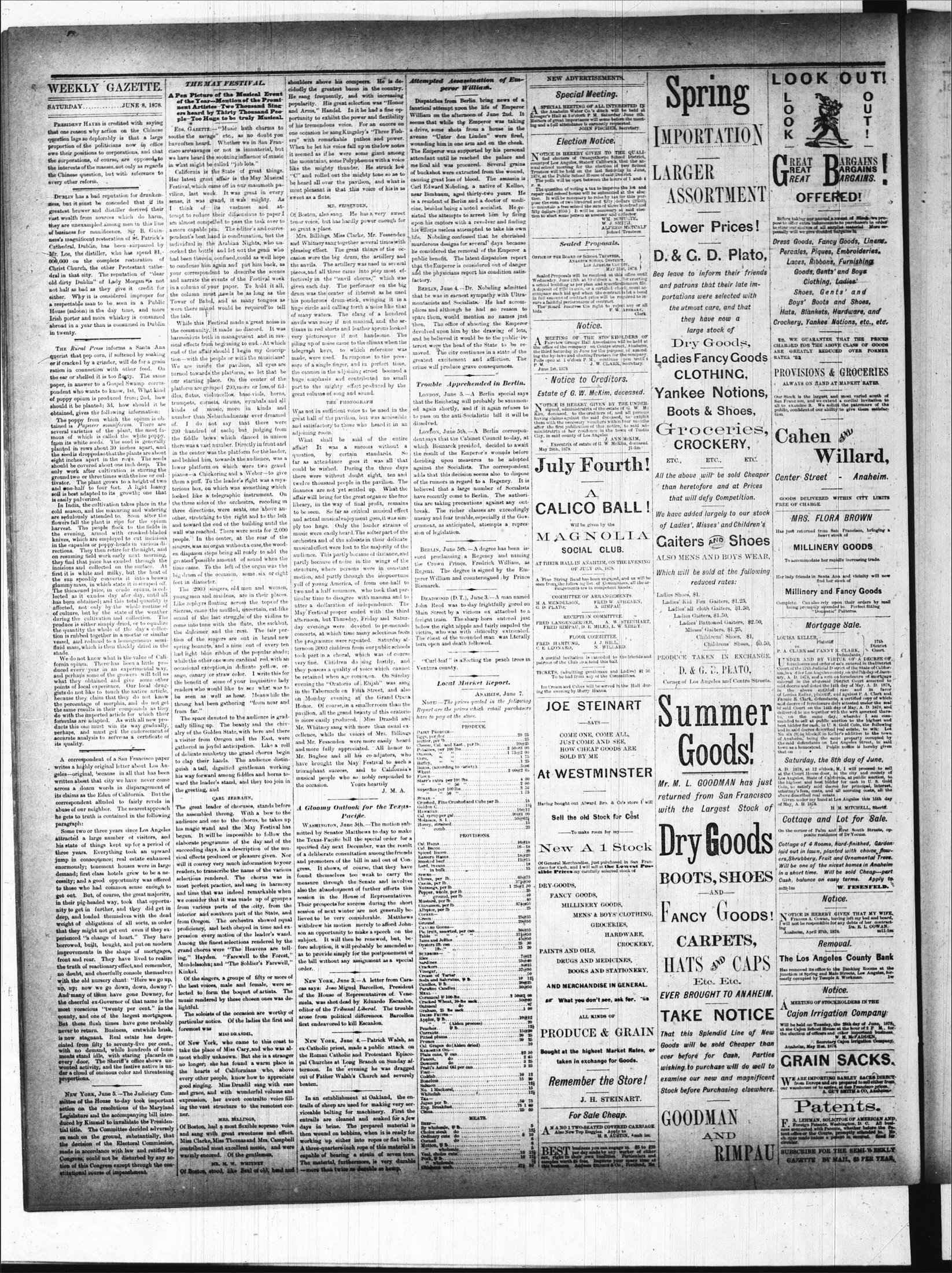
Searchable text
WEEKLY GAZETTE.
SATURDAY... JUNE 8, 1878.
PRESIDENT HAYES is credited with saying that one reason why action on the Chinese question lags so deplorably is that a large proportion of the politicians now in office owe their positions to corporations, and that the corporations, of course, are opposed to the interests of the masses, not only as regards the Chinese question, but with reference to every other reform.
DUBLIN has a bad reputation for drunkenness, but it must be conceded that if its greatest brewer and distiller derived their vast wealth from sources which do harm, they are unexamined among men in this line of business for munificence. Sir B. Guinness's magnificent restoration of St. Patrick's Cathedral, Dublin, has been surpassed by Mr. Loe, the distiller, who has spend $1,000,000 on the complete restoration of Christ Church, the other Protestant cathedral in that city. The reputation of "dear old dirty Dublin" of Lady Morgan is not half as bad as they give it credit for either. Why it is considered improper for a respectable man to be seen in a Public House (saloon) in the day time, and more Irish porter and more whiskey is consumed abroad in a year than is consumed in Dublin in twenty.
THE Rural Press informs a Santa Ana querist that pop corn, if softened by soaking or if cracked by a grinder, will do for a grain ration in connection with other feed. On the ear or shelled it is too flugy. The same paper, in answer to a Gospel Swamp correspondent who wants to know, 1st, What kind of poppy opium is produced from; 2nd, how should it be planted; 3d, how should it be obtained, gives the following information:
The poppy from which the opium is obtained is Papaver somniferum. There are several varieties of the plant, the most famous of which is called the white poppy, from its white seeds. The seed is generally planted in rows about 30 inches apart, and the seed is dropped so that the plants are about eight inches apart in the rows. The seeds should be covered about one inch deep. The only work after cultivation is stirring the soil.
THE MAY FESTIVAL.
A Pen Picture of the Musical Event of the Year—Mention of the Prominent Artistes—Two Thousand Singers heard by Thirty Thousand People—Too Huge to be truly Musical.
EDS. GAZETTE:—"Music hath charms to soothe the savage" etc., as no doubt you have often heard. Whether we in San Francisco are savages or not is immaterial, but we have heard the sootning influence of music in what might be called "job lots."
California is the State of great things. Her latest great affair is the May Musical Festival, which came off in our manmoth pavilion, last week. It was great in every sense, it was grand, it was mighty. As I think of its vastness and attempt to reduce their dimensions to paper I am almost compelled to pass the task over to a more capable pen. The editor's and correspondent's best hand is condensation, but the individual in the Arabian Nights, who uncorked the bottle and let out the genii who had been therein confined, could as well hope to condense him again and put him back, as your correspondent to describe the scenes and narrate the events of the Festival week in a column of your paper. To hold it all, the column must kneel be as long as the Tower of Babel, and as many tongues as were there mixed would be required to tell the tale.
While this Festival made a great noise in the community, it made no discord. It was harmonious both in management and in musical effects from beginning to end.. At which end of the affair should I begin my description—with the people or with the musicians? We are inside the pavilion, all eyes are turned towards the platform, so let that be our starting place. On the center of the platform are grouped 200, more or less, of fiddles, flutos, violoncellos, base-viols, horns, trumpets, cornetts, drums, cymbals and all kinds of music, more in kinds and number than Nebuchadnezzar ever dreamed of. I do not say that there were 200 hundred of each; but judging from the fiddle bows which danced in unison there was a vast number. Directly in front and in the center was the platform for the leader, and behind him, towards the audience, was a lower platform on which were two grand pianos—a Chickering and a Weber—to give shoulders above his comrades accordingly the greatest bass. He sang frequently, and popularity. His great schott and Arms," Handel. In portunity to exhibit the power of his tremendous voice. One occasion he sang Kingers' with remarkable power. When he let his voice fall it seemed as if he were in the mountains, some Polynesia like the mighty thunder "C" and rolled out the maze be heard all over the play most pleasant is that they sweet as a flute.
MR. FEESEN
Of Boston, also sang. He tenor voice, but has hardly so great a place.
Mrs. Billings, Miss Clay and Whitney sang together pleasing effect. The greatest casion were the big drum the anvils. The artillery pieces,and all three came effectively in the "anvil" given each day. The pedrum was the center of his ponderous drum-sticks huge circle and calling to many waters. The anvils was noisy if not tizans in red shirts and low very picturesque if not piling up of noise came to telegraph keys, to which made were used. In residence of a single finger, and the cannon in the adjoinin huge emphasis and come part to the mighty effort great volume of song and.
THE PHONO
Was not in sufficient voice great hall of the pavilion and satisfactory to those adjoining room.
What shall be said affair? It was a question, by certain far as attendance good could be wished. Durie
the ear or shelled it is too flugy. The same paper, in answer to a Gospel Swamp correspondent who wants to know, 1st. What kind of poppy opium is produced from; 2nd, how should it be planted; 3d, how should it be obtained, gives the following information:
The poppy from which the opium is obtained is Papaver somniferum. There are several varieties of the plant, the most famous of which is called the white poppy, from its white seeds. The seed is generally planted in rows about 30 inches apart, and the seed is dropped so that the plants are about eight inches apart in the rows. The seeds should be covered about one inch deep. The only work after cultivation is stirring the ground two or three times with the hoe or cultivator. The plant grows to a height of two and one-half to four feet. A light loamy soil is best adapted to its growth; one that is easily pulverized.
In India, the cultivation takes place in the cold season, and the manuring and watering are sedulously attended to. Soon after the flowers fall the plant is ripe for the opium harvest. The people flock to the fields in the evening, armed with crooked-bladed knives, which are employed to cut incisions in the capsules or poppy-heads in various directions. They then retire for the night, and on resuming field work early next morning, they find that juice has exuded through the incisions and collected on the surface. At first it is white and milky, but the heat of the sun specially converts it into a brown glummy mass, in which state it is scraped off. The thickened juice, in crude opium, is collected as it exudes day after day, until all has been obtained; and this total quantity is affected, not only by the whole routine of culture, but by the state of the weather during the cultivation and collection. The produce is either simply dried, or to equalize the quantity the whole of the day's collection is rubbed together in a mortar or similar vessel, and reduced to a homogeneous semi-fluid mass, which is then thickly dried in the shade.
We do not know what is the value of California opium. There has been a little produced every year in an experimental way, and perhaps some of the growers will tell us what they obtained and give some other points of local experience. Our local drugists do not like to touch the native article, because they claim that they do not know the percentage of morphia, and do not get the same results in their compounds as they do with the imported article for which their formulas are adapted. As with all new products this one must win its way gradually, perhaps, and must get the endorsement of accurate analysis to serve as a certificate of its quality.
A correspondent of a San Francisco paper writes a highly original letter about Los Angeles—original, because in all that has been written about that city we have never come across a dozen words in disparagement of its claims as the Eden of California. But the correspondent alluded to fairly revels in abuse of our neighbor. The nearest approach he gets to truth is contained in the following paragraph:
Some two or three years since Los Angeles attracted a large number of visitors, and his state of things kept up for a period of three years. Everything took an upward jump in consequence; real estate enhanced enormously; tenement houses were in large demand; first class hotels grew to be a necessity; and a good opportunity was offered to those who had common sense enough to get out. But, of course, the great majority,
turned towards the platform so our starting place. On the center of the platform are grouped 200 more or less, of fiddles, flutes, violoncellos, base-viols, horns, trumpets, cornets, drums, cymbals and all kinds of music, more in kinds and number than Nebuchadnezzar ever dreamed of. I do not say that there were 200 hundred of each; but judging from the fiddle bows which danced in unison there was a vast number. Directly in front and in the center was the platform for the leader, and behind him, towards the audience, was a lower platform on which were two grand pianos—a Chickering and a Weber—to give them a puff. To the leader's right was a mysterious box, on which was something which looked like a telegraphic instrument. On the three sides of the orchestra, receding in three directions, were seats, one above another, stretching to the right and to the left and toward the end of the building until the wall was reached. There were seats for 2,000 people. In the center, at the rear of the singers, was an organ without a case, the wooden diapason stops being all ready to add the greatest possible amount of sound when the time came. To the left of the organ was the big drum of the occasion, some six or eight feet in diameter.
The 2000 singers, old men and women, young men and maidens, are in their places. Like zephyrs floating across the tops of the Sierra, came muffled, uncertain, cat-like sound of the last struggle of the violins to come into tune with the flute, the sackbut, the dulcimer and the rest. The fair portion of the singers are out in brand new spring bonnets, and a nine out of every ten had light blue ribbon of the popular shade; while the other one wore cardinal red with an occasional exception in delicate yellow, orange, canary or straw color. I write this for life benefit of some of your inquisitive lady readers who would like to see what was to be seen as well as hear. Meanwhile the throng had been gathering "from near and from far."
The space devoted to the audience is gradually filling up. The beauty and chivalry of the Golden State, with here and there a visitor from Oregon and the East, were gathered in joyful anticipation. Like a roll of delicate musketry the grand chorus begin to clap their hands. The audience distinguish a tall dignified gentleman working his way forward among fiddles and horns toward the leader's stand, and they too join in the greeting, and
CARL ZERRAHN,
The great leader of choruses stands before the assembled throng. With a bow to the audience and one to the chorus, he takes up his magic wand and the May Festival has begun. It will be impossible to follow the elaborate programme of the day and of the succeeding days, in a description of the musical effects produced or pleasure given. Nor will it convey very much information to your readers, to transcribe the name of various selections rendered. The chorus was in most perfect practice, and sang in harmony and time that was indeed remarkable when we consider that it was made up of groups.
A Gloomy Outlook
Pacific
WASHINGTON, June 14 marked by Senator Matthews' Texas-Pacific bill that specified day next December as adjoining room.
What shall be said affair? It was a question, by certain far as attendance could be wished. During there were without doubt twelve thousand people who finances are not yet set afair will bring for the library, in the way of it to be seen. So far as creature and actual musical enjoyment too huge. Only these music were easily heard; orchestra and of the solo musical effect were lost to audience. This partly boasted partly because of noise structure, where person motion, and partly through yell of young America; two and a half summers; ticular time to disagree utter a declaration of May Festival proper afternoon; but Thursday day evenings were decor concerts; at which time this programme were repeated nocturno 3000 children fell took part in a choral; very fine. Children did they possess a quality owe be retained when age ceased in the Tabernacle on Friday on Monday evening at House. Of course, in all pavilion all the grand bards is more easily produced Mr. Whitney sang with celence; while the voice and Mr. Fessenden weand more fully appriced Mr. Bugbee and all have brought the Marian triumphant success; and musical people who saw this occasion.
A Gloomy Outlook
Pacific
correspondent alluded to fairly revels in abuse of our neighbor. The nearest approach he gets to truth is contained in the following paragraph:
Some two or three years since Los Angeles attracted a large number of visitors, and his state of things kept up for a period of three years. Everything took an upward jump in consequence; real estate enhanced enormously; tenement houses were in large demand; first class hotels grew to be a necessity; and a good opportunity was offered to those who had common sense enough to get out. But, of course, the great majority, in their pig-headed way, took that opportunity to get in further, and they did get in deep, and loaded themselves with the dead weight of obligations of all sorts, in order that they might not get out even if they experienced "a change of heart." They have borrowed, built, bought, and put on modern improvements in the shape of mortgages, front and rear. They have lived to realize the truth of reactionary effect, and remember, no doubt, and cheerfully console themselves with the old nursery chant: "Here we go up, up, up; now we go down, down, downy!" And many of them have gone Downey, for the cheerful ex-Governor of that name is the most voracious "twenty per cent." in the county, and one of the largest mortgagees. But these flush times have gone probably never to return. Business, erstwhile brisk, is now stagnant. Real estate has depreciated from fifty to seventy-five per cent., with no demand, while hundreds of tenements stand idle, with staring placards on every door. The Sheriff's office shows unwonted activity, and the festive native is under a cloud of ominous color and threatening proportions.
NEW YORK, June 5.—The Judiciary Committee of the House to-day took important action on the resolutions of the Maryland Legislature and the accompanying bill introduced by Kimmel to invalidate the Presidential title. The Committee decided adversely on each on the ground, substantially, that the decision of the Electoral Commission, made in accordance with law and ratified by Congress, could not be disturbed by any action of this Congress except through the constitutional source of impeachment.
The great leader of choruses, stands before the assembled throng. With a bow to the audience and one to the chorus, he takes up his magic wand and the May Festival has begun. It will be impossible to follow the elaborate programme of the day and of the succeeding days, in a description of the musical effects produced or pleasure given. Nor will it convey very much information to your readers, to transcribe the name of the various selections rendered. The chorus was in most perfect practice, and sang in harmony and time that was indeed remarkable when we consider that it was made up of groups from various parts of the city, from the interior and southern part of the State, and from Oregon. The orchestra showed equal proficiency, and both obeyed in time and expression every motion of the leader's wand. Among the finest selections rendered by the grand chorus were "The Heavens are telling," Hayden. "Farewell to the Forest," Mendelssohn; and "The Soldier's Farewell," Kinkel.
Of the singers, a groupe of fifty or more of the best voices, male and female, were selected to form the boquet of artists. The music rendered by these chosen ones was delightful.
The soloists of the occasion are worthy of particular notice. Of the ladies the first and foremost was
MISS DRASDIL,
Of New York, who came to this coast to take the place of Miss Cary, and who was almost wholly unknown. But she is a stranger no longer; she has found a warm place in the hearts of Californians who, above every other people, know how to appreciate good singing. Miss Drasdil sang with ease and grace, and with wonderful volume and expression, her sweet contralto voice filling the vast structure to the remotest corner.
MRS. BILLINGS,
Of Boston, had a most flexible soprano voice and sang with great sweetness and effect. Miss Clarke, Miss Thomas and Mrs. Campbell contributed most excellent music, and were warmly encored. Of the gentlemen,
MR. M. W. WHITNEY,
Of Boston, stood like Seal of old, hand and
shoulders above his compers. He is decidedly the greatest basso in the country. He sang frequently, and with increasing popularity. His great selection was "Honor and Arms," Handel. In it he had a fine opportunity to exhibit the power and flexibility of his tremendous voice. For an encore on one occasion he sang Kingsley's "Three Fishers" with remarkable pathos and power. When he let his voice fall upon the low notes it seemed as if he were some giant among the mountains, some Polyphemus with a voice like the mighty thunder. He struck low "C" and rolled out the mighty tone so as to be heard all over the pavilion, and what is most pleasant is that this voice of his is as sweet as a flute.
MR. FESSENDEN,
Of Boston, also sang. He has a very sweet tenor voice, but has hardly power enough for so great a place.
Mrs. Billings, Miss Clarke, Mr. Fessenden and Whitney sang together several times with pleasing effect. The great things of the occasion were the big drum, the artillery and the anvils. The artillery was used in several pieces, and all three came into play most effectively in the "anvil chorus," which was given each day. The performer on the big drum was the center of interest as he used his ponderous drum-stick, swinging it in a huge circle and calling forth a noise like that of many waters. The clang of a hundred anvils was noisy if not musical, and the artizans in red shirts and leather aprons looked very picturesque if not handsome. The piling up of noise came to the climax when the telegraph keys, to which reference was made, were used. In response to the pressure of a single finger, and in perfect time, the cannon in the adjoining street boomed a huge emphasis and contributed no small part to the mighty effect produced by the great volume of song and sound.
THE PHONOGRAPH
Was not in sufficient voice to be used in the great hall of the pavilion, but was accessible and satisfactory to those who heard it in an adjoining room.
What shall be said of the entire affair? It was a success without a question, by certain standards. So far as attendance goes it was all that could be wished. During the three days shoulderers above his compers. He is decidedly the greatest basso in the country. He sang frequently, and with increasing popularity. His great selection was "Honor and Arms," Handel. In it he had a fine opportunity to exhibit the power and flexibility of his tremendous voice. For an encore on one occasion he sang Kingsley's "Three Fishers" with remarkable pathos and power. When he let his voice fall upon the low notes it seemed as if he were some giant among the mountains, some Polyphemus with a voice like the mighty thunder. He struck low "C" and rolled out the mighty tone so as to be heard all over the pavilion, and what is most pleasant is that this voice of his is as sweet as a flute.
MR. FESSENDEN,
Of Boston, also sang. He has a very sweet tenor voice, but has hardly power enough for so great a place.
Mrs. Billings, Miss Clarke, Mr. Fessenden and Whitney sang together several times with pleasing effect. The great things of the occasion were the big drum, the artillery and the anvils. The artillery was used in several pieces, and all three came into play most effectively in the "anvil chorus," which was given each day. The performer on the big drum was the center of interest as he used his ponderous drum-stick, swinging it in a huge circle and calling forth a noise like that of many waters. The clang of a hundred anvils was noisy if not musical, and the artizans in red shirts and leather aprons looked very picturesque if not handsome. The piling up of noise came to the climax when the telegraph keys, to which reference was made, were used. In response to the pressure of a single finger, and in perfect time, the cannon in the adjoining street boomed a huge emphasis and contributed no small part to the mighty effect produced by the great volume of song and sound.
THE PHONOGRAPH
Was not in sufficient voice to be used in the great hall of the pavilion, but was accessible and satisfactory to those who heard it in an adjoining room.
What shall be said of the entire affair? It was a success without a question, by certain standards. So far as attendance goes it was all that could be wished. During the three days shoulderers above his compers. He is decidedly the greatest basso in the country. He sang frequently, and with increasing popularity. His great selection was "Honor and Arms," Handel. In it he had a fine opportunity to exhibit the power and flexibility of his tremendous voice. For an encore on one occasion he sang Kingsley's "Three Fishers" with remarkable pathos and power. When he let his voice fall upon the low notes it seemed as if he were some giant among the mountains, some Polyphemus with a voice like the mighty thunder. He struck low "C" and rolled out the mighty tone so as to be heard all over the pavilion, and what is most pleasant is that this voice of his is as sweet as a flute.
MR. FESSENDEN,
Of Boston, also sang. He has a very sweet tenor voice, but has hardly power enough for so great a place.
Mrs. Billings, Miss Clarke, Mr. Fessenden and Whitney sang together several times with pleasing effect. The great things of the occasion were the big drum, the artillery and the anvils. The artillery was used in several pieces, and all three came into play most effectively in the "anvil chorus," which was given each day. The performer on the big drum was the center of interest as he used his ponderous drum-stick, swinging it in a huge circle and calling forth a noise like that of many waters. The clang of a hundred anvils was noisy if not musical, and the artizans in red shirts and leather aprons looked very picturesque if not handsome. The piling up of noise came to the climax when the telegraph keys, to which reference was made, were used. In response to the pressure of a single finger, and in perfect time, the cannon in the adjoining street boomed a huge emphasis and contributed no small part to the mighty effect produced by the great volume of song and sound.
THE PHONOGRAPH
Was not in sufficient voice to be used in the great hall of the pavilion, but was accessible and satisfactory to those who heard it in an adjoining room.
What shall be said of the entire affair? It was a success without a question, by certain standards. So far as attendance goes it was all that could be wished. During the three days shoulderers above his compers. He is decidedly the greatest basso in the country. He sang frequently, and with increasing popularity. His great selection was "Honor and Arms," Handel. In it he had a fine opportunity to exhibit the power and flexibility of his tremendous voice. For an encore on one occasion he sang Kingsley's "Three Fishers" with remarkable pathos and power. When he let his voice fall upon the low notes it seemed as if he were some giant among the mountains, some Polyphemus with a voice like the mighty thunder. He struck low "C" and rolled out the mighty tone so as to be heard all over the pavilion, and what is most pleasant is that this voice of his is as sweet as a flute.
MR. FESSENDEN,
Of Boston, also sang. He has a very sweet tenor voice, but has hardly power enough for so great a place.
Mrs. Billings, Miss Clarke, Mr. Fessenden and Whitney sang together several times with pleasing effect. The great things of the occasion were the big drum, the artillery and the anvils. The artillery was used in several pieces, and all three came into play most effectively in the "anvil chorus," which was given each day. The performer on the big drum was the center of interest as he used his ponderous drum-stick, swinging it in a huge circle and calling forth a noise like that of many waters. The clang of a hundred anvils was noisy if not musical, and the artizans in red shirts and leather aprons looked very picturesque if not handsome. The piling up of noise came to the climax when the telegraph keys, to which reference was made, were used. In response to the pressure of a single finger, and in perfect time, the cannon in the adjoining street boomed a huge emphasis and contributed no small part to the mighty effect produced by the great volume of song and sound.
THE PHONOGRAPH
Was not in sufficient voice to be used in the great hall of the pavilion, but was accessible and satisfactory to those who heard it in an adjoining room.
What shall be said of the entire affair? It was a success without a question, by certain standards. So far as attendance goes it was all that could be wished. During the three days shoulderers above his compers. He is decidedly the greatest basso in the country. He sang frequently, and with increasing popularity. His great selection was "Honor and Arms," Handel. In it he had a fine opportunity to exhibit the power and flexibility of his tremendous voice. For an encore on one occasion he sang Kingsley's "Three Fishers" with remarkable pathos and power. When he let his voice fall upon the low notes it seemed as if he were some giant among the mountains, some Polyphemus with a voice like the mighty thunder. He struck low "C" and rolled out the mighty tone so as to be heard all over the pavilion, and what is most pleasant is that this voice of his is as sweet as a flute.
MR. FESSENDEN,
Of Boston, also sang. He has a very sweet tenor voice, but has hardly power enough for so great a place.
Mrs. Billings, Miss Clarke, Mr. Fessenden and Whitney sang together several times with pleasing effect. The great things of the occasion were the big drum, the artillery and the anvils. The artillery was used in several pieces, and all three came into play most effectively in the "anvil chorus," which was given each day. The performer on the big drum was the center of interest as he used his ponderous drum-stick, swinging it in a huge circle and calling forth a noise like that of many waters. The clang of a hundred anvils was noisy if not musical, and the artizans in red shirts and leather aprons looked very picturesque if not handsome. The piling up of noise came to the climax when the telegraph keys, to which reference was made, were used. In response to the pressure of a single finger, and in perfect time, the cannon in the adjoining street boomed a huge emphasis and contributed no small part to the mighty effect produced by the great volume of song and sound.
THE PHONOGRAPH
Was not in sufficient voice to be used in the great hall of the pavilion, but was accessible and satisfactory to those who heard it in an adjoining room.
What shall be said of the entire affair? It was a success without a question, by certain standards. So far as attendance goes it was all that could be wished. During these three days shoulderers above his compers. They have been received at this office until Wednesday; June 12th at 10 o'clock A.M., for creating a school building as per plan and specification on file. A deposit of $500 in coin or a certified check must accompany each bid and whenthe contractisleta bondin full amountofcontractpricewillberequiredtoinsureafaultfulperformanceofcontract.TheBoardreservestherightto rejectanyorallbids.F.W.Athkars,Clerk.
Notice.
A MEETING OF THE STOCKHOLDERS OF Fairview Grange Hall Association will be held attheofficeofthecompanyonCentrestreet,Anaheim,thethirdSaturdayinJuneforthepurposeofamendingtheby-lawsandelectingTrusteesforthecompany.Pollsopenat10o'clockP.M.,continueuntilsP.M.June1st,Bustory.
Notice to Creditors.
EstateofG.W.McKimdeceased.May28th,Bustory.
July Fourth!
A Gloomy Outlook for the Texas-Pacific.
WASHINGTON, June 5th.—The motion submitted by Senator Matthews to-day to make the Texas-Pacific bill the special order for a specified day next December, was the result of a deliberate consultation among the friends and promoters of the bill in and out of Congress. It shows, of course, that they have found themselves too weak to carry the measure through the Senate and involves also the abandonment of further efforts this session in the House of Representatives.
Trouble Apprehended in Berlin.
LONDON, June 5.—A Berlin special says that the Reichstag will probably be summoned again shortly, and if it again refuses to pass on the anti-Socialistic bill it will be dissolved.
LONDON, June 5th.—A Berlin correspondent says that the Cabinet Council to-day, at which Bismarck presided, decided to await the result of the Emperor's wounds before deciding upon measures to be adopted against the Socialists. The correspondent adds that this decision seems also to dispose of the rumors in regard to a Regency. It is believed that a large number of Socialists have recently come to Berlin. The authorities are taking precautions against any outbreak. The richer classes are exceedingly uneasy and fear trouble, especially if the Government, as anticipated, attempts a repression of legislation.
BERLIN, June 5th.—A degree has been issued proclaiming a Regency and naming the Crown Prince, Fredrick William, as Regent. The degree is signed by the Emperor William and counter-signed by Prince Bismarck.
DEADWOOD (D.T.), June 3.—A man named John Reed was to-day frightfully gored on Main Street by a vicious ox attached to a freight train. The sharp horn entered just below the right nipple and fairly impaled the victim, who was with difficulty extricated. The chest of the wounded man was literally torn open and death followed.
"Curl-leaf" is affecting the peach trees in Ventura county.
Local Market Report.
ANAHEIM, June 7.
NOTE:—The prices quoted in the following Report are the prices which retail purchasers have to pay at the store.
PRODUCE
Eggs, per doz. 20 25
Butter, per lb. 25
Cheese, Cal. and East, per lb. 20 25
Potatoes, per 100 lbs. 2 50 00
Onions, " " 1 75 2 00
Corn, " " 1 75
Harley, " " 1 25
Beans, (according to variety). 1 60
Wheat. 2 60 02 06
Floor
Starr's extra per 100 lbs. 4 00
" " " 50 2 00
Superfine per 100 lbs. 3 50
" " " 50 1 75
SUGAR
Crushed, Fine Crushed and Cube per lb. 15
Golden C. 13
Hawaiian. 10 12
Cal. syrup per gal. 90 1 00
Molasses, S. L. 50 624
Honey, strained. 15
comb. 20
PROVISIONS
Cal. Hams. 16 18
Cal. Bacon. 16-18
Spiced Bacon. 20
Eastern Hams. 18-20
Smoked beef. 12 15
Lard, in canns. 18
in bulk. 15
Sweets
Cloves, per lb. 65 75
Cassia, per lb. 37 150
Nutmegs, per lb. 1 25 150
Pepper, whole, per lb. 25
ground, per lb. 40
Notice to Creditors.
Estate of G.W.McKim, deceased.
NOTICE IS HEREBY GIVEN BY THE UNDER-signed, administratrix of the estate of G.W.McKim, deceased, to the creditors of, and all persons having claims against the said deceased, to exhibit them with the necessary vouchers within four months after the first publication of this notice, to said administratrix at her residence in the town of Tustin City, in said county of Los Angeles.
J. ANN McKIM,
Executrix of estate of G.W.McKim,
May 28th, 1878.
July Fourth!
A CALICO BALL!
Will be given by the MAGNOLIA SOCIAL CLUB.
AT THEIR HALL IN ANAHEIM, ON THE EVENING OF JULY 4th, 1878.
A Pine String Band has been engaged, and as will be seen from the following list of Committees, all the arrangements are in competent hands.
COMMITTEE OF ARRANGEMENTS.
M.A.MENDELSON, FRED W.AHTEARN,
G.D.PLATO,
A.RIMPAU.
RECEPTION COMMITTEE.
FRED LANGENGBERGER, A.W.ESTEINHART,
FRED RIMPAU,D.E.MILES,L.W.KIRBY.
FLOOR COMMITTEE.
FRED.HARTUNG,
C.E.LENARD,
N.WILLIARD.
A cordial invitation is extended to the friends and patrons of the Club to attend this ball.
TICKETS,(admitting gentleman and Ladies) $81.50 To be had from any of the Committees.
Ice Cream and Cakes will be served in the Hall during the evening by Harry Hanna.
JOE STEINART
SAYS
COME ONE,COME ALL,
JUST COME AND SEE,
HOW CHEAP GOODS ARE
SOLD BY ME
At WESTMINSTER
Having bought out Alward Bro. & Co.'s store I will Sell the old Stock for Cost
To make room for my New A1 Stock
Of General Merchandise, just purchased in San Francisco for Cash, and I will sell at the Lowest Possible Prices my carefully selected stock of DRY-GOODS,
FANCY GOODS,
A Gloomy Outlook for the Texas-Pacific.
WASHINGTON, June 5th. The motion submitted by Senator Matthews to-day to make the Texas-Pacific bill the special order for a specified day next December, was the result of a deliberate consultation among the friends and promoters of the bill in and out of Congress. It shows, of course, that they have found themselves too weak to carry the measure through the Senate and involves also the abandonment of further efforts this session in the House of Representatives. Their prospects for success during the short session of next winter are not generally believed to be very considerable. Matthews withdrew his motion merely to afford Johnson an opportunity to make a speech on the subject. It will then be renewed, but, before adoption, it will probably be amended so as to provide simply for the postponement of the bill without any assignment as a special order.
NEW YORK, June 3. A letter from Caracas says: Jose Miguel Barcellon, President of the House of Representatives of Venezuela, was shot dead by Eduardo Escanlon, editor of the Tribunal Liberal. The trouble arose from political differences. Barcellon first endeavored to kill Escanlon.
NEW YORK, June 4. Patrick Walsh, an ex-Catholic priest, made a public attack on the Roman Catholic and Protestant Episcopal Churches at Long Branch on Sunday afternoon. In the evening he was dragged out of Father Walsh's Church and severely beaten.
In an establishment at Oakland, the entrails of sheep are used for making very serviceable belting for machinery. First the entrails are cleaned and soaked for a few days in brine. The prepared material is then wound on bobbins, when it is ready for working up either into ropes or flat belts. A three-quarters-inch rope of this material is capable of bearing a strain of seven tons. The material, furthermore, is very durable—more than twice as durable as hemp.
Spring Importation
LARGER ASSORTMENT
Lower Prices!
D. & G. D. Plato,
Beq leave to inform their friends and patrons that their late importations were selected with the utmost care, and that they have now a large stock of Dry Goods, Ladies Fancy Goods CLOTHING, Yankee Notions, Boots & Shoes, Groceries, CROCKERY,
ETC., ETC., ETC.
LOOK OUT!
LOOK OUT!
GREAT GREAT BARGAINS
BARGAINS!
OFFERED!
Before taking our annual account of Sloth we propose to offer extra inducements to purchaser in order to clear our slaves of all airplus material. More especially will we give decided bargains in:
Dress Goods, Fancy Goods, Linens,
Percales, Piques, Embroideries,
Laces, Ribbons, Furnishing
Goods, Gents' and Boys'
Clothing, Ladies'
Shoes, Gents' and
Boys' Boots and Shoes,
Hats, Blankets, Hardware, and Crockery, Yankee Notions, etc., etc.
WE GUARANTEE THAT THE PRICES CHARGED FOR THE ABOVE CLASS OF GOODS ARE GREATLY REDUCED OVER FORMER RATES.
PROVISIONS & GROCERIES
ALWAYS ON HAND AT MARKET RATES.
Our Stock is the largest and most varied south of San Francisco, and we extend a cordial invitation to all to examine it. We solicit the patronage of the public, confident of our ability to give them satisfaction.
Cahen and Willard,
CLOTHING,
Yankee Notions,
Boots & Shoes,
Groceries,
CROCKERY,
ETC., ETC., ETC.
All the above will be sold Cheaper than heretofore and at Prices that will defy Competition.
We have added largely to our stock of Ladies', Misses' and Children's Gaiters AND Shoes
ALSO MENS AND BOYS WEAR,
Which will be sold at the following reduced rates:
Ladies Shoes, $1.
Ladies' Kid Fox Gaiters, $1.25.
Ladies' all cloth Gaiters, $1.50.
Ladies Gaiters, $1.50.
Ladies' Buttoned Gaiters, $2.50.
Misses' Gaiters, $1.25.
Children's Shoes, $1.
Children's Shoes, $0.50.
PRODUCE TAKEN IN EXCHANGE.
D. & G. D. PLATO,
Corner of Los Angeles and Centre Streets.
Summer Goods!
Mr. M. L. GOODMAN has just returned from San Francisco with the Largest Stock of Dry Goods BOOTS, SHOES AND
Provisions W. Groceries
Always on Hand at Market Rates.
Our Stock is the largest and most varied south of San Francisco, and we extend a cordial invitation to all to examine it. We solicit the patronage of the public, confident of our ability to give them satisfaction.
Cahen and Willard,
Center Street - Anaheim.
GOODS DELIVERED WITHIN CITY LIMITS FREE OF CHARGE.
MRS. FLORA BROWN
Has just returned from San Francisco, bringing a heavy stock of MILLINERY GOODS
To accommodate her rapidly increasing trade.
Her lady friends in Santa Ana and vicinity will now find her stock of Millinery and Fancy Goods
Complete. Can also rely upon their orders by mail being promptly attended to. Perfect fitting "Domestic" Patterns.
Mortgage Sale.
LOUISA KELLER,
Plaintiff
P. A. CLARK and FANNY R CLARK,
Defendants.
UNDER AND BY VIRTUE OF A DECREE OF foreclosure and order of sale entered in the District Court of the 17th Judicial District of the State of California in a ward for Los Angeles county on the 67th day of January, A.D. 1878, and a writ on foreclosure of mortgage entered in the afresaid District Court annexed to said decree and dated the 14th day of May, A.D. 1878, in the above entitled case and in favor of Louisa Kellier, plaintiff, and against P. A. Clark and Fannie R Clark, defendants, a certified copy of which shall deceive of foreclosure duly attested under the seal of said Court on the 14th day of May, A.D. 1878, and delivered to us together with the writ annexed thereunto, on the same day, whereby I am commanded to sell at public auction to the highest and best bidder for cash, in U.S. Gold Coin, the following and in said decree described real estate, to wit: Lot No six (6) in block E in Keller's addition to the town of Anaheim, being the same property occupied by the said defendants on Los Angeles Street, in said town as a homestead. Public notice is hereby given that on
Saturday, the 8th day of June,
A.D. 1878, at 12 o'clock, M. I will proceed to sell at the Court House door, in the city and county of Los Angeles, State of California, at public auction, to the highest and best bidder for cash in U.S. Gold Coin, to satisfy said decree for principal, interest, attorney's fees, costs, and all accruing costs, all the above described real estate.
Given under my hand at Los Angeles this 15th day of May, A.B. 1878.
H.M. MITCHELL, Sheriff.
Cottage and Lot for Sale.
On the corner of Palm and First South Streets, opposite residence of Dr Yocum.
Cottage of 4 Rooms, hard-finished, Garden laid out in lawn, planted with choice flowers, Shrubbery, Fruit and Ornamental Trees.
Will be one of the nicest homes in Anaheim in a short time. Will be sold Cheap—part Cash, balance on easy terms. Apply to m29.lm
Notice
with the Largest Stock of
Dry Goods
BOOTS, SHOES
AND
FANCY GOODS!
CARPETS,
HATS AND CAPS
Etc. Etc.
EVER BROUGHT TO ANAHEIM.
TAKE NOTICE
That this Splendid Line of New Goods will be sold Cheaper than ever before for Cash, Parties wishing to purchase will do well to examine our new and magnificent Stock before Purchasing elsewhere.
GOODMAN
AND
RIMPAU
Cottage and Lot for Sale.
On the corner of Palm and First South Streets, opposite residence of Dr Yocum.
Cottage of 4 Rooms, hard-finished, Garden laid out in lawn, planted with choice flowers, Shrubbery, Fruit and Ornamental Trees.
Will be one of the nicest homes in Anaheim in a short time. Will be sold Cheap—part Cash, balance on easy terms. Apply to W. FESENFELD.
Notice.
NOTICE IS HEREBY GIVEN THAT MY WIFE, Frances A. Cowan, having left my bed and board, I will not be responsible for any debts of her contracting Dr. E. L. COWAN.
Anaheim, April 27th, 1878.
Removal.
The Los Angeles County Bank
Has removed its office to the Banking Rooms at the junction of Spring and Main Streets, Los Angeles, formerly occupied by Temple & Workman.
Notice.
A MEETING OF STOCKHOLDERS IN THE Cajon Irrigation Company:
Will be held on Tuesday, the 26th day of June, 1878, at the Cajon School House at the hour of 2 P. M., for the election of officers and other important business.
W. M. McFADDEN,
Secretary Cajon Irrigation Company.
Anaheim, May 21st, 1878.
GRAIN SACKS.
WE ARE IMPORTING BARLEY SACKS DIRECT FROM Europe and are prepared to sell either from our warehouse or to arrive at San Francisco prices.
A. GUY SMITH & CO., Anaheim.
Patents.
F. A. LEHMAN, SOLICITOR OF AMERICAN AND Foreign Patents, Washington, D. C. All business connected with Patents, whether before the Patent office or the Courts, promptly attended to. No charge made unless a patent is secured. Good for circular.
SUBSCRIBE FOR THE SEMI-WEEKLY GAZETTE BY MAIL, $5 PER YEAR.