anaheim-gazette 1878-04-20
Scanned page
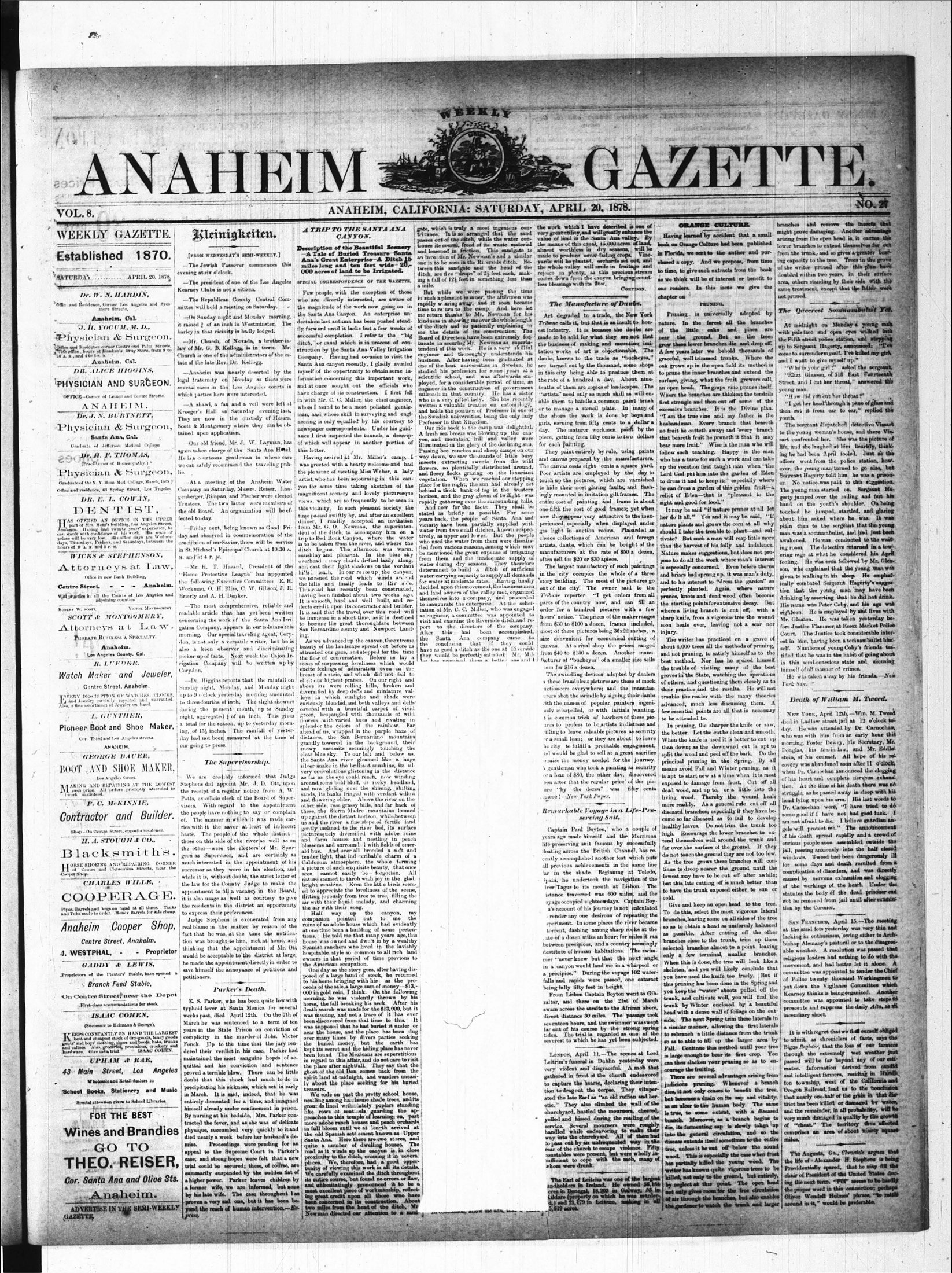
Searchable text
ANAHEIM
VOL. 8.
WEEKLY GAZETTE.
Established 1870.
SATURDAY... APRIL 20, 1878.
Dr. W. N. HARDIN,
Office and Residence, Corner Los Angeles and Sycamore Streets,
Anaheim, Cal.
J. H. YOCUM, M. D., Physician & Surgeon.
Office and Residence corner Centre and Palm Streets, with office, hours at Blanken's Drug Store, from 9 to 10 A.M., and 4 to 5 P.M.
Anaheim, Cal.
DR. ALICE HIGGINS, PHYSICIAN AND SURGEON.
OFFICE—Corner of Lennon and Centre Streets.
ANAHEIM.
Dr. J. N. BURTNETT, Physician & Surgeon,
Santa Ana, Cal.
Graduate of Jefferson Medical College
Dr. H. F. THOMAS, (Practitioner of Homoeopathy.)
Physician & Surgeon,
Kleinigkeiten.
[FROM WEDNESDAY'S SEMI-WEEKLY.]
The Jewish Passover commences this evening at six o'clock.
The president of one of the Los Angeles Kearney Clubs is not a citizen.
The Republican County Central Committee will hold a meeting on Saturday.
On Sunday night and Monday morning, it rained 2 of an inch in Westminster. The barley in that vicinity is badly lodged.
Mr. Church, of Nevada, a brother-in-law of Mr. G. B. Kellogg, is in town. Mr. Church is one of the administrators of the estate of the late Rev. Dr. Kellogg.
Anaheim was nearly deserted by the legal fraternity on Monday as there were several cases in the Los Angeles courts in which parties here were interested.
A shawl, a fan and a veil were left at Kroeger's Hall on Saturday evening last. They are now in the custody of Messrs. Scott & Montgomery where they can be obtained upon application.
Our old friend, Mr. J. W. Layman, has again taken charge of the Santa Ana Hotel. He is a courteous gentleman to whose care we can safely recommend the traveling public.
A TRIP TO THE CANYON.
Description of the Land:
A Tale of Buried Ana's Great Entire miles long and te 000 acres of land.
Few people, with who are directly into the magnitude of the w the Santa Ana Canyon dertaken last autumn hily forward until it lack successful completion. ditch," or canal which struc tion by the Santa Company. Having ha Santa Ana canyon receive myself of the opportunity formation concerning and at once sought o have charge of its con in with Mr. C. C. Mill whom I found to be a man, and whose skill neering is only equalled newspaper correspondence I first inspected th of which will appear this letter.
Having arrived at M was greeted with a he pleasure of meeting
PHYSICIAN AND SURGEON.
OFFICE—Corner of Lennon and Centre Streets.
ANAHEIM.
Dr. J. N. BURTNETT,
Physician & Surgeon,
Santa Ana, Cal.
Graduate of Jefferson Medical College
DR. H. F. THOMAS,
(Practitioner of Homoeopathy.)
Physician & Surgeon,
Graduate of the N.Y. Horn Med College, March, 1899)
Office and residence, 63 Spring Street, Los Angeles.
DR. E. L. COWAN,
DENTIST,
Has opened an office in the upper part of Mrs. Metz's building, Los Angeles Street, Anaheim. Having had twenty years' experience, he can speak with confidence of his work. His scale of prices will be very low. His office days are: Wednesdays, Thursdays, Fridays, and Saturdays, between the hours of 9 A.M. and 5 P.M.
WICKS & STEPHENSON,
Attorneys at Law,
Office in new Bank Building,
Centre Street, Anaheim.
Will practice in all the Courts of Los Angeles and adjoining counties.
ROBERT W. SCOTT.
VICTOR MONTGOMERY.
SCOTT & MONTGOMERY,
Attorneys at Law.
PROBATE BUSINESS A SPECIALTY.
Anaheim.
Los Angeles County, Cal.
R. LUFDKE.
Watch Maker and Jeweler,
Centre Street, Anaheim.
EVERY DESCRIPTION OF WATCHES, CLOCKS, AND JEWELRY carefully required and warranted. Also, a fine assortment of Jewelry on hand.
L. GUNTHER,
Pioneer Boot and Shoe Maker,
Cor. Third and Los Angeles streets.
ANAHEIM.
GEORGE BAUER,
BOOT AND SHOE MAKER,
Los Angeles Street.
MAKING AND REPAIRING AT THE LOWEST cash price. All orders promptly attended to work guaranteed.
P. C. McKINNIE,
Contractor and Builder.
Shop—On Centre Street, opposite residence.
H. A. STOUGH & CO., Blacksmiths.
HORSE SHOKING AND REPAIRING. CORNER of Centre and Clementina Streets, near the Cooper Shop.
CHARLES WILLE,
COOPERAGE.
The Supervisorship.
We are credibly informed that Judge Stephens did appoint Mr. J. D. Ott, upon the receipt of a regular notice from A. W. Potts, ex-officio clerk of the Board of Supervisors. With regard to the appointment the people have nothing to say or complain of. The manner in which it was made carries with it the savor at least of indecent haste. The people of the whole district—those on this side of the river as well as on the other—were the electors of Mr. Spurgeon as Supervisor, and are certainly as much interested in the appointment of his successor as they were in his election, and while it is, without doubt, the strict letter of the law for the County Judge to make the appointment to fill a vacancy in the Board, it is also usage as well as courtesy to give legal fraternity on Monday as there were several cases in the Los Angeles courts in which parties here were interested.
A shawl, a fan and a veil were left at Kroeger's Hall on Saturday evening last. They are now in the custody of Messrs. Scott & Montgomery where they can be obtained upon application.
Our old friend, Mr. J. W. Layman, has again taken charge of the Santa Ana Hotel. He is a courteous gentleman to whose care we can safely recommend the traveling public.
At a meeting of the Anaheim Water Company on Saturday, Messrs. Reiser, Langenberger, Rimpan, and Fischer were elected Trustees. The two latter were members of the old Board. An organization will be effected to-day.
Friday next, being known as Good Friday and observed in commemoration of the crucifixion of our Savior, there will be service in St. Michael's Episcopal Church at 10:30 A.M. and at 4 P.M.
Mr. H. T. Hazard, President of the "Home Protective League" has appointed the following Executive Committee: E. H. Workman, O. H. Bliss, C. W. Gibson, J. R. Brierly and A. H. Denker.
The most comprehensive, reliable and readable article that has yet been written concerning the work of the Santa Ana Irrigation Company, appears in our columns this morning. Our special traveling agent, Corydon, is not only a versatile writer, but he is also a keen observer and discriminating picker-up of facts. Next week the Cajon Irrigation Company will be written up by Corydon.
Dr. Higgins reports that the rainfall on Sunday night, Monday, and Monday night up to 9 o'clock yesterday morning amounted to three-fourths of inch. The slight showers during the present month, up to Sunday night, aggregated 1 of an inch. This gives a total for the season, up to yesterday morning, of 15 inches. The rainfall of yesterday had not been measured at the time of our going to press.
The Supervisorship.
We are credibly informed that Judge Stephens did appoint Mr. J. D. Ott, upon the receipt of a regular notice from A. W. Potts, ex-officio clerk of the Board of Supervisors. With regard to the appointment the people have nothing to say or complain of. The manner in which it was made carries with it the savor at least of indecent haste. The people of the whole district—those on this side of the river as well as on the other—were the electors of Mr. Spurgeon as Supervisor, and are certainly as much interested in the appointment of his successor as they were in his election, and while it is, without doubt, the strict letter of the law for the County Judge to make the appointment to fill a vacancy in the Board, it is also usage as well as courtesy to give legal fraternity on Monday as there were several cases in the Los Angeles courts in which parties here were interested.
A shawl, a fan and a veil were left at Kroeger's Hall on Saturday evening last. They are now in the custody of Messrs. Scott & Montgomery where they can be obtained upon application.
Our old friend, Mr. J. W. Layman, has again taken charge of the Santa Ana Hotel. He is a courteous gentleman to whose care we can safely recommend the traveling public.
At a meeting of the Anaheim Water Company on Saturday, Messrs. Reiser, Langenberger, Rimpan, and Fischer were elected Trustees. The two latter were members of the old Board. An organization will be effected to-day.
Friday next, being known as Good Friday and observed in commemoration of the crucifixion of our Savior, there will be service in St. Michael's Episcopal Church at 10:30 A.M. and at 4 P.M.
Mr. H. T. Hazard, President of the "Home Protective League" has appointed the following Executive Committee: E. H. Workman, O. H. Bliss, C.W.Gibson, J.R.Brierly and A.H.Denker.
The most comprehensive, reliable and readable article that has yet been written concerning the work of the Santa Ana Irrigation Company, appears in our columns this morning. Our special traveling agent, Corydon, is not only a versatile writer, but he is also a keen observer and discriminating picker-up of facts. Next week the Cajon Irrigation Company will be written up by Corydon.
Dr. Higgins reports that the rainfall on Sunday night, Monday, and Monday night up to 9 o'clock yesterday morning amounted to three-fourths of inch. The slight showers during the present month, up to Sunday night, aggregated 1 of an inch. This gives a total for the season, up to yesterday morning, of 15 inches. The rainfall of yesterday had not been measured at the time of our going to press.
The Supervisorship.
We are credibly informed that Judge Stephens did appoint Mr. J.D.Ott upon the receipt of a regular notice from A.W.Potts.ex-officio clerkoftheBoardofSupervisors.Withregardto,theappointmentthepeoplehave nothingtosayorcomplainof.Themannerinwhichitwasmadecarrieswithitthesavoratleastofindecenthaste.Thepeopleofthewholedistrict—thoseonthissideoftheriveraswellasontheother—weretheelectorsofMr.SpurgeonasSupervisor,andarecertinallyasmuchinterestedintheappointmentofhissuccessorastheywereinhiselection,andwhileitiswithoutdoubt,thestrictletterofthelawfortheCountyJudgetomaketheappointmenttolfillavacancyintheBoard.itisalsousageaswellascourtesytogivelegalfraternityontMondayastherewereseveralcasesintheLosAngelescourtsinwhichpartiesherewereinterested.
A shawl,a fanandaveilwereleftatKroeger'sHallonsaturdayevenlastTheyarenowinthecustodyofMessrs.Langenberger,Rimpan,andFischerwereelectedTrustees.Thetwo latterweremembersoftheoldBoard.Anorganizationwillbefeffectedto-day.
FridaynextbeingknownasGoodFridayandobservedincommemorationofthecrucifixionofoursaviortherewillbeserviceinSt.Michael'sEpiscopalChurchat10:30A.M.mandat4P.M.
Mr.H.T.HazardPresidentofthe"HomeProtectiveLeague"hasappointedthefollowingExecutiveCommittee:E.H.WorkmanO.H.BlossC.W.GibsonJ.R.BrierlyandA.H.Denker.
Themostcomprehensive,reliableandreadablearticlethathasyetbeenwrittenconcerningtheworkoftheSantaAniaIrrigationCompanyappearsinourcolumnsthismorning.Thespecialtravelingagent,Corydonisnotonlyaversatilewriterbutheisalsokeenobserveranddiscriminatingpicker-upoffacts.NextweektheCajonIrrigationCompanywillbewrittenupbyCorydon.
Dr.HigginsreportsthattherainfallonSundaynight,Monday,andMondaynightupto9o'clockyesterdaymorningamountedtothree-fourthsofinch.Theslightshowersduringthepresentmonth.uptoSundaynightaggregated1ofaninchThisgivesatotalfortheseasonuptoyesterdaymorningof15inches.Therainfallyesterdayhadnotbeenmeasuredatthetimeofourgoingtopress.
TheSupervisorship.
WearecrediblyinformedthatJudgeStephensdidappointMr.J.D.OttuponthereceiptofaregularnoticefromA.W.Potts.ex-officioclerkoftheBoardofSupervisors.Withregardto,theappointmentthepeoplehave nothingtosayorcomplainof.Themannerinwhichitwasmadecarrieswithitthesavoratleastofindecenthaste.Thepeopleofthewholedistrict—thoseonthissideoftherriveraswellasontheother—weretheelectorsofMr.SpurgeonasSupervisor,andarecerticallyasmuchinterestedintheappointmentofhissuccessorastheywereinhiselection,andwhileitiswithoutdoubt,thestrictletterofthelawfortheCountyJudgetomaketheappointmenttolfillavacancyintheBoard.itisalsousageaswellascourtesytogivelegalfraternityontMondayastherewereseveralcasesintheLosAnglescourtsinwhichpartiesherewereinterested.
A shawl,a fanandaveilwereleftatKroeger'sHallonsaturdayevenlastTheyarenowinthecustodyofMessrs.Langenberger,Rimpan,andFischerwereelectedTrustees.Thetwo latterweremembersoftheoldBoard.Anorganizationwillbefeffectedto-day.
FridaynextbeingknownasGoodFridayandobservedincommemorationofthecrucifixionofoursaviortherewillbe服务在St.Michael'sEpiscopalChurchat10:30A.M.mandat4P.M.
Mr.H.T.HazardPresidentofthe"HomeProtectiveLeague"hasappointedthefollowingExecutiveCommittee:E.H.WorkmanO.H.BlossC.W.GibbonJ.R.BrierlyandA.H.Denker.
Themostcomprehensive,reliableandreadablearticlethathasyetbeenwrittenconcerningtheworkoftheSantaAniaIrrigationCompanyappearsinourcolumnsthismorning.Thespecialtravelingagent,Corydonisnotonlyaversatilewriterbutheisalsokeenobserveranddiscriminatingpicker-upoffacts.NextweektheCajonIrrigationCompanywillbewrittenupbyCorydon.
Dr.HigginsreportsthattherainfallonSundaynight,Monday,andMondaynightupto9o'clockyesterdaymorningamountedtothree-fourthsofinch.Theslightshowersduringthepresentmonth.uptoSundaynightaggregated1ofaninchThisgivesatotalfortheseasonuptoyesterdaymorningof15inches.Therainfallyesterdayhadnotbeenmeasuredatthetimeofourgoingtopress。
TheSupervisorship.
WearecrediblyinformedthatJudgeStephensdid appointMr.J.D.OttuponthereceiptofaregularnoticefromA.W.Potts.ex-officioclerkoftheBoardofSupervisors.Withregardto,theappointmentthepeoplehave nothingtosayorcomplainof.Themannerinwhichitwasmadecarrieswithitthesavoratleastofindecenthaste.Thepeopleofthewholedistrict—thoseonthissideoftherriveraswellasontheother—weretheelectorsofMr.SpurgeonasSupervisor,andarecerticallyasmuchinterestedintheappointmentofhissuccessorastheywereinhiselection,andwhileitiswithoutdoubt,thestrictletterofthelawfortheCountyJudgetomaketheappointmenttolfillavacancyintheBoard.itisalsousageaswellascourtesytogivelegalfraternityontMondayastherewereseveralcasesintheLosAnglescourtsinwhichparties herewereinterested.
A shawl,a fanandaveilwereleftatKroeger'sHallonsaturdayevenlastTheyarenowinthecustodyofMessrs.Langenberger,Rimpan,andFischerwereelectedTrustees.Thetwo latterweremembersoftheoldBoard.An Organizationwillbefeffectedto-day.
FridaynextbeingknownasGoodFridayandobservedincommemorationofthecrucifixionofoursaviortherewillbe服务在St.Michael'sEpiscopalChurchat10:30A.M.mandat4P.M.
Mr.H.T.HazardPresidentofthe"HomeProtectiveLeague"hasappointedthefollowingExecutiveCommittee:E.H.WorkmanO.H.BlossC.W.GibbonJ.R.BrierlyandA.H.Denker.
Themostcomprehensive,reliableandreadablearticlethathasyetbeenwrittenconcerningtheworkoftheSantaAniaIrrigationCompanyappearsinourcolumnsthismorning.Thespecialtravelingagent,Corydonisnotonlyaversatilewriterbutheisalsokeenobserveranddiscriminatingpicker-upoffacts.NextweektheCajonIrrigationCompanywillbewrittenupbyCorydon.
Dr.HigginsreportsthattherainfallonSundaynight,Monday,andMondaynightupto9o'clockyesterdaymorningamountedtothree-fourthsofinch.Theslightshowersduringthepresentmonth.uptoSundaynightaggregated1ofaninchThisgivesatotalfortheseasonuptoyesterdaymorningof15inches.Therainfallyesterdayhadnotbeenmeasuredatthetimeofourgoingtopress。
P. C. McKINNIE,
Contractor and Builder.
H. A. STOUGH & CO., Blacksmiths.
HORSE SHOEING AND REPAIRING. CORNER of Centre and Climentina Streets, near the Cooper Shop.
CHARLES WILLE, COOPERAGE.
Pipes, Barrels and kegs on hand at all times. Tanks and Tubs made to order. Honey Barrels for sale cheap.
Anaheim Cooper Shop, Centre Street, Anaheim.
J. WESTPHAL, Proprietor
GADDY & LEWIS,
Proprietors of the Planters' Stable, have opened a Branch Feed Stable, On Centre Street, near the Depot First-class accommodations for stock.
ISAAC COHEN,
(Successor to Heimann & George).
KEEPS CONSTANTLY ON HAND THE LARGEST best and cheapest stock of dry goods, fancy goods greens' and boys' clothing, shoes and boots, hats, trunks and vests. Also, groceries, provisions, crockery and hardware. Give me a trial.
UPHAM & RAE,
43 Main Street, Los Angeles
Wholesale and Retail dealers in School Books, Stationery and Music
Special attention given to School Libraries.
FOR THE BEST Wines and Brandies GO TO THEO. REISER, Cor. Santa Ana and Olive Sts. Anaheim.
ADVERTISE IN THE SEMI-WEEKLY GAZETTE.
Potts, oxoduro clerk of the Board of Supervisors. With regard to the appointment the people have nothing to say or complain of. The manner in which it was made carries with it the savor at least of indecent haste. The people of the whole district—those on this side of the river as well as on the other—were the electors of Mr. Spurgeon as Supervisor, and are certainly as much interested in the appointment of his successor as they were in his election, and while it is, without doubt, the strict letter of the law for the County Judge to make the appointment to fill a vacancy in the Board, it is also usage as well as courtesy to give the residents in the district an opportunity to express their preferences.
Judge Stephens is exonerated from any real blame in the matter by reason of the fact that he was, at the time the notification was brought to him, sick at home, and thinking that the appointment of Mr. Ott would be acceptable to the district at large, he made the appointment directly in order to save himself the annoyance of petitions and petitioners.
Parker's Death.
E. S. Parker, who has been quite low with typhoid fever at Santa Monica for several weeks past, died April 12th. On the 7th of March he was sentenced to a term of ten years in the State Prison on conviction of complicity in the murder of John Victor Fonek. Up to the time that the jury rendered their verdict in his case, Parker had maintained the most sanguine hopes of acquittal and his conviction and sentence proved a terrible blow. There can be little doubt that this shock had much to do in precipitating his sickness; which set in early in March. It is said, indeed, that he was entirely demented for a time, and imagined himself already under confinement in prison. By nursing at his bedside, Mrs. Parker contracted the fever, and as she was of delicate physique, succumbed very quickly to it and died nearly a week before her husband's demise. Proceedings were pending for an appeal to the Supreme Court in Parker's case; and strong hopes were felt that a new trial could be secured; these, of course, are summarily suspended by the sudden fiat of a higher power. Parker leaves children by a former wife, we are informed, but none by his late wife. The case throughout last proven a very sad one, but it has been beyond the reach of human intervention. Ex-press,
Half way up companion pointed ruins of an adobe house at one time been a burial site. He told me that house was owned and Spanish rancho where hospitable style so owners in that peri- cation the American occupants.
One day so the store posed of a large banquet to his home bringing ceeds of the sale, a lair 000 in gold coin. I thou-morning, he was vi- horse, the fall break- death search was ma- was missing, and not been discovered from was supposed that he near the house, and over many times by the buried money, kept its secret and t- been found The Me- in regard to this affair the place after night ghost of the old Dou- spirit land at midnight about the place treasure.
We rode on past nestling among ha- grounds lined with like rows of sentil- proaches to this tem- more adobe ranch hie in full bloom until w- the old Spanish settla Santa Ana. Here t-quite a number o- road as it winds up proximity to the dit- places. We theref unty of viewing th- We carefully exami- its entire course, but and unhesitatingly most excellent piece ing great credit upon been concerned in two miles from the Newman directed o-
A TRIP TO THE SANTA ANA CANYON.
Description of the Beautiful Scenery
— A Tale of Buried Treasure — Santa Ana's Great Enterprise — A Ditch 15 miles long and ten feet wide — 20,000 acres of land to be Irrigated.
SPECIAL CORRESPONDENCE OF THE WAZETTE.
Few people, with the exception of those who are directly interested, are aware of the magnitude of the work now going on in the Santa Ana Canyon. An enterprise undertaken last autumn has been pushed steadily forward until it lacks but a few weeks of successful completion. I refer to the "big ditch," or canal which is in process of construction by the Santa Ana Valley Irrigation Company. Having had occasion to visit the Santa Ana canyon recently, I gladly availed myself of the opportunity to obtain some information concerning this important work, and at once sought out the officials who have charge of its construction. I first fell in with Mr. C. C. Miller, the chief engineer, whom I found to be a most polished gentleman, and whose skill in surveying and engineering is only equalled by his courtesy to newspaper correspondents. Under his guidance I first inspected the tunnels, a description of which will appear in another portion of this letter.
Having arrived at Mr. Miller's camp, I was greeted with a hearty welcome and had the pleasure of meeting Miss Weber, a lady gate, which is truly a most ingenious contrivance. It is so arranged that the sand passes out of the ditch, while the water continues its course, freed of its waste material and leased in friction. This sandgate is an invention of Mr. Newman's and a similar one is to be seen in the Riverside ditch. Between this sandgate and the head of the ditch, are five "drops" of 2½ feet each, making a fall of 12½ feet in something less than a mile.
But while we were passing the time in such a pleasant manner, the afternoon was rapidly waring away, and it soon became time to return to the camp. And here let me return thanks to Mr. Newman for his kindness in showing me over the whole length of the ditch and so patiently explaining to me the details of its construction. The Board of Directors have been extremely fortunate in securing Mr. Newman as superintendent of this work. He is a very skillful engineer and thoroughly understands his business. After having been graduated at one of the best universities in Sweden, he studied his profession for some years at a scientific school, and was afterwards employed, for a considerable period of time, as engineer in the construction of government railroads in that country. He has a sister who is a very gifted lady. She has recently written a valuable treatise on entomology, and holds the position of Professor in one of the Swedish universities, being the only lady Professor in that Kingdom.
Our ride back to the camp was delightful. A fresh sea breeze was blowing up the canyon, and mountain, hill and valley were illuminated in the glory of the declining sun. Passing bee ranches and sheep camps on our way down, we saw thousands of little busy insects extracting sweets from the wild flowers, so plentifully distributed around, and fleecy flocks grazing on the luxuriant work which I have described is one of very great utility, and will greatly enhance the value of land in the Santa Ana valley. By the means of this canal, 15,000 acres of land, almost worthless in dry seasons, will be made to produce never-failing crops. Vineyards will be planted, orchards set out, and the whole valley will smile in fruitage and rejoice in plenty, as this precious stream comes down from the canyon bringing countless blessings with its flow.
CORYDON.
The Manufacture of Danbs.
Art degraded to a trade, the New York Tribune calls it, but that is an insult to honest industry. It is because the daubs are made to be sold for what they are not that the business of making and mounting imitation works of art is objectionable. The daubs, known to the trade as "buckeyes," are turned out by the thousand, some shops in this city being able to produce them at the rate of a hundred a day. About nine-tenths of them are copies of landscapes. The "artists" need only so much skill as will enable them to handle a common paint brush or to manage a stencil plate. In many of the shops the work is done by boys and girls, earning from fifty cents to a dollar a day. The maturer workmen paint by the piece, getting from fifty cents to two dollars for each painting.
They paint entirely by rule, using paints and canvas prepared by the manufacturers. The canvas costs eight cents a square yard. Poor artists are employed by the day to
formation concerning this important work, and at once sought out the officials who have charge of its construction. I first fell in with Mr. C. B. Miller, the chief engineer, whom I tound to be a most polished gentleman, and whose skill in surveying and engineering is only equalled by his courtesy to newspaper correspondents. Under his guidance I first inspected the tunnels, a description which will appear in another portion of this letter.
Having arrived at Mr. Miller's camp, I was greeted with a hearty welcome and had the pleasure of meeting Miss Weber, a lady artist, who has been sojourning in this canyon for some time taking sketches of the magnificent scenery and lovely picturesque views, which are so frequently to be seen in this vicinity. In such pleasant society the time passed swiftly by, and after an excellent dinner, I readily accepted an invitation from Mr. G. O. Newman, the superintendent of the ditch, to accompany him on a trip to Bed Rock Canyon, where the water is to be taken from the river, and where the ditch begins. The afternoon was warm, sunshiny and pleasant. In the blue sky overhead snow clouds drifted lazily along, and cast their light shadows on the verdant hills. In our rote up the canyon, we pursued the road which winds around the hills and finally leads to Riv side. This road has recently been constructed, having been finished about two weeks ago. It is smooth, hard and well built, and reflects credit upon its constructor and builder. It is said that the travel over this road will be immense in a short time, as it is destined to become the great thoroughfare between San Bernardino county and Newport Landing.
As we advanced up the canyon, the extreme beauty of the landscape spread out before us attracted our gaze, and stopped for the time flow of conversation. Before us lay a scene of surpassing loveliness which would excite feelings of admiration even in the breast of a stoic, and which did not fail to elicit our highest praises. On our right and above us were rolling hills, broken and diversified by deep dells and miniature valleys in which sunlight and shade were curiously blended, and both valleys and dels covered with a beautiful carpet of vivid green, bespangled with thousands of wild flowers with varied hues and rivaling in splendor the colors of the rainbow. Far ahead of us, wrapped in the purple haze of distance, the San Bernardino mountains grandly towered in the background, their snowy summits seemingly touching the clear blue sky. To our left and below us, the Santa Ana river gleamed like a huge silver snake in the brilliant sunshine, its silvery convolutions glistening in the distance as far as the eye could reach, now winding around some bold bluff, or rocky headland, and now gliding over the shining, shifting sands, its banks fringed with vendant willow and flowering elder. Above the river on the other side, rose grassy hills, and far back of these, the Sierra Madre mountains loomed up against the distant horizon, while between us and the river a fine slope of fertile land gently inclined to the river bed, its surface picturesquely diversified with adobe ruins and farm houses and nestling in peach blossoms and surrounded with fields of emerald hue. And over all brooded a soft and tender light, that indescribable charm of a California atmosphere, the whole forming a picture of such exquisite beauty, that once seen cannot easily be forgotten. All nature seemed to throb with joy in the glad bright sunshine. Even the little birds seemed to appreciate the loveliness of the scene, flitting joyously from tree to tree, filling the scientific school, and was afterwards employed, for a considerable period of time, as engineer in the construction of government railroads in that country. He has a sister who is a very gifted lady. She has recently written a valuable treatise on entomology, and holds the position of Professor in one of the Swedish universities, being the only lady Professor in that Kingdom.
Our ride back to the camp was delightful. A fresh sea breeze was blowing up the canyon, and mountain, hill and valley were illuminated in the glory of the declining sun. Passing bee ranches and sheep camps on our way down, we saw thousands of little insects extracting sweets from the wild flowers, so plentifully distributed around, and fleecy flocks grazing on the laxurian vegetation. When we reached our stopping place for the night, the sun had already set behind a thick bank of fog in the western horizon, and the gray gloom of twilight was rapidly gathering over the surrounding hills.
And now for the facts. They shall be stated as briefly as possible. For some years back, the people of Santa Ana and vicinity have been partially supplied with water from two small ditches, known respectively, as upper and lower. But the people who used the water from them were dissatisfied from various reasons, among which may be mentioned the great expense of irrigating from them and the inadequate supply of water during dry seasons. They therefore determined to build a ditch of sufficient water-carrying capacity to supply all demands for water at moderate rates. Having finally decided upon this movement, the business men and land owners of the valley met, organized themselves into a company, and proceeded to inaugurate the enterprise. At the solicitation of Mr. C. C. Miller, who was engaged as engineer, a committee was appointed to visit and examine the Riverside ditch,and report to the directors of the company. After this had been accomplished,the Santa Ana company came to the conclusion that if they could have as good a ditch as the one at Riverside they would be perfectly satisfied. Mr. Milton has promised them a better one and I
The largest manufactory of such paintings in the city occupies the whole of a three story building. The most of the pictures go out of the city. The owner said to the Tribune reporter: "I get orders from all parts of the country now, and can fill an order for a hundred pictures with a few hours' notice." The prices of the makeerranges from $30 to $100 a dozen, frames included, most of these pictures being 36x22 inches,a size convenient for economical cutting of canvas. At a rival shop the prices ranged from $40 to $150 a dozen. Another manufacturer of "buckeyes" of a smaller size sells them for $16 a dozen.
The swindling devices adopted by dealers are these fraudulent pictures are those of mock auctioneers everywhere; and the manufacturers abet the swindle by signing their daubs with the names of popular painters ingeniously misspelled, or with initials wanting it is common trick of hawkers of these pictures to profess to be artists in distress andilling to leave valuable pictures as security or a small loan; or they are about to leavebe city to fulfill a profitable engagement,and would be glad to sell at a great sacrificeo raise the money needed for the journey.A gentleman who took a painting as securityor a loan of $80,the other day,discoveredoon after thatthe regular priceofthe picture"bythedozen"was fifty centspiece!—New York Paper.
Remarkable Voyage in a Life-Preserving Suit.
Captain Paul Boyton, who a couple of years ago made himself and the Merriman life-preserving suit famous by successfully floating across the British Channel,has recently accomplished another feat which puts all previous achievements in the same linefar in the shade.Beginning at Toledo,Spainhe undertookthe navigationofthe River Tagusto its mouth at Lisbon.Theistance traversed was 600 miles,andthe
Remarkable Voyage in a Life-Preserving Suit.
Captain Paul Boyton, who a couple of years ago made himself and the Merriman life-preserving suit famous by successfully floating across the British Channel, has recently accomplished another feat which puts all previous achievements in the same line far in the shade. Beginning at Toledo, Spain, he undertook the navigation of the river Tagus to its mouth at Lisbon. The distance traversed was 600 miles, and the voyage occupied eighteewdays. Captain Boyton's account of his journey is not calculated to render any one desirous of repeating the experiment. In some places the river became torrent, dashing among sharp rocks at the rate of a dozen miles an hour; for miles it ran between precipices, and a country seemingly destitute of human habitations. The swimmer "never knew but that the next angle in a canyon would land me in a whirpool or a precipice." During the voyage 102 waterfalls and rapids were passed, one cataract being fully fifty feet in height.
From Lisbon Captain Boyton went to Gibraltar, and there on the 21st of March swim across the straits to the African shore, direct distance 30 miles. The passage took seventeen hours, and the swimmer was swept far out of his course by the strong spring tides. The trial is regarded as one of the severest to which he has yet been subjected.
London, April 11.—The scenes at Lord Leitrim's funeral in Dublin yesterday were very violent and disgraceful. A mob that gathered in front of the church endeavored to capture the hearse, declaring their intention to drag out the corpse. They vituperated the late Karl as "an old ruffian and heretic." They also climbed the wall of the churchyard, hustled the mourners, cheered, yelled and hissed during the reailing of the service. Several mourners were roughly handled while endeavoring to make their way into the churchyard. All of them had to pass out by an unfrequented way in the rear of the church to escape violence. Fifty constables were present, but were wholly insufficient to cope with the mob, many of whom were drunk.
The Earl of Leitrim was one of the largest landholders in Ireland. He owned 56,184 acres in Donegal, 18,203 in Galway, 53 in Kildare (property on which he was merited) and 21,179 in Leitrim, making in all 3,619 acres.
GAZETTE.
NO. 27
ORANGE CULTURE.
Having learned by accident that a small book on Orange Culture had been published in Florida, we sent to the author and purchased a copy. And we propose, from time to time, to give such extracts from the book as we think will be of interest or benefit to our readers. In this issue we give the chapter on PRUNING.
Pruning is universally adopted by nature. In the forest all the branches of the little oaks and pines are near the ground. But as the trees grow these lower branches die and drop off. A few years later we behold thousands of graceful, well trimmed trunks. Where the oak grows up in the open field its method is to prune the inner branches and extend the surface, giving what the fruit growers call, an open head. The grape vine prunes itself. Where the branches are thickest the tendrils first strangle and then cut off some of the excessive branches. It is the Divine plan. "I am the true vine and my father is the husbandman. Every branch that beareth no fruit he cutteth away; and every branch that beareth fruit he pruneth it that it may bear more fruit." Wise is the man who will follow such teaching. Happy is the man who has a taste for such a work and can take up the vocation first taught man when "the Lord God put him into the garden of Eden branches and remove the insects that might prove damaging. Another advantage arising from the open head is, it canes the lower branches to extend themselves far out from the trunk, and so gives a greater bearing capacity to the tree. Trees in the grove of the writer pruned after this plan have doubled within two years, in their surface area, others standing by their side with the same treatment, except that the latter were not pruned.
The Queerest Sonnambulist Yet.
At midnight on Monday a young mah with pale face and open eyes walked into the Fifth street police station, and stepping up to Sergeant Hagerty, announced: "I've come to surrender myself. I've killed my girl, and I want to give myself up."
"Who is your girl?" asked the sergeant.
"Eliza Gleason, of 516 East Fourteenth Street, and I cut her throat," answered the young man.
"How did you cut her throat?"
"I got her head through a pane of glass and then cut it from ear to ear," replied the youth.
The sergeant dispatched detective Vissart to the young woman's house, and there Vissart confronted her. She was the picture of life, and she laughed at him heartily, thinking he had been April fooled. Just as the officer went from the police station, however, the young man turned to go also, but Sergeant Hagerty told him he was a prisoner.
by rule, using paints by the manufacturers. The much skill as will ename common paint brush plate. In many of is done by boys and may cents to a dollar a workmen paint by the few cents to two dollars.
by rule, using paints by the manufacturers. The much skill as will ename common paint brush plate. In many of is done by boys and may cents to a dollar a workmen paint by the few cents to two dollars.
history of such paintings the whole of a three most of the pictures go owner said to the I get orders from all know, and can fill an pictures with a few pieces of the makerranges frozen, frames included, being 36x22 inches, a economical cutting of shop the prices ranged frozen. Another manu- of a smaller size sells pictures adopted by dealers pictures are those of mock here; and the manufacute by signing their daubs popular painters ingenious with initials wanting of hawkers of these picc-artists in distress and able pictures as security they are about to leave profitable engagement, sell at a great sacrifice needed for the journey. Ask a painting as security another day, discovered regular price of the picture" was fifty cents paper.
usage in a Life-Preggy Suit.
inton, who a couple of self and the Merriman famous by successfully British Channel, has re-another feat which puts elements in the same line Beginning at Toledo, k the navigation of the south at Lisbon. The was 600 miles, and the
pruning, the sharper the knife or saw, the better. Let the cut be clean and smooth. When the knife is used it is better to cut up than down; as the downward cut is apt to split the wood and peel off the bark. Do the principal pruning in the Spring. By all means avoid Fall and Winter pruning, as it apt to start new at a time when it is most exposed to damage from frost. Cut off all dead wood, and up to, or a little into the living wood. Thereby the wound heals more readily. As a general rule cut off all diseased branches; especially if they have become so far diseased as to fail to develop healthy leaves. Do not trim the trunk too high. Encourage the lower branches to extend themselves well around the trunk and far over the surface of the ground. If they do not touch the ground they are not too low. As the tree grows these branches will continue to droop nearer the ground until the lowest may have to be cut off after awhile; but this late cutting off is much better than to have the trunk exposed either to sun or cold.
"Eliza Gleason, of 516 East Fourteenth Street, and I cut her throat," answered the young man.
"How did you cut her throat?"
"I got her head through a pane of glass and then cut it from ear to ear," replied the youth.
The sergeant dispatched detective Vissart to the young woman's house, and there Vissart confronted her. She was the picture of life, and she laughed at him heartily, thinking he had been April fooled. Just as the officer went from the police station, however, the young man turned to go also, but Sergeant Hagerty told him he was a prisoner. No notice was paid to this suggestion. The young man started on. Sergeant Hagerty jumped over the railing and but his hand on the youth's shoulder. On being touched he jumped, startled, and glaring about him asked where he was. It was plain then to the sergeant that the young man was a somnambulist, and had just been awakened. He was conducted to the waiting room. The detective returned in a towering rage at what he considered his April fooling. He was soon followed by Mr. Gleason, who explained that the young man was given to walking in his sleep. He emphatically combated Sergeant Hagerty's suggestion that the young man may have been drinking by asserting that he did not drink. His name was Peter Coby, and his age was eighteen. He is employed by and lives with Mr. Gleason. He was taken yesterday before Justice Flammer, at Essex Market Police Court. The Justice took considerable interest in him, having been a somnambulist himself. Numbers of young Coby's friends testified that he was in the habit of going about in this semi-conscious state and accusing himself of all manner of crimes.
He was taken away by his friends.—New York Sun.
Death of William M. Tweed.
New York, April 12th.—Wm. M. Tweed died in Laddow street jail at 12 o'clock today. He was attended by Dr. Carnochan, who was with him from an early hour this morning, Foster Dewey, his Secretary, Mr. Douglas, his son-in-law, and Mr. Eddlestein, of his counsel. All hope of his recovery was abandoned soon after 11 o'clock, when Dr. Carnochan announced the clogging of his heart and complete nervous exhaustion. At the time of his death there was no struggle, as he passed away in sleep with his head lying upon his arm. His last words to Dr. Carnochan were, "I have tried to do some good if I have not had good luck. I am not afraid to die. I believe guardian angels will protect me." The announcement of his death spread rapidly and a crowd of curious people soon assembled outside the jail, poering anxiously into the half closed windows. Tweed had been dangerously ill for some days and death resulted from a complication of disorders, and was directly caused by nervous exhaustion and clogging of the workings of the heart. Under the statutes the body of the dead prisoner can
Boston, who a couple of self and the Merriman famous by successfully British Channel, has re-another feat which puts elements in the same line Beginning at Toledo, took the navigation of the south at Lisbon. The was 600 miles, and the beeways. Captain Boytourney is not calculated desirous of repeating the places the river became among sharp rocks at the can hour; for miles it ran and a country seemingly habitations. The swim that the next angle and me in a whirpool or the voyage 102 water were passed, one cataract in height.
Boyton went to Gibbon the 21st of March its to the African shore, miles. The passage took the swimmer wasswept by the strong spring regarded as one of the has yet been subjected.
The scenes at Lord Dublin yesterday were misgraceful. A mob that the church endeavored, declaring their inten- corpse. They vituper- "an old ruffian and her limbed the wall of the mourners, cheered, during the reading of the mourners were roughly beavoring to make their yard. All of them had frequented way in the escape violence. Fifty went, but were wholly with the mob, many of
There are several advantages arising from judicious pruning. Whenever a branch dies, it not only ceases to benefit the tree, but becomes a drain on its sap and vitality, as an ulcer to the human body. The same is true, to some extent, with a diseased branch. Moreover, as a branch begins to die, its fermenting sap is slowly taken up into the general circulation, and so the disease extends itself sometimes to the entire tree, unless it be eut off below the sound wood. This is especially the case when frost has partially killed the young wood. The writer has known quite vigorous trees to be killed, not only to the ground, but entirely, by neglect at this point. The open head not only gives room for the free circulation of air through the branches, but also enables the gardener to watch the trunk and larger more readily. As a general rule cut off all diseased branches; especially if they have become so far diseased as to fail to develop healthy leaves. Do not trim the trunk too high. Encourage the lower branches to extend themselves well around the trunk and far over the surface of the ground. If they do not touch the ground they are not too low.
As the tree grows these branches will continue to droop nearer the ground until the lowest may have to be cut off after awhile; but this late cutting off is much better than to have the trunk exposed either to sun or cold.
Give and keep an open head to the tree. To do this, select the most vigorous lateral branches, leaving some on all sides of the tree so as to obtain a head as uniformly balanced as possible. After cutting off the other branches close to the trunk, trim up these selected branches almost to a point leaving only a few terminal, smaller branches. When this is done, the tree will look like a skeleton, and you will likely conclude that you have used the knife too freely. But if this pruning has been done in the Spring and you keep the "water" shoots pulled off the trunk, and cultivate well, you will find the trunk by Winter enclosed by a beautiful head with a dense wall of foliage on the outside. The next Spring trim these laterals in a similar manner, allowing the first laterals to rebranch a little distance from the trunk so as to able to fill up the larger area by Fall. Continue this method until your tree is large enough to bear its first crop. You can then slacken your pruning so as to encourage the fruiting.
There are several advantages arising from judicious pruning. Whenever a branch dies, it not only ceases to benefit the tree, but becomes a drain on its sap and vitality, as an ulcer to the human body. The same is true, to some extent, with a diseased branch. Moreover, as a branch begins to die, its fermenting sap is slowly taken up into the general circulation, and so the disease extends itself sometimes to the entire tree, unless it be eut off below the sound wood. This is especially the case when frost has partially killed the young wood. The writer has known quite vigorous trees to be killed, not only to the ground, but entirely, by neglect at this point. The open head not only gives room for the free circulation of air through the branches, but also enables the gardener to watch the trunk and larger more readily. As a general rule cut off all diseased branches; especially if they have become so far diseased as to fail to develop healthy leaves. Do not trim the trunk too high. Encourage the lower branches to extend themselves well around the trunk and far over the surface of the ground. If they do not touch the ground they are not too low.
As the tree grows these branches will continue to droop nearer the ground until the lowest may have to be cut off after awhile; but this late cutting off is much better than to have the trunk exposed either to sun or cold.
Give and keep an open head to the tree. To do this, select the most vigorous lateral branches, leaving some on all sides of the tree so as to obtain a head as uniformly balanced as possible. After cutting off the other branches close to the trunk, trim up these selected branches almost to a point leaving only a few terminal, smaller branches. When this is done, the tree will look like a skeleton, and you will likely conclude that you have used the knife too freely. But if this pruning has been done in the Spring and you keep the "water" shoots pulled off the trunk, and cultivate well, you will find the trunk by Winter enclosed by a beautiful head with a dense wall of foliage on outside. The next Spring trim these laterals in a similar manner, allowing the first laterals to rebranch a little distance from the trunk so as to able to fill up the larger area by Fall. Continue this method until your tree is large enough to bear its first crop. You can then slacken your pruning so as to encourage the fruiting.
There are several advantages arising from judicious pruning. Whenever a branch dies, it not only ceases to benefit the tree, but becomes a drain on its sap and vitality, as an ulcer to the human body. The same is true, to some extent, with a diseased branch. Moreover, as a branch begins to die, its fermenting sap is slowly taken up into the general circulation, and so the disease extends itself sometimes to the entire tree, unless it be eut off below the sound wood. This is especially the case when frost has partially killed the young wood. The writer has known quite vigorous trees to be killed, not only to the ground, but entirely, by neglect at this point. The open head not only gives room for the free circulation of air through the branches, but also enables the gardener to watch the trunk and larger more readily. As a general rule cut off all diseased branches; especially if they have become so far diseased as to fail to develop healthy leaves. Do not trim the trunk too high. Encourage the lower branches to extend themselves well around the trunk and far over the surface of the ground. If they do not touch the ground they are not too low.
As the tree grows these branches will continue to droop nearer the ground until the lowest may have to be cut off after awhile; but this late cutting off is much better than to have the trunk exposed either to sun or cold.
Give and keep an open head to the tree. To do this, select the most vigorous lateral branches, leaving some on all sides of the tree so as to obtain a head as uniformly balanced as possible. After cutting off the other branches close to the trunk, trim up these selected branches almost to a point leaving only a few terminal, smaller branches. When this is done, the tree will look like a skeleton, and you will likely conclude that you have used the knife too freely. But if this pruning has been done in the Spring and you keep the "water" shoots pulled off the trunk, and cultivate well, you will findthe trunk by Winter enclosed by a beautiful head with a dense wall of foliage on outside. The next Spring trim these laterals in a similar manner, allowingthe first laterals to rebranch a little distance fromthe trunk so as to able to fill upthe larger area by Fall. Continue this method until your tree is large enough to bear its first crop. You can then slacken your pruning so as to encouragethe fruiting.
There are several advantages arising from judicious pruning. Whenever a branch dies, it not only ceases to benefitthe tree, but becomesa drain onits sap and vitality,as an ulcerto theremainbody.The sameistrue,tosomeextentwithadiseasedbranch.Moreover,abranchbeginstodie,thefetmentingapislowlytakenupintothegeneralcirculation,andsothediseaseextendsitselfsometimestotheentiretree.unlessitbeeutoffbelowthesoundwood.Thisespeciallythecasewhenfrosthaspartiallykilledtheyoungwood.Thewriterhasknownquitevigoroustreestobekillednotonlytothegroundbutentirebyneglectatthispoint.Theopenheadnotonlygivesroomfortherefecirculationofairthroughthebranchesbutalsoenablesthedardensertowatchthetrunkandlargermorereadonly.AchroniclersoffactssaystheBiggsRegisterthatthelossofourfarmersthroughtheextremelywetweatherjustpassedwillbefar beyondanyofourestimates.Informationderivedfromcandidandintelligentfarmersresidinginhamiltontownship.westoftheCaliforniaandOregonRailroadleadustotheconclusionthatnearlyone-halfofthegraininthatdistricthasbeenkilledordamagedbywater,andthe remainder.inallprobability.willverymuchdamagedinqualitybythegrowthof"cheat."Theterritorythusaffectedcomprisesanareaofaboutninetysquaremiles.
The Augusta,Ga.,Chronicle argues thatthelifeofAlexanderH.StephensisbeingProvidentiallysparedthathemayfillthechairofPresidentoftheUnitedStatesduringthenextterm.“Fifff”seemstobehardlytheproperwordinthisconnection;perhapsOliverWendellHolmes’phrase,"torattlearoundinit,”wouldbepreferable.