anaheim-gazette 1878-03-23
Scanned page
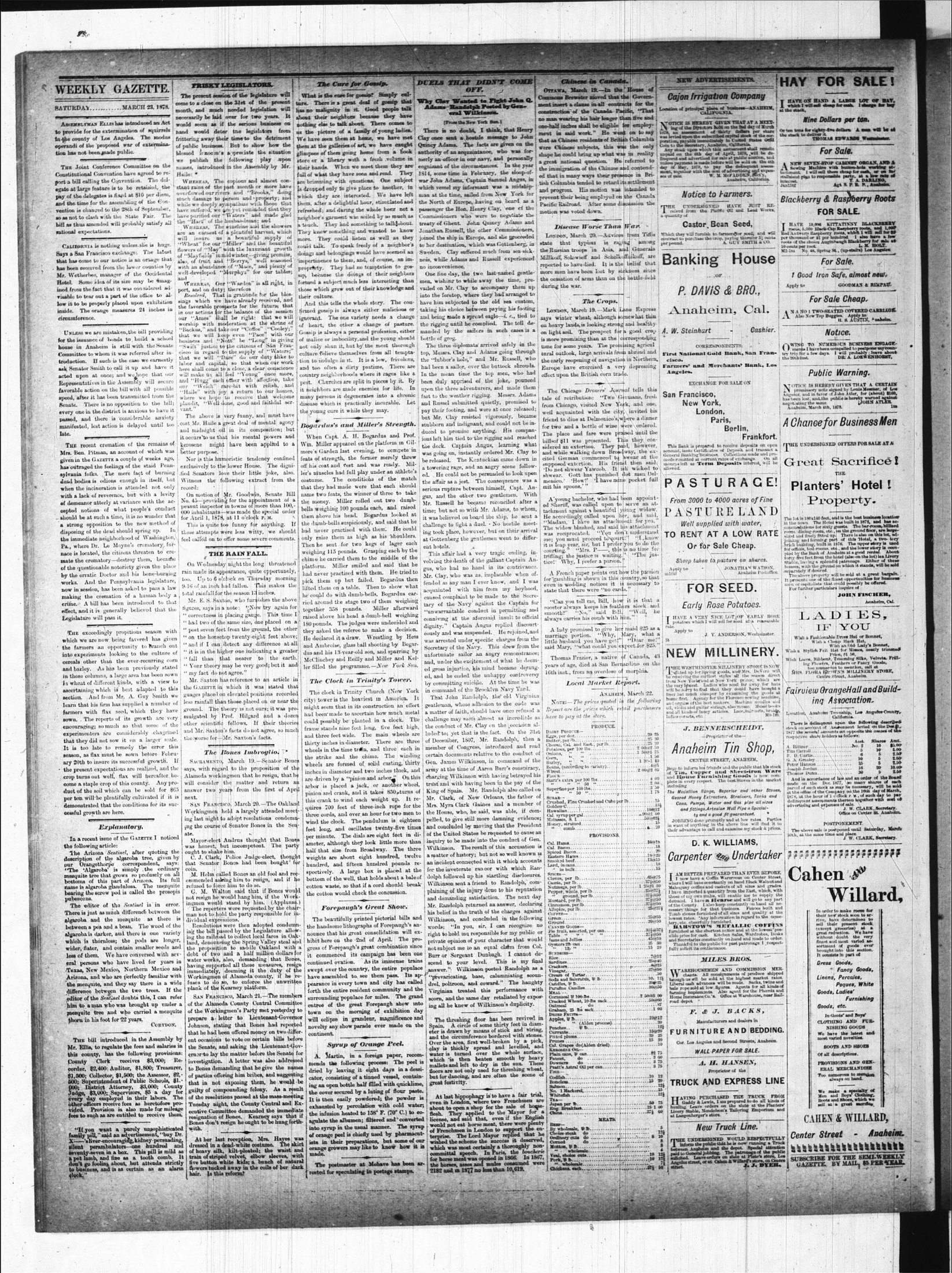
Searchable text
WEEKLY GAZETTE.
SATURDAY...MARCH 23, 1878.
ASSEMBLYMAN Ellis has introduced an Act to provide for the extermination of squirrels in the county of Los Angeles. The modus operandi of the proposed war of extermination has not been made public.
The Joint Conference Committee on the Constitutional Convention have agreed to report a bill calling the Convention. The delegate at large feature is to be retained, the pay of the delegates is fixed at $10 per diem, and the time for the assembling of the Convention is changed to the 28th of September, so as not to clash with the State Fair. The bill as thus amended will probably satisfy all national expectations.
CALIFORNIA is nothing unless she is huge. Says a San Francisco exchange: The latest that has come to our notice is an orange that has been received from the lower counties by Mr. Wetherbee, manager of the Occidental Hotel. Some idea of its size may be imagined from the fact that it was considered advisable to tear out a part of the office to allow it to be properly placed upon exhibition inside. The orange measures 24 inches in circumference.
Unless we are mistaken, the bill providing for the issuance of bonds to build a school house in Anaheim is still with the Senate Committee to whom it was referred after introduction. If such is the case we earnestly ask Senator Smith to call it up and have it acted upon at once; and we hope that our Representatives in the Assembly will secure favorable action on the bill with all possible speed, after it has been transmitted from the Senate. There is no opposition to the bill; every one in the district is anxious to have it passed, and there is considerable anxiety manifested, least action is delayed until too late.
The recent cremation of the remains of Mrs. Ben. Pitman, an account of which was given in the Gazette a couple of weeks ago, has outraged the feelings of the staid Pennsylvania folks. The mere fact of burning
FRISKY LEGISLATORS.
The present session of the legislature will come to a close on the 31st of the present month, and much needed legislation will necessarily be laid over for two years. It would seem as if the serious business on hand would deter the legislators from frittering away their time to the detriment of public business. But to show how the blessed it doesn’t appreciate the situation we publish the following play upon names, introduced in the Assembly by Mr. Haile:
WHEREAS, The copious and almost constant rains of the past month or more have overflowed our rivers and “Brooks,” doing much damage to person and property; and while we deeply sympathize with those that have suffered, we are yet reminded that they have purified our “Waters” and made glad the “Hart” of the husbandman; and
WHEREAS, The windline and the showers are an earnest of a plentiful harvest, which will insure us a bountiful supply of “Wheat” for our “Miller” and the beautiful flowers of “May” with the luxuriant growth of “Mayfields” in mid-winter—giving promise, also, of fruit and “Berrys,” well seasoned with an abundance of “Mace,” and plenty of well-developed “Murphys” for our tables; and
WHEREAS, Our “Warden” is all right, in port, and on duty; therefore
Resolved, That in gratitude for the blessings which we have already received, and the favorable prospects for the future, that in our actions for the balance of the session our “Ames” shall be right: that we will worship with moderation at the shrine of “Backus,” and take our “Coffee” “Cooley;” that we will keep even “Pace” with our business and “Nott” be “Long” in giving “Swift” justice to the citizens of San Francisco in regard to the supply of “Waters;” that we will “Pare” do our duty alike to labor and capital, so that when our work here shall come to a close, a clear conscience will make us all feel “Young” once more, and “Hugg” each other with affection, take our “Weich” rare-bit with relish, and “Haile” with joy a return to our homes, where we hope to receive that welcome plaudit, “Well done, good and faithful servant.”
The above is very funny, and must have cost Mr. Haile a great deal of mental agony and midnight oil in its composition; but it occurs to us that his mental powers and kerosene might have been applied to a better purpose.
Nor is this humoristic tendency confined exclusively to the lower House. The dignified Senators love their little joke, also.
The Cure for what is the cure for nature. There is a great has no malignity in me about their neighbors nothing else to talk about us the picture of a fire We have seen them attack them at the galleries of glimpses of them going store or a library with their hands. When we full of what they have are brimming with quail is dropped only to give which they are interested them, after a delightful refreshed; and during neighbor’s garment was a touch. They had so They knew something more. They could live could talk. To speak doings and belongings impertinence to them, propriety. They had sip, because the doings formed a subject much those which grew out their culture.
And this tells the w firmed gossip is always ignorant. The one vail of heart, the other Gossip is always a peril of malice or imbecility not only shun it, but culture believe themselves to indulge in it. And too often a dirt country neighborhood pest. Churches are all it neighbors are made many persons it degenerate disease which is practiced the young cure it whit
Bogardus's and
When Capt. A. H. Win. Miller appeared more’s Garden last feats of strength, then off his coat and vestler’s muscles had full
The recent cremation of the remains of Mrs. Ben. Pitman, an account of which was given in the Gazette a couple of weeks ago, has outraged the feelings of the staid Pennsylvania folks. The mere fact of burning dead bodies is odious enough in itself, but when the incineration is attended not only with a lack of reverence, but with a levity of demeanor utterly at variance with the accepted notoriety of what people's conduct should be at such a time, it is no wonder that a strong opposition to the new method of disposing of the dead should spring up. In the immediate neighborhood of Washington, Pa., where Dr. Le Moyne's crematory furnace is located, the citizens threaten to cremate the crematory—destroy them, because of the questionable notoriety given the place by the erratic Doctor and his bone-burging works. And the Pennsylvania legislature, now in session, has been asked to pass a law making the cremation of a human body a crime. A bill has been introduced to that effect, and it is generally believed that the Legislature will pass it.
The exceedingly propitious season with which we are now being favored has given the farmers an opportunity to branch out into experiments looking to the culture of cereals other than the ever-recurring corn and barley. As has been previously stated in these columns, a large area has been sown in wheat of different kinds, with a view to ascertaining which is best adapted to this section. And from Mr. A. Guy Smith we learn that his firm has supplied a number of farmers with flax seed, which they have sown. The reports of its growth are very encouraging; so much so that some of the experimenters are considerably chagrined that they did not sow it on a larger scale. It is too late to remedy the error this season, as flax must be sown before February 20th to insure its successful growth. If the present expectations are realized, and the crop turns out well, flax will hereafter become a staple crop of this county. Any product of the soil which can be sold for $65 per ton will be plentifully cultivated if it is demonstrated that the conditions for its successful growth are here.
Explanatory.
In a recent issue of the Gazette I noticed the following article:
The Arizona Sentinel, after quoting the description of the algaroba tree, given by our Orangethorpe correspondent, says: 'The Algaroba is simply the ordinary mezquite tree that grows so profusely on all bottoms of this part of Arizona. Its full name is algaroba glandulosa. The mezquite bearing the scrow pod is called the prosopis unesenae.'
Explanatory.
In a recent issue of the Gazette I noticed the following article:
The Arizona Sentinel, after quoting the description of the algaroba tree, given by our Orangethorpe correspondent, says: 'The Algaroba is simply the ordinary mezquite tree that grows so profusely on all bottoms of this part of Arizona. Its full name is algaroba glandulosa. The mezquite bearing the screw pod is called the prosopis pubescens.
The editor of the Sentinel is in error. There is just as much difference between the algaroba and the mezquite as there is between a pea and a bean. The wood of the algaroba is darker, and there is one variety which is thornless; the pods are longer, wider, flater, and contain smaller seeds and less of them. We have conversed with several persons who have lived for years in Texas, New Mexico, Northern Mexico and Arizona, and who are perfectly familiar with the mezquite, and they say there is a wide difference between the two trees. If the editor of the Sentinel doubts this, I can refer him to a man who was brought up under a mezquite tree and who carried a mezquite thorn in his foot for 22 years.
Corydon.
The bill introduced in the Assembly by Mr. Ellia, to regulate the fees and salaries in this county, has the following provisions: County Clerk receives $3,000; Recorder, $2,400; Auditor, $1,800; Treasurer, $1,500; Collector, $1,500; the Assessor, $2,500; Superintendent of Public Schools, $1,000; District Attorney, $3,000; County Judge, $3,000; Supervisors, $5 a day for every day employed in their labors. The other officers receive fees as heretofore provided. Provision is also made for mileage fees to such as are entitled to receive them.
"If you want a purely unsophisticated family pill," said an advertisement, "buy Dr. X—aliver-encouraging,kidney-persuading, silent perambulator—one hundred and seventy-seven in a box. This pill is mild as a pet lamb, and fine as a tooth comb. It don't go fooling about, but attends strictly to business, and is as certain as an alarm clock."
SAN FRANCISCO, March 20. — The Oakland Workingmen held a largely attended meeting last night to adopt resolutions condemning the course of Senator Bones in the Senate.
Mayor-elect Andrus thought that Bones was honest, but incompetent. The party ought to shake him.
C. J. Clark, Police Judge-elect, thought that Senator Bones had been bought for coin.
M. Helm called Bones an old fool and recommended asking him to resign, and if he refused to force him to do so.
G. M. Walton said that if Bones would not resign he would hang him, if the Workingmen would stand by him. (Applause.)
The reporters were requested by the chairman not to hold the party responsible for individual expressions.
Resolutions were then adopted condemning the bill passed by the Legislature allowing the railroad to collect local fares in Oakland, denouncing the Spring Valley steal and the proposition to saddle Oakland with a debt of two and a half million dollars for water works, also, demanding that Bones having supported all these measures, resign immediately, deeming it the duty of the Workingmen of Alameda county, if he refuses to do so, to enforce the unwritten plank of the Kearney platform.
SAN FRANCISCO, March 21. — The members of the Alameda County Central Committee of the Workingmen's Party met yesterday to prepare a letter to Lieutenant-Governor Johnson, stating that Bones had reported that he had been offered money on two different occasions to vote on certain bills before the Senate, and asking the Lieutenant-Governor to lay the matter before the Senate for investigation. A letter was also addressed to Bones demanding that he give the names of parties offering him bribes, and suggesting that in not exposing them, he would be guilty of compounding felony. As a result of the resolutions passed at the mass-meeting Tuesday night, the County Central and Executive Committee demanded the immediate resignation of Bones. Kearney says that if Bones don't resign he ought to be hung forthwith.
At her last reception, Mrs. Hayes was dressed in a dead-white costume. The skirt of heavy silk, kilt-plaited; the waist and train of striped velvet, elbow sleeves, with five button white kids; a bunch of natural flowers tucked away in the coils of her dark hair. Is this reform?
The Cure for Gossip.
What is the cure for gossip? Simply culture. There is a great deal of gossip that has no malignity in it. Good people talk about their neighbors because they have nothing else to talk about. There comes to us the picture of a family of young ladies. We have seen them at home, we have met them at the galleries of art, we have caught glimpses of them going home from a book store or a library with a fresh volume in their hands. When we meet them they are full of what they have seen and read. They are brimming with questions. One subject is dropped only to give place to another, in which they are interested. We have left them, after a delightful hour, stimulated and refreshed; and during the whole hour not a neighbor's garment was soiled by so much as a touch. They had something to talk about. They knew something and wanted to know more. They could listen as well as they could talk. To speak freely of a neighbor's doings and belongings would have seemed an impertinence to them, and, of course, an impropriety. They had no temptation to gossip, because the doings of their neighbors formed a subject much less interesting than those which grew out of their knowledge and their culture.
And this tells the whole story. The confirmed gossip is always either malicious or ignorant. The one variety needs a change of heart, the other a change of pasture. Gossip is always a personal profession, either of malice or imbecility, and the young should not only shun it, but by the most thorough culture believe themselves from all temptation to indulge in it. It is a low, frivolous, and too often a dirty pastime. There are country neighborhoods where it rages like a pest. Churchs are split in pieces by it. By it neighbors are made enemies for life. In many persons it degenerates into a chronic disease which is practically incurable. Let the young cure it while they may.
Bogardus's and Miller's Strength.
When Capt. A. H. Bogardus and Prof. Wm. Miller appeared on the platform in Gilmore's Garden last evening, to compete in feats of strength, the former merely threw off his coat and vest and was ready. Miller's muscles had full play under an athlete's duel.
DUELS THAT DIDN'T COME OFF.
Why Clay Wanted to Fight John Q. Adams-Randolph Posted by General Wilkinson.
[From the New York Sun.]
There is no doubt, I think, that Henry Clay once sent a hostile message to John Quincy Adams. The facts are given on the authority of an acquaintance, who was formerly an officer in our navy, and personally cognizant of the circumstances. In the year 1814, some time in February, the sloop-of-war John Adams, Captain Samuel Angus, in which vessel my informant was a midshipman at the time, sailed from New York for the North of Europe, having on board as a passenger the Hon. Henry Clay, one of the Commissioners who were to negotiate the treaty of Ghent. John Quincy Adams and Jonathan Russell, the other Commissioners, joined the ship in Europe, and she proceeded to her destination, which was Gottenberg, in Sweden. Clay suffered much from sea sickness, while Adams and Russell experienced no inconvenience.
One fine day, the two last-named gentlemen, wishing to while away the time, prevailed on Mr. Clay to accompany them up into the foretop, where they had arranged to have him subjected to the old sea custom, taking his choice between paying his footing and being made a spread eagle—i.e., tied to the rigging until he complied. The toll demanded by the sailors in such cases is a bottle of grog.
The three diplomats arrived safely in the top, Messrs. Clay and Adams going through the "lubber's hole," and Mr. Russell, who had been a sailor, over the buttock shrugs. In the mean time the top men, who had been duly apprised of the joke, pouenced upon the three adventurers, and made them fast to the weather rigging. Messrs. Adams and Russel submitted quietly, promised to pay their footing, and were at once released; but Mr. Clay resisted vigorously, became stubborn and indignant, and could not be induced to promise anything. His companions left tied to the rigging and reached the deck. Captain Angus, learning what was going on, instantly ordered Mr. Clay to be released. The Kentuckian came down in a towering rage, and an angry scene followed.
He could not be persuaded to look upon Chinese in Canada.
Ottawa, March 19—In the House of Commons Brewster moved that the Government insert a clause in all contracts for the construction of the Canada Pacific, "That no man wearing his hair longer than five and one-half inches shall be eligible for employment in said work." He went on to say that as Chinese residents of British Columbia were Chinese subjects, this was the only shape he could bring up what was in reality a great national question. He referred to the immigration of the Chinase and contended that in many ways their presence in British Columbia tended to retard its settlement and progress. His motion was intended to prevent their being employed on the Canada Pacific Railroad. After some discussion the motion was voted down.
Disease Worse Than War
London, March 20—Advices from Tiffis state that typhus is raging among the Russian troops in Asia, and Generals Millkoff, Solowieff and Schelkoffnikoff, are reported to have died. It is belief that more men have been lost by sickness since the cessation of arms than on the battle-field during the war.
The Crops.
London, March 19—Mark Lane Express says winter wheat, although somewhat thin on heavy lands, is looking strong and healthy on light soil. The prospect for a good crop is more promising than at the corresponding time for some years. The promising agricultural outlook, large arrivals from abroad and the early reopening of navigation in Northern Europe have exercised a very depressing effect upon the British corn trade.
The Chicago Drovers Journal tells this tale of retribution: "Two Germans, fresh from Chicago, visited New York, and one well acquainted with the city, invited his friend to dine at Delmonico's where a dinner for two and a bottle of wine were ordered. The place and fare were praised until the bill of $11 was presented. This they considered an extortion. They paid, however, and while walking down Broadway, the excited German commenced to swear at the supposed extortion. His friend then said: 'Do not shwear Yawcob.' It is wicked to shwear Yawcob has punished dot man Delmonico.'
Bogardus's and Miller's Strength.
When Capt. A. H. Bogardus and Prof. Win. Miller appeared on the platform in Gilmore's Garden last evening, to compete in feats of strength, the former merely threw off his coat and vest and was ready. Miller's muscles had full play under an athlete's costume. The conditions of the match that they had made were that each should name two feats, the winner of three to take the money. Miller rolled out two dumb-bells weighing 100 pounds each, and raised them above his head. Bogardus looked at the dumb-bells suspiciously, and said that he had never practised with them. He could only raise them as high as his shoulders. Then he sent for two kegs of lager each weighing 115 pounds. Grasping each by the chime he carried them to the middle of the platform. Miller smiled and said that he had never practised with them. He tried to pick them up but failed. Bogardus then lifted them on a table. Then to show what he could do with dumb-bells, Bogardus carried around the stage two of them weighing together 358 pounds. Miller afterward raised above his head a dumb-bell weighing 180 pounds. The judges were undecided and they asked the referee to make a decision. He declared it a draw. Wrestling by Hess and Ambroise, glass ball shooting by Bogardus and his 13-year-old son, and sparring by McClinchey and Reilly and Keller filled the programme.—New York Sun.
The Clock in Trinity's Tower.
The clock in Trinity Church (New York city) tower is the heaviest in America. It might seem that in its construction an effort had been made to ascertain how much metal could possibly be planted in a clock. The frame stands nine feet long, five feet high, and three feet wide. The main wheels are thirty inches in diameter. There are three wheels in the time train, and three each in the strike and the chime. The winding wheels are formed of solid casting, thirty inches in diameter and two inches thick, and are driven by a "pinion and arbor." On this arbor is placed a jack, or another wheel, pinion and crank, and it takes 850 turns of this crank to wind each weight up. It requires 700 feet of three-inch rope for the three cords, and over an hour for two men to wind the clock. The pendulum is eighteen feet long, and oscillates twenty-five times per minute. The dials are eight feet in diameter, although they look little more than half that size from Broadway. The three weights are about eight hundred, twelve hundred, and fifteen hundred pounds respectively. A large box is placed at the bottom of the well, that holds about a bale of cotton waste, so that if a cord should break the cotton would check the concussion.
In the mean time the top men, who had been duly apprised of the joke, pouenced upon the three adventurers, and made them fast to the weather rigging. Messrs. Adams and Russel submitted quietly, promised to pay their footing, and were at once released; but Mr. Clay resisted vigorously, became stubborn and indignant, and could not be induced to promise anything. His companions left him tied to the rigging and reached the deck. Captain Angus, learning what was going on, instantly ordered Mr. Clay to be released. The Kentuckian came down in a towering rage, and an angry scene followed. He could not be persuaded to look upon the affair as a jest. The consequence was a serious rupture between himself, Capt. Angus, and the other two gentlemen. With Mr. Russell he became reconciled after a time; but not so with Mr. Adams, to whom it was believed on board the ship, he sent a challenge to fight a duel. No hostile meeting took place, however, but on their arrival at Gottenberg the gentlemen went to different hotels.
This affair had a very tragic ending, involving the death of the gallant Captain Angus, who had no hand in its contrivance. Mr. Clay, who was as implacable when offended as any man I ever knew, and I was acquainted with him from my boyhood, caused complaint to be made to the Secretary of the Navy against the Captain for "unwarrantable conduct in permitting and conniving at the aforesaid insult to official dignity." Captain Angus replied discountedly and was suspended. He rejoined, and was arrested under specific charges from the Secretary of the Navy. This drew from the unfortunate sailor an angry remonstrance; and, under the excitement of what he deemed gross injustice, his mind became deranged, and he ended the unhappy controversy by committing suicide. At the time he was in command of the Brooklyn Navy Yard.
That John Randolph, the old Virginian gentleman, whose adhesion to the code was a matter of faith, should have once refused a challenge may seem almost as incredible as the conduct of Mr. Clay on the occasion allowed to; yet that is the fact. On the 31st of December, 1807, Mr. Randolph, then a member of Congress, introduced and read certain documents relative to the conduct of Gen. James Wilkinson, in command of the army at the time of Aaron Burr's conspiracy, charging Wilkinson with having betrayed his trust and with having been in the pay of the King of Spain. Mr. Randolph also called on Mr. Clark, of New Orleans, the father of Mrs. Myra Clark Gaines and a member of the House, who, he said, was able, if compelled, to give still more damning evidence; and concluded by moving that the President of the United States be requested to cause an inquiry to be made into the conduct of Gen. Wilkinson. The result of this accusation is a matter of history; but not so well known is an incident connected with it which accounts for the inveterate rancor with which Randolph followed up his startling disclosures. Wilkinson sent a friend to Randolph, complaining of the injury done to his reputation and demanding satisfaction. The next day
The Chicago Droners' Journal tells this tale of retribution: "Two Germans, fresh from Chicago, visited New York, and one well acquainted with the city, invited his friend to dine at Delmonico's where a dinner for two and a bottle of wine were ordered. The place and fare were praised until the bill of $11 was presented. This they considered an extortion. They paid, however, and while walking down Broadway, the excited German commenced to swear at the supposed extortion. His friend then said 'Do not shwear Yawcob.' It is wicked to shwear. Gott has punished dot man Delmonico.' How? I have nine pocket full mit his spoons."
A young bachelor, who had been appointed Sheriff, was called upon to serve an attachment against a beautiful young widow. He accordingly called upon her, and said "Madam, I have an attachment for you." The widow blushed, and said his attachment was recuprocated. "You don't understand me; you must proceed to court." I know it leap year, sir, but I prefer you to do the courting." "Mrs. P—— this is no time for trifling; the justice is waiting." "The justice! Why, I prefer a parson."
A French paper points out how the passion for gambling is shown in this country, so that even in wedding notices it is necessary to state that there were "no cards."
"Can you tell me, Bill, how it is that a rooster always keeps his feathers sleek and smooth?" "No," said Bill. "Well, he always carries his comb with him."
A lady promised to give her maid $25 as a marriage portion. "Why Mary, what a little husband you have got!" "Dear me!" said Mary. "what could you expect for $25."
Thomas Frazier, a native of Canada, 43 years of age, died at San Bernardino on the 16th inst., from an overdose of morphia.
Local Market Report.
ANAHEIM, March 22.
NOTE: The prices quoted in the following Report are the prices which retail purchasers have to pay at the store.
PRODUCE.
Eggs, per doz.
Butter, per lb.
Cheese, Cal. and East., per lb.
Potatoes, per 100 lbs.
Onions,
Corn,
Barley,
Beans (according to variety).
Wheat.
Flour.
Starch's extra per 100 lbs.
Soybean,
Superfine per 100 lbs.
Golden C.
Hawaiian,
Cal syrup per gal.
Molasses,
Honey,
comb.
PROVISIONS.
Cal.Hams.
Cal.Bacon.
Spiced Bacon.
Eastern Hams.
Smoked beef.
Lard in canns.
In bulk.
SPICES.
Cloves,
per lb.
Cassia,
per lb.
Nutmegs,
per lb.
Pepper whole,
per lb.
ground,
per lb.
THE CHICAGO DROWSER'S JOURNAL tells this tale of retribution: "Two Germans, fresh from Chicago, visited New York,and one well acquainted with the city invited his friend to dine at Delmonico's where a dinner for two and a bottle of wine were ordered.The place and fare were praised untilthe billof$11waspresented.ThistheyconsideranextortionTheypaidhowever,andwhilewalkingdownBroadway,theexcitedGermancommencedtoswearatthesupposedextortion.Hisfriendthensaid'Do notshwearYawcob.Itshewicktowishwear.GotthaspunisheddotmanDelmonico.'How?'Ihaveminepocketfullmithisspoons."
A young bachelor who had been appointed Sheriff was called upon to serve an attachment against a beautiful young widow. He accordingly called upon her,and said "Madam,我有anattachmentforyou." The widow blushed,and said his attachment was recuprocated."Youdon'tunderstandme;youmustproceedtocourt."Iknowitleapyear,sirbutIpreferyoutodothecourting."Mrs.P——thisisnotimefortrifling;thejusticeiswaiting."Thejustice!Why,Ipreferaparson.
A French paper points out how the passion for gambling is shown in this country so that even in wedding notices it is necessary to state that there were "no cards."
"Can you tell me,Bill,how it isthata roosteralwayskeepshisfeathers sleekandsmooth?" "No," said Bill. "Well,the alwayscarrieshimbwithhim."
A lady promised to give her maid $25asasmarriageportion."Why,Mary,awhatalittlehusbandyouhavegot!" "Dearme!"saidMary."whatcouldyouexpectfor$25."
ThomasFrazier,a nativeofCanada,43yearsofage,diedatSanBernardinoonthe16thinst.,fromanoverdoseofmorphia.
LOCAL MARKET REPORT.
ANAHEIM,March22.
NOTE:-ThepricesquotedinthefollowingReportarethepriceswhichretailpurchasershavetopayatthestore.
PRODUCE.
Eggsperdoz.
Butterperlb.
CheeseCalandEast.perlb
Potatoesper100lbs
Onions,
Corn,
Barley,
Beans(accordingtovariety).
Wheat.
Flour.
Starch'sextraper100lbs.
Soybean.perlb
GoldenC.
Hawaiian。
Calsyruppergal。
Molasses.S.L.
Honey.strained
comb.
CAL.HAMS.
Cal.Bacon.
SpicedBacon.
EasternHams.
Smokedbeef.
Lard.incanss
Inbulk
SPICES.
Clovesperlb.
Cassiaperlb.
Nutmegsperlb
Pepperwholeperlb
Groundperlb
THE CHICAGO DROWSER'S JOURNAL tells this tale of retribution: "Two Germans,fresh from Chicago,visited New York,and one well acquainted with the city invited his friend to dine at Delmonico's where a dinner for two and a bottle of wine were ordered.The place and fare were praised untilthe billof$11waspresented.ThistheyconsideranextortionTheypaidhowever,andwhilewalkingdownBroadway,theexcitedGermancommencedtoswearatthesupposedextortion.Hisfriendthensaid'Do notshwearYawcob.Itshewicktowishwear.GotthaspunisheddotmanDelmonico.'How?'Ihaveminepocketfullmithisspoons."
Forepaugh's Great Show.
The beautifully printed pictorial bills and the handsome lithographs of Forepaugh's announce that his great consolidation will exhibit here on the 2nd of April. The progress of Forepaugh's great combination since it commenced its campaign has been one continued ovation. As its immense trains swept over the country, the entire populace have assembled to see them pass. Its appearance in every town and city has called forth the entire resident community and the surrounding populace for miles. The grand entree of the great Forepaugh show into town on the morning of exhibition day will eclipse in grandeur, magnificence and novelty any show parade ever made on the continent.
Syrup of Orange Peel.
A. Martin, in a foreign paper, recommends the following process: The peel is dried by leaving it eight days in a dessicator, consisting of a tinned vessel, containing an open bottle half filled with quicklime, the cover secured by a luting of flour paste. It is then easily powdered; the powder is exhausted by percolation with cold water; the infusion heated to 158° F. (70° C.) to coagulate the albumen; filtered and converted into syrup in the usual manner. The syrup of orange peel is chiefly used by pharmacists in their preparations, but some of our orange growers may like to know how it is made.
The postmaster at Mohave has been arrested for speculating in postage stamps.
Mr. Clark, of New Orleans, the master of Mrs. Myra Clark Gaines and a member of the House, who, he said, was able, if compelled, to give still more damning evidence; and concluded by moving that the President of the United States be requested to cause an inquiry to be made into the conduct of Gen. Wilkinson. The result of this accusation is a matter of history; but not so well known is an incident connected with it which accounts for the inveterate rancor with which Randolph followed up his startling disclosures. Wilkinson sent a friend to Randolph, complaining of the injury done to his reputation and demanding satisfaction. The next day Mr. Randolph returned an answer, declaring his belief in the truth of the charges against Wilkinson, and concluded in the following words: "In you, sir. I can recognize no right to hold me responsible for my public or private opinion of your character that would not subject me to an equal claim from Col. Burr or Sergeant Dunbagh. I cannot descend to your level. This is my final answer." Wilkinson posted Randolph as a "prevaricating, base, calumniating scoundrel, poltroon, and coward." The haughty Virginian treated this performance with scorn, and the same day retaliated by exposing all he knew of Wilkinson's duplicity.
The threshing floor has been revived in Spain. A circle of some thirty feet in diameter is drawn by means of stick and string, and the circumference bordered with stones. Over the area, first well-broken by a pick, clay is thickly spread and levelled, and water is turned over the whole surface, which is then beaten smooth by heavy mallets and left to dry in the sun. These floors are not only used for threshing wheat, but for dancing, and are often the scene of great festivity.
At last hippophagy is to have a fair trial, even in London, where two Frenchmen are about to open a shop for the sale of horse flesh. They applied to the Mayor for a license, and said that, even if the English would not eat horse meat, there were plenty of Frenchmen in London to support the enterprise. The Lord Mayor replied that he wished the scheme the success it deserved, which was most certainly a thoroughly non-committal speech. In Paris, the boucherie for horse meat was opened in 1866. In 1867, the horses, asses and mules consumed were 2182 and in 1877 no less than 10,619.
NEW ADVERTISEMENTS.
Cajon Irrigation Company
Location of principal place of business—ANAHEIM,
CALIFORNIA.
NOTICE IS HEREBY GIVEN THAT AT A MEETING of the Directors held on the 2nd day of March 1878, an assessment of thirty dollars per share was levied upon the subscribed capital stock of the corporation, payable immediately in United States Gold Coin to the Secretary, Anaheim, California.
Any stock upon which this assessment shall remain unpaid on the 6th day of April, 1878, will be delinquent and advertised for sale at public auction, and unless payment is made before will be sold on the 4th day of May, 1878, to pay the delinquent assessment, together with the cost of advertising and expenses of sale.
W. M. McFADDEN, Secy., Anaheim, California.
Notice to Farmers.
THE UNDERSIGNED HAVE JUST RECEIVED from the Pacific Oil and Lead Works, a quantity of Castor Bean Seed,
Which they will furnish to farmer or seed, and will contract to purchase the crop, paying therefor $3 cents per pound.
A. GUY SMITH & CO.
Banking House
OF
P. DAVIS & BRO., Anaheim, Cal.
A. W. Steinhart - Cashier.
CORRESPONDENTS:
First National Gold Bank, San Francisco.
Farmers' and Merchants' Bank, Los Angeles.
EXCHANGE FOR SALE ON
San Francisco,
New York,
London,
Paris,
Berlin,
Frankfort.
This Bank is prepared to receive deposits on open account, issue Certificates of Deposit and transact a General Banking Business. Collections made and proceeds remitted at current rates of exchange. On all money left as Term Deposits interest will be allowed.
HAY FOR SALE!
I HAVE ON HAND A LARGE LOT OF HAY, which I will sell cheap for cash. I charge for hay at the stack.
Nine Dollars per ton.
Or ten tons for eighty-five dollars. A man will be at the stack to deliver it.
For Sale.
A NEW SEVEN-STOP CARRIET ORGAN, AND A Sewing Machine with button-hole working attachment. I will sell these cheap for cash, or on installment plan to responsible party, at a low rate of interest.
T. A. DARLINO,
Jan15th
Blackberry & Raspberry Roots FOR SALE.
I HAVE 10,000 KITTATINNY BLACKBERRY roots, 5,000 Black-Cap Raspberry roots, and 1,000 Red Antevero Raspberry roots, which I will sell for $9 per thousand or $1 per hundred. I also have a few roots of the choice Auginbaugh Blackberry for sale at 10 cents per root.
M2-1m
No. 48, Spring St., (up-stairs) Los Angeles.
For Sale.
1 Good Iron Safe, almost new.
Apply to GOODMAN & RIMPAU.
For Sale Cheap.
AN A NO 1 TWO-SEATED COVERED CARRIAGE.
Also New Top Buggies. Apply to H. S. AUSTIN, Anaheim.
Notice.
OWING TO NUMEROUS BUSINESS ENGAGEMENTS I have compelled to postpone my country trip for a few days. I will probably leave about the 20th inst.
DR. A. LOEWENHOURST,
Public Warning.
NOTICE IS HEREBY GIVEN THAT A CERTAIN promissory note signed by Louis Memner, of Los Angeles, and in favor of John Atter, for (about) $100, has been lost, and the public is hereby warned against negotiating the same.
Anaheim, March 4th, 1878.
A Chance for Business Men
THE UNDERSIGNED OFFERS FOR SALE AT &
Great Sacrifice!
EXCHANGE FOR SALE ON
San Francisco,
New York,
London,
Paris,
Berlin,
Frankfort.
This Bank is prepared to receive deposits on open account, issue Certificates of Deposit and transact a General Banking Business. Collections made and proceeds remitted at current rates of exchange. On all money left as Term Deposits interest will be allowed.
PASTURAGE!
From 3000 to 4000 acres of Fine PASTURE LAND
Well supplied with water,
TO RENT AT A LOW RATE
Or for Sale Cheap.
Sheep taken to pasture on shares.
Apply to JONATHAN WATSON,
Anaheim Postoffice.
FOR SEED.
Early Rose Potatoes.
I HAVE A VERY NICE LOT OF EARLY ROSE potatoes which I will sell for seed at a reasonable rate.
Apply to J. Y. ANDERSON, Westminster.
NEW MILLINERY.
THE WESTMINSTER MILLINERY STORE IS NOW fitted up for Spring goods, and Mrs. DeVere will be receiving the earliest styles all the season direct from New York and at New York prices; which are the very lowest. Ladies who send for away for hats will be sorry to find that they could have bought a finer hat much cheaper by examining the goods at home first. Agency for the Florence sewing machine, and organs of the best makers. Machine needles and oil, violin and guitar strings, also music. Music books and all kinds of fancy articles. Lace, male nets, bridal ladies coats, etc.
J. BENNERSCHEIDT,
Proprietor of the Anaheim Tin Shop,
CENTER STREET, ANAHEIM.
Begs to inform his friends and the public that his stock of Tin, Copper and Sheet-Iron Ware and House Furnishing Goods is now complete in every respect. The best Stoves in the market including The Medallion Range, Superior and other Stoves, Geared Honey Extractors, Strainers, Tanks and Cans, Pumps, Water and Gas pipe all sizes and fittings. Artesian Well Pipe a Specialty and a good fit guaranteed.
JOBBING done promptly and at low rates. Parties in want of anything in the above line will find it to their advantage to call and examine my stock & prices.
D. K. WILLIAMS,
Carpenter Undertaker
I AM BETTER PREPARED THAN EVER BEFORE. I now have a Coffin Warmer on Center Street, where I will have constantly on hand Black Walnut and Mahogany coffins and caskets of all sizes and grades. I have imported a quantity from the East, which, with those of my own make, will enable me to supply the public warning.
NOTICE IS HEREBY GIVEN THAT A CERTAIN promissory note signed by Louis Meiner, of Los Angeles, and in favor of John Atter, for (about) $100, has been lost, and the public is hereby warned against negotating the same.
JOHN ATLER.
Anaheim, March 4th, 1878.
A Chance for Business Men
THE UNDERSIGNED OFFERS FOR SALE AT A Great Sacrifice!
THE Planters' Hotel! Property.
The lot is 180x140 feet, and is the best business location in the town. The Hotel was built in 1872, and has accommodations for sixty guests. The bar-room, billiard room, dining-room, etc., on the ground floor are large-sized and finely fitted up. There is also on this lot, old joining and forming part of this Hotel, a two-tory brick building, built in 1876. The upper story is used for offices, bed-rooms, etc., and the lower story is occupied by the Bank of Anaheim at a good rental. About forty-five feet from the hotel (also on the lot) sea Livery Stable, having a splendid patronage. Either of these houses, with the ground on which it stands, will be sold separately if desired.
The above property will be sold at a great bargain. It presents one of the finest opportunities for business men or capitalists that could possibly be offered. For further particulars inquire of JOHN FINCHER,
Anaheim, Cal.
LADIES,
IF YOU
Wish a Fashionable Dress Hat or Bonnet,
Wish a Cheap Hack Hat,
Wish an Old-Lady's Bonnet,
Wish a Stylish Felt Hat for Misses, neatly trimmed prices, $15.90.
Wish Laces, Ribbons, Trimming Silks, Velveta. Prilling Flowers, Feathers or Fancy Goods, too numerous to mention, call at SHS. FLORA BROWN'S MILLINERY STORE,
Centre Street, Anaheim.
Fairview Grange Hall and Building Association.
Location: Anaheim Township, Los Angeles County, California.
There is delinquent upon the following described stock on account of Assessment levied on the Dec. 8th, 1877 the several amounts set opposite the names of the respective share holders as follows:
Asst. Shares Amt.
No. 2 10 $5.00
Tim Carroll 5 10 $5.00
B. D. Curtis 6 5 $2.50
G. A. Greedey 10 5 $2.50
Peter Hanson 15 5 $2.50
Joseph Jordan 16 20 $10.00
Thomas Dunn 30 5 $2.50
And in accordance of law and an order of the Board made on the Dec. 1877, so many shares of each parcel of such stock as may be necessary, will be sold at the office of the Company on the 16th day of March, 1878, at the hour of 1 o'clock p.m., of such day to pay delinquent assessments thereon together with cost of advertising and expenses of sale.
J.W. CLARK, Secretary.
Office on Center St. Anaheim.
POSTPONENT.
The above sale is postponed until Saturday, March 30th, at the same time and place.
J.W. CLARK, Secretary.
D. K. WILLIAMS,
Carpenter and Undertaker
I AM BETTER PREPARED THAN EVER BEFORE. I now have a Coffin Warmer on Center Street, where I will have constantly on hand Black Walnut and Mahogany coffins and caskets of all sizes and grades. I have imported a quantity from the East, which, with those of my own make, will enable me to supply the demand. I have a Rearse and will go to any part of the County. I also keep constantly on hand all necessary things for that business. Fences built and Tomb stones furnished of all sizes and quality at the lowest rates. Any information in regard to the cemetery, etc. cheerfully furnished.
HARSTOW'S METALLIC COFFINS furnished at the shortest notice and at the lowest possible price for cash. Kitchen Scales, Wardrobes, Desks and Secretaries constantly on hand and made to order.
Thankful to the public for past patronage I respectfully solicit its continuance.
MILES BROS.
WAREHOUSEMEN AND COMMISSION MERCHANTS. All consignments of produce shipped brought us will be sold at the highest market rates. Liberal cash advances will be made. Sacks, twine and bale rope sold at low figures. Agents for all kinds of farming implements. Also agent for the Phoenix and Home Insurance Co.'s Office at Warehouse, near Railroad depot.
F. & J. BACKS,
Manufacturers and dealers in FURNITURE AND BEDDING.
Cor. Los Angeles and Second Streets, Anaheim.
WALL-PAPER FOR SALE.
A. H. HANSEN,
Proprietor of the TRUCK AND EXPRESS LINE
HAVING PURCHASED THE TRUCK FROM Gaddy & Lewis, I am prepared to do all kinds of hauling. Leave orders on the slate at the Planters' Livery Stable, Mondebon's Tailoring Emporium and at Langenberger's store.
New Truck Line.
THE UNDERSIGNED WOULD RESPECTFULLY inform the public that he is now running a Truck between Anglesheim and the depot. Special attention paid to General Jobbing. The patronage of the public solicited. Leave orders on slate at Plato's store, Los Angeles street, or at Cahen & Willard's store, on Centre street.
J. J. DYER.
In order to make room for their new stock soon to arrive, have determined to sell their present stock (except groceries) at a great reduction. We have without doubt the very finest and most varied assortment of goods ever brought into this section. It consists in part of:
Dress Goods,
Fancy Goods,
Linens, Percales,
Peques, White Goods, Ladies'
Furnishing Goods, etc.
In Gents' and Boys' CLOTHING AND FURNISHING GOODS We have the latest and most varied novelties.
BOOTS AND SHOES Of all descriptions.
PROVISIONS AND GENERAL MERCHANTABILITY Too numerous to mention always on hand.
We make a specialty of Men and Boys' Clothing, Boots and Shoes, which we sell at a great sacrifice.
CAHEN & WILLARD,
Center Street - Anaheim.
SUBSCRIBE FOR THE SEMI-WEEKLY GAZETTE BY MAIL, $5 PER YEAR.